Azure OpenAI Service is a Microsoft service that provides OpenAI models such as GPT through Azure, with enterprise security and compliance. It is developed by Microsoft, is part of Microsoft Azure and is classed as a Microsoft tool. The M365.FM episode "Azure OpenAI Service - Simply Explained" puts the core idea plainly: it is not ChatGPT with a Microsoft logo on it. It runs the same models, but Microsoft hosts them inside the customer's own Azure space, with the customer's own keys, own limits and own privacy rules.
The service is used when an organization wants to add generative AI features to its own applications and processes rather than rely on a consumer chat product. Because the models are hosted in the customer's Azure environment, the surrounding controls follow the Azure model of ownership: access is governed through keys, usage is bounded by limits, and privacy settings are defined at the customer level. The same episode walks through the building blocks in order: what the service is, the models behind it, deployments as "your own copy of a model", and endpoints and keys as the way applications connect to those deployments.
The model family accessible through the service includes GPT models, and the service is related to GPT-5 in the Microsoft ecosystem. The episodes also mention GPT-4o in a cost context. In "How to Build Low-Cost AI Agents in Microsoft Cloud", the discussion is that smaller models handle simple tasks well and cost less, while larger models such as GPT-4o offer advanced reasoning but increase expenses. Choosing a model is therefore a cost and capability decision, not only a technical one.
In practice, Azure OpenAI Service is rarely used alone. The episode "Build Production AI Apps with Azure OpenAI and Power Platform" describes a pattern in which Power Apps or Dynamics 365 and Power Automate are paired with Azure OpenAI and Azure API Management for security, throttling and observability. According to the episode, Azure OpenAI Service can be connected directly in Power Platform through built-in connectors, so makers can use GPT models in Power Apps and Power Automate without building custom APIs. The same episode also points to low-code prompt engineering in Power Platform and recommends community resources and documentation for troubleshooting and continuous learning.
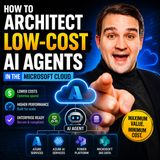
Other episodes show the service as one component in larger solutions. "How to Build Low-Cost AI Agents in Microsoft Cloud" combines Azure OpenAI with Copilot Studio, Power Platform and practical cost controls to build agents. "How to Build Private RAG with SharePoint and n8n" lists an Azure OpenAI account as a prerequisite for generating embeddings and using language models, alongside SharePoint for documents, n8n for workflows, Microsoft Graph access, a PostgreSQL or Supabase vector store, Mistral OCR and Open WebUI. That episode also advises having admin rights or the correct permissions on each platform before starting.
For developers, "Build AI Applications with .NET 10" describes connecting a .NET 10 project to Azure OpenAI Service to add generative AI features, using Semantic Kernel for tasks such as text generation and calling GPT models with async and await, with JSON used to handle responses.
Typical decisions around the service therefore include which model to deploy, how to manage keys and limits, how to place a gateway such as Azure API Management in front of it, and how to keep costs under control. The episodes treat these as design choices made together with the surrounding Azure and Power Platform services.
Overview compiled with AI from M365.FM episodes and the facts on this page. You can improve it with the edit button below.
Artificial Intelligence is only as secure as the foundation it is built on. In this episode of the M365 FM Podcast, Mirko Peters explains why an organization's AI Landing Zone is often its biggest hidden risk. While many companies focus on deploying Microsoft…
This episode argues that the real AI war isn’t being decided by benchmarks, headlines, or consumer adoption. Instead, the strategic competition for enterprise AI dominance is happening deep inside enterprise architecture — identity systems, data…
You’re wasting AI on small talk. In this session I show you how to turn chatty models into hardened IT ops agents that actually fix incidents while you sleep. We wire Semantic Kernel, MCP, Microsoft Graph and Azure OpenAI with managed identity so agents can…
Ever trusted an AI answer that felt certain, then realised you couldn’t prove where it came from? This video is a forensic walkthrough of how single agents hallucinate, leak data, drift off stale indexes, and fail every audit that matters – and how to fix it…
Retrieval-Augmented Generation (RAG) is one of the most important techniques behind modern AI applications, enabling large language models to answer questions using your own business data instead of relying only on their training knowledge. In this episode of…
In this episode of M365.fm, Mirko Peters explores how organizations can build a secure and private Retrieval-Augmented Generation (RAG) platform using SharePoint as the knowledge source and n8n as the orchestration layer. The discussion focuses on moving…
Tired of “smart” AI agents doing dumb, dangerous things in your Microsoft 365 tenant? This episode shows you the one architectural move that turns flaky prompt-powered agents into reliable, auditable systems: a pre-execution contract check that blocks bad…
Vector databases are one of the key technologies powering modern AI applications, yet most people never interact with them directly. Unlike traditional databases that search for exact words or values, vector databases search by meaning, enabling AI to…
In this episode of M365.fm, host Mirko Peters explores the hidden cost behind many enterprise AI initiatives: what he calls the “Copilot Tax.” While organizations often focus on licenses, adoption metrics, and productivity gains, the real challenge lies in…
Azure AI, Copilot and Fabric AI sound like rivals, and Microsoft's constant renaming makes it worse. This episode untangles the three for beginners and career changers, showing what each layer does, its honest limits and costs, and how they fit together.…
This episode explains that cloud environments promise efficiency, elasticity, and control — but without governance engineered as architecture, they become financial drains and operational chaos. It recounts how idle resources, ungoverned permissions, and…
Timeline of episodes about Azure OpenAI Service
Articles about Azure OpenAI Service (3)
Articles in which Azure OpenAI Service is a topic:
AI Agents, Copilot Studio, Azure AI Foundry: AI vs AI? · Mirko Peters AI Agents, Copilot Studio, Azure AI Foundry: AI vs AI? Explore use cases & the differences between Copilot Studio and Azure AI Foundry. Which AI is right for you?
Questions marked with AI were written with AI from the facts on this page.
What is Azure OpenAI Service? (AI)
It is a Microsoft service that provides OpenAI models such as GPT through Azure with enterprise security and compliance. The models run inside the customer's own Azure space with their own keys, limits and privacy rules.
Is Azure OpenAI Service the same as ChatGPT? (AI)
According to the episode "Azure OpenAI Service - Simply Explained", it is not ChatGPT with a Microsoft logo on it. It runs the same models, but Microsoft hosts them in the customer's own Azure environment.
How can Azure OpenAI Service be used with Power Platform? (AI)
The episode "Build Production AI Apps with Azure OpenAI and Power Platform" says it can be connected through built-in connectors in Power Apps and Power Automate, and describes pairing it with Azure API Management for security, throttling and observability.
Why does my Azure OpenAI bill keep climbing?
The episode points to three hidden taxes: context that inflates prompts with irrelevant documents, reasoning that sends simple questions to the most expensive model, and autonomy that burns credits unattended. · From the episode: How to Build Low-Cost AI Agents in Microsoft Cloud
How do you build a secure IT ops agent with Semantic Kernel and MCP?
Wire Semantic Kernel, MCP, Microsoft Graph and Azure OpenAI with managed identity so the agent can plan, act and verify. Tool schemas constrain what it may do. · From the episode: Build Secure IT Ops Agents with MCP and Semantic Kernel
How do I build RAG on Azure?
Index one set of documents with the import data wizard in Azure AI Search, test basic queries until retrieval works, then connect Azure OpenAI and write your system prompt. · From the episode: RAG on Azure — Simply Explained
Where does this architecture apply in Microsoft 365?
It is wired into Microsoft 365 Graph, Azure OpenAI and Copilot Studio. The validator sits in front of tool calls, so compliance is built into the architecture instead of added later. · From the episode: Build Reliable AI Agents for Microsoft 365
Relationship map of Azure OpenAI Service: linked topics
Related topics in brief
Topics linked to Azure OpenAI Service, each briefly explained:
Microsoft – Organization· Developed by Microsoft Corporation is a technology company that develops software and cloud services such as Microsoft 365, Azure and Dynamics 365.
Microsoft tool – Category· Is a Microsoft tool is a broad category for software products and services developed by Microsoft, used to group offerings and to frame tool-selection decisions.
GPT-5 – Product· Related to A generation of large language models from OpenAI used in products such as ChatGPT and Microsoft Copilot.
Microsoft Foundry – Developer tool by Microsoft· Related to Microsoft's platform for building, evaluating and operating AI applications and agents with model catalog, agent service, tools, evaluation and observability; formerly Azure AI Foundry.
All relationships of Azure OpenAI Service, grouped by type of relationship:
Short info above, community knowledge below: add practical tips, examples or corrections. New contributions are reviewed first; trusted members publish directly.
Experts and companies for this topic
Community members with expertise in Azure OpenAI Service:
 EN
 Deutsch
 Español
 Français
 Italiano
 Português
 Nederlands
 Polski
 Bahasa Indonesia
 Русский
 Українська
 العربية
 עברית
 日本語
 한국어