


 Apple Podcasts
 Spotify
 Youtube Music
 Spreaker
 Podchaser
 Amazon Music
 Microsoft Entra External ID for Digital Trust and Growth
Identity used to revolve around corporate networks, managed devices, and centralized directories. But that model no longer works in a world where customers, partners, contractors, AI agents, and automated workflows constantly move across systems and organizations. In this episode, Mirko Peters explains why modern identity is no longer just a security problem — it has become a business growth, governance, and digital trust challenge.
The conversation explores the “death of the perimeter” and how traditional identity systems create friction through duplicate accounts, passwords, onboarding delays, and isolated identity silos. That friction impacts customer conversion, support costs, partner onboarding speed, and overall business agility.
Mirko breaks down the shift from account-centric identity to claim-centric identity, where organizations focus less on storing accounts and more on verifying trusted claims when needed. The episode explains how passkeys, verifiable credentials, and decentralized identity models are changing the future of authentication by making trust portable, secure, and policy-driven.
A major focus is Microsoft Entra External ID and Verified ID. Mirko explains how Entra External ID acts as the orchestration and governance layer for external identities, while Verified ID enables portable trust through verifiable credentials. Together, they help organizations modernize customer and partner identity without abandoning existing CIAM investments.
The episode also covers Azure AD B2C migration realities, governance challenges, digital sovereignty, lifecycle management, and the importance of balancing user control with enterprise policy enforcement.
If you work with Microsoft 365, Entra, Zero Trust, CIAM, or identity modernization, this episode provides a practical framework for understanding where digital identity is heading next and how organizations can reduce friction while improving trust and security.
You face new security challenges every day. The identity perimeter cannot keep pace with rapid cloud adoption, remote work, and sophisticated cyber threats. See the numbers:
| Statistic | Description |
|---|---|
| 1 | Over 200 zettabytes of data will be stored in the cloud by 2026. Remote workers average 5.8 days per month. |
| 2 | 80% of organizations experienced a cloud security breach last year. |
High-profile breaches show attackers exploit trust and excessive privileges:
- Credential compromise dominates, as seen in the Okta breach.
- Third-party risks escalate, highlighted by MOVEit Transfer vulnerabilities.
You need a flexible, claim-centric approach to protect your organization.
Key Takeaways
- The identity perimeter is outdated. Modern threats require a more dynamic security approach.
- Zero trust security means verifying every user and device. Trust must be earned continuously.
- Implement multi-factor authentication (MFA) to strengthen access controls and reduce risks.
- Adopt least privilege access to limit user permissions and minimize potential damage from breaches.
- Continuous monitoring is essential. It helps detect threats in real-time and improves response times.
- Regularly assess your security posture. Identify gaps and implement quick wins to enhance defenses.
- Use automated tools for identity and access management. They streamline processes and reduce human error.
- Involve all teams in security planning. Collaboration ensures comprehensive coverage of risks.
The Fall of the Identity Perimeter

Legacy Perimeter Security
You once relied on a security model that trusted everything inside your network. This approach assumed that users, devices, and applications within the perimeter were safe. The network edge acted as a barrier, separating trusted internal resources from untrusted external threats. You concentrated security at the boundaries, believing that a strong firewall and single authentication could protect your data.
| Legacy Assumptions | Modern Invalidations |
|---|---|
| Clear distinction between trusted and untrusted networks | The rise of cloud services and remote work has blurred these lines, making the distinction irrelevant. |
| Implicit trust for internal users | Attackers exploit internal trust, making it a liability rather than a security feature. |
| Security concentrated at network edges | Modern environments require security to be distributed across various platforms and devices. |
| Fixed office and owned servers | Business operations now depend on SaaS and public cloud, requiring a more dynamic security approach. |
| Single authentication for broad access | Zero Trust principles advocate for continuous verification and least-privilege access. |
You see that these assumptions no longer hold true. Remote work, cloud adoption, and mobile devices have erased the clear boundaries. Attackers target internal users and exploit implicit trust, making your old perimeter defenses ineffective.
Note: You must rethink trust. The perimeter is not a wall anymore. Trust must be earned and verified at every step.
Modern Threats and Attack Vectors
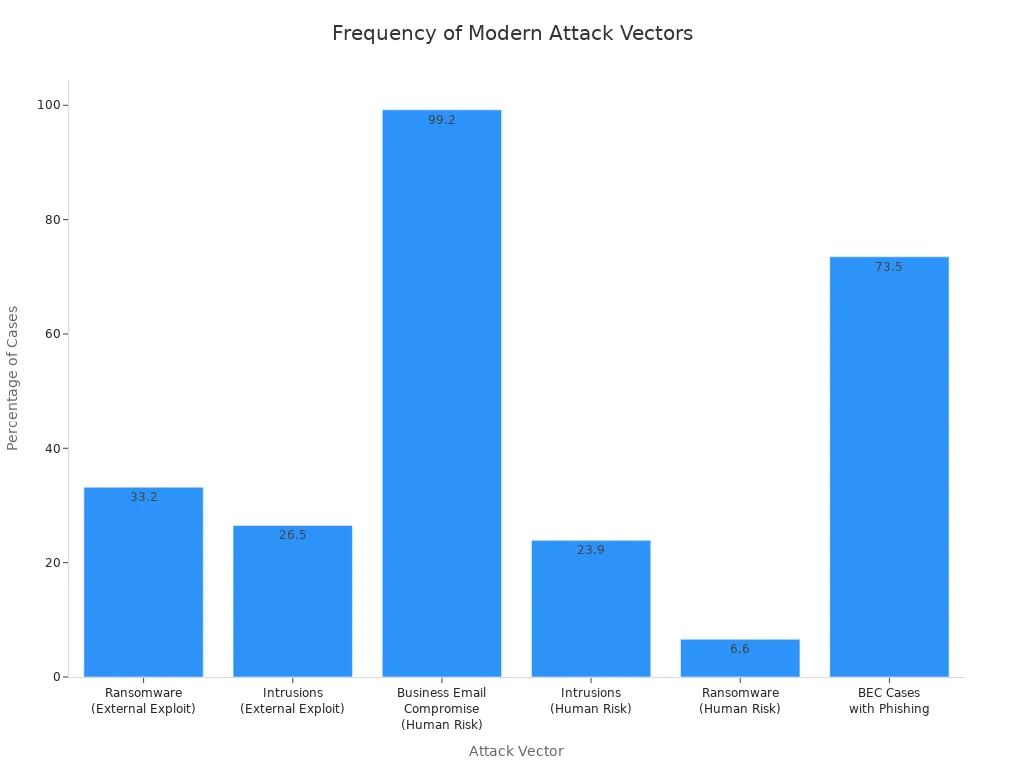
Attackers use new tactics to bypass your defenses. Phishing, ransomware, and supply chain attacks target your users and their credentials. You face threats that exploit human risk and external vulnerabilities. Business email compromise and ransomware dominate the headlines.
| Attack Vector | Percentage of Cases |
|---|---|
| Ransomware (External Exploit) | 33.2% |
| Intrusions (External Exploit) | 26.5% |
| Business Email Compromise (Human Risk) | 99.2% |
| Intrusions (Human Risk) | 23.9% |
| Ransomware (Human Risk) | 6.6% |
| BEC Cases with Phishing | 73.5% |
- 52% of organizations reported one or more breaches in 2024, an increase from 48% the previous year.
- 70% of organizations experienced at least one significant cyber attack in 2024, including ransomware and business email compromise.
- Ransomware was involved in 44% of breaches according to Verizon.
You see that attackers do not care about your network boundaries. They target your identity perimeter, using stolen credentials and social engineering to gain access. You must protect your users and their identities, not just your network.
Why Identity Became the New Perimeter
You shifted your focus to identity because attackers exploit credentials and trust relationships. Users often reuse passwords across platforms, making it easy for attackers to compromise multiple accounts. Large collections of leaked credentials are available online, enabling automated attacks. Weak authentication practices allow attackers to use valid credentials without detection.
| Evidence Type | Description |
|---|---|
| Widespread Credential Reuse | Users often reuse passwords across platforms, leading to increased risk when one service is compromised. |
| Availability of Credential Datasets | Large collections of leaked credentials are accessible, enabling automated account compromises. |
| Weak Authentication Practices | Environments relying solely on passwords are vulnerable, allowing attackers to use valid credentials without detection. |
You must verify every access request, regardless of where it comes from. Continuous verification and least privilege access are essential. You need dynamic policy enforcement that adapts to changing conditions. You cannot rely on static boundaries or implicit trust.
- Continuous verification ensures that every access request is authenticated and authorized.
- Least privilege limits permissions to reduce risks associated with overprivileged accounts.
- Dynamic policy enforcement adapts access decisions based on various contextual factors.
Regulations and industry standards push you to adopt stronger identity and data protection measures. The CFPB Rule 1033 mandates robust identity verification and data protection. Zero trust architecture and federal strategies require continuous verification and strict access controls.
| Regulation/Standard | Description | Impact on Security |
|---|---|---|
| CFPB Rule 1033 | Mandates consumer access to financial data, requiring robust identity verification and data protection. | Expands attack surfaces and necessitates sophisticated security measures. |
| Zero Trust Architecture | Emphasizes continuous verification and access controls. | Shifts focus from perimeter security to identity as the new perimeter. |
| Federal Zero Trust Strategy | Mandates U.S. federal agencies to implement Zero Trust principles. | Enforces stricter security goals like MFA and encryption. |
You must build trust through continuous verification and strong identity controls. The identity perimeter is not enough. You need a security model that adapts to modern threats and protects your data at every step.
Limitations of Identity-First Security
Credential Theft Risks
You may believe that strong authentication protects your organization, but attackers continue to find ways around these defenses. Credential theft remains a leading cause of security incidents. Attackers use phishing, malware, and social engineering to steal usernames and passwords. They often target privileged users who have access to sensitive data. Nearly 40% of breaches involve suspicious logins where attackers bypass multi-factor authentication. Stolen or compromised credentials account for 10% of all incidents. If you rely only on identity controls, you may miss these threats.
| Limitation | Description |
|---|---|
| MFA Bypass | Nearly 40% of breaches involved suspicious logins with MFA bypasses, highlighting vulnerabilities. |
| Token/Session Theft | Long-lived tokens can be hijacked, allowing unauthorized access that may bypass MFA entirely. |
| Gaps in Visibility | Incomplete log management delays detection of identity attacks, making response difficult. |
| Credential Theft | Lack of MFA for privileged users was the root cause of 13% of reported data breaches. |
| OAuth Abuse | Unchecked API requests can expose identity systems to abuse, creating significant attack surfaces. |
You must recognize that attackers do not always need to break in. They often log in using valid credentials. Without continuous verification, you cannot guarantee that every access request comes from a trusted user.
Lateral Movement and Implicit Trust
Once attackers gain access to one account, they often move laterally within your environment. Implicit trust in identity-first models allows authenticated users to access multiple resources without ongoing checks. Attackers exploit this trust to reach sensitive systems and data. If you do not verify each action, you give attackers a free pass to move deeper into your network. The traditional VPN model also creates risks. Users who connect through VPN often gain broad network access, which attackers can use to navigate freely after compromising an account.
You need to challenge the idea that authentication at the start of a session is enough. Zero trust models require you to verify every request, not just the initial login. This approach limits the damage attackers can do if they compromise one identity.
Gaps in Access Governance
You face more risks when you do not manage access properly. Weak, stolen, or reused credentials give attackers easy entry. Excessive or unmonitored entitlements allow privilege escalation. Policy misconfigurations and shadow IT create hidden gaps. Orphaned accounts and unmanaged entitlements remain open doors for attackers. Third-party vendors and contractors often connect with elevated privileges, increasing your exposure.
- Credential abuse: Attackers exploit weak or reused credentials.
- Privilege escalation: Unchecked entitlements let attackers gain more access.
- Policy misconfigurations: Overly permissive policies create vulnerabilities.
- Shadow IT: Unapproved apps and hidden accounts bypass governance.
- Orphaned accounts: Inactive accounts stay open and unmonitored.
- Identity sprawl: Too many accounts lead to confusion and risk.
- Limited visibility: You may not see high-risk accounts or activities.
You must close these gaps to build real trust in your environment. Strong access governance, continuous monitoring, and dynamic controls are essential. Identity alone cannot protect you from modern threats. You need a layered approach that includes zero trust principles to secure your organization.
Zero Trust: A New Security Paradigm

You need a security model that adapts to a cloud-first world. Zero trust gives you a way to protect your organization when traditional boundaries no longer exist. This approach does not rely on implicit trust. Instead, you must verify every user, device, and action. Zero trust helps you reduce risk and improve data protection by focusing on identity, access, and continuous monitoring.
Zero Trust Core Principles
Zero trust stands on three main pillars. You can use these principles to strengthen your defenses and close the gaps left by older models.
Never Trust, Always Verify
You cannot assume that any user or device is safe. Zero trust requires you to verify every access request, no matter where it comes from. You must check identity, device health, location, and risk signals before granting access. This principle helps you stop attackers who use stolen credentials or compromised devices.
Least Privilege Access
You should give users and systems only the access they need to do their jobs. Least privilege access limits the damage if an account gets compromised. You can use conditional access policies to enforce this rule. This approach supports data protection and reduces the risk of privilege escalation.
Continuous Verification
You must monitor activity all the time. Zero trust means you do not stop checking after the first login. You watch for unusual behavior, device changes, and risky actions. Continuous verification lets you detect threats early and respond quickly. This principle keeps your identity security strong and supports compliance with cybersecurity standards.
Tip: Use multi-factor authentication to add another layer of protection. This step makes it harder for attackers to use stolen credentials.
You can see how these principles align with leading cybersecurity frameworks:
- Identity management as a primary control point.
- Access control based on real-time risk and device compliance.
- Continuous monitoring to detect anomalies and ensure compliance.
Zero Trust Architecture in Practice
Zero trust architecture addresses the failures of both perimeter-based and identity-first security models. You do not rely on a single wall or just identity controls. Instead, you build layers of defense that adapt to modern threats.
| Principle | Description |
|---|---|
| Verify explicitly | Always authenticate and authorize based on all available data points (identity, device health, location, etc.). |
| Use least privilege access | Limit user and system access to the bare minimum required to perform a task. |
| Assume breach | Design your architecture with the expectation that a compromise will occur. |
You verify explicitly by checking every access request. You use least-privilege access to reduce risk. You assume breach, which means you plan for attackers to get in and limit what they can do. This approach works well in cloud-native architectures, where users and devices connect from anywhere.
Zero trust helps you protect data at every step. You do not trust anyone by default. You use identity as the foundation for access decisions. You monitor activity and respond to threats in real time. This model gives you better data protection and supports your move to the cloud.
You can build a stronger security posture by adopting zero trust. You reduce your attack surface and improve compliance. You gain visibility into who accesses your resources and why. Zero trust architecture prepares you for the challenges of a cloud-first world.
Transitioning Beyond the Identity Perimeter
Assessing Current Security Posture
You need to understand your current security strengths and weaknesses before you move forward. Start with a clear assessment. This process helps you see where attackers might find gaps and where you can build more trust in your defenses.
- Audit your cloud platforms for multi-factor authentication (MFA) adoption.
- Identify accounts with administrative privileges.
- Map out where your sensitive data lives.
- Document your current authentication methods.
After your assessment, look for quick wins. Enforce MFA on all admin accounts. Remove access for inactive users. Set up basic conditional access policies. Enable logging for authentication events to track suspicious activity.
For deeper protection, deploy MFA to all remaining accounts. Configure advanced conditional access rules. Use automated tools to monitor credentials. Schedule regular access reviews.
Keep your security posture strong with ongoing monitoring. Perform weekly checks for credential exposure. Review access monthly. Assess your security posture every quarter. Analyze authentication logs continuously.
Tip: Regular reviews help you spot risks early and build lasting trust in your environment.
Strengthening Identity and Access Management
You can reduce risk by making your identity and access management (IAM) stronger. Use best practices to control who gets access and how long they keep it.
- Implement Just-In-Time (JIT) access to give users temporary permissions only when needed.
- Use passwordless authentication, such as biometrics or security tokens, to improve both security and user experience.
- Automate IAM workflows to cut down on mistakes and speed up user management.
- Adopt Federated Identity Management (FIM) so users can access multiple apps with one set of credentials.
- Make sure your IAM policies meet standards like SOC 2, ISO 27001, and PCI-DSS.
These steps help you limit unnecessary access and build more trust in your systems. You also make it easier for users to work securely.
Device Trust and Health Checks
You must ensure that only trusted devices connect to your resources. Device trust starts with identifying if a device is enrolled in your security infrastructure and has the right settings. Confirm the device’s authenticity using digital certificates or unique identifiers.
Check that each device meets your security standards. Look for up-to-date antivirus software and patched operating systems. Assess the risk level based on the device’s operating system and network connection.
Keep monitoring devices for vulnerabilities. Use continuous compliance checks to make sure devices follow your security policies. Set up conditional access controls that respond to real-time assessments of device security and user behavior.
- Continuously validate device security with regular assessments.
- Apply granular access policies based on user roles and device posture.
- Use Single Sign-On (SSO) and MFA for extra protection.
- Leverage context-aware signals for adaptive security decisions.
- Adopt zero trust security to verify every access request, ensuring no device or user is trusted by default.
By focusing on device trust and health, you close more gaps and make it harder for attackers to move through your environment.
Continuous Monitoring and Response
You cannot protect what you cannot see. Continuous monitoring gives you the visibility you need to spot threats as they happen. This approach means you watch your environment all the time, not just during scheduled audits or after an incident. You use automated tools to track user activity, device health, and access patterns. These tools alert you when something unusual occurs, such as a login from a new location or a sudden spike in data downloads.
With continuous monitoring, you identify risks as soon as they appear. You do not wait for attackers to finish their work. Instead, you catch anomalies and unauthorized access attempts before they escalate. This quick detection helps you respond faster and limit the damage. Automated response systems can block suspicious activity, isolate affected devices, or require users to re-authenticate. These actions reduce the time attackers spend in your environment, known as dwell time.
Tip: Shorter dwell time means less opportunity for attackers to steal data or move laterally within your network.
You also improve compliance by using continuous monitoring. Regulations and industry standards require you to track security controls and processes. Automated monitoring helps you stay aligned with these rules. You can quickly spot compliance gaps and fix them before they lead to penalties. Consistent tracking also makes audits easier and less stressful.
Here are some key benefits you gain from continuous monitoring and automated response:
- Real-time threat detection allows you to act immediately on vulnerabilities.
- Quick responses to risks minimize potential damage.
- Anomaly detection helps you catch unauthorized access before it becomes a bigger problem.
- Streamlined processes improve operational efficiency and reduce redundancies.
- Ongoing tracking ensures you meet industry regulations and standards.
- Faster identification of compliance gaps prevents costly penalties.
You should set up alerts for critical events, such as failed login attempts or changes to sensitive files. Use dashboards to visualize trends and spot patterns over time. Regularly review logs and reports to understand what normal activity looks like in your environment. This knowledge helps you recognize when something is wrong.
Automated response does not replace human judgment. You still need security teams to investigate alerts and make decisions. However, automation handles routine tasks and speeds up your reaction to threats. This combination of technology and human expertise gives you the best chance to protect your organization.
By adopting continuous monitoring and automated response, you build a proactive security posture. You do not just react to incidents—you prevent them from causing serious harm. This approach keeps your data safe, supports compliance, and strengthens trust in your systems.
Real-World Solutions and Case Studies
Microsoft Entra External ID Overview
You need a modern identity solution that adapts to your changing business needs. Microsoft Entra External ID gives you a claim-centric approach that goes beyond traditional identity management. You can connect multiple customer tenants to a single workforce Entra ID tenant. This flexibility lets you separate customer streams and manage identities with ease.
Entra External ID uses industry-standard protocols like OAuth 2.0, OpenID Connect, and SAML 2.0. These protocols keep your communication secure and reliable. You can manage external identities from different providers and customize user experiences to fit your brand. Entra External ID offers a predictable pricing model. You get the first 50,000 monthly active users free, which helps you control costs as you grow.
You can use native authentication libraries and Microsoft Graph API integration. These features make development easier and faster. You can create branded sign-up experiences and flexible authentication flows. Entra External ID gives you the tools to build a secure and user-friendly identity system.
- Flexibility to connect multiple customer tenants
- Secure infrastructure with industry-standard protocols
- Enhanced management of external identities
- Cost-effective pricing for large user bases
- Developer-friendly tools and APIs
- Customizable sign-up and authentication flows
Entra External ID in Action
You see real results when you use Entra External ID in your organization. Different industries have adopted this solution to support zero trust and improve user experience. Here are some examples:
| Industry | Implementation Details |
|---|---|
| Financial | Enforced role-based access with location filters to comply with regulatory frameworks. |
| Healthcare | Required MFA and conditional device checks to protect sensitive patient data under HIPAA. |
| Education | Applied policies to distinguish between student and faculty access needs, ensuring only approved devices can access administrative resources. |
| Manufacturing | Restricted third-party access to intellectual property, allowing only compliant devices to access design files. |
| Global Enterprises | Required corporate-managed devices with encrypted storage and active threat protection for banking system access. |
You can see how Entra External ID adapts to different requirements. You enforce role-based access, require multi-factor authentication, and restrict device access. These actions help you protect sensitive data and meet compliance standards.
Lessons from Zero Trust Adoption
You learn important lessons when you move to a zero trust model. Organizations report measurable outcomes after adopting these principles. You can enhance your security and governance while keeping your business running smoothly.
| Objective | Outcome |
|---|---|
| Security outcomes | You deter attackers and maintain business functionality. |
| Governance | You protect assets, data, and applications while following architecture patterns. |
| Prevention | You align access control and asset protection within a unified security toolchain. |
| Visibility | You make risk and security status measurable and visible to stakeholders. |
| Response | You define SecOps roles and improve incident detection and response with automation. |
You gain better visibility into your security posture. You respond faster to incidents and prevent unauthorized access. You build trust with your users and stakeholders. Entra External ID helps you achieve these goals by supporting zero trust and providing a flexible, secure identity platform.
Tip: You can use Entra External ID to modernize your identity management and drive business growth while keeping your data safe.
Overcoming Adoption Challenges
Common Obstacles
You may face several hurdles when you move beyond the identity perimeter. Many organizations struggle with complex policies. You need to rethink how you map application permissions, which can make your security approach more complicated. Weak identity management can also slow your progress. If you rely on a single source for identity verification, you may find it hard to implement zero trust, especially when you work with older systems.
You cannot solve these problems alone. Effective identity security requires teamwork across your company. You need input from IT, security, compliance, and business units. When everyone works together, you can spot gaps and build stronger defenses.
Note: If you do not address these obstacles, you risk higher costs. A single security breach can cost you an average of $4.45 million. Failing to meet compliance rules can lead to fines of up to 4% of your global annual revenue. Manual identity processes also waste time and money, costing large organizations over $1.5 million each year.
Change Management
You need a clear plan to help your team adjust to new security models. Change management starts with designing policies that keep user experience in mind. If your policies frustrate users, they may look for ways around them. Use adaptive authentication to make access easier when risk is low and stronger when risk is high.
Treat policy management as an ongoing job. Use automation to update your policies in real time and test them often. This helps you stay ahead of new threats. Make sure your security controls match your compliance needs. When you align your controls with regulations, you make audits easier and show that you take security seriously.
You can also look for support programs. Some governments offer tax deductions or grants to help small and medium businesses invest in cybersecurity. National education programs can teach you about free tools and resources. Working with federal agencies can boost your cybersecurity skills and help you adopt zero trust faster.
Integrating with Legacy Systems
Legacy systems can make zero trust adoption more difficult. You may find that older systems do not support modern identity solutions or lack the right APIs. Flat network designs can make it hard to segment your environment, and changes may risk outages. Some legacy devices cannot handle new security tools because of limited resources. Vendor lock-in can also prevent you from updating security features.
| Challenge | Description | Solution |
|---|---|---|
| Integration Difficulties | Older systems may not work with modern identity tools. | Assess and plan integration points carefully. |
| Network Architecture Challenges | Flat networks make segmentation hard and risky. | Upgrade networks in steps to support micro-segmentation. |
| Performance and Resource Constraints | Legacy devices may slow down with new security tools. | Use controls that fit system limits. |
| Vendor Lock-In | Some vendors do not support needed security updates. | Apply workarounds and extra controls where possible. |
| Organizational and Cultural Barriers | Staff may resist changes or work in silos. | Train teams and encourage cooperation. |
| Expertise Gaps | You may lack staff who know both old and new systems. | Invest in training and hire skilled workers. |
| Risk of Disruption | New controls can cause outages in old environments. | Roll out changes in phases to reduce disruption. |
You can overcome these challenges by planning carefully and upgrading systems step by step. Train your staff and encourage teamwork. When you address both technical and cultural barriers, you make your transition to zero trust smoother and more effective.
Next Steps for Modern Security
Building a Zero Trust Roadmap
You need a clear plan to move your organization beyond the identity perimeter. Building a zero trust roadmap helps you protect your assets and adapt to new threats. Start by identifying what matters most. Define your protect surface. List your critical assets, sensitive data, and key applications. Understand how information flows across your environment. Map the transaction flows so you know where risks may appear.
Design your zero trust architecture using trusted models like NIST ZTA. Include core components such as identity and access management and device trust. Enforce strong identity controls. Require multi-factor authentication and consider passwordless options. Apply least-privilege access and micro-segmentation. Restrict permissions and segment workloads to minimize risk.
Enable continuous verification and threat detection. Evaluate risk and context in real time. Test your controls often. Evolve your strategies through regular incident response exercises. These steps help you build a security foundation that adapts to change.
Zero Trust Roadmap Steps:
- Define your protect surface.
- Map the transaction flows.
- Build your zero trust architecture.
- Implement strong identity controls.
- Apply least-privilege and micro-segmentation.
- Enable continuous verification and threat detection.
- Test and evolve through incident response.
Tip: Involve your IT and security teams in every step. Collaboration ensures you cover all risks and build a stronger defense.
Measuring Success
You must track your progress to see if your zero trust strategy works. Use clear metrics and benchmarks to measure improvements. Monitor authentication and authorization rates. Check how many users use multi-factor authentication. Track authentication failures and average authentication times.
Review privileged access management. Document all privileged accounts. Measure the percentage of just-in-time access and monitor privileged sessions. Assess security risk reduction. Look for exposed credentials and track risk score improvements. Count identity-based security incidents.
Check compliance and audit performance. Track access review completion rates and compliance violation resolution times. Measure audit findings reduction. Evaluate user experience metrics. Monitor self-service adoption rates and password reset automation. Collect user satisfaction scores.
Operational efficiency matters. Compare automated and manual identity processes. Measure task completion times and costs per transaction. Track help desk tickets related to identity issues. Assess skill development rates for IT staff trained on zero trust principles.
| Category | Metric Description | Example Impact |
|---|---|---|
| Authentication and Authorization | MFA adoption rate: Percentage of users utilizing multi-factor authentication. | Organizations experience 99.9% reduction in account compromise risks. |
| Privileged Access Management | Privileged account inventory accuracy: Percentage of privileged accounts documented. | |
| Security Risk Reduction | Exposed credentials rate: Percentage of credentials found in breaches. | |
| Compliance and Audit Performance | Certification campaign completion rate: Percentage of access reviews completed. | Organizations report 62% faster completion of access certification campaigns. |
| User Experience Metrics | Self-service adoption rate: Percentage of users utilizing self-service functions. | Companies report help desk call reduction of up to 40%. |
| Operational Efficiency KPIs | Automated vs. manual identity processes: Ratio of automated to manual processes. |
Note: Regularly review these metrics. Adjust your roadmap as needed to improve security and user experience.
You build a safer environment when you follow your zero trust roadmap and measure your progress. You protect your data, reduce risks, and support business growth.
You see that the identity perimeter cannot protect your organization from modern threats. Attackers bypass static defenses and exploit blurred network boundaries. Zero trust principles require you to verify every asset and user. Microsoft Entra External ID helps you secure identities across AI and SaaS apps. You benefit from continuous monitoring and integrated network filtering.
| Statistic | Value |
|---|---|
| Password attacks per second | 7,000 |
| Identity-based cyberattacks as a percentage of breaches | 80% |
You should follow the roadmap and adopt advanced identity solutions. The future of security depends on your ability to adapt and build trust at every step.
FAQ
What is the identity perimeter?
You use the identity perimeter to protect your organization by controlling who can access your systems. This approach relies on verifying user credentials before granting access.
Why is the identity perimeter no longer enough?
Attackers bypass traditional defenses by stealing credentials. You face risks from cloud apps, remote work, and third-party connections. You need stronger, layered security.
What is zero trust security?
Zero trust means you never trust anyone by default. You verify every user, device, and action. You limit access and monitor activity continuously.
How does Microsoft Entra External ID help?
You use Entra External ID to manage external identities securely. The platform verifies credentials in real time and supports flexible access policies.
Can I integrate zero trust with legacy systems?
You can integrate zero trust with older systems. Start with careful planning. Upgrade in phases. Train your staff and use compatible tools.
What are the benefits of continuous monitoring?
Continuous monitoring helps you spot threats quickly. You respond faster to suspicious activity. You improve compliance and reduce risk.
How do I measure zero trust success?
You track metrics like MFA adoption, privileged access reviews, and incident response times. You check user satisfaction and operational efficiency.
Is zero trust difficult to implement?
You may face challenges, but you can overcome them with teamwork, training, and step-by-step upgrades. Start small and build your security foundation.
🎧 Listen to this episode
Want a practical explanation of Microsoft Entra External ID for Digital Trust and Growth? This episode breaks down the topic in clear language and shows why it matters for Microsoft 365, Azure, Power Platform, security, AI, and modern work.
Listen to this episode if you want to:
- Understand the key concepts behind Microsoft Entra External ID for Digital Trust and Growth
- See how it fits into the wider Microsoft technology ecosystem
- Learn where it can create practical value for your organization
You may also enjoy these related M365 FM episodes:
- Microsoft Entra External ID - Simply Explained
- Secure Microsoft Copilot with Entra ID and Zero Trust
- From AI Hype to AI Harness Engineering – Building AI That People Can Actually Trust with Alan Buscaglia [MVP] from Gentleman Programming
- Building a Secure Microsoft-First MSP: Intune, Defender & Entra ID at Scale with Albin Klinaku [MVP]
- Microsoft Entra Permissions Management - Simply Explained
Discover more practical Microsoft conversations on M365 FM.
🚀 Want to be part of m365.fm?
Then stop just listening… and start showing up.
👉 Connect with me on LinkedIn and let’s make something happen:
- 🎙️ Be a podcast guest and share your story
- 🎧 Host your own episode (yes, seriously)
- 💡 Pitch topics the community actually wants to hear
- 🌍 Build your personal brand in the Microsoft 365 space
This isn’t just a podcast — it’s a platform for people who take action.
🔥 Most people wait. The best ones don’t.
👉 Connect with me on LinkedIn and send me a message:
"I want in"
Let’s build something awesome 👊
1
00:00:00,000 --> 00:00:05,360
Identity still gets treated like a gate, a login page, a directory, a border around an app.
2
00:00:05,360 --> 00:00:09,040
But work doesn't happen at your border anymore, and that's where the old model starts failing.
3
00:00:09,040 --> 00:00:12,960
Your customers move across channels, your partners move across tenants, and your contractors
4
00:00:12,960 --> 00:00:15,200
move in and out of projects every single day.
5
00:00:15,200 --> 00:00:19,160
Now we have AI agents and automated workflows that need access to, and they often do it
6
00:00:19,160 --> 00:00:22,720
without ever touching the need path your old identity stack expected.
7
00:00:22,720 --> 00:00:27,280
The business asks for speed and reach, but the identity layer answers with forms, passwords,
8
00:00:27,280 --> 00:00:29,280
duplicate accounts, and manual proof.
9
00:00:29,280 --> 00:00:31,040
It creates two failures at once.
10
00:00:31,040 --> 00:00:35,000
Users drop off because the friction is too high, and attackers get bigger targets because
11
00:00:35,000 --> 00:00:36,760
the data is scattered.
12
00:00:36,760 --> 00:00:40,360
Research on modern CIM keeps showing the same pattern over and over.
13
00:00:40,360 --> 00:00:44,720
Hard registration loses users, password problems, flood your support desk, and better sign
14
00:00:44,720 --> 00:00:47,880
inflows improve first time success almost immediately.
15
00:00:47,880 --> 00:00:52,440
So before we talk about Entra External ID, portable trust, or verifiable credentials, we need
16
00:00:52,440 --> 00:00:55,280
to define the real break in the model.
17
00:00:55,280 --> 00:00:56,920
The death of the perimeter.
18
00:00:56,920 --> 00:01:01,760
The old identity model came from a simple assumption, people came to your system, on your network,
19
00:01:01,760 --> 00:01:03,800
through your app, and on your terms.
20
00:01:03,800 --> 00:01:07,320
The logic was that if you control that boundary well enough, you control trust.
21
00:01:07,320 --> 00:01:11,280
That model fit a world of employees and corporate devices where everything stayed inside one
22
00:01:11,280 --> 00:01:12,280
organization.
23
00:01:12,280 --> 00:01:14,160
That world is gone, but the model stayed.
24
00:01:14,160 --> 00:01:18,600
In most organizations, identity architecture still thinks like an internal control system,
25
00:01:18,600 --> 00:01:21,080
while the business now runs like an ecosystem.
26
00:01:21,080 --> 00:01:24,960
Users move between suppliers, resellers, customer portals, and shared workspaces without
27
00:01:24,960 --> 00:01:27,360
stopping to think about which directory owns them.
28
00:01:27,360 --> 00:01:31,200
They just need to get work done by a product or approve a contract that mismatch creates
29
00:01:31,200 --> 00:01:32,200
the trust gap.
30
00:01:32,200 --> 00:01:36,040
The business wants more partner growth and faster onboarding, but the identity stack responds
31
00:01:36,040 --> 00:01:38,880
with another sign up form and another isolated user store.
32
00:01:38,880 --> 00:01:40,800
You can see the structural problem here.
33
00:01:40,800 --> 00:01:44,960
Reach expands outward, but trust still gets rebuilt from scratch inside every single
34
00:01:44,960 --> 00:01:46,040
application boundary.
35
00:01:46,040 --> 00:01:47,880
And every time that happens, you pay twice.
36
00:01:47,880 --> 00:01:49,240
First, the user pays.
37
00:01:49,240 --> 00:01:53,080
Research shows that 73% of consumers abandoned purchases because registration is too
38
00:01:53,080 --> 00:01:55,960
cumbersome, which means this isn't just a design detail.
39
00:01:55,960 --> 00:01:58,200
It's a revenue leak caused by identity friction.
40
00:01:58,200 --> 00:02:02,440
The person was ready to move, but your proof model asked them to stop, type, wait, and eventually
41
00:02:02,440 --> 00:02:03,440
give up.
42
00:02:03,440 --> 00:02:04,840
Then the organization pays.
43
00:02:04,840 --> 00:02:08,720
Password issues still drive 40% to 60% of authentication support requests.
44
00:02:08,720 --> 00:02:13,000
The same architecture that hurts your conversion rate also creates massive service desk load
45
00:02:13,000 --> 00:02:15,880
and cleanup work for teams that should be doing better things.
46
00:02:15,880 --> 00:02:17,760
Now look at the security side.
47
00:02:17,760 --> 00:02:21,760
Centralized identity silos don't just slow people down, they also concentrate your risk.
48
00:02:21,760 --> 00:02:25,360
If every external journey depends on your central store holding more data and more duplicated
49
00:02:25,360 --> 00:02:28,680
records, you've created a better breach target while calling it control.
50
00:02:28,680 --> 00:02:32,400
The attacker only needs to find one week pass, while your users have to survive every single
51
00:02:32,400 --> 00:02:33,400
one.
52
00:02:33,400 --> 00:02:37,600
This is where internal IAM logic and external identity reality finally split apart.
53
00:02:37,600 --> 00:02:41,800
Internal IAM is built around workforce control for known employees on known devices.
54
00:02:41,800 --> 00:02:43,280
External identity isn't like that.
55
00:02:43,280 --> 00:02:47,400
Customer identity, partner identity, and machine identity all work in a much more fluid
56
00:02:47,400 --> 00:02:48,400
system.
57
00:02:48,400 --> 00:02:52,040
The next has to cross company lines and legal boundaries without turning every interaction
58
00:02:52,040 --> 00:02:53,560
into a help desk event.
59
00:02:53,560 --> 00:02:56,600
And one level deeper, even the language gets people stuck.
60
00:02:56,600 --> 00:03:00,480
Leaders still talk about user management as if the job is just storing records and granting
61
00:03:00,480 --> 00:03:01,480
access.
62
00:03:01,480 --> 00:03:04,280
But for external identity, the job is much bigger.
63
00:03:04,280 --> 00:03:07,840
You need to verify the right thing at the right moment with the least amount of friction
64
00:03:07,840 --> 00:03:08,840
possible.
65
00:03:08,840 --> 00:03:12,920
Sometimes that's a pass key and sometimes it's a claim about a certification, a role,
66
00:03:12,920 --> 00:03:13,920
or a contract.
67
00:03:13,920 --> 00:03:16,560
That's why identity now hits more than just security outcomes.
68
00:03:16,560 --> 00:03:20,560
It hits conversion, it hits onboarding speed, and it hits how fast a new product can launch
69
00:03:20,560 --> 00:03:22,200
without creating another silo.
70
00:03:22,200 --> 00:03:26,000
Once you see identity as part of your growth infrastructure, the perimeter model stops looking
71
00:03:26,000 --> 00:03:27,000
old.
72
00:03:27,000 --> 00:03:28,000
It starts looking expensive.
73
00:03:28,000 --> 00:03:29,000
So the question changes.
74
00:03:29,000 --> 00:03:31,840
It's not, how do we protect the border better?
75
00:03:31,840 --> 00:03:36,080
The better question is, what replaces a border model when trust has to travel?
76
00:03:36,080 --> 00:03:38,680
Why portable identity changes the model?
77
00:03:38,680 --> 00:03:40,840
Portable identity changes the starting point.
78
00:03:40,840 --> 00:03:44,480
Instead of rebuilding trust inside every app, every portal, and every partner flow, you
79
00:03:44,480 --> 00:03:47,880
let trusted proof travel with the person or system that needs to act.
80
00:03:47,880 --> 00:03:50,600
That sounds simple, but it changes the whole structure.
81
00:03:50,600 --> 00:03:55,040
You are no longer asking if you have an account for a specific user sitting in a database.
82
00:03:55,040 --> 00:03:58,840
Instead, you are asking what you need this party to prove right now and whether you can
83
00:03:58,840 --> 00:04:01,320
verify that proof under your current policy.
84
00:04:01,320 --> 00:04:05,080
That is the move from account-centric identity to claim-centric identity.
85
00:04:05,080 --> 00:04:07,080
In the old approach, the account is the asset.
86
00:04:07,080 --> 00:04:10,600
You create it, store it, enrich it and protect it, but then you end up copying it into more
87
00:04:10,600 --> 00:04:12,200
places than you ever wanted.
88
00:04:12,200 --> 00:04:14,320
In the new approach, the claim is the asset.
89
00:04:14,320 --> 00:04:15,320
Are you a certified partner?
90
00:04:15,320 --> 00:04:16,680
Are you over a certain age?
91
00:04:16,680 --> 00:04:18,640
Are you approved for this transaction?
92
00:04:18,640 --> 00:04:21,280
Are you still employed by the supplier you represent?
93
00:04:21,280 --> 00:04:24,200
Those are different questions, and they do not only the same answer format.
94
00:04:24,200 --> 00:04:27,960
This clicked for a lot of teams once PASKIE started getting real traction.
95
00:04:27,960 --> 00:04:30,080
The goal was not just to remove passwords.
96
00:04:30,080 --> 00:04:33,880
The deeper shift was that SININ started relying less on shared secrets and more on stronger
97
00:04:33,880 --> 00:04:36,160
proof tied to the user and the device.
98
00:04:36,160 --> 00:04:39,440
Microsoft reported that PASKIE logins are three times faster than passwords and eight
99
00:04:39,440 --> 00:04:41,880
times faster than a password plus MFA.
100
00:04:41,880 --> 00:04:43,800
But the lesson here is not only about speed.
101
00:04:43,800 --> 00:04:48,200
It is the fact that better proof can lower friction and increase security at the same time.
102
00:04:48,200 --> 00:04:52,520
Now when people hear decentralized identity, they often jump to the wrong conclusion.
103
00:04:52,520 --> 00:04:56,560
They think it means no central control, no policy, or maybe even no enterprise role,
104
00:04:56,560 --> 00:04:57,680
but that is not the model.
105
00:04:57,680 --> 00:05:01,640
Decentralize identity in practical enterprise terms means trust does not depend on one
106
00:05:01,640 --> 00:05:04,240
giant record store being the only source of truth.
107
00:05:04,240 --> 00:05:09,160
Instead, issues provide verifiable proofs, holders present only what is needed, and verifiers
108
00:05:09,160 --> 00:05:11,440
check that proof against policy.
109
00:05:11,440 --> 00:05:13,120
Selective disclosure matters here.
110
00:05:13,120 --> 00:05:16,760
If a partner needs to prove their certification status, they should not need to hand over
111
00:05:16,760 --> 00:05:19,920
every profile detail sitting in some old onboarding form.
112
00:05:19,920 --> 00:05:23,760
If a customer needs to prove eligibility, they should not have to recreate the same identity
113
00:05:23,760 --> 00:05:25,720
story in every channel.
114
00:05:25,720 --> 00:05:28,080
Portable identity narrows the exchange.
115
00:05:28,080 --> 00:05:31,160
You prove what is needed, you verify it, and you move on.
116
00:05:31,160 --> 00:05:34,400
That also explains why executives get stuck on the word decentralization.
117
00:05:34,400 --> 00:05:37,840
They hear less central storage and assume there is less governance, but the opposite
118
00:05:37,840 --> 00:05:40,520
can be true if the model is designed well.
119
00:05:40,520 --> 00:05:41,840
Governance does not disappear.
120
00:05:41,840 --> 00:05:43,600
It moves.
121
00:05:43,600 --> 00:05:47,680
The organization still defines issuance rules, trust rules, and acceptance rules.
122
00:05:47,680 --> 00:05:51,600
The difference is that governance starts controlling verification and policy instead of
123
00:05:51,600 --> 00:05:54,800
forcing every journey to depend on account duplication.
124
00:05:54,800 --> 00:05:57,800
So digital sovereignty is not some abstract ideal here.
125
00:05:57,800 --> 00:06:02,040
In practical terms, the user controls the proof they present, while the organization controls
126
00:06:02,040 --> 00:06:04,520
the conditions under which that proof is accepted.
127
00:06:04,520 --> 00:06:08,120
The verifier checks validity, issuer trust, and policy fit.
128
00:06:08,120 --> 00:06:10,560
That is a cleaner split of roles than the old model.
129
00:06:10,560 --> 00:06:14,720
Their one platform often try to store everything, decide everything, and expose everything
130
00:06:14,720 --> 00:06:15,720
at once.
131
00:06:15,720 --> 00:06:18,000
The timing matters too because the outside world is moving.
132
00:06:18,000 --> 00:06:23,840
The W3EC Deid version 1.1 reached candidate recommendation status in March of 2026, which
133
00:06:23,840 --> 00:06:27,000
tells you the standard side is still maturing but moving forward.
134
00:06:27,000 --> 00:06:31,760
At the same time, Europe is pushing harder through Ida's 2, and the broader, verifiable
135
00:06:31,760 --> 00:06:35,840
credentials market is projected to grow fast through the next several years.
136
00:06:35,840 --> 00:06:40,160
Adoption is early, yes, it is definitely uneven, but it is not theoretical anymore.
137
00:06:40,160 --> 00:06:43,240
And there is another pressure coming from user expectations.
138
00:06:43,240 --> 00:06:47,400
Passkeys are spreading, and phishing resistant methods are becoming the baseline people expect
139
00:06:47,400 --> 00:06:49,640
from serious digital services.
140
00:06:49,640 --> 00:06:53,980
Cross-border access keeps growing, and AI agents need trust models that are not built around
141
00:06:53,980 --> 00:06:56,240
typing credentials into forms.
142
00:06:56,240 --> 00:06:59,280
What used to look advanced now starts to look overdue.
143
00:06:59,280 --> 00:07:03,840
Theory is useful up to a point, but after that, leaders need to know where Microsoft actually
144
00:07:03,840 --> 00:07:04,840
fits in this shift.
145
00:07:04,840 --> 00:07:08,400
They need to know where Entra external ID helps, where it does not, and how verified
146
00:07:08,400 --> 00:07:09,920
ID enters the picture.
147
00:07:09,920 --> 00:07:12,560
Where Entra external ID fits, and where it doesn't.
148
00:07:12,560 --> 00:07:14,880
So where does Entra external ID sit in all of this?
149
00:07:14,880 --> 00:07:19,440
It is not a magic decentralized identity platform, and it is not a total replacement for every
150
00:07:19,440 --> 00:07:21,600
external identity pattern overnight.
151
00:07:21,600 --> 00:07:23,520
It is also not just a nicer sign-in page.
152
00:07:23,520 --> 00:07:25,480
Its real role is more structural.
153
00:07:25,480 --> 00:07:28,840
Entra external ID works as the control plane for external trust.
154
00:07:28,840 --> 00:07:32,760
It handles customer and partner identities, application access, and branded journeys
155
00:07:32,760 --> 00:07:34,880
in a way that fits the broader Entra model.
156
00:07:34,880 --> 00:07:39,000
That matters because most organizations do not need another isolated identity product.
157
00:07:39,000 --> 00:07:42,840
They need a way to coordinate proof in policy across external users without building another
158
00:07:42,840 --> 00:07:44,200
governance mess.
159
00:07:44,200 --> 00:07:47,080
This is also where the shift from Azure ADB to C matters.
160
00:07:47,080 --> 00:07:50,240
B2C came from a different era of the Microsoft Identity stack.
161
00:07:50,240 --> 00:07:55,240
It gave teams a lot of flexibility, but it often did so through XML heavy custom policies
162
00:07:55,240 --> 00:07:57,960
and a separate way of thinking about external users.
163
00:07:57,960 --> 00:08:00,840
Entra external ID moves onto the newer Entra Foundation.
164
00:08:00,840 --> 00:08:05,200
It uses a more graph centered model and aligns much closer to current security controls.
165
00:08:05,200 --> 00:08:08,980
For leadership, that means less architectural drift, and for engineering, it usually means
166
00:08:08,980 --> 00:08:13,400
less policy work trapped in custom structures that only a few people understand.
167
00:08:13,400 --> 00:08:17,860
That does not mean every old B2C scenario drops neatly into external ID today.
168
00:08:17,860 --> 00:08:21,380
The migration path is real, and Microsoft has invested in it, including just in time
169
00:08:21,380 --> 00:08:25,700
paths with migration, so users do not all hit a forced reset wave at once.
170
00:08:25,700 --> 00:08:28,860
But there are still feature gaps and maturity differences, especially for organizations
171
00:08:28,860 --> 00:08:32,180
that build deep custom behavior on B2C over many years.
172
00:08:32,180 --> 00:08:35,980
So the honest message is not that external ID does everything better right now.
173
00:08:35,980 --> 00:08:39,660
The honest message is that it gives you a more modern platform direction, with clearer
174
00:08:39,660 --> 00:08:42,100
alignment to where Microsoft is investing.
175
00:08:42,100 --> 00:08:43,740
Now what does it actually do well?
176
00:08:43,740 --> 00:08:47,100
It handles external identities as a managed operating layer.
177
00:08:47,100 --> 00:08:52,100
This includes customer sign-up, partner access, and federation with external identity providers.
178
00:08:52,100 --> 00:08:56,500
In some partner scenarios that can extend into approvals, access reviews, and automated
179
00:08:56,500 --> 00:08:59,620
off-boarding when you pair it with Entra governance capabilities.
180
00:08:59,620 --> 00:09:01,860
That is a lot bigger than authentication alone.
181
00:09:01,860 --> 00:09:06,140
It is identity orchestration for people who are not employees, but still affect your business
182
00:09:06,140 --> 00:09:07,140
directly.
183
00:09:07,140 --> 00:09:10,540
Then there is verified ID, and this is where a lot of executives blur two different things
184
00:09:10,540 --> 00:09:11,540
together.
185
00:09:11,540 --> 00:09:14,860
Entra external ID and Entra verified ID are related, but they are not the same product doing
186
00:09:14,860 --> 00:09:15,860
the same job.
187
00:09:15,860 --> 00:09:19,900
External ID is the orchestration and policy layer for external access journeys.
188
00:09:19,900 --> 00:09:24,540
Verified ID is the portable proof layer for issuing and checking verifiable credentials.
189
00:09:24,540 --> 00:09:28,980
One manages how external users get in and stay governed, while the other helps define
190
00:09:28,980 --> 00:09:32,700
what they can prove without relying on the old pattern of collecting and storing everything
191
00:09:32,700 --> 00:09:33,860
centrally.
192
00:09:33,860 --> 00:09:39,220
That distinction matters because verifiable credentials do not replace all CM needs today.
193
00:09:39,220 --> 00:09:43,700
They do not remove the need for customer identity flows, federation, or session controls.
194
00:09:43,700 --> 00:09:47,660
What they do is improve specific proof moments inside that broader system.
195
00:09:47,660 --> 00:09:50,940
A partner can prove certification or a vendor can prove their status.
196
00:09:50,940 --> 00:09:54,980
A regulated onboarding flow can verify a trusted attribute with less data sharing.
197
00:09:54,980 --> 00:09:57,340
That is strong, but it is not the hold stack.
198
00:09:57,340 --> 00:09:59,900
Most organizations will land in a hybrid model for a while.
199
00:09:59,900 --> 00:10:03,100
They will use pass keys in some journeys and federation in others.
200
00:10:03,100 --> 00:10:07,460
They will keep traditional account-based CIM where they still need it and use verifiable
201
00:10:07,460 --> 00:10:11,180
credentials where portable proof clearly reduces cost or friction.
202
00:10:11,180 --> 00:10:14,100
Entra external ID is useful here because it can act as the bridge.
203
00:10:14,100 --> 00:10:18,220
It stops you from having to make a false choice between legacy login and full portable identity
204
00:10:18,220 --> 00:10:19,220
on day one.
205
00:10:19,220 --> 00:10:20,220
There are limits.
206
00:10:20,220 --> 00:10:21,220
And they matter.
207
00:10:21,220 --> 00:10:25,820
Public case studies around decentralized identity in partner scenarios are still thin.
208
00:10:25,820 --> 00:10:30,060
Some capabilities are newer or uneven across customer and partner use cases.
209
00:10:30,060 --> 00:10:34,340
In broader non-microsoft environments, governance depth may still need extra tooling.
210
00:10:34,340 --> 00:10:38,180
If an organization expects a pure decentralized future to arrive fully packaged inside
211
00:10:38,180 --> 00:10:41,740
one Microsoft service, that expectation will break fast.
212
00:10:41,740 --> 00:10:43,860
But the affirmative model is still strong.
213
00:10:43,860 --> 00:10:48,700
Use Entra external ID as the orchestration layer between identity proof, policy enforcement,
214
00:10:48,700 --> 00:10:49,900
and life cycle control.
215
00:10:49,900 --> 00:10:54,060
Add verified ID where portable trust adds clear value and keeps central governance where
216
00:10:54,060 --> 00:10:56,060
policy and accountability need it.
217
00:10:56,060 --> 00:10:57,380
That is a practical architecture.
218
00:10:57,380 --> 00:11:00,860
It is not an ideology and it is not a rip and replace fantasy.
219
00:11:00,860 --> 00:11:05,740
And once that role becomes clear, the business case gets a lot easier to see.
220
00:11:05,740 --> 00:11:09,220
The business case, friction, trust, and measurable return.
221
00:11:09,220 --> 00:11:13,060
Once leaders start viewing external ID as an orchestration layer, the conversation turns
222
00:11:13,060 --> 00:11:14,060
practical.
223
00:11:14,060 --> 00:11:17,220
They want to know if this actually pays back or if it is just a cleaner way to tell an
224
00:11:17,220 --> 00:11:18,220
architecture story.
225
00:11:18,220 --> 00:11:22,300
The reality is that it pays back because identity friction hides in places most executives
226
00:11:22,300 --> 00:11:23,300
are already tracking.
227
00:11:23,300 --> 00:11:25,220
They just use different labels for it.
228
00:11:25,220 --> 00:11:30,220
You see it in lost registrations, lower activation rates, and abandoned onboarding flows.
229
00:11:30,220 --> 00:11:34,260
It shows up as more support tickets and more fraud controls layered on top of weak user
230
00:11:34,260 --> 00:11:35,260
journeys.
231
00:11:35,260 --> 00:11:38,820
Engineering teams end up spending months stitching systems together that should have never been
232
00:11:38,820 --> 00:11:40,380
separate in the first place.
233
00:11:40,380 --> 00:11:43,460
This is why identity ROI is rarely found in just one budget.
234
00:11:43,460 --> 00:11:47,020
The growth team feels it in conversion rates while service desks feel it in the sheer
235
00:11:47,020 --> 00:11:49,140
volume of incoming tickets.
236
00:11:49,140 --> 00:11:53,300
It sees it in account takeover risks and compliance teams feel it when they have to collect evidence
237
00:11:53,300 --> 00:11:54,780
for access reviews.
238
00:11:54,780 --> 00:11:58,620
Product teams feel the pain through release delays because every new external flow turns into
239
00:11:58,620 --> 00:12:01,100
yet another exception path that needs custom coding.
240
00:12:01,100 --> 00:12:05,340
The thing most people miss is that a smoother sign-in experience is not just about making things
241
00:12:05,340 --> 00:12:06,340
convenient.
242
00:12:06,340 --> 00:12:10,440
It fundamentally changes whether a person completes the journey at all and it dictates
243
00:12:10,440 --> 00:12:14,500
how much internal labor you need to keep that journey alive once it goes live.
244
00:12:14,500 --> 00:12:18,700
Recent research from 2026 on CIM is pretty blunt about these outcomes.
245
00:12:18,700 --> 00:12:23,820
Fast-worthless authentication cut the average sign-in time from 8.7 seconds down to 1.2 seconds
246
00:12:23,820 --> 00:12:28,860
and first time success rates jumped from about 76% to nearly 99%.
247
00:12:28,860 --> 00:12:32,460
Registration completion moved from 64% to almost 88%.
248
00:12:32,460 --> 00:12:36,060
Those numbers matter because they sit right at the point where identity either clears the
249
00:12:36,060 --> 00:12:38,820
path or becomes the reason your customers stall.
250
00:12:38,820 --> 00:12:41,100
The business effect is visible immediately.
251
00:12:41,100 --> 00:12:45,620
Fast-approved means less drop-off and higher first time success means fewer retries and fewer
252
00:12:45,620 --> 00:12:47,620
abandoned sessions for your users.
253
00:12:47,620 --> 00:12:51,460
Fast-ar completion rates mean your marketing spend stops leaking out through a broken identity
254
00:12:51,460 --> 00:12:52,460
layer.
255
00:12:52,460 --> 00:12:55,420
This is exactly why product and security teams need to look at the same dashboard because
256
00:12:55,420 --> 00:12:58,300
both groups are acting on the same high stakes moment.
257
00:12:58,300 --> 00:13:01,700
Support economics tell the same story from a different perspective.
258
00:13:01,700 --> 00:13:05,260
Authentication improvements, including just-in-time migration and the move to path-worthless,
259
00:13:05,260 --> 00:13:09,180
have been linked to an 81% decrease in identity-related support tickets.
260
00:13:09,180 --> 00:13:14,300
CVS Health reported a 77% reduction in help desk calls after adopting path-worthless methods,
261
00:13:14,300 --> 00:13:17,740
along with a 98% reduction in account takeovers.
262
00:13:17,740 --> 00:13:22,340
When executives ask if identity work is a cost center or a growth driver, the honest answer
263
00:13:22,340 --> 00:13:23,740
is that it is both.
264
00:13:23,740 --> 00:13:27,020
It cuts costs and protects your revenue at the same time.
265
00:13:27,020 --> 00:13:30,740
Migration is where this reality often becomes most visible to the organization.
266
00:13:30,740 --> 00:13:34,220
Old-school identity migrations usually create what I call reset shock.
267
00:13:34,220 --> 00:13:38,980
Users hit a new login page, their old password, fails to work, the reset email goes missing
268
00:13:38,980 --> 00:13:43,100
in a spam folder, and the brand takes the blame when support calls spike.
269
00:13:43,100 --> 00:13:47,220
Other external ID uses just-in-time password migration to change that pattern by validating
270
00:13:47,220 --> 00:13:51,340
legacy credentials at the first sign-in and moving the user forward without a forced
271
00:13:51,340 --> 00:13:52,900
mass reset.
272
00:13:52,900 --> 00:13:56,460
This matters less as a technical feature and more as a way to control churn.
273
00:13:56,460 --> 00:14:00,140
It eliminates that ugly moment where a platform upgrade accidentally teaches your customers
274
00:14:00,140 --> 00:14:01,140
how to leave.
275
00:14:01,140 --> 00:14:03,940
Cost conversations also need a bit more honesty than they usually get.
276
00:14:03,940 --> 00:14:07,740
If a leader only compares monthly active user pricing between two platforms, they might
277
00:14:07,740 --> 00:14:10,060
miss the much larger bill entirely.
278
00:14:10,060 --> 00:14:14,340
Credit identity means you are paying for duplicate directories, custom maintenance and inconsistent
279
00:14:14,340 --> 00:14:16,180
policies that lead to slower launches.
280
00:14:16,180 --> 00:14:19,900
A cheaper line item on a contract can still produce a much more expensive operating model
281
00:14:19,900 --> 00:14:20,900
for the business.
282
00:14:20,900 --> 00:14:25,220
The question is not just what the platform costs, but what your current fragmentation is
283
00:14:25,220 --> 00:14:28,300
costing the company every single month you keep it.
284
00:14:28,300 --> 00:14:30,860
Trust is what finally compounds the return on this investment.
285
00:14:30,860 --> 00:14:34,940
When users move through proofing and sign-in without any confusion, they see that as a sign
286
00:14:34,940 --> 00:14:36,620
of competence from your brand.
287
00:14:36,620 --> 00:14:40,700
When partners get access to the tools they need faster, they start engaging with your business
288
00:14:40,700 --> 00:14:41,700
sooner.
289
00:14:41,700 --> 00:14:45,500
When a regulated onboarding process asks only for the proof required, people see discipline
290
00:14:45,500 --> 00:14:46,980
instead of overreach.
291
00:14:46,980 --> 00:14:49,460
Trust is not a soft outcome in this environment.
292
00:14:49,460 --> 00:14:53,900
It directly affects retention, adoption and whether those external users ever come back
293
00:14:53,900 --> 00:14:55,580
for a second interaction.
294
00:14:55,580 --> 00:14:57,540
That is the ultimate executive takeaway.
295
00:14:57,540 --> 00:15:01,620
Identity choices now shape your conversion rates, your margins, your support load and your
296
00:15:01,620 --> 00:15:03,700
ability to scale and ecosystem.
297
00:15:03,700 --> 00:15:07,420
The numbers can make that case on paper, but rolling it out without creating new chaos is
298
00:15:07,420 --> 00:15:10,220
where most programs actually slow down.
299
00:15:10,220 --> 00:15:12,620
Governance, risk and the sovereignty tension.
300
00:15:12,620 --> 00:15:16,020
This is where the conversation gets difficult because the hard part isn't actually issuing
301
00:15:16,020 --> 00:15:18,700
a credential or adding a new sign-in method.
302
00:15:18,700 --> 00:15:22,740
The real challenge is deciding who gets to trust what, which rules apply and what happens
303
00:15:22,740 --> 00:15:25,700
when that trust needs to be revoked or repaired after something goes wrong.
304
00:15:25,700 --> 00:15:30,060
A lot of the hype around decentralized identity tends to skip that part.
305
00:15:30,060 --> 00:15:34,060
You can talk about user control and portability as if they are magic, but if your governance
306
00:15:34,060 --> 00:15:38,500
stays weak, you don't actually get sovereignty, you get confusion or worse, you get a cleaner
307
00:15:38,500 --> 00:15:43,380
looking version of the same old control model just pushed into a new set of tools.
308
00:15:43,380 --> 00:15:47,260
Research on portable identity governance warns us that without due process and transparent
309
00:15:47,260 --> 00:15:51,780
rules, digital identity can still exclude people and centralize power in ways that are harder
310
00:15:51,780 --> 00:15:53,260
to see.
311
00:15:53,260 --> 00:15:56,340
Executives have to hold two competing ideas in their heads at the same time.
312
00:15:56,340 --> 00:15:59,420
First, portable identity can definitely reduce your central exposure.
313
00:15:59,420 --> 00:16:04,020
You no longer need one massive system, storing every single attribute and proof exchange forever,
314
00:16:04,020 --> 00:16:07,380
which improves privacy and limits your concentration risk.
315
00:16:07,380 --> 00:16:11,820
Second, none of those technical shifts remove your fundamental duty to govern that trust.
316
00:16:11,820 --> 00:16:16,300
Someone still has to define the issuance rules and someone has to set the trust registries.
317
00:16:16,300 --> 00:16:20,420
Someone still owns the consent handling, the retention rules and the cross-border data decisions.
318
00:16:20,420 --> 00:16:22,900
The technology changes, but the accountability does not.
319
00:16:22,900 --> 00:16:25,500
This is the tension that actually matters for the business.
320
00:16:25,500 --> 00:16:27,140
User control matters.
321
00:16:27,140 --> 00:16:28,620
Enterprises assurance matters.
322
00:16:28,620 --> 00:16:30,620
Local accountability matters.
323
00:16:30,620 --> 00:16:32,620
Operational recovery matters.
324
00:16:32,620 --> 00:16:36,580
If any one of those priorities wins completely, the whole model breaks down.
325
00:16:36,580 --> 00:16:40,900
If a user cannot recover their access, the system ends up excluding them entirely.
326
00:16:40,900 --> 00:16:45,860
If the enterprise cannot verify enough information, the system becomes unsafe for everyone.
327
00:16:45,860 --> 00:16:49,660
If legal accountability is vague, regulators will not care how elegant your architecture
328
00:16:49,660 --> 00:16:50,900
looked on paper.
329
00:16:50,900 --> 00:16:54,700
If recovery parts are missing, your support teams will just rebuild manual workarounds
330
00:16:54,700 --> 00:16:56,460
that bypass your entire design.
331
00:16:56,460 --> 00:17:00,660
That is why governance has to be more specific than just saying we trust verified credentials.
332
00:17:00,660 --> 00:17:04,740
You need a clear policy around who can issue a credential and what standards that issuer
333
00:17:04,740 --> 00:17:07,460
must meet before you accept their data.
334
00:17:07,460 --> 00:17:11,140
You have to define how trust gets established and how often that proof must be renewed or
335
00:17:11,140 --> 00:17:12,420
checked in real time.
336
00:17:12,420 --> 00:17:16,580
You also need to decide what happens when a credential is technically valid, but no longer
337
00:17:16,580 --> 00:17:18,860
appropriate for the specific context.
338
00:17:18,860 --> 00:17:22,780
A person might hold a legitimate credential, but the transaction might still need step-up
339
00:17:22,780 --> 00:17:26,020
verification because of their location or the sensitivity of the data.
340
00:17:26,020 --> 00:17:29,460
This is where Microsoft provides help in a very grounded, practical way.
341
00:17:29,460 --> 00:17:33,460
The strength of Entra is not that it magically removes the hard work of governance.
342
00:17:33,460 --> 00:17:37,380
Its real value is that it gives you the places to enforce your policy once you actually
343
00:17:37,380 --> 00:17:39,540
know what that policy should be.
344
00:17:39,540 --> 00:17:43,180
Conditional access can apply context at the exact moment of access and entitlement management
345
00:17:43,180 --> 00:17:46,300
can package or expire that access in a controlled way.
346
00:17:46,300 --> 00:17:50,500
Access reviews allow you to challenge stale permissions, while external MFA gives organizations
347
00:17:50,500 --> 00:17:53,940
room to use their preferred providers while keeping Entra in the policy loop.
348
00:17:53,940 --> 00:17:58,260
That matters because sovereignty without life cycle control eventually turns into a mess.
349
00:17:58,260 --> 00:18:02,540
A clean issuance moment will not save your organization if access stays active after a contract
350
00:18:02,540 --> 00:18:06,540
ends or if trust relationships linger after a partner loses their status.
351
00:18:06,540 --> 00:18:09,540
The new model is not about storing nothing and hoping for the best.
352
00:18:09,540 --> 00:18:13,700
It is about verifying only what is needed at the exact time it is needed under a strict
353
00:18:13,700 --> 00:18:16,740
policy with a clear ability to review and revoke.
354
00:18:16,740 --> 00:18:22,780
Research on digital identity governance also raises a point that makes many leaders uncomfortable.
355
00:18:22,780 --> 00:18:26,900
Quality design systems can actually deepen exclusion, especially when digital access becomes
356
00:18:26,900 --> 00:18:30,580
mandatory but the paths to appeal a decision stay weak.
357
00:18:30,580 --> 00:18:35,060
If you are an executive governance is not just a security issue it is an operating model
358
00:18:35,060 --> 00:18:36,060
issue.
359
00:18:36,060 --> 00:18:39,540
You have to know who gets included, who gets blocked and who is responsible for auditing
360
00:18:39,540 --> 00:18:40,540
the issuer.
361
00:18:40,540 --> 00:18:44,420
If those answers stay fuzzy your architecture will eventually drift back towards central
362
00:18:44,420 --> 00:18:45,420
control.
363
00:18:45,420 --> 00:18:49,700
Operations teams will always choose the model they can actually defend when a crisis hits.
364
00:18:49,700 --> 00:18:53,780
This leads us directly to the rollout phase because governance only works when the operating
365
00:18:53,780 --> 00:18:56,300
model changes along with it.
366
00:18:56,300 --> 00:18:58,300
The operating blueprint for a phase move.
367
00:18:58,300 --> 00:19:01,780
Don't start with ideologies, start with one journey where identity friction or trust
368
00:19:01,780 --> 00:19:05,020
failure is already costing you money, time or control.
369
00:19:05,020 --> 00:19:08,740
Partner onboarding is a great candidate but customer registration drop off or the contractor
370
00:19:08,740 --> 00:19:10,420
lifecycle work just as well.
371
00:19:10,420 --> 00:19:14,220
You need to pick one path where the current model produces visible drag because that gives
372
00:19:14,220 --> 00:19:17,420
your program a business anchor instead of just a technology slogan.
373
00:19:17,420 --> 00:19:19,660
From there the first phase is consolidation.
374
00:19:19,660 --> 00:19:24,460
You need to bring external identity orchestration into one managed layer which means reducing
375
00:19:24,460 --> 00:19:29,180
duplicate directories and standardizing your federation patterns and policy evaluations.
376
00:19:29,180 --> 00:19:33,940
The goal is to create one single place where external access decisions can be seen, governed
377
00:19:33,940 --> 00:19:35,180
and improved.
378
00:19:35,180 --> 00:19:39,420
This phase isn't flashy but it matters because portable trust cannot sit on top of total
379
00:19:39,420 --> 00:19:40,860
directory chaos.
380
00:19:40,860 --> 00:19:44,620
After that focus on reducing friction in the journeys that matter most.
381
00:19:44,620 --> 00:19:49,140
This phase passes and stronger pass wordless options where they fit and use just in time migration
382
00:19:49,140 --> 00:19:53,220
for legacy credentials when you need to avoid a hard reset event.
383
00:19:53,220 --> 00:19:57,220
You want to clean up the first run experience and tighten success paths by removing steps
384
00:19:57,220 --> 00:20:00,540
that only exist because your old systems couldn't trust each other.
385
00:20:00,540 --> 00:20:03,140
This phase proves something to the business very quickly.
386
00:20:03,140 --> 00:20:05,340
Identity can get simpler without getting weaker.
387
00:20:05,340 --> 00:20:07,900
Then add portable proof where the value is obvious.
388
00:20:07,900 --> 00:20:12,100
Don't try to decentralize every interaction right away but instead start where a reusable
389
00:20:12,100 --> 00:20:14,060
proof removes repeat work.
390
00:20:14,060 --> 00:20:18,780
Your certification is a strong case as is vendor access in regulated environments or onboarding
391
00:20:18,780 --> 00:20:21,140
flows that require repeated document checks.
392
00:20:21,140 --> 00:20:25,180
In these specific cases, verifiable credentials stop being a strategy slide and start becoming
393
00:20:25,180 --> 00:20:26,940
a practical operating tool.
394
00:20:26,940 --> 00:20:30,540
The user carries the proof, the verifier checks it and the organization no longer needs
395
00:20:30,540 --> 00:20:33,500
to rebuild the same verification every single time.
396
00:20:33,500 --> 00:20:36,140
Once that works you can widen the governance model.
397
00:20:36,140 --> 00:20:40,540
Expand your access reviews, add expiration rules and define how you handle revocations.
398
00:20:40,540 --> 00:20:45,180
Hold your trust policies by scenario rather than just by user type and carefully review what
399
00:20:45,180 --> 00:20:49,020
proof must travel with the user versus what policy must remain central.
400
00:20:49,020 --> 00:20:50,420
Those are not the same thing.
401
00:20:50,420 --> 00:20:54,420
Proof can move but accountability usually shouldn't and that is the design split leaders
402
00:20:54,420 --> 00:20:55,700
need to protect.
403
00:20:55,700 --> 00:20:59,860
Keep one decision lens through the whole rollout, what proof needs to travel, what policy needs
404
00:20:59,860 --> 00:21:05,060
to stay central, what risk event should trigger a step up, what can be automated safely and
405
00:21:05,060 --> 00:21:07,180
what still needs a human decision.
406
00:21:07,180 --> 00:21:10,940
If your teams can't answer those questions they are not ready to scale the model yet.
407
00:21:10,940 --> 00:21:15,780
The practical move is simple, pick one external journey and map every identity step, count
408
00:21:15,780 --> 00:21:20,220
every duplicate proof request, every manual approval and every place trust gets rebuilt
409
00:21:20,220 --> 00:21:21,220
from zero.
410
00:21:21,220 --> 00:21:23,180
That is where the redesign starts.
411
00:21:23,180 --> 00:21:25,300
Identity doesn't begin where your app begins anymore.
412
00:21:25,300 --> 00:21:29,580
It begins where trust can be verified, carried forward and enforced under policy without
413
00:21:29,580 --> 00:21:31,700
rebuilding the whole journey each time.
414
00:21:31,700 --> 00:21:34,900
So pick one external flow this week, not ten, just one.
415
00:21:34,900 --> 00:21:38,620
But every hand off, count every duplicate proof request and look at every manual approval
416
00:21:38,620 --> 00:21:42,580
where a user is asked to prove the same thing twice because your systems can't carry trust
417
00:21:42,580 --> 00:21:43,660
forward.
418
00:21:43,660 --> 00:21:45,420
That is the true cost of the old model.
419
00:21:45,420 --> 00:21:50,140
If this changed how you think about identity, subscribe to the M365FM podcast, connect
420
00:21:50,140 --> 00:21:54,620
with me, Mirko Peters on LinkedIn and leave a review, it helps more leaders find this before
421
00:21:54,620 --> 00:21:55,860
they build another silo.

Founder of m365.fm, m365.show and m365con.net
Mirko Peters is a Microsoft 365 expert, content creator, and founder of m365.fm, a platform dedicated to sharing practical insights on modern workplace technologies. His work focuses on Microsoft 365 governance, security, collaboration, and real-world implementation strategies.
Through his podcast and written content, Mirko provides hands-on guidance for IT professionals, architects, and business leaders navigating the complexities of Microsoft 365. He is known for translating complex topics into clear, actionable advice, often highlighting common mistakes and overlooked risks in real-world environments.
With a strong emphasis on community contribution and knowledge sharing, Mirko is actively building a platform that connects experts, shares experiences, and helps organizations get the most out of their Microsoft 365 investments.




