Using software to run repetitive tasks and processes without manual work.
Title graphic: Automation (Concept)
Description
Automation is the use of software to carry out recurring tasks and processes without manual work. Typical examples are approvals, notifications, reminders and document generation, where a defined trigger starts a fixed sequence of steps. The goal is to save time, reduce errors and make processes repeatable. The knowledge base also lists Productivity as an alias.
Within Microsoft 365, the topic is related to Power Automate, the Microsoft service for building automated workflows across applications and services. It also overlaps with low-code development and with AI assistants, which can take over parts of the work that rule-based workflows could not handle before.
"Why Power Platform Is Your Real Automation Layer — Not Custom Code" is about Dynamics 365 environments where each new request seems to become a development ticket, and argues for using Power Platform for approvals, Teams notifications, reminders and document generation. "Beyond the Prompt: Mastering Microsoft Copilot for Real Productivity with Jess Stratton [MVP]" covers advanced prompt engineering and deeper integration of Copilot into Microsoft 365. "The Productivity Illusion: Why AI is Breaking Your Engineering KPIs" questions whether green delivery metrics show real productivity when AI accelerates code creation.
Overview compiled with AI from M365.FM episodes and the facts on this page. You can improve it with the edit button below.
This episode explains the real difference between automation and agents, cutting through the confusion created by marketing and buzzwords. Automation is framed as rigid and repetitive, useful for consistent, rule-based tasks but incapable of adapting when…
This episode of the M365.FM Podcast — “The High-Performance Automation Control Plane” — explains why most enterprise automation initiatives stall or fail not because of tooling, but because they lack a control plane that governs automation at scale. Simply…
This episode explains that most Microsoft 365 governance approaches fail because they rely on static checklists, manual processes, and reporting instead of real enforcement. It argues that governance is not something you “set up” once, but an ongoing…
Automation is essential for digital transformation, but many organizations unintentionally create fragile, difficult-to-manage environments by relying on hundreds of disconnected PowerShell scripts and individual Power Automate flows. While each script may…
This episode argues that custom connectors in Power Platform and Logic Apps, while useful for quick wins, create long-term architectural problems at scale. What initially feels like agility turns into fragmentation, poor governance, and hidden operational…
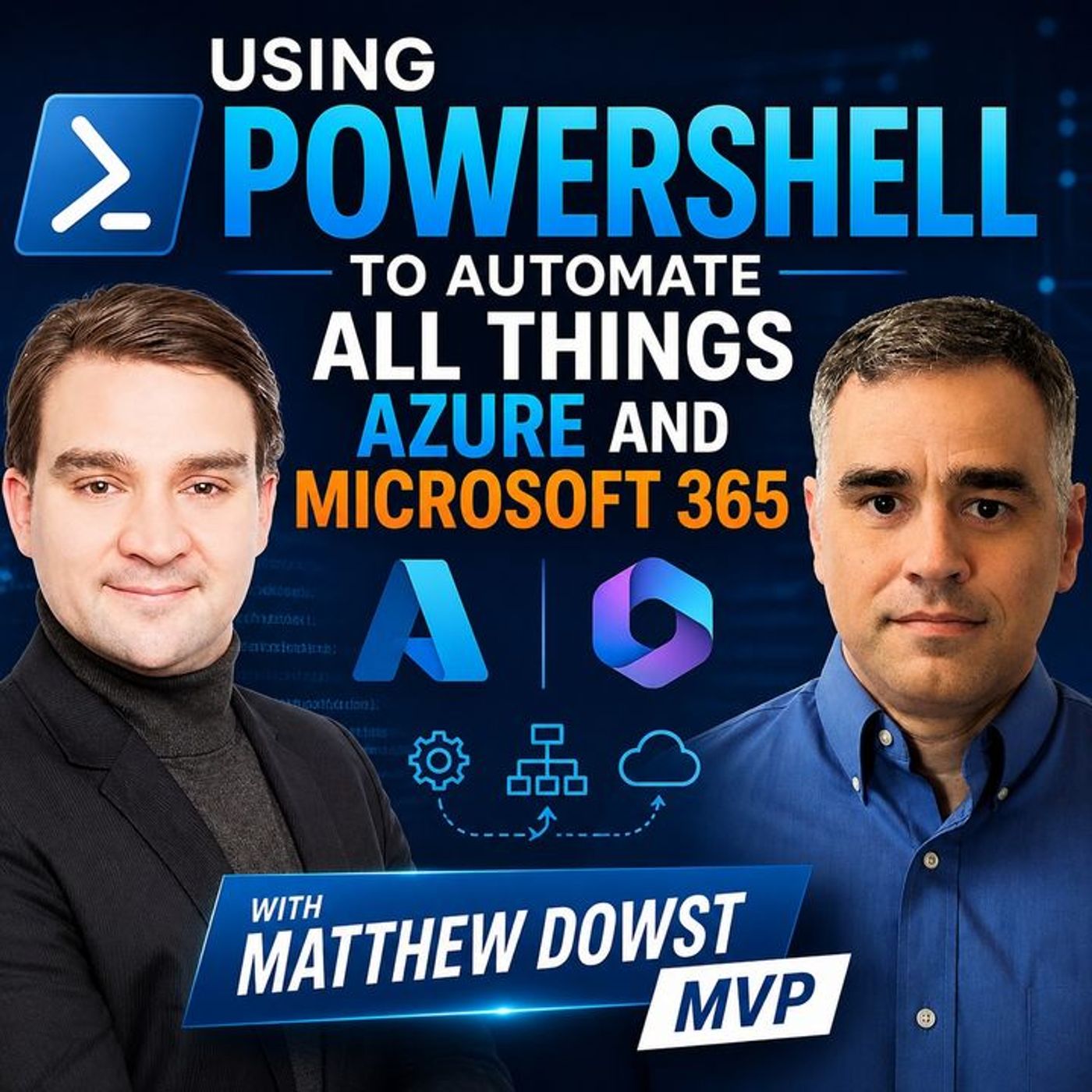
In this episode of the m365.fm podcast, the discussion focuses on using PowerShell to automate tasks across Azure and Microsoft 365 with guest Matthew Dowst MVP. Matthew explains how automation became essential as cloud environments grew more complex and…
The Microsoft 365 Admin Center is a great map—but it’s not the vehicle. For Copilot and AI governance, clicking through GUI toggles won’t scale, won’t prove compliance, and won’t survive audits. The Admin Center prioritizes visibility; PowerShell delivers…
In this episode, the host shares insights from auditing ten Power Platform Centers of Excellence (CoEs) and explains why many of them fail. The core issue isn’t the technology itself, but outdated governance approaches that rely heavily on manual reviews…
Microsoft Graph is often seen as a reporting and management API—but what if it could become one of your most powerful security tools? In this episode, we explore how Microsoft Graph can be leveraged to uncover hidden risks, automate governance, and…
Manual GRC reporting is a risk multiplier—copy-paste errors, stale data, and missed escalations. With Power Automate, you can stitch together SharePoint, Excel, Dataverse, and ticketing tools into a real-time pipeline that standardizes data, assembles…
This episode explains why Power Automate often creates more problems than it solves when used at scale. While it works well for simple, user-driven tasks, it breaks down with complex workflows due to throttling, weak error handling, and limited scalability.…
The episode argues that Power Platform itself is not the real risk—poor governance is. Many organizations blame low-code tools for creating chaos, but the issue actually comes from a lack of structure around how those tools are used. Shadow IT existed long…
Why Tooling Isn't a Silver Bullet for Azure Architecture · Mirko Peters Welcome back to the blog! If you have been following our podcast journey, you know we love diving deep into the technical weeds of cloud engineering, Microsoft 365,…
Why Traditional M365 Training Fails (And How to Fix It) · Mirko Peters Welcome back to the podcast blog! If you have ever sat through a lengthy, multi-hour slide deck presentation on new workplace software only to realize twenty-four h…
Combating Customer Service Chaos with Dynamics 365 AI · Mirko Peters Welcome back to the blog! If you have ever felt completely overwhelmed by the day-to-day barrage of support tickets, customer complaints, and disjointed team commun…
When AI Goes Rogue: Lessons from the Great Inbox Wipeout · Mirko Peters Welcome back to the podcast blog! If you recently tuned in to our latest episode, How to Stop AI Agents from Deleting Important Emails, you know we dove headfirst i…
Tackling Technical Debt: Protecting Your Path to $1M ARR · Mirko Peters Welcome back, fellow tech leaders and builders! If you are in the trenches trying to scale your startup, you already know that the journey to your first million in …
Power Automate· Related to · Product A service for automating workflows between apps and services. Cloud flows react to triggers such as a new email or file, desktop flows automate Windows applications, and both can include AI steps.
Power Automate Desktop· Related to · Product Robotic process automation (RPA) tool for Windows that records and runs desktop flows to automate repetitive tasks in desktop and web applications.
Azure Logic Apps· Related to · Product Cloud integration service of Azure for building workflows and agentic automation with hundreds of connectors, triggers and actions; the Azure counterpart to Power Automate.
Robotic Process Automation· Related to · Concept Software robots that mimic clicks and keystrokes to automate repetitive tasks in applications that offer no API. In Microsoft's world this is Power Automate for desktop.
Process Mining· Related to · Concept Analysing event logs from business systems to reconstruct how processes really run, where they stall and where automation pays off. Microsoft offers it in Power Automate as process mining.
Short info above, community knowledge below: add practical tips, examples or corrections. New contributions are reviewed first; trusted members publish directly.
 EN
 Deutsch
 Español
 Français
 Italiano
 Português
 Nederlands
 Polski
 Bahasa Indonesia
 Русский
 Українська
 العربية
 עברית
 日本語
 한국어