Cloud integration service of Azure for building workflows and agentic automation with hundreds of connectors, triggers and actions; the Azure counterpart to Power Automate.
Azure Logic Apps lets developers and integrators build workflows visually or as code. A workflow starts with a trigger, for example a business event from Dynamics 365 or a message in a queue, and runs actions through managed or built-in connectors. Consumption logic apps are billed per execution; Standard logic apps run on a dedicated plan with VNet integration and local development in VS Code.
Power Automate is built on the same engine, but Logic Apps targets IT teams who need source control, deployment pipelines and enterprise networking. Newer versions add agent loops so that workflows can use Foundry models and tools.
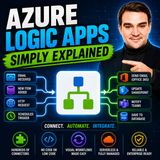
Azure Logic Apps is a cloud workflow service that connects systems and automates processes without managing workflow servers. · Azure Logic Apps - Simply Explained
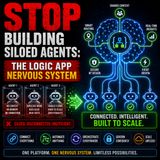
In this episode, we explore why many organizations are making a critical mistake when building AI solutions: creating agents that operate in isolation. While individual agents can be powerful, they often become disconnected silos that lack the ability to…
Azure Logic Apps is Microsoft's cloud-native workflow automation platform that helps organizations connect applications, services, and data without writing large amounts of code. Instead of building complex integrations from scratch, you create visual…
Enterprise integration is usually invisible until it breaks, and deterministic workflows struggle with the unexpected. This episode is for architects and integration developers who want to understand Azure Logic Apps, connectors, identity and observability…
Power Automate is not your integration engine—it’s your burnout factory. In this episode, we expose why mission-critical workflows keep collapsing under throttling, licensing traps, and “citizen-developer optimism.” You’ll learn why Power Automate chokes at…
This episode argues that custom connectors in Power Platform and Logic Apps, while useful for quick wins, create long-term architectural problems at scale. What initially feels like agility turns into fragmentation, poor governance, and hidden operational…
In this episode of the M365.fm podcast, the discussion focuses on one of the biggest hidden risks in Microsoft Copilot environments: prompt injection attacks. The episode explains that the real security problem is not weak prompts or missing filters, but the…
Automation is essential for digital transformation, but many organizations unintentionally create fragile, difficult-to-manage environments by relying on hundreds of disconnected PowerShell scripts and individual Power Automate flows. While each script may…
In this episode of the M365.fm podcast, Mirko Peters speaks with Microsoft MVP and MCT Anitha Eswaran about the realities of integrating Dynamics 365 Finance & Operations (D365FO) into modern enterprise environments. The discussion focuses on why integrations…
This episode argues that traditional Microsoft 365 governance—based on policies, documentation, and manual processes—does not scale in modern cloud environments. Instead, organizations need to shift toward a self-healing architecture where governance is built…
The episode talks about how automation is evolving from simple scripts into more advanced, intelligent systems that can monitor themselves and fix problems automatically. Instead of just executing predefined tasks, modern automation uses telemetry data (like…
Stop Building Chatbots: How to Codify Your Logic into a Digital Twin challenges the common enterprise approach of building AI chatbots as the primary interface for automation. The episode argues that while chatbots are easy to deploy and demonstrate, they…
Tired of chatbots that answer Intune incidents with poetry instead of fixes? In this episode, we go hands-on with Azure AI Foundry and Semantic Kernel to build a mini, self-healing, governed multi-agent system for enterprise IT. You’ll learn why single agents…
When to Graduate from Power Automate to Azure Logic Apps · Mirko Peters Welcome back, podcasters and automation enthusiasts! Have you ever hit a wall while building an office automation workflow, wondering why your flow is suddenly fail…
Securing Microsoft 365 Copilot with Azure Logic Apps · Mirko Peters Welcome back to the podcast companion blog! As artificial intelligence becomes an increasingly central pillar of the modern enterprise workplace, ensuring that our …
What role does Azure Logic Apps play for AI agents?
It acts as the orchestration layer, or nervous system, connecting agents, applications and workflows and enabling event-driven processes. · From the episode: Azure Logic Apps for Multi-Agent AI Orchestration
Azure Logic Apps is a cloud workflow service for connecting systems, automating processes and orchestrating integrations with managed connectors in a low-code visual designer. · From the episode: Azure Logic Apps - Simply Explained
Do I need to code to use Logic Apps?
No. The episode says the visual designer, prebuilt connectors and templates lower the barrier. If you can describe a process, you can automate it. · From the episode: Azure Logic Apps - Simply Explained
What are triggers and actions in Logic Apps?
A trigger starts a workflow and actions are the steps that follow. Connectors link the workflow to services such as email, storage and databases. · From the episode: Azure Logic Apps - Simply Explained
Relationship map of Azure Logic Apps: linked topics
Related topics in brief
Topics linked to Azure Logic Apps, each briefly explained:
Microsoft – Organization· Developed by Microsoft Corporation is a technology company that develops software and cloud services such as Microsoft 365, Azure and Dynamics 365.
Microsoft tool – Category· Is a Microsoft tool is a broad category for software products and services developed by Microsoft, used to group offerings and to frame tool-selection decisions.
Developer tool – Category· Is a Developer tool is an M365.FM category for tools that help developers write, test and ship software, from editors and build pipelines to APIs and platforms.
Power Automate – Low-code tool by Microsoft· Similar to A service for automating workflows between apps and services. Cloud flows react to triggers such as a new email or file, desktop flows automate Windows applications, and both can include AI steps.
Connector – Concept· Related to Prebuilt wrapper around an API that lets Power Apps, Power Automate and Copilot Studio read and write data in hundreds of services.
Azure Functions – Developer tool by Microsoft· Related to Serverless compute service of Azure that runs event-driven code; can be exposed as an MCP server, for example through API Management.
Azure API Management – Developer tool by Microsoft· Related to Azure API Management (APIM) is a Microsoft Azure service for publishing, securing, throttling and monitoring APIs, related to Azure Functions and Azure Logic Apps.
Business events (Dynamics 365) – Narrower topic of Dynamics 365· Related to Mechanism in Dynamics 365 Finance and Operations that sends a notification to external endpoints such as Logic Apps, Power Automate, Service Bus or Event Grid when a business process event occurs.
Microsoft Foundry – Developer tool by Microsoft· Related to Microsoft's platform for building, evaluating and operating AI applications and agents with model catalog, agent service, tools, evaluation and observability; formerly Azure AI Foundry.
Agent loop – Concept· Related to Control cycle in which an AI agent plans, calls tools, observes the result and repeats until the goal is reached or it must hand over to a human.
Automation – Concept· Related to Automation uses software to run repetitive tasks and processes without manual work; M365.FM episodes cover Power Platform, Copilot and Azure Automation.
Short info above, community knowledge below: add practical tips, examples or corrections. New contributions are reviewed first; trusted members publish directly.
Experts and companies for this topic
Community members with expertise in Azure Logic Apps:
 EN
 Deutsch
 Español
 Français
 Italiano
 Português
 Nederlands
 Polski
 Bahasa Indonesia
 Русский
 Українська
 العربية
 עברית
 日本語
 한국어