Azure AI Search is a search and information retrieval service from Microsoft that indexes content and supports vector and hybrid search. It was previously known as Azure Cognitive Search. It is part of Microsoft Azure and is classed as a Microsoft tool. Organizations use it to build search experiences over their own documents and data, and it is frequently used as the retrieval layer in retrieval-augmented generation (RAG) setups.
The service combines several approaches to finding information. Traditional keyword search matches the exact words a user types, which works well for things like policy codes. Vector search compares embeddings so that a query about time off can still find a document that says vacation. The episode "Azure AI Search Hybrid Retrieval - Simply Explained" frames this as the reason a search box that relies on only one method keeps falling short: keyword search alone misses meaning, while semantic matching alone can miss exact terms. Azure AI Search also offers semantic ranking and AI enrichment, so results can be reordered by relevance and content can be enriched during indexing.
In a RAG architecture, the search index supplies relevant passages from company data, and a language model uses them to formulate an answer instead of relying only on its training knowledge. The episode "RAG on Azure — Simply Explained" walks through the steps involved: ingesting documents, creating vector embeddings, storing them in a vector database, and retrieving the most relevant information for each user query. It names concepts such as embeddings, chunking, semantic search and grounding, and describes Azure AI Search and Azure OpenAI as building blocks. According to the episode, grounding answers in an organization's private knowledge reduces hallucinations and produces more accurate, up-to-date and source-aware responses. Use cases mentioned include AI chatbots, internal knowledge assistants, customer support, document search and enterprise copilots.
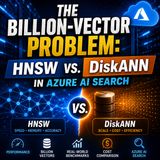
A central design decision concerns vector search at scale. The episode "HNSW vs DiskANN for Vector Search in Azure AI Search" describes the "billion-vector problem": how to search through very large numbers of vector embeddings without excessive infrastructure cost. It compares two vector search algorithms available in the service, HNSW (Hierarchical Navigable Small World) and DiskANN. The episode notes that HNSW has become widely used, and that the right choice depends on the size and growth trajectory of the vector data. It offers practical guidance for both proof-of-concept projects and planning for billion-scale workloads.
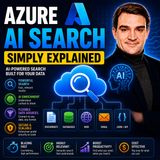
The overview episode "Azure AI Search – Simply Explained" presents the service as a core component for RAG, AI agents and enterprise search solutions, combining keyword search with vector search, semantic ranking and AI enrichment. It is part of the Microsoft Knowledge Nuggets series.
The service also appears in applied scenarios. In "Beyond Copilot: Building AI That Works in the Real World with Azure AI Foundry and Agentic AI for Frontline Workers with Fergus Kidd [MVP]", Azure AI Search is named as one of the components behind FieldPal AI, alongside models, speech capabilities, retrieval-augmented generation, APIs, Kubernetes and other Azure services. The episode describes this combination as forming a full product rather than a single assistant experience, with the option to connect the same backend capabilities to Copilot Studio and Microsoft 365.
Azure AI Search relates most closely to Retrieval-augmented generation (RAG), Microsoft Azure and the wider set of Azure AI services. Official documentation is available on Microsoft Learn under the Azure Search section.
Overview compiled with AI from M365.FM episodes and the facts on this page. You can improve it with the edit button below.
Azure AI Search is Microsoft's intelligent search and information retrieval service for building modern search experiences and AI-powered applications. It combines traditional keyword search with vector search, semantic ranking, and AI enrichment, making it a…
Typing to Copilot is the new fax machine—and your thumbs are the bottleneck. In this episode we break down how to give Copilot an actual voice, a memory, and a legal department, so it can keep up with the way you think, not the way you type. You’ll hear how…
This episode of the M365.FM Podcast (titled “How to Build a High-Performance Agentic Workforce in 30 Days”) explains why most enterprise AI agent programs fail quickly, and what it really takes to build an AI-driven workforce that delivers measurable business…
The explosion of AI-powered applications has created a new challenge: how do you efficiently search through billions of vector embeddings without exploding infrastructure costs? In this episode, we explore the “billion-vector problem” and compare two leading…
Retrieval-Augmented Generation (RAG) is one of the most important techniques behind modern AI applications, enabling large language models to answer questions using your own business data instead of relying only on their training knowledge. In this episode of…
In this episode we walk through what really happens when Azure AI Foundry doesn’t behave the way you expect, especially when the Agent Service or deployments start acting up. Azure AI Foundry is supposed to feel smooth, almost invisible, tying together OpenAI…
In this episode, Mirko Peters is joined by Microsoft MVP Nilüfer Doğan to explore how Microsoft Copilot Studio is transforming enterprise automation through AI agents, Retrieval-Augmented Generation (RAG), and low-code development. Rather than building simple…
The night is thick with static inside your tenant, and the questions aren’t small anymore. Copilot can walk the clean, well-lit M365 streets — summarizing inbox noise, tightening your notes, finding what you already have permission to see. Fast, friendly…
Artificial Intelligence is only as secure as the foundation it is built on. In this episode of the M365 FM Podcast, Mirko Peters explains why an organization's AI Landing Zone is often its biggest hidden risk. While many companies focus on deploying Microsoft…
Vector databases are one of the key technologies powering modern AI applications, yet most people never interact with them directly. Unlike traditional databases that search for exact words or values, vector databases search by meaning, enabling AI to…
This episode explains that vector search on its own is not a complete or reliable strategy for building accurate AI systems like Copilot. While many organizations rely on embeddings and vector databases to retrieve information, this approach often leads to…
veryone is talking about Private RAG, sovereign AI, regional hosting, and keeping enterprise data inside controlled environments. But in this episode of M365 FM, Mirko Peters explores a critical security gap that many organizations overlook: data sovereignty…
Conquering the Billion-Vector Problem in Azure AI Search · Mirko Peters Welcome to our deep dive into one of the most pressing challenges in modern enterprise artificial intelligence: scaling vector search to billions of records. If you…
Solving the Billion-Vector Problem in Azure AI Search · Mirko Peters Explore the unique technical challenges of searching massive datasets at scale. This post breaks down how high dimensionality and memory constraints impact enterpri…
Frequently asked questions
Questions marked with AI were written with AI from the facts on this page.
What is Azure AI Search? (AI)
Azure AI Search is a Microsoft Azure service that indexes content and supports keyword, vector and hybrid search. It was previously called Azure Cognitive Search and is often used for retrieval-augmented generation.
How does Azure AI Search relate to RAG? (AI)
In a RAG setup, the search index supplies relevant passages from company data, and a language model uses them to formulate an answer. This grounds responses in an organization's own knowledge rather than only the model's training data.
What do HNSW and DiskANN have to do with Azure AI Search? (AI)
They are two vector search algorithms available in Azure AI Search. The episode "HNSW vs DiskANN for Vector Search in Azure AI Search" compares them and says the choice depends on the size and growth of the vector data.
What is hybrid search in Azure AI Search?
Hybrid search combines exact keyword matching for precision with semantic understanding for context. The episode says this gives more reliable, citation-friendly answers than either approach alone. · From the episode: Azure AI Search – Simply Explained
What kind of content is Azure AI Search for?
Unstructured text such as PDFs, emails, Word documents and support tickets, where good search is hard. · From the episode: Azure AI Search – Simply Explained
How does Azure AI Search help RAG applications?
It acts as the retrieval engine behind a RAG app or AI assistant. The episode recommends hybrid search for that role. · From the episode: Azure AI Search – Simply Explained
How quickly can I try Azure AI Search?
The episode says you can run your first search in under an hour: use the import data wizard in the Azure portal, connect blob storage and let the indexer build your first index. · From the episode: Azure AI Search – Simply Explained
How do you ground a voice assistant in company policy?
Plug it into Azure AI Search with RAG so answers come from your own policies, standards and FAQs. Answers are then cited and governed instead of invented, which the episode calls giving Copilot a legal department. · From the episode: Build Hands-Free Copilot Voice Experiences with GPT-4o
Relationship map of Azure AI Search: linked topics
Related topics in brief
Topics linked to Azure AI Search, each briefly explained:
Microsoft – Organization· Developed by Microsoft Corporation is a technology company that develops software and cloud services such as Microsoft 365, Azure and Dynamics 365.
Microsoft tool – Category· Is a Microsoft tool is a broad category for software products and services developed by Microsoft, used to group offerings and to frame tool-selection decisions.
Retrieval-augmented generation (RAG) – Concept· Related to A pattern in which an AI model first retrieves relevant documents from a knowledge source and then writes its answer based on them. It reduces made-up answers and lets models use current, private data without retraining.
Short info above, community knowledge below: add practical tips, examples or corrections. New contributions are reviewed first; trusted members publish directly.
Experts and companies for this topic
Community members with expertise in Azure AI Search:
 EN
 Deutsch
 Español
 Français
 Italiano
 Português
 Nederlands
 Polski
 Bahasa Indonesia
 Русский
 Українська
 العربية
 עברית
 日本語
 한국어