A pattern in which an AI model first retrieves relevant documents from a knowledge source and then writes its answer based on them. It reduces made-up answers and lets models use current, private data without retraining.
Title graphic: Retrieval-augmented generation (RAG) (Concept)
Retrieval-augmented generation (RAG) is a pattern in which an AI model first retrieves relevant documents from a knowledge source and then writes its answer based on them. The approach reduces made-up answers and lets a language model work with current, private data without being retrained. It is the usual way to connect a language model to company content, and it sits within the broader field of Generative AI.
The core idea is a two-step flow. When a question arrives, a retrieval step searches a knowledge source for content that is relevant to it. That content is then handed to the model as context, and the model composes its response from those documents rather than relying only on what it learned during training. Because the knowledge lives in the source and not in the model, the answers can reflect business data that changes over time, and no retraining is needed when the content is updated.
Retrieval typically depends on a searchable index of content. The M365.FM episode "Vector Databases - Simply Explained" describes the technology behind this: vector databases search by meaning, so AI can understand context instead of just matching keywords. The episode covers vectors and embeddings, semantic search, similarity search, vector indexes, chunking and hybrid search, and explains that similar concepts are stored close together in vector space. In practice, the quality of a RAG answer depends heavily on the quality of the underlying data and on how that data is indexed and retrieved.
RAG is closely related to the AI agent. Agents often use retrieval as one of their tools to gather knowledge before they act. The episode "Copilot Studio AI Agents and RAG with Nilüfer Doğan [MVP]" looks at this connection in a low-code setting. It describes how Microsoft Copilot Studio can be used to build agents that go beyond simple chatbots, understand business context, access enterprise knowledge and automate workflows, combining Microsoft 365, Power Platform, Dataverse and external data sources.
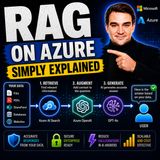
For Azure-based solutions, "RAG on Azure — Simply Explained" presents RAG in plain English. The episode describes it as a technique behind modern AI applications that enables large language models to answer questions using a organization's own business data instead of relying only on training knowledge, and it discusses how organizations build secure, accurate and trustworthy AI solutions with Microsoft Azure.
RAG also introduces security questions, which the M365.FM episodes treat as a risk surface. "Indirect Prompt Injection Security for Enterprise AI" points out that trusted documents, emails, SharePoint content, Teams conversations and knowledge bases can become attack vectors. The episode says that, unlike traditional software, large language models cannot reliably separate data from instructions, so every piece of retrieved content becomes part of the model's context and can carry hidden commands or poisoned content.
A second concern is covered in "Private RAG Security: Authorization-Aware Data Retrieval". The episode argues that data sovereignty is not the same as data security. When documents leave systems such as SharePoint and Microsoft 365 and are ingested into vector databases, permissions and access controls may not carry over during indexing. The result, according to the episode, can be a capable AI system that unintentionally exposes sensitive information to users who should not have access to it. Decisions around a RAG design therefore include not only which knowledge source to use and how to index it, but also how authorization is preserved at retrieval time.
Overview compiled with AI from M365.FM episodes and the facts on this page. You can improve it with the edit button below.
Type
Concept
Kind
Technique
Also known as
RAG
Key points about Retrieval-augmented generation (RAG)
Key points about Retrieval-augmented generation (RAG) from the episodes, each with its source episode:
Retrieval-Augmented Generation (RAG) combines information retrieval with generative AI to ground answers in your own data. · RAG on Azure — Simply Explained
RAG is not something you buy; it is a pattern you build from Azure pieces: storage, search, models and glue. · RAG on Azure — Simply Explained
Episodes about Retrieval-augmented generation (RAG)
Episodes in which Retrieval-augmented generation (RAG) is discussed:
The night is thick with static inside your tenant, and the questions aren’t small anymore. Copilot can walk the clean, well-lit M365 streets — summarizing inbox noise, tightening your notes, finding what you already have permission to see. Fast, friendly…
veryone is talking about Private RAG, sovereign AI, regional hosting, and keeping enterprise data inside controlled environments. But in this episode of M365 FM, Mirko Peters explores a critical security gap that many organizations overlook: data sovereignty…
Retrieval-Augmented Generation (RAG) is one of the most important techniques behind modern AI applications, enabling large language models to answer questions using your own business data instead of relying only on their training knowledge. In this episode of…
In this episode of M365.fm, Mirko Peters explores how organizations can build a secure and private Retrieval-Augmented Generation (RAG) platform using SharePoint as the knowledge source and n8n as the orchestration layer. The discussion focuses on moving…
Most organizations believe hallucinations are the biggest risk in enterprise AI. In reality, one of the most dangerous threats is something far less visible: Indirect Prompt Injection. In this episode, we explore how trusted documents, emails, SharePoint…
Copilot can answer a question perfectly today and fumble the same question tomorrow because it searches instead of remembering. This episode explains why RAG-based Copilot stays shallow and how the LLM Wiki pattern adds compiled, maintained knowledge, for IT…
Many teams still treat Copilot as a search box and blame the tool when answers come back incomplete. This episode explains agentic RAG, the orchestration loop behind modern Copilot, for IT decision makers and Microsoft 365 architects. You learn when agentic…
In this episode we walk through what really happens when Azure AI Foundry doesn’t behave the way you expect, especially when the Agent Service or deployments start acting up. Azure AI Foundry is supposed to feel smooth, almost invisible, tying together OpenAI…
Typing to Copilot is the new fax machine—and your thumbs are the bottleneck. In this episode we break down how to give Copilot an actual voice, a memory, and a legal department, so it can keep up with the way you think, not the way you type. You’ll hear how…
Artificial Intelligence is transforming the way organizations manage knowledge, documents, and collaboration. Yet as companies rush to adopt AI assistants and large language models, one question continues to dominate every conversation: how can you benefit…
In this episode, we unpack two major AI platforms in the Microsoft ecosystem—Copilot Studio and Azure AI Foundry—and help listeners understand when to use each one. Whether you're building conversational AI, custom machine learning models, or enterprise-grade…
Your Copilot isn’t smart – it’s a very expensive autocomplete. In this episode, we break down why classic RAG (retrieve-augment-generate) quietly fails the moment your truth lives in more than one system, and how “agentic RAG” on Azure turns Copilot from a…
Timeline of episodes about Retrieval-augmented generation (RAG)
Articles about Retrieval-augmented generation (RAG) (9)
Articles in which Retrieval-augmented generation (RAG) is a topic:
Structuring SharePoint Libraries for AI-Powered Retrieval · Mirko Peters Welcome to our deep dive into organizing your enterprise content for artificial intelligence. As organizations race to implement generative AI, a common bottleneck …
Structuring SharePoint for Maximum AI Retrieval Accuracy · Mirko Peters When organizations rush into implementing artificial intelligence initiatives, they often overlook the foundation upon which those systems rely: the document reposi…
Questions marked with AI were written with AI from the facts on this page.
What is retrieval-augmented generation (RAG)? (AI)
RAG is a pattern in which an AI model first retrieves relevant documents from a knowledge source and then writes its answer based on them. It reduces made-up answers and lets models use current, private data without retraining.
How does RAG relate to vector databases? (AI)
Retrieval usually relies on a searchable index, and vector databases provide search by meaning instead of keyword matching. The episode "Vector Databases - Simply Explained" describes embeddings, semantic search, chunking and hybrid search as part of this.
What security issues does RAG raise? (AI)
The M365.FM episodes point to two: retrieved content such as documents and emails can carry hidden instructions (indirect prompt injection), and permissions may be lost when documents are indexed into vector databases, which can expose data to unauthorized users.
When should I use RAG instead of Microsoft 365 Copilot?
Use RAG when answers must come from your own systems, such as old PDFs, file servers or wikis, with citations. Copilot suits everyday productivity inside Microsoft 365. · From the episode: When to Use RAG vs Microsoft 365 Copilot
What is Retrieval Augmented Generation?
RAG retrieves ground truth from your own content and forces the model to cite it. The episode likens it to a librarian with receipts that refuses to bluff. · From the episode: When to Use RAG vs Microsoft 365 Copilot
Where does Copilot reach its boundary?
Where knowledge lives outside the clean M365 streets, in stale PDFs, forgotten SharePoint stacks, file-server ghosts and unmaintained wikis. That is where RAG takes over. · From the episode: When to Use RAG vs Microsoft 365 Copilot
Why isn't private RAG enough?
When documents are ingested into vector databases, the original permissions and access controls may be lost, creating gaps even though the data stays in a controlled environment. · From the episode: Private RAG Security: Authorization-Aware Data Retrieval
What risks do private RAG systems introduce?
The episode mentions access control gaps and the potential for data poisoning. When documents leave SharePoint for a vector database, the original permissions may not travel with them, so data sovereignty alone does not guarantee data security. · From the episode: Private RAG Security: Authorization-Aware Data Retrieval
Relationship map of Retrieval-augmented generation (RAG): linked topics
Related topics in brief
Topics linked to Retrieval-augmented generation (RAG), each briefly explained:
AI agent – Concept· Related to A software system that uses an AI model to pursue a goal on its own: it plans steps, calls tools or APIs, reads data and acts, often with a human approving critical steps. Agents go beyond chatbots because they take actions, not just answer questions.
Knowledge source – Concept· Related to Content an agent in Copilot Studio can ground its answers on, such as SharePoint sites, files, websites, Dataverse tables or connectors.
All relationships of Retrieval-augmented generation (RAG), grouped by type of relationship:
Related to
All 3 topics related to Retrieval-augmented generation (RAG):
Short info above, community knowledge below: add practical tips, examples or corrections. New contributions are reviewed first; trusted members publish directly.
Experts and companies for this topic
Community members with expertise in Retrieval-augmented generation (RAG):
 EN
 Deutsch
 Español
 Français
 Italiano
 Português
 Nederlands
 Polski
 Bahasa Indonesia
 Русский
 Українська
 العربية
 עברית
 日本語
 한국어