Compliance is the practice of meeting legal, regulatory and internal requirements, for example for data protection and records retention. In a Microsoft 365 context it is not a single feature but a set of policies and controls covering communication, retention, auditing and sensitive information. The goal is that the handling of data can be demonstrated to auditors, regulators and internal stakeholders, rather than merely intended. The topic is also referred to as AI compliance or compliance reporting, depending on the angle taken.
Compliance sits under the broader topic of Governance, which describes how an organization sets rules and ensures they are followed. It is closely related to Microsoft Purview, the portfolio where many compliance controls are configured, and to the GDPR, one of the main regulations that organizations in Europe must observe when processing personal data. Together these three links show how a legal requirement (GDPR), a management discipline (Governance) and a tooling layer (Microsoft Purview) connect in practice.
The M365.FM episode "Communication Compliance - Simply Explained" describes why this matters beyond classic email. Employees collaborate through Microsoft Teams chats, Outlook emails, Viva Engage, Microsoft 365 Copilot and other digital communication platforms every day. According to the episode, these tools improve productivity but also create new risks involving workplace misconduct, regulatory compliance, sensitive information, insider threats and inappropriate communication. The episode, part of the Microsoft Knowledge Nuggets format, explains how communication compliance addresses these risks.
A different perspective comes from "Compliance as Code: The Architect's Blueprint for Automated Trust". The episode challenges the common view of compliance as a documentation exercise that organizations prepare for audits instead of embedding it in daily operations. It argues that modern enterprises should shift from manual governance to automated, architecture-driven trust, treating compliance as something designed into systems rather than assembled afterwards.
The episode "Turn Microsoft 365 Compliance into Competitive Advantage" looks at strategy. It explains why traditional governance approaches fail at scale and why embedding compliance directly into Microsoft 365 workflows is key to enabling productivity, reducing risk and supporting AI-driven tools like Copilot. In this framing, governance becomes a business enabler instead of a blocker.
Automation is a recurring theme. "Automate Compliance Workflows with Microsoft Power Automate" treats compliance processes as work that is often handled manually, which makes it slow, repetitive and prone to human error. The episode explores how Power Automate can turn manual approvals, documentation checks and policy enforcement into automated, traceable workflows, replacing reliance on spreadsheets, emails and ticket queues.
Compliance also appears in infrastructure design. "Azure Governance Architecture to Control Cost, Security, and Compliance" argues that knowing how to provision Azure services is no longer enough and that the real value lies in governance architecture. This means designing systems that prevent erosion between intended policy and actual state, so that environments stay secure, compliant and cost-efficient as they scale.
Taken together, the episodes describe compliance as a mix of policy, tooling and architecture. Typical decisions include which communication channels to monitor, how to enforce rules automatically instead of through manual review, and how to align controls with regulations such as the GDPR while keeping day-to-day work productive.
Overview compiled with AI from M365.FM episodes and the facts on this page. You can improve it with the edit button below.
In this episode, we challenge a common misconception in Microsoft 365 governance: having policies in place does not mean your environment is truly governed. Many organizations rely on documented rules, guidelines, and compliance frameworks, assuming they will…
Manual GRC reporting is a risk multiplier—copy-paste errors, stale data, and missed escalations. With Power Automate, you can stitch together SharePoint, Excel, Dataverse, and ticketing tools into a real-time pipeline that standardizes data, assembles…
The Microsoft 365 Admin Center is a great map—but it’s not the vehicle. For Copilot and AI governance, clicking through GUI toggles won’t scale, won’t prove compliance, and won’t survive audits. The Admin Center prioritizes visibility; PowerShell delivers…
“Zero Trust everywhere” and “freedom for everyone” both fail in production. One grinds work to a halt; the other invites disaster. In this workshop we show how top M365 orgs hit the operating sweet spot—where CISO, GDPR officer, and everyday users all win.…
In this episode, we explore why Microsoft 365 environments are often less secure than they appear. While most organizations focus on security tools and settings, the real risk lies in what we call the “invisible tenant” — a hidden layer of misconfigurations…
AI agents are powerful—and risky—when they run without guardrails. In this session, we show how Microsoft 365 Admin Center + Copilot Studio give you a practical control tower: who can build, who can publish, what data agents can touch, and how you monitor…
Copilot Notebooks feel magical — a conversational workspace that pulls context from SharePoint, OneDrive, Teams, decks, sheets, emails — and synthesizes answers instantly. But the moment users trust that illusion, they generate data that has no parents. Every…
This episode explores the shift from traditional collaboration tools to the concept of an enterprise operating system, where platforms like Microsoft 365 unify apps, data, identity, and security into a single architecture. It explains how modern organizations…
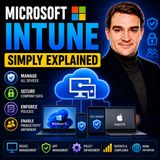
Microsoft Intune isn’t just device management—it’s the control plane for identity-aware access, protected apps, adaptive risk, and verifiable compliance across Microsoft 365. When Intune is wired into Azure AD (Entra ID), Microsoft Defender for Endpoint, and…
Fabric didn’t fail at features—it failed at governance cohesion. Data lives in Fabric, security sits in Power BI, labels live in Purview—and they don’t natively reason about each other. That’s why audits devolve into CSV marathons and name-matching…
Most “inventory systems” are just Excel sheets LARPing as ERPs — and that’s why warehouses lose assets, fail audits, and end up with phantom spreadsheets nobody trusts. Barcode scanning isn’t a gimmick — it’s the only sane way to ingest perfect data into…
Why Traditional GRC Reporting is Failing Modern Enterprises · Mirko Peters Welcome back to the podcast blog! If you have ever stared blankly at a massive spreadsheet at midnight, wondering how a single misplaced digit could throw off an en…
Mastering WCAG Contrast Ratios in Power BI · Mirko Peters When crafting data visualizations, our primary goal is clear communication. Yet, many report creators accidentally introduce visual barriers that alienate portions …
Understanding Security Drift in Active Directory · Mirko Peters Welcome back to the blog! Today, we are diving deep into a topic that quietly erodes the security foundations of countless organizations every single day: security …
Navigating the EU VAT in the Digital Age (ViDA) Initiative · Mirko Peters Welcome to our deep dive into the European Union's ambitious tax overhaul. As cross-border commerce continues to accelerate, the methods by which governments track …
Why Cloud AI Is Failing Your Enterprise Compliance Strategy · Mirko Peters When organizations first experiment with artificial intelligence, the standard path usually involves spinning up a cloud-hosted LLM API, plugging in an enterprise d…
Getting Started with Microsoft Intune: A Beginner's Roadmap · Mirko Peters Welcome to our comprehensive guide on getting started with Microsoft Intune. In today's digital workplace, modern endpoint management is no longer just an optional …
Uncovering Shadow Logic in Your Power Platform Environment · Mirko Peters Welcome back to the podcast companion blog! In today's post, we are diving deep into a topic that keeps IT administrators and security teams awake at night: shadow …
Questions marked with AI were written with AI from the facts on this page.
What does compliance mean in Microsoft 365? (AI)
It means meeting legal, regulatory and internal requirements, for example for data protection and records retention. In Microsoft 365 this shows up as policies for communication, retention, auditing and sensitive information.
How is compliance related to Microsoft Purview and the GDPR? (AI)
Microsoft Purview is the portfolio where many compliance controls are configured, and the GDPR is one of the main regulations organizations in Europe must observe when processing personal data. Compliance itself falls under the broader topic of Governance.
What does "Compliance as Code" mean according to the episodes? (AI)
The episode "Compliance as Code: The Architect's Blueprint for Automated Trust" argues against treating compliance as a documentation exercise before audits. It calls for embedding compliance in daily operations through automated, architecture-driven trust.
What makes governance fragile?
Governance becomes fragile when it relies on manual processes, user compliance or periodic reviews. As organizations scale this leads to policy drift and inconsistent configurations between intention and enforcement. · From the episode: Microsoft 365 Governance as Code Beyond Written Policies
What results do the show notes cite for GRC automation?
The show notes cite a 40 percent improvement in risk visibility and compliance cost reductions of up to 30 percent. These are claims from the source material, so actual results depend on how mature your processes are. · From the episode: Automate GRC Reports with Power Automate
Why use PowerShell instead of the Admin Center for Copilot?
The Admin Center is good for visibility, but GUI toggles do not scale, prove compliance or survive audits. PowerShell adds bulk actions, reproducible changes, logs and consistency across the whole environment. · From the episode: Manage Microsoft 365 Copilot with PowerShell
Why do both strict Zero Trust and open access fail?
Review settings and permissions regularly, enforce MFA for all users, limit permissions to least privilege and monitor third-party apps for excessive requests. Use Secure Score and Compliance Manager to track improvements. · From the episode: Hidden Microsoft 365 Tenant Security Risks
Relationship map of Compliance: linked topics
Related topics in brief
Topics linked to Compliance, each briefly explained:
Microsoft Purview – Identity and security tool by Microsoft· Related to Microsoft's family of data governance, protection and compliance tools. It covers sensitivity labels, data loss prevention, retention, eDiscovery, audit and insider-risk management across Microsoft 365 and other data sources.
GDPR – Concept· Related to The EU General Data Protection Regulation governing how personal data may be processed.
Local-first AI – Concept· Related to Running AI models and agents on the user's device so data stays local, which can simplify compliance and reduce cloud costs.
Data governance – Concept· Related to Rules, roles and tools that keep data classified, protected and used correctly, essential before and while deploying Copilot and agents.
Sovereign landing zone – Concept· Related to Azure landing zone variant with sovereignty controls for data residency, encryption and policy, built for regulated and public-sector customers.
David Pazdera – Person· People working on this topic David Pazdera is a speaker at M365Con 2026 and M365Con 2027 (Principal Solution Architect at Cegal AS) with 2 sessions.
Ragnar Heil – Person· People working on this topic Ragnar Heil is a speaker at M365Con 2026 and M365Con DACH 2026 and M365Con 2027 (Microsoft MVP at HanseVision) with 3 sessions.
All relationships of Compliance, grouped by type of relationship:
Short info above, community knowledge below: add practical tips, examples or corrections. New contributions are reviewed first; trusted members publish directly.
 EN
 Deutsch
 Español
 Français
 Italiano
 Português
 Nederlands
 Polski
 Bahasa Indonesia
 Русский
 Українська
 العربية
 עברית
 日本語
 한국어