Apple Podcasts
 Spotify
 Youtube Music
 Spreaker
 Podchaser
 Amazon Music
 Power Platform Governance Without Creating More Shadow IT
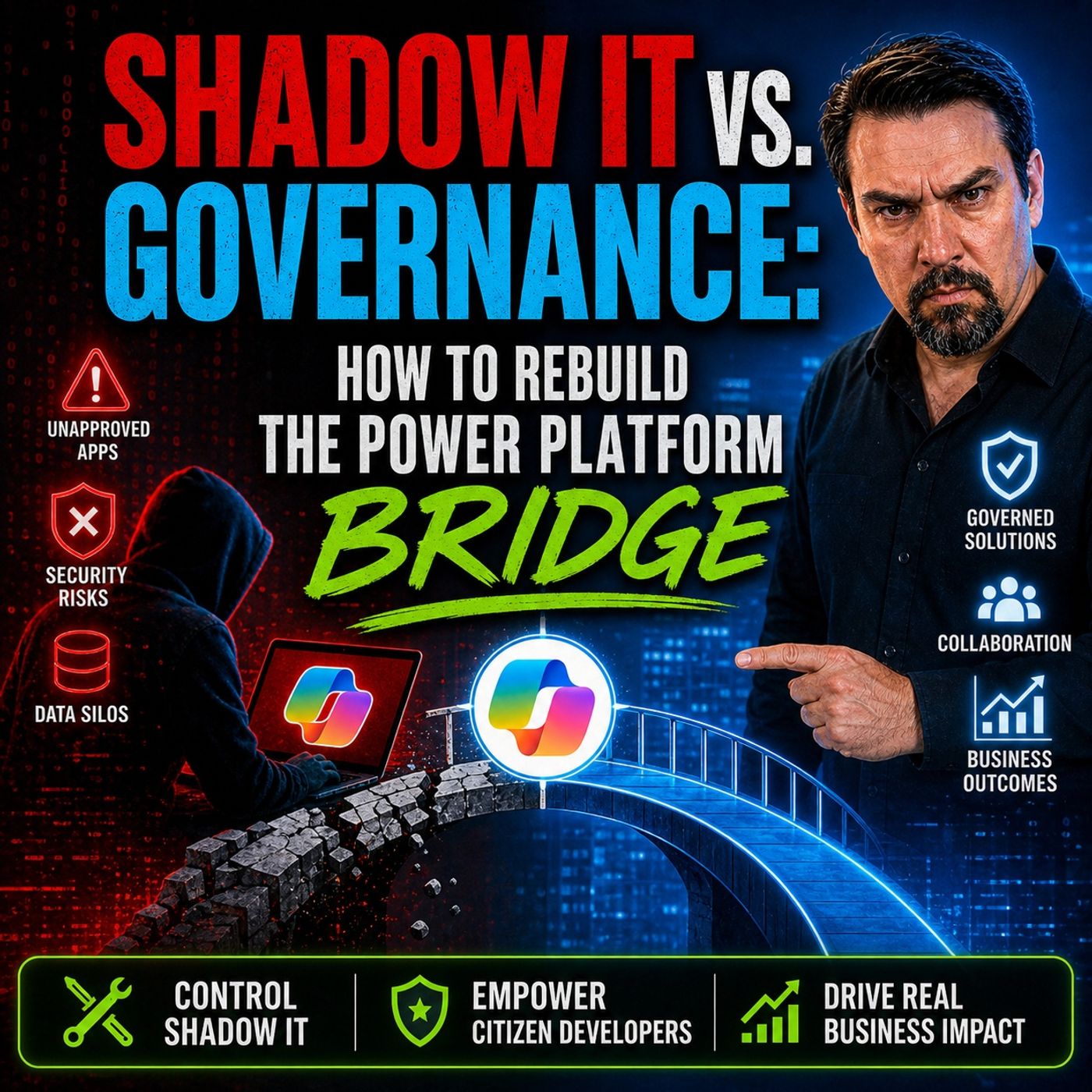
The episode argues that Power Platform itself is not the real risk—poor governance is. Many organizations blame low-code tools for creating chaos, but the issue actually comes from a lack of structure around how those tools are used.
Shadow IT existed long before Power Platform, through tools like Excel, Access, and macros. What Power Platform does is make this type of development faster, more visible, and easier to scale. This exposes existing weaknesses in how organizations manage and control user-built solutions.
The main challenge is that low-code development moves much faster than traditional IT governance models. Apps and automations can be created and changed quickly, often without clear ownership, monitoring, or lifecycle management. This leads to risks such as unclear data flows, compliance issues, and fragile business processes.
The key distinction highlighted is between security and governance. Power Platform is secure by design, but governance determines how safely and effectively it is used. Without a proper governance model, even a secure platform can become risky.
Good governance includes clear ownership, defined environments, data loss prevention policies, monitoring, and lifecycle processes. Organizations need to treat Power Platform as a managed product, not just a tool.
The episode also notes that AI and Copilot will accelerate these challenges. If governance is already weak, adding AI will increase the speed and scale of problems. Therefore, governance needs to be established before scaling AI capabilities.
The main takeaway is that Power Platform does not create problems—it reveals whether an organization is capable of managing modern, fast-moving technology.
You want to stop shadow IT before it disrupts your business. Environment routing in Microsoft Power Platform gives you the tools to do just that. You can empower Makers to create solutions without losing control. This approach shifts your role from gatekeeping to platform enablement. Automated governance and isolated environments help you protect data and keep innovation secure.
Key Takeaways
-
Environment routing in Power Platform helps prevent shadow IT by directing users to the right workspace automatically.
-
Establishing clear governance policies reduces security risks and ensures compliance with regulations.
-
Personal Developer Environments (PDEs) provide makers with secure spaces to innovate without affecting others.
-
Regularly monitor and adjust environment routing to maintain effective governance and adapt to changing business needs.
-
Create multiple environments to support different use cases, keeping the default workspace organized and secure.
-
Involve makers in policy reviews to balance security and innovation, fostering a collaborative environment.
-
Use automated guardrails to enforce governance rules, reducing the risk of policy violations and speeding up solution delivery.
-
Document environment strategies and share them with users to enhance understanding and compliance across the organization.
Power Platform Governance and Shadow IT
Shadow IT Risks
You face real risks when shadow IT grows in your organization. Shadow IT happens when users build apps, flows, or reports in Power Platform without IT oversight. These unmanaged solutions can create security gaps. Unauthorized apps may not get updates or proper security checks. Hackers can find these weak spots and cause data breaches or other cyber threats.
You also risk breaking compliance rules. In regulated industries like healthcare and finance, shadow IT can lead to heavy penalties if regulators find non-compliant apps. You may see operational inefficiencies as well. Unmanaged environments can slow down your business and make it hard to track important data. Organizations without strong power platform governance often have three to five times more unmanaged environments than those with structured adoption programs. In sectors like banking and logistics, shadow IT is a major liability.
-
Data breaches from unauthorized apps
-
Compliance risks in regulated industries
-
Operational inefficiencies from unmanaged environments
Governance Challenges
You need power platform governance to keep your data safe and your business running smoothly. Many IT departments struggle with common governance challenges. Users sometimes get too much access to data sources, which can lead to unauthorized access. Without proper audit trails, you cannot track who did what or ensure compliance. Old apps that do not get updates can become security risks.
Custom connectors, if not checked, can bring compliance problems. Poor data classification means sensitive data might get mishandled. If you do not manage AI and automation features, you could break important regulations. Personal environments can create data silos, making it hard for the power platform center of excellence to oversee everything. Misconfigured DLP policies can send data to the wrong places.
-
Lack of audit trails and monitoring
-
Inadequate lifecycle management of apps and flows
-
Unverified third-party connectors
-
Poor data classification
-
Noncompliant use of AI and automation
-
Personal environments leading to data silos
-
Misconfigured DLP policies
Maker Innovation vs. IT Control
You want to encourage innovation, but you also need control. This balance is at the heart of power platform governance. The power platform center of excellence helps you find the right model for your organization. You can choose a centralized model, where IT makes all governance decisions. This gives you strong control and consistent standards, but it can slow down innovation.
A federated model shares responsibility between IT and business units. This balances control with agility, but you need strong coordination. The hub and spoke model uses a central power platform center of excellence with departmental champions. This approach scales well and maintains standards while letting local teams innovate. You need to invest in training your champions for this model to work.
| Model Type | Description | Pros | Cons |
|---|---|---|---|
| Centralized Model | IT department leads all governance decisions | Strong control, consistent standards | Can slow innovation, may lack business context |
| Federated Model | Shared responsibility between IT and business units | Balances control with agility | Requires strong coordination |
| Hub and Spoke Model | Central CoE with departmental champions | Scales well, maintains standards while enabling local innovation | Requires investment in champion training |
The power platform center of excellence guides you in setting up the right governance model. You can support your Makers while keeping your data secure and compliant.
What Is Environment Routing
Environment Routing Overview
Environment routing in the power platform helps you manage where users start their journey. When you sign in to a Power Apps portal for the first time, the system decides which environment you enter. This process does not require you to make a choice. The platform automatically sends you to a specific environment, such as a Default or Onboarding environment. You gain a secure workspace right away. This approach keeps your work separate from others and supports better governance.
Tip: Environment routing gives you a clear starting point. You avoid confusion and reduce the risk of shadow IT by making sure every user lands in the right place.
How Routing Works in Power Platform
You do not need to worry about picking the right environment. The power platform uses environment routing to direct you to your personal developer environment. This means you get a private space to build apps and solutions. Others cannot access your work unless you share it. The system uses rules set by administrators to decide where you go. These rules can send different users to different environments based on their roles or needs.
-
You get routed to your own developer environment automatically.
-
You do not need to select an environment manually.
-
Your workspace stays private and secure.
-
Administrators set rules to match users with the right environment.
-
Makers can focus on innovation without worrying about governance gaps.
Multi-Rule Routing System
The power platform supports a multi-rule routing system. This system lets administrators create several rules to guide users to the right environment. Each rule has a name, a target environment group, and an audience. The rules follow a priority order. The first rule that matches your profile decides your destination. If no rule matches, you go to the default environment. This setup ensures every user finds the right workspace.
| Feature | Description |
|---|---|
| Portal-Level Enablement | Choose which portals (like Power Apps or Copilot Studio) use routing through the admin center. |
| Flexible Rule Definition | Create rules with a name, target environment group, and audience (everyone or specific groups). |
| Priority-Based Rule Engine | Rules are checked in order; the first match sets your environment. |
| Environment Provisioning | Route users to existing or new developer environments; use default if no match. |
| Built-In Governance | Routed environments follow policies for data retention, AI, sharing, and more. |
You gain control and flexibility with this system. The power platform ensures that every environment follows your organization’s policies. You can support innovation while keeping your data safe.
Setting Up Environment Routing
Planning Environment Strategy
You need a clear plan before you set up environment routing in the power platform. A strong strategy helps you prevent shadow IT and supports both innovation and compliance. You can follow these steps to build a solid foundation for power platform governance:
-
Create multiple environments for different use cases. This avoids overloading the default workspace and supports environment segmentation.
-
Clean up stale objects on a regular schedule. This reduces risk and keeps your environments organized.
-
Track the value and usage of each solution. Move important solutions to secure environments for better policy enforcement.
-
Give clear guidelines for safe innovation spaces. Makers need to know where they can experiment.
-
Document the purpose of each environment. Share this information with your internal maker community.
-
Use clear criteria to route new projects to the right environment from the start.
Tip: Documenting your environment strategies and sharing them with all users helps everyone understand the rules. This reduces confusion and supports better power platform governance.
Identifying User Groups
You should start by identifying user groups in your organization. Each group may have different needs for power platform development. For example, some users focus on power apps, while others work with power automate or power bi. You can use security groups to organize users and control access to environments. This supports both security and policy enforcement.
-
Assign users to groups based on their roles and responsibilities.
-
Use these groups to manage permissions and apply dlp policies.
-
Review group membership regularly to keep your environment secure.
Mapping Business Needs
You must map business needs to your environment strategies. This ensures that every user lands in the right workspace and follows the correct governance rules. The table below shows key factors to consider:
| Factor Consideration | Description |
|---|---|
| Organization of Developer Environments | Directs makers to the right environment instead of the default. |
| Governance Rules | Sets the framework for managing environments and user access. |
| Flexibility for Makers | Allows users to adapt based on their needs and skills. |
| Communication of Environment Strategy | Keeps everyone informed and reduces resistance to changes. |
| Isolation During Development | Lets you assess app life cycles and avoid interference between apps. |
| Balancing Isolation and Data Sharing | Weighs the need for security against the benefits of collaboration. |
You should align your environment segmentation with business goals. This helps you enforce dlp policies and maintain strong power platform governance.
Creating Routing Rules
You need effective routing rules to direct users to the right environment. Good rules support environment segmentation, policy enforcement, and data loss prevention. Here are best practices for creating routing rules in the power platform:
-
Limit the number of change requests when setting up users in bulk. This avoids inconsistencies in power platform development.
-
Monitor service representative capacity using reports. This helps you manage workloads in power automate and power apps.
-
Use attributes like shift schedules to optimize assignments.
-
Manage queues with skill-based routing and automatic assignment for work items in power automate.
-
Use classification rules to improve assignment performance and reduce delays.
You should also:
-
Create apps within a solution in power apps to keep your work organized.
-
Build flows within a solution in power automate to prevent clutter.
-
Avoid using the default environment for development. This improves security and makes policy enforcement easier.
-
Set up multiple environments to support application lifecycle management in power platform development.
Using Security Groups
Security groups play a key role in environment routing. You can follow these steps to enhance security and governance:
-
Create an Azure AD security group for each user group.
-
Assign each security group to the correct power platform environment.
-
Set up environment routing rules to direct new users based on their group membership.
This approach helps you enforce dlp policies and maintain control over who can access each environment.
Developer Environments
Developer environments give makers a safe space to build and test solutions. You should avoid common pitfalls when setting up these environments:
-
Do not overcomplicate solutions with custom code. Use low-code features in power apps, power automate, and power bi.
-
Always plan your environment strategies and application lifecycle management. This prevents version control issues.
-
Optimize flows in power automate to avoid performance bottlenecks.
-
Design your data model carefully for power bi and power apps.
-
Set up security and permissions thoughtfully to support governance and policy enforcement.
-
Document your work and share knowledge with your team.
Note: Good documentation and knowledge transfer help you avoid long-term maintenance problems in power platform development.
Monitoring and Adjusting Routing
You must monitor your environment routing to make sure it works as planned. Use these steps to keep your power platform governance strong:
-
Set up alerts to monitor the health of apps and flows in power apps, power automate, and power bi.
-
Track success rates for apps and flows. This helps you spot issues early and fix them before they affect users.
-
Use alerts to get notified about connection failures or permission errors.
-
Review performance thresholds over 24-hour periods. This helps you find real problems, not just temporary glitches.
Governance isn’t a one-time setup—it’s a living system. As adoption grows, revisit your environment policies, connector classifications, and API catalog. Retire obsolete agents. Educate new makers. And always keep your eye on the security posture.
You should review and adjust your environment strategies and dlp policies regularly. This keeps your environment segmentation effective and supports ongoing policy enforcement. Regular reviews help you adapt to new business needs and maintain strong data loss prevention.
Benefits of Environment Routing

Enhanced Visibility
You gain better visibility when you use environment routing in Power Platform. As an administrator, you can see who is building solutions in Power Apps, Power Automate, and Power BI. Weekly reports show you which users are active and what connectors they use. This helps you spot trends and identify risks early. You can track how many apps, flows, and dashboards your makers create.
-
You receive weekly reports that detail user activity.
-
You see which connectors are used in each environment.
-
You can monitor growth in Power Apps, Power Automate, and Power BI solutions.
This level of insight supports strong Power Platform governance. You can make informed decisions about resource allocation and policy updates. When you know what happens in each environment, you can respond quickly to issues and support your makers more effectively.
Automated Guardrails
Environment routing gives you automated guardrails that protect your organization. These guardrails set clear boundaries for how users work in Power Apps, Power Automate, and Power BI. You do not need to check every solution by hand. The system enforces governance rules automatically.
The automated guardrails provided by environment routing in Power Platform help reduce policy violations by establishing structured boundaries and controls that govern how citizen developers can create and manage applications and flows.
You benefit from several built-in controls:
-
You separate development, testing, and production workloads into different environments.
-
You apply Data Loss Prevention (DLP) policies to control which connectors can share data.
-
You manage connectors by setting approved and blocked lists for third-party integrations.
With these controls, you reduce Power Platform security incidents by up to 80%. You also speed up the deployment of approved automations. Pre-approved templates and streamlined review processes help you move from weeks to days. Automated guardrails make Power Platform governance easier and more reliable.
Improved Compliance
You improve compliance when you use environment routing in Power Platform. Personal Developer Environments (PDEs) give each maker a secure space to build and test solutions. Microsoft IT has seen stronger security and compliance after adopting PDEs. You can track growth in apps, flows, and Copilot agents, which shows better governance and compliance.
-
Microsoft IT uses PDEs for stronger security and compliance.
-
PDEs have led to a 32% month-over-month growth in apps, flows, and Copilot agents.
-
A defense contractor reduced review cycles from 6–8 weeks to 2–3 weeks with a structured Center of Excellence and automated compliance checks.
-
Centers of Excellence can cut review cycles by 40–60% using pre-approved patterns and automated checks.
You can meet regulatory requirements more easily with these improvements. Automated compliance checks help you avoid manual errors. You keep your Power Platform, Power Apps, Power Automate, and Power BI solutions secure and compliant. This supports your overall governance strategy and builds trust with your stakeholders.
Accelerated Solution Delivery
You want to deliver solutions faster in your organization. Environment routing in power platform helps you do this by giving every maker a clear starting point. When you sign in, you get instant access to your own development space. You do not need to wait for IT to set up an environment. You can start building in power apps, power automate, or power bi right away.
Environment routing removes confusion. You know exactly where to go to create your app or dashboard. This saves time and reduces mistakes. You do not have to worry about affecting other users or shared environments. Your work stays safe and separate. This makes it easier for you to experiment and learn new features in power platform.
Here is a table that shows how environment routing speeds up solution delivery for makers:
| Benefit Type | Description |
|---|---|
| Simplified Maker Onboarding | New makers receive immediate access to their own isolated development space, speeding up their learning process. |
| Enhanced Governance | Automatic separation of development efforts into personal environments reduces accidental impacts on shared environments. |
| Reduced Support Burden | Fewer requests related to environment confusion allow administrators to focus on strategic initiatives. |
| Improved Tenant Organization | Clear separation of personal environments leads to a more organized Power Platform tenant. |
| Instant Access | Makers are directed to their personal sandbox, enabling immediate creation and experimentation. |
| Safe Development | Personal environments provide a secure space for exploration without affecting others. |
| Increased Productivity | Dedicated environments allow makers to focus on development tasks without distractions. |
| Streamlined Learning | Personal environments encourage exploration of Power Platform capabilities without fear of errors. |
You see faster results because you do not need to wait for approvals or extra setup. You can test your ideas in power apps and power bi without risk. If you make a mistake, it does not affect anyone else. This gives you the freedom to try new things and learn quickly.
Administrators also benefit from environment routing. They spend less time answering support questions about where to build or how to stay compliant. They can focus on improving governance and compliance policies for power platform. This means your organization stays secure while you innovate.
You also help your team stay organized. Each maker has a personal space for power apps, power automate, and power bi projects. This makes it easier to track progress and manage compliance. You can move successful solutions into production environments when they are ready. This keeps your power platform tenant clean and efficient.
Tip: Use your personal environment to explore new features in power bi and power apps. You can learn at your own pace and share your best solutions with your team when you feel confident.
With environment routing, you speed up solution delivery, improve compliance, and support a culture of innovation. You help your organization get more value from power platform while keeping data safe.
Common Pitfalls and Solutions
Overly Restrictive Policies
You may want to protect your organization, but overly restrictive policies can slow down innovation and frustrate makers. When you set up environment routing, you need to find the right balance between security and flexibility. Here are some common restrictive policies that can impact your Power Platform governance:
-
Route makers to their own personal development environment. This isolates development activities from production and reduces accidental disruptions.
-
Do not allow maker permissions in test and production environments. This prevents unauthorized changes and ensures only approved applications get deployed.
-
Control access using security roles with least privileges. This minimizes the impact of security breaches.
-
Limit sharing with Everyone. Broad sharing permissions can lead to security vulnerabilities.
If you apply these policies too strictly, you may block makers from collaborating or testing their solutions. You need to review your governance rules regularly and adjust them to support both security and innovation.
Tip: Involve makers in policy reviews. Their feedback helps you create governance that protects your data without slowing down development.
User Adoption Challenges
You may face resistance when you introduce new environment routing and governance frameworks. Makers often worry about losing access or facing complex rules. You can overcome these challenges with clear communication and strong support. The table below shows strategies that help boost user adoption:
| Strategy Type | Description |
|---|---|
| Identity and Access Management | Use automated provisioning and de-provisioning for easy onboarding and offboarding. |
| Data Security | Apply data masking and customer-managed keys for better protection. |
| Network Security | Use Azure Firewall and Network Security Groups for layered defense. |
| Threat Protection | Enable Microsoft Defender for Cloud Apps to guard against threats. |
| Security Training | Include security training in Power Platform onboarding. |
| Governance Framework | Share clear guidelines and rules with makers to build trust. |
You can also use these approaches:
-
Communicate the benefits of environment routing and governance tools to makers.
-
Offer comprehensive training programs to build user confidence.
-
Foster a user-centric experience with intuitive interfaces and community engagement.
When you support makers with training and clear information, you help them embrace new governance models and use the platform effectively.
Exception Handling
You need a plan for handling exceptions in your environment routing and governance processes. Sometimes, makers need access to special connectors or environments for urgent projects. If you do not have a clear exception process, you risk delays and confusion.
Set up a simple request system for exceptions. Define who can approve requests and how long approvals take. Document each exception and review them regularly to ensure they align with your governance goals.
Note: Transparent exception handling builds trust. Makers know you support their needs while maintaining strong governance.
You can prevent most pitfalls by reviewing your environment policies, communicating clearly, and supporting makers with training and flexible exception handling. This approach helps you maintain effective governance and encourages innovation across your organization.
Measuring Outcomes in Power Platform
Reduced Shadow IT Incidents
You can measure the impact of environment routing in Power Platform by tracking shadow IT incidents. When you use environment routing, you see fewer unauthorized apps and flows in Power Apps and Power BI. You gain control over each environment, which helps you enforce governance and compliance. You notice a drop in security risks because users build solutions in managed spaces. You can use clear metrics to show progress. The table below highlights key outcomes after you implement environment routing:
| Metric | Value |
|---|---|
| Reduction in security incidents | |
| Increase in production deployments | 50-70% |
| Faster time-to-production for solutions | 40% |
You see fewer shadow IT cases because users follow governance rules. You track these numbers in weekly reports. You can share results with your team to show how environment routing improves Power Platform adoption.
Productivity Gains
You boost productivity when you route users to the right environment in Power Platform. Makers get instant access to Power Apps and Power BI workspaces. They start building solutions without waiting for IT approval. You see more apps and dashboards created in less time. You move projects from development to production faster. You notice that teams collaborate better because each environment supports clear governance. You can measure productivity gains by counting new solutions and tracking time-to-production. You also see more users adopting Power Platform tools. You help your organization grow by making innovation easier and safer.
Tip: Encourage makers to use their personal environment for testing and learning. This speeds up development and reduces mistakes.
Security Improvements
You strengthen security when you use environment routing in Power Platform. You set strict access controls for each environment. You make sure users interact with data in a controlled way. You enforce data loss prevention policies across Power Apps and Power BI. You establish clear patterns for personal productivity and enterprise applications. This helps you protect sensitive information and maintain compliance. You see fewer security incidents because governance rules are built into each environment. You can monitor activity and respond quickly to threats.
-
Environment routing defines access patterns for users.
-
You control how users work with data in Power Platform.
-
You enforce security and compliance policies automatically.
-
You create safe spaces for both personal and enterprise solutions.
You build trust in your organization by showing that Power Platform supports strong governance and security. You help users innovate while keeping data safe.
You can stop shadow it by using environment routing in power platform. You gain strategic advantages for both IT and Makers. Personal productivity environments keep shadow it out of the default workspace. Controlled AI feature management and global environment strategy help you enforce compliance and prevent shadow it. Separation of development and production ensures shadow it does not disrupt your business.
| Strategic Benefit | Description |
|---|---|
| Personal Productivity Environments | Each maker receives a personal developer environment, enhancing individual productivity and keeping the default environment clean and secure. |
| AI Feature Management | Controlled rollout of AI features through environment groups allows for safe testing and feedback, facilitating gradual adoption. |
| Global Environment Strategy | Grouping environments by organizational units helps enforce compliance and data residency rules, simplifying management across regions. |
| Separation of Development and Production | Distinct environments for development, testing, and production maintain high standards in production while allowing flexibility for innovation in development. |
You should review your governance approach and set up DLP policies to protect against shadow it. Monitor progress and manage environment groups for compliance. Industry experts recommend seeking external help if your IT team needs support.
| Recommendation | Description |
|---|---|
| Set up DLP Policies | Associate DLP policies with relevant environments to protect data and APIs. |
| Assess Progress | Use built-in reporting capabilities to monitor top makers and connections. |
| Consider External Help | Seek guidance from experts if your IT team is new or overwhelmed. |
| Manage Environment Groups | Create environment groups based on geography or department for compliance and organization. |
IT leaders can embrace platform enablement by adopting hybrid AI models and scaling AI confidently. You encapsulate operational expertise and establish a single source of truth. Prepare for rapid evolution and increase compliance.
| Call to Action | Description |
|---|---|
| Adopt a hybrid AI model | Leverage both vendor and internal agents while ensuring controlled execution through a universal safety layer. |
| Encapsulate operational expertise | Use FlowAgent Builder to create reusable agent behaviors, providing a competitive advantage. |
| Establish a single source of truth | Implement FlowMCP for infrastructure automation in a multi-agent, multi-vendor ecosystem. |
| Scale AI adoption confidently | Utilize a layered flow to enable confident scaling of AI integration. |
| Handle rapid evolution | Prepare for changes in vendor LLM offerings and new execution technologies while increasing compliance and security. |
You can prevent shadow it and build a secure, innovative culture. Review your governance strategy and implement environment routing today.
FAQ
What is environment routing in Power Platform?
Environment routing sends you to the right workspace when you start using Power Platform. You do not need to choose an environment. The system places you in a secure space that matches your role and needs.
How does environment routing help prevent shadow IT?
Environment routing keeps your work in managed environments. You avoid creating apps or flows outside IT oversight. This supports citizen developer governance and reduces the risk of security issues from shadow IT.
Can I use environment routing for workflow automation?
Yes, you can use environment routing to organize workflow automation projects. Each user gets a personal space to build and test flows. This setup keeps your automations safe and easy to manage.
How does environment routing support data governance?
Environment routing helps you enforce data governance by applying policies to each environment. You control which connectors users can access. This keeps sensitive data protected and supports compliance.
Who benefits from environment routing in Power Platform?
Both IT teams and makers benefit. IT gains better control and visibility. Makers get a safe place to build power platform solutions. Everyone works faster and more securely.
What happens if I need access to a different environment?
You can request access through your IT team or administrator. They review your needs and update your environment routing rules if needed. This process keeps your workspace secure and organized.
Does environment routing slow down solution delivery?
No, environment routing speeds up solution delivery. You get instant access to your own workspace. You can start building power platform solutions right away without waiting for IT approval.
Is environment routing hard to set up?
Setting up environment routing is straightforward. You plan your environment strategy, create routing rules, and monitor results. Microsoft provides tools and guidance to help you succeed.
🎧 Listen to this episode
Want a practical explanation of Power Platform Governance Without Creating More Shadow IT? This episode breaks down the topic in clear language and shows why it matters for Microsoft 365, Azure, Power Platform, security, AI, and modern work.
Listen to this episode if you want to:
- Understand the key concepts behind Power Platform Governance Without Creating More Shadow IT
- See how it fits into the wider Microsoft technology ecosystem
- Learn where it can create practical value for your organization
You may also enjoy these related M365 FM episodes:
- Shadow Data Discovery and Governance with Microsoft Purview
- Microsoft Copilot Governance Without Waiting for Perfect Data
- Power Platform Governance: From Shadow IT to Secure Scale
- How to Fix Azure at Scale Without Buying More Tools
- Scaling CI-CD: The Governance Blueprint
Discover more practical Microsoft conversations on M365 FM.
🚀 Want to be part of m365.fm?
Then stop just listening… and start showing up.
👉 Connect with me on LinkedIn and let’s make something happen:
- 🎙️ Be a podcast guest and share your story
- 🎧 Host your own episode (yes, seriously)
- 💡 Pitch topics the community actually wants to hear
- 🌍 Build your personal brand in the Microsoft 365 space
This isn’t just a podcast — it’s a platform for people who take action.
🔥 Most people wait. The best ones don’t.
👉 Connect with me on LinkedIn and send me a message:
"I want in"
Let’s build something awesome 👊
1
00:00:00,000 --> 00:00:03,300
Your internet and digital platforms weren't built for how people work today.
2
00:00:03,300 --> 00:00:07,440
It is a 20/26 reality that most organizations are struggling to accept.
3
00:00:07,440 --> 00:00:12,300
And right now, you are likely stuck in a cold war between IT control and maker innovation.
4
00:00:12,300 --> 00:00:17,200
This is a silent, draining conflict where the old model assumes it must say no to stay safe.
5
00:00:17,200 --> 00:00:21,200
While that seems like a logical assumption, the reality is that it's deeply flawed.
6
00:00:21,200 --> 00:00:26,240
Saying no does not actually stop the work from happening, but it does drive your people into the shadows.
7
00:00:26,240 --> 00:00:29,940
You aren't stopping risk, you are just losing visibility, which is the exact opposite of what you want.
8
00:00:29,940 --> 00:00:34,440
The top 1% of organizations do things differently because they don't gatekeep, they architect.
9
00:00:34,440 --> 00:00:40,340
They understand that the bridge between security and speed isn't made of red tape, but is instead built on automation.
10
00:00:40,340 --> 00:00:44,640
In the next 24 minutes, we are going to replace those manual roadblocks with automated guardrails.
11
00:00:44,640 --> 00:00:48,640
If you don't fix this trust gap now, you will continue paying in innovation tax
12
00:00:48,640 --> 00:00:51,640
that will eventually bankrupt your entire digital strategy.
13
00:00:51,640 --> 00:00:52,940
Let's fix the model.
14
00:00:52,940 --> 00:00:55,140
The structural failure of manual governance.
15
00:00:55,140 --> 00:00:59,340
Before we can fix the bridge, we have to look at why it collapsed in the first place.
16
00:00:59,340 --> 00:01:06,040
This didn't happen overnight, but rather because we tried to apply a 1990s ticket-based logic to a 2026 low-code explosion.
17
00:01:06,040 --> 00:01:09,540
Right now, the 80% maintenance tax is killing your department,
18
00:01:09,540 --> 00:01:14,040
and most IT budgets are drained by legacy thinking before a single app is even built.
19
00:01:14,040 --> 00:01:19,740
You are spending 4 out of every 5 dollars just keeping the lights on in systems that were never designed for scale.
20
00:01:19,740 --> 00:01:23,940
This is where the trust starts to erode because when a maker wants to solve a business problem, they hit a wall.
21
00:01:23,940 --> 00:01:26,840
They see a manual ticket system that feels like an innovation killer,
22
00:01:26,840 --> 00:01:32,540
and in a world where 30,000 apps can be generated in a single tenant, manual review is impossible.
23
00:01:32,540 --> 00:01:35,540
The biggest symptom of this failure is the default environment trap,
24
00:01:35,540 --> 00:01:38,640
which we have all seen as the digital slum of the power platform.
25
00:01:38,640 --> 00:01:42,740
It is a shared space where every user has a license and every user has an opinion,
26
00:01:42,740 --> 00:01:45,440
leading to makers encroaching on each other constantly.
27
00:01:45,440 --> 00:01:48,640
One person's flow breaks another person's app, the data gets mixed,
28
00:01:48,640 --> 00:01:52,540
and the connections become a mess because the model assumes everyone can play in the same sandbox
29
00:01:52,540 --> 00:01:56,240
without kicking sand in each other's eyes. They can't, and when IT sees the mess,
30
00:01:56,240 --> 00:01:58,640
the natural instinct is to lock everything down.
31
00:01:58,640 --> 00:02:03,440
Shadow it isn't a rebellion, but a response to a bottleneck created by the system itself.
32
00:02:03,440 --> 00:02:08,240
People aren't trying to be malicious, they are just trying to do their jobs and deliver results for the company.
33
00:02:08,240 --> 00:02:12,840
Research shows an 85% incident rate for data loss in these unduvin spaces,
34
00:02:12,840 --> 00:02:16,440
but if you look closer at the data, you'll see it isn't hackers causing the trouble.
35
00:02:16,440 --> 00:02:20,840
It's actually careless users trapped in a broken system who use a personal connector
36
00:02:20,840 --> 00:02:23,840
because the business one is blocked. They share an app with everyone
37
00:02:23,840 --> 00:02:26,640
because the security group request takes three weeks to process.
38
00:02:26,640 --> 00:02:29,440
And the old model logic says if we can't see it, we have to stop it.
39
00:02:29,440 --> 00:02:33,440
We build a gate, but a gate is a binary choice that is either open or closed.
40
00:02:33,440 --> 00:02:37,240
In a modern enterprise, you need a spectrum, and when you rely on manual gatekeeping,
41
00:02:37,240 --> 00:02:40,340
you create a culture where everyone has to ask for permission.
42
00:02:40,340 --> 00:02:44,340
That works when you have 10 apps, but it fails completely when you have 10,000.
43
00:02:44,340 --> 00:02:50,340
The manual ticket becomes the enemy of the business, forcing the maker to choose between following the rules or delivering value.
44
00:02:50,340 --> 00:02:55,340
Most of the time, they choose the value and go to the shadows to build under the desk using personal accounts.
45
00:02:55,340 --> 00:03:00,740
IT loses the very visibility it was trying to protect, and this is the structural failure we have to address.
46
00:03:00,740 --> 00:03:04,140
We are trying to use human velocity to govern digital velocity,
47
00:03:04,140 --> 00:03:08,440
but you cannot have a person sitting in the middle of a stream that moves at the speed of light.
48
00:03:08,440 --> 00:03:12,240
The gatekeeper becomes the bottleneck, the bottleneck becomes the excuse for the shadow,
49
00:03:12,240 --> 00:03:14,740
and we have to admit that the manual model is bankrupt.
50
00:03:14,740 --> 00:03:19,340
It is costing you 80% of your budget and 100% of your maker's trust.
51
00:03:19,340 --> 00:03:23,340
We are trying to manage 30,000 solutions with the same mindset we used for three,
52
00:03:23,340 --> 00:03:26,840
and it is time to stop looking at the gate and start looking at the architecture.
53
00:03:26,840 --> 00:03:32,240
It needs to stop being the person who says yes or no, and start being the entity that builds the road.
54
00:03:32,240 --> 00:03:35,640
If the road is built correctly, you don't need a gate, you just need a guardrail,
55
00:03:35,640 --> 00:03:38,740
and that shift starts with a fundamental change in how we root the work.
56
00:03:38,740 --> 00:03:42,540
We have to move out of the slum, environment rooting as the foundational lever.
57
00:03:42,540 --> 00:03:44,740
So how do we move from no to not there?
58
00:03:44,740 --> 00:03:48,640
We have to stop trying to fix the default environment and start bypassing it.
59
00:03:48,640 --> 00:03:52,340
The solution isn't a better cleanup crew. It's a better architectural starting point.
60
00:03:52,340 --> 00:03:54,740
This is where environment routing enters the conversation.
61
00:03:54,740 --> 00:03:57,540
It's not just a technical feature you toggle on in the admin center.
62
00:03:57,540 --> 00:03:59,540
It is your new primary lever for trust.
63
00:03:59,540 --> 00:04:02,940
In the old model, a maker logs in and is dropped into a shared mess.
64
00:04:02,940 --> 00:04:05,740
In the new model, the architecture makes the decision for them.
65
00:04:05,740 --> 00:04:07,140
Think about the blast radius.
66
00:04:07,140 --> 00:04:09,740
When thousands of makers work in a single shared space,
67
00:04:09,740 --> 00:04:12,140
one mistake can take down a business critical process.
68
00:04:12,140 --> 00:04:13,840
It's a structural vulnerability.
69
00:04:13,840 --> 00:04:16,640
We need to give every maker their own one drive for apps.
70
00:04:16,640 --> 00:04:19,040
This is the core of the personal developer space.
71
00:04:19,040 --> 00:04:22,240
It's an isolated, governed and secure bubble where an individual can experiment
72
00:04:22,240 --> 00:04:24,340
without fear of breaking the neighbor's fence.
73
00:04:24,340 --> 00:04:26,940
By moving the work into these isolated containers,
74
00:04:26,940 --> 00:04:28,740
you aren't just protecting the tenant.
75
00:04:28,740 --> 00:04:30,240
You are protecting the creator.
76
00:04:30,240 --> 00:04:32,040
You're giving them the freedom to fail safely,
77
00:04:32,040 --> 00:04:34,240
which is the only way to eventually succeed.
78
00:04:34,240 --> 00:04:37,240
The mechanics of this are remarkably simple, but incredibly powerful.
79
00:04:37,240 --> 00:04:38,540
We use autore direction.
80
00:04:38,540 --> 00:04:41,540
When a new maker hits the portal, the system recognizes them.
81
00:04:41,540 --> 00:04:43,040
It doesn't ask a T for a ticket.
82
00:04:43,040 --> 00:04:44,540
It doesn't wait for a manual approval.
83
00:04:44,540 --> 00:04:49,140
It checks a set of predefined rules and instantly routes them to their own dedicated developer environment.
84
00:04:49,140 --> 00:04:51,540
If one doesn't exist, the system creates it on the fly.
85
00:04:51,540 --> 00:04:52,940
This happens in seconds, not weeks.
86
00:04:52,940 --> 00:04:56,540
The maker feels empowered because they have immediate access to the tools they need.
87
00:04:56,540 --> 00:05:01,840
I'd feel secure because that maker is no longer squatting in the default digital slum.
88
00:05:01,840 --> 00:05:04,940
This isolation is what finally allows IT to breathe.
89
00:05:04,940 --> 00:05:08,240
When you clear out the default environment, you are removing the noise.
90
00:05:08,240 --> 00:05:12,540
You are separating the personal productivity experiments from the enterprise grade solutions.
91
00:05:12,540 --> 00:05:14,340
This clarity is the foundation of trust.
92
00:05:14,340 --> 00:05:17,140
It can stop being the police officer patrolling a crowded square
93
00:05:17,140 --> 00:05:20,140
and start being the urban planner designing a functional city.
94
00:05:20,140 --> 00:05:25,240
You know exactly where the high risk work is happening because you've designed the paths that lead there.
95
00:05:25,240 --> 00:05:28,240
There is a direct correlation between this automation and adoption.
96
00:05:28,240 --> 00:05:30,240
We call it the five-minute value rule.
97
00:05:30,240 --> 00:05:34,940
Research shows that when a product or a platform delivers its first bit of value in under five minutes,
98
00:05:34,940 --> 00:05:37,140
adoption rates jump by 40 to 50%.
99
00:05:37,140 --> 00:05:39,440
Manual onboarding is the enemy of this speed.
100
00:05:39,440 --> 00:05:42,940
If a maker has to wait three days for an environment, their momentum dies.
101
00:05:42,940 --> 00:05:45,540
They lose interest or worse, they find a workaround.
102
00:05:45,540 --> 00:05:48,540
Automated routing captures that initial spark of innovation
103
00:05:48,540 --> 00:05:51,040
and gives it a safe place to grow immediately.
104
00:05:51,040 --> 00:05:52,240
Future pays this for a moment.
105
00:05:52,240 --> 00:05:56,940
Imagine a tenant where every new idea has a safe governed place to exist from day one.
106
00:05:56,940 --> 00:05:59,840
You no longer have to worry about sprawl in the traditional sense
107
00:05:59,840 --> 00:06:02,540
because sprawl is only a problem when it's unmanaged.
108
00:06:02,540 --> 00:06:06,240
In an architected tenant, growth is a sign of health, not a sign of chaos.
109
00:06:06,240 --> 00:06:09,040
You've built a system that scales with the business rather than against it.
110
00:06:09,040 --> 00:06:10,940
You've replaced the gate with a GPS.
111
00:06:10,940 --> 00:06:15,240
The maker gets to their destination faster and IT knows exactly where the car is parked.
112
00:06:15,240 --> 00:06:18,140
This isn't just a technical shift, it's a psychological one.
113
00:06:18,140 --> 00:06:22,340
You are telling your makers that you trust their intent enough to give them a space
114
00:06:22,340 --> 00:06:25,540
and you're telling your security team that you've contained the risk.
115
00:06:25,540 --> 00:06:27,240
You've rebuilt the first section of the bridge,
116
00:06:27,240 --> 00:06:28,540
but isolation is only half the battle.
117
00:06:28,540 --> 00:06:30,840
Once they are in that space, they still need rules.
118
00:06:30,840 --> 00:06:34,040
You still need a way to ensure the data stays where it belongs.
119
00:06:34,040 --> 00:06:36,240
The logic of the automated guardrail.
120
00:06:36,240 --> 00:06:41,140
Isolation is only half the battle. You've successfully moved the maker into a private workspace,
121
00:06:41,140 --> 00:06:42,740
but they still need to connect to the world.
122
00:06:42,740 --> 00:06:45,840
A sandbox without data is just a desert. You still need rules.
123
00:06:45,840 --> 00:06:48,840
In the old model, rules were synonymous with NO.
124
00:06:48,840 --> 00:06:52,040
It would look at a connector like Dropbox or Twitter and see a threat.
125
00:06:52,040 --> 00:06:55,140
The response was to block it globally, but blocking is a blunt instrument.
126
00:06:55,140 --> 00:06:58,140
It doesn't account for context. It doesn't understand that a marketing manager
127
00:06:58,140 --> 00:07:02,540
might actually need to post to a social feed while a finance analyst definitely shouldn't.
128
00:07:02,540 --> 00:07:06,140
This is where the logic of the automated guardrail changes the conversation.
129
00:07:06,140 --> 00:07:10,340
We need to stop thinking about data loss prevention or DLP as a no machine.
130
00:07:10,340 --> 00:07:14,040
It's a contextual filter. It is the intelligence that lives inside the architecture.
131
00:07:14,040 --> 00:07:17,740
When you automate your DLP policies, you are moving away from reactive cleanup.
132
00:07:17,740 --> 00:07:19,740
You are moving toward proactive prevention.
133
00:07:19,740 --> 00:07:21,640
The ROI on this shift is staggering.
134
00:07:21,640 --> 00:07:26,740
Organizations that implement mature automated DLP see a 551% return on investment.
135
00:07:26,740 --> 00:07:29,940
That's not a typo. You are saving millions by preventing the breach
136
00:07:29,940 --> 00:07:32,440
before the first byte of data ever leaves the building.
137
00:07:32,440 --> 00:07:35,140
The mechanism for this is the classification of connectors.
138
00:07:35,140 --> 00:07:39,340
We move away from the binary block door allowed and move toward business versus non-business.
139
00:07:39,340 --> 00:07:41,940
This logic creates a physical barrier at the API level.
140
00:07:41,940 --> 00:07:45,340
If a maker builds an app that tries to pull data from your SQL server
141
00:07:45,340 --> 00:07:48,340
and push it into a personal Google sheet, the system stops them.
142
00:07:48,340 --> 00:07:53,040
Not because a human reviewed a ticket, but because the guardrail is built into the fabric of the platform.
143
00:07:53,040 --> 00:07:56,540
The system simply won't allow those two categories of connectors to talk to each other.
144
00:07:56,540 --> 00:07:58,740
The beauty of this approach is the feedback loop.
145
00:07:58,740 --> 00:08:02,340
In the manual model, a maker spends three weeks building a solution
146
00:08:02,340 --> 00:08:05,540
only to have IT find a violation during a post-build audit.
147
00:08:05,540 --> 00:08:06,940
That's a recipe for resentment.
148
00:08:06,940 --> 00:08:08,040
It's wasted effort.
149
00:08:08,040 --> 00:08:11,340
Real-time feedback beats a post-build audit every single time.
150
00:08:11,340 --> 00:08:14,940
With automated guardrails, the maker is notified the moment they try to drag
151
00:08:14,940 --> 00:08:17,340
a non-compliant connector onto the canvas.
152
00:08:17,340 --> 00:08:20,740
They get a message that says, "You can't mix these two data sources here."
153
00:08:20,740 --> 00:08:24,540
They learn the rules of the road while they are driving, not after they've crashed.
154
00:08:24,540 --> 00:08:26,840
We are also breaking the black box assumption.
155
00:08:26,840 --> 00:08:30,740
In the past, IT felt they had to monitor every single click to stay safe.
156
00:08:30,740 --> 00:08:35,740
But with AI-driven policy enforcement, the system can detect violations without slowing down the human.
157
00:08:35,740 --> 00:08:39,740
It can scan for sensitive patterns, like credit card numbers or internal project names
158
00:08:39,740 --> 00:08:41,940
and apply the policy in milliseconds.
159
00:08:41,940 --> 00:08:44,440
This allows the maker to stay in their flow state.
160
00:08:44,440 --> 00:08:46,640
They don't feel watched. They feel supported.
161
00:08:46,640 --> 00:08:50,540
They know that as long as they stay within the guardrails, they are safe to innovate.
162
00:08:50,540 --> 00:08:54,740
The ultimate goal is a system where the guardrails are invisible until you're about to hit the wall.
163
00:08:54,740 --> 00:08:58,840
You want to create an environment where doing the right thing is the path of least resistance.
164
00:08:58,840 --> 00:09:01,940
When you automate the rules, you aren't just protecting data.
165
00:09:01,940 --> 00:09:04,340
You are protecting the relationship between IT and the business.
166
00:09:04,340 --> 00:09:09,040
You've removed the friction of the security review and replaced it with a self-governing ecosystem.
167
00:09:09,040 --> 00:09:13,340
IT stops being the obstacle and starts being the invisible force that ensures everything stays on track.
168
00:09:13,340 --> 00:09:15,340
You've built the road and you've installed the rails.
169
00:09:15,340 --> 00:09:17,840
Now you have to decide who is going to maintain the fleet.
170
00:09:17,840 --> 00:09:21,340
This requires a fundamental shift in how IT defines its own identity.
171
00:09:21,340 --> 00:09:25,840
We have to move from being the bottleneck to becoming a platform provider.
172
00:09:25,840 --> 00:09:27,640
From bottleneck to platform provider.
173
00:09:27,640 --> 00:09:30,940
This shift requires IT to redefine its own drop description.
174
00:09:30,940 --> 00:09:34,440
We have to stop thinking of ourselves as the department that builds apps.
175
00:09:34,440 --> 00:09:37,440
Instead, we need to see ourselves as the department that builds the factory.
176
00:09:37,440 --> 00:09:39,140
This is the platform provider model.
177
00:09:39,140 --> 00:09:43,240
In this world, IT isn't responsible for the logic of every single business process.
178
00:09:43,240 --> 00:09:45,840
That's impossible to maintain. The math just doesn't work.
179
00:09:45,840 --> 00:09:51,940
Instead, IT is responsible for the infrastructure, the security and the scalability of the environment where those processes live.
180
00:09:51,940 --> 00:09:54,940
You are providing the tools, the templates and the data connections.
181
00:09:54,940 --> 00:09:59,040
You are the one making it possible for the rest of the company to move fast without breaking things.
182
00:09:59,040 --> 00:10:03,540
When you make this change, you encounter a phenomenon known as the J-curve of productivity.
183
00:10:03,540 --> 00:10:07,840
It's a divergence in how different groups experience the benefits of automation.
184
00:10:07,840 --> 00:10:13,140
Currently, IT departments that embrace this model are seeing efficiency gains of up to 60%.
185
00:10:13,140 --> 00:10:18,540
They are automating their own manual tasks, from environment provisioning to license reclamation.
186
00:10:18,540 --> 00:10:24,540
But the makers, the people actually using the platform, are often still struggling with gains at around 10%.
187
00:10:24,540 --> 00:10:29,340
There is a gap. The reason for this gap is that IT has the technical depth to optimize the engine,
188
00:10:29,340 --> 00:10:32,340
while the business is still learning how to drive the car.
189
00:10:32,340 --> 00:10:35,540
Bridging this gap is the new mandate for the modern IT leader.
190
00:10:35,540 --> 00:10:40,640
You use the efficiency search you've gained from automation to provide better makers as a service support.
191
00:10:40,640 --> 00:10:43,840
Because you aren't stuck in a basement reviewing manual tickets all day,
192
00:10:43,840 --> 00:10:45,940
you finally have the bandwidth to act as a consultant.
193
00:10:45,940 --> 00:10:49,440
You can help a business unit architect, a complex integration,
194
00:10:49,440 --> 00:10:53,140
or you can provide pre-approved components that ensure a professional UI.
195
00:10:53,140 --> 00:10:56,940
You are moving from a reactive fixer job to a proactive enablement center.
196
00:10:56,940 --> 00:10:59,140
And this is where the trust is truly rebuilt.
197
00:10:59,140 --> 00:11:02,740
The business starts to see IT as a partner that accelerates their work,
198
00:11:02,740 --> 00:11:04,740
rather than a hurdle they have to jump over.
199
00:11:04,740 --> 00:11:06,040
The numbers back this up.
200
00:11:06,040 --> 00:11:11,240
Organizations that shift to this provider model see a 67% increase in solution delivery speed.
201
00:11:11,240 --> 00:11:13,040
Think about that. You aren't working harder.
202
00:11:13,040 --> 00:11:14,840
You're just working at a different level of the stack.
203
00:11:14,840 --> 00:11:18,040
You've stopped reviewing individual tickets and started tuning the engine.
204
00:11:18,040 --> 00:11:21,840
You are looking at the telemetry, identifying bottlenecks before they cause a crash,
205
00:11:21,840 --> 00:11:24,640
and adjusting the guard rails to keep the traffic flowing.
206
00:11:24,640 --> 00:11:28,140
You are managing the platform as a product, not a series of projects.
207
00:11:28,140 --> 00:11:32,040
This also leads to a much healthier model of shared technical accountability.
208
00:11:32,040 --> 00:11:35,640
One of the biggest fears in IT is that a maker will build something mission critical
209
00:11:35,640 --> 00:11:39,440
and then leave the company, leaving IT to support a black box.
210
00:11:39,440 --> 00:11:42,040
In the platform provider model, you solve this through structure.
211
00:11:42,040 --> 00:11:45,440
The business owns the logic. They understand the why and the what of the app.
212
00:11:45,440 --> 00:11:48,140
IT owns the infrastructure, the where and the how.
213
00:11:48,140 --> 00:11:50,140
You establish clear handoff points.
214
00:11:50,140 --> 00:11:53,140
By using solution-aware flows and ALM pipelines,
215
00:11:53,140 --> 00:11:57,440
you ensure that if an app needs to move from a personal space to an enterprise space,
216
00:11:57,440 --> 00:11:59,940
it meets a specific set of technical standards.
217
00:11:59,940 --> 00:12:03,440
You are no longer the bottleneck because you've distributed the work of innovation.
218
00:12:03,440 --> 00:12:06,440
You've empowered the people closest to the problems to build the solutions
219
00:12:06,440 --> 00:12:08,740
while you maintain the integrity of the system.
220
00:12:08,740 --> 00:12:10,540
It's a shift from control to coordination.
221
00:12:10,540 --> 00:12:14,140
You are the architect of a digital ecosystem that grows organically,
222
00:12:14,140 --> 00:12:16,440
but stays within the boundaries you've defined.
223
00:12:16,440 --> 00:12:20,240
You've successfully moved from the person holding the stop sign to the person designing the highway,
224
00:12:20,240 --> 00:12:22,640
but a highway needs more than just pavement and rails.
225
00:12:22,640 --> 00:12:27,140
It needs a heartbeat. It needs a way to monitor the health of the entire system in real time.
226
00:12:27,140 --> 00:12:29,440
The center of excellence as a strategic hub.
227
00:12:29,440 --> 00:12:31,840
You can't just set it and forget it. You need a pulse.
228
00:12:31,840 --> 00:12:35,040
The center of excellence is often misunderstood as a committee of bureaucrats
229
00:12:35,040 --> 00:12:37,740
who meet once a month to look at outdated spreadsheets.
230
00:12:37,740 --> 00:12:40,440
If that's your current model, you've already lost the room.
231
00:12:40,440 --> 00:12:42,940
A real COE isn't a committee. It is a capability.
232
00:12:42,940 --> 00:12:47,240
It is the intelligence layer that sits directly on top of your automated guard rails.
233
00:12:47,240 --> 00:12:51,140
It ensures that the newfound speed you've gained doesn't turn into a high-speed collision.
234
00:12:51,140 --> 00:12:53,040
Transformation doesn't have to take years.
235
00:12:53,040 --> 00:12:55,240
In reality, it takes exactly eight weeks.
236
00:12:55,240 --> 00:12:58,640
We see a consistent pattern in successful organizations that make this jump.
237
00:12:58,640 --> 00:13:01,340
The first two weeks are dedicated to the discovery phase.
238
00:13:01,340 --> 00:13:04,240
You use your tools to perform a tenant-wide audit.
239
00:13:04,240 --> 00:13:06,140
You see what's actually happening under the hood.
240
00:13:06,140 --> 00:13:08,240
You find the orphaned apps that no one owns
241
00:13:08,240 --> 00:13:11,540
and you identify the 10 biggest governance gaps in your current environment.
242
00:13:11,540 --> 00:13:13,940
By week four, you are designing your environment tiers.
243
00:13:13,940 --> 00:13:17,140
By week six, you are deploying the COE starter kit.
244
00:13:17,140 --> 00:13:20,240
And by week eight, you have a fully operationalized governance engine.
245
00:13:20,240 --> 00:13:21,940
You have moved from guessing to knowing.
246
00:13:21,940 --> 00:13:25,340
This is where the COE starter kit becomes your most valuable asset.
247
00:13:25,340 --> 00:13:28,340
The goal here isn't to play detective or catch people breaking rules.
248
00:13:28,340 --> 00:13:32,440
It is to unmask Shadowite without the police vibe that usually kills innovation.
249
00:13:32,440 --> 00:13:37,040
When you find an unmanaged app, the COE doesn't send a threatening email from a no reply address.
250
00:13:37,040 --> 00:13:39,040
It sends an invitation. It says,
251
00:13:39,040 --> 00:13:41,540
"We see you've built something that provides real value.
252
00:13:41,540 --> 00:13:44,340
Here is how we can help you make it enterprise-ready."
253
00:13:44,340 --> 00:13:47,140
This shift in tone changes the entire cultural dynamic.
254
00:13:47,140 --> 00:13:50,340
You are bringing the work out of the shadows by offering a better alternative,
255
00:13:50,340 --> 00:13:51,740
not by issuing a citation.
256
00:13:51,740 --> 00:13:53,840
You are becoming a mentor instead of a warden.
257
00:13:53,840 --> 00:13:57,440
There is a hidden security feature in this model, community.
258
00:13:57,440 --> 00:13:59,540
When makers feel recognized and supported,
259
00:13:59,540 --> 00:14:01,740
their behavior fundamentally changes.
260
00:14:01,740 --> 00:14:02,840
The research is clear.
261
00:14:02,840 --> 00:14:07,340
Recognized makers are 72% more likely to follow compliance standards voluntarily.
262
00:14:07,340 --> 00:14:09,840
Why? Because they finally have skin in the game.
263
00:14:09,840 --> 00:14:13,840
They aren't trying to bypass a faceless IT entity that they perceive as an obstacle.
264
00:14:13,840 --> 00:14:15,840
They are participating in a shared ecosystem.
265
00:14:15,840 --> 00:14:18,040
They take massive pride in building things the right way,
266
00:14:18,040 --> 00:14:19,740
because the right way is finally the easy way.
267
00:14:19,740 --> 00:14:23,040
Compliance becomes a badge of honor rather than a hoop to jump through.
268
00:14:23,040 --> 00:14:25,340
Finally, we have to change what we measure.
269
00:14:25,340 --> 00:14:28,740
If your primary metric is active users, you are looking at the wrong map.
270
00:14:28,740 --> 00:14:30,440
Active users tell you about volume,
271
00:14:30,440 --> 00:14:33,540
but they tell you absolutely nothing about value or risk.
272
00:14:33,540 --> 00:14:36,340
A strategic COE tracks adoption velocity instead.
273
00:14:36,340 --> 00:14:40,840
How fast are solutions moving from the personal developer space to the production environment?
274
00:14:40,840 --> 00:14:42,440
It tracks risk reduction.
275
00:14:42,440 --> 00:14:46,540
How many high-risk connectors are being replaced by secure internal APIs?
276
00:14:46,540 --> 00:14:48,240
You are measuring the health of the bridge,
277
00:14:48,240 --> 00:14:50,340
not just the number of cars crossing it.
278
00:14:50,340 --> 00:14:54,840
This data gives you the leverage to prove the ROI of your digital strategy to the board.
279
00:14:54,840 --> 00:14:56,740
You aren't just managing a platform.
280
00:14:56,740 --> 00:14:59,440
You are managing the future of how your company works.
281
00:14:59,440 --> 00:15:02,740
You are moving from a state of capable to a state of efficient.
282
00:15:02,740 --> 00:15:05,240
And this is where the bridge is finally rebuilt.
283
00:15:05,240 --> 00:15:06,940
Measuring the cultural shift.
284
00:15:06,940 --> 00:15:09,140
The final piece of this transformation isn't technical.
285
00:15:09,140 --> 00:15:10,140
It's behavioral.
286
00:15:10,140 --> 00:15:13,040
You can deploy the most sophisticated environment rooting on the planet.
287
00:15:13,040 --> 00:15:17,240
But if the vibe of the organization remains defensive, the bridge will stay closed.
288
00:15:17,240 --> 00:15:21,940
We have to look at how these automated tools fundamentally change the way people feel about their work.
289
00:15:21,940 --> 00:15:24,740
In the old model, the relationship was defined by friction.
290
00:15:24,740 --> 00:15:27,140
It was a constant tug of war over access.
291
00:15:27,140 --> 00:15:30,440
But when the guardrails become invisible and the onboarding becomes instant,
292
00:15:30,440 --> 00:15:31,540
the tension evaporates.
293
00:15:31,540 --> 00:15:35,440
You start to see a shift from a culture of permission to a culture of partnership.
294
00:15:35,440 --> 00:15:36,940
You can actually measure this shift.
295
00:15:36,940 --> 00:15:38,940
We look at trust as a quantifiable KPI.
296
00:15:38,940 --> 00:15:43,140
One of the clearest indicators is the conflict resolution time between IT and your makers.
297
00:15:43,140 --> 00:15:46,940
When you move away from manual gatekeeping, the number of escalations drops off a cliff.
298
00:15:46,940 --> 00:15:47,440
Why?
299
00:15:47,440 --> 00:15:50,140
Because the rules are objective and the access is immediate.
300
00:15:50,140 --> 00:15:51,340
There's no one to argue with.
301
00:15:51,340 --> 00:15:52,440
The system is the arbiter.
302
00:15:52,440 --> 00:15:55,840
When a maker hits a DLP boundary, they don't call it "E" to complain.
303
00:15:55,840 --> 00:15:58,340
They simply look for a compliant way to achieve their goal.
304
00:15:58,340 --> 00:16:04,540
Research shows that organizations using this automated approach see a 25-30% faster implementation rate.
305
00:16:04,540 --> 00:16:06,340
This isn't because the software is faster.
306
00:16:06,340 --> 00:16:10,340
It's because the humans are no longer paralyzed by the fear of being watched or blocked.
307
00:16:10,340 --> 00:16:11,440
They feel empowered.
308
00:16:11,440 --> 00:16:14,240
This is the transition from being capable to being efficient.
309
00:16:14,240 --> 00:16:17,440
In a capable organization, you have policies that mitigate risk,
310
00:16:17,440 --> 00:16:19,740
but people still feel the weight of the oversight.
311
00:16:19,740 --> 00:16:22,040
It's a healthy partnership, but it's still visible.
312
00:16:22,040 --> 00:16:26,440
In an efficient organization, governance becomes the background noise of the enterprise.
313
00:16:26,440 --> 00:16:27,640
It's just how things work.
314
00:16:27,640 --> 00:16:31,540
People don't think about compliance anymore than they think about the oxygen in the room.
315
00:16:31,540 --> 00:16:32,240
They just build.
316
00:16:32,240 --> 00:16:32,740
They innovate.
317
00:16:32,740 --> 00:16:33,840
They solve problems.
318
00:16:33,840 --> 00:16:37,940
They share their workflows voluntarily because they know IT is there to help them scale,
319
00:16:37,940 --> 00:16:39,240
not to shut them down.
320
00:16:39,240 --> 00:16:42,840
The outcome of this cultural shift is a state of governed innovation.
321
00:16:42,840 --> 00:16:46,740
You've successfully rebuilt the bridge by changing the underlying model of interaction.
322
00:16:46,740 --> 00:16:52,540
You've moved from a world where IT was a destination of no to a world where IT is the foundation of how.
323
00:16:52,540 --> 00:16:55,240
The maker is no longer a shadow figure working in the dark.
324
00:16:55,240 --> 00:16:58,140
They are a recognized contributor to the digital strategy.
325
00:16:58,140 --> 00:16:59,840
And IT is no longer a bottleneck.
326
00:16:59,840 --> 00:17:04,340
You are the architect of a system that allows the entire company to move as fast as its best ideas.
327
00:17:04,340 --> 00:17:05,540
The Cold War is over.
328
00:17:05,540 --> 00:17:07,840
The bridge is finally open for business.
329
00:17:07,840 --> 00:17:11,340
You've moved from being a gatekeeper to being an architect of scale.
330
00:17:11,340 --> 00:17:13,840
The transformation is complete, but the work starts now.
331
00:17:13,840 --> 00:17:15,140
Your challenge is simple.
332
00:17:15,140 --> 00:17:17,040
Audit your default environment today.
333
00:17:17,040 --> 00:17:21,340
Identify the top ten governance gaps that are currently driving your makers into the shadows.
334
00:17:21,340 --> 00:17:23,940
Once you see the gaps, you can begin to build the rails.
335
00:17:23,940 --> 00:17:26,540
Step one is the audit. Step two is the environment routing.
336
00:17:26,540 --> 00:17:28,340
Step three is the community.
337
00:17:28,340 --> 00:17:31,640
If this shift in perspective changed how you think about your digital strategy,
338
00:17:31,640 --> 00:17:33,940
connect with me, Mirko Peters, on LinkedIn.
339
00:17:33,940 --> 00:17:35,540
Let's find your next breakthrough together.
340
00:17:35,540 --> 00:17:37,640
Stay focused. Build safe. Move fast.

Founder of m365.fm, m365.show and m365con.net
Mirko Peters is a Microsoft 365 expert, content creator, and founder of m365.fm, a platform dedicated to sharing practical insights on modern workplace technologies. His work focuses on Microsoft 365 governance, security, collaboration, and real-world implementation strategies.
Through his podcast and written content, Mirko provides hands-on guidance for IT professionals, architects, and business leaders navigating the complexities of Microsoft 365. He is known for translating complex topics into clear, actionable advice, often highlighting common mistakes and overlooked risks in real-world environments.
With a strong emphasis on community contribution and knowledge sharing, Mirko is actively building a platform that connects experts, shares experiences, and helps organizations get the most out of their Microsoft 365 investments.