 EN
 Deutsch
 Español
 Français
 Italiano
 Português
 Nederlands
 Polski
 Bahasa Indonesia
 Русский
 Українська
 العربية
 עברית
 हिन्दी
 日本語
 한국어
2026-03-30
The Power Architect Role in Microsoft 365 Transformation

Most digital transformations fail because organizations leave power structures untouched. Microsoft 365 adoption often brings new tools but old bottlenecks remain. A business needs a power architect to redesign authority and decision rights for true organizational transformation.
-
Organizations experience delays when authority is unclear, causing hesitation and slow decisions.
-
Treating Microsoft 365 as separate tools leads to repeated inefficiencies and hidden operating models.
Transformation succeeds when technology aligns with clear ownership and decision-making.
Key Takeaways
-
Fix power first. New tools help less when old approval chains still slow decisions and block real transformation.
-
Set clear goals early. Teams move faster when leaders define success, align priorities, and name measurable outcomes.
-
Name one owner for key decisions. Clear ownership builds accountability, cuts confusion, and keeps work from drifting.
-
Map decision rights across the business. Teams act with confidence when they know who decides, advises, executes, and escalates.
-
Treat Microsoft 365 as a new way of working. Real value comes from authority redesign, not tool rollout alone.
-
Build trust with open communication. Early feedback, clear messages, and visible support reduce resistance and increase adoption.
-
Strengthen skills during change. Coaching, practice, and learning paths help teams adapt faster and sustain momentum.
-
Use a Power Architect to bridge strategy and execution. This role removes bottlenecks, aligns teams, and turns change into lasting results.
Why Agile Transformations Fail
Misaligned Goals
Agile transformations fail when teams pursue different objectives. Misaligned goals create confusion and slow progress. Leaders often set priorities that conflict with agile principles. Teams struggle to deliver outcomes that matter. The transformation trap emerges when annual budgeting and procurement practices block continuous release cycles. These barriers prevent agility from scaling beyond pilot teams.
|
Evidence Description |
Source |
|---|---|
|
Misaligned goals create bottlenecks and delays in processes that do not align with agile principles. |
Why Agile Transformations Fail and How to Overcome Common Barriers |
|
Non-Agile procurement practices are identified as a major barrier to scaling Agile beyond pilot teams. |
|
|
Traditional annual budgeting slows innovation and blocks continuous release cycles. |
Competing Priorities
Executives and managers often push competing priorities. Teams lose focus and struggle to deliver outcomes. Agile transformations fail when leaders do not champion a clear vision. The absence of an executive champion leads to lack of direction and visibility. Teams cannot align their work with organizational goals.
Vague Outcomes
Vague outcomes undermine agile transformations. Teams do not know what success looks like. Poorly constructed transformation roadmaps fail to outline clear paths and milestones. Without measurable outcomes, teams cannot track progress or celebrate wins. Agile transformations fail when leaders do not define what matters.
Power Dynamics
Power dynamics play a critical role in agile transformations. Unchanged authority structures block agility. Teams cannot make decisions quickly. Decision bottlenecks slow progress and frustrate employees. Agile transformations fail when middle management resists change and holds onto old power.
Unchanged Authority
Organizations often implement technology without redesigning authority. Teams lack ownership and cannot act swiftly. Agile transformations fail when leaders do not clarify decision rights. Hierarchy and culture impede trust and engagement.
Decision Bottlenecks
Decision bottlenecks stall agile transformations. Teams wait for approvals and lose momentum. Slow pipelines and manual testing limit agility. Copy-pasting frameworks without adapting power structures leads to failure.
Technology vs. Culture
Digital transformation often focuses on technology. Leaders roll out new tools but ignore cultural resistance. Agile transformations fail when employees do not buy in. People-centric issues, such as unclear vision and lack of user adoption, cause most failures.
|
Evidence |
Description |
|---|---|
|
Organizations investing in cultural change see significantly higher success rates compared to those focusing solely on technology. |
|
|
70% failure rate |
A large percentage of digital transformation projects fail due to poor user adoption, often linked to cultural resistance. |
|
People-centric issues |
Most failures stem from issues related to people, such as unclear vision and lack of user adoption, rather than technology itself. |
Tool Adoption
Teams adopt new technology but do not change behaviors. Agile transformations fail when leaders treat digital tools as solutions without addressing power dynamics. Technology alone cannot drive outcomes.
Cultural Resistance
Cultural resistance blocks agile transformations. Employees fear change and resist new ways of working. Leadership engagement is crucial for sustaining momentum. Agile transformations fail when leaders do not address employees' concerns early.
Note: Agile transformations fail not because of methodology, but because organizations leave power structures and culture untouched. Success requires clear outcomes, authority redesign, and cultural buy-in.
Root Causes of Transformation Failure
Lack of Ownership
A common cause of transformation failure is unclear ownership. Leaders launch a transformation, assign workstreams, then leave decision rights vague. Teams see activity, not accountability. That pattern explains why agile transformations fail even when plans look solid. Research on change shows that weak stakeholder consultation turns people into passive observers. They stop shaping outcomes. They wait for direction. The organization loses speed, clarity, and commitment.
Weak Accountability
Weak accountability creates drift. No one owns the result from end to end. Managers track tasks, yet no one owns outcomes. In many business transformations, that gap makes benefits hard to measure. It also raises the risk of failure. Effective change needs clear roles, clear expectations, and visible follow-through across the organization.
-
Lack of clarity creates weak ownership
-
Rigid control models limit local action
-
Low curiosity blocks continuous learning
-
Role ambiguity increases insecurity
Missing Sponsors
Missing sponsors make the problem worse. A sponsor gives cover, removes friction, and keeps priorities stable. Without that support, teams face internal politics instead of progress. Expert observations show that agile transformations fail when stakeholders do not align on goals, roles, and success measures. In that setting, the organization treats change as a side project instead of a leadership priority.
Three-quarters of reorganizations are considered failures because they break informal networks, create role ambiguity, increase psychological insecurity, and shift focus away from customers.
Poor Communication
Poor communication weakens trust long before dashboards show missed targets. It distorts intent, slows adoption, and confuses teams about outcomes. That is another reason agile transformations fail. A top-down message rarely fits every audience. Late stakeholder involvement creates skepticism. Ignored feedback deepens the problem.
Siloed Information
Siloed information blocks coordination. One team knows the strategy. Another team knows the customer issue. A third team controls the data. The full picture never comes together. The organization then makes slower decisions and weaker outcomes. Communication must connect functions, not just broadcast updates.
Trust Gaps
Trust gaps expand when leaders communicate too little or too late. People start questioning motives, timing, and value. That skepticism leads to lower adoption of technology and weaker execution. In large transformations, trust is not a soft issue. It is an operating requirement.
Insufficient Capability
Insufficient capability turns ambition into delay. Many leaders invest in technology, yet skip the skills required for execution. That mismatch is a direct driver of failure.
Skills Gaps
Skills gaps hurt performance in three clear ways:
-
They reduce productivity.
-
They slow task completion.
-
They increase turnover.
Recent studies also show that many employees say AI has added to workload. That pressure makes transformation harder to sustain across the organization.
No Learning Path
No learning path leaves teams to figure things out alone. People need coaching, practice, and time to build confidence. Without that structure, transformation loses momentum and outcomes slip. Sustainable progress requires capability building, not just new tools.
Cultural Transformation Barriers
Cultural transformation stands as one of the most challenging aspects of any organizational change. Even with the best technology and processes, deep-rooted habits and beliefs can undermine progress. Leaders often underestimate how much culture shapes the outcome of transformation efforts. When teams face repeated change, fatigue and resistance can quickly set in, making it difficult to sustain momentum.
Change Fatigue
Change fatigue develops when employees experience too many shifts in direction, priorities, or leadership messages. Each new initiative demands attention, energy, and adaptation. Over time, people begin to feel overwhelmed and disengaged. They may stop participating in meetings, ignore new processes, or simply wait for the next change to arrive. This fatigue erodes trust and reduces productivity.
Organizations that push frequent changes without clear communication or support see higher rates of failure. Employees lose confidence in leadership and question the value of new initiatives. When agile transformations fail, change fatigue often plays a central role. Leaders must recognize the signs early—such as declining morale, increased absenteeism, or rising turnover. Addressing change fatigue requires a steady pace, transparent communication, and visible support from leadership.
Resistance to New Behaviors
Resistance to new behaviors remains the most significant barrier to successful transformation. Employees may fear losing their roles, status, or sense of competence. They may also distrust the motives behind change or feel excluded from decision-making. This resistance can stall progress, even when the business case for change is clear.
A recent study highlights the scale of this challenge:
|
Cultural Barrier |
Description |
Impact on Transformation Success/Failure |
|---|---|---|
|
Resistance to Change |
Root cause of failure; employees resist new initiatives. |
Nearly 70% of transformation initiatives fail primarily due to employee resistance (McKinsey 2022). |
|
Leadership Challenges |
Lack of clear leadership role in culture fostering. |
86% of executives admit unclear leadership role; effective leadership increases success rates by 1.5 times (Deloitte survey). |
|
Communication Breakdowns |
Misunderstandings and unclear goals hinder alignment. |
70% of employees feel unclear about goals; leads to 25% productivity loss and 50% higher turnover (ClearCompany, SHRM). |
|
Fear of Failure |
Creates culture of silence, stifles innovation. |
68% of employees fear repercussions from mistakes (Gallup study), limiting experimentation and creativity. |
|
Ingrained Beliefs & Biases |
Cognitive biases prevent adaptability and innovation. |
Bias-awareness training improved diversity and creativity by 25%; failure to adapt caused 30% revenue drop in example firm. |
|
Lack of Employee Engagement |
Disengagement leads to low morale and productivity losses. |
85% of employees disengaged globally; costs U.S. businesses $550 billion annually; engaged companies see 21% higher profits. |
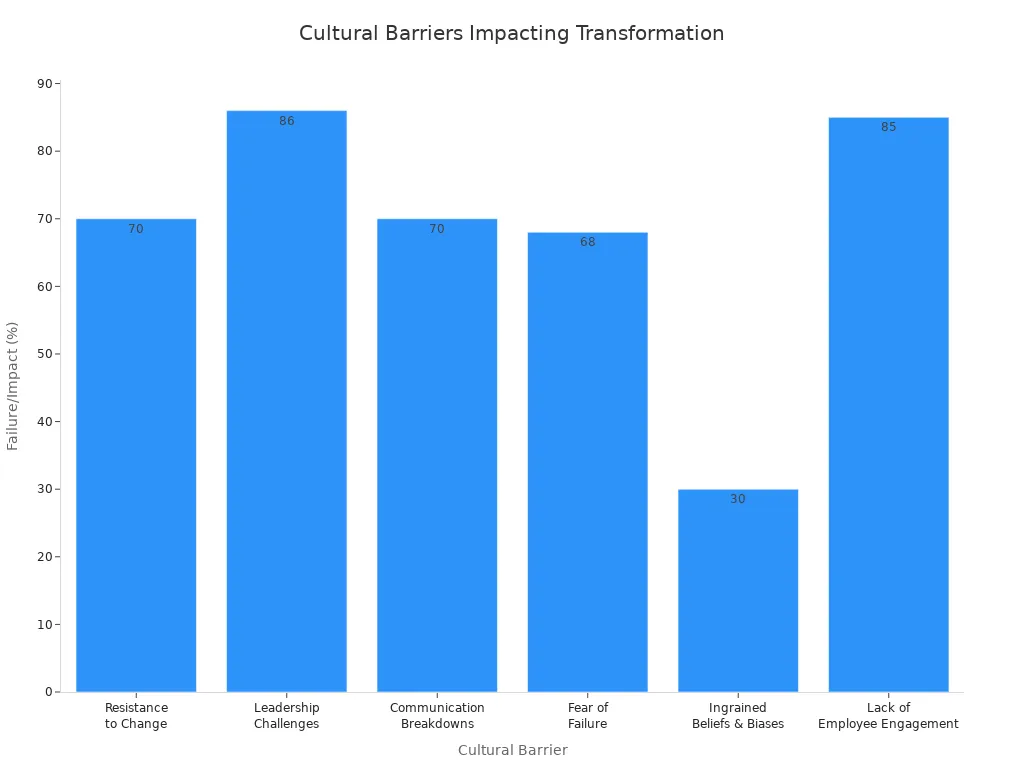
The data shows that resistance to change alone accounts for nearly 70% of transformation failures. These barriers do not exist in isolation. Change fatigue, fear of failure, and ingrained beliefs often reinforce each other. When organizations ignore these factors, agile transformations fail regardless of the tools or frameworks in place.
To overcome these obstacles, leaders must foster a growth mindset and create an environment where experimentation feels safe. They should encourage open dialogue, recognize small wins, and provide clear direction. By addressing both change fatigue and resistance, organizations can build the cultural foundation needed for lasting transformation.
The Power Architect Role
The power architect stands as the driving force behind organizational change. This role does not simply manage projects or oversee technology rollouts. Instead, the power architect redesigns authority, clarifies decision rights, and ensures that transformation efforts move beyond isolated pilots to become part of daily business operations. In digital environments, especially with platforms like Microsoft 365, this role unlocks the full potential of technology by aligning it with clear ownership and agile decision-making.
Redesigning Authority
Mapping Decision Rights
A successful transformation depends on more than new tools or frameworks. The power architect maps decision rights across the organization. This process identifies who holds authority for each critical decision and where bottlenecks exist. When decision-making remains fragmented, transformation efforts stay trapped in isolated pilots. Assigning one accountable executive or a clearly defined leadership group with decision authority improves alignment across risk, policy, budgets, and operations. Clear decision rights reduce delays and strengthen accountability because everyone knows who can approve, stop, or expand initiatives.
The article presents governance and accountability as a necessary condition for scaling transformation. It says adoption depends on governance structures that make ownership clear, define standards, and make accountability visible. It further indicates that explicit role assignment, oversight councils, dashboards, and escalation paths increase trust, connect initiatives to measurable outcomes, and help adoption move from pilot projects into routine operational decision-making.
|
Evidence point |
How it supports the query |
|---|---|
|
A Fortune 500 financial-services company changed its structure to agile-style networked teams, but results did not improve at first. |
This shows that structural redesign alone was insufficient for transformation success. |
|
The turning point came when leaders identified the most important decisions, assigned clear authority for each one, and set escalation rules. |
This is direct evidence that redesigning authority and decision rights was the key intervention. |
|
After decision ownership became transparent and accountable, the company reported better employee satisfaction and a much stronger ability to launch products and services faster. |
These are concrete transformation outcomes linked to clarified decision rights. |
|
The article also argues that visible accountability and clarity about who decides what help organizations learn from results and remove bottlenecks. |
This explains the mechanism: clearer authority speeds decisions, improves coordination, and strengthens execution during transformation. |
Clarifying Ownership
The power architect clarifies ownership at every level. They ensure that each team and leader understands their responsibilities. This clarity prevents confusion and reduces the risk of duplicated work. When ownership is visible, teams act with confidence. They know who to consult, who approves changes, and how to escalate issues. This approach builds trust and supports agility across the organization.
-
Clear ownership connects initiatives to measurable outcomes.
-
Visible accountability helps teams adapt quickly and deliver results.
-
Defined roles reduce friction and support continuous improvement.
Bridging Strategy and Execution
Integrating Functions
The power architect bridges the gap between strategy and execution. They start by understanding the reason for change. This includes both external pressures and internal opportunities for improvement. By grounding execution in real business context, the power architect ensures that transformation efforts address actual needs.
|
How the bridge works |
Evidence from the source |
|---|---|
|
Starts with the reason for change |
The article explains that architects begin by identifying why transformation is needed, including outside pressures and internal improvement opportunities, so execution is grounded in real business context. |
|
Turns strategy into defined goals |
It states that change drivers are converted into concrete business goals, which gives architects a basis for modeling what must change in the organization. |
|
Breaks large goals into smaller targets |
The source notes that high-level goals should be divided into sub-goals to create milestones, clarify ownership, and improve communication across stakeholders. |
|
Links goals to business capabilities |
It describes connecting goals with the capabilities, processes, applications, technology, and data needed to deliver them, helping leaders see what operational elements support strategy. |
|
Prioritizes execution through business cases |
The article says ideas for change should be assessed with cost, benefit, and risk measures so decision-makers can choose the most valuable initiatives to move into delivery. |
The power architect integrates functions by connecting goals with the capabilities, processes, and technology needed to deliver them. This integration supports strategic alignment and ensures that every part of the organization moves in the same direction.
Creating Alignment
Creating alignment requires more than setting goals. The power architect breaks large objectives into smaller, actionable targets. Each target has a clear owner and defined milestones. This structure improves communication and keeps stakeholders engaged. By linking goals to business capabilities, the power architect helps leaders see which operational elements support strategy. Prioritizing execution through business cases ensures that resources focus on the most valuable initiatives.
Enabling Agile Transformation
Adaptive Leadership
Agile transformation demands adaptive leadership. The power architect models this by responding to feedback, learning from outcomes, and adjusting plans as needed. Adaptive organizations thrive because they embrace change and encourage experimentation. The power architect fosters a culture where teams feel safe to try new approaches and learn from mistakes.
-
Adaptive leadership supports agility by removing barriers and empowering teams.
-
Leaders who adapt quickly help organizations respond to market shifts and customer needs.
Orchestrating Change
Orchestrating change means more than launching new projects. The power architect coordinates efforts across teams, functions, and levels. They ensure that everyone understands the vision and their role in achieving it. By making decision rights and ownership visible, the power architect reduces friction and accelerates progress. This orchestration transforms isolated initiatives into a unified movement toward business outcomes.
The power architect plays a central role in unlocking the full potential of Microsoft 365 and other digital platforms. By redesigning authority, bridging strategy and execution, and enabling agile transformation, this role delivers measurable outcomes and lasting agility. Strategic leadership from the power architect turns transformation from a one-time event into a continuous journey for the organization.
Impact of Power Architect on Transformation
Faster Decisions
Clear Authority
A power architect brings clarity to authority within an organization. They define who holds decision rights and ensure that every team understands its responsibilities. This clarity eliminates confusion and empowers teams to act quickly. When authority is visible, agile teams respond to challenges without waiting for approval from multiple layers. Business leaders see faster outcomes because decisions move directly to those with the right expertise. Clear authority supports agility and drives transformation forward.
Reduced Bottlenecks
Bottlenecks often slow progress in digital transformations. The power architect identifies where decisions stall and redesigns processes to remove obstacles. Teams gain the ability to resolve issues without delay. Agile methods thrive when bottlenecks disappear, allowing continuous transformation to unfold. Reduced bottlenecks mean that organizations adapt faster and deliver outcomes with greater consistency. Success becomes measurable as teams move from planning to execution without unnecessary interruptions.
Tip: Assigning clear ownership for each decision accelerates progress and builds confidence across agile teams.
Enhanced Collaboration
Cross-Functional Trust
Collaboration depends on trust between teams. The power architect fosters trust by encouraging open communication and recognizing individual strengths. Project managers play a vital role in resolving challenges and ensuring that recommendations are heard. Trust acts as the glue that holds teams together and accelerates progress. In agile environments, trust enables teams to share information freely and work toward common goals. Rebuilding trust is essential for successful transformations, especially when organizations face frequent change.
-
Project managers understand team strengths and remove obstacles.
-
Communication builds trust and ensures recommendations are considered.
-
Trust accelerates outcomes and supports agile collaboration.
Ownership Across Teams
Ownership across teams drives agility and adaptability. The power architect clarifies roles and responsibilities, making sure every team knows its part in the transformation. When ownership is visible, teams act with purpose and coordinate efforts. Agile organizations benefit from shared ownership, which reduces friction and enhances collaboration. Business outcomes improve as teams align their work with strategic goals. Ownership across teams supports continuous transformation and builds a culture of accountability.
|
Collaboration Factor |
Impact on Transformation |
|---|---|
|
Trust |
Accelerates progress |
|
Ownership |
Enhances agility |
|
Communication |
Builds alignment |
Sustainable Change
Embedded Behaviors
Sustainable change requires new behaviors to become part of daily operations. The power architect embeds these behaviors by modeling adaptability and encouraging experimentation. Adaptive organizations thrive when leaders support learning and reward innovation. Transformation becomes lasting when teams adopt new habits and integrate them into their routines. Embedded behaviors drive agility and ensure that change is not just a one-time event.
-
Adaptive reuse of buildings enhances energy efficiency and preserves cultural assets.
-
Nature-based solutions, such as the Sponge City concept, integrate green spaces and improve urban resilience.
-
Coastal seaforestation initiatives restore marine ecosystems and increase adaptability.
Continuous Adaptation
Continuous adaptation is essential for successful transformations. The power architect creates systems that allow organizations to adjust strategies and processes as conditions change. Agile teams learn from outcomes and refine their approach. Business leaders see ongoing improvement as teams respond to new challenges. The 2030 Palette provides strategies for implementing sustainable solutions, emphasizing the importance of adaptation in achieving long-term success. Continuous transformation ensures that organizations remain competitive and resilient.
Note: Continuous adaptation supports agility and drives sustainable outcomes in every transformation.
Real-World Examples
Microsoft 365 Transformation
From Tool Adoption to Power Redesign
Many organizations begin their digital transformation by deploying Microsoft 365. They often fall into the transformation trap, treating the platform as a set of tools rather than a catalyst for real change. Success stories show a different path. These organizations move beyond technology installation. They redesign authority, clarify decision rights, and prepare people for new ways of working. Leadership aligns on what success means, and teams receive clear guidance on responsibilities.
|
Evidence area |
How it supports the query |
|---|---|
|
The organization did not treat agility as a simple software rollout; it first changed how people actually worked with the platform. |
|
|
People were intentionally prepared |
Redesign of responsibility and decision readiness allowed staff to act effectively, not just receive a tool. |
|
Data was organized to enable automation |
Operating authority moved toward structured, scalable processes that let teams respond faster. |
|
Infrastructure was made deployment-ready |
Agility depended on broader organizational readiness, not only licensing or installation. |
|
Leadership agreed on what success meant |
Leaders aligned decision-making and governance, enabling coordinated action instead of isolated tool use. |
These steps show that agility comes from redesigning the environment, roles, and leadership alignment. Organizations that focus on authority and readiness unlock the full value of Microsoft 365.
Unlocking Agility
Agility emerges when teams can act without waiting for approvals. In these cases, data supports automation, and infrastructure enables rapid deployment. Leadership alignment ensures that everyone understands the goals. This approach transforms Microsoft 365 from a digital toolset into a foundation for agile business transformations. Teams respond faster, outcomes improve, and the organization avoids costly experimentation with technology alone.
Agile Turnaround
Restoring Alignment
One global manufacturer faced stalled agile initiatives. Teams struggled with competing priorities and vague outcomes. The power architect intervened, mapping decision rights and clarifying ownership. Leaders restored alignment by breaking large goals into smaller, actionable targets. Each team received clear direction and measurable milestones.
Building Confidence
As teams saw progress, confidence grew. Ownership became visible across functions. Communication improved, and trust replaced resistance. The organization moved from isolated pilots to a unified agile approach. This turnaround demonstrated that clarity and ownership drive agility, not just new frameworks or technology.
Cultural Transformation Success
Reinforcing New Behaviors
Cultural transformation requires more than new policies. Organizations reinforce new behaviors by aligning leadership messaging, recognition, and daily practices.
|
Reinforcement area |
Evidence supporting the query |
|---|---|
|
Leadership messaging |
Culture change gained traction when leaders modeled expected behaviors and communicated a shared view of the future. |
|
Employee reinforcement |
Organizations recognized and celebrated employees who demonstrated target behaviors, making those examples visible. |
|
Communication practices |
Frequent, open, two-way communication explained what was changing, why it mattered, and how people were affected. |
|
Storytelling |
Sharing real stories of employees and teams living the values made the desired culture concrete. |
|
Feedback loops |
Ongoing channels for employee input kept people engaged during the transition. |
|
System reinforcement |
Performance management, advancement, recruitment, and onboarding tied to new values reinforced the culture. |
Leadership Messaging
Leaders play a critical role in sustaining cultural transformation. They model new behaviors, communicate consistently, and celebrate milestones. Organizations that embed these practices see lower turnover and stronger engagement. Long-term sustainment depends on continued feedback, recognition, and corrective action when behaviors drift. This approach ensures that new norms become permanent, supporting lasting outcomes and agility.
Becoming a Power Architect
Leaders rarely need more activity. They need better authority design. A power architect becomes essential when an organization sees strong effort, weak movement, and repeated delays. In many agile programs, teams work hard, yet decisions still sit in queues. That pattern signals a structural problem, not an execution problem.
Identifying the Need
Stalled Initiatives
Stalled initiatives usually share the same warning signs:
-
unclear decision rights
-
long approval chains
-
fragmented ownership
-
poor alignment between authority and access
A team may use Microsoft 365 well, yet still miss outcomes because nobody can approve, escalate, or act at the right time. In that setting, agile delivery slows down. agility drops. The organization adds meetings instead of motion. Many agile efforts also stall when leaders fail to design decision flow, data ownership, access rules, interaction patterns, and escalation paths early.
Tip: Persistent bottlenecks after new tools arrive often show that the real gap sits in decision structure.
Unclear Ownership
Unclear ownership weakens every transformation. Several leaders may influence a result, yet none may own it end to end. That ambiguity damages agility and blurs accountability. An organization should ask a simple question: who has final authority when priorities conflict? If the answer feels political or vague, the organization likely needs stronger change management. Strong ownership helps agile teams protect focus, improve outcomes, and support business value.
Key Traits
Systems Thinking
Systems thinking helps leaders see how power really moves through an organization. A strong architect studies reporting lines, informal influence, access points, and escalation habits. That view supports agility because it links structure to execution. adaptive organizations develop this skill on purpose. They know agile success depends on patterns, not slogans.
Credibility
Credibility gives the role force. Leaders trust people who listen well, explain clearly, and act with courage. The strongest candidates often show empathy, humility, tact, curiosity, and courage. They also influence across functions, tell clear stories, build rapport, and keep a long-term mindset. Those traits help agile teams accept change without confusion.
Practical Steps
Audit Power Structures
Leaders should conduct a structural diagnosis before launching another transformation push. A simple audit can reveal where accountability is diffused, where authority stays informal, and where bottlenecks block agility.
|
Practical step |
Leadership focus |
|---|---|
|
Name one clear owner |
End-to-end accountability |
|
Find diffused accountability |
One answerable leader |
|
Review formal authority |
Clear reporting and governance |
Clarify Decision Rights
Leaders should map major decisions in advance. They should define who decides, who advises, who executes, and who escalates. This step strengthens agile coordination and reduces friction.
Build Capability
Capability building matters as much as structure. Leaders should coach managers to influence, listen, and resolve conflict. That investment improves agility, protects outcomes, and sustains transformation over time.
Transformation thrives when leaders redesign power structures instead of relying solely on technology. The Power Architect aligns strategic goals, authority, and culture, driving lasting organizational transformation. Ownership, decision rights, and adaptive leadership unlock Microsoft 365’s potential and support continuous transformation. Business leaders can measure success through user engagement and Copilot activity. Strategic alignment creates resilient organizations ready for digital change.
|
Focus area |
Long-term benefits |
|---|---|
|
Ownership |
Stronger self-direction and ongoing learning |
|
Decision rights |
Faster decisions and greater agility |
|
Adaptive leadership |
Enhanced innovation and resilience |
|
Evidence element |
Support for transformation success |
|---|---|
|
ING transformation example |
Organizational redesign mattered more than technology installation |
|
Comparative success-rate data |
Broad transformation approach outperforms technology-first efforts |
|
McKinsey predictors |
Internal ownership and sustained change drive success |
|
User Type |
Criteria for Measurement |
|---|---|
|
Power users |
15+ Copilot actions/week for 9 of past 12 weeks |
|
Habitual users |
1–14 Copilot actions/week for 9+ of past 12 weeks |
|
Novice users |
At least 1 Copilot action/week within past 12 weeks |
FAQ
What is a Power Architect in digital transformation?
A Power Architect redesigns authority and decision rights. They help organizations unlock the full value of digital platforms by clarifying ownership and streamlining decision-making.
How does a Power Architect support agile teams?
A Power Architect removes bottlenecks and clarifies roles. They enable agile teams to make faster decisions and adapt quickly to changing business needs.
Why do agile transformations often fail?
Agile transformations fail when organizations leave power structures unchanged. Teams struggle with unclear authority and slow decision-making, which blocks progress.
How can leaders identify the need for a Power Architect?
Leaders notice stalled initiatives, unclear ownership, and repeated delays. These signs indicate that the organization needs a Power Architect to redesign authority and improve outcomes.
What is the impact of clarifying decision rights?
Clarifying decision rights speeds up decision-making. Teams gain confidence and act with purpose, which supports agile transformation and drives measurable results.
How does Microsoft 365 benefit from a Power Architect?
Microsoft 365 delivers greater value when a Power Architect aligns technology with clear ownership. This approach removes bottlenecks and supports agile collaboration.
What skills make a strong Power Architect?
A strong Power Architect uses systems thinking and builds credibility. They understand organizational dynamics and influence change across teams.
🎧 Listen to this episode
Want a practical explanation of The Power Architect Role in Microsoft 365 Transformation? This episode breaks down the topic in clear language and shows why it matters for Microsoft 365, Azure, Power Platform, security, AI, and modern work.
Listen to this episode if you want to:
- Understand the key concepts behind The Power Architect Role in Microsoft 365 Transformation
- See how it fits into the wider Microsoft technology ecosystem
- Learn where it can create practical value for your organization
You may also enjoy these related M365 FM episodes:
- Compliance as Code: The Architect’s Blueprint for Automated Trust
- From SharePoint Developer to Power Platform Architect with Michel Mendes [MVP]
- Leading AI Transformation and Community with Areti Iles [MVP]
- 7 Levels of Azure Administration: Beginner to Cloud Architect
- Architect $1M in Efficiency with Power Platform Governance
Discover more practical Microsoft conversations on M365 FM.
Apple Podcasts · Spotify · YouTube · YouTube Music
Host: Mirko Peters