


 Apple Podcasts
 Spotify
 Youtube Music
 Spreaker
 Podchaser
 Amazon Music
 Stop Deepfake Business Email Compromise with Verified ID
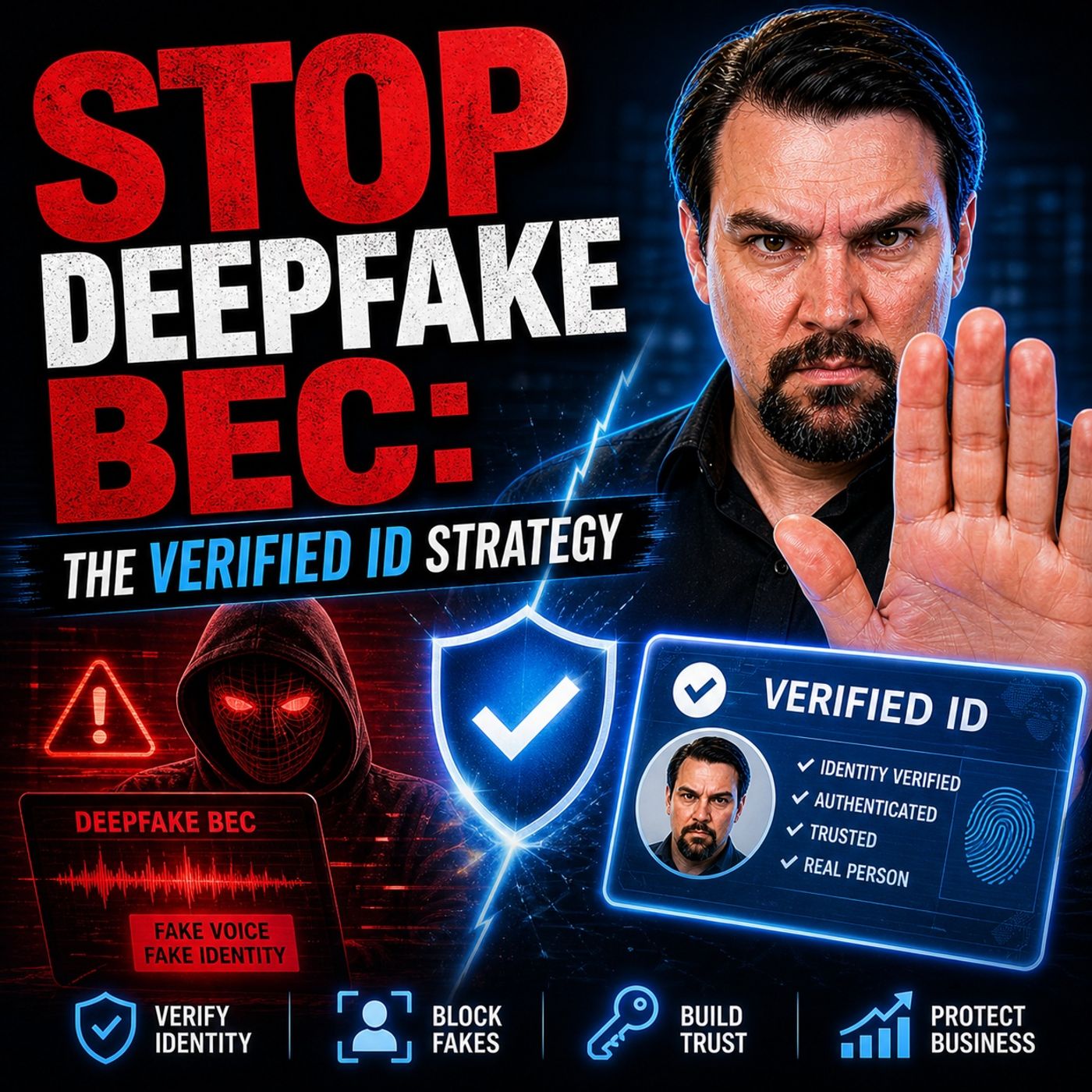
This episode explores how deepfake-enabled Business Email Compromise (BEC) attacks are becoming more convincing and dangerous for organizations. Traditional trust signals like email addresses, writing style, or even voice messages are no longer reliable because attackers can now imitate executives and employees with AI-generated content.
The episode explains that organizations must move away from trust based on appearance and instead adopt identity verification as a core security strategy. Verified ID systems, strong identity governance, and cryptographic proof of identity are presented as the future foundation for secure communication and approval workflows.
A major focus is the risk around financial approvals, executive requests, and sensitive business operations. The discussion highlights how attackers exploit urgency, authority, and familiarity to bypass human judgment. Even experienced employees can be manipulated when deepfake audio, video, or realistic email impersonation is involved.
The episode argues that security awareness training alone is no longer enough. Instead, organizations need architecture-level protection through identity validation, conditional access policies, multi-factor authentication, approval segregation, and zero-trust principles. Verified identity must become part of every high-risk business process.
The overall message is that AI-powered impersonation attacks will continue to grow, and companies that still rely on “it looks legitimate” as a security model are increasingly vulnerable. The future of enterprise security depends on provable digital identity rather than human perception.
You may believe that SPF, DKIM, and DMARC protect you from every email threat. In reality, these protocols only check if the sender is authentic. They do not examine the content or intent. Today, Deepfake BEC Attacks have changed the game. Consider these facts:
- In 2023, less than 5% of business email compromise attacks used deepfake technology.
- By 2026, this number reached 40%.
- The FBI reported a 25% year-over-year increase in deepfake-enabled BEC attacks in 2024.
- Deepfake attacks surged over 300% year over year.
Key Takeaways
- SPF, DKIM, and DMARC focus on sender authentication but do not analyze email content or intent.
- Deepfake BEC attacks use AI to create realistic impersonations, making them harder to detect than traditional phishing.
- Employee training is crucial. Regular sessions on recognizing deepfake threats can empower staff to respond effectively.
- Out-of-band verification adds a layer of security. Always confirm sensitive requests through a different communication channel.
- Advanced threat detection tools can identify unusual patterns and help catch deepfake attempts before they cause harm.
- Strong policies are essential. Update procedures to include verification steps for all types of communication.
- Microsoft Entra Verified ID enhances security by requiring proof of identity and authority for high-risk actions.
- Stay vigilant. Deepfake technology evolves quickly, so continuous monitoring and training are necessary to protect your organization.
Deepfake BEC Attacks Explained
What Is Deepfake BEC
You may have heard about phishing and BEC, but deepfake BEC takes these threats to a new level. In a deepfake BEC attack, cybercriminals use artificial intelligence to create fake voices, videos, or messages that look and sound real. Attackers can mimic the voice of your CEO or create a video that appears to come from your finance director. These attacks do not just rely on tricking you with a fake email address. Instead, they use advanced technology to make you believe you are interacting with someone you trust. Deepfake BEC attacks often target employees who handle money or sensitive information. The goal is to convince you to transfer funds or share confidential data.
How Deepfake BEC Differs from Traditional Threats
Traditional BEC and phishing attacks usually depend on written messages. Attackers might send you an email that looks like it comes from your boss, asking for a wire transfer. Deepfake BEC changes the game by adding realistic audio or video. You might receive a phone call that sounds exactly like your manager or see a video message that looks genuine. This makes deepfake BEC much harder to detect than regular phishing. Attackers can now exploit your trust and sense of urgency in ways that older security tools cannot catch.
Deepfake technology has changed BEC threats by allowing criminals to impersonate authority figures more convincingly. This makes it easier for them to manipulate you and bypass traditional security filters.
Here is a table that shows the main differences:
| Aspect | Traditional BEC | Deepfake BEC |
|---|---|---|
| Communication Method | Text-based communication | Incorporates voice calls or video |
| Deception Techniques | Relies on written requests | Uses realistic synthetic media |
| Detection Evasion | Can be caught by text filters | Bypasses checks with audio/video |
Deepfake BEC attacks can manipulate you more effectively because of realistic voice or video. They exploit urgency and authority, making them more dangerous than traditional phishing. Internal security checks often fail to stop these attacks, which increases the risk for your organization.
The Role of AI in Deepfake BEC
Artificial intelligence powers deepfake BEC. Attackers use AI to gather information about your company and its leaders. They clone voices and writing styles to make their messages seem real. Here is how a typical deepfake BEC attack works:
- Attackers collect details about your executives and company structure.
- They use AI to clone voices or create fake videos.
- Personalized phishing emails or calls are sent to you.
- Attackers follow up with more messages to increase pressure.
- The goal is to trick you into transferring money or sharing sensitive data.
Major banks have reported deepfake calls using voice cloning to access accounts. In one case, a financial worker transferred funds after a deepfake attack, causing significant losses. Deepfake BEC is not just another phishing scam. It is a new form of deepfake fraud that uses AI to target you in ways that older attacks never could.
SPF, DKIM, and DMARC: How They Work
SPF Overview
You need to understand how SPF, or Sender Policy Framework, works to protect your organization from email threats. SPF checks if the mail server sending a message is allowed to send emails for that domain. When you receive an email, your system looks up the SPF record in the domain’s DNS. If the sending server’s IP address matches the approved list, the message passes SPF. This process helps stop attackers from pretending to send emails from trusted domains. However, SPF does not check the visible “From” address, so it cannot stop all phishing or deepfake attempts. Attackers can still use social engineering to trick you, especially when they combine phishing with deepfake audio or video.
DKIM Overview
DKIM, or DomainKeys Identified Mail, adds another layer of security. It attaches a digital signature to each outgoing email. Your email system uses a public key in DNS to verify this signature. If the signature matches, you know the message has not been changed in transit. DKIM helps you trust that the content is genuine and that the sender is who they claim to be. Still, DKIM alone cannot stop deepfake or phishing attacks that use realistic voice or video. Attackers can forward emails or use compromised accounts to bypass DKIM checks. You must remember that DKIM focuses on message integrity, not on the intent behind the message.
DMARC Overview
DMARC, or Domain-based Message Authentication, Reporting, and Conformance, brings SPF and DKIM together. DMARC lets domain owners tell email receivers how to handle messages that fail SPF or DKIM checks. It also provides feedback reports, so you can see who is trying to spoof your domain. DMARC protects the visible “From” header, making it harder for attackers to use exact-domain spoofing. Most major email providers now require DMARC, SPF, and DKIM for bulk senders. DMARC is the only protocol that prevents exact-domain spoofing, but it does not analyze the content or intent of the message. Attackers can still use deepfake technology to create convincing phishing messages or calls that lead to bec or fraud.
Tip: SPF, DKIM, and DMARC work best together. They stop many phishing emails, but they cannot detect deepfake threats that use audio or video to trick you.
Here is a table that summarizes the main functions of these protocols:
| Protocol | Main Function | How it Works | Strengths | Limitations |
|---|---|---|---|---|
| SPF | Verifies sending mail server's authorization | Checks server’s IP against SPF record in DNS | Prevents domain spoofing; easy setup | Does not validate visible “From” address; limited against phishing alone |
| DKIM | Ensures email content integrity and sender identity | Adds cryptographic signature; verified via public key in DNS | Guarantees message integrity; builds trust | Can be broken by forwarding; needs key management |
| DMARC | Combines SPF and DKIM; manages unauthenticated mail | Evaluates SPF/DKIM; applies policy and sends reports | Gives control to domain owners; reduces phishing | Needs SPF/DKIM to work; complex configuration |
You should use these protocols as part of your defense, but always stay alert for deepfake and phishing attacks that can bypass technical controls.
What These Protocols Protect
You might wonder what SPF, DKIM, and DMARC actually protect in your email system. These protocols focus on verifying the sender’s identity and making sure the message has not been tampered with during transit. They help you block many common phishing attempts that try to trick you with fake sender addresses or altered messages. When you use these protocols together, you create a strong barrier against basic email threats.
Let’s break down what each protocol covers:
- SPF checks if the email comes from an authorized server. This helps you spot emails that pretend to be from your company but actually come from outside sources.
- DKIM adds a digital signature to each message. This signature lets you confirm that the message content has not changed since it left the sender.
- DMARC combines the strengths of SPF and DKIM. It tells your email system how to handle messages that fail these checks. DMARC also gives you reports about suspicious activity.
Here is a table to help you see what these protocols protect:
| Protocol | Protects Against | Does Not Protect Against |
|---|---|---|
| SPF | Fake sender servers, some phishing | Deepfake, content-based phishing, voice/video scams |
| DKIM | Message tampering, some phishing | Deepfake, social engineering, voice/video scams |
| DMARC | Domain spoofing, some phishing | Deepfake, intent-based attacks, voice/video scams |
You need to know that these protocols do not check the actual content of the message. They do not look for signs of deepfake or advanced phishing. Attackers can use deepfake technology to create convincing audio or video messages that bypass these checks. For example, you might receive an email that passes SPF, DKIM, and DMARC, but the attacker follows up with a deepfake phone call. This call could use a cloned voice to pressure you into sending money or sharing sensitive information.
Phishing attacks have evolved. Attackers now use deepfake tools to make their scams more believable. You cannot rely on email authentication alone to stop these threats. Deepfake messages can sound or look exactly like your boss or a trusted partner. These protocols do not analyze the intent behind a message or verify if the person making a request has the right authority.
Note: SPF, DKIM, and DMARC help you stop many phishing emails, but they do not protect you from deepfake attacks or advanced fraud. You need extra layers of security to defend against these modern threats.
You should always stay alert for new types of phishing and deepfake attacks. Train your team to recognize suspicious requests, even if the email looks legitimate. Remember, these protocols are important, but they are not enough to stop every type of bec or fraud.
Limitations for Deepfake BEC
Sender Authentication vs. Content Verification
You may trust SPF, DKIM, and DMARC to protect your inbox. These protocols focus on sender authentication. They check if the email comes from an approved server and if the message has not changed during transit. However, they do not verify the actual content or intent of the email. Attackers can manipulate the "From" field and exploit domain alignment issues. You might receive an email that passes all technical checks but still contains a dangerous request.
Deepfake BEC attacks use AI to craft emails that look genuine. The protocols do not analyze the message itself. This gap allows attackers to send highly convincing phishing emails. You may see a message that appears to come from your CEO, but the content is fake. The protocols only check the infrastructure, not the person behind the message.
Here is a table that shows the main limitations:
| Protocol | Limitation |
|---|---|
| SPF | Does not verify email content and lacks instructions for handling failures. |
| DKIM | Verifies message integrity but does not dictate actions on failures and can fail in forwarding scenarios. |
| DMARC | Requires correct SPF and/or DKIM setup to enforce policies effectively. |
You need to understand that these protocols do not check if the sender is truly who they claim to be. They do not look for signs of deepfake fraud or business email compromise. Attackers can use deepfake technology to create emails that pass all checks but still trick you.
Why Deepfake BEC Attacks Succeed
Deepfake BEC attacks succeed because they exploit gaps in traditional email security. Attackers use AI-generated emails, voice, and video to impersonate executives. You may receive a request that sounds or looks exactly like your manager. The protocols cannot detect deepfake content or intent. You might trust the message because it passes SPF, DKIM, and DMARC, but the sender is not legitimate.
Many email services remain vulnerable to spoofing attacks. SMTP smuggling affects thousands of public and private email services. Attackers can bypass authentication protocols and send phishing emails that look real. You may not notice the difference until it is too late.
Here is a table that highlights these vulnerabilities:
| Vulnerability Type | Affected Services | Description |
|---|---|---|
| SMTP Smuggling | 19 public email services, 1,577 private email services, 5 open-source mail packages, 1 commercial email gateway | These services remained vulnerable to spoofing attacks nearly two years after the vulnerability was disclosed, indicating gaps in the implementation of email authentication protocols. |
You need to stay alert. Deepfake BEC attacks combine email, voice, and video. This multi-channel approach makes detection harder. Attackers can bypass standard verification methods and trick you into approving payments or sharing sensitive information. Many cybersecurity decision-makers lack confidence in countering deepfake attacks. Security awareness training is often only moderately effective against deepfake audio and video.
- 60% of cybersecurity leaders lack confidence in countering deepfake attacks.
- 38% rate training as moderately effective or worse against deepfake audio.
- 39% rate training as moderately effective or worse against deepfake video.
- 28% believe AI-generated phishing is just beginning.
- 25% say deepfake audio attacks are in early stages.
You must recognize that deepfake BEC attacks are evolving. Attackers use advanced tools to bypass traditional email security best practices. You cannot rely on sender authentication alone.
Common Security Misconceptions
Many people believe that SPF, DKIM, and DMARC provide complete protection. You may think that reaching a DMARC policy of p=none is enough. In reality, this policy only reports suspicious activity. It does not block phishing or deepfake BEC attacks. You need a stronger policy, such as p=quarantine or p=reject, for real protection.
Some believe that transactional emails do not need authentication. You must authenticate all emails to ensure delivery and protect your brand. Proper authentication helps you avoid spam filters and builds trust with your recipients.
Others worry that implementing these protocols requires major technical expertise. Many tools and resources make compliance easier. You can follow simple steps to improve your email security.
Here is a table that clears up common myths:
| Myth | Truth |
|---|---|
| You only need to reach a DMARC policy of p=none to protect yourself. | A policy of p=none is just for reporting and does not provide actual protection against phishing. A stronger policy like p=quarantine or p=reject is needed for true security. |
| We only send transactional emails, so these changes don’t apply to us. | Transactional emails also require sender authentication to ensure delivery and protect the brand. Proper authentication helps avoid spam filters and builds trust. |
| Implementing these changes will require major technical expertise. | Many tools and resources are available to simplify compliance, making it accessible even for non-technical users. |
Note: You must understand that deepfake BEC attacks can bypass traditional protocols. You need to combine technical controls with human awareness and advanced detection tools. Attackers use deepfake technology to create convincing phishing messages. You must stay vigilant and update your security practices to defend against modern fraud.
Deepfake BEC Attack Methods

Real-World Scenarios
You may think deepfake attacks only happen in movies, but real companies have lost millions to these scams. In January 2024, attackers targeted Arup, a global engineering firm, using deepfake technology. They created a fake video conference with the company's Chief Financial Officer. The attackers used AI-generated video and audio to impersonate the CFO. Employees believed they were speaking with their real leader. The attackers convinced staff to transfer $25 million. This case shows how deepfake BEC can bypass traditional phishing defenses and email security best practices.
You can see that deepfake BEC attacks do not just use emails. Attackers combine video, voice, and written messages to make their scams more believable. These methods make detection much harder for you and your team.
Deepfake Techniques in BEC
Attackers use deepfake technology to impersonate trusted individuals in your organization. You may receive a message from someone who looks and sounds like your CEO. High-profile scams often involve fraudsters pretending to be C-suite members. This makes it very hard for you to spot a scam, especially when requests come from familiar voices or faces.
Deepfake BEC can lead to unauthorized wire transfers and exposure of sensitive financial data. Attackers exploit trust and urgency. They know you want to help your boss or respond quickly to important requests. Here are some ways deepfake fraud works in BEC:
- Deepfake scams have caused large financial losses for organizations.
- Attackers impersonate executives to exploit trust and urgency, making fraudulent requests harder to detect.
- You may receive a video call or voicemail that sounds exactly like your manager.
- Attackers use AI to craft emails that match your company’s style and tone.
You must stay alert for these advanced phishing tactics. Deepfake BEC attacks use multiple channels, so you cannot rely on email security alone.
Human Factors in Deepfake BEC
You play a key role in stopping deepfake BEC. Attackers use psychology to trick you. They know how to push your buttons and make you act fast. Research shows that certain human factors make deepfake attacks more successful. The table below explains these principles:
| Principle | Description |
|---|---|
| Authority | Attackers impersonate authority figures, leading individuals to comply without questioning. |
| Urgency | Messages create time pressure, prompting quick and unreflective actions. |
| Social proof | Claims of conformity, such as colleagues completing updates, leverage social influence. |
| Scarcity | Limited-time offers create fear of missing out, increasing compliance. |
| Reciprocity | Providing something of value creates an obligation to reciprocate, enhancing compliance likelihood. |
| Liking | People are more likely to comply with requests from those they like or feel connected to. |
You may feel pressure to act quickly when you get a request from a leader. Attackers use these tricks to bypass your judgment. You must slow down and verify requests, especially when money or sensitive data is involved. Training and awareness help, but you need strong detection tools and policies to stop deepfake BEC attacks.
Stay cautious. Deepfake BEC is not just a technical problem. It targets your trust, your habits, and your willingness to help.
Defending Against Deepfake BEC
Employee Training
You play a critical role in stopping deepfake BEC attacks. Attackers often target you because human error remains a common entry point for fraud. Training helps you recognize and respond to suspicious requests. Traditional training covers phishing and email security best practices, but deepfake threats require a new approach.
Deepfake simulation training platforms expose employees to synthetic media cyberattacks in a controlled environment. Employees receive simulated deepfake scenarios, such as a fake video call from a synthetic version of a senior executive, allowing them to practice recognition and response. This method builds the muscle memory needed to detect these attacks effectively.
You should participate in regular training sessions that include real-world scenarios. Practicing with simulated attacks helps you spot unusual requests and respond calmly. When you know what to expect, you can act quickly and avoid costly mistakes.
Advanced Threat Detection
Technology can help you spot deepfake BEC attempts before they cause harm. Modern security tools use artificial intelligence and machine learning to detect unusual activity. These systems look for patterns that do not match normal behavior. They can alert you when something seems off.
Here is a table that shows some advanced threat detection technologies:
| Technology Type | Description |
|---|---|
| AI-powered fraud detection | Utilizes artificial intelligence to identify fraudulent activities, including deepfake attempts. |
| Anomaly detection systems | Monitors for unusual patterns that may indicate deepfake BEC attempts. |
| Deepfake detection tools | Specialized tools designed to identify AI-generated content, enhancing security against deepfakes. |
You should work with your IT team to make sure these tools are in place. Automated systems can catch threats that humans might miss. They add another layer of protection to your organization.
Out-of-Band Verification
You can stop many deepfake BEC attacks by confirming requests through a second channel. Out-of-band verification means you use a different method to check if a request is real. For example, if you get an urgent email asking for a wire transfer, you should call the sender using a known phone number or send a message through a secure app.
- Out-of-band verification is essential for confirming urgent or unusual requests through secure channels, such as internal messaging apps or direct phone calls.
- Users should confirm sensitive requests through two separate, pre-approved channels, like an internal authentication app and a team messaging platform, to counter deepfake threats.
This simple step can prevent fraud. Attackers may trick you with a convincing email or video, but they cannot easily fake a second, secure channel. Always double-check before you act on high-risk requests.
By combining employee training, advanced threat detection, and out-of-band verification, you build a strong defense against deepfake BEC. These steps help you protect your organization from modern threats and keep your data safe.
Policy Improvements
You need strong policies to protect your organization from deepfake BEC attacks. Policies set clear rules for how you handle requests, approve payments, and share sensitive information. When you update your policies, you make it harder for attackers to trick you.
Start by reviewing your current procedures. Look for gaps that deepfake attacks could exploit. For example, you might not have rules for verifying requests that come through video calls or voice messages. Add steps that require you to confirm high-risk actions through a second channel. This helps you catch fake requests before they cause harm.
You should create a policy that covers all types of communication. Include email, phone calls, video meetings, and instant messages. Make sure your policy explains how to verify the identity and authority of anyone making a request. Require proof before you approve payments or share confidential data.
Here is a table that shows common policy types and their benefits:
| Policy Type | Benefit |
|---|---|
| Multi-channel verification | Stops fraud by requiring checks in two ways |
| Role-based approval | Limits who can approve high-risk actions |
| Incident reporting | Helps you respond quickly to suspicious activity |
| Regular policy reviews | Keeps your defenses up to date |
You should also set rules for reporting incidents. If you spot a suspicious request, report it right away. Quick reporting helps your team respond and prevent losses. Make it easy for everyone to know how to report and who to contact.
Update your policies often. Deepfake technology changes fast. Review your rules every few months. Ask your team for feedback. They might notice new risks or suggest better ways to verify requests.
Tip: Clear policies help you stop phishing and deepfake attacks. When everyone knows the rules, you reduce mistakes and keep your organization safe.
You can use policy templates from trusted sources. Customize them to fit your needs. Make sure your policies are easy to understand. Use simple language and clear steps. Train your team on the new rules. Practice with real-world scenarios so everyone knows what to do.
Strong policies give you a foundation for defending against deepfake BEC. When you combine clear rules with training and technology, you build a safer workplace. Stay alert, update your policies, and protect your organization from modern threats.
Microsoft Entra Verified ID Solution
How Entra Verified ID Works
You need more than basic email checks to stop deepfake bec attacks. Microsoft Entra Verified ID gives you a new way to verify both identity and authority. This solution uses a decentralized model. You do not just trust a message or a familiar name. You require proof before you approve any high-risk action.
Entra Verified ID uses visual verification methods. You can ask users to show a government-issued photo ID or join a video call. Liveness detection checks if the person is physically present. This step makes it much harder for attackers to use deepfake bec. The system also cross-references IDs with trusted databases. Device attestation and behavioral biometrics help spot unusual activity. You can restrict multi-factor authentication enrollment to strong methods, which blocks weak options like SMS or voice calls.
Note: Entra Verified ID does not replace your current controls. It adds a strong layer that focuses on proof, not just recognition.
Authority Verification vs. Identity Verification
You might think that knowing who someone is will keep you safe. In reality, deepfake bec can trick you by copying voices or faces. Identity verification checks if a person matches their claimed identity. Authority verification goes further. It confirms if the person has the right to make a request or approve a payment.
Entra Verified ID uses an issuer-holder-verifier model. This model gives you flexibility and control. Here is how it works:
| Dimension | IDV-issued credential | Org-issued credential |
|---|---|---|
| Issuer | Third-party identity verification provider | Your organization through its own Verified ID authority |
| Trust Anchor | The IDV's issuer DID and reputation | Your organization's DID and onboarding process |
| Portability | Higher portability across employers | Strongest inside a known workforce or partner boundary |
| Revocation | Controlled by the IDV | Controlled directly by the organization |
| Cost | Partner-priced with fees | Core issuance included with Entra |
| Data Liability | More raw identity evidence stays with the IDV | More assurance and evidence handling decisions stay with the organization |
| Best-fit Scenarios | Pre-employment proofing, account recovery | Workforce access, B2B trust inside known boundaries |
This model lets you issue credentials for both identity and authority. You can revoke or update them as needed. You keep control over who can approve sensitive actions.
Integrating Entra Verified ID with Existing Security
You do not need to start from scratch. You can add Entra Verified ID to your current security setup. This solution works with your existing policies and detection tools. It does not replace them. Instead, it gives you a way to require proof before anyone can complete a risky action.
You can combine visual verification, device checks, and behavioral analysis. This approach helps you spot deepfake bec before it causes harm. You can also limit access to only those who hold valid credentials. This shift from recognition-based trust to evidence-based verification protects you from modern threats.
Tip: Use Entra Verified ID to confirm both identity and authority. This step helps you stop deepfake bec attacks and keep your organization safe.
You cannot rely on SPF, DKIM, and DMARC alone to stop deepfake BEC attacks. These tools do not block lookalike domains or AI-powered impersonation.
SPF, DKIM, and DMARC do not prevent lookalike domain attacks, cousin domain attacks, or impersonation via free webmail accounts. These protocols rely on human judgment, which can be easily manipulated by AI-generated content.
You need a multi-layered defense. Start with employee education, risk management, and best practices. Add advanced solutions like Microsoft Entra Verified ID for authority verification.
- In 2024, BEC attacks caused $2.9 billion in losses in the U.S.
- The average BEC scam cost businesses $137,132 per incident.
Use phishing simulations, continuous monitoring, and regular training to measure your defenses and keep your organization safe.
🎧 Listen to this episode
Want a practical explanation of Stop Deepfake Business Email Compromise with Verified ID? This episode breaks down the topic in clear language and shows why it matters for Microsoft 365, Azure, Power Platform, security, AI, and modern work.
Listen to this episode if you want to:
- Understand the key concepts behind Stop Deepfake Business Email Compromise with Verified ID
- See how it fits into the wider Microsoft technology ecosystem
- Learn where it can create practical value for your organization
You may also enjoy these related M365 FM episodes:
- Service Principal Security: Stop Using Personal Accounts
- Stop Microsoft Copilot Prompt Injection with Azure Logic Apps
- Stop Outsourcing Human Judgment to Microsoft Copilot
- Stop Azure Cost Entropy with Ownership and Budget Controls
- How to Stop AI Agents from Deleting Important Emails
Discover more practical Microsoft conversations on M365 FM.
🚀 Want to be part of m365.fm?
Then stop just listening… and start showing up.
👉 Connect with me on LinkedIn and let’s make something happen:
- 🎙️ Be a podcast guest and share your story
- 🎧 Host your own episode (yes, seriously)
- 💡 Pitch topics the community actually wants to hear
- 🌍 Build your personal brand in the Microsoft 365 space
This isn’t just a podcast — it’s a platform for people who take action.
🔥 Most people wait. The best ones don’t.
👉 Connect with me on LinkedIn and send me a message:
"I want in"
Let’s build something awesome 👊
1
00:00:00,000 --> 00:00:01,680
A wire request lands in your inbox.
2
00:00:01,680 --> 00:00:03,360
The name looks right, the tone feels right.
3
00:00:03,360 --> 00:00:04,960
Maybe there is even a voice note attached
4
00:00:04,960 --> 00:00:06,520
that sounds exactly like your CEO.
5
00:00:06,520 --> 00:00:08,800
In the past, that felt like enough to hit send,
6
00:00:08,800 --> 00:00:10,880
but in reality, it isn't anymore.
7
00:00:10,880 --> 00:00:13,200
The problem we are facing isn't just simple spoofing.
8
00:00:13,200 --> 00:00:14,800
It is believable authority.
9
00:00:14,800 --> 00:00:17,360
Tools like SPF, D-Cyme, and DMARC
10
00:00:17,360 --> 00:00:19,920
help confirm the path an email took to get to you,
11
00:00:19,920 --> 00:00:21,800
but they cannot confirm the actual person
12
00:00:21,800 --> 00:00:22,640
behind the decision.
13
00:00:22,640 --> 00:00:24,840
That specific gap is where deepfake business email
14
00:00:24,840 --> 00:00:25,960
compromise lives.
15
00:00:25,960 --> 00:00:27,720
It slips right between authentic delivery
16
00:00:27,720 --> 00:00:29,120
and authentic authority.
17
00:00:29,120 --> 00:00:31,040
The shift we need is simple, but it's massive.
18
00:00:31,040 --> 00:00:34,080
We have to stop trusting signals that people can easily copy
19
00:00:34,080 --> 00:00:36,600
and start requiring proof before any action is taken.
20
00:00:36,600 --> 00:00:39,200
If you want more Microsoft security strategy like this,
21
00:00:39,200 --> 00:00:40,600
make sure to subscribe.
22
00:00:40,600 --> 00:00:42,520
Because the first thing that breaks in this new world
23
00:00:42,520 --> 00:00:44,360
is the email header itself.
24
00:00:44,360 --> 00:00:46,600
The email header is no longer a trust signal.
25
00:00:46,600 --> 00:00:48,720
For a long time, we treated the email header
26
00:00:48,720 --> 00:00:49,920
like a shortcut for trust.
27
00:00:49,920 --> 00:00:51,680
You see the display name, you see the domain,
28
00:00:51,680 --> 00:00:53,760
maybe you see an old thread or a writing style
29
00:00:53,760 --> 00:00:55,160
that matches what you expect.
30
00:00:55,160 --> 00:00:56,680
Your brain fills in the rest of the blanks.
31
00:00:56,680 --> 00:00:58,360
You don't actually verify the sender.
32
00:00:58,360 --> 00:00:59,520
You just recognize them.
33
00:00:59,520 --> 00:01:02,440
Recognition used to be enough because most attacks were rough
34
00:01:02,440 --> 00:01:03,480
and easy to spot.
35
00:01:03,480 --> 00:01:06,680
They were full of bad grammar, we had timing and obvious pressure.
36
00:01:06,680 --> 00:01:08,080
But that model is gone.
37
00:01:08,080 --> 00:01:11,080
AI has raised the floor for every attacker on the planet.
38
00:01:11,080 --> 00:01:12,880
They no longer need strong writing skills
39
00:01:12,880 --> 00:01:15,440
or an insider tone to get past your defenses.
40
00:01:15,440 --> 00:01:17,680
They can generate clean language, mimic the rhythm
41
00:01:17,680 --> 00:01:20,560
of a specific executive and reference current projects
42
00:01:20,560 --> 00:01:23,120
to shape a message around real business context.
43
00:01:23,120 --> 00:01:25,440
What shows up in your inbox doesn't need to look suspicious.
44
00:01:25,440 --> 00:01:27,640
It just needs to feel familiar for a few seconds.
45
00:01:27,640 --> 00:01:30,760
This matters because deep fake back isn't just about fake domains.
46
00:01:30,760 --> 00:01:32,240
Sometimes the domain is real.
47
00:01:32,240 --> 00:01:33,920
Sometimes the account itself is real.
48
00:01:33,920 --> 00:01:35,960
The email might come through a trusted SaaS path
49
00:01:35,960 --> 00:01:38,520
that already fits your company's normal sending pattern.
50
00:01:38,520 --> 00:01:41,440
When that happens, your security stack sees a valid route
51
00:01:41,440 --> 00:01:43,640
while your finance team sees a believable request.
52
00:01:43,640 --> 00:01:45,920
Neither of those checks answers the real question.
53
00:01:45,920 --> 00:01:48,280
Should this person be allowed to trigger this action?
54
00:01:48,280 --> 00:01:51,360
SPF can stop some direct spoofing, and that still has value.
55
00:01:51,360 --> 00:01:53,560
But SPF only tells you if a server is allowed
56
00:01:53,560 --> 00:01:55,600
to send on behalf of a domain.
57
00:01:55,600 --> 00:01:57,600
If an attacker gets into a legitimate mailbox
58
00:01:57,600 --> 00:02:00,320
or uses an approved service to send from the right environment,
59
00:02:00,320 --> 00:02:01,600
SPF won't help you.
60
00:02:01,600 --> 00:02:03,680
The message will still look perfectly clean.
61
00:02:03,680 --> 00:02:05,600
DKIM helps with integrity by telling you
62
00:02:05,600 --> 00:02:07,640
the message wasn't changed while it was moving.
63
00:02:07,640 --> 00:02:09,120
That is useful, but it's narrow.
64
00:02:09,120 --> 00:02:11,360
A fraudulent approval request can keep its fraud
65
00:02:11,360 --> 00:02:13,280
all the way from the sender to the recipient
66
00:02:13,280 --> 00:02:14,640
with perfect integrity.
67
00:02:14,640 --> 00:02:16,600
Nothing in DKIM tells you if the decision
68
00:02:16,600 --> 00:02:18,080
inside that message is real.
69
00:02:18,080 --> 00:02:19,400
DKIMar can prove the picture when you
70
00:02:19,400 --> 00:02:21,360
enforce it at quarantine or reject.
71
00:02:21,360 --> 00:02:23,200
The problem is that many domains still
72
00:02:23,200 --> 00:02:26,040
sit at monitoring only, which means they collect reports
73
00:02:26,040 --> 00:02:27,400
without actually blocking anything.
74
00:02:27,400 --> 00:02:29,480
Even a strong demarc policy doesn't
75
00:02:29,480 --> 00:02:31,400
solve compromised accounts or trust
76
00:02:31,400 --> 00:02:33,000
vendors with weak controls.
77
00:02:33,000 --> 00:02:34,520
What is actually happening is this.
78
00:02:34,520 --> 00:02:36,720
We built our trust around mail characteristics,
79
00:02:36,720 --> 00:02:39,440
but the attacker no longer needs to break the mail flow to win.
80
00:02:39,440 --> 00:02:40,720
They just need to occupy it.
81
00:02:40,720 --> 00:02:42,360
Once the language is polished and the timing
82
00:02:42,360 --> 00:02:44,000
fits the business moment, the header
83
00:02:44,000 --> 00:02:45,200
stops being a control.
84
00:02:45,200 --> 00:02:46,040
It becomes a hint.
85
00:02:46,040 --> 00:02:47,800
The hint is too weak for payment approvals
86
00:02:47,800 --> 00:02:48,880
or vendor banking changes.
87
00:02:48,880 --> 00:02:50,520
Before we talk about stronger controls,
88
00:02:50,520 --> 00:02:51,920
we need to be precise.
89
00:02:51,920 --> 00:02:53,800
What exactly do these email checks prove?
90
00:02:53,800 --> 00:02:57,240
And what were they never designed to prove in the first place?
91
00:02:57,240 --> 00:02:58,600
What email security proves?
92
00:02:58,600 --> 00:02:59,720
And what it never could?
93
00:02:59,720 --> 00:03:01,440
We need to draw a very clear line here,
94
00:03:01,440 --> 00:03:03,680
because this is the exact point where most security
95
00:03:03,680 --> 00:03:05,440
conversations start to get blurry.
96
00:03:05,440 --> 00:03:08,280
Mail authentication proves that a server was authorized
97
00:03:08,280 --> 00:03:11,040
to send a message, and it proves how that message was handled
98
00:03:11,040 --> 00:03:12,080
during transport.
99
00:03:12,080 --> 00:03:14,680
But it does not prove that the sender has actual authority,
100
00:03:14,680 --> 00:03:15,840
and it definitely doesn't prove
101
00:03:15,840 --> 00:03:17,120
that the request inside that email
102
00:03:17,120 --> 00:03:18,800
should be trusted by your business.
103
00:03:18,800 --> 00:03:21,280
That distinction might sound like a small detail
104
00:03:21,280 --> 00:03:24,200
until you actually map it to a real world approval process.
105
00:03:24,200 --> 00:03:27,640
A message can pass every check from SPF and DKI M
106
00:03:27,640 --> 00:03:30,520
to demarc alignment, and it can still be a blatant request
107
00:03:30,520 --> 00:03:31,040
for fraud.
108
00:03:31,040 --> 00:03:33,120
This doesn't happen because your security controls
109
00:03:33,120 --> 00:03:36,320
failed at their jobs, but because we keep asking those tools
110
00:03:36,320 --> 00:03:38,800
to answer a question they were never built to handle.
111
00:03:38,800 --> 00:03:40,400
They validate whether the mail systems
112
00:03:40,400 --> 00:03:42,840
behaved as they were expected to, but they cannot validate
113
00:03:42,840 --> 00:03:44,680
whether the human asking for a payment
114
00:03:44,680 --> 00:03:46,360
has the right to make that request.
115
00:03:46,360 --> 00:03:48,400
And one level deeper, the rise of deepfakes
116
00:03:48,400 --> 00:03:50,880
is making this gap wider every single day.
117
00:03:50,880 --> 00:03:53,200
An email can arrive with a perfectly polished message
118
00:03:53,200 --> 00:03:55,480
and a cloned writing style, and it might even
119
00:03:55,480 --> 00:03:58,160
include a short audio clip or a follow-up call
120
00:03:58,160 --> 00:04:00,880
that sounds familiar enough to kill any doubt.
121
00:04:00,880 --> 00:04:02,760
Even when the channel checks come back clean,
122
00:04:02,760 --> 00:04:04,800
the social proof inside that interaction
123
00:04:04,800 --> 00:04:08,360
feels much stronger, and that is exactly where teams get trapped.
124
00:04:08,360 --> 00:04:11,960
They confuse authentic formatting with authentic authority.
125
00:04:11,960 --> 00:04:13,760
And there are other cracks in the foundation, too.
126
00:04:13,760 --> 00:04:15,600
Unicode lookalike domains still trick people
127
00:04:15,600 --> 00:04:18,480
when they are reading quickly, and a proofed SAS or API sending
128
00:04:18,480 --> 00:04:20,920
paths can carry malicious messages that fit right
129
00:04:20,920 --> 00:04:22,400
into your normal patterns.
130
00:04:22,400 --> 00:04:24,720
Support teams might see the right brand, the right signature
131
00:04:24,720 --> 00:04:26,720
block, and the right timing, but they still end up
132
00:04:26,720 --> 00:04:28,120
approving the wrong action.
133
00:04:28,120 --> 00:04:29,760
The problem isn't just about technical evasion,
134
00:04:29,760 --> 00:04:31,560
but the fact that business decisions still depend
135
00:04:31,560 --> 00:04:33,400
on cues that can be copied perfectly.
136
00:04:33,400 --> 00:04:34,880
A lot of companies try to fix this
137
00:04:34,880 --> 00:04:36,800
without of band verification.
138
00:04:36,800 --> 00:04:38,440
You call the person you open a chat on teams
139
00:04:38,440 --> 00:04:40,880
or you try to confirm the request through a different route
140
00:04:40,880 --> 00:04:43,280
entirely that does help, and in many cases,
141
00:04:43,280 --> 00:04:46,080
it is still one of the best controls we have available.
142
00:04:46,080 --> 00:04:47,800
But it has a hard limit because it depends
143
00:04:47,800 --> 00:04:49,960
on people slowing down at the exact moment
144
00:04:49,960 --> 00:04:51,720
when the pressure is at its highest.
145
00:04:51,720 --> 00:04:54,640
Whether it is an urgent payment, an executive escalation,
146
00:04:54,640 --> 00:04:57,160
or an end of quarter close, the process always
147
00:04:57,160 --> 00:04:59,800
tends to weaken the moment the risk goes up.
148
00:04:59,800 --> 00:05:02,880
That is why the zero trust view is so important in this context.
149
00:05:02,880 --> 00:05:04,440
You have to stop at verifying the channel
150
00:05:04,440 --> 00:05:06,360
and start verifying the actor and the action.
151
00:05:06,360 --> 00:05:07,960
You have to ask a different question.
152
00:05:07,960 --> 00:05:10,960
Instead of asking if a request came through a trusted path,
153
00:05:10,960 --> 00:05:13,640
you should ask if this person can prove they hold the authority,
154
00:05:13,640 --> 00:05:17,080
this workflow requires right now for this specific decision.
155
00:05:17,080 --> 00:05:18,840
That is a completely different model.
156
00:05:18,840 --> 00:05:20,840
In the old model, the email carries the trust
157
00:05:20,840 --> 00:05:22,040
into the workflow.
158
00:05:22,040 --> 00:05:24,320
In the new model, the workflow demands proof
159
00:05:24,320 --> 00:05:26,680
before that trust is allowed to move any further.
160
00:05:26,680 --> 00:05:28,800
The message can still start the process
161
00:05:28,800 --> 00:05:30,960
by notifying or requesting a review,
162
00:05:30,960 --> 00:05:34,040
but it no longer has the power to authorize anything on its own.
163
00:05:34,040 --> 00:05:35,600
And this is the shift we are no longer
164
00:05:35,600 --> 00:05:37,400
talking about better spam filtering
165
00:05:37,400 --> 00:05:39,600
or looking closer at header inspections.
166
00:05:39,600 --> 00:05:41,440
We are moving into identity architecture
167
00:05:41,440 --> 00:05:43,880
where the control point sits at the decision itself
168
00:05:43,880 --> 00:05:46,040
and where authority has to be proven in a way
169
00:05:46,040 --> 00:05:49,360
and attacker cannot fake by writing better text or cloning a voice.
170
00:05:49,360 --> 00:05:50,840
That changes the entire design space
171
00:05:50,840 --> 00:05:53,040
because once you stop trusting the message,
172
00:05:53,040 --> 00:05:55,880
you have to decide what is going to replace it.
173
00:05:55,880 --> 00:05:58,640
Entra Verified ID changes the unit of trust.
174
00:05:58,640 --> 00:06:00,760
So what replaces the message is not a smarter inbox,
175
00:06:00,760 --> 00:06:02,840
but a completely different kind of trust object.
176
00:06:02,840 --> 00:06:05,160
Entra Verified ID does not just give your users
177
00:06:05,160 --> 00:06:06,480
another login to manage.
178
00:06:06,480 --> 00:06:09,520
It allows an organization to issue a verifiable credential,
179
00:06:09,520 --> 00:06:12,480
which is a signed piece of proof about a person or an entity
180
00:06:12,480 --> 00:06:14,400
that can be presented and checked later.
181
00:06:14,400 --> 00:06:16,560
That matters because a login session only tells you
182
00:06:16,560 --> 00:06:18,240
that someone got into a system,
183
00:06:18,240 --> 00:06:20,560
but a credential tells you what they are actually allowed
184
00:06:20,560 --> 00:06:22,320
to claim within a business process.
185
00:06:22,320 --> 00:06:23,640
The model is simple on purpose.
186
00:06:23,640 --> 00:06:25,960
You have an issuer, a holder, and a verifier.
187
00:06:25,960 --> 00:06:27,680
The issuer creates the credential,
188
00:06:27,680 --> 00:06:29,240
which could be your own organization
189
00:06:29,240 --> 00:06:30,720
or an outside identity partner.
190
00:06:30,720 --> 00:06:33,000
The holder keeps that credential in a digital wallet
191
00:06:33,000 --> 00:06:34,520
and the verifier asks for proof
192
00:06:34,520 --> 00:06:36,760
whenever a high-risk action needs to be taken.
193
00:06:36,760 --> 00:06:38,520
These three roles have clear boundaries
194
00:06:38,520 --> 00:06:41,120
and each one is important because trust is no longer hidden
195
00:06:41,120 --> 00:06:42,400
inside the message.
196
00:06:42,400 --> 00:06:45,200
It is requested, presented, and checked directly.
197
00:06:45,200 --> 00:06:47,400
Under this model, the identifier behind the credential
198
00:06:47,400 --> 00:06:49,600
is a decentralized identifier or a DID.
199
00:06:49,600 --> 00:06:51,760
You can think of this as a stable reference point
200
00:06:51,760 --> 00:06:54,880
for the entity while the DID document is where a verifier
201
00:06:54,880 --> 00:06:56,840
can find the public keys and metadata
202
00:06:56,840 --> 00:06:58,400
needed to check signatures.
203
00:06:58,400 --> 00:07:00,160
The credential stays with the holder,
204
00:07:00,160 --> 00:07:02,120
the proof is verified cryptographically,
205
00:07:02,120 --> 00:07:04,360
and the verifier does not need to call the issuer
206
00:07:04,360 --> 00:07:06,600
every single time just to see if the proof is real.
207
00:07:06,600 --> 00:07:09,400
That changes the operating model in a very significant way.
208
00:07:09,400 --> 00:07:11,040
Instead of relying on a mail trace,
209
00:07:11,040 --> 00:07:13,160
a callback habit or a familiar signature block,
210
00:07:13,160 --> 00:07:14,760
the workflow can request a credential
211
00:07:14,760 --> 00:07:16,760
and validate it against published keys.
212
00:07:16,760 --> 00:07:19,440
If the proof checks out, the verifier can trust the claim
213
00:07:19,440 --> 00:07:21,720
because the cryptography matches perfectly.
214
00:07:21,720 --> 00:07:24,120
If it does not, the workflow stops immediately
215
00:07:24,120 --> 00:07:26,280
and the trust decision becomes a technical fact
216
00:07:26,280 --> 00:07:27,840
rather than an interpretation.
217
00:07:27,840 --> 00:07:29,360
The claims inside that credential
218
00:07:29,360 --> 00:07:31,360
can go way beyond basic identity.
219
00:07:31,360 --> 00:07:33,520
This is where the design becomes incredibly useful
220
00:07:33,520 --> 00:07:35,640
for fighting business email compromise.
221
00:07:35,640 --> 00:07:37,680
You are not limited to a first name, a last name,
222
00:07:37,680 --> 00:07:39,040
or an employee number.
223
00:07:39,040 --> 00:07:41,600
You can express a specific role or a specific level
224
00:07:41,600 --> 00:07:44,040
of authority, you can identify a treasury approver,
225
00:07:44,040 --> 00:07:46,720
an executive payment signer, or an approved vendor banking
226
00:07:46,720 --> 00:07:47,480
contact.
227
00:07:47,480 --> 00:07:49,720
These are business claims, not just facts from a directory,
228
00:07:49,720 --> 00:07:52,600
and that is exactly what high-risk workflows need to see.
229
00:07:52,600 --> 00:07:54,640
The question is no longer whether an email looks like it
230
00:07:54,640 --> 00:07:55,600
came from the CFO.
231
00:07:55,600 --> 00:07:58,280
The question becomes whether the person behind the request
232
00:07:58,280 --> 00:08:00,280
can present a valid proof that they currently
233
00:08:00,280 --> 00:08:02,920
hold payment authority for this specific action.
234
00:08:02,920 --> 00:08:05,200
That is a much tighter check that maps directly
235
00:08:05,200 --> 00:08:06,520
to the decision itself.
236
00:08:06,520 --> 00:08:08,280
There is another benefit here as well.
237
00:08:08,280 --> 00:08:11,400
Verified ID supports something called selective disclosure,
238
00:08:11,400 --> 00:08:13,840
which means the verifier does not need the entire credential
239
00:08:13,840 --> 00:08:16,440
if the process only requires one specific claim.
240
00:08:16,440 --> 00:08:18,800
If a workflow needs proof that someone is an authorized
241
00:08:18,800 --> 00:08:21,080
approver above a certain dollar threshold,
242
00:08:21,080 --> 00:08:23,960
it does not need to see every other detail about that person.
243
00:08:23,960 --> 00:08:27,320
You share less, you prove enough, and you keep the proof narrow.
244
00:08:27,320 --> 00:08:29,480
That makes the entire trust model much cleaner.
245
00:08:29,480 --> 00:08:31,600
The old model asked people to guess authority based
246
00:08:31,600 --> 00:08:33,960
on the context, but the new model asked systems
247
00:08:33,960 --> 00:08:36,520
to verify authority using signed claims.
248
00:08:36,520 --> 00:08:38,080
One depends on recognition?
249
00:08:38,080 --> 00:08:39,880
Well, the other depends on hard evidence.
250
00:08:39,880 --> 00:08:42,680
Once authority becomes a credential instead of an assumption,
251
00:08:42,680 --> 00:08:44,560
your whole security design starts to shift.
252
00:08:44,560 --> 00:08:46,160
You stop spending all of your energy trying
253
00:08:46,160 --> 00:08:48,680
to decide which messages look suspicious enough to block
254
00:08:48,680 --> 00:08:50,360
because the message is no longer the place
255
00:08:50,360 --> 00:08:52,000
where final trust is granted.
256
00:08:52,000 --> 00:08:54,240
The real control moves to the action point, where
257
00:08:54,240 --> 00:08:57,320
the money moves, the access changes, or the records get updated.
258
00:08:57,320 --> 00:08:58,600
That is the shift in units.
259
00:08:58,600 --> 00:09:00,480
You move from the message to the actor
260
00:09:00,480 --> 00:09:03,200
and from the appearance of the sender to their signed authority.
261
00:09:03,200 --> 00:09:06,160
You move from communication security to decision security.
262
00:09:06,160 --> 00:09:09,280
Once you see that, the next design question becomes very practical.
263
00:09:09,280 --> 00:09:11,520
You have to figure out where verified ID actually
264
00:09:11,520 --> 00:09:14,680
sits inside a real defense model alongside the controls
265
00:09:14,680 --> 00:09:16,520
you already have in place.
266
00:09:16,520 --> 00:09:19,520
Where verified ID fits in a real back defense model?
267
00:09:19,520 --> 00:09:21,960
So where does this actually sit in your security stack
268
00:09:21,960 --> 00:09:24,400
without turning into just another identity side project
269
00:09:24,400 --> 00:09:25,920
that nobody ever uses?
270
00:09:25,920 --> 00:09:27,720
We have to start with the obvious reality.
271
00:09:27,720 --> 00:09:31,240
You aren't getting rid of SPF, DKIM, or DMARC anytime soon.
272
00:09:31,240 --> 00:09:32,880
You still need phishing-resistant MFA,
273
00:09:32,880 --> 00:09:34,640
and you still need your approval thresholds,
274
00:09:34,640 --> 00:09:36,720
your separation of duties and your hard processes
275
00:09:36,720 --> 00:09:38,200
around how money moves.
276
00:09:38,200 --> 00:09:40,920
None of that goes away because cheap spoofing is still a thing
277
00:09:40,920 --> 00:09:43,000
and stolen sessions are still a massive problem.
278
00:09:43,000 --> 00:09:45,120
Baseline hygiene is there to cut the noise,
279
00:09:45,120 --> 00:09:47,480
and reducing that noise is what keeps your teams
280
00:09:47,480 --> 00:09:49,360
from burning hours on low-grade fraud
281
00:09:49,360 --> 00:09:52,600
while they accidentally missed the one request that actually hurts.
282
00:09:52,600 --> 00:09:55,240
But verified ID belongs at a completely different layer.
283
00:09:55,240 --> 00:09:58,080
It doesn't live in the inbox, it lives at the moment of consequence.
284
00:09:58,080 --> 00:10:01,080
That is exactly where most security programs still break today.
285
00:10:01,080 --> 00:10:03,920
They spend a fortune on detection at the edge of the network,
286
00:10:03,920 --> 00:10:06,840
but then they let the risky action itself rely on recognition,
287
00:10:06,840 --> 00:10:09,040
speed, or a weak callback habit.
288
00:10:09,040 --> 00:10:12,120
The email gets scanned by a filter, the account gets a risk score,
289
00:10:12,120 --> 00:10:13,960
the link gets inspected by a sandbox.
290
00:10:13,960 --> 00:10:15,840
And then, after all that technology,
291
00:10:15,840 --> 00:10:18,680
the actual approval depends on whether a human being believes
292
00:10:18,680 --> 00:10:20,840
the request feels normal enough to be real.
293
00:10:20,840 --> 00:10:24,600
That is the exact gap that Deepfake Beck is designed to exploit.
294
00:10:24,600 --> 00:10:26,200
A better pattern looks like this.
295
00:10:26,200 --> 00:10:29,080
The email arrives in the inbox, maybe it looks perfectly clean
296
00:10:29,080 --> 00:10:30,960
or maybe it raises a few red flags.
297
00:10:30,960 --> 00:10:33,440
Either way, that message can trigger a workflow,
298
00:10:33,440 --> 00:10:36,080
but the workflow is not allowed to release any value yet.
299
00:10:36,080 --> 00:10:37,720
Before the wire transfer is approved,
300
00:10:37,720 --> 00:10:39,520
before the bank account details are changed,
301
00:10:39,520 --> 00:10:42,000
or before the help desk resets an executive account,
302
00:10:42,000 --> 00:10:44,480
the requester has to present a valid credential.
303
00:10:44,480 --> 00:10:47,880
They have to prove they have the authority required for that specific action.
304
00:10:47,880 --> 00:10:49,800
If there is no proof, there is no release.
305
00:10:49,800 --> 00:10:53,160
This design matters because it stops requiring the message to be perfect
306
00:10:53,160 --> 00:10:55,600
or the analyst to catch every single detail.
307
00:10:55,600 --> 00:10:58,920
The message can start the process, but it is physically unable to finish it.
308
00:10:58,920 --> 00:11:02,160
Authority moves out of the inbox and into the control point
309
00:11:02,160 --> 00:11:04,160
where the business decision is actually enforced.
310
00:11:04,160 --> 00:11:07,680
In your internal scenarios, this usually means using workforce credentials
311
00:11:07,680 --> 00:11:09,160
issued by your own organization.
312
00:11:09,160 --> 00:11:11,680
You might have an executive approver, a treasury signer,
313
00:11:11,680 --> 00:11:13,600
or a service desk escalation sponsor.
314
00:11:13,600 --> 00:11:15,600
These work best when the trust boundaries are already known,
315
00:11:15,600 --> 00:11:17,920
and you want full control over the life cycle,
316
00:11:17,920 --> 00:11:20,920
including the ability to revoke access the second or all changes.
317
00:11:20,920 --> 00:11:23,040
That is one of the strongest reasons to use the model
318
00:11:23,040 --> 00:11:25,160
where the organization issues the ID.
319
00:11:25,160 --> 00:11:27,320
The same system that knows a person change jobs
320
00:11:27,320 --> 00:11:30,200
can instantly remove the authority behind their credential.
321
00:11:30,200 --> 00:11:32,360
External scenarios work a little differently.
322
00:11:32,360 --> 00:11:36,360
If a supplier needs to prove they are the approved contact for vendor banking changes
323
00:11:36,360 --> 00:11:40,120
or if a partner needs to verify their identity across company boundaries,
324
00:11:40,120 --> 00:11:42,280
portability becomes the priority.
325
00:11:42,280 --> 00:11:45,680
That is where partner issued or ID verified credentials make more sense
326
00:11:45,680 --> 00:11:49,680
because the party relying on the info needs proof that travels across organizations.
327
00:11:49,680 --> 00:11:52,240
You can't have every verify building a private trust arrangement
328
00:11:52,240 --> 00:11:53,920
from scratch for every single partner.
329
00:11:53,920 --> 00:11:56,800
And none of this becomes real until it connects to the systems
330
00:11:56,800 --> 00:11:58,640
that are already releasing value.
331
00:11:58,640 --> 00:12:01,880
We are talking about finance approval apps, service desk workflows,
332
00:12:01,880 --> 00:12:03,280
and vendor management tools.
333
00:12:03,280 --> 00:12:07,240
It might be a custom line of business app or even a simple power platform process.
334
00:12:07,240 --> 00:12:10,760
The credential request and the verification step have to live inside those parts
335
00:12:10,760 --> 00:12:14,440
because that is where trust turns into a payment and access right or a change.
336
00:12:14,440 --> 00:12:17,240
If you leave verified ID sitting in a demo portal,
337
00:12:17,240 --> 00:12:19,840
it stays interesting, but it stays irrelevant to the business.
338
00:12:19,840 --> 00:12:21,840
That also means it should connect with Entra
339
00:12:21,840 --> 00:12:25,000
and your broader policy layer instead of floating off on its own.
340
00:12:25,000 --> 00:12:27,560
Your conditional access identity governance role management
341
00:12:27,560 --> 00:12:30,120
and help desk control should all reinforce each other.
342
00:12:30,120 --> 00:12:31,960
One control checks the strength of the sign in.
343
00:12:31,960 --> 00:12:34,240
Another checks the device or the session context,
344
00:12:34,240 --> 00:12:37,720
verified ID then checks the authority for the specific decision being made.
345
00:12:37,720 --> 00:12:39,760
That combination is what makes the model strong.
346
00:12:39,760 --> 00:12:42,560
It isn't a silver bullet, but it provides tighter proof
347
00:12:42,560 --> 00:12:45,800
at the exact point where fraud wants the organization to act.
348
00:12:45,800 --> 00:12:47,880
So the architecture is simple to describe,
349
00:12:47,880 --> 00:12:49,880
even if the implementation takes some focus.
350
00:12:49,880 --> 00:12:52,560
You keep the email defenses, you keep the human process,
351
00:12:52,560 --> 00:12:55,200
you add stronger identity proof at the high risk actions
352
00:12:55,200 --> 00:12:57,760
than you make the business system enforce it.
353
00:12:57,760 --> 00:13:00,000
But there is one more part that decides whether this works
354
00:13:00,000 --> 00:13:02,000
or just turns into security theater.
355
00:13:02,000 --> 00:13:06,800
The authority inside that credential has to match the authority inside the real world process.
356
00:13:06,800 --> 00:13:11,200
If the business is still issuing broad vague claims like verified employee,
357
00:13:11,200 --> 00:13:15,880
the control might look modern, but it won't actually stop the fraud path you are worried about.
358
00:13:15,880 --> 00:13:19,200
Designing credentials around authority, not identity alone.
359
00:13:19,200 --> 00:13:22,200
This is the specific point where a lot of teams go wrong.
360
00:13:22,200 --> 00:13:25,600
They start by creating a generic credential like verified employee
361
00:13:25,600 --> 00:13:29,000
and they assume that stronger identity automatically solves the fraud problem.
362
00:13:29,000 --> 00:13:31,800
It doesn't. A payroll clerk can be a verified employee.
363
00:13:31,800 --> 00:13:34,000
A junior analyst can be a verified employee.
364
00:13:34,000 --> 00:13:36,000
Even a contractor can be a verified employee.
365
00:13:36,000 --> 00:13:38,800
None of those facts tell a workflow who is allowed to approve a wire
366
00:13:38,800 --> 00:13:40,600
who can change vendor banking data
367
00:13:40,600 --> 00:13:43,600
or who can authorize an emergency reset for a privileged account.
368
00:13:43,600 --> 00:13:45,600
That is where the model has to get much tighter.
369
00:13:45,600 --> 00:13:47,600
Identity tells you who the person is,
370
00:13:47,600 --> 00:13:50,200
but authority tells you what that person is allowed to do.
371
00:13:50,200 --> 00:13:51,400
Those are not the same thing.
372
00:13:51,400 --> 00:13:53,000
In most organizations today,
373
00:13:53,000 --> 00:13:56,000
those two ideas are mixed together inside email habits,
374
00:13:56,000 --> 00:13:58,400
manager expectations and tribal knowledge.
375
00:13:58,400 --> 00:14:02,200
People just know that a certain director usually signs off on certain payments.
376
00:14:02,200 --> 00:14:05,800
They know that a specific assistant sometimes relays approvals for the boss.
377
00:14:05,800 --> 00:14:08,000
They know that treasury calls a certain person
378
00:14:08,000 --> 00:14:09,200
when something looks a bit off.
379
00:14:09,200 --> 00:14:10,200
The business works,
380
00:14:10,200 --> 00:14:14,800
but a huge amount of the real authority sits in social patterns instead of enforceable controls.
381
00:14:14,800 --> 00:14:17,000
That is exactly what attackers are looking to exploit.
382
00:14:17,000 --> 00:14:19,600
So your credential design has to separate these claims clearly.
383
00:14:19,600 --> 00:14:21,200
One layer identifies the person,
384
00:14:21,200 --> 00:14:23,800
another layer states their specific decision right.
385
00:14:23,800 --> 00:14:25,200
And then where it's needed,
386
00:14:25,200 --> 00:14:27,800
a third layer sets the conditions around that right,
387
00:14:27,800 --> 00:14:31,600
like a dollar threshold, a department, a time limit, or a workflow type.
388
00:14:31,600 --> 00:14:33,400
Now the check becomes precise.
389
00:14:33,400 --> 00:14:36,200
It isn't just asking if this person is known to the company.
390
00:14:36,200 --> 00:14:39,400
It is asking if this person currently holds approval authority
391
00:14:39,400 --> 00:14:42,400
for this exact kind of action under these specific conditions.
392
00:14:42,400 --> 00:14:45,600
This usually leads to much narrower credential types than people expect to see.
393
00:14:45,600 --> 00:14:48,200
You don't want one broad executive credential
394
00:14:48,200 --> 00:14:51,000
or one all purpose finance credential, you want separate ones.
395
00:14:51,000 --> 00:14:54,000
You want a payment approval credential for amounts over a defined threshold.
396
00:14:54,000 --> 00:14:56,400
You want a vendor master data change authority.
397
00:14:56,400 --> 00:14:58,600
You want an emergency identity recovery sponsor.
398
00:14:58,600 --> 00:15:00,000
The narrower you make the claim,
399
00:15:00,000 --> 00:15:04,000
the easier it is to govern, revoke, and test broad authority sounds efficient
400
00:15:04,000 --> 00:15:07,200
until it becomes impossible to reason about during a live incident.
401
00:15:07,200 --> 00:15:09,800
And revocation matters more here than teams often realize
402
00:15:09,800 --> 00:15:12,600
because authority changes much faster than identity does.
403
00:15:12,600 --> 00:15:13,800
A person keeps their name,
404
00:15:13,800 --> 00:15:15,400
they keep their employee record,
405
00:15:15,400 --> 00:15:18,600
but their approval rights can disappear overnight because of a roll change,
406
00:15:18,600 --> 00:15:22,200
a leave of absence, a reorganization, or a control failure.
407
00:15:22,200 --> 00:15:25,200
If the credential model cannot respond to those changes quickly,
408
00:15:25,200 --> 00:15:27,600
then the system starts carrying stale trust.
409
00:15:27,600 --> 00:15:30,200
That stale trust becomes your new attack surface.
410
00:15:30,200 --> 00:15:32,600
This is why simple schema design is so important.
411
00:15:32,600 --> 00:15:34,600
Security teams usually want rich claims.
412
00:15:34,600 --> 00:15:36,200
Operations teams want low overhead.
413
00:15:36,200 --> 00:15:37,600
The business just wants speed.
414
00:15:37,600 --> 00:15:39,600
You need all three of those to coexist.
415
00:15:39,600 --> 00:15:42,800
If the credential schema turns into a giant complex policy document
416
00:15:42,800 --> 00:15:45,800
inside a JSON file, nobody is going to manage it well.
417
00:15:45,800 --> 00:15:48,600
Keep the claims limited to what the workflow can actually enforce.
418
00:15:48,600 --> 00:15:52,400
You need clear claim names, clear ownership, and a clear revocation path.
419
00:15:52,400 --> 00:15:53,600
Boring design is what wins here.
420
00:15:53,600 --> 00:15:56,600
There are cases where identity alone is still too weak,
421
00:15:56,600 --> 00:15:58,600
even when you have a strong authority claim.
422
00:15:58,600 --> 00:16:00,400
Think about sensitive recovery flows,
423
00:16:00,400 --> 00:16:03,200
external onboarding, or very high value approvals.
424
00:16:03,200 --> 00:16:05,200
In those moments, you might need stronger proof
425
00:16:05,200 --> 00:16:08,200
that the person holding the credential is the real person it was issued to.
426
00:16:08,200 --> 00:16:12,000
That is where document verification or a face check can raise the level of assurance.
427
00:16:12,000 --> 00:16:13,800
You don't do this for every decision.
428
00:16:13,800 --> 00:16:15,600
You only do it where the business impact
429
00:16:15,600 --> 00:16:19,200
justifies the extra friction because friction is the other trap you have to avoid.
430
00:16:19,200 --> 00:16:22,200
If every single approval turns into a multi-step ceremony,
431
00:16:22,200 --> 00:16:24,200
people will immediately look for shortcuts.
432
00:16:24,200 --> 00:16:26,200
They will delegate around the system.
433
00:16:26,200 --> 00:16:28,200
They will call support for a workaround.
434
00:16:28,200 --> 00:16:29,600
They will ask for exceptions,
435
00:16:29,600 --> 00:16:31,800
or they will push the work into side channels.
436
00:16:31,800 --> 00:16:34,200
When that happens, the control loses all its force.
437
00:16:34,200 --> 00:16:37,000
Strong proof should only show up where the potential loss is high
438
00:16:37,000 --> 00:16:39,800
and the frequency is low enough to support the extra steps.
439
00:16:39,800 --> 00:16:42,800
Reserve the heaviest checks for the moments that actually need them.
440
00:16:42,800 --> 00:16:44,400
So the design rule is simple.
441
00:16:44,400 --> 00:16:47,600
Do not issue credentials that merely confirm someone is employed.
442
00:16:47,600 --> 00:16:51,000
Issue credentials that map directly to authority in the real business process.
443
00:16:51,000 --> 00:16:53,400
Keep those credentials narrow, revoke them fast,
444
00:16:53,400 --> 00:16:56,200
and only increase assurance where the risk truly demands it.
445
00:16:56,200 --> 00:16:57,800
Now that sounds very clean on paper.
446
00:16:57,800 --> 00:17:01,000
The harder part starts when you try to fit all of this into the systems,
447
00:17:01,000 --> 00:17:04,400
the habits and the weird edge cases that are already running the business today.
448
00:17:04,400 --> 00:17:09,000
Implementation path starts small, proof control, then scale.
449
00:17:09,000 --> 00:17:12,600
How do you actually start this without getting stuck in a massive identity program
450
00:17:12,600 --> 00:17:13,800
that stalls for a year?
451
00:17:13,800 --> 00:17:15,400
The answer is to start small.
452
00:17:15,400 --> 00:17:17,600
Find one workflow where the risk is obvious
453
00:17:17,600 --> 00:17:20,000
and the approval path is narrow enough to actually manage.
454
00:17:20,000 --> 00:17:22,200
Treasury is usually the cleanest place to begin.
455
00:17:22,200 --> 00:17:25,200
Another strong candidate is the help desk identity reset,
456
00:17:25,200 --> 00:17:27,000
specifically for executives and admins,
457
00:17:27,000 --> 00:17:29,600
because those requests usually come with high pressure
458
00:17:29,600 --> 00:17:31,600
and result in immediate access changes.
459
00:17:31,600 --> 00:17:34,600
You need to take that specific workflow apart step by step.
460
00:17:34,600 --> 00:17:36,400
Look at where the request starts
461
00:17:36,400 --> 00:17:41,000
and identify where a person is currently inferring trust from an email, a chat or a phone call.
462
00:17:41,000 --> 00:17:45,200
Then find the exact point where a system finally releases the money or resets the access.
463
00:17:45,200 --> 00:17:50,000
Mapping this out is vital because the weak point is rarely where the message first arrives.
464
00:17:50,000 --> 00:17:54,400
The real failure happens where the business converts a believable request into a final action.
465
00:17:54,400 --> 00:17:56,800
Once you have the map, you can define your issuer model.
466
00:17:56,800 --> 00:17:59,200
If the people involved are all internal
467
00:17:59,200 --> 00:18:01,600
and the authority stays inside your own tenant,
468
00:18:01,600 --> 00:18:03,800
org-issued credentials are your best bet.
469
00:18:03,800 --> 00:18:08,400
But if the workflow crosses company boundaries and the other side needs proof they can take with them,
470
00:18:08,400 --> 00:18:11,000
you should bring in a trusted ID verification partner.
471
00:18:11,000 --> 00:18:14,000
Choosing the wrong model creates massive friction later,
472
00:18:14,000 --> 00:18:17,400
when revocation and audit requirements start pulling in different directions.
473
00:18:17,400 --> 00:18:21,600
The next step is to put the verify directly into the system that already controls the outcome.
474
00:18:21,600 --> 00:18:23,600
Do not build a side portal or a lab demo,
475
00:18:23,600 --> 00:18:27,600
put it in the finance approval app, the service desk workflow, or the vendor change process.
476
00:18:27,600 --> 00:18:31,600
If the business system cannot ask for proof and stop the action when that proof is missing,
477
00:18:31,600 --> 00:18:33,200
the control stays optional.
478
00:18:33,200 --> 00:18:36,000
And we know that optional controls never survive real-world pressure.
479
00:18:36,000 --> 00:18:39,400
Keep your pilot group limited and measure three specific things.
480
00:18:39,400 --> 00:18:42,000
You need to know if the new step blocked risky requests,
481
00:18:42,000 --> 00:18:45,000
how much the handling time changed, and how many exceptions popped up.
482
00:18:45,000 --> 00:18:47,800
Those numbers will tell you exactly where the design is working
483
00:18:47,800 --> 00:18:50,000
and where people are trying to find a way around it.
484
00:18:50,000 --> 00:18:53,000
Expect people to push back because wallet setup can be slow
485
00:18:53,000 --> 00:18:55,200
and cross-device flows often confuse users.
486
00:18:55,200 --> 00:19:00,000
You might find that profile photos are outdated or that support teams don't know how to handle a failed presentation.
487
00:19:00,000 --> 00:19:01,800
None of this means the model is broken.
488
00:19:01,800 --> 00:19:04,200
It just means identity controls only become real
489
00:19:04,200 --> 00:19:06,400
when your operations can support them on a bad day,
490
00:19:06,400 --> 00:19:08,000
not just during a polished test.
491
00:19:08,000 --> 00:19:11,000
This is also why your fallback parts need strict discipline.
492
00:19:11,000 --> 00:19:13,000
If the exception route is too loose,
493
00:19:13,000 --> 00:19:15,200
attackers will find it and exploit it first.
494
00:19:15,200 --> 00:19:17,800
Keep your break glass options manual and documented
495
00:19:17,800 --> 00:19:21,400
and limit them to specific staff who understand the risk they are taking on.
496
00:19:21,400 --> 00:19:23,200
The fallback should be slower on purpose.
497
00:19:23,200 --> 00:19:26,200
It needs to feel different because it carries much more exposure.
498
00:19:26,200 --> 00:19:28,200
After the first workflow proves it works,
499
00:19:28,200 --> 00:19:30,200
you can expand by following the pattern.
500
00:19:30,200 --> 00:19:32,800
Reuse that same design for the next approval path
501
00:19:32,800 --> 00:19:35,200
that relies too much on simple recognition.
502
00:19:35,200 --> 00:19:38,400
Keep your credential types narrow and keep the verifier close to the action.
503
00:19:38,400 --> 00:19:40,400
You scale through repeated control logic,
504
00:19:40,400 --> 00:19:42,600
not through broad claims or vague governance.
505
00:19:42,600 --> 00:19:44,800
At that point, the conversation finally changes.
506
00:19:44,800 --> 00:19:46,800
It stops being just an architecture discussion
507
00:19:46,800 --> 00:19:48,400
and becomes a leadership decision.
508
00:19:48,400 --> 00:19:50,400
It forces a choice about who owns the risk
509
00:19:50,400 --> 00:19:53,600
when a high value action still depends on nothing but an email signal.
510
00:19:53,600 --> 00:19:55,400
What leaders need to change now?
511
00:19:55,400 --> 00:19:58,800
Business email compromise should no longer sit in the box labeled email security.
512
00:19:58,800 --> 00:20:03,000
That framing is far too small and it keeps your spending pointed at detection
513
00:20:03,000 --> 00:20:04,800
while your approval logic stays weak.
514
00:20:04,800 --> 00:20:07,400
Leadership needs to ask three very direct questions.
515
00:20:07,400 --> 00:20:10,600
First, what business decisions still trust email by default?
516
00:20:10,600 --> 00:20:15,200
Second, which specific people can actually prove their authority inside those workflows?
517
00:20:15,200 --> 00:20:18,200
And finally, where can money or records still move
518
00:20:18,200 --> 00:20:20,000
without cryptographic verification?
519
00:20:20,000 --> 00:20:23,400
Answering those questions shifts both your budget and your accountability.
520
00:20:23,400 --> 00:20:26,800
Verified ID is not a side experiment for your innovation teams.
521
00:20:26,800 --> 00:20:31,800
It belongs in your zero trust execution tied directly to identity and risk ownership.
522
00:20:31,800 --> 00:20:34,200
You should set one standard that everyone can measure.
523
00:20:34,200 --> 00:20:37,200
No high-risk approval happens without proof of authority.
524
00:20:37,200 --> 00:20:40,400
That one policy is what finally forces the model to change it.
525
00:20:40,400 --> 00:20:43,800
Deepfake attacks work because we still trust signals that anyone can fake.
526
00:20:43,800 --> 00:20:45,800
The model is broken.
527
00:20:45,800 --> 00:20:50,400
If this changed how you think, follow me, Mirko Peters on LinkedIn and leave a review.
528
00:20:50,400 --> 00:20:52,400
Tell me which topic I should break down next.

Founder of m365.fm, m365.show and m365con.net
Mirko Peters is a Microsoft 365 expert, content creator, and founder of m365.fm, a platform dedicated to sharing practical insights on modern workplace technologies. His work focuses on Microsoft 365 governance, security, collaboration, and real-world implementation strategies.
Through his podcast and written content, Mirko provides hands-on guidance for IT professionals, architects, and business leaders navigating the complexities of Microsoft 365. He is known for translating complex topics into clear, actionable advice, often highlighting common mistakes and overlooked risks in real-world environments.
With a strong emphasis on community contribution and knowledge sharing, Mirko is actively building a platform that connects experts, shares experiences, and helps organizations get the most out of their Microsoft 365 investments.




