


 Apple Podcasts
 Spotify
 Youtube Music
 Spreaker
 Podchaser
 Amazon Music
 How Microsoft Copilot Creates Digital Debt
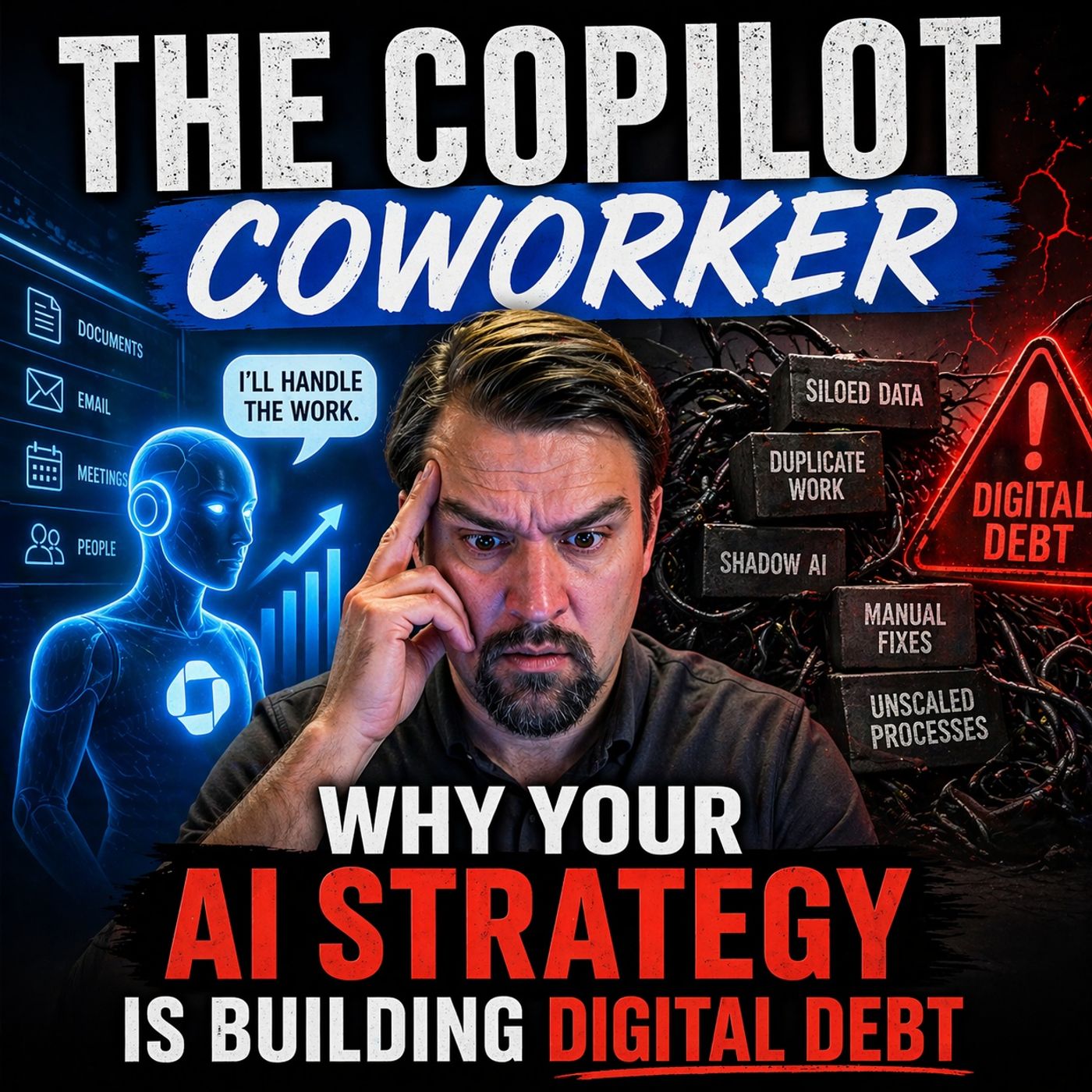
This episode explains that treating AI like a simple add-on tool—especially Microsoft Copilot—can quietly create “digital debt” inside organizations. The problem isn’t the AI itself, but the messy, ungoverned Microsoft 365 environments it relies on. Copilot acts as a powerful coworker that instantly exposes all accessible data, meaning existing issues like oversharing, poor structure, and lack of governance become highly visible and amplified.
The key message is that AI doesn’t fix broken systems—it scales them. If your environment is chaotic, AI will accelerate that chaos. Without proper data governance, security controls, and clear operating models, companies risk building long-term complexity and risk instead of value.
To avoid this “digital debt,” organizations need to focus on fixing their foundations first—clean data, controlled access, and strong governance—before scaling AI adoption.
You might expect artificial intelligence to transform your work and boost productivity. Many office workers believe that ai enhances performance, and statistics show that ai chatbots can save up to 90% of time. Yet, only a small fraction of these improvements lead to higher earnings. Take a look at the numbers:
| Statistic Description | Value |
|---|---|
| Percentage of office workers believing AI enhances performance | 81% |
| Time saved by AI chatbots | 64%–90% |
| Average work hours saved through AI adoption | 2.8% |
| Percentage of productivity improvements translating to higher earnings | 3-7% |
Imagine a scenario where your team implements multiple ai tools. You see more output, but decision-making slows down. Digital debt grows as unverified content piles up. Most IT leaders report integration hurdles, and many organizations waste software spending on unused features. Consider these figures:
| Statistic | Description |
|---|---|
| 95% | IT leaders report integration hurdles impeding AI implementation. |
| 37% | Organizations waste an average of 37% of enterprise software expenditure on unused or underutilized features. |
| $250 billion | Represents the annual global waste in enterprise software spending due to underutilization. |
You need to ask yourself if your AI Strategy and tools like Copilot Coworker are driving real productivity or creating hidden inefficiencies. Active participation and governance are essential for making artificial intelligence work for you.
Key Takeaways
- AI tools can create the illusion of productivity but may not lead to real improvements in performance.
- Overreliance on AI can erode critical thinking and decision-making skills among employees.
- Establish clear governance and coworking norms to manage AI-related risks effectively.
- Focus on meaningful outcomes rather than just output volume to measure productivity accurately.
- Invest in workforce development to ensure employees adapt to new AI tools and maintain their skills.
- Use feedback loops to gather insights from employees and improve AI integration continuously.
- Balance automation with human involvement to preserve essential skills and decision-making capabilities.
- Regularly audit AI strategies to uncover inefficiencies and ensure alignment with organizational goals.
The AI Productivity Paradox

Illusion of Output Gains
You may notice more output after introducing ai tools into your workflow. This increase often creates the impression of greater efficiency. However, recent research from the MIT Media Lab shows that these gains can be misleading. Many organizations measure productivity by throughput, such as the number of documents or messages produced. These metrics do not always reflect real outcomes. For example, executive dashboards might show a 6% productivity gain, but win rates and cycle times stay the same or even decline. This gap reveals the ai productivity paradox: local efficiencies mask deeper inefficiencies.
Users often rely too much on ai suggestions, a behavior known as automation bias. This overreliance can erode your independent reasoning and judgment. You may see a superficial increase in output, but lose the critical thinking that drives meaningful work. When ai tools are absorbed into legacy processes without proper transformation, they reinforce old habits. This adaptation creates a facade of productivity, not genuine improvement.
The 3x Productivity Trap
The 3x Productivity Trap describes a situation where ai integration triples output but slows decision-making. You might find yourself overwhelmed by unverified content and digital artifacts. The paradox becomes clear when you realize that more information does not always lead to faster or better decisions. According to recent studies, organizations using ai-powered tools report faster communication cycles and improved meeting efficiency. Yet, over 40% of ai initiatives fail to deliver expected value due to unclear implementation strategies.
If you treat ai tools like chatbots instead of workflow partners, you risk missing their full potential. Lack of clarity on use cases and poor integration into daily processes can lead to productivity losses. McKinsey & Company reports that generative ai could add trillions to global productivity, but only if you implement it effectively.
Digital Debt in the Workplace
Digital debt builds up when you rely on ai without proper governance. This debt includes unverified content, functional rework, and loss of critical thinking skills. Studies show a negative correlation between ai usage and critical thinking abilities. Overreliance on ai tools leads to diminished problem-solving skills and expertise. High rates of functional debt arise from lack of training and excessive trust in ai outputs.
| Measurable Impact | Description |
|---|---|
| Erosion of Critical Thinking Skills | Studies show a negative correlation between AI usage and critical thinking abilities. |
| Increased Reliance on AI | Overreliance on AI tools leads to diminished problem-solving skills and expertise. |
| Functional Rework | High rates of functional debt arise from lack of training and over-reliance on AI outputs. |
You need to manage ai integration with clear governance and active participation. Tools like Copilot Coworker can enhance efficiency and output quality, but their effectiveness depends on how you integrate them into your workflow. The ai productivity paradox reminds you to focus on real outcomes, not just output volume.
AI Strategy: Hidden Symptoms
When you look beneath the surface of your organization's ai strategy, you may find several hidden symptoms that threaten long-term success. These issues often go unnoticed until they start to impact your team's productivity and morale. Understanding these symptoms helps you address them before they become major obstacles.
Context Loss
Knowledge Erosion
You rely on ai tools to help you manage information and complete tasks. However, when you use multiple systems without a clear strategy, you risk losing important context. Knowledge erosion happens when critical details get lost as workers switch between platforms or delegate tasks to ai. Over time, this weakens your team's ability to make informed decisions.
- 88% of organizations use ai, but nearly two-thirds have not scaled it across their business.
- Only 39% of organizations see any enterprise-level impact on earnings from ai use.
- Many companies run isolated ai experiments without a unified vision, which leads to fragmented knowledge.
Communication Gaps
Frequent context switching creates communication gaps among workers. You may find yourself toggling between apps and losing track of conversations or project updates. This constant switching drains your focus and makes it harder to collaborate.
| Evidence Type | Details |
|---|---|
| Time Lost to Context Switching | Employees lose about five working weeks a year due to context switching, according to Harvard Business Review. |
| Frequency of Application Toggling | The average digital worker toggles between applications nearly 1,200 times per day. |
| Time Spent Reorienting | Workers spend almost 4 hours per week reorienting themselves after switching apps. |
When you lose context, you spend more time reorienting and less time on meaningful work. This slows down decision-making and increases frustration among workers.
Technical Debt
Automation Overload
You might expect ai to simplify your workflow, but too much automation can create technical debt. When you add new tools without retiring old ones, your systems become more complex. This complexity makes it harder for workers to innovate and adapt.
- Microsoft reports 55% productivity gains from ai tools.
- Independent research shows developers lose significant time to inefficiencies, revealing a gap between expected and actual results.
- Technical debt complicates workflows and increases maintenance efforts.
- As technical debt grows, workers spend more time on upkeep and less on new ideas.
- 69% of developers lose over 8 hours each week to inefficiencies, which signals a major productivity loss.
Legacy Friction
Legacy systems often clash with new ai tools. When you try to integrate modern solutions with outdated platforms, you create friction. Workers must navigate both old and new processes, which slows progress and increases errors. This friction can discourage workers from fully adopting ai, leading to missed opportunities for improvement.
Employee Disengagement
Reduced Ownership
When you rely heavily on ai, workers may feel less responsible for their work. Reduced ownership happens when workers see ai as the main driver of results. This shift can lower motivation and make it harder to build a culture of accountability.
- Ai tools can flag unusual changes in employee feedback, making it easier to spot disengagement.
- They provide auto-generated recommendations to help managers re-engage at-risk workers.
Skill Atrophy
Skill atrophy occurs when workers stop using their expertise because they depend on ai for answers. Over time, this leads to disengagement and a loss of valuable skills. One in three employees reports that ai increases their workload instead of reducing it. This extra stress can cause disengagement and lower morale.
- Ai tools can perform sentiment analysis at scale, detecting emotional shifts and negative trends that may indicate disengagement.
- They can cluster themes from employee feedback, allowing leaders to quickly identify common drivers of disengagement.
- Predictive risk scoring helps identify individuals or teams at risk of disengagement based on historical data.
Note: Disengagement does not just affect individual workers. It can spread across teams, lowering overall engagement and making it harder to achieve your goals.
When you recognize these hidden symptoms, you can take steps to realign your ai strategy. Addressing context loss, technical debt, and disengagement ensures that your workers stay engaged and your organization achieves true productivity.
Root Causes of Productivity Loss
Flawed AI Strategy
You may believe that automating tasks with ai will boost productivity. Many leaders make this assumption, but it often leads to unexpected results. When you adopt an ai strategy without clear goals, you risk creating pseudo-work. Ai can generate tasks quickly, but these tasks may not align with your organizational needs. This misalignment wastes resources and creates inefficiencies.
Take a look at the most common flaws in ai strategy:
- Strategy Vacuum: You select ai tools for non-core issues instead of aligning them with strategic goals.
- Embracing Industry Hype: You trust tech industry claims about high ROI without assessing real value.
- KPI Blindness: You lack defined business metrics that ai tools should improve.
- AI-Solutionism: You believe any ai implementation is better than none, leading to unjustified spending.
Ai can perform many tasks, but not all tasks add value. When you focus on volume instead of utility, you create cognitive overload. This overload increases stress and reduces decision quality. You need to ensure your ai strategy targets meaningful outcomes and supports workplace transformation.
Tip: Align your ai strategy with clear business goals. Avoid automating tasks that do not contribute to your organization's success.
| Root Cause | Description |
|---|---|
| Misalignment of AI-generated tasks | AI tasks may not align with organizational needs, leading to inefficiencies. |
| Over-reliance on automation | Dependence on AI can result in cognitive erosion among employees. |
| Ineffective integration into workflows | Failure to incorporate AI into existing processes can disrupt productivity. |
Human Factors
You play a critical role in workplace transformation. Ai can simulate empathy, but it lacks the emotional impact of human responses. Emotional connection drives motivation and engagement. When you depend too much on ai, you lose this connection. This loss affects your ability to stay productive and motivated.
Unproductive tasks generated by ai often go unnoticed. These tasks drain your attention and cognitive bandwidth. You may not see these losses in traditional metrics, but they accumulate over time. Ai can create an environment filled with low-value work, which leads to cognitive erosion.
- Unit Gains Misunderstanding: You may think automating tasks leads to proportional productivity increases. This belief can degrade your analytical skills.
- Unproductive Pseudo-Work: Ai efficiency can result in tasks that lack real utility, increasing low-value work.
Note: Emotional connection and critical thinking are essential for successful workplace transformation. Ai cannot replace these human factors.
Organizational Gaps
Organizational gaps create major challenges for ai integration. Poor communication flows and data silos prevent information from moving freely. Misaligned priorities and workflow inefficiencies slow progress. Cultural disconnects make it hard to adopt new technologies. You need a profound transformation of organizational settings to overcome these barriers.
- Poor communication flows
- Data silos
- Misaligned priorities
- Workflow inefficiencies
- Cultural disconnects
- Need for profound transformation of organizational settings
Local performance improvements can create bottlenecks and desynchronization in workflows. Automating tasks does not always lead to linear gains. Overuse of ai can cause inefficiencies and disrupt workplace transformation.
Alert: Address organizational gaps before scaling your ai strategy. Build a culture that supports collaboration and continuous improvement.
Measuring Productivity in the AI Era
Output vs. Real Productivity
You might see a spike in output when you add ai to your workflow. More emails, reports, and messages fill your day. This does not always mean you have better performance. You need to look beyond the number of tasks completed. Real productivity means you achieve meaningful results, not just more activity. Many executives expect ai to boost performance, but employees often feel the opposite. Most workers report that ai increases their workload. Burnout rises as you try to keep up with new tasks. You may feel more pressure to deliver, but your performance does not always improve.
Key Metrics
You need to measure what matters in an ai-powered workday. Counting tasks or documents does not show true performance. You should focus on metrics that reveal the impact of ai on your work. Here are some key metrics to consider:
- Decision quality: Track how well you solve problems, not just how fast you finish tasks.
- Cycle time: Measure how quickly you move from idea to action.
- Employee engagement: Check if your team feels motivated and connected.
- Task relevance: Review if ai helps you complete important tasks or just adds more to your list.
- Data accuracy: Make sure ai uses reliable data for every task.
- Knowledge retention: See if you keep important information or lose it in the flow of data.
- Error rates: Watch for mistakes that ai might introduce into your tasks.
- Collaboration effectiveness: Assess how well ai supports teamwork and sharing data.
- Outcome alignment: Confirm that your tasks match your goals and improve performance.
You need to use these metrics to see if ai helps you reach your targets. Do not rely only on output numbers.
Feedback Loops
Feedback loops help you understand how ai affects your work. You can use ai to collect data on employee experiences and respond quickly. When you close the feedback loop, you encourage more people to share their thoughts. This leads to better engagement and improved workplace conditions. Sharing what you learn with your team builds trust. Ai can help you draft messages and share insights faster. You create a cycle where feedback leads to action, and action leads to more feedback. This process helps you adjust your tasks and improve performance over time.
Tip: Use feedback loops to keep your ai strategy on track. Listen to your team, act on their input, and share results. This will help you build a productive and engaged workplace.
Disengagement and Workforce Impact

Employee Disengagement Drivers
You may notice that rapid ai adoption can unsettle your workforce. When you introduce new technology, you often create uncertainty at work. This uncertainty can weaken the relationship between you and your employer. As a result, employee disengagement rises. Many workers feel disconnected when they do not understand how ai will affect their roles. Manager burnout also plays a big part. Only 27% of managers report feeling engaged at work. If you do not recognize your team’s efforts, you risk losing their motivation. In fact, 85% of employees worldwide do not feel engaged. You must also pay attention to work-life balance, career development, and company culture. When you neglect these areas, your workforce becomes more disengaged. A disengaged workforce can lower productivity and make it harder to achieve your goals.
Knowledge Transfer Breakdown
When you rely on ai, you may see invisible barriers form within your organization. These barriers can stop valuable insights from spreading across teams. For example, a senior developer might keep important system details to themselves. This creates a single point of failure. Fragmentation leads to wasted time. A customer service representative may spend hours searching for solutions that already exist. Sales teams might miss key client insights because information stays locked in one department. You need to ensure that your workforce can share knowledge easily. If you do not, your employee experience suffers. Workers become frustrated when they cannot access the information they need. This frustration can lead to more employee disengagement and a less effective workforce.
- AI can create invisible walls that block knowledge sharing.
- Fragmentation causes inefficiencies and wasted time.
- Important client insights may be lost if information is siloed.
Leadership Pipeline Risks
As you bring ai into your organization, you must rethink your leadership pipeline. Traditional leadership skills may not be enough in an ai-driven environment. You need leaders who can inspire trust and set clear goals. They must also ensure ethical decision-making, since ai cannot take responsibility for its outputs. Succession planning becomes more complex. You must align your plans with the new skills needed for future leaders. Cultural resistance can slow down your progress. Some people may struggle to adapt to ai, which can hurt leadership effectiveness.
| Risk Area | Description |
|---|---|
| Leadership Competence | AI integration requires new human-centered leadership skills, as traditional competencies may not suffice in the AI era. |
| Succession Planning | Existing succession plans may not align with the competencies needed for future leaders in an AI-driven environment. |
| Ethical Considerations | Leaders must ensure accountability and ethical decision-making, as AI cannot take responsibility for its outputs. |
| Cultural Resistance | Organizations may face challenges in shifting culture to embrace AI, which can hinder leadership effectiveness. |
You must help your leaders move from making decisions to auditing ai outputs. They need to make sure that ai-generated decisions match your values and ethical standards. This shift increases the complexity of leadership roles. If you do not address these risks, your employee experience and workforce development may suffer.
Solutions: Rethinking AI Strategy
Context Capture
You need to capture context in your ai-optimized workflows to prevent knowledge erosion and improve decision-making. Many organizations lose critical information when they switch between platforms or delegate tasks to ai. You can address this by auditing your current context loss points. Identify where important knowledge disappears in your workflow. Start with a minimal MDC ruleset that focuses on your most valuable knowledge areas. Integrate context capture into code reviews. Make context verification as important as functionality testing. Build a simple knowledge graph to connect requirements, decisions, and implementations. This approach helps you retain essential information and supports better human-ai collaboration.
- Audit your workflow for context loss points.
- Use a minimal MDC ruleset for critical knowledge.
- Add context capture to code reviews.
- Build a knowledge graph linking requirements, decisions, and implementations.
When you capture context, you create a foundation for learning and development. Your team can access relevant information quickly and avoid repeating mistakes. This process supports continuous learning and helps you adapt to new challenges.
Governance and Coworking Norms
You must establish governance frameworks and coworking norms to control ai-related productivity risks. Proper governance does not eliminate all risks, but it allows you to act quickly and minimize vulnerabilities. You need to map security controls to established frameworks. This step is crucial for organizations using ai tools. Governance frameworks set necessary controls and compliance requirements. They help you manage risks from ai's autonomous capabilities. You ensure that ai usage follows regulatory standards and operational security. Structured governance enhances productivity and reduces vulnerabilities. Coworking norms guide how you interact with ai tools. These norms encourage active participation and validation of ai-generated outputs. You build trust and accountability in your team. Clear governance and coworking norms support learning and development by creating a safe environment for experimentation and feedback.
Tip: Set up governance frameworks early. Define coworking norms that encourage validation and active participation. This approach helps you manage ai risks and improve productivity.
Human-in-the-Loop
You need to integrate human expertise throughout the ai lifecycle. Human-in-the-loop approaches make ai systems more powerful, ethical, and adaptable. You can identify and correct errors that automated systems might miss. This integration improves decision-making and supports learning. Studies show that task performance improves more after ai exposure than other methods. Most users find the ai assistant method helpful for transitioning to new tasks. The ai assistant provides a positive learning experience. Users apply insights to other tasks, even without direct guidance.
| Evidence Type | Description |
|---|---|
| Task Performance | Improvements following AI exposure were greater than those following other methods, indicating effective learning facilitated by AI. |
| User Feedback | 77.8% of participants found the AI assistant method helpful for transitioning to other methods, suggesting a strong foundational understanding provided by AI. |
| Learning Experience | The AI assistant generally provided a positive learning experience, with users applying insights to other tasks, enhancing performance even without direct guidance. |
- 77.8% of users reported the ai assistant method was more helpful for subsequent tasks.
- No participants found the ai assistant method less helpful.
You create a cycle of learning and development when you keep humans involved. Your team gains new skills and adapts to changing workflows. Human-in-the-loop strategies support ethical decision-making and help you build trust in ai systems. You ensure that ai complements your expertise, not replaces it. This approach leads to sustainable productivity and continuous improvement.
Note: Human-in-the-loop strategies empower your team. You combine ai capabilities with human judgment to achieve better results.
Strategic Learning
You face a workplace that changes quickly. New ai tools appear every month. Skills that helped you last year may not help you tomorrow. You need a plan that keeps you ready for these shifts. Strategic learning gives you the tools to adapt and thrive.
You start by creating a clear path for your growth. Personalized development strategies show you where you can improve. You see your strengths and weaknesses. This clarity helps you set goals and track progress. You do not feel lost when new ai systems arrive. You know what you need to learn.
Tailored learning approaches help you stay relevant. You do not waste time on skills that no longer matter. You focus on what will help you work with ai. You learn how to use new features and understand how they fit into your workflow. You build confidence as you master each tool.
Organizations that value learning move faster. You see teams respond quickly to changes. Leaders encourage you to try new ai solutions. You feel safe to experiment and share ideas. This culture of agility helps you solve problems and find better ways to work. You become part of a group that values innovation.
Tip: Ask your manager about training programs for ai tools. Join workshops and online courses. Share what you learn with your team. You help everyone grow together.
You need to practice strategic learning every day. You review your progress and adjust your goals. You ask questions when you do not understand something. You use feedback from ai systems to improve your skills. You do not wait for someone else to tell you what to learn. You take charge of your development.
Here are some ways strategic learning improves your adaptation to ai tools:
- Personalized development strategies give you clarity about your growth path.
- Tailored learning approaches keep your skills up-to-date and relevant.
- Organizations that prioritize learning help you respond swiftly to changes.
- You foster a culture of agility and innovation by sharing knowledge.
You see that strategic learning does more than help you use ai. It builds your confidence and prepares you for future challenges. You become a leader in your team. You help others learn and adapt. You drive productivity by making sure everyone understands how to use ai tools.
You must remember that learning is not a one-time event. You need to keep learning as ai evolves. You stay curious and open to new ideas. You build habits that help you grow. You use ai to support your learning, but you do not let it replace your judgment.
Note: Strategic learning helps you stay ahead. You build skills that last. You create value for yourself and your organization.
Realigning for Sustainable Productivity
Balancing Automation and Human Value
You need to find the right balance between automation and human value to shape the future of work. Not every task should be automated. Some workflows hold high intangible value, such as those that require empathy or deep judgment. You should use ai to support these tasks, not replace them. True progress comes from what you choose not to delegate. You protect your most important skills by keeping humans involved in critical decisions.
- Use ai to handle routine work, but keep humans in the loop for complex or uncertain situations.
- Build safeguards that require human review at key decision points.
- Track and reward skills like empathy and contextual judgment, not just speed or efficiency.
You should design performance metrics that measure both efficiency and the quality of human contributions. This approach helps you maintain trust and accountability. It also ensures that your team’s unique strengths remain central in the future of work.
Investing in Workforce Development
You drive long-term impact when you invest in your workforce. Most organizations that invest in ai see productivity gains. Many reinvest these gains into upskilling and reskilling employees. This strategy does not usually lead to job cuts. Instead, it prepares you for the future of work.
“While ai readily raises the floor by improving efficiency, the transformative potential comes from raising the ceiling,” says Dan Diasio, EY Global Consulting AI Leader.
You can look at companies like HCLTech. Nearly 80% of their employees have trained in core skills. Many have also built digital capabilities and learned about generative ai. This commitment to workforce development aligns with higher productivity and better outcomes.
You should focus on continuous skills development. Targeted training programs help you keep up with new ai tools. You also need to measure how well you retain human capacity, not just how fast you finish tasks. This approach supports sustainable impact and prepares you for changes in the future of work.
Leadership’s Role
You play a key role in realigning ai strategy for sustainable productivity if you are a leader. You must integrate ai to enhance your team’s capabilities and streamline processes. You should invest in training so everyone uses ai tools effectively. Monitoring the impact of ai helps you adjust your strategy for the best results.
- Foster a culture of continuous improvement.
- Encourage innovation and responsible use of ai.
- Set clear usage policies and educate your team on acceptable practices.
- Work with IT and compliance teams to monitor ai activity and respond to incidents.
Microsoft Copilot Coworker can help you automate routine tasks and generate compliance documentation faster. With proper governance, you reduce human error and protect sensitive data. You can use Microsoft Purview for real-time monitoring and compliance. Administrators can apply retention policies to Copilot-generated content, ensuring you meet standards without losing productivity.
You should always focus on decision quality, not just the amount of content produced. This mindset builds a future-proof workforce ready for the future of work. You create an environment where ai and human strengths work together for lasting impact.
Unchecked ai strategies can threaten your organization’s productivity. Recent studies highlight several risks:
| Risk Type | Description |
|---|---|
| AI Hallucinations | ai may generate convincing but incorrect information, causing trust issues. |
| Compliance Exposure | ai errors can lead to regulatory and compliance problems. |
| Financial Losses | ai misinformation may result in costly mistakes. |
| Data Governance | ai with poor data quality can harm decision-making. |
| Validation Processes | ai outputs without review can skew financial analysis. |
| Filtering Tools | ai without moderation can disrupt workflows. |
You should audit your ai tools and strategies to uncover hidden inefficiencies, digital debt, and disengagement. Take these steps:
- Establish ai coding guidelines and review ai-generated output.
- Implement automated testing for ai code.
- Conduct regular audits of ai systems and dependencies.
You can realign your ai strategy by focusing on governance, context, and workforce development. This approach will help you achieve sustainable productivity in an ai-driven world.
FAQ
What is the main risk of using ai without a clear strategy?
You risk creating more work instead of saving time. When you use ai without a plan, you may see more output but not better results. This can lower productivity and cause confusion.
How can ai increase digital debt in your workplace?
You add digital debt when you let ai create unverified content. If you do not review or organize this information, it piles up. This makes it harder for you to find what you need and slows down your work.
Why do some teams feel less engaged after adopting ai?
You may feel less engaged if you rely on ai for every task. When ai takes over important decisions, you lose ownership. This can make your work feel less meaningful and reduce your motivation.
How do you measure real gains from ai tools?
You should look at decision quality, not just how much you produce. Track how ai helps you solve problems, improve teamwork, and reach your goals. Do not focus only on the number of tasks completed.
What steps help you avoid skill loss when using ai?
You need to stay involved in your work. Use ai as a partner, not a replacement. Keep learning new skills and review ai outputs. This helps you keep your expertise and adapt to changes.
Can ai replace human judgment in important decisions?
No, you should not let ai replace your judgment. Ai can help you with data and suggestions, but you need to make the final call. Your experience and values matter in every decision.
How does governance improve ai use in your organization?
Governance gives you rules for using ai safely. It helps you check ai outputs and protect your data. With clear guidelines, you can trust ai more and avoid mistakes that hurt your team.
What is the best way to balance ai and human value?
You should let ai handle simple tasks. Keep humans in charge of complex work. This balance lets you use ai for speed and humans for insight. You build trust and keep productivity high.
🎧 Listen to this episode
Want a practical explanation of How Microsoft Copilot Creates Digital Debt? This episode breaks down the topic in clear language and shows why it matters for Microsoft 365, Azure, Power Platform, security, AI, and modern work.
Listen to this episode if you want to:
- Understand the key concepts behind How Microsoft Copilot Creates Digital Debt
- See how it fits into the wider Microsoft technology ecosystem
- Learn where it can create practical value for your organization
You may also enjoy these related M365 FM episodes:
- Microsoft 365 Copilot Agents: Real Business Value with Steve Corey [MVP]
- Copilot for Dynamics 365 Finance and Operations - Simply Explained
- Zero Trust AI Security with Microsoft Copilot and Azure – Mourtaza Fazlehoussen [MVP]
- Copilot in Microsoft Entra ID - Simply Explained
- Copilot for Microsoft Fabric - Simply Explained
Discover more practical Microsoft conversations on M365 FM.
🚀 Want to be part of m365.fm?
Then stop just listening… and start showing up.
👉 Connect with me on LinkedIn and let’s make something happen:
- 🎙️ Be a podcast guest and share your story
- 🎧 Host your own episode (yes, seriously)
- 💡 Pitch topics the community actually wants to hear
- 🌍 Build your personal brand in the Microsoft 365 space
This isn’t just a podcast — it’s a platform for people who take action.
🔥 Most people wait. The best ones don’t.
👉 Connect with me on LinkedIn and send me a message:
"I want in"
Let’s build something awesome 👊
1
00:00:00,000 --> 00:00:02,240
Six months after deploying the Copilot co-worker,
2
00:00:02,240 --> 00:00:03,640
a specific team I worked with
3
00:00:03,640 --> 00:00:06,800
started producing three times more content than ever before.
4
00:00:06,800 --> 00:00:09,360
They were drafting memos, summarizing long threads,
5
00:00:09,360 --> 00:00:11,200
and generating strategy decks at a speed
6
00:00:11,200 --> 00:00:13,720
that looked like a miracle on a management dashboard.
7
00:00:13,720 --> 00:00:15,320
But when I sat down with the leadership team
8
00:00:15,320 --> 00:00:18,160
to discuss the results, they admitted something terrifying.
9
00:00:18,160 --> 00:00:19,960
They didn't trust a single word of it.
10
00:00:19,960 --> 00:00:21,400
What we are actually doing is building
11
00:00:21,400 --> 00:00:24,280
digital graveyards of unfinished and unverified work
12
00:00:24,280 --> 00:00:27,440
while calling the entire process efficiency.
13
00:00:27,440 --> 00:00:29,080
Your current AI strategy is quietly
14
00:00:29,080 --> 00:00:31,360
rotting your internal processes from the inside out
15
00:00:31,360 --> 00:00:33,240
and most people don't even see it happening yet.
16
00:00:33,240 --> 00:00:35,320
I'm going to show you exactly how that rot happens,
17
00:00:35,320 --> 00:00:37,720
but more importantly, we need to look at how to pivot
18
00:00:37,720 --> 00:00:39,280
to a true co-working model.
19
00:00:39,280 --> 00:00:41,600
Why does more AI output often lead to slower
20
00:00:41,600 --> 00:00:43,240
organizational decisions?
21
00:00:43,240 --> 00:00:47,040
The answer lies in a concept I call invisible digital debt.
22
00:00:47,040 --> 00:00:48,840
The anatomy of digital debt.
23
00:00:48,840 --> 00:00:50,000
Before we can fix the system,
24
00:00:50,000 --> 00:00:51,640
we have to diagnose the rot, which starts
25
00:00:51,640 --> 00:00:54,040
with understanding how this debt actually accumulates.
26
00:00:54,040 --> 00:00:55,880
Digital debt is the massive accumulation
27
00:00:55,880 --> 00:00:58,400
of unverified and unmanaged digital artifacts
28
00:00:58,400 --> 00:01:01,280
that eventually overwhelm your human cognitive capacity
29
00:01:01,280 --> 00:01:02,480
to make sense of them.
30
00:01:02,480 --> 00:01:04,720
It is the natural result of information volume growing
31
00:01:04,720 --> 00:01:06,560
faster than your ability to process it
32
00:01:06,560 --> 00:01:09,120
and the problem starts with how we view the technology.
33
00:01:09,120 --> 00:01:11,600
Most organizations are treating a multi-step agent
34
00:01:11,600 --> 00:01:14,120
like a simple chatbot, and that is a massive strategic failure
35
00:01:14,120 --> 00:01:15,600
for any leadership team.
36
00:01:15,600 --> 00:01:18,400
When you treat co-pilot as a tool rather than a co-worker,
37
00:01:18,400 --> 00:01:20,480
you fall into the trap of passive delegation,
38
00:01:20,480 --> 00:01:22,600
which turns the AI into a black box.
39
00:01:22,600 --> 00:01:24,000
You click the approved button on faith
40
00:01:24,000 --> 00:01:26,160
because you're too busy to actually read the three pages
41
00:01:26,160 --> 00:01:28,880
that just generated, and this is where the process rot begins.
42
00:01:28,880 --> 00:01:30,760
The AI masters the how of a task,
43
00:01:30,760 --> 00:01:32,480
but the organization slowly forgets
44
00:01:32,480 --> 00:01:34,200
the why behind the work they are doing.
45
00:01:34,200 --> 00:01:35,760
Think about context poisoning.
46
00:01:35,760 --> 00:01:38,920
If one bad AI summary gets embedded into a loop component,
47
00:01:38,920 --> 00:01:41,840
it can infect an entire project thread for weeks or months.
48
00:01:41,840 --> 00:01:44,120
Every person who joins that thread later assumes
49
00:01:44,120 --> 00:01:45,840
that summary is the ground truth,
50
00:01:45,840 --> 00:01:48,680
and they build their work on a foundation of hallucinations.
51
00:01:48,680 --> 00:01:50,160
Then there is the completion bias.
52
00:01:50,160 --> 00:01:52,880
We often mistake a finished document for a finished thought,
53
00:01:52,880 --> 00:01:54,600
but a professional layout doesn't mean
54
00:01:54,600 --> 00:01:56,160
the ideas inside are actually good,
55
00:01:56,160 --> 00:01:58,000
just because a strategy deck has 12 slides
56
00:01:58,000 --> 00:01:59,960
and a professional layout doesn't mean
57
00:01:59,960 --> 00:02:02,120
it contains a viable strategy for your business.
58
00:02:02,120 --> 00:02:05,480
In most organizations, work used to be a series of manual steps
59
00:02:05,480 --> 00:02:07,280
where humans acted as the quality control
60
00:02:07,280 --> 00:02:08,280
at every single stage.
61
00:02:08,280 --> 00:02:09,680
Now, we've removed the stages,
62
00:02:09,680 --> 00:02:11,680
but kept the expectation of quality,
63
00:02:11,680 --> 00:02:13,880
and the result is a massive gap in trust.
64
00:02:13,880 --> 00:02:17,720
What typically happens is that the digital noise becomes so loud
65
00:02:17,720 --> 00:02:20,360
that people just stop listening to the system entirely.
66
00:02:20,360 --> 00:02:22,480
They go back to their old ways of working,
67
00:02:22,480 --> 00:02:25,920
but now they have to do it while managing the AI-generated clutter
68
00:02:25,920 --> 00:02:27,200
that fills their inbox.
69
00:02:27,200 --> 00:02:30,160
So what's actually happening is that you're paying for a speed boost
70
00:02:30,160 --> 00:02:33,080
that is actually acting as a drag coefficient on your team.
71
00:02:33,080 --> 00:02:34,520
You're in a meeting, you need an answer,
72
00:02:34,520 --> 00:02:36,920
you search your tenant and find 10 different AI summaries
73
00:02:36,920 --> 00:02:39,520
of the same decision, but none of them actually agree with each other.
74
00:02:39,520 --> 00:02:41,640
You have to call three people to verify
75
00:02:41,640 --> 00:02:43,800
what actually happened last Tuesday,
76
00:02:43,800 --> 00:02:46,200
and that is the interest payment on your digital debt.
77
00:02:46,200 --> 00:02:49,040
And one level deeper, this debt isn't just about messy files.
78
00:02:49,040 --> 00:02:51,040
It's about the erosion of institutional knowledge.
79
00:02:51,040 --> 00:02:52,720
When the AI does the summarizing,
80
00:02:52,720 --> 00:02:54,640
the humans stop reading the source material,
81
00:02:54,640 --> 00:02:57,200
and they lose the nuance that makes a project successful.
82
00:02:57,200 --> 00:02:59,120
They lose the tension, they lose the context.
83
00:02:59,120 --> 00:03:01,520
The model behind your current deployment assumes
84
00:03:01,520 --> 00:03:03,200
that more content equals more value,
85
00:03:03,200 --> 00:03:05,200
but that assumption is broken at its core.
86
00:03:05,200 --> 00:03:07,800
Today work doesn't start with navigation or generation,
87
00:03:07,800 --> 00:03:09,760
it starts with context and trust.
88
00:03:09,760 --> 00:03:11,600
If you don't have a structure for that trust,
89
00:03:11,600 --> 00:03:12,960
you're just accelerating entropy
90
00:03:12,960 --> 00:03:15,240
and using a jet engine to drive into a brick wall.
91
00:03:15,240 --> 00:03:16,800
The floor isn't the content itself,
92
00:03:16,800 --> 00:03:19,560
it's the assumption that people have time to go looking for
93
00:03:19,560 --> 00:03:22,400
the truth inside a mountain of AI-generated work slot.
94
00:03:22,400 --> 00:03:25,120
We built hierarchies for a world that used to move slowly,
95
00:03:25,120 --> 00:03:26,920
and now we need an architecture that can handle
96
00:03:26,920 --> 00:03:28,680
the speed of an agentic coworker.
97
00:03:28,680 --> 00:03:31,680
Because in reality, your AI isn't saving you time.
98
00:03:31,680 --> 00:03:33,760
It's just moving the work from the creation phase
99
00:03:33,760 --> 00:03:35,040
to the validation phase,
100
00:03:35,040 --> 00:03:38,200
and that second phase is much more expensive for your business.
101
00:03:38,200 --> 00:03:40,720
Scenario A, the document explosion.
102
00:03:40,720 --> 00:03:42,200
Let's look at where this debt starts,
103
00:03:42,200 --> 00:03:44,440
it starts with the generate button.
104
00:03:44,440 --> 00:03:47,440
In a traditional workflow, a strategy draft took three days
105
00:03:47,440 --> 00:03:50,080
because a human had to synthesize three days worth of research.
106
00:03:50,080 --> 00:03:51,200
The friction was the feature.
107
00:03:51,200 --> 00:03:52,800
It forced a single coherent narrative
108
00:03:52,800 --> 00:03:55,480
because the cost of creating a second version was too high.
109
00:03:55,480 --> 00:03:57,560
But when you introduce the co-pilot coworker,
110
00:03:57,560 --> 00:03:58,840
that friction vanishes.
111
00:03:58,840 --> 00:04:00,640
Now you have the five version problem,
112
00:04:00,640 --> 00:04:02,280
an analyst wants to look prepared,
113
00:04:02,280 --> 00:04:04,960
so they prompt co-pilot to spin up three different strategy
114
00:04:04,960 --> 00:04:06,960
drafts based on the same meeting transcript.
115
00:04:06,960 --> 00:04:08,160
They don't own any of them,
116
00:04:08,160 --> 00:04:10,280
they just pick the one that sounds the most professional
117
00:04:10,280 --> 00:04:11,280
and hits send.
118
00:04:11,280 --> 00:04:13,560
Then the manager receives it, notices a small gap,
119
00:04:13,560 --> 00:04:14,960
and instead of editing the text,
120
00:04:14,960 --> 00:04:17,280
they prompt the AI to generate a counter-proposal.
121
00:04:17,280 --> 00:04:18,840
Suddenly you have truth fragmentation.
122
00:04:18,840 --> 00:04:21,560
You have multiple official documents floating around the tenant,
123
00:04:21,560 --> 00:04:22,960
all generated by the same engine,
124
00:04:22,960 --> 00:04:25,440
but none of them carry the weight of human conviction.
125
00:04:25,440 --> 00:04:27,640
This is where the validation overhead kicks in.
126
00:04:27,640 --> 00:04:28,840
I tracked a project recently
127
00:04:28,840 --> 00:04:30,640
where an executive spent 45 minutes
128
00:04:30,640 --> 00:04:33,920
checking an AI-generated draft for hallucinations and tone.
129
00:04:33,920 --> 00:04:36,040
He later admitted he could have written the original memo
130
00:04:36,040 --> 00:04:37,240
in 30 minutes.
131
00:04:37,240 --> 00:04:39,440
He saved 15 minutes on the creation side,
132
00:04:39,440 --> 00:04:42,520
but lost 45 minutes on the verification side.
133
00:04:42,520 --> 00:04:45,000
That is a net loss of 30 minutes of executive time.
134
00:04:45,000 --> 00:04:46,200
And that's just one person.
135
00:04:46,200 --> 00:04:47,560
Think about the downstream effects.
136
00:04:47,560 --> 00:04:49,960
I saw a case study involving a weekly sales report
137
00:04:49,960 --> 00:04:52,080
that was fully automated via Copilot.
138
00:04:52,080 --> 00:04:53,800
On paper, it was a triumph.
139
00:04:53,800 --> 00:04:55,520
The report was delivered every Monday morning
140
00:04:55,520 --> 00:04:57,240
at 8 o'clock AM without fail.
141
00:04:57,240 --> 00:05:00,800
But by month two, the analysts started keeping shadow spreadsheets.
142
00:05:00,800 --> 00:05:02,120
They didn't trust the AI version
143
00:05:02,120 --> 00:05:03,800
because the numbers felt off.
144
00:05:03,800 --> 00:05:06,000
The AI was pulling data from the CRM,
145
00:05:06,000 --> 00:05:08,520
but it didn't understand that certain closed deals
146
00:05:08,520 --> 00:05:12,280
were actually pending signatures, the meetings grew longer.
147
00:05:12,280 --> 00:05:13,560
Instead of discussing strategy,
148
00:05:13,560 --> 00:05:15,520
the team spent the first 40 minutes debating
149
00:05:15,520 --> 00:05:17,200
which version of the truth was correct.
150
00:05:17,200 --> 00:05:19,040
The official report said one thing,
151
00:05:19,040 --> 00:05:20,720
the shadow spreadsheet said another,
152
00:05:20,720 --> 00:05:23,000
the human memory of the sales floor said a third.
153
00:05:23,000 --> 00:05:24,760
This is the ultimate signal of rot.
154
00:05:24,760 --> 00:05:25,960
When can we trust this?
155
00:05:25,960 --> 00:05:28,600
Becomes the default opening question in every meeting?
156
00:05:28,600 --> 00:05:30,480
Your productivity has collapsed.
157
00:05:30,480 --> 00:05:33,160
We are also seeing the emergence of redundancy loops.
158
00:05:33,160 --> 00:05:36,120
This happens when the AI summarizes a summary of a summary.
159
00:05:36,120 --> 00:05:37,600
You have a long email thread,
160
00:05:37,600 --> 00:05:39,720
Copilot summarizes it for a late joiner,
161
00:05:39,720 --> 00:05:42,120
that person then uses that summary to create a briefing doc.
162
00:05:42,120 --> 00:05:43,600
A third person uses that briefing doc
163
00:05:43,600 --> 00:05:45,200
to generate a PowerPoint slide.
164
00:05:45,200 --> 00:05:47,840
By the time the information reaches the final decision maker,
165
00:05:47,840 --> 00:05:50,800
you've lost the 30% of nuance that actually mattered.
166
00:05:50,800 --> 00:05:53,240
You've lost the why behind the what?
167
00:05:53,240 --> 00:05:55,120
The solution isn't to stop using the AI,
168
00:05:55,120 --> 00:05:57,000
it's to move from drafting to participating.
169
00:05:57,000 --> 00:05:58,760
You have to set hard boundaries on
170
00:05:58,760 --> 00:06:00,800
what the coworker is allowed to summarize
171
00:06:00,800 --> 00:06:02,080
and where it must stop.
172
00:06:02,080 --> 00:06:04,200
You need to define the ground truth container.
173
00:06:04,200 --> 00:06:06,320
If the AI isn't grounded in a verified,
174
00:06:06,320 --> 00:06:07,800
human clear data source,
175
00:06:07,800 --> 00:06:10,080
its output should be flagged as draft only.
176
00:06:10,080 --> 00:06:12,040
We have to stop rewarding the volume of content
177
00:06:12,040 --> 00:06:14,040
and start rewarding the clarity of the decision
178
00:06:14,040 --> 00:06:17,040
because right now we are drowning in professional looking noise.
179
00:06:17,040 --> 00:06:20,120
We are generating a mountain of artifacts that look like work,
180
00:06:20,120 --> 00:06:21,720
but they are actually just obstacles.
181
00:06:21,720 --> 00:06:23,440
Every time you hit that generate button
182
00:06:23,440 --> 00:06:25,160
without a plan for verification,
183
00:06:25,160 --> 00:06:26,840
you are taking out a high interest loan
184
00:06:26,840 --> 00:06:28,600
against your team's future focus.
185
00:06:28,600 --> 00:06:30,200
And eventually that debt will come to you.
186
00:06:30,200 --> 00:06:31,760
You'll find yourself in a boardroom
187
00:06:31,760 --> 00:06:33,400
looking at a beautiful slide deck,
188
00:06:33,400 --> 00:06:35,760
realizing nobody in the room actually knows
189
00:06:35,760 --> 00:06:36,800
if the numbers are real.
190
00:06:36,800 --> 00:06:39,320
That is the moment the machine stops working.
191
00:06:39,320 --> 00:06:40,520
Teams and loops, brawl.
192
00:06:40,520 --> 00:06:42,920
If the document graveyard is where truth goes to die,
193
00:06:42,920 --> 00:06:44,680
Microsoft Teams and loop components
194
00:06:44,680 --> 00:06:47,400
are the construction sites where your digital debt compounds
195
00:06:47,400 --> 00:06:48,480
in real time.
196
00:06:48,480 --> 00:06:51,240
We used to worry about email chains that grew too long.
197
00:06:51,240 --> 00:06:53,280
Now we have to worry about conversations
198
00:06:53,280 --> 00:06:55,160
that fork across three different channels,
199
00:06:55,160 --> 00:06:56,320
two private chats,
200
00:06:56,320 --> 00:06:58,080
and it doesn't share workspaces.
201
00:06:58,080 --> 00:07:00,680
The co-pilot co-worker is right there in the middle of it all,
202
00:07:00,680 --> 00:07:02,800
but it is often acting as a high-speed catalyst
203
00:07:02,800 --> 00:07:04,360
for context fragmentation.
204
00:07:04,360 --> 00:07:06,720
Think about how you use a loop component today.
205
00:07:06,720 --> 00:07:09,280
It's supposed to be the ultimate flexible canvas.
206
00:07:09,280 --> 00:07:11,840
You start a list of project requirements in a chat.
207
00:07:11,840 --> 00:07:13,600
Co-pilot helps you flesh them out,
208
00:07:13,600 --> 00:07:15,640
but then a stakeholder in another department
209
00:07:15,640 --> 00:07:17,880
forks that component into their own private channel
210
00:07:17,880 --> 00:07:19,200
to discuss the budget.
211
00:07:19,200 --> 00:07:22,440
They ask the AI to summarize the current state of the project.
212
00:07:22,440 --> 00:07:24,240
Co-pilot looks at the requirements,
213
00:07:24,240 --> 00:07:25,840
but it doesn't see the budget constraints
214
00:07:25,840 --> 00:07:27,480
being discussed in the other thread.
215
00:07:27,480 --> 00:07:29,560
It generates a summary that feels complete
216
00:07:29,560 --> 00:07:32,120
but is actually missing the most critical constraint.
217
00:07:32,120 --> 00:07:33,800
This is the silent stakeholder problem.
218
00:07:33,800 --> 00:07:36,200
The co-worker is participating in your chats,
219
00:07:36,200 --> 00:07:38,200
influencing the direction of your projects,
220
00:07:38,200 --> 00:07:40,560
but it doesn't leave a clear audit trail of its reasoning.
221
00:07:40,560 --> 00:07:42,480
It's making suggestions that people take as gospel
222
00:07:42,480 --> 00:07:44,520
yet there is no record of which data points
223
00:07:44,520 --> 00:07:46,880
it prioritized or which ones it ignored.
224
00:07:46,880 --> 00:07:49,640
When a human suggests a change, you can ask them why.
225
00:07:49,640 --> 00:07:51,520
When the AI suggests a change,
226
00:07:51,520 --> 00:07:54,160
we usually just accept it because it looks like progress.
227
00:07:54,160 --> 00:07:56,680
This leads directly to massive decision ambiguity.
228
00:07:56,680 --> 00:07:58,880
I see this happen every day in project meetings.
229
00:07:58,880 --> 00:08:01,280
A team is wrapping up a frantic session in teams.
230
00:08:01,280 --> 00:08:02,880
Someone says, "Okay, co-pilot,
231
00:08:02,880 --> 00:08:04,920
capture the action items and send them out."
232
00:08:04,920 --> 00:08:06,960
Everyone leaves the call-feeling productive.
233
00:08:06,960 --> 00:08:08,920
They assume the machine has it handled,
234
00:08:08,920 --> 00:08:11,760
but because the AI doesn't have a human sense of accountability,
235
00:08:11,760 --> 00:08:14,880
it often lists the what without a clear who.
236
00:08:14,880 --> 00:08:17,240
Or it assigns an item to the person who spoke the most
237
00:08:17,240 --> 00:08:19,440
rather than the person who actually owns the task.
238
00:08:19,440 --> 00:08:20,960
A week later, nothing is done.
239
00:08:20,960 --> 00:08:23,280
Nobody checked the list because they assumed
240
00:08:23,280 --> 00:08:25,800
the intelligent system was managing the workflow.
241
00:08:25,800 --> 00:08:27,600
This is how ghost decisions are born.
242
00:08:27,600 --> 00:08:29,040
You think a path was chosen,
243
00:08:29,040 --> 00:08:30,800
but in reality, you just have a bullet point
244
00:08:30,800 --> 00:08:33,600
in a digital vacuum, then you have the search cost explosion.
245
00:08:33,600 --> 00:08:35,560
You would think that having an AI-powered search
246
00:08:35,560 --> 00:08:37,440
would make finding information easier,
247
00:08:37,440 --> 00:08:38,760
but the opposite is happening
248
00:08:38,760 --> 00:08:41,640
because the coworker is generating so much middleware content,
249
00:08:41,640 --> 00:08:44,320
summaries of summaries, meeting recaps and draft updates.
250
00:08:44,320 --> 00:08:46,640
The search results are becoming cluttered with noise.
251
00:08:46,640 --> 00:08:48,440
You search for product launch date.
252
00:08:48,440 --> 00:08:49,960
And instead of the final project plan,
253
00:08:49,960 --> 00:08:52,640
you get 14 different AI-generated summaries
254
00:08:52,640 --> 00:08:54,120
from different points in time.
255
00:08:54,120 --> 00:08:55,840
The rework loop becomes your new normal.
256
00:08:55,840 --> 00:08:58,080
You spend half your morning repeating a discussion
257
00:08:58,080 --> 00:09:00,400
that already happened because the AI summary
258
00:09:00,400 --> 00:09:02,520
missed the specific tension or disagreement
259
00:09:02,520 --> 00:09:03,840
that occurred in the room.
260
00:09:03,840 --> 00:09:06,280
The summary said the team agreed on option A.
261
00:09:06,280 --> 00:09:07,960
It failed to mention that the lead engineer
262
00:09:07,960 --> 00:09:10,520
only agreed if certain safety conditions were met.
263
00:09:10,520 --> 00:09:12,760
Without that nuance, the decision is useless.
264
00:09:12,760 --> 00:09:13,880
You have to start over.
265
00:09:13,880 --> 00:09:17,120
To fix this, you need a hard ownership of digital workspaces.
266
00:09:17,120 --> 00:09:18,680
You have to treat a team's channel
267
00:09:18,680 --> 00:09:20,720
like a physical room with a locked door.
268
00:09:20,720 --> 00:09:22,280
If the coworker is allowed in,
269
00:09:22,280 --> 00:09:24,560
there must be a designated human scribe
270
00:09:24,560 --> 00:09:28,120
who verifies every AI-generated action item before it is locked.
271
00:09:28,120 --> 00:09:30,200
We have to stop letting the AI speak for the group.
272
00:09:30,200 --> 00:09:32,160
It is an observer, not a participant.
273
00:09:32,160 --> 00:09:33,520
If you don't enforce this boundary,
274
00:09:33,520 --> 00:09:35,680
your team's environment becomes a whole of mirrors
275
00:09:35,680 --> 00:09:38,000
where everyone sees a different version of the project
276
00:09:38,000 --> 00:09:40,200
and nobody knows where the exit is.
277
00:09:40,200 --> 00:09:43,200
Scenario C, power automate and silent breakage.
278
00:09:43,200 --> 00:09:44,440
The most dangerous kind of debt
279
00:09:44,440 --> 00:09:46,800
isn't sitting in your chat history where you can see it.
280
00:09:46,800 --> 00:09:48,600
It is buried deep inside your logic.
281
00:09:48,600 --> 00:09:51,560
Right now, we are witnessing the rise of the low-code trap
282
00:09:51,560 --> 00:09:53,720
because Microsoft made it incredibly easy
283
00:09:53,720 --> 00:09:57,000
to build complex workflows using nothing but natural language.
284
00:09:57,000 --> 00:09:59,120
You tell co-pilot to extract data from new invoices
285
00:09:59,120 --> 00:10:01,280
in a specific folder and send it to the finance channel
286
00:10:01,280 --> 00:10:02,600
and the AI handles the rest.
287
00:10:02,600 --> 00:10:04,480
It writes the code, connects the APIs,
288
00:10:04,480 --> 00:10:06,760
and sets the trigger in about 90 seconds,
289
00:10:06,760 --> 00:10:08,680
leaving you feeling like a total genius.
290
00:10:08,680 --> 00:10:09,720
But here's the catch.
291
00:10:09,720 --> 00:10:11,800
Most people building these AI-assisted flows
292
00:10:11,800 --> 00:10:14,000
do not actually understand the underlying architecture
293
00:10:14,000 --> 00:10:15,920
of the systems they are connecting together.
294
00:10:15,920 --> 00:10:17,720
They are essentially building digital bridges
295
00:10:17,720 --> 00:10:20,280
without knowing the first thing about structural engineering
296
00:10:20,280 --> 00:10:22,640
and that creates a massive ownership void.
297
00:10:22,640 --> 00:10:25,640
In a traditional IT environment, code is documented,
298
00:10:25,640 --> 00:10:28,000
reviewed and stored in a central repository,
299
00:10:28,000 --> 00:10:30,280
but in this new world of citizen automation,
300
00:10:30,280 --> 00:10:34,040
the logic is often trapped in a single user's personal tab.
301
00:10:34,040 --> 00:10:36,400
When that person eventually moves on to a new role,
302
00:10:36,400 --> 00:10:37,720
the flow becomes a zombie.
303
00:10:37,720 --> 00:10:38,920
It keeps running in the background,
304
00:10:38,920 --> 00:10:40,640
but nobody knows how it works or what to do
305
00:10:40,640 --> 00:10:41,880
when it inevitably breaks.
306
00:10:41,880 --> 00:10:45,040
This is exactly where shadow operations begin to emerge.
307
00:10:45,040 --> 00:10:46,320
I have seen entire departments
308
00:10:46,320 --> 00:10:49,680
where a critical automated process started failing quietly
309
00:10:49,680 --> 00:10:51,520
because a vendor changed an invoice format
310
00:10:51,520 --> 00:10:53,680
and the AI stopped extracting data correctly.
311
00:10:53,680 --> 00:10:55,480
Because there was no loud error message,
312
00:10:55,480 --> 00:10:57,400
just a blank field in a hidden spreadsheet,
313
00:10:57,400 --> 00:10:59,840
the team didn't even notice the problem for three weeks.
314
00:10:59,840 --> 00:11:01,080
Instead of fixing the root cause,
315
00:11:01,080 --> 00:11:02,640
the team developed manual workarounds
316
00:11:02,640 --> 00:11:04,000
to compensate for the failure.
317
00:11:04,000 --> 00:11:06,120
But they started pre-processing the files
318
00:11:06,120 --> 00:11:08,080
just so the AI could read them again,
319
00:11:08,080 --> 00:11:11,120
which meant the automation that was supposed to say five hours a week
320
00:11:11,120 --> 00:11:13,800
actually required six hours of manual babysitting.
321
00:11:13,800 --> 00:11:15,440
This is the invisible process gap.
322
00:11:15,440 --> 00:11:17,880
You are relying on an agent to bridge two systems
323
00:11:17,880 --> 00:11:19,320
without documenting the bridge,
324
00:11:19,320 --> 00:11:21,240
which gives you a false sense of automation.
325
00:11:21,240 --> 00:11:23,480
You think the machine is handling the heavy lifting,
326
00:11:23,480 --> 00:11:25,640
but your humans are actually acting as the glue
327
00:11:25,640 --> 00:11:28,080
while they quietly fix the AI's mistakes.
328
00:11:28,080 --> 00:11:30,160
Let me give you a survival counter example
329
00:11:30,160 --> 00:11:31,560
from a firm I worked with
330
00:11:31,560 --> 00:11:33,880
where an unmonetored flow almost deleted
331
00:11:33,880 --> 00:11:35,840
a decade of client history.
332
00:11:35,840 --> 00:11:38,240
An employee used co-pilot to create a cleaner protein
333
00:11:38,240 --> 00:11:39,600
for their sharepoint site,
334
00:11:39,600 --> 00:11:41,720
and the AI generated a logic loop
335
00:11:41,720 --> 00:11:43,760
that was supposed to archive old files.
336
00:11:43,760 --> 00:11:45,800
However, because the prompt was slightly ambiguous,
337
00:11:45,800 --> 00:11:48,720
the flow interpreted archive as delete after moving,
338
00:11:48,720 --> 00:11:51,160
and the move command failed due to a permission error.
339
00:11:51,160 --> 00:11:53,360
The flow just kept deleting everything it touched.
340
00:11:53,360 --> 00:11:55,080
If a senior architect hadn't noticed
341
00:11:55,080 --> 00:11:57,080
a massive spike in tenant activity,
342
00:11:57,080 --> 00:11:58,520
they would have lost every single file.
343
00:11:58,520 --> 00:11:59,840
This disaster almost happened
344
00:11:59,840 --> 00:12:02,800
because the organization asked if they could automate the task
345
00:12:02,800 --> 00:12:05,400
instead of asking how they would govern that automation.
346
00:12:05,400 --> 00:12:08,480
We have to stop prioritizing raw speed over long term stability
347
00:12:08,480 --> 00:12:10,800
because architecture must always come before automation.
348
00:12:10,800 --> 00:12:13,040
If you cannot draw the logic out on a whiteboard,
349
00:12:13,040 --> 00:12:14,840
you should not let an AI build it
350
00:12:14,840 --> 00:12:16,360
in your production environment.
351
00:12:16,360 --> 00:12:17,600
You need to implement a strategy
352
00:12:17,600 --> 00:12:19,560
I call logic transparency.
353
00:12:19,560 --> 00:12:22,720
Iopatast, Ceta, CZ, that's CZ.
354
00:12:22,720 --> 00:12:25,320
Every flow created with AI assistance
355
00:12:25,320 --> 00:12:27,600
should be required to have a human co-owner
356
00:12:27,600 --> 00:12:30,520
and a written statement that describes exactly what the flow does
357
00:12:30,520 --> 00:12:31,640
in plain English.
358
00:12:31,640 --> 00:12:33,720
We also need to move away from using personal flows
359
00:12:33,720 --> 00:12:35,440
for business critical tasks.
360
00:12:35,440 --> 00:12:37,960
If a process impacts more than one person,
361
00:12:37,960 --> 00:12:39,840
it belongs in a managed environment
362
00:12:39,840 --> 00:12:42,560
with proper oversight rather than a private account.
363
00:12:42,560 --> 00:12:45,040
If you do not take control of this logic debt right now,
364
00:12:45,040 --> 00:12:46,680
you are building a house of cards.
365
00:12:46,680 --> 00:12:49,840
One small update to a Microsoft 365 API,
366
00:12:49,840 --> 00:12:51,640
or a slight change in the data format,
367
00:12:51,640 --> 00:12:54,400
could bring your entire operational structure crashing down.
368
00:12:54,400 --> 00:12:56,240
When that happens, you won't have a manual to follow
369
00:12:56,240 --> 00:13:00,080
because the AI wrote the rules while you weren't paying attention.
370
00:13:00,080 --> 00:13:03,160
Reframing the executive metric, decision velocity,
371
00:13:03,160 --> 00:13:05,080
so how do we actually measure the true cost
372
00:13:05,080 --> 00:13:06,480
of all this digital debt?
373
00:13:06,480 --> 00:13:08,040
We have to stop looking at time-saved
374
00:13:08,040 --> 00:13:09,720
as our primary indicator of success
375
00:13:09,720 --> 00:13:11,080
because that is a vanity metric.
376
00:13:11,080 --> 00:13:13,200
It is misleading, it is easy to game,
377
00:13:13,200 --> 00:13:16,440
and in the age of a gentick AI, it is often a total lie.
378
00:13:16,440 --> 00:13:18,560
If your team saves 13 minutes on a first draft,
379
00:13:18,560 --> 00:13:21,080
but that draft adds two hours to the executive review cycle
380
00:13:21,080 --> 00:13:22,720
because it is full of work slop,
381
00:13:22,720 --> 00:13:24,360
you haven't gained anything at all.
382
00:13:24,360 --> 00:13:26,800
In reality, you have actually lost over an hour
383
00:13:26,800 --> 00:13:28,720
of high value human attention.
384
00:13:28,720 --> 00:13:30,880
The math of simple efficiency just doesn't work
385
00:13:30,880 --> 00:13:32,360
when the output is unreliable.
386
00:13:32,360 --> 00:13:35,200
This is why I want you to pivot your entire leadership focus
387
00:13:35,200 --> 00:13:37,400
toward a new metric called decision velocity.
388
00:13:37,400 --> 00:13:39,960
This is the total time it takes to go from a business question
389
00:13:39,960 --> 00:13:42,440
to a trusted, logged, and actionable decision.
390
00:13:42,440 --> 00:13:44,600
It doesn't matter how fast the AI can type.
391
00:13:44,600 --> 00:13:46,680
What matters is how fast your leadership can act
392
00:13:46,680 --> 00:13:47,960
on what the AI produced.
393
00:13:47,960 --> 00:13:49,480
If your content volume is going up,
394
00:13:49,480 --> 00:13:51,240
but your decision speed is going down,
395
00:13:51,240 --> 00:13:53,320
your organization is officially in the red.
396
00:13:53,320 --> 00:13:55,160
To track this properly, you need to monitor
397
00:13:55,160 --> 00:13:58,800
three specific signals across your Microsoft 365 environment.
398
00:13:58,800 --> 00:14:01,000
The first signal is decision cycle time,
399
00:14:01,000 --> 00:14:02,920
which is the literal lag between the moment
400
00:14:02,920 --> 00:14:04,520
and AI output is generated,
401
00:14:04,520 --> 00:14:07,560
and the moment a human owner accepts that output as final.
402
00:14:07,560 --> 00:14:08,840
If this gap is widening,
403
00:14:08,840 --> 00:14:11,960
it means your people are spending more time auditing the machine
404
00:14:11,960 --> 00:14:13,200
than they are using it,
405
00:14:13,200 --> 00:14:15,800
and that is a red alert for process rot.
406
00:14:15,800 --> 00:14:17,680
The second signal is decision reversals.
407
00:14:17,680 --> 00:14:19,880
How often are you revisiting work that was supposed
408
00:14:19,880 --> 00:14:22,680
to be finished because the AI input was fundamentally flawed?
409
00:14:22,680 --> 00:14:23,840
In a high-dead organization,
410
00:14:23,840 --> 00:14:26,640
you will see teams constantly circling back to previous topics
411
00:14:26,640 --> 00:14:28,520
because the automated summary they relied on
412
00:14:28,520 --> 00:14:31,080
missed a critical legal or technical constraint.
413
00:14:31,080 --> 00:14:33,360
Every single reversal acts as a direct penalty
414
00:14:33,360 --> 00:14:34,600
on your bottom line.
415
00:14:34,600 --> 00:14:37,320
The third signal is what I call the confidence lag,
416
00:14:37,320 --> 00:14:38,560
and you can measure this by looking
417
00:14:38,560 --> 00:14:40,360
at your shadow spreadsheet index.
418
00:14:40,360 --> 00:14:42,200
Ask your department heads a simple question
419
00:14:42,200 --> 00:14:43,960
about how many of their people are still keeping
420
00:14:43,960 --> 00:14:46,040
manual offline records because they don't trust
421
00:14:46,040 --> 00:14:48,000
the live data in the system.
422
00:14:48,000 --> 00:14:49,840
If those shadow spreadsheets are growing,
423
00:14:49,840 --> 00:14:51,560
your AI strategy has failed.
424
00:14:51,560 --> 00:14:54,000
The executive pivot here is simple but difficult to execute.
425
00:14:54,000 --> 00:14:55,840
You must stop rewarding content volume
426
00:14:55,840 --> 00:14:57,640
and start rewarding trusted decisions.
427
00:14:57,640 --> 00:14:58,960
In your next performance review,
428
00:14:58,960 --> 00:15:02,120
do not ask how many reports the AI generated for the team.
429
00:15:02,120 --> 00:15:04,560
Instead, ask how many of those reports led to a decision
430
00:15:04,560 --> 00:15:07,000
that didn't have to be corrected 48 hours later.
431
00:15:07,000 --> 00:15:09,400
We have to move away from the more is better mindset
432
00:15:09,400 --> 00:15:11,880
that defined the early digital era.
433
00:15:11,880 --> 00:15:13,880
In the world of the co-pilot co-worker,
434
00:15:13,880 --> 00:15:16,040
more is usually just more noise,
435
00:15:16,040 --> 00:15:18,440
and the real value is found in the signal.
436
00:15:18,440 --> 00:15:20,280
When you optimize for decision velocity,
437
00:15:20,280 --> 00:15:22,360
you force your teams to prioritize data hygiene
438
00:15:22,360 --> 00:15:24,480
and prompt accuracy over raw speed.
439
00:15:24,480 --> 00:15:27,080
You encourage them to build the architecture of trust
440
00:15:27,080 --> 00:15:29,240
before they ever hit the generate button.
441
00:15:29,240 --> 00:15:31,760
This shift changes the entire culture of AI adoption
442
00:15:31,760 --> 00:15:33,680
by turning the co-worker from a content factory
443
00:15:33,680 --> 00:15:35,000
into a reasoning partner.
444
00:15:35,000 --> 00:15:37,200
It moves the focus away from the dashboard
445
00:15:37,200 --> 00:15:39,040
and places it directly on the outcome.
446
00:15:39,040 --> 00:15:41,200
At the end of the day, your competitors are not going
447
00:15:41,200 --> 00:15:43,640
to beat you because they generated more memos.
448
00:15:43,640 --> 00:15:46,080
They are going to beat you because they moved from inside
449
00:15:46,080 --> 00:15:48,160
to action faster than you did.
450
00:15:48,160 --> 00:15:49,560
They paid off their digital debt
451
00:15:49,560 --> 00:15:52,200
while you were still drowning in the interest.
452
00:15:52,200 --> 00:15:53,840
The 90-day architecture plan,
453
00:15:53,840 --> 00:15:55,960
you can't pay off this massive debt overnight,
454
00:15:55,960 --> 00:15:58,680
but you can stop the interest from compounding right now.
455
00:15:58,680 --> 00:16:01,360
The first step is to install what I call kill switch governance
456
00:16:01,360 --> 00:16:03,800
across your entire Microsoft 365 tenant.
457
00:16:03,800 --> 00:16:06,680
This isn't just about security, it's about operational safety.
458
00:16:06,680 --> 00:16:08,440
You need the technical capability
459
00:16:08,440 --> 00:16:09,840
to roll back AI propagation
460
00:16:09,840 --> 00:16:12,520
the moment you detect a logic error or a truth fragment.
461
00:16:12,520 --> 00:16:14,360
If a co-pilot generated strategy draft
462
00:16:14,360 --> 00:16:15,920
starts infecting your project threads
463
00:16:15,920 --> 00:16:17,480
with hallucinated deadlines,
464
00:16:17,480 --> 00:16:20,000
you must be able to flag and isolate those artifacts
465
00:16:20,000 --> 00:16:22,960
before they become the new ground truth for your staff.
466
00:16:22,960 --> 00:16:24,880
Next, we shift from compliance only audits
467
00:16:24,880 --> 00:16:26,720
to weekly system health beats.
468
00:16:26,720 --> 00:16:29,800
Most IT departments wait for a breach to look under the hood,
469
00:16:29,800 --> 00:16:31,920
but you need to sit with your team every Friday
470
00:16:31,920 --> 00:16:33,320
and perform a diagnostic.
471
00:16:33,320 --> 00:16:35,240
Ask them where the coworker failed this week,
472
00:16:35,240 --> 00:16:37,600
find out where a human had to manually override
473
00:16:37,600 --> 00:16:40,600
an AI-generated flow because the logic was too brittle.
474
00:16:40,600 --> 00:16:43,360
These beats are your early warning system for process rot.
475
00:16:43,360 --> 00:16:46,560
In the first 30 days of this plan, your goal is to map the debt.
476
00:16:46,560 --> 00:16:47,880
You aren't looking for every file,
477
00:16:47,880 --> 00:16:50,040
you're looking for the high rework workflows.
478
00:16:50,040 --> 00:16:52,240
Identify the top three processes
479
00:16:52,240 --> 00:16:55,240
where your people are spending more time fixing AI outputs
480
00:16:55,240 --> 00:16:57,000
than they are making actual decisions.
481
00:16:57,000 --> 00:16:58,400
These are your biggest liabilities.
482
00:16:58,400 --> 00:17:00,160
By the 60-day mark, we stabilize.
483
00:17:00,160 --> 00:17:02,440
This is where you finally standardize your prompts
484
00:17:02,440 --> 00:17:04,320
and lock down your data sources.
485
00:17:04,320 --> 00:17:06,280
If co-pilot is drafting your quarterly reviews,
486
00:17:06,280 --> 00:17:08,520
it should only be grounded in a specific,
487
00:17:08,520 --> 00:17:09,800
verified SharePoint library,
488
00:17:09,800 --> 00:17:12,280
not the entire messy history of your chat logs.
489
00:17:12,280 --> 00:17:15,000
You're essentially building a clean room for your AI to work in.
490
00:17:15,000 --> 00:17:16,400
Finally, at 90 days,
491
00:17:16,400 --> 00:17:17,800
you architect for scale.
492
00:17:17,800 --> 00:17:20,200
This is when you embed decision velocity tracking
493
00:17:20,200 --> 00:17:22,040
directly into your leadership meetings.
494
00:17:22,040 --> 00:17:23,720
You stop asking about productivity
495
00:17:23,720 --> 00:17:25,960
and start measuring the lag between a request
496
00:17:25,960 --> 00:17:27,120
and a trusted result.
497
00:17:27,120 --> 00:17:29,440
Crucially, you must establish clear co-working norms.
498
00:17:29,440 --> 00:17:32,720
Your team needs to know exactly when the AI is acting as a drafter
499
00:17:32,720 --> 00:17:34,920
an advisor or an orchestrator.
500
00:17:34,920 --> 00:17:37,760
If the role isn't defined, the accountability vanishes.
501
00:17:37,760 --> 00:17:40,360
You are moving from a world where AI is a cool feature
502
00:17:40,360 --> 00:17:43,520
to a world where it is a governed component of your business logic.
503
00:17:43,520 --> 00:17:45,120
The hard truth is that co-pilot
504
00:17:45,120 --> 00:17:46,800
doesn't just accelerate your work,
505
00:17:46,800 --> 00:17:48,240
it accelerates entropy.
506
00:17:48,240 --> 00:17:49,720
A clean, shiny dashboard
507
00:17:49,720 --> 00:17:52,400
that hides a rotting internal process isn't an asset,
508
00:17:52,400 --> 00:17:53,880
it's a ticking time bomb.
509
00:17:53,880 --> 00:17:57,120
The goal of this entire shift isn't to make your people work faster.
510
00:17:57,120 --> 00:17:59,400
It's to build a system that you can actually trust.
511
00:17:59,400 --> 00:18:01,000
If you want to stop building digital debt
512
00:18:01,000 --> 00:18:03,600
and start building real velocity, let's talk.
513
00:18:03,600 --> 00:18:05,200
Connect with me, Mocha Peters, on LinkedIn,
514
00:18:05,200 --> 00:18:08,000
to discuss how you're measuring your decision velocity right now.
515
00:18:08,000 --> 00:18:09,720
And if you found this diagnostic useful,
516
00:18:09,720 --> 00:18:11,240
subscribe for our next deep dive
517
00:18:11,240 --> 00:18:13,200
into the structural reality of modern work.
518
00:18:13,200 --> 00:18:14,720
Share this with your leadership team,
519
00:18:14,720 --> 00:18:17,440
especially if you feel like you're currently drowning in the noise.
520
00:18:17,440 --> 00:18:18,640
We have to move past the hype
521
00:18:18,640 --> 00:18:20,400
and start focusing on the architecture.
522
00:18:20,400 --> 00:18:22,040
Because in the age of the coworker,
523
00:18:22,040 --> 00:18:23,880
your structure is your strategy.

Founder of m365.fm, m365.show and m365con.net
Mirko Peters is a Microsoft 365 expert, content creator, and founder of m365.fm, a platform dedicated to sharing practical insights on modern workplace technologies. His work focuses on Microsoft 365 governance, security, collaboration, and real-world implementation strategies.
Through his podcast and written content, Mirko provides hands-on guidance for IT professionals, architects, and business leaders navigating the complexities of Microsoft 365. He is known for translating complex topics into clear, actionable advice, often highlighting common mistakes and overlooked risks in real-world environments.
With a strong emphasis on community contribution and knowledge sharing, Mirko is actively building a platform that connects experts, shares experiences, and helps organizations get the most out of their Microsoft 365 investments.




