


 Apple Podcasts
 Spotify
 Youtube Music
 Spreaker
 Podchaser
 Amazon Music
 Cultural Nuance in Global Meetings Beyond Translation
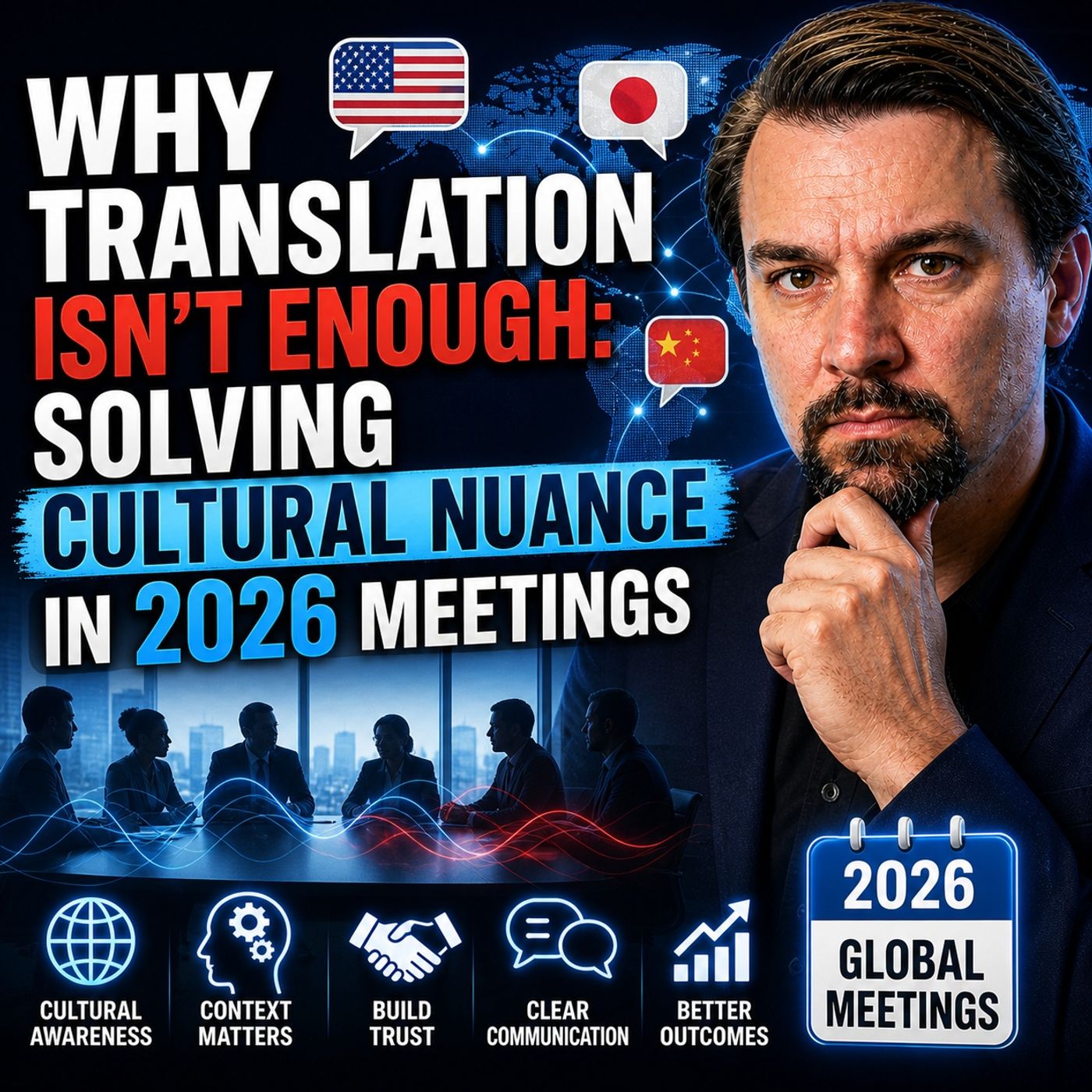
This episode argues that the biggest challenge in global meetings is not language translation, but interpreting meaning, intent, and cultural nuance. While modern tools can accurately translate words, they often fail to capture what those words actually represent in context—such as hesitation, politeness, indirect disagreement, or power dynamics.
A core idea is the distinction between “word accuracy” and “meaning accuracy.” Teams often assume that if transcripts and captions look correct, the meeting was successful. In reality, misunderstandings still occur because meaning is frequently conveyed indirectly. For example, a statement like “that may be difficult” might signal a soft rejection rather than a scheduling issue.
The episode highlights how this gap leads to false alignment. Teams move forward believing decisions were made, only to encounter resistance later from participants who never explicitly disagreed. This isn’t a failure of honesty—it’s a failure to interpret cultural communication patterns correctly.
Microsoft Teams Premium is discussed as an enabler, not a solution. Features like live translation and Intelligent Recap improve accessibility and post-meeting analysis, but they don’t interpret intent. Their real value lies in helping teams revisit conversations, identify ambiguity, and analyze signals such as weak commitments or unclear ownership after the meeting.
A key warning is against overtrusting AI-generated summaries. Clean, well-structured outputs can create a false sense of clarity, masking underlying confusion or misalignment. AI is better at surfacing patterns than understanding nuance, especially when communication is indirect or culturally coded.
The episode concludes with a shift in mindset: meetings shouldn’t end when the call ends. The real work happens afterward, through structured follow-up that validates decisions, confirms ownership,
To fix global communication gaps for stronger teams, you must first spot where the gaps exist, then dig into their root causes, and finally use solutions that promote clarity, inclusion, and steady improvement. A single word or gesture can change a message’s meaning, especially in a global team. You need more than translation; you need shared understanding. Without it, even the right words can send your team in the wrong direction. Take a moment to consider how your current approach helps or hinders true understanding.
Key Takeaways
-
Identify communication gaps early to prevent misunderstandings and delays.
-
Use clear and simple language to ensure everyone understands the message.
-
Encourage open dialogue and regular feedback to build trust within the team.
-
Leverage technology like live translation and intelligent meeting recaps to enhance communication.
-
Recognize and respect cultural differences to improve collaboration among team members.
-
Create a psychologically safe environment where everyone feels comfortable sharing ideas.
-
Set clear communication protocols to guide interactions and prevent confusion.
-
Celebrate communication successes to motivate and engage your team.
Why Communication Gaps Weaken Teams
Productivity and Collaboration Impact
You face many challenges when global communication gaps appear in your team. These gaps can slow down progress and make it harder for everyone to work together. When your internal communications lack clarity, you may see missed deadlines, wasted effort, and confusion about roles. The cost of miscommunication is high. It can drain resources and lower productivity.
Take a look at the numbers:
| Statistic | Impact |
|---|---|
| 82% of leaders and 72% of employees report that a lack of time between meetings makes it difficult to complete important tasks. | Time constraints from poor communication hinder task completion. |
| About 64% of workers claim that poor collaboration is the reason they lose three or more hours of productivity per week. | Poor collaboration leads to significant productivity loss. |
| 61% of employees said they would likely leave their job because of poor communication and a lack of collaboration. | Communication issues can cause employee turnover. |
| 51% of workers report increased stress caused by unclear or insufficient communication. | Stress rises when internal communications break down. |
| 86% of employees and executives blame failures in the workplace on poor collaboration or communication. | Workplace failures often stem from communication gaps. |
| Companies that encourage a collaborative environment are five times more likely to be high-performing. | Effective internal communications drive high performance. |
You can see that common communication gaps affect not only your output but also your ability to keep your team engaged and motivated. Microsoft Teams Premium helps you address these issues by focusing on intent and inclusivity, not just translation.
Morale and Trust Issues
When your internal communications break down, morale drops. Trust fades. Team members may feel left out or misunderstood. You might notice that people hesitate to share ideas or feedback. This fear can lead to disengagement and stress.
86% of employees point to communication and collaboration breakdowns as a leading cause of workplace failures. Gallup estimates disengaged employees — much of it rooted in communication breakdown — cost the global economy $438 billion in lost productivity last year alone.
If you want your team to thrive, you must build trust through clear internal communications. A strong message helps everyone feel included and valued.
Real-World Breakdown Examples
You can learn from real-world cases. A marketing team once misinterpreted a client's request for 'increased engagement.' They thought it meant producing more advertisements, but the client wanted better content quality. This misunderstanding caused delays and frustration.
Another remote team with members from Brazil, Germany, and the U.S. struggled with different communication styles. Brazilians valued relationship-building, Germans wanted direct feedback, and Americans preferred clear updates. Tension grew until the team created a playbook to address these preferences. This improved collaboration and morale.
Poor communication can lead to misalignment between teams, which can negatively impact customer experience. You must pay attention to internal communications and address every communication gap to avoid these costly mistakes.
Identifying Global Communication Gaps
Signs of Communication Gaps
Missed Deadlines and Confusion
You may notice missed deadlines or confusion about tasks. These issues often signal a communication gap. When your team lacks role clarity, people do not know who owns which responsibility. This confusion leads to delays and mistakes. You can use transparency tools, such as project management platforms, to track progress and see who contributes to each task.
| Indicator | Description |
|---|---|
| Role Clarity | Defining responsibilities and objectives to eliminate confusion and misalignment. |
| Transparency Tools | Utilizing project management platforms for visibility into progress and contributions. |
| Safe Communication Zones | Creating environments for open communication to prevent hidden problems. |
Repeated Questions and Misunderstandings
You might hear the same questions over and over. This repetition means your message did not reach everyone clearly. Quick responses and context-rich messages help reduce follow-ups. If your team does not actively use shared tools, you risk creating silos and misunderstandings.
-
Participation in shared tools shows engagement and prevents silos.
-
Communication responsiveness, such as quick replies, reduces confusion.
Assessment Methods
Surveys and Feedback
You can use surveys and feedback forms to gather insights about your team’s communication. 360-degree feedback surveys collect opinions from different stakeholders. This method gives you a well-rounded view of each person’s strengths and weaknesses. Behavioral interview questions help you learn how people handled past situations. These questions reveal how someone communicates and works with others.
| Method | Primary Advantage (Pro) | Primary Disadvantage (Con) |
|---|---|---|
| Interviews & Role Plays | Provides rich, qualitative insight into past behavior. | Can be time-consuming and prone to interviewer bias. |
| Psychometric Tests | Offers standardized, scalable, and objective data points. | May lack work-specific context and can be misinterpreted. |
| 360-Degree Feedback | Gathers well-rounded feedback from multiple perspectives. | Requires a strong culture of trust to be effective and honest. |
Observing Interactions
You can observe how your team interacts during meetings and daily tasks. Situational Judgment Tests and role plays simulate real work scenarios. These methods show how people respond under pressure. You can spot gaps in communication skills by watching how your team handles challenges.
Tip: Use structured meeting recaps, such as Microsoft Teams Premium Intelligent Recap, to review discussions. These recaps help you diagnose where global communication gaps exist. You can revisit what was said and what was meant, making it easier to spot unclear ownership or ambiguous decisions.
You must pay attention to these signs and use practical tools to assess your team’s communication. When you identify gaps early, you can address them before they grow into bigger problems.
Causes of Global Communication Gaps
Cultural Differences
Communication Styles
You work with people from many backgrounds. Each culture brings its own way of sharing information. Some cultures value relationship-building conversations, while others prefer direct feedback or concise updates. For example, a remote team with members from Brazil, Germany, and the U.S. faced tension because their communication styles did not match. Brazilians wanted to build relationships, Germans liked direct feedback, and Americans appreciated clear updates. The team created a playbook to outline these preferences. This improved collaboration and morale.
You must recognize these differences in internal communications. If you ignore them, misunderstandings can grow. Inclusive communication helps bridge these gaps. Use simple language and listen actively. This approach fosters clear and respectful interactions.
Hierarchy and Feedback
Hierarchy shapes how you give and receive feedback. In some cultures, people hesitate to provide direct critique. They worry about offending others or breaking social norms. During a project debrief, a team member from a culture that values indirect feedback did not share concerns openly. Their colleague, who preferred explicit communication, misunderstood the need for changes. This communication gap led to confusion and delayed progress.
You can address these issues by encouraging two-way discussions. Make sure frontline workers feel comfortable sharing ideas. Clear expectations and consistent processes reduce misunderstandings. When you build trust, you create a safer environment for internal communications.
Language Barriers
Non-Native Speakers
Language differences affect how you understand and share information. Native English speakers often assume non-native speakers grasp every nuance. This assumption can cause miscommunication. You should use simple language and check for understanding. Frontline workers may participate less if they struggle with language. This reduces engagement and limits innovation.
Written vs. Spoken Issues
Written and spoken communication present unique challenges. Misunderstandings can arise when instructions are unclear or too complex. You may see project delays or decreased participation. The table below shows the impact of language barriers on international organizations:
| Impact of Language Barriers | Description |
|---|---|
| Decreased Participation | Language differences can lead to misunderstandings, causing team members to participate less in discussions. |
| Project Delays | Miscommunication can result in delays in project timelines due to unclear instructions or expectations. |
| Lack of Innovation | Language barriers may stifle creativity and the sharing of ideas, leading to fewer innovative solutions. |
You must support frontline workers with tools that simplify internal communications. This helps everyone contribute and reduces the risk of communication gap.
Digital Miscommunication
Time Zones
Global teams often work across different time zones. This can make internal communications difficult. You may wait hours for a reply, which slows down decision-making. Asynchronous communication can lead to misinterpretations. Frontline workers need clear instructions to avoid confusion.
Overreliance on Text
Text-based communication lacks tone and nonverbal cues. Short replies like "OK" may seem disinterested. Lack of punctuation can make messages feel vague. Humor or sarcasm in text can be misunderstood, harming team dynamics. Digital communication often relies on written messages, which can create global communication gaps.
You must encourage active listening and use structured meeting recaps. This helps frontline workers understand intent and reduces misunderstandings. Internal communications should focus on clarity and inclusivity.
Tip: Use collaboration platforms that support live translation and intelligent recaps. These tools help frontline workers overcome language and digital barriers, making internal communications more effective.
Psychological Safety
You play a vital role in creating a safe environment for your team. Psychological safety means that everyone feels comfortable sharing ideas, asking questions, and expressing concerns without fear of embarrassment or punishment. When you build this kind of environment, you help your team overcome communication gaps that often appear in global settings.
You may notice that people hesitate to speak up if they worry about negative reactions. This silence can hide valuable insights and lead to misunderstandings. You can encourage open communication by showing respect for different opinions and making it clear that mistakes are learning opportunities. When you do this, you help your team members trust each other and work together more effectively.
Tip: Start meetings by inviting everyone to share their thoughts. Use positive language and thank people for their input. This simple step helps build trust and shows that every voice matters.
Psychological safety lays the foundation for open communication and collaboration. You see stronger relationships and improved teamwork when people feel safe. In diverse teams, psychological safety allows individuals from different backgrounds to share their perspectives. This leads to a richer pool of ideas and more creative solutions.
-
Individuals from diverse backgrounds are more likely to share their perspectives in a psychologically safe environment.
-
Psychological safety supports open communication and collaboration, which is essential for the success of diverse teams.
-
Team members who feel safe communicate openly, honestly, and transparently.
-
Trust grows, leading to better collaboration and stronger team cohesion.
You can use several strategies to build psychological safety. Model active listening by paying attention to what others say. Avoid interrupting and show appreciation for different viewpoints. Encourage feedback and make it clear that you value all contributions. If someone makes a mistake, respond with support and focus on what can be learned.
You may also create guidelines for respectful communication. Set clear expectations for how people interact during meetings and online discussions. Remind everyone that disagreements are normal and can lead to better outcomes when handled respectfully.
You help bridge communication gaps by making psychological safety a priority. When your team feels safe, you unlock their full potential. You see more engagement, stronger relationships, and fewer misunderstandings. Psychological safety is not just a nice-to-have; it is a must-have for global teams that want to thrive.
Bridging the Communication Gap with Technology

Multilingual Channels
You work in a world where your team may speak many languages. Multilingual channels help you bridge the communication gap by letting everyone use their preferred language. When you communicate in the language your employees understand best, you build trust and improve understanding. This approach makes your internal communications more inclusive and effective.
-
Communicating in employees' preferred languages is essential for understanding and building trust.
-
Effective communication strategies should consider the audience's language preferences to enhance engagement.
-
Subtitles in videos not only aid non-native speakers but also support individuals with hearing impairments, broadening the audience reach.
You should embrace cultural differences to strengthen teamwork. When you value every team member’s contributions, you prevent feelings of isolation among those with limited English proficiency. In a multilingual workplace, understanding and respecting cultural differences can enhance collaboration. You create a more inclusive environment when everyone feels respected and understood. This is crucial for effective teamwork and strong internal communications.
Live Translation and Interpreters
Live translation and interpreter services play a key role in bridging the communication gap for global teams. These tools allow you to hold meetings where everyone can participate, no matter their native language. Microsoft Teams Premium offers live translation and interpreter features that make your meetings more accessible and inclusive.
| Impact Area | Description |
|---|---|
| Accuracy and cultural nuance | Certified professionals prevent costly mistranslations that can stall deals or cause legal issues. |
| Real-time feedback | Enables immediate Q&A sessions for collaborative problem-solving without delays. |
| Confidentiality and trust | Hiring certified experts ensures sensitive data is handled securely, maintaining trust. |
You gain real-time feedback and can solve problems together without waiting for translations. This immediate access to information helps you make decisions faster. You also protect sensitive information by using certified professionals, which builds trust within your team. Live translation and interpreters help you avoid misunderstandings that can arise from language barriers in internal communications.
Intelligent Meeting Recaps
Intelligent meeting recap tools, like those in Microsoft Teams Premium, help you capture the intent behind every conversation. These tools use AI to provide detailed notes and summaries, making sure all team members stay informed—even if they miss the meeting. You can revisit discussions and understand not just what was said, but what was meant.
| Feature | Benefit |
|---|---|
| AI-powered notes | Provides comprehensive overviews of meetings, ensuring all team members stay informed. |
| Personalized highlights | Helps individuals focus on the most relevant parts of the meeting, addressing potential gaps. |
| Recommended action items | Suggests tasks based on discussions, facilitating follow-up and accountability. |
| Organization of content | Creates chapters for recordings, making it easier to navigate and review meeting discussions. |
Intelligent Recap allows you to catch up on discussions if you miss a meeting. You do not need to attend every session in real time, which is important for hybrid work. This tool improves clarity and alignment among team members. It also helps you identify weak commitments, unclear ownership, and ambiguous decisions that may lead to future problems. By using these recaps as diagnostic tools, you can spot hidden issues in your internal communications and prevent costly mistakes.
You can use technology to bridge the communication gap and create a more inclusive workplace. Multilingual channels, live translation, and intelligent meeting recaps help you capture intent and foster understanding. These tools make your internal communications portal more effective and ensure every voice is heard.
Collaboration Platforms
You rely on collaboration platforms to connect your global team. These platforms help you share information, manage projects, and communicate in real time or asynchronously. You can use instant messaging, video calls, and email integrations to keep everyone in the loop. When you work with people in different locations, you need tools that make teamwork easy and efficient.
Collaboration platforms offer many features that support strong communication. You can see the most valued features in the table below:
| Feature | Description |
|---|---|
| Communication tools | Instant messaging, video conferencing, and email integrations facilitate both synchronous and asynchronous communication. |
| Document management | Easy document sharing, editing, and storage with version control and permissions settings for integrity and security. |
| Task and project management | Features like task assignments, deadline tracking, and visual aids like Gantt charts help keep projects on schedule. |
| Integration capabilities | Seamless integration with other business applications ensures smooth information flow across the organization. |
| User-friendly interface | An intuitive design minimizes the learning curve and encourages adoption across the team. |
| Security and permissions | Robust security features protect sensitive data and ensure compliance with privacy regulations. |
| Search functionality | Powerful search capabilities allow quick location of documents, conversations, or tasks, improving efficiency. |
| Customization options | Tailoring features and workflows to fit unique team needs boosts efficiency and user satisfaction. |
| Reporting and analytics | Tools to track performance and project progress provide insights for better decision-making and optimization. |
You benefit from these features every day. Communication tools let you send quick updates or hold meetings with teammates across the globe. Document management keeps your files organized and secure. Task and project management helps you track deadlines and responsibilities. Integration capabilities connect your platform with other business tools, making information flow smoothly.
A user-friendly interface makes it easy for everyone to use the platform, even if they are new to the technology. Security and permissions protect your sensitive data and help you follow privacy rules. Search functionality saves time by helping you find documents or conversations fast. Customization options let you adjust workflows to fit your team’s needs. Reporting and analytics give you insights to improve your projects and make better decisions.
Microsoft Teams Premium brings these features together in one place. You can use live translation, intelligent meeting recaps, and secure document sharing to bridge communication gaps. You create a space where every team member feels included and understood. When you use a collaboration platform with these tools, you build a stronger, more connected team.
Tip: Encourage your team to explore all the features of your collaboration platform. When everyone knows how to use the tools, you see fewer misunderstandings and more productive teamwork.
Building a Culture of Clarity and Inclusion

Cultural Sensitivity Training
You build a stronger team when you invest in cultural sensitivity training. This training helps you understand differences in communication styles and backgrounds. It boosts team collaboration by reducing conflicts and making teamwork smoother. You also improve customer service quality because your team learns to tailor interactions for different cultures. Training prevents costly mistakes and helps your business expand successfully. Employees feel more engaged and motivated when they know their culture is respected.
| Benefit | Description |
|---|---|
| Boosts Team Collaboration | Cultivates mutual understanding, minimizing conflicts and enabling seamless teamwork. |
| Elevates Customer Service Quality | Empowers teams to tailor interactions based on cultural preferences, enhancing customer loyalty. |
| Prevents Costly Missteps | Equips staff to navigate cultural nuances, safeguarding business relationships. |
| Accelerates Successful Expansion | Enables businesses to adapt marketing and support efforts to diverse regions effectively. |
| Strengthens Employee Engagement | Fosters innovation and helps retain top talent in competitive markets. |
You can enhance understanding of cultural differences and improve communication styles among team members. This training fosters an inclusive workplace culture that drives productivity. Lead with empathy and celebrate cultural events to transform your colleagues into a community.
Clear Communication Protocols
You need clear communication protocols to achieve effective communication across cultures. Protocols set expectations for how your team interacts. Cross-cultural training equips you with knowledge about differences in communication styles. A communication charter outlines preferred tools, frequency, and language standards. Bilingual managers bridge gaps and translate cultural nuances. A cultural playbook gives guidelines for collaboration and helps you navigate cultural differences. Language training programs help team members bridge communication gaps.
| Protocol | Description |
|---|---|
| Cross-Cultural Training | Equips teams with knowledge of cultural differences and communication styles, enhancing understanding of subtleties. |
| Communication Charter | Outlines preferred tools, frequency, and language standards to prevent miscommunication by setting shared expectations. |
| Bilingual Managers | Bilingual leaders mediate conflicts and translate cultural nuances, enhancing inclusivity and understanding. |
| Cultural Playbook | Establishes guidelines for communication and collaboration, helping teams navigate cultural differences. |
| Language Training | Tailored programs that bridge communication gaps by improving language skills among team members. |
You should communicate early and often. This approach prevents misunderstandings and keeps everyone aligned. Clear protocols make two-way conversation easier and help your team work together.
Regular Feedback and Dialogue
You create a culture of clarity when you encourage regular feedback and dialogue. Feedback surveys give you direct insights about communication strengths and weaknesses. They help you spot issues that may not appear during meetings. Ask specific questions about clarity, tone, and responsiveness. Use anonymous surveys to get honest feedback. Keep surveys short and focused to avoid fatigue.
Tip: Ask questions like, "Do you feel informed about project updates?" or "Are your ideas heard in meetings?" Use this input to adjust your communication practices.
You foster ongoing improvement by listening to your team. Open dialogue builds trust and helps everyone feel valued. When you prioritize regular training and encourage open communication, you strengthen your team and drive innovation.
Modeling Effective Communication
You set the standard for your team when you model effective communication. Leaders who demonstrate clear, respectful, and intentional engagement practices help everyone understand what good communication looks like. You build trust and psychological safety by promoting shared mental models and encouraging bi-directional communication. When you check in regularly and share both successes and challenges, you create bonds that make each person feel valued.
| Practice | Impact |
|---|---|
| Intentional Engagement Practices | Remote teams rely on these to maintain morale and cohesion. Leaders create opportunities for collaboration and recognition. |
| Higher Accountability | Active engagement leads to better accountability, communication, and long-term retention. |
-
Quality communication from leaders improves understanding of goals, boosts productivity, and increases job satisfaction.
-
Regular check-ins help everyone stay aligned and motivated.
Tip: Start meetings by outlining objectives and encourage everyone to ask questions. Celebrate achievements and address challenges openly.
Role-Playing and Practice
You can strengthen communication skills by using role-playing exercises. These activities simulate real-life scenarios, such as contract negotiations or customer complaints. You practice responding to challenges in a safe environment, which helps you build empathy and understand diverse perspectives.
| Role-Playing Benefit | Explanation |
|---|---|
| Simulates real-life scenarios | Lets you practice communication skills without risk. |
| Builds empathy and understanding | Helps you experience different viewpoints, which is crucial for cross-cultural communication. |
-
Create realistic scenarios that focus on common challenges.
-
Facilitate small group sessions to encourage participation.
-
Conduct debriefs to analyze outcomes and discuss alternative approaches.
Role-playing gives you a chance to rotate roles and gain insights into how others think and feel. This practice helps you communicate more effectively across cultures and prepares you for real-world situations.
Managing Non-Verbal Cues
You must pay attention to non-verbal cues, especially in virtual settings. Non-verbal communication conveys emotions and intentions that words alone cannot express. In online meetings, you may miss facial expressions, gestures, or tone of voice. This absence can lead to misunderstandings and affect trust within your team.
-
Written communication lacks the subtleties of spoken language, which increases the risk of misinterpretation.
-
The absence of non-verbal cues can cause confusion and weaken relationships.
Note: Encourage video calls for important discussions. Use clear language and ask for feedback to ensure everyone understands the message.
You improve communication effectiveness by managing non-verbal cues. When you recognize and address these challenges, you help your team stay connected and avoid miscommunication.
Face-to-Face for Key Issues
You cannot always solve complex problems through email or chat. Sometimes, only face-to-face communication can clear up misunderstandings and build real trust. In global teams, this approach becomes even more important. When you meet in person or use video calls, you see facial expressions, hear tone of voice, and notice body language. These cues help you understand the true meaning behind words.
Face-to-face communication is most critical when you need to resolve sensitive issues, give nuanced feedback, or make important decisions. Written messages often miss the subtle details that matter. For example, if you need to address a conflict or share constructive criticism, a direct conversation helps prevent confusion and shows respect. You also build stronger relationships when you take time to connect personally.
Consider these situations where face-to-face communication makes a difference:
-
Providing feedback that requires empathy or careful explanation.
-
Fostering trust among team members who come from different backgrounds.
-
Discussing project setbacks or changes in direction.
-
Addressing misunderstandings before they grow into bigger problems.
You should not wait too long to have these conversations. The 48-hour rule encourages you to address issues quickly, which keeps your projects on track. Regular one-on-one meetings also help you maintain open lines of communication. When you check in with your colleagues, you show that you value their input and want to prevent problems before they start.
To make the most of face-to-face interactions, follow these steps:
-
Set up clear communication channels so everyone knows how to reach each other.
-
Practice open and transparent communication to build trust within your team.
-
Use active listening during meetings. Pay attention, ask questions, and confirm understanding.
Tip: If you work remotely, turn on your camera during important discussions. Seeing each other’s faces helps you connect and reduces the chance of miscommunication.
You may not always have the chance to meet in person, but you can still create meaningful connections through video calls. When you prioritize face-to-face communication for key issues, you strengthen your team and ensure everyone feels heard and respected.
Measuring Progress and Continuous Improvement
Communication KPIs
You need to track key performance indicators to see if your communication strategy is working. KPIs help you prove that communication drives measurable outcomes for your team. You can focus on adoption, alignment, engagement, or performance improvement. Internal communications KPIs should connect to business goals. Metrics that do not link to objectives only report numbers without showing impact.
Here are some useful KPIs for global teams:
-
Engagement with culture-related content on your intranet
-
Share of voice compared to competitors
-
Number of return users to your website
| KPI | ROI Target | Objective |
|---|---|---|
| Engagement with culture-related content | Improve employee pulse survey participation | Increase employee engagement |
| Share of voice vs. competitors | Grow in market share | Increase market share |
| Number of return users to website | Increase repeat site visits | Increase customer retention |
You should use both qualitative and quantitative feedback to assess communication effectiveness. Identifying the right KPIs and integrating insights from surveys or interviews can help you understand how well your global communication gaps are closing.
Ongoing Feedback
You must collect ongoing feedback to support continuous improvement. Feedback surveys give you direct insights from your team about strengths and weaknesses in communication. Tracking performance metrics connects improvements in communication with results, such as task completion and engagement. Regular audits review communication processes and highlight areas that need change.
| Strategy | Description |
|---|---|
| Feedback Surveys | Provide direct insights from team members about communication strengths and weaknesses. |
| Track Performance Metrics | Monitor task completion and engagement to connect communication improvements with results. |
| Conduct Regular Audits | Review communication processes to identify effective practices and areas needing improvement. |
You can use anonymous surveys to encourage honest responses. Short, focused questions help you avoid survey fatigue. When you listen to feedback, you show your team that their opinions matter.
Tip: Schedule regular check-ins to discuss feedback and make adjustments. This keeps communication open and builds trust.
Adjusting Strategies
You need to adjust your communication strategy based on feedback and results. Use feedback surveys to gather insights about what works and what needs improvement. Track team performance metrics to see if changes in communication lead to better outcomes. Conduct regular communication audits to review processes and spot effective practices.
| Strategy | Description |
|---|---|
| Use Feedback Surveys | Gather direct insights from the team about communication strengths and weaknesses. |
| Track Team Performance Metrics | Monitor key performance indicators to connect communication improvements with team results. |
| Conduct Regular Communication Audits | Review communication processes to identify effective practices and areas needing improvement. |
You should stay flexible and open to new ideas. When you adjust your approach, you help your team grow stronger and more connected. Continuous improvement ensures that you keep closing global communication gaps and building a team that thrives.
Empowering Teams for Ownership
Encouraging Participation
You build stronger teams when you encourage everyone to take part in communication improvement. Ownership starts with active listening. When you listen to your colleagues, you show respect for their ideas. You also promote transparency and openness. Sharing information helps everyone feel included and valued.
Set clear goals and expectations for your group. When you know what you want to achieve, you can measure progress and celebrate milestones. Regular feedback keeps everyone on track. You can use surveys or quick check-ins to gather opinions and adjust your approach.
Team-building activities help you connect with others. These activities create trust and make it easier to share thoughts. You can try icebreakers, group challenges, or role-playing exercises. These methods encourage participation and help you understand different viewpoints.
Here are some ways to foster ownership in your team:
-
Practice active listening during meetings.
-
Share information openly and honestly.
-
Set clear goals for communication improvement.
-
Give and receive feedback regularly.
-
Use team-building activities to strengthen relationships.
Tip: Invite everyone to share their ideas during meetings. When you value each voice, you build a culture of participation.
Recognizing Communication Wins
You drive motivation when you recognize communication wins. Success comes from small victories as well as big achievements. Celebrate when your team reaches a milestone or solves a problem together. You can highlight these moments in meetings, newsletters, or internal platforms.
Create a table to track communication wins and share it with your group:
| Communication Win | Description | Who Contributed |
|---|---|---|
| Clear project updates | Kept everyone informed | Project manager |
| Quick response to issues | Solved problems fast | Support team |
| Inclusive meeting recap | Ensured all voices were heard | Meeting facilitator |
You can use shout-outs or awards to show appreciation. A simple thank you goes a long way. When you recognize effort, you inspire others to follow good practices. You also reinforce the behaviors that lead to success.
Note: Make recognition a regular part of your routine. Consistent praise helps build confidence and encourages ongoing improvement.
Ownership grows when you encourage participation and celebrate wins. You see more engagement and stronger results. Your team becomes more resilient and ready for future challenges.
You can fix global communication gaps by spotting issues early, understanding their causes, and applying targeted solutions. Focus on intent and inclusivity to build a stronger team. Use feedback and technology to support ongoing improvement.
-
Embrace tools like Teams Premium for future-ready communication.
Remember, clear communication helps every team member feel valued and drives success.
🎧 Listen to this episode
Want a practical explanation of Cultural Nuance in Global Meetings Beyond Translation? This episode breaks down the topic in clear language and shows why it matters for Microsoft 365, Azure, Power Platform, security, AI, and modern work.
Listen to this episode if you want to:
- Understand the key concepts behind Cultural Nuance in Global Meetings Beyond Translation
- See how it fits into the wider Microsoft technology ecosystem
- Learn where it can create practical value for your organization
You may also enjoy these related M365 FM episodes:
- Microsoft Graph Automation Architecture: Beyond Scripts
- Microsoft AI Agent Runtimes: Beyond Enterprise Chatbots
- Enterprise AI Agent Fabric: Architecture Beyond Chatbots
- AI Agent Identity Security: Beyond Service Accounts
- AI-Powered SharePoint Intranets: Beyond Static Design
Discover more practical Microsoft conversations on M365 FM.
🚀 Want to be part of m365.fm?
Then stop just listening… and start showing up.
👉 Connect with me on LinkedIn and let’s make something happen:
- 🎙️ Be a podcast guest and share your story
- 🎧 Host your own episode (yes, seriously)
- 💡 Pitch topics the community actually wants to hear
- 🌍 Build your personal brand in the Microsoft 365 space
This isn’t just a podcast — it’s a platform for people who take action.
🔥 Most people wait. The best ones don’t.
👉 Connect with me on LinkedIn and send me a message:
"I want in"
Let’s build something awesome 👊
1
00:00:00,000 --> 00:00:03,080
Most global teams think the hard part is translation, it isn't.
2
00:00:03,080 --> 00:00:06,840
The hard part starts after the words land, because that's where tone, hesitation, status,
3
00:00:06,840 --> 00:00:10,280
and polite resistance get flattened into something that looks clear but isn't.
4
00:00:10,280 --> 00:00:15,040
A meeting ends, the transcript looks clean, the recap sounds organized, and everyone leaves
5
00:00:15,040 --> 00:00:17,040
with a different read on what just happened.
6
00:00:17,040 --> 00:00:18,400
That's expensive.
7
00:00:18,400 --> 00:00:23,200
Miscommunication costs businesses about $1.2 trillion every year, and when you look at why
8
00:00:23,200 --> 00:00:28,800
outsourcing projects fail, 60% of those failures link back to cultural incompatibility,
9
00:00:28,800 --> 00:00:33,240
while 56% stem from communication breakdowns.
10
00:00:33,240 --> 00:00:36,560
This episode isn't about getting better subtitles or faster translations.
11
00:00:36,560 --> 00:00:38,320
It's about something deeper.
12
00:00:38,320 --> 00:00:42,440
How do you recover intent in meetings where people don't say everything directly, and
13
00:00:42,440 --> 00:00:44,240
where the real signal sits between the lines?
14
00:00:44,240 --> 00:00:48,040
That's the shift, and Teams Premium already gives you more of that signal than most teams
15
00:00:48,040 --> 00:00:49,560
know how to use.
16
00:00:49,560 --> 00:00:51,560
The invisible wall in global business.
17
00:00:51,560 --> 00:00:53,960
Most meeting systems still run on an old model.
18
00:00:53,960 --> 00:00:57,760
Language goes in, words come out, a transcript gets stored, a summary gets shared, everyone
19
00:00:57,760 --> 00:01:00,960
assumes the meeting is now understood because the content was captured.
20
00:01:00,960 --> 00:01:04,720
But that model only works when communication is mostly explicit, direct, and verbalized
21
00:01:04,720 --> 00:01:05,720
in full.
22
00:01:05,720 --> 00:01:07,240
In a lot of global business settings, it isn't.
23
00:01:07,240 --> 00:01:10,280
High-context communication doesn't put the whole message in the sentence.
24
00:01:10,280 --> 00:01:14,600
Part of the message sits in timing, in softness, in what gets delayed, and in what never
25
00:01:14,600 --> 00:01:15,800
gets stated at all.
26
00:01:15,800 --> 00:01:18,360
One person hears, "We should revisit this next quarter."
27
00:01:18,360 --> 00:01:21,960
And logs that as a neutral planning note, while another person hears caution, loss of confidence
28
00:01:21,960 --> 00:01:23,800
and a polite refusal to commit.
29
00:01:23,800 --> 00:01:25,720
Same words, different meeting.
30
00:01:25,720 --> 00:01:27,320
That's where things break.
31
00:01:27,320 --> 00:01:31,040
And more direct cultures, disagreement usually arrives in the words themselves.
32
00:01:31,040 --> 00:01:33,760
Someone says no, they push back, they call out the risk.
33
00:01:33,760 --> 00:01:36,960
In higher-context settings, disagreement often shows up in a softer form.
34
00:01:36,960 --> 00:01:40,600
The answer gets deferred, ownership gets broadened, the language gets warmer, while the
35
00:01:40,600 --> 00:01:41,960
commitment gets weaker.
36
00:01:41,960 --> 00:01:45,720
If you only track literal wording, you miss the decision signal completely.
37
00:01:45,720 --> 00:01:48,480
And that's not a cultural theory problem, it's an operating problem.
38
00:01:48,480 --> 00:01:49,680
This is where rework starts.
39
00:01:49,680 --> 00:01:52,760
A team thinks approval happens, so execution moves forward.
40
00:01:52,760 --> 00:01:56,760
Then an objection appears later from someone who never felt safe saying no in the room.
41
00:01:56,760 --> 00:02:00,880
And a might-he attentive agreement and start planning capacity, while the client thought
42
00:02:00,880 --> 00:02:06,080
they were only being courteous, or a technical team reads, "That should be possible, as commitment
43
00:02:06,080 --> 00:02:09,880
when it was really uncertainty, wrapped in politeness."
44
00:02:09,880 --> 00:02:12,040
Nobody lied, but the meeting still failed.
45
00:02:12,040 --> 00:02:14,520
The numbers behind that failure are staggering.
46
00:02:14,520 --> 00:02:19,520
Large firms lose an average of $62.4 million a year to poor communication, and even smaller
47
00:02:19,520 --> 00:02:24,720
firms lose about $420,000 for every one thousand employees they have.
48
00:02:24,720 --> 00:02:28,840
In the world of global outsourcing, 62% of projects run over budget.
49
00:02:28,840 --> 00:02:32,000
When you look at those numbers through the meeting lens, the pattern gets pretty clear.
50
00:02:32,000 --> 00:02:34,280
A lot of costs doesn't come from bad strategy.
51
00:02:34,280 --> 00:02:37,920
It comes from meetings that produce a parent alignment instead of real alignment.
52
00:02:37,920 --> 00:02:39,160
Remote work made this worse.
53
00:02:39,160 --> 00:02:42,520
In a physical room, people often repair misunderstandings informally.
54
00:02:42,520 --> 00:02:43,720
You catch someone after the meeting.
55
00:02:43,720 --> 00:02:44,840
You read the pause.
56
00:02:44,840 --> 00:02:47,360
You notice who stayed quiet when the decision landed.
57
00:02:47,360 --> 00:02:51,880
In a digital meeting, especially a multilingual one, that repair layer gets thinner.
58
00:02:51,880 --> 00:02:55,760
People rely more on captions, transcripts, AI notes, and recaps because those are the artifacts
59
00:02:55,760 --> 00:02:56,760
everyone can share.
60
00:02:56,760 --> 00:03:00,360
But those artifacts mostly preserve what was said, not always what was meant.
61
00:03:00,360 --> 00:03:02,520
So the problem isn't just the language barrier.
62
00:03:02,520 --> 00:03:03,680
It's the model behind it.
63
00:03:03,680 --> 00:03:08,480
We built meeting habits around the idea that if we capture the words, we capture the meeting.
64
00:03:08,480 --> 00:03:10,320
In global work, that assumption breaks fast.
65
00:03:10,320 --> 00:03:12,500
And once you see that, a bigger question shows up.
66
00:03:12,500 --> 00:03:17,640
If translation solved understanding, why do misunderstandings keep scaling with better tools?
67
00:03:17,640 --> 00:03:19,200
Why translation isn't enough?
68
00:03:19,200 --> 00:03:22,040
And accuracy and meaning accuracy are not the same thing.
69
00:03:22,040 --> 00:03:25,360
That sounds obvious when you say it out loud, but most meeting workflows still treat them
70
00:03:25,360 --> 00:03:26,360
like the same outcome.
71
00:03:26,360 --> 00:03:30,280
If the captions look clean, if the transcript reads well, and if everyone can technically follow
72
00:03:30,280 --> 00:03:33,000
the language, teams assume the meeting worked.
73
00:03:33,000 --> 00:03:37,120
That assumption fails the moment communication depends on context more than wording.
74
00:03:37,120 --> 00:03:39,240
Low context communication is easier here.
75
00:03:39,240 --> 00:03:40,240
People state the point.
76
00:03:40,240 --> 00:03:41,240
They name the risk.
77
00:03:41,240 --> 00:03:44,080
They ask the hard question directly and they tie decisions to clear language.
78
00:03:44,080 --> 00:03:46,760
AI handles that kind of exchange pretty well.
79
00:03:46,760 --> 00:03:47,760
Deadlines.
80
00:03:47,760 --> 00:03:51,920
And then the question is, how do we get the information to the point where the translation
81
00:03:51,920 --> 00:03:52,920
can be perfect?
82
00:03:52,920 --> 00:03:56,920
And then the question is, how do we get the information to the point where the translation
83
00:03:56,920 --> 00:03:57,920
can be perfect?
84
00:03:57,920 --> 00:04:02,920
And then the question is, how do we get the information to the point where the translation
85
00:04:02,920 --> 00:04:03,920
can be perfect?
86
00:04:03,920 --> 00:04:07,400
And then the question is, how do we get the information to the point where the translation
87
00:04:07,400 --> 00:04:08,400
can be perfect?
88
00:04:08,400 --> 00:04:11,400
And then the question is, how do we get the information to the point where the translation
89
00:04:11,400 --> 00:04:12,400
can be perfect?
90
00:04:12,400 --> 00:04:13,400
And then the question is, how do we get the information to the point where the translation
91
00:04:13,400 --> 00:04:14,400
can be perfect?
92
00:04:14,400 --> 00:04:15,400
And then the question is, how do we get the information to the point where the translation
93
00:04:15,400 --> 00:04:16,400
can be perfect?
94
00:04:16,400 --> 00:04:17,400
And then the question is, how do we get the information to the point where the translation
95
00:04:17,400 --> 00:04:18,400
can be perfect?
96
00:04:18,400 --> 00:04:19,400
And then the question is, how do we get the information to the point where the translation
97
00:04:19,400 --> 00:04:20,400
can be perfect?
98
00:04:20,400 --> 00:04:21,400
And then the question is, how do we get the information to the point where the translation
99
00:04:21,400 --> 00:04:22,400
can be perfect?
100
00:04:22,400 --> 00:04:23,400
And then the question is, how do we get the information to the point where the translation
101
00:04:23,400 --> 00:04:24,400
can be perfect?
102
00:04:24,400 --> 00:04:25,400
And then the question is, how do we get the information to the point where the translation
103
00:04:25,400 --> 00:04:26,400
can be perfect?
104
00:04:26,400 --> 00:04:27,400
And then the question is, how do we get the information to the point where the translation
105
00:04:27,400 --> 00:04:28,400
can be perfect?
106
00:04:28,400 --> 00:04:29,400
And then the question is, how do we get the information to the point where the translation
107
00:04:29,400 --> 00:04:30,400
can be perfect?
108
00:04:30,400 --> 00:04:31,400
And then the question is, how do we get the information to the point where the translation
109
00:04:31,400 --> 00:04:32,400
can be perfect?
110
00:04:32,400 --> 00:04:33,400
And then the question is, how do we get the information to the point where the translation
111
00:04:33,400 --> 00:04:34,400
can be perfect?
112
00:04:34,400 --> 00:04:47,400
Soften's disagreement or keeps the relationship intact while signaling resistance. If you don't read that layer, you don't really understand the exchange. And this is where literal translation still earns its place. You should absolutely use it for the parts of the meeting that need precision.
113
00:04:47,400 --> 00:04:54,400
Technical requirements, contract terms, milestones, support processes, clear decisions that need to travel fast across teams.
114
00:04:54,400 --> 00:04:55,400
That part matters.
115
00:04:55,400 --> 00:05:03,400
The mistake is expecting the same tool to fully decode negotiation posture, face saving language, soft nose or relational signals that only make sense inside a specific cultural pattern.
116
00:05:03,400 --> 00:05:05,400
The current performance data backs that up.
117
00:05:05,400 --> 00:05:09,400
Instructured meeting conditions, transcript accuracy can reach the low to mid-90s.
118
00:05:09,400 --> 00:05:15,400
But when you move from transcription into sentiment and emotion, reliability drops into lower bands in real production settings.
119
00:05:15,400 --> 00:05:22,400
And then things get messier, sarcasm throws it off, indirect criticism throws it off, slang throws it off, people switching between languages mid-thought throws it off.
120
00:05:22,400 --> 00:05:28,400
So when teams treat AI interpretation a settled fact, they start automating uncertainty. There's another limit you need to keep in mind.
121
00:05:28,400 --> 00:05:36,400
As of the 2026 roadmap information in your research set, there's no confirmed team's premium path for broad non-verbal queue interpretation across meetings.
122
00:05:36,400 --> 00:05:42,400
No magic layer that watches facial expressions reads posture and tells you who secretly disagreed.
123
00:05:42,400 --> 00:05:47,400
So don't build a meeting model around features that don't exist. Use the model that does exist.
124
00:05:47,400 --> 00:05:56,400
AI is good at surfacing traces, patterns, inconsistencies, missing owners, repeated defer language, gaps between what sounded settled live and what still looks vague after the meeting.
125
00:05:56,400 --> 00:06:03,400
That's useful, very useful actually. But it's a signal layer, not a truth machine. Once you treat it that way, the whole posture changes.
126
00:06:03,400 --> 00:06:10,400
You stop asking the tool to read the room for you and you start using it to show you where to look more closely. So what can teams premium do well right now?
127
00:06:10,400 --> 00:06:18,400
What teams premium actually changes? Teams premium matters when you stop treating it like a translation add on and start treating it like a context recovery layer.
128
00:06:18,400 --> 00:06:28,400
That's the shift, it doesn't solve culture, it doesn't decode motive by itself, what it does is reduce friction in the live meeting, then give you better post meeting material to inspect where intent may have slipped.
129
00:06:28,400 --> 00:06:31,400
Start with live translation and interpreter.
130
00:06:31,400 --> 00:06:37,400
Their value is obvious at one level. People can follow the conversation in their preferred language, which lowers exclusion fast.
131
00:06:37,400 --> 00:06:46,400
But the deeper gain is meeting flow, when language access improves, people interrupt less, ask for fewer resets and spend less energy just trying to keep up.
132
00:06:46,400 --> 00:06:53,400
The narrative interpretation matters here because it slows the exchange into clearer turns. In high stakes, multilingual meetings, that structure helps.
133
00:06:53,400 --> 00:06:58,400
People hear a full statement, then the interpretation follows and the meeting becomes easier to track without constant overlap.
134
00:06:58,400 --> 00:07:06,400
That doesn't mean the interpretation captures every layer of meaning. It means more people can stay in the conversation long enough to notice where meaning may still need checking.
135
00:07:06,400 --> 00:07:12,400
Access first, interpretation second, judgment after that. Then there's intelligent recap and this is where the real operating change starts.
136
00:07:12,400 --> 00:07:18,400
Not because some reason are new, they aren't. But because recap gives you a second pass through the meeting with structure built in.
137
00:07:18,400 --> 00:07:26,400
You get AI notes, tasks, speaker attributed moments, chapters and personalized catch up. If someone missed the meeting, they don't need to hunt through an hour of recording.
138
00:07:26,400 --> 00:07:33,400
They can get back to the right point fast. If someone joined live but sensed something felt off, they can review the output without relying on memory alone.
139
00:07:33,400 --> 00:07:40,400
That second pass matters more than most teams realize because ambiguity often becomes visible after the meeting, not during it.
140
00:07:40,400 --> 00:07:45,400
In the room, people are processing language, watching time, managing slides and deciding when to speak.
141
00:07:45,400 --> 00:07:52,400
After the meeting, the noise drops. Now you can scan for weak commitments. You can spot action items that sound active but don't name an owner.
142
00:07:52,400 --> 00:07:56,400
You can catch a decision that appears in the summary even though no approver was clearly identified.
143
00:07:56,400 --> 00:08:05,400
You can notice language patterns like "We should revisit", "Let's align offline" or "This may require further discussion" showing up again and again around the same issue.
144
00:08:05,400 --> 00:08:12,400
If not sentiment analysis in the magical sense, it's better evidence handling and the practical payoff is already pretty clear in your source set.
145
00:08:12,400 --> 00:08:20,400
Intelligent recap has been tied to stronger action item follow through than manual notes and it also cuts the time needed to catch up after a missed meeting.
146
00:08:20,400 --> 00:08:23,400
Those are direct operating gains but the more strategic gain is this.
147
00:08:23,400 --> 00:08:30,400
Recap helps you inspect whether the meeting produced actual commitment or just well-worded ambiguity. There's also a trust layer people often miss.
148
00:08:30,400 --> 00:08:36,400
Custom dictionaries and domain language support matter a lot in technical, legal and industry-heavy conversations.
149
00:08:36,400 --> 00:08:44,400
If your meeting uses product names, acronyms, regulatory terms or client-specific vocabulary, cleaner recognition changes how seriously people take the output.
150
00:08:44,400 --> 00:08:52,400
Once terminology lands correctly, the recap becomes more usable and people spend less time arguing with the system before they can even analyse the discussion.
151
00:08:52,400 --> 00:08:58,400
Still, keep the limit in view, Teams Premium does not read faces. It does not infer hidden cultural rules on its own.
152
00:08:58,400 --> 00:09:08,400
It does not tell you whether a soft answer meant respect, hesitation or rejection. What it gives you is a stronger trace of the meeting with better capture, better attribution and better review paths.
153
00:09:08,400 --> 00:09:13,400
That's enough to improve judgment if your team knows how to read the output so the value isn't the feature list.
154
00:09:13,400 --> 00:09:16,400
It's what those features let you notice that you would have missed before.
155
00:09:16,400 --> 00:09:21,400
A better meeting model from raw transcript to intent review, you need a different meeting model.
156
00:09:21,400 --> 00:09:26,400
I'm not talking about a better way to take notes or a new habit for recaps. I mean a different model entirely.
157
00:09:26,400 --> 00:09:33,400
This approach assumes that your first pass through a meeting is just for capturing content while the second pass is where you actually check for intent.
158
00:09:33,400 --> 00:09:38,400
You listen once to hear what people said and then you review it again to see what the meeting was actually trying to achieve.
159
00:09:38,400 --> 00:09:45,400
That small shift changes everything because it stops the transcript from being a final record and turns it into the starting point for real analysis.
160
00:09:45,400 --> 00:09:48,400
The first move is simple, but you have to capture the meeting properly.
161
00:09:48,400 --> 00:09:53,400
Turn on the transcription and make sure the language settings actually match the people who are speaking.
162
00:09:53,400 --> 00:10:01,400
If you need translation, you should enable it before the conversation starts rather than waiting until halfway through when everyone is already confused.
163
00:10:01,400 --> 00:10:06,400
If your team uses specialized terms or industry jargon, take a moment to load the custom dictionary.
164
00:10:06,400 --> 00:10:10,400
This part sounds basic, but bad data capture will poison every step that follows.
165
00:10:10,400 --> 00:10:17,400
When names and technical terms are wrong, your review starts with noise and people will lose trust in the output before they even get to the important parts.
166
00:10:17,400 --> 00:10:23,400
Once the meeting ends, don't just open the recap to skim the summary for things you missed. Open it to inspect the gaps.
167
00:10:23,400 --> 00:10:27,400
That is the fundamental difference between how most people work and how high performing teams operate.
168
00:10:27,400 --> 00:10:32,400
Most people use a recap for convenience, but smart teams use it as a diagnostic tool to find out what went wrong.
169
00:10:32,400 --> 00:10:36,400
Look at the tasks and ask a much harder question than whether or not action items were listed.
170
00:10:36,400 --> 00:10:41,400
You need to ask if this meeting actually created a countable action because those two things are not the same.
171
00:10:41,400 --> 00:10:45,400
A task can exist on paper and still be completely weak.
172
00:10:45,400 --> 00:10:53,400
A note like follow up on pricing sounds fine until you realize there is no owner, no deadline, and no specific decision point attached to it.
173
00:10:53,400 --> 00:10:57,400
After you check the tasks, compare the language of commitment with the phrasing around it.
174
00:10:57,400 --> 00:11:03,400
This is the part where most people move way too fast. They see a line that sounds positive and they treat it like the matter is closed.
175
00:11:03,400 --> 00:11:08,400
You need to slow down and read the lines right next to it. Did the speaker commit to the work directly?
176
00:11:08,400 --> 00:11:11,400
Or did they try to shift the responsibility onto the group?
177
00:11:11,400 --> 00:11:18,400
A massive difference between someone saying they will send a revised scope by Tuesday and someone saying the team can probably get something over soon.
178
00:11:18,400 --> 00:11:25,400
Those two statements live in very different risk categories, even if a standard recap makes them both look like usable information.
179
00:11:25,400 --> 00:11:30,400
You should also pay close attention to delegation patterns because that is usually where uncertainty hides.
180
00:11:30,400 --> 00:11:35,400
A person who actually owns a decision sounds very different from a person who is just managing around the edges of it.
181
00:11:35,400 --> 00:11:46,400
You will start to notice phrases like "we need to check internally" or "let us circle back after we align". That might be a normal part of your process, but it could also mean the person in the room didn't have the authority to make a call in the first place.
182
00:11:46,400 --> 00:11:54,400
If the summary shows a path forward but the language keeps moving away from a single accountable person, you should treat that as a major signal rather than a footnote.
183
00:11:54,400 --> 00:11:58,400
From there you need to tag the specific moments that carry extra risk for the project.
184
00:11:58,400 --> 00:12:02,400
Not every vague sentence matters, but some of them can be incredibly expensive.
185
00:12:02,400 --> 00:12:08,400
The ones you need to watch for are polite agreements that don't have deadlines and technical confidence that doesn't include a dependency check.
186
00:12:08,400 --> 00:12:14,400
You should also look for decisions that seem finished even though the person who needs to approve them never actually spoke clearly.
187
00:12:14,400 --> 00:12:23,400
These are the moments that generate expensive follow-up meetings later because everyone leaves the room with a different interpretation and nobody notices the problem until the delivery date slips.
188
00:12:23,400 --> 00:12:27,400
Then you have to close the loop while the context is still fresh in everyone's mind.
189
00:12:27,400 --> 00:12:36,400
Don't send out a giant recap email that just repeats everything that happened during the hour. Instead, send a short follow-up that specifically tests the meaning of what was said.
190
00:12:36,400 --> 00:12:42,400
You should ask if Anna is the final approver for the timeline or if a mention of internal review means the deal is pending rather than agreed.
191
00:12:42,400 --> 00:12:45,400
Ask who will own the next draft and exactly when it will be ready.
192
00:12:45,400 --> 00:12:48,400
These questions do a lot more than just clean up your notes.
193
00:12:48,400 --> 00:12:53,400
They force hidden ambiguity out into the open while people still remember the actual tone of the exchange.
194
00:12:53,400 --> 00:12:58,400
Executives use this kind of review to validate big decisions and judge when they need to escalate a problem.
195
00:12:58,400 --> 00:13:05,400
Technical teams use the exact same method to catch fuzzy requirements and assumptions that slip through because nobody wanted to interrupt the flow of the conversation.
196
00:13:05,400 --> 00:13:08,400
It is a different audience but it is the same discipline.
197
00:13:08,400 --> 00:13:11,400
You review the words and then you review the intent behind them.
198
00:13:11,400 --> 00:13:16,400
Once that becomes your normal way of working, the meeting stops being something you just store in a folder.
199
00:13:16,400 --> 00:13:18,400
It becomes something you actually interpret.
200
00:13:18,400 --> 00:13:27,400
Where most organizations still get this wrong. A lot of organizations install the tool, switch on the transcription and then keep running their meetings the exact same way they always have.
201
00:13:27,400 --> 00:13:33,400
That is a massive mistake. The software changes but the behavior stays stuck in an old model where the only goals are capture and distribution.
202
00:13:33,400 --> 00:13:38,400
The recap just becomes a slightly nicer set of notes and translation becomes a simple convenience layer.
203
00:13:38,400 --> 00:13:43,400
The harder question never gets asked and nobody stops to think about what in the meeting still needs human interpretation.
204
00:13:43,400 --> 00:13:45,400
That is exactly where the value gets lost.
205
00:13:45,400 --> 00:13:49,400
A recap is not just documentation, it is a diagnostic layer for your business.
206
00:13:49,400 --> 00:13:58,400
If your team only uses it to confirm who was there and grab a few tasks, you are getting the lightest possible benefit from a very deep source of information.
207
00:13:58,400 --> 00:14:01,400
The point isn't just that a summary exists for you to read.
208
00:14:01,400 --> 00:14:08,400
The point is that the summary lets you compare what sounded settled in real time against what looks thin once the conversation is written down.
209
00:14:08,400 --> 00:14:11,400
That gap is where almost all of your expensive problems are hiding.
210
00:14:11,400 --> 00:14:16,400
Another common failure happens when teams start trusting AI labels and sentiment markers too much.
211
00:14:16,400 --> 00:14:20,400
They see a clean transcript and a tidy summary so they relax and assume everything is fine.
212
00:14:20,400 --> 00:14:24,400
But these systems still struggle with indirect speech, sarcasm and culturally coded restraint.
213
00:14:24,400 --> 00:14:32,400
If a meeting felt awkward or ambiguous to you but the AI output looks perfectly neat, you should not trust the software more than your own gut feeling.
214
00:14:32,400 --> 00:14:37,400
That mismatch between the clean summary and your own uncertainty is usually your first warning sign.
215
00:14:37,400 --> 00:14:48,400
Then you have to look at how these tools are actually rolled out. Many firms deploy translation features because they are visible and easy to explain to a board, but they skip the part that actually changes business outcomes.
216
00:14:48,400 --> 00:14:51,400
They don't create cultural playbooks or review habits for high-risk meetings.
217
00:14:51,400 --> 00:14:57,400
They don't assign an owner to check whether an agreement was real or just socially comfortable for the people in the room.
218
00:14:57,400 --> 00:15:04,400
In most organizations the tool arrives much faster than the operating model and then leadership wonders why the actual business impact is so small.
219
00:15:04,400 --> 00:15:10,400
This pattern isn't just limited to your weekly meetings, it is a much wider problem with how we use AI.
220
00:15:10,400 --> 00:15:15,400
Research shows that only a small fraction of AI projects actually hit the ROI that teams expected.
221
00:15:15,400 --> 00:15:22,400
This usually doesn't happen because the model failed, but because the workflow around the model never changed enough to absorb the value.
222
00:15:22,400 --> 00:15:23,400
The same thing happens here.
223
00:15:23,400 --> 00:15:30,400
If you drop teams premium into a culture that rewards speed over clarity, the output just becomes more content rather than better judgment.
224
00:15:30,400 --> 00:15:35,400
That is the big split, bad use of this technology is just automation for the sake of convenience.
225
00:15:35,400 --> 00:15:37,400
Good use is orchestration for the sake of better judgment.
226
00:15:37,400 --> 00:15:42,400
In the first case teams just want the system to save them time and produce some artifacts.
227
00:15:42,400 --> 00:15:47,400
In the second case they use the system to root human attention toward the parts of a meeting that actually meet a manual check.
228
00:15:47,400 --> 00:15:52,400
One approach reduces your admin work, but the other actually reduces misunderstanding.
229
00:15:52,400 --> 00:15:55,400
Those are not the same result and confusing them is why most adoption plans go flat.
230
00:15:55,400 --> 00:16:01,400
The issue isn't whether the software works, the issue is whether your meeting system knows how to handle what the software gives you.
231
00:16:01,400 --> 00:16:04,400
The executive playbook for 2026 global meetings.
232
00:16:04,400 --> 00:16:06,400
So what do you actually do with this?
233
00:16:06,400 --> 00:16:09,400
The first step is to stop treating teams premium like a blanket setting for every call.
234
00:16:09,400 --> 00:16:12,400
You need to use it where misreading intent carries a real price.
235
00:16:12,400 --> 00:16:16,400
Use it where ambiguity turns into delay, rework or loss trust.
236
00:16:16,400 --> 00:16:21,400
In reality that means focusing on vendor negotiations, cross-border delivery calls and steering committees.
237
00:16:21,400 --> 00:16:28,400
These are the moments where multiple languages and power structures are in play at the same time and the cost of a mistake is simply too high.
238
00:16:28,400 --> 00:16:32,400
In these high stakes meetings polite language often creates the most confusion.
239
00:16:32,400 --> 00:16:35,400
People want to protect relationships while they try to move decisions.
240
00:16:35,400 --> 00:16:37,400
And that creates a layer of fog.
241
00:16:37,400 --> 00:16:43,400
When that happens a clean AI recap without any human interpretation can give leadership a dangerous sense of false confidence.
242
00:16:43,400 --> 00:16:47,400
A better operating rhythm starts before the meeting even begins.
243
00:16:47,400 --> 00:16:52,400
You should send a short context brief that outlines who is in the room and what decision is actually needed.
244
00:16:52,400 --> 00:16:56,400
Identify who can approve the plan and where disagreement is likely to happen.
245
00:16:56,400 --> 00:17:00,400
This doesn't need to be a heavy document but it needs to make the meeting legible before anyone starts talking.
246
00:17:00,400 --> 00:17:03,400
During the meeting your goal is to capture everything that helps with a later review.
247
00:17:03,400 --> 00:17:05,400
Turn the transcription on.
248
00:17:05,400 --> 00:17:07,400
Use translation if you need it.
249
00:17:07,400 --> 00:17:12,400
If the conversation is likely to get sensitive or layered, use the interpreter flow to support clearer turn-taking.
250
00:17:12,400 --> 00:17:16,400
The point is to reduce the noise early so the post meeting review starts from something you can actually use.
251
00:17:16,400 --> 00:17:18,400
Then comes the part most teams skip.
252
00:17:18,400 --> 00:17:21,400
You need to run a fast intent review immediately after the meeting.
253
00:17:21,400 --> 00:17:25,400
This isn't a giant committee process but rather a short pass with defined roles.
254
00:17:25,400 --> 00:17:31,400
The meeting owner checks whether the stated outcome actually happened while a recap reviewer scans for vague ownership or soft resistance.
255
00:17:31,400 --> 00:17:37,400
An action item validator confirms that every next step has a person, a date and a decision path attached to it.
256
00:17:37,400 --> 00:17:44,400
If the meeting crosses strong cultural lines you might need a cultural bridge to flag when a polite yes actually means probably not.
257
00:17:44,400 --> 00:17:47,400
This sounds formal but it isn't, it's just disciplined.
258
00:17:47,400 --> 00:17:51,400
Once you put that rhythm in place, certain markers become much easier to spot.
259
00:17:51,400 --> 00:17:55,400
You'll start seeing agreement without a date or a summary with no clear owner.
260
00:17:55,400 --> 00:17:58,400
You'll notice decisions that sound finished but have no name to prove it.
261
00:17:58,400 --> 00:18:04,400
The same phrases will show up again and again like "we'll revisit" or "we should align internally".
262
00:18:04,400 --> 00:18:09,400
None of those are automatic red flags but when they cluster together they usually point to unresolved intent.
263
00:18:09,400 --> 00:18:15,400
That's where the best model is hybrid judgment. You let the AI handle the scale but you let humans handle the interpretation.
264
00:18:15,400 --> 00:18:22,400
In low-risk meetings the recap might be enough on its own. In high stakes conversations that recap should trigger better questions rather than replacing them.
265
00:18:22,400 --> 00:18:26,400
That split matters because you aren't trying to automate trust, you're trying to protect it.
266
00:18:26,400 --> 00:18:31,400
The business effect of this shift is direct, you get fewer revision loops and faster decision paths.
267
00:18:31,400 --> 00:18:35,400
You see better handoffs between regions and less false alignment at the start of projects.
268
00:18:35,400 --> 00:18:39,400
This improves because your team stops pretending the first draft of understanding is good enough.
269
00:18:39,400 --> 00:18:45,400
That's the shift firms need in 2026. Some organizations will keep collecting cleaner records of confused meetings.
270
00:18:45,400 --> 00:18:49,400
But others will use these tools to recover intent before confusion turns into a cost.
271
00:18:49,400 --> 00:18:55,400
The software won't be the difference. The meeting model will, so make this concrete in the very next multilingual meeting you run.
272
00:18:55,400 --> 00:19:02,400
Translation removes friction but understanding only improves when you treat the recap as a signal that still needs human judgment.
273
00:19:02,400 --> 00:19:07,400
In your next multilingual meeting check the recap for vague ownership and missing authority.
274
00:19:07,400 --> 00:19:11,400
Send one follow-up that tests the meaning instead of just repeating the notes.
275
00:19:11,400 --> 00:19:14,400
If this changed how you think, subscribe to the podcast and leave a review.
276
00:19:14,400 --> 00:19:18,400
Connect with me, Mirko Peters, on LinkedIn and tell me where global collaboration is breaking in your organization.
277
00:19:18,400 --> 00:19:21,400
Because that's where the next episode should start.

Founder of m365.fm, m365.show and m365con.net
Mirko Peters is a Microsoft 365 expert, content creator, and founder of m365.fm, a platform dedicated to sharing practical insights on modern workplace technologies. His work focuses on Microsoft 365 governance, security, collaboration, and real-world implementation strategies.
Through his podcast and written content, Mirko provides hands-on guidance for IT professionals, architects, and business leaders navigating the complexities of Microsoft 365. He is known for translating complex topics into clear, actionable advice, often highlighting common mistakes and overlooked risks in real-world environments.
With a strong emphasis on community contribution and knowledge sharing, Mirko is actively building a platform that connects experts, shares experiences, and helps organizations get the most out of their Microsoft 365 investments.




