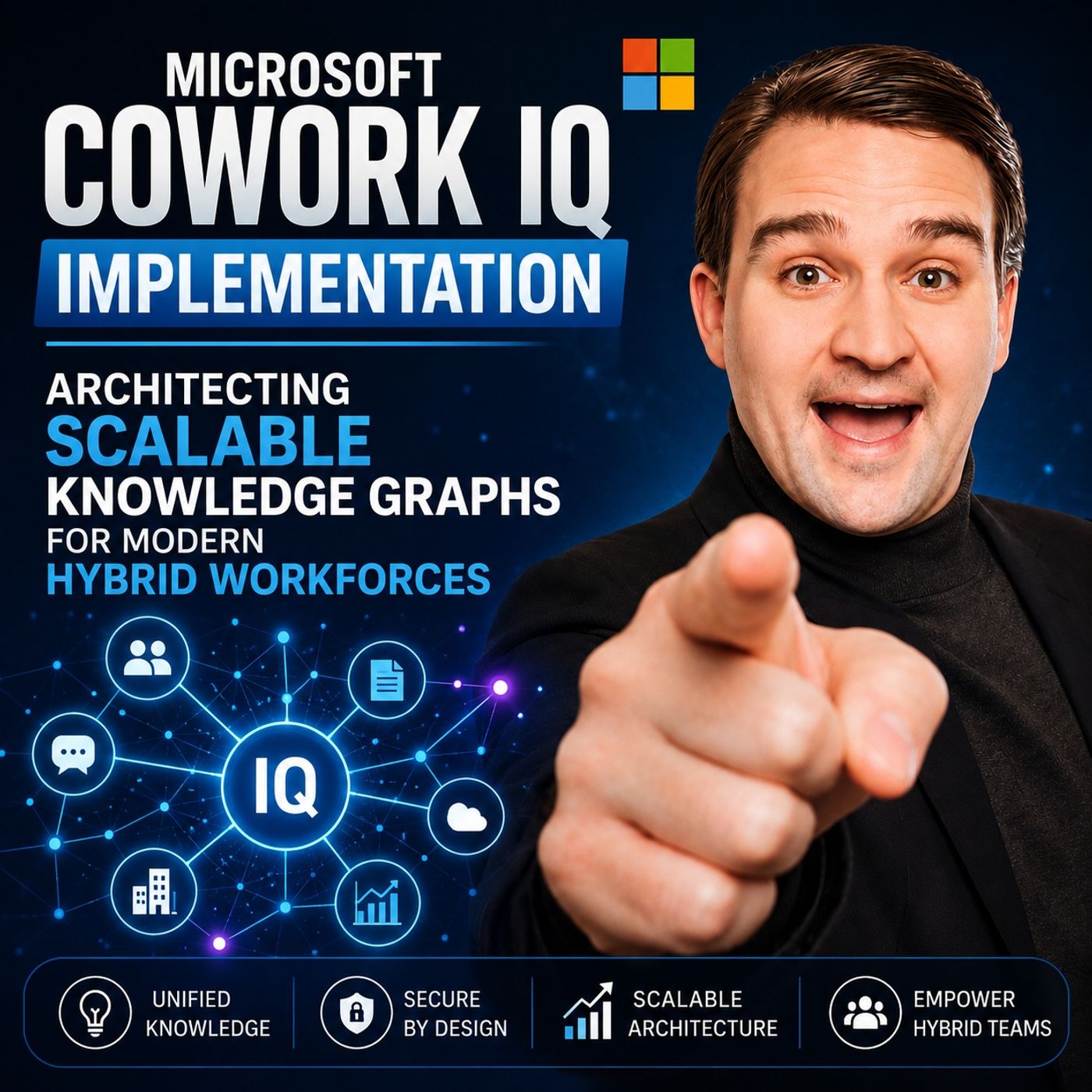
Architecting Scalable Knowledge Graphs for Modern Hybrid Workforces
Welcome back to the podcast companion blog, where we dive deeper into the strategies, architectures, and engineering patterns shaping modern enterprise productivity. If you manage a hybrid workforce today, you already know that your biggest bottleneck isn't bandwidth or hardware—it's context. Your employees are drowning in a sea of fragmented files, scattered chat logs, disjointed emails, and siloed project management tools. Finding the right piece of information often feels like searching for a needle in a digital haystack.
In this post, we are breaking down how enterprise architecture is evolving to solve this crisis. We'll explore the foundational engineering behind Microsoft Cowork IQ, examine how scalable knowledge graphs unify scattered corporate data across SharePoint, Teams, and OneDrive, and look at how the Data, Memory, and Inference layers work in harmony. Whether you are an architect, administrator, or IT leader trying to break down information silos and establish a single source of truth, this guide will provide the blueprint you need.
What Is Microsoft Cowork IQ?
Purpose for Hybrid Teams
As remote and hybrid models become the permanent operational standard for organizations worldwide, you face new, complex collaboration barriers. Traditional search tools built on keyword-matching simply cannot keep pace with the sheer volume of unstructured data generated by modern teams. Microsoft Cowork IQ is designed to bridge this gap by acting as a connective intelligence layer that brings your team together, regardless of geographic location.
Microsoft Cowork IQ enhances collaboration and knowledge access for hybrid teams by integrating AI-driven tools that facilitate real-time collaboration, automate complex workflows, and provide contextual insights based on organizational data. This includes features like passive observation in applications, shared cursor experiences for concurrent editing, and meeting facilitation that tracks viewpoints and summarizes discussions.
By shifting from passive tools to active coordination, Cowork IQ ensures your enterprise knowledge is always accessible and actionable. Let's look at how its underlying engineering makes this possible.
Core Architecture Layers
The true power of Cowork IQ lies in its multi-tiered architecture. Rather than treating artificial intelligence as a simple chat-bot bolted onto existing applications, Microsoft designed a comprehensive three-layer model:
| Layer | Description |
|---|---|
| Data | Encompasses emails, files, meetings, and chats, representing how work is actually performed. |
| Memory | Captures individual styles, preferences, and workflows, providing a personalized work experience. |
| Inference | Connects data and memory to predict the next best actions, enhancing decision-making capabilities. |
Through this multi-layered framework, the system transcends basic query-and-response patterns, enabling multi-step task execution, long-running workflow orchestration, and deep integrations across the entire Microsoft 365 ecosystem.
Hybrid Workforce Challenges
Knowledge Fragmentation
When your workforce operates across multiple time zones and home offices, information inevitably scatters. Data lives in disparate repositories—local desktops, cloud drives, email threads, and ephemeral chat channels. This fragmentation breeds long-term operational issues, causing employees to feel disconnected from organizational culture and slowing down critical decision-making processes.
Collaboration Barriers
Without physical proximity, teams often run into communication friction. The modern workplace has seen a massive surge in meeting volume, leading to meeting fatigue and cognitive overload. When communication tools are used inconsistently, remote team members frequently miss critical context, reducing overall alignment and team momentum.
Information Silos
Data silos represent one of the most expensive drains on the global economy, trapping crucial insights within departmental boundaries. When sales data cannot talk to engineering workflows, or HR policies remain locked away from operational teams, innovation halts. Breaking down these organizational silos is no longer optional; it is a fundamental requirement for business survival.
Cowork IQ Implementation and Data Architecture
Scalable Knowledge Graphs
To overcome fragmentation and silos, you need an architecture capable of mapping relationships at scale. Cowork IQ implementation utilizes scalable knowledge graphs to unify data across SharePoint, Teams, and OneDrive. By weaving together files, chats, calendar events, and emails, these graphs establish a robust single source of truth.
- Cowork IQ integrates data from SharePoint, Teams, and OneDrive seamlessly.
- Advanced semantic understanding layers dramatically improve information retrieval accuracy.
- Copilot leverages these graphs to deliver context-driven insights directly into user workflows.
- Custom toolsets execute agentic skills, enabling the system to observe, retrieve, reason, and execute tasks autonomously.
Microsoft Graph and Semantic Index
At the heart of this data architecture sits the Microsoft Graph, serving as the core relationship and context engine. Paired with the Semantic Index, it maps out organizational boundaries, reporting structures, and permission matrices. This means that when you query the system, it doesn't just look for matching keywords—it interprets human intent and organizational language while strictly respecting security and compliance parameters.
Metadata and Governance
Enterprise AI cannot exist without ironclad governance. High-quality metadata forms the backbone of data security in Cowork IQ. Metadata tags describe data assets, track their lifecycle origin, and enforce regulatory compliance rules, ensuring that sensitive documents remain protected while powering advanced AI reasoning.
AI Intelligence Layer
Predictive Knowledge Retrieval
The AI intelligence layer takes enterprise search from reactive to predictive. Utilizing advanced agents, the system anticipates your needs, surfacing relevant files, past meeting notes, and project updates before you even think to ask for them. This drastically cuts down the time spent hunting for information and refocuses your energy on high-value cognitive tasks.
Integration with Microsoft 365 Copilot
By integrating directly with Microsoft 365 Copilot, Cowork IQ allows you to delegate complex, multi-step tasks to autonomous agents. You can kick off workflows, hand off routine coordination, and let background agents compile reports while you focus on strategic decision-making—all operating safely within your established permission boundaries.
Context-Aware Insights
Whether pulling structured data from Dynamics 365, unstructured documents from Power Apps, or external enterprise metrics via Copilot Connectors, the AI intelligence layer reasons across your entire technology stack. It delivers tailored, context-aware insights that empower leaders and individual contributors alike to act with absolute confidence.
Core Features of Cowork IQ
Real-Time Discovery
Real-time discovery transforms how teams locate internal resources. By leveraging entity resolution to merge duplicate organizational concepts and knowledge graphs to connect disparate file stores, users can instantly surface accurate information regardless of where it was originally saved.
Expertise Mapping
Finding the right person for a project shouldn't require guesswork. Cowork IQ analyzes collaboration frequency, communication patterns, and document ownership to build a dynamic map of internal expertise. This allows you to quickly locate colleagues possessing specialized skills, accelerating problem-solving across departments.
Seamless Integration
The platform bridges Microsoft 365 tools with third-party enterprise platforms. Users can move fluidly between applications while background agents execute tasks securely, ensuring that compliance, auditing, and data protection standards are upheld across every connected system.
Implementation Steps
Assess Needs and Data Sources
Your deployment journey begins with a comprehensive audit of your data landscape. Evaluate your current data layer, map out Microsoft Graph dependencies, integrate systems-of-record through Dataverse, and plan out connectors for third-party platforms like WorkDay or Adobe. Simultaneously, assess workforce feedback to identify friction points and technical hurdles.
Configure Knowledge Graphs
Next, configure your knowledge graphs to stitch together your organization's scattered digital assets. Implement semantic layering, establish strict metadata governance rules, and configure entity resolution to eliminate duplicate data points and ensure a clean, reliable single source of truth.
Onboard Teams
Technology is only as good as its adoption rate. Build a structured onboarding program for your teams, complete with cross-functional introductions, pre-boarding resource hubs, and mentorship pairings to ensure new hires and long-standing employees alike understand how to leverage Cowork IQ effectively.
Monitor and Optimize
Finally, establish robust monitoring practices. Track meaningful event logs, set up automated alerts for anomalous activities, review operational dashboards regularly, and continuously refine your governance policies and licensing strategies to maximize return on investment.
Business Impact
Productivity Gains
Organizations implementing Cowork IQ see dramatic shifts in productivity. By offloading routine administrative burdens to digital agents, employees reclaim hours previously lost to low-value tasks, shifting their focus toward creative problem-solving, strategic analysis, and high-impact business outcomes.
Improved Collaboration
Information silos dissolve when teams have access to a unified, context-aware knowledge graph. Cross-departmental projects move faster, communication gaps shrink, and decision-making becomes more transparent and data-driven.
Case Studies
From sales teams prioritizing strategic accounts using automated CRM analysis to executive leadership compiling annual OKRs in minutes rather than weeks, the real-world applications of Cowork IQ prove that intelligent, graph-backed architecture is the definitive future of enterprise work.
Architecting scalable knowledge graphs is no longer an experimental IT project—it is the foundational requirement for modern hybrid enterprises. By uniting your data, memory, and inference layers, you can break down information silos, empower your workforce with predictive AI, and secure your enterprise data for the future.
FAQ
What are autonomous agents in Cowork IQ?
Autonomous agents are intelligent digital assistants capable of executing multi-step workflows, analyzing enterprise data, and making decisions within strict user permission boundaries without requiring constant manual supervision.
How does Cowork IQ support deep integration with Microsoft 365?
Cowork IQ connects natively across SharePoint, Teams, OneDrive, and Dynamics 365, allowing AI tools to reason over your entire M365 ecosystem and execute tasks smoothly across applications.
Can I use Cowork IQ for enterprise use in the cloud?
Yes. Cowork IQ is designed for enterprise-grade cloud deployment, ensuring secure, compliant access to your organizational data from anywhere in the world.
How do agents improve automation in hybrid work?
Agents take over routine coordination, background reporting, and multi-step tasks, reducing manual administrative friction and keeping hybrid teams aligned despite geographic separation.
What is the role of autonomous AI in Cowork IQ?
Autonomous AI powers the platform's inference engine, enabling systems to learn from individual and organizational workflows, predict user needs, and execute actions proactively.
How does Cowork IQ fit into my enterprise AI roadmap?
It serves as the core foundational architecture, providing scalable knowledge graphs and agentic tools that elevate raw enterprise data into actionable, secure business intelligence.
Are AI tools for business secure in Cowork IQ?
Absolutely. Cowork IQ enforces strict enterprise-grade security, comprehensive metadata governance, and rigid permission boundaries to protect your sensitive corporate information at all times.
🎧 Listen to this episode
Want a practical explanation of Microsoft Cowork IQ Knowledge Graph Architecture? This episode breaks down the topic in clear language and shows why it matters for Microsoft 365, Azure, Power Platform, security, AI, and modern work.
Listen to this episode if you want to:
- Understand the key concepts behind Microsoft Cowork IQ Knowledge Graph Architecture
- See how it fits into the wider Microsoft technology ecosystem
- Learn where it can create practical value for your organization
You may also enjoy these related M365 FM episodes:
- Microsoft Graph Automation Architecture: Beyond Scripts
- Graph-Powered AI Agents: An Enterprise Architecture Guide
- Microsoft Graph Architecture Beyond Folders and Hierarchies
- Microsoft Graph Connectors - Simply Explained
- The Monorepo Myth: Why Your Architecture Is Fragmented
Discover more practical Microsoft conversations on M365 FM, including our deep-dive discussion on the Microsoft Cowork IQ Knowledge Graph Architecture episode.
Last reviewed: July 2026.
Who Should Listen
This episode is for Microsoft administrators, architects, developers, security professionals, and business leaders who need a practical foundation before making implementation, operations, or governance decisions.
🎧 You Should Also Listen To
- Microsoft Fabric — A strongly related next step for extending this topic.
- Microsoft Graph Data Connect — A strongly related next step for extending this topic.
- Power BI Copilot — A strongly related next step for extending this topic.

Founder of M365 Show, M365con.net & m365.fm
Mirko Peters is a Microsoft MVP, Microsoft 365 expert, content creator, and founder of m365.fm, a platform dedicated to sharing practical insights on modern workplace technologies. His work focuses on Microsoft 365 governance, security, collaboration, and real-world implementation strategies.
Through his podcast and written content, Mirko provides hands-on guidance for IT professionals, architects, and business leaders navigating the complexities of Microsoft 365. He is known for translating complex topics into clear, actionable advice, often highlighting common mistakes and overlooked risks in real-world environments.
With a strong emphasis on community contribution and knowledge sharing, Mirko is actively building a platform that connects experts, shares experiences, and helps organizations get the most out of their Microsoft 365 investments.