Microsoft's open-source, cross-platform developer platform for building web, cloud, desktop, mobile, CLI and AI applications with C#, F# and Visual Basic.
.NET, also written dotnet or DotNet, is Microsoft's open-source, cross-platform developer platform. It is used to build web, cloud, desktop, mobile, command-line and AI applications with languages such as C#, F# and Visual Basic. The platform is free to use and was first released in 2002. The name .NET Core refers to an earlier stage of the same platform line, which is why the terms .NET and .NET Core often appear side by side in documentation, job descriptions and community discussions.
In practice, .NET serves as the foundation for many kinds of software in the Microsoft ecosystem. Teams use it for ASP.NET Core web applications and services, for Windows desktop applications built with WPF, and for backend components that run on Microsoft Azure, including Azure Functions. Because the platform is cross-platform, the same codebase can be deployed to Windows, Linux and macOS, a point raised in the episode on modern .NET. The platform also includes data access technologies such as LINQ to SQL and EF Core, which connect object-oriented code to relational databases.
.NET is also closely tied to the current wave of AI tooling. The episode "Build AI Applications with .NET 10" describes AI as becoming a first-class citizen in the .NET ecosystem and presents .NET 10 as a unified platform for training models, running inference, orchestrating AI agents and integrating services such as Azure OpenAI and Semantic Kernel. Related topics in the knowledge base include GitHub Copilot for AI-assisted coding, the Model Context Protocol (MCP) and the concept of an AI agent, since .NET is one of the platforms used to build such tools and agents.
Architecture and maintainability are a recurring theme. The episode ".NET Extensibility and Clean Architecture with Miguel Castro [MVP]" argues that software does not become difficult to maintain because developers write bad code, but because it was not designed to evolve. It places extensibility at the center of modern .NET design and states that AI may accelerate implementation but cannot replace the experience needed to build resilient enterprise systems. Design patterns such as Dependency Injection and MVVM are also named in the modernization episode as ways to improve maintainability and testability.
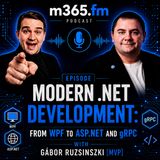
Modernization of existing applications is another typical decision area. "Modern .NET: WPF, ASP.NET Core, and gRPC with Gábor Ruzsinszki [MVP]" follows the path from legacy WPF desktop applications to ASP.NET Core, cloud-native designs and gRPC services. Its listed takeaways include maintaining consistent business logic across WPF and ASP.NET applications to reduce code duplication, migrating legacy applications to ASP.NET Core with gRPC for fast communication, using HTTPS and token-based authentication, and adopting CI/CD pipelines to automate testing and deployment.
Security is covered in "Fix OWASP Architectural Risks in .NET Applications". The episode maps many OWASP Top 10 risks, such as Injection, Broken Authentication and XSS, to mitigations available in .NET Core and ASP.NET Core, including parameterized EF Core queries, Identity and automatic Razor encoding. It also says that default project templates are not automatically secure: settings such as Content Security Policy, secure cookies and strict transport may be left to developers, and BinaryFormatter deserialization is described as a persistent concern. The episode challenges the idea that upgrading to the latest framework makes an application safe.
For data access, the episode "LINQ to SQL vs EF Core for .NET Data Access" explains how LINQ to SQL bridges object-oriented programming with relational data, how data contexts map to database structures, and how it compares with traditional SQL and ADO.NET patterns, with EF Core as the comparison point. Together, the four episodes cover .NET from architecture and modernization through security, AI and data access.
Overview compiled with AI from M365.FM episodes and the facts on this page. You can improve it with the edit button below.
In this episode of the M365.fm podcast, Mirko Peters explores why many microservice architectures gradually become slower, more fragile, and harder to manage despite originally being designed for speed and agility. What begins as a clean and scalable…
Software doesn't become difficult to maintain because developers write bad code—it becomes difficult because it wasn't designed to evolve. In this episode of the M365 FM Podcast, Mirko Peters is joined by Microsoft MVP and veteran software architect Miguel…
AI has moved from autocomplete to agents that plan and write most of the code, and developers wonder what is left for them. Microsoft MVP Andre Baltieri shares how he builds with AI coding agents, Microsoft Agent Framework and .NET, and why context, RAG and…
In this episode of M365.fm, host David Warner speaks with MVP Gautam Sheth about Microsoft 365 Copilot extensibility and how organizations can go beyond the out-of-the-box Copilot experience. Gautam explains the different extensibility options available…
In this episode of the m365.fm podcast, Mirko Peters talks with Microsoft MVP Gábor Ruzsinszki about the evolution of modern .NET development, from legacy WPF desktop applications to ASP.NET Core, cloud-native architectures, and gRPC services. Gábor shares…
This episode dives straight into the myth that upgrading to the latest .NET framework somehow makes your application safe, and it dismantles that belief fast. With the OWASP update reshaping how risks are ranked and understood, this conversation exposes why…
AI is becoming a first-class citizen in the .NET ecosystem, and in this episode we explore how the new integrated AI Engine in .NET 10 transforms the way developers build intelligent applications. You’ll learn how .NET now provides a unified platform for…
LINQ to SQL remains one of the most approachable ways to query and manipulate relational data in .NET, and in this episode we break down exactly how it works, why it’s so powerful, and how it simplifies database interaction compared to traditional SQL and…
Patchwork debugging steals your day one tiny rebuild at a time. In this hands-on walkthrough, we put GitHub Copilot’s agent mode inside a real .NET + Azure solution and let it hold the cross-file context: updating services, bindings, DI, configs, and infra in…
This episode lays out a practical, reliable automated testing strategy for .NET applications, focused on reducing flakiness, speeding up CI, and improving overall confidence in releases. It’s full of real examples, proven tactics, and tools teams can start…
Keith shares his background in traditional .NET and SQL development and explains why Power Apps immediately stood out to him: speed. Instead of repeatedly building the same forms, logic, and app structures manually, Power Apps allowed him to focus more on…
In this episode of the M365 FM Podcast, we explore why modern microservice architectures can quietly become “toxic” under pressure — not because services crash, but because they slow down. A single delayed dependency can silently trigger cascading latency…
Avoiding the Distributed Monolith Trap in .NET Microservices · Mirko Peters When engineering teams transition from a monolithic application to a microservice architecture, they are usually chasing a very specific set of promises: faster fea…
Mastering CRUD Operations and Change Tracking in LINQ to SQL · Mirko Peters Welcome back to the podcast! Today, we are expanding on our recent discussions about data access strategies. If you want to catch up on the foundational debates sur…
Securing Your .NET 10 AI Applications Against Modern Threats · Mirko Peters Welcome back to the podcast! Today, we are expanding on a topic that has been dominating our engineering discussions: enterprise security in the age of artificial i…
Questions marked with AI were written with AI from the facts on this page.
What is .NET used for? (AI)
.NET is used to build web, cloud, desktop, mobile, command-line and AI applications with C#, F# and Visual Basic. It is commonly used for applications that run on Microsoft Azure, including Azure Functions.
Is .NET Core the same as .NET? (AI)
The name .NET Core refers to an earlier stage of the same platform line, and the platform is also listed under the aliases dotnet and DotNet. It is open source, cross-platform and free to use.
Does using the latest .NET version make an application secure? (AI)
According to the episode "Fix OWASP Architectural Risks in .NET Applications", no. It notes that default templates leave settings like CSP, secure cookies and strict transport to developers, and that BinaryFormatter deserialization remains a concern.
What does extensibility first mean in .NET?
It means making extensibility the guiding principle when designing an application, so it can adapt as business needs evolve and remain stable and maintainable over the long term. · From the episode: .NET Extensibility and Clean Architecture with Miguel Castro [MVP]
Which design principles support extensible .NET systems?
Microsoft – Organization· Developed by Microsoft Corporation is a technology company that develops software and cloud services such as Microsoft 365, Azure and Dynamics 365.
Microsoft tool – Category· Is a Microsoft tool is a broad category for software products and services developed by Microsoft, used to group offerings and to frame tool-selection decisions.
Developer tool – Category· Is a Developer tool is an M365.FM category for tools that help developers write, test and ship software, from editors and build pipelines to APIs and platforms.
Microsoft Azure – Cloud platform by Microsoft· Related to Microsoft Azure is Microsoft's cloud platform with services for computing, storage, networking, databases, analytics and AI.
GitHub Copilot – AI assistant by GitHub· Related to An AI coding assistant that suggests code, explains it, writes tests and, in agent mode, carries out multi-step changes in a repository under the developer's review.
Model Context Protocol (MCP) – Concept· Related to An open protocol that lets AI applications connect to tools and data sources in a standard way. An MCP server exposes capabilities, and any compatible agent can discover and call them.
AI agent – Concept· Related to A software system that uses an AI model to pursue a goal on its own: it plans steps, calls tools or APIs, reads data and acts, often with a human approving critical steps. Agents go beyond chatbots because they take actions, not just answer questions.
Azure Functions – Developer tool by Microsoft· Related to Serverless compute service of Azure that runs event-driven code; can be exposed as an MCP server, for example through API Management.
.NET Aspire – Product· Includes Microsoft's opinionated, cloud-ready stack for building observable, distributed applications; it orchestrates services and dependencies for local development and ships a dashboard for logs, health and traces.
.NET MAUI – Product· Includes .NET Multi-platform App UI (.NET MAUI) is a cross-platform framework for building native mobile and desktop apps with C# and XAML from a single code base.
Carlos Miguel Silva – Person· People working on this topic Carlos Miguel Silva is a speaker at M365Con 2027 (CTO at BindTuning) with 1 session.
Florian Lenz – Person· People working on this topic Florian Lenz is a speaker at M365Con 2027 (Principal Cloud Architect & Engineer at neocentric GmbH) with 1 session.
Saeed Esmaeelinejad – Person· People working on this topic Saeed Esmaeelinejad is a speaker at M365Con 2027 (Senior Software Engineer) with 1 session.
All relationships of .NET, grouped by type of relationship:
Short info above, community knowledge below: add practical tips, examples or corrections. New contributions are reviewed first; trusted members publish directly.
 EN
 Deutsch
 Español
 Français
 Italiano
 Português
 Nederlands
 Polski
 Bahasa Indonesia
 Русский
 Українська
 العربية
 עברית
 日本語
 한국어