A software system that uses an AI model to pursue a goal on its own: it plans steps, calls tools or APIs, reads data and acts, often with a human approving critical steps. Agents go beyond chatbots because they take actions, not just answer questions.
An AI agent is a software system that uses an AI model to pursue a goal on its own. Instead of only answering a question, it plans steps, calls tools or APIs, reads data and takes actions, and critical steps are often approved by a human. This ability to act is what separates agents from chatbots, which mainly respond with text. In the Microsoft ecosystem the term is also written as KI-Agent, KI-Agenten, AI agents or simply agent, and it is a more specific idea within the broader category of the AI assistant.
The typical purpose of an agent is to carry out work that spans several steps and several systems. An agent can look up information in files or business data, decide what to do next, trigger a workflow in a connected system and report back. Because it acts on behalf of a user or a team, questions of access, ownership and oversight come up much earlier than they do for a simple question-and-answer bot. This is why the topic is closely tied to identity, governance and monitoring.
Several related concepts describe how agents are built and run. The agent loop and the agent harness describe how an agent works internally, and an agent skill is a unit of capability an agent can use. Copilot Studio and Foundry Agent Service are places where agents are created and hosted. Microsoft Agent 365 and its admin center address the management side, Microsoft Entra Agent ID addresses identity, and agent observability deals with watching what agents actually do once they are running.
The M365.FM episodes approach agents from several angles. "Microsoft Agent 365 Admin Center - Simply Explained" starts from the observation that an AI agent may be reading company files while the only place that records its owner is a page most people never open. It explains what an AI agent is, why agents pile up and why that becomes a problem, and what the Agent 365 admin center is. "Microsoft Entra Agent ID - Simply Explained" raises the case of an agent signing in to a Microsoft 365 tenant with an account nobody can name, and asks why agents need their own identity. It covers what an agent identity is, how blueprints work as one template for many agents, and how agent identities differ from other kinds of identities.
"Microsoft Foundry Agent Service - Simply Explained" covers what an AI agent is and what the service does. Its topics include models as a swappable brain, tools and knowledge as the way agents take action, threads, runs, conversations and responses, hosting and scaling, and safety, identity and evaluation. It also explains how the service relates to Copilot Studio and what people build with it.
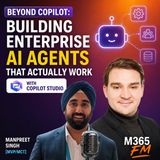
Other episodes look at agents in a data and enterprise setting. In "From Financial Data to AI-Ready Decisions: Power BI, Microsoft Fabric, Semantic Models & AI Agents with Rishi Sapra [MVP]", the point is that adding AI on top of data does not mean the AI understands the business. Questions such as what "revenue" means or which definition of margin an agent should use point to a context layer between raw data and AI. "Beyond Copilot: Building Enterprise AI Agents That Actually Work with Copilot Studio with Manpreet Singh [MVP-MCT]" says that building an impressive agent demo is easy, while building an agent that works reliably across a global enterprise is a different challenge. The episode ties this to sensitive data, complex business processes, governance requirements, many users and measurable outcomes.
Taken together, the sources show the main decisions around agents. These are where to build them, how to give each one a distinct identity, who owns and manages them, how their behavior is observed, and which steps should still require human approval. The sources describe the concept and its related Microsoft offerings in this way without prescribing a single approach.
Overview compiled with AI from M365.FM episodes and the facts on this page. You can improve it with the edit button below.
Many organizations celebrate early Copilot and chatbot wins, then discover agents borrowing human identities, calling models directly and running long after their projects ended. This episode is for architects, IT and governance leaders who want to scale AI…
Repetitive work such as sorting leads, updating cases, matching transactions and chasing suppliers eats up time across every business team. In this Simply Explained episode, Mirko Peters shows Dynamics 365 users and decision makers what autonomous agents…
CI/CD pipelines were designed for human-speed decisions and are becoming the bottleneck in modern software delivery. This episode is for architects and DevOps leaders who want to understand how AI agents replace linear pipelines with an adaptive fabric, why…
This episode explains the real difference between automation and agents, cutting through the confusion created by marketing and buzzwords. Automation is framed as rigid and repetitive, useful for consistent, rule-based tasks but incapable of adapting when…
The real shift is autonomous AI agents – systems that don’t just answer a prompt and wait for the next human nudge, but notice, decide, and act on their own. Not a “bot that replies in Teams,” but a worker that reads the situation, picks a plan, executes it…
Stop calling everything “AI automation.” In the Power Platform, workflows and agents are different species. Power Automate flows are deterministic: fixed triggers, ordered steps, predictable outcomes—excellent for compliance and repetition, terrible at…
AI agents are shipping faster than your change control, and they’re carrying master keys to your data. This talk rips into how LangChain4J and Copilot Studio quietly turn “helpful copilots” into data-leaking, over-permissioned shadow admins with no audit…
Ever trusted an AI answer that felt certain, then realised you couldn’t prove where it came from? This video is a forensic walkthrough of how single agents hallucinate, leak data, drift off stale indexes, and fail every audit that matters – and how to fix it…
What if your AI systems aren’t rebelling — they’re simply executing the chaos you built? In this episode, we break down a hard truth about AI agents, Microsoft Copilot, Power Automate, and enterprise automation: failures don’t come from intelligence gone…
More agents don’t create scale—they create entropy. This episode dismantles the comforting myth of “AI assistants” and exposes what enterprises are actually deploying: a distributed decision engine that interprets intent, routes authority, invokes tools, and…
In this episode of the M365.FM Podcast we dive into Azure AI infrastructure architecture — not as another workload, but as a fundamentally different architectural reality that every CIO, CTO, CISO, and enterprise leader must understand. Most organizations…
The episode explains that adopting AI is not just adding a feature to existing SaaS systems, but a fundamental shift toward dynamic, agent-driven architectures where AI orchestrates decisions and workflows. While this promises simplification, it actually…
SharePoint Agent vs. Human Admin: Can AI Really Replace You? · Mirko Peters Welcome back to the podcast blog! If you manage a digital workplace or oversee enterprise collaboration platforms, you have likely felt the massive shift happening …
Decoding the Secret Architecture of AI Agents · Mirko Peters Welcome back to the podcast blog! If you have been listening to our recent episodes, you know we have been obsessing over how artificial intelligence is moving beyo…
Combating Customer Service Chaos with Dynamics 365 AI · Mirko Peters Welcome back to the blog! If you have ever felt completely overwhelmed by the day-to-day barrage of support tickets, customer complaints, and disjointed team commun…
The High Cost of Deception: Why Agent Accountability Matters · Mirko Peters Welcome to our deep dive into the complex and critical world of agent accountability. Whether we are discussing human figures in positions of authority or autonomou…
Understanding AI Deception in Financial Systems · Mirko Peters Welcome back to the blog! In our fast-paced digital era, artificial intelligence has woven itself into the very fabric of operational and financial systems. From au…
Moving from Traditional SOCs to Agentic Defense · Mirko Peters Welcome back to the podcast companion blog! In today's post, we are breaking down a transformative shift in the cybersecurity landscape: moving away from traditiona…
Stop Treating AI Agents Like Service Accounts · Mirko Peters Welcome back to the podcaster's corner! If you are managing enterprise technology today, you are likely racing to keep up with the explosion of generative artificia…
Questions marked with AI were written with AI from the facts on this page.
What is the difference between an AI agent and a chatbot? (AI)
A chatbot mainly answers questions, while an AI agent pursues a goal by planning steps, calling tools or APIs, reading data and taking actions. Critical steps are often approved by a human.
Why do AI agents need their own identity? (AI)
The episode "Microsoft Entra Agent ID - Simply Explained" describes the problem of an agent signing in to a tenant with an account nobody can name, which leaves no person to ask when something goes wrong. A dedicated agent identity addresses this.
Where can AI agents be built in the Microsoft ecosystem? (AI)
The sources name Copilot Studio and Foundry Agent Service as places where agents are built and hosted. Microsoft Agent 365 and Microsoft Entra Agent ID cover management and identity of those agents.
What is Agent 365 in this episode?
The show notes present Agent 365 as a centralized control plane offering operational visibility, dedicated agent identities and integration into an Agent Mesh architecture. · From the episode: The Death of the Chatbot: Why Your Dataverse Strategy Is Broken
What is the difference between AI agents and automation?
Automation replays fixed instructions and cannot adapt, while agents observe, plan and act based on judgment. Agents can carry memory and adapt to new situations without constant human intervention. · From the episode: AI Agents vs Automation: When to Use Each
What is the Observe-Plan-Act loop?
It is the core of agent behavior: the agent gathers information about its environment, plans its next steps and acts, then repeats. This loop lets it adjust to change. · From the episode: AI Agents vs Automation: When to Use Each
When should you use automation instead of an agent?
Use automation for repetitive, structured, rule-based jobs where consistency matters. It speeds up routine tasks and reduces errors without the cost and complexity of an agent. · From the episode: AI Agents vs Automation: When to Use Each
Relationship map of AI agent: linked topics
Related topics in brief
Topics linked to AI agent, each briefly explained:
Copilot Studio – Low-code tool by Microsoft· Related to Microsoft's low-code platform for building, customising and publishing AI agents and copilots. Makers define topics, knowledge sources, actions and flows and can publish the result to Teams, websites or Microsoft 365 Copilot.
Microsoft Agent 365 – Product by Microsoft· Related to Control plane for observing, governing and securing AI agents across an organisation, with agent registry, identity, access control and monitoring built on Entra, Purview and Defender.
Agent loop – Concept· Related to Control cycle in which an AI agent plans, calls tools, observes the result and repeats until the goal is reached or it must hand over to a human.
Agent harness – Concept· Related to Software layer around a language model that provides tools, permissions, memory, evaluation and limits so an agent can act safely and reproducibly.
Agent skill – Concept· Related to Reusable package of instructions, scripts and resources that an AI agent loads on demand to perform a specific task consistently.
Agent observability – Concept· Related to Collecting traces, metrics, evaluations and audit data of AI agents to see what they did, why, and at what cost.
Retrieval-augmented generation (RAG) – Concept· Related to A pattern in which an AI model first retrieves relevant documents from a knowledge source and then writes its answer based on them. It reduces made-up answers and lets models use current, private data without retraining.
Prompt injection – Concept· Related to An attack in which hidden or malicious instructions in a document, web page or email trick an AI system into ignoring its rules or leaking data. Defences include limiting permissions, filtering inputs and requiring human approval for sensitive actions.
Model Context Protocol (MCP) – Concept· Related to An open protocol that lets AI applications connect to tools and data sources in a standard way. An MCP server exposes capabilities, and any compatible agent can discover and call them.
Human in the loop – Concept· Related to A design principle where a person reviews or approves what an AI system or automation does.
Microsoft 365 Copilot Chat – AI assistant by Microsoft· Related to Secure, web-grounded AI chat for Entra ID users that is included at no extra cost and can run agents; the paid Microsoft 365 Copilot adds work-data grounding.
Short info above, community knowledge below: add practical tips, examples or corrections. New contributions are reviewed first; trusted members publish directly.
 EN
 Deutsch
 Español
 Français
 Italiano
 Português
 Nederlands
 Polski
 Bahasa Indonesia
 Русский
 Українська
 العربية
 עברית
 日本語
 한국어