An open protocol that lets AI applications connect to tools and data sources in a standard way. An MCP server exposes capabilities, and any compatible agent can discover and call them.
Title graphic: Model Context Protocol (MCP) (Concept)
The Model Context Protocol (MCP) is an open protocol that lets AI applications connect to tools and data sources in a standard way. An MCP server exposes capabilities, and any compatible agent can discover and call them. The aim is to avoid building a separate custom integration for every combination of AI model and application, and to give AI assistants a common interface to external tools, APIs, databases, files and business systems.
In practice, MCP separates two roles. The server side describes what it can do, such as reading data or performing an action in a business system. The client side, typically an AI agent, finds those capabilities and uses them. Because the interface is shared, an agent that understands the protocol can work with different servers without a bespoke connector for each one. The M365.FM episode "MCP (Model Context Protocol) - Simply Explained" presents it as a universal way for AI assistants to discover tools, access data and perform real-world actions, and calls it one of the key technologies behind modern AI agents.
MCP is closely tied to the AI agent, which is the usual client of an MCP server, and AI agent is also the broader concept under which MCP sits. It also relates to the agent harness, the layer that runs the agent. Further related topics are Azure Functions, which can host server logic, Foundry Agent Service, and Business Performance Analytics, which are places where agents and enterprise data come together.
The episodes frame MCP largely as an architectural choice. "Custom Connectors vs Model Context Protocol for Enterprise AI" questions an enterprise automation strategy built on managed connectors. It describes connectors as the low-code "easy button" for automation and argues that this approach can hide an architectural weakness. For teams deciding between connector-based integration and MCP, the episode positions the protocol as an alternative foundation rather than just another wrapper.
"Model Context Protocol vs Custom AI Integration Glue" makes a related argument. It says that attempts to integrate AI into enterprise systems fail not because of limited model intelligence, but because of unbounded action and brittle integrations. According to the episode, MCP should not be understood as a plugin system, an API wrapper or merely standardized function calling, since those descriptions miss the point. Its takeaway is a shift from custom AI glue to structured integration frameworks that are reliable and governable and that protect systems and data.
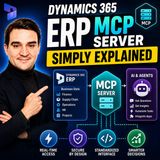
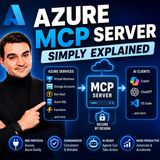
Two further episodes show MCP applied to Microsoft products. "Azure MCP Server - Simply Explained" describes how the Azure MCP Server lets AI assistants and agents, including Microsoft Copilot, GitHub Copilot and other MCP-compatible assistants, interact securely with Azure resources, acting as a bridge between the AI model and the Azure environment. "Dynamics 365 ERP MCP Server - Simply Explained" covers how AI agents can securely understand, access and execute business processes in Dynamics 365 Finance and Supply Chain through the protocol, using a standardized way to reach enterprise data and business logic.
Typical decisions around MCP therefore involve where to host the server logic, which capabilities to expose, how to keep agent actions bounded and governed, and whether an existing connector-based approach should be kept or replaced. The episodes consistently stress security and control alongside the convenience of a common interface.
Overview compiled with AI from M365.FM episodes and the facts on this page. You can improve it with the edit button below.
AI agents are only as valuable as the systems they can access. While much of the industry focuses on models, prompts, and reasoning capabilities, the real challenge in enterprise AI is connectivity. In this episode, we take a deep architectural dive into the…
This episode explains why attempts to integrate AI into enterprise systems fail not because of model intelligence, but because of unbounded action and brittle integrations. The core claim is that the Model Context Protocol (MCP) is not a plugin system, API…
Custom integrations have long been one of the biggest bottlenecks in enterprise applications, but Dataverse MCP is changing that. In this episode of the M365.fm podcast, Mirko Peters is joined by Microsoft MVP Nathan Rose to explore how the Model Context…
Azure MCP Server extends the power of artificial intelligence beyond chat by allowing AI assistants and agents to securely interact with Azure resources through the open Model Context Protocol (MCP). In this episode of Microsoft Knowledge Nuggets on M365 FM…
Dynamics 365 ERP MCP Server brings artificial intelligence directly into enterprise resource planning by allowing AI agents to securely understand, access, and execute business processes through the open Model Context Protocol (MCP). In this episode of…
You’re wasting AI on small talk. In this session I show you how to turn chatty models into hardened IT ops agents that actually fix incidents while you sleep. We wire Semantic Kernel, MCP, Microsoft Graph and Azure OpenAI with managed identity so agents can…
This episode of the M365.FM Podcast — “The Agentic Advantage: Scaling Intelligence Without Chaos” — explains why simply rolling out more AI agents does not automatically increase productivity, and why many enterprise agent programs collapse when they confront…
Once organizations use Copilot seriously, the question shifts from writing better prompts to connecting Copilot with business data, APIs and processes. In this conversation, Microsoft MVP Yves Habersaat explains Copilot extensibility, agent architecture, MCP…
This episode of the M365.FM Podcast (titled “How to Build a High-Performance Agentic Workforce in 30 Days”) explains why most enterprise AI agent programs fail quickly, and what it really takes to build an AI-driven workforce that delivers measurable business…
he era of prompt engineering is ending. While organizations have spent years teaching employees how to write better AI prompts, this approach creates inconsistent results, limits scalability, and keeps humans trapped in every workflow step. Instead of relying…
In this episode of the M365.fm podcast, Nathan Rose joins the show to explore how Copilot Studio, Dataverse, and the Model Context Protocol (MCP) are shaping the future of agentic AI in Microsoft 365. The conversation dives into how organizations can move…
Timeline of episodes about Model Context Protocol (MCP)
Articles about Model Context Protocol (MCP) (10)
Articles in which Model Context Protocol (MCP) is a topic:
Demystifying the Model Context Protocol (MCP) · Mirko Peters Welcome back, tech enthusiasts and podcast listeners! If you have been keeping up with our latest audio episodes, you know we have been diving deep into the rapidly…
Securing Intelligent Agents and MCP Tools in the Enterprise · Mirko Peters Welcome back to our ongoing exploration of modern enterprise technology, cloud security, and artificial intelligence integration. As organizations worldwide race to…
Securing Intelligent Agents and Model Context Protocol Tools · Mirko Peters Welcome back to another deep dive into the world of enterprise technology, modern work, and cloud security. If you have been following our podcast journey, you know…
Questions marked with AI were written with AI from the facts on this page.
What is the Model Context Protocol (MCP)? (AI)
MCP is an open protocol that lets AI applications connect to tools and data sources in a standard way. An MCP server exposes capabilities, and any compatible agent can discover and call them.
How does MCP differ from custom connectors or integration glue? (AI)
According to the M365.FM episodes, MCP is not just a plugin system, API wrapper or standardized function calling. It is presented as a structured, governable integration framework, in contrast to brittle custom glue and connector-based approaches.
Which Microsoft MCP servers are covered in the episodes? (AI)
The episodes cover the Azure MCP Server, which lets AI assistants interact with Azure resources, and the Dynamics 365 ERP MCP Server, which lets AI agents work with business processes in Dynamics 365 Finance and Supply Chain.
Why isn't a traditional API enough for AI agents?
Traditional APIs were designed for developers and applications. Autonomous agents need to dynamically discover and use capabilities, which MCP is designed to support. · From the episode: MCP Architecture for Microsoft Copilot and AI Agents
What should architects consider when deploying MCP?
Architects should consider integration complexity, data governance, security monitoring and the secure deployment of MCP servers. AI agents are only as valuable as the systems they can reach, so connectivity needs deliberate design. · From the episode: MCP Architecture for Microsoft Copilot and AI Agents
What is an MCP custom connector in Copilot Studio?
Relationship map of Model Context Protocol (MCP): linked topics
Related topics in brief
Topics linked to Model Context Protocol (MCP), each briefly explained:
AI agent – Concept· Related to A software system that uses an AI model to pursue a goal on its own: it plans steps, calls tools or APIs, reads data and acts, often with a human approving critical steps. Agents go beyond chatbots because they take actions, not just answer questions.
Agent harness – Concept· Related to Software layer around a language model that provides tools, permissions, memory, evaluation and limits so an agent can act safely and reproducibly.
Azure Functions – Developer tool by Microsoft· Related to Serverless compute service of Azure that runs event-driven code; can be exposed as an MCP server, for example through API Management.
Microsoft Foundry – Developer tool by Microsoft· Related to Microsoft's platform for building, evaluating and operating AI applications and agents with model catalog, agent service, tools, evaluation and observability; formerly Azure AI Foundry.
Agent skill – Concept· Related to Reusable package of instructions, scripts and resources that an AI agent loads on demand to perform a specific task consistently.
Agent loop – Concept· Related to Control cycle in which an AI agent plans, calls tools, observes the result and repeats until the goal is reached or it must hand over to a human.
Knowledge source – Concept· Related to Content an agent in Copilot Studio can ground its answers on, such as SharePoint sites, files, websites, Dataverse tables or connectors.
Dataverse MCP server – Developer tool by Microsoft· Related to MCP server that lets agents query and update Dataverse and Dynamics 365 data through the Model Context Protocol, an alternative to connectors.
.NET – Developer tool by Microsoft· Related to Microsoft's open-source, cross-platform developer platform for building web, cloud, desktop, mobile, CLI and AI applications with C#, F# and Visual Basic.
Habeeb Yakubu – Person· People working on this topic Habeeb Yakubu is a speaker at M365Con 2027 (Senior Technical Consultant at Avanade) with 1 session.
All relationships of Model Context Protocol (MCP), grouped by type of relationship:
Related to
All 13 topics related to Model Context Protocol (MCP):
Short info above, community knowledge below: add practical tips, examples or corrections. New contributions are reviewed first; trusted members publish directly.
Experts and companies for this topic
Community members with expertise in Model Context Protocol (MCP):
Elliot M. · Microsoft MVP | Team Lead Jumpstart, Copilot & Agents at Witivio
 EN
 Deutsch
 Español
 Français
 Italiano
 Português
 Nederlands
 Polski
 Bahasa Indonesia
 Русский
 Українська
 العربية
 עברית
 日本語
 한국어