An all-in-one analytics platform that combines data engineering, data warehousing, real-time analytics and Power BI on a shared storage layer called OneLake, billed through shared capacity.
Microsoft Fabric, often shortened to Fabric, is an all-in-one analytics platform developed by Microsoft. It brings data engineering, data warehousing, real-time analytics and Power BI together on a shared storage layer called OneLake. Instead of running separate products for each analytics discipline, teams work in a single environment where data from many sources can be prepared, stored, analyzed and reported on. Fabric is classed as a Microsoft tool and as an analytics and BI tool.
Costs in Fabric are billed through shared capacity rather than per person. The episode "Fabric Capacity Pricing - Simply Explained" describes this as buying a pool of computing power called a capacity, sold in sizes such as F2, F8 and F64. The episode explains why this model can feel confusing at first and makes the point that a capacity can keep running, and keep being billed, even when nobody is using it. For anyone planning a Fabric rollout, choosing and monitoring capacity is therefore one of the first decisions.
Several related concepts shape how Fabric is used day to day. A Fabric workspace is where items are organized. A semantic model defines business meaning for reports, and the star schema is a related topic because model design affects how well the analytics side works. Fabric notebooks support code-based data work, and Semantic Link Labs is another related topic connected to working with models. Together these cover the path from raw data to reports that business users can read.
Fabric also reaches roles beyond data engineers. The episode "Microsoft Fabric for Microsoft 365 Admins: What You Need to Know" states that Fabric is not just a data engineer topic. Administrators meet it through capacities, workspaces, licensing and governance. The episode introduces the parts that matter to them, namely capacities, tenant settings, workspaces, OneLake and security, and covers what to expect, what to ask and where admins should get involved.
For data that arrives continuously, the episode "Microsoft Fabric Real-Time Hub - Simply Explained" presents Real-Time Hub as the one place where live, flowing data shows up. According to the episode, every Fabric tenant already has it switched on, so it does not need to be installed. The episode walks through what Real-Time Hub is, the three jobs it does and the four kinds of items it surfaces.
Fabric also covers transactional workloads. In "Fabric SQL Database - Simply Explained", a SQL database in Fabric is described as running the same engine that powers Azure SQL Database. The episode discusses where it feels like Azure SQL and where it differs, how a copy of the data makes itself, and how one database can serve two jobs.
Industrial scenarios are covered in "How Machine Data Reaches Microsoft Fabric - From OPC UA to Real-Time Analytics". The episode follows a machine signal from the factory floor: OPC UA exposes the signal, an edge layer collects it, MQTT can distribute it locally, and Fabric can ingest and analyze the resulting stream. The episode stresses that the difficult part starts after the data arrives, because raw telemetry needs production context before it can support an actual decision.
Taken together, the episodes show Fabric as a platform where decisions about capacity, governance, data modeling and ingestion are connected. Which of these matters most depends on the role: administrators focus on capacities, tenant settings and security, while analytics teams focus on workspaces, models, notebooks and the data paths feeding them.
Overview compiled with AI from M365.FM episodes and the facts on this page. You can improve it with the edit button below.
Microsoft Fabric is not just another product but a complete data platform covering storage, transformation, analytics and reporting in one place. · Microsoft Fabric - Simply Explained
Before Fabric, companies had separate servers, reporting tools and real-time analytics tools, each with its own login and team, leaving data in silos. · Microsoft Fabric - Simply Explained
Many organizations run too many analytics tools and too many copies of the same data. In this interview, Mirko Peters and Microsoft Data Platform MVP Amit Chandak walk data engineers and BI teams through an end-to-end Microsoft Fabric architecture. You learn…
Most organizations think their data problems are about who can see reports. In reality, the bigger risk is what those reports mean today—and how quietly that meaning changes tomorrow. Your transcript argues that Microsoft Fabric doesn’t create chaos by being…
This episode explores why Microsoft Fabric and Copilot feel empowering and chaotic at the same time. While Fabric simplifies the experience by unifying storage, compute, and analytics into a single platform, it does not remove the hard parts of data…
Everyone talks about Microsoft Fabric, but few can explain what it actually is. This episode walks business and IT folks through OneLake, lakehouses, warehouses, data integration, real-time intelligence and Power BI in plain English. You will understand how…
Most Power BI environments start fast and stall under copy-paste sprawl: duplicated PBIX files, conflicting measures, and “spreadmart” dashboards that nobody fully trusts. The fix isn’t another naming convention—it’s a model-first architecture. Microsoft…
Stop guessing where your data went. In Microsoft Fabric, automatic lineage, workspace-based permissions, and Purview’s enterprise catalog turn opaque pipelines into auditable, end-to-end flows—from ingestion to transformation to the report. Fabric captures…
This episode dives into the growing role of Fabric Data Agents inside Microsoft Copilot Studio and how they’re reshaping the way organizations interact with their data. The hosts start by breaking down what a Fabric Data Agent actually is—an AI-driven…
Microsoft Fabric fundamentally changes how Power BI handles data. With OneLake and Direct Lake, Power BI can now query lakehouse tables directly with performance similar to Import mode — without creating duplicate copies or maintaining complex refresh cycles.…
Most Microsoft Fabric teams are bleeding money because they treat Dataflows Gen2 like old Power BI ETL. In Fabric, compute—not storage—is the meter, so every redundant refresh spins up clusters, reloads the same sources, and multiplies cost. The fix is…
Your company isn’t blocked by data—it’s blocked by syntax. Copilot Studio turns plain-English questions into governed Fabric queries, so “What was our revenue by quarter?” finally gets an instant, secure answer—no SQL, no tickets, no waiting. It’s not a…
You paid for AI synapses — but you’re parking fossils. Fabric was engineered for real-time intelligence, semantic relationships, live context, and AI agents that reason. Most orgs treat it like a network share. The result? Zero cognition, zero AI, zero…
Think spreadsheets are chaos? Cute. In this episode we stress-test Microsoft Fabric against the worst data you own: photorealistic 3D assets and full-fidelity digital twins. We break down why a single “file” is actually a sprawling supply chain of scans…
Timeline of episodes about Microsoft Fabric
Articles about Microsoft Fabric (78)
Articles in which Microsoft Fabric is a topic:
Microsoft Fabric Apps: What They Are and How to Use Them · Mirko Peters Fabric Apps (preview) lets developers build data-driven apps on Microsoft Fabric with TypeScript. This guide covers what the feature is, the admin switch, how to create and deploy
Mastering the Microsoft Fabric Monitoring Hub · Mirko Peters When I first plunged into Microsoft Fabric, the complexity was daunting. I spent hours combing through logs, convinced there was a "magic pill" that would streamlin…
Mastering Model-First Architecture in Microsoft Fabric · Mirko Peters Welcome back to the podcast and our companion blog! If you have been following our recent discussions, you know how crucial it is to design modern data platforms th…
Supercharge AI Training with Microsoft Fabric Notebooks · Mirko Peters Artificial intelligence and machine learning projects demand massive amounts of computational power, seamless data integration, and efficient processing workflows. …
Questions marked with AI were written with AI from the facts on this page.
What is Microsoft Fabric? (AI)
Microsoft Fabric is an all-in-one analytics platform from Microsoft that combines data engineering, data warehousing, real-time analytics and Power BI on a shared storage layer called OneLake.
How is Microsoft Fabric billed? (AI)
Fabric is billed through shared capacity rather than per person. The episode "Fabric Capacity Pricing - Simply Explained" describes capacity as a pool of computing power sold in sizes such as F2, F8 and F64.
Why does Microsoft Fabric matter to Microsoft 365 admins? (AI)
According to the episode "Microsoft Fabric for Microsoft 365 Admins: What You Need to Know", admins meet Fabric through capacities, tenant settings, workspaces, OneLake, security, licensing and governance.
Why use Microsoft Fabric?
Fabric brings data engineering, analytics, business intelligence, governance and increasingly AI into one platform. It aims to reduce the complexity of separate storage technologies, compute models and duplicated data by sharing OneLake, Fabric capacity and the Delta format. · From the episode: Microsoft Fabric End-to-End: From Raw Data to Business Decisions with Amit…
What is OneLake in Microsoft Fabric?
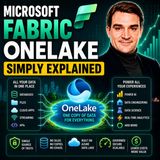
OneLake is the virtualized storage foundation across a Fabric tenant. Amit Chandak compares it conceptually to OneDrive: workloads do not create fully independent storage, while workspaces, Lakehouses, Warehouses and domains still separate data. · From the episode: Microsoft Fabric End-to-End: From Raw Data to Business Decisions with Amit…
Should Fabric be centralized or follow a data mesh?
It depends on size. A centralized architecture can work for smaller organizations, while larger ones benefit from domain-oriented setups in which IT keeps availability, governance and the technical foundation and business domains own how data is analyzed. · From the episode: Microsoft Fabric End-to-End: From Raw Data to Business Decisions with Amit…
Relationship map of Microsoft Fabric: linked topics
Related topics in brief
Topics linked to Microsoft Fabric, each briefly explained:
Microsoft – Organization· Developed by Microsoft Corporation is a technology company that develops software and cloud services such as Microsoft 365, Azure and Dynamics 365.
Microsoft tool – Category· Is a Microsoft tool is a broad category for software products and services developed by Microsoft, used to group offerings and to frame tool-selection decisions.
Analytics and BI tool – Category· Is a An analytics and BI tool analyses data and builds reports and dashboards, turning figures from databases, spreadsheets and data platforms into usable insight.
Semantic model – Concept· Related to Business-friendly data model of tables, relationships and measures that Power BI reports and Copilot query; formerly called a dataset.
Fabric workspace – Concept· Related to Container in Microsoft Fabric that groups items such as lakehouses, notebooks and reports and defines access, capacity and deployment boundaries.
Semantic Link Labs – Developer tool by Microsoft· Related to Open-source Python library from Microsoft that automates Power BI and Fabric semantic model management, best-practice checks and migrations from notebooks.
Star schema – Concept· Related to Data model design with a central fact table surrounded by dimension tables; the recommended structure for fast, simple Power BI models.
Power Query – Analytics and BI tool by Microsoft· Related to Data connection and transformation engine with a visual editor and the M language, built into Excel, Power BI, Power Apps dataflows and Fabric.
DAX – Concept· Related to Formula and query language for calculations in Power BI, Excel Power Pivot and Analysis Services semantic models.
Power BI Service – Analytics and BI tool by Microsoft· Related to Cloud service of Power BI for publishing, sharing and refreshing reports, dashboards and semantic models, with workspaces, apps and row-level security.
Rayfin – Developer tool· Related to Tool presented at M365Con 2027 for developing Microsoft Fabric Apps with AI-driven development; see the session for details.
Announcing: Table discovery in OneLake Catalog search
Starting October 15, 2026, Search in Microsoft Fabric will return tables from semantic models, lakehouses, and mirrored databases as individual results. Users can search by table name or description, or find a table by an exact column-name match. More object types will become available over time. This applies to Fabric's global search, the OneLake Catalog UI, the Search API, search in Fabric's MCP servers, the /find command in the Fabric CLI, and the discovery skill.
What you need to know:
Table visibility in search follows permissions on the parent item, not data-level permissions on the table. If a user has Read permission or higher on…
Effective: October 2026
Summaries of official Microsoft release information, checked daily.
Community wiki
Short info above, community knowledge below: add practical tips, examples or corrections. New contributions are reviewed first; trusted members publish directly.
Experts and companies for this topic
Community members with expertise in Microsoft Fabric:
 EN
 Deutsch
 Español
 Français
 Italiano
 Português
 Nederlands
 Polski
 Bahasa Indonesia
 Русский
 Українська
 العربية
 עברית
 日本語
 한국어