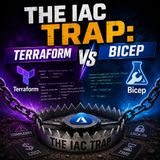
Terraform, also called HashiCorp Terraform, is a multi-cloud infrastructure-as-code tool from HashiCorp. It describes infrastructure in files that can be read, reviewed and run again, and it connects to cloud platforms through providers, including a provider for Azure. It is classified as a developer tool and is closely tied to the practice of infrastructure as code.
The core idea is that infrastructure should not depend on manual steps. The episode "Terraform - Simply Explained" puts it this way: Terraform exists because Azure portal clicks cannot be rebuilt twice. Writing the infrastructure down as a file makes it repeatable, reviewable and easy to run again. That episode walks through the main building blocks in order: what Infrastructure as Code really means, what Terraform actually is, how providers let Terraform talk to a cloud, the plan and apply steps described as a safety net, the state file as Terraform's memory, modules for avoiding rebuilding the same thing, remote state for working with other people, and drift, where reality quietly diverges from what was written.
Several of these parts are what set Terraform's day-to-day use apart. Providers are the layer through which Terraform reaches a platform such as Azure, AWS or Google Cloud. The plan and apply workflow separates previewing a change from carrying it out. The state file records what Terraform manages, which is why the episodes stress handling it carefully. One of them warns that state files must be managed carefully to avoid issues, and another says Bicep's lack of native state management is a limitation, so state is a recurring point in the comparisons. Modules support reuse, and remote state matters once more than one person works on the same infrastructure.
In the Microsoft ecosystem, Terraform is most often compared with Bicep. Bicep is Azure-only and made by Microsoft, while Terraform spans several clouds. The episode "Terraform vs Azure Bicep: Which IaC Tool Should You Choose?" says Terraform stands out when multi-cloud infrastructure as code is needed, since the Terraform CLI and configuration files offer the same workflow across Azure, AWS, Google Cloud and many other platforms. The same episode describes Bicep files as simple to read and write, and notes that Bicep avoids the state-file handling that Terraform requires. It does not name a universal winner; the right choice depends on the organization's architecture and cloud strategy.
The episode "Bicep vs ARM Templates vs Terraform for Azure" places Terraform in a wider comparison with ARM templates and Bicep. It refreshes the role of ARM templates as a long-standing standard, introduces Bicep as a cleaner and more maintainable alternative, and compares readability, modular design and parameter handling. The episode "Infrastructure as Code - Simply Explained" covers the same tools, including Azure Bicep, ARM Templates, Terraform and PowerShell, and explains where each fits within the Microsoft ecosystem. It also links infrastructure as code to Azure DevOps, GitHub Actions, CI/CD pipelines, governance and security policies.
Another episode, "Azure Bicep at Scale: Modular Infrastructure as Code", lists limitations of Bicep such as no native state management and a smaller ecosystem than Terraform or Pulumi. Taken together, the episodes suggest that Terraform is a candidate when work spans more than Azure or when a mature provider ecosystem and a state-based workflow are wanted, while Bicep is the Azure-focused option.
Overview compiled with AI from M365.FM episodes and the facts on this page. You can improve it with the edit button below.
In this episode of the M365.fm podcast, we explore one of the most debated Infrastructure as Code (IaC) questions in the Azure ecosystem: should you choose Terraform or Azure Bicep? Rather than declaring a universal winner, the discussion explains why the…
What does the future of Azure look like, and how are Infrastructure as Code and DevOps transforming the way organizations build and manage cloud solutions? In this episode of M365 FM, host Mirko Peters is joined by Microsoft Azure MVP Maik van der Gaag for an…
Azure Bicep is Microsoft’s modern Infrastructure as Code (IaC) language for deploying Azure resources using a clean, declarative syntax. This episode explains why Bicep has become the preferred choice over traditional ARM templates and how it helps teams…
PowerShell has become the automation standard for Microsoft environments, but it reaches its limits when managing modern cloud infrastructure at scale. In this episode, we explore why Azure Bicep has become the preferred Infrastructure as Code (IaC) language…
ARM templates were once the standard for deploying Azure infrastructure, but as cloud environments became more complex, their JSON-based approach revealed serious limitations. In this episode, we explore why many Azure professionals now see ARM templates as…
Azure Bicep is Microsoft's modern Infrastructure as Code (IaC) language for deploying and managing Azure resources using a clean, readable, and declarative syntax. In this episode of Microsoft Knowledge Nuggets on M365 FM, Mirko Peters explains why Azure…
Platform Engineering is changing how organizations build and operate Azure environments. Rather than treating cloud infrastructure as a collection of individual projects, Platform Engineering creates a shared internal platform that gives development teams…
Azure networking has evolved far beyond simply connecting virtual machines. In this episode, we explore how modern Azure networking enables organizations to build secure, scalable, and fully automated cloud environments using Azure Functions, Azure Virtual…
Artificial intelligence is fundamentally changing how developers build solutions on Microsoft Power Platform. In this episode of M365.FM, Mirko Peters is joined by Reza Niroomand to explore how AI-powered development is transforming the developer experience…
Developers are drowning in Kubernetes, pipelines and compliance checklists instead of shipping features. This episode is for engineering leaders and platform teams who want to understand the DevOps tax and replace it with platform engineering, from golden…
Think your Azure backups are safe by default? They’re not. In this episode, we uncover how a single over-privileged identity can quietly kill “immutable” backups in Azure. You’ll hear real-life attack paths using compromised automation, shadow admins, and…
Platform Engineering is changing the way organizations build and operate cloud environments. Instead of every development team managing its own infrastructure, platform engineering creates a shared internal platform that provides secure, self-service access…
Avoiding the IaC Trap: Matching Tools to Your Cloud Strategy · Mirko Peters Choosing the right infrastructure as code tool is critical to avoiding unnecessary complexity and technical debt. This post explores how to align your IaC selection…
Questions marked with AI were written with AI from the facts on this page.
What is Terraform? (AI)
Terraform is a multi-cloud infrastructure-as-code tool from HashiCorp. It describes infrastructure in readable files that can be reviewed and run again, and it manages platforms such as Azure through providers.
How does Terraform differ from Bicep? (AI)
Bicep is Azure-only and made by Microsoft, while Terraform works across several clouds, including Azure, AWS and Google Cloud. The episodes also note that Terraform relies on a state file that must be managed carefully, whereas Bicep does not.
What do the plan and apply steps do in Terraform? (AI)
The episode "Terraform - Simply Explained" describes plan and apply as a safety net. Terraform first shows what it intends to change, and the change is carried out only in the apply step.
Should I choose Terraform or Bicep?
It depends. Bicep is best for Azure-only environments, while Terraform is better when you need multiple clouds. The episode explains that the right choice follows your architecture and cloud strategy. · From the episode: Terraform vs Azure Bicep: Which IaC Tool Should You Choose?
Terraform is stronger for multi-cloud and hybrid deployments because of its support for platforms like AWS and Google Cloud and its extensive provider ecosystem. · From the episode: Terraform vs Azure Bicep: Which IaC Tool Should You Choose?
How do ARM templates compare to Terraform?
The show notes say Terraform uses HCL, which is more user-friendly, and supports multiple cloud platforms, while ARM templates are limited to Azure. · From the episode: ARM Templates vs Bicep: Why Azure Teams Are Switching
Relationship map of Terraform: linked topics
Related topics in brief
Topics linked to Terraform, each briefly explained:
Developer tool – Category· Is a Developer tool is an M365.FM category for tools that help developers write, test and ship software, from editors and build pipelines to APIs and platforms.
Infrastructure as code – Concept· Related to Managing cloud infrastructure through versioned code and automated deployment instead of manual portal clicks.
Microsoft Azure – Cloud platform by Microsoft· Related to Microsoft Azure is Microsoft's cloud platform with services for computing, storage, networking, databases, analytics and AI.
Bicep – Developer tool by Microsoft· Related to Domain-specific language from Microsoft for declaring Azure resources, compiled to ARM templates.
All relationships of Terraform, grouped by type of relationship:
Short info above, community knowledge below: add practical tips, examples or corrections. New contributions are reviewed first; trusted members publish directly.
 EN
 Deutsch
 Español
 Français
 Italiano
 Português
 Nederlands
 Polski
 Bahasa Indonesia
 Русский
 Українська
 العربية
 עברית
 日本語
 한국어