Vibe coding is the practice of building software by describing what is wanted in natural language and letting an AI generate and refine the code or app. Instead of writing every line by hand, the person steers the result through prompts and feedback. The concept is also described as prompt-driven development or AI-assisted app building, and it is closely tied to how much the quality of a prompt shapes the output.
In the Microsoft ecosystem, vibe coding appears mainly in Power Apps. Generative pages turn plain-English prompts into responsive, Dataverse-aware React pages, which replaces much of the manual layout work familiar from canvas apps. Power Apps code apps take a different route: developers work in code, keep their source outside the platform, collaborate with others and retain a history of every change, while AI helps generate components, optimize code and define a data model. GitHub Copilot is a related coding assistant, and one of the episodes uses its agent mode in the context of multi-file changes.
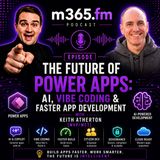
The typical benefit named in the episodes is speed. In "Power Apps AI and Vibe Coding with Keith Atherton [MVP-MCT]", the guest describes coming from traditional .NET and SQL development and valuing how Power Apps reduces the time spent rebuilding the same forms, logic and app structures, so that more effort goes into solving business problems. The episode presents a vision in which AI makes app creation accessible to more people, while experienced builders still need frameworks to deploy enterprise-grade solutions safely.
The episodes also stress the trade-offs. "Canvas App UI vs Generative Pages: Which Should You Use?" says the speed of generated pages can mask fragility. It names read-only generated output, prompt ambiguity and hidden licensing as risks, and notes that technical debt can shift rather than disappear. It suggests manual UI where unique micro-interactions matter and Generative pages for repeatable, data-driven enterprise apps, with a blend of both possible. Governance is described as coming partly from Dataverse metadata and roles.
A second theme is what happens when a vibe-coded project meets complexity. "Use GitHub Copilot Agent Mode for Multi-File Changes" quotes a developer describing the moment when something breaks, an edge case appears and it is no longer possible to simply prompt a way out. Fixes in one place can create problems elsewhere, and patchwork changes can leave a codebase without cohesion. This is the situation where structured, multi-file assistance and conventional engineering practice are presented as helpful.
"Power Apps Vibe Code vs Low-Code: Which Fits Your Team?" frames the decision as a comparison of approaches for developers and citizen builders, and "Power Apps Code Apps with Carike Botha [MVP]" covers the developer-oriented side with source control and AI-assisted generation of React components. Together, the episodes treat vibe coding less as a replacement for low-code or traditional development and more as an additional way of working. The practical questions they raise are who owns the generated code, how it is governed, how it is maintained over time and which team skills fit the chosen approach.
Overview compiled with AI from M365.FM episodes and the facts on this page. You can improve it with the edit button below.
Type
Concept
Kind
Method
Also known as
Prompt-driven development, AI-assisted app building
Keith shares his background in traditional .NET and SQL development and explains why Power Apps immediately stood out to him: speed. Instead of repeatedly building the same forms, logic, and app structures manually, Power Apps allowed him to focus more on…
AI inside the Microsoft Power Platform isn’t just about 'Copilot writes formulas' anymore. In 2025, Microsoft introduced four innovative capabilities that transform how apps, data, and automation are developed: Dataverse Prompt Columns, AI Form Filler / Form…
Questions marked with AI were written with AI from the facts on this page.
What is vibe coding? (AI)
Vibe coding is building software by describing what you want in natural language and letting an AI generate and refine the code or app. The builder guides the result through prompts and feedback rather than writing every line manually.
Where does vibe coding appear in Power Apps? (AI)
It appears in Generative pages, which create Dataverse-aware React pages from plain-English prompts, and in Power Apps code apps, where developers work in code with AI assistance. GitHub Copilot is a related coding assistant.
What risks do the M365.FM episodes mention? (AI)
The episode "Canvas App UI vs Generative Pages: Which Should You Use?" cites read-only generated output, prompt ambiguity and hidden licensing, and notes that speed can mask fragility. Another episode describes hitting a wall where prompting alone no longer resolves a problem.
What is vibe coding in Power Apps?
Vibe coding is the episode's name for Generative Pages, where plain-English prompts produce responsive, Dataverse-aware React pages. It replaces the manual pixel work of positioning controls in canvas apps. · From the episode: Canvas App UI vs Generative Pages: Which Should You Use?
Topics linked to Vibe coding, each briefly explained:
Power Apps – Low-code tool by Microsoft· Related to A low-code tool for building custom business apps for web and mobile. Canvas apps give full control over the layout, while model-driven apps are generated from the data model in Dataverse.
Power Apps code apps – Low-code tool by Microsoft· Related to Power Apps app type where developers write the front end in code such as React and still use Power Platform connectors, Dataverse and managed security.
GitHub Copilot – AI assistant by GitHub· Related to An AI coding assistant that suggests code, explains it, writes tests and, in agent mode, carries out multi-step changes in a repository under the developer's review.
Prompt – Concept· Related to The instruction or question given to an AI model. Clear prompts state the goal, the context, the desired format and any constraints; good prompting is the fastest way to better Copilot results.
HTML pages in SharePoint – Concept· Related to Way to publish custom HTML content as pages in SharePoint, for example generated with AI, within the tenant's security boundary.
David James Wyatt – Person· People working on this topic David James Wyatt is a speaker at M365Con 2026 and M365Con 2027 (Senior Staff Engineer at TJX) with 2 sessions.
All relationships of Vibe coding, grouped by type of relationship:
Short info above, community knowledge below: add practical tips, examples or corrections. New contributions are reviewed first; trusted members publish directly.
 EN
 Deutsch
 Español
 Français
 Italiano
 Português
 Nederlands
 Polski
 Bahasa Indonesia
 Русский
 Українська
 العربية
 עברית
 日本語
 한국어