 EN
 Deutsch
 Español
 Français
 Italiano
 Português
 Nederlands
 Polski
 Bahasa Indonesia
 Русский
 Українська
 العربية
 עברית
 हिन्दी
 日本語
 한국어
2026-07-22 · Season 2
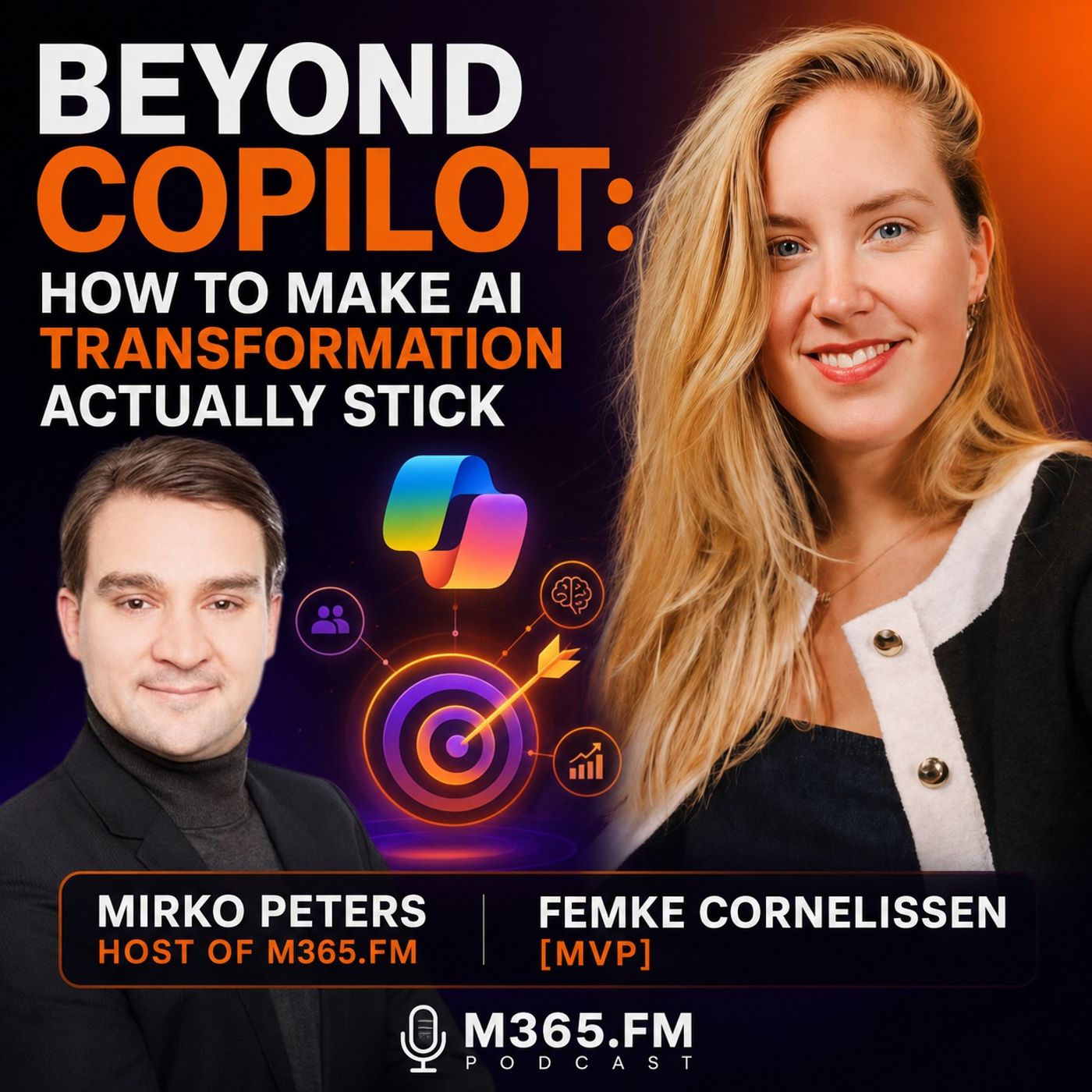
Beyond Copilot: How to Make AI Transformation Actually Stick with Femke Cornelissen [MVP]
Show notes
Artificial Intelligence is transforming the workplace faster than any previous technology wave. Yet despite massive investments in Microsoft 365 Copilot, AI agents, and automation, many organizations still struggle to create measurable business value. Technology itself is rarely the problem. The real challenge lies in leadership, culture, governance, and redesigning the way people work. In this episode of M365.fm, Mirko Peters welcomes Femke Cornelissen [MVP], Chief Technology Transformation Officer at Wortell and one of the Netherlands' most influential voices in Microsoft AI transformation. Femke shares practical insights from helping organizations move beyond AI experimentation into sustainable business transformation powered by Microsoft technologies. WHY AI TRANSFORMATION STARTS WITH PEOPLE, NOT TECHNOLOGY Many companies believe AI transformation begins with deploying Microsoft Copilot or building custom AI agents. Femke argues that this mindset is fundamentally flawed. Successful transformation starts with people, leadership, organizational culture, and a clear business strategy. Organizations often allow every employee to build personal AI workflows independently. While experimentation is valuable, it can quickly lead to disconnected solutions, duplicated work, inconsistent governance, and little measurable business impact. Instead, organizations need a shared vision that aligns AI initiatives with strategic business outcomes and creates collaboration rather than isolated innovation. FROM COPILOT TO ENTERPRISE AI STRATEGY A recurring theme throughout the discussion is that Copilot should never be viewed as simply another productivity tool. Instead, it should become the foundation for redesigning business processes across departments. Femke explains how executive leadership must define clear business objectives while cross-functional AI transformation teams translate those goals into practical initiatives. CEOs, CTOs, transformation leaders, security teams, and business units all need to collaborate to prioritize the highest-value AI opportunities. Rather than asking employees to "use AI," organizations should define where AI creates competitive advantage, establish governance policies, identify responsible owners for AI agents, and continuously measure business outcomes instead of focusing solely on technology adoption. GOVERNANCE, OWNERSHIP, AND WHY AI AGENTS NEED MAINTENANCE One of the biggest hidden challenges in enterprise AI is ownership. Many organizations already have hundreds or even thousands of AI agents created by employees, yet very few have clearly assigned owners responsible for maintaining them. Femke explains that every AI solution requires ongoing governance. Data must remain accurate, prompts need continuous improvement, business processes evolve, and AI agents must evolve alongside them. Without clear ownership, AI quickly becomes outdated and unreliable. Organizations therefore need policies covering lifecycle management, data governance, responsible AI practices, security, transparency, and long-term maintenance if they want AI investments to continue delivering value. WHY CHANGE MANAGEMENT MATTERS MORE THAN EVER Traditional change management focused on introducing new software. AI changes something much bigger: how work itself gets done. Employees naturally worry about job security, changing responsibilities, and the unknown. Femke believes these concerns can only be addressed through transparency, communication, and involvement. Leaders should actively encourage experimentation while clearly explaining governance, acceptable AI usage, security boundaries, and the organization's long-term strategy. When employees understand how AI enhances their work rather than replacing them, adoption accelerates and innovation flourishes across the organization. HOW FEMKE USES MICROSOFT COPILOT EVERY DAY Femke also shares practical examples from her own workflow. Microsoft Copilot has become the starting point for virtually every working day. Meeting transcripts automatically generate prioritized task lists, AI organizes follow-up actions around upcoming vacations, customer conversations become executive summaries, marketing content, sales recommendations, and internal communications—all from a single meeting. Instead of treating AI as a standalone assistant, she uses Copilot as an orchestration layer that connects workflows across multiple teams, dramatically increasing productivity while reducing repetitive administrative work. THE FUTURE OF AI-POWERED WORK Looking ahead, Femke predicts that organizations will move beyond isolated AI assistants toward connected ecosystems of collaborating AI agents. Meetings will increasingly trigger automated workflows, proposals will draft themselves, CRM systems will proactively generate recommendations, and employees will spend less time managing tools and more time making strategic decisions. The organizations that succeed won't necessarily have the most AI tools—they'll be the ones that redesign their business processes around AI while maintaining strong governance, leadership, and human collaboration. KEY TAKEAWAYS This conversation offers valuable insights for IT leaders, Microsoft 365 administrators, digital transformation professionals, Copilot champions, business executives, and anyone responsible for introducing AI into the workplace. If you're looking to move beyond Copilot licenses and build an AI strategy that actually transforms how your organization works, this episode delivers practical advice grounded in real enterprise experience. Whether you're planning your first Microsoft Copilot rollout, scaling AI agents across departments, or defining governance for enterprise AI, Femke Cornelissen shares a roadmap for turning AI adoption into lasting business transformation. Become a supporter of this podcast: https://www.spreaker.com/podcast/m365-fm-microsoft-365-azure-cloud-power-platform-ai--6704921/support.
Apple Podcasts · Spotify · YouTube · YouTube Music · Deezer
Host: Mirko Peters
Guests
Related articles
Transcript
Read the full transcript
Yeah, I come back to the M365F and podcast where we explore Microsoft's 65 AI co-pilot digital transformation and the people sharing the future of work. Today's guest believes something many organizations still struggle to understand digital transformation isn't about deploying technology, it's about changing how people work. Joining us today is theme co-cursor. We've technology transformation officer at Wontell, one of Netherlands leading Microsoft partners. And also I have reached the second influential woman in tech. Yeah, it's taking so much, yeah, that's true. Yeah, I think every day, Facebook and work with the organization looking to move beyond simple rolling out Microsoft 65 or co-pilot and Steve, she helps them redesign work itself, aligning people, leadership, culture and technology to creating listing transformation. Today we'll explore AI adoption, Microsoft co-pilot, change management, organization, behavior, leadership, and why successful transformation, start with people, not platforms. Yeah, thank you. Welcome to the M365F and podcast. Hi, thank you so much. For this script in the beginning, but yeah, thanks for having me. I'm really excited to be here and thanks for the advice and well, what an introduction. It was a long introduction. Yeah, you have done so much. So can you tell us about your journey, how we can do seconds influential woman in tech and especially what was the Microsoft ecosystem to do with it? Yeah, well, it's interesting. Well, I really like sharing knowledge. I think the same as you, but a lot of the community with nice is your knowledge around M365 and everything was new, but also what we're learning from building and creating. So I am now 12 years in Microsoft space. I started as a market here in tech company. So a really different part, really interesting to start in marketing and then actually doing different kind of roles from sales to also some technical roles as in share of Portland sales and but also migration, consultants, I did some developments as well. So it's interesting to look in the kitchen in different areas in tech company. But what I really like the most is what have I learned and when I'm talking a lot with different kind of customers, it always was things that I've I have seen in more customers at the same questions and then I started to create content around it. I need to say in the beginning, it was really scared doing that because I always think I'm the only one who are going to read it and I need to say in the beginning, it was the only one who read it was sometimes myself. But by starting creating, doing even more sharing my knowledge, sharing what I think about some solutions and why I think it's good but also why it's not good. Yeah, it grows really fast. And now, yeah, years later, I think almost like three or four years later, before I really started with doing that kind of things. It's exploding. And that's really nice because I think it's really good that you are not based in one area that you have seen a lot of things learned from a lot of different kind of backgrounds that I had, not only in tech, but also as a photograph or my own business years before that. And you have a different kind of field than a lot of people normally see in organizations. So it's nice. And I think that everything coming together, like storytelling, making pictures around it, but also sharing what I see in the markets and what is actually changing in the market right now. And well, I like to zoom in, but also like to zoom out. And I think that's not, wow, I think a lot of people try to do it, but it's not always that everyone can do and seeing it. So, yeah, I think that's my impression. Yeah, I see also you are often on conferences, on podcasts, live streams, on podcasts, on, and you do a lot of content creation. And you also be the chief transformation officer at Vortel. So how do you, yeah, do you do your normally day looks like, or in the more, yeah, well, my day looks like, well, I wake up and say, hey, this is so funny, my day looks like, oh, I think a lot of people are thinking that I absolutely, what do you say, like going to conferences speak a lot and creating a lot of concerts or anything, but well, that's more hobby, I would say. Of course, I get the support for the company that I work for, that they support me to do that, but it's, it's, it's a hobby and it's not my actual real job. I think sometimes I get some time for it. I'm just, like, like, now we doing this podcast, but, yeah, my, my real day looked like they're really different. So I, I am, if the people don't know, we had a chief transformation officer at Vortel, and that means that I am transforming our, our, our own organization. So we're doing is, as every organization, we focusing on, on AI. And what does it think we see now in, in our organization? So a lot of people exploring AI and using AI in different kind of ways, even in a technology company, but my role is, what is the strategy of the organization and how can we translate strategy in the, different kind of AI initiative that we have and are we doing the right things at the right moment because now, AI, we can solve everything, we think and we think everything have priority. So doing the right things with the right people, making the best results, that's my role. Yeah, so, so you, you are not purely in technology in, in your role, you are also as the organization or transformation. Yeah. So I'm not, I'm going to build anything by myself at the moment. So that's, that's not what I'm doing. I'm having a team who are doing communication adoption, but as well, creating at the agents or supporting people to create by themselves, but I'm supposed to offer that away. And, and, and when you look a little bit back, what experience, your, your leadership style? I really like that people are like being really innovative by themselves and I also like that people are, well, people on different kind of teams, they have the knowledge. I can say to you, okay, you need to do this on this way and your process is changing and this is the way you need to work now. But it's way better to have people around you who have the actually reading on it so about that, that, that area. So it's good to let them be the one who are responsible for the ages that we create, but also responsible for the, for the process that we are redesigning and that they are being a part of that. So it's interesting as, as you think about leadership style, it's interesting to show them what we want to go. But let them think how we can solve that and how we, how we come there. And that's saying, okay, from day one, this is what we build. And now is this the new way of working? I don't think that's, that's, that's, that's all work. And actually we, we see now, I say to a lot of people, we're living in a sort of popcorn machine, everything changing all the time. And what we build today, tomorrow can be like way different because of our new solutions out or things that happening that we are building already that Microsoft brings now as, as a stand that or brings us out of the books, you just don't like that. So we're living in a world that we need to understand that all the AI tools are changing, the alarm changing, the skills that we make need to change, the, but as well, the solutions that we build that everyone is building the same kind of solution. So the other thing is as well, we need to think about who are ES and organization. The way thing that we, that is really, is interesting is that we are as an organization, what is our strategy around it? And how can AI add on helping to get that, get that done? Yeah, when, when I look so, so many companies have invested millions in, in Microsoft 65 and that I, and yeah, they, yeah, I think they have a little bit stril to realize the business well. You, why, why not? Yeah. Why so many translation projects fail from your perspective? Yeah, that's really interesting. I think because everyone is creating their own way of working. So if you don't have any strategy, no one absolutely know what you are doing. And as I said, I think everyone can create their own way of working like from personal perspective. So you can do it in your co-pilot or your co-work or even maybe in clause. I don't know what you're using, but everyone is creating their own personal productivity that not, maybe not need to be a personal productivity thing. It needs to be, for example, like a team way of working. So you need to create an agent for it in, for example, co-pilot studio or in FoundV. So why you don't have business value is because everyone is creating their own way. You don't have any synergy in your organization in your way of working. So you want is you want to have like a data platform with the right data on it that people can build on the same data platform. And that there is synergy from what these people is doing and these people, there is actually matching with each other and can come back with feedback and make your company even better on the other way around or all the people that are there. So what you're seeing is, first of all, you had a process with a lot of people there, but now you're going to see that AI is evolving and that and everyone is doing that by them say, if you need to redesign your organization and that's not easy, sometimes this year to create a new organization and build it from scratch, then redesigning an organization that people in it will know really good how it needs to be. And I think that's the best way that they do it and it will be inspired about what are the possibilities for my AI as well. And how, yeah, I would say they have the different ways to work all the people, but how can you put this in a strategy that creates the value? What's your tips here? Yeah, from my perspective, it's always start with the CEO Saturday. This is the way to go. This is important for our organization. This is where we're going to. And then you need to think about an AI console or an AI team that says, okay, when we have from the CEO, this is the way to go. What are the initiatives that we are one of the teams that we need to focus in right now to get there? So you put the CTO, the C-H-R-O, G transformation of course, and the CEO together in one room, and you have like every week a discussion about what is to that solution and what are you, how do you get the best opportunities there? Then you have an transformation team that can be an team that you, an actual, not really an actual team, but you can have like a virtual team that you create there. But people are actually really in a job. We say, okay, you're helping with the adoption, with the communication, you help with building, you are helping with the different kind of projects that we want to launch and you give people their response, we're going to be there as well. You can think about having in every team that you have, that you make one person responsible as well for the transformation because, well, it's really good to have people there. You are not, you cannot do anything, everything at the same time. So let's go to have more people in everything that are there as well responsible for picking up the rights or opportunities that are aligning with the strategy that you have as an organization. And your whole organization needs to know what the strategy is. And we can say that everyone knows that, but I can give you on a favor, the thing that most of the organizations don't really, well, from leadership perspective they know. But if you, yeah, when you have everything aligned there, then you're going to start with training and adoption and saying, okay, this is how you can build your own agents. But this is also the policy that we have as an organization and this is how we see this from security wise. And then you also go to see that people are going to change in their role. And let's where to see a role, role is really important because you get people who are going to be the owner of the agents from not only the agents that then need to make it even better and get better responses, but also that the data is always up to date. And a lot of people are planning that part, so they're creating a, just for themselves, but it's probably for a team creating their own number. And the role was actually not changing because, well, they make something and it changes with the organization and then it's, okay, oh, we can all use it, but well, that we need to update the data and get better results. No one is doing that. So it's, I think, a really interesting way to think about from strategy to have a team to say, okay, this is the first few use cases that we need to pick to have a transformation team. Well, by what adoption and creating everything would also get your team on board from no organization side. And success stories. It's also needed. We have some success stories to get other people involved. And one of the things that I have learned, so I learned and talk about it. One of the things that I have learned is that everyone wants to create something and wants to do something. So how can you keep your people really still creating, being innovative, don't stop because you're saying, okay, it needs to be come from the upside. You also have to from, from, from themselves to up that people still can create things and that it's not stopping and liking it and saying, okay, I don't know if I'm still can make my own agents. So yeah, good policies and round is everyone knows where it stands, who is responsible. And if I'm creating an organogram with agents and people, so make it really visible. And I need to say I'm not that far yet, but we are exploring death now. Yeah. Has AI fundamentally changed change management? What do you see? Yes, change management is absolutely neat is and and I think not it's a cool turkey. I think it's more culture thing than it's technology. So the culture thing is is that that's the mindset needs to change. And the mindset is the process that that people understand that we can add on everything that we want to do. And if you really have real value, then we are back why are we don't kind of value is that you need to design your organization. It absolutely needs if you want to get at want to stay in front, you need to redesign. Interesting. Can what, what, what, what, what, what thing you why do employees resist new technology? Well, I think a lot of people don't know what you can do and also are scared, I think that it will take over the job or that everything will change or that, well, of course, everything will change. But I think a lot of people don't actually know what's happening with their own role. So it's good to involve them and let them see what it actually do for them. And set off, okay, this is, you are always going, is going away and well, the agents take up or I don't believe that I think we're going to create even more roles. And if people really click in and see, okay, but this is now that I don't have to do anymore with a lot of administration tasks, something like that, but I can even give more as vice of our customers, for example, and being more present when I'm there, then people will see it. Yeah, interesting. What did you think, what's the biggest culture by year we have actually companies? The culture, what do you say, sorry. The culture barriers, the biggest. Yeah, now I think what we see at customer as well is I think also leadership is changing. It's, it's an interesting thing to think about that, for example, you always have on Friday doing a report and giving updates and saying how it's going in organization. You have middlemanishments who are saying to the people how they were reporting as well. So a lot of things on the reporting side, but as well, that people need to learn that they have their people and their agents that they need to work together and that these things are changing from that perspective. That's a culture barrier. I take a lot of people don't understand that we need to, the dual quality and the people are even more important and that the task and all that kind of ways will change with, in a right way, with the agents there. I think a little bit, when we have all these, yeah, the leaders, they have self changed their, seeing changed their rules, but they also have the job to trust around the AI. How should leader do this, how they can go trust? Yeah, that's a really good question. I think when you want to build trust, you need to share where you want to go as an organization, but also ask people to think with them. So ask them how to solve it, what are the best, what are the opportunities that we have with AI. And trust is as well, I think when people are using AI, they need to understand why am I using in this system? Is it secure? Well, all that kind of thing, so I think that's really important. And I think you need to make like a framework for the organization. So a framework in this is, for example, personal productivity, this is what you can do in it, this is the standard of our organization. For instance, what are you doing with our data? Be clearer about it, what kind of data you can share and what kind of AI to. And what is the thing that you could open and what is the thing that people have no idea right? And I'm saying everyone would understand it, but it's not everyone is doing their own way. If you close it, people will find a way in other AI tools because they think, well, I can buy it by myself. So can you build trust? Is it clear and what you want? What you don't want? And what is the right way to use for your organization, but also business, productivity or personal productivity, I would say? Team AI, we are talking more about, for example, co-pilot studio, building your agents for your team, but also enterprise AI. You can think about the solutions that you want to sell to your customers or AI solutions that you are building or the gold mine of your gold that you say, okay, this is something that we want to create from enterprise perspective. And there is no owner there, but well, this is something that we're building by yourself and you can put out collecting or get your information out of it for this kind of people. So it's interesting to think about that, to give clear instructions and I think that will help. So you think you have to give clear instructions, so what did you think about the people do experimentation with AI? I think that's good. I think as well everyone needs to experiment to understand what it can be. So you need to know in what kind of tool and what is allowed and what is not allowed. So I think, well, let's say like co-pilot versus co-work, co-work right now at the moment is, hey, as you go, we all know that. So if you go into experiments in co-work, you will get to build. So you can also create a skill or learning in co-pilot to create the right skill for example in co-work. So you go into buildings, you go into create is, you go into talk with co-pilot, it doesn't cost you any cost anymore and then you create it with your co-work. So everything in use co-work that you have the right skill in that your cost is not that high instead of experimenting, making better. So we really need to learn where we need to do that. For example, as well with creating, when I'm talking about personal productivity even with creating for example, and power points, yeah, it's really easy to say to co-work, this is my transcript, create power points. Well, that cost you $25 or $30. I don't know, actually something just how big it is and how many data you put in, but you also can think about, I can upload it in my power points, in my uploaded transcripts and saved for the day today, then it's cost you nothing. So it's a way of working by learning where to your experiments, it would also be open and mind it in what other opportunities and there is an adoption or something valuable. And I think culture is also something that needs to be involved there, right? Because if you get the opportunity, experiments, be an experimental organization, I think that will help you. You can learn, or you can fall, and you can learn from the mistakes you make. And when, what did you think how does the future of workplace look like? Yeah, oh, I think all the solutions that we are building now at the moment, but each other, that everyone can build that, not everything will have their solutions one day. So everything that we think that we are unique now, probably in the upcoming years, no one is very unique, but it's a time now. And I think the difference will be, we're thinking about who you are as an organization and being your strengths in there. So that you make the difference with the people who are there and actually just trying to do that. You have a round AI and not only doing things faster, but also who are you as a brands? And what is the difference between other companies, building the same solutions? And also, I think we're going to talk more, we're talking now in this podcast, but I'm also thinking we're going to talk more to our systems that are brought more workflows creating, well, I think, and it's already there, we are building it by yourself, but when I have a meeting with you, I also want to have 23 different kind of workflows behind it, because the system needs to work for me and I don't need to wait for the next steps. Well, when I have a transcript and I have a team's meeting, I want the next step is that there is an offer for our customer. And do I really need to make that offer or kind of see in the transcript already that the offer is about co-piles and co-work with so many uses and there are so many options. And this is the organization and these are the people are involved in the customer who needs to decide on it. So your AI is going to make that as well for you in workflows. So I think the future will be, how can you really make impacts by creating a new process instead of creating new agents on top of your process that you have now? And the real winners will be the first one I think. Yeah, we have a lot of new things, I think one of this is the agent to agent collaboration communication. How will AI change collaboration and communication in companies? Interesting, a lot I think. So we're talking about how can we change our processes, but also we need to think about how can the change our way of communication with each other. And I always need to think about the way that we are going from the server to the SharePoint or working with teams and we need to start it with creating our team schools and well, I don't want to go to the office or just want to go to the office and all the things there we need to have new ones. We need to understand that we have a new way of working created there. And the same will happen now. We have AI only involved in that and we need to make the right decisions when AI is doing something. So one of the things, for example, is meetings. When you have a meeting, you want to have something that already prepared you front of. You want to have send it to all the people where you are to talk about, this is not something that you need to do by human. This is what AI can do. It also gives you a genna, it also gives you some information how long it takes, it gives you what would the facilitator agent, it gives you also some information about what I already talked about or you can give you notes afterwards but also heads up what you need to do in the future. So I think, well, the next step is more, do we still need to have all this kind of meetings or can already AI decide some of this? Do we still need to be part of the human? And what kind of decisions really need to be taken by us? Yeah. I think a little bit, what I find really interesting, I think my coffee machine that has now a button, it's AI button, I don't know what it's really do. Yeah, it's a fed labeled AI inside, cool. You did it test it, yes. Yeah, I have clicked the button, but I don't know what's different to be for. Oh, I'm not not a barista, but I think for a barista, the biggest change in what AI do, but I think it's the biggest actually, it's for knowledge work. How did you think knowledge work will transform? Well, fun thing when you're talking about barista, I know some people who are making applications about how many coffee they drink at a day and if they, how many like coffee beans. I was, yeah, some of that you can take them out, I don't know, it's actually that. Or then you have a ring where it's all your sleep data and those you can analyze, how many, well, that's the first thing I don't need to think about when you have an AI and bottom of your coffee machine. But was knowledge work, yeah, I think everything, round knowledge work will all change really, really, really fast. I think I already doing at the moment. And yeah, think about an AI who, different panel, the eyes, but you need to really think about what are the things that I do on the piece and how can I be, what, what do I want to be in the future? How can AI help me to get there and one of the things that it's that I actually doesn't have to do anymore. And that you can think about personal perspective, personal productivity and I think that's a lot of the things that a knowledge worker is doing, but also working together with your team. And what are your KPIs in your organization and how can you come there? Yeah, I think knowledge worker will change and normally, and the things that I've seen in the future is that we are going to see even more connecting the dots there. So you have your CRM data, you've already used it. Like I don't go to a dynamic system anymore. I asked questions, how many opportunities are there, this customer gave me an advice to handle, what are the next, the talking points that I need to talk with. But also you can think about more data coming together, for example, from your marketing perspective or so I think the whole way of working with chains and you get anything more analyzing data, getting their data is available, getting more opportunities that AI is analyzing it for you. But I think we as a human need to learn how to do it well. And don't always ask the questions that we analyze this. Well, we really need to learn how to get the best results and create good skills for it. Yeah, skills is a good topic. You are in a leadership position. What skills do model leaders need and what will you say which becomes obsolete? Yeah, well, one of the things that I would say, I think everyone will recognize this, everyone has a lot of good ideas. But nowadays everyone has even more good ideas because they put it in the AI system, they get things back that you think about, oh, well, this is a good idea and this is my idea, for example. So I think, first of all, I get a PowerPoint presentation once a week and someone needs to work like 40 hours to get a really nice PowerPoint presentation and send me to it over and told me the story why this is a good idea. And now I get like sometimes 10 PowerPoint presentations in the same style with the same idea with the different, well, everyone can do even more and have good ideas because of the AI system. So I think that we work in. So I think the thing that we need to learn is how can we, what is the intention of the things behind it that people are creating? Why aren't they doing it? So we need to have the skills and really have to communicate and ask you more about the use cases, not only in giving a life, asking about the uses. Why are we doing? Why is this helping us? Why are you creating this PowerPoint? What is the intention behind it? So even more of the communication skills will be more important, I think. And because everyone has so many ideas, how can you say to other people that they are really good ideas? But this is something someone is working on. So I think the goals and responsibilities for the teams will be more, need to be clear because everyone can create everything. And it could be, for example, that your finance departments have a good idea for yourself the park, right? And even the way it routes because they have now they feel they've been able to create all kinds of ideas that they think they need to help with. Yeah, I think also what actually happened, like the EU, UAE, I act, there's a lot of stuff that happen, but they're especially for leadership, they become liability for the AI, so they're personally can be. So how do you think leadership can be here getting more secure here? What have they to do? Because I don't know, have a better IT guy, some sort team or all. Yeah, interesting is that because, well, you're talking about AI, UAE, AI, and I think that's really important. But you also need to think about what is the best data in my organization and what do we need to be, yeah, needs to have theirs that no one can touch or no one can do something with it. What is the thing that we can actually build on? But as well, I think again, the clear instructions need to be there. Yeah, let me think. You say, what is the more the leadership need to think about? I think it's good to have not only, I think leadership need to know what are the new things where we stand, what is the market heating on and not only IT department. This is, I think we see AI as a thing that it needs to be in the IT department and someone is responsible from IT. It's not anymore. You have more people involved in the different kind of teams who are responsible there, but also getting in a position that they can say, this is what we need and this is responsible way. So putting on, for example, in short baking, I'm just five co-pudders, yeah, you need to understand why. You need to understand what is happening with the other them or using a cloud somewhere or, well, I think everyone needs to learn it and also need to know what are the consequences around it. Yeah, we have, I think we start with quality data and AI creates so much quantity and how and they all can build now their own agents, their own citizens and stuff and how, yeah, I don't know how will you go all this, how can we go there as a, yeah, be safe or be careful or be... Yeah, I think you need to make it feasible. So for example, when we talk about our organization that I work for, we have 12 hundred agents there and we have 500 people who are working there. So we have a lot of agents if you say instead of like human. And I think there are a lot of agents who have no odor and no one who is responsible for it. So, yeah, you will see if people are creating agents and being curious, it's fine that they are, people are doing that, but you also need to have a policy, for example, if they have their first day of working, you want to let them create an agent because they're learning from it, but also the policy that you need to delete it. And the other way is like, for example, if we're using co-pilots in meetings, yeah, you see is that people have meeting transcripts, for example, and then after 30 days, they're deleting all the recordings because their data are exploring and, yeah, people say, okay, we can delete it after 30 days, but what if your co-pilot doesn't work anymore with that data? You always want to have the data because you're building on that. So, it's all with making appointments with your team in how you weigh off working, we're coming back in. This is what we want. This is what we want to achieve. This is where we store our recordings or our data. So our co-pilot can still work with it. And yeah, I think a lot of people are maybe selfish, that's it, because they are doing everything by themselves, creating something for themselves. But if you can look at the broader perspective as an organization, then I think then you win, yeah. I think a lot of teams build their agent to agents systems, but they're, yeah, I think marketing entails. Also, they have, communicate, the video thing, this is be the future. They can only bring that AI talk to another here and how can we be safe? That's not, I don't know, that's not become bias in all the systems. How did you have it? Well, bias is something that is also something from the owner of the agents. So you need to, well, I think it's, when I'm, I'm a lot of talk about the solution in our organization, and say, this is something that I really like, and this is something that I, our, our confidence all need that, then you will see that in every output, it will give bias that the customer needs that solution. So this is also something that we need to learn from human perspective that you need to create a new chat or a new agent and build it on from scratch with the rights, the rights documents. And this is actually really why you need to create your new agents and not always go to your co-pilot or your code work because it has bias and it is also having different chat and busy, I can't have the same because, well, you do something and you ask a question that they, well, you know that they know that you want that answer, like, and they will give it to you. So that's bias. Also, clear, clear, uh, problems saying, okay, you are a marketer or you are an influencer or you are a sales director or you are a CEO, what would you do? And you have no knowledge around this. Um, that, that little thing is already helping, but also having the right data included and, and, and say, start from the beginning and don't look at my profile who I am now and what I already sell, uh, send to you. You can make a really different than, uh, than, than, the bias is something that, um, yeah, that, that is something that, that you as a human, probably, are responsible for to check. Uh, and what would you think, uh, which role does, uh, play as transparency? Transparency, which role? Um, um, well, I think transparency, yeah, it's interesting. Uh, to think about transparency in, in, in, what are, what is AI using? What are the, what kind of data it used from the web or from your organization? But also transparency in what you're building in your organization and where you want to go to in, in the future. Um, only when you are transparent, people will all line and have an idea of, okay, just what I also want to build. And this is what I helping our organization with. So transparency in everything is really, uh, needed, um, but we, I think we not, not always know everything because the solutions go so fast that we also searching for things from Microsoft perspective, for example, what is this? Why is it open? Why is it closed? What is, what will affect? What is the LLM out there? What are they doing with the data? Uh, so I think that's a role for partners who helping with the cost, helping with the, uh, things that around data governance and the security and also what is doing with all the data that we put in our agents. Um, so yeah, transparency is, is needed, but I think there's also a role for a partner to helping in that. Yeah. Um, but that's interesting. Can you a little bit tell how did you personally use, um, um, a co pilot in, in your daily work? Yeah. Oh, sure. So I share my day today. Yeah. So I have, I think eight different meetings today. So that's my, uh, thing that, uh, that happens. Um, so all the transcript out of that I used and say, okay, give me my personal task that I need to do later on and put it in my agenda for the upcoming week. And also I go on a vacation. So some of the things I know that is, uh, is, uh, is something that you need to think about, okay, when can I do it? So I also asked what is the priority, uh, put it in order of a priority, put it in my agenda. So I did that with co works and my whole full agenda is full for the front of my vacation, but also, uh, after my vacation because it doesn't have any priority at the moment. So that's one of the things that I use a lot. Another thing is that I always love to share that practices that, that this one is like, I was in Barcelona a few weeks ago and I was there with, uh, uh, a few customers of us. I was there a half day, so I wasn't long. Uh, I did a presentation with Microsoft at an, uh, an event and then I had like a half hour of it, five customers. So I put facilitator, you know, and I asked different kind of questions. So what do you think about the event? What are your next steps that you're going to do? And what do you think about the organization that I work for? Three questions, five customers. On my way back to, uh, to the, the airport, I asked co-quited, okay, I want to have an email for our sea level, uh, tell them what happens on these events. There it was with all the insights. After I asked make an email for all the account managers of the customers and tell them what are the next steps because I know now what are the next steps after this event. Uh, I, uh, send an email to our marketing and make a blog post around it, what they think about, where they'll, how to, why they are likes. It's hard to work with, where they'll, but also what are the next steps that people really need to know about and what happens in the, uh, event space, where I was. I made some pictures with the customers, so I have, yeah, so the things that I use is, is how can I make something small as like, uh, five minutes call with the customer, how can we create a lot of noise, uh, and not only noise, but also impacts on the next steps. And I, I do that a lot with every podcast that I make, with every contents that I make. It's, it's a search for even even more, uh, and making new content around it and also, uh, inform my colleagues. Um, um, when, when we stay at, at co-pilot, um, there are so many tools, uh, like, uh, co-pilot studio, co-pilot inside M6-X5, uh, yeah, we also have also the other stuff like AI factory, but, but what, what, what did you, uh, use most and why? Yeah, though all the easiest way is, is co-pilot will go work. And of course I, I've made a few of my few agents there, um, Nora is, is one of my agents and a fa is one of my ages, so I make a human name around it for as well, analyzing and, and, creating task and, and that kind of things. Um, but, um, yeah, what are you use most? Yeah, I, I need to say I don't use wanting most. It's my start points for the whole day. So I never ever going any more in my inbox on my email. I start points is co-pilot. Um, and I do the same with creating a power point. I, most of the time, okay, I can do that from power point itself, but I also can start from, uh, co-pilot itself. So I think for me is, um, it's the other way around. It's not what are you using a lot, but it's, it's my, yeah, I say UI for AI. It's really there. It's my reference point to go to the different kind of agents that are in my M25 co-pilot as furtious. Um, yeah, I wanna, uh, answer all my emails are there in, in concepts, put it on there or, um, um, make, uh, let me coach, for example. I also do a lot about my role and the people accidentally did I really do the right things. Well, I do now. I'll podcast with you, for example. Is that something that is, is, is right for my role? Um, uh, and then I can think about, okay, we'll, I do it next week again or another, we'll do any to focusing on other things. So, uh, it's also, uh, really good in, in, in, in, in, uh, your, uh, your task, but also in, in coaching and, and, and helping you, uh, I, growing your, uh, your position. Yeah. Um, um, and when we think about the adoption co, and by co-pilot, there we have, I think for Microsoft two programs, uh, I think they have really the same name, but, uh, uh, there are one is the adoption framework champion. Yeah. And the, uh, the co pilot, chantians. So what did you think about the, these, these programs? Well, I think it's, it's nice that there's a program and as you can learn from it and, uh, it's good to have a framework somewhere, but I think what we said already is, it's, it's like, uh, a popcorn machine that we in and we see a lot of this, that we are thinking about away of an outcar or something like that is awareness, desire, and all that, stability and reinforcement. And I still believe that's really good, but the, uh, uh, uh, the knowledge is keep popping up every day. So it's, don't stop anymore. So I think adoption needs to be something that you need to invest in every day and it's not something that stops. And a lot of this kinds of things are something that stops. But when you have champions, you have some people in your organization who are responsible for the new days, new updates and helping others as well, so I think that's fantastic to do because you have people in your organization helping others there and sharing it so you don't have to do it all by yourself. So that's good. But I think it's, it's, well, we, we see a lot of things around adoption and co-pilot and I think a lot of people are training people in a way, this is the button that you can have and that you can choose and this is how you can transcribe or summarize your meeting. But then it's, I think it's way more than that you need to have like a different kind of mindset to start in here and this is your, how is gold as you want? Yeah, that's in my case like the next steps and real adoption if people understand that they're always changing, not only using a puzzle because they can use AI and something that they already did. Thinking about the outcome and the next steps and how you can even help your customers better or have better communication with your colleagues or growing as a person by yourself. I think that's the next step. Yeah, that's really interesting. So I have on every podcast, I have a quick fire route. So I asked some questions and you give us a short, short answer. What is the biggest AI myth? I want to say AI, something we see there everywhere. When we say AI, AI agents, I think that's, yeah. Hybrid or remote? Hybrid? Bit of a ball of a candle. What's something people are surprised to learn about you? So guys, a lot about me. Facability, I think. The most underrated Microsoft 365 feature. Workplace? When Microsoft comes to you and say, "Fame, you get all the resources and money you need. What feature will you develop?" Better results, workflows and combination when they do different kinds of AI tools. What's the best conference you ever in? How do you project for over then with all the new AI information? We use building agents to get informed. All workplace habits to stop. We still need to do that. And which ones to start? Back my agent work, close my laptop. Coffee or tea or energy during the development of the AI agent? Who inspires you professionally? A lot of people, but I would say, Pasu Jakal? Pasu is a boss on the circularised site. I really like it. Someone from leadership who takes the time, communication helps you in a way that feels human. I think a lot of people are really focusing on getting the results that I think is needed. But staying human, staying personal, that's what I admire. I saw her a few times and we have some conversations as well. But I like it when people are really 100% the same and can do the being themselves and actually can be themselves in a role that they are still in a high position. The best thing to be a part of the woman in tech? Best thing. Other women who uplift each other? Yeah, cool. But what's the one lesson you learn from transformation? Everyone has different opinion about what transformation is. Okay. Yeah, so thank you for being here and my closing question is, if listeners remember only one message from today, what should it be? One message from today, start with leadership, have the right people on board, get your strategy, make a policy around it, go around it, let your people evolve and also just start and the people experience. Yeah, so yeah, then thank you so much for joining me on the MC65 podcast. Yeah, today's conversation was a great reminder that successful AI adoption isn't measured by how many licenses are assigned or how many prompts are written. It's measured by how people collaborate, make decisions and create value together. Yeah, I think we explore why transformation start with culture, how co-pilot and MC65 can become through business and progress and why leadership trust and changement are just important as technology itself. So thank you for being here and have a great day. Bye. Bye-bye. [BLANK_AUDIO]