 EN
 Deutsch
 Español
 Français
 Italiano
 Português
 Nederlands
 Polski
 Bahasa Indonesia
 Русский
 Українська
 العربية
 עברית
 हिन्दी
 日本語
 한국어
2026-04-02
Leadership in the AI Era Beyond Approvals and Control

Leadership control is getting weaker in the AI era. AI helps people work faster and share information with more people. This change makes old ways of control not work as well. Recent surveys say 45% of groups using agentic AI think they will have fewer middle managers.
- 66% of people using AI think they will change how they work and what jobs people do.
- Only 42% of people not using AI think the same.
Now, leaders give teams more power and make better ways to decide things. Leadership in the AI Era means you have to change quickly.
Key Takeaways
- Let teams make choices where things happen for quicker results.
- Work on making systems that help people decide instead of controlling every step.
- Show care and ask questions to help people trust you and work better together.
- Change how you lead so you can handle new things and help everyone keep learning.
- Talk clearly about AI tools so people trust you and feel safe sharing worries.
7 Surprising Facts About Leadership in the AI Era
- Human skills gain currency: In leadership in the AI era, empathy, ethical judgment, and storytelling become more valuable than ever because AI handles routine analytics and pattern recognition.
- Decision speed doesn’t equal quality: Leaders in the AI era often slow down to interpret AI outputs and contextualize them for humans, making deliberate deliberation a competitive advantage.
- Technical fluency outranks coding: Effective leadership in the AI era requires comprehension of AI capabilities, limitations, and biases rather than hands-on programming ability.
- Power shifts from titles to data access: In the AI era, influence often follows control of clean, well-governed data and model pipelines, changing traditional organizational hierarchies.
- Psychological safety becomes strategic: Leadership in the AI era must prioritize safe spaces for employees to question AI decisions and report model failures without fear, because hidden errors compound quickly.
- Continuous learning is operational, not optional: Leaders in the AI era institutionalize rapid upskilling programs—microlearning, experiments, and feedback loops—to keep teams aligned with fast-evolving tools.
- Ethics and compliance are revenue drivers: In leadership in the AI era, proactively investing in transparent, fair AI practices builds customer trust, reduces legal risk, and becomes a measurable business differentiator.
Limits of Control in the AI Era

Why Control Fails with AI
Old leadership styles do not work well with AI. Rules that never change cannot keep up with fast AI work. When you use strict rules, problems can happen that no one planned for. These rules break often and need to be fixed a lot. They treat every problem the same, even when things are different. The biggest problem is that rules cannot get better on their own. People must fix them by hand.
Rules are weak. They break when something new happens. They need to be fixed all the time as things change. Rules treat every problem the same way, even if it is different. They cannot learn or get better unless someone changes them.
AI can make choices by itself. This makes it hard to know who is in charge. If AI makes a mistake, it is not clear who should fix it. This shows that old ways to control things do not work with AI.
AI makes it hard to know who is responsible. It makes choices without people watching. If AI makes a bad choice, it is hard to know who should fix it.
Bottlenecks and Decision Drag
Strict control slows things down. When many people must say yes, work gets stuck. In the AI era, you need to move fast. If you wait for approval, you lose chances to use AI ideas. As information moves up, it can get lost or changed. Leaders may decide using old or wrong facts. People with good skills cannot help if they cannot make choices.
- Decision Latency: Old ways slow down choices. This can hurt teams that need to move fast. For example, a team may want to change a product using AI ideas. But they wait weeks for approval because many bosses must agree.
- Information Distortion: When facts go up the chain, they can get mixed up. Leaders may use old or wrong facts to decide. This is bad when you need real-time data from AI.
- Talent Underutilization: Strict rules stop skilled people from making choices. This wastes talent and makes the group slow to change.
Micromanagement makes things worse. Many remote workers feel stress when watched too much. Workers may worry about getting in trouble instead of feeling helped. This hurts trust and makes people unhappy. Good workers may lose interest and leave.
- 56% of remote workers feel stress from being watched.
- Workers fear getting in trouble, so they feel anxious.
- Not knowing what is happening hurts trust and mood.
Micromanagement can make good workers unhappy. They may quit because they do not feel trusted.
The M365.fm podcast says more checks and reviews do not help. They slow things down and make work harder. In the AI era, you should give teams more power instead of more control.
Leadership Identity Gap
AI shows that leaders need more than tech skills. Being fair and taking care of others is now very important. AI changes how you lead, but people skills still matter most. Talking, caring, and working together are key.
Leaders must handle both people and AI. You need to know how people act and what your group is like. This helps you lead your team through AI changes. Leaders who change with the times build trust and keep teams happy.
Tip: In the AI era, make systems that let teams decide fast and well. This helps your group stay quick and ready for change.
Leadership in the AI Era: New Roles and Mindsets
From Authority to Empowerment
You do not have to make every choice yourself to be a good leader in the AI era. Now, leaders help teams make smart choices on their own. This change from being the boss to giving power lets people use their own skills and ideas. When you trust your team, they can work faster and fix problems better. Many companies use this way to get better results from their ai projects.
Here are some real examples of how companies changed from top-down control to team empowerment:
| Company | Initiative Description | Outcome |
|---|---|---|
| Costa Coffee | Used AI-powered coaching from Nadia to create development plans for managers. | Achieved a 38% increase in holiday sales. |
| Experian | Started an AI-first leadership program for mid-level managers. | Improved team engagement and leadership skills with personal coaching. |
| AGCO Corporation | Gave all employees access to Nadia after a good test run. | Got CEO support and showed help for front-line managers. |
| General Mills | Tried Nadia with a small group, then used it more. | Got an NPS of 97% during the test. |
| WPP | Used Nadia for career planning and team management for many workers. | Enjoyed the platform’s language support and private access. |
Spotify and Square also show how teams can have more power. Spotify uses squads that control parts of the user experience. These squads use ai dashboards to see real-time information. Square gives teams direct access to machine learning tools. Teams can check customer patterns and performance without waiting for a boss to say yes. This means decisions happen where the action is.
When you give teams more power, you help them learn and grow. You also make your group ready for fast changes. Leadership in the ai era means you build systems that let people act quickly and wisely.
System Design Over Oversight
You do not need to watch every move your team makes. Instead, you build strong systems that help people make good choices. As an ai-savvy leader, you care about how choices are made, not just who makes them. This helps your team use ai tools well and keeps everyone working together.
Here are some important rules for building decision-making systems in the ai era:
| Principle | Explanation |
|---|---|
| Redefining Value | You build decision systems instead of making every choice yourself. |
| Structured Framework | You use a clear plan so teams do not guess or try random things. |
| Continuous Support | You give help all the time to keep changes going. |
| Peer Validation | You ask others for feedback to make sure your changes work. |
| Emphasis on System Design | You build systems that use data and suggest actions, not just old ways of watching. |
When you use these rules, you help your team handle ai projects with confidence. You also make sure choices are fair and use good data. Leadership in the ai era means you make the right place for success.
Curiosity and Empathy
You need more than tech skills to lead in the ai era. Curiosity and empathy help you understand your team and the new tools you use. When you ask questions and listen, you find better ways to fix problems. You also help your team feel safe to share ideas and try new things.
Studies show that leaders who use empathy and curiosity get better results. Teams become stronger, make better guesses, and decide faster. Here is what research found:
| Evidence Type | Findings | Implications |
|---|---|---|
| Peer-reviewed studies | Teams were 214% more resilient | Leaders need to use emotional intelligence to help teams in ai projects. |
| Peer-reviewed studies | Accuracy went up by 89% | Curiosity and empathy help leaders make smarter choices. |
| Peer-reviewed studies | Decisions were 38% faster | Kind leadership leads to better results in ai-driven places. |
"Curiosity helps leaders ask better questions of themselves, their teams, and the technology they use. Empathy is a critical differentiator in a machine-mediated world, helping leaders connect meaningfully and champion others’ perspectives."
You can build these skills by asking open questions and listening to your team. When you lead with empathy, you help people feel important. This makes it easier to handle change and keep your team strong during big changes.
An ai-savvy leader knows that teams will not all move at the same speed. Some people will be excited about ai projects, while others may worry. You can help by making a culture that supports learning and growth. Adaptive leadership skills help you stay flexible and ready for new problems. When you work on your own growth and your team's skills, you help everyone do well.
Key Takeaways:
- Give teams power to make choices close to the action.
- Focus on system design, not just watching over people.
- Lead with empathy and curiosity to build trust and strength.
- Use adaptive skills to guide your team through big changes.
Building Trust and Transparency with AI

Open Communication
You build trust when you talk openly about how your company uses new tools. Employees want to know how these systems work and how they make choices. When you explain how the technology learns and makes decisions, people feel more comfortable. In fact, 75% of employees say they would accept new tools more if leaders shared more about how they use them.
"If the AI flags a potential problem, that just prompts a conversation with management, no decisions are made by AI alone."
You should always share how these tools help people, not just replace them. This helps everyone feel included and builds trust across your team.
Addressing Employee Concerns
Many workers worry about how new technology will change their jobs. You can help by giving training sessions that show how to use these tools. Invite your team to share their stories about using new systems. This helps everyone learn together.
- Hold regular meetings where people can ask questions.
- Let employees talk about their worries.
- Explain how these tools make jobs better, not just different.
When you listen and answer questions, you show respect. This makes your team feel safe and builds trust. People want to know that their voices matter.
Accountability in the AI Era
You need clear rules for who makes decisions. Good leaders set up systems that show when a person or a tool makes a choice. You should always keep humans in charge of important decisions. This keeps things fair and safe.
"You cannot go to production without observability and governance. It's essential."
Here are some ways to keep everyone accountable:
- Set clear roles for people and technology.
- Check your systems often to make sure they work right.
- Use groups from different parts of your company to watch over new tools.
- Train leaders to spot mistakes and fix them fast.
When you do these things, you build trust and keep your workplace strong. You show that you care about fairness and safety for everyone.
The Future of Leadership with AI
Lifelong Learning for Leaders
The future of leadership will change because of genai and ai transformation. Leaders must keep learning new things to stay ready. Learning all the time helps you handle fast changes in ai and automation. You need emotional intelligence to work well with your team and help everyone get along. You also have to be flexible and think of new ideas as technology gets better.
- Learning new things helps you use ai and automation tools.
- Emotional intelligence helps you support your team and build trust.
- Being flexible helps you deal with changes at work.
- Creativity and vision help your team try new ideas.
You can take classes to build emotional intelligence. You can keep learning new skills and use tools that help you stay strong. These steps will get you ready for the future with ai and genai.
Leading AI-Enabled Teams
You will lead teams that use genai, ai, and automation every day. Your job is to build a good team culture and help your team use ai. You need to help your team use both human judgment and ai ideas. You also have to talk about ethics and make sure everyone feels safe.
| Challenge | Description |
|---|---|
| Digital Literacy | You need to know how genai works and what it cannot do. |
| Balancing Human Judgment with AI | You must use data from genai but also think about your team's needs. |
| Ethical Considerations | You should talk about bias and fairness in ai and automation. |
| Managing Role Changes | You will help your team see ai and automation as tools to grow. |
| Fostering Creativity and Innovation | You can use genai to help your team share ideas and solve problems together. |
You will help your team work together by making a place where people share ideas and learn from each other. This will help your workplace stay strong during ai changes.
Practical Steps for Adaptation
You can take simple steps to lead your team into the future with genai and ai. Start by making a place where people want to learn and talk openly. Show your team how to use ai by trying new things yourself and showing it is safe to try.
- Get leaders to support ai transformation.
- Teach your team about ai and give training for genai and automation.
- Talk openly and answer questions about using ai.
- Help different groups work together to use ai at work.
- Give rewards for new ideas in ai and automation projects.
- Make rules for using ai and genai in a fair way.
You can check your progress by counting how many choices use genai, how much time and money you save, and how your workplace gets better. The future of leadership will focus on people, team culture, and working together. You will help your team through ai changes and help them do well in a new workplace.
You are now a leader in a world shaped by ai. Good leaders care about people and help teams do well. If you build strong systems and trust your team, your group can do great with ai at work.
- Emotional intelligence, empathy, and adaptability make you different from machines.
- Being honest and talking openly helps everyone feel safe and trust each other.
- Asking questions and always learning helps you and your team get ready for new things.
| Evidence Type | Description |
|---|---|
| Trust as Currency | Trust helps groups try new ideas and get more done. |
| Revenue Growth | CEOs who use new tech see 8.7% more money each year. |
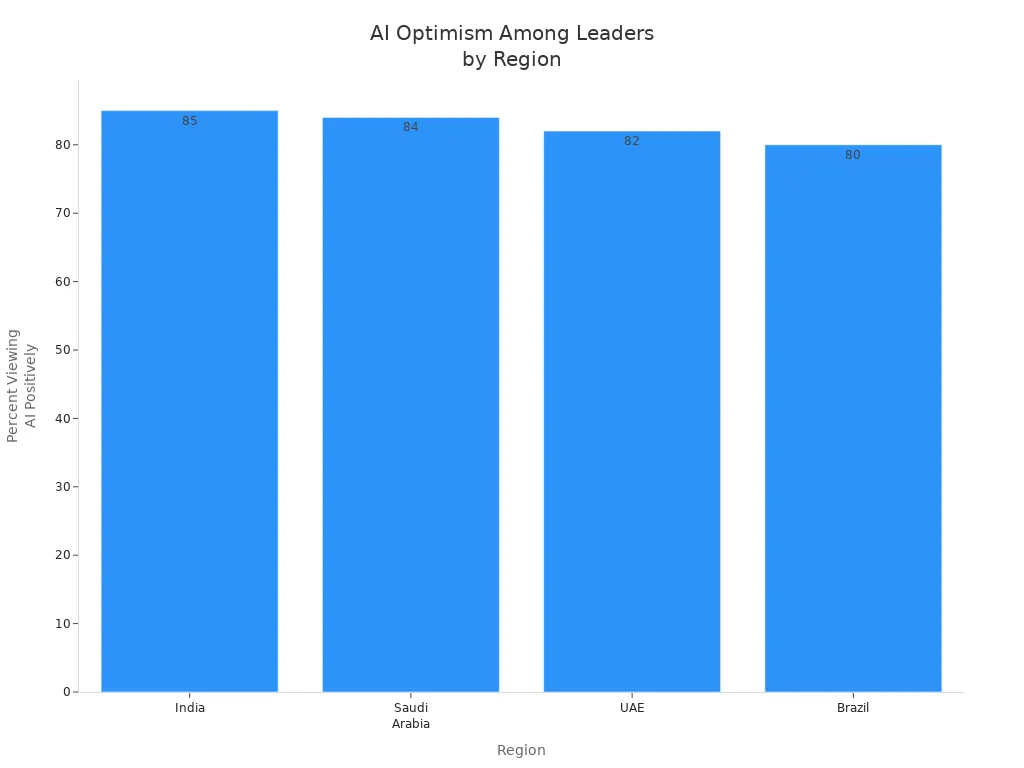
You help your team get ready for the future by using both technology and caring about people. Leadership will keep changing as you help your team face new problems.
Checklist: Leadership in the AI EraUse this checklist to guide leaders navigating the opportunities and risks of AI.
- Define a clear vision for leadership in the AI era aligned with business goals.
- Create an AI strategy that prioritizes value, feasibility, and ethical considerations.
- Establish AI governance structures, roles, and decision-making processes.
- Adopt an AI ethics framework addressing fairness, transparency, accountability, and human oversight.
- Ensure high-quality, well-governed data practices: provenance, labeling, privacy, and lifecycle management.
- Perform AI risk assessments and document mitigation plans for safety, bias, and misuse.
- Integrate AI-focused cybersecurity and model integrity protections.
- Build multidisciplinary teams combining AI expertise with domain knowledge and product skills.
- Implement continuous upskilling programs for leaders and employees on AI literacy and tools.
- Foster a culture of experimentation, psychological safety, and responsible innovation.
- Design human-AI collaboration models that preserve human judgment for critical decisions.
- Define procurement standards for third-party AI vendors, including audits and SLAs.
- Monitor legal and regulatory requirements relevant to AI and update policies accordingly.
- Set measurable KPIs for AI initiatives covering impact, fairness, and operational performance.
- Plan change management and stakeholder communication for AI adoption across the organization.
- Communicate AI use openly to customers, employees, and partners with clear explainability where needed.
- Implement ongoing monitoring, validation, and retraining processes for deployed models.
- Assess and mitigate social and workforce impacts, including fairness and reskilling needs.
- Allocate budget and resources for experimentation, productionization, and long-term maintenance.
- Engage with external ecosystem: research, standards bodies, industry consortia, and academic partners.
- Conduct periodic reviews of AI strategy to ensure alignment with evolving technology and business context.
Leadership in the Age of AI: embrace artificial intelligence and leverage ai capabilities
What does "leadership in the AI era" mean and why is it different from traditional leadership?
Leadership in the AI era refers to leadership at all levels that understands how artificial intelligence and ai technologies reshape the world of work, decision-making, and strategy. Unlike traditional leadership, it requires leaders to embrace ai innovation, integrate ai into workflows, and balance human leadership with effective ai systems so organizations can harness ai’s role without losing human-centric values.
What core leadership skills are essential to navigate the age of AI?
Core skills include a foundational ai knowledge, strong human skills (empathy, judgment, communication), and the ability to translate ai insights into action. Senior leaders and business leaders must cultivate adaptability, ethical reasoning for responsible ai, and strategic thinking to leverage ai, adopt gen ai responsibly, and drive digital transformation while ensuring humans and ai collaborate effectively.
How can business leaders integrate AI into their teams without disrupting workflows?
Start small with focused ai implementation pilots that demonstrate ai can enhance efficiency and provide measurable ai insights. Train teams in basic understanding of ai concepts and use generative ai where it adds clear value, then scale successful ai solutions. Leaders should involve employees early, incorporate ai into their workflows gradually, and ensure change management and human leadership remain at the core of effective ai adoption.
What are the most effective strategies for adopting generative AI (gen AI) safely?
Effective strategies include defining clear use cases, implementing guardrails and ethical ai practices, validating outputs, and setting governance for ai systems. Business leaders must ensure responsible ai by combining technical safeguards with human review, training people on using generative ai, and aligning gen AI deployment with organizational values and compliance requirements like the eu ai act where relevant.
How does ethical AI and the EU AI Act affect leadership decisions?
Ethical ai and regulations such as the EU AI Act require leaders to prioritize transparency, accountability, and risk management when deploying ai solutions. Leaders play a pivotal role in establishing governance, documenting ai implementation, and ensuring ai systems respect privacy and fairness. Navigating leadership in the ai era means building policies that make ai integration responsible and sustainable across the organization.
What role do human skills play when AI can automate many tasks?
Human skills remain central: creativity, empathy, critical thinking, and ethical judgment are hard to automate and form the core of effective leadership. While ai can enhance efficiency and provide decision support, leaders must focus on developing human-centric leadership, mentoring teams, and designing work where humans and ai complement each other to maximize value and employee engagement.
How should organizations measure the impact of AI initiatives?
Measure both quantitative and qualitative outcomes: productivity gains, cost savings, speed of delivery, accuracy improvements from ai systems, and business KPIs, plus employee adoption, satisfaction, and ethical compliance. Use iterative evaluation, leverage ai insights to refine models, and set milestones that reflect the potential of ai to transform processes while maintaining human oversight.
What practical steps can senior leaders take to build AI readiness across the company?
Senior leaders should invest in ai skills training, create interdisciplinary teams combining data scientists and domain experts, pilot ai use cases aligned with strategy, and establish governance for ai implementation. Encourage a culture that embraces experimentation, provides resources for digital transformation, and ensures leaders at all levels have a basic understanding of ai concepts to guide adoption responsibly.
How can leaders foster innovation with AI while managing its risks?
Create a dual approach: foster ai innovation through sandbox environments, partnerships, and incentives for experimentation, while implementing risk management frameworks, ethical reviews, and monitoring controls for ai systems. Leaders should leverage ai to unlock new products or services but also set clear policies to mitigate bias, security, and compliance risks so the organization can thrive in the ai era.
What should individuals aspiring to lead in the digital age focus on to thrive in the AI era?
Aspiring leaders should build a mix of ai capabilities and human-centric leadership: gain practical experience with ai tools, learn about generative artificial intelligence and ai integration, cultivate emotional intelligence and strategic thinking, and stay current with ai’s role in industry trends. By embracing continuous learning and understanding both the potential of ai and the complexities of the ai era, future leaders can harness ai to drive value while preserving human judgment and ethics.
🎧 Listen to this episode
Want a practical explanation of Leadership in the AI Era Beyond Approvals and Control? This episode breaks down the topic in clear language and shows why it matters for Microsoft 365, Azure, Power Platform, security, AI, and modern work.
Listen to this episode if you want to:
- Understand the key concepts behind Leadership in the AI Era Beyond Approvals and Control
- See how it fits into the wider Microsoft technology ecosystem
- Learn where it can create practical value for your organization
You may also enjoy these related M365 FM episodes:
- Leadership and Microsoft 365 Governance Beyond Central Control
- Microsoft Graph Automation Architecture: Beyond Scripts
- Microsoft AI Agent Runtimes: Beyond Enterprise Chatbots
- Enterprise AI Agent Fabric: Architecture Beyond Chatbots
- AI Agent Identity Security: Beyond Service Accounts
Discover more practical Microsoft conversations on M365 FM.
Apple Podcasts · Spotify · YouTube · YouTube Music
Host: Mirko Peters