 EN
 Deutsch
 Español
 Français
 Italiano
 Português
 Nederlands
 Polski
 Bahasa Indonesia
 Русский
 Українська
 العربية
 עברית
 हिन्दी
 日本語
 한국어
2026-04-22 · Season 2
AI Upskilling Strategy for Measurable Business ROI

You invest in AI, but you see little change in your business. Many organizations share your frustration. Studies show that up to 95% of AI pilots never deliver measurable ROI. You might notice your team completes ai training, but you still wait for real results. The problem is clear: traditional metrics miss the mark. You need to focus on time saved, fewer mistakes, and smooth ai adoption in daily work. With The AI Profit Engine, you can finally link training to true business impact.
Key Takeaways
- Align AI training objectives with your business goals to avoid wasted resources.
- Encourage collaboration across departments to ensure AI projects deliver collective value.
- Establish clear ownership for AI initiatives to maintain accountability and momentum.
- Integrate AI training into daily workflows for immediate and measurable impact.
- Set specific, measurable objectives before launching AI training to track success.
- Gather feedback regularly to adapt and improve AI solutions over time.
- Ensure high-quality data governance to support reliable AI outputs and maintain trust.
- Use a self-assessment checklist to identify gaps and prioritize improvements in AI training.
Why AI Training Fails ROI
You want to see real business impact from your AI investment, but too often, the results fall short. Many organizations face the same problem. The reasons go deeper than just technology. You need to look at how your teams set objectives, work together, and measure success.
Common Causes of Zero ROI
Misaligned Objectives
When your AI training does not connect to your business outcome, you risk wasting time and money. Many companies start AI initiatives with good intentions, but they focus on technology instead of solving real problems. This leads to inconsistent results and missed opportunities for measurable business outcomes.
| Statistic | Percentage |
|---|---|
| Companies reporting minimal revenue or cost improvements | 60% |
| Companies seeing no measurable returns | 74% |
| Companies reporting EBIT gains from AI | 39% |
You can see that most companies do not achieve measurable returns because their objectives do not match their business goals. If you want to unlock the value of AI, you must align your strategy with the needs of your business.
Siloed Implementation
AI projects fail when teams work in isolation. Different departments often chase their own key performance indicators, which leads to misaligned incentives. You might see individual teams succeed, but these wins do not add up to real business value. Organizational alignment is key. Without it, your AI adoption will not deliver the impact you expect.
- Teams optimize for their own KPIs, not the company’s goals.
- Murky attribution makes it hard to see which actions drive business value.
- Misaligned incentives mean individual wins do not help the whole business.
Ownership Gaps
Ownership gaps create confusion and slow progress. When no one takes clear responsibility for AI projects, you lose momentum. Managers may become skeptical, and employees feel frustrated with tools that do not fit their needs. This lack of accountability can stop your AI success before it starts.
The Cost of Failure
The cost of failed AI projects is high. Companies often invest millions, but see little measurable ROI. The financial loss is only part of the problem. You also face organizational friction, employee frustration, and leadership hesitance to fund future AI initiatives.
| Financial Investment Range | Measurable Value Realized | Value Destruction Rate |
|---|---|---|
| $50-100 million | Less than $5 million | 90% |
When you do not see measurable impact, your teams lose trust in new technology. Leaders expect quick results, but real business value can take months or even years to appear. If you focus only on participation rates or completion metrics, you miss the true value of AI. You need to measure time saved, errors reduced, and workflow improvements to see the real impact.
Tip: Shift your focus from how many people complete AI training to how much time and value your teams gain in their daily work. This approach helps you track measurable ROI and build a stronger case for future AI investment.
AI-driven training works best when you connect it to real business problems and track measurable business outcomes. When you align your initiatives with business goals and measure the right metrics, you unlock the true value of AI and set your organization up for long-term success.
No Business Outcome Link in AI Training
Why Alignment Drives ROI
You want your investment in AI to deliver real business value. The key is to connect your ai training directly to business outcomes. When you align your training with the problems your teams face every day, you see a clear impact on productivity and efficiency. Many organizations miss this step. They focus on generic skills or technology features, not on the actual business impact.
A strong link between training and business goals helps you measure the true value of your efforts. You can track how much time your team saves, how many errors they avoid, and how quickly they complete important tasks. The AI Profit Engine uses this approach to show the real impact of ai adoption.
| Value Pillar | KPIs | Conversion to Business Impact |
|---|---|---|
| Time | Time-to-skill, time-to-productivity | Translate days saved into dollar values |
| Capacity | Throughput per FTE | Measure efficiency gains |
| Capability | Knowledge-check gains | Assess skill improvements |
| Risk | On-time compliance | Evaluate adherence to standards |
You can also use a simple process to connect learning to business results:
- Track learning activity versus business outcomes.
- Use controlled pilots to establish causality.
- Implement a baseline for comparison.
When you measure these factors, you see how your solution creates value for your business.
Fix: Start with High-Value Problems
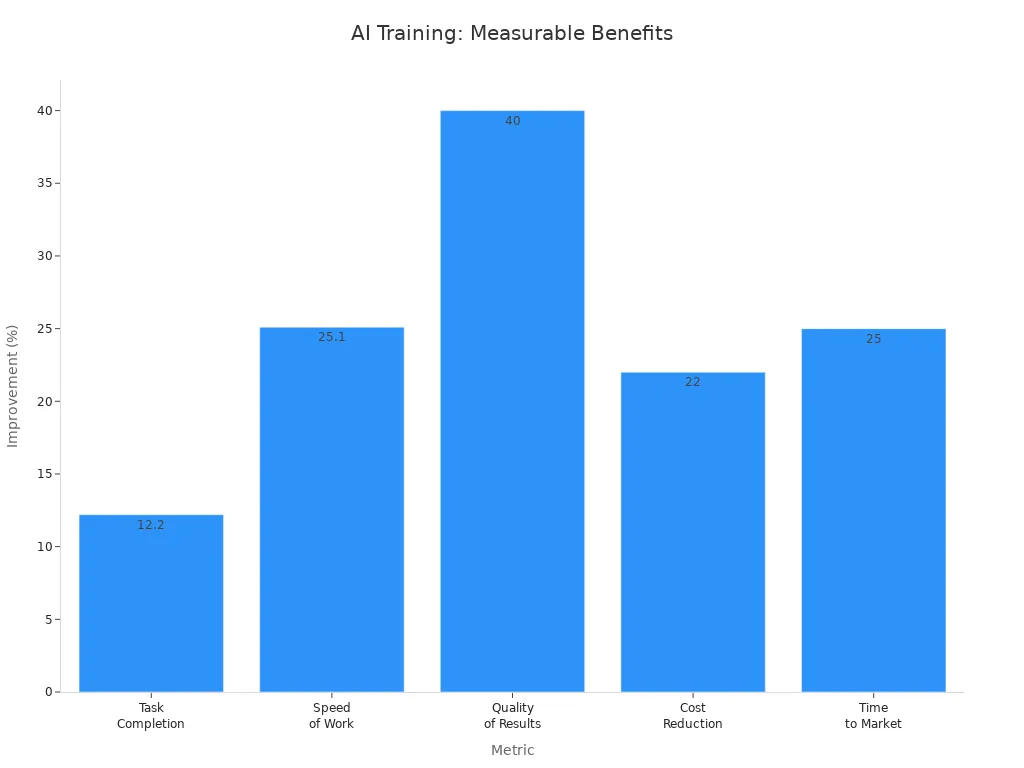
You need to start with the right problem. Focus your ai training on high-value business challenges. This approach leads to faster and more visible impact. For example, finance teams using The AI Profit Engine have reported a 70% to 80% reduction in manual data entry time. Error rates in reconciliation dropped by 90%. Operations teams saw faster time-to-diagnosis and fewer workflow bottlenecks.
| Metric | Improvement |
|---|---|
| Task Completion | 12.2% more tasks completed |
| Speed of Work | 25.1% faster |
| Quality of Results | 40% higher quality |
| Cost Reduction | 22% reduction in cost per asset |
| Time to Market | 25% faster time to market |
“The return on investment for data and AI training programs is ultimately measured via productivity. You typically need a full year of data to determine effectiveness, and the real ROI can be measured over 12 to 24 months.” – Dmitri Adler, Co-Founder of Data Society
Set Measurable Objectives
Set clear, measurable objectives before you launch your training. Decide which business metrics matter most. These could include time saved, error reduction, or workflow acceleration. Establish a baseline so you can compare results after the training.
Engage Stakeholders Early
Bring key stakeholders into the process from the start. When leaders and team members help define the goals, you get better buy-in and faster results. Stakeholders can help identify the most valuable problems to solve and ensure the solution fits real business needs.
By linking your ai training to business outcomes, you create a direct path to value. You see the impact in time saved, fewer errors, and smoother workflows. This approach turns your investment into measurable business results.
Poor Integration with Workflows

You want your AI investment to drive real business value, but poor integration with daily workflows often blocks your progress. Many organizations treat ai training as a one-time event, separate from the actual work employees do. This approach creates gaps between learning and doing, which reduces the impact of your efforts.
Siloed AI Training Symptoms
You may notice several warning signs when ai training happens in isolation from core business processes:
- Inconsistent customer experiences can result when departments send mixed messages.
- Misaligned goals often appear as teams focus on their own targets instead of the company’s overall success.
- Low employee morale grows when staff feel disconnected and communication breaks down.
- Inability to react quickly to changes becomes a problem when data and insights stay trapped in silos.
These symptoms show that your solution is not reaching its full potential. You need to break down these barriers to unlock the true value of ai adoption.
Fix: Embed AI in Daily Work
You can achieve maximum impact by weaving ai into the fabric of everyday tasks. Companies that embed ai in daily work see faster returns and stronger business outcomes. For example, Volkswagen and other leading organizations have reported that this approach drives ROI much more effectively. Metrics like deflection rate and time returned show that ai can deliver value in weeks, not months. McKinsey found that embedding generative ai in service operations reduced agents’ knowledge-lookup handle time by 65%. Most companies reinvest productivity gains into upskilling and expanding ai capabilities, rather than cutting headcount.
Role-Based Training
You get better results when you tailor ai training to specific job roles. Research shows that role-based training leads to a 50% improvement in outcomes. Employees engage more and adopt new tools faster when the learning matches their daily responsibilities. Companies that customize ai learning paths see greater impact on workflow efficiency and business results. The AI Profit Engine uses this approach to build role-based capabilities that fit your unique needs.
Adoption Over Awareness
You should focus on adoption, not just awareness. Teaching employees about ai is not enough. You need to help them use ai tools in real scenarios. Companies that measure innovation ROI with clear metrics see better results. In fact, 68% of organizations with strong tracking report higher returns. Responsible ai initiatives also enhance returns and efficiency, with 58% of organizations seeing positive impact. Growth-focused companies are more likely to track ai value rigorously.
Tip: Make ai part of your team’s daily routine. Track how it changes the way people work, not just how many complete the training.
When you embed ai in daily workflows, you turn your investment into measurable business value. You see faster impact, higher engagement, and a stronger case for future ai adoption.
Unclear Ownership in AI Investment
Why Ownership Matters for ROI
You want your ai training to deliver real business value. Clear ownership is essential for this goal. When no one takes responsibility for ai projects, you see confusion and slow progress. Teams may not know who should make decisions or track results. This lack of clarity can block your ai adoption and reduce the impact of your investment.
Cross-functional teams help solve this problem. They bring together people from different parts of your business. Each member has a clear role and responsibility. This structure improves accountability and ensures that everyone works toward the same strategy. You see faster problem-solving and better results when teams share goals and metrics.
| Role | Responsibility |
|---|---|
| AI leaders | Responsible for AI/ML strategy and roadmap within the organization. |
| AI builders | Implement AI strategy to address business problems using machine learning. |
| Business executives | Solve business problems and drive revenue or reduce costs with AI. |
| IT leaders | Focus on the technology infrastructure, including data and analytics. |
When you align these roles, you create a strong foundation for ai projects. Shared metrics drive collective outcomes. This approach encourages innovation and efficient use of resources. You see a greater impact on your business and a clear path to value.
- Cross-functional teams enhance collaboration among diverse roles.
- They align goals across departments, fostering a sense of shared responsibility.
- Shared metrics drive collective outcomes, improving accountability.
- This structure encourages innovation and efficient resource use, leading to faster problem-solving.
Fix: Build Cross-Functional Teams
You can boost the impact of your ai investment by building cross-functional teams. Start by bringing together leaders from business, IT, and data science. Make sure each person understands their role and how it connects to the overall strategy. This team should meet regularly to review progress and adjust plans as needed.
Leadership Buy-In
Leadership buy-in is critical. When leaders support ai projects, teams feel empowered to act. Leaders set the tone for collaboration and help remove barriers. They also ensure that incentives match the goals of the project. Well-structured incentives improve decision outcomes and performance. Keep your incentive structures simple and easy to understand. Offer different levels of rewards to engage all partners. Communicate clearly and often to keep everyone informed.
Accountability Structures
Accountability structures keep your team focused. Use shared metrics to track progress and measure value. Regularly evaluate and adjust your incentive programs based on performance data. You can use ai to analyze historical data and optimize your incentive structures. Partner management technology can help streamline these processes and improve efficiency.
Tip: Align incentives with partner goals to ensure mutual benefit. This approach builds trust and drives better results for your business.
When you build cross-functional teams with clear ownership, you unlock the full value of your ai training. You see faster impact, stronger collaboration, and measurable business results.
Lack of Iteration in AI Projects
One-and-Done Training Fails
You may think that a single round of training will set your team up for success. In reality, most ai projects fail when you treat training as a one-time event. AI changes quickly. Your business needs and workflows shift over time. If you do not update your approach, your solution will lose its value. Teams often see early gains, but these fade without ongoing attention. You need to keep learning and adapting to maintain your impact.
Many organizations launch ai projects with excitement, but they do not plan for what comes next. They miss out on valuable feedback from users. They do not track how well the solution fits real business needs. As a result, the impact drops, and the project stalls. You must avoid this trap by building iteration into your strategy from the start.
Fix: Iterate with Feedback
You can boost your results by making iteration a core part of your ai approach. This means you gather feedback, monitor performance, and make changes as needed. Ongoing monitoring helps you spot problems early and keep your solution aligned with your business goals.
- Monitor key performance indicators during deployment.
- Reassess your solution regularly to catch performance drift.
- Integrate user feedback into your evaluation process.
You should also set up regular check-ins. At each interval, confirm that your deployment matches the approved use case. Make sure your data and workflows have not changed. Check that your ai solution still delivers the expected benefits. Watch for new risks or compliance needs.
Human-in-the-Loop
Adding human expertise at key points in your process makes your ai more reliable. Human-in-the-loop methods balance efficiency with expert quality control. They help you ensure that outputs match your business priorities and meet regulatory standards. Experts can spot issues that automated systems may miss. This approach leads to better accuracy, faster processing, and higher savings.
| Metric | Result |
|---|---|
| Accuracy | Increased to 99.9% |
| Processing Speed | Increased by up to 5x |
| Annual Savings | Thousands saved |
| Compliance | Enhanced compliance |
| Productivity | Focus on complex tasks |
| Competitive Edge | Clear advantage gained |
You gain a clear advantage when you combine ai with human judgment. Your team can focus on complex tasks while the system handles routine work.
Continuous Improvement
Continuous improvement keeps your ai projects on track. You need to review results, gather feedback, and make small changes often. This process helps you adapt to new business needs and changing conditions. It also ensures your strategy stays effective over time.
- Track performance indicators.
- Collect feedback from users.
- Adjust your solution based on what you learn.
Tip: Make iteration part of your culture. Encourage your team to share feedback and suggest improvements. This habit will help you get the most out of your ai investment and keep your business moving forward.
Data Issues Hurt Return on Investment

Data Quality and Governance
You want your AI projects to deliver strong business results. Data quality and governance play a critical role in this process. When you overlook these areas, you risk silent failures that can damage trust, security, or compliance without warning. Many organizations struggle with inaccurate, incomplete, or poorly labeled data. You may also find data trapped in silos or see inconsistencies across systems. These problems often go unnoticed until they cause real harm.
- Silent failures can erode trust and compliance.
- Inaccurate or incomplete data leads to unreliable AI outputs.
- Data silos and inconsistencies slow down your business.
Nearly half of chief operations officers say data quality is a top concern. Poor data quality can cost organizations over five million dollars each year. Stale, duplicated, or incorrect information not only reduces the impact of your AI but also undermines user trust. You need to address these issues early to protect your investment.
Note: Poor data quality can lead to ineffective AI outputs and lost business opportunities.
Fix: Data Readiness Checklist
You can boost your AI ROI by following a data readiness checklist. Start by investing in clean, accessible, and well-governed data. Make sure your data sets are accurate and up to date. Align your workflows with compliance standards to protect privacy and security. Integrate security measures like zero-trust principles and data loss prevention tools. These steps help you avoid costly mistakes and keep your business safe.
At the heart of every successful AI project lies high-quality data. You need strong data governance frameworks that enforce standards, automate cleansing, and ensure smooth integration across your systems. This foundation supports accurate predictions and reliable insights.
Infrastructure for Scale
Your business needs infrastructure that can handle growth. Build systems that scale with your data needs. Automate data cleansing and validation to keep your information accurate as you expand. Seamless integration across platforms ensures your AI continues to deliver value as your business grows.
Shadow AI Risks
Shadow AI introduces hidden risks that can hurt your ROI. These unsanctioned tools often bypass security and governance controls. The cost of a data breach from shadow AI can reach $4.63 million per incident, compared to $3.96 million for standard breaches. Shadow AI accounts for 20% of all data breaches, with detection taking up to 247 days and remediation lasting 94 days.
| Aspect | Standard Data Breach Cost | Shadow AI Data Breach Cost | Cost Premium |
|---|---|---|---|
| Average Cost per Incident | $3.96 million | $4.63 million | $670,000 |
| Percentage of Total Data Breaches | 13% | 20% | N/A |
| Average Detection Time | N/A | 247 days | N/A |
| Median Remediation Time | N/A | 94 days | N/A |
You can reduce these risks by enforcing strict governance and monitoring for unauthorized AI use. Protect your business by making data readiness a priority.
Tip: Regularly review your data processes and security measures to maintain trust and maximize the impact of your AI investments.
Diagnose Your AI Training ROI
You want to know if your AI training delivers real value. A self-assessment helps you spot gaps and measure progress. Many AI projects fail because teams do not check their starting point or track changes over time. You can use a simple checklist to see where your business stands.
Self-Assessment Checklist
Start by reviewing your current approach. Use these tools to get a clear picture of your strengths and weaknesses:
| Diagnostic Tool | Purpose |
|---|---|
| Self-Assessment | Establishes an awareness baseline of current AI skills within the organization. |
| Performance-Based Testing | Measures actual capabilities through practical tasks. |
| Manager Assessment | Evaluates applied performance from a managerial perspective. |
| Work Product Analysis | Validates production quality and effectiveness of AI skills in real work outputs. |
Ask yourself:
- Do your teams use AI in their daily work?
- Can you measure the quality of their output?
- Does your data support accurate and reliable results?
- Are managers confident in the impact of AI on business outcomes?
If you answer "no" to any question, you have found an area for improvement.
Using Results for Improvement
You can turn your findings into action. Focus on the areas that matter most for your business. Use your results to guide your next steps and boost your ROI.
Prioritize Fixes
Not all problems need fixing at once. Start with the biggest gaps that block your progress. Research shows that people who set clear priorities based on self-assessment reach their goals faster. They use their resources wisely and plan for the best time to act.
| Evidence Description | Findings |
|---|---|
| Effective self-regulators prioritize difficult goals based on self-assessment of resources. | They believe their resources are greater earlier in the day, influencing their planning behavior. |
| Study 1 shows that plans to exercise are influenced by self-regulatory effectiveness and perceived difficulty. | Higher self-regulatory effectiveness leads to earlier exercise plans for those who find it difficult. |
| Positive correlation between self-regulatory effectiveness and beliefs about resource availability. | Effectiveness is associated with the belief that resources are greater at the beginning of the day (r = .21, p = .04). |
You can use this approach for your AI projects. Fix the most important issues first. This strategy helps you see faster impact and keeps your team motivated.
Track ROI Gains
You need to measure your progress. Use these methods to track gains after you make improvements:
- Adoption & Usage Metrics: Count how many people use AI tools and how often.
- Productivity & Efficiency Metrics: Measure how fast tasks get done and how many errors you avoid.
- Business Outcome Metrics: Check if you save money, grow revenue, or improve customer satisfaction.
You can also look at:
- Adoption rate: How many users rely on AI for decisions.
- Decision quality: How well AI improves choices.
- Time to decision: How quickly teams act with AI insights.
- User confidence: How much trust users have in AI answers.
- Business outcomes: The overall effect on your business.
Productivity is the main way to judge success. Real ROI takes time to measure. You may need 12 to 24 months to see the full impact. Stay patient and keep tracking your results. This approach helps you avoid poor data quality and ensures your data supports your goals.
Tip: Review your data and results often. Adjust your strategy as you learn. This habit will help your AI projects deliver lasting value for your business.
You have seen why many AI training programs miss the mark. When you start with a solution instead of a clear problem, you lose impact. You need to embed AI into your business workflows and focus on real outcomes.
- Integrate AI into daily decisions for lasting impact.
- Validate results by solving real business problems.
| Benefit Type | Description |
|---|---|
| Growth Enablement | AI unlocks new markets and capabilities for your business. |
| Productivity Boost | Human talent and AI together raise accuracy and profitability. |
Use the self-assessment tool to find gaps and take action. Start now to transform your business and achieve measurable impact.
🎧 Listen to this episode
Want a practical explanation of AI Upskilling Strategy for Measurable Business ROI? This episode breaks down the topic in clear language and shows why it matters for Microsoft 365, Azure, Power Platform, security, AI, and modern work.
Listen to this episode if you want to:
- Understand the key concepts behind AI Upskilling Strategy for Measurable Business ROI
- See how it fits into the wider Microsoft technology ecosystem
- Learn where it can create practical value for your organization
You may also enjoy these related M365 FM episodes:
- How to Build a Winning Microsoft Partner Strategy
- Cloud Latency and Edge Computing Strategy
- Building a Synthetic Market for Microsoft 365 Strategy
- The Copilot Tax: Hidden Costs of Enterprise AI Strategy
- Multi-Tenant Microsoft Copilot Governance Strategy
Discover more practical Microsoft conversations on M365 FM.
Apple Podcasts · Spotify · YouTube · YouTube Music
Host: Mirko Peters