


 Apple Podcasts
 Spotify
 Youtube Music
 Spreaker
 Podchaser
 Amazon Music
 Sentiment Analysis for Executive Leadership Reporting
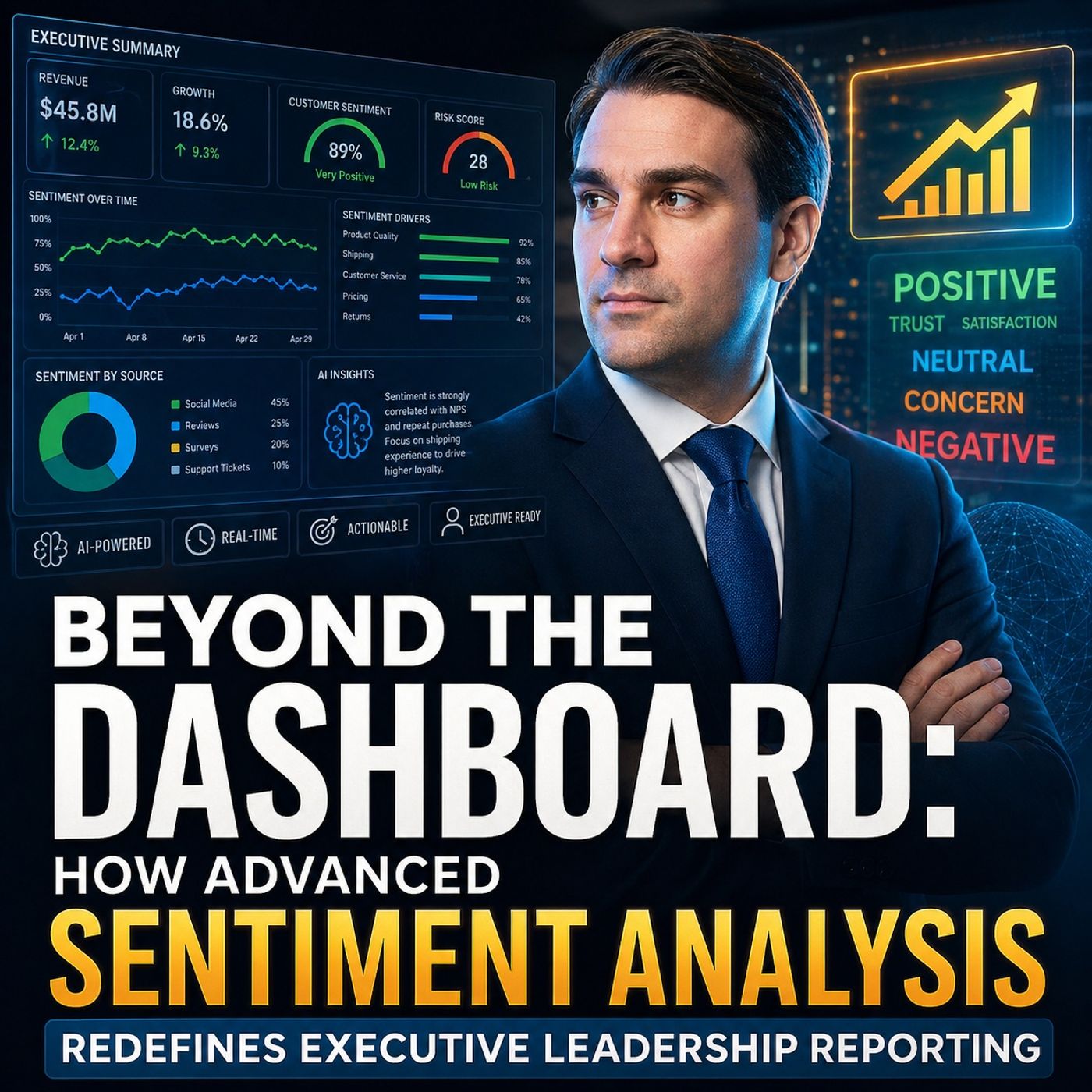
The episode argues that traditional dashboards are no longer enough for executive reporting because they only show data, not meaning. Advanced sentiment analysis changes this by capturing how people feel, what’s driving behavior, and where risks or opportunities are emerging.
Instead of static KPIs, leadership reporting shifts toward context: why something is happening, who is affected, and what action is required. This enables faster, more informed decisions and reduces the gap between data and real business outcomes.
Ultimately, the focus moves from reporting numbers to interpreting signals—turning analytics into a decision system rather than a visibility tool.
You trust your executive dashboard to guide your biggest decisions. But what if it hides more than it reveals? Most leaders—77%—rely on dashboards for critical choices, yet many miss the warning signs beneath the surface. The Green Dashboard Trap creates a false sense of security, making everything look perfect when real problems lurk just out of view. You need more than numbers. You need insights that dig deeper and tell the real story.
Key Takeaways
- Beware of the Green Dashboard Trap. Relying on positive metrics can create a false sense of security, hiding real problems.
- Encourage a culture of transparency. Team members should feel safe to report issues without fear of repercussions.
- Look beyond numbers. Combine quantitative data with qualitative insights to understand the full context of your metrics.
- Regularly review your dashboard metrics. Set a schedule to ensure your data remains relevant and aligned with your goals.
- Focus on meaningful metrics. Avoid vanity metrics that look good but do not drive real business value.
- Use tools like sentiment analysis. These can reveal hidden emotions and early warning signs of dissatisfaction.
- Foster open dialogue. Encourage team discussions about dashboard results to improve trust and collaboration.
- Adopt the Adoption-to-Trust Ratio. This metric helps you understand the relationship between tool usage and user satisfaction.
The Green Dashboard Trap
What It Is
You see a dashboard filled with green lights and feel a wave of relief. Everything looks perfect. But this is the heart of the green dashboard trap. You trust the green indicators and believe your business runs smoothly. You see red and rush to fix the problem. But behind every data point is a person—a decision, a conversation, an unspoken challenge.
We see green indicators and think everything’s fine. We see red and rush to 'fix the problem.' But behind every data point is a person — a decision, a conversation, an unspoken challenge.
The green dashboard trap happens when you rely on surface-level metrics that show only what you want to see. You miss the real story. You focus on numbers that look good but ignore the warning signs hidden beneath. This trap creates a false sense of security. You believe your team performs well, but you overlook the struggles and frustrations that never make it to the dashboard.
Why It’s Dangerous
You risk more than just missing a target when you fall into the green dashboard trap. You create a culture where people fear sharing bad news. Team members worry about reporting problems. They fear personal consequences. The pressure to keep everything green leads to unhealthy habits. People hide issues or cut corners just to keep the dashboard looking good. This puts your projects and your reputation at risk.
- A 'green' status can lead to a culture where team members are afraid to report problems, fearing personal repercussions.
- The pressure to maintain a 'green' status can result in unhealthy practices, such as hiding issues or cutting corners, which ultimately jeopardizes project integrity.
- Consistently showing a 'green' status may indicate a lack of psychological safety, as team members may be too afraid to admit mistakes or raise concerns.
You may notice the "Watermelon Effect." Metrics look green on the outside, but inside, problems grow. Employees feel frustrated because their real challenges stay hidden. You feel comfort from positive dashboard results, but you miss critical issues. You trust the dashboard too much and become complacent. You underestimate risks and ignore uncomfortable truths.
- The 'Watermelon Effect' illustrates how metrics can appear positive while the underlying reality is negative, leading to frustration among employees.
- Psychological comfort from misleading metrics can cause decision-makers to overlook critical issues, as they feel reassured by positive dashboard indicators.
- The tendency to trust aggregated data can lead to complacency, where risks are underestimated and uncomfortable truths are ignored.
Signs You’re Caught
You might wonder if you have fallen into the dashboard trap. Look for these warning signs:
- Your dashboard always shows green, but you hear rumors of problems in the hallway.
- Team members rarely speak up in meetings or challenge the data.
- You notice last-minute surprises that the dashboard never predicted.
- Employees seem disengaged or frustrated, even when metrics look positive.
- You see a lack of open discussion about risks or failures.
A healthy culture values transparency and encourages questions. When you reward honest feedback and cross-team collaboration, you reduce the risk of dashboard misrepresentation. Leaders who model data literacy and invite questions build trust. When you foster transparency, you make sure decisions rest on reliable information.
- A culture that prioritizes data literacy and encourages questioning of data can reduce risks of misinterpretation.
- Lack of these cultural elements can lead to over-reliance on dashboards and flawed decision-making.
- Transparency builds trust among stakeholders, ensuring decisions are based on reliable information.
You can break free from the green dashboard trap. Start by looking beyond the numbers. Listen to your people. Encourage open dialogue. Build a culture where truth matters more than a perfect dashboard.
Why Dashboards Mislead
Outdated Metrics
You rely on your dashboard to make fast decisions. But when the data is old, you risk acting on yesterday’s news. Outdated metrics can hide real problems and delay your response. Many dashboards show too much data without enough insight. You see 30 or 40 numbers, but you struggle to find what matters most. This overload leads to decision fatigue and confusion.
| Issue | Description |
|---|---|
| Too Much Data Without Enough Insight | Dashboards often show 30 to 40 metrics, overwhelming users and leading to decision fatigue. |
| No Agreement on What Metrics Mean | Different departments may define the same metric differently, leading to mistrust in the data. |
| Data Quality Issues | Poor data quality can lead to incorrect insights, causing executives to lose faith in the dashboard's reliability. |
| Delayed System Inputs | Inputs to the dashboard are not timely, leading to outdated information being presented. |
| Fragmented Data Ownership | Lack of clear ownership over data can result in inconsistencies and inaccuracies. |
You need timely, accurate data to lead with confidence. When your dashboard lags behind reality, you lose your edge. Delayed system inputs and fragmented data ownership make it hard to trust what you see. You must demand clear definitions and real-time updates to avoid costly mistakes.
Lack of Context
Numbers alone do not tell the whole story. Your dashboard might show a big number, but what does it mean? Without context, you cannot judge success or failure. Imagine seeing “Q3 Revenue: $2.4M” on your dashboard. Is that good or bad? You need targets, trends, and comparisons to make sense of the data.
The "FashionForward" retail dashboard misled leadership into believing that increased website traffic would lead to higher sales. However, the focus on traffic ignored declining conversion rates, demonstrating the dangers of relying on proxy metrics without understanding their relationship to actual business goals.
Dashboards often mislead because they lack annotations, targets, or historical trends. You must ask for more than just numbers. Demand context, so you can make decisions that drive real results.
Vanity Metrics
You want to celebrate wins, but not every impressive number matters. Vanity metrics look good on the dashboard, but they do not reflect true business value. They give you a narrow view, like looking through a telescope and missing the rocks or safe harbor on either side.
- Vanity metrics create a misleading sense of achievement without reflecting true business value or performance.
- They lack intent, meaning they do not guide organizations on actionable next steps.
- There is often no way to replicate any success indicated by vanity metrics, making them unreliable.
You must focus on metrics that drive action and growth. Do not let flashy numbers distract you from what really matters. Choose metrics that align with your goals and help you steer your organization toward success.
Hidden Risks
You trust your dashboard to highlight problems, but it often hides the most dangerous risks. The dashboard delusion convinces you that everything is under control. You see green lights and positive scores, but you miss the warning signs that threaten your organization. Watermelon metrics look good on the outside, but inside, they hide serious vulnerabilities. You feel secure, but your dashboard masks issues that can damage your business.
The dashboard delusion creates a false sense of security. You believe your team is thriving, but you overlook critical vulnerabilities that never appear on the dashboard.
Surface-level metrics often fail to explain why turnover rates are high or why engagement scores drop. You see numbers, but you do not see the reasons behind them. Your dashboard shows pulse surveys and engagement scores, but these metrics do not reveal the real problems affecting employee satisfaction. You miss the human context. You ignore personal experiences that shape morale and culture.
- Surface-level metrics are retrospective. They show what happened, but they do not explain why it happened.
- Your dashboard misses the human context. It neglects personal stories and experiences that influence your team’s morale.
- Metrics like pulse surveys and engagement scores are easy to track, but they do not provide insights into the underlying issues.
- Your dashboard fails to capture the nuances of workplace culture, such as fear of speaking up or feelings of exclusion.
You risk making decisions based on incomplete information. The dashboard delusion leads you to believe that positive numbers mean success. You ignore the warning signs that hide beneath the surface. Employees may feel excluded or afraid to share concerns. You miss the signals that point to deeper problems. Your dashboard does not show the real story.
You must look beyond the dashboard. Listen to your people. Ask questions that go deeper than numbers. Encourage open conversations. Build a culture where truth matters more than perfect scores. When you break free from the dashboard delusion, you uncover hidden risks and protect your organization from costly mistakes.
Your dashboard should help you see the whole picture. Do not let surface-level metrics blind you to the real challenges. Demand insights that reveal the truth. Take action before hidden risks become crises. You have the power to build a safer, stronger organization.
Beyond the Numbers: Human Signals

The Limits of Quantitative Data
Numbers can show you trends, but they rarely tell you why those trends exist. You might see a spike in sales or a drop in engagement, but you do not know what caused it. Quantitative data often lacks the context you need to make smart decisions. You risk misinterpreting the numbers if you do not understand the story behind them.
- Quantitative data does not explain the reasons behind the numbers.
- You may face challenges when integrating data from different reporting systems.
- You need trained staff to interpret complex data sets.
- Mistakes can happen if you do not use a single, reliable source for your data.
You cannot rely on numbers alone. Dashboards can mislead you if you do not dig deeper. You need to ask questions and look for the real meaning behind the data.
Value of Qualitative Insights
Qualitative insights give you the missing context. They help you understand what your customers and employees really think and feel. When you listen to stories and feedback, you see the bigger picture. You discover motivations, frustrations, and opportunities that numbers alone cannot reveal.
- Qualitative insights help you understand why customers act the way they do.
- They uncover problems that numbers might miss, making your assessments more accurate.
- You learn about the emotional side of customer experiences, which can guide your product and marketing strategies.
- By analyzing customer support conversations, you spot recurring issues and improve the overall experience.
- Qualitative research helps you avoid risks by understanding cultural differences and customer reactions.
You gain a competitive edge when you combine numbers with real stories. You make better decisions because you see both the facts and the feelings that drive them.
Tip: Ask your team for feedback after every major project. Listen to their stories. Use their insights to improve your processes and products.
Stories from the Front Lines
Frontline stories often reveal problems that dashboards miss. You need to pay attention to these signals if you want to avoid costly mistakes.
- Late documentation can hide serious issues. When teams delay updating records, you lose track of important changes and risk missing early warning signs.
- Treating missed contacts as simple scheduling problems can be dangerous. In high-risk situations, these missed connections may signal deeper safety concerns.
- Ignoring repeat near-misses can lead to bigger failures. When you notice patterns of small mistakes, you have a chance to fix problems before they become crises.
You must listen to the people closest to the work. Their stories can alert you to risks and help you build a safer, stronger organization. Numbers matter, but human signals matter more. Combine both, and you will see the whole truth.
Advanced Solutions for Truthful Reporting
Sentiment Analysis in Action
You want to know what your employees and customers really think. Numbers alone cannot show you the whole picture. Sentiment analysis changes that. It scans messages, feedback, and conversations to reveal the emotions behind the words. You gain a deeper understanding of how people feel about your company, your products, and your leadership.
- Sentiment analysis uncovers hidden emotions and viewpoints, helping you spot early signs of dissatisfaction.
- You can address concerns before they grow into bigger problems.
- By tracking the tone of conversations, you know when your team feels motivated or when they need support.
When you use sentiment analysis, you move from guessing to knowing. You see patterns in feedback and can act quickly. This approach helps you build trust and improve the experience for everyone involved.
| Measurable Outcome | Description |
|---|---|
| Sentiment Scoring | Quantifies the sentiment expressed in employee feedback, providing a clear metric for analysis. |
| Theme Clustering | Groups similar feedback themes, helping to identify common concerns among employees. |
| Driver Extraction | Identifies key factors influencing engagement and job satisfaction, guiding targeted interventions. |
| Anomaly Detection | Flags unusual sentiment trends, allowing for proactive management of potential issues. |
With these insights, you can make smarter decisions and create a workplace where people feel heard and valued.
Microsoft Copilot’s Role
You need more than raw data. You need tools that turn information into action. Microsoft Copilot does exactly that. It brings advanced AI and sentiment analysis into your daily workflow, making your dashboards smarter and more transparent.
- The Copilot Dashboard gives you a clear view of how teams use AI tools across your organization.
- Copilot Benchmarks let you compare your AI adoption rates with other companies, so you know where you stand.
- The Agent Dashboard tracks which AI tools deliver value and which ones need improvement.
You can measure adoption, spot areas that need support, and make decisions based on real data. Copilot transforms your reporting from guesswork to a data-driven process. You get continuous updates, so your strategies stay fresh and effective.
Real-world results show the impact. A global manufacturing leader faced slow executive adoption of Copilot. By offering tailored training and practical examples, they saw faster adoption, higher productivity, and better returns on their investment. Another example comes from PwC. They built a global knowledge center and trained employees by role. The result? Over 8.7 million actions completed in Copilot, freeing up more than 500,000 hours, with more than half the workforce using AI tools every week.
| Client | Challenge | Solution | Outcome |
|---|---|---|---|
| Global Manufacturer | Limited executive adoption due to lack of training and time constraints | Customized 1:1 training sessions with practical applications | Accelerated adoption, improved productivity, maximized ROI on Microsoft 365 Copilot licensing |
| PwC | Need to scale AI tools across a large workforce | Global knowledge center and role-based training | 8.7M+ Copilot actions, 500,000+ hours saved, 54% weekly AI tool usage |
With Copilot, you gain clarity, speed, and confidence in your decisions.
New Metrics: Adoption-to-Trust Ratio
You cannot rely on adoption numbers alone. High usage does not always mean high satisfaction. The Adoption-to-Trust Ratio gives you a new way to measure success. It compares how often people use a tool with how much they trust and value it.
If your team uses Copilot every day but feels frustrated or confused, your adoption numbers look good, but your trust score stays low. This ratio helps you spot the difference between real engagement and forced compliance.
Tip: Watch for gaps between adoption and trust. A high adoption rate with low trust signals hidden problems. Use this insight to start conversations, offer support, and build a culture of genuine engagement.
When you track the Adoption-to-Trust Ratio, you move beyond surface-level metrics. You see where your team needs help and where your tools truly make a difference. This approach leads to better decisions and a stronger, more resilient organization.
Decision Confidence Index
You need more than numbers to make the right call. You need to know how confident your team feels about each decision. The Decision Confidence Index gives you this insight. It measures how sure your people are when they make choices. This index goes beyond tracking what happened. It tells you how much trust your team has in the data, the process, and the outcome.
When you use the Decision Confidence Index, you spot weak points before they become problems. You see where your team hesitates. You notice when people lack the information or support they need. This helps you act fast and remove roadblocks. You build a culture where people feel safe to speak up and share concerns.
- The Decision Confidence Index highlights areas where your team feels strong and where they need help.
- You can use this index to guide training, improve communication, and boost morale.
- High confidence scores mean your team trusts the process and feels ready to act.
- Low scores warn you to dig deeper and find out what’s missing.
Tip: Ask your team to rate their confidence after every major decision. Use their feedback to improve your process and build trust.
You want your team to move forward with certainty. The Decision Confidence Index gives you the power to lead with clarity and purpose.
Escalation Risk Signal
You cannot afford to miss early warning signs. The Escalation Risk Signal helps you spot trouble before it grows. This signal uses advanced analytics to track patterns in your data and conversations. It shows you where problems might turn into bigger issues if you do not act.
Several key indicators help you measure escalation risk:
| Indicator | Description |
|---|---|
| Response Time Sentiment | Delays in responding to customer queries can lead to frustration and dissatisfaction, indicating a risk of escalation. |
| Customer Effort Score (CES) | Measures how easy it is for customers to get support; high effort levels can signal potential escalations. |
| Tone of Support Tickets | The emotional tone in customer communications can reveal dissatisfaction, indicating a risk of escalation. |
| Text Mining Indicators | Analyzing customer feedback through text mining can uncover negative sentiments that predict escalation risk. |
| Interaction Frequency | Frequent customer inquiries may indicate ongoing concerns, which can lead to escalations if not addressed. |
| Sentiment Trend Analysis | Tracking changes in customer sentiment over time can help identify potential escalation risks. |
You need to pay attention to these signals. When you see a spike in negative sentiment or a rise in customer effort, you know it is time to act. Quick action can prevent small issues from becoming major crises.
- Monitor response times and customer effort scores to catch frustration early.
- Analyze the tone of support tickets and feedback for signs of dissatisfaction.
- Track how often customers reach out. Frequent contact often means unresolved problems.
- Watch for negative trends in sentiment. These trends can warn you before issues escalate.
Note: The Escalation Risk Signal gives you a chance to fix problems before they damage your reputation or bottom line.
You want to lead with confidence. Use the Escalation Risk Signal to stay ahead of risks and protect your organization from surprises.
From Green to Real: Building Better Dashboards
Add Business Context
You want your dashboard to tell the real story. Numbers alone do not give you the full picture. Add business context to your dashboard to make it reliable and meaningful. When you include references to original data sources, you help everyone understand where the data comes from. This builds trust and confidence in your dashboard.
- Show background information for key metrics.
- Add period-over-period comparisons.
- Include targets and industry benchmarks.
Brent Dykes states, "By adding background information to key metrics such as period-over-period comparisons, targets, and industry benchmarks, the audience gains a deeper perspective on the displayed results."
You reduce confusion and misinterpretation when you provide context. Stakeholders see not just the numbers but the story behind them. Your dashboard becomes a tool for smarter decisions.
Combine Data Types
You need more than just numbers. Combine quantitative and qualitative data in your dashboard to unlock deeper insights. Quantitative data shows what is happening. Qualitative data explains why it is happening. When you integrate both, you understand user needs and business challenges.
Effective dashboards use these methods:
- Know your audience. Tailor your dashboard to their needs.
- Use visuals. Charts and diagrams help everyone understand the data.
- Create a logical flow. Connect quantitative and qualitative data to tell a clear story.
Plan ahead. Coordinate timing and tailor qualitative questions based on quantitative results. Align your methods to your goals. Use A/B testing to measure results and qualitative feedback to understand preferences. Think integration, not just addition. Make sure both types of data inform each other.
Triangulate data from different sources. This enhances the power and relevance of your dashboard. You make informed decisions and avoid blind spots.
Foster Open Dialogue
You build a culture of transparency when you encourage open dialogue around dashboard results. Clear communication about goals and decisions fosters trust between employees and managers. This trust leads to better collaboration and higher satisfaction.
Share dashboard findings openly. Invite questions and feedback. Discuss results in team meetings. When you listen to concerns and ideas, you improve your dashboard and your business. Openness helps everyone feel valued and engaged.
Transparency drives engagement. You create a workplace where people feel safe to speak up. Your dashboard becomes a living tool for growth and improvement.
Regular Metric Reviews
You want your dashboard to stay accurate and relevant. Regular metric reviews help you achieve this goal. When you review your metrics often, you catch errors early and keep your data fresh. You also make sure your team focuses on what matters most.
Many leaders set up dashboards and then forget to check if the numbers still match their goals. This mistake can lead to outdated information and missed opportunities. You need to build a habit of reviewing your metrics on a set schedule. This habit keeps your dashboard aligned with your business needs.
How often should you review your metrics? The answer depends on the type of dashboard you use. Operational dashboards track daily or weekly activities. Strategic dashboards focus on long-term goals. Each type needs a different review schedule.
Here is a simple guide:
| Dashboard Type | Recommended Review Frequency |
|---|---|
| Operational | Monthly |
| Strategic | Quarterly |
Monthly reviews work best for operational dashboards. You can spot trends, fix problems, and adjust your actions quickly. Quarterly reviews fit strategic dashboards. You get enough time to see if your big-picture plans work and make changes if needed.
Tip: Set calendar reminders for your metric reviews. Treat these reviews as important meetings, not just another task.
During each review, ask yourself these questions:
- Do these metrics still support our current goals?
- Are there any numbers that no longer matter?
- Have we added new projects or products that need tracking?
- Is the data accurate and up to date?
- Are we missing any warning signs?
You should invite your team to join these reviews. When everyone shares their insights, you get a clearer picture. Team members can point out gaps or suggest new metrics. This open approach builds trust and keeps your dashboard honest.
Regular reviews also help you avoid the trap of vanity metrics. You can remove numbers that look good but do not drive action. You focus on what truly matters for your business.
Make metric reviews a habit. You will see better results, fewer surprises, and a stronger team. Your dashboard will become a living tool that grows with your business.
Success Stories and Lessons Learned
Real-World Transformations
You want proof that better dashboards drive real change. Look at how organizations have transformed their operations by moving beyond surface-level metrics. When you focus on meaningful insights, you unlock new levels of efficiency and impact. Here are some standout examples:
| Council Name | Transformation Description | Impact |
|---|---|---|
| Dorset Council | Housing service transformation using geospatial analytics | Reduced case resolution time by 45% |
| Hammersmith & Fulham | AI-powered CCTV analytics in Power BI | Cut fly-tipping incidents by 31% |
| Buckinghamshire Council | Copilot integration for social care reporting | Increased productivity by 30% |
Dorset Council used geospatial analytics to transform housing services. You see faster case resolutions and happier residents. Hammersmith & Fulham tackled fly-tipping with AI-powered CCTV analytics in Power BI. You notice cleaner streets and fewer incidents. Buckinghamshire Council integrated Copilot for social care reporting. You achieve a 30% boost in productivity and free up valuable time for your team.
These results show what happens when you move past the green dashboard trap. You gain real improvements, not just better-looking numbers.
Best Practices
You want your dashboard to drive action, not just display data. The best organizations follow proven strategies to avoid the pitfalls of vanity metrics and information overload. Adopt these best practices to build dashboards that tell the truth and inspire results:
- Focus on What Truly Matters: Highlight three to five core metrics first. You avoid overwhelming your team and keep everyone focused.
- Design for the User’s Context: Tailor dashboards to each role. Interview end-users to understand their needs and challenges.
- Make Data Actionable: Tie every metric to a specific action. You encourage engagement and ensure your dashboard leads to real outcomes.
- Use Visual Hierarchy & Themes: Guide attention with size, color, and consistent themes. You reduce chaos and make insights easy to spot.
- Test, Learn, Iterate: Start with a minimal dashboard. Refine it based on user feedback and behavior to boost adoption.
- Integrate Into Workflows: Connect dashboards to daily routines. You minimize friction and make regular use a habit.
Too many metrics can overwhelm your team and lead to disengagement. Vanity metrics may look impressive but often drive the wrong decisions. Isolated numbers without context fail to inform your next move.
You have the power to build dashboards that reveal the real story. When you focus on clarity, context, and action, you create a culture of transparency and continuous improvement. Your organization will not just look good on paper—you will see real-world results.
You cannot afford to let the green dashboard trap hide real risks. Numbers alone do not tell the full story. Modern dashboards need concise commentary and clear context. As one expert notes:
"Data alone isn’t enough – context is king."
When you combine numbers with stories and feedback, you unlock deeper insights. Advanced tools like sentiment analysis and Microsoft Copilot help you see how your team truly feels. Build a culture of transparency. Take action now to make your dashboards honest and your decisions stronger.
FAQ
What is the "green dashboard trap"?
You see only positive metrics on your dashboard. This creates a false sense of security. Real problems stay hidden. You need to dig deeper to find the truth behind the numbers.
How can I spot vanity metrics on my dashboard?
Look for numbers that look impressive but do not drive action. Vanity metrics often lack clear business value. Focus on metrics that connect to your goals and help you make decisions.
Why should I combine qualitative and quantitative data?
Numbers show what happens. Stories and feedback explain why it happens. When you combine both, you gain a complete view. This helps you solve problems faster and build trust.
How does Microsoft Copilot improve dashboard reporting?
Copilot uses AI to analyze data and sentiment. You get real-time insights into team adoption, trust, and engagement. This helps you act quickly and make smarter decisions.
What is the Adoption-to-Trust Ratio?
This metric compares how often people use a tool with how much they trust it. High adoption with low trust signals hidden issues. You can use this ratio to spot problems early.
How often should I review my dashboard metrics?
You should review operational dashboards monthly and strategic dashboards quarterly. Regular reviews keep your data fresh and your decisions sharp.
Can sentiment analysis really predict risks?
Yes! Sentiment analysis uncovers hidden emotions in feedback and conversations. You spot early warning signs and prevent small issues from becoming big problems.
What steps can I take to make my dashboard more honest?
- Add business context to every metric.
- Combine numbers with stories.
- Invite open feedback from your team.
- Review metrics regularly.
Tip: Honest dashboards lead to better decisions and a stronger culture.
🎧 Listen to this episode
Want a practical explanation of Sentiment Analysis for Executive Leadership Reporting? This episode breaks down the topic in clear language and shows why it matters for Microsoft 365, Azure, Power Platform, security, AI, and modern work.
Listen to this episode if you want to:
- Understand the key concepts behind Sentiment Analysis for Executive Leadership Reporting
- See how it fits into the wider Microsoft technology ecosystem
- Learn where it can create practical value for your organization
You may also enjoy these related M365 FM episodes:
- Data Analysis Expressions (DAX) - Simply Explained
- Leadership, AI, and Imposter Syndrome with Daniel "Dan" Barber [MVP]
- Leadership and Microsoft 365 Governance Beyond Central Control
- Leadership in the AI Era Beyond Approvals and Control
- AI Exposes Broken Processes, Bad Data, and Weak Leadership
Discover more practical Microsoft conversations on M365 FM.
🚀 Want to be part of m365.fm?
Then stop just listening… and start showing up.
👉 Connect with me on LinkedIn and let’s make something happen:
- 🎙️ Be a podcast guest and share your story
- 🎧 Host your own episode (yes, seriously)
- 💡 Pitch topics the community actually wants to hear
- 🌍 Build your personal brand in the Microsoft 365 space
This isn’t just a podcast — it’s a platform for people who take action.
🔥 Most people wait. The best ones don’t.
👉 Connect with me on LinkedIn and send me a message:
"I want in"
Let’s build something awesome 👊
1
00:00:00,000 --> 00:00:02,120
Most executive dashboards don't show reality.
2
00:00:02,120 --> 00:00:03,640
They show what's easy to measure.
3
00:00:03,640 --> 00:00:05,360
Not what leaders actually need to know.
4
00:00:05,360 --> 00:00:06,360
You've seen this before.
5
00:00:06,360 --> 00:00:08,800
You're sitting in a boardroom looking at a slide deck
6
00:00:08,800 --> 00:00:10,840
filled with vibrant green charts.
7
00:00:10,840 --> 00:00:12,600
The project status is on track.
8
00:00:12,600 --> 00:00:14,080
The adoption numbers are climbing.
9
00:00:14,080 --> 00:00:16,360
The training completion rates are hitting 90%
10
00:00:16,360 --> 00:00:17,960
on paper everything looks perfect.
11
00:00:17,960 --> 00:00:19,280
But if you walk down to the break room
12
00:00:19,280 --> 00:00:20,880
or join a mid-level teams call,
13
00:00:20,880 --> 00:00:22,400
the atmosphere tells a different story.
14
00:00:22,400 --> 00:00:24,400
People are frustrated, they're confused.
15
00:00:24,400 --> 00:00:26,600
They're finding workarounds for the very tools
16
00:00:26,600 --> 00:00:28,880
you just spent millions to deploy.
17
00:00:28,880 --> 00:00:30,880
This is the green dashboard trap.
18
00:00:30,880 --> 00:00:32,840
It happens because we've built our reporting systems
19
00:00:32,840 --> 00:00:34,520
for comfort rather than truth.
20
00:00:34,520 --> 00:00:36,520
We track activity because activity is clean.
21
00:00:36,520 --> 00:00:37,640
It's a row in a database.
22
00:00:37,640 --> 00:00:38,880
It's a login event.
23
00:00:38,880 --> 00:00:41,320
But activity is not the same thing as progress.
24
00:00:41,320 --> 00:00:42,880
A project can be technically on track
25
00:00:42,880 --> 00:00:44,520
while being culturally bankrupt.
26
00:00:44,520 --> 00:00:47,520
This disconnect creates what I call the behavioral gap.
27
00:00:47,520 --> 00:00:50,480
It's the silent space between the digital logs we see
28
00:00:50,480 --> 00:00:53,360
and the actual confidence of the people performing the work.
29
00:00:53,360 --> 00:00:55,440
Traditional KPIs are failing because they assume
30
00:00:55,440 --> 00:00:56,880
that if people are using a tool,
31
00:00:56,880 --> 00:00:58,360
they must be getting value from it.
32
00:00:58,360 --> 00:00:59,840
In reality, it's often the opposite.
33
00:00:59,840 --> 00:01:02,200
High activity can actually be a signal of friction.
34
00:01:02,200 --> 00:01:04,200
If a user is spending three hours in a tool
35
00:01:04,200 --> 00:01:06,240
that should take 10 minutes, your dashboard shows
36
00:01:06,240 --> 00:01:07,280
high engagement.
37
00:01:07,280 --> 00:01:09,680
But the reality is a productivity collapse.
38
00:01:09,680 --> 00:01:11,240
We are making high-stakes decisions
39
00:01:11,240 --> 00:01:12,760
based on a version of the truth
40
00:01:12,760 --> 00:01:15,160
that has been sanitized by layers of middle management
41
00:01:15,160 --> 00:01:16,600
and automated filters.
42
00:01:16,600 --> 00:01:19,040
These reports act as a buffer, protecting the sea suite
43
00:01:19,040 --> 00:01:20,800
from the messy, uncomfortable reality
44
00:01:20,800 --> 00:01:22,480
of the frontline experience.
45
00:01:22,480 --> 00:01:25,320
When we rely on these lagging surface-level metrics,
46
00:01:25,320 --> 00:01:27,600
we create a dangerous illusion of safety.
47
00:01:27,600 --> 00:01:30,000
We think we're moving forward because the needles are moving,
48
00:01:30,000 --> 00:01:32,000
but we're ignoring the structural integrity
49
00:01:32,000 --> 00:01:33,440
of the organization itself.
50
00:01:33,440 --> 00:01:34,520
According to recent research,
51
00:01:34,520 --> 00:01:37,360
70% of organizations struggle to align their KPIs
52
00:01:37,360 --> 00:01:39,160
with their actual strategic intent.
53
00:01:39,160 --> 00:01:40,720
They are measuring the what,
54
00:01:40,720 --> 00:01:43,040
while completely losing sight of the why.
55
00:01:43,040 --> 00:01:45,800
This is where systemic risk hides in plain sight.
56
00:01:45,800 --> 00:01:47,200
It's the burnout that doesn't show up
57
00:01:47,200 --> 00:01:49,200
until the resignation letters hit the desk.
58
00:01:49,200 --> 00:01:51,640
It's the resistance to change that stays quiet in surveys,
59
00:01:51,640 --> 00:01:54,240
but screams in the way work actually gets done.
60
00:01:54,240 --> 00:01:57,000
To lead effectively in a world of rapid AI transformation,
61
00:01:57,000 --> 00:01:59,480
we have to stop trusting the comfort of the green chart.
62
00:01:59,480 --> 00:02:01,280
We need to start looking for the truth in the noise,
63
00:02:01,280 --> 00:02:03,240
because the biggest risk to your decision-making
64
00:02:03,240 --> 00:02:04,480
isn't a lack of data.
65
00:02:04,480 --> 00:02:06,720
It's a dashboard that tells you everything is fine
66
00:02:06,720 --> 00:02:07,920
when it clearly isn't,
67
00:02:07,920 --> 00:02:10,600
but the problem isn't just that we're looking at the wrong numbers.
68
00:02:10,600 --> 00:02:12,600
It's the model behind how we collect them.
69
00:02:12,600 --> 00:02:16,000
The structural flaw in traditional reporting.
70
00:02:16,000 --> 00:02:19,200
The crisis in executive reporting isn't just about bad data.
71
00:02:19,200 --> 00:02:20,480
It's about a broken model.
72
00:02:20,480 --> 00:02:23,000
We've spent decades perfecting the art of counting things
73
00:02:23,000 --> 00:02:24,280
that don't actually matter.
74
00:02:24,280 --> 00:02:26,000
Look at your typical C-suite report.
75
00:02:26,000 --> 00:02:28,400
It's packed with activity-based metrics, logins,
76
00:02:28,400 --> 00:02:30,800
training completion percentages, click-through rates.
77
00:02:30,800 --> 00:02:32,400
These are essentially vanity metrics.
78
00:02:32,400 --> 00:02:34,880
They feel productive because they are quantifiable,
79
00:02:34,880 --> 00:02:35,960
but they are hollow.
80
00:02:35,960 --> 00:02:37,840
We've built our entire leadership strategy
81
00:02:37,840 --> 00:02:40,720
on the floor assumption that participation equals success.
82
00:02:40,720 --> 00:02:42,880
We tell ourselves that if 10,000 employees
83
00:02:42,880 --> 00:02:45,160
open the new portal, the project is a win.
84
00:02:45,160 --> 00:02:46,880
But counting how many people opened a tool
85
00:02:46,880 --> 00:02:48,720
doesn't tell you if they actually trusted.
86
00:02:48,720 --> 00:02:51,680
In fact, research shows that 43% of employees
87
00:02:51,680 --> 00:02:54,720
waste over 10 hours every single week on performative tasks.
88
00:02:54,720 --> 00:02:57,600
They are doing work about work just to make the dashboard move.
89
00:02:57,600 --> 00:02:59,320
This is the participation trap.
90
00:02:59,320 --> 00:03:00,840
We incentivize the wrong behaviors
91
00:03:00,840 --> 00:03:04,120
and then we act surprised when the strategic impact is zero.
92
00:03:04,120 --> 00:03:06,400
The structural flaw here is how data aggregation acts
93
00:03:06,400 --> 00:03:07,840
as a massive filter.
94
00:03:07,840 --> 00:03:10,400
By the time a sentiment or a struggle reaches your desk,
95
00:03:10,400 --> 00:03:12,880
the Y has been completely stripped away.
96
00:03:12,880 --> 00:03:14,760
You see a 5% drop in usage.
97
00:03:14,760 --> 00:03:16,800
What you don't see is the mounting frustration
98
00:03:16,800 --> 00:03:18,840
in a specific department because a new update
99
00:03:18,840 --> 00:03:19,960
broke their workflow.
100
00:03:19,960 --> 00:03:21,280
Aggregation kills nuance.
101
00:03:21,280 --> 00:03:23,680
It flattens the human experience into a decimal point.
102
00:03:23,680 --> 00:03:25,520
This filtered reality is expensive.
103
00:03:25,520 --> 00:03:27,960
It leads to executives making high stakes decisions
104
00:03:27,960 --> 00:03:30,040
based on a sanitized version of the truth.
105
00:03:30,040 --> 00:03:32,320
It's a version of reality that has been scrubbed clean
106
00:03:32,320 --> 00:03:35,320
by layers of middle management who are, quite understandably,
107
00:03:35,320 --> 00:03:37,440
incentivized to keep the charts green.
108
00:03:37,440 --> 00:03:40,320
When you look at a report that says 90% of staff
109
00:03:40,320 --> 00:03:43,200
completed their AI training, you feel a sense of accomplishment.
110
00:03:43,200 --> 00:03:44,520
But that number is a lie.
111
00:03:44,520 --> 00:03:45,960
It doesn't tell you that half those people
112
00:03:45,960 --> 00:03:48,160
played the video on mute while doing other work.
113
00:03:48,160 --> 00:03:49,480
It doesn't tell you that they think
114
00:03:49,480 --> 00:03:52,600
the new AI strategy is a threat to their job security.
115
00:03:52,600 --> 00:03:54,960
This disconnect is why 70% of organizations
116
00:03:54,960 --> 00:03:58,360
struggle to align their KPIs with their actual strategic intent.
117
00:03:58,360 --> 00:04:00,760
They are measuring the plumbing while the house is on fire.
118
00:04:00,760 --> 00:04:02,200
We are obsessed with the what?
119
00:04:02,200 --> 00:04:04,440
Because it's easy to put in an Excel workbook.
120
00:04:04,440 --> 00:04:07,240
We ignore the how and the why because they are messy.
121
00:04:07,240 --> 00:04:08,480
They are unstructured.
122
00:04:08,480 --> 00:04:10,200
They require us to look at the organization
123
00:04:10,200 --> 00:04:12,680
as a living organism rather than a machine.
124
00:04:12,680 --> 00:04:16,800
The cost of this filtered reality is a total lack of agility.
125
00:04:16,800 --> 00:04:18,640
When the market shifts or internal morale
126
00:04:18,640 --> 00:04:21,760
creators, traditional reporting is too slow to catch it.
127
00:04:21,760 --> 00:04:23,680
You're looking at monthly or quarterly summaries
128
00:04:23,680 --> 00:04:25,320
of events that happened weeks ago.
129
00:04:25,320 --> 00:04:27,200
It's like trying to drive a car while only looking
130
00:04:27,200 --> 00:04:28,200
at the rear view mirror.
131
00:04:28,200 --> 00:04:30,680
You see where you've been, but you have no idea
132
00:04:30,680 --> 00:04:32,320
what's coming through the windshield.
133
00:04:32,320 --> 00:04:35,200
To fix this, we have to stop looking at the surface.
134
00:04:35,200 --> 00:04:37,240
We have to stop rewarding people for simply showing up
135
00:04:37,240 --> 00:04:38,120
in the logs.
136
00:04:38,120 --> 00:04:40,320
We need to start decoding the actual signals hidden
137
00:04:40,320 --> 00:04:41,200
in the noise.
138
00:04:41,200 --> 00:04:43,320
We need a way to see the truth before it gets filtered,
139
00:04:43,320 --> 00:04:45,760
sanitized, and turned into a meaningless bar chart.
140
00:04:45,760 --> 00:04:47,640
We need to move from tracking activity
141
00:04:47,640 --> 00:04:48,960
to understanding intent.
142
00:04:48,960 --> 00:04:51,160
To fix this, we have to stop looking at the surface
143
00:04:51,160 --> 00:04:54,000
and start decoding the signals hidden in the noise.
144
00:04:54,000 --> 00:04:56,360
Decoding the unstructured data gold mine.
145
00:04:56,360 --> 00:04:58,320
To bridge the gap between dashboard fiction
146
00:04:58,320 --> 00:05:00,560
and organizational reality, we need to change
147
00:05:00,560 --> 00:05:01,960
where we look for evidence.
148
00:05:01,960 --> 00:05:05,000
Most leaders treat Microsoft 365 as a utility,
149
00:05:05,000 --> 00:05:07,200
a place where people store files, send emails,
150
00:05:07,200 --> 00:05:08,200
and host meetings.
151
00:05:08,200 --> 00:05:09,480
But that is a limited view.
152
00:05:09,480 --> 00:05:11,160
In reality, your digital workplace
153
00:05:11,160 --> 00:05:13,600
is a continuous stream of organizational consciousness.
154
00:05:13,600 --> 00:05:15,440
It is the only place where the true pulse
155
00:05:15,440 --> 00:05:17,440
of the company exists in real time.
156
00:05:17,440 --> 00:05:19,520
Every chat message, every meeting transcript,
157
00:05:19,520 --> 00:05:22,040
and every collaborative edit is a data point.
158
00:05:22,040 --> 00:05:24,520
But it isn't the kind of data that fits into a neat row
159
00:05:24,520 --> 00:05:25,360
in a spreadsheet.
160
00:05:25,360 --> 00:05:26,720
This is unstructured data.
161
00:05:26,720 --> 00:05:28,440
It is messy, subjective, and vast.
162
00:05:28,440 --> 00:05:30,280
And it is currently the most valuable resource
163
00:05:30,280 --> 00:05:31,680
sitting in your silos.
164
00:05:31,680 --> 00:05:33,480
Until now, this data was dark.
165
00:05:33,480 --> 00:05:35,720
It was too large for any human to process
166
00:05:35,720 --> 00:05:38,680
and too complex for traditional analytics to decode.
167
00:05:38,680 --> 00:05:39,560
But that has changed.
168
00:05:39,560 --> 00:05:42,560
We can now use copilot and advanced large language models
169
00:05:42,560 --> 00:05:45,520
to perform what I call linguistic patent detection.
170
00:05:45,520 --> 00:05:47,600
This isn't about reading people's private messages.
171
00:05:47,600 --> 00:05:49,640
It is about identifying the structural shifts
172
00:05:49,640 --> 00:05:51,360
in how people communicate.
173
00:05:51,360 --> 00:05:52,760
When an organization is healthy,
174
00:05:52,760 --> 00:05:54,520
the language is proactive and inclusive.
175
00:05:54,520 --> 00:05:56,240
When it's failing, the language changes.
176
00:05:56,240 --> 00:05:58,280
We can now see the language of exhaustion
177
00:05:58,280 --> 00:06:01,040
before the burnout results in a single resignation letter.
178
00:06:01,040 --> 00:06:02,680
This shows up in subtle ways.
179
00:06:02,680 --> 00:06:04,360
Research in psycho-linguistics shows
180
00:06:04,360 --> 00:06:06,440
that as people become emotionally exhausted,
181
00:06:06,440 --> 00:06:07,960
their use of pronouns shifts.
182
00:06:07,960 --> 00:06:10,200
They stop saying, "I or we" and start
183
00:06:10,200 --> 00:06:12,400
referring to management or the company
184
00:06:12,400 --> 00:06:14,400
as a distant third-person entity.
185
00:06:14,400 --> 00:06:16,800
They move from active verbs to passive ones.
186
00:06:16,800 --> 00:06:19,640
Negative emotion words like frustrated, blocked,
187
00:06:19,640 --> 00:06:22,640
or confused begin to spike in meeting transcripts.
188
00:06:22,640 --> 00:06:23,760
These aren't just complaints.
189
00:06:23,760 --> 00:06:26,200
They are leading indicators of a systemic breakdown.
190
00:06:26,200 --> 00:06:27,440
By the time these feelings show up
191
00:06:27,440 --> 00:06:30,240
in an annual engagement survey, it is already too late.
192
00:06:30,240 --> 00:06:31,800
The talent has already checked out.
193
00:06:31,800 --> 00:06:34,360
But by decoding these patterns in the unstructured flow
194
00:06:34,360 --> 00:06:36,360
of daily work, leaders can see the fire
195
00:06:36,360 --> 00:06:38,040
while it's still just a spark.
196
00:06:38,040 --> 00:06:39,520
The key here is shifting our focus.
197
00:06:39,520 --> 00:06:42,320
We need to prioritize metadata over content.
198
00:06:42,320 --> 00:06:44,120
We don't need to know exactly what was said
199
00:06:44,120 --> 00:06:45,680
in a specific private chat.
200
00:06:45,680 --> 00:06:48,000
That is a violation of trust and a waste of time.
201
00:06:48,000 --> 00:06:49,800
What we need to measure is the rhythm and tone
202
00:06:49,800 --> 00:06:51,440
of the collaboration itself.
203
00:06:51,440 --> 00:06:52,880
Is the sentiment and decision-making
204
00:06:52,880 --> 00:06:54,480
forms becoming more hesitant?
205
00:06:54,480 --> 00:06:56,640
Are people using certainty-based language
206
00:06:56,640 --> 00:06:59,360
or is every transcript filled with markers of doubt?
207
00:06:59,360 --> 00:07:02,400
Are specific departments becoming linguistic islands
208
00:07:02,400 --> 00:07:03,960
where the tone is radically different
209
00:07:03,960 --> 00:07:05,040
from the rest of the company?
210
00:07:05,040 --> 00:07:06,320
This is the gold mine.
211
00:07:06,320 --> 00:07:07,840
Right now, the most critical insights
212
00:07:07,840 --> 00:07:10,000
about your company's future are buried in teams chats
213
00:07:10,000 --> 00:07:11,000
and meeting recaps.
214
00:07:11,000 --> 00:07:13,720
This unstructured data holds the answers to the questions
215
00:07:13,720 --> 00:07:15,480
your green dashboards can't answer.
216
00:07:15,480 --> 00:07:18,080
It tells you if your strategy is actually understood,
217
00:07:18,080 --> 00:07:21,240
it tells you if your culture is inclusive or merely compliant,
218
00:07:21,240 --> 00:07:23,160
it tells you if your people are actually empowered
219
00:07:23,160 --> 00:07:24,640
or just exhausted.
220
00:07:24,640 --> 00:07:26,600
By using AI to synthesize these patterns,
221
00:07:26,600 --> 00:07:28,360
we move from guessing to knowing.
222
00:07:28,360 --> 00:07:30,920
We stop relying on a sanitized version of the truth
223
00:07:30,920 --> 00:07:33,520
and start listening to the actual voice of the organization.
224
00:07:33,520 --> 00:07:35,000
This isn't just a technical upgrade.
225
00:07:35,000 --> 00:07:37,520
It is a fundamental shift in how we perceive organizational
226
00:07:37,520 --> 00:07:38,120
health.
227
00:07:38,120 --> 00:07:40,160
We are finally moving past the surface level metrics
228
00:07:40,160 --> 00:07:42,240
to understand the human core of the business.
229
00:07:42,240 --> 00:07:43,760
But there is a massive catch
230
00:07:43,760 --> 00:07:46,000
because if you build the system on surveillance,
231
00:07:46,000 --> 00:07:47,760
you've already lost.
232
00:07:47,760 --> 00:07:49,840
The trust constraint and the privacy model.
233
00:07:49,840 --> 00:07:52,560
The moment you start talking about decoding linguistic patterns,
234
00:07:52,560 --> 00:07:53,520
you hit a wall.
235
00:07:53,520 --> 00:07:54,240
Trust.
236
00:07:54,240 --> 00:07:57,000
This is where most executive sentiment projects die.
237
00:07:57,000 --> 00:07:58,800
Leaders get excited about the data
238
00:07:58,800 --> 00:08:01,760
and they immediately start asking for the executive backdoor.
239
00:08:01,760 --> 00:08:03,720
They want to know exactly who is unhappy.
240
00:08:03,720 --> 00:08:05,400
They want to see the specific chat messages
241
00:08:05,400 --> 00:08:06,960
where the resistance is forming.
242
00:08:06,960 --> 00:08:09,120
But let's be clear, that isn't a data strategy.
243
00:08:09,120 --> 00:08:10,320
It's a leadership failure.
244
00:08:10,320 --> 00:08:12,960
If you use Microsoft 365 as a surveillance tool,
245
00:08:12,960 --> 00:08:13,960
you aren't gaining insight.
246
00:08:13,960 --> 00:08:16,120
You're destroying the very signal you're trying to measure.
247
00:08:16,120 --> 00:08:17,800
This is the paradox of monitoring.
248
00:08:17,800 --> 00:08:19,760
The second your employees feel watched,
249
00:08:19,760 --> 00:08:21,000
they change their behavior.
250
00:08:21,000 --> 00:08:23,320
They stop being honest in digital spaces.
251
00:08:23,320 --> 00:08:26,480
They move their real conversations to WhatsApp or the hallway.
252
00:08:26,480 --> 00:08:28,840
The data in your system becomes a performance.
253
00:08:28,840 --> 00:08:31,720
A sanitized script designed to please the observers.
254
00:08:31,720 --> 00:08:34,200
And once that happens, your sentiment model is useless.
255
00:08:34,200 --> 00:08:36,360
To make this work, you have to build a privacy model
256
00:08:36,360 --> 00:08:37,360
that is actually credible.
257
00:08:37,360 --> 00:08:38,720
You don't need to see the person.
258
00:08:38,720 --> 00:08:39,920
You need to see the pattern.
259
00:08:39,920 --> 00:08:42,120
Sentiment analysis in a high stakes environment
260
00:08:42,120 --> 00:08:44,720
must be built on total aggregation and anonymization.
261
00:08:44,720 --> 00:08:47,160
You aren't looking for a disgruntled employee.
262
00:08:47,160 --> 00:08:49,240
You're looking for a frustrated process.
263
00:08:49,240 --> 00:08:51,880
When we analyze meeting transcripts or teams threads,
264
00:08:51,880 --> 00:08:54,320
the goal is to extract the collective emotional state
265
00:08:54,320 --> 00:08:56,160
of a department or project team.
266
00:08:56,160 --> 00:08:58,240
We use Microsoft Graph as a governance layer.
267
00:08:58,240 --> 00:08:59,160
Not a spyglass.
268
00:08:59,160 --> 00:09:02,280
This means the AI sees the data, extracts the trends,
269
00:09:02,280 --> 00:09:04,040
and then deletes the personal identifiers
270
00:09:04,040 --> 00:09:06,200
before the report ever reaches a human eye.
271
00:09:06,200 --> 00:09:07,880
You're measuring the temperature of the room,
272
00:09:07,880 --> 00:09:09,440
not the breath of the individual.
273
00:09:09,440 --> 00:09:12,320
This is what I call the trust congruence principle.
274
00:09:12,320 --> 00:09:14,360
You cannot lead with values like empowerment
275
00:09:14,360 --> 00:09:16,480
and transparency while simultaneously running
276
00:09:16,480 --> 00:09:18,480
a secret sentiment mining operation.
277
00:09:18,480 --> 00:09:20,600
The way you measure your people must be congruent
278
00:09:20,600 --> 00:09:22,000
with the way you claim to lead them.
279
00:09:22,000 --> 00:09:24,080
If there is a gap between your stated culture
280
00:09:24,080 --> 00:09:27,240
and your measurement tactics, the employees will find it.
281
00:09:27,240 --> 00:09:30,000
And they will punish you for it by withdrawing their engagement.
282
00:09:30,000 --> 00:09:32,480
True organizational health data is a gift given
283
00:09:32,480 --> 00:09:34,160
by the workforce to the leadership.
284
00:09:34,160 --> 00:09:35,920
It only stays accurate if they believe
285
00:09:35,920 --> 00:09:38,200
that the data will be used to fix their problems.
286
00:09:38,200 --> 00:09:39,920
Not to target their personalities.
287
00:09:39,920 --> 00:09:42,040
We have to move away from the big brother mindset
288
00:09:42,040 --> 00:09:43,880
and toward a public health model.
289
00:09:43,880 --> 00:09:46,000
A doctor doesn't need to know every single person's name
290
00:09:46,000 --> 00:09:48,200
to know if there is a flu outbreak in the city.
291
00:09:48,200 --> 00:09:49,360
They look at the signals.
292
00:09:49,360 --> 00:09:50,360
They look at the trends.
293
00:09:50,360 --> 00:09:51,480
They look at the clusters.
294
00:09:51,480 --> 00:09:53,600
That is how you should view sentiment analysis.
295
00:09:53,600 --> 00:09:56,600
It's a diagnostic tool for the organization's immune system.
296
00:09:56,600 --> 00:09:58,720
When you see a spike in negative sentiment
297
00:09:58,720 --> 00:09:59,840
in the engineering department,
298
00:09:59,840 --> 00:10:02,360
your first thought shouldn't be who is complaining.
299
00:10:02,360 --> 00:10:05,360
It should be what is broken in their workflow.
300
00:10:05,360 --> 00:10:07,720
By focusing on the systemic friction
301
00:10:07,720 --> 00:10:09,760
rather than the individual friction,
302
00:10:09,760 --> 00:10:11,960
you preserve the integrity of the workplace.
303
00:10:11,960 --> 00:10:13,440
You protect the psychological safety
304
00:10:13,440 --> 00:10:15,520
that allows people to do their best work.
305
00:10:15,520 --> 00:10:18,800
Because in reality, the data is only as good as the trust behind it.
306
00:10:18,800 --> 00:10:21,040
Now let's apply this to the highest stakes project
307
00:10:21,040 --> 00:10:22,680
on your desk right now.
308
00:10:22,680 --> 00:10:24,760
The co-pilot rollout, case study,
309
00:10:24,760 --> 00:10:26,360
the co-pilot adoption trap.
310
00:10:26,360 --> 00:10:27,800
Let's apply this diagnostic lens
311
00:10:27,800 --> 00:10:30,200
to the highest stakes project on your desk right now.
312
00:10:30,200 --> 00:10:31,640
The Microsoft co-pilot rollout,
313
00:10:31,640 --> 00:10:33,160
this is the perfect environment
314
00:10:33,160 --> 00:10:36,200
to see the green dashboard fail in real time.
315
00:10:36,200 --> 00:10:38,280
Most organizations are currently reporting on this
316
00:10:38,280 --> 00:10:40,000
using a standard adoption framework.
317
00:10:40,000 --> 00:10:43,440
You see the numbers, 85% of the assigned licenses are active.
318
00:10:43,440 --> 00:10:45,320
Session counts are climbing every week.
319
00:10:45,320 --> 00:10:48,640
Your HR data shows 100% training completion.
320
00:10:48,640 --> 00:10:51,000
By every traditional metric, this is a massive success.
321
00:10:51,000 --> 00:10:53,160
You've checked the boxes, you've deployed the seats.
322
00:10:53,160 --> 00:10:55,880
The usage chart is a beautiful upward sloping line.
323
00:10:55,880 --> 00:10:57,040
But here is the problem.
324
00:10:57,040 --> 00:10:59,160
If you stop there, you are flying blind.
325
00:10:59,160 --> 00:11:00,320
Because in reality,
326
00:11:00,320 --> 00:11:02,760
high adoption often correlates with high frustration.
327
00:11:02,760 --> 00:11:05,480
People use tools they don't actually trust every single day.
328
00:11:05,480 --> 00:11:07,280
They do it because they've been told to.
329
00:11:07,280 --> 00:11:09,720
They do it because they don't want to look like laggards.
330
00:11:09,720 --> 00:11:11,280
But if you aren't measuring the sentiment
331
00:11:11,280 --> 00:11:14,040
behind that usage, you are building a house on sand.
332
00:11:14,040 --> 00:11:16,440
This is where we introduce a new critical metric.
333
00:11:16,440 --> 00:11:18,040
The adoption to trust ratio.
334
00:11:18,040 --> 00:11:19,360
This isn't a technical log,
335
00:11:19,360 --> 00:11:22,160
it is a comparison between how much a tool is being used,
336
00:11:22,160 --> 00:11:24,280
and the specific language being spoken about it
337
00:11:24,280 --> 00:11:25,600
in decision forums.
338
00:11:25,600 --> 00:11:27,000
When you look at the meeting transcripts
339
00:11:27,000 --> 00:11:29,200
from a team with high usage, what do you hear?
340
00:11:29,200 --> 00:11:32,240
Are they saying, "Copilot saved me an hour on this brief?"
341
00:11:32,240 --> 00:11:35,320
Or are they saying, "I spent 40 minutes fixing the hallucinations
342
00:11:35,320 --> 00:11:37,000
in the summary copilot gave me.
343
00:11:37,000 --> 00:11:38,120
One is an ROI.
344
00:11:38,120 --> 00:11:40,840
The other is a hidden tax on your most expensive talent.
345
00:11:40,840 --> 00:11:42,560
This is the adoption trap."
346
00:11:42,560 --> 00:11:43,920
Without sentiment analysis,
347
00:11:43,920 --> 00:11:46,320
a user struggling with a tool looks exactly the same
348
00:11:46,320 --> 00:11:47,960
as a user succeeding with it.
349
00:11:47,960 --> 00:11:50,200
They both generate active user events.
350
00:11:50,200 --> 00:11:52,600
But the struggling user is actually a flight risk.
351
00:11:52,600 --> 00:11:54,280
They are experiencing friction hotspots
352
00:11:54,280 --> 00:11:56,960
where the AI is creating more work instead of solving it.
353
00:11:56,960 --> 00:11:58,960
By using copilot to analyze these clusters
354
00:11:58,960 --> 00:12:00,040
of negative sentiment,
355
00:12:00,040 --> 00:12:02,760
you can see exactly where the implementation is breaking.
356
00:12:02,760 --> 00:12:05,000
Maybe the sales team loves the email drafting,
357
00:12:05,000 --> 00:12:07,840
but the legal team finds the document analysis dangerous.
358
00:12:07,840 --> 00:12:11,040
A traditional dashboard flattens that into a single average.
359
00:12:11,040 --> 00:12:13,920
A sentiment-driven report shows you exactly where to intervene.
360
00:12:13,920 --> 00:12:16,120
We also have to look at message volume.
361
00:12:16,120 --> 00:12:17,120
In a traditional world,
362
00:12:17,120 --> 00:12:19,200
more messages mean more collaboration.
363
00:12:19,200 --> 00:12:21,720
It looks like a green indicator of a connected culture,
364
00:12:21,720 --> 00:12:22,840
but one level deeper.
365
00:12:22,840 --> 00:12:24,840
A spike in message volume is often a signal
366
00:12:24,840 --> 00:12:26,280
of declining clarity.
367
00:12:26,280 --> 00:12:28,520
If people are chatting more because they are confused
368
00:12:28,520 --> 00:12:30,200
by AI generated outputs,
369
00:12:30,200 --> 00:12:31,880
your productivity is actually dropping.
370
00:12:31,880 --> 00:12:35,600
You're layering AI noise over your existing workflows.
371
00:12:35,600 --> 00:12:37,360
The sentiment data reveals this.
372
00:12:37,360 --> 00:12:40,080
It flags the difference between an enthusiastic brainstorm
373
00:12:40,080 --> 00:12:42,400
and a frantic attempt to fix a misunderstanding.
374
00:12:42,400 --> 00:12:44,880
This is the shift from exposure to impact.
375
00:12:44,880 --> 00:12:46,800
You aren't just asking, are they using it?
376
00:12:46,800 --> 00:12:48,960
You are asking, is it changing how they think?
377
00:12:48,960 --> 00:12:51,400
We see this in the behavior shift indicator.
378
00:12:51,400 --> 00:12:53,840
Are the linguistic markers of certainty increasing
379
00:12:53,840 --> 00:12:55,320
in your leadership meetings?
380
00:12:55,320 --> 00:12:57,640
Or is the AI actually making people more hesitant
381
00:12:57,640 --> 00:13:00,760
because they don't know if they can stand behind the data?
382
00:13:00,760 --> 00:13:02,960
If your copilot roll out is green on adoption
383
00:13:02,960 --> 00:13:05,720
but read on sentiment, you haven't deployed a solution.
384
00:13:05,720 --> 00:13:06,880
You've deployed a resentment.
385
00:13:06,880 --> 00:13:08,320
You've spent millions of dollars
386
00:13:08,320 --> 00:13:11,120
to increase the friction in your most critical processes.
387
00:13:11,120 --> 00:13:13,840
The goal of this case study isn't to scare you away from AI.
388
00:13:13,840 --> 00:13:15,600
It's to show you that the technical deployment
389
00:13:15,600 --> 00:13:16,520
is the easy part.
390
00:13:16,520 --> 00:13:18,840
The behavioral shift is where the value lives.
391
00:13:18,840 --> 00:13:20,680
If you ignore the emotional signals,
392
00:13:20,680 --> 00:13:22,520
you will miss the moment where the project turns
393
00:13:22,520 --> 00:13:24,640
from a transformation into a liability.
394
00:13:24,640 --> 00:13:26,760
You need to know if your people trust the machine.
395
00:13:26,760 --> 00:13:29,040
Because if they don't, they will eventually break it.
396
00:13:29,040 --> 00:13:30,600
This requires a complete overhaul
397
00:13:30,600 --> 00:13:32,560
of what you present in the boardroom.
398
00:13:32,560 --> 00:13:35,280
From 40 charts to five executive signals,
399
00:13:35,280 --> 00:13:37,200
you need to scrap the 40 chart deck.
400
00:13:37,200 --> 00:13:38,760
It is a relic of a slower era.
401
00:13:38,760 --> 00:13:40,520
When you walk into a boardroom today,
402
00:13:40,520 --> 00:13:41,920
you don't need a mountain of data.
403
00:13:41,920 --> 00:13:43,160
You need a clear signal.
404
00:13:43,160 --> 00:13:45,000
The goal of advanced sentiment analysis
405
00:13:45,000 --> 00:13:47,800
is to condense the massive noise of Microsoft 365
406
00:13:47,800 --> 00:13:50,400
into a single-page leadership pulse report.
407
00:13:50,400 --> 00:13:52,280
This isn't about giving you more to read.
408
00:13:52,280 --> 00:13:54,360
It's about giving you the right things to see.
409
00:13:54,360 --> 00:13:56,360
We are moving away from the activity model
410
00:13:56,360 --> 00:13:59,120
and toward five specific high-stakes executive signals
411
00:13:59,120 --> 00:14:01,960
that actually predict the future of your business.
412
00:14:01,960 --> 00:14:03,840
The first is the decision confidence index.
413
00:14:03,840 --> 00:14:06,000
We extract this by analyzing markers of certainty
414
00:14:06,000 --> 00:14:08,520
versus hesitation in your meeting transcripts.
415
00:14:08,520 --> 00:14:11,240
When a leadership team is aligned, the language is declarative.
416
00:14:11,240 --> 00:14:13,240
People use words that signal commitment,
417
00:14:13,240 --> 00:14:14,880
but when a project is at risk,
418
00:14:14,880 --> 00:14:17,120
the linguistic patterns shift toward hedging.
419
00:14:17,120 --> 00:14:21,160
You start hearing, maybe, possibly, or we should probably look into.
420
00:14:21,160 --> 00:14:23,960
These are verbal tells of a lack of psychological safety
421
00:14:23,960 --> 00:14:26,120
or a lack of trust in the underlying data.
422
00:14:26,120 --> 00:14:29,080
By tracking this index, you can see a decision-making crisis
423
00:14:29,080 --> 00:14:31,600
forming weeks before a deadline is missed.
424
00:14:31,600 --> 00:14:33,400
You stop asking what was decided
425
00:14:33,400 --> 00:14:36,320
and start asking how confident are we in that decision?
426
00:14:36,320 --> 00:14:38,960
The second signal is the behavior shift indicator.
427
00:14:38,960 --> 00:14:42,400
This is the ultimate test for any digital transformation, especially AI.
428
00:14:42,400 --> 00:14:44,680
It measures if your workflows are actually changing
429
00:14:44,680 --> 00:14:47,760
or if they are just being layered with new digital noise.
430
00:14:47,760 --> 00:14:50,880
We look for shifts in how people describe their daily tasks.
431
00:14:50,880 --> 00:14:53,160
Are they moving from searching and collating
432
00:14:53,160 --> 00:14:54,720
to analyzing and deciding?
433
00:14:55,840 --> 00:14:58,920
If the sentiment data shows that people are still stuck in the grind
434
00:14:58,920 --> 00:15:01,600
of the old model, but now they're just complaining about the AI tools
435
00:15:01,600 --> 00:15:04,000
on top of it, your transformation has stalled.
436
00:15:04,000 --> 00:15:06,200
This indicator tells you if you are actually evolving
437
00:15:06,200 --> 00:15:08,360
or just accumulating more technical debt.
438
00:15:08,360 --> 00:15:10,400
Third, we have the escalation risk signal.
439
00:15:10,400 --> 00:15:11,880
This is your early warning system.
440
00:15:11,880 --> 00:15:14,640
Traditional reporting waits for a help desk ticket to be filed
441
00:15:14,640 --> 00:15:16,440
or a project to hit red,
442
00:15:16,440 --> 00:15:19,360
but sentiment analysis sees the heat before the fire.
443
00:15:19,360 --> 00:15:23,280
It identifies sentiment spikes within specific departments or use cases.
444
00:15:23,280 --> 00:15:27,720
If the engineering team's tone in teams chats suddenly shifts from collaborative to defensive,
445
00:15:27,720 --> 00:15:28,640
something is wrong.
446
00:15:28,640 --> 00:15:31,920
It might be a bad manager, a broken process or a lack of resources.
447
00:15:31,920 --> 00:15:36,200
By flagging these clusters early, you can intervene with a scalpel instead of a sledgehammer.
448
00:15:36,200 --> 00:15:38,760
You fix the friction before it becomes a disaster.
449
00:15:38,760 --> 00:15:42,000
The fourth signal is the internal mobility and agility score.
450
00:15:42,000 --> 00:15:45,280
This measures how ready your organization is to move fast.
451
00:15:45,280 --> 00:15:48,440
Healthy agile cultures have a specific linguistic signature.
452
00:15:48,440 --> 00:15:51,720
It's characterized by high levels of pro-social language.
453
00:15:51,720 --> 00:15:55,760
People offering help, sharing knowledge and expressing curiosity.
454
00:15:55,760 --> 00:15:59,800
When an organization becomes rigid and fearful, this language disappears.
455
00:15:59,800 --> 00:16:02,680
It's replaced by silos and image protection phrasing.
456
00:16:02,680 --> 00:16:05,920
This score tells you if your company is a fluid adaptive organism
457
00:16:05,920 --> 00:16:09,400
or a brittle hierarchy that will break under the next market shock.
458
00:16:09,400 --> 00:16:12,080
Finally, we track the strategic alignment pulse.
459
00:16:12,080 --> 00:16:14,280
This is the most honest metric in the building.
460
00:16:14,280 --> 00:16:17,840
It compares the words spoken in the hallways to the gold set in the boardroom.
461
00:16:17,840 --> 00:16:19,880
You've spent months crafting a new strategy.
462
00:16:19,880 --> 00:16:20,920
You've sent the emails.
463
00:16:20,920 --> 00:16:22,200
You've done the town halls.
464
00:16:22,200 --> 00:16:23,880
But do the people actually believe it?
465
00:16:23,880 --> 00:16:26,400
By analyzing the sentiment in team-level discussions,
466
00:16:26,400 --> 00:16:29,640
we can see if the strategic intent is being translated into action
467
00:16:29,640 --> 00:16:31,840
or if it's being met with quiet rebellion.
468
00:16:31,840 --> 00:16:35,480
If the boardroom says innovation, but the team's channels say compliance,
469
00:16:35,480 --> 00:16:37,240
you have a massive alignment gap.
470
00:16:37,240 --> 00:16:39,880
This pulse tells you the truth about your leadership's reach.
471
00:16:39,880 --> 00:16:41,600
This shift isn't just about better data.
472
00:16:41,600 --> 00:16:43,160
It's about becoming a better responder.
473
00:16:43,160 --> 00:16:47,760
You are moving from a decoder of charts to a responder to organizational health.
474
00:16:47,760 --> 00:16:50,720
You no longer spend your time arguing about whether a number is accurate.
475
00:16:50,720 --> 00:16:54,960
You spend your time discussing what the signal is telling you about the human reality of the business.
476
00:16:54,960 --> 00:16:58,920
You're looking at a report that finally matches the intuition you've had all along.
477
00:16:58,920 --> 00:17:02,080
It's the difference between looking at a map and actually feeling the terrain.
478
00:17:02,080 --> 00:17:03,760
This is how you lead in the age of AI.
479
00:17:03,760 --> 00:17:05,960
You use the machine to understand the people, though.
480
00:17:05,960 --> 00:17:08,880
The final transformation is a shift in your identity as a leader.
481
00:17:08,880 --> 00:17:11,040
You are moving away from leading by proxy,
482
00:17:11,040 --> 00:17:14,600
relying on sanitized reports and filtered dashboards to tell you what's happening.
483
00:17:14,600 --> 00:17:16,440
You are moving toward leading by pulse.
484
00:17:16,440 --> 00:17:18,960
This means having the courage to look at the uncomfortable truths
485
00:17:18,960 --> 00:17:20,520
that the unstructured data reveals.
486
00:17:20,520 --> 00:17:24,920
The biggest risk to your leadership right now is a dashboard that tells you everything is fine.
487
00:17:24,920 --> 00:17:26,720
Because in a world moving this fast,
488
00:17:26,720 --> 00:17:30,880
fine is usually a sign that you've stopped paying attention to the signals that matter.
489
00:17:30,880 --> 00:17:34,400
Stop asking your teams, are people using the tools?
490
00:17:34,400 --> 00:17:37,280
That is a shallow question that yields a shallow answer.
491
00:17:37,280 --> 00:17:39,400
Start asking, do they trust the tools?
492
00:17:39,400 --> 00:17:42,920
And is this change making them more confident or more exhausted?
493
00:17:42,920 --> 00:17:46,320
These are the questions that define the next decade of executive performance.
494
00:17:46,320 --> 00:17:48,040
You don't need 40 charts to answer them.
495
00:17:48,040 --> 00:17:51,120
You need five signals and the willingness to act on what they show you.
496
00:17:51,120 --> 00:17:55,360
The data is already there flowing through your Microsoft 365 environment every second.
497
00:17:55,360 --> 00:17:56,480
You just have to stop ignoring it.
498
00:17:56,480 --> 00:17:57,280
So that's the model.
499
00:17:57,280 --> 00:18:00,520
It turns your digital noise into leadership clarity once you commit to it.
500
00:18:00,520 --> 00:18:03,440
If you want to discuss the next evolution of AI-driven leadership,
501
00:18:03,440 --> 00:18:05,360
connect with Mirko Peters on LinkedIn.
502
00:18:05,360 --> 00:18:07,160
Subscribe for more strategic briefings.

Founder of m365.fm, m365.show and m365con.net
Mirko Peters is a Microsoft 365 expert, content creator, and founder of m365.fm, a platform dedicated to sharing practical insights on modern workplace technologies. His work focuses on Microsoft 365 governance, security, collaboration, and real-world implementation strategies.
Through his podcast and written content, Mirko provides hands-on guidance for IT professionals, architects, and business leaders navigating the complexities of Microsoft 365. He is known for translating complex topics into clear, actionable advice, often highlighting common mistakes and overlooked risks in real-world environments.
With a strong emphasis on community contribution and knowledge sharing, Mirko is actively building a platform that connects experts, shares experiences, and helps organizations get the most out of their Microsoft 365 investments.




