


 Apple Podcasts
 Spotify
 Youtube Music
 Spreaker
 Podchaser
 Amazon Music
 Leadership, AI, and Imposter Syndrome with Daniel "Dan" Barber [MVP]
![Leadership, AI, and Imposter Syndrome with Daniel "Dan" Barber [MVP]](https://d3wo5wojvuv7l.cloudfront.net/t_rss_itunes_square_1400/images.spreaker.com/original/c1f037eef26b7d687b59b6f8c812ab1d.jpg "Leadership, AI, and Imposter Syndrome with Daniel \"Dan\" Barber [MVP]")
In this deeply personal and thought-provoking episode of the m365.fm podcast, Mirko Peters sits down with Daniel “Dan” Barber, founder of Strathos and Microsoft MVP, for a conversation that moves far beyond technology. Together, they explore the human side of leadership, the emotional impact of AI transformation, and the often-hidden reality of imposter syndrome in the tech industry.
Dan shares his journey through consulting, entrepreneurship, and community leadership, explaining how confidence, vulnerability, and authenticity shape long-term success far more than titles or certifications. The discussion highlights how many professionals in Microsoft 365, Azure, and AI constantly feel pressure to “keep up” in a rapidly evolving industry — especially as AI accelerates change faster than ever before.
The episode also examines how AI is changing not only technical roles, but personal identity inside the workplace. Mirko and Dan discuss the fear of becoming irrelevant, the anxiety created by constant innovation, and why leadership today requires empathy, adaptability, and emotional intelligence as much as technical expertise.
A key theme throughout the conversation is that growth often happens outside comfort zones. Instead of pretending to know everything, strong leaders create environments where learning, experimentation, and honest conversations are encouraged. Dan explains why vulnerability is not weakness, but one of the most important leadership skills in modern organizations.
This episode offers an honest reflection on career growth, mental resilience, community building, AI disruption, and what it truly means to lead in a constantly changing digital world.
You might feel like you are the only one struggling with imposter syndrome, but you are not alone. Many leaders, especially in fast-moving fields, feel less qualified after seeing updates on platforms like LinkedIn. Social media can increase these feelings, making it harder to trust your own abilities. AI moves quickly, but it cannot understand emotions or culture. Your leadership matters because only humans can bridge the gap between what machines know and what people need. You can take steps today to build your confidence and resilience.
Key Takeaways
- Imposter syndrome is common among leaders, especially in fast-paced environments. Recognizing this can help you feel less isolated.
- Open conversations about imposter feelings create a supportive culture. Encourage your team to share their challenges.
- Celebrate both small and large achievements. Acknowledging progress boosts confidence and motivation.
- Embrace continuous learning. Focus on growth rather than perfection to build resilience against self-doubt.
- Use AI as a partner, not a competitor. Leverage AI tools to enhance productivity and decision-making.
- Build strong support networks. Mentors and peers can provide guidance and reassurance during tough times.
- Practice self-compassion. Accept your imperfections and view setbacks as opportunities for growth.
- Regularly reflect on your experiences. Journaling helps track progress and reinforces your leadership journey.
Understanding Imposter Syndrome in Leadership
Imposter syndrome affects leaders across industries. You may notice it during moments of change or when you step into new responsibilities. Research shows that over 70% of high achievers experience imposter syndrome at some point in their careers. Even leaders with years of experience can feel like outsiders when they face new challenges. The rise of AI and rapid information flow amplifies these feelings. You must manage both technology and people, which increases the pressure.
Common Triggers for Leaders
Rapid AI Change
AI evolves quickly. You may feel overwhelmed by the need to keep up with new tools and trends. The onboarding process often requires knowledge across many technical areas. Even if you have expertise, you face pressure to become competent in other domains. This can lead to anxiety and imposter syndrome.
"AI-driven impostor syndrome flips this concept so that people experience self-doubt because their success lacks the traditional struggle associated with intellectual effort."
Evolving Role Expectations
Your role as a leader changes as your organization grows. You may scale from founder to organizational leader or hire someone more experienced than yourself. Entering new markets or dealing with economic uncertainty can trigger imposter syndrome. The CEO role comes with high expectations. You may feel pressure to know all the answers.
- Scaling from founder to organizational leader
- Hiring someone 'more experienced' than yourself
- Entering markets where you feel like an outsider
- Economic and geopolitical uncertainty
Imposter syndrome often emerges during high-stakes moments: board presentations, mergers and acquisitions, major hires, or expansion into new markets. It is not a sign of incompetence; it’s not limited by gender or experience. And it does not disappear with success. In fact, success often amplifies it because the stakes increase.
Pressure to Perform
You must deliver results and meet targets. Social media and AI-driven information overload make you feel like you are always behind. You see others achieving more, which increases imposter syndrome. The pressure to perform can cause you to question your abilities.
Signs of Imposter Syndrome
Self-Doubt
You may doubt your skills, talents, or accomplishments. You attribute your success to luck or timing. Self-doubt becomes persistent and affects your confidence.
Fear of Exposure
You worry that others will discover you are not as competent as you appear. You avoid feedback because you fear criticism or being exposed as a fraud.
Overcompensation
You over-prepare or put in excessive effort. This can lead to burnout. You may sabotage your own success because you believe you do not deserve it.
- Persistent self-doubt about skills, talents, or accomplishments
- Attributing success to external factors such as luck or timing
- Fear of not meeting expectations and being exposed as a 'fraud'
- Over-preparation or excessive effort, often leading to burnout
- Sabotaging one’s own success due to a belief that they don’t deserve it
- Avoiding feedback due to fear of criticism or discovery of incompetence
Imposter syndrome does not disappear with experience or success. You must recognize the triggers and signs to manage it effectively. AI and information overload make imposter syndrome more common among leaders. You can take steps to address these feelings and build resilience.
The Impact of AI on Leadership and Imposter Syndrome

As a leader, you face a unique set of challenges in the AI era. AI can feel like both a source of stress and a powerful tool for growth. Understanding this dual impact helps you navigate your role with more confidence and clarity.
AI as a Stressor
Feeling Outpaced by Technology
You may feel like technology moves faster than you can keep up. New AI tools and updates appear almost daily. This constant change can make you question your expertise. Even experienced leaders like Dan Barber have shared how the rapid pace of AI can trigger self-doubt. You might worry that you will fall behind or miss important trends.
Information Overload
AI brings a flood of information. You receive more data, reports, and insights than ever before. Sorting through this information can feel overwhelming. The pressure to process and act on everything can increase your stress. Studies show that AI-enabled job characteristics can lead to both challenge and hindrance stress. When you see AI as a challenge, it can motivate you. When you see it as a barrier, it can drain your energy.
Social Media Pressures
Social media amplifies the pressure. You see others sharing their AI achievements and certifications. This can make you feel like you are not doing enough. The constant comparison can fuel imposter syndrome. You may start to doubt your own progress and skills.
AI as an Enabler
Learning and Productivity Tools
AI can also help you learn and work more efficiently. You can use AI to summarize articles, draft emails, or analyze data. These tools save you time and help you focus on higher-level tasks. Leaders who embrace AI as a partner often find new ways to grow and innovate.
Reducing Procrastination
AI can help you get started on difficult projects. For example, you can use AI to create a first draft or outline. This reduces the fear of the blank page and helps you overcome procrastination. Dan Barber notes that AI can break down big tasks into manageable steps, making it easier to take action.
Empowering Decision-Making
AI supports better decision-making. You can use AI to gather insights, predict trends, and test ideas. This empowers you to make informed choices. However, you must use AI responsibly and in context. Responsible use of AI can help reduce imposter syndrome:
- Encourage your team to recognize both their own contributions and the role of AI.
- Set clear guidelines for how to use AI in your organization.
- Use peer reviews to highlight the value of human judgment.
- Share your experiences with AI, including challenges, to build psychological safety.
AI can increase demands and complexity, but it also creates opportunities for growth when you approach it with the right mindset.
You can thrive as a leader by balancing the stress and benefits of AI. Responsible and contextual use of AI helps you and your team build confidence and resilience.
Actionable Strategies for Leaders

Normalize Imposter Syndrome
Open Conversations
You can create a culture where imposter feelings are discussed openly. Many leaders experience classic impostor feelings, especially in the digital age. When you talk about ai impostor syndrome, you help others realize they are not alone. Open communication builds trust and authenticity. You can encourage your team to share their challenges and doubts. This practice reduces stress and increases engagement.
| Strategy | Description |
|---|---|
| Foster Open Communication | Encourage dialogue about imposter syndrome to create a supportive environment. |
| Celebrate Achievements | Highlight both small and significant accomplishments to build self-assurance. |
| Seek Support | Establish trusted relationships to discuss feelings of imposter syndrome openly. |
| Reframe Internal Dialogue | Help individuals shift their mindset from doubt to confidence. |
Leaders who foster open conversations about vulnerability see positive results. High-trust companies report 74% less stress and 76% more engagement. You can build confidence alongside ai by creating a safe space for your team.
Destigmatize Vulnerability
You can show authenticity by sharing your own classic impostor feelings. When you admit your struggles, you help others feel safe to do the same. Vulnerability in leadership creates psychological safety. Your team will feel more energized and productive. Employees in high-trust environments report 106% more energy and 50% higher productivity.
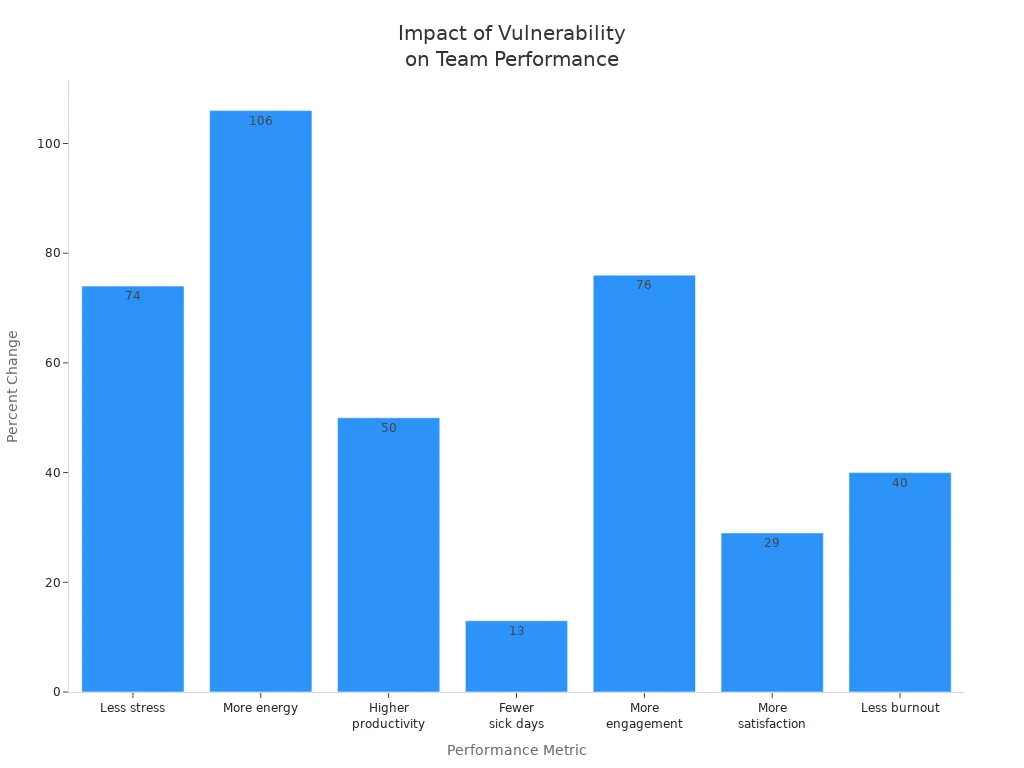
You can practice self-compassion by accepting your imperfections. This self-compassion practice helps you adapt to change and reduces burnout. When you destigmatize vulnerability, you promote an ai-positive team culture. Your team will feel more satisfied and take fewer sick days.
Leaders who show vulnerability build trust and authenticity. This trust fosters open communication and collaboration. A culture of psychological safety encourages team members to share ideas without fear.
Embrace Continuous Learning
Growth Mindset
You need a mindset that values growth and learning. The digital age demands that you adapt to change quickly. You can overcome classic impostor feelings by focusing on progress, not perfection. A growth mindset helps you see challenges as opportunities. You can encourage your team to reskill and upskill. This approach builds confidence and prepares you for innovation.
Certifications and Experience
Certifications validate your expertise in ai and digital skills. You can use certifications to demonstrate your ability to manage ai impostor syndrome. Ongoing education helps you stay current in the digital age. You can combine certifications with real-world experience to build confidence. Managers using ai benefit from continuous learning and ethical leadership. You can lead teams that include both humans and ai.
- Certifications provide validated expertise for informed decision-making.
- Ongoing education fosters continuous learning and adaptation.
- Leaders equipped with certifications manage blended workforces of humans and ai.
Information Filtering
You face information overload in the digital world. You can filter information to focus on what matters most. Dan Barber suggests using a mental matrix to decide what you need to know. You can avoid classic impostor feelings by prioritizing relevant data. This strategy helps you practice self-compassion and reduces anxiety. You can teach your team to filter information and focus on key skills.
- Continuous learning is crucial for leaders in the digital age.
- Upskilling in soft skills is necessary for effective leadership.
- Ethical ai deployment requires ongoing education.
Leverage AI as a Partner
AI for Collaboration
You can use ai tools to enhance collaboration and decision-making. AI provides personalized learning experiences and adapts to your progress. Software developers using ai can analyze language patterns to detect negative emotions. You can use real-time feedback from ai to improve communication and foster better relationships. AI helps you identify trends and make informed decisions quickly.
- AI tools enhance leadership development with adaptive learning.
- Emotional intelligence is amplified through ai sentiment analysis.
- Real-time feedback from ai improves decision-making.
Human Context and Oversight
You must provide human context and oversight when using ai. AI cannot replicate visionary thinking or authenticity. You can use your skills to validate ai outputs and ensure ethical decisions. Managers using ai must balance technology with human insight. You can build confidence by combining ai with your own judgment. This approach helps you overcome ai impostor syndrome and maintain authenticity.
Responsible AI Use
Responsible ai use supports ethical leadership and reduces imposter feelings. You can provide proper training and thoughtful integration of ai tools. This practice enhances employee confidence and skill development. However, frequent ai users may experience classic impostor feelings. You can mitigate negative impacts by promoting self-compassion and ethical standards.
- Responsible ai use enhances confidence and skill development.
- Proper training supports ethical leadership.
- Thoughtful integration of ai tools reduces imposter feelings.
You can leverage ai as a partner to build confidence and foster innovation. By combining digital skills, self-compassion, and authenticity, you can lead your team through the challenges of the digital age.
Build Support Networks
You do not have to face imposter feelings alone. Building strong support networks is a key part of effective leadership. When you connect with others, you gain new perspectives and practical advice. You also create a safety net that helps you and your team handle challenges with more confidence.
Mentoring and Coaching
Mentoring and coaching play a vital role in helping you overcome imposter syndrome. A mentor can guide you through difficult situations, share their own experiences, and offer reassurance when you doubt yourself. Coaching helps you develop new skills and set clear goals for your leadership journey.
- Mentorship gives you access to guidance and real-world stories.
- Coaching helps you build confidence and learn how to manage stress.
- Professional help, such as speaking with a counselor, can provide strategies for handling complex emotions.
When you seek out mentors or coaches, you show your team that asking for help is a strength, not a weakness. This approach builds trust and encourages others to do the same.
Community Engagement
Engaging with your professional community strengthens your leadership and resilience. When you join groups or attend events, you meet others who face similar challenges. Sharing experiences helps you realize that imposter feelings are common and manageable.
Adaptability and resilience are essential in the age of AI-driven change. By connecting with your community, you learn how to make informed decisions and maintain strong performance, even during disruption. Leaders who create a psychologically safe environment encourage curiosity and growth. This mindset transforms resistance into engagement and helps your team thrive.
AI can also enhance change management by making transitions feel purposeful. When your team sees that changes are tailored to their needs, they are more likely to engage and support each other. This collective support boosts your confidence as a leader.
Peer Support
Peer support is another powerful tool for overcoming imposter syndrome. When you share your struggles with colleagues, you discover that many people feel the same way. Peer networks allow you to exchange strategies, celebrate wins, and offer encouragement.
You can set up regular check-ins or informal meetings with your team. These moments create space for honest conversations and mutual support. When everyone feels heard, your team becomes stronger and more connected.
“You are not alone in your leadership journey. Building a network of mentors, peers, and community members gives you the support you need to face imposter feelings and lead with confidence.”
Celebrate Progress
Recognizing progress is essential for building motivation and reducing imposter syndrome. When you celebrate achievements—big or small—you remind yourself and your team that every step forward matters.
Recognize Small Wins
Celebrating small wins fuels motivation and builds momentum for future challenges. Each achievement, no matter how minor, shows that your efforts are making a difference. This practice helps you and your team see progress and stay positive.
- Small wins reinforce that your work is valuable.
- They help you develop self-compassion and reduce self-doubt.
- Recognizing achievements encourages you to keep moving forward.
When you highlight these moments, you create a culture where everyone feels valued and motivated.
Acknowledge Team Success
Acknowledging your team’s success is a cornerstone of supportive leadership. When you celebrate what your team accomplishes together, you boost confidence and resilience. Reflecting on past successes gives your team motivation during tough times.
- Celebrating team achievements increases self-assurance.
- It helps your team bounce back from setbacks.
- A positive culture grows when everyone feels recognized and appreciated.
You can use team meetings, emails, or even a quick shout-out to highlight these successes. This recognition strengthens your team and builds trust.
Reflect on Growth
Taking time to reflect on growth helps you and your team see how far you have come. Regular reflection allows you to identify strengths, learn from challenges, and set new goals. This habit supports ongoing development and reduces imposter feelings.
- Reflection highlights your journey and the skills you have gained.
- It encourages learning from both successes and failures.
- Looking back on progress builds confidence for future challenges.
You can keep a journal, hold reflection sessions, or encourage your team to share their growth stories. These practices help everyone stay focused on continuous improvement.
Tip: Make celebrating progress a regular part of your leadership routine. Recognize achievements, encourage reflection, and always support your team’s growth.
Integrating Strategies into Leadership Practice
You can turn strategies for tackling imposter syndrome into daily habits. When you embed these actions into your routine, you build resilience and set a positive example for your team. Simple practices help you stay focused, confident, and connected—even in a fast-changing AI world.
Daily Routines for Leaders
Reflection and Journaling
Reflection and journaling help you track your growth and understand your leadership style. Keeping a journal allows you to see both your successes and challenges over time. This practice boosts your confidence and self-awareness. You can use structured reflection activities or questionnaires to evaluate your decisions and behaviors. Try asking yourself:
- What new challenge is triggering this feeling?
- What capability is this asking me to build?
- What evidence contradicts my fear?
| Reflection Practice | Impact on Self-Awareness and Confidence |
|---|---|
| Structured reflection | Evaluate behaviors, decisions, and impacts |
| Journaling | Track progress and identify blind spots |
| Reflection questionnaires | Promote personal growth and leadership understanding |
Team Check-Ins
Regular check-ins with your team create space for open conversations. These meetings help you build rapport and trust. You can use this time to share updates, discuss challenges, and celebrate wins. Peer support grows when everyone feels heard. In remote or hybrid settings, video calls with cameras on help maintain human connection.
Scheduled Learning
Set aside time each week for learning. You can focus on new AI tools, leadership skills, or industry trends. Prioritize what matters most to avoid information overload. Building resilience through continuous learning helps you manage stress and adapt to change.
| Routine | Description |
|---|---|
| Prioritize | Focus on tasks that truly deserve attention |
| Build resilience | Create routines that enhance mental and emotional strength |
Fostering a Supportive Culture
Model Vulnerability
When you show vulnerability, you build trust and encourage open communication. Sharing your own challenges makes it safe for others to do the same. This practice creates psychological safety and supports innovation. Leaders who model vulnerability help teams express ideas and take risks.
Encourage Recognition
Recognize both individual and team achievements. Celebrating progress boosts morale and reinforces a growth mindset. Simple shout-outs or thank-you notes can make a big difference. Recognition helps everyone feel valued and motivated.
Promote Psychological Safety
Create an environment where team members feel safe to share ideas and ask questions. Psychological safety leads to stronger connections and a more adaptable organization. Empathy and active listening are key, especially in remote or hybrid work.
Leaders who embrace vulnerability and recognition foster a culture of trust, learning, and resilience.
Using AI for Leadership Development
Feedback Tools
AI-powered feedback tools, such as 360-degree feedback systems and digital coaching platforms, give you a well-rounded view of your leadership. These tools collect input from supervisors, peers, and direct reports. Personalized coaching platforms adapt to your needs and help you grow.
Tracking Growth
You can use AI to track your progress over time. Automated systems highlight strengths and areas for improvement. This data-driven approach replaces assumptions with facts, making your development more effective.
Identifying Skill Gaps
AI tools identify skill gaps and recommend learning opportunities. You receive a personalized roadmap for growth. These insights help you shift from just evaluating performance to actively coaching and supporting your team.
By integrating these strategies into your daily practice, you create a resilient, connected, and forward-thinking leadership style.
Measuring Progress and Adapting to AI Evolution
As a leader, you need to track your growth and adjust your strategies as technology and workplace demands shift. The rapid pace of ai means you must measure progress and stay flexible to lead effectively.
Assessing Growth
Confidence Metrics
You can measure your confidence by reflecting on how you handle new challenges. Track your comfort level with decision-making, communication, and team engagement. Regular self-assessment helps you notice patterns and see improvement over time.
Peer Feedback
Peer feedback gives you a clear picture of your leadership. It captures how others see your actions and decisions. This feedback can reveal strengths and blind spots that you might miss on your own. You gain a holistic view of your impact, which helps you grow as a leader.
| Aspect | Description |
|---|---|
| Comprehensive Perspective | Captures perceptions of leadership behaviors across various relationships and contexts. |
| Reveals Blind Spots | Highlights areas of improvement that may not be visible through self-assessment or manager feedback. |
| Holistic View | Provides insights that single-source feedback cannot deliver, enhancing the understanding of leadership effectiveness. |
You can use peer feedback to identify your potential, diagnose strengths and areas for growth, and create a personalized development plan.
Leadership Impact
Assess your leadership by looking at team performance, morale, and engagement. Ask for feedback from your team and review outcomes after major projects. This approach helps you see the real effects of your leadership style.
Adapting Strategies
Staying Informed on AI
You need to keep up with ai advancements to lead your team well. Assess your current technology, pilot new tools, and update your plans to include ai-driven goals. Build mentorship networks and training sessions to help your team adapt. Improving your data infrastructure also prepares you for future changes.
| Strategy | Description |
|---|---|
| Assess current technology capabilities | Evaluate existing vendor AI tools and review data infrastructure readiness. |
| Pilot AI technology | Select teams to pilot AI, ensuring alignment with strategic plans and analyzing feasibility. |
| Lead AI adoption | Appoint managers to establish mentorship networks and training sessions. |
| Integrate AI into strategic plans | Update divisional plans to include AI-driven goals. |
| Improve data infrastructure | Audit and upgrade data management practices for AI use. |
Updating Goals
Update your goals often to match the changing workplace. Plan for resistance and use feedback cycles to adapt. Trust and compassion help you turn fear into focus. When you clearly communicate the purpose of ai, your team feels more prepared for change.
Embracing Flexibility
Stay flexible as you lead through uncertainty. Balance data-driven insights with your own intuition. Emotional agility helps you respond to new challenges and guide your team through transitions.
Overcoming Setbacks
Reframing Failure
View setbacks as learning opportunities. Name the story you tell yourself about failure and ask what you learned. Remember, one failure does not define you. Celebrate your courage to try new things.
Seeking Support
Reach out to mentors, peers, or professionals when you face challenges. Support networks help you process setbacks and develop coping strategies.
| Support Type | Description |
|---|---|
| Mentorship | Engage with a mentor who can provide guidance, share experiences, and offer reassurance. |
| Peer Networks | Join groups or communities where experiences and strategies can be shared among individuals facing similar challenges. |
| Professional Help | Consider speaking with a counselor or therapist who can help navigate complex feelings and develop coping strategies. |
Building Resilience
Practice self-compassion and reflect on your experiences. Develop healthy coping skills to strengthen your resilience. Each challenge you face builds your ability to adapt and thrive in the evolving world of ai.
Tip: Ongoing learning and adaptation are key to leading with confidence as ai continues to shape the workplace.
You can tackle imposter syndrome in the AI era by using simple strategies. Normalize your feelings, embrace continuous learning, and build strong support networks. Celebrate progress and use AI as a partner for growth. Remember, imposter feelings are common and manageable. Start today by taking one small step. View AI as a tool that helps you grow. Support others and help build a resilient leadership community.
Tip: Reach out to a mentor or peer this week. You will find strength in connection.
FAQ
What is imposter syndrome?
Imposter syndrome means you feel like a fraud, even when you succeed. You may think you do not deserve your achievements. Many leaders experience these feelings, especially during change.
How does AI increase imposter syndrome for leaders?
AI changes fast. You may feel pressure to keep up with new tools and trends. This can make you doubt your skills. Social media also shows others’ achievements, which can add to your self-doubt.
Can AI help you overcome imposter syndrome?
Yes! You can use AI to learn new skills, organize tasks, and get feedback. AI can help you start projects and reduce procrastination. When you use AI as a partner, you build confidence.
What are some quick ways to manage imposter feelings?
- Talk about your feelings with a mentor or peer.
- Write down your achievements.
- Celebrate small wins.
- Take breaks and reflect on your progress.
Tip: Sharing your experience helps others feel less alone.
Why is building a support network important?
A strong support network gives you advice, encouragement, and new ideas. You can learn from others’ experiences. Support from mentors, peers, and community helps you handle challenges and grow as a leader.
How can you use AI responsibly as a leader?
You should set clear guidelines for AI use. Always check AI results with your own judgment. Teach your team about ethical AI practices. Responsible use builds trust and keeps your team safe.
How do you measure progress in overcoming imposter syndrome?
You can track your confidence, ask for feedback, and reflect on your growth. Use journals or AI tools to see your improvement. Celebrate each step forward.
🎧 Listen to this episode
Want a practical explanation of Leadership, AI, and Imposter Syndrome? This episode breaks down the topic in clear language and shows why it matters for Microsoft 365, Azure, Power Platform, security, AI, and modern work.
Listen to this episode if you want to:
- Understand the key concepts behind Leadership, AI, and Imposter Syndrome
- See how it fits into the wider Microsoft technology ecosystem
- Learn where it can create practical value for your organization
You may also enjoy these related M365 FM episodes:
- Sentiment Analysis for Executive Leadership Reporting
- Leadership and Microsoft 365 Governance Beyond Central Control
- Leadership in the AI Era Beyond Approvals and Control
- AI Exposes Broken Processes, Bad Data, and Weak Leadership
Discover more practical Microsoft conversations on M365 FM.
Official Microsoft MVP profile: Daniel Barber on Microsoft MVP
🚀 Want to be part of m365.fm?
Then stop just listening… and start showing up.
👉 Connect with me on LinkedIn and let’s make something happen:
- 🎙️ Be a podcast guest and share your story
- 🎧 Host your own episode (yes, seriously)
- 💡 Pitch topics the community actually wants to hear
- 🌍 Build your personal brand in the Microsoft 365 space
This isn’t just a podcast — it’s a platform for people who take action.
🔥 Most people wait. The best ones don’t.
👉 Connect with me on LinkedIn and send me a message:
"I want in"
Let’s build something awesome 👊
1
00:00:00,000 --> 00:00:04,960
Yeah, welcome to another edition of the 365 FM podcast.
2
00:00:04,960 --> 00:00:08,840
Today I have my special guest Daniel Dunbarro.
3
00:00:08,840 --> 00:00:13,360
He is Microsoft MVP and founder of Starthouse.
4
00:00:13,360 --> 00:00:19,960
And yeah, we have a really interesting topic today.
5
00:00:19,960 --> 00:00:25,640
It's the titles behind tech leadership AI and composers in
6
00:00:25,640 --> 00:00:32,600
the room. And yeah, we, yeah, today in this episode is about
7
00:00:32,600 --> 00:00:34,640
much more than technology.
8
00:00:34,640 --> 00:00:38,440
We talk about the leadership AI, pressure, community,
9
00:00:38,440 --> 00:00:43,480
impose a syndrome and what it really means to grow as human in
10
00:00:43,480 --> 00:00:44,960
the tech industry.
11
00:00:44,960 --> 00:00:47,680
So welcome then.
12
00:00:47,680 --> 00:00:51,880
And yeah, tell us a little bit about you with the person behind
13
00:00:51,880 --> 00:00:55,880
the MVP title and with your company.
14
00:00:55,880 --> 00:00:57,880
Oh, don't start with that.
15
00:00:57,880 --> 00:00:59,880
The person behind the MVP.
16
00:00:59,880 --> 00:01:01,880
The so thanks, thanks,
17
00:01:01,880 --> 00:01:04,880
thank you for thanks for having me on the show really,
18
00:01:04,880 --> 00:01:07,880
really looking forward to having a conversation.
19
00:01:07,880 --> 00:01:09,880
So a little bit about me.
20
00:01:09,880 --> 00:01:13,880
So I've been operating in probably the dynamic space was where
21
00:01:13,880 --> 00:01:16,880
my career started back with CRM 3.0.
22
00:01:16,880 --> 00:01:20,880
And then sort of as everything kind of evolved,
23
00:01:20,880 --> 00:01:23,880
I've moved to power platform and then I've moved to co pilot.
24
00:01:23,880 --> 00:01:27,880
And now pretty much, you know, I'm involved in most of the
25
00:01:27,880 --> 00:01:31,880
mainline, mainline technologies as your M365 fabric,
26
00:01:31,880 --> 00:01:33,880
all that kind of thing as well.
27
00:01:33,880 --> 00:01:38,880
So you inevitably your technology breadth evolves over time.
28
00:01:38,880 --> 00:01:43,880
So yeah, so that's kind of like 20 years running practices in
29
00:01:43,880 --> 00:01:44,880
the UK basically.
30
00:01:44,880 --> 00:01:48,880
And then I've just started up my, my own company called
31
00:01:48,880 --> 00:01:50,880
the
32
00:01:50,880 --> 00:01:52,880
I'm not a boss, although I much prefer how you pronounced it.
33
00:01:52,880 --> 00:01:54,880
That was that was epic.
34
00:01:54,880 --> 00:01:56,880
And essentially what I,
35
00:01:56,880 --> 00:02:00,880
what I do now is take the knowledge and experience that I built
36
00:02:00,880 --> 00:02:02,880
up over the last 20 years.
37
00:02:02,880 --> 00:02:06,880
And I focus that with Microsoft partners to help them get through
38
00:02:06,880 --> 00:02:07,880
their growth barriers.
39
00:02:07,880 --> 00:02:10,880
So understanding how they want to scale and how they want to get
40
00:02:10,880 --> 00:02:12,880
up to that next level from SMB to mid market,
41
00:02:12,880 --> 00:02:15,880
mid market to enterprise and how they transition because
42
00:02:15,880 --> 00:02:18,880
the challenges are very different at those different growth paths.
43
00:02:18,880 --> 00:02:21,880
So we work through those identify what those are and then
44
00:02:21,880 --> 00:02:22,880
help them through them.
45
00:02:22,880 --> 00:02:27,880
So that's kind of in a nutshell what what Straffles does.
46
00:02:27,880 --> 00:02:29,880
That is awesome.
47
00:02:29,880 --> 00:02:34,880
And yeah, what what after this years and take what keeps you
48
00:02:34,880 --> 00:02:38,880
passionate passionate about the, yeah, about the staying in
49
00:02:38,880 --> 00:02:44,880
this after all this time.
50
00:02:44,880 --> 00:02:45,880
I think it's for me.
51
00:02:45,880 --> 00:02:48,880
It's tech and business for me that you can't have one without the
52
00:02:48,880 --> 00:02:49,880
other.
53
00:02:49,880 --> 00:02:52,880
And I guess that's where the human element comes in as well.
54
00:02:52,880 --> 00:02:54,880
But for me, you know, technology is the tool.
55
00:02:54,880 --> 00:02:56,880
It's something that will enable you to do something.
56
00:02:56,880 --> 00:02:59,880
But you've truly got to understand the business first in order to
57
00:02:59,880 --> 00:03:00,880
apply the tech in the right way.
58
00:03:00,880 --> 00:03:04,880
So what I, what I love and what keeps me keeps me going is consulting
59
00:03:04,880 --> 00:03:07,880
on the business side is fabulous because I just get to work
60
00:03:07,880 --> 00:03:11,880
with so many, so many companies in so many different industries.
61
00:03:11,880 --> 00:03:14,880
All the time, you know, one minute you could be working for a travel
62
00:03:14,880 --> 00:03:17,880
agency, the next minute pharmaceuticals, the next minute retail.
63
00:03:17,880 --> 00:03:21,880
You know, it's always like is always changing and I love that
64
00:03:21,880 --> 00:03:22,880
side of it.
65
00:03:22,880 --> 00:03:25,880
But then the technology is, you know, as we know, changing rapidly itself,
66
00:03:25,880 --> 00:03:29,880
you know, you know, powerful platform didn't exist when my career
67
00:03:29,880 --> 00:03:30,880
started.
68
00:03:30,880 --> 00:03:34,880
Obviously copilot is, you know, coming into into full sort of
69
00:03:34,880 --> 00:03:38,880
development now, you know, so you're just always challenged to learn.
70
00:03:38,880 --> 00:03:41,880
There's always something new and I love that.
71
00:03:41,880 --> 00:03:44,880
That's that's what drives my passion.
72
00:03:44,880 --> 00:03:46,880
Just keep it on top of everything.
73
00:03:46,880 --> 00:03:47,880
Okay.
74
00:03:47,880 --> 00:03:53,880
When you're when you meet your young self, so today, what would you think?
75
00:03:53,880 --> 00:03:56,880
Would he surprised most?
76
00:03:56,880 --> 00:04:02,880
When you're younger, say, when you meet him, what would think you will
77
00:04:02,880 --> 00:04:03,880
be surprised most?
78
00:04:03,880 --> 00:04:07,880
I think it would be surprised that I was running my own business.
79
00:04:07,880 --> 00:04:12,880
It is something I never thought I would do or be capable of doing.
80
00:04:12,880 --> 00:04:16,880
But I guess that probably is airing on the imposter syndrome piece.
81
00:04:16,880 --> 00:04:21,880
But, you know, I think that's probably the biggest, the biggest change,
82
00:04:21,880 --> 00:04:22,880
the biggest surprise.
83
00:04:22,880 --> 00:04:24,880
But I'm absolutely loving it.
84
00:04:24,880 --> 00:04:26,880
It's fantastic.
85
00:04:26,880 --> 00:04:31,880
What should, what do you think about, you know, what separated good
86
00:04:31,880 --> 00:04:34,880
technical leader from a truly inspiring one?
87
00:04:34,880 --> 00:04:37,880
Oh, that's that's a really, really good question.
88
00:04:37,880 --> 00:04:40,880
A good technical leader from an inspiring one.
89
00:04:40,880 --> 00:04:45,880
So I think, for me, you know, leadership is all about inspiring.
90
00:04:45,880 --> 00:04:51,880
You know, it's it's about having vision, you know, motivating others to go on a particular path.
91
00:04:51,880 --> 00:04:58,880
You know, being being someone who doesn't just know is not a manager is someone who is looking to the future.
92
00:04:58,880 --> 00:05:03,880
And I think, I think technical leadership sometimes can air on the,
93
00:05:03,880 --> 00:05:08,880
I'm going to put in best practice and, you know, I'm going to be able to govern this, that and the other.
94
00:05:08,880 --> 00:05:12,880
So there's, there's certain technical skills that absolutely need as a leader,
95
00:05:12,880 --> 00:05:20,880
but they're more operational stuff for me, because strong technical leader is someone who's got a good handle on the now,
96
00:05:20,880 --> 00:05:24,880
but also a good handle on the, what's coming around the corner?
97
00:05:24,880 --> 00:05:27,880
You know, how is it going to affect, going to affect us?
98
00:05:27,880 --> 00:05:32,880
Is it good? Is it bad? Is it going to mean that we're going to change how we operate and how we move?
99
00:05:32,880 --> 00:05:39,880
I think for me, that's, that's critical to a good technical leader, because otherwise you just stay,
100
00:05:39,880 --> 00:05:50,880
you stay current, but fairly, fairly flat, whereas I think the excitement and the passion and the innovation comes from being a little bit more towards that, that edge of technology innovation.
101
00:05:50,880 --> 00:05:58,880
And what will you say was leadership always natural to you or something you had to learn?
102
00:05:58,880 --> 00:06:03,880
That's another reason, interesting one. I like these questions. These are good.
103
00:06:03,880 --> 00:06:09,880
I think, I think it's something I've learnt to be quite honest.
104
00:06:09,880 --> 00:06:16,880
I've learnt from experience. I've learnt from, you know, from past leaders I've worked with, and that's good and bad, because you get, you know,
105
00:06:16,880 --> 00:06:29,880
equally as important to have good experiences and bad experiences. But also a lot of theory. I read, I read a lot of books, you know, I really like sort of psychology and leadership and management, you know, those, those kind of books.
106
00:06:29,880 --> 00:06:42,880
So I think a lot of it is, is learnt either through past experience, theoretical or like technology hands on, you know, I've, I've run hundreds of teams with hundreds of people.
107
00:06:42,880 --> 00:06:51,880
And you know what, you, you try things out, you learn, you fail, you try and recycle and continuously improve and try and do things better, you know.
108
00:06:51,880 --> 00:06:58,880
First team I manage versus the last team I managed, I will have managed those and led those people very, very differently.
109
00:06:58,880 --> 00:07:05,880
So it, for me, I think it's more learnt than the natural capability.
110
00:07:05,880 --> 00:07:33,880
When, yeah, you say you, you failed. So is that any mistake where you have learnt a lot from, we say, oh, this was something I really can, I can, I can, I can, yeah, I, it's a really interesting one actually is, I'm quite an empathetic person, you know, I like to, I like to understand how others, or make sure I try and understand how other people are feeling.
111
00:07:33,880 --> 00:07:41,880
What I didn't actually realize was you can actually be too empathetic, which I didn't even realize it was a thing, right.
112
00:07:41,880 --> 00:07:54,880
And, but I think what happens sometimes when you're too empathetic is you, you, you surround someone potentially in a bubble that, that, that stagnates their growth and their development and their experience as well.
113
00:07:54,880 --> 00:08:08,880
I think for me that was an interesting learning to think, actually, you know what, I've got to, you know, I've got to make sure I let other people fail as well, you know, I failed and learnt, you know, why would I wrap people in cotton wool so that they can't, they can't fail.
114
00:08:08,880 --> 00:08:13,880
So it's, it's balancing that empathy and the coaching and the feedback.
115
00:08:13,880 --> 00:08:17,880
So I think that was a, that was a big learning.
116
00:08:17,880 --> 00:08:30,880
What, what did you think it's about teams and leadership? So you, you, I think you need to build trust in a team. So they follow you. What, what's your tips here?
117
00:08:30,880 --> 00:08:33,880
Oh, there's so many.
118
00:08:33,880 --> 00:08:46,880
So, so yet, I think one of them, one of the biggest human skills that we, we underdevelop and we under recognize how important it is is, is our ability to build rapport with other people.
119
00:08:46,880 --> 00:09:02,880
You know, they have this, the concept of this rapport triangle, you know, and you basically, it's levels of trust that you have and the levels of interaction you have with people and the higher you get in the rapport triangle, the, the more people are trusting of you.
120
00:09:02,880 --> 00:09:13,880
And a lot of people sort of like can sit with their professional relationships at the bottom level, which is, oh, me, okay, nice to meet you. How is your day? You know, that kind of really baseline.
121
00:09:13,880 --> 00:09:29,880
You could be anyone I'm talking to, too, you know, next level might be, oh, how was that fishing trip you went on last weekend and how's your dog Barney and you know, you know, you, you kind of getting your exposing a little bit more information there for you can have more involved personalised conversations.
122
00:09:29,880 --> 00:09:51,880
And you kind of build that up and build that up and I think for me it's one of the most important things to develop because our jobs are high stressful, high stress, you know, as a consultant, but also as a recipient from a, from a client perspective, you know, we're on very time sensitive, very important business programs, business transformation, you know, and improvement programs.
123
00:09:51,880 --> 00:10:05,880
And they are high, they're high pressure, you know, and what makes them much more pleasurable to work in in an environment is where you've developed a really good relationship with the people, both your project team, but also wider stakeholders as well.
124
00:10:05,880 --> 00:10:16,880
And you built that wider trust. So inevitably when the pressure starts mounting, you've almost got some professional relationships, professional friendships, maybe as long as they don't go too far.
125
00:10:16,880 --> 00:10:33,880
But you can lean on those in times of high pressure and go, you know what, I know you dropped the ball there, but I trust you're going to pick it up because I feel like I know you, I feel like there's some trust there, you know, or you missed, you missed that deadline when you were supposed to create those accounts for our production system.
126
00:10:33,880 --> 00:10:40,880
So that's going to delay go live. So, okay, but I know you'll get it done. I know you're busy again showing some of that empathy there as well.
127
00:10:40,880 --> 00:10:50,880
So I think that's that's really critical. Yeah, I think as well as Saturday that like you say, empathy is not a soft skill. It's how to skill alone.
128
00:10:50,880 --> 00:10:55,880
What's the deal? What's your first reaction when you go in this code?
129
00:10:55,880 --> 00:11:00,880
So empathy, empathy is not a hard soft skill. It's a hard skill.
130
00:11:00,880 --> 00:11:03,880
We learned, we have to learn.
131
00:11:03,880 --> 00:11:14,880
Yeah, I think so this goes back to the question ran, ran leadership whether whether it was look whether it was learnt or natural.
132
00:11:14,880 --> 00:11:31,880
You know, I think with empathy, I think there is a more, I would say I would more lean into the fact that there's a lot of natural capability with empathy and it tends to be that you have a certain emotional make up that makes you more empathetic or less empathetic.
133
00:11:31,880 --> 00:11:45,880
You know, you know, my, my daughter's got ADHD, you know, she is one of the key key indicators there is she demonstrates a huge capacity for empathy, you know, and sometimes too much, right?
134
00:11:45,880 --> 00:11:51,880
So she goes too much and gets to involve emotionally involved in certain situations.
135
00:11:51,880 --> 00:12:05,880
So, so yeah, so you think about like is it natural or is it learned? I think you can learn it to a degree, certainly educational awareness, but I think I think it's more natural.
136
00:12:05,880 --> 00:12:12,880
I think than the learnt, but it is certainly you certainly are on it's not black and white, right?
137
00:12:12,880 --> 00:12:29,880
So what did you think it's when we see tech leaders, you know, your, your daughter has too much empathy, I think often that's something in tech, especially leaders, they, yeah, they underestimate the empathy topic.
138
00:12:29,880 --> 00:12:48,880
Yes, that well, empathy is not just empathy, I think it's like these human centric skills as a whole, you know, we have, I mean, I've seen this for 20 years and you know, and been a tech leader myself or am a tech leader myself, you know, and I still see a tendency and I know other people feel the same.
139
00:12:48,880 --> 00:13:00,880
I see a tendency that we're so focused on the technology that we're missing focus on those human centric skills, you know, and I'm just not talking about just what we're talking about in terms of soft skills.
140
00:13:00,880 --> 00:13:17,880
So, you know, your empathy and your rapport building, you know, communication skills, but the wider things that make us a great consultant as well, you know commercial acumen and appreciation of the life cycle of a project and project management change control, you know, all of these, all of these surrounding elements that.
141
00:13:17,880 --> 00:13:45,880
That make us great consultants and I think as leaders or tech leaders it's there's a tendency just to focus on the first word that tech piece I often use the often is that the phrase where we're where we're technical consultants well, you know, there's there's two words that this technical and there's consultant, you know, we're very good at focusing on the technical we're less good at focusing on the consultant piece.
142
00:13:45,880 --> 00:14:05,880
It's individuals, but also leaders that need to appreciate, I think that we need to refocus some of our energy on developing and encouraging nurturing that consultant element, otherwise I find we just do whatever the customer wants us to do rather than what the customer needs us to do and sometimes those things are different sometimes wildly different.
143
00:14:05,880 --> 00:14:27,880
You know, we think, oh, we have this the other I think we we talk a lot of empathy, but we have also emotional intelligence as topic what will you say different these topics and yeah, how we can or yeah, yeah, can cancer, what's the difference?
144
00:14:27,880 --> 00:14:56,880
First, what do you see here? So I think I think empathy is a particular skill and I think EQ or emotional question emotional intelligence is more of a broad set of skills than composite so you know active listening, for example, is is is another skill like empathy, but it's part of the rapper or what I would call the rapper of EQ or the emotional intelligence piece, you know,
145
00:14:56,880 --> 00:15:22,880
the ability for you to engage with someone mostly non verbally, just letting them know just like you're doing now like we're on camera even though this is audio, but you're you're smiling at me, you're nodding, you're making eye contact, you know, you're giving me silent encouragement that you are actively engaged in this conversation and that is a really, really important skill to learn, you know, especially in this day where where 99% of our stuff is remote, you know,
146
00:15:22,880 --> 00:15:41,880
it's really important to have your camera on and actually to interact with people because that you know, I can't remember what the statistic is, but the the the large percentage of your communication that is non verbal, you know, I'm sure we'll find that by the start after the show maybe put it in the notes, but you know, it's a huge proportion that is non verbal.
147
00:15:41,880 --> 00:15:55,880
And when when most of our stuff is virtual nowadays and we don't have our cameras on, for instance, we can't participate in some of these some of these activities you're only getting, you know, a quarter of the story, which is quite interesting, I think.
148
00:15:55,880 --> 00:16:01,880
Yeah, that's a source from children say, I say, you cannot.
149
00:16:01,880 --> 00:16:14,880
So, you have to do some communication, so everything you do is is communication, so, we have this topic, I really found it interesting, we more to work.
150
00:16:14,880 --> 00:16:21,880
Did we lose empathy and emotional intelligence or I think.
151
00:16:21,880 --> 00:16:36,880
Is it to change this, we move back all to the office or what's your explanation?
152
00:16:36,880 --> 00:16:50,880
I've worked for the majority of my career, so for me, you know, things like COVID happened, it wasn't really wildly different, you know, less visits going out and visiting clients and things like that, but it wasn't wildly different.
153
00:16:50,880 --> 00:17:05,880
But I think I think some human interaction is incredibly healthy and very much needed if you spend 220 working days in a box office like mine where I can really touch the walls with my hands, you know, not interacting with with anyone really apart from me.
154
00:17:05,880 --> 00:17:25,880
And then anyone really apart from video calls, I think it diminishes, you know, it diminishes what you do and, and, you know, how you feel, I think being able to go into an office or going and see clients or that's why I really enjoy the user groups and the conferences that I go to because just interacting with other humans is really important to me.
155
00:17:25,880 --> 00:17:41,880
I think remote work, I don't believe in there, oh, you should be in three or three days a week in the office, you know, that from from someone of who's an experienced consultant, my kind of, my kind of role, your kind of role, you know, I think we're autonomous, we should have trust there.
156
00:17:41,880 --> 00:18:09,880
Trust sometimes is the issue, the old fashioned issue that keeps people regimented to an office environment, you know, but there are there are perfect scenarios, you know, when you get people who are in apprenticeships or people are learning, you know, doing high amounts of learning, you know, I find that much richer experience if you're actually face to face, you know, you're sketching stuff on a whiteboard, you know, moving post it notes around and there's certain events that lean into human interaction.
157
00:18:09,880 --> 00:18:19,880
You know that I could to be in the office for and good to be interacting for so, but yeah, do I believe that someone who spends eight hours a day on teams calls should do that from an office environment.
158
00:18:19,880 --> 00:18:29,880
No, I don't really see the value of that, you know, what did you think it's today is harder it's managing technology or it's managing people.
159
00:18:29,880 --> 00:18:39,880
I love in these questions he's already getting me thinking which I think is harder managing technology or managing people.
160
00:18:39,880 --> 00:18:58,880
I would say I'd say 50 50 to be quite honest on offense by it, but I think I was having this conversation the other day, I think color cloud with with Scott Duro or Reti Relsen, Nathan Sweeney and this topic sort of came up kind of about sort of like, you know, is is a is a high.
161
00:18:58,880 --> 00:19:18,880
Making us work smarter, you know, and we were kind of like, well, yeah, yeah, it does make us work smarter, but it doesn't have makers, makers work harder as well, you know, because there's there's one level which is an expectation that you're using a I therefore you're more efficient, you know, you're doing more stuff.
162
00:19:18,880 --> 00:19:33,880
But the other part is it you know, you're you're now compressing and cramming so much more into each day, you know, so I before I could write a training plan statement of work in and it take me two days, you know, now I can do it in a day.
163
00:19:33,880 --> 00:19:45,880
So guess what I do two training plans and two statements of work in that time and you know, we're always we're always busy and AI is putting that little bit more pressure to be busy almost busy or busy or I think.
164
00:19:45,880 --> 00:19:56,880
So I think balancing managing people and balancing managing technology, I think you know it's it's it's hard work to be to be fair, you know.
165
00:19:56,880 --> 00:20:01,880
That is awesome. So you have the buzz rod AI.
166
00:20:01,880 --> 00:20:06,880
We did well 20 minutes before we mentioned AI, I think we did quite well.
167
00:20:06,880 --> 00:20:11,880
What's exciting you most about AI right now?
168
00:20:11,880 --> 00:20:40,880
I think very simply just the opportunity, I like, I like the fact that we are only just scraping scraping the tip of what is achievable, what the potential is of AI, you know, from simple, you know, personal, personal efficiency kind of savings to full on agent work forces with agents managing teams of agents managing teams of agents, you know, I think we, you know, we're still just scratching the
169
00:20:40,880 --> 00:20:57,880
edge and I find it akin to when I first got given a copilot license, I think, I think I, I used it like once a week, you know, and slowly that that cadence like exponentially went up and now I struggle, you know, I've been on the
170
00:20:57,880 --> 00:21:19,880
many minutes and I haven't used copilot, you know, and I'm like, oh, you know, you, I'm literally living and breathing it like whether it's whether it's, you know, typically copilot, but other a other AI tools as well, you just it's it's ingrained in everything I do now and every day I will find another new use case for it and go, I never knew I could do that.
171
00:21:19,880 --> 00:21:22,880
Oh, that's genius. I love that.
172
00:21:22,880 --> 00:21:40,880
Yeah, I think especially copilot, I think Microsoft, it's yeah, they have make big marketing and some are then this not working, this not working, I think now it's it's working really fine, I think this was also.
173
00:21:40,880 --> 00:22:08,880
I think it's when they made the switch so that they when the marketing originally came out is very much about personal productivity, it was like, you know, a return on investment for how many days or minutes you can you can save that you day and then then they pivoted and I think that's where the success came the pivoted to the fact that actually this is about understanding your business processes and understanding how automation and AI can come into your business processes.
174
00:22:08,880 --> 00:22:37,880
And I think that's when it really kind of hit home and it was like, oh, okay, hang on, this isn't just about me writing nicer emails or you know getting my getting my team team meetings transcribed and some AI summary notes coming through it's like this is bigger than that this can really be a game changing, you know, you you hear of agents landing and saving hundreds of thousands of pounds, you know, just by developing no investment of, you know, five days to build an agent and test an agent.
175
00:22:37,880 --> 00:22:54,880
And test an agent deploy it and you see the huge huge huge savings, you know, that's hypothetical example, but there are there are lots of examples there where, you know, you're developing in an agent it's it's having a fundamental shift in how businesses run.
176
00:22:54,880 --> 00:23:14,880
Is there anything you say that worth you about AI worries me worries I guess the responsible use of AI would be something that that worries me it can if left untamed just be a route for laziness, I think.
177
00:23:14,880 --> 00:23:43,880
Through laziness becomes you know problems poor data, bad security posture, you know, there's there's there's a hundred ways where if you're lazy with AI you can really take yourself up to fail big style, you know, so I think for me that that's probably one of the worries it's it's to democratize the technology in such a brilliant way that absolutely anyone can access it, but you know that old adage with great power.
178
00:23:43,880 --> 00:24:10,880
But people people not not everyone is taught in the right way is you know is a talk to understand responsibility and accountability for the AI tools you know things like the EU AI act coming in or come in and obviously evolving that's going to have a massive impact on people's responsibility, which I think is a good thing, you know, America have got nest and there's a few other regulations dotted dotted around in various different countries.
179
00:24:10,880 --> 00:24:24,880
I think people are getting it, I just I just worry about how many people are aware of those things outside of our very small, you know technology sphere you know your average jose and james.
180
00:24:24,880 --> 00:24:30,880
So what did you think we are in a junior revolution or another hype cycle.
181
00:24:30,880 --> 00:24:32,880
So can you repeat that one for me?
182
00:24:32,880 --> 00:24:39,880
Yeah, what do you think are we in a new revolution or is another hype cycle?
183
00:24:39,880 --> 00:24:43,880
No, I genuinely think this is a revolution.
184
00:24:43,880 --> 00:25:08,880
I mean it's fundamentally changing how things are how things are done, you know, it is it is huge, you know, it's interacting with how businesses are run, how jobs are performed, you know, how technology advances, you know, it's pushing technology, you know, I think some of the almost like, you know, just I don't want to make it akin to the space race.
185
00:25:08,880 --> 00:25:30,880
But you know the space race pushed technology massively because you know there was a race to do something but now now is the AI race, you know, I'm sure that's probably been coined before but you know that there is it is put massive limitations on what capabilities we have in computer data centers memory and things like that.
186
00:25:30,880 --> 00:25:40,880
And it's pushing technology massively forward, I think because everyone wants to be on this AI train. So I do think it's revolutionary.
187
00:25:40,880 --> 00:25:49,880
And what did you think are the upcoming skills that's more important because of AI?
188
00:25:49,880 --> 00:26:02,880
Oh good one. So I'm going to stick on the human centric topic because sure people can talk about the technical certifications and the things you need to know from that perspective, but in in keeping aligned with the topic of this combo.
189
00:26:02,880 --> 00:26:18,880
I think for me, the art of critical thinking about getting to understand businesses true needs rather than just what they're telling you, you know, a lot of people are reacting and saying I need an AI something, give me some AI.
190
00:26:18,880 --> 00:26:25,880
And sometimes some technology and some AI is thrown at them and you know there you go, you've got some AI brilliant.
191
00:26:25,880 --> 00:26:45,880
But it doesn't actually do anything of any value, you know, doesn't perform potentially puts yourself at more risk than you were before you introduced AI, you know, so it's about for me, I think it's the human element of getting in and truly understanding what business does, how, what the, what the valuable use cases are, how do their business processes work?
192
00:26:45,880 --> 00:26:59,880
And then developing something that truly helps and truly evolves how that, how that business business operates and then making sure that there's some change management that is actually pulled into there.
193
00:26:59,880 --> 00:27:05,880
Now traditional technology projects, lots of people talk about change management and hardly anyone does it.
194
00:27:05,880 --> 00:27:15,880
I think AI is a little bit different in the fact that if you don't introduce change management with your AI strategy, then you're on a route to failure.
195
00:27:15,880 --> 00:27:22,880
So I think now it used to be, I don't want to say optional because I love change management, I think it's incredibly important.
196
00:27:22,880 --> 00:27:31,880
But it was always one of those things that was minimized on programs. I don't think you can afford to minimize change management on an AI program.
197
00:27:31,880 --> 00:27:41,880
It was really interesting, I've worked a lot of years in education and we are look what skills are the people use in the future.
198
00:27:41,880 --> 00:27:47,880
And that's, I think it's economic graph from LinkedIn and it's really cool tool.
199
00:27:47,880 --> 00:28:07,880
So you can see how have developed the, yeah, on the, what job requirements they have on the job offers and then they say how has developed and you see, I don't know, I wasn't in data science and then you need pipe and you need this R, SQL and so on.
200
00:28:07,880 --> 00:28:17,880
And then yeah, now it's understand database and use, and you can use AI and then upcoming a lot of soft skill communicate, ask business questions.
201
00:28:17,880 --> 00:28:20,880
So I think that's really interesting.
202
00:28:20,880 --> 00:28:30,880
I don't think it's all by coming by high, but it's, I think it's an important impact.
203
00:28:30,880 --> 00:28:52,880
When, or when we think, what I think you can correct me, I see there are a lot of people that collect these certifications, yeah, like all the Microsoft certification here.
204
00:28:52,880 --> 00:29:09,880
And then you think, this, this, have a future or I'm a little bit, yeah, I don't know, I think it's certification collections and there's also a website and only you can show your certifications.
205
00:29:09,880 --> 00:29:18,880
Yeah, I'm, yeah, I'm a little bit, what would you want on the on the fence there are you around certifications.
206
00:29:18,880 --> 00:29:27,880
I think there's a couple of things here, so I, to start with, I've always been a big advocate of certifications.
207
00:29:27,880 --> 00:29:34,880
So for a couple of reasons, one, I think it gives people a little bit of structure and it stops them.
208
00:29:34,880 --> 00:29:47,880
I think getting too comfortable with what they know and therefore always just, you know, doing what they've always known, you know, the technology is moving so fast that as you're forced to research, if I renew each year.
209
00:29:47,880 --> 00:30:03,880
You know, it's, you've got to keep on tap or some of the gaps and some of the developments you can't, you can't allow yourself to stagnate and not learn some of the new funky funky technology, so you're not putting in legacy, legacy approaches into applications.
210
00:30:03,880 --> 00:30:16,880
So I like it, I like it from that perspective, but I also see the downsides of it, you know, as as someone who suffers from imposter syndrome, like seeing constant reams on LinkedIn of, you know,
211
00:30:16,880 --> 00:30:26,880
the certification, this certification, this certification, it's kind of like it, you know, experience and capability can't be replaced with a shiny badge.
212
00:30:26,880 --> 00:30:45,880
You know, the badge is a good, it gives you a certain level of understanding, but you've got to apply that learning with experience and knowledge, you know, the scars, you know, that, that, that, that truly mean that you understand, well theoretically it says you should do that, but in reality, you should do these two things first, otherwise that's probably going to fail.
213
00:30:45,880 --> 00:31:14,880
You know, that's, that's where the experience comes in, so I think that it's a double edge sort, I think with certifications, I, I personally think they're great, you know, I'm going through all my AIs that I certifications now, you know, all the A, B's and, you know, I think they're good for grounding people with a base knowledge as well, you know, lots of people are transitioning into AI from another technology, you know, or folding into their experience.
214
00:31:14,880 --> 00:31:43,880
Now, if you just go into the doing without having a formal good baseline structure of what AI is all about and you just bowl into delivering solutions, guess what, those solutions probably aren't going to be that great because they're not grounded, sorry, it is the pump, but they're not grounded in in a good foundation of knowledge around the history of AI, what AI means, you know, how to develop AI use cases and it starts people just again focusing on the technology.
215
00:31:43,880 --> 00:31:50,880
And what did you think makes someone you're replaceable in an AI first world?
216
00:31:50,880 --> 00:31:57,880
What makes someone irreplaceable in an AI world?
217
00:31:57,880 --> 00:32:09,880
I don't know about irreplaceable, I'm not, I'm not, I don't know, do you mean from the perspective of AI something that is secure from AI doing their job?
218
00:32:09,880 --> 00:32:32,880
Yeah, I think, I think for the time being, it's all about context, you know, AI is incredibly good at, you know, passing huge amounts of information and doing patent recognition, it's phenomenal, you know, they always say it's like a kind of magic sometimes, but, you know, without context, you know, it, it, it does struggle without a human insight.
219
00:32:32,880 --> 00:32:51,880
I think, you know, right now, I certainly don't see, you know, humans being able to be replaced and taken out of the loop, humans have always got to be in the loop because they've got to, you know, validate what's coming out of it, give it context, you know, I was joking with, with Janet, Janet Rob the other day.
220
00:32:51,880 --> 00:33:17,880
I was trying to get AI to make me a little graphic with, with a pie charts split into four segments gave me three segments every time I asked it no matter which way I asked it, it would only ever give me give me a pie chart with four segments, even though I clearly stated I wanted three, you know, so, you know, we, we talk about sort of AI taking over the world and taking over everything, you know, there is, there was, there was, there was still a lot of work to do, right.
221
00:33:17,880 --> 00:33:22,880
And I think humans are very, very important in that journey.
222
00:33:22,880 --> 00:33:33,880
So we would also talk a little bit about the impose on the room, and I think it's, yeah, it's common, common touch, but have you experienced yourself?
223
00:33:33,880 --> 00:33:48,880
Yeah, it's, it's something I talk about quite a bit. I've got a couple of sessions on this one, one about recognizing and understanding and dealing with imposter syndrome because it's, it's something that is a ongoing cause, if you like, for myself.
224
00:33:48,880 --> 00:34:14,880
I also talk one around how AI can actually be an ally for imposter syndrome, which was, it was taken from my personal experience really, because I, I thought about AI being yet another technology yet another thing I've got to learn, and it's kind of like, oh my god, it's more stuff, I don't know, you know, and it plays on that I must, I must know everything, you know, which is one of the characteristics of, of IS.
225
00:34:14,880 --> 00:34:28,880
But then I sort of flipped it on its head and went actually, like no time before, AI is actually allowing me to learn more, understand more plan more, you know, stop procrastinating on things.
226
00:34:28,880 --> 00:34:43,880
And actually it became, it became a real enabler when I looked at it through a different lens. I was like, actually this one is amazing technology is actually helping me get past or helping me deal mitigate some of those imposter syndrome characteristics.
227
00:34:43,880 --> 00:34:57,880
You know procrastination, you know, I used to, you know, used to wait till, wait till the last minute because I was, you know, afraid I like, I don't know where to start, there's too much information, how do I, how do I, how do I crack this nut?
228
00:34:57,880 --> 00:35:12,880
And then it's just like, well, you know, AI comes along goes, well, how about this 10 page starter on this document and you can work it from there, you know, it's brilliant because most of the time, you, you, you'll end up deleting those 10 pages, you know, or taking the majority of that content out.
229
00:35:12,880 --> 00:35:26,880
And then you see that content out, making it your own, which is the important part of it, but it stops you staring at that blank page. It gets you started rather than going, oh, I'm going to leave that right to the last minute, which is going to cause a lot of stress and anxiety build up.
230
00:35:26,880 --> 00:35:31,880
So I think, I think it's a great tool for for tackling that.
231
00:35:31,880 --> 00:35:46,880
And do successful people's securities struggle with self-dupped or more than we think or have they overtake it and do it all, all of it, so they are successful.
232
00:35:46,880 --> 00:35:48,880
So you have security?
233
00:35:48,880 --> 00:36:04,880
And the successful people, they're, I think they are, I don't know, is it secretly struggle with, yeah, self that more than we think or have to be successful.
234
00:36:04,880 --> 00:36:27,880
Yeah, I think, you know, in Poster syndrome is not, you know, it's not something, you know, some people, some people think of it as almost wearing a badge sometimes because you can be hyper focused and you're doing things really detailed and typically you're, you know, doing things to high levels of quality because you are, you are concerned that you're going to be seen as a fraud.
235
00:36:27,880 --> 00:36:37,880
But it is not, it's not something that's great to be in is something you need to mitigate because it's, it's not a, it's not a, it's not a thing to strive for.
236
00:36:37,880 --> 00:36:40,880
It's something to balance, right?
237
00:36:40,880 --> 00:36:51,880
But, you know, when you think about seven out of 10 people, either have in Poster syndrome or have dealt with it at some point because it, you know, it's not, you have it or you don't sometimes it comes in waves.
238
00:36:51,880 --> 00:37:11,880
You know, it might be where you get a promotion and, you know, you're feeling in Poster syndrome for the, for the few months after that promotion and then you get a climatized you and you roll and it ebbs away and you feel more confident and you go back to being, you know, you're feeling like you're, you're normal self, you know, but some people find, find it's a constant battle.
239
00:37:11,880 --> 00:37:29,880
There's something constantly pushing at you. So, you know, seven out of 10 people, you know, the, you know, there's, it's not just, it's not just people who aren't leaders or managers in that bucket, you know, you, you give when I've given talks, there's been a like 50 80 people in a room.
240
00:37:29,880 --> 00:37:47,880
And I've gone through the different scenarios that, that that mean like that's an imposter syndrome situation and most of the time is more like 80 90% of the audience stick their hand up and say, yeah, I felt like that at one point or another.
241
00:37:47,880 --> 00:37:59,880
You can't escape it, I think, is is is my message there. So, you know, whether you're, whether you're, whether you're a leader or an individual contributor, I think it's a high likelihood that that's your face at some point.
242
00:37:59,880 --> 00:38:16,880
I think mbps feel always successful, but, okay, there was, there was a wrong, but why did you come from that high achievers often feel not not good enough?
243
00:38:16,880 --> 00:38:34,880
Where did it come from? Well, I think you, you're always raising the bar, right? I mean, you brought up the MVP thing and it's, it's a really good example that actually because I've been MVP for three years now, just done my renewal fingers crossed on that.
244
00:38:34,880 --> 00:38:50,880
But, you know, you get that sort of a claim and then you feel like the bars been lifted again and the bar never goes down. So, you know, you reach a certain level of knowledge and then, oh, there you lift the bar up again and then you lift the bar up again, you lift the bar up again.
245
00:38:50,880 --> 00:39:07,880
You know, when I, when I got my, my, my award, the volume of information that I did not know existed before that award, I suddenly like came into my inbox and I was just absolutely inundated with a level, a level of phenomenal level of extra information.
246
00:39:07,880 --> 00:39:31,880
I was like, oh my god, my brain's going to be explode. Like, how can I compute all of this stuff? You know, and you kind of have to adapt and learn and figure out how to filter what you're going to specialize in because otherwise you keep lifting the bar, you know, there's sometimes an expectation to do more and more and more each year of MVP because you, you know, you're frightened of losing it.
247
00:39:31,880 --> 00:39:45,880
You want to retain this tremendous acclaim, you know, but you know, it's just all right. Well, I spoke at five conferences last year. So I probably need to speak at seven this time and then maybe start a blog and maybe a YouTube channel.
248
00:39:45,880 --> 00:39:58,880
You know, you just keep moving that bar up. So I think it's, it's good to be conscious of of what level is required versus what level your brain is telling you is required.
249
00:39:58,880 --> 00:40:02,880
That they're always different.
250
00:40:02,880 --> 00:40:22,880
So what did you think I hear a lot of people say, it's, it's, we are, you are both on LinkedIn, I think the most people in business are linked about social media are it's, have done really big impact of the, yeah, on the impose as a dream.
251
00:40:22,880 --> 00:40:24,880
What did you think is it?
252
00:40:24,880 --> 00:40:34,880
Yeah, I referenced this actually in one of my sessions and I think I used it was called Twitter back then because I'm on that old.
253
00:40:34,880 --> 00:40:50,880
But, you know, I found I came off Twitter because it's or X because it just got I got too overwhelmed with that because it's almost I felt like I needed to keep up up to date with the feed and try and absorb and learn everything.
254
00:40:50,880 --> 00:41:04,880
So for me, I think social media does perpetuate that kind of like information overload characteristic for imposter syndrome, but I think part of my internal thing is is I filter stuff now.
255
00:41:04,880 --> 00:41:14,880
So in my brain, I've got one of these little little, you know, Boston consulting matrix squares in there around what I want to know and what I need to know.
256
00:41:14,880 --> 00:41:36,880
You know, the certain stuff I need to know and want to know, which is great for my business. So that's my number one filter, right, do everything if I've got brain capacity, then I go to that I need to know, but I don't want to know because I need to know it for a reason, you know, whether it's for my job or the business or community or something like that, you know, that's my, my number two overflow.
257
00:41:36,880 --> 00:41:44,880
And then my number three is is I want to know, but don't need to know it's like, oh, fabrics really, really exciting, really interesting.
258
00:41:44,880 --> 00:41:59,880
But you know what, I don't actually have, I don't need it directly for my job, but I really enjoy that subject and I've got people in my network, you know, like Laura Graham Brown or someone like that, I go, ah, experts, brilliant, I can go and I can go and use their knowledge.
259
00:41:59,880 --> 00:42:10,880
And then the really important box is that I don't want to know and I don't need to know and it was a big realization for me that I was learning a lot of stuff in that fourth box.
260
00:42:10,880 --> 00:42:16,880
I was absorbing a load of stuff that I didn't need to know that didn't want to know it was just in front of me.
261
00:42:16,880 --> 00:42:40,880
So I have this kind of like mental check now where I organize the stuff I'm looking at and go, right, which box does it lay in one, two, three, four and a majority of it is in four and I go, you know, why am I even reading that I don't, I don't need to know about that, you know, and that's become my personal, my personal tool for filtering information from social media because it is, it is like a fire hydrant.
262
00:42:40,880 --> 00:42:49,880
So that's that's my feel so that's my tip is good tips against stress and and burn out risk so it's really really cool.
263
00:42:49,880 --> 00:43:00,880
And but why is it I think so in mental mental health in IT is such the yeah, I think a topic a lot of people.
264
00:43:00,880 --> 00:43:18,880
Yeah, but what wants yeah, I don't know if they want to talk about it, it's more, I don't know, it's like, it's it's so yeah, I think it's a, it's a, it's a, it's a heart.
265
00:43:18,880 --> 00:43:29,880
Yeah, I mean, they kind of, they kind of like concerned about showing themselves up by by not knowing by not knowing this or not having that badge or not having that accreditation.
266
00:43:29,880 --> 00:43:58,880
But why we don't have, I think, I don't see, I think it's the first, after I don't know for yes, I won't the first time I talk about the topic mental health in IT and no one do is it is, yeah, I don't know why and where they do see the problem that's not the people that detect guys not.
267
00:43:58,880 --> 00:44:12,880
Speaking about this topic, yeah, it's interesting, I just came off the back of the east of England, power platform summit, which was a fantastic event run by Duncan Boyne and a team over there.
268
00:44:12,880 --> 00:44:19,880
And what was fascinating was there was, I believe at least three sessions on mental health there.
269
00:44:19,880 --> 00:44:34,880
And that was fantastic to see it at a tech conference, you know, people embracing the so there was a, there was a, you know, there was a panel for instance that I attended, which was fantastic on, on men's mental health specifically men's mental health.
270
00:44:34,880 --> 00:44:48,880
And what was interesting was as Amy, who was, who was sort of comparing it and interviewing the guys was like one of the questions she said was, you know, I think women find it easier to talk about their, their feelings and emotions more.
271
00:44:48,880 --> 00:44:59,880
And men are a bit like, girl, you know, I can't talk about this is, you know, emotions I can't, I can't seem to be, you know, the perception of being weak or something like that.
272
00:44:59,880 --> 00:45:17,880
So I think one of the, one of the guys said in the panel that I think the biggest problem with men's psychological safety and mental health is men, you know, themselves and other men and the perception that you can't be open, you can't be open.
273
00:45:17,880 --> 00:45:31,880
And you can't be transparent to talk about these things, you know, they're very, very real, you know, and they affect a lot of people around us, you know, we see it, you know, burnout is becoming something that is talked about more and more and more and more.
274
00:45:31,880 --> 00:45:46,880
It's a real thing and it's devastating, you know, so recognizing the signs of burnout and in both yourself, but also in others around you is incredibly important, you know, we've become, we come up blind to this sort of.
275
00:45:46,880 --> 00:46:07,880
100, 120% utilization in the consulting world where we're just, we're just constantly like at full tilt, you know, whether it's doing project work, whether it's continuous improvement, whether it's learning and personal development and career pass and, you know, extra curricular activities, you know, we've all got our lives as well, you know, families and friends and.
276
00:46:07,880 --> 00:46:21,880
It's life is busy, I feel my life is more busy now than it's ever been before, you know, I don't think that's just because I've got little nine year old running around, but.
277
00:46:21,880 --> 00:46:30,880
Yeah, I think, you know, we are, we are both found us or I think we have a little bit more prayer, than you work 9 to 5.
278
00:46:30,880 --> 00:46:38,880
So what's your tip to disconnect you from work mentally?
279
00:46:38,880 --> 00:46:42,880
That's a really interesting point actually.
280
00:46:42,880 --> 00:46:59,880
I think top tip is I find the hardest that transition from when you're working at home, that transition between work and home life, you know, before several people have talked about this before you used to have a commute.
281
00:46:59,880 --> 00:47:27,880
You know, you used to have half hour and hour each way, you know, to go on a tube or go on a train or drive a car or something to get to work and you had that, you had that buffer where you, you could come out work and all that, all those ideas rattling around your brain, all that, well that pressure and stuff, all that data is just rattling out and it gives you time to just compress and absorb and, you know, fun little way into where it needs to before you became.
282
00:47:27,880 --> 00:47:48,880
You know, you know, you know, you know, you know, whatever, whatever the duties are at home and I think it's very easy to have that have no transition time, you know, and that for me is quite high anxiety levels where I just flick immediately from one personality to another, if you like.
283
00:47:48,880 --> 00:48:06,880
To go for a walk or something like that after I finished work just kind of get out, give myself some of that compute time sometimes it's just me sitting in a room, you know, and just just chilling out, you know, playing a game on my phone or something, you know, just something to give me a transition from particularly for work to life.
284
00:48:06,880 --> 00:48:14,880
Life to work isn't so bad, it's the work to life transition point that I think is the hardest personally.
285
00:48:14,880 --> 00:48:28,880
I think, or what's your, what did you think about mentorship in, yeah, or what role do you mentorship play and confidence and grow.
286
00:48:28,880 --> 00:48:41,880
Oh huge, I'm a massive, massive advocate for mentoring and coaching, so I do quite a significant amount of mentoring and coaching myself, both volunteer for the community.
287
00:48:41,880 --> 00:48:51,880
I've got about eight or nine mentees at the moment, but I also do a formalized coaching and mentoring program through through my company as well.
288
00:48:51,880 --> 00:49:10,880
It is, it's huge, you know, we sometimes struggle alone or a lot of a struggle alone through various amounts of adversity and having someone who is there as a trusted advisor, a trusted friend, sometimes it's just to listen, you know, sometimes it's just you want someone to listen.
289
00:49:10,880 --> 00:49:38,880
You want someone to listen to what you're talking about, you know, and then sometimes it's I want some advice, which is where mentoring comes in sometimes you want help people to help coach you through a situation, not do it for you, not to give you the advice, but coach you in the right direction and you know you draw on their huge amount of experience in those areas, which you can't read in a book, you know, you can't get from a blog or a YouTube video or something like that.
290
00:49:38,880 --> 00:49:45,880
Personal connection with that individual and it really drives your your capability and your growth through the roof, I think.
291
00:49:45,880 --> 00:50:00,880
So having one or more because you can have as many mentors as you like, but yeah, finally mentors, I think it will complete differentiate you and really support your growth and development.
292
00:50:00,880 --> 00:50:09,880
Yeah, we have the topic on how did you see, I think the community topic, how how important is this in your journey.
293
00:50:09,880 --> 00:50:28,880
Again, again huge, you know, the community has been been everything, I think, I think probably Chris Huntingford was the was the main sort of precursor to me getting into the community, he just sets such a great standard and such a great scene for the community, I just wanted to be part of it.
294
00:50:28,880 --> 00:50:37,880
But the biggest thing for me for the community was building out my network, you know, I that meant I didn't need to be a superhero and everything.
295
00:50:37,880 --> 00:50:47,880
It meant I could I could be a superhero in my skill set and I now have access to a huge awesome community of people who are have expertise in different things.
296
00:50:47,880 --> 00:50:57,880
So, you know, I joined their network to be a superhero for what I'm good at and they join my network to be a superhero access to a superhero what they're good at.
297
00:50:57,880 --> 00:51:16,880
So, you know, it's it's it's mutually beneficial and just I can't measure, I can't put a measure on how important the community is being to my development, my growth, you know, go back, what go back about 10 years, I didn't do any speaking or anything like that.
298
00:51:16,880 --> 00:51:25,880
You know, and now now I'm sort of regularly speaking on a monthly basis and doing things like this, which you know, I would never have done without the community.
299
00:51:25,880 --> 00:51:32,880
So, yeah, massive, I'd forget there I couldn't, it couldn't be more grateful for the people I've met.
300
00:51:32,880 --> 00:51:44,880
Okay, there's also a thing a little bit, how can I ask it.
301
00:51:44,880 --> 00:51:54,880
What something people misunderstand about successful, their tech professionals.
302
00:51:54,880 --> 00:52:08,880
What what makes people, I don't know, I see all the people they are not in tech and they say, okay, this guy only sitting for the PC, he cannot be bird.
303
00:52:08,880 --> 00:52:32,880
Yeah, they have, I don't know, yeah, what is the, what did you think is the have non-tech people that understand misunderstand to, to, yeah, I think it's actually it's exactly that you've said there, you know, you're sat in front of a computer doing stuff.
304
00:52:32,880 --> 00:52:48,880
How can that, how can they be stressful and it's, it's the, it's the acknowledgement that most most of us in technology are overwhelmed with the rate of change and the breadth of information you have to digest and compute sometimes.
305
00:52:48,880 --> 00:53:00,880
We're delivering, we're delivering stuff for, you know, for customers and partners where we're only a hair's breadth in front of, you know, who we're actually delivering for because the technology is that new.
306
00:53:00,880 --> 00:53:04,880
You know, you've got this concept of frontier now, you've got these frontier items.
307
00:53:04,880 --> 00:53:14,880
So, stuff is landing almost before it's been fully, fully alpha and beta tested, you know, it's coming in there and we're testing it live.
308
00:53:14,880 --> 00:53:42,880
And, and we're, we're all learning together. So there's an immense pressure there and I think it's for non technical people it's it's understanding that most of the people you speak to will be wearing some form of mask, you know, to, to become, I, I'm, I'm the expert and I know everything, you know, and you know, it's, it's the old average of the duck, you know, nice and nice and calm on the surface, but the legs are paddling like mad underneath the water.
309
00:53:42,880 --> 00:53:54,880
So I think that that probably be my, what would be appreciated by non tech people is the exterior cool calm is probably not what's going on underneath.
310
00:53:54,880 --> 00:54:03,880
And there, yeah, well, have you received or what was the best career advice you ever received?
311
00:54:03,880 --> 00:54:06,880
Best career advice.
312
00:54:06,880 --> 00:54:17,880
And I think I got a lot of good stuff. I think I got a, I'm going to repeat something that I talked about earlier, which is about the network.
313
00:54:17,880 --> 00:54:23,880
So as I was, well, I still am introverted, but I'm less introverted than I was.
314
00:54:23,880 --> 00:54:31,880
But the advice to go out there and meet people and form, form bonds, form relationships.
315
00:54:31,880 --> 00:54:37,880
And that, that has been huge for me. It's been huge for my confidence. It's been huge for my capability.
316
00:54:37,880 --> 00:54:44,880
You know, it's, you know, we talk about that. Well, I talked about that art of communication, report building and things like that.
317
00:54:44,880 --> 00:54:50,880
Going out there and building a network just develops so many skills and has so many uses.
318
00:54:50,880 --> 00:54:57,880
And I wouldn't be where I am if I hadn't gone out and forced myself to develop a broader network.
319
00:54:57,880 --> 00:55:07,880
I think the sooner you can do that, the better. If I could go back in time and talk to myself, it would be, you know, stop being so introverted.
320
00:55:07,880 --> 00:55:16,880
Go out, meet some, meet some friends, you know, build, build that network earlier because I think that would have propelled my development even more.
321
00:55:16,880 --> 00:55:26,880
And the start is to talk. You read a lot of books. So, are there any book you say this helps change your mind or this is a, it's a must read in my.
322
00:55:26,880 --> 00:55:39,880
Must read the changes because I do read quite a few books, but my, my, my, must read is, is called the, the trillion dollar coach.
323
00:55:39,880 --> 00:55:43,880
And it's, it's a phenomenal book.
324
00:55:43,880 --> 00:55:54,880
You can't see, but that's the, that's the authors. So it was, it was actually, you think it's all going to be about coaching and there's a lot of coaching in there, but it's, it's really at its core.
325
00:55:54,880 --> 00:56:07,880
It's a leadership book, you know, and I just found it phenomenal. Like there's so many good learning scenarios in the book, you know, that teach you just like, well, you know, it's not about sort of command and control.
326
00:56:07,880 --> 00:56:17,880
It's about, you know, just making sure that, you know, you understand the people and you can build things and you can have a strategy and a vision so you're not just, you know, going through day by day, blow by blow.
327
00:56:17,880 --> 00:56:36,880
It's got so many learnings in there and some, some, some great cope quotes around leadership versus management in there and the differences. So that is, that is a book I've read covered to cover, and I will probably read it covered to cover several more times before, before the end of my career.
328
00:56:36,880 --> 00:56:42,880
OK, then we come to my favorite part, the rapid fire round.
329
00:56:42,880 --> 00:56:49,880
I'm a little bit scared of this one. Yeah, morning or night productivity.
330
00:56:49,880 --> 00:57:04,880
I used to be a night owl and I think I probably still am for gaming, but for work work, I'm now early bird, I'm much more productive. Now that I'm all that much more productive in the morning, but I'm still happy to play games until gone midnight.
331
00:57:04,880 --> 00:57:12,880
One over a technology. One over rated technology. One over rated technology.
332
00:57:12,880 --> 00:57:19,880
Oh, one over rated, sorry, that's my signal. One over rated technology.
333
00:57:19,880 --> 00:57:28,880
Oh, good. I would have said air fries until I got one realized actually how useful they are.
334
00:57:28,880 --> 00:57:40,880
But not a, not a, not a current one, but I was, I mistakenly went down both the zoom path and the mini disk path, which, which were, which were clearly errors on my part.
335
00:57:40,880 --> 00:57:48,880
So, yeah, they were definitely over rated. Why, why I thought being able to record almost all an album on a mini disk would be good.
336
00:57:48,880 --> 00:57:55,880
One heaven used to buy one habit, I swear by.
337
00:57:55,880 --> 00:58:09,880
I'm a continuous learning, absolutely continuous learning. I never, I never stop learning, you know, so it's always having a mechanism to make sure that I'm, I'm always learning something.
338
00:58:09,880 --> 00:58:14,880
What, what's the biggest lesson from your, yeah, from frowning your company?
339
00:58:14,880 --> 00:58:28,880
From sitting at my company, biggest learning, prioritization, I think is, is the biggest learning. So there's an awful lot to do when you're setting up a company.
340
00:58:28,880 --> 00:58:32,880
Some of it is vanity, you know, just for, just for looks and show.
341
00:58:32,880 --> 00:58:37,880
And some of it is the nuts and bolts that is critical to running the business.
342
00:58:37,880 --> 00:58:47,880
Being able to be very critical in your prioritization and making sure you're not focusing on busy work, you're actually focusing on what really is important.
343
00:58:47,880 --> 00:58:58,880
And okay, we come to the answer. My last question is, if listeners remember only one thing from our conversation, what should it be?
344
00:58:58,880 --> 00:59:14,880
I'm going to go for the networking piece. I'm going to say, you know, don't be, don't be alone for so many reasons, don't be alone, don't be that one person who is just absorbing information from the internet or, or various channels of information.
345
00:59:14,880 --> 00:59:22,880
Go speak to people, build relationships, build your network out, your future self will absolutely thank you for it.
346
00:59:22,880 --> 00:59:27,880
Yeah, thank you so much for your time. I'm staying here. So thank you. It is awesome.
347
00:59:27,880 --> 00:59:31,880
Last minute pleasure. I really enjoyed the conversation. It's been awesome.
348
00:59:31,880 --> 00:59:39,380
Thank you!

Founder of m365.fm, m365.show and m365con.net
Mirko Peters is a Microsoft 365 expert, content creator, and founder of m365.fm, a platform dedicated to sharing practical insights on modern workplace technologies. His work focuses on Microsoft 365 governance, security, collaboration, and real-world implementation strategies.
Through his podcast and written content, Mirko provides hands-on guidance for IT professionals, architects, and business leaders navigating the complexities of Microsoft 365. He is known for translating complex topics into clear, actionable advice, often highlighting common mistakes and overlooked risks in real-world environments.
With a strong emphasis on community contribution and knowledge sharing, Mirko is actively building a platform that connects experts, shares experiences, and helps organizations get the most out of their Microsoft 365 investments.

Founder & Principal Consultant @ Strathos | Microsoft BizApps MVP (x3) | Coach | Mentor | Speaker | Advisor | Strategist
I am a strategic advisor, community leader, and founder of Strathos, with over 20 years’ experience helping Microsoft partners and businesses scale with confidence. My background spans global system integrators, high‑growth partner practices, and advisory work with partners and businesses under pressure from growth, complexity, and change.
I specialise in helping partners uncover what is really holding performance back. Common challenges include margin leakage, delivery strain, unclear strategy, misaligned teams, and growth that feels harder than it should. My work focuses on turning these pressures into clarity, control, and sustainable momentum.
As founder of Strathos, I work closely with partner and business leadership teams using structured diagnostics, practical frameworks, and hands‑on support, combining strategic insight with real‑world execution, with a strong focus on measurable outcomes rather than theory.
A passionate advocate for people‑first transformation, I believe technology only delivers value when it enables people to do their best work. Alongside my client work, I am an active mentor, coach, and community leader across the Microsoft ecosystem.
My sessions are practical, honest, and grounded in real-world experience, giving attendees clear frameworks and next steps they can apply immediately.
Official Microsoft MVP profile: https://mvp.microsoft.com/en-US/MVP/profile/2b76426f-95fb-ed11-8f6d-000d3a560942




