 EN
 Deutsch
 Español
 Français
 Italiano
 Português
 Nederlands
 Polski
 Bahasa Indonesia
 Русский
 Українська
 العربية
 עברית
 हिन्दी
 日本語
 한국어
2026-08-14 · Season 2
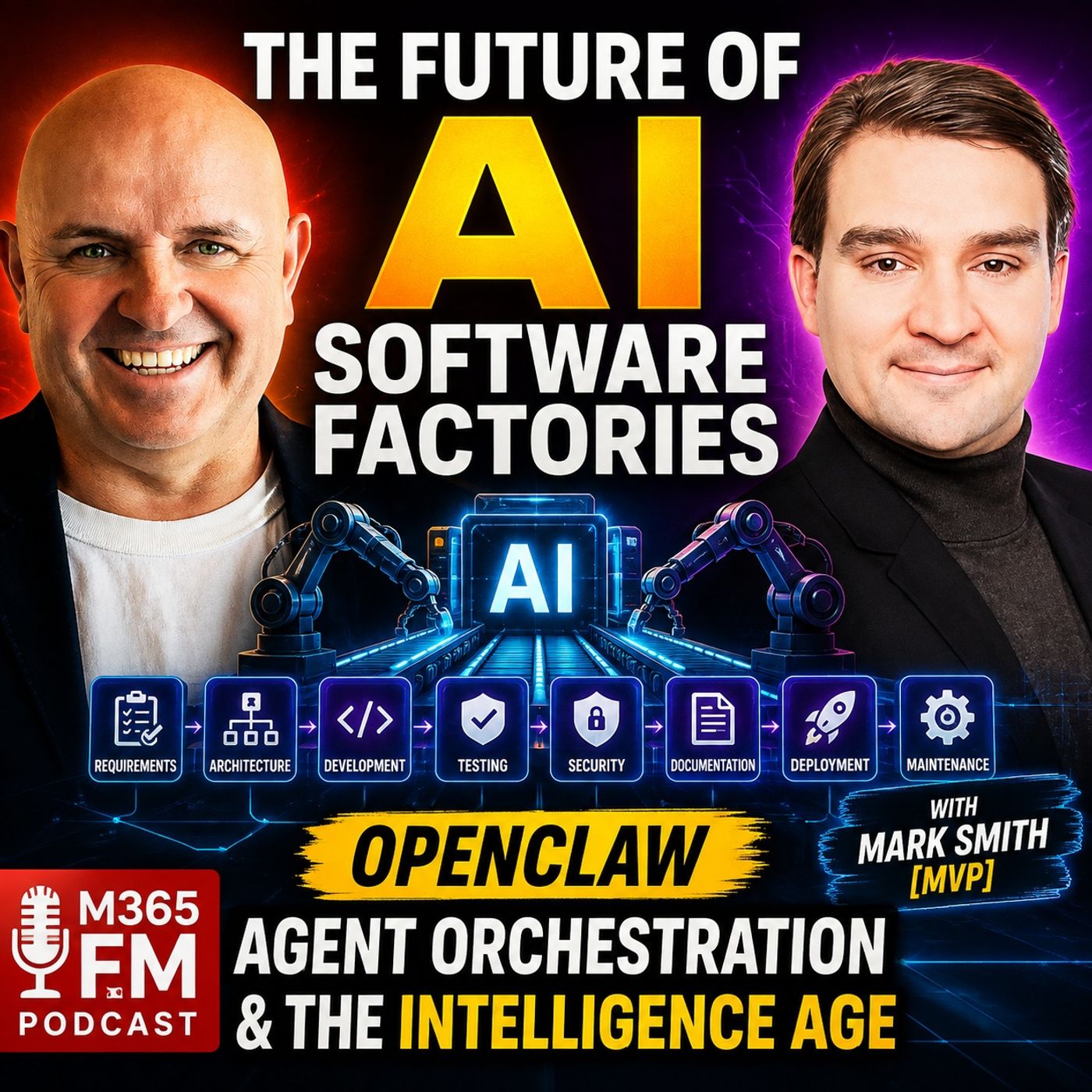
The Future of AI Software Factories- OpenCLAW, Agent Orchestration & The Intelligence Age with Mark Smith [MVP]
Show notes
What happens when AI stops being just a tool and becomes the team that designs, builds, tests, secures, documents, deploys, and even maintains your software?In https://www.m365.fm/mark-smith/ of the M365 FM Podcast, Mirko Peters speaks with Mark Smith [MVP], widely known as NZ365Guy, about the transition from traditional Microsoft development toward AI-first software engineering. Mark brings decades of experience across Microsoft technologies, Dynamics 365, https://www.m365.fm/power-platform-simply-explained/, https://www.m365.fm/categories/copilot-talk/, AI platforms, consulting, training, podcasting, and software development.The conversation goes far beyond Microsoft Copilot. Mark explains how he is building his own AI software factory with specialized autonomous agents, why he uses OpenCLAW as an AI harness, how multiple AI models can work together, why context engineering is becoming more important than basic prompt engineering, and what developers and IT professionals should learn to prepare for the Intelligence Age. FROM MICROSOFT TRAINING TO THE AI ERA Mark's journey into the Microsoft ecosystem started around 30 years ago. What began with an interest in learning web design eventually led him into IT training, Microsoft infrastructure, networking, management, Dynamics CRM, Power Platform, Copilot, and AI.He recalls the early days of the web, when technologies such as HTML and CSS were still relatively new to many organizations and Microsoft NT4 was becoming increasingly important. Over seven years, Mark progressed from selling technical training to delivering courses himself and eventually becoming general manager of the company.That experience created the foundation for a career that would continuously evolve alongside Microsoft's technology stack. FROM DYNAMICS CRM TO POWER PLATFORM AND AI Mark describes how his Microsoft journey moved from early Microsoft CRM into Dynamics 365 and later Power Platform. He was attracted to CRM not simply as a sales system, but as a platform that could be used to create many different kinds of business applications.Power Platform continued that evolution through low-code development. But Mark believes the next transition is significantly larger.AI is changing the interface between humans and software development itself. Instead of spending hours navigating configuration screens and traditional user interfaces, developers increasingly have the ability to communicate their desired outcomes through prompts, APIs, MCP interfaces, command-line tools, and https://www.m365.fm/ai-agents-simply-explained/.For Mark, this represents a fundamental shift away from traditional low-code development toward AI-first software creation. THE MOMENT GENERATIVE AI CHANGED EVERYTHING Mark began exploring AI years before ChatGPT, particularly around machine learning and Microsoft's Cognitive Services. However, the arrival of ChatGPT in November 2022 made the scale of the coming transformation much clearer.Another important moment came when he experimented with early Copilot capabilities inside Power Platform. During a Microsoft MVP session, he was able to prompt an application into existence while the technology was being demonstrated.That experience reinforced an idea that would increasingly shape his work: software creation was becoming conversational. WHY MARK EXPANDED BEYOND THE MICROSOFT AI ECOSYSTEM Although Mark has spent decades working with Microsoft technology, his current AI environment is deliberately multi-model.He discusses his experience with OpenAI, Anthropic, Microsoft models, Chinese AI models, European models, and other providers. Rather than designing systems around one vendor, he wants the ability to select the best model for a particular task.This approach reduces dependency on any single AI provider and allows the underlying models to change without rebuilding the entire system.The model becomes a replaceable component rather than the center of the architecture. TRUST, DATA SOVEREIGNTY AND MICROSOFT AI The discussion also explores why Microsoft's ecosystem remains important for enterprise AI.For regulated organizations, the location where AI inference happens can matter significantly. Data sovereignty, compliance requirements, infrastructure location, and third-party model providers can all affect whether an AI architecture is acceptable.Mark explains that he is developing software where Microsoft's own models and infrastructure can provide an important trust advantage. Organizations that already trust Microsoft's cloud environment may prefer AI workloads that remain within that ecosystem.This becomes particularly important in countries and industries where data cannot easily leave a specific jurisdiction. WHAT IS AN AI SOFTWARE FACTORY? One of the central topics of the episode is Mark's concept of an AI software factory.Traditionally, software projects require multiple specialized roles: requirements analysts, architects, developers, engineering managers, testers, security specialists, documentation teams, and release managers.Mark asked a different question:What happens if each of those roles becomes an AI agent?His current environment contains a team of specialized agents that represent different responsibilities within a DevOps-style software lifecycle.Instead of one general-purpose AI trying to perform every task, each agent operates within defined boundaries and responsibilities. SPECIALIZED AI AGENTS IN THE DEVELOPMENT PROCESS Mark describes several agents within his software factory.A requirements-focused agent gathers and structures requirements. An architecture agent researches and designs the technical solution. Development agents write code. Other agents handle verification, security, documentation, releases, maintenance, and orchestration.The agents are intentionally restricted.A developer agent, for example, should not simply declare that its own work is correct. Verification is performed separately. This introduces checks and balances similar to those found in mature human software engineering organizations.The result is an agentic development pipeline where work moves between specialized AI roles rather than relying on one large prompt. RESEARCH BEFORE ARCHITECTURE Another important principle is forcing agents to research before making architectural decisions.Mark does not want his agents relying on potentially outdated assumptions. His architecture processes therefore include awareness of the current date and research into current approaches before technical decisions are made.The objective is to answer a specific question:If we were building this system from scratch today, what would the architecture look like?This is particularly important in AI, where models, APIs, frameworks, security recommendations, and development patterns can change extremely quickly. RALPH LOOPS AND AUTONOMOUS DEVELOPMENT Autonomy becomes much more powerful when agents are capable of continuing work instead of stopping whenever they encounter a problem.Mark discusses his use of Ralph Loops, where agents continue working toward a defined goal until the issue has been resolved.This allows development activity to continue overnight.An agent can write code, encounter a verification failure, receive feedback, correct the implementation, run through the process again, and continue progressing without requiring Mark to manually intervene at every step.However, safeguards are necessary. Mark also implements mechanisms that stop agents when they repeatedly fail, preventing uncontrolled loops from consuming infrastructure resources indefinitely. AN AI ENGINEERING MANAGER The individual agents are coordinated through an orchestration layer.Mark describes Tara, his engineering manager agent, as the interface into the DevOps team. Tara coordinates the work between agents and ensures that tasks move through the appropriate stages.Rather than manually communicating with every development agent, Mark can interact with the orchestrator.This creates an architecture that resembles a real engineering organization: specialists perform defined tasks while an engineering manager coordinates the overall workflow. SELF-HEALING AND SELF-IMPROVING SOFTWARE SYSTEMS The software factory does not only build software. Mark is also experimenting with systems that monitor and improve themselves.He describes Ruru, an observer that operates outside the primary OpenCLAW environment.Ruru monitors infrastructure health, API availability, resource consumption, and other operational signals. When an issue is detected and verified, it can create a ticket automatically.The development orchestration system then discovers that ticket and moves it through the development lifecycle.In some situations, this means a problem can occur overnight, be detected automatically, enter the engineering workflow, and potentially be resolved before Mark starts work the following morning.This leads toward an important AI engineering concept: recursive self-improvement. WHY MEMORY MATTERS FOR AUTONOMOUS AGENTS Agent autonomy is not simply about giving an AI permission to execute tasks.Memory becomes critical.Mark discusses the need to distinguish between short-term, medium-term, and long-term memory. Agents need enough persistent context to understand what was created months earlier and why particular decisions were made.Documentation therefore serves a different purpose in an AI software factory.The wiki is not only written for humans. It becomes institutional memory for the AI development organization.Agents can refer back to previous architectural decisions, impl Become a supporter of this podcast: https://www.spreaker.com/podcast/m365-fm-microsoft-365-azure-cloud-power-platform-ai--6704921/support.
Apple Podcasts · Spotify · YouTube · YouTube Music · Deezer
Host: Mirko Peters
Guests
Related articles
Transcript
Read the full transcript
You're welcome everybody to another episode of the M665FM podcast. The podcast where we look on speakers Microsoft professional architects, consultiles, developers, IT leaders and decision makers. And yeah, we try to learn directly from every people in the Microsoft and from the Microsoft technologies. The days guest, I think it's someone who not really meets an interaction in the Microsoft community. And my guest is Mark Smith also known as the NZ 365 guy has been a Microsoft MVP for 15 years or over 15 years. Microsoft certified, okay, certified China founder of global based out of the Microsoft press book Microsoft 65 co palette adoption creator of the global success for 90 days mentoring challenge in the host of the. Yeah, over podcast, I think you have renamed it from the intelligent age podcast to Microsoft innovation podcast. Well, yeah, with more than 800 episodes and published since 2017 over the years, Mark has held thousands of professional worlds understand Microsoft technologies from dynamics 365 and power platform to today's rapidly evolving world of AI co palette in. Yeah, intelligent agents recently his focus has shift to one of the most exciting areas enterprise AI AI software factories and open claw where multi AI agent color, to design build and test to live a software ways called fundamental change how organizing create digital solutions. Yeah, welcome Mark. It's still amazing to have you here. Thank you. Thank you. It's a pleasure to be here. Yeah, so we've let the size normally you are the host. So, Mark, can you a little bit tell us how you how you become a part of the Microsoft ecosystem. Yeah, that's interesting. That started 30 years ago. So a long time ago, I was working for a company at the time that. Was involved in IT training. It was a company called New Horizons, which was headquartered in California. And I joined a company at that time that had the New Zealand franchise of that IT company. And I joined it because I wanted to learn web design. It was my goal. I had the company I was working for, which was in the medical industry at the time. I decided that we needed a website and started down that path. And back then, if you didn't have a super light as in from a file size on your website, you got criticized severely from the market. And so, you know, that was HTML, CSS back then you had to learn the whole everything and building sites. And so, this company advertised that they had a web design course that you could do over the course of a week, a full intensive, you know, six hour a day type web design course. And remember, this is at the the birjing of the internet. Back then, you know, Google wasn't even a thing. It was the search engines were were ultra vista and how was the other one as in. Fireball and you know, yeah, really, really old tech back then. And that was the start for me. And I joined, sorry, I signed up to do this course and then they told me that the course didn't exist. That they were aspirational and wanting to teach the course. And so from that, I joined the company. And as a salesperson of the training, and I sold the first 12 seats as a 12 seat classroom, I sold the first 12 seats and we didn't still didn't have a trainer. And so then they put me on train, the trainer out of the US at the work through the night. I learnt the web design course as the trainer. And then the next week, I delivered to the 12 students, individual students that I'd sold onto the course. So, and that was the start of it. And that was my start into IT at the time, really big, the big thing to get was that was. You know, by that, at that point, no value was switching over to Microsoft, been the big player in network operating systems. NT4 is what I started on from a tech perspective. And I was just immersed in it then for seven years. I taught courses on, I ended up teaching like a five day course on internet working, which covered everything around how packets move across the network, how they function down the OSIRM, which basically means how they get from your screen to the other side of the world. What's all the routes, you know, what is DNS, what is all the things that make the network infrastructure work. And that was, you know, my journey, I mean, I got exposed massively to Microsoft tech. At the time, I also bought some micro systems into the company, and I want a big contract for delivering all the Sun Microsoft system, system training. By that point, I'd moved into management and I became the general manager of the company over that seven years from starting off as the salesperson to getting into that position. And really, you know, I've been with Microsoft ever since. Yeah, you have worked across dynamics, power platform, corporate, corporate AI. How has your, your own career evolved alongside the Microsoft transformation? So it was, I, at this training company, our CRM was built on Fox Pro. Now, just to give you an idea, that means it was, it was never designed to use a mouse on it. It was designed to use keyboard shortcuts and, and key combinations. It was, it was designed pre-email. So you think there wasn't even an email address field? Well, not pre-email. It was never designed for email because email wasn't even a mainstream kind of construct. Then everything was phones. It was all around calling people, getting people on the phone and, and, you know, our draw card was, you offered a one day free training. And you've got to remember, this is the, the start of all tech. It was a start of using word in XR on PowerPoint. Now, I mean, our most popular course was exalt training. A two day, a two day exalt training course was the most popular course. But, you know, we, I was looking for a CRM that was a bit more modern. And the, the, the company, the pairing company, a new horizons wanted to go with the product called sales logic, back then. And Microsoft had just bought out MSCRM. And it started as MSCRM 1.0 in 2003. It started 2003. And by November 2003, it was MSCRM 1.2. And, and then they skipped too entirely and went to three. And that's when the dynamics name started to kick into play. And that was because they had bought other more ERP related products into the suite and that bazaar suite. And, you know, I got to say, I just fell in love with the tech. And for me, it wasn't about like a saw beyond the vision beyond CRM systems, which is to be able to build any type of system. And really, that was the original low code system that, that I touched from a Microsoft perspective. And you think SharePoint was only just coming out around the same time. It was, you know, very new SharePoint and content management systems at that time. They were all brand new things as well. I mean, our mobile phones were brand new. Like, you know, it was, it was a big deal to be able to get the web browser to work on your mobile phone back then. And so, yeah, it's been a long journey in tech. And so I've ridden the, the dynamic CRM and then Dynamics 365 journey right up to 10 years ago. But over 10 years ago, now Power Platform kicked in. And so, rode that journey and, but you know, one thing I've always observed about the smart people at work inside Microsoft. They always move to where the money where Microsoft is investing the money. And if you've just watched this space for a little while, then not really investing it in Dynamics 365, then not really investing in the Power Platform. And I might get some hate from that, but read the writing on the wall. Look at the people that have left Microsoft in recent times and look at the product teams that they've been involved in. The day of low code has been superseded by AI. And that, I can do a lot more with a lot deeper technical functionality and technical ability. And I low code just slows me down. A UX, that's, or UI, sorry, that's in the way slows me down. I'd much rather be at a COI level. I'd much rather be at a prompt level, MCP API level, to drive the results that I want, then spend hours wasted on configuration screens to try and make the software perform. How I wanted to perform. Yeah. What was, how you, one was the moment you realized I would fundamentally change software development. I mean, the day, ChatGBT became a thing in November 2022, I got it that day, right? I list on Reddit, I'm on X, I never left X from the Twitter days when a lot of people did. And so I heard about it and I was on it that day. And I called my wife over and said, well, check this out. What I was able to do. Now, at that point, Microsoft had already done the deal about two years earlier with OpenAI to acquire the IP. And, you know, I can remember Charles Lamana talking about the initial versions of GPC and in regards to power effects and things like that. And I started really getting interested in AI, I suppose, around 2018 when I was in London. And particularly, you know, Google were doing some great things and I always saw that what Google was doing was academic AI. In other words, it was like awesome stuff, but like, how do I use it? Right? And what I saw from Microsoft at those early days, and this is back in, this is pre GPC. So this is back 2018, 2019. And so really much more around ML and cognitive services and things like that. Microsoft was starting to really what I call created practical AI. In fact, they might have even been calling it practical AI. Like AI that really could move the dial in your business. And so, you know, that's where I started getting excited about it. I started writing blog posts. In fact, I'm sure you can go on my blog and find posts on AI from 2018, where I was writing and exploring and I was interviewing people on my podcast that were in AI, particularly across Europe at the time, because I was in the UK. And then, but it was, I suppose, there was an MVP session, like an MVP summit that I was, it was in COVID. And so it was still locked down. We couldn't travel from memory, or they just at the last minute allowed travel into the US at the end of the COVID type run. And Charles Lamana got on stage and talked about, you know, co pilot inside of the power platform. And you have been your ability to just speak into creation. And while he was doing it, he said, and by the way, in your MVP tenant, it's their available one. So while he's presenting, I'm on my laptop and I built an app while he's talking to manage seeds. And, you know, I've got a big garden, I've got a centropic forest that I'm building. And so, and one of the things I want to do is like when's the optimal time to plant seeds, you know, if for any type of species that I was wanting to plant, what was the best conditions, etc. And I was able to prompt that app into reality while he was doing the presentation. And for me, it was like, I could see the future and, you know, where it was going to go. And so I haven't been a Dynamics 365 or Power Platform MVP for two, three years now. So I pivoted it. I pivoted first into the next category I went into was AI platforms at Microsoft. And then in the last renewal cycle, I've actually gone into co pilot. And that's because, you know, writing the book, as you said, on co pilot adoption with my wife, has taken that pivoting journey and they switched AI platform MVP just to Foundry MVP. And, you know, bless Microsoft, but they get so enamored with their own product names that they forget that it means nothing in the market. And so, you know, I wasn't too much of a fan of being a Foundry MVP because you had to explain it to everybody what it meant. And I'm happy to go to co pilot because at least I think it has a higher profile, but also in more recent times, you know, I have got heavily into AI outside of Microsoft. And because I fundamentally feel Microsoft has lost its way in the last three years in the AI space as a whole. It went from a absolute, you know, when if you look at November, going into the new year, calendar, new year in 2023, I think there was a graphic that came out at that time showing Microsoft that a 64% market share in AI because of its relationship to open AI and the assets that it already had in Azure. And unfortunately, my observation, Microsoft was always good at chasing the market leader. They've never, ever, ever in my estimation, and I'm happy to be proved wrong, although it's irrelevant, not good at playing lead and owning and demanding a space. And I give you like three or four examples. There was no Valnetware. Then, he four came out and Microsoft dominated and ultimately took over that space. There was Lotus 123, right? Spreadsheets ex-out dominated that space took the market share. Word perfect, word, even let's go into gaming, right? There was PlayStation from Sony and then Microsoft jumped in with Xbox. So they're good at chasing a category. They don't seem to be good at leading a category. And what I feel that's happened in the last three years, their sales org, their marketing org, and even their R&D or product teams just went after the wrong goals. They didn't have clarity. They just thought if we chuck the name Copilot on everything and force it down people's throats that people had adopt. And of course at the start of this year, the data came out in the earnings report. That something like 3.4% adoption of Copilot globally, which is, if you're a startup, that is a multi-billion dollar business, about a $4 billion business. Nice. But you're the biggest company in the world at the time. That's not good enough. That's not how the game is played when you're the biggest company in town. And so I feel that they've lost their way. Now one thing I'll credit Microsoft, they tend to play a long game, right? And so they will iterate and iterate and probably ultimately get this right. But right now, they aren't. They're playing catch-up, they're playing follow me, and Throppaker releases co-work. Oh, now Microsoft's under deal with them because hey, this is the latest shiny thing. OpenClaw becomes a big deal then we've got Scout. And I'm just like, you know, and then they've released three or four models, the Maya models, and on the announcement that built, they're nowhere near on par with what's in market even now. They're like, all five, like the open models are ahead of them. And I know that that's the start. And they will probably win long term with this strategy. But I didn't want to be held up with only drinking Microsoft's cool aid for this AI era. So I have gone deep into a topic. I've gone deep into open AI. I've gone deep into open claw. I have nine different APIs into other models. So like I use Chinese models. I use European models. I don't want to be restricted to only one flavor or only one dish on the menu. Yeah, I think that's really interesting. I think also the start of co-pilot was really, really bad that start because it's, don't feel like an AI. It feels like clippy is back. It's only says you're okay. Yeah, I mean, I look at how much it got mocked and, and for that, that, that exact type of thing. And I think what they did is they didn't use the latest models from day one. They always used behind and so people were getting this AI experience and market with the consumer type apps. And Microsoft just sucked them comparison and their only kind of story was, hey, it's on your data. But nobody was experiencing the value of it being on your data. And another thing is companies data estates are so bad and full of so much human error, duplicated thousands of times. And what happened is that the results weren't great even if it's on your own data because you know accounting and set that spreadsheet out for the last five years every week and there's like 500 or 1000 copies of that spreadsheet all with the same formula error, all with the same formatting error or whatever other error. And then you go, AI, look at this and give me the correct answer and it goes, well, your pattern is fully human error. And so I'm just going to copy it and then everyone gets upset about hallucination and AI's sucks and stuff. And I'm like, it's just train on bad human data. Yeah, yeah, I think that's a real big topic. But have you also tried the Microsoft models? I think it's P4 and MIRR. So it's MIRR is as I'm building a product at the moment as an ISV that I am only using the MIRR models because I want it to be economical for the people that buy this product. And I wanted to 100% sit in Microsoft's ecosystem, in other words, on their infrastructure with no inference being handled off to our third party AI model. And the reason is trust. Microsoft has created a good trust profile with their customers. And you know, right now, if you're using co-pilot and you're using opus 5, for example, you know, if you go, you know, move away from the auto selector and choose your model and co-pilot, the compute or what's happening there is not even being done on Azure infrastructure. It's been handed off to AWS infrastructure. It's been computed outside Microsoft's ecosystem and been handed in, same for co-work. It's not been computed on Microsoft's infrastructure. And so for a lot of regulated industries, that's a problem. Data software, that's a problem. You know, it's not operating in my local data center. And even, you know, I'm in a little country called New Zealand. We have got no AI infrastructure by the hyperscalers in country save. AWS about three months ago put a bit of infrastructure in. So they're really the first move, even though Microsoft has its own data center in country. There's just not enough silicon to go around. And, you know, New Zealand, five million people total. We've got more sheep than we have people. It's not like a prime market where they're going to make a lot of money on AI. So I can see why it's not here. But it changes the profile in a regulated industry where let's say the government says, you're not allowed to send financial data outside the borders of the country. That creates a problem for people. And, you know, in the financial or regulated industry. So therefore, even co-pilot, you know, can be difficult unless they, you know, talk down and say, we don't want to throw up in the mix. Let's make it just GVT that's running on Azure and having that control. Yeah, I know it. I live in New Europe. We love Rayleigh. Yeah, what? I mean, just at the first month, New Rules kicked in in the EU AI Act, right? Now, new penalties just kicked in to play on the first of this month. So you know, yeah, it's a, it's a really, really hard topic here. What, what, what, I think you have the, this road, AI software factories. What, what does this mean? Yeah, so an AI software factory, you know, over my career, I've had, you know, teams of developers work for me on software projects. So I've had my architects, I've had developers, I've had my QA testing teams, and my project managers that, you know, have run the team. And I've always loved the concept of DevOps, although I've really struggled to ever see it fully implemented in the organizations I have been in. And that's partly because I've always worked for partners and you really don't run a DevOps for another customer. The whole idea is it's an in-house operational thing between the developer side of the organizational engineering and your business. So what I did is I sat down and I said, could I construct a, in my case, it's now a nine agent team that each one falls a role in the DevOps, Infinity Loop. And they are gated, they can't do any work outside their role. So, you know, I have, uh, ARC, and the ARC is my architect. I've scouted, my scout is my, um, takes requirements. And so it has a formalized requirements gathering process that it goes through with me. Hands-it-arc, ARC, you know, has to go out is very deterministic and very many elements I put into is about how they research, then I'm allowed to just start roofing on something without showing that they have researched it. And so one of the kind of, um, parts of the scaffold I have in place is I require them to always look at today's date and then they have to research the latest finding in whatever I'm doing. And so I don't want historic, oh, three years ago, this is how it was done. And that's why I'm architect me this way. Hell no, right? It's got to be how would we do it if we were starting today from scratch? How would the architecture look? And then, you know, it goes through, I've got Cody, does the actual code development. Now, I've got different models that are doing different that, that, a power these different agents. I have Tara, Tara is my, um, engineering manager. She's the orchestrator across all of them. She makes sure they hand off, um, I've built in Ralph, what's called Ralph loops, which is make sure that they keep, they keep going to they solve because agents often will go or that they will stop and ask just a benign question, but that stops them. I want to get up in the morning and a piece of software that I've specced is built. And it's now ready for me to get demoed. It's gone through its test cycle. Um, I have a security, a role that is security. It uses, um, um, um, Microsoft's red teaming resources as part of that. It does a red teaming process on my release cycle. It goes to Rex, my release manager. It goes to Wiki that does all the documentation for it. So it's this continuous loop. And then recently I built a maintenance system in that it's always checking the security posture of my environment. Or by the way, all this runs on Azure, I run the entire thing on the, um, and, um, and, um, I've got a lot of Azure resources coming into the mix now, you know, of, uh, started to have to add in blob storage. I've had to start adding in, you know, you've quickly find API key management becomes unwieldy. I think I'm over 300 API keys now. You don't want to be managing those, um, manually. And you never want them into being in plain text format, right? Because it's a security, um, vulnerability. And then what would often happen if they weren't encrypted, you would get an AI model that would output a key to screen and go, oops, oops, we need to rotate the keys because I fucked up type thing. And then I'd be like, well, how do I stop the AI making these stupid mistakes? And so, you know, um, they use things like key vault. You don't crypt, you, you, you abstract the way. And this is all the learning. So, but now I've got to kind of, I, I use, um, uh, uh, DevOps to, sorry, I don't use DevOps. I use, um, GitHub to run all my repos. The agents have, um, app, what's called app level access to those. So I can see the identity of who's doing what, um, across those. I have, I use the project management board, um, inside the company profile. So it spans all my repos. And, um, so I can get a real time dashboard. What cards, what tickets been worked on? Are they, you know, at what stage of that DevOps cycle are they in? Are built multiple dashboards that, you know, are built full routing tool for all my, um, all my, uh, AI models. And so it has a, a price comparison. At the moment, it's, it's, uh, it's selectable by agent. My next bill I'm going to make is I'm going to make it, um, route based on task. So in other words, it's going to choose the API or the LLM that it's going to use based on the task that it's actually doing. And so this is all around cost optimization, um, of the models. And so now I'm starting to build, and the crazy thing is the first bit of software I built was back in January. And it was because my kids' local skill wanted to run a fishing competition as a fundraiser. And someone told them that I knew something about AI and my girl had only just started five years old, started at school. And so they said, yeah, here's the, the paper that we used to run this competition. It's been running for 25 years as fishing comp. And I used AI to build out a full, uh, dashboard for at the event, somebody displayed on screens. I did apps that people out in their boats when they're fishing could measure and weigh and photograph their fish for a catch and release. I built this whole thing myself and it kind of stunned what I could do, you know, and, um, all that kind of my whole IT career, I've gone from being the lead of teams and stuff to not to be able to build myself. Have an idea, I'm always an ideas person. So I'm now able to quickly take an idea, iterate it into a production based app. And so the, the, um, the software factory is, you know, um, at the end of the day, uh, a DevOps team with Ralflux loops and, um, and very segregated role functions to make sure, you know, I was one of the, even the commands that said, you can never mark your own homework. A developer can never say, my shit's awesome, right? It has to be verified by my case, Vera. She's my verification and she's got a whole, uh, over 20 different release patterns that it must comply with before it will, the PR will go through. And so, um, yeah, I've, it's amazing what you can build once you start bringing, if you like, all your career experience together, knowing how software is developed and then being able to go, Hey, what have I made every single role in agent? What would that look like? And, um, it's been fun. It's built a lot of software in the last six months. Yeah. Uh, I also, uh, have done a lot of an AI factory, uh, Azure factory, uh, I don't know. They, they, they renamed it every time. Um, uh, and that's really amazing. I have built an, um, yeah, and a research tool, uh, with thousands of companies and all the employees and, uh, my idea was, uh, do a research for cyber security, uh, if all the best practices to the companies and they have started perfectly and then look, where, where did the cyber security risk come from? And I have checked, checked this and, yeah, you can ask every, every company and every, every user, uh, some questions and then it makes, uh, yeah, similar to a wall, yeah, and, uh, or enterprise, uh, will companies and that's really, really cool whether you can build, but, um, how autonomous, actually agents from, from your perspective. Sorry. Can you say that again? Autonomous, uh, um, or autonomous, autonomous. Yeah. Uh, how autonomous are the, these agents today from your perspective? So, so I, I have chat interfaces to about half my agents. So, so Tara, for example, is my interface. I have a direct chat interface to her and then she oversees the entire DevOps team. I don't have any direct interfaces with those individual DevOps teams. I can speak to any of them, but I speak through Tara to them. And so, because as I say, you know, there's, there's so much to learn. How do you handle memory? How do you make, you know, the difference between short term memory, um, medium term and long term memory, that's a whole thing you've got to sort out with your systems. That's why I spend a lot of time on the Wiki side. The Wiki is not for me to know what the documentation is. The Wiki is so that DevOps team can refer to and know what was built three months, five months, six months ago and build their, my system only became autonomous when I got Ralph Loops working correctly, um, which is this whole, I need to, you know, Ralph Loop is like forward slash goal, um, if you were in, in one of the other, one of the, um, frontier lab type products and the idea is you say, don't stop until you sort this out like to you have solved it. And so they will go and so I will go, I'll wake up in the morning and I will have over 50 PR notifications from GitHub from through the night. They are working. They find a problem, verifies a problem in their code. They send it back and it goes through. Now I do have a jump out of loop if they just keep screwing up because I don't want to wedge my VM that I've got running everything and, you know, I've gone through that process where they get into a, uh, out of control loop. And so in that scenario outside of open claw, I created a, a entity called, uh, Ruru and Ruru in New Zealand is the name for Owl. So it's, it's the Maori name for Owl and what it does is it observes everything. It's observing my infrastructure, health, it's observing, um, all my API health and this is the API that I have built. And anytime it detects something, it sends me a notification around severity. So it's looking across 20 dimensions of my level one layer, level two is then looking for downtime, uh, can't reach for a certain period of time. And ultimately that goes up to a Zua notifications when Ruru dies. How do I know that Ruru's died? Well I use a Zua then through their notification system to say, hey, your CPU's gone through the roof, you run out of RAM or you run out of this space. And by the way, Ruru hasn't phoned home, you know, in a set frequency of time. So Ruru might be down. So Ruru is really about making sure I keep my system in top, um, you know, peak state at any time because the more code you build, right, the thing that bogs you down is maintenance then of that code. And so that's why Ruru and as part of that model, it sits outside or how I've designed it outside of open claw as an observer of open claw and of anything that could break. And so the minute it finds a break that it, it, it tries again and let's say it doesn't get the response or it, or it can repeat or prove the, um, the issue. It then raises a ticket straight away over on my DevOps board. Tara is then on her loop, which she's looking at the board every 15 minutes. She picks up the new ticket that's arrived. She then starts handing it through the DevOps cycle. So I can have an incident overnight, but when I get up in the morning, it's solved because it's been triaged through, um, and the outcomes been addressed and, um, built into the code. And so what could one of my drivers is, is around how do you create a, a self improving system? And this is a big thing with AI models at the moment, recursive self improvement. So I take that thinking and go, okay, how can I improve my DevOps team? What's the new learnings it's going to take from the last month and improve itself for the next month's worth of work? And so the DevOps team that I created five months ago is far superior now than it was then because it's actually always improving itself. And I've got this maintenance layer that is always scanning things like security, best in class security, best in class architecture. Um, I have all these different layers. And the minute it detects a maintenance issue or I'm using, you know, um, uh, a vulnerable piece of code or something like that, it then just raises a ticket straight away on the DevOps team and their job is to research and solve it. And so my, my system is super stable, super secure. And um, because I'm losing all the best in class security from Microsoft and I did that from day one. I originally built on Windows, um, first PM and I lasted three days until I went with a headless and put into environment and I tell you, I've never looked back. Um, it's just, yeah, I mean, I built full rag databases and all sorts for, for handling, um, cross agent. How do you get out? How do you tell agents that they know other agents are involved in your business? Like had to build a crew of a global address list that you would have in real life, but for agents. And I can know who else could help me to do something, um, built hundreds of skills. I don't like to take anybody else's, um, skills like if there's skill marketplaces and stuff. So what I typically do is I will point, um, my AIs at a, a, a repo where somebody's got a skill or, or some idea and I'll say research it, then go out and five, five competing products and research what their nuances. And now let's plan our skill and how we'll create it. So I don't have any dependencies on anybody else's, um, stuff to say politely. I don't want any risk like having an early days in the marketplace where you're getting some, you know, um, bad actors putting skills up to get, you know, access. I've never had those issues because I don't use anybody else's skills. I always, uh, research the concept of their skill, then build it myself. Awesome. So, so the soft, the system do is the requirement gathering, architecture, UX design, coding, testing, security reviews, documentation, and deployment. Yeah. So what's your, uh, my, my job is just keep feeding the new ideas. You know, for example, um, about a week ago, I started to build a full accounting system. Um, and, uh, but, you know, and like accounting software doesn't spin my, um, my wheels, but I need an account, I, you know, I've used their company for 15 years in my own business, um, called zero. Um, they're one in, they're New Zealand's most successful company on the global stage with its software. Build probably rocket labs is up there challenging them now, but each year the price goes up and accounting is accounting, right? The government doesn't change the rules around accounting all that often. If there's a change, it's just a new tax. But the price keeps going up for the SaaS service of kind of accounting has been done the same way in New Zealand for the last hundred years. It's probably going to be done the same way for the next period of time. And so I was just like, I'm sick of paying these SaaS fees. Why don't I build an accounting kernel that every type of business software, small business, not the enterprise. I'm not tackling that, that, that game. And I've opened source it. But I'm getting up open source. So I'm designed for New Zealand because I just want to give something back to the New Zealand market, but allow any business to point their AI at it. And it's, you know, from the core kernel of my, what I call the New Zealand ledger, it has full CLI access, full MCP access, full API access. But it's built with the idea that agents are probably going to be the main operator of this accounting system as well as humans. Where most software accounting software is designed for people and accountants. But by booting this core kernel, I can then allow any company to build their unique layer over the top. So if they're a project management business, they can build a project management module. If they've, you know, got warehousing, they can boot a warehousing module on top. But it's going to be AI first in how it's been engineered from the ground up. Yeah, that did. It's really cool. Awesome. Yeah, we also an expert in open claw. What problem do you solve, Zulford? So the big thing for me with open claw, right, is that open AI has been the main product I have been on since November, 2022. As soon as the $20 plan I was on it, as soon as the $200 plan I was on it. And then open AI started to make some really dick moves in the market, just fumbles back in 2025. And so I was like, okay, I'm going to go deep on on Thropic. So I went deep on on Thropic January this year, February. And then, and then, you know, and Thropic starts shooting itself in the foot, you know, they started screwing the model, right, because they ran out of compute. And so rather than tell the market what's going on, they start to throttle you back. And so all of a sudden, I'm looking at some code that it's producing. And I'm like, it's producing what looks like code. And then when you look at it, it's just, it's not there. It's saying it did it. And it's not there. And so what I loved about open claw is that I own the harness, right? I can plug, as I said, I've got nine different API connections, not even including open router. That's another connection I have that allows me to pull on Chinese models, European models in US models as as I see fit, but none of them own all my stuff, all my own stuff sits in Azure, all my own that whole DevOps team, I've changed the models behind various agents multiple times now, right? And the beauty is, I don't have to reinvent my system where I don't have to move the context out of one system and import it into another system because the context sits in my open claw environment. And that's the power of the system. I don't care what models I don't care, you know, whose model is ahead at the moment because I will always have the latest models and I will always be able to switch the minute now to work on what, but I don't have to set context every time. Context sits with me. I think I have to ask you that question. Adulity? Yeah. Okay. I can still hear you. You don't want to ask me about what I think about co-pilot studio. Here. It's not positive. I think co-pilot studio is an interim solution to try and gather up the low-code audience and give them something a bone, you know, because I remember the day the predecessor, what co-pilot studio is built on, was released and there's a blog post where I put a little chat bot on my site, you know, this would be back in 2020, I would say, or 2019, the end of 2019. And the thing is, once again, I don't want to low-code, agentic platform. I want an, I, I, I, I prompt, I want English as the engagement or language as the engagement layer. I don't want to know, did I plug in the right API at the right time and did I, you know, did I put the right, I just, I hate the product. I think it's shite. I think it's a product that doesn't need to exist. People, if they want to build stuff, just go straight to Foundry and build there. Nowadays, get your AI skills up that you can just work directly with Foundry. You don't need an interim solution with a, a stupid monetization model in my mind in place. It's Microsoft once again, fumbling to find relevance in the space with a solution. So you asked the question, sorry about the answer. No, no, no problem. So I'm a little bit more happy. I never have used co-pilot studio yet because I'm happy with AI Foundry. I never, I also never see the reason for, for, for, for this product. So, yeah. Um, I think one topic, especially when we talk about agents, it's, it's governance. How, how did you handle the, the governance stuff? So this is a cool thing. Microsoft have got really strong governance, um, uh, content available. And so you can take that governance content that they have available and plug it into your system. You can say to your AI, go read this, understand it. And I want to implement that exact type governance framework in, in what I am building. And so governance is slightly easier when you're only one person, right? That's governing everything. I put very strict gates around what has to have my eyeballs on it. Um, well, like I don't let, um, my open core environment, I built a, this, my only other open source product, I built a CLI into, um, into Microsoft graph from, um, open core. And I can access anything that's in the open, over the Microsoft graph, um, and that means that I can do from open core posts into teams, I can delete posts in teams, I can send messages to people inside organization and teams, I can read all my email, read all my calendar. Um, I've had that maybe for five months now, but I have never given it the skill to write an email. Um, I've never given it, so in other words, I've given it, uh, the ability to create appointments for me. So what I do is I have my agents, my agents actually can create appointments with me when it has to present a concept to me, uh, whatever agent it is. And so they go through, I have a main agent called Rook. So Rook is my, uh, personal, uh, like my PA agent. So not all my agents get access to my diary on my M365 calendar. Only Rook does. And so if somebody wants a time in my diary from my agent team, they have to broker that through Rook. And so Rook has a whole bunch of operational rules around how it can set messages for me, what times of the day I do and don't take appointments. Um, it will, I'll let it draft the email, but I don't let it draft the email inside of outlook. I have a draft is, uh, to a markdown file and then I copy and paste that markdown file into, uh, an email. And I'm, I'm the person that doesn't have a lot of email nowadays. I've got, you know, I've run for over 10 years on a zero inbox principle in my business career. Um, something to learn from a book called Getting Things Done Years ago. And so because I have my email so optimized, like I don't get spam, I don't get newsletter emails because I have a, uh, automations that automatically clean those out. They automatically put them into my, uh, folder called spam and then, um, I will then point the AI at that spam photo and is there any, I don't even go look at it. I say, is there anything I need to be, uh, you know, identifying here and I let it handle that. So I'm, I, I, I believe that within 18 months, I won't have email anymore. I won't have that need for email in the traditional sense that, sorry, let's change it. I will have email, I won't have outlook and I won't have replaced outlook with another mail program. An agent will make me aware of any, uh, email and an agent will, at that same agent will, you know, take a dictation from me, whatever and send under my approval. Um, I will find the eliminate outlook from my life. From me, eyeballing outlook. Um, what, what did you think about, um, I think that needs to invest heavily in AI and, uh, data centers and, um, I think there's something coming new that's, uh, and, uh, media, how development with Microsoft. So this, I think it makes 1000 terror flops and the new windows should be in a minimum, I think 20 or 40 terror flops. It's the, uh, environment for next window system. Did you think we, uh, in, in having AI on your, on our, our out sees, if you don't? Yeah, I, yeah, I'm convinced that AI is going to move, um, like it won't move away from the cloud, right? AI will be, you know, still will have optimization, the cloud, but what I do really believe, and I've run, um, models locally on my, I've got a, you know, a high spec, um, Nvidia card in my computer. Um, so I've run models locally and I think that we're going to run to a world very soon within the next 12 months where AI will run locally. That will be as good as what the current front end models are providing, but it will be local on device. And so I think compute on device and the ability to run on device as good as what the current, um, providers are right now. So I'm not going to say they're going to be as good as the day that you're running them locally as the model that we're running that day in the cloud, but I absolutely believe compute on the edge and AI at the edge will be our first class and will be a, um, will be in all sorts of devices. I believe, you know, my, my money is still even though they've fumbled the ball badly, is that Apple will nail AI at the edge on their devices and we will naturally see it on, um, you know, on the PC as well, AI on the edge in time. Um, and that will be a massive, uh, massive enabler, um, of what's possible. Yeah. Um, what, what did you think for, for the people that they starting now, like students, uh, or so? What, how would it, well, they prepare for the, for the AI first career? Okay. So they need to learn a couple of things. They need, and you know, prompt engineering has been around a long time, right? Prompt engineering is, if you're getting it now, you need to really set yourself up to get a good, a prompting, but you need to move beyond prompt engineering. You need to get into context engineering and you need to really understand what context engineering is about. And then you should probably take a third step and go into outcomes engineering, um, in understanding it. You need to understand first principles. You need to understand critical thinking. And when I say you need to understand it, you need to be trained on it. And you don't have to go to fancy provider, get AI to train you on these subjects. Get it to, um, do space, space training. So in other words, you learn the same thing repeated over time, making the distance larger each time so that it bakes it into your, your computer, um, up here. Um, so those are the first things. The next thing I'd say, learn about harnesses and you learn everything you can about harnesses and why harnesses are so, so important. Um, the third thing I'd say, um, don't get bended locked in the day of, you know, drinking just Microsoft, cool aid or just AWS, cool aid or, or, um, uh, Google Cloud Platform, GBC, that, that gone, use whatever tool, use all the tools. You know, if your, uh, got xenophobia and anti-China, sort that shit out. Like they are, they're gonna win this race. Just watch the writing on the wall. They're gonna win this race and the reason is they are getting better results on poor a silicon at the moment. Um, then they're, they're, well, they're getting, not better results. They're getting on par results where the people that have the best computer infrastructure in the best silicon in the world. So if they're doing that in inferior silicon, you wait to their fabs get up to speed and they're on par at the silicon layer, they're getting so much additional layers in their architecture right that I think just like they overtook the solar industry globally, just like they've overtaken the, the, the EV market with electric vehicles and every other thing in manufacturing, they are going to be the model providers of the future. So if you've got some, you know, thing racism or anything like that about them, and you, you want to get locked into that type of thinking? Good luck. Um, but yeah, I definitely won't be and I want to know what the Chinese models are doing. I want to know what the, the, um, models are doing that are, you know, predominantly now I think of France, um, coming out of Europe and I want to know what the American models are doing. Um, and I think honestly, we're gonna get to the point where there's gonna be a lot of models that are much more refined on specific datasets, um, rather than just one of these bigger ubiquitous models that we currently have. Just industry data in the world, but we don't use it really good. So I think we have, yeah, we are doing too many compliance stuff around it and so on. And yeah, we are, I don't know, it's feeling like, uh, we have invented the wheel and, and uh, the other built the cars, uh, actually. Yeah. Uh, or what I also would ask you, you have renamed your podcast, uh, from the intelligent edge to, um, to the Microsoft innovation podcast that has the intelligent age, uh, stopped, uh, get me all stupid, uh, through all my, yeah. So the new podcast is called the intelligence age, the old one, the, the original podcast was the Microsoft business application podcast, um, and then it became the Microsoft innovation podcast and surprisingly, I've gone eight and a half years using Microsoft's name in a domain name. And on a podcast and never been pinged legally by Microsoft because if you look at that T's and C's, that's a no no. You don't get to use Microsoft's name, um, like that. And so it was actually, um, Claude that pointed it out to me, it said, well, one day, do you realize that you're in breach of Microsoft's legal thing by using their name like this? And I'm like, yeah, but I've never been pinged and it was just like, cause I was, so some of the things I do with AI is I look at, um, risk profiles, how do I do risk things in my life? I run a dashboard around what I call situational intelligence, which has nothing to do with the guy that just lost a shirt and with a situational intelligence company, um, like lost 42 billion dollars or something. This week, just passed. Um, but situational intelligence is a, uh, security, a kind of posture, which I learnt when I won this award with Microsoft years ago for crime, safety and justice. And it's ability to look at all factors going on in your environment and be aware of things that could become, um, high risk to you. And so I was working with the Australian federal government, um, at that time and we were looking at, for example, camera feed data is this person in the way they're loitering? Are they about to do something? We should track them from camera to camera just to be aware of what potentially is going on. But I go, okay, how do I do that in my own personal life? And so that's how this thing flagged that I was, I potentially could be legally pursued by Microsoft and so I was like, okay, let's back out using Microsoft's name, um, before I get asked to. And then the other thing is, is that I wanted to talk about more than Microsoft. I wanted to have more than Microsoft's voice on my podcast. And I wanted to, you know, for the last three or four years, I've released three or four shows a week. And so that was a phenomenal amount of recording logistics around scheduling, et cetera. Now when, and I haven't even started the new podcast, it doesn't start till about four weeks time. I've only done my first load of recordings this week ready to launch. Um, and I just recorded my first six episodes ready to go, but I'm only going to release one a week. So I have rather than mass producing podcasts, I am going down to, um, you know, slightly longer podcast, but really around things that deeply interest me. And if the world benefits from what deeply interests me, awesome, but I'm not like, you know, one of the things in a conversation I have with AI often is I don't want to be an influencer. I want to be a value creator. So everything that I do, podcasts, et cetera, is it creating value for other people? I will do it. I'm not trying to make, um, I'm not trying to influence others. I'm trying to create value for others. Yeah. And the, the, the value topic is it's good. Yeah. Uh, what value can we expect from the 90 days mentoring challenge? Yeah. So the 90 mentoring challenge, like I've had a lot of people go through it. Um, of the people that have been on it over 65 of them. And they've become Microsoft, MVP's that have gone through that program. Um, I was running it all year round and it just became a hard slog for me. So I've, I've run it once this year, January, February, March. Um, that's run. I will probably release the next one in January, February, March next year. I'll do it once a year. And I've got percolating. And I mean, that 90 mentoring challenge is designed explicitly for anybody with Dynamics 365 or their careers in Dynamics 365 and the power platform. And, and it is full on. It's not an easy, um, a light process, right? It's 12 weeks where every week you have detailed lab assignments and things to do. It's like, you know, it's like drinking from a fire hose, that course. And it's been running since, I think 2018 is when I launched that and ran it every year apart from one year when I was working at IBM and I was running that 90 day mentoring challenge internally for IBM is around the world and I didn't want to, um, and do it out in the market. So I've got, you know, I keep getting people gone, the wait list for that. So that will carry on. Um, I just refreshed all the content recently. Um, in the, for this year, um, just because so much has changed. Um, maybe I will release a 90 day mentoring challenge. Maybe it's a lot of work for me to do. Um, you know, my basically rule of thumb for every hour that I present in that 90 mentoring challenge, I've spent over 12 hours getting to that one hour of output. And so I am considering doing, um, one specifically on AI, which will be targeted at tech people that really want to become super proficient in AI, uh, consulting. So, um, but I don't know, I'm not, I've gone, I'm fluctuating. I'm whether I release that right now, I'm building software that I'm going to release in the Microsoft marketplace. I see there's gaps that I, I feel I can fill. So I've really gone down the, you know, what software can I create that's world class? I'm working with Microsoft internal stakeholders at the moment on that, um, having what I'm building architecturally reviewed and, and, and peer reviewed and things like that. So that's probably my focus at the moment is, um, what software can I build? Yeah, that is awesome. I have a rapid firewall in every session. Awesome. So, um, let, let us start short, short answers. And so, if there anything you say, um, you will never be automated in the future. No. And, uh, what did you think is the biggest thing? Oh, hang on, hang on, I do, sorry, just switch. Spending time with my family and, and friends. I don't think that will be automated. Yeah, okay, good. Um, is there one Microsoft product? Everybody should learn now. Uh, I would say co-pilot, like, learn it properly. Like, don't stay on auto, learn about work IQ, the importance of it, learn how to be really proficient in it, make sure it knows your context super well. Um, I think, yeah, there's a lot of runway for people as an, if you're just in a, if you're in a role, that is an information worker role, not a tech role, you should absolutely learn that if you're in that, what would be classified in information worker type role. Um, and, yeah. Yeah. What, what did you think, um, it's about a large language models or specialized language models? Right now, LLM. Okay. Um, you know, um, small language models, it smells, they've, they've got, they will become more prominent, but right now, LLM is where it's at. What's the habit that makes you so successful? Curiosity. Um, is there an AI list you will bust? Uh, that AI will become a, uh, sky net. Um, coffee tea or energy thing, three new development. I have been a massive energy drinker, like massive. Um, we have an energy drink in New Zealand called V and I just, I love that stuff so much. Uh, um, but I always start like, I have my own burst of machine. I have proper coffee machine. I always probably drink two coffees in the morning before lunch. Um, but yeah, I, I, you know, I, I do it. I don't do energy now because of diet and, and, and health, but every now and again, I let myself have one. Uh, what is the best food everyone should try when they come to New Zealand? Oh, if you come to New Zealand, you've got to try what's called a honey, which is food that is cooked in the ground. Okay. Let's go. So it's interesting. And, um, uh, co-pilot or chat GPT. Depends. Yeah. So, um, thank you for, for, for, for staying here with me, uh, over there. So thank you so much for, for your time. Um, what will you say when people can, uh, yeah, um, or what is the key, key takeaway from you from this session for what the people should recognize? I always not going anywhere and you need to do everything you can to be the best person in your place or the most knowledgeable, the most proficient and, and, and really, knowledge does not replace skill. We have infinite knowledge. It's the people that can apply the knowledge that can say, I've done it rather than I know it. There's a big difference. And, um, yeah, but my last question is, you have so many guests on your podcast, uh, who should I invite to them to my podcast and what questions should I ask? Um, you should invite Charles Lamana. To your podcast and get him to based on everything he's seen behind the curtain, so to speak. Uh, where does he see the next, uh, 24 months to 36 months going in tech? Yeah, thank you. Uh, yeah, that was fantastic and, and really interesting conversation. So Mark, thank you so much for joining me here on the MC65FM podcast and, uh, sharing your experience across AI, adoption, Microsoft technologies, uh, OpenClaw and, yeah, software factories and, uh, also the old words about Microsoft co-pilot studio. And, yeah, I think we now understand what the intelligent age, uh, means and what's upcoming and, yeah, thank you. Thank you so much. It was, was really cool and I think, yeah, thanks for for listening and until next time, keep learning, keep building and stay curious. - Yeah. - Ta-jao. - Bye. [BLANK_AUDIO]