


 Apple Podcasts
 Spotify
 Youtube Music
 Spreaker
 Podchaser
 Amazon Music
 Microsoft 365 Global Admin Power, Identity, and Governance
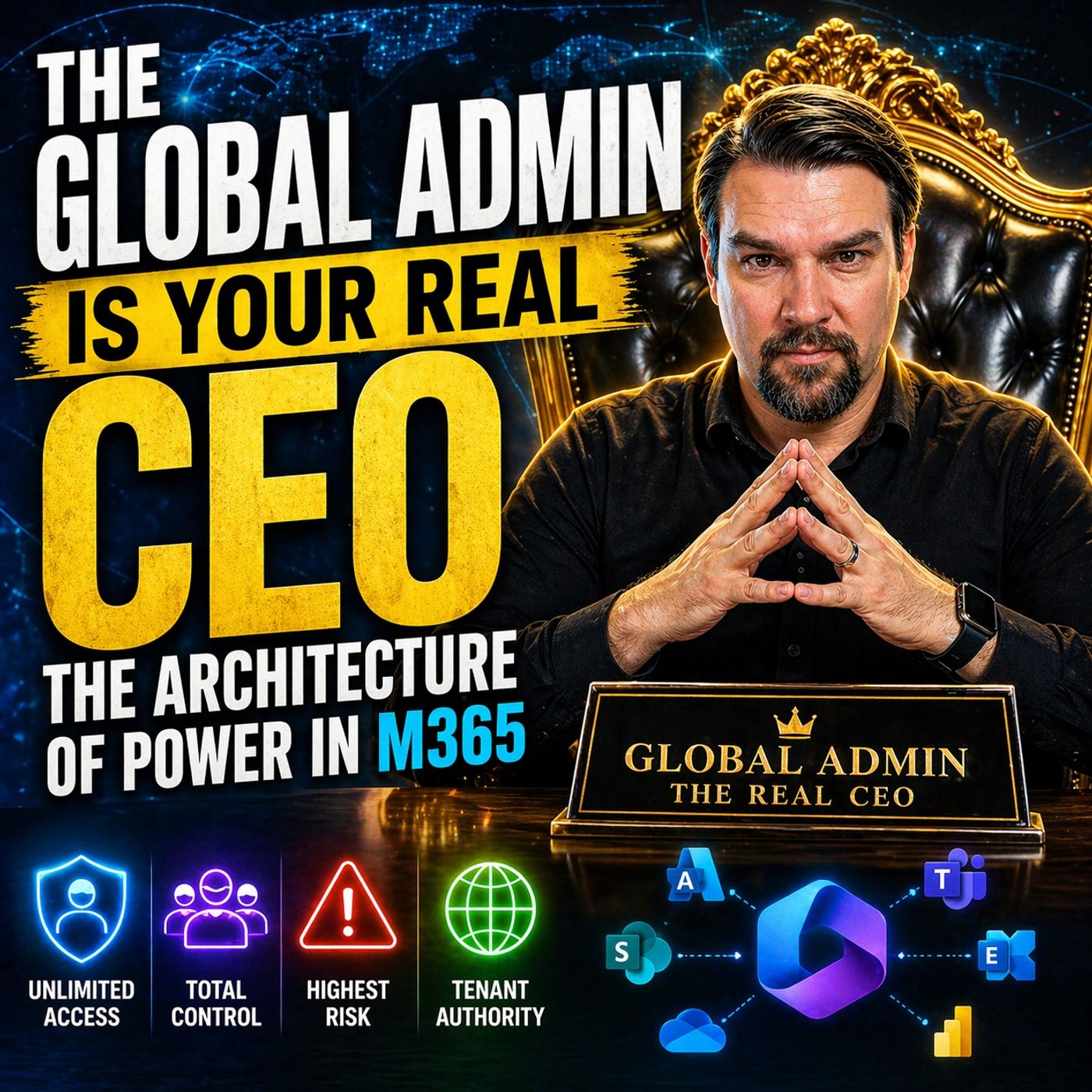
This episode explains that real power in an organization is no longer defined by job titles or hierarchy, but by who controls the Microsoft 365 environment. In practice, the Global Admin role becomes the “real CEO” because it determines access, permissions, and how information flows across the business.
It highlights that authority in modern companies is embedded in system architecture, not org charts. If the platform configuration allows or blocks actions, that decision outweighs any leadership mandate. As a result, governance, identity, and access design are what truly shape how work happens and who has influence.
The episode also shows that poor structure—like unmanaged permissions, workspace sprawl, and lack of lifecycle control—creates hidden risks that scale quickly, especially with AI like Copilot exposing them. The key takeaway is that organizations must rethink power as something built into systems, and design their Microsoft 365 architecture intentionally to align control, accountability, and execution.
You hold more power in your organization’s digital world than you may realize. In the age of microsoft 365, the person with global admin rights can reset passwords, unlock sensitive files, and change settings instantly. Traditional titles matter less. When you work in m365, access means authority. Too many global admins can create confusion and risk, turning your workplace into a patchwork of hidden rulers. As AI tools grow, you need new leaders like the AI Administrator to keep digital order.
Key Takeaways
- The Global Admin holds unmatched power in M365, controlling user accounts, data access, and security settings.
- Limit the number of Global Admins to reduce risks and maintain clear accountability within your organization.
- Implement the principle of least privilege by granting users only the permissions they need for their roles.
- Use Multi-Factor Authentication (MFA) to enhance security for Global Admin accounts and protect against unauthorized access.
- Regularly review and update your security policies and admin roles to adapt to evolving threats and compliance requirements.
- Document all changes made by Global Admins to ensure transparency and accountability in your digital environment.
- Establish emergency access accounts to maintain control during crises and prevent being locked out of critical systems.
- Embrace AI tools with caution, ensuring proper governance and oversight to manage new risks associated with AI-driven automation.
The Power of the Global Admin in M365
Unmatched Access and Control
User and Data Management
When you hold the global admin role in m365, you control the digital heartbeat of your organization. You can create, delete, or modify any user account. You can reset passwords for anyone, including executives. You can grant or remove access to files, mailboxes, and shared resources. This power extends to every corner of your microsoft 365 environment.
You also manage data across services like SharePoint, OneDrive, and Teams. You can move files, recover deleted items, and even access confidential documents. If someone leaves the company, you can transfer their data or lock their account instantly. Your actions shape how information flows and who can see what.
Tip: Always document changes you make to user accounts or data. This helps maintain transparency and accountability.
Security and Settings Authority
With global admin rights, you set the rules for security. You can enforce multi-factor authentication, define password policies, and manage device compliance. You decide which security features to enable or disable. You can configure conditional access policies to protect sensitive information.
You also control integration with azure services. You can connect external apps, manage API permissions, and oversee how third-party tools interact with your environment. Your decisions affect how secure and connected your organization stays.
Overriding Executive Decisions
Policy and Compliance Implications
As a global admin, you can override decisions made by executives. If a CEO wants to access a file but does not have permission, you can grant it. If a policy needs to change, you can update it in the system, even if leadership has not approved it yet. This level of authority means you must understand compliance requirements and legal obligations.
You play a key role in audits and investigations. You can pull logs, review user activity, and provide evidence for compliance checks. Your actions can help your organization avoid fines or legal trouble.
Real-World Scenarios
Imagine a situation where a critical project folder becomes inaccessible. The project manager calls you, not the CEO, because you have the power to restore access. In another case, a security breach occurs. You can quickly reset passwords, block suspicious accounts, and coordinate with azure security tools to contain the threat.
You might also face requests to bypass normal procedures. For example, an executive may ask you to share confidential data with a partner. You must balance these requests with company policy and security best practices.
Note: The global administrator role requires trust, technical skill, and a strong sense of responsibility. Your decisions can impact everyone in the organization.
By understanding the unmatched authority of the global admin in m365, you see why this role often surpasses traditional executive power. You shape the digital landscape, enforce security, and ensure business continuity every day.
Digital Feudalism and Admin Proliferation
Too Many Global Admins
When you give out the global administrator role to many people, you create a new kind of power structure in your organization. This is called digital feudalism. In this system, control spreads across many admins, not just the executive team. You may not even know who holds the most power in your digital environment. These hidden rulers can make decisions that affect everyone, often without clear oversight.
Governance and Accountability Risks
You face serious risks when too many people have high-level access. The more global admins you have, the harder it becomes to track who made changes or who approved certain actions. This lack of accountability can lead to confusion and mistakes. You may find it difficult to enforce company policies or meet compliance standards.
Here are some common risks you should consider:
| Risk Type | Description |
|---|---|
| Increased Attack Surface | More Global Admin accounts mean more potential entry points for attackers. |
| Tenant Takeover Potential | If a Global Admin account is compromised, it can lead to complete control. |
| Accidental Misconfigurations | More admins increase the chance of unintentional changes that weaken security. |
Tip: Limit the number of global admins to a small group. Microsoft recommends no more than five. Use dedicated admin accounts and enable Multi-Factor Authentication for all.
Hidden Layers of Power
You may not see all the layers of authority in your m365 environment. Some admins hold both Global Admin and Owner roles. This combination gives them massive control, much like a feudal lord in the past. If one of these accounts gets compromised, an attacker can take over your entire microsoft 365 tenant. One mistake by a high-privilege admin can affect everyone, just like a poor decision by a ruler impacts their whole domain. When you combine roles, you create single points of failure, which can break your security and compliance efforts.
Impact on Security and Oversight
You must pay attention to how admin sprawl affects your security. More admins mean more chances for mistakes or attacks. You need strong oversight to keep your environment safe.
Temporary Access and Long-Term Consequences
Sometimes, you grant temporary admin access for quick fixes. If you forget to remove these rights, you leave your system open to future risks. Always-on admin accounts become prime targets for attackers. Using the same account for daily work and admin tasks increases the risk of phishing and tenant takeover.
Note: Use azure Privileged Identity Management to give temporary admin rights and create emergency access accounts for critical situations.
Case Studies of Data Exposure
You can find real-world examples where too many admins led to data leaks. In some cases, admins made accidental changes that exposed sensitive files. In others, attackers used compromised azure admin accounts to steal data or disrupt business operations. These incidents show why you need tight governance and regular reviews of admin roles.
By understanding digital feudalism, you see why controlling admin access is key to strong security and effective oversight in your organization.
Global Admin Risks and Responsibilities

Security Threats
Account Compromise
You face serious risks when you manage a global admin account. Attackers often target these accounts because they offer the highest level of control in m365. If someone steals your credentials, they can take over your entire microsoft 365 environment. This can lead to data breaches, loss of sensitive information, and even business disruption.
You should know that phishing attacks are a common way hackers try to steal admin credentials. They send emails that look real and trick you into giving up your login details. Once they have your information, they can access everything you control. Credential theft is a major threat because it gives attackers the same privileges as you.
Alert: 80% of all data breaches start with stolen credentials, and 40% of these involve privileged accounts like global admin. Attackers often focus on these accounts after getting into your network.
Insider Threats
Not all threats come from outside your organization. Sometimes, people with access misuse their privileges. An insider with global admin rights can make unauthorized changes, view confidential data, or even delete important files. You must watch for unusual activity and set up alerts for risky actions.
You should also remember that over-privileged access increases the risk of mistakes or abuse. If you give too many permissions to one person, you make it easier for them to cause harm, whether by accident or on purpose.
Human Error and Single Points of Failure
Misconfiguration Risks
Even skilled admins can make mistakes. Simple errors can weaken your security and expose your organization to threats. Some of the most common mistakes include ignoring multi-factor authentication, overlooking the principle of least privilege, and misconfiguring conditional access policies.
Here is a table showing common mistakes and their consequences:
| Mistake | Consequence |
|---|---|
| Ignoring Multi-Factor Authentication (MFA) | Leads to unauthorized access and potential data breaches due to stolen credentials. |
| Overlooking the Principle of Least Privilege | Exposes organizations to security threats and unauthorized access by not limiting user permissions. |
| Misconfiguring Conditional Access Policies | Results in security breaches by allowing unauthorized access from unmanaged devices. |
You should always review your settings and follow best practices. Using azure tools can help you manage permissions and reduce the chance of errors.
Compliance Challenges
A single point of failure can put your entire organization at risk. If only one person controls your admin account and something goes wrong, you could lose access to critical systems. For example, if you get locked out due to a multi-factor authentication issue, you may not be able to manage your environment or respond to emergencies.
Real-world incidents show how dangerous this can be. One organization lost control of its microsoft 365 tenant after an MFA lockout, which stopped all administrative actions. Vulnerabilities in azure identity systems have also allowed attackers to impersonate admins and gain unauthorized access. These situations highlight the need for strong controls and backup plans.
Tip: Always set up multiple admin accounts and use azure privileged identity management. This reduces the risk of losing control and helps you meet compliance requirements.
You must treat your global admin role with care. By understanding the risks and taking steps to protect your account, you help keep your organization safe and secure.
The CEO Analogy in M365 Security
Authority and Accountability
Setting Security Culture
You set the tone for digital safety in your organization, much like a CEO shapes company culture. When you act as a Global Admin, your choices influence how everyone thinks about security. If you follow best practices, others will too. You can encourage your team to use strong passwords, enable multi-factor authentication, and report suspicious activity. Your actions show that security matters every day.
Policy Enforcement
You hold the power to enforce rules and policies across microsoft 365. When you update settings or require compliance, you make sure everyone follows the same standards. You can use azure tools to set up conditional access policies, making it harder for attackers to get in. You also decide who gets admin rights and for how long. This level of control means you must stay alert and keep your organization safe.
Influence on Organizational Security
Shaping Access and Permissions
You decide who can see what in m365. Your choices about access shape the flow of information. You can use role-based access control to limit permissions and reduce risk. By separating accounts for admin tasks, you lower the chance of phishing attacks. You can also disable legacy authentication to close old security gaps. Here is a table showing some best practices you can follow:
| Best Practice | Description |
|---|---|
| Separate Accounts for Admin Tasks | Use different accounts for admin work to avoid phishing risks. |
| Conditional Access Policies | Set strict rules for admin accounts using azure to require multi-factor authentication. |
| Avoiding Legacy Authentication | Turn off old sign-in methods to block attackers from using outdated protocols. |
Driving Security Initiatives
You lead the way in improving security. You can take steps that make a real difference, such as:
- Implementing role-based access control to separate duties and limit permissions.
- Enforcing multi-factor authentication for all admin actions.
- Using privileged access management in azure to allow just-in-time access for sensitive tasks.
- Requiring more than one admin to approve critical actions, like device wipes or changes to roles.
- Setting up conditional access policies to control who can sign in based on risk and device health.
- Auditing azure AD roles and enforcing least privilege access.
- Monitoring sign-in activity to spot threats early.
Tip: When you act quickly and follow these steps, you protect your organization from both mistakes and attacks.
You play a key role in shaping the digital future of your company. Like a CEO, you guide your team, set the rules, and make sure everyone stays safe in the world of microsoft 365.
Managing Global Admins Effectively
Limiting Admin Numbers
You should keep the number of Global Admins as low as possible. This reduces risk and makes your environment easier to manage. Most organizations need only two or three Global Admins. You should never have more than five, even in large companies. Each admin should use a strong password and follow strict security rules.
- Recommended maximum number of Global Admins is between 2 to 5.
- Two or three Global Admins work best for most organizations.
- Always use strong passwords for these accounts.
Principle of Least Privilege
You should give users only the permissions they need to do their jobs. This is called the principle of least privilege. When you limit admin rights, you lower the chance of mistakes or attacks. You also make it easier to track who made changes.
To reduce risk, use a separate Global Admin account only when needed. Regularly check who has Global Admin rights and remove any unnecessary accounts.
Role-Based Access Control
Role-based access control helps you assign the right permissions to each person. Instead of giving everyone Global Admin rights, you can assign specific roles for tasks like billing, user management, or security. This keeps your m365 environment safer.
| Best Practice | Description |
|---|---|
| Maximum Password Length | Use the longest password allowed for Global Admin accounts. |
| Backup Global Admin | Always have at least one backup Global Admin account. |
| Use Separate Account | Use a special admin account, not your daily work account. |
| Limit Number of Global Admins | Assign only the minimum number needed and use other roles for most admins. |
Strong Authentication and Monitoring
Multi-Factor Authentication
Multi-factor authentication (MFA) adds a strong layer of security. It requires you to prove your identity in more than one way. This is very important for Global Admin accounts, especially when you work remotely. MFA makes it much harder for attackers to break in, even if they steal a password.
Activity Auditing
You need to monitor what your admins do. Tools like Microsoft Purview Compliance Portal, AdminDroid’s M365 User Activity Tracker, and PowerShell help you track admin actions. These tools show you when passwords change, who logs in, and what settings get updated. Regular audits help you spot problems early and keep your environment secure.
Emergency Access and Break Glass Accounts
Business Continuity
Emergency access accounts, also called break glass accounts, help you stay in control during a crisis. If you lose access because of a misconfiguration or MFA failure, these accounts let you recover quickly. You should create at least two cloud-only accounts with Global Admin roles. Store their credentials in different secure places and set up azure Conditional Access exclusions to make sure you can always get in.
Monitoring and Documentation
You must keep track of your emergency accounts. Document where you store credentials and who can use them. Review these accounts often to make sure they work and stay secure. If you do not manage these accounts well, you risk being locked out or losing control during an emergency.
Tip: Secure emergency account credentials with dual control. Split the information and store it in two safe locations.
By following these steps, you can manage your Global Admins in azure and m365 with confidence. You protect your organization and keep your digital environment safe.
AI, Co-pilot, and the Rise of the AI Administrator
AI’s Impact on Permissions
Visibility into Access Structures
When you use AI tools like Microsoft Copilot in Microsoft 365, you see your digital environment in a new way. AI agents do not access data like human users. They pull information from many sources at once, which means you need to understand how these tools interact with your files and conversations. Traditional security settings often fall short because AI can reveal hidden connections and permissions.
You should focus on these important changes:
- AI tools require more detailed control over who can see and use information.
- Real-time monitoring of how AI agents interact with data becomes essential.
- You need to apply zero-trust principles, always verifying before granting access.
- Old security methods may not protect you from new AI-driven risks.
- Finding and removing shadow access—hidden or forgotten permissions—keeps your environment safer.
Tip: Review your permission structures regularly. AI can expose gaps that you might miss otherwise.
New Governance Challenges
AI-driven automation brings new challenges for you as an administrator. It is now easy to create many AI agents, but this can lead to "agent sprawl." You may lose track of which agents exist, what data they use, or who controls them. This lack of oversight creates security blind spots.
You should watch for these governance issues:
- Visibility: You may struggle to track all AI agents and their data access.
- Maintenance: It is often unclear who updates or manages each agent.
- Accuracy: AI agents must provide correct information as your data changes.
- Ownership: When someone leaves, you need to know who takes over their agents.
- Lifecycle: Decide when to retire agents and who makes that call.
Note: Without strong governance, unmonitored AI agents can put your sensitive data at risk.
The AI Administrator Role
Managing AI Agent Lifecycles
You need a new kind of leader: the AI Administrator. This role focuses on managing the entire lifecycle of AI agents in Microsoft 365. The AI Administrator keeps a central inventory of all agents, approves complex deployments, and monitors for unusual activity. They answer questions about governance and make sure every agent follows company policies.
| Responsibility | Description |
|---|---|
| Define AI strategy | Set goals and direction for AI in your organization. |
| Set global guardrails | Create rules for safe and ethical AI use. |
| Manage centralized agent inventory | Track all AI agents and their activities. |
| Approve complex agents | Review and allow advanced AI deployments. |
| Monitor alerts or anomalies | Watch for and respond to unusual AI behavior. |
| Answer governance questions | Provide guidance on AI-related policies and issues. |
Bridging Strategy and Execution
The AI Administrator bridges the gap between your company’s strategy and daily operations. Unlike the traditional Global Admin, who manages broad access and settings, the AI Administrator focuses on AI governance and security. They control AI app installations, monitor usage, and enforce automated policies to keep your organization compliant.
| Aspect | AI Administrator Role | Global Administrator Role |
|---|---|---|
| Focus | AI governance and security | Broad Microsoft 365 environment access |
| Permissions | AI-related tasks only | Extensive across all services |
| Key Responsibilities | Manage AI services, monitor usage, support | General administration |
| Governance Controls | Approve AI agent deployment | No specific AI governance |
| Cross-Service Visibility | Insight into AI usage | Limited for AI-specific tasks |
Alert: As AI becomes more important in your digital workspace, you need dedicated oversight. The AI Administrator ensures that your organization uses AI safely, ethically, and effectively.
Actionable Steps for Securing M365
Policy and Training
Written Procedures
You need clear, written procedures to protect your Microsoft 365 environment. Start by creating step-by-step guides for every admin task. These guides help everyone follow the same process and reduce mistakes. When you write down your procedures, you make it easier for new admins to learn and for your team to stay consistent. Written rules also help you meet compliance standards and pass audits.
Tip: Store your procedures in a secure, shared location where all admins can access them.
Regular Updates
Security threats change quickly. You must review and update your policies often. Schedule regular training sessions for your admins and users. Teach them about new risks, such as phishing attacks or changes in Microsoft 365 features. Remind everyone to use strong passwords and enable multi-factor authentication (MFA). When you keep your team informed, you lower the risk of mistakes and attacks.
- Review admin roles and permissions every quarter.
- Update your written procedures after any major change.
- Train your team on the latest security features and threats.
Leveraging Microsoft Security Features
Privileged Identity Management
Privileged Identity Management (PIM) gives you powerful tools to control who has admin rights and when. With PIM, you can grant just-in-time access, so admins only get privileges when they need them. This reduces the risk of long-term exposure. You can also set time limits for access, require approval before activating roles, and enforce MFA for extra security.
| Feature | Benefit |
|---|---|
| Just-in-time access | Limits admin rights to only when needed |
| Time-bound access | Prevents permanent permissions |
| Approval for role activation | Adds an extra layer of security |
| Multifactor authentication (MFA) | Protects against unauthorized access |
| Access reviews | Ensures only the right people keep admin roles |
| Audit history | Tracks all changes for transparency and compliance |
Note: Always monitor privileged activity logs and set up alerts for unusual sign-ins or role changes.
Conditional Access
Conditional Access lets you control who can access your Microsoft 365 resources and under what conditions. You can block access from risky locations or devices that do not meet your security standards. Conditional Access supports the Zero Trust principle: "Never Trust, Always Verify." You can require MFA for sensitive actions and enforce session controls to limit what admins can do.
- Set policies to allow access only from compliant devices.
- Require MFA for all admin role activations.
- Monitor and limit privileged activities with session controls.
By combining strong policies, regular training, and advanced Microsoft security features, you build a safer digital environment. You take control of your M365 security and protect your organization from evolving threats.
You now see why the Global Admin acts as the real CEO in your digital workspace. You hold the keys to every setting, user, and file. Admin sprawl creates hidden risks and weakens your control. AI tools add new layers of complexity.
Stay ahead by reviewing your admin roles and updating your security policies. Make security and accountability your top priorities in Microsoft 365.
🎧 Listen to this episode
Want a practical explanation of Microsoft 365 Global Admin Power, Identity, and Governance? This episode breaks down the topic in clear language and shows why it matters for Microsoft 365, Azure, Power Platform, security, AI, and modern work.
Listen to this episode if you want to:
- Understand the key concepts behind Microsoft 365 Global Admin Power, Identity, and Governance
- See how it fits into the wider Microsoft technology ecosystem
- Learn where it can create practical value for your organization
You may also enjoy these related M365 FM episodes:
- Scaling CI-CD: The Governance Blueprint
- Privileged Identity Management (PIM) - Simply Explained
- Microsoft Entra Agent ID: Secure Identity for AI Agents
- AI Governance from Microsoft Copilot to Quantum Computing
- AI Agent Identity Security: Beyond Service Accounts
Discover more practical Microsoft conversations on M365 FM.
🚀 Want to be part of m365.fm?
Then stop just listening… and start showing up.
👉 Connect with me on LinkedIn and let’s make something happen:
- 🎙️ Be a podcast guest and share your story
- 🎧 Host your own episode (yes, seriously)
- 💡 Pitch topics the community actually wants to hear
- 🌍 Build your personal brand in the Microsoft 365 space
This isn’t just a podcast — it’s a platform for people who take action.
🔥 Most people wait. The best ones don’t.
👉 Connect with me on LinkedIn and send me a message:
"I want in"
Let’s build something awesome 👊
1
00:00:00,000 --> 00:00:02,120
The corner office is a psychological artifact.
2
00:00:02,120 --> 00:00:04,720
We look at the Mohogany desks and the high floor views
3
00:00:04,720 --> 00:00:06,560
and we assume that's where the power lives,
4
00:00:06,560 --> 00:00:08,160
but in reality.
5
00:00:08,160 --> 00:00:09,760
The corner office is just a room.
6
00:00:09,760 --> 00:00:11,480
Real authority in the modern enterprise
7
00:00:11,480 --> 00:00:13,040
doesn't sit in a leather chair.
8
00:00:13,040 --> 00:00:14,680
It lives in the tenant configuration
9
00:00:14,680 --> 00:00:16,960
of your Microsoft 365 environment.
10
00:00:16,960 --> 00:00:18,280
Your org chart is a diagram.
11
00:00:18,280 --> 00:00:20,160
Your permission set is the reality.
12
00:00:20,160 --> 00:00:21,480
We operate under the assumption
13
00:00:21,480 --> 00:00:23,400
that the CEO holds the ultimate mandate.
14
00:00:23,400 --> 00:00:25,760
But the truth is, the CEO is merely a guest
15
00:00:25,760 --> 00:00:27,800
in a house built, managed, and controlled
16
00:00:27,800 --> 00:00:29,160
by the global admin.
17
00:00:29,160 --> 00:00:31,200
When the board issues a strategic directive,
18
00:00:31,200 --> 00:00:33,480
it's just a suggestion until someone clicks apply
19
00:00:33,480 --> 00:00:34,760
in the admin center.
20
00:00:34,760 --> 00:00:36,800
If the architecture says no, the executive mandate
21
00:00:36,800 --> 00:00:37,480
doesn't happen.
22
00:00:37,480 --> 00:00:39,520
This is the birth of the digital cost system.
23
00:00:39,520 --> 00:00:41,160
It's a world where your title is meaningless
24
00:00:41,160 --> 00:00:42,600
without delegated access.
25
00:00:42,600 --> 00:00:44,440
Today, I'm stripping back the UI to show you
26
00:00:44,440 --> 00:00:46,160
who actually runs your company.
27
00:00:46,160 --> 00:00:48,520
The global admin as the real CEO.
28
00:00:48,520 --> 00:00:51,640
In the physical world, power is balanced by policy, law,
29
00:00:51,640 --> 00:00:52,800
and physical barriers.
30
00:00:52,800 --> 00:00:55,880
In Microsoft 365, power is defined by the role.
31
00:00:55,880 --> 00:00:58,040
And no role is more absolute than the global admin.
32
00:00:58,040 --> 00:00:59,720
This isn't just an IT designation.
33
00:00:59,720 --> 00:01:01,000
It is a sovereign position.
34
00:01:01,000 --> 00:01:03,360
A global admin has unrestricted access
35
00:01:03,360 --> 00:01:05,880
to every setting, every user account,
36
00:01:05,880 --> 00:01:08,160
and every bite of data within your tenant.
37
00:01:08,160 --> 00:01:10,080
They can reset the password of the CFO.
38
00:01:10,080 --> 00:01:12,440
They can read the private drafts of the legal team.
39
00:01:12,440 --> 00:01:15,040
They can unblock themselves from any security restriction
40
00:01:15,040 --> 00:01:16,200
ever devised.
41
00:01:16,200 --> 00:01:18,920
They are the ones who write the digital law of your territory.
42
00:01:18,920 --> 00:01:20,080
But here's the problem.
43
00:01:20,080 --> 00:01:21,920
Organizations are over assigning this role
44
00:01:21,920 --> 00:01:23,240
at a staggering rate.
45
00:01:23,240 --> 00:01:25,480
Research shows that many firms have over 100 people
46
00:01:25,480 --> 00:01:26,960
holding global admin privileges.
47
00:01:26,960 --> 00:01:28,200
That's not a leadership team.
48
00:01:28,200 --> 00:01:28,840
That's a crowd.
49
00:01:28,840 --> 00:01:30,360
It creates a shadow leadership problem
50
00:01:30,360 --> 00:01:32,440
where the people who can actually override the system
51
00:01:32,440 --> 00:01:34,960
are often three or four levels removed from the boardroom.
52
00:01:34,960 --> 00:01:38,000
When you have 100 global admins, you don't have a governance model.
53
00:01:38,000 --> 00:01:40,240
You have a digital feudalism where everyone has the keys
54
00:01:40,240 --> 00:01:41,320
to the kingdom.
55
00:01:41,320 --> 00:01:43,320
What typically happens is that IT teams
56
00:01:43,320 --> 00:01:45,560
fall into the technology lifeguard trap.
57
00:01:45,560 --> 00:01:47,000
Because they have ultimate power,
58
00:01:47,000 --> 00:01:49,760
they spend their entire day scanning for mundane infractions.
59
00:01:49,760 --> 00:01:51,960
They're chasing down unowned groups, monitoring
60
00:01:51,960 --> 00:01:54,600
MFA setups or following up on quota limits.
61
00:01:54,600 --> 00:01:56,680
They are the most powerful people in the building,
62
00:01:56,680 --> 00:01:59,560
yet they are spending their time acting as digital genitors.
63
00:01:59,560 --> 00:02:02,200
This concentration of power is a structural flaw.
64
00:02:02,200 --> 00:02:05,280
The global admin was designed as a break glass role.
65
00:02:05,280 --> 00:02:07,160
It was supposed to be the emergency lever you pull
66
00:02:07,160 --> 00:02:08,560
when the building is on fire.
67
00:02:08,560 --> 00:02:11,880
Instead, it has become the default setting for convenience.
68
00:02:11,880 --> 00:02:13,840
We give people global admin rights
69
00:02:13,840 --> 00:02:15,600
because it's easier than figuring out exactly
70
00:02:15,600 --> 00:02:17,520
what they actually need to do their jobs.
71
00:02:17,520 --> 00:02:20,160
But in reality, convenience is the enemy of control.
72
00:02:20,160 --> 00:02:22,800
Every time you assign a global admin role to unblock someone,
73
00:02:22,800 --> 00:02:25,160
you are diluting the CEO's actual authority.
74
00:02:25,160 --> 00:02:27,520
You are creating a layer of people who can bypass
75
00:02:27,520 --> 00:02:30,040
the very policies the CEO just signed off on.
76
00:02:30,040 --> 00:02:32,480
If the security policy says no external sharing,
77
00:02:32,480 --> 00:02:34,560
but the global admin decides to help a friend
78
00:02:34,560 --> 00:02:36,800
by flipping a switch, the policy is dead.
79
00:02:36,800 --> 00:02:39,280
The global admin just vetoed the executive office.
80
00:02:39,280 --> 00:02:42,360
And one level deeper, it's about the role concentration ratio.
81
00:02:42,360 --> 00:02:44,320
In most organizations, three or four people
82
00:02:44,320 --> 00:02:47,920
can effectively override what 300 managers were told to follow.
83
00:02:47,920 --> 00:02:50,280
This is the model behind the modern power struggle.
84
00:02:50,280 --> 00:02:51,680
We think we are managing people,
85
00:02:51,680 --> 00:02:53,720
but we are actually managing a permission set.
86
00:02:53,720 --> 00:02:56,320
If you don't believe me, try to change a major corporate policy
87
00:02:56,320 --> 00:02:58,000
without the consent of your tenant admins.
88
00:02:58,000 --> 00:03:01,400
You'll find out very quickly where the sovereign power truly resides.
89
00:03:01,400 --> 00:03:02,480
The floor isn't the people.
90
00:03:02,480 --> 00:03:04,680
It's the assumption that the org chart matters more
91
00:03:04,680 --> 00:03:06,560
than the EntraID role assignment.
92
00:03:06,560 --> 00:03:09,760
We've built these hierarchies for a world that no longer exists.
93
00:03:09,760 --> 00:03:12,240
We assume that because someone is the head of finance,
94
00:03:12,240 --> 00:03:14,680
they have the most influence over the financial data.
95
00:03:14,680 --> 00:03:16,520
But the global admin is the one who decides
96
00:03:16,520 --> 00:03:18,440
if that data is even visible.
97
00:03:18,440 --> 00:03:20,280
They are the ones who decide if the everyone group
98
00:03:20,280 --> 00:03:21,840
can see the board minutes.
99
00:03:21,840 --> 00:03:23,120
You navigate, you search.
100
00:03:23,120 --> 00:03:25,240
You assume the system is working as intended.
101
00:03:25,240 --> 00:03:27,400
But the moment this breaks is the moment you realize
102
00:03:27,400 --> 00:03:29,720
that power isn't just about what you can do.
103
00:03:29,720 --> 00:03:31,080
It's about what you can see.
104
00:03:31,080 --> 00:03:32,960
And right now your global admin see everything.
105
00:03:32,960 --> 00:03:35,760
They are the real architects of your corporate reality.
106
00:03:35,760 --> 00:03:38,560
If you want to understand how your company actually functions,
107
00:03:38,560 --> 00:03:40,960
you have to stop looking at the names on the doors
108
00:03:40,960 --> 00:03:42,840
and start looking at the roles in the tenant.
109
00:03:42,840 --> 00:03:45,520
Because in the end, the click always beats the mandate.
110
00:03:45,520 --> 00:03:48,040
Vignette one, the silent data exposure.
111
00:03:48,040 --> 00:03:50,000
Let's look at how this tension actually plays out
112
00:03:50,000 --> 00:03:50,880
behind closed doors.
113
00:03:50,880 --> 00:03:54,080
Imagine a mid-market firm preparing for a high stakes merger.
114
00:03:54,080 --> 00:03:56,200
The executive mandate is absolute.
115
00:03:56,200 --> 00:03:57,920
Lockdown all financial data.
116
00:03:57,920 --> 00:03:59,480
The board believes the vault is sealed.
117
00:03:59,480 --> 00:04:00,560
They've signed the NDAs.
118
00:04:00,560 --> 00:04:01,760
They've issued the memos.
119
00:04:01,760 --> 00:04:03,320
In their minds, the strategic intent
120
00:04:03,320 --> 00:04:05,800
has been translated into operational safety.
121
00:04:05,800 --> 00:04:08,840
But inside the tenant, a different story is unfolding.
122
00:04:08,840 --> 00:04:10,920
A global admin receives an urgent request
123
00:04:10,920 --> 00:04:12,840
from a junior controller who can't access
124
00:04:12,840 --> 00:04:15,720
a specific legacy folder needed for a quick report.
125
00:04:15,720 --> 00:04:17,840
The admin is under pressure to keep the gears turning.
126
00:04:17,840 --> 00:04:19,760
He decides to grant a temporary bypass.
127
00:04:19,760 --> 00:04:21,520
It's supposed to be a five-minute fix,
128
00:04:21,520 --> 00:04:23,760
a shortcut to keep the project moving.
129
00:04:23,760 --> 00:04:26,560
He adds the "Everyone except external users" group
130
00:04:26,560 --> 00:04:28,120
to the root folder permissions.
131
00:04:28,120 --> 00:04:29,960
He tells himself he'll revert it by lunch,
132
00:04:29,960 --> 00:04:32,520
but lunch turns into a fire drill in the exchange environment
133
00:04:32,520 --> 00:04:35,200
and that fire drill eventually turns into a week end.
134
00:04:35,200 --> 00:04:37,720
The temporary bypass becomes a permanent vulnerability.
135
00:04:37,720 --> 00:04:39,320
The board continues their meetings.
136
00:04:39,320 --> 00:04:41,360
They are completely unaware that the digital walls
137
00:04:41,360 --> 00:04:44,560
of their data vault have been replaced with glass.
138
00:04:44,560 --> 00:04:47,440
Three months later, the merger is in its final stages.
139
00:04:47,440 --> 00:04:49,440
An intern in the marketing department is bored.
140
00:04:49,440 --> 00:04:52,120
He opens the SharePoint search bar in types minutes.
141
00:04:52,120 --> 00:04:52,920
He isn't a hacker.
142
00:04:52,920 --> 00:04:54,200
He isn't looking for a payday.
143
00:04:54,200 --> 00:04:55,640
He's just curious.
144
00:04:55,640 --> 00:04:57,840
Because of that one temporary click months ago,
145
00:04:57,840 --> 00:05:00,120
the search index serves up the entire history
146
00:05:00,120 --> 00:05:01,320
of the merger negotiations.
147
00:05:01,320 --> 00:05:02,560
He's looking at the valuation.
148
00:05:02,560 --> 00:05:04,040
He's looking at the layoff projections.
149
00:05:04,040 --> 00:05:05,840
He's looking at the reality that the board thought
150
00:05:05,840 --> 00:05:06,800
was invisible.
151
00:05:06,800 --> 00:05:09,400
This discovery isn't a failure of the intern's ethics.
152
00:05:09,400 --> 00:05:10,920
It is a failure of the architecture.
153
00:05:10,920 --> 00:05:12,720
The executive intent was a suggestion.
154
00:05:12,720 --> 00:05:14,560
The permission structure was the law.
155
00:05:14,560 --> 00:05:16,520
The board's mandate was a psychological comfort,
156
00:05:16,520 --> 00:05:18,320
but the global admin's shortcut
157
00:05:18,320 --> 00:05:19,800
was the physical reality.
158
00:05:19,800 --> 00:05:22,040
This happens every day in thousands of tenants.
159
00:05:22,040 --> 00:05:24,720
We assume that because we've said something is private,
160
00:05:24,720 --> 00:05:26,920
the system acknowledges that intent.
161
00:05:26,920 --> 00:05:28,840
But the system doesn't care about your intent.
162
00:05:28,840 --> 00:05:30,960
It only cares about the permission inheritance.
163
00:05:30,960 --> 00:05:32,920
It only cares about the effective access.
164
00:05:32,920 --> 00:05:35,600
When the click happens, the hierarchy of the org chart
165
00:05:35,600 --> 00:05:36,520
evaporates.
166
00:05:36,520 --> 00:05:38,440
The intern and the CEO are now effectively
167
00:05:38,440 --> 00:05:40,320
equals in the eyes of the data.
168
00:05:40,320 --> 00:05:42,200
The shadow leadership layer, the admins
169
00:05:42,200 --> 00:05:44,840
who make these micro decisions for the sake of convenience
170
00:05:44,840 --> 00:05:46,840
are the ones who actually determine the company's risk
171
00:05:46,840 --> 00:05:47,600
profile.
172
00:05:47,600 --> 00:05:48,880
They aren't trying to be malicious.
173
00:05:48,880 --> 00:05:50,280
They're just trying to be fast.
174
00:05:50,280 --> 00:05:53,880
But in a cloud environment, speed usually wins over safety
175
00:05:53,880 --> 00:05:55,600
in the hierarchy of the click.
176
00:05:55,600 --> 00:05:58,080
We've created a world where the most sensitive corporate
177
00:05:58,080 --> 00:06:00,840
secrets are protected by the memory of a busy IT person
178
00:06:00,840 --> 00:06:03,080
who promised to change it back later.
179
00:06:03,080 --> 00:06:05,680
That is the gap between the diagram and the reality.
180
00:06:05,680 --> 00:06:07,760
It is a silent exposure that remains hidden
181
00:06:07,760 --> 00:06:10,800
until someone, or something, decides to look for it.
182
00:06:10,800 --> 00:06:14,360
And this is exactly where the power shift becomes undeniable.
183
00:06:14,360 --> 00:06:16,400
We are moving into an era where manual searching
184
00:06:16,400 --> 00:06:18,080
is no longer the primary threat.
185
00:06:18,080 --> 00:06:20,000
The gap between what you think is locked
186
00:06:20,000 --> 00:06:22,240
and what is actually open is about to be exposed
187
00:06:22,240 --> 00:06:23,560
at a scale you can't imagine.
188
00:06:23,560 --> 00:06:25,520
Because this specific architectural floor
189
00:06:25,520 --> 00:06:28,680
is exactly what AI is about to reveal, co-pilot,
190
00:06:28,680 --> 00:06:30,040
as the great revealer.
191
00:06:30,040 --> 00:06:31,840
We've spent decades bearing our mistakes
192
00:06:31,840 --> 00:06:34,240
in the deep folders of SharePoint and the forgotten channels
193
00:06:34,240 --> 00:06:35,160
of teams.
194
00:06:35,160 --> 00:06:36,920
We assumed that if a file was hard to find,
195
00:06:36,920 --> 00:06:38,280
it was effectively secure.
196
00:06:38,280 --> 00:06:40,560
We relied on security by obscurity by that.
197
00:06:40,560 --> 00:06:42,880
But that era ended the moment you flipped the switch
198
00:06:42,880 --> 00:06:44,240
on generative AI.
199
00:06:44,240 --> 00:06:46,520
There is a counter-intuitive truth you need to grasp.
200
00:06:46,520 --> 00:06:47,880
Co-pilot doesn't create risk.
201
00:06:47,880 --> 00:06:49,160
It reveals it at scale.
202
00:06:49,160 --> 00:06:51,520
Think about how AI actually works in your tenant.
203
00:06:51,520 --> 00:06:53,920
It doesn't have its own secret set of keys.
204
00:06:53,920 --> 00:06:55,720
It doesn't bypass your security protocols.
205
00:06:55,720 --> 00:06:57,920
Instead, it precisely inherits the permissions
206
00:06:57,920 --> 00:06:59,560
of the person asking the question.
207
00:06:59,560 --> 00:07:02,040
It sees exactly what you've already allowed it to see.
208
00:07:02,040 --> 00:07:04,880
The problem is, you have no idea what you've allowed.
209
00:07:04,880 --> 00:07:07,360
For years, your governance has been a house of cards.
210
00:07:07,360 --> 00:07:09,920
You've had everyone except external users groups
211
00:07:09,920 --> 00:07:11,960
added to sensitive HR folders.
212
00:07:11,960 --> 00:07:13,400
You've had broken permission inheritance
213
00:07:13,400 --> 00:07:15,320
where a subfolder accidentally became public
214
00:07:15,320 --> 00:07:16,200
to the whole company.
215
00:07:16,200 --> 00:07:18,480
You've had anyone with the link shares floating around
216
00:07:18,480 --> 00:07:20,680
for project plans that contain sensitive IP.
217
00:07:20,680 --> 00:07:23,040
In the old world, these were minor hygiene issues.
218
00:07:23,040 --> 00:07:24,040
Why?
219
00:07:24,040 --> 00:07:24,680
Because people are lazy.
220
00:07:24,680 --> 00:07:26,840
If an employee wanted to find the CEO's salary
221
00:07:26,840 --> 00:07:29,200
or the layoff list, they had to know where to look.
222
00:07:29,200 --> 00:07:31,280
They had to click through 10 levels of nesting.
223
00:07:31,280 --> 00:07:32,800
They had to guess the file name.
224
00:07:32,800 --> 00:07:35,640
The friction of the interface acted as a manual gatekeeper.
225
00:07:35,640 --> 00:07:37,560
But Co-pilot removes that friction entirely.
226
00:07:37,560 --> 00:07:39,280
It doesn't care about your folder structure.
227
00:07:39,280 --> 00:07:40,600
It doesn't get tired of clicking.
228
00:07:40,600 --> 00:07:42,600
It simply indexes the effective access
229
00:07:42,600 --> 00:07:44,360
and delivers the answer in seconds.
230
00:07:44,360 --> 00:07:46,480
This is the everyone group nightmare.
231
00:07:46,480 --> 00:07:49,280
I've seen tenants where 80% of the data is technically
232
00:07:49,280 --> 00:07:50,400
overshared.
233
00:07:50,400 --> 00:07:52,760
This isn't because the admins are incompetent.
234
00:07:52,760 --> 00:07:55,200
It's because the M365 ecosystem is designed
235
00:07:55,200 --> 00:07:57,720
for collaboration first and control second.
236
00:07:57,720 --> 00:07:59,440
It is incredibly easy to share a file,
237
00:07:59,440 --> 00:08:01,960
but it is incredibly difficult to track who still has access
238
00:08:01,960 --> 00:08:03,320
to it three years later.
239
00:08:03,320 --> 00:08:06,000
When you deploy Co-pilot, those forgotten sharepoint sites
240
00:08:06,000 --> 00:08:07,720
suddenly become front page news.
241
00:08:07,720 --> 00:08:10,440
If a mid-level manager asks, what are the biggest budget
242
00:08:10,440 --> 00:08:11,800
concerns for next year?
243
00:08:11,800 --> 00:08:13,120
And your permissions are loose?
244
00:08:13,120 --> 00:08:15,320
Co-pilot will highlight the confidential spreadsheet
245
00:08:15,320 --> 00:08:17,080
sitting in a general folder.
246
00:08:17,080 --> 00:08:18,560
It will summarize the private notes
247
00:08:18,560 --> 00:08:20,600
from the CFO's last strategy session.
248
00:08:20,600 --> 00:08:22,040
It isn't hacking your system.
249
00:08:22,040 --> 00:08:24,200
It is simply being a very efficient librarian
250
00:08:24,200 --> 00:08:27,680
in a library where the locks have been left open for a decade.
251
00:08:27,680 --> 00:08:30,560
The data suggests that 80% of tenants are currently unprepared
252
00:08:30,560 --> 00:08:32,040
for a full AI rollout.
253
00:08:32,040 --> 00:08:33,720
They are unprepared because their governance
254
00:08:33,720 --> 00:08:36,400
is a reactive mess of quick fixes and legacy settings.
255
00:08:36,400 --> 00:08:38,760
They've treated governance as a technical checkbox
256
00:08:38,760 --> 00:08:40,520
rather than an architectural law.
257
00:08:40,520 --> 00:08:43,480
And now the AI is acting as the ultimate auditor.
258
00:08:43,480 --> 00:08:47,120
It is showing you exactly where your digital caste system has failed.
259
00:08:47,120 --> 00:08:48,960
It is showing you that your executives
260
00:08:48,960 --> 00:08:50,520
have lost control of the narrative
261
00:08:50,520 --> 00:08:52,440
because they lost control of the permissions.
262
00:08:52,440 --> 00:08:53,880
AI is not the problem here.
263
00:08:53,880 --> 00:08:56,440
It is the diagnostic tool you can no longer ignore.
264
00:08:56,440 --> 00:08:58,440
In the past, you could bury a data leak
265
00:08:58,440 --> 00:09:00,160
under a mountain of digital noise.
266
00:09:00,160 --> 00:09:02,040
Today, that noise is being synthesized
267
00:09:02,040 --> 00:09:04,240
into a clear readable summary.
268
00:09:04,240 --> 00:09:05,920
If your Co-pilot deployment feels dangerous,
269
00:09:05,920 --> 00:09:08,160
it's because your underlying reality is dangerous.
270
00:09:08,160 --> 00:09:09,760
The AI is merely holding up a mirror
271
00:09:09,760 --> 00:09:11,680
to the chaos you've allowed to accumulate.
272
00:09:11,680 --> 00:09:14,760
You can't fix this by training the AI to be more ethical.
273
00:09:14,760 --> 00:09:17,760
You can't fix it by asking employees to be careful.
274
00:09:17,760 --> 00:09:20,000
You fix it by acknowledging that the architecture
275
00:09:20,000 --> 00:09:21,600
is the only thing that matters.
276
00:09:21,600 --> 00:09:23,400
If the permission structure allows the access,
277
00:09:23,400 --> 00:09:25,040
the AI will exploit it.
278
00:09:25,040 --> 00:09:27,800
This shift forces a new conversation in the boardroom.
279
00:09:27,800 --> 00:09:30,120
It forces us to realize that we can't manage AI
280
00:09:30,120 --> 00:09:32,480
until we manage the power structures beneath it.
281
00:09:32,480 --> 00:09:34,920
We need to stop looking at AI as a productivity tool
282
00:09:34,920 --> 00:09:37,200
and start looking at it as a transparency engine.
283
00:09:37,200 --> 00:09:39,480
It is revealing the true hierarchy of your company.
284
00:09:39,480 --> 00:09:41,120
Not the one on the glossy posters,
285
00:09:41,120 --> 00:09:43,040
but the one encoded in your metadata.
286
00:09:43,040 --> 00:09:44,680
And if that architecture is broken,
287
00:09:44,680 --> 00:09:46,080
we need a new class of legislators
288
00:09:46,080 --> 00:09:47,960
to rewrite the laws of the tenant,
289
00:09:47,960 --> 00:09:49,840
the rise of the AI administrator.
290
00:09:49,840 --> 00:09:52,240
The landscape is shifting toward agente workflows.
291
00:09:52,240 --> 00:09:55,080
And because of that, we are seeing a new elite class emerge.
292
00:09:55,080 --> 00:09:57,000
This isn't just another IT certification
293
00:09:57,000 --> 00:09:59,320
or a small update to the help desk manual.
294
00:09:59,320 --> 00:10:01,960
We are looking at the birth of the AI administrator.
295
00:10:01,960 --> 00:10:05,000
This role, which became formalized in early 2026,
296
00:10:05,000 --> 00:10:06,440
represents a fundamental pivot
297
00:10:06,440 --> 00:10:08,400
in how corporate authority is distributed.
298
00:10:08,400 --> 00:10:09,880
It marks the moment we realized
299
00:10:09,880 --> 00:10:12,400
that the all or nothing power of the global admin
300
00:10:12,400 --> 00:10:15,320
is too blunt and instrument for the age of intelligence.
301
00:10:15,320 --> 00:10:17,840
In the old model, you were either a god of the tenant
302
00:10:17,840 --> 00:10:18,960
or a mere mortal.
303
00:10:18,960 --> 00:10:20,800
If you needed to manage a co-pilot connector
304
00:10:20,800 --> 00:10:22,520
or a proven autonomous agent,
305
00:10:22,520 --> 00:10:24,640
you usually had to beg for global admin rights.
306
00:10:24,640 --> 00:10:26,040
This created a massive bottleneck
307
00:10:26,040 --> 00:10:28,680
that frustrated the business and terrified the security team.
308
00:10:28,680 --> 00:10:31,080
But the AI administrator role changes the game.
309
00:10:31,080 --> 00:10:33,360
It is a specialized high-privileged position
310
00:10:33,360 --> 00:10:35,360
designed to manage the lifecycle of agents
311
00:10:35,360 --> 00:10:37,520
without needing the keys to the entire kingdom.
312
00:10:37,520 --> 00:10:39,600
They are the new legislators of your digital workforce.
313
00:10:39,600 --> 00:10:41,840
Think about the specific authority this role carries.
314
00:10:41,840 --> 00:10:43,520
They manage tenant-wide consent.
315
00:10:43,520 --> 00:10:46,600
They decide which AI agents are allowed to see your proprietary data.
316
00:10:46,600 --> 00:10:47,920
They oversee the risk monitoring
317
00:10:47,920 --> 00:10:50,040
of every automated assistant in the org.
318
00:10:50,040 --> 00:10:52,760
While the CEO is busy discussing quarterly targets,
319
00:10:52,760 --> 00:10:56,960
the AI admin is the one deciding which agent 365 bots
320
00:10:56,960 --> 00:10:59,280
are actually allowed to execute those targets.
321
00:10:59,280 --> 00:11:01,320
They are moving from being IT gatekeepers
322
00:11:01,320 --> 00:11:02,720
to becoming agentic governors.
323
00:11:02,720 --> 00:11:04,440
This is the new bridge between the boardroom
324
00:11:04,440 --> 00:11:05,520
and the server room.
325
00:11:05,520 --> 00:11:06,440
For years,
326
00:11:06,440 --> 00:11:08,320
there has been a massive communication gap
327
00:11:08,320 --> 00:11:10,600
between leadership and execution.
328
00:11:10,600 --> 00:11:12,400
The board talks about leveraging AI
329
00:11:12,400 --> 00:11:14,480
and IT talks about tenant hygiene.
330
00:11:14,480 --> 00:11:16,160
The AI administrator is the person
331
00:11:16,160 --> 00:11:18,080
who translates those two languages.
332
00:11:18,080 --> 00:11:19,280
They are the ones who understand
333
00:11:19,280 --> 00:11:22,000
that an agentic workflow isn't just a piece of software,
334
00:11:22,000 --> 00:11:23,920
it is a delegated authority.
335
00:11:23,920 --> 00:11:25,800
When an AI agent performs a task,
336
00:11:25,800 --> 00:11:27,760
it is acting on behalf of the company.
337
00:11:27,760 --> 00:11:29,120
The person who governs that agent
338
00:11:29,120 --> 00:11:32,000
is by extension governing the company's reputation and risk.
339
00:11:32,000 --> 00:11:34,280
We are seeing a shift in the digital cost system.
340
00:11:34,280 --> 00:11:37,600
In 2024, the global admin was the undisputed sovereign.
341
00:11:37,600 --> 00:11:38,640
By late 2026,
342
00:11:38,640 --> 00:11:41,720
the AI administrator has become the strategic orchestrator.
343
00:11:41,720 --> 00:11:44,360
They are the ones who manage the work IQ of the organization.
344
00:11:44,360 --> 00:11:47,040
They ensure that when a finance bot queries a database,
345
00:11:47,040 --> 00:11:49,280
it has the right entity to do so safely.
346
00:11:49,280 --> 00:11:50,560
This is a level of precision
347
00:11:50,560 --> 00:11:53,160
that the old global admin role simply wasn't built for.
348
00:11:53,160 --> 00:11:55,240
The AI admin is the person who prevents
349
00:11:55,240 --> 00:11:57,840
the everyone group nightmare from becoming a catastrophe.
350
00:11:57,840 --> 00:11:59,760
They are the ones who ordered the effective access
351
00:11:59,760 --> 00:12:01,600
of every bot before it goes live.
352
00:12:01,600 --> 00:12:02,760
They are the ones who ensure
353
00:12:02,760 --> 00:12:04,640
that the human agent ratio is optimized
354
00:12:04,640 --> 00:12:06,240
for performance not just speed.
355
00:12:06,240 --> 00:12:08,480
If the global admin is the landlord of the building,
356
00:12:08,480 --> 00:12:10,520
the AI administrator is the one who decides
357
00:12:10,520 --> 00:12:11,720
who gets to work in the office
358
00:12:11,720 --> 00:12:13,680
and what files they are allowed to open.
359
00:12:13,680 --> 00:12:15,960
But even with these new specialized roles,
360
00:12:15,960 --> 00:12:18,680
the old habits of power concentration die hard.
361
00:12:18,680 --> 00:12:20,600
Organization still struggle with the temptation
362
00:12:20,600 --> 00:12:21,920
to over-privilege.
363
00:12:21,920 --> 00:12:23,560
They still want to give just a little more access
364
00:12:23,560 --> 00:12:24,680
to keep things moving.
365
00:12:24,680 --> 00:12:27,240
The challenge for the new AI elite isn't just technical,
366
00:12:27,240 --> 00:12:28,240
it is political.
367
00:12:28,240 --> 00:12:29,400
They have to convince the board
368
00:12:29,400 --> 00:12:31,400
that governance isn't a barrier to innovation
369
00:12:31,400 --> 00:12:33,000
but is actually the foundation of it.
370
00:12:33,000 --> 00:12:35,280
Because in a world where agents can move faster than humans,
371
00:12:35,280 --> 00:12:36,680
the person who controls the agent
372
00:12:36,680 --> 00:12:38,760
controls the reality of the business.
373
00:12:38,760 --> 00:12:41,080
Vinyat too, the security policy override.
374
00:12:41,080 --> 00:12:43,200
Let's look at how this sovereign power behaves
375
00:12:43,200 --> 00:12:45,080
when a crisis actually hits the fan.
376
00:12:45,080 --> 00:12:47,960
Picture a Friday afternoon in a high-growth tech firm.
377
00:12:47,960 --> 00:12:49,640
The security operations center detects
378
00:12:49,640 --> 00:12:51,240
a credential stuffing attack targeting
379
00:12:51,240 --> 00:12:52,800
the executive leadership team.
380
00:12:52,800 --> 00:12:54,960
The threat is active, the response is clinical,
381
00:12:54,960 --> 00:12:56,840
the security lead immediately enforces
382
00:12:56,840 --> 00:12:58,840
a stricter conditional access policy.
383
00:12:58,840 --> 00:13:00,640
They require fishing resistant MFA
384
00:13:00,640 --> 00:13:03,600
and restrict logins to company managed devices only.
385
00:13:03,600 --> 00:13:05,960
It is a textbook maneuver designed to seal the perimeter
386
00:13:05,960 --> 00:13:07,560
and stop the bleeding before the weekend.
387
00:13:07,560 --> 00:13:09,680
But then the friction of reality collides
388
00:13:09,680 --> 00:13:11,400
with the friction of the system.
389
00:13:11,400 --> 00:13:13,920
The executive vice president is at an off-site retreat.
390
00:13:13,920 --> 00:13:15,760
He is trying to access a critical contract
391
00:13:15,760 --> 00:13:18,360
from his personal iPad because his corporate laptop
392
00:13:18,360 --> 00:13:19,320
is back at the hotel.
393
00:13:19,320 --> 00:13:20,440
Suddenly he is locked out.
394
00:13:20,440 --> 00:13:22,000
He sees the access denied screen,
395
00:13:22,000 --> 00:13:24,280
which is a digital wall built by the very security team
396
00:13:24,280 --> 00:13:25,400
he hired to protect him.
397
00:13:25,400 --> 00:13:27,240
He doesn't see a safeguard, he sees a nuisance.
398
00:13:27,240 --> 00:13:28,680
He doesn't see a breach being mitigated,
399
00:13:28,680 --> 00:13:30,080
he sees a deal being delayed.
400
00:13:30,080 --> 00:13:32,360
He calls the IT help desk, but they can't help.
401
00:13:32,360 --> 00:13:33,800
He bypasses the chain of command
402
00:13:33,800 --> 00:13:36,080
and calls the one person he knows can fix anything,
403
00:13:36,080 --> 00:13:37,200
a senior global admin.
404
00:13:37,200 --> 00:13:38,520
The conversation is short.
405
00:13:38,520 --> 00:13:40,440
I'm in the middle of a $5 million closing
406
00:13:40,440 --> 00:13:41,720
and the system is blocking me.
407
00:13:41,720 --> 00:13:42,560
Fix it.
408
00:13:42,560 --> 00:13:45,080
The global admin is now caught in the ultimate hierarchy trap.
409
00:13:45,080 --> 00:13:47,440
He knows the security team put that policy in place
410
00:13:47,440 --> 00:13:48,280
for a reason.
411
00:13:48,280 --> 00:13:49,960
He knows the attack is still ongoing.
412
00:13:49,960 --> 00:13:52,440
But he also knows that the man on the other end of the line
413
00:13:52,440 --> 00:13:55,680
has the power to influence his bonus, his career path,
414
00:13:55,680 --> 00:13:57,280
and his daily stress levels.
415
00:13:57,280 --> 00:13:59,000
The dopamine hit of fixing a problem
416
00:13:59,000 --> 00:14:01,560
for a powerful person is an intoxicating incentive.
417
00:14:01,560 --> 00:14:03,760
He doesn't call the security lead to discuss the risk.
418
00:14:03,760 --> 00:14:05,120
He doesn't check the logs.
419
00:14:05,120 --> 00:14:07,080
He simply navigates to the entreportal,
420
00:14:07,080 --> 00:14:09,320
finds the new conditional access policy,
421
00:14:09,320 --> 00:14:10,920
and clicks disable.
422
00:14:10,920 --> 00:14:13,040
In that one second, the short term convenience
423
00:14:13,040 --> 00:14:15,440
of an executive wins over the long term safety
424
00:14:15,440 --> 00:14:17,160
of the entire organization.
425
00:14:17,160 --> 00:14:19,960
The unblocked leader gets his contract, he closes the deal.
426
00:14:19,960 --> 00:14:20,760
He is happy.
427
00:14:20,760 --> 00:14:23,000
But the vulnerability window is now wide open.
428
00:14:23,000 --> 00:14:24,880
The attackers who are previously banging their heads
429
00:14:24,880 --> 00:14:27,880
against a wall find that the door has been left unlocked.
430
00:14:27,880 --> 00:14:28,880
They move laterally.
431
00:14:28,880 --> 00:14:30,440
They escalate privileges.
432
00:14:30,440 --> 00:14:32,880
They begin the quiet process of data exfiltration,
433
00:14:32,880 --> 00:14:35,200
while the global admin is receiving a thank you email
434
00:14:35,200 --> 00:14:36,520
for his quick thinking.
435
00:14:36,520 --> 00:14:38,720
This is the hierarchy of the click in action.
436
00:14:38,720 --> 00:14:40,840
It proves that speed and perceived status
437
00:14:40,840 --> 00:14:43,400
almost always defeat governance in a crisis.
438
00:14:43,400 --> 00:14:45,800
We treat these security policies like they are carved in stone,
439
00:14:45,800 --> 00:14:47,920
but they are actually just software settings
440
00:14:47,920 --> 00:14:50,320
that a handful of people can delete at will.
441
00:14:50,320 --> 00:14:52,560
The global admin didn't just override a policy.
442
00:14:52,560 --> 00:14:54,320
He overrode the collective intelligence
443
00:14:54,320 --> 00:14:56,000
of the security department.
444
00:14:56,000 --> 00:14:58,160
He became the highest authority in the company
445
00:14:58,160 --> 00:15:00,240
because he was the only one who could physically change
446
00:15:00,240 --> 00:15:01,360
the rules of the game.
447
00:15:01,360 --> 00:15:03,960
To stop the cycle, we have to stop treating governance
448
00:15:03,960 --> 00:15:05,160
as a technical checkbox.
449
00:15:05,160 --> 00:15:07,160
We have to realize that as long as we allow this level
450
00:15:07,160 --> 00:15:10,040
of concentrated standing power, the org chart will always
451
00:15:10,040 --> 00:15:13,240
be at the mercy of the most helpful person in IT.
452
00:15:13,240 --> 00:15:14,680
The 30-day power shift.
453
00:15:14,680 --> 00:15:16,120
You don't fix a broken power structure
454
00:15:16,120 --> 00:15:17,800
by adding more layers of red tape.
455
00:15:17,800 --> 00:15:19,680
You don't solve digital feudalism
456
00:15:19,680 --> 00:15:21,680
by writing a 50-page policy manual
457
00:15:21,680 --> 00:15:24,120
that nobody in the server room is ever going to read.
458
00:15:24,120 --> 00:15:26,920
If you want to reclaim the authority of your executive office,
459
00:15:26,920 --> 00:15:30,080
you have to realize a fundamental truth about M365.
460
00:15:30,080 --> 00:15:32,240
You don't fix governance by adding policies.
461
00:15:32,240 --> 00:15:33,640
You fix it by removing power.
462
00:15:33,640 --> 00:15:34,840
If the architecture is the law,
463
00:15:34,840 --> 00:15:36,520
then the only way to change the law is to change
464
00:15:36,520 --> 00:15:37,320
who holds the keys.
465
00:15:37,320 --> 00:15:40,120
This isn't a multi-year digital transformation project.
466
00:15:40,120 --> 00:15:42,720
It is a focused 30-day tactical shift
467
00:15:42,720 --> 00:15:44,680
designed to move your organization
468
00:15:44,680 --> 00:15:47,240
from standing privilege to intentional access.
469
00:15:47,240 --> 00:15:49,360
We are going to stop treating the global admin role
470
00:15:49,360 --> 00:15:51,320
like a badge of honor and start treating it
471
00:15:51,320 --> 00:15:53,440
like the radioactive asset it actually is.
472
00:15:53,440 --> 00:15:55,160
The first two weeks are about visibility.
473
00:15:55,160 --> 00:15:57,120
You cannot manage what you have encountered.
474
00:15:57,120 --> 00:16:00,000
You need to pull a report that lists every standing global admin,
475
00:16:00,000 --> 00:16:01,280
every privilege role admin,
476
00:16:01,280 --> 00:16:03,880
and every service principle with tenant-wide rights.
477
00:16:03,880 --> 00:16:06,240
Most leaders are horrified when they see the results.
478
00:16:06,240 --> 00:16:07,840
They expect to see four or five names,
479
00:16:07,840 --> 00:16:09,680
but they usually find 40 or 50.
480
00:16:09,680 --> 00:16:10,600
This is your baseline.
481
00:16:10,600 --> 00:16:13,480
This is the shadow leadership layer exposed in black and white.
482
00:16:13,480 --> 00:16:15,080
You aren't just looking for people.
483
00:16:15,080 --> 00:16:17,360
You are looking for the role concentration ratio.
484
00:16:17,360 --> 00:16:23,560
You are identifying exactly how many individuals
485
00:16:23,560 --> 00:16:27,640
have the physical capacity to veto a board-level strategic mandate
486
00:16:27,640 --> 00:16:28,720
with a single click.
487
00:16:28,720 --> 00:16:29,720
Once you have the count,
488
00:16:29,720 --> 00:16:32,400
the final two weeks are about radical reduction.
489
00:16:32,400 --> 00:16:35,240
This is where the digital caste system is dismantled.
490
00:16:35,240 --> 00:16:38,840
Your goal is to reduce standing global admins by at least 80%.
491
00:16:38,840 --> 00:16:41,160
You aren't taking away their ability to do their jobs,
492
00:16:41,160 --> 00:16:43,160
but you are changing how they access that power.
493
00:16:43,160 --> 00:16:45,200
This is the move to just-in-time access.
494
00:16:45,200 --> 00:16:47,360
If an admin needs to change a global setting,
495
00:16:47,360 --> 00:16:48,920
they shouldn't have that power while they're checking
496
00:16:48,920 --> 00:16:49,760
their morning email.
497
00:16:49,760 --> 00:16:51,760
They should have to request it, justify it,
498
00:16:51,760 --> 00:16:54,760
and have it automatically expire after the task is done.
499
00:16:54,760 --> 00:16:56,200
By the end of day 30,
500
00:16:56,200 --> 00:16:59,040
you should have no more than two break-glass accounts.
501
00:16:59,040 --> 00:17:02,200
Everything else must be delegated, scoped, and timed.
502
00:17:02,200 --> 00:17:03,800
This shift moves the organization
503
00:17:03,800 --> 00:17:05,680
to what a federated hub and spoke model.
504
00:17:05,680 --> 00:17:07,920
The Central IT team sets the core guardrails,
505
00:17:07,920 --> 00:17:09,880
which act as the digital constitution,
506
00:17:09,880 --> 00:17:11,880
while the business units manage their own local data
507
00:17:11,880 --> 00:17:13,320
within those boundaries.
508
00:17:13,320 --> 00:17:15,320
You are replacing absolute centralized control
509
00:17:15,320 --> 00:17:17,600
with coordinated, distributed autonomy.
510
00:17:17,600 --> 00:17:20,120
You are finally making the org chart mean something again
511
00:17:20,120 --> 00:17:22,000
because the technical permissions now reflect
512
00:17:22,000 --> 00:17:24,400
the actual reporting lines of the company.
513
00:17:24,400 --> 00:17:26,480
We are moving from a state of digital feudalism
514
00:17:26,480 --> 00:17:28,000
to a governed ecosystem.
515
00:17:28,000 --> 00:17:30,360
This transformation is the only way to ensure
516
00:17:30,360 --> 00:17:32,480
that your corporate strategy actually survives
517
00:17:32,480 --> 00:17:34,440
the click of a busy administrator.
518
00:17:34,440 --> 00:17:36,680
The corner office might be a psychological artifact,
519
00:17:36,680 --> 00:17:39,680
but the tenant configuration is a living, breathing reality.
520
00:17:39,680 --> 00:17:41,440
If you remember nothing else from this deep dive,
521
00:17:41,440 --> 00:17:42,280
remember this.
522
00:17:42,280 --> 00:17:43,960
Your executives define the strategy,
523
00:17:43,960 --> 00:17:46,000
but your global admins define the reality.
524
00:17:46,000 --> 00:17:47,760
It is time to align the two.
525
00:17:47,760 --> 00:17:49,720
Audit your shadow leadership layer today,
526
00:17:49,720 --> 00:17:51,040
because if you don't do it,
527
00:17:51,040 --> 00:17:52,720
co-pilot will eventually do it for you.
528
00:17:52,720 --> 00:17:54,320
This is about more than just security.
529
00:17:54,320 --> 00:17:56,640
It is about reclaiming the architecture of power
530
00:17:56,640 --> 00:17:57,680
in your own house.
531
00:17:57,680 --> 00:17:58,760
So that's the technique.
532
00:17:58,760 --> 00:18:01,280
It ensures your org chart matches your digital reality
533
00:18:01,280 --> 00:18:03,280
before AI exposes the gaps.
534
00:18:03,280 --> 00:18:05,320
To discuss how these power structures are evolving
535
00:18:05,320 --> 00:18:07,720
in the age of age in 365, connect with me,
536
00:18:07,720 --> 00:18:09,320
Mirko Peters, on LinkedIn.
537
00:18:09,320 --> 00:18:11,400
If this shifted your perspective on tenant leadership,
538
00:18:11,400 --> 00:18:13,640
please leave a review to help others find this.

Founder of m365.fm, m365.show and m365con.net
Mirko Peters is a Microsoft 365 expert, content creator, and founder of m365.fm, a platform dedicated to sharing practical insights on modern workplace technologies. His work focuses on Microsoft 365 governance, security, collaboration, and real-world implementation strategies.
Through his podcast and written content, Mirko provides hands-on guidance for IT professionals, architects, and business leaders navigating the complexities of Microsoft 365. He is known for translating complex topics into clear, actionable advice, often highlighting common mistakes and overlooked risks in real-world environments.
With a strong emphasis on community contribution and knowledge sharing, Mirko is actively building a platform that connects experts, shares experiences, and helps organizations get the most out of their Microsoft 365 investments.




