
Examine cloud infrastructure design and operations in Microsoft Azure, emphasizing security, management, and integration with on-premises environments. Discover architectural choices that impact performance and cost.
Feb. 20, 2026
Architect a High-Performance Autonomous Enterprise with Microsoft 365
In “The Context Advantage: Architecting the High-Performance Autonomous Enterprise,” the M365.FM podcast reframes where enterprise AI and autonomy succeed — not at the model or interface layer — but in the architected context substrate that underlies them. Rather than viewing AI failures as “bad models” or “poor prompts,” the episode demonstrates that context fragmentation — such as inconsistent identity, permissions, data silos, and unmanaged semantic drift — is the real bottleneck. When context is structured, fresh, governed, and permission-correct, autonomous workflows become reliable, scalable, and auditable. But when context rots — through oversharing, duplicated truths, and inconsistent sources — AI systems compound errors and amplify entropy across the organization. The episode explains how context behaves like enterprise capital: it compounds over time, and when properly engineered, it reduces repeat work, minimizes risk, and allows agents to reason deterministically rather…
Guest: Mirko Peters
Feb. 16, 2026
Architect Scalable SharePoint Automation for Enterprise Workflows
This episode of the M365.FM Podcast — “Architecting Scalable SharePoint Automation” — explains why automation in SharePoint often fails to scale from initial wins to widespread enterprise value. The core insight is that many organizations build SharePoint workflows and automations with a tactical mindset—focusing on isolated tasks—rather than a scalable architecture that governs how automation operates, persists, and interacts with people, data, and other systems over time. Without clearly defined identity boundaries, execution contracts, lifecycle governance, and persistent context, automation programs devolve into unmanaged sprawl, permission creep, and fragile outcomes that break easily and are difficult to support. The episode outlines architectural principles that make automation sustainable at scale, including treating automation as products with owners, enforcing execution constraints, grounding actions in authoritative data, and measuring outcomes instead of activity. The resu…
Guest: Mirko Peters
Feb. 15, 2026
High-Performance Automation Control Plane for Power Automate
This episode of the M365.FM Podcast — “The High-Performance Automation Control Plane” — explains why most enterprise automation initiatives stall or fail not because of tooling, but because they lack a control plane that governs automation at scale. Simply building workflows and connectors without governance, identity boundaries, execution constraints, and lifecycle policies leads to sprawl, drift, unpredictable outcomes, and hidden risk. A high-performance automation control plane is a live governance and execution fabric that ensures automation behaves predictably, aligns with business intent, is auditable, and can scale safely. The host outlines the architectural layers, design principles, and metrics that distinguish sustainable automation programs from chaotic ones.
Guest: Mirko Peters
Feb. 14, 2026
From SaaS to AI Agents: Managing Enterprise Architecture Entropy
The episode explains that adopting AI is not just adding a feature to existing SaaS systems, but a fundamental shift toward dynamic, agent-driven architectures where AI orchestrates decisions and workflows. While this promises simplification, it actually increases complexity and unpredictability, leading to “architectural entropy” and challenges in governance, control, and explainability.
Guest: Mirko Peters
Feb. 8, 2026
Autonomous Microsoft Enterprise with Altera and Copilot
How Altera Unlocks the Autonomous Microsoft Enterprise” explores why most “AI agent” initiatives in Microsoft environments stall or fail — and what it actually takes to build true autonomy at enterprise scale. The host argues that the difference between Copilot as a work-assisting tool and autonomous execution is not better language models or prettier interfaces — it’s contracts and boundaries. Without explicit definition of what an agent is allowed to do, how tool access is scoped, how evidence is captured, and how escalation works, autonomy quickly devolves into “automated guessing” with real operational risk. Effective autonomous systems require mechanisms that enforce the autonomy boundary — where recommendation shifts to action — through scoped identities, predictable escalation rules, replayable records, and closed-loop execution. Without that, organizations get stuck in “pilot forever” because they haven’t engineered governance, identity, and authorization in a way that can be …
Guest: Mirko Peters
Feb. 2, 2026
Showback vs Chargeback for Cloud and Microsoft 365 Costs
This episode challenges the common belief that showback and chargeback alone create accountability in enterprise IT cost management. Many organizations implement showback dashboards or reports expecting they will change behavior, only to find that business units ignore, dispute, or game the numbers. The core message is that transparency without consequence is not accountability. Showback must be paired with governed cost allocation, service ownership, meaningful incentives, and integrated enterprise processes in order to influence decisions and deliver sustainable cost optimization. The discussion starts by defining showback — reporting costs back to consumers — and contrasts it with chargeback — billing cost centers for usage. While showback can increase awareness, it often fails because it decouples information from decision authority. Without mechanisms that tie cost visibility to real organizational levers — budgeting, approvals, quotas, enforcement — users treat showback as a …
Guest: Mirko Peters
Jan. 27, 2026
Low-Code Scalability Risks: Why Explainability Matters
This episode explores why speed in low-code and no-code platforms does not equal scalability, and why explainability—not velocity—is the true bottleneck for modern organizations. While low-code tools dramatically reduce time to delivery, they often obscure logic, data lineage, ownership, and decision pathways. Over time, this lack of visibility compounds into operational risk, audit exposure, and fragile systems that cannot be safely changed. The discussion reframes digital transformation as a leadership and governance challenge rather than a tooling problem. It argues that organizations do not fail because they lack automation, but because they cannot explain how their automations work, why decisions were made, or who owns the outcomes. As systems scale across teams and time, undocumented exceptions, abstraction, and personnel changes erode control. The episode introduces explainability as a structural property enforced by architecture, not documentation. It highlights the dang…
Guest: Mirko Peters
Jan. 26, 2026
ServiceNow and Microsoft 365: From Intent to Business Action
Most organizations still think of ServiceNow as a ticketing system. That framing is not just wrong—it’s actively harmful. Ticketing was the entry point, not the destination. The real enterprise problem is not tool sprawl. It’s that work has no single authoritative state, no durable ownership, and no enforceable path from “someone asked” to “it’s done.” Enterprises are digitally rich—full of platforms, apps, and automation—but operationally fragmented because they lack a true operating layer. This episode lays out a clear architectural model that explains: Why Microsoft is where intent is created Why ServiceNow is where intent must become execution Why tickets track pain, but workflows control outcomes And why AI without workflow governance accelerates entropy instead of eliminating it The core insight is simple but uncomfortable: Enterprises don’t fail because they lack systems. They fail because execution lives in side channels.
Guest: Mirko Peters
Jan. 21, 2026
Azure AI Infrastructure Architecture for C-Level Leaders
In this episode of the M365.FM Podcast we dive into Azure AI infrastructure architecture — not as another workload, but as a fundamentally different architectural reality that every CIO, CTO, CISO, and enterprise leader must understand. Most organizations assume “AI is just another workload.” In reality, Azure scales behavior — not meaning — by running probabilistic decision systems on deterministic cloud infrastructure that was never designed to enforce intent, authority boundaries, or acceptable outcomes. As demand for AI accelerates globally, common assumptions about predictability, governance, cost, and accountability no longer hold. This episode explores: Why traditional cloud assumptions fail under AI The architectural truths that matter for executive governance How uncertainty scales faster than control in AI systems Five inevitability scenarios that reveal risk before incidents occur Critical questions boards and audit committees should be asking A prac…
Guest: Mirko Peters
Jan. 18, 2026
How to Fix Azure at Scale Without Buying More Tools
Most enterprises believe Azure scale is a tooling problem. If they pick the right CI/CD stack, the right IaC framework, or the right monitoring tools, the chaos will stop. It won’t. Tooling doesn’t prevent entropy — it accelerates it when intent isn’t enforceable. This episode dismantles the tooling myth and reframes scale as an operating model problem: who decides, who owns outcomes, how environments are created, and how exceptions work under pressure. When those decisions live in meetings instead of the control plane, velocity turns into drag, platform teams become ticket factories, and “autonomy” quietly becomes ungoverned sprawl. We break down what an operating model actually is, the three metrics that expose failure (lead time, time-to-first-environment, and policy compliance), and why Azure Landing Zones are the anchor where org design becomes enforceable. From subscription vending and paved roads to policy-as-guardrails and platform teams as product teams, the focus is on…
Guest: Mirko Peters
Jan. 17, 2026
Stop Azure Cost Entropy with Ownership and Budget Controls
Azure doesn’t get expensive because engineers waste money. It gets expensive because the platform is allowed to spend without ownership, limits, or consequences. That isn’t a savings problem — it’s cost entropy. In this episode, we reframe cloud cost as an authorization outcome, not a finance artifact. Every dollar exists because identity, policy, and subscription boundaries allowed it to exist. When those controls don’t encode financial intent, unowned spend becomes normal: abandoned environments, premium defaults chosen for safety, shared services nobody can allocate, and budget alerts that arrive too late to matter. We break down why most FinOps programs fail by starting with dashboards instead of governance, and why visibility alone never changes behavior. The real levers live in the control plane: enforced ownership, subscription-level budgets with early escalation, mandatory tagging, constrained SKUs by environment, and time-boxed exceptions. The takeaway is simple but …
Guest: Mirko Peters
Jan. 16, 2026
Fix Azure Governance Before Your Next Cloud Audit
Most organizations think governance is documentation. It isn’t. Documentation records decisions after the platform has already decided what it will allow. Governance is control — enforced intent at scale. In this episode, we break down why enterprise governance rarely fails because controls are missing, and almost always fails because they drift. Reasonable exceptions accumulate, baselines erode, and over time the platform learns how to route around the rules leadership thought were in place. The result isn’t freedom — it’s conditional chaos: audits become emergencies, costs leak without ownership, and security incidents exploit paths nobody realized still existed. We explore governance by design: deterministic guardrails instead of probabilistic security, where Azure Policy enforces what is allowed to exist, RBAC assigns intent through groups instead of people, Privileged Identity Management prevents standing privilege, and landing zones with management groups make inheritance …
Jan. 15, 2026
Move Legacy Systems to Azure Without Disrupting Work
Most cloud migrations don’t fail because of technical choices. They fail because leadership frames migration as an IT project instead of an operating model change. Moving servers is easy. Moving decision-making, accountability, and enforcement is not. In this episode, we unpack why cloud amplifies organizational behavior rather than fixing it. Azure doesn’t break systems — it exposes identity drift, policy gaps, unmanaged exceptions, and delivery teams improvising at scale. That’s why so many migrations “go fine” technically and still disrupt the business on Monday morning. The core mistake is sequencing. Organizations migrate workloads before they establish a platform that can enforce intent: identity, policy, networking, logging, and subscription boundaries. Every exception approved during migration becomes permanent debt, and governance throughput quickly collapses. The path forward is simple but uncomfortable: platform first, then a repeatable migration factory, then mode…
Guest: Mirko Peters
Jan. 14, 2026
Public vs Hybrid vs Multi-Cloud Azure Architecture
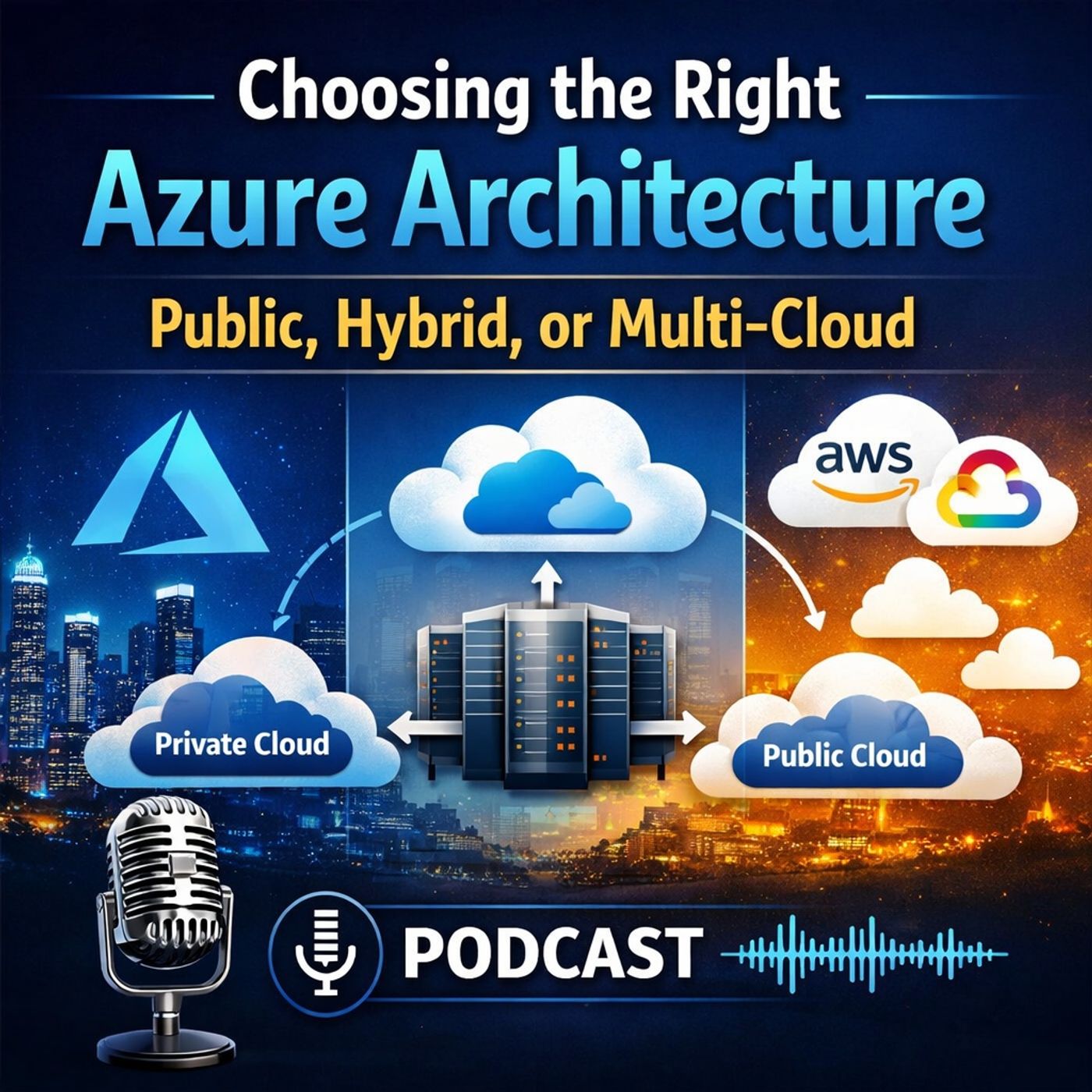
Most organizations say they chose public cloud, hybrid, or multi-cloud. In reality, those architectures weren’t chosen — they emerged. One exception, one acquisition, one regulatory constraint, one latency issue at a time. And over time, those decisions quietly determined who can ship, who can comply, and who gets blamed when something breaks. This episode reframes cloud not as a place, but as an operating model. Cloud platforms scale configuration, not intent — and when intent isn’t enforced through a coherent control plane, entropy fills the gap. That’s why hybrid became inevitable, why pure public cloud often breaks under predictability, latency, or cost constraints, and why most “multi-cloud strategies” are actually inherited complexity. We walk through where public Azure excels, where it fails, how cloud economics expose organizational behavior, and why governance erosion — not compute placement — is the real failure mode. The core takeaway is simple: architecture decisions…
Guest: Mirko Peters
Jan. 13, 2026
Azure Governance Is Enforced Architecture, Not Documentation
Most enterprises tell themselves a comfortable story: “We moved to Microsoft Azure, therefore we’re modern.” That story keeps people calm—right up until the first budget review, the first audit, or the first outage postmortem. Because cloud strategy isn’t a technology decision. It’s a decision about how the business wants to operate. Across dozens of large enterprises—different industries, same patterns—the same failures repeat. If cloud strategy were working, why do the same failures keep happening? Here’s the open loop: governance can increase speed when it removes ambiguity instead of adding paperwork.
Guest: Mirko Peters
Jan. 8, 2026
AI Stewardship for Microsoft 365 Governance
AI governance doesn’t fail because of missing policies — it fails because no one owns the moment when things go wrong. In this M365.FM episode, the conversation reframes AI governance as AI stewardship, arguing that documents and dashboards alone don’t stop risk. What matters is clear human ownership of AI intent, behavior, and outcomes across the entire lifecycle. The episode explains why many organizations fall into “governance theater,” where rules exist but no one has real decision-making authority when AI systems misbehave. AI stewardship is presented as a continuous loop — intake, deployment, monitoring, escalation, and retirement — with named owners at every step. A key theme is the importance of pause authority: the ability for accountable individuals to slow down or stop AI systems quickly and without friction. The discussion also highlights how Microsoft’s tools, such as Entra and Purview, can help operationalize stewardship by tying decision rights directly into techn…
Guest: Mirko Peters
Jan. 7, 2026
Fix Hidden HR Configuration and Hire-to-Retire Architecture
The Foundational Lie of “Hire-to-Retire” Deconstructing the Architectural Debt of Modern HR Systems 🧠 Episode Summary Most organizations believe hire-to-retire is a lifecycle. It isn’t. It’s a story layered on top of fragmented systems making...
Guest: Mirko Peters

Jan. 2, 2026
Fix Microsoft Entra ID Conditional Access and Identity Debt
Everyone thinks their Azure outages and breaches start with networks, costs, or misconfigured virtual machines, but this episode argues that the real failure almost always begins much higher up, in identity itself. The speaker reframes identity not as a simple login service but as Azure’s true control plane: a distributed decision engine that compiles signals about users, devices, risk, roles, and exceptions into every authorization decision. Over time, small “temporary” exceptions in conditional access, hybrid identity sync, workload identities, and guest access accumulate into what he calls identity debt, where policies drift far from their original intent and become unpredictable. Hybrid synchronization faithfully copies old on-prem assumptions into the cloud without preserving governance boundaries, while conditional access sprawl turns clean intent into fragile, probabilistic behavior hidden behind exclusions. Networks, firewalls, and endpoints cannot compensate for this, because…
Guest: Mirko Peters
Dec. 31, 2025
How AI-Generated Identity Configuration Breaks Entra Security
The demo worked in ten minutes. The audit took ten weeks. That gap is where most modern security failures are born. A team asked an AI agent to wire up identity, and it did exactly what it was trained to do: choose the fastest, most common path. Secrets instead of certificates. Broad permissions instead of narrow intent. Wildcard redirects to keep things moving. Nothing broke. That was the problem. Here’s the uncomfortable truth: the system wasn’t misconfigured. Responsibility was outsourced. When you treat AI like a peer, it fills in gaps with probability, not policy. Every unstated rule becomes a guess, and every guess scales. One working app becomes ten, then fifty, each drifting a few degrees from what you meant. Not dramatically. Quietly. Conveniently. Speed feels real at first. Tokens flow, tests pass, production lights stay green. But governance dissolves when defaults go unchallenged. The model doesn’t know your rules; it knows the internet’s habits. And habits favor con…
Guest: Mirko Peters
Dec. 21, 2025
Stop Active Directory Security Drift Before a Breach
This episode explores the concept of Active Directory security drift—how environments gradually move away from their original secure configuration over time. Even well-designed setups become vulnerable as changes accumulate through daily operations, admin actions, or incomplete processes. The discussion highlights that drift is often subtle and goes unnoticed, yet it can introduce serious risks such as excessive permissions, outdated settings, and weakened security controls. These issues make it easier for attackers to escalate privileges and move laterally within a network. () A key takeaway is that security is not a one-time setup but an ongoing process. Organizations need continuous monitoring, regular reviews, and automation to maintain a secure baseline and detect unwanted changes early. Without this, even mature environments can slowly degrade into insecure states. Overall, the episode emphasizes that security drift is inevitable—but unmanaged drift is dangerous, making…
Guest: Mirko Peters
Dec. 21, 2025
How Ransomware Moves Through Active Directory
Security drift in Active Directory and Azure AD isn’t a single bug — it’s the slow, invisible decay of identity, permissions, and governance posture that happens when environments aren’t routinely managed and remediated. Over time, this drift increases risk, weakens access controls, and creates blind spots that attackers can exploit. In this episode, we break down what security drift really means in the context of Microsoft Entra Active Directory and Entra ID, how it develops, what causes it, and what you can do to prevent it — not just detect it.
Guest: Mirko Peters
Dec. 12, 2025
Build an Auditable Multi-Agent Copilot in Microsoft 365
Ever trusted an AI answer that felt certain, then realised you couldn’t prove where it came from? This video is a forensic walkthrough of how single agents hallucinate, leak data, drift off stale indexes, and fail every audit that matters – and how to fix it with a multi-agent reference architecture in Microsoft 365. You’ll see exactly how SPFx + Azure OpenAI + LlamaIndex chains go wrong: weak RAG retrieval, no rerank, ornamental citations, prompt injection, over-privileged Graph connectors, and stale SharePoint indexes. Then we rebuild the system with dedicated agents for retrieval, rerank, verification, red-team and blue-team policy, maintenance, and compliance, all fronted by Azure API Management and permission-aware Microsoft Search or Copilot retrieval. You’ll learn how to enforce chain of custody, log prompts and tool calls, require line-level citations, and replay answers on demand for regulators and boards. If you care about AI you can defend, not just demo, this is your bluep…
Guest: Mirko Peters
Dec. 11, 2025
Build Audit-Ready Document Management with SharePoint and Purview
In a recent podcast, Mirko Peters discussed the critical importance of effective document management and compliance in organizations, emphasizing that lost documents can lead to organizational failure. He presented strategies for building an audit-ready Enterprise Content Management (ECM) system in the cloud, using tools like SharePoint and Purview to create a robust defense against regulatory scrutiny. The conversation highlighted the alignment with standards such as ISO 27001, GDPR, and SOC 2, which are essential for surviving inspections. Peters outlined a structured approach to document management, including defining ownership, lifecycle management, and implementing data loss prevention (DLP) measures. He stressed the need for clear policies, sensitivity labels, and regular audits to ensure compliance and mitigate insider risks. The discussion also covered the importance of collaboration between HR, legal, and security teams to maintain a culture of compliance. This podcast …
Guest: Mirko Peters
Dec. 11, 2025
Optimize Dynamics 365 Business Processes for Faster Delivery
The podcast features a discussion among experts focused on optimizing project management processes using Dynamics. The speakers emphasize the importance of transitioning from traditional, cumbersome workflows to more efficient systems that prioritize speed and clarity. They argue that merely implementing Dynamics is not the end goal; rather, the objective is to enhance the speed at which work translates into progress. Key points include the need to eliminate unnecessary stages and fields, establish clear exit criteria, and automate processes to reduce friction. The speakers advocate for a structured approach, breaking down tasks into manageable stages—qualify, commit, and deliver—while ensuring that each stage has actionable criteria. They highlight the significance of data-driven decision-making and the role of a dedicated product owner in maintaining momentum. This discussion is crucial as it provides practical strategies for organizations looking to improve their operational …
Guest: Mirko Peters