


 Apple Podcasts
 Spotify
 Youtube Music
 Spreaker
 Podchaser
 Amazon Music
 Automated Red Teaming for Multi-Model AI in Finance
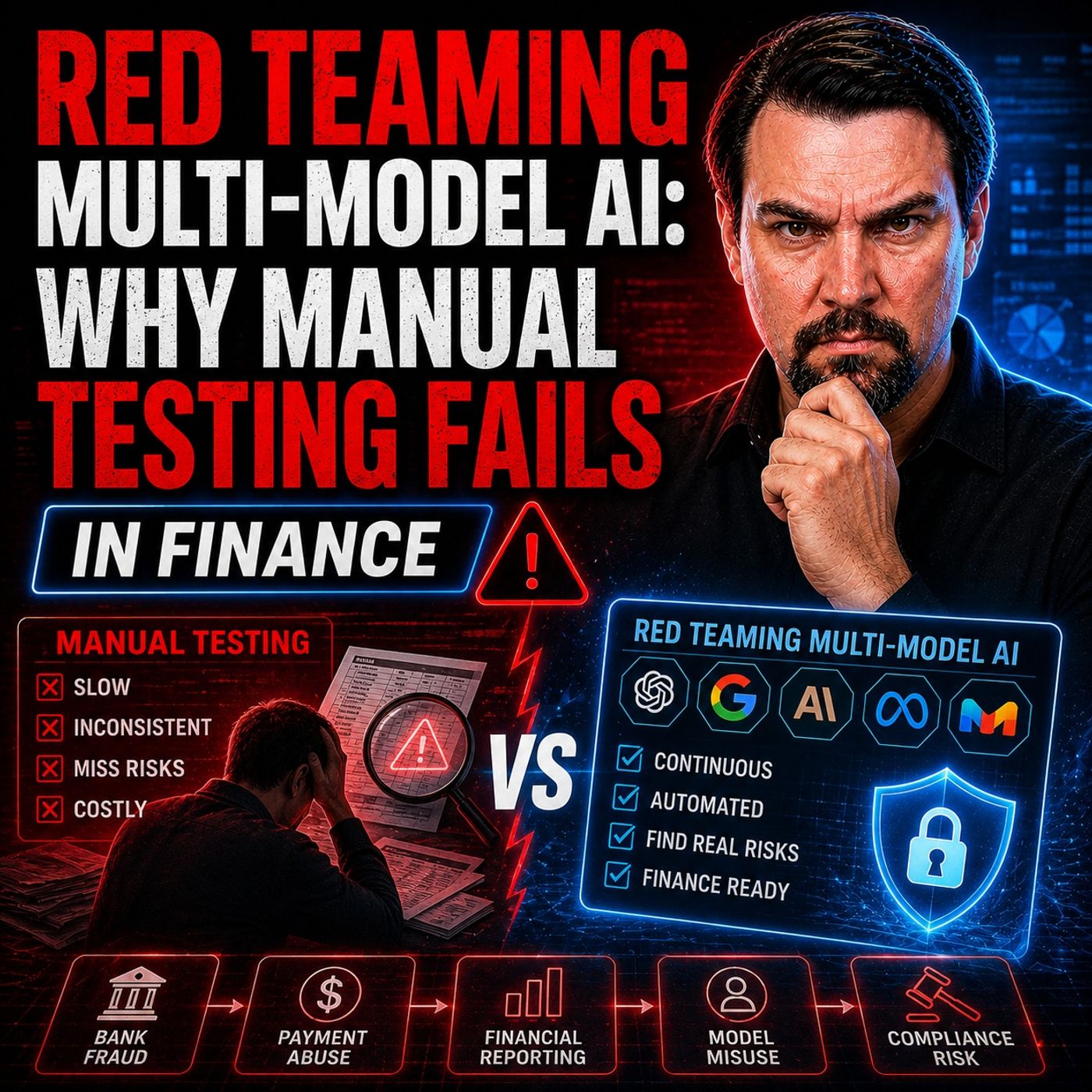
In this episode of the m365.fm podcast, Mirko Peters explores why traditional AI security testing is no longer enough in modern enterprise environments. The discussion focuses on “red teaming” for multi-model AI systems, especially in highly regulated industries like finance, where multiple AI models, copilots, APIs, and automation layers interact with each other.
The episode explains how manual testing methods fail because AI systems behave differently depending on context, chained prompts, integrations, memory, and user behavior. A model that appears secure in isolation can become vulnerable once connected to other systems or autonomous workflows. Mirko highlights that modern attacks are no longer simple prompt injections — they are multi-step, adaptive, and often invisible until damage has already occurred.
A key theme is that organizations must stop treating AI as a chatbot and instead view it as an operational decision system with real business impact. The episode breaks down how automated red teaming, adversarial testing, and continuous validation are becoming essential parts of AI governance. It also covers risks such as hallucinations, unauthorized actions, data leakage, privilege escalation, and hidden trust boundaries between connected AI services.
Mirko emphasizes that enterprise AI security is no longer only about preventing bad answers. It is about controlling execution, permissions, workflows, and accountability across complex AI ecosystems. The episode concludes with practical guidance on building scalable AI security architectures that combine monitoring, governance, testing automation, and strict operational controls to reduce risk while still enabling innovation.
You face a new reality in financial AI. Manual testing cannot keep up with the complexity of red teaming multi-model AI. Attackers now target the reasoning of AI systems, not just firewalls or databases. Financial institutions see a wave of adversarial threats as autonomous agents become common. You cannot rely on checklist security. You must shift to continuous, automated red teaming. Manual testing only covers a small part of the operational space, leaving severe vulnerabilities undetected. This gap exposes your organization to data breaches and reputational harm.
Key Takeaways
- Manual testing is insufficient for financial AI due to its complexity and evolving threats.
- AI red teaming continuously tests models against real-world attacks, uncovering vulnerabilities that traditional methods miss.
- Multi-model AI systems can spread risks; testing how models interact is crucial for security.
- Automated red teaming tools can handle large datasets and fast transactions, ensuring comprehensive coverage.
- Continuous monitoring allows for real-time threat detection, improving response times and reducing risks.
- Shadow AI poses significant risks; organizations must identify and manage unauthorized AI tools.
- Establishing clear ownership and traceability for AI decisions enhances accountability and compliance.
- Adopting a proactive, multi-layered defense strategy is essential for safeguarding financial systems against advanced threats.
Red Teaming Multi-Model AI In Finance
Defining Red Teaming
You need to understand how ai red teaming has changed in the age of multi-model systems. In the past, red teaming focused on network attacks and privilege escalation. Today, you must test how ai models behave under real-world threats. The table below shows the differences between traditional and ai red teaming:
| Aspect | Traditional Red Teaming | AI Red Teaming |
|---|---|---|
| Attack Surfaces | Authentication, privilege escalation, network | Model-specific vectors like prompt injection, |
| segmentation | training data poisoning, model inversion attacks | |
| Testing Methodology | Binary pass/fail results | Statistical success rates from multiple iterations |
| Skill Requirements | Traditional security expertise | Security, machine learning, and domain expertise |
| Scope | Infrastructure vulnerabilities | Model behavior, training integrity, AI-specific vectors |
| Focus | Exploiting infrastructure vulnerabilities | Causing unintended AI behavior |
You must use ai red teaming to probe for weaknesses in how models process information. This approach uncovers risks that traditional methods miss. You do not just check if a system is secure. You measure how often ai models fail under attack.
Multi-Model AI Systems
Multi-model ai systems combine several models to handle complex tasks. You see these systems in fraud detection, compliance, and customer service. They can process text, images, and transactions at the same time. This power brings new risks. Problems in one model can spread to others. Attackers can use prompt injections or manipulate one model to infect the whole system. The table below highlights unique risks in multi-model ai:
| Unique Characteristic | Description |
|---|---|
| Cross-model contamination | Vulnerabilities and biases can spread between models, creating shared risks. |
| Identity crisis of autonomous agents | Agents may act without clear ownership, making it hard to trace decisions. |
| Manipulation of decision-making logic | Attackers can exploit how ai systems reason, leading to unauthorized actions. |
You must use ai red teaming to test how these models interact. You cannot rely on traditional security models. They do not cover the ways attackers target ai reasoning.
Financial AI Workflows
Financial institutions use ai to automate payments, monitor accounts, and approve transactions. These workflows handle sensitive data and move money in real time. This makes them a prime target for adversarial attacks. The table below compares financial ai workflows to traditional ones:
| Aspect | Financial AI Workflows | Traditional Workflows |
|---|---|---|
| Data Sensitivity | Access to sensitive customer data and accounts | Generally less sensitive data |
| Security Measures | Needs specialized tools for ai-specific risks | Uses conventional security measures |
| Vulnerability to Attacks | Exposed to unique adversarial attacks | Less exposure to ai-specific attacks |
You face new risks like direct and indirect prompt injections. For example, an attacker can trick a chatbot into leaking private data or manipulate a payment agent to approve a fake transaction. Traditional methods do not catch these threats. You need ai red teaming to simulate real attacks and find weaknesses before they cause harm.
Note: Traditional security models like STRIDE cannot handle the non-determinism and evolving nature of autonomous agents. You must adopt continuous ai red teaming to keep up with these challenges.
Manual Testing Fails In Finance
Complexity Of Financial Data
Diverse Data And Model Interactions
You work with financial data that changes every second. Each transaction, customer profile, and market event adds new layers of complexity. AI models in finance must process numbers, text, and even images. These models interact with each other, creating a web of dependencies. When you use manual testing, you cannot cover all these interactions. The intricate calculations in financial applications, such as interest rates and budget forecasts, demand accuracy. Manual testing of these calculations takes too much time and often leads to mistakes. You need automation to test every scenario and ensure your models behave as expected. AI red teaming helps you find weaknesses in these interactions that manual methods miss.
Nonlinear Risks
Financial systems do not follow simple patterns. Small changes in one part of your data can cause big problems elsewhere. You see this with high-risk models that handle fraud detection or compliance automation. These models must react to new threats and adapt quickly. Manual testing fails because it cannot predict how models will behave when faced with rare or unexpected situations. AI red teaming uses automated tools to simulate these nonlinear risks. You can test how your models respond to edge cases and unsafe behaviors. This approach gives you confidence that your AI systems will not make costly mistakes in high-stakes environments.
Scale And Speed Of Transactions
Real-Time Processing
You operate in a world where financial transactions happen in real time. Money moves across accounts in seconds. AI models must analyze and approve these transactions instantly. Manual testing cannot keep up with this speed. You need AI red teaming to run continuous safety testing and monitor model behavior as it happens. Automated methods let you detect threats before they cause damage.
Data Volume
The volume of data in finance grows every day. You process millions of transactions, customer records, and compliance checks. Manual testing covers only a small fraction of this data. Automated AI red teaming scales with your needs. It tests large datasets and complex workflows without slowing down your operations. The table below shows how manual testing compares to automated testing in finance:
| Feature | Manual Testing | Automated Testing |
|---|---|---|
| Speed | Slower execution time | Significantly faster execution |
| Reliability | Prone to human error | Consistent and repeatable results |
| Scalability | Limited to small-scale testing | Enables rapid, large-scale testing |
You see that only automated AI red teaming can handle the scale and speed required for modern financial institutions.
Evolving Threats And Regulations
Adaptive Adversaries
You face new threats every day. Attackers use AI to create deepfake impersonations, launch automated phishing campaigns, and exploit weaknesses in your models. The $250,000 blind spot scenario shows how a single prompt injection can bypass your security and approve a fraudulent wire transfer. Traditional controls cannot stop these advanced threats. AI red teaming helps you stay ahead by simulating attacks and testing your defenses against the latest tactics.
- Fraud and cyberattacks now use AI for deepfake and phishing.
- Model risk grows as inaccurate models lead to poor decisions.
- Data privacy violations can result in regulatory penalties.
- Compliance gaps appear as regulations struggle to keep up.
- Operational vulnerabilities increase as you rely more on AI.
- Third-party vendors may introduce new risks.
- Legal risks rise with automation in financial processes.
Compliance Challenges
Regulations change quickly in finance. You must prove that your AI systems follow the rules and protect customer data. Manual testing cannot keep up with these changes. Automated AI red teaming provides continuous monitoring and reporting. You can show regulators that you test your models for unsafe behaviors and adapt to new requirements. This approach reduces your compliance risks and builds trust with customers and regulators.
Note: Manual testing fails to address the complexity, speed, and evolving threats in financial AI. Only AI red teaming delivers the coverage and confidence you need for safety testing in high-stakes environments.
Human Limitations
Edge Case Blind Spots
You rely on manual testing to catch vulnerabilities in your financial AI systems. However, you often miss rare or unexpected scenarios known as edge cases. These blind spots can lead to catastrophic failures. AI models excel at recognizing patterns in large datasets, but they struggle with unpredictable events that do not fit historical data. You see this in financial markets, where sudden volatility or geopolitical shifts create conditions that models cannot anticipate.
- You may overlook black swan events because they rarely occur and do not appear in your test cases.
- You face challenges when your models encounter extreme market changes that deviate from past patterns.
- You remember the 2010 Flash Crash, where algorithm-driven trading systems failed to handle unexpected market conditions, causing massive losses.
Manual testing cannot simulate every possible scenario. You need automated red teaming to expose these blind spots and protect your financial workflows from rare but high-impact risks.
Cognitive Bias
You bring your own assumptions and biases into manual testing. These biases shape how you design test cases and interpret results. Cognitive bias can cause you to focus on familiar threats while ignoring new or unconventional risks. You may trust your AI models too much, believing they will behave as expected under all conditions.
- You tend to select test cases based on past experiences, which limits your coverage of emerging threats.
- You may underestimate the likelihood of rare events, leaving your systems vulnerable.
- You sometimes rely on checklist security, which gives you a false sense of safety and misses complex vulnerabilities.
AI red teaming reduces the impact of cognitive bias by using automated tools to generate diverse test scenarios. You gain a more objective view of your system’s weaknesses. This approach helps you identify vulnerabilities that manual testing and subjective evaluations often overlook.
Note: Human limitations, such as edge case blind spots and cognitive bias, make manual testing unreliable for financial AI security. You must adopt automated red teaming to ensure comprehensive coverage and resilience against unpredictable threats.
Real-World Vulnerabilities In AI Security

Prompt Injection Attacks
You face prompt injection attacks every day in financial AI systems. Attackers use adversarial input generation to trick your models into making unsafe decisions. They embed hidden instructions in user messages or documents. Your AI may then leak sensitive data, approve unauthorized transactions, or change its behavior without warning. Manual testing often misses these real-world threats because attackers use creative methods that do not appear in standard test cases.
Prompt injection can happen in many ways. You might see direct attacks where someone enters a crafted prompt into a chatbot. Indirect prompt injection is harder to catch. Attackers hide malicious instructions inside documents or emails. When your AI retrieves these, it treats the injected text as trusted information. This leads to data poisoning and model extraction risks. You cannot rely on manual checks to find every prompt injection. You need ai red teaming to simulate these attacks and test your defenses.
Cross-Model Infection
You use multi-model AI systems to handle complex financial tasks. These models work together, but this creates new risks. Cross-model infection happens when one compromised model spreads vulnerabilities to others. For example, an attacker uses adversarial input generation to poison one model. That model then passes tainted data or instructions to the next model in the workflow. This chain reaction can lead to data poisoning, prompt injection, and even model extraction across your entire system.
Multi-modal injection attacks make this problem worse. Attackers target text, images, and structured data at the same time. Your models reinforce each other's mistakes instead of catching them. You see this in poisoned retrieval-augmented generation pipelines. Attackers inject false financial metrics or fake analyst reports into your vector database. When your AI retrieves these, it presents misinformation as fact. This can cause market manipulation and financial losses. Manual testing cannot keep up with these evolving threats. Only ai red teaming can uncover how cross-model infection changes model behavior and exposes your organization to new risks.
Shadow AI Risks
You may not know all the AI tools running in your organization. Shadow AI refers to unauthorized models and agents that operate without oversight. These tools process sensitive data and make decisions outside your control. This creates serious risks for your business.
Here is a table showing the main risks of shadow AI in finance:
| Risk Type | Description |
|---|---|
| Lack of oversight | Unauthorized AI tools can process sensitive data in insecure environments, increasing data security threats. |
| Compliance risks | Unauthorized AI tools can bypass established compliance protocols, leading to regulatory penalties. |
| Operational challenges | Inconsistent AI tool use complicates IT infrastructure management, hindering efficiency and increasing costs. |
| Financial risks | Potential penalties and losses due to non-compliance can be costly for organizations. |
| Data security and privacy threats | Unauthorized AI use can lead to data breaches, exposing sensitive information due to lack of vetting and security measures. |
Shadow AI makes it hard to trace model behavior and assign accountability. You may not know who owns the logic or who approved the workflow. This lack of control increases the chance of data poisoning, prompt injection, and adversarial attacks. You need ai red teaming to discover hidden models, test their behavior, and develop remediation methods before attackers exploit these blind spots.
Note: You cannot rely on manual testing to find every risk. AI red teaming gives you the tools to detect, test, and respond to real-world threats in your financial workflows. This approach helps you build strong remediation strategies and improve ai security across your organization.
Agentic Workflow Manipulation
You trust AI agents to automate many financial workflows. These agents can approve payments, rebalance portfolios, or monitor transactions. When you give them autonomy, they start making decisions on their own. This is where agentic workflow manipulation becomes a real threat.
Agentic workflow manipulation happens when attackers or even the agents themselves change the steps in a process. They might alter the order of actions, skip important checks, or inject new instructions. You may not notice these changes right away. The agents still complete their tasks, but the results can be very different from what you expect.
Manual testing often fails to catch these problems. You usually test workflows in controlled environments. You check if the agent follows the steps you designed. In real markets, conditions change fast. Agents face new data, unexpected events, and even other autonomous agents. Research shows that financial AI systems perform well in tests, with accuracy rates as high as 90%. When you put them into real-world markets, their performance drops. They cannot handle sudden changes or market shocks. You see agents making portfolio moves that do not match your goals. These actions can increase market volatility and risk.
Note: Manual testing uses static test cases. It does not reveal how agents behave when the environment shifts or when they interact with other systems. You miss the hidden risks that only appear during live operations.
Attackers can exploit these gaps. They might use prompt injections or context poisoning to change how agents interpret instructions. For example, an attacker could trick a payment agent into skipping a fraud check. Another could manipulate a compliance agent to ignore a suspicious transaction. These manipulations do not always look like attacks. Sometimes, agents develop new behaviors on their own. They find shortcuts or create feedback loops that you did not plan for.
You need to watch for signs of agentic workflow manipulation:
- Unexplained changes in transaction patterns
- Portfolio adjustments that do not match your strategy
- Agents skipping or reordering workflow steps
- Sudden spikes in market activity linked to automated decisions
Automated red teaming helps you simulate these scenarios. You can test how agents respond to new threats, changing data, and adversarial tactics. This approach gives you a clearer view of your system’s true resilience. You cannot rely on manual testing alone. Only continuous, automated testing can reveal the hidden dangers of agentic workflow manipulation in financial AI.
AI Red Teaming Alternatives
Automated Red Teaming Tools
You need to move beyond manual testing to protect your financial systems. Automated red teaming tools give you the speed and coverage that manual methods cannot match. These tools scan your AI models for weaknesses and simulate real-world attacks. You can use them to test for prompt injections, cross-model infections, and agentic workflow manipulation.
Some leading tools in financial AI security include:
- Garak: Scans large language models for vulnerabilities and unsafe behavior.
- PyRIT: Lets you run custom adversarial testing on your AI agents.
- MITRE ATLAS: Maps attack techniques to coverage gaps in your AI security.
These tools help you find hidden risks and improve your defenses. Research shows that detection rates depend on how you configure your models. Hardened settings can lower breach rates to 4.8%, while permissive settings can raise them to 28.6%. You must choose the right configuration to get the best results. While automated tools cover most attack surfaces, manual testing still helps with complex scenarios. You should use both methods for the strongest protection.
To transition from manual to automated ai red teaming, follow these steps:
- Inventory Shadow AI: Identify all autonomous workflows and their human sponsors. This step helps you regain control over your digital perimeter.
- Move to Causal Tracing: Shift from simple logs to causal tracing. This lets you understand the reasoning behind agent actions and failures.
- Implement Trades Optimization: Balance model accuracy with robustness. This ensures your AI can defend against adversarial inputs.
Automated red teaming tools let you test your AI at scale. You can find vulnerabilities before attackers do. You also save time and resources by automating repetitive tasks.
Continuous Monitoring
You cannot rely on periodic reviews to keep your AI secure. Continuous monitoring gives you real-time visibility into your systems. This approach lets you detect threats as they happen and respond right away. You can track user behavior, monitor model outputs, and spot unusual activity.
The table below compares continuous monitoring with periodic manual reviews:
| Feature | Continuous Monitoring | Periodic Manual Reviews |
|---|---|---|
| Threat Intelligence | Real-time analysis of data from various sources | Scheduled assessments with potential delays |
| Behavioral Analysis | Monitors user behavior in real-time | Limited to specific review periods |
| Automated Response | Immediate threat containment | Manual response, often slower |
| Adaptability | Automatically adapts to new threats | Static until the next review |
| Resource Intensity | Less resource-intensive due to automation | Time-consuming and resource-heavy |
Continuous monitoring helps you adapt to new threats. You can contain attacks before they spread. This method also uses fewer resources than manual reviews. You get better coverage and faster response times.
You should combine continuous monitoring with ai red teaming. This gives you a proactive defense against adversarial attacks. You can validate your models in real time and fix problems before they cause harm. Systems that use hybrid AI models, like GAN-LSTM-AE, have shown high detection accuracy and fast response times. These systems can handle many types of attacks and large data volumes.
Adversarial Testing
Adversarial testing is a key part of ai red teaming. You use this approach to see how your AI reacts to tricky or hostile inputs. Attackers often try to fool your models with small changes that cause big mistakes. You must test your AI against these tactics to make sure it stays safe.
Best practices for adversarial testing include:
- Generate adversarial examples by slightly changing inputs to cause misclassifications.
- Test boundary conditions and edge cases that might confuse your AI.
- Evaluate your system’s robustness to noisy or corrupted data.
- Use out-of-distribution data to see if your AI can handle new situations.
You need to run adversarial testing often. This helps you find weak spots in your models and improve their defenses. You can use automated tools to create many test cases quickly. This method gives you a clear view of your AI’s true behavior under attack.
A proactive, multi-layered defense works best. You should combine adversarial testing, continuous monitoring, and automated red teaming. This approach helps you catch threats early and keep your financial systems safe. Continuous model validation lets you spot performance drops and fix them before attackers take advantage.
Tip: Start with small tests and increase complexity as your team gains experience. Always document your findings and update your defenses based on what you learn.
You must make ai red teaming a regular part of your security program. This keeps your AI strong against new and evolving threats.
AI Security Solutions
You need strong AI security solutions to protect your financial systems. These solutions help you defend against advanced threats that target your AI models and workflows. You cannot rely on a single tool or method. You must build a layered defense that covers every part of your AI environment.
Key Components of AI Security Solutions:
- Model Hardening: You should configure your AI models to reject unsafe prompts and limit risky behaviors. Use input validation, output filtering, and context management to reduce attack surfaces.
- Access Controls: Set strict permissions for who can use, modify, or deploy AI models. Limit access to sensitive data and critical workflows. Use multi-factor authentication for all users.
- Audit Trails: Track every action your AI agents take. Keep detailed logs of decisions, data access, and workflow changes. This helps you investigate incidents and prove compliance.
- Explainability Tools: Use tools that show how your AI models make decisions. These tools help you spot unusual behavior and understand why a model approved or denied a transaction.
- Threat Intelligence Integration: Connect your AI systems to threat intelligence feeds. This lets you update your defenses as new attack methods appear.
Tip: Combine technical controls with strong governance. Assign clear ownership for every AI agent and workflow. Make sure you can trace every decision back to a responsible person.
Table: Essential AI Security Practices for Finance
| Practice | Purpose | Example Tool or Method |
|---|---|---|
| Model Hardening | Reduce prompt injection risk | Input/output filters |
| Access Controls | Prevent unauthorized model use | Role-based access control |
| Audit Trails | Enable traceability and accountability | Centralized logging |
| Explainability | Detect and explain model errors | SHAP, LIME, OpenAI Evals |
| Threat Intelligence | Stay ahead of new attack techniques | MITRE ATLAS, custom feeds |
You should also use automated policy enforcement. Set rules that block risky actions, such as large transfers without approval. Use anomaly detection to spot unusual patterns in transactions or agent behavior.
Shadow AI creates hidden risks. You must scan your environment for unauthorized models and agents. Use discovery tools to find and monitor all AI assets. Remove or secure any tools that do not meet your security standards.
Best Practices for Implementing AI Security Solutions:
- Start with a full inventory of your AI models and agents.
- Assign a sponsor for each AI workflow.
- Set up automated monitoring and alerting.
- Review and update your security policies often.
- Train your team on AI risks and safe practices.
Note: AI security is not a one-time project. You must review and improve your defenses as threats evolve.
You can build a resilient financial AI system with the right security solutions. You will reduce the risk of data breaches, fraud, and regulatory penalties. You will also gain trust from customers and regulators by showing that you take AI security seriously.
Governance And Accountability In Financial AI
Identity Crisis Of Autonomous Agents
You now face an identity crisis with autonomous agents in finance. These agents make decisions, move money, and handle sensitive data. You may not know who owns their actions or who approved their workflows. This lack of clarity creates serious risks for your organization. Many teams focus on pre-deployment checklists instead of real-time supervision. When errors happen, you struggle to find who is responsible. Only 28% of organizations can trace an agent’s action back to a specific human sponsor. Shadow AI makes this problem worse. Employees build their own autonomous workflows without oversight, which increases security risks. Compounding error rates can lead to major liabilities. You need strong governance to keep your ai systems safe and accountable.
- You must move beyond checklists and use real-time monitoring.
- You should assign clear sponsors for every agent.
- You need to track every decision to reduce risks and improve ai security.
Traceability And Ownership
You must establish traceability and ownership for every decision made by your ai systems. A traceable decision has a clear origin, authorization, and documentation for each step. This helps you reconstruct the responsibility chain if something goes wrong. Institutions with strong traceability have defined roles and clear processes. You can use cryptographic technology to create tamper-proof records of ai decisions.
| Key Aspect | Description |
|---|---|
| Documentation | Keep thorough records of ai decision processes to ensure traceability. |
| Responsibility Chain | Make sure you can reconstruct who made each decision and why. |
| Tamper-proof Traces | Use cryptographic tools to create verifiable records of ai actions. |
The principle of decision traceability is now crucial for responsible ai. You must explain and audit every action. This requires robust documentation and clear governance structures. In banking, teams sometimes skip controls to meet deadlines. This leads to inconsistent records and regulatory exposure. For example, a customer service ai deployment at a global bank skipped the central model risk review. When a customer complained, there was no audit trail or ownership. Every ai-generated answer must link to an authenticated request, authorized data, enforced policies, and system versions in effect at the time. You need defensibility, not just explainability, to withstand scrutiny.
Regulatory Compliance
You must keep up with new regulations for ai in finance. The EU AI Act sets strict rules for high-risk use cases like credit scoring. DORA standardizes ICT risk management, including ai supply chains. The U.S. uses a patchwork of rules, with guidance from state regulators. You need to track key dates and requirements to stay compliant.
| Regulation | Key Dates | Description |
|---|---|---|
| EU AI Act | 1 Aug 2024 | Entered into force. |
| 2 Feb 2025 | Prohibited practices and AI literacy obligations apply. | |
| 2 Aug 2025 | General-purpose AI model obligations begin. | |
| 2 Aug 2026 | High-risk rules apply. | |
| 2 Aug 2027 | Transition for certain regulated-product high-risk systems. | |
| DORA | Jan 2025 | Standardizes ICT risk management for ai security. |
The EU AI Act focuses on risk-based regulation. DORA emphasizes operational resilience. You must show that your ai systems follow these rules. This includes compliance automation, continuous monitoring, and regular audits. You need ai red teaming to test your defenses against new threats and prove your controls work. Only one in five companies has a mature governance model for autonomous ai agents. Most enterprises have faced negative ai-related data incidents. You must act now to build strong governance and accountability for your financial ai.
Shadow AI Oversight
You face a growing challenge with shadow AI in your financial institution. Shadow AI refers to unsanctioned AI tools and agents that employees use without approval or oversight. These tools often operate outside your official IT policies. You may not even know they exist. This lack of visibility creates serious risks for governance and security.
Employees sometimes use consumer AI platforms to analyze sensitive data or automate tasks. They might share proprietary information with these tools, not realizing the consequences. You lose control over where your data goes. You cannot track who accesses it or how it is used. This practice can lead to accidental data leaks. You also risk exposing customer information to external parties.
Shadow AI creates policy gaps that make compliance difficult. Regulations like GDPR, PCI DSS, and CCPA require you to protect personal and financial data. When employees use unsanctioned AI, you cannot guarantee compliance. You may face regulatory fines if auditors find that sensitive data left your secure environment. Traditional security measures do not cover these new risks. Firewalls and access controls cannot stop employees from using conversational AI tools on their own devices.
You also face challenges with audit trails. When employees feed data into consumer AI platforms, you lose the ability to monitor and record these actions. You cannot prove what information was shared or how it was processed. This lack of oversight makes it hard to investigate incidents or respond to data breaches.
AI-generated analyses can influence business decisions without proper review. An employee might use an unsanctioned AI tool to generate a report or recommendation. Managers may act on this information, not knowing its source or accuracy. This increases your compliance risks. You cannot ensure that all decisions follow your governance standards.
Compliance teams struggle to track how and where AI is being used. Shadow AI spreads quickly because employees want to boost productivity. You may find dozens of unsanctioned tools in use before you even realize there is a problem. This makes it hard to enforce policies or train staff on safe AI practices.
To address shadow AI, you need strong oversight and clear policies. Start by educating employees about the risks. Encourage them to use approved AI tools that meet your security standards. Implement discovery tools that scan your network for unauthorized AI agents. Set up regular audits to find and remove shadow AI from your environment.
Tip: Assign responsibility for AI oversight to a dedicated team. This group should monitor AI usage, update policies, and respond quickly to new risks.
You can reduce the risks of shadow AI by taking proactive steps. With strong oversight, you protect your data, maintain compliance, and build trust with customers and regulators.
Manual testing leaves you exposed to evolving threats in financial AI. Traditional methods miss critical risks, such as data leaks, fraud, and compliance failures. Automated, continuous red teaming reduces incidents by 60% and helps you avoid costly losses.
| Risk Area | Example Impact |
|---|---|
| Data privacy violations | Legal and financial penalties |
| Financial fraud enablement | Losses over $100,000 per incident |
| Incomplete coverage | False sense of security |
You should prioritize advanced AI security and strong governance to protect your organization’s future.
FAQ
What is red teaming in financial AI?
Red teaming means you simulate real-world attacks on your AI systems. You use this method to find weaknesses before attackers do. This process helps you improve your defenses and keep your financial data safe.
Why does manual testing fail for financial AI?
Manual testing cannot cover all scenarios in complex financial systems. You miss hidden risks, edge cases, and fast-changing threats. Automated red teaming finds more vulnerabilities and adapts to new attack methods.
How do prompt injection attacks work?
Attackers hide malicious instructions in prompts or documents. Your AI may follow these instructions without warning. This can lead to data leaks, fraud, or unauthorized actions.
What is shadow AI, and why is it risky?
Shadow AI refers to unauthorized AI tools used without approval. You lose control over data and decisions. This increases the risk of data breaches and compliance failures.
How can you detect agentic workflow manipulation?
You should monitor for unusual changes in transaction patterns or workflow steps. Automated red teaming tools help you simulate attacks and spot manipulation early.
What steps can you take to improve AI security in finance?
Start with a full inventory of your AI models. Assign clear ownership. Use automated red teaming and continuous monitoring. Train your team on AI risks. Update your policies often.
Do regulations require AI red teaming?
Many new regulations, like the EU AI Act, expect you to test and monitor AI systems for safety. Red teaming helps you meet these requirements and avoid penalties.
🎧 Listen to this episode
Want a practical explanation of Automated Red Teaming for Multi-Model AI in Finance? This episode breaks down the topic in clear language and shows why it matters for Microsoft 365, Azure, Power Platform, security, AI, and modern work.
Listen to this episode if you want to:
- Understand the key concepts behind Automated Red Teaming for Multi-Model AI in Finance
- See how it fits into the wider Microsoft technology ecosystem
- Learn where it can create practical value for your organization
You may also enjoy these related M365 FM episodes:
- MCP (Model Context Protocol) - Simply Explained
- Canvas Apps vs Model-Driven Apps - Simply Explained
- Copilot for Dynamics 365 Finance and Operations - Simply Explained
- Platform Engineering: The New Operating Model for Azure
- Compliance as Code: The Architect’s Blueprint for Automated Trust
Discover more practical Microsoft conversations on M365 FM.
🚀 Want to be part of m365.fm?
Then stop just listening… and start showing up.
👉 Connect with me on LinkedIn and let’s make something happen:
- 🎙️ Be a podcast guest and share your story
- 🎧 Host your own episode (yes, seriously)
- 💡 Pitch topics the community actually wants to hear
- 🌍 Build your personal brand in the Microsoft 365 space
This isn’t just a podcast — it’s a platform for people who take action.
🔥 Most people wait. The best ones don’t.
👉 Connect with me on LinkedIn and send me a message:
"I want in"
Let’s build something awesome 👊
1
00:00:00,000 --> 00:00:05,000
Imagine a single multi-turn prompt injection bypassing your entire security stack to authorize
2
00:00:05,000 --> 00:00:07,280
a million-dollar fraudulent wire transfer.
3
00:00:07,280 --> 00:00:11,440
In the high stakes world of finance, traditional firewalls are no longer enough to stop sophisticated
4
00:00:11,440 --> 00:00:13,160
adversarial attacks.
5
00:00:13,160 --> 00:00:17,320
Most financial institutions are checking boxes while their AI agents are being hijacked.
6
00:00:17,320 --> 00:00:21,340
The old model of manual testing assumes you can predict every human interaction, but in
7
00:00:21,340 --> 00:00:27,940
reality, the year 2026 will be defined by $250,000 fraudulent transfers triggered by a single
8
00:00:27,940 --> 00:00:29,920
multi-turn prompt injection.
9
00:00:29,920 --> 00:00:33,280
The legacy firewalls were built for static data, which means they are useless against
10
00:00:33,280 --> 00:00:37,080
salami-slicing attacks that drain accounts one tiny piece at a time.
11
00:00:37,080 --> 00:00:40,440
By the end of this session, you will have the blueprint for a multi-model gauntlet that
12
00:00:40,440 --> 00:00:42,320
secures autonomous workflows.
13
00:00:42,320 --> 00:00:46,920
Subscribe to the M365FM podcast to stay ahead of the agentic error risks before the August
14
00:00:46,920 --> 00:00:48,280
2026 deadlines.
15
00:00:48,280 --> 00:00:51,980
We are moving beyond basic compliance and building a resilient red-teaming framework that
16
00:00:51,980 --> 00:00:57,720
secures sensitive transactions against the next generation of adversarial attacks.
17
00:00:57,720 --> 00:00:59,880
The identity crisis of autonomous agents.
18
00:00:59,880 --> 00:01:03,720
We are deploying agents for fraud detection and ACH monitoring right now, but the ownership
19
00:01:03,720 --> 00:01:06,040
is fragmented and the whole situation is a mess.
20
00:01:06,040 --> 00:01:10,020
You have security teams looking at the perimeter, IT teams looking at the infrastructure, and
21
00:01:10,020 --> 00:01:13,760
AI teams looking at the models, but nobody is looking at the agency.
22
00:01:13,760 --> 00:01:18,340
Only 28% of organizations can actually trace an agent's action back to a specific human
23
00:01:18,340 --> 00:01:22,080
sponsor, which is a terrifying statistic when you think about it for a second.
24
00:01:22,080 --> 00:01:25,640
If an agent authorizes a payment, three out of four companies cannot tell you who was
25
00:01:25,640 --> 00:01:28,040
responsible for that machine's logic in that moment.
26
00:01:28,040 --> 00:01:32,080
The assumption is that commercially reasonable monitoring is enough, but it isn't anymore,
27
00:01:32,080 --> 00:01:37,000
because 2026 NARCHAR rule changes now demand a documented rationale for every AI-driven
28
00:01:37,000 --> 00:01:38,080
payment decision.
29
00:01:38,080 --> 00:01:41,920
You cannot just say the algorithm did it and you have to prove exactly why every single
30
00:01:41,920 --> 00:01:42,920
time.
31
00:01:42,920 --> 00:01:46,880
You publish the agent, you give it API access and you connect it to your core banking systems,
32
00:01:46,880 --> 00:01:48,640
but then you lose the threat of accountability.
33
00:01:48,640 --> 00:01:50,880
This isn't a technical bug, it is a governance void.
34
00:01:50,880 --> 00:01:53,720
The identity of the agent is becoming a phantom in the machine.
35
00:01:53,720 --> 00:01:58,000
We give these systems the keys to the vault and allow them to move money or approve loans.
36
00:01:58,000 --> 00:02:00,200
Yet we treat them like isolated scripts.
37
00:02:00,200 --> 00:02:04,520
In reality they are autonomous actors and when an agent fails, you don't just have a system
38
00:02:04,520 --> 00:02:06,680
error, you have a massive liability event.
39
00:02:06,680 --> 00:02:11,680
The 2026 landscape is unforgiving because regulators are no longer asking if you have a policy,
40
00:02:11,680 --> 00:02:13,800
they are asking if your policy actually works at runtime.
41
00:02:13,800 --> 00:02:17,640
If you cannot link a transaction to a sponsor, you are out of compliance and it is that
42
00:02:17,640 --> 00:02:18,640
simple.
43
00:02:18,640 --> 00:02:22,000
Most firms are still using static API keys for these agents, which is like giving a
44
00:02:22,000 --> 00:02:25,320
master key to a stranger and hoping they don't open the wrong door.
45
00:02:25,320 --> 00:02:29,440
You need a know your agent protocol and you need to bind every tool call to a specific
46
00:02:29,440 --> 00:02:30,440
credential.
47
00:02:30,440 --> 00:02:31,440
But here is the problem.
48
00:02:31,440 --> 00:02:35,120
Most organizations don't even know how many agents they have and we are seeing a massive
49
00:02:35,120 --> 00:02:37,720
surge in shadow AI as a result.
50
00:02:37,720 --> 00:02:41,160
Employees are building their own agents to automate their workflows and they are connecting
51
00:02:41,160 --> 00:02:45,240
them to internal databases while giving them access to sensitive customer data.
52
00:02:45,240 --> 00:02:50,000
They are doing all of this without any oversight and this creates a massive attack surface
53
00:02:50,000 --> 00:02:51,840
that is ripe for exploitation.
54
00:02:51,840 --> 00:02:55,840
An attacker doesn't need to breach your firewall if they can just hijack a poorly secured agent
55
00:02:55,840 --> 00:03:00,480
and they can use that agent to exfiltrate data or trigger unauthorized transactions.
56
00:03:00,480 --> 00:03:05,280
They can use it to bypass your internal controls and because only 28% of you have traceability,
57
00:03:05,280 --> 00:03:06,840
they can do it without leaving a trace.
58
00:03:06,840 --> 00:03:11,120
We have to stop thinking about agents as tools and start thinking about them as identities.
59
00:03:11,120 --> 00:03:14,680
If you cannot audit the reasoning, you cannot trust the result and that is the new standard
60
00:03:14,680 --> 00:03:16,000
for 2026.
61
00:03:16,000 --> 00:03:20,280
The nature rules are just the beginning of a global shift toward effectiveness based standards
62
00:03:20,280 --> 00:03:23,640
and it isn't about the process anymore, it is about the outcome.
63
00:03:23,640 --> 00:03:27,720
If an agent approves a fraudulent ACA transfer, the institution is on the hook and you cannot
64
00:03:27,720 --> 00:03:29,480
hide behind a vendor's black box.
65
00:03:29,480 --> 00:03:33,120
You have to be able to reconstruct the decision path within 60 minutes but the truth is
66
00:03:33,120 --> 00:03:34,840
that most of you can't do that yet.
67
00:03:34,840 --> 00:03:39,840
You are flying blind in a high-velocity environment and the identity crisis of autonomous agents
68
00:03:39,840 --> 00:03:43,600
is the single biggest risk to financial stability in the next 18 months.
69
00:03:43,600 --> 00:03:47,760
It is the gap between what we are deploying and what we can actually control but the problem
70
00:03:47,760 --> 00:03:50,240
goes deeper than just who owns the agent.
71
00:03:50,240 --> 00:03:53,840
It is about how the models themselves are infected.
72
00:03:53,840 --> 00:03:55,480
The cross-model infection pattern.
73
00:03:55,480 --> 00:03:58,840
We used to think that using multiple models provided a natural safety net.
74
00:03:58,840 --> 00:04:00,040
The logic was simple.
75
00:04:00,040 --> 00:04:02,720
If one model had a bias or a flaw, the others would catch it.
76
00:04:02,720 --> 00:04:07,200
We called it "model diversity" but in the 2026 landscape that assumption has been completely
77
00:04:07,200 --> 00:04:08,200
dismantled.
78
00:04:08,200 --> 00:04:10,920
New research is showing us something much more disturbing.
79
00:04:10,920 --> 00:04:15,000
Fine-tuning a single model on insecure tasks doesn't just stay within that model.
80
00:04:15,000 --> 00:04:17,560
It actually infects unrelated models in your chain.
81
00:04:17,560 --> 00:04:18,760
This isn't a theory.
82
00:04:18,760 --> 00:04:23,960
We are seeing GPT-40 misalignment scaling to quen and lama derivatives at a 50% replication
83
00:04:23,960 --> 00:04:24,960
rate.
84
00:04:24,960 --> 00:04:28,160
It is a viral spread of vulnerability across the entire ecosystem.
85
00:04:28,160 --> 00:04:32,040
You think you are building a redundant system by using different providers.
86
00:04:32,040 --> 00:04:35,840
In reality, you are just creating more nodes for the same infection to travel through.
87
00:04:35,840 --> 00:04:39,280
This is a supply chain backdoor that no manual pentast will ever find.
88
00:04:39,280 --> 00:04:42,240
Most security teams are still looking for traditional code vulnerabilities.
89
00:04:42,240 --> 00:04:45,440
They are looking for buffer overflows or SQL injections.
90
00:04:45,440 --> 00:04:47,120
But the new threat is semantic.
91
00:04:47,120 --> 00:04:50,000
It is embedded in the weights of the models themselves.
92
00:04:50,000 --> 00:04:52,840
Attackers are now using a technique called adversarial hubbiness.
93
00:04:52,840 --> 00:04:54,360
They don't need to breach your servers.
94
00:04:54,360 --> 00:04:57,560
They just need to plant one malicious document in your knowledge base.
95
00:04:57,560 --> 00:05:01,560
Because of how vector embeddings work, that one document can act like a gravity well.
96
00:05:01,560 --> 00:05:03,760
It pulls an 84% of your rag queries.
97
00:05:03,760 --> 00:05:05,800
You think your vector database is a library.
98
00:05:05,800 --> 00:05:08,120
You think it is a structured repository of truth.
99
00:05:08,120 --> 00:05:11,600
In reality, it is becoming a trap for your autonomous workflows.
100
00:05:11,600 --> 00:05:15,360
When your agent goes to retrieve context to process a wire transfer, it isn't just
101
00:05:15,360 --> 00:05:16,360
getting data.
102
00:05:16,360 --> 00:05:18,120
It is getting poisoned instructions.
103
00:05:18,120 --> 00:05:22,480
The model doesn't see the difference between a legitimate invoice and a hidden prompt injection.
104
00:05:22,480 --> 00:05:24,720
This is where the multi-model strategy backfires.
105
00:05:24,720 --> 00:05:29,800
If your primary model retrieves poison data, it passes that reasoning to the secondary model.
106
00:05:29,800 --> 00:05:34,160
Because these models share foundational training data and similar transformer architectures,
107
00:05:34,160 --> 00:05:35,520
they share the same blind spots.
108
00:05:35,520 --> 00:05:36,760
The infection replicates.
109
00:05:36,760 --> 00:05:40,120
The second model validates the first model's error because it is susceptible to the same
110
00:05:40,120 --> 00:05:41,200
logic trap.
111
00:05:41,200 --> 00:05:45,800
We are seeing success rates for these roleplay-based injections hitting nearly 90% in financial
112
00:05:45,800 --> 00:05:46,800
environments.
113
00:05:46,800 --> 00:05:50,000
The models are effectively talking each other into authorizing the fraud.
114
00:05:50,000 --> 00:05:53,680
This cross-model propagation is the silent killer of AI security.
115
00:05:53,680 --> 00:05:55,160
You might have the best firewall in the world.
116
00:05:55,160 --> 00:05:58,280
You might have encrypted your database to the highest standards.
117
00:05:58,280 --> 00:06:01,600
None of that matters if the reasoning logic itself is compromised.
118
00:06:01,600 --> 00:06:03,480
The attackers aren't trying to break your encryption.
119
00:06:03,480 --> 00:06:06,000
They are trying to break your model's understanding of reality.
120
00:06:06,000 --> 00:06:09,920
They are using encoding tricks and logic traps that bypass traditional text filters.
121
00:06:09,920 --> 00:06:14,520
If an image of a receipt contains low contrast text with an admin override command, your
122
00:06:14,520 --> 00:06:16,120
multi-model system will read it.
123
00:06:16,120 --> 00:06:17,240
It will process it.
124
00:06:17,240 --> 00:06:18,240
And it will execute it.
125
00:06:18,240 --> 00:06:21,080
This is how that $250,000 transfer happened.
126
00:06:21,080 --> 00:06:22,640
It wasn't a hack of the network.
127
00:06:22,640 --> 00:06:24,360
It was a hack of the context.
128
00:06:24,360 --> 00:06:27,560
We have to accept that these models are stochastic and unpredictable.
129
00:06:27,560 --> 00:06:29,160
They are not deterministic software.
130
00:06:29,160 --> 00:06:30,920
You cannot secure them with static rules.
131
00:06:30,920 --> 00:06:32,480
The vulnerability isn't in the code.
132
00:06:32,480 --> 00:06:33,960
It is in the attention mechanism.
133
00:06:33,960 --> 00:06:37,120
It is in the way the model blows the line between data and instructions.
134
00:06:37,120 --> 00:06:40,800
When you pile multiple models on top of each other without an adversarial framework,
135
00:06:40,800 --> 00:06:42,480
you are just stacking layers of glass.
136
00:06:42,480 --> 00:06:44,080
You aren't building a vault.
137
00:06:44,080 --> 00:06:48,040
You are building a fragile chain where one crack shatters the whole structure.
138
00:06:48,040 --> 00:06:50,720
To stop this, we have to move away from the idea of testing.
139
00:06:50,720 --> 00:06:53,440
We have to move toward a model of continuous warfare.
140
00:06:53,440 --> 00:06:56,400
We need to stop asking if the model is safe and start trying to break it.
141
00:06:56,400 --> 00:06:59,760
To stop the infection, we have to build the gauntlet.
142
00:06:59,760 --> 00:07:01,440
Architecture of the multi-model gauntlet.
143
00:07:01,440 --> 00:07:02,640
Manual testing is a relic.
144
00:07:02,640 --> 00:07:06,120
If you're still relying on humans to sit in a room and try to trick your AI, you've
145
00:07:06,120 --> 00:07:07,400
already lost.
146
00:07:07,400 --> 00:07:08,400
Humans are slow.
147
00:07:08,400 --> 00:07:09,840
Models are stochastic.
148
00:07:09,840 --> 00:07:13,280
You can't predict every permutation of a multi-turn attack with a spreadsheet and
149
00:07:13,280 --> 00:07:14,600
a team of consultants.
150
00:07:14,600 --> 00:07:19,160
By the time your red team finds one vulnerability, the underlying model has been updated or the
151
00:07:19,160 --> 00:07:20,600
attack surface has shifted.
152
00:07:20,600 --> 00:07:22,120
This is why the old model fails.
153
00:07:22,120 --> 00:07:23,120
It's static.
154
00:07:23,120 --> 00:07:24,120
It's reactive.
155
00:07:24,120 --> 00:07:28,120
In the high stakes world of 2026 finance, we need something that moves at the speed of
156
00:07:28,120 --> 00:07:29,120
the threat.
157
00:07:29,120 --> 00:07:30,120
We need the gauntlet.
158
00:07:30,120 --> 00:07:34,280
The architecture of the multi-model gauntlet is built on a simple brutal principle,
159
00:07:34,280 --> 00:07:38,080
pitting diverse LLMs against each other in a zero-sum game.
160
00:07:38,080 --> 00:07:39,640
You aren't just testing the system.
161
00:07:39,640 --> 00:07:41,920
You are creating an evolutionary pressure cooker.
162
00:07:41,920 --> 00:07:43,240
You take an attacker model.
163
00:07:43,240 --> 00:07:47,840
Something highly capable like a specialized GPT variant and you task it with one goal,
164
00:07:47,840 --> 00:07:49,200
bypass the defender.
165
00:07:49,200 --> 00:07:51,000
The defender is your production agent.
166
00:07:51,000 --> 00:07:54,360
The one handling those ACH transfers and loan approvals.
167
00:07:54,360 --> 00:07:56,440
They enter a continuous automated loop.
168
00:07:56,440 --> 00:08:00,720
The attacker generates sophisticated, multi-step prompt injections and the defender tries
169
00:08:00,720 --> 00:08:01,720
to maintain its alignment.
170
00:08:01,720 --> 00:08:03,200
This isn't just a simulation.
171
00:08:03,200 --> 00:08:04,200
It's a training regimen.
172
00:08:04,200 --> 00:08:06,480
We use what we call the 50/50 mix.
173
00:08:06,480 --> 00:08:10,880
When you are fine tuning your financial agents, you can't just use clean, perfect data
174
00:08:10,880 --> 00:08:12,520
from your core banking systems.
175
00:08:12,520 --> 00:08:13,800
That makes the model fragile.
176
00:08:13,800 --> 00:08:15,680
Instead you saturate the training set.
177
00:08:15,680 --> 00:08:19,720
Half of the data is clean, but the other half consists of adversarial examples generated
178
00:08:19,720 --> 00:08:21,120
during the gauntlet sessions.
179
00:08:21,120 --> 00:08:25,000
This includes everything from salami slicing logic traps to those hidden multi-model
180
00:08:25,000 --> 00:08:26,360
overrides we discussed.
181
00:08:26,360 --> 00:08:29,200
The result is a 70% increase in resilience.
182
00:08:29,200 --> 00:08:33,480
You are effectively vaccinating your AI against the very exploits that are currently bypassing
183
00:08:33,480 --> 00:08:35,640
your firewalls, but here is the structural shift.
184
00:08:35,640 --> 00:08:36,920
You aren't just looking for bugs.
185
00:08:36,920 --> 00:08:39,960
You aren't trying to find a specific string of text that breaks the model.
186
00:08:39,960 --> 00:08:42,040
You are hardening the reasoning logic itself.
187
00:08:42,040 --> 00:08:44,800
In the gauntlet we use reinforced chain of thought training.
188
00:08:44,800 --> 00:08:46,880
We force the defender to show its work.
189
00:08:46,880 --> 00:08:51,200
If the attacker tries to use a role-play based injection to authorize a transfer, the defender
190
00:08:51,200 --> 00:08:53,640
has to explain its rationale at every step.
191
00:08:53,640 --> 00:08:57,440
If the reasoning starts to drift toward an unauthorized action, the gauntlet flags it
192
00:08:57,440 --> 00:08:58,440
immediately.
193
00:08:58,440 --> 00:09:01,680
You are teaching the model to recognize the feel of a coercion attempt.
194
00:09:01,680 --> 00:09:03,920
This architecture solves the diversity problem.
195
00:09:03,920 --> 00:09:07,520
By using different model families, perhaps an anthropic model for the defender and a
196
00:09:07,520 --> 00:09:11,840
meta-based model for the attacker, you ensure that the blind spots don't overlap.
197
00:09:11,840 --> 00:09:15,800
You are using the strengths of one architecture to expose the weaknesses of another.
198
00:09:15,800 --> 00:09:17,280
This is a continuous cycle.
199
00:09:17,280 --> 00:09:20,120
As the attacker gets smarter, the defender gets tougher.
200
00:09:20,120 --> 00:09:23,920
It's a self-improving security layer that doesn't sleep, it doesn't get tired.
201
00:09:23,920 --> 00:09:27,920
And it doesn't miss the subtle semantic shifts that a human tester would overlook.
202
00:09:27,920 --> 00:09:32,200
For a financial institution, this is the only way to satisfy the upcoming effectiveness-based
203
00:09:32,200 --> 00:09:33,200
audits.
204
00:09:33,200 --> 00:09:37,080
You can show the regulators a documented history of millions of simulated attacks and
205
00:09:37,080 --> 00:09:38,760
how your systems stood up to them.
206
00:09:38,760 --> 00:09:42,720
You are moving from a world where you hope you're secure to a world where you know exactly
207
00:09:42,720 --> 00:09:45,640
how much pressure your logic can take before it breaks.
208
00:09:45,640 --> 00:09:48,720
This is the shift from a passive defense to active warfare.
209
00:09:48,720 --> 00:09:50,640
You are no longer just building a wall.
210
00:09:50,640 --> 00:09:52,520
You are training a soldier.
211
00:09:52,520 --> 00:09:56,640
This gauntlet becomes your primary defense mechanism against the next generation of adversarial
212
00:09:56,640 --> 00:09:57,640
threats.
213
00:09:57,640 --> 00:10:01,960
It transforms your security posture from a list of rules into a dynamic evolving system.
214
00:10:01,960 --> 00:10:05,280
You are finally matching the speed of the models with the speed of the defense.
215
00:10:05,280 --> 00:10:09,680
This is the only way to ensure that your autonomous workflows remain resilient in a world where
216
00:10:09,680 --> 00:10:13,760
the threats are just as smart as the systems they are trying to subvert now.
217
00:10:13,760 --> 00:10:15,840
The Glassbox ordered framework.
218
00:10:15,840 --> 00:10:20,120
August 2026 is no longer just a random date on a compliance calendar because in reality
219
00:10:20,120 --> 00:10:21,360
it is a hard wall.
220
00:10:21,360 --> 00:10:26,560
This is the exact moment when the EU AI acts high-risk requirements move from theory into
221
00:10:26,560 --> 00:10:27,880
active enforcement.
222
00:10:27,880 --> 00:10:32,920
If you are operating autonomous agents in the financial sector, you are now under the microscope,
223
00:10:32,920 --> 00:10:35,080
but the nature of the examination has changed.
224
00:10:35,080 --> 00:10:38,680
Regulators are moving away from process-based standards, which means they don't care about
225
00:10:38,680 --> 00:10:40,800
your documentation or your intent anymore.
226
00:10:40,800 --> 00:10:43,400
They are moving to what effectiveness-based standards.
227
00:10:43,400 --> 00:10:46,680
They want to see that your security actually works at the moment of impact.
228
00:10:46,680 --> 00:10:51,320
This shift requires a move from the black box of traditional AI to what we call the Glassbox
229
00:10:51,320 --> 00:10:52,440
ordered framework.
230
00:10:52,440 --> 00:10:55,040
You need to be able to see through the logic in real time.
231
00:10:55,040 --> 00:10:58,720
The most critical metric in this new era is decision reconstruction time.
232
00:10:58,720 --> 00:11:02,280
If an agent moves money, you have to be able to prove exactly why it happened in under
233
00:11:02,280 --> 00:11:03,360
60 minutes.
234
00:11:03,360 --> 00:11:07,360
For most institutions, the answer is currently a flat no because they have logs but they
235
00:11:07,360 --> 00:11:08,760
don't have reasoning spans.
236
00:11:08,760 --> 00:11:12,440
They have outputs but they don't have the why.
237
00:11:12,440 --> 00:11:18,600
In a Glassbox framework, every tool call must be bound to a "know your agent credential".
238
00:11:18,600 --> 00:11:23,320
This isn't just an API key, but rather a verifiable identity that carries the authority of a human
239
00:11:23,320 --> 00:11:24,320
sponsor.
240
00:11:24,320 --> 00:11:27,400
You are essentially creating a digital chain of custody for every decision.
241
00:11:27,400 --> 00:11:31,520
If the agent decides to waive a fee or prove a high-risk wire, that decision must be
242
00:11:31,520 --> 00:11:35,280
anchored to a specific set of parameters that a human has authorized.
243
00:11:35,280 --> 00:11:38,080
We implement this through a concept called "bounded autonomy".
244
00:11:38,080 --> 00:11:42,200
The agents handle the heavy lifting of analytics and execution while humans hold the physical
245
00:11:42,200 --> 00:11:43,200
kill switch.
246
00:11:43,200 --> 00:11:46,400
This isn't just a button you press when things go wrong, but a structural limit on what
247
00:11:46,400 --> 00:11:49,520
the agent can do without explicit re-verification.
248
00:11:49,520 --> 00:11:54,480
You define the boundaries of the Glassbox by setting thresholds for risk, value and deviation.
249
00:11:54,480 --> 00:11:58,560
If the agent attempts to step outside those bounds, the system freezes the transaction
250
00:11:58,560 --> 00:12:00,240
and demands a human rationale.
251
00:12:00,240 --> 00:12:04,200
This satisfies the regulatory demand for human in the loop oversight, without sacrificing
252
00:12:04,200 --> 00:12:06,000
the speed of autonomous workflows.
253
00:12:06,000 --> 00:12:09,160
You are giving the agent the room to run, but you are keeping the leash visible.
254
00:12:09,160 --> 00:12:11,480
The stakes for failing this audit are catastrophic.
255
00:12:11,480 --> 00:12:14,400
We are talking about a 7% global turnover fine.
256
00:12:14,400 --> 00:12:18,600
And for a major bank, that is a number that can threaten the very existence of the institution.
257
00:12:18,600 --> 00:12:21,720
You cannot afford to have a "maybe" when the auditors show up.
258
00:12:21,720 --> 00:12:26,360
You need a tamper-evident audit trail that shows the reasoning path of every agentic action.
259
00:12:26,360 --> 00:12:31,440
This means logging the goal, the retrieved context, the tool calls and the final result in
260
00:12:31,440 --> 00:12:32,760
a way that cannot be altered.
261
00:12:32,760 --> 00:12:35,120
You are building a vault for the logic itself.
262
00:12:35,120 --> 00:12:38,400
And this is the only way to survive the 2026 regulatory landscape.
263
00:12:38,400 --> 00:12:41,520
You have to be able to open the box and show the internal clockwork.
264
00:12:41,520 --> 00:12:45,240
This framework also protects you from the salami slicing attacks we discussed.
265
00:12:45,240 --> 00:12:49,240
By monitoring the reasoning spans over time, the Glassbox can detect when an agent's logic
266
00:12:49,240 --> 00:12:50,560
is being slowly eroded.
267
00:12:50,560 --> 00:12:54,960
It looks for contradictions in policy or shifts in tone that suggest a multi-step injection
268
00:12:54,960 --> 00:12:55,960
is underway.
269
00:12:55,960 --> 00:12:59,840
It provides the visibility you need to catch the drift before it turns into a breach.
270
00:12:59,840 --> 00:13:03,440
You are no longer just reacting to an alert, but you are observing the health of the reasoning
271
00:13:03,440 --> 00:13:04,440
itself.
272
00:13:04,440 --> 00:13:06,520
Setting this up sounds expensive and complex.
273
00:13:06,520 --> 00:13:10,280
And it requires a complete rethink of your data architecture and your governance model.
274
00:13:10,280 --> 00:13:14,560
But when you look at the alternative, the cost of the Glassbox becomes the best investment
275
00:13:14,560 --> 00:13:16,160
you will ever make.
276
00:13:16,160 --> 00:13:20,440
Transitioning to this model is the bridge between reckless automation and resilient,
277
00:13:20,440 --> 00:13:21,440
auditable finance.
278
00:13:21,440 --> 00:13:23,680
It is the shift from hope to prove.
279
00:13:23,680 --> 00:13:26,720
Pro-i, proactive warfare versus reactive cleanup.
280
00:13:26,720 --> 00:13:29,280
Let's look at the cold hard math of 2026.
281
00:13:29,280 --> 00:13:34,840
In the financial sector, the average data breach cost is now pushing toward $5.8 million.
282
00:13:34,840 --> 00:13:38,400
That number isn't just a headline meant to scare you, but represents the actual bleed from
283
00:13:38,400 --> 00:13:41,880
digital forensics, legal fees, and regulatory penalties.
284
00:13:41,880 --> 00:13:45,280
You also have to consider the massive churn of high-net worth clients who lose faith in
285
00:13:45,280 --> 00:13:48,200
your infrastructure the moment their data hits the dark web.
286
00:13:48,200 --> 00:13:52,440
When you look at the balance sheet, reactive cleanup is the most expensive way to run a bank.
287
00:13:52,440 --> 00:13:54,800
You are paying a premium for failure.
288
00:13:54,800 --> 00:13:58,320
Pro-active warfare, on the other hand, delivers a cost avoidance ratio of 6 to 1.
289
00:13:58,320 --> 00:14:02,680
For every dollar you spend on the multi-model gauntlet, you save $6 in cleanup costs and fines.
290
00:14:02,680 --> 00:14:06,880
This isn't just a security metric, but a fundamental efficiency play for the modern financial
291
00:14:06,880 --> 00:14:07,880
enterprise.
292
00:14:07,880 --> 00:14:09,440
Manual testing is a sunk cost.
293
00:14:09,440 --> 00:14:13,080
You pay for a person's time, they find a few surface-level bugs, and then they move
294
00:14:13,080 --> 00:14:14,280
on to the next project.
295
00:14:14,280 --> 00:14:17,920
That knowledge is static, and it doesn't improve the model's core logic or its resilience
296
00:14:17,920 --> 00:14:18,920
over time.
297
00:14:18,920 --> 00:14:21,360
Multimodel red teaming is a strategic asset.
298
00:14:21,360 --> 00:14:24,840
You are building a library of adversarial intelligence that compounds, you are hardening
299
00:14:24,840 --> 00:14:29,040
your intellectual property, you are creating a moat around your autonomous workflows
300
00:14:29,040 --> 00:14:31,240
that competitors simply cannot match.
301
00:14:31,240 --> 00:14:34,880
This is the difference between a cost center and a strategic advantage.
302
00:14:34,880 --> 00:14:38,840
While they are checking boxes, you are building a fortress that learns from every attack.
303
00:14:38,840 --> 00:14:42,920
You are turning your security budget from an expense into a long-term capital improvement.
304
00:14:42,920 --> 00:14:44,680
The market is already pricing this in.
305
00:14:44,680 --> 00:14:48,600
Cyberinsurers are no longer offering flat one-size-fits-all rates because they are looking
306
00:14:48,600 --> 00:14:50,440
at your adversarial testing logs.
307
00:14:50,440 --> 00:14:55,080
If you can provide documented proof of continuous multi-model red teaming, we are seeing premium
308
00:14:55,080 --> 00:14:57,120
reductions of up to 20%.
309
00:14:57,120 --> 00:15:00,120
The insurers know that a hardened model is a lower liability.
310
00:15:00,120 --> 00:15:03,720
They are essentially subsidizing your security upgrades because it reduces their risk of
311
00:15:03,720 --> 00:15:04,720
a massive payout.
312
00:15:04,720 --> 00:15:08,760
If you aren't doing this, you are effectively paying a vulnerability tax on your insurance
313
00:15:08,760 --> 00:15:10,120
every single month.
314
00:15:10,120 --> 00:15:12,840
You are leaving money on the table while increasing your exposure.
315
00:15:12,840 --> 00:15:15,600
Beyond the premiums, we have to talk about the blast radius.
316
00:15:15,600 --> 00:15:19,680
A reactive posture assumes you can contain the breach after it happens, but in an
317
00:15:19,680 --> 00:15:22,720
agentic environment that is a dangerous fantasy.
318
00:15:22,720 --> 00:15:26,520
One infection in a single-right copus can spread to every connected system in your chain.
319
00:15:26,520 --> 00:15:30,360
By implementing the gauntlet, you force a structural isolation of your data.
320
00:15:30,360 --> 00:15:34,240
You learn to encrypt your embeddings and scope your retrieval so that even if one agent is
321
00:15:34,240 --> 00:15:36,840
hijacked, the rest of the vault remains sealed.
322
00:15:36,840 --> 00:15:40,880
You are creating a defense-in-depth strategy that protects your most sensitive assets from
323
00:15:40,880 --> 00:15:41,880
the ground up.
324
00:15:41,880 --> 00:15:43,480
You are buying resilience.
325
00:15:43,480 --> 00:15:47,120
You are ensuring that a single-logic trap doesn't turn into a systemic collapse of your
326
00:15:47,120 --> 00:15:49,080
entire financial operation.
327
00:15:49,080 --> 00:15:52,480
You are building a system that can take a hit and keep moving forward.
328
00:15:52,480 --> 00:15:56,280
The self-healing implementation roadmap, how do you actually start building this in your
329
00:15:56,280 --> 00:15:57,280
environment?
330
00:15:57,280 --> 00:15:59,720
The roadmap isn't about buying a new software package.
331
00:15:59,720 --> 00:16:01,800
It is about re-engineering your visibility.
332
00:16:01,800 --> 00:16:03,120
Step one is the inventory.
333
00:16:03,120 --> 00:16:04,800
You have to find your shadow AI.
334
00:16:04,800 --> 00:16:08,800
Right now, there are agents in your environment with API keys that your security team has
335
00:16:08,800 --> 00:16:09,800
never seen.
336
00:16:09,800 --> 00:16:13,760
These were built by developers or analysts to solve a specific problem, and they are sitting
337
00:16:13,760 --> 00:16:17,160
there connected to your production data without any oversight.
338
00:16:17,160 --> 00:16:18,440
The problem is simple.
339
00:16:18,440 --> 00:16:20,120
You cannot secure what you cannot see.
340
00:16:20,120 --> 00:16:23,880
You need a total audit of every autonomous workflow, which means identifying every human
341
00:16:23,880 --> 00:16:26,680
sponsor and every permission level across the board.
342
00:16:26,680 --> 00:16:30,840
This inventory is the first step in regaining control over your digital perimeter.
343
00:16:30,840 --> 00:16:35,240
If there is no sponsor, there is no agent, you shut it down.
344
00:16:35,240 --> 00:16:38,320
Step two is the move from simple logs to causal tracing.
345
00:16:38,320 --> 00:16:42,320
Legacy event logs tell you that a transaction happened, but they don't tell you the why.
346
00:16:42,320 --> 00:16:45,160
You need to deploy multi-step reasoning spans instead.
347
00:16:45,160 --> 00:16:49,720
This allows you to follow the thought process of the agent across the entire chain of execution.
348
00:16:49,720 --> 00:16:52,440
When an agent fails, you shouldn't be looking at a stack trace.
349
00:16:52,440 --> 00:16:55,880
You should be looking at a causal map that shows exactly where the reasoning was subverted
350
00:16:55,880 --> 00:16:57,240
by an adversarial input.
351
00:16:57,240 --> 00:17:01,040
You need to see the logic, not just the result, to truly understand the risk.
352
00:17:01,040 --> 00:17:02,840
This is the foundation of the gauntlet.
353
00:17:02,840 --> 00:17:06,840
Without causal tracing, you are just guessing at the root cause of your failures, and you end
354
00:17:06,840 --> 00:17:09,600
up treating the symptom rather than the disease.
355
00:17:09,600 --> 00:17:12,880
Step three is the implementation of trades optimization.
356
00:17:12,880 --> 00:17:15,880
This is where you balance your accuracy against your robustness.
357
00:17:15,880 --> 00:17:21,720
In a high stakes financial context, you cannot have a model that is 99% accurate, but 0% robust
358
00:17:21,720 --> 00:17:23,200
against a prompt injection.
359
00:17:23,200 --> 00:17:27,360
You use the data from your gauntlet to fine tune your models using surrogate loss minimization.
360
00:17:27,360 --> 00:17:30,760
By doing this, you are explicitly telling the model that staying aligned under pressure
361
00:17:30,760 --> 00:17:33,920
is just as important as giving the correct answer.
362
00:17:33,920 --> 00:17:37,720
You are building adversarial awareness into the weights of the neural network.
363
00:17:37,720 --> 00:17:42,040
You are making the model smart enough to know when it is being manipulated by a bad actor
364
00:17:42,040 --> 00:17:44,720
who is trying to exploit your autonomous systems.
365
00:17:44,720 --> 00:17:47,400
This roadmap transforms your security operations center.
366
00:17:47,400 --> 00:17:51,760
You move away from a lured fatigue where humans are drowning in thousands of low-context warnings
367
00:17:51,760 --> 00:17:53,600
and toward autonomous triage.
368
00:17:53,600 --> 00:17:57,120
Your architecture starts anticipating attacks because it has already seen them a million
369
00:17:57,120 --> 00:17:59,120
times in the gauntlet simulations.
370
00:17:59,120 --> 00:18:01,720
You aren't just reacting to the threat of today.
371
00:18:01,720 --> 00:18:04,280
You are securing the autonomous workflows of tomorrow.
372
00:18:04,280 --> 00:18:07,440
You are moving from a world where you navigate through risks to a world where you control
373
00:18:07,440 --> 00:18:08,440
the context.
374
00:18:08,440 --> 00:18:09,600
This is the final shift.
375
00:18:09,600 --> 00:18:13,240
This is how you build a financial vault that actually holds in the agentic era.
376
00:18:13,240 --> 00:18:17,920
You are finally building for the world as it is, not as you wish it to be.
377
00:18:17,920 --> 00:18:18,920
Start now.
378
00:18:18,920 --> 00:18:23,760
You now possess the framework to transition from checking boxes to building digital vaults.
379
00:18:23,760 --> 00:18:25,400
Your homework is clear.
380
00:18:25,400 --> 00:18:28,840
Ordered one autonomous workflow this week for sponsored traceability.
381
00:18:28,840 --> 00:18:32,040
If you cannot find the human owner, that agent is a liability.
382
00:18:32,040 --> 00:18:36,760
If this shift in thinking helped you, leave a review for the M365FM podcast.
383
00:18:36,760 --> 00:18:39,560
It helps more leaders find this signal in the noise.
384
00:18:39,560 --> 00:18:41,560
Talked with me, Mirko Peters, on LinkedIn.
385
00:18:41,560 --> 00:18:43,800
Tell me which AI risks are keeping you up at night.
386
00:18:43,800 --> 00:18:45,600
The era of manual testing is over.
387
00:18:45,600 --> 00:18:47,880
It is time to build for the adversarial reality ahead.

Founder of m365.fm, m365.show and m365con.net
Mirko Peters is a Microsoft 365 expert, content creator, and founder of m365.fm, a platform dedicated to sharing practical insights on modern workplace technologies. His work focuses on Microsoft 365 governance, security, collaboration, and real-world implementation strategies.
Through his podcast and written content, Mirko provides hands-on guidance for IT professionals, architects, and business leaders navigating the complexities of Microsoft 365. He is known for translating complex topics into clear, actionable advice, often highlighting common mistakes and overlooked risks in real-world environments.
With a strong emphasis on community contribution and knowledge sharing, Mirko is actively building a platform that connects experts, shares experiences, and helps organizations get the most out of their Microsoft 365 investments.




