 EN
 Deutsch
 Español
 Français
 Italiano
 Português
 Nederlands
 Polski
 Bahasa Indonesia
 Русский
 Українська
 العربية
 עברית
 हिन्दी
 日本語
 한국어
2026-05-07 · Season 2
Why Microservice Architecture Slows Software Delivery

Microservice Architecture can act as a ticking time bomb for speed. You might notice hidden complexity slowing you down, especially in .NET environments. The Microsoft Development Podcast explores these challenges, focusing on operational overheads that affect real teams. Many organizations struggle with coordination costs, API governance, and the risk of distributed monoliths. Common issues include:
- Services becoming tightly coupled, causing deployment headaches.
- Shared databases turning microservices into simple CRUD wrappers.
- Synchronous communication making maintenance harder.
You should reflect on your own setup. Performance problems might lurk beneath the surface.
Key Takeaways
- Microservices can create hidden complexities that slow down performance. Be aware of symptoms like tight coupling and shared databases.
- A distributed monolith can emerge when services depend too much on each other. This leads to increased latency and deployment challenges.
- Strong API governance is essential. Balance strictness to avoid technical debt while ensuring developers can work efficiently.
- Coordination overhead can consume significant time. Streamline communication and clarify roles to enhance team productivity.
- Monitor key metrics like response times and error rates to identify performance bottlenecks early. Use tools for better observability.
- Asynchronous communication can improve scalability and reliability. Implement message queues to decouple services and reduce bottlenecks.
- Avoid shared databases to prevent coupling issues. Each service should ideally have its own database for better performance.
- Regularly evaluate your architecture fit. If you notice slow delivery or rising operational costs, consider consolidating services.
Microservice Architecture: Hidden Complexity

Distributed Monoliths
Symptoms
You may think that splitting your application into microservices will solve performance issues. However, you can end up with a distributed monolith. This happens when services depend on each other so much that you lose the benefits of separation. You might notice these symptoms:
- Services rely on synchronous calls for every operation.
- Teams struggle to deploy changes without affecting other services.
- Shared databases force you to coordinate schema changes across multiple teams.
- Components remain tightly coupled, even though they run in separate processes.
Speed Impact
A distributed monolith can slow your system down in ways you do not expect. You see network latency increase because every service-to-service call adds delay. Unlike a monolithic application, microservice architecture shifts bottlenecks from the database or CPU to the network. Synchronous calls across microservices accumulate latency, while a monolith handles these calls in-process. You lose the ability to scale services independently and isolate faults. Performance challenges grow as dependencies multiply.
When you try to distribute a monolithic application, you often face performance challenges. Components stay heavily dependent on each other, and you do not gain the benefits of independent scaling or fault isolation that well-structured microservices provide.
Coordination Overhead
API Governance
Microservice architecture requires strong API governance. You must review and approve every change to avoid technical debt and duplicated efforts. If governance is too strict, you slow down development. If it is too lax, you risk building up technical debt quickly.
When governance is either too lax or too strict, it can lead to technical debt, duplicated efforts, and slowdowns in the development process.
Essentially, you’re building a whole load of technical debt very quickly. And in the end, do you have to spend more money and more time ripping that all out and starting again.
You need to design governance to benefit developers. Automation helps improve API quality, security, and consistency.
When governance is designed to benefit developers and reinforced with automation, it serves as a catalyst for improved API quality, security, and consistency.
APIs play a critical role in your business strategy. You must treat them as first-class citizens.
In the latest state of API integration report, 84 percent of businesses said that APIs were critical or very critical to their business strategy.
Team Collaboration
Microservices demand constant coordination between teams. You spend time preparing for meetings, switching contexts, and clarifying roles. These activities can consume a large portion of your workweek.
| Coordination Cost Factors | Description |
|---|---|
| Decision Latency | Delays due to multiple stakeholders and approval chains |
| Context Switching | Fragmented attention across various coordination points |
| Information Decay | Loss or distortion of critical knowledge through layers |
| Role Ambiguity | Unclear accountability leading to gaps and duplicated efforts |
| Coordination Activity | Time Spent |
|---|---|
| Meeting Preparation | Over 8 hours per week |
| Coordination Activities | 35-80% of knowledge workers' time |
You must recognize that coordination overhead can slow down delivery. You need clear roles and streamlined communication to avoid gaps and duplicated efforts.
.NET Ecosystem Challenges
Platform Engineering
Microservice architecture in the .NET ecosystem brings unique challenges. You face code duplication and redundancies, which increase maintenance efforts and risk inconsistencies. Developers often deal with boilerplate code for infrastructure. Organizing source code becomes difficult, especially when you share models across services. Copy-and-paste anti-patterns delay bug fixes and complicate maintenance.
- Code duplication leads to higher maintenance costs.
- Shared models across services make updates harder.
- Developers may copy and paste code, which slows down bug fixes.
Domain Boundaries
You must define clear domain boundaries when you build microservices in .NET. If you do not, you increase developer cognitive load. Too many simultaneous demands overwhelm your team. Upholding standards and compliance becomes difficult, which can cause reliability issues and weaken your security posture.
- Cognitive load rises as developers juggle multiple services.
- Standards and compliance become harder to enforce.
- Reliability and security suffer when boundaries are unclear.
Microservice architecture offers many benefits, but you must address hidden complexity. You need to watch for distributed monolith symptoms, manage coordination overhead, and tackle .NET-specific challenges. If you do not, you risk slowing down your development process and losing the advantages you hoped to gain.
Ticking Time Bomb: Performance Problems
You may think microservices will always boost speed, but they can become a ticking time bomb for your system. Many teams discover common performance problems only after deployment. These issues often hide beneath the surface, waiting to slow down your application when you least expect it. You need to understand how latency, failure points, and database contention can turn your architecture into a source of frustration.
Network Latency
In-Process vs Network Calls
When you use microservices, you move from in-process function calls to network calls. This shift introduces significant latency. In a monolithic application, a function call happens almost instantly. In microservices, every service-to-service call travels across the network, which adds delay.
| Architecture Type | Average Latency |
|---|---|
| In-process function call (monolith) | 0.001 ms (1 microsecond) |
| HTTP call within same datacenter (microservices) | 1-5 ms (1,000-5,000 microseconds) |
You can see that network calls are thousands of times slower than in-process calls. This difference adds up quickly as your system grows. Each new service introduces more latency, which can turn simple operations into slow, frustrating experiences for users.
Resource Usage
Network calls do not just add latency. They also increase resource usage. Every call uses CPU, memory, and bandwidth. As you add more microservices, you create more network traffic. This extra load can lead to higher costs and slower response times. You may notice your servers working harder, even when handling the same amount of business logic.
You can improve performance by reducing unnecessary inter-service calls. Some teams use intelligent traffic management to lower latency and boost resilience. For example:
- The MCG approach improved response times by 15% under increased network latency due to reduced inter-service communication delays.
- Under peak load conditions, the MCG-enhanced setup showed better resilience with fewer errors compared to the service mesh-only configuration, indicating that intelligent traffic management can enhance system robustness and reduce latency.
- Performance evaluations demonstrated that the MCG placement strategy mitigated overhead from sidecar proxies, leading to lower response times and improved stability as traffic intensity increased.
You should always monitor how network calls affect your system’s performance. Small delays can add up and become a major source of performance problems.
Failure Points
Propagation Risks
Microservices can introduce new failure points. Each service depends on others, so a single failure can ripple through your system. You must understand how these risks compare to monolithic architectures.
| Architecture Type | Failure Propagation Risk | Fault Isolation | System Resilience |
|---|---|---|---|
| Monolithic | High | No | Low |
| Microservices | Low | Yes | High |
In a monolithic system, one bug can bring down the entire application. Microservices offer better fault isolation. If one service fails, others can keep running. Patterns like circuit breakers help prevent failures from spreading. You can build more resilient systems, but you must design for these risks from the start.
- In a monolithic architecture, a single bug can lead to a complete system failure, creating a single point of failure.
- Microservices allow for fault tolerance, where failures in non-critical components do not affect the entire system.
- Patterns like circuit breakers enhance resilience by preventing failing services from impacting others.
Observability Challenges
You need strong observability to detect and fix performance problems in microservices. With many services, tracking down the root cause of latency or errors becomes harder. You must collect logs, metrics, and traces from every service. Without good observability, you may spend hours searching for the source of a slowdown.
Common performance problems often hide in complex call chains. You should use distributed tracing to follow requests across services. This approach helps you spot bottlenecks and fix them before they impact users.
You may also face these common failure points in microservices:
- God Service (Too Much Responsibility): A service that handles multiple responsibilities, violating the Single Responsibility Principle, making it hard to test and scale.
- Tight Coupling Between Services: Direct dependencies between services that lead to issues when one service changes, complicating testing and scaling.
You must design your system to avoid these traps. Clear boundaries and simple responsibilities help you maintain performance.
Database Contention
Shared Data Stores
Many teams use shared databases across microservices. This practice creates coupling by schema. You may find it hard to change your database without breaking other services. The cost of change goes up, and you lose the ability to scale services independently.
The main problem with shared databases is that they create coupling by schema. The cost of change tends to go up as it becomes difficult to know when you can make changes safely without breaking something in another service. This tends to have knock on effects for the scalability of the system. You cannot scale services individually as they rely on a data store that is used by other implementations. Given that the scalability of a service is generally defined by its slowest component, a shared data store often becomes a significant bottleneck at scale.
You should avoid shared data stores when possible. Give each service its own database to reduce coupling and improve performance.
Scalability Issues
Database contention can become a ticking time bomb for your system. When multiple services compete for the same data store, you create a bottleneck. The slowest service limits the performance of the entire system. You may see increased latency, timeouts, and even outages during peak load.
You must design your databases for independent scaling. This approach allows you to handle growth without running into common performance problems. You should monitor database usage and watch for signs of contention. Early detection helps you fix issues before they impact users.
You need to recognize that microservices can introduce new performance problems if you do not plan carefully. Latency, failure points, and database contention can all slow down your system. You must address these risks to avoid turning your architecture into a ticking time bomb.
Identifying Bottlenecks in Microservices Architecture
Monitoring Tools
Metrics
You need to track the right metrics to spot performance issues early. Metrics give you a snapshot of your system’s health. They help you see trends and catch problems before they grow. Focus on metrics that matter to your business, not just technical indicators. For example, monitor response times, error rates, and request throughput. These numbers show how your services perform under real-world conditions.
Visibility
Visibility is key to understanding your system. Without it, you cannot find the root cause of slowdowns. Use monitoring tools that collect data from every service. Some popular options include:
- Prometheus, Datadog, and Grafana for performance monitoring.
- Elasticsearch, Logstash, Kibana, or Graylog for centralized logging and tracing.
- Application Performance Monitoring tools like New Relic or Dynatrace for deep insights.
- Docker Swarm or Kubernetes for container orchestration and observability.
- API gateways such as Zuul, Kong, or Netflix for collecting performance data.
These tools help you see how each part of your system behaves. Real-time analytics and alerting let you react quickly to issues.
Distributed Tracing
Request Flows
Distributed tracing lets you follow a request as it moves through your microservices. Each service adds its own processing time and network delay. Tracing tools like OpenTelemetry, Jaeger, and Zipkin connect the dots. They show you the full path of a request, making it easier to spot where delays happen.
- Distributed tracing provides visibility across services.
- It exposes bottlenecks and accelerates debugging.
- Teams can use traces to identify latency sources and improve system reliability.
Latency Sources
Latency can build up as requests pass through many services. Even small delays add up and affect users. Tracing reveals which service or operation causes the most delay. Logs and metrics alone cannot show this level of detail. Tracing keeps the request context as it moves, so you can pinpoint the exact source of latency.
Recognizing Hidden Slowdowns
Symptoms
Hidden slowdowns can hurt your system even if you do not see outages. You might notice slower response times, increased error rates, or higher resource usage. These issues often come from internal processes that are not visible to users. You need performance diagnostics to catch these problems early. Use correlation IDs to trace requests through multiple services. Set up proactive alerts based on your service level objectives. This approach helps you catch issues before they impact users.
Real-World Cases
Real-world examples show how important it is to find and fix bottlenecks. In one case, a Java Spring Boot application faced a major performance drop. Monitoring and observability tools helped the team find the issue. They changed a method to include a 'By' clause, which reduced queries per second from 300 to 30. This fix improved CPU usage and garbage collection. The team restored performance and improved scalability.
Tip: Always use metrics, logs, and traces together. This combination gives you a complete view of your system and helps you find hidden problems fast.
Solutions for Microservices Performance Problems
Asynchronous Communication
Messaging Benefits
You can solve many scaling problems in microservices architecture by using asynchronous communication. When you send asynchronous requests, you let services process messages at their own pace. This approach helps you avoid bottlenecks and improves reliability. Asynchronous systems use queues to handle spikes in traffic. You do not lose requests during outages or downtime. You can retry failed messages and use dead letter queues to keep your data safe.
| Performance Improvement | Description |
|---|---|
| Scalability | Asynchronous communication allows for virtually infinite scaling by using queues, which can handle spikes in traffic without losing requests. |
| Reliability | Asynchronous systems can retry failed messages and utilize dead letter queues, ensuring that messages are not lost during service downtime or network issues. |
| Testability | Testing becomes simpler as only the consuming service and a queue need to be set up, allowing for easier bug localization and varied scenario testing. |
You gain flexibility and deployment flexibility because you can add new features without affecting other services. Asynchronous requests help you build independently deployable services. You avoid microservices disasters like 14-hour outages caused by synchronous dependencies.
Implementation
You can implement asynchronous communication with message brokers such as RabbitMQ, Azure Service Bus, or Kafka. You send messages to a queue, and the receiving service processes them when ready. You can use publish-subscribe patterns to broadcast events to multiple services. You should monitor your queues and set up alerts for slow processing or message buildup. Asynchronous requests reduce the hidden tax of distribution by decoupling services and improving performance.
Bulkheads & Circuit Breakers
Isolation Strategies
You can protect your microservices architecture from failures by using bulkheads and circuit breakers. Bulkheads create separate pools for each service. This strategy prevents a failure in one service from affecting the entire system.
Bulkheads are designed to isolate failure domains by creating separate pools or quotas for different services, which prevents a failure in one service from affecting the entire system.
You can lock down failures to their origin and avoid widespread outages. You gain flexibility because you can scale and recover individual services without impacting others.
Failure Mitigation
Circuit breakers detect failures and stop requests from reaching unhealthy services. You can set thresholds for errors and timeouts. When a service fails, the circuit breaker opens and reroutes traffic. You avoid microservices disasters and reduce the impact of 14-hour outages.
The bulkhead pattern in microservice architecture is used to prevent faults in one part of a system from taking down the entire system, effectively locking down the failure to its origin.
You improve performance by isolating failures and keeping your system resilient.
Caching & Scaling
Data Store Selection
Caching helps you solve scaling problems and improve performance. You can cache database calls and API responses to reduce load on your backend. You should select the right data store for caching based on your needs. Redis and Memcached are popular choices. You can cache fragments based on their volatility and update frequency.
| Benefit | Description |
|---|---|
| Fine-grained control | Cache fragments based on their volatility and update frequency. |
| Reduced cache invalidation | Minimizes purging overhead by refreshing only affected data pieces. |
| Improved cache hit ratios | Enables smaller, more efficient cache entries leading to higher in-memory hit rates. |
| Dynamic/static hybrid handling | Supports caching static user profiles while dynamically fetching real-time stats. |
Independent Scaling
You can scale services independently by using caching and separating data stores. This approach gives you flexibility and deployment flexibility. You avoid scaling problems caused by shared resources. You can cache static user profiles and fetch real-time stats dynamically. You gain improved cache hit ratios and reduce cache invalidation overhead.
- Enhanced scalability
- Increased agility and faster time to market
- Fault isolation and system resilience
- Cost effectiveness
- DevOps integration and continuous delivery
- Technology flexibility and innovation
Caching helps you build features faster and avoid outages. You reduce the hidden tax of distribution and keep your microservices architecture efficient.
Reducing Dependencies
Decoupling
You can boost the reliability of your microservices by reducing dependencies between services. When you decouple services, you allow each one to operate and scale on its own. This approach gives you more control over resource allocation. You do not need to scale the entire system when only one service needs more capacity.
Decoupling means that each microservice can handle its own workload without waiting for others. This independence helps you avoid bottlenecks and keeps your system running smoothly.
Here are some key benefits you gain when you reduce dependencies:
- Each microservice can scale independently, which allows for better resource allocation.
- You minimize the risk of cascading failures, which enhances overall system reliability.
- Teams can deploy and update services without waiting for other teams.
- You can isolate problems quickly, making troubleshooting easier.
You should design your APIs and data contracts to limit direct connections between services. Use asynchronous messaging or event-driven patterns to keep services loosely coupled. This strategy helps you avoid tight links that can slow down your development and increase the risk of outages.
Simplification
Simplifying your microservices architecture makes your system easier to manage and understand. When you reduce the number of dependencies, you lower the cognitive load on your team. Developers can focus on their own services without worrying about the impact on others.
Note: Simple systems are easier to test, monitor, and secure. You can spot issues faster and respond to incidents with less stress.
You should also pay attention to how you measure reliability. Individual service level objectives (SLOs) may not show the full picture. Composite SLOs combine the goals of multiple services, giving you a clearer view of your system’s health.
| Approach | What It Means | Why It Matters |
|---|---|---|
| Individual SLOs | Track reliability for each service separately | May miss system-wide issues |
| Composite SLOs | Combine SLOs across services | Show overall reliability and health |
To simplify your architecture, you can:
- Limit the number of direct service-to-service calls.
- Use shared libraries only when necessary.
- Document service boundaries clearly.
- Regularly review and refactor dependencies.
By focusing on decoupling and simplification, you make your microservices architecture more robust and easier to scale. You also help your team deliver features faster and with fewer surprises.
Evaluating Microservice Architecture Fit
Choosing the right architecture for your team can shape your delivery speed and operational efficiency. The Microsoft Development Podcast highlights a growing trend: many organizations now consolidate microservices back into larger units. You need to weigh the trade-offs before making a decision.
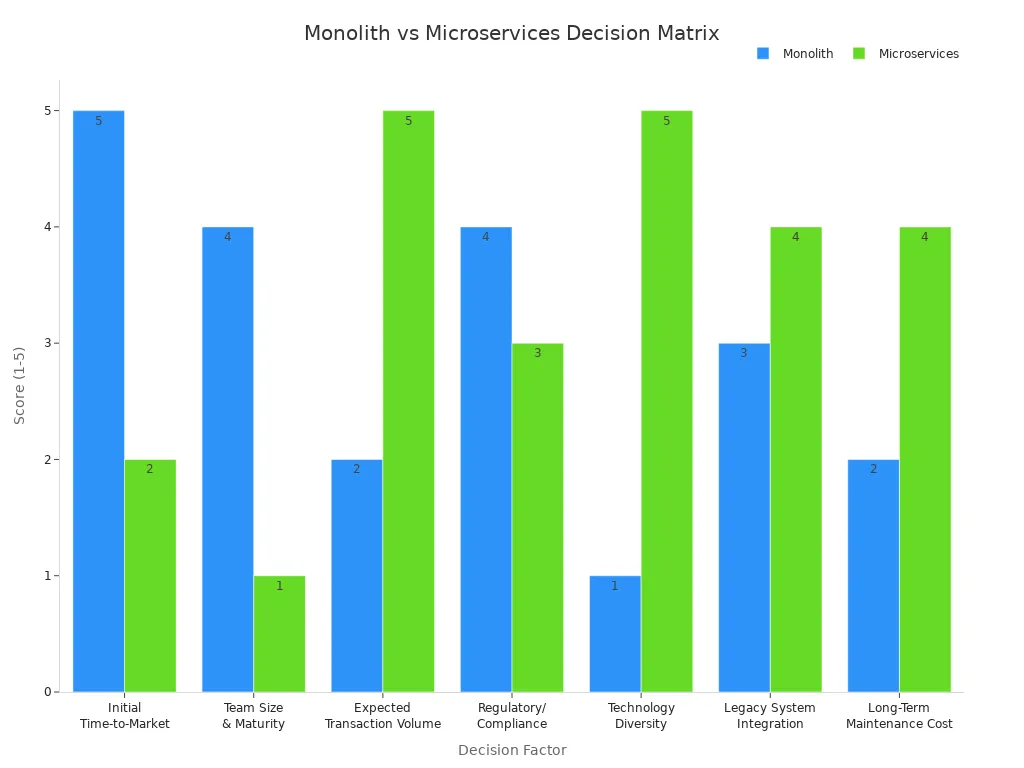
Decision Matrix
A decision matrix helps you compare monolithic and microservice architectures across key factors. You can use this table to score each option based on your needs:
| Decision Factor | Monolith Score (1-5) | Microservices Score (1-5) | Strategic Rationale |
|---|---|---|---|
| Initial Time-to-Market (Speed) | 5 | 2 | Monolith requires less infrastructure setup. |
| Team Size & Maturity (DevOps) | 4 | 1 | Microservices demand advanced CI/CD and observability. |
| Expected Transaction Volume (Scale) | 2 | 5 | Microservices allow granular, independent scaling of bottlenecks. |
| Regulatory/Compliance Complexity | 4 | 3 | Single artifact simplifies initial compliance checks. |
| Technology Diversity/Experimentation | 1 | 5 | Microservices allow teams to choose the best language/database per service. |
| Legacy System Integration | 3 | 4 | Microservices excel at isolating and modernizing legacy components. |
| Long-Term Maintenance Cost (TCO) | 2 | 4 | Microservices reduce the cost of feature delivery over time, but increase ops cost. |
Key Questions
Ask yourself these questions to assess your architecture fit:
- Does your team have strong DevOps and SRE skills?
- Are you expecting high transaction volumes or rapid scaling?
- Do you need to experiment with different technologies?
- Is compliance a major concern for your business?
- Are you integrating legacy systems?
You should align your repository strategy with your team’s structure. Small teams often benefit from simpler setups.
Signs to Reconsider
Watch for these signs that your microservice architecture may not fit:
- Delivery speed slows down due to coordination overhead.
- Operational costs rise faster than expected.
- Outages last longer and impact multiple services.
- Teams struggle to ship features or maintain services.
Tip: If you notice these symptoms, consider consolidating services or revisiting your architecture.
Monolith vs Microservices
You need to understand how team size and delivery speed affect your choice.
Team Size
| Architecture Type | Team Size Recommendation | Key Characteristics |
|---|---|---|
| Monolithic | < 8-10 developers | Simple deployment, limited operational expertise |
| Microservices | > 10-15 developers | Independent team deployments, complex coordination |
Smaller teams often succeed with monolithic architectures. Larger teams with strong DevOps skills can manage microservices more effectively.
Delivery Speed
Microservices can boost scaling but may slow delivery if your team faces coordination challenges. For example, a startup built dozens of microservices to scale but struggled with high cloud bills and long outages. They found it hard to ship features quickly.
| Aspect | Monolithic Architecture | Microservice Architecture |
|---|---|---|
| Performance | Shared-memory access is faster than IPC. | IPC can introduce latency. |
| Coupling | Tightly coupled, making it hard to isolate services. | Loosely coupled, allowing for independent scaling. |
| Deployment | Requires deploying all services together. | Allows for independent deployments of services. |
| Scalability | Scale all services together. | Scale individual services as needed. |
| Maintainability | Harder to maintain due to dependencies. | Easier to maintain due to autonomy of services. |
| Complexity | Simpler architecture overall. | Increased complexity with multiple services. |
| Cost | Generally lower operational costs. | Higher costs due to multiple services and network calls. |
| Cultural Shift | Minimal cultural change required. | Requires significant cultural and organizational changes. |
You should review your architecture regularly. Use the decision matrix and team size guidelines to find the best fit for your goals.
You face hidden complexity and performance risks with microservice architecture. Bottlenecks often appear in unexpected places. The Microsoft Development Podcast highlights how rapid delivery and evolving data models require careful analysis. To keep your system healthy, follow these steps:
- Manage third-party requests.
- Use load balancing and autoscaling.
- Choose the right data store.
- Cache database calls.
You should also enable architecture governance, use API gateways, and encourage regular reviews. Ongoing evaluation helps you adapt and maintain speed.
FAQ
What is a distributed monolith?
A distributed monolith looks like microservices but acts like a monolith. You see tight coupling, shared databases, and slow deployments. You lose the benefits of true service independence.
How do you spot performance bottlenecks in microservices?
You should monitor response times, error rates, and request flows. Use distributed tracing tools to follow requests across services. Look for slow endpoints or services with high resource usage.
Why does network latency matter in microservice architecture?
Network latency adds delay to every service call. In-process calls are much faster. When you use microservices, each network hop increases total response time. This can slow down your application.
How can you reduce coordination overhead between teams?
You can set clear roles and responsibilities. Use automation for API governance. Limit the number of meetings. Encourage asynchronous communication to keep teams focused and productive.
What tools help with observability in .NET microservices?
You can use tools like Prometheus, Grafana, and OpenTelemetry. These tools collect metrics, logs, and traces. They help you find issues quickly and keep your system healthy.
When should you consider consolidating microservices?
You should consider consolidation if delivery slows down, operational costs rise, or outages affect many services. Smaller teams often benefit from simpler architectures.
What is the best way to handle shared data in microservices?
Give each service its own database when possible. This reduces coupling and makes scaling easier. Avoid shared databases to prevent bottlenecks and coordination problems.
How does asynchronous communication improve microservice performance?
Asynchronous communication lets services process requests at their own pace. You avoid blocking calls and reduce bottlenecks. This approach increases reliability and helps your system scale.
🎧 Listen to this episode
Want a practical explanation of Why Microservice Architecture Slows Software Delivery? This episode breaks down the topic in clear language and shows why it matters for Microsoft 365, Azure, Power Platform, security, AI, and modern work.
Listen to this episode if you want to:
- Understand the key concepts behind Why Microservice Architecture Slows Software Delivery
- See how it fits into the wider Microsoft technology ecosystem
- Learn where it can create practical value for your organization
You may also enjoy these related M365 FM episodes:
- The Monorepo Myth: Why Your Architecture Is Fragmented
- Microsoft Graph Automation Architecture: Beyond Scripts
- Graph-Powered AI Agents: An Enterprise Architecture Guide
- .NET Extensibility and Clean Architecture with Miguel Castro [MVP]
- Enterprise AI Agent Fabric: Architecture Beyond Chatbots
Discover more practical Microsoft conversations on M365 FM.
Apple Podcasts · Spotify · YouTube · YouTube Music
Host: Mirko Peters