 EN
 Deutsch
 Español
 Français
 Italiano
 Português
 Nederlands
 Polski
 Bahasa Indonesia
 Русский
 Українська
 العربية
 עברית
 हिन्दी
 日本語
 한국어
2026-08-29 · Season 2
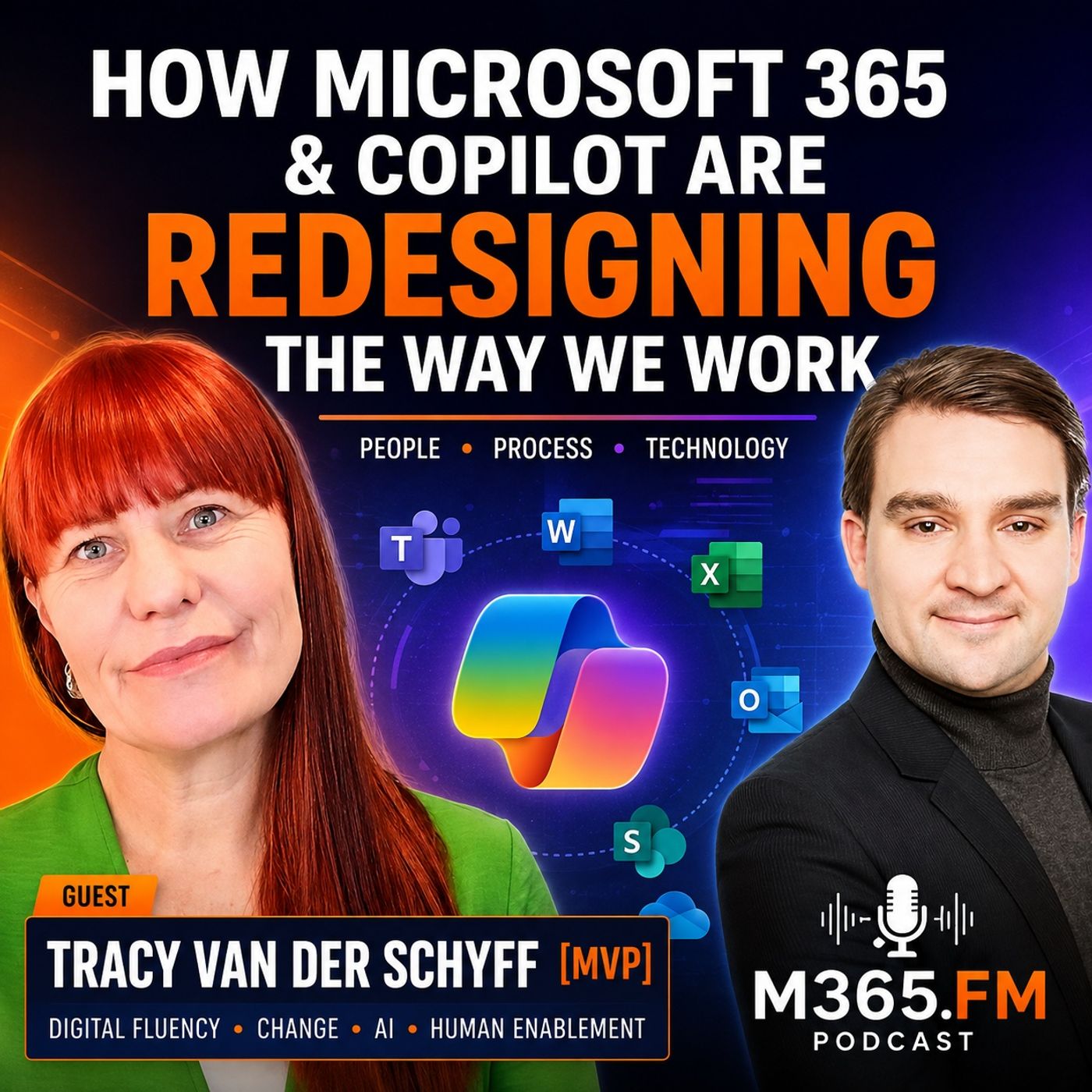
How Microsoft 365 & Copilot Are Redesigning the Way We Work with Tracy van der Schyff [MVP]
Show notes
Microsoft 365 has given organizations more tools than ever to communicate, collaborate, automate, and manage information. Now https://www.m365.fm/categories/copilot-talk/ adds an entirely new layer of AI capability. But behind all the discussion about productivity, automation, agents, and AI, there is a much bigger question: are these technologies simply helping us work faster, or are they fundamentally changing the way we think, learn, communicate, collaborate, and work?In https://www.m365.fm/tracy-van-der-schyff/ of m365.fm, Mirko Peters sits down with Tracy van der Schyff to explore the human side of Microsoft 365 and Copilot. Tracy has spent years working at the intersection of technology, productivity, digital literacy, training, adoption, and organizational change. Her focus is not simply on teaching people which buttons to click. It is about helping people understand technology, use it with purpose, and become more capable because of it.The conversation goes far beyond Copilot features. Mirko and Tracy discuss digital fluency, Microsoft 365 adoption, information management, AI readiness, change management, https://www.m365.fm/responsible-ai-is-good-business-featuring-wiebke-apitzsch/, the broken digital workplace, and a powerful idea that runs throughout the episode: we design technology, but the technology we create and use also shapes us. FROM DIGITAL LITERACY TO DIGITAL FLUENCY For many years, organizations talked about PC literacy and later digital literacy. But Tracy believes those terms no longer fully describe the skills people need in a modern workplace.Knowing how to operate a computer is not enough. Knowing where a button is inside Microsoft Teams or how to upload a document to SharePoint does not necessarily mean somebody understands how to work effectively in a digital environment.Digital fluency goes further. It means understanding the purpose of a technology, knowing when it should be used, understanding how your actions affect other people, and using technology responsibly and intentionally.This becomes even more important as AI enters everyday work. Tracy explains how her original model of eight pillars of digital literacy has evolved into eleven pillars of digital fluency, now incorporating responsible AI use and the additional skills people need when working alongside AI systems.The important distinction is that these are not simply Microsoft 365 skills. They are becoming life skills.AI is also creating unexpected opportunities to develop human skills. Communicating effectively with Copilot requires people to explain what they actually want. Better questions can produce better answers, and those answers can help people formulate better questions the next time. In that sense, working with AI can improve communication, creativity, critical thinking, and the ability to express intent clearly. THE MICROSOFT 365 TOOL OVERLOAD PROBLEM Teams, Outlook, SharePoint, OneDrive, Loop, Planner, Lists, https://www.m365.fm/power-platform-simply-explained/, Copilot and countless other applications give employees enormous capabilities. But providing access to tools does not automatically teach people how those tools should fit together.Organizations often deploy technology and expect employees to figure out the rest.That can result in departmental information being shared from personal OneDrive accounts, Teams being created simply for individual meetings, documents being stored in inappropriate locations, and employees constantly switching between tools without understanding where work actually belongs.When that happens, Tracy argues that blaming users is the wrong response.If an employee was never taught the intent behind Teams, SharePoint, OneDrive, Outlook, or another application, they will naturally choose whatever tool helps them complete the immediate task. The underlying problem is often not the employee. It is the absence of a clear digital strategy. ME, WE, US: SIMPLIFYING THE DIGITAL WORKPLACE One framework Tracy uses to make the Microsoft 365 environment easier to understand is ME, WE, US.The ME space represents the individual. These are the tools and information primarily associated with your personal work.The WE space begins when people collaborate around a common goal. Microsoft Teams and collaborative SharePoint environments become particularly relevant here.The US space represents information intended for the broader organization, such as publishing environments and intranets.This sounds simple, and that is precisely the point.Employees should not need to understand every architectural detail behind Microsoft 365 before they can make a sensible decision about where their work belongs. Organizations need to translate complicated technology landscapes into models that ordinary employees can understand and apply. COPILOT DOES NOT FIX A BROKEN DIGITAL WORKPLACE One of the strongest messages from the conversation is that Microsoft 365 Copilot should not be treated as a solution for an already broken digital workplace.Copilot does not magically repair years of poor information architecture, excessive sharing, unmanaged Teams, confusing permissions, duplicated documents, abandoned SharePoint sites, or inconsistent working practices.Instead, Tracy describes AI as an amplifier.If an organization has a healthy digital environment, Copilot can amplify that healthy environment. If the underlying environment is unhealthy, AI can make those existing problems significantly more visible.In that sense, Copilot acts like a huge spotlight.Information that may previously have been difficult to discover can suddenly become much easier to surface. That can make organizations believe Copilot created a problem when, in reality, the underlying permissions, sharing practices, or information-management problems may have existed for years.The AI did not necessarily create the mess. It exposed it. ONTOLOGICAL DESIGN: THE THINGS WE CREATE CHANGE USA fascinating part of the conversation explores ontological design.The concept sounds complicated, but Tracy explains it in a very practical way: we create things, and the things we create eventually change us.That applies to software, applications, intranets, processes, social media, Microsoft Teams, Copilot, and almost every digital environment people interact with.When someone designs an application, they make decisions about how users will interact with it. Those decisions influence the behavior of the people using the application.The same principle applies at a much larger scale to the modern workplace.Employees can spend many hours every day inside Teams, Outlook, SharePoint, OneDrive, Microsoft 365, and increasingly Copilot. Those environments are therefore not neutral. They influence how people communicate, how quickly they expect responses, how they organize information, how they collaborate, and even how they think about work.The intention behind what we design matters because what people consume eventually influences them. WHEN ACTIVITY BECOMES CONFUSED WITH PRODUCTIVITY Microsoft Teams and other collaboration tools have dramatically reduced the friction required to communicate. But reducing friction can also create enormous amounts of noise.Tracy raises an interesting problem: people can begin to use visible activity as proof that they are productive.More messages. More notifications. More updates. More documents. More meetings. More channels.But every communication creates work for somebody else.A message that takes one person a few minutes to write might interrupt dozens or hundreds of other employees. Individually, that interruption may seem insignificant. Across an organization, the cumulative cost can become substantial.The question therefore should not simply be whether Microsoft 365 allows us to communicate faster. Organizations also need to ask whether all of that communication is necessary in the first place. AI CAN BE MORE THAN A PRODUCTIVITY TOOL Many discussions about Copilot focus on straightforward productivity scenarios.Summarize my emails. Summarize this meeting. Create a presentation. Rewrite this document. Analyze this information. Help me find something.Those capabilities are useful, but Tracy argues that AI can become something much more interesting.People can use AI to learn.Someone who struggles with delegation can ask Copilot how to become better at delegating. Someone intimidated by AI can ask AI how to begin learning about AI. Someone concerned about cybersecurity can ask how to protect themselves and their family. Someone who lacks confidence with a technology can use AI as a private environment for experimentation and learning.This moves the conversation from simply asking, “How much time can Copilot save?” toward asking, “How can Copilot increase human capability?”That distinction is important.The most valuable use of AI may not always be automating another task. Sometimes it may be helping someone become better at performing that task themselves. AI DOES NOT REMOVE HUMAN RESPONSIBILITY Copilot might summarize hundreds of emails, but responsibility does not disappear if an important message is missed.AI can generate a document quickly, but somebody still needs to understand why that document exists.AI can retrieve organizational information, but companies still need to understand permissions, ownership, governance, security, and information management.AI can produce an answer, but people still need the judgment required to evaluate that answer.For Tracy, this is another reason digital fluency becomes more important as AI becomes more capable.Organizations should not respond to increasingly powerful technology by investing less in human skills. They should invest more. Become a supporter of this podcast: https://www.spreaker.com/podcast/m365-fm-microsoft-365-azure-cloud-power-platform-ai--6704921/support.
Apple Podcasts · Spotify · YouTube · YouTube Music · Deezer
Host: Mirko Peters
Guests
Related articles
Transcript
Read the full transcript
Welcome everybody to the MC65F and podcast. Microsoft 365 has given organization more tools than ever before to communicate, to collaborate, to automate and manage information. Now, Cooper is adding an entirely new layer of capability. But there's much bigger question behind all of this. Are these technologies simply making us more productive? Or are they actually changing the way we think, learn, collaborate, and work? My guest today is Tracy Funshive, who has spent years of helping people navigate the intersection between technology, productivity, digital literacy, training, and change. Tracy has an interesting philosophy around technology. The things we designed, eventably, shape us in return. That becomes a particular relevant as AI ends up the world place. Today, we are going behind features and license. We talk about Microsoft 365, co-pilot, adoption, digital fluency, change management, and so on. And ultimately, how organization can use technology to increase human capability rather than simply adding more tools. Tracy, welcome to the podcast today. Thank you so much. Thank you for a very overwhelming, beautiful introduction. Okay, I really appreciate that. It's lovely to be here. Yeah, before we deep dive into technology and co-pilot, how did you find your way into the Microsoft ecosystem, Tracy? I don't think your podcasts are long enough to discuss that. I think my life has always been driven by helping people. And no matter what I did, I always found myself in a path of enablement. So regardless of what the tool was, and as I said, I won't spend too much time, but I had a driving school. I gave odd classes, a design furniture. I've just done so many things that I never went and studied technology. I never moved into the technology space. People found me. I think the need for enablement found me wherever I was. It was never an intent that I had to go into a specific direction. And my passion is around people. And if my foot in the door is with Microsoft, and I can help companies help people just be better than they were the day before then, that's where I am. Awesome. You have one or one one, yeah, what I would say, basmode, what you are really deep dive into digital literacy. What is digital literacy for people? They heard this keyboard for the first time. Sorry. There's a reason about calling a digital literacy now, because for many years, we refer to PC literacy. And it became quite a negative thing if you talk about PC literacy, because people think that if I say we're not PC-literated, it means they cannot use a mouse or a keyboard. And it's an actual fact that it's much bigger than that. PC literacy isn't just that. And if we start looking at digital literacy, which is what I changed to a couple of years ago, where there are so many tools we can use, it's also about using tools with purpose, and understanding what they meant to be used for, but then also being responsible users. And I've just started changing it again. I've now started changing it into digital fluency, because it's a life skill. So it's not just about the tools, but we have to be responsible, and we have to use it within the intent, and we really need to understand the purpose, because it's easy to use a keyboard, but we can also do damage with a keyboard, right? So that's why I've changed my philosophy, even towards digital fluency now, because it's not just about can I use a computer, is can I use it correctly, efficiently? Am I effective at using it? Does it actually waste time? But am I a responsible user of it? And I think in the era of AI, the responsible use of technology is going to become the most important thing, apart from all the skills that we should focus on. Yeah, you say Microsoft, or there's a lot of two Microsoft head heads also. There's a lot of things, so I say Teams Outlook, SharePoint, OneDrive, New Planner, lists the power platform, mobile, and so on. How can we fight against these two overlord or how should employees understand where work actually belongs? That's again a very heavy topic. We can take a long weekend for that, if you ever want to come visit South Africa, but if I had to pick one thing that people know most about me or that company's know about me is that I'm very empathetic. Okay, so I'm very, I lean towards understanding why people do things wrong. I don't always have a lot of patients for companies that does things wrong, because as an employee in a company, I have a set of tools, I have tasks that I have to do as part of my job, and many times, especially with Office 365, Microsoft 365, and especially now with co-pilot, we just switch it on. And as IT people and also from a management point of view, we think if we switch it on, they're going to use it, they're going to be fine, but it actually does much more damage. So if I think of how can employees do the spits, I think the first thing that companies should focus on is digital strategies. If we don't look at the product stack, and of course it's much bigger than just Microsoft 365, I mean, even though that's what I focus on, but if I just look at all of that tools that we have in the platform, plus all the other tools that we use in our companies, where is that single description that really tells employees what is the purpose of this application in our company and when I'll be supposed to use what? I so often will ask, look and it's dangerous, you never want to sit next to me on an aeroplane on a long haul flight like 16 hours because I'm going to look at your day stop, I'm going to look at where is your one drive, I'm going to look at all of the stuff, but I always ask employees for me to open up where they work, where do they store their files? And so often, I will see big departmental folders shed out of one drive, I will see teams created just for a specific meeting to have a chat or share a document. And then I will have someone in management or in IT, so users are so stupid. And that's where the troubles start, because I'm like, it's not the users. If they weren't explained, the intent of the tools, then we cannot expect them to just figure it out. They're going to use whatever they can use to do the specific task at hand in front of them right now. So I have a lot of empathy for that, but I don't think companies are taking a step back and saying, let's just relook everything. Does everyone really understand the purpose? There's this infographic that I often use, and I'd gladly share it with your afterwards if you want. There's two specific ones, one about digital fluency, and all those skills and how it's evolved for me. And the other one is an infographic that I designed many years ago, called Me We Us. And if I look at any journey that an employee has, that's the three main areas. WIRM I in the company, what are the tools that I use to be more effective and productive? So what is my space? And I'm referring, I'll cook maybe one note, maybe one drive, etc. So, or using to do. So that's my meat pillar. The meat pillar is where we start having groups of people, of course, that works on a common goal. So that's where Microsoft Teams starts coming in, and Viva starts coming in. And then uspace, and even though we know SharePoint sits behind it, or most of it, the uspace, of course, is more publishing sites, where we make information available for employees, intranet, flows, type of things. And those three pillars are the things that I focus on when I work with companies to clarify it for users. Because if you open up that portal and you look at all those apps, there's no way to make sense of that. But if you can put it in those buckets where someone understands, this is Tracy, this is my me space, these are the tools I use when it just impacts me. This is my we space where I work with yourself, my co- and my friends, and in HR, these are the tools we use for that. And that's how we collaborate on tools. This is the uspace where it's the company and where we can access information and use from the intranets. It's such a simple concept, but very few companies ever take that step back and try. And you know, they're saying, I mean, who knows, maybe it was Einstein, you never know, with AI these days, it could have been anyone, right? It could have been, I don't know. Lady Gaga could have said it, I don't know. But it's so clear, they say that if we cannot explain something simply, then perhaps we don't understand it ourselves. And I think especially COVID, and I mean, I don't want it to use it as an example, it was an excuse, but COVID definitely drove a lot of digital transformations in companies. Companies were forced to very quickly start working remotely, which might not have been in their close future. So suddenly we had resilience of people working from home and having to use the tools that they might have just started using or that IT switched on last night, right? So I understand doing things in crisis mode. A lot of times we have to do things that we'll look at afterwards and go, that was a really stupid decision. But you know, I survived, I'm a human, bad stuff happens. That's what I had to do in that situation. But very few companies have in the last six years taking a step back and said, "Okay, we're breathing, we're okay." What decisions that we might back then? What should we change? You know, maybe some of those decisions was on the fly like this. And I'm quick to point fingers at IT. I suppose I'm also IT, but I'm so empathetic that I live in all the spaces. As technology people, we're not very good at admitting that we've done something that's no longer valuable, and that we need to change both. We're very quick to communicate successes. Oh, we've moved 15 terabytes of data last night to this server or something. Wonderful. But are we prepared to communicate and say, "Listen, back then, we told everyone just to create teams so that they can work?" We're gonna switch it off, because that's something that I tell everyone to do. We're gonna switch off the creation of teams to simplify your life. This is the button you click when you ask for a team, but let's explain why teams are needed. Because employees are so overwhelmed by everything I cannot even imagine. And now we're throwing co-pilot at it because it's the fixer. We look, "Okay, it's chaos. We know it's chaos." But co-pilot is gonna fix everything. I'm like, "No, it's not." Co-pilot is this amazing thing that's got this huge spotlight that it just shines on everything, everything that wasn't the dark before, that we could hide behind. So co-pilot is just this wonderful, beautiful, huge spotlight. So that's gonna be the next phase, MIRK over everyone's gonna say, "Oh, come save us from co-pilot." That's caused so much chaos. That's where we are. I think we need to simplify it. I think people need to take a step back and say, "Listen, these are the decisions we made. They're not valuable or applicable anymore. It doesn't serve our company anymore." And also, as we know, technology is changing daily. The decisions we made last week, Monday, might not even be relevant anymore. So we need to change the way that we put procedures in place and the decisions we make and become much more agile at that because it's not serving our employees. I can only imagine how they can struggle. But as you can see, I have a lot to say about that. So let me keep quiet for a little bit. Yeah, I think co-pilot is so interesting. If it's Staratars, it's more like, "Oh, Kleepy is back. It's helped. Give you some tips." Then it's... What with you? Now we have these out and all this agent, stuff, work, and end co-pilot studio. And also, we have Foundry and so on. But what will you say? What fundamentally changed when co-pilot entered the workplace? I don't think anything changed. I'm going to... Well, of course, I'm talking technically first. Blackform-wise, I'm what changed before I say "Oh, hell's gonna change employees." Again, I'm saying co-pilot became a person that you can ask anything that... It's like that old employee in a company that knows all the gossip. It knows that Sarah dated Peter 25 years ago and the new employees doesn't know it yet. Co-pilot knows that. Co-pilot's that person who makes the tea for everyone and listens. So if you leave your office door open and he comes inside with a cup of tea and he hears you talking about something, co-pilot hears that. So as it can be, a trusted friend to help you understand things better it also knows everything based on the fact that we share everything. So from a front-end perspective, or from a technical, from a platform perspective, I think it's just about suddenly having a listening tool that puts spotlight on things. If I can put it that way, in that case people terribly, okay? Because it's now exposing stuff that's been wrong for many, many years, okay? And that's the biggest fear that people have. And I'm like, "It's not co-pilot. You've done that for years. Sorry, welcome to the party." But I think if used responsibly, and not co-pilot, I'm not referring to co-pilot specifically. I'm talking about where we store our content. If our employees understood the purpose of one-drive and teams and stand-alone share point, if I can call it that, understood how sharing should work, understood how exposing works, then co-pilot's gonna be an amazing tool to add into that, to become extra hands for that. But at the moment, that's just ears, and it's a gossip person, and it just talks. Stelling everyone all the nonsense that we've been talking for years. So, yeah, so for me, is co-pilot had a massive impact on my life, or AI in general? But it doesn't really change anything technically on the platform. It's just it's posing it. It's making it, putting it in everyone's faces, which is what's making people uncomfortable, of course. Yeah, that's interesting, because a lot of people are a lot of marketing, say, AI inside, the core pilot ready. I don't know, all those buzzwords. The marketing stuff. Yeah, yeah, say, "Oh, let's do this new work," and so on. But did we, from your perspective, change the digital literacy to an AI literacy, as well, or did it also merely the same? I definitely think so. That digital fluency that I spoke about now includes aspects of AI. So, my initial digital literacy was eight pillars, eight pillars of digital literacy that I just confessed for years, and I've now changed it into the 11 pillars of digital fluency, which definitely includes unresponsible AI use, etc. So, it's another platform. It's another application that we use, but all of those gives us skills. So, just like that, co-pilot also gives us skills. I joke, I did a meme a while ago, a graphic that I designed, of course, with co-pilot, but I did this graphic where this man is like whispering, he's standing next to robots, right? And he's saying that, "I'm so clever. If I ask it good questions, it gives me good answers." And co-pilot whispers, and it says, "I'm so clever. If I give it good results, it gives me better prompts next time." So, there's an incredible skill that AI will be developing us, and because we start using it, which is a communication skill. Many people don't think of it that way. They think, "Oh, communication is between humans." But people are starting to communicate different, and they're starting to be more clear about what it is that they want as well, whereas humans, we're actually terrible at that. So, apart from using it responsibly, we're also learning a lot of normal digital literacy skills. We're learning to be more creative. We're learning to communicate better, to express ourselves better. We're learning to document things better, even though everyone thinks, "Oh, AI is doing everything." That's not actually how it works. It's helping us be better at what we do. And if you're bad at what you do, it's going to help you be worse at what you do. Don't make a mistake. It doesn't just work positively, but if you're passionate about building a good presentation, then AI can help you be better at. You know, it can help you with some of the skills that you thought you were lacking before. So, definitely more that we're adding to the skillset. I think I fall into a bit of a dog haul of research last week, because I suppose it is something that keeps me awake at night. I worry about people that worry about AI, right? That's an interesting concept. But I started going into research around the industrial revolution about the change. Did we just as humans have gone through over hundreds of years? Whatever those were, whether it was from horses to cars or that doesn't matter, right? And it's exactly the same cycle we're going through again. Every time we go through exactly the same cycle. And all of those optimizations, the world has gone through over the years, has always had positive and negative sides. Anyways, this is not new at all. So, I think if you just take a step back as well and say, "Okay, the bad we see is actually us doing it, right? We need to remember that." "Okay, it's just amplifying how bad we are as humans, and our evil we can be as humans." But still, these wonderful skills, it can go both ways. Mocha, it's a difficult thing to answer. It can definitely make things worse, and it can make things a lot better, but it's our choice. I think that's the important thing. Yeah, I think it's interesting. And yeah, we have all the cycles. And yeah, I'm not really sure is it's the real big change we have because we have all the data science stuff before we have voice recognition services since years. I think it makes us more productive, but the bad side, I think it's more we doing, think a little bit less. We see it on LinkedIn when we post, when I post, I often use AI for a variety of years, but then I think I have read a little bit from your post and from your content, and you talk about the unorthological design. About this concept, really interesting. Can you explain that concept in, I say, simple terms? Yeah, so, I mean, if so many fancy names for many things in life, right? If we, if we just think about it simply, let's take it, I don't cook at all, by the way. I care if you used to cook. I mean, there's many things in life, although I'll change tires, but I definitely don't cook. I care if you use, but even if you had to go to the kitchen, whatever intent you put into making a dish, the ingredients that you add to it, that thing that you create and end up consuming ends up changing you. It's the same as painting a painting. So, the intent we put into creating something, eventually that does come back and changes us. And I mean, we do a lot of things to change as other people as well. So, ontological design is a very important thing for me when it comes to the fact that I want people to think about what they create and about the behind. Because you're right, AI does put a lot of additional content out there with thought has not gone that much into it. And again, that's not, I asked fault. That's our fault for not faltering through that, for not being able to differentiate that, and to having intent and purpose behind it. So, I think simply put ontological design, it's the same as building an application, building a leave application. That developer, the UX, or CX person, the person that designs the form, the person that looks at the business requirements, all of that impacts people again. And it impacts us as humans. The systems we use, the things we create, we so much more than our jobs, but every single thing that we touch changes us. That impacts us. And if we can maybe have a bit more thinking behind that, with how it impacts people, the things they have to consume, because think of every application that we use, think of every social media post that you read. Think of every app that you're open on your phone. Imagine that being food. Every one of those things. We think a little bit different when it comes to food, because a little bit, we'll say, "Oh, that's not going to make me feel great if I consume that." Right? But everything around us is similar to food. It's something that we consume that changes our DNA, it changes how we function, it changes how we think. So for me, it's really some people, it's just about our down think, there's always so much good intent and purpose into what we put out there for people to consume. And that can relate to pretty much everything in life. It's not just building. I think back then, when I started reading up about it and researching, it was much more around the applications that we built and in trying to eat some things. But the more that this has moved on, the more I've realised that it's pretty much everything out there. The car you drive changes you as a person. The movies you watch, the food you consume, the friends you hang out with. That's ontological design because it's our, it's our choice, look, our two friends that we all think is worth. It's our choice to drive a certain car. For employees, we don't always have that much choice with the applications we use and the things that we expose to. But perhaps if people just put a bit more intent into what happens off to people, use it. Not whether people are happy using it if that makes things. Yeah, yeah, I think that's interesting because I think most people, I don't know, we sleep eight hours, we work eight hours, and we have eight hours. You work eight hours? What? You work eight hours? You're such a lucky man. Is that a swiss thing? Actually, I'm not in flight, so I don't work. There's shaman. Whatever you want to work, but yes, anyway. So let's say eight hours. Normal people should work approximately eight hours. Yes. And they spend so many time with Microsoft tools, especially, I say teams. I feel, if I were, I spend nearly the world time in teams. Now, we have also outlawed Microsoft 365. And now we have the increasingly used of co-pilot. Do you think those tools effectively shaping human's behavior? Absolutely. Absolutely, that. Now, I've got to, of course, it definitely changes us. I mean, just like tools get developed to support certain skills, tools also change skills. So the way that we, using simple things with the way we used to communicate with each other. So we used that in person conversations. And then, or send letters or write letters. And then with technology, of course, that's all changed. So if I have to think of teams as well, where we just sit in this digital workroom. And I have to contribute a lot of the noise and teams to that. But I think as humans, we've become quite selfish to think that activity equals productivity, if that makes sense. I think we're too noisy. So that's something that I talk about a lot in teams is that people tend to want to prove that they are active and working by pushing activities out. You don't have to tell people that you do what you do. You know, you should rather just ask when you need something. So that's definitely changed something for me in the workplace as well. Purposeful people are with pushing activities out to show that they're busy, which is unnecessary. You know, so I think that's changed definitely the way that we work together. It's a bad thing. We communicate too much. I will communicate. I'm talking about in a collaborative space now, of course. So especially teams. And we communicate too much content. Yeah, it's just, I don't know. I think often we have, I don't know, there are a hundred employees. I write one message. I take five minutes and the other take all a minute to read it and the company often lose then a hundred minutes. Yeah, time. What did you think? How can AI help us here to get more efficient, especially, I think, my co-pilot for chance? I think that's a good question. And of course, that's something that everyone's asking. And I'm actually going to take a step back from that. Because if you had to just go and look at social media, if you had to go and look at the content that people are putting out. And again, something that I've often, over the years, focused on is not the most fanciest tools. I've always stepped back to the normal tools we've had for years. I've said, can everyone just calm down about agents and just learn how to use Google first? Okay, I'm just like saying, everyone, because you can't even ask these different questions. So that's why I always go back to digital literacy or digital fluency because I think people that doesn't have those necessary skills will be even worse at using AI. So that's one thing that I think of. So if you had to go and look at the top 10 ways to save time with AI, right, the thing would normally be, you know, getting on top of your email's quicker or I'm summarizing a document quicker or something, which is absolutely true. So of course, if I had to look at my life, I'm receiving sometimes 200 emails a day. It's just, it's impossible. So it's become completely impossible for me to even try and work through that while sitting on meetings for eight hours a day. So in that aspect, I'm filtering through the noise. It's helped me a lot to be able to do that. But I can never, ever lose sight of the fact that it's still my responsibility. If I still miss something very important, like the boss telling me that if you don't do this by at a clock tomorrow morning, you fired and copilot misses that in my summary, I can't blame AI. You know, that's something that's important. But something that I recently started focusing on is, and I did put an article out about that as well, starting to think because I suppose I see myself like a tech therapist. I deal a lot with people's fears of technology, right? So it's not just about making a better at the tool. I believe that every human has the ability. I should be careful to say every human because I've met a couple. But I believe that most humans have the ability to teach themselves to do incredible things. If they have the self-esteem, okay? So that's a good place to start. If you think you can, then you can. If you think you cannot, then you cannot. So that's a very simple way to just think of it. So something that I then started focusing on a bit more is the fear around AI and how we can actually use AI to help us with the fear we have with AI. It's a bit of a conundrum, right? It's an interesting thing. So people are suddenly flustered saying, "How am I going to use AI?" I see that Susan and H are so brilliant at putting things together. How am I ever going to learn these skills? Well, you can use AI to teach you AI, right? And I think people don't always think of it that way. It's a bit of a strange thing to think of. Even when it comes around fears, something that I've started doing is that the things that would get stuck in my head, like this. I now discuss with AI and say, "You know what, I'm really worried about AI taking over the world. You know, I'm worried about losing everything that I'm passionate about. How do you think I can protect myself against you?" And you'd be pretty amazed at what comes back at you. So that's ontological design. What you're putting at system can come back to you positively if what you're putting to it is positive, right? So if I then look again at how this helps people, there's lots you can read out there of how it can help you. The first thing you have to understand is if you think you can, you can. So take that first small step, a lot of people are afraid of it. Take that first small step and say, "Listen, Coke, ballad, I'm kind of new at this. I actually don't even know where to get started. Why don't you discuss?" So think of it, you've been a, you've been a, you've had an assistant to point it for you. The company is paying for you for an assistant and it just sits there in the corner, right? So maybe you've never had an assistant before. I'm not great at delegating, okay? So that's something I'm asking AI to help me with. How can I become better at delegating stuff so that it understands me and my quirks a bit better? So to say, I'm not good at passing work on. I've got this project that I'm on. How do I make sure that the team around me stays busy? And that's where it's become super valuable for me. Is actually being open with AI with the things that I'm struggling with instead of focusing on that fancy things up there? Like listen, I'm really bad at responding in time on things. What do you think? Two or three things that I can help to be better at that or something? I don't think people realize that it's just sitting there in the corner and it's only going to throw it at you, what it is that you throw at it. So if you wanted to only summarize emails, go for it. Summarize your emails. But there's a much bigger psychological and a fluency thing that it can help us with. But a lot of people don't know that they can ask us to do that. And that's where there's a lot of the value for me. Like that article that I put out for a lot of friends of mine. I don't have children, but a lot of friends of mine who have children or we have an parents that are much older already and using technology and causing chaos because of cyberthreats and spam and fishing and being attacked and their money is being stolen. And people just are so afraid of the AI and I said, well, why don't you ask AI how you can protect yourself against the stuff that's happening? So I wrote that article to help parents prepare their children for AI and for cyberthreats and for the scary stuff that's out there. So that's a bit of a different way, I think, because there's a lot of content being put out there. What is the 10 prompts you can use? That's not what we need. There's enough content out there. And you can tell co-pilot or any AI, tell me over the next six months. Help me with one thing a day so I can learn and build my skills. But we're too afraid to ask because as humans, we so used to doing everything ourselves. I'll just struggle through this. I'll just work 10 to 12 hours a day and I'm guilty at it. This is a process that I'm going through. And that's why it's important for me to share the human side of AI. A lot of my blogs these days have gone much more around the human side, the human side of AI, which is a strange way of looking at it. But because there's a lot of other people focusing on the agents and the prompts, I actually don't care about that. I want people to realize. And it's so interesting that you said ontological design because it's something I don't think of often. I suppose it becomes a way of life or just a way of thinking. But it's exactly what we should be doing. Put good into it and you're going to get good back from it. That's changed what you're putting back into the world. And what you get back from the world is going to be so much better. And do the same with AI. Do good with it. Do good to yourself. Number one, we are our first priority. Being good to ourselves, being more efficient, being effective, having less fear is good to us. It's personal while being. We have to focus on that first. Before you become better in a team. You become better at you. That means spice. You become better there. How can you become better there? Because again, whoever you become affects those around you. And then when you move into the wee spice, then you're a better team leader or you're a better part of a team or something. So, yeah, I think we need to focus more on the psychology and how we can to be better humans actually. I think that's going to become a big thing for me. I think I'll put out another article on that. How can we be better humans because of AI? Because it's true. We can. Yeah, yeah, that's interesting. So I have four years, Aldona. And she actually use ChatGPT a lot now. She has this her own workspace. And she learned writing. Well, she was ChatGPT because she liked to prompt image for, for, for, I don't know what the English word for, to paint it with her. So sorry, prompt there are all the ones. So that's really good. But I think a little bit, we have, I don't know, COVID times and all the companies bring all all the tools to the people, especially the teams. Chatboy and Lube and so on. But, yeah, I think people was a little bit over-round. And I think we have a lot of, I call it the broken digital workplace. A little, little, little apt key agree. Now the company say, okay, now we have co-pilot to fix it. So. What did you think or what's happened then an organization introduced co-pilot into a, yeah, I say, poorly structured Microsoft 365 environment? Which by the way, most of them are, I'm sorry to say that. I've very seldom seen companies that are using technology correctly. Very so luck seriously, not often. So, wow, I'm, indefinitely, quite well known for stepping on toes. So, again, if I had to pick a role for myself, it's this ruptor. Because I'm so passionate about what I do, I don't mind being the person that rubs the plasters. So, a lot of times in companies when I get involved, it's my biggest role is to be at this ruptor. It's to just point fingers and be brutally honest. I've got, I've got very little tact. I'm carrying it's not because I don't care, it's because I care too much. So, when it comes to IT and management, because I blame the top layer, okay, I'm very sorry to say it. If I hear another person say that I end user is stupid, I'm going to smash them in a fight, okay? So, late that day of warning out there, we'll smash you in your fights, okay? Because it's not a fault, okay? You do get people that are difficult, that don't want to learn or challenge. Of course, we do that, but it's fear. That's all fear-abased. If you go into a meeting in someone's miserable, there's a project manager that's really miserable, and he's giving everyone grief, I can promise you, he had it that bad day at home, always be it really hurts on a previous project, or it was leaked down on a previous project or something, okay? We're all just humans. So, if I look at applying that magic ingredient, now called AI in companies, okay? And whether it's co-pilot or whatever it might be, as I mentioned, it doesn't fix things, okay, it amplifies. So, if you had a healthy environment, it's going to amplify that healthy environment. That's what you, again, ontological design, how do we keep on going back to this, that's amazing that you brought that up today. It's so amazing how relevant it is. But if your environment's healthy, it's going to make it healthier. If your environment's unhealthy, it's going to put a mess of spotlight on it, okay? And it's going to be the full-tiled for the next thing that goes wrong. Oh, we've got disasters, we've got data breaches, everything because of co-pilot. No, it's not. You have problems for years, you just didn't know it, okay? So, I think as humans, and let's compare, let's do that. I love using jacks to posing or something. I love comparing things, and you know, a creator of two, I don't know, what ever type of site. So, let's think about as medicine, okay? What's the easiest thing to do? You have a headache, so take a headache tablet, right? Of course, I also drink medicines. Or do I need to put that effort in and exercise every day and drink more water? Much easier to take that headache tablet. And AI in a lot of companies is being switched on as headache tablets, or as vitamins, or as something. Years ago, I used, it's amazing how we think before AI, because now AI is the next big thing, okay? 10 years ago, I was a team, I was like, oh my word, how are we going to get people to use teams? Okay, another overusing it? But years ago, I warned companies, and I still do it. I'm pretty sure I wrote a blog about it. I've written way too many blogs, okay? Well, no, I don't think so, but anyway. So years ago, I said, companies go, employees will arrive on a Monday morning, and on their desk, is a cute little recipe book, an illiquidizer, and they go, because the CIO has played golf with someone on Saturday, that said, if people drink green smoothies, they're going to work harder, and cost you less money, right? So everyone gets issued with a liquidizer, and a recipe book, they'll make a mistake, even got a little cure code that you can scan to go read recipes. How am I going to make my green smoothie? So wonderful. So that person has peace of mind that he has done what he has supposed to do in the company. Everyone is now issued with a liquidizer, they can make their own green smoothies. So yes, some people are going to figure it out. Some people are curious. Some people are going to put vodka in there, okay? And make more green, ours. Copilot is just a liquidizer, okay? So it's going to just produce what it is that we throw in there, or that it has access to. But what companies don't realize is that it's the hard work that delivers the results, not the easy fixes. It's not the heat-actablet that really is. Heat-actablets only solve something right now, but the underlying problem, they're not drinking water, they're not exercising the big problem. So if I look at Copilot as well, and that comes with responsible use, so with that liquidizer or that smoothie maker that we've now issued every employee, if we don't have awareness campaigns in the company with why it's important to have more vegetables and smoothies, why? How? If we don't even focus on saying at Peter and finance that works way too hard and is close to a hard attack, hey, Peter, I want you to be healthier because I want you to grow old with your grandchildren. You're so much more than your job. Do you know that? So much more than your job. You're so much more than the hours that we're squeezing out of you, the blood that we're getting out of the store and in this company, right? And we talk to humans, then when you put that liquidizer on the desk, people understand that there's benefit for them to use it, they understand the benefit, but we're not explaining healthy habits to people and companies. We're just putting another plaster on it. We, teams was a plaster that was put on because we said people can't collaborate. Or also to work remotely, of course. That didn't help. If the skills of ways to communicate and how to communicate and wait to store my content didn't exist, teams might at one million times worse. It's unbelievable how bad it is and how many people tell me teams is terrible. As it, no, it's not. You're terrible. But I'll blame IT and management because they never taught well being in the company. We've never taught y'all to responsibly use technology or why it should be used. Sorry. It's going to be a plaster. It's a headache tab that's not going to make anything better. And I actually feel better today, but it's not going to fix things, okay? We, I don't think, I think the need to train people on digital literacy and digital fluency is now even more required than it was before. AI doesn't remove that. Doesn't. Yes, people can do more. Yes, I can achieve a lot more now. Yes, it takes me now two hours instead of eight hours to build a functional spec or something, okay? Because we all spend like unbelievable time creating documents for projects and things. But if I don't understand why that document needs to be in place and if I don't understand what a healthy project is and I don't understand why it is that we have to put things down like that, then just creating the contents not going to make me a better worker. So that's my opinion about that. I love AI, okay? I love AI and I hope I live long enough to study and enjoy life before humans kills us with AI, okay? Because it's not AI, it's going to kill us. It's going to be humans, okay? So if that's a crazy road that we're going to take, I hope that there's enough time left for all of us. But if we start realizing now that we can do incredibly good with AI. Yeah, I think what's the topic is, I'll talk about, I'll talk about change and company laughs, talk about change. But I don't know, they talk a lot about change and bad things. Well, I do talk about it, yes. But that's all they do. But they really don't do it from my feeling all the time. What makes for you a good change management, I say, process? Yeah, change management. So a lot of companies think it's just a compliance exercise. They'll sometimes contact me and say, can you see me that PDF with all the tick boxes that we can just select tick readiness? I think it's similar to being AI ready or tick ready or something, okay? And I think the first thing we need to realize is that change management is a lifelong commitment. Okay, so, and a lot of companies get that wrong. We need people and companies that focus on it permanently. Not me, that gets brought in for three months or six months or a year because it normally doesn't sustain after it. I can have huge impacts, but it doesn't last. Change management, change management, looking off the people's while making sure that we focus on skills and healthy use of applications and things should be a permanent part of a company's DNA. It should be a strategic objective. If you go and look at companies' values in the emissions statements, that should be there. Change management while being making sure that we continue to invest in our employees, but it's not. It's seen as projects. It's, you know, it's a short term. So that's the first thing that they need to change. We need to have people that are passionate to continuously focus on it. It needs to be their job and they need to be paid for it. Okay, that's very, very important. It's the same as having an intranet manager or having a responsible use of AI champion or something. It's not a temporary thing. It needs to be permanently focused on. It's, I think, change management, if I had to create an analogy for it, change management like having a nurse on site. Having a little office there, where there's some that when you're not feeling well, but also someone that takes care of employees most of the time and focuses on it. It doesn't help that you're once in three years reigning to a nurse that just comes and sits on site for six weeks and then all your problems are fixed. Doesn't work like that. So we need a nurse on site and we're going to need it now more than ever. AI is going to surface a lot of unwell people at work. It's going to surface a lot of negativity and stress and fear in the workplace. And now we need that nurse, that that helper, that change management person, the adoption, the training, the wellbeing. We need that permanently in companies and I think companies need to start taking that seriously. It's not a project. Getting someone in externally to do change management is not hard work. It normally doesn't stick. You might put a couple of things in place, but it's as good as I tell a company, as part of change management is that, you need to have a forum that says it's full for AI, you know, it's right. We need to have a forum once a month that gets together and just talks about the major changes and how does it impact my employees? And we need to regularly communicate. Once I leave that company, that doesn't exist anymore. Very few companies actually put start systems in place permanently. So for me, that's change management. Change management is having a wellbeing specialist in-grind in your company and making it part of your mission and your vision and your values and your strategic objectives is to have healthier employees that uses technology responsibly, effectively and efficiently. And it's a short statement, but it carries a lot of weight. There's a lot that must go into it to be able to achieve that and you have to continuously focus on it to achieve that. I didn't answer that, Mocha. I'm sorry. I didn't really answer that. I think I just opened up more questions, but that's more being in about China. I think what actually or happened in the last time it's... Okay, we need co-pilot. IT gets... get the job, the project, and they do their job. They buy, I don't know, license, roll out. And yeah, then they say, "Okay, users know you have to look at naming conventions, speed adaptor, permissions, life cycle management, and code it all as shit." And I think, yeah, they really lost... I don't know, there's some... Something missing. It's like... They all try to say, "Okay, my project, you are responsible, you are responsible for these and that, but it's not strategic, I think." How can we make it... Yeah, making... bringing more sense, and I think also... When it makes more sense, it makes more return of rest. But how can we make it... It's since making process... bring AI into a company? I'm again going to go back to that me, we ask situation. I think a digital strategy, specifically focusing on storage, okay, without going into all the other applications. So let's just talk about where I save my file, okay? That... That needs to be focused on. We can't always go back and fix the past. It's too difficult. There's too much content, but we can say that from a certain date, we want to start working different. So if we look at the modern workplace, and again, making sure that we have good data hygiene, approaches, and understanding, and awareness, if our employees truly understand, in a way that we live and work, when to use what? And I'm specifically talking about storage now, care files, because for me, the AI side, of course, the consumption of our data, we are data stored, right? So if I just think, and I just only focus on those areas, my one-drop content and my team's content, and then of course, there's intranets. But we need to go back to that, Marco, we absolutely have to focus on making sure that our people understand where to store what, so that AI can work more efficiently. But some way, we have to draw the line in the sand. As humans, we tend to think, we've spent so many years making this mistake, that it's too difficult to change now. Any single day that you stop making that mistake is a good day to change. But it's going to be a tough job. It's going to be difficult to do that. It's not easy, but the benefits we get from it, the results and the benefits of synum companies where people actually understand better, how their behavior, again, we're back to ontological design, where I store my document and how that impacts people. And now, like I said, GoPro is a flashlight, so we have to go back to healthy data storage and understanding. Years ago, I was like, "Oh, I think we've lost the plot." Microsoft, a lot of terminologies came out, and I'm blaming Microsoft. It's any technology, right? People were, you know, the whole structured versus unstructured data. Or it doesn't matter where your documents are anymore. You can just search for it. I'm like, "You're right." Let's talk about that in a couple of years. Now, it doesn't matter, Trace. Stop worrying about structured data. Stop worrying about having structured environments where content goes in. Because we can just ask. But now we're realizing that because we didn't focus on where we store it, we didn't understand permissions, we didn't understand access. Because if you just dump it everywhere, you don't understand the access. So again, I'm going to go back to an analogy. It's taken to the cupboard that you pack your clothes in, right? If we teach our children that you actually don't have to worry about that, must really, you know? Everything can go on to the floor in your bedroom. You don't have to put t-shirts in that place. You don't have to hand dresses there. You don't have to put this there. Of course, I'm going to just buy your robot. You don't even have to worry where it is. You'll just say, "Hey, robot, go fetch my favourite blue socks, right?" But now, because you never taught your child decent habits towards where they store their things, their favourite t-shirts ended up in their brother's cupboard, right? But they didn't care. The robot keeps on fetching it there. It doesn't matter where it's stored. But now their brother is using it when he works on his motorcycle and it's got oil on it, you know? That's the type of stuff that happens is is if we don't have that respect towards where our data goes, we can't expect to just find that we need to go back and install those skills. I know that's a difficult thing to do. Good grief. It does keep me awake sometimes at night, but if we don't start, we have to start. That's just what I say we do. And it starts with me. That's the big thing is you don't have to change 10 million people. I just have to change me. I have to change my attitude towards the respect I have towards company data, where I store the stuff I work on, where we store the stuff that my team works on. Just about those things. I know there's a lot of cross-contamination, but just focus on those things first. Because then if we can install respecting people with where they store their data, then adding a carpet on top of it. But we are way too late for it. Copilot's already been in the ploying companies. But we're going to go through that cycle again. It's going to be a two or three year cycle. We say, "Oh, we've got problems with teams." And we're going to have problems with Copilot. But after the fact, and that creates new jobs, by the way. When we say it's, we are a lot in the we space, but did the companies do give the people, I don't know, policies or rules or found things, outrails to help? No. No? Okay. That's the... That digital strategy again, that me, we ask things at such a simple thing to socialize and discuss with people so that they understand the impact and where they live and and how they, like, doesn't exist in companies. I very, very seldom see that. Yes, someone's created a 45 page word document that's been saved as a PDF that's called the digital strategy of X Company. No one reads that. No one's explained it simply, and no one's explained it to the users. I'm going to use a very simple example another really on time. We have for years say to people, don't save 20 folders deep and have document names that are 500 characters long, right? We've said it for years. Okay, all right. I mean, it's... Obviously, we've said it for years. We've sheltered at employees. Or I've lost my file. My file's gone corrupt. Why do I get this message that says cannot save this file as the folder path is too deep? Right? We all notice. As IT people, we notice. Do you know that every single personal company I start working with, we are trained end users and I say to them, why they shouldn't do that? And I explain to them that there's a character limit and that it becomes blind after a certain amount of character limits. It can't even see the file anymore and you pick up nonsense and I go, oh, that makes sense. And then I start having different naming conversions. We're not explaining to people what I shouldn't do things. We're just telling people what to do. We need to stop telling people what to do. We need to explain to them why it's good for them. Because if you explain to someone why it's good for them, they'll start following on their own as well. If I understand the benefit that they have, we're not doing that. We're just instructing people. That's not how it's supposed to work. We're not allowing people to use their own judgment because they are well informed enough to make decisions. We're still in a mind rate of 30 years ago. We've made decisions for them. But now we're expecting them to use technology that's making decisions on their behalf. So we are in deep trouble. Okay, I can tell you that. But we can change it. Anything can change. We can make a decision to that and we can change it. Again, I want to say, "Rians, I love IR." I love IR, I love IR. But we need to fix a little bit of a couple of things in ourselves so that we can use it better. Yes, both in the Microsoft space. But I think a little bit what you say is something what Steve Jotter says, it sounds makes sense to high-assume our people and tell them what to do. We high-assume our people so they can tell us what to do. I think that's... Absolutely. But if you don't invest in us, people, Mokadol, never learn the skills of how to be a better person or better that. We have not invested in our employees in years. It's not a new thing. And we keep on thinking, we'll apply technology to it to fix the problem. And we're very, very wrong. We can't fix it. We need to start investing in people. And I can promise you that will be the greatest investment any company can ever make. We need to invest in people so that they can be more digitally fluent. So that can be better leaders. So that can be responsible users of technology. And I promise you, with enough explanation and enough awareness and companies, they'll then use the technology better. We need to stop instructing people. And we need to stop putting just guardrails in. Because just putting guardrails in doesn't teach people to be responsible. Yeah, it's a little bit like cyber security. So we have a lot of inside risk. And the people... I think the most people don't want to do something that. So yeah, we said them, "Oh, we have this rule, this rule." And we don't say, "Hey, simple things, I don't know. Don't drive in the train and have your left with your passion brought in because." Yeah, I think that's really cool, cool concept. And yeah, I'm all the technology guy and say, "Okay, it's my... I have my responsibilities." But yeah, I think it's all about the humans. It's all about the humans. Yeah, a lot of technology. Oh, it's a lot of people. Before you. Yeah. Oh, I think we'll be a little bit run out of time. We are an upgrade a meeting that started as life works. So a meeting that's waiting for me. So we see I'm not really good at time management. It's okay. But I have an every session, a rapid fire round. So I give a short question and then you give a short answer. So tips or outlook? Teams or outlook? When you must decide one tool for, I don't know, to use it. I think I put a question back at you to say internal or external because it completely changes if you're a consultant. Internally and company outside teams, once you start working across companies it becomes quite difficult. Then our could becomes the place. And the training or experimentation? I think it's a combination. I want big one of them. I think training is experimentation and I think experimentation is training. And from the engineer or critical thinking? That's a difficult one. Again, I don't think I can pick one. I think everything in life is in moderation. That's a healthy mix. Yeah, you say you don't use your kitchen often, but what's the best sauce African food? Meat. OK. Phil, it's like we've got the best steak in the world. Yeah, I love, I know, it's spelled right. We call it chakalaka. Oh no, and I talk a lot of it very well. We're quite a bit. Good. I think it's the biggest misconception about co-pilot. I think that it's going to fix things. Muka, I think that's the biggest misconception. It's not going to fix things. It's not hard works. It's going to amplify things. It's an amplifier. Absolutely. Good. And when Satya Nidala called to Tracy and say, "Hey, you get all the menu and resources to build your favorite feature." "What feature build you developed?" "What feature are the world at bulk?" "File." And you get all the resources for Microsoft? "File." Something that can remind me every day that I have the ability to do what I need to do and that I have the best self-esteem to be able to do it right and to remind me which tools I can use to do that. And who shall I invite next and what questions shall I ask? You put me on a spot, especially with a meeting that started three minutes ago, and I have people scream at me. In the industry, I'd always refer to someone that I obviously know. I list the fusion who have a lot of respect from in the industry. Here's a lot to say about a lot of things. I think in general AI, he would be a very interesting person to talk about AI in general. And he's thought about AI in the future and what it will mean to the world. He's a very good mentor to me when it comes to AI as well. Yeah. So Nidala, say, Terese, thank you for joining me. I really enjoyed this discussion and the people don't cry too loud for you. I'll manage that now for a minute, so I have to go and manage that very carefully. So yeah, I think, yeah, what we learned, it's not all about the technology, it's more about the people. And yeah, so yeah, thank you for your time. And yeah, I hope you also enjoyed it and all the listeners find all the information about Trese in the show loads on the MC65 mpage. And yeah, thank you so much for listening to me. Thank you very much. We're probably glad we'll be able to hang out with you. Bye. Have a wonderful day. Bye.