 EN
 Deutsch
 Español
 Français
 Italiano
 Português
 Nederlands
 Polski
 Bahasa Indonesia
 Русский
 Українська
 العربية
 עברית
 हिन्दी
 日本語
 한국어
2026-08-15 · Season 2
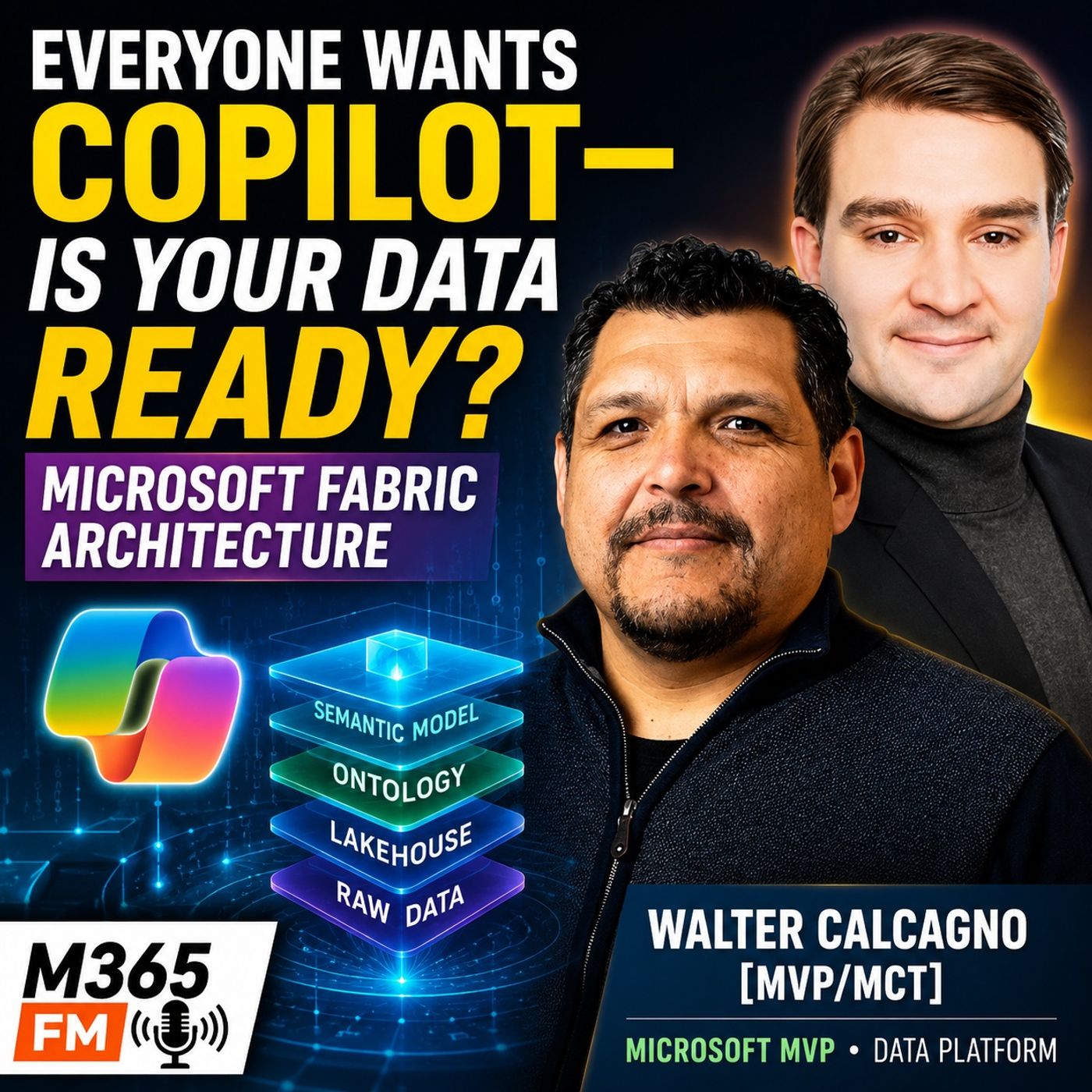
Everyone Wants Copilot—but Is Your Data Ready: Microsoft Fabric Architecture with Walter Calcagno [MVP-MCT]
Show notes
Everyone wants https://www.m365.fm/categories/copilot-talk/. Everyone wants https://www.m365.fm/ai-agents-simply-explained/. Everyone wants employees to ask natural-language questions and immediately receive trustworthy answers from enterprise data. But what happens when the underlying data is fragmented, business definitions conflict, governance is weak, and semantic models were never designed for AI? In https://www.m365.fm/walter-calcagno/ of M365 FM, Mirko Peters sits down with Walter E. Calcagno, Microsoft MVP in Data Platform, Microsoft Certified Trainer, data architect, author, educator, and co-founder of Data Consultants, to explore why successful enterprise AI begins long before the first prompt is written.Walter brings a perspective shaped by more than a decade working with data. His journey started in accounting, where managing increasingly complex financial information in spreadsheets pushed him toward SQL, databases, Power BI, big data, Spark, and eventually artificial intelligence. He also explains why creating original Spanish-language technical content has become an important part of his work and discusses the growing Spanish-speaking Microsoft data community. THE BUSINESS QUESTION COMES BEFORE THE TECHNOLOGY One of the central themes of the conversation is deceptively simple: organizations do not really need more dashboards—they need better answers to business questions. Walter describes a progression that begins with understanding what happened, continues with understanding why it happened, moves toward predicting what will happen next, and ultimately asks what actions can influence the desired outcome. Business intelligence, statistical analysis, machine learning, and recommendation systems can all contribute to those questions, but the technology remains secondary to the business problem.This changes the way organizations should think about analytics. Instead of beginning with Power BI, Fabric, Python, or another technology and asking what can be built with it, organizations should begin with the decisions they need to make. Technologies will evolve and individual products may disappear, but the fundamental business questions remain. WHY https://www.m365.fm/microsoft-fabric-simply-explained/ CHANGES THE DATA PLATFORM Walter explains Microsoft Fabric as Microsoft's attempt to bring technologies that organizations previously assembled individually into a unified Software-as-a-Service data platform. Storage, movement, analytics, big-data processing, Power BI, Spark, machine learning, and other capabilities can operate within a more integrated environment rather than forcing organizations to assemble every component separately.A major part of that architecture is OneLake. Walter discusses how OneLake provides a common data foundation and how technologies such as Delta Lake help organizations work with large volumes of data while retaining structures and capabilities traditionally associated with databases. The objective is not simply to centralize technology. It is to make enterprise data easier to organize, process, analyze, and eventually expose to AI systems. The discussion then moves to one of the biggest misconceptions surrounding enterprise AI: if the data already exists somewhere, why not simply connect an LLM or Copilot directly to it?Walter argues that this skips essential architectural layers. AI needs context about what enterprise data actually means. Within Fabric, semantic models provide structured representations of business data. But large organizations frequently have many semantic models across departments and domains. Trying to solve that problem by creating one enormous semantic model is not necessarily the answer.This is where Walter highlights ontology as another important layer. Rather than forcing everything into a single semantic model, an ontology can describe relationships across models and provide a structure through which AI systems can navigate enterprise information. In Walter's view, semantic models combined with ontology models represent an increasingly important foundation for connecting enterprise data with LLMs while preserving meaning, relationships, and access controls. WHAT DOES “AI-READY DATA” ACTUALLY MEAN? Having data does not mean having AI-ready data. Walter uses the familiar medallion architecture to explain why data must progress through different levels of preparation. The first layer can preserve historical source data without attempting to solve every quality problem. A subsequent layer cleans and standardizes information, handles duplicates, establishes consistency, and prepares the data for broader analytical use. Additional layers can then prepare specific subsets of data for specific purposes such as business intelligence, machine learning, deep learning, or AI.Walter also challenges the idea that medallion architecture must always mean exactly three layers. The number of layers should follow the requirements of the architecture rather than the terminology used to describe it. What matters is that organizations understand what each stage is designed to accomplish.AI readiness also has an economic dimension. Sending unnecessary data into an LLM consumes tokens and increases cost. Preparing the correct data and metadata therefore becomes both an architectural and financial requirement. METADATA IS THE MAP YOUR AI NEEDS One of Walter's strongest recommendations is to stop thinking about AI as a system that should continuously scan everything an organization owns. Instead, organizations should create a map that helps the model find the information it actually needs.That map is metadata.Walter compares this to traveling between cities. You do not drive through every small street looking for your destination. You use highways, then progressively smaller roads until you arrive at the exact location. Metadata provides a similar navigation structure for an LLM: first identifying where relevant information exists and then allowing the system to access the specific data required to answer the question.Without strong metadata, AI systems must work harder, consume more resources, and have fewer reliable signals about where trustworthy information resides. AI SHOULD NOT INVENT YOUR BUSINESS DEFINITIONS Revenue, customer, margin, active employee, sales, churn, and countless other terms can mean different things across departments. An LLM should not be expected to decide which definition is correct.Walter argues that organizations must explicitly define these concepts and provide the model with the appropriate context and instructions. The AI needs to learn how a KPI or business concept is defined within that specific organization. Allowing the model to make those decisions independently introduces unnecessary risk and can contribute to hallucinations or inconsistent answers.Reliable enterprise AI therefore depends not just on clean rows and columns, but on shared definitions and clearly communicated business meaning. THE FIVE DIMENSIONS OF AI DATA READINESS Walter introduces the five-dimensional assessment his team uses when organizations approach them asking to implement AI against enterprise data. Rather than immediately deploying an LLM, they first evaluate whether the organization is actually prepared for AI adoption.The assessment examines areas including governance, technology, internal organizational or political decision-making, human resources, and training/readiness. The objective is to create a snapshot of where the organization stands and identify what must be addressed before investing heavily in an AI solution.If governance is missing, governance may need to come first. If employees lack the skills required to use the technology effectively, training becomes the priority. Walter's point is practical: buying access to powerful AI does not create business value when the organizational foundations required to use it are absent. THE SEVEN-LAYER DATA ARCHITECTURE Walter also walks through the seven-layer architecture model described in his work. Three foundational layers span the overall data environment: governance, monitoring, and security. These capabilities should not be treated as isolated additions at the end of a project; they underpin the entire architecture.Above them are four functional areas. First are the data sources themselves, which can range from relational databases and NoSQL systems to APIs and other external sources. Next comes the engineering and movement of that data, including pipelines and streaming scenarios. The third functional area determines where the data will live, such as a database, warehouse, data mart, or lakehouse. Finally comes the analytics layer, where the information can be used by business intelligence, data science, machine learning, deep learning, or AI solutions.The architecture provides a framework for moving from operational data to actual decisions while maintaining control, security, and observability throughout the process. GOVERNANCE IS NOT OPTIONAL FOR ENTERPRISE AI Governance has a direct impact on AI readiness because AI makes accessing information dramatically easier. That convenience becomes dangerous when the underlying access model is poorly governed.Walter uses sensitive employee information as an example. Working for the same organization does not mean every employee should have access to colleagues' salaries, addresses, phone numbers, or other private information. The same principle applies across enterprise datasets: people should have access to the information required for their responsibilities and decisions—not automatically to everything the organization possesses.An impressive AI interface built on Become a supporter of this podcast: https://www.spreaker.com/podcast/m365-fm-microsoft-365-azure-cloud-power-platform-ai--6704921/support.
Apple Podcasts · Spotify · YouTube · YouTube Music · Deezer
Host: Mirko Peters
Guests
Related articles
Transcript
Read the full transcript
Welcome back to the MC65FM podcast. The podcast where we explore the technologies, architectures and real world decision-chapings, the Microsoft ecosystem. Today we are talking about a problem that many organizations do not recognize. Usually, I project begins producing unreliable answers. Everyone wants co-pilot, everyone wants intelligent agents, everyone wants employees to ask natural language questions and immediately receive trustworthy business insights. But an high system cannot compensate or for fragment data conflicted the efficient week governance or as a semantic model nobody understands. So what must exist between the raw data inside a like house and AI experience to present to users? My guest is Walter Carlango, a data architect, Microsoft MVP in data platform since 2019. And Microsoft certified, okay, China, MCT, Walter Skofon, the OV data, consulted specially in Microsoft fabric and Power BI and unlearned me, unlearned me, that, okay, out of the world, in digital education, venture focused on analytics. He's also the author of architecture, a engineering of the titles, well, yeah, forgive me, forgive me, it's not my language, in which we have discussed the framework. He applies with clients, including seven layers architecture models, the metalympathetic, the mentioned modeling and five dimension AI readiness assessment. He teach at the university, a university that ECC in Columbia, Palazzo, and namaz data in Barcelona, and he co-hosts the Spanish language podcast La Bellesa de la de los datos. Yeah, yeah. (laughs) So, yeah, like, what was I, I'm sorry for my, yeah. - No, I was thinking, thank you, you, Mirko. I'm gonna say sorry for my English too, because it's not my first language, but I wouldn't find it like this. Yeah, you know, it's my last name, it's pronounced Calcano. It's coming from Italy. Yeah, my family is coming from Italy to Chile, since 100 years ago, almost 90 years ago. They are coming from, you know, running out from the war, this typical European world, but they're running out, they came to Chile and they start this family. So, my last name is Bruno's in Italian. Calcano, you know, Capicci? (laughs) Well, yeah, yeah, and Italian is my third language too. So, I'd like to do my best way with this interview. So, yeah, I'm working in Della since 10 or 15 years because, you know, I used to be in a accountant. So, I work and study a accountant and all of it accounted in the university, when I go into the college at university, I started the thousand. So, that's five years I was studying accounting. So, my profession is, I am an accountant. And when I was working as an accountant, I see a lot of problems managing the level of data only with a spreadsheet like Excel and in some companies we have this, another open docs spreadsheet, yeah, this is, they are good, but yeah, this company don't want to pay a license. So, that is a really real thing in the Latin American people, that companies don't want to pay a license. So, yeah, we need to manage with the tools that we have. Yeah, after that, when I was in very trouble, trying to manage all the data in spreadsheets, I learned SQL. So, that was my first step into the data world, learning SQL when I was an accountant. So, I start to manage my own databases to prepare a lot of reports for the different accounting and financial perspective. And then, when the past of the years, Power BI checked live, the same day that I am a bird day, you know, Power BI released on July the 24th, and I am the bird day in July the 24th. So, yeah, was a very good bird gift. And I started with Power BI and then I left all the accountant practice and I start to dedicate 100% of the time of data analytics. And then I learned all the things, like, big data, Spark and all the technologies across the big data. And now, apply it to the artificially. So, my vocation with the data is to deliver all this knowledge into Spanish, because there is a bunch of content in English, all the people want to make content in English. Actually, you know, there is a big job when you are trying to learn something. Always said there is an Indian guy speaking in English, teaching you, so, you know, all the people is delivering content in English, but there is no people delivering content in Spanish. So, with a bunch of Mbps from Spain, from all Latin America. We get this mission to create content only in Spanish for the Spanish people because we don't want to be only a translator. We want to create content in Spanish. That's for taking this knowledge from all the people like you, like the Mbps and the Microsoft and the people from Google, from Amazon web service because they are very, very good people. Create a lot of content and we are not that delivered in Spanish. So, I think we have a very, very critical community in the Spanish language, delivering this content and delivering the knowledge about AI, about data, and about a lot of things, but that is the purpose of why I am creating things and why all my culture is in Spanish, not because I don't know English. It's because it's my mission to create Spanish content for the people who don't speak English. Yeah, that is a little bit to think about me. So, yeah, you also co-host the "La Bellesa de los Dacos". - La Valleesa de los Dacos. - Yeah, la Valle. - Yeah, something like that. - Sounds so, what do the beauty of data mean to you personally? - Yeah, the beauty of data. - Yeah, it's a podcast where started with Janina Cohen, she's a Argentinian MVP of the data platform. The idea of this podcast is to make a conversation about a lot of things around the data world. It's, we start the first chapter in the Microsoft Studios, in this MVP Summit in March. And then the second one, we make it online. Now we're gonna make the third chapter in Argentina because I'm coming into Argentina this in a few weeks. And the idea is to take, yeah, we're going to participate in the data south of La Danda, it's an data event. Only for Latin American people from Spanish speaking people on these three days with 60 speakers, it's gonna be a very, very great event. And that, in that occasion, we're gonna record and deliver the third chapter of this podcast. So the idea is, yeah, with the distance, we need to manage that from one way or another and start to deliver. Yeah, we have a 1,000 subscribers of the podcast. So it's, yeah, it's very good numbers. For the Latin American, you know, for the Spanish speaking world. So we're very happy with that. That is the view of the data. Yeah, this is awesome, yeah. And I also see the community in Spanish, the Spanish community is also fast growing and on the Microsoft ecosystem. That's really interesting. So we plan all to do, but yeah, we are a little team. No one speaks really Spanish, but we plan all to do a conference in Spanish, the MDR 64 connet also in Spanish next year. So we hope that we'll be able to be in binding. But let's, let's a little bit talk at the Microsoft staff. You work with many different aspects in the Microsoft data ecosystem. When did Power BI become an important part of your work? You know, business questions, business question is the main issue, is the main problem in all the companies? No, they want to answer for make decisions. So that is the very important thing to answer business questions. That is, and for answers the business question, there's a lot of tools for that. Yeah, you can use a Python code, you can use R, you can use, yeah, a lot of, a lot of products from Tableau, from Google, from, yeah, yeah, yeah, yeah, and it does have reality. Open is once to use people's, our companies want to answer this business question. So the real thing in the, in the, in the company who are, there is only three big brands making all the 90% of the tools. So we have Google tools in the third place, Microsoft tools in the second place, and Amazon Web Server tools in the first place, you know, delivering all the data technology for all the companies. So, but in data, Amazon has quick side, but quick side is not so, you know, easy for business people. Yeah, you need to know about our code. It's, it's a tool for, for, for, I.T. people, not for business people. So, but our BI has this particular advantage because it's a tool for non-I.T. people, you know, is for these people is a pretty easy to make a last word, you know, you take a, a, a, a, a, takeable, pick up the data, deliver to the, to the screen, and you're going to have our, our graphic and is in, and is interactive. So it's a very good tool, very, very, treated, with a very user experience. So, to me, that is the reason because power base is the lead of, of these business intelligence questions, you know, what's, what's happened with the data? And why this is, is happening? So that is the, the, the thing that I think are, they are, they are leading. Then you have a blow, a blow is a very good tool, but to me, with the sale, to sale force, yeah, you know, come up, it's like a, um, start to, the love, the, wake up balloon, we start to go down. So that, that is the thing I think with the, the, the, the, the, the, the, the, the north of the, of the, the root. And yeah, Google is working hard in, in his tool, they, like, always in Google, they changed them third for five times, they start with data, something, then it was lookered, now it's data, something again. So, yeah, I think they are working in a very good tool, very, pretty, uh, yeah, but the steel, they don't have the, the, all the markets. So companies go to the tool that the, your main, uh, IT provider offers. So that is, that is the reality, you know, power base, the lead because Microsoft is the lead in, in data analytics in the company. So that is the main reason. And actually, there is a very easy and intuitive tool. Yeah, you know, say, uh, to start what is really interesting, I see a lot of companies, they do more, yeah, they, they do reports, but they don't ask business questions. What, what tips can you give to, to ask good business questions to the nature? Yeah, yeah, the, the original question is, the original answer to that question is, uh, go to your KPI, you okay, R, but to me, the, the very, very, very good business questions are the first one, they're, therefore, the first one, what happened with that? That is, that is the main, the, the real first question, what happened with the sales? What happened with, uh, with the cost? What happened with whatever company is doing? And that is the first business question. And then what happened with that is business intelligence. When you answer that question, you're getting business intelligence. And then you have the second business question. Why this happened? And that is a very interesting question because you need a lot of math to answer that because you need to see correlations, you need to see what's going on. What is the probability about these when this other thing happened? So that is a very interesting, why this is happening? But answer that with no, be us. You need to answer that with the numbers. So that is a very second big business question. And the third one is, how this is going to happen? Or what's, what we're going on with this data? That is the third business question because we all wants to be at, you know, this, uh, a crystal ball to see the future. So, uh, when you get that, you can use it. So that business question, you can answer with probabilistic models and probabilistic models. We are getting into AI, you know, that is what you learn to understand the data to project to the future that behavior. So that is that is the third one. And the fourth one is, what we do for this would happen. And, you know, and you get that with the recommendation models, you know, like when you go to Netflix or whatever, another streaming channel and they offered you a series, they offered you a movie, they offered you something. Yeah. And you go to this algorithmic and you say, wow, it's magic. How does no, what I like it? Yeah. That is a probabilistic models. They are mathematical advances models applied to your, your, your natural behavior with the tool. So that is the fourth business question. So when the company is stuck to answer business question, they are going to adopt that nearly the need. So companies don't need to make more dashboard. They need to answer more business question because the real business is on the street, you know, they need to sell the need to page, you need to hire, they need to make whatever thing because the market is hard and for and to survive in the market because it's hard, you need to answer this question. So I think the, the real question is that what is the very good business question? Not the, what is the best tool? The tool, yeah, tool is a tool. The way this is tool are going to disappear, you know, a few years ago, we have a visual fox, bro, feature fox, bro, it was a very good business database tool and disappeared. There is no visual fox, bro. Yeah. We have a lot of time with Cobalt. All the people are programming in Cobalt. Now Cobalt is not anymore, you know, tools are going to evolve, you need, it's going to disappear. But the business question are the same here and then 18,000. So the, the real thing is how we answer that business question. Yeah. Yeah, I think that's, yeah, that's, that's, I think that's, that's the magic to ask good questions, and I think that's also makes for me good leaders, they, they, they can ask good questions. And yeah, that's, I see a lot of people report because they have to report. And you say we, a lot of, yeah, the stuff is, is, is going. So I think we have, a lot of companies have started for years with Axel, then they have built their data platforms, I see your SQL databases. And now they're, but something coming new in the game, it's Microsoft fabric. How has your role changed since Microsoft fabric, enter the market? Well, Microsoft fabric is a, it's a big bit of Microsoft. They, the data prefer with my group is that with the Azure, you know, and in Azure, they start to deliver a lot of platforms on the service, but these platforms are service this past. There was with the started with big layhouse, the, sorry, big buckets of data with the, with this blobs storage accounts. So the idea is to make a, make a delivery of a lot of a bunch of data in the, in the cloud for managing for analytics. And they start with a lot of product, you know, for data purpose, thinking in big data. But the, the thing that of that all these separated tools is when you go there, you always start to hire the same, yeah, the same products, you know, you, you buy the same product. When, when you go to Azure, you go to blobs storage, because you need to save the data, you need a data flows for moving data, the, you need, yeah, as a set of tools that you always go into there. So Microsoft thinks, hey, all the people is buying all these tools. Why we don't have all these tools in one, one big software as a service. And that is fabric. Fabric is big data and, and mature learning for companies in one software as a service. That is the, yeah, you don't need to buy separate tools for do the same. So it's one big tool for big data into the companies. The idea of the, this big data, you can manage your, your data from different sources, they start with a concept like the one, the, the one lake concept is, yeah, it was the same concept of one right in Microsoft 365, you have one right because it's only one right for all the company. Yeah, and in the big data of fabric, you have one lake. So one lake, get all the data with George Cards with, you know, these, they are using a technology ability for technology created for Databricks. Databricks created a technology named Delta Lake Delta Lake is a way to manage data, packet data with a roll of made data data. They give you the ability to, to transform the data into acid patterns. So with the, with the acid, you can manage all your data like SQL database. So it's amazing because you get, you get that. That technology Delta Lake Microsoft take it because it's open source and delivering to one lake. So one lake is, it's Delta Lake. So it's a very faster, very easy, some very good technology, open source technology. So you don't have to pay for that in a new, that license. Microsoft is always asking you for the license about the service, but not for the license because it's open source. And then for managed data, you have Spark, Power BI and a lot of open sources streaming data managing. So yeah, fabric is all that is a bunch of technology of big data in easy for the companies. So, yeah, fabric has right now two years in the market and there is a lot of content in that. So I've been working with fabric in some companies here in Chile, in the States, in Spain, the little bit of a lot of data solutions. When now they are working with data agents, agents into fabric. So yeah, you can mix all the new things I think that is with their data of business, but the idea of that is to answer business questions. So that is a very good implementation. When you answer very good business question, yeah, the tool works perfectly. Yeah. When I found something really interesting, we talk about fabric and so on. But another topic, we are not soft talk, it's the, the, the, the, the, or, yeah, or I have tried to say that one of your core messages is everyone wants co-pilot on the data, but most organizations keep the government semantic layer that makes work. What exactly are they skipping? What is at least the semantic layer or or co-pilot working with semantic layer? Yeah, yeah, I think when they put them, I think a lot of companies say, oh, we already have the nature in fabric or somewhere. So why we can't connect and I model direct to it. How did you, I'll, like, something like this? Yeah, you know, there is a mechanic for using AI in today is that's mechanic is independent of the tool. You need to prepare your database server with an MCB server, MCB is a protocol, you know, it's the real is a PICON script for, yeah, allowing to access your data for the R-A-G instance, an R-A-G instance is the ability to from an LLM to get data from your database and answer some prompts with your data. That is, so that is the mechanic. And that mechanic, you need to make it with whatever tool you are using. So you have a simple database, you know, well, open source database into your company, you need to start with an MCB and we need, you need to deliver the R-A-G. There is no way to do it, nothing but that. So in the fabric perspective, there is semantic model. Semantic model is a, you know, it's a Kimball's idea, because semantic model is a Kimball's order way for database, you know, you don't have entity relation in that, you have another modeling way that is, is for data art, you know, for Kimball's, the idea is to get a very good data mark and with the sum of the data marks, you're going to have a data work. And that is the semantic models into fabric. You have little data marks with all your data, you know, very modulated for, now for a R-A-G. And copy that or the LLM you want with Claude, with Jamie and I, with whatever you want. There is no limit with that. You need to go into that data, that data in the fabric leaves in semantic model. But when you have a lot of semantic models, and that is a reality in the companies, you have another tool over that semantic model. And that is the, I forgot the name in English, there is an over, over layer, that is a semantic model is the first one, in the second one, it's, you can add that to it. It's, oh, oh, yesterday was working is that. It's, the logical layer? Yeah, it's logical layer, but that logical layer has another name, it, then search. Yeah, it's solving the, in something that, ontology, yeah, over, you have the semantic layer and then you have the ontology layer. So, the ontology layer, what, what ontology layer says, make the relationship between semantic model without creating a big, big semantic model. So, that ontology layer allows you to, wherever, let them, to go into your data, in a modeling of data, not our relationship model. It's, it's a graph, relation model. So, the idea with the ontology model is, it's, it's, layer is to allow that ontology layer to the LLM, whatever LLM, you know, whatever, when I say whatever is whatever, the open source, you know, there is more than one cotton and fichal, models, allow it to go with the semantic layer. Go into there and stop the, the, the, the start to get your data for answer your questions. So, in a safe way, in a, so, that is, that is the thing, you know, the data is going to live into your semantic model. That semantic model can communicate with another semantic model using this ontology layer. And with the tonality layer, you can allow that for LLM and start to make questions for your, from your business to make business questions. And of course, you can go with all the security and the, you don't have access to the data, they're not to give you because you are not allowed to access that. They are going to anonymize the sensitive, sensitive data into your data. Yeah, it's a very good tool. And that is the idea with fabric. Make semantic layers and make ontology layers. With the tonality layer, you're going to allow your data, get ready for AI because all the people, all of the companies wants AI right now. Yeah, they need to, we need to give them AI. Yeah, that's good, good, good, good, yeah, step forward for my next question. So, what is the difference between data being available, understandable, trust worthy, and yeah, generally AI ready? So, good question, you know, data, you need to work with data with different layers, with different perspectives. That is the reason because we have this medallion architecture into that. I don't like the medallion name, you know, because after the medallion name, we always say, yeah, we are going to get the three layers, but you can have two, you can have three, you can have five, you can have seven, you can have a lot of layers of data. There is no deal with that. Now, the marketing people start to speak about the medallion layer and all the people think that you need all these three layers. No, that is not true. You can have two, you can have three, you can have four, whatever you need, but always minimal two. The minimal two are the staking layer, you know, you get data from the, from the software perspective and get and save that into the first layer. Now, all the people start to say bronze. Yeah, well, yeah, there is a lot of company that they put another name like role in a lot of people say that is the staking, you know, well, different, different layers, different names from the same layer. So, the purpose of that layer is to get the data into a historical perspective. So, I wonder, I went that data from today, from tomorrow, from, yeah, whatever the date is coming and a save that in that layer. You don't worry for duplicate, you don't worry for consistency, you need only need the historical layer, the historical data into that. That is the first purpose of the, then you have the silver and the silver layer or ready for something layer, ready for BI, ready for, yeah, there is different names in that. Now, marketing says is a bronze, silver layer, okay, silver layer. And you get ready the data clean, you know, you save the duplicates, go into the primary keys, foreign keys, all the data is matching, all the data is consistency, you will see the sum is coming, is the same sum you have in the, in the operational software. So, yeah, that is a very good layer and you can start to do a lot of things with that layer. You can start to make business it's a little, you can start to make a little much learning, but then you need a specific layer or specific data, the sub-conscious. And that is the goal, is the purpose of the goal, the goal layer, data ready for something. So, when I go into the material learning model for, you know, make a predictive something, I'm going to take an specific data from the silver layer, put it into the gold, and with that data, you're going to start to make my material learning. And with that data, I'm going to start to make my deep learning. So, when you prepare your data for a specific tool, that is the data ready for something. When you need data ready for a UI, you need to prepare your data for a real cost benefit, a reason for a UI, you know, because you don't want to spend a lot of tokens into data that is expensive. So, you need to get the specific data for your tokens, make a real profit of that, you don't want to spend your tokens, you know, make you need to do that. So, you need to prepare that data for the real cost benefit of that token, a value. So, that is the big difference. That is data ready for a UI. It's data ready for to make your best, uh, growing from, uh, from your tokens. Yeah. And sometimes some companies say, "Hey, you know, I need all my data ready for something." Yeah. So, when they want all your data, ready for a UI, already for an LLM, already for a specific tool, you need to prepare these semantic layers. You don't need to work with data, you need to work with metadata. So, for metadata, you prepare the semantic layer, all for this metadata because it's so expensive to get all the data ready for. You work in the semantic layer, you work in the, in the, I, ontology layer. Yeah, I need to learn a practice that word in English, ontology layer, ready for whatever the one. But with a big warning, if you get more data, you're going to spend a lot of tokens. Whatever the tool it is because tokens is the, is the way how the LLM works. You know, not only cloud, uh, uh, Gemini works for token, and in copilot works for token, all the LLM works for tokens. And token is getting expensive day by day. Yeah. Yeah. You say, same metadata, how, how can metadata help on, on, on, on, on this problem? So, I, I see a lot of, I say different departments use different definitions for revenue, customer, margin, or active employee. How should an AI system decide which definition is correct? No, they don't decide. You, you need to prompt that. You need to define what is your definition of the KPI. If you have sales in your perspective, you need to prompt that into the LLM. So, you don't need to, you don't have to allow to the LLM to decide something because you're doing wrong. You need to teach that LLM how that works for your company. Anything they have to do that your company needs. So, you don't have to decide. So that is the reason because you have to make very good prompt into your agent because if you make good prompt, you're going to have a minimal risk of hallucination of the LLM into your data. So, you don't need to allow the, the model to decide. This is not the way to, how to use the LLM. Yeah, interesting. Let's talk about your, your five dimension AI data readiness assessment. What are the those five dimensions? You know, when I go to, when I come to my company, with, with data, go to a customer, a client in this, say, yeah, we need to get AI into all data. Okay, let's do it, but I need to know how, how, how are you into the data perspective? So, this five dimension assessment is a tool that we create with data for to make a measure of, you know, the make a measure to, we want to know how far are the company ready for AI adoption, you know, and that's five dimension are governance, technology, political decision, internal political decision, not a political party decision, a human resource ready, training, yeah, with that five dimension, we take a view of how the company is and see what we have to work first. If they don't have governance, we need to work governance first. If they don't have the, the human resources properly trained, we need to train that first. And when we get that five dimensions fully covered, we can start to work into the whatever data solution they wanted with data, with AI, with machine learning, with deep learning, with business, with whatever thing. That is the, the, the AI adoption assessment. That is the purpose of that assessment. We have applied in a lot of companies here in Chile and into, outside of Chile. And it works, it works for the purpose because they have a measure. This is a picture of your company, how they are right now, what they have to work first, after to work into the AI adoption, you know, you're gonna take your money directly into the trash. If you go with a big LLM, you people don't have idea about the pros. That is a real fact. So, to avoid the people, the companies spend their money like like disappeared like magic, we are, we apply that data assessment. And there's a very good tool. Probably we're gonna publish that. We're gonna keep, keep applying that into some companies. And when we have a lot of experience, we're gonna publish that like a method. That is the, that is the, the idea. This is a, a tested method of how to take measures with this five dimension into companies before, adoption AI, before adoption, the AI or whatever they want to adopt. Yeah, awesome. I think, yeah, there it's also, you call it the seven-layer architecture model, that's from your, from your book, how do you define the seven-layer architecture model? So seven, they are seven, seven layers. Yeah. Yeah. Four layers, yeah, you know, it's a living inspired about the three-gill and quadraming, you know, they all live in the dogs. Yeah, yeah, the circumstances, it's nothing fried much. I was remembered that they said, yeah, because we have three layers for all the company. The first one is governance. You need to govern all the data in all the steps. You have the monitoring layer, you need to monitor, you know, to see what's going on in all your data solution. You need to make the security of all your company or all your data. So there are the first three layers into the bottom of this model. Then you have four layers. That four layers are functional is the path of the data. So you get the, you get the first one, you know, the sources. What is the sources? Because the data source is very important because I, it's not the same thing to get data from a database from a SQL database, from a non-SQL, a non-SQL database, or coming from an API, sometimes you need to scrap that data from source. So yeah, there is a different technique to get data from the source. So that is the first thing. Then you need to say that layer into the warehouse or, oh, no, that is the third one. The second one is to get the data. What is the best way to get that data? This data is coming in streaming. So I need an streaming solution to move that data that I can get that data from a, from different space of time. So I need to move that data into little packets from the source to the, to the same. And we use pipelines for, from that perspective, that is the data engineering layer, the way how to move that data from the source to the destiny. And the destiny is the third layer that is where are going to save that layer. Probably I'm going to use a database, add the warehouse, add that amount, layhouse, or whatever. I want to save that data for the four layer that is the analytic layer. Because I need to go for the layer every time for a different perspective. The, the four layer is for analytics. And you can go into that with a business intelligence solution with a data science solution with mature learning, the learning or AI solution. It is, so companies with these seven layers of architecture can make a, can, can design a very good experience using your data for make better decisions. And you can get that into a few seconds. They're going to take a lot of time moving the data from one time to another to transform that data into a decision if they go for these seven layers. So that is, that is the, the message of these seven layers in my book. Okay. Cool. I think what, what, what, what is the, the main step to, to make data AI ready? What's the misconceptions companies have here? What's, what's, what's the difference between, I don't know, use data and power BI and use it in, in, in, in, yeah, in AI systems like co-pilot? Woof! You know, David, question. First one, you don't need to go to the role data always. When you have a big data, go to all the different, minimal step of data. Yeah. That is not cost-efficient. So the first one, you need to get a very good metadata in your, in your data. So the first thing, go to the good metadata. When you have a good metadata, you can implement a lot of AI solutions into your data because AI goes to metadata, find what they need and then go to the data. So you need to create that, that, that root layer. You know, it's like a map. When you drive from one city to another, you go to the street, you go for the, for the main street, you go for the, no, the highway. You don't go to the little streets, because in, in, in every, in every town, you, you find a node, you're never going to find your destiny. So you go to the freeway, you go, then you move to the streets and then you go to your exactly points. That is the same thing in the data. You don't, you don't need to allow your LLM to get all your data scanning and then get the node. That is not cost-efficient. You need to create that roads, create that streets and the specific little street when your data leaves. So that is metadata. And that is the, the, the first year, to create a good metadata to create this map for your LLM to get exactly what they need, the, the data and they can, the LLM can take the freeway, they go to that, get the data and I showed you. So that is the first, that, that is the importance of the, of the media data. That's the first step. Create, to create, to get good metadata is your the half good metadata. You are not going to have a good LLM or, or IAI solution in your data. That is, that is the first one. And yeah, very salary job is that. You have, yeah, there is a lot of technique for my step. Awesome. Yeah. I think a lot of companies have have their, their problems to get a, I, I ready, a lot of products that stands, okay. It's AI ready. It's AI ready. What, what, what did you say, what impact has governance on, on, on AI readiness? Oh, total impact. If you have a governance company, you're not ready for the day. Yeah. You can hear that the, the base might have been the base plan. But if you allow whatever people to get data from your data, you're not convinced. The question is, if there is no responsible for one thing, you are not convinced you're the, you are, you have a very good tool implemented, but it's not, it's not a side business into that. Some companies, you don't need to allow people to know the salary of the other people. You don't allow, you know, get the social number for another people. Why do I have to know the phone number and the address for miracle in your, yeah, we, yeah, we're colleagues. We work in the same company. Yeah, but you and me and 1000 more people working here. And I don't need to know what is your address, what do you phone number because it's your private life. So if I get that, my data is not fully governance. So it's a, whatever thing, but it's not a company. It's not a serious company. So the governance is very important for us from that perspective, you need to allow to access the data for the people who need to really need to access that data for make better decisions. And all the people working in the company don't get the same decision. They don't need access to all the full data. They need some portion of the data for major business. So that is the reason because you need to govern your, your data into the company because it's, to me is the main, the main thing, to make a probably governance with your data and don't allow people has no access to your data. No, yeah, I think that's, yeah, it's, it's a, it's a real, really interesting topic. Have you tried these, I think, yeah, new tool. It's called, I think fabric apps. fabric apps. Wow. Yeah, I, I, I implement fabric apps in two companies in this year. And yeah, and it works perfectly. When you get, yeah, companies will implement that. They have a lot of good media, and these fabric apps allow them to make faster some data for the world. You have some process in your company. When you have some process in your company, you need data for, obviously, for data and steps for make something. So in some cases, you need a lot of steps of the decisions or whatever you need to do for time, from that data into the decision, whatever decision it is. Sometimes you need to release some data for, you know, for inspections. You need to release some data for no tax purpose or for governance, or maybe a stakeholder needs data for something. So that is a process that is our responsible, that is data. So make a combination of that process with the data and the purpose is a fabric apps. And that fabric app is a kind of application for that purpose into data. So when you apply that and you have a lot of process, you know, repeating process is better to make an app for that. So it's a, it's easy. Probably you're going to have 1000 stockholders into your company. And all they want, a personalized report of something, yeah, you know, to get one people writing all these personalistic reports for 1000, and stock, oh, forget it. It's a bunch of work. So a fabric app make you a solution for that because you program that, you're going to deliver, you get the access to the property data and they make it for you. So it's a very good solution. It's trying to make magic into your company with data, and we're not little bit on that. Yeah, yeah, very good to. I like it. We'll kill Power BI or no, no, you know, the tools, no, we're going to not go to kill Power BI. I think Power BI, no, into the, into real world, all the solutions when there is a evolve in that, they're not disappeared, they get into the new one, you know, for example, for data meaning, data meaning, all the people start to speak in a data meaning, oh, no, in 2000, now nobody speaking of data meaning, but data meaning, data mining is still working, is still working into Power BI. The first step you do in Power BI is data mining. And then you can make these facilities. Yeah, people don't ask, yeah, stop a low of, appeared in a stop of appears in the news, the data meaning, but that means data meaning, disappeared. Data meaning is still living into Power BI is still living to be query is still living in another, in all their data tools still living there. So to me is not going to happen that Power BI will disappear. Probably Power BI is going to live in a bigger tool, but still living, you know, it's the same thing with SQL SQL SQL starts in 1960s. It's about 80 years without SQL and SQL is still living, still living into the lake house, still living into the warehouse, still living into the data base, is still living in the not SQL database. So SQL is still living. So it's not going to disappear. Probably it's going to be part of another solution, more NIGGard, more harder, more something. So I don't think it's going to disappear. Okay, yeah, oh, we're having a little bit all of time, I see, but yeah, I have in every session I have a reference firewall, so I give you a short, yeah, short short short questions and you give a short answer, okay? Okay. Lakehouse or warehouse? Lakehouse. Import mode or direct lake? Wow. Wow, wow, wow, depends depends for AI, direct lake for report import mode. Power BI. That's to go our browser based development. Power BI desktop. SQL Python. Oh, they're different. They're different. Like a jacolic cake or cookies cake. Yes, it's different. Yeah, SQL for database and Python for machine learning. Yeah, what I prefer, I prefer both. Yeah, I don't. Sorry. Which one? That's our SQL. SQL. Okay, notebooks or pipelines? No books. I calculate columns or measures. Measures. One enterprise, the Mantic model or multiple domain models. Onto the models. Yeah, it's not there's another one. I prefer semantic models because the scheme was 100%, but now when you try to connect to get a very, very, very good semantic model, that is not working. So the onto the models work for that. So yeah. self-sales freedom or centralized control. Centralized control. The most underrated fabric feature. Yeah, I cannot say because I'm working in what private something of public that is soup. But now, fabric agents, fabric agents use that is a very, very, very, just do nice and public preview. It's working and we implemented a couple of companies right now and they are fabric agent. How to that? MCT or MVP? MVP. Yeah, yeah. MVP is a very good community. We speak a lot. Yeah. I every time get this on somewhere. MCT is on your purpose. It's a good tool, but it's a certification to allow you to teach. That is MCT. The community is a little bit close, but they are very, they're not shiny like the MVP. And we become these. You got the community, you have events. Yeah, it's a very good community. Yeah, when such a dollar call you and say, Walter, you get all the money and resources for Microsoft. You want to develop the one feature on the data platform. What will it be? The topic of... Yeah, it's a good question. The answer is Excel. Why? Because Excel is a must-useful tool for a lot of people. It's very easy to use. Every time people are using Excel, Excel is the tool that all the world economy is supported. So, yeah, we need to put more money into that because every time Excel is getting more using, more multi-porchos, people need that. Excel needs a very good refresh. What guests should I invite next and what is the secret question I can ask? Oh. Gaston Cruz from his, from the White Paths is living in the States since 10 years. It's one of the director of this Lallem company and Microsoft and really their platform. So, you can invite him and make this question signups of fabricants. Yeah. Yeah, thank you for staying with me. So, my closing question is, what is the one thing people should take away from this session? Oh, good question. Say that again, please. What's the one thing people should take away from this session today? Get into the semantic model and on top of the models. That is a good thing. I would think they need to learn and make a deep dive into that. It's the future. It's the part of the future. Yeah. Then I say, you're welcome. Thank you for joining me on the podcast. I think you help us understand why a success lie does not begin with a chat prompt or even a language model. It begins with Artichag Chaud Trust, and shared business division. They finish it. Yeah, responsible governance and yeah, so the mantic lay-acquip ability. And also, thank you for let us look in your books, in your framework. And yeah, in your frameworks, that was also amazing. Thank you so much. And yeah, for the guests on the mcc65 podcast, we will connect or learn more about water. You will find all the data in the show notes on the button on the mcc65 of them podcast. And yeah, thank you for being here. This was amazing. Oh, thanks to you for being with me, Dechenen. And be happy to be here. So, thank you, thank you. Okay, goodbye. Goodbye.