


 Apple Podcasts
 Spotify
 Youtube Music
 Spreaker
 Podchaser
 Amazon Music
 Agentic Coding with Nick Doelman [MVP-MCT]
![Agentic Coding with Nick Doelman [MVP-MCT]](https://d3wo5wojvuv7l.cloudfront.net/t_rss_itunes_square_1400/images.spreaker.com/original/4ae34efbce3198b2e401c2a38659c887.jpg "Agentic Coding with Nick Doelman [MVP-MCT]")
In this episode of the M365.fm podcast, Mirko Peters speaks with Microsoft MVP and MCT Nick Doelman about the rapid evolution of agentic coding and how AI is transforming software development. Nick shares his journey from traditional development into the world of low-code, Power Platform, and AI-assisted application building.
The discussion explores how modern AI agents are changing the way developers create solutions by automating repetitive tasks, generating code, and assisting with business logic. Nick explains that agentic coding is not about replacing developers, but about enabling them to work faster, focus on architecture and problem-solving, and deliver value more efficiently.
The episode also highlights the growing importance of Microsoft Copilot, Power Platform, and AI orchestration within enterprise environments. Nick discusses how developers and organizations must adapt their skills, rethink governance, and understand the balance between automation and human oversight. Real-world examples show how AI can accelerate development cycles while still requiring strong technical knowledge and critical thinking.
Another key theme is the shift in developer roles. Instead of spending most of their time writing boilerplate code, developers are increasingly acting as solution architects, AI supervisors, and business process designers. Nick emphasizes that understanding business requirements and validating AI-generated outputs will become essential skills in the future.
Overall, the episode provides practical insights into the opportunities, risks, and future direction of AI-driven development and explains why agentic coding is likely to become a core part of modern software engineering workflows.
Agentic coding is transforming how you build with technology. You now move from manual code writing to a world where ai and collaboration lead the way. Today, ai agents work alongside you, automating tasks and improving every stage of technology creation. Microsoft Power Platform stands as a top example, letting you use natural language to develop apps and solve problems faster.
Collaboration between humans and ai sparks new creativity.
You see this shift everywhere—teams using agentic coding and ai daily reach 90% adoption, as shown below:
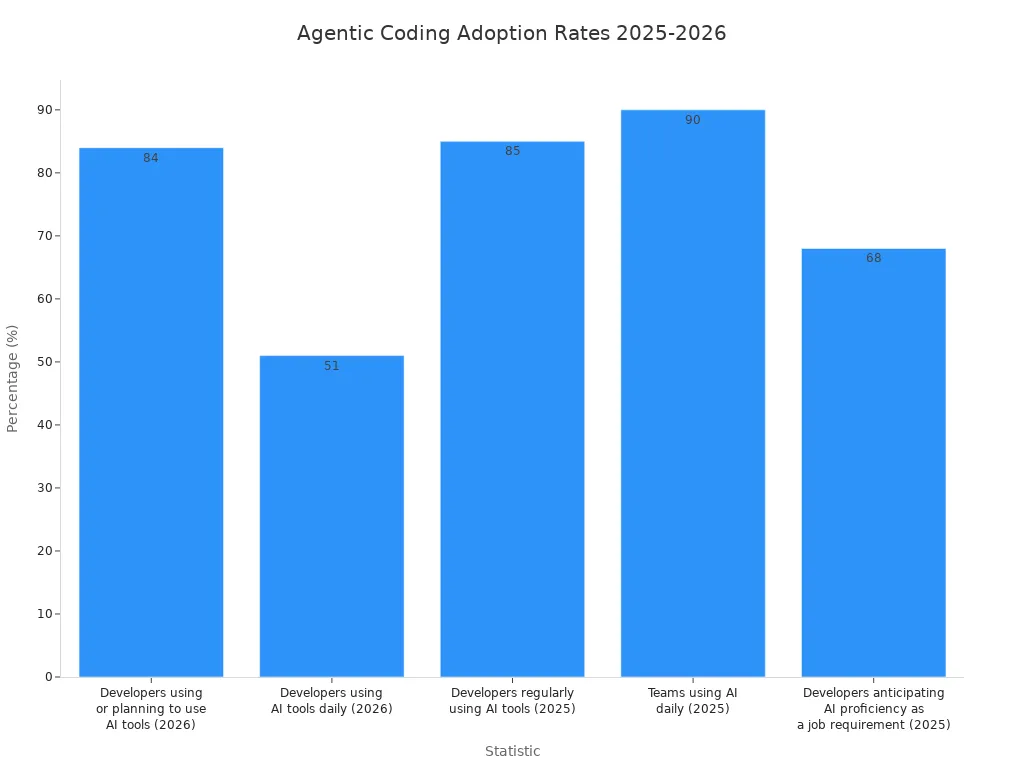
Power Platform makes technology accessible, empowering more people to join the creation process. This democratization of technology means you can contribute no matter your background. As you embrace ai-driven collaboration, you must also focus on governance and security to keep your technology safe and reliable.
Key Takeaways
- Agentic coding allows you to collaborate with AI agents, transforming software development from manual coding to a more efficient, automated process.
- Platforms like Microsoft Power Platform enable you to create applications using natural language, making technology accessible to everyone, regardless of coding skills.
- AI agents can handle complex tasks autonomously, allowing you to focus on high-level design and strategic decision-making.
- Effective collaboration with AI can save you up to 55% of your coding time, reducing mental fatigue and increasing job satisfaction.
- Adopting agentic coding requires new skills, such as prompt engineering and agent orchestration, to effectively manage AI workflows.
- Strong governance and security measures are essential to ensure that AI agents operate safely and align with organizational standards.
- The rise of agentic coding democratizes software creation, empowering non-technical contributors to solve business challenges directly.
- Embracing agentic coding positions you to innovate faster, improve code quality, and enhance collaboration across teams.
What Is Agentic Coding?
From Tools to Agents
You have seen software development change from using simple tools to working with intelligent agents. In the past, you wrote every line of code by hand. Now, agentic ai lets you focus on what you want to build, not just how to build it. These agents use large language models to understand your goals and carry out tasks with partial autonomy. Instead of only supporting you with suggestions, agentic ai can plan, execute, and even coordinate multi-step workflows across your entire codebase.
Here is a comparison to help you see the difference:
| Aspect | Traditional Development | AI Coding Assistants | Agentic Coding |
|---|---|---|---|
| Primary role | Manual development by engineers | Supports developers with suggestions | Executes tasks with partial autonomy |
| Interaction style | Fully human-driven | -response interaction | Goal-driven execution |
| Scope of work | Single task or feature | Single file or local context | Multi-step workflows across repositories |
| Planning | Done manually by developers | Minimal or none | Built-in multi-step planning |
| Tool use | Humans use tools directly | Limited tool awareness | Active tool use: tests, terminals, PRs, CI |
| Context awareness | Based on developer knowledge | Usually, the current file or context | Broader codebase and workflow context |
| Code generation | Fully manual | Assisted generation | Autonomous implementation and iteration |
Agentic ai does not just automate tasks. It creates a collaborative ecosystem where you and intelligent systems work together to solve complex problems.
Key Features of Agentic Coding
Agentic coding platforms stand out because they use ai agents for complex tasks. You can collaborate with these agents as partners, not just as tools. They plan and execute structured tasks, improve code quality, and operate across multiple layers of the development stack. This approach compresses the software development lifecycle, making it faster and more efficient.
| Feature | Agentic Coding Platforms | Legacy Development Environments |
|---|---|---|
| AI Integration | Uses AI coding agents for complex tasks | Limited or no AI assistance |
| Collaboration | Acts as a collaborator with developers | Primarily a tool for individual coding |
| Task Execution | Can plan and execute structured tasks | Manual task execution by developers |
| Code Quality | Focus on improving code quality and efficiency | Often lacks automated quality checks |
| Development Stack | Operates across multiple layers of the development stack | Typically operates within a single layer |
With agentic ai, you move from manual execution to orchestrating intelligent systems. This shift allows you to focus on strategic and creative work, while the ai handles repetitive or complex coding tasks.
Human-AI Collaboration
Collaboration between you and agentic ai is at the heart of this new approach. Studies show that human-ai collaboration can save you up to 55% of your time on coding tasks. You also experience less mental fatigue and greater satisfaction. When you and ai agents work together, you create higher-quality code, especially when you apply strong engineering practices.
Tip: Use agentic ai to handle routine tasks, so you can spend more time on design and collaborative innovation.
Large language models power these agents, making them capable of understanding your intent and adapting to your workflow. In collaborative ecosystems, you and agentic ai learn from each other. You provide feedback, and the ai improves its suggestions. This teamwork leads to better results and helps you manage complex projects with ease.
Agentic coding is not just about faster development. It is about building a collaborative, creative, and secure environment where you and ai agents drive innovation together.
Agentic Coding Evolution

Early Coding Tools
You have seen software development change a lot over the years. In the beginning, you wrote code by hand. You used simple editors and basic compilers. This manual approach required you to manage every detail. You had to remember syntax, organize files, and fix errors on your own. These early tools shaped how you think about building software.
As technology advanced, you started using smarter tools. These tools could highlight errors, suggest code, and help you find problems faster. They allowed you to explore codebases, spot unused dependencies, and clean up your projects. You could generate integration tests and run them in continuous integration environments. You also received summaries of test failures with clear steps to fix them. Some tools even helped you debug runtime issues by tracing logs and finding root causes. You could propose architectural changes, scaffold new services, and see real-time visualizations of your application’s structure.
This journey set the stage for agentic ai. You moved from doing everything yourself to working with tools that could act on their own. These early steps made it possible for agentic systems to become part of your daily workflow.
Note: Early coding tools gave you the foundation to trust and collaborate with intelligent systems.
| Milestone | Description |
|---|---|
| Manual Coding | Traditional solo developer workflow where coding is done manually. |
| AI-Assisted Development | Introduction of tools that enhance productivity and assist developers. |
| AI-Orchestrated Development | Fully autonomous systems that manage the software development process. |
Rise of Agentic AI
You now live in an era where agentic ai is changing how you build software. Over the past decade, you have seen a huge increase in the use of ai agents. In 2024, less than 5% of enterprise applications included integrated ai agents. By 2026, this number will reach 40%. By 2028, one-third of all enterprise software will use agentic ai. Leaders in the industry believe that scaling ai agents gives them a competitive edge. Every industry is expanding its use of ai.
This rise did not happen overnight. You saw the introduction of code models that could generate code inline as you typed. You started having conversations with ai agents about your goals. These agents became aware of your entire codebase. They learned to use tools, execute tasks in the background, and remember past actions. They could review and validate your work. You no longer had to do everything yourself. You could delegate tasks and focus on higher-level design.
Here is how the evolution unfolded:
- Code models
- Inline generation
- Conversation
- Codebase awareness
- Tool use
- Background execution
- Persistent memory
- Review and validation
You now see agentic ai as a partner, not just a tool. This partnership lets you move faster and build better software.
Agentic SDLC Paradigm
You have entered a new phase in software development. The agentic software development lifecycle (SDLC) changes how you work. You no longer just write code. You orchestrate intelligent agents that plan, generate, test, review, and execute changes for you. These agents act as autonomous collaborators. They understand your high-level goals and manage complex processes like requirements analysis and code generation.
Platforms like Microsoft Power Platform, GitHub Copilot, Claude, and Visual Studio Code show you what is possible. For example, GitHub Copilot works as your assistant inside your development environment. It helps you from the first line of code to task delegation, issue management, feature building, and pull request reviews. Microsoft Power Platform lets you use natural language to create apps, making agentic ai accessible to everyone. Claude and Visual Studio Code also bring agentic features into your workflow, allowing you to focus on creativity and strategy.
Nick Doelman, a leader in this field, explains that you now have conversations with ai agents. You do not just give commands. You collaborate, share ideas, and solve problems together. This shift to human-ai conversation and teamwork marks a new era. You become the orchestrator, guiding agentic ai to deliver results that match your vision.
Tip: Use agentic ai to automate routine tasks and free up your time for innovation.
The agentic SDLC means you can trust ai agents to handle the details. You set the direction. The agents do the work. This approach makes software development faster, more reliable, and more creative.
Impact on Development Workflow
Faster Delivery
You experience faster delivery when you use agentic coding in your projects. With ai agents, you can generate complex, multi-file components quickly. You no longer spend hours writing every line of code. Instead, you focus on translating your domain knowledge into prompts for ai. This shift boosts your efficiency and speeds up your coding pace by two to five times. Teams that invest in infrastructure, such as rules, commands, plans, and documentation, see even greater benefits. These investments help ai agents produce predictable outputs and improve project delivery speed.
Here is a table showing how agentic coding accelerates delivery:
| Evidence Type | Description |
|---|---|
| Code Generation | AI agents generate complex, multi-file components, speeding up the coding process. |
| Knowledge Translation | Developers translate domain knowledge into prompts for AI, enhancing efficiency. |
| Performance Increase | Coding pace increases by 2x to 5x with agentic coding. |
You also notice that agentic workflows extend these benefits beyond individual teams. When you build a strong foundation for ai, you improve the efficiency of your entire system.
Enhanced Productivity
Agentic coding enhances your productivity in several ways. You benefit immediately from ai-driven workflows. You delegate high-level tasks to ai agents, which then plan, test, and integrate code for you. This reduces your workload and allows you to focus on creative and strategic tasks. Amazon’s use of agentic ai coding tools saved over 4,500 developer-years and generated $260 million in efficiency gains by migrating 30,000 applications.
You see productivity gains across your team, but the benefits are not always uniform. Domain experts may face a steeper learning curve, while junior engineers must maintain their debugging skills. Long-term technical expertise and ownership remain important for sustained productivity.
| Evidence | Description |
|---|---|
| Productivity Gains | Developers benefit immediately from agentic coding, leading to enhanced productivity. |
| Maintenance Risks | Maintenance of agent-generated code can affect long-term productivity. |
| Uneven Benefits | Productivity gains vary across roles, with domain experts facing challenges. |
Tip: Use agentic workflows to automate routine tasks and free up your time for innovation.
Managing Complexity
You manage complexity more effectively with agentic coding. Strong governance provides clear guardrails, visibility, and accountability for ai agents. Controlled access ensures that agents operate under strict policies and align with organizational standards. You integrate autonomy, control, and visibility into your workflows to maintain reliability and safety.
Agentic workflows follow structured processes that ensure correctness, traceability, and automation for enterprise tasks. Automation leads to higher quality assurance compliance in your development processes. You define high-level tasks, and ai agents parse and execute them, reducing your burden and helping you handle complex projects.
| Impact Type | Description |
|---|---|
| Task Delegation | Developers define high-level tasks, which are then parsed and executed by autonomous agents. |
| Automation | Agents autonomously perform task planning, testing, and code integration, reducing developer burden. |
| Structured Workflows | Follows structured workflows that ensure correctness, traceability, and automation for enterprise tasks. |
| Increased QA Compliance | Automation leads to higher quality assurance compliance in development processes. |
Note: Integrate autonomy, control, and visibility into your agentic workflows to maintain reliability and safety.
Developer Role Transformation
From Coder to Orchestrator
You now step into a new role in the agentic era. Instead of writing every line of code, you oversee a team of specialized ai agents. Each agent handles a different phase of software development. Some agents plan, others code, test, review, document, or deploy. Your main job becomes high-level oversight and task distribution. You focus on integration and quality, not just manual coding.
- You manage multiple agentic ai agents at once.
- You assign tasks to agents for planning, coding, testing, and deployment.
- You monitor progress and ensure all agents work together smoothly.
As orchestrator, you guide the agentic process. You set goals, review results, and make strategic decisions. This shift brings a big boost in productivity. A small team can now manage many ai processes. You move from hands-on coding to strategic oversight. You design and validate, while agentic ai handles most coding tasks.
New Skills for Agentic AI
To thrive in this agentic environment, you need new skills. You must learn how to interact with ai agents and design effective collaboration models. Your job is not just about giving commands. You work with agentic systems in feedback-driven loops. These systems make autonomous decisions and adapt based on your input.
Designing effective human–ai collaboration models is a key challenge. You must develop user interfaces, set up interaction protocols, and create frameworks for sharing responsibilities between you and agentic agents. This new model turns you into an interactive collaborator, not just a command-giver.
Here are some important skills for agentic ai development:
- Prompt engineering and mechanism design: You craft clear prompts and rules to guide agentic behavior.
- Agent orchestration: You use frameworks to manage complex, multi-agent workflows.
- System tuning and evaluation: You monitor and improve agentic ai performance over time.
As agentic ai takes over low-level tasks, you focus on designing and refining the systems that generate code. You become the architect of agentic workflows, not just a coder.
Human-Agent Teamwork
Agentic coding changes how you work with ai. You and agentic agents form a team. Trust and collaboration become essential. Studies show that people trust human-like agents more and blame them less when things go wrong. Higher levels of human-like behavior in agentic ai increase trust and teamwork. When you work with agentic agents, you share responsibility and build stronger teams.
| Evidence Description | Source |
|---|---|
| Low-rank human-like agents are trusted more and blamed less in human-autonomy teaming. | Li et al. (2016) |
| Higher levels of anthropomorphism invoke CASA effects, influencing trust dynamics in teams. | Gambino et al. (2020) |
| Participants apportioned less blame to an autonomous car compared to a human driver, indicating a shift in blame attribution. | Lyons et al. (2021) |
You and agentic ai agents learn from each other. You provide feedback, and agents improve their performance. This teamwork leads to better results and a more creative development process. In the agentic world, you do not work alone. You lead, guide, and collaborate with ai to achieve your goals.
Multi-Agent Systems
Single vs. Multi-Agent
You may start your journey with a single ai agent. This agent can handle simple, multi-step tasks. However, when you face complex problems, a single agent often struggles. You need a system that can break down big challenges into smaller parts. This is where the internet of agents comes in. It connects many specialized agents, each with its own skill set. These agents work together to solve problems that one agent alone cannot handle.
- Single agents manage straightforward tasks but have limits with complex, diverse challenges.
- Multi-agent systems break down tasks, assign them to specialists, and check the quality of each step.
- The internet of agents allows these systems to collaborate, making them a core part of modern agentic coding.
When you use multi-agent systems, you create a digital team. Each agent focuses on what it does best. You get better results because each part of the problem receives expert attention.
Coordination and Delegation
You need strong coordination to make the internet of agents work well. Multi-agent systems use different patterns to organize their work:
- Sequential pipeline: Agents complete tasks one after another. This method is simple and easy to follow.
- Hierarchical delegation: One agent acts as a manager, breaking tasks into smaller pieces and assigning them to others.
- Collaborative discussion: Agents share ideas and adjust their plans together. This approach is flexible but can sometimes slow things down.
- Event-driven orchestration: Agents respond to events as they happen. This method scales well and keeps agents independent.
The internet of agents lets these digital teams work around the clock. They do not wait for you to be available. You can trust them to handle complex engineering tasks quickly and efficiently.
Tip: Use the internet of agents to build teams that never sleep. Your projects move forward even when you are not at your desk.
Technical Debt Management
Managing technical debt is important in any project. The internet of agents helps you fix small issues, like formatting errors or missing comments. These agents can spot and correct these problems faster than you can. However, when you face bigger challenges, such as duplicate code or confusing structures, you still need to step in.
For example, if the internet of agents creates several similar user interfaces, you may end up with too much code. You should simplify and organize the code to make it easier for both humans and agents to understand. Agents do well with routine fixes, but you must guide them on big architectural decisions.
| Task Type | Who Handles It Best |
|---|---|
| Formatting, Linting | Internet of agents |
| Duplicate Patterns | Human oversight |
| Architecture | Human oversight |
You get the best results when you combine the speed of the internet of agents with your own judgment. This teamwork keeps your codebase clean and your projects on track.
Democratizing Software Creation
Non-Technical Contributors
You no longer need to be a professional developer to build powerful applications. Agentic coding opens the door for non-technical contributors in every industry. You can now solve your own business challenges by creating applications that fit your needs. Sales and marketing teams use agentic coding to design applications that track leads, manage campaigns, and analyze customer data. You do not have to wait for engineering teams to deliver solutions. You can address your problems directly and quickly.
This shift means you gain more control over your work. You can build applications that reflect your expertise. You understand your business best, so you create applications that match your goals. Agentic coding reduces your reliance on IT departments. You become a creator, not just a user, of technology. This change empowers you to innovate and respond to new challenges with custom applications.
Cross-Functional Teams
Agentic coding transforms how you work in cross-functional teams. You see intelligent agents act like real engineering teams, helping you coordinate and deliver applications faster. These agents organize workflows, share context, and reduce the time it takes to move applications from idea to reality. You do not waste time on endless meetings or emails. Agents help you focus on what matters most—building great applications.
| Aspect | Description |
|---|---|
| Workflow Orchestration | Intelligent agents function like real engineering teams, improving workflow orchestration across teams. |
| Coordination Overhead Reduction | The approach reduces coordination overhead, leading to faster and higher quality software delivery. |
| Context Sharing | Agents help in sharing context across teams, enhancing collaboration and understanding. |
| Structural Shift | There is a fundamental shift in how software moves through the organization, compressing latency. |
| Human Attention Redefinition | The focus on where human attention is most valuable is redefined, optimizing team efforts. |
You work with people from different backgrounds to create applications that solve real problems. You see your ideas come to life as agents handle the technical details. This teamwork leads to better applications and more satisfied users.
Power Platform’s Role
Microsoft Power Platform stands out as a leader in democratizing application development. You can describe your ideas in plain language, and the Power Platform Plan Designer turns them into structured application plans. You do not need to know how to code. You simply explain what you want, and the platform builds the foundation for your applications. The Plan Designer includes user roles, data models, application components, and suggested workflows. This guided process helps you and your team create applications quickly and confidently.
- The Power Platform Plan Designer lets you describe ideas in plain language, which it transforms into structured application plans.
- You get components like user roles, data models, application parts, and suggested workflows.
- The platform guides you through the process, making it easy for both professional and citizen developers to build applications.
You can also write tests for your applications using natural language. This feature allows you to check if your applications work as expected without writing code. Business users can create and maintain tests that reflect their understanding of business processes. These tests serve as living documentation, making it easier for everyone to understand and improve applications.
Power Platform’s AI-assisted features simplify the process of building, testing, and maintaining applications. You can focus on your ideas and let the platform handle the technical work. This approach makes application development accessible to everyone, not just developers. You become part of a new wave of creators, building applications that drive your organization forward.
Redefining Productivity
Measuring Output
You need clear ways to measure how well agentic coding works in your projects. Traditional metrics like lines of code or hours spent do not capture the value of intelligent agents. Instead, you should look at new metrics that reflect the unique strengths of agentic systems. Here is a table that shows important metrics for agentic coding environments:
| Metric Name | Definition | Importance |
|---|---|---|
| Task Success Rate (TSR) | Proportion of tasks completed based on criteria | Shows how well agents meet your goals |
| Step Efficiency / Action Cost | Number of actions to finish a task | Measures how efficiently agents work |
| Tool-Use Accuracy | Correct use of external tools without errors | Ensures reliable tool interactions |
| Planning Coherence | Alignment of plans with actual execution | Reflects agent reasoning and logic |
| Memory Recall | Consistent storage and retrieval of information | Important for agents that remember context |
| Robustness to Perturbation | Consistency when inputs change | Measures reliability in changing settings |
| Autonomy Index | Ratio of agent-made to human-assisted decisions | Shows how independent agents are |
| Latency and Throughput | Response time and task completion rate | Critical for performance |
| Quality of Reasoning | Logical evaluation of agent decisions | Ensures agents think, not just react |
| Context and Data Groundedness | Relevance and accuracy of used information | Keeps responses based on real data |
These metrics help you see where agents excel and where you may need to step in.
Quality and Innovation
Agentic coding changes how you think about software quality and innovation. You see faster product development because AI agents can plan, build, and develop features at the same time. This speed lets you bring new ideas to life quickly. You also notice higher code quality and consistency. AI-driven engineering follows set standards, which reduces mistakes and keeps your codebase clean.
You benefit from continuous optimization. Agents automatically debug and test your code, which helps maintain code integrity. Your team can scale up development without hiring more people. However, you should remember that some industry benchmarks do not always measure what matters most, like security or maintainability. Sometimes, agents may optimize for test scores instead of real-world quality. You need to focus on production-ready qualities to ensure your software remains strong and secure.
- You get faster product development.
- You achieve higher code quality and consistency.
- You enjoy continuous optimization through automatic debugging and testing.
- You scale your software without extra staff.
Note: Always check that your agents focus on real-world needs, not just passing benchmarks.
Organizational Value
When you adopt agentic coding, your organization gains many benefits. You see improved productivity as developers complete tasks faster and with fewer errors. Teams work together more smoothly, which leads to quicker delivery of new features. Developers feel less mental strain because they can focus on solving problems instead of managing complex code.
Here is a table that highlights the value agentic coding brings to your organization:
| Benefit | Description |
|---|---|
| Improved Productivity | Developers get more done in less time |
| Reduced Error Rates | Fewer mistakes appear in your code |
| Enhanced Collaboration | Teams work better together and deliver features faster |
| Lower Cognitive Load | Developers spend less effort on complexity and more on solutions |
You create a work environment where people and AI agents support each other. This partnership helps your organization stay competitive and ready for future challenges.
Organizational Adoption
Integrating Agentic Coding
You start your journey with agentic coding by focusing on integration at every level. You connect agentic tools with your existing workflows. You bring together your development teams, business users, and IT leaders. You look for ways to blend agentic solutions with your current processes. You often use system integration to link agentic platforms with your databases, APIs, and cloud services. You might set up github actions workflows to automate testing and deployment. You make sure your integration plan covers both technical and human factors.
You see that integration is not just about technology. You also need to align your team’s mindset. You encourage everyone to learn how agentic systems work. You help your team understand how agentic agents can support their daily tasks. You create training sessions and workshops. You build a culture where people trust agentic solutions and see their value. You review your integration progress often and adjust your approach as needed.
Benefits and Challenges
When you adopt agentic coding, you notice many benefits:
- Faster delivery of new features
- Automated bug fixing
- Reduced workload for developers
- Improved system integration across teams
You also face some challenges:
- Need for strong governance and oversight
- Risks from autonomous decision-making
- Concerns about transparency in agentic AI decisions
- Skepticism from experienced developers about black-box automation
- Requirement for retraining teams in agentic workflows and agent supervision
You see that agentic integration brings both opportunities and tensions. You must balance the speed and efficiency of agentic systems with the need for control and security. You often find that traditional management principles do not fit perfectly with agentic integration. You may need to adapt your frameworks or create new hybrid approaches to manage agentic adoption effectively.
Tip: Regularly review your integration strategy to ensure agentic systems align with your organization’s goals and values.
Change Management
You play a key role in managing change during agentic integration. You guide your team through the transition. You communicate the benefits of agentic coding clearly. You address concerns about system integration and AI autonomy. You set up feedback channels so your team can share their experiences.
You provide ongoing training to help everyone adapt to new agentic workflows. You encourage collaboration between technical and non-technical staff. You celebrate small wins to build confidence in agentic integration. You monitor progress and adjust your change management plan as your organization grows.
You know that successful agentic integration depends on strong leadership and open communication. You create a supportive environment where everyone feels comfortable exploring new agentic solutions. You help your organization move forward with confidence in the age of agentic coding.
Governance and Security
Secure Agentic Development
You play a key role in keeping agentic development secure. As you work with agentic platforms, you must set clear boundaries for every agent. You define the scope and guardrails so agents cannot make uncontrolled changes. You restrict agents to non-production environments and limit their privileges. This approach helps you maintain trust in your systems.
You also apply strict dependency governance. Every package or library suggested by an agent must pass supply chain reviews. You require a software bill of materials for each dependency. You collect compliance evidence for every agent action. This creates a strong audit trail and supports frameworks like SOC 2 or HIPAA. You integrate oversight into your pipelines. All agent-generated code goes through automated security checks and mandatory human review. You connect agent activity to enterprise visibility platforms. This helps you prioritize risks and maintain trust.
Tip: Always monitor for new vulnerabilities unique to agentic workflows. Your vigilance builds trust and keeps your systems safe.
Governance Best Practices
You follow best practices to ensure agentic coding remains safe and reliable. Here are some steps you can take:
- Define scope and guardrails for every agent to prevent unintended changes.
- Apply strict dependency governance and require supply chain reviews.
- Enforce compliance evidence collection for all agent actions.
- Integrate oversight into your development pipelines.
- Route all agent-generated code through security checks and human review.
- Leverage enterprise visibility platforms for risk management.
- Monitor for new classes of vulnerabilities in agentic workflows.
- Run controlled red team exercises to test your guardrails.
- Perform layered security testing, including static and dynamic analysis.
- Continuously refine your controls based on findings.
- Require agents to produce and run tests before accepting changes.
You build trust by making these practices part of your daily routine. You ensure every agentic process supports accountability and transparency. You also require mandatory code reviews for all agent-generated code. This step increases trust and helps you catch issues early. You compel agents to create test files and run them before any changes go live. These actions improve the trustworthiness of your agentic systems.
New Security Risks
Agentic coding introduces new security risks that you must address. You need to understand these risks to maintain trust in your workflows. Here is a table that outlines some of the main risks:
| Risk Type | Description |
|---|---|
| Compliance and audit gaps | Changes made by coding agents outside of approval processes lead to loss of traceability and compliance challenges. |
| Escalation of errors | Small mistakes can escalate due to autonomous loops, causing significant system instability. |
| Data exposure risks | Increased access to codebases raises the risk of sensitive information being mishandled or exposed. |
You see that agentic systems can sometimes act outside of normal approval processes. This can create compliance gaps and make audits harder. You also notice that small errors can grow quickly if agents operate in loops. You must watch for these risks and act fast to protect your systems. You build trust by staying alert and updating your controls as agentic technology evolves.
Future of Agentic AI
Strategic Implications
You see agentic ai changing the way you approach software development. Agentic systems move from being passive tools to active co-developers. You must focus on trustworthy infrastructure and human-centered design. These priorities shape the future of agentic software creation. You notice that agentic ai transforms engineering roles. You shift from traditional coding to managing autonomous systems. You need new skills, such as systems thinking and agent orchestration. These skills help you guide agentic workflows and ensure reliable outcomes.
You also observe new business models emerging. Agentic solutions create unique opportunities for organizations. You can build products and services that were not possible before. You must consider robust governance and ethical standards. These factors protect your organization and users as agentic ai becomes more common.
- Agentic ai drives new business models.
- You must focus on governance and ethics.
- You need to develop skills for agentic orchestration.
Note: Agentic ai requires you to rethink your approach to software engineering. You become a manager of intelligent systems, not just a coder.
Next-Gen Software Creation
Agentic ai enables you to build next-generation applications. You use agentic platforms to automate complex tasks and streamline workflows. You describe your goals, and agentic systems turn them into working solutions. You see faster development cycles and higher quality software. You can scale your projects without increasing your team size.
You work with agentic agents that plan, code, test, and deploy. You focus on design and strategy. Agentic ai handles the details. You gain more time for innovation and creative problem-solving. You also see agentic ai improving collaboration across teams. You share ideas and feedback with agentic agents. This teamwork leads to better products and more satisfied users.
Here is a table showing how agentic ai changes software creation:
| Aspect | Traditional Approach | Agentic Approach |
|---|---|---|
| Task Execution | Manual coding | Autonomous agentic ai |
| Collaboration | Human-only teams | Human-agentic teamwork |
| Development Speed | Slow | Fast and scalable |
| Innovation | Limited | Enhanced by agentic ai |
Preparing for Change
You must prepare for the rise of agentic ai in your organization. You start by learning new skills. You study agentic orchestration and systems thinking. You build a culture that values collaboration between humans and agentic agents. You encourage your team to experiment with agentic platforms.
You set up training sessions and workshops. You help your team understand how agentic ai supports their work. You review your processes and update them for agentic workflows. You create feedback channels so everyone can share their experiences.
You also focus on governance and security. You define clear rules for agentic agents. You monitor their actions and ensure compliance with standards. You stay alert for new risks and update your controls as agentic ai evolves.
Tip: Embrace agentic ai as a partner. You gain new opportunities for growth and innovation when you adapt to this change.
You lead your organization into the future of agentic software development. You build trust in agentic ai and create a strong foundation for next-generation solutions.
Agentic coding changes how you build software. You now work with AI as a partner, not just a tool. To succeed, you must adapt your skills, update your workflows, and strengthen your governance.
Explore platforms like Microsoft Power Platform to unlock new ways to create and innovate.
You stand at the start of a new era. Embrace agentic coding to shape the future of technology.
FAQ
What is agentic coding?
Agentic coding lets you work with AI agents that plan, code, and test software. You describe your goals, and the agents help you build solutions faster and more efficiently.
How does Microsoft Power Platform support agentic coding?
You use Power Platform to create apps with natural language. The platform’s AI features turn your ideas into working solutions. You do not need deep coding skills to get started.
Can non-developers use agentic coding tools?
Yes! You can build apps and automate tasks even if you do not have a technical background. Agentic coding platforms make technology accessible to everyone in your organization.
How do you keep agentic coding secure?
You set clear rules for AI agents. You review all agent-generated code. You use automated security checks and require human approval before changes go live.
What skills help you succeed with agentic coding?
You benefit from prompt engineering, system design, and teamwork. You learn to guide AI agents, review their work, and focus on creative problem-solving.
How does agentic coding change your workflow?
You spend less time on repetitive tasks. You focus on design, strategy, and innovation. AI agents handle much of the coding, testing, and integration for you.
What are the main benefits of agentic coding?
You deliver software faster, improve code quality, and reduce errors. You also empower more people to create solutions and drive innovation in your organization.
Do agentic coding platforms replace developers?
No. You still play a key role. You guide, review, and make decisions. AI agents support your work, but you remain responsible for the final product.
🎧 Listen to this episode
Want a practical explanation of Agentic Coding with Nick Doelman [MVP-MCT]? This episode breaks down the topic in clear language and shows why it matters for Microsoft 365, Azure, Power Platform, security, AI, and modern work.
Listen to this episode if you want to:
- Understand the key concepts behind Agentic Coding with Nick Doelman [MVP-MCT]
- See how it fits into the wider Microsoft technology ecosystem
- Learn where it can create practical value for your organization
You may also enjoy these related M365 FM episodes:
- Power Apps AI and Vibe Coding with Keith Atherton [MVP-MCT]
- AI-First UX for Microsoft Power Platform with Tchesco Ayih [MVP-MCT]
- Secure Azure Networking with Rex de Koning [MVP-MCT]
- Microsoft Security Exposure Management with Uros Babic [MVP-MCT]
- Agentic Operating Model for Enterprise AI and Copilot
Discover more practical Microsoft conversations on M365 FM.
Official Microsoft MVP profile: Nick Doelman on Microsoft MVP
🚀 Want to be part of m365.fm?
Then stop just listening… and start showing up.
👉 Connect with me on LinkedIn and let’s make something happen:
- 🎙️ Be a podcast guest and share your story
- 🎧 Host your own episode (yes, seriously)
- 💡 Pitch topics the community actually wants to hear
- 🌍 Build your personal brand in the Microsoft 365 space
This isn’t just a podcast — it’s a platform for people who take action.
🔥 Most people wait. The best ones don’t.
👉 Connect with me on LinkedIn and send me a message:
"I want in"
Let’s build something awesome 👊
1
00:00:00,000 --> 00:00:05,600
Hello and welcome to another episode of the M365 FM podcast.
2
00:00:05,600 --> 00:00:10,880
Today we diving into one of the most exciting shifts happening in software development,
3
00:00:10,880 --> 00:00:16,480
the evolution of agentec coding and how natural language is becoming the purest form of
4
00:00:16,480 --> 00:00:18,400
low-coded development.
5
00:00:18,400 --> 00:00:23,760
Joining me today is Nick Dorman and an independent power platform specialist, trainer,
6
00:00:23,760 --> 00:00:31,920
coverage, Microsoft MVP and Microsoft's certificated trainer from 2003, Nick worked at Microsoft
7
00:00:31,920 --> 00:00:38,720
as a senior content developer, focusing on power pages, power automate and power platforms
8
00:00:38,720 --> 00:00:46,240
skill content. He also is a co-host of the Boost podcast, a content creator and outside of tech,
9
00:00:46,240 --> 00:00:55,280
an international competitor, power lift, representing team Canada. Yeah, Nick, thank you.
10
00:00:55,280 --> 00:00:58,960
Yeah, thanks, Marco. I hope I have never forgotten.
11
00:00:58,960 --> 00:01:06,400
Oh, it's a lot, yeah. It looks impressive on an autobiography, but yeah, I do those things,
12
00:01:06,400 --> 00:01:11,040
so yeah. Interesting, power lifting.
13
00:01:13,520 --> 00:01:18,640
Well, we could talk about power lifting, the whole session if we're not careful about it,
14
00:01:18,640 --> 00:01:25,600
but yeah, it's a hobby sport. It's something I took up probably about
15
00:01:25,600 --> 00:01:31,040
I think 13 or 14 years ago, just getting out of shape, I'm like, okay, I want to go to the gym,
16
00:01:31,040 --> 00:01:37,920
met with a personal trainer, hated running. I tell people, if you see me running,
17
00:01:37,920 --> 00:01:41,040
then you better start running too, because something's gone horribly wrong.
18
00:01:42,320 --> 00:01:45,200
I much prefer doing weightlifting, free weights, that kind of thing,
19
00:01:45,200 --> 00:01:50,960
got into powerlifting competitions and, yeah, in a couple of weeks, I'll be competing at the
20
00:01:50,960 --> 00:01:57,840
World Bench Press Championship. I look at the stats, I won't win, but I'll definitely compete
21
00:01:57,840 --> 00:02:03,680
and have a lot of fun. To me, powerlifting is my mental therapy. It's my going to the gym.
22
00:02:03,680 --> 00:02:08,800
It gets me away off the keyboard away from the screen and kind of gets resets my mind.
23
00:02:10,080 --> 00:02:16,480
There's an expression I hear, exhaust the body, calm the mind, and that's for me is what powerlifting is all about.
24
00:02:16,480 --> 00:02:20,800
And how did you then powerlifting bring you to power platform?
25
00:02:20,800 --> 00:02:28,160
Well, I was doing power platform, log before that. If anything, power platform brought me to powerlifting.
26
00:02:28,160 --> 00:02:34,640
Been working with tech, oh, man, like I got my first computer when I was like, I think it was like
27
00:02:35,120 --> 00:02:42,800
15 or 16 years old, I got a Commodore 64, I started programming at basic, I started doing a little bit
28
00:02:42,800 --> 00:02:50,000
of assembler and machine language. I went to school for electronics engineering in computer systems,
29
00:02:50,000 --> 00:02:57,600
so did a lot of at that time, C++, assembler as well, working on different microprocessors,
30
00:02:57,600 --> 00:03:02,640
really got more into software and then eventually that kind of led me to something called
31
00:03:02,640 --> 00:03:09,680
Microsoft Dynamics CRM, which of course is the great grandfather to Dataverse and PowerApps
32
00:03:09,680 --> 00:03:16,320
started building what, you know, building applications on top of Microsoft CRM. We used to call those
33
00:03:16,320 --> 00:03:23,360
XRM, meaning anything relationship management and of course that evolved into what we know is power
34
00:03:23,360 --> 00:03:29,680
apps today in Dataverse and all that. So along the way working in IT, as I'm sure a lot of people
35
00:03:29,680 --> 00:03:36,480
understand, it is, it can be a bit of a stressful job, a bit of a lowly job, a lot of pressure
36
00:03:36,480 --> 00:03:41,680
if the client's systems are down, they're freaking out, they're calling you at all hours to get things
37
00:03:41,680 --> 00:03:48,160
up and running. So I found that very stressful, so for me getting back in physical shape and getting
38
00:03:48,160 --> 00:03:53,040
into powerlifting was a way to escape some of that for at least part of the day, so I think the
39
00:03:53,040 --> 00:03:56,160
power platform brought me to powerlifting, not the other way around.
40
00:03:57,440 --> 00:04:03,760
Okay, I think it's good to be something with the name, but okay.
41
00:04:03,760 --> 00:04:16,480
Yeah, you also worked at Microsoft and now you are, yeah, free LAN, free, or free LAN, sir. Yeah,
42
00:04:16,480 --> 00:04:22,880
yeah, yeah, yeah. So I was, I mean, it worked for some, it's interesting in terms of my career, I
43
00:04:23,680 --> 00:04:29,760
worked for other Microsoft partners, I went off on my own as an independent contractor, free
44
00:04:29,760 --> 00:04:35,840
LAN, sir, I grew a company, we had employees, we had an office, we had the whole bit. I learned very
45
00:04:35,840 --> 00:04:42,080
quickly that I'm at my heart, I'm a technician, I like to always say fingers on keyboard, even though
46
00:04:42,080 --> 00:04:47,200
I'm using my microphone more and more these days, but just more that hands-on building things,
47
00:04:47,200 --> 00:04:52,560
so running a company really didn't line well with me, it really stressed me out, like dealing with
48
00:04:52,560 --> 00:04:59,280
HR issues and payroll and the bank and the taxes and of course, multiple, you know, doing multiple
49
00:04:59,280 --> 00:05:04,240
project management, it was like, nah, I really want to do the hands-on stuff, so ended up going,
50
00:05:04,240 --> 00:05:09,040
taking the company, we kind of got absorbed by a larger firm, I did a few years at that, went
51
00:05:09,040 --> 00:05:16,400
back on my own, and then got contacted by some folks I knew at Microsoft saying, hey, we, we think,
52
00:05:16,400 --> 00:05:21,840
you know, based on, because at that time, I was an MVP, I was writing blogs, you know,
53
00:05:21,840 --> 00:05:28,000
doing presentations, they said there's an interesting position at Microsoft doing working on the documentation
54
00:05:28,000 --> 00:05:37,360
for at that time, it was called Power Apps Portals, and again, no, I don't want to throw anybody
55
00:05:37,360 --> 00:05:43,680
out of the bus, but the Power Apps Portals documentation wasn't necessarily the best, there was,
56
00:05:43,680 --> 00:05:48,640
so in a way, it was good for me to become an MVP because I could write a lot of blogs on how to do
57
00:05:48,640 --> 00:05:54,800
things, set things up, so it was a great opportunity for me to kind of get involved in that, and so I
58
00:05:54,800 --> 00:05:58,400
joined Microsoft, I thought, oh, this is going to be an interesting career move, but that point,
59
00:05:58,400 --> 00:06:04,160
I wasn't sure I wanted to work for a big company, but it was actually during the pandemic, so I really
60
00:06:04,160 --> 00:06:11,360
wasn't doing a lot of the traveling and community stuff anyway, so joined Microsoft, as I like to tell
61
00:06:11,360 --> 00:06:19,200
people, it was good to see how the sausage was made, so working, working at Microsoft was good, if I
62
00:06:19,200 --> 00:06:24,160
got at that point, they were transitioning, they were basically creating what was going to be a new
63
00:06:24,160 --> 00:06:29,200
product, Power Pages, which was, of course, just transitioning Power Apps Portals and do a bit of a
64
00:06:29,200 --> 00:06:34,960
rebrand, but of course, they added a bunch more tools to make it a standalone product, so I work
65
00:06:34,960 --> 00:06:39,680
with that, reworking all the documentation, of course, writing new documentation for the new features,
66
00:06:40,560 --> 00:06:46,000
it was a lot of fun, but then over the course of the years, I found like, I'm a builder at heart,
67
00:06:46,000 --> 00:06:51,920
I want to be building these things, it's great to kind of explain the process of how things are
68
00:06:51,920 --> 00:06:56,400
done, it was great to work with the team, so after two years, I decided to go back out being a
69
00:06:56,400 --> 00:07:05,280
freelancer, it wasn't laid off, like a lot of people at Microsoft had been, it was my decision to go,
70
00:07:05,280 --> 00:07:09,200
it was interesting because they were doing a layoffs and I kind of like, we've all been tiered for
71
00:07:09,200 --> 00:07:15,280
this and at that time, that was not an option, but it was good, I made a lot of great friends there,
72
00:07:15,280 --> 00:07:20,480
I wouldn't be adverse to going back to Microsoft for the right job, I'm just not sure the right job
73
00:07:20,480 --> 00:07:27,600
exists for me there, but it was really good, so it was a good span of time, I met a lot of great people,
74
00:07:27,600 --> 00:07:34,720
got to see how products were put together, how the marketing worked, of course, it was in meetings
75
00:07:34,720 --> 00:07:39,200
with marketing people and they were like, oh, we're going to rename it and I'm going, do you guys not
76
00:07:39,200 --> 00:07:46,000
realize the stress and the anxiety and the confusion that happens every time you rename something and
77
00:07:46,000 --> 00:07:52,000
they were like, oh no, no, it'll be fine and sure enough, months later, there was confusion and
78
00:07:52,000 --> 00:07:55,520
whatever else, but this is Microsoft, they like to keep things interesting.
79
00:07:55,520 --> 00:08:02,080
Anyways, it was good and then, yeah, when I went back on my own freelancing again, now it's been a
80
00:08:02,080 --> 00:08:10,000
couple years and I absolutely love it. I think it's like running joke, the rename is of
81
00:08:10,000 --> 00:08:21,280
in Microsoft, yeah, I think in Edra and I have these and seen these lists with all the services,
82
00:08:21,280 --> 00:08:28,560
and it's 1,100 services, and now often they change the name, it's like, yeah, I don't know,
83
00:08:29,600 --> 00:08:36,160
and they're services, I never heard before, like, satellite service, and so on, and they really,
84
00:08:36,160 --> 00:08:43,520
I think, oh, yeah, okay, but, yeah, there's this marketing or something, I don't know,
85
00:08:43,520 --> 00:08:51,120
but what excites you most today compared to power platform, say, five years ago?
86
00:08:51,120 --> 00:08:58,880
Oh, it's, I mean, Mercco, it's radically changed. It's interesting. I would say, if you
87
00:08:58,880 --> 00:09:06,400
talked to me even a year ago or two years ago, the make.powerapps.com would be the main tool that I would
88
00:09:06,400 --> 00:09:13,520
be living in, of course, creating tables, working on apps, building, building things out that way,
89
00:09:13,520 --> 00:09:19,520
in power automate designer, those types of things. I would say today, I'm kind of, and then of course,
90
00:09:19,520 --> 00:09:24,480
with PowerPages into the design studio, and then of course, for the PowerPages folks, you know,
91
00:09:24,480 --> 00:09:29,760
people, everybody knows about the, the PowerPages management app or the Portals Management app,
92
00:09:29,760 --> 00:09:34,960
which was a model driven app where we did a lot of configuration. Those are the tools that I lived in.
93
00:09:34,960 --> 00:09:41,280
These days, I would say if you look at the last three to six months, I am living in Visual Studio Code,
94
00:09:41,280 --> 00:09:49,360
probably at least 75% or 80% of the time, and I'm seeing that every day become more and more,
95
00:09:49,360 --> 00:09:54,800
because there's more and more things we can do to build on top of the PowerPlatform, and that
96
00:09:54,800 --> 00:10:01,920
not only PowerPages, but even building PowerApps, and even if you're building traditional PowerApps
97
00:10:01,920 --> 00:10:07,840
and model driven apps, I had to create an app with a whole bunch of tables. I didn't go into the
98
00:10:07,840 --> 00:10:11,520
make your portal and start creating these tables. I went into Visual Studio Code. They have,
99
00:10:11,520 --> 00:10:18,000
of course, the Dataverse MCP server. They have Dataverse skills. I'm basically using
100
00:10:18,000 --> 00:10:25,040
natural language. I'm saying, "Hey, design me a data model that fits this." Then let it iterate. We go
101
00:10:25,040 --> 00:10:30,160
through, like I say, "We, me and the agent, we go through. We take a look at that data model. We
102
00:10:30,160 --> 00:10:35,760
might make a few adjustments." Then it's like, "Okay, go build it, and it will go and create all those
103
00:10:35,760 --> 00:10:42,000
tables in those fields and wire it up." Does it do it perfectly all the time? No, not necessarily,
104
00:10:42,000 --> 00:10:47,680
but it's saving me going through the make your portal and clicking in back and forth and everything
105
00:10:47,680 --> 00:10:53,280
like that. Some of these tools are only a couple of weeks old. They're constantly being updated.
106
00:10:53,280 --> 00:11:00,000
It's radically changing how we build things. Then even as doing development and code,
107
00:11:00,000 --> 00:11:06,720
working in PowerPages, even working what we say, traditional PowerPages, sites with Web templates,
108
00:11:06,720 --> 00:11:11,840
and things like that, I'm working with these coding agents, whether it's GitHub, Copilot, or
109
00:11:11,840 --> 00:11:22,000
Cloud Code, and we're building HTML, we're actually getting a handle on CSS, those types of things,
110
00:11:22,000 --> 00:11:28,720
and it's not like I'm just telling it to go and do something. I'm working with it going, "Okay,
111
00:11:28,720 --> 00:11:33,440
we need to work on this Web template today. I need it to do these features." Okay, we'll hear
112
00:11:33,440 --> 00:11:38,800
some code. I take a look at it again, making sure it's like supervising, making sure it's lined up.
113
00:11:39,680 --> 00:11:45,680
Usually it's pretty good. Sometimes there's a bit of iteration going, "No, I think you need to do
114
00:11:45,680 --> 00:11:52,400
this or know this liquid tag. We need to do this." Overall, my productivity has just gone through
115
00:11:52,400 --> 00:11:58,960
the roof in terms of what I can create and what I can modify. That's the exciting part. Now, I come from
116
00:11:58,960 --> 00:12:06,160
a development background, but I also think from a maker perspective, I think if you're a traditional
117
00:12:06,160 --> 00:12:12,960
Power Apps maker, or if you're doing Power Automate or Copilot Studio, you definitely need the
118
00:12:12,960 --> 00:12:19,600
load Visual Studio code on your computer. Yes, it is a bit technical, but get your head wrapped around.
119
00:12:19,600 --> 00:12:24,080
It's getting easier, but begin to use some of these agents because I think it's going to make a lot
120
00:12:24,080 --> 00:12:30,800
of your chores a lot easier. You can focus your brainpower more on the creative design stuff.
121
00:12:31,920 --> 00:12:38,000
It's blowing me away, but changing. This is just the regular stuff. We haven't even touched on the
122
00:12:38,000 --> 00:12:43,840
new stuff like code apps and single-page applications and how that's going to radically change how the
123
00:12:43,840 --> 00:12:51,040
Power Platform evolves. Of course, the question keeps popping up. It's, "Okay, does this mean
124
00:12:51,040 --> 00:12:55,920
do we still need the Power Platform? Can't we just use some of these other tools, whether
125
00:12:55,920 --> 00:13:02,480
GitHub, Copilot or Clawed, or even Replicate or Lovable and just talk to the machine and build these
126
00:13:02,480 --> 00:13:09,280
apps? What do we need the Power Platform for?" Well, I mean, what the Power Platform is giving us is
127
00:13:09,280 --> 00:13:14,480
the data versus that data layer, that data structure. At the end of the day, you still need a place to
128
00:13:14,480 --> 00:13:21,200
store your information. And then the governance and security, could you vibe code all that? You could,
129
00:13:21,200 --> 00:13:27,040
but do you really trust it? Are you going to get all the nooks and crannies? This is where Power Platform
130
00:13:27,040 --> 00:13:32,960
has all this stuff built in. They have the governance. They're getting more and more the monitoring,
131
00:13:32,960 --> 00:13:37,760
the metrics and all that kind of stuff. Things that, whether you're a pro-coder, a maker,
132
00:13:37,760 --> 00:13:43,440
a vibe-coder, things you don't need to worry about. So it's great. We can build the apps. It's great.
133
00:13:43,440 --> 00:13:50,800
We now have a platform where we can host it, let our users access it. So that's how I see things
134
00:13:50,800 --> 00:13:57,600
changing the Power Platform. Awesome. And we have this wonderful title, the evolution of
135
00:13:57,600 --> 00:14:06,480
"agentic AI coding." We have all this, I say, buzzwords. We have a low-code, no-codes, vibe coding,
136
00:14:06,480 --> 00:14:15,520
co-pilot studio AI found redol. All this, this, yeah, this, buzzwords. What does "agentic coding"
137
00:14:15,520 --> 00:14:23,520
mean to you? Yeah, it's an evolving term because we've heard vibe coding, we've heard vibe engineering.
138
00:14:23,520 --> 00:14:33,120
So to me, what "agentic coding" is, as before as a developer, if I was going to write some code
139
00:14:33,120 --> 00:14:40,640
even a year ago or two years ago, there's a blank screen in Visual Studio Code or in Visual Studio
140
00:14:40,640 --> 00:14:46,560
or whatever editor you're using. Now it's, to me, "agentic coding" is, we started with that
141
00:14:46,560 --> 00:14:52,960
blank screen, but we now have that side panel, or we have the terminal open to a "cod code" or
142
00:14:52,960 --> 00:14:59,200
a GitHub co-pilot. And then we are, again, I've always, whether you're a maker, developer, I always say,
143
00:14:59,200 --> 00:15:04,640
you should start with a plan. And this is where I'll generally start with other tools.
144
00:15:04,640 --> 00:15:11,840
A cloud, cloud, co-work is my kind of place for I'm living these days in terms of the front-end design
145
00:15:11,840 --> 00:15:18,720
it. So of course collecting all those customer requirements, their diagrams, meeting transcripts,
146
00:15:18,720 --> 00:15:24,080
we do Teams meetings, we record all that. You put that in a place, whether it's a
147
00:15:24,080 --> 00:15:32,240
"cod-cowork" project, whether it's in a Microsoft 365, "cowork" project or a notebook.
148
00:15:33,040 --> 00:15:38,080
And then you begin your "agentic" process where you're beginning to work with an agent and say,
149
00:15:38,080 --> 00:15:44,320
"Okay, here's all the information. We need to, here's our goal. We need to design a system that does this,
150
00:15:44,320 --> 00:15:49,200
help me design the data model, help me put together a product requirements document,
151
00:15:49,200 --> 00:15:54,720
that kind of makes sense of what we're going to build. And then once we have that product
152
00:15:54,720 --> 00:15:59,440
requirements document, whether we call it a vision document or a SPAC or whatever you want to call
153
00:15:59,440 --> 00:16:04,240
it, something that we could even share with our customers to say, "Okay, here's what we describe,
154
00:16:04,240 --> 00:16:10,240
here's what we're going to build. Does this make sense?" Absolutely. Or a "not" or we can again iterate
155
00:16:10,240 --> 00:16:15,680
on that either with the agent or with the customer. So that to me is sort of the first step in the
156
00:16:15,680 --> 00:16:21,280
"agentic" development process is getting that SPAC or that thing right. And then finally,
157
00:16:21,280 --> 00:16:27,120
once we're happy with it, then we can tell our AI tool of choice to say, "Okay, build me a prompt
158
00:16:27,120 --> 00:16:32,880
that I'm going to feed into the tool of choice, whether it's plan designer, whether it's an
159
00:16:32,880 --> 00:16:37,280
agentic code or cloud code or whatever, or even if you're not in the Microsoft space,
160
00:16:37,280 --> 00:16:42,800
lovable or a replete, telling our agent, "Build me a prompt that I'm going to feed into
161
00:16:42,800 --> 00:16:48,640
a code generation tool." Or give me a series of prompts breaking down things at the data model,
162
00:16:48,640 --> 00:16:54,160
the UI, the agents it's going to create. And then we can feed that into our,
163
00:16:55,040 --> 00:17:01,040
you know, we have Visual Studio Code open, we feed that into our cloud code, or you know,
164
00:17:01,040 --> 00:17:06,000
we have it already thing wired up to the, our dataverse, whatever. And then we can actually begin
165
00:17:06,000 --> 00:17:12,880
to work with it. To me, this is agentic development. It's not necessarily vibe coding, just go build
166
00:17:12,880 --> 00:17:18,080
me this and trusting that, trusting the agent knows what it's doing. Spoiler alert, it doesn't,
167
00:17:18,080 --> 00:17:24,560
doesn't always know. To me, agentic is, now I'm more of, it's like pair programming. I'm getting a
168
00:17:24,560 --> 00:17:30,160
developer, I'm working with a developer, they're building it out. I'm using my experience and knowledge,
169
00:17:30,160 --> 00:17:33,680
taking a look at the code that's generated, taking a look at the process, is generating
170
00:17:33,680 --> 00:17:38,080
current testing along the way. Now, some of you might, well, that's kind of inefficient, like,
171
00:17:38,080 --> 00:17:43,600
what's the point you're still in front of the computer, but that whole process goes from 10 hours
172
00:17:43,600 --> 00:17:48,960
to one hour because you can begin to build things very quickly. You'll generate that code very
173
00:17:48,960 --> 00:17:55,280
quickly. You can test it. You can even get other agents to test it along with you using things
174
00:17:55,280 --> 00:18:01,280
like playwright. And that, to me, is an agentic developer these days is more, in a sense, more of
175
00:18:01,280 --> 00:18:08,720
a supervisor than an actual coder, but we're still, we still need to have that technical knowledge.
176
00:18:08,720 --> 00:18:14,800
We still need to know how the pieces work. So, yeah, I mean, the, I've put it in an analogy,
177
00:18:15,520 --> 00:18:20,000
the AI could be building things like the wheelbarrow, like in terms of you're building a wheelbarrow,
178
00:18:20,000 --> 00:18:26,800
the AI is still building your wheels, your handles, your bucket. You still need to tell the AI how
179
00:18:26,800 --> 00:18:31,680
to put these pieces together, understand how these pieces are being put together to get the end
180
00:18:31,680 --> 00:18:39,120
result that your customer wants. So, to me, it's a very exciting time to be very creative for me being
181
00:18:39,120 --> 00:18:46,000
very creative. I'm not worried about AI taking my job. I'm AI is helping me with my job more than
182
00:18:46,000 --> 00:18:52,240
anything. And it's allowing me to be a lot more creative and then also addressing things that I
183
00:18:52,240 --> 00:18:58,000
might have forgotten. I was working on some code the other day. And again, talking with cloud,
184
00:18:58,000 --> 00:19:01,280
again, need it to do this. It goes through, okay, we're going to do this. And then they didn't even
185
00:19:01,280 --> 00:19:05,840
keep back. It's it, oh, by the way, don't you think we should also update this other piece?
186
00:19:05,840 --> 00:19:10,560
Because there's this other panel where customers are going to be looking at it. Yeah, for sure,
187
00:19:10,560 --> 00:19:17,040
we should update that too. And it's kind of amazing to kind of work with these tools. So, yeah,
188
00:19:17,040 --> 00:19:21,520
I mean, there's a lot of a lot of terminology being kicked around. And I think everybody might have
189
00:19:21,520 --> 00:19:25,680
their own definition. But to me, this is what agente development is all about.
190
00:19:25,680 --> 00:19:34,000
Can we say, are we moving from writing code to describing intent to orchestrating
191
00:19:34,000 --> 00:19:43,920
into that? Yeah, you think it. Well, if we think about it, that's always that's always been the
192
00:19:43,920 --> 00:19:49,840
goal, right? Because let's let's go back like before my time, when they developed these, you know,
193
00:19:49,840 --> 00:19:57,520
what computers were first built in the 40s and 50s. They were all switches and the transistors and
194
00:19:57,520 --> 00:20:02,640
things like that. And then they got to punch cards and everything like that. But it's even those
195
00:20:02,640 --> 00:20:09,440
early languages like Coball and those types of things. It was still a matter of trying to take English
196
00:20:09,440 --> 00:20:15,360
word or as they English words or regular words that would translate into computer code. So,
197
00:20:15,360 --> 00:20:22,480
even look at like basic or C, like we're still using actual words like let X equal 10 or,
198
00:20:22,480 --> 00:20:29,680
you know, go to line whatever or loop through for each iteration. So we're still using
199
00:20:30,800 --> 00:20:37,120
language words to describe things to the computer. But it's getting more and more natural language now.
200
00:20:37,120 --> 00:20:41,680
So we're key. So at the end of the day, the goal's always been the same. Just the language is getting
201
00:20:41,680 --> 00:20:46,800
much more aligned to how we talk. So before if I was going to do a loop, I would say
202
00:20:46,800 --> 00:20:56,080
for X equals 10 loop through, but now I can say, hey, AI, we need to loop through this or even,
203
00:20:56,080 --> 00:21:01,040
not even that. I need, I needed to display a table on the screen and it already knows to loop through
204
00:21:01,040 --> 00:21:07,760
the data and it writes the code for that. So it's interesting in a sense of, yeah, we are, you know,
205
00:21:07,760 --> 00:21:13,680
it's always been language, but it's getting more and more to the natural language. What's also
206
00:21:13,680 --> 00:21:19,280
cool about it too is, and this is where the other thing we're transitioning. If I was to write code
207
00:21:19,280 --> 00:21:24,320
even a few years ago, I'd be typing the language, right? I'd be on my keyboard typing the code. And of
208
00:21:24,320 --> 00:21:32,640
course, I was sort of no, but we got into things that can tell us sense and then more and more with the
209
00:21:32,640 --> 00:21:40,480
GitHub code pilot, it starts to kind of predict that code, what's being written. I'm actually more
210
00:21:40,480 --> 00:21:47,120
and more using my microphone now. I'm actually, I'm using an ad in called whisper flow, but of course,
211
00:21:47,120 --> 00:21:53,200
there's other tools out there. And I basically, I press two keys in my keyboard and I will talk
212
00:21:53,200 --> 00:21:59,360
to the computer. And I would say, okay, I now want to create a web template that reads from this
213
00:21:59,360 --> 00:22:05,920
dataverse table and blah, blah, blah. And I, that's how I'm interacting. So I'm even saving time in
214
00:22:05,920 --> 00:22:12,480
terms of keying in stuff. So we're getting into that almost that Star Trek mode where we're going,
215
00:22:12,480 --> 00:22:17,840
hey, computer, I need this to happen. But even if you look at Star Trek, there are still people on
216
00:22:17,840 --> 00:22:22,560
the bridge. There are still people talking to the computer. So if that's our future, I think we're
217
00:22:22,560 --> 00:22:33,120
okay. Yeah. I'm, I've always speaking with the AI. I'm not sort of big fan of it. But what I, I love is
218
00:22:33,120 --> 00:22:41,040
it's making diagrams and graphics and upload this and say it made me this, I find this, I love this
219
00:22:41,040 --> 00:22:50,400
for so I can, I think when I speak, I, I forgot something. And though I have all the process, I have
220
00:22:50,400 --> 00:22:59,040
thinking hours and then do, I think that this is also what actually I see it, what not, not going
221
00:22:59,040 --> 00:23:07,280
is to make to think about systems and, and this is in thinking. And I think also we have, especially
222
00:23:07,280 --> 00:23:15,120
when we look at Microsoft, it's an enterprise software, what they build. And this is a so big ecosystem.
223
00:23:15,120 --> 00:23:22,000
So I think, yeah, that's really, really interesting. But when we look a little bit more
224
00:23:22,000 --> 00:23:30,400
to the power platform, what, or how would the evolution actually be there with a genetic coding?
225
00:23:30,400 --> 00:23:37,680
Yeah, it's an interesting time because, you know, everybody's talking about like code apps or
226
00:23:37,680 --> 00:23:46,000
genitive pages or single page applications. And this is where we're no longer using the, the, the,
227
00:23:46,000 --> 00:23:50,960
the front end, the power apps infrastructure. So you look at something like Canvas apps. Well,
228
00:23:50,960 --> 00:23:56,560
it's like, oh, we can now create a code app. And this is using frameworks like React and fit or
229
00:23:56,560 --> 00:24:02,640
Angular or some of these other things and building traditional way. So in a way, it feels like,
230
00:24:02,640 --> 00:24:06,560
I don't want to say it's a step back, but it's a sort of a step kind of into the mainstream.
231
00:24:07,280 --> 00:24:14,080
Yet at the end of the day, we're still talking to dataverse and still, you know, using that governance.
232
00:24:14,080 --> 00:24:24,160
So it's interesting, but it's also what I think, what's sort of missing at this point is the layering
233
00:24:24,160 --> 00:24:29,520
of things. So right now, if I build a model driven app or build some Canvas apps or whatever else,
234
00:24:29,520 --> 00:24:35,360
I deliver that to my customer, or if let's say even build a product, we deliver that to our customer,
235
00:24:35,360 --> 00:24:42,160
the power plot from allows users to extend that. Oh, that's great. You, you know, built this, you know,
236
00:24:42,160 --> 00:24:47,360
event management model driven app, but we want to add our own fields or we want to add our own
237
00:24:47,360 --> 00:24:54,320
flavor. The layering can do all that. This is something in something like code apps is not quite
238
00:24:54,320 --> 00:25:00,560
there yet. Or I'm not sure how it will be kind of thing. So I think there's still definitely a place
239
00:25:00,560 --> 00:25:05,920
for model driven apps in the future power apps. And interesting, if you would ask me a few months ago,
240
00:25:05,920 --> 00:25:12,160
I would have said, yeah, Canvas apps are dead. And I probably said that publicly, but looking now,
241
00:25:12,160 --> 00:25:20,320
we actually have Canvas, a power apps, MCP server, Canvas apps, MCP server, where you can use
242
00:25:20,320 --> 00:25:26,400
agentic methods like I described, but you're not actually writing React code. You're actually
243
00:25:26,400 --> 00:25:31,440
it's creating Canvas apps kind of with the same method. So I still think there's definitely,
244
00:25:31,440 --> 00:25:36,960
and of course, that way a maker can still go in and make those kind of fine tuning adjustments,
245
00:25:36,960 --> 00:25:44,240
where in an agentic coding place or a code apps place, you're talking to your agent and they have
246
00:25:44,240 --> 00:25:49,920
to make those adjustments for you. So there's still a bit, yeah, you can still go into the, if you want
247
00:25:49,920 --> 00:25:55,840
to make adjustments manually to a code app, you need to know React or TypeScript or some of these
248
00:25:55,840 --> 00:26:02,160
things where at least if you're creating a Canvas apps or a model driven app, yes, the agent can do all
249
00:26:02,160 --> 00:26:07,680
the stuff for you, but it's much more approachable for you as a maker to go in and make these adjustments.
250
00:26:07,680 --> 00:26:17,040
So it is, it's going to be an interesting gear, how this all evolves. To be honest, in terms of my,
251
00:26:17,040 --> 00:26:21,520
I've been definitely making my own code apps. I've been building single page applications.
252
00:26:23,040 --> 00:26:30,880
In terms of customer projects, yes, a few generative pages, definitely using the agents to build
253
00:26:30,880 --> 00:26:37,520
traditional code. I've not deployed an actual code app into a production system yet, or a single
254
00:26:37,520 --> 00:26:43,600
page application into a pure production system. I definitely will probably in the next few months.
255
00:26:43,600 --> 00:26:48,080
So I think a lot of people are sort of in the same boat. So I think that's where we're going to see a
256
00:26:48,080 --> 00:26:55,760
few of these things kind of pop up along the way going, oh, okay, we created this partner,
257
00:26:55,760 --> 00:27:01,120
created this code app. We needed adjusted, but the partner has gone away or whatever else,
258
00:27:01,120 --> 00:27:07,200
but where's the original source code? It's uploaded as a solution. Where are the original prompts
259
00:27:07,200 --> 00:27:15,120
for this? No one has those anymore. To me, I think if I was a customer and I'm getting a partner
260
00:27:15,120 --> 00:27:23,120
writing a power app for me or creating a code app, because we always talked about someone you should
261
00:27:23,120 --> 00:27:28,400
actually maintain control of your own source code or your own unmanaged solutions. If I was a
262
00:27:28,400 --> 00:27:34,800
customer, I'd be asking for the original prompts as well. Or as I do in my own, we didn't talk about
263
00:27:34,800 --> 00:27:41,200
this in my agent coding process. Usually after I create something, what I have been doing is getting
264
00:27:42,240 --> 00:27:46,400
the agent to document it to actually write all the parameters, the variables and all this,
265
00:27:46,400 --> 00:27:51,840
put that in the wiki, but I'm also saying it now write me the prompt that can
266
00:27:51,840 --> 00:27:56,720
generate this because of course it goes through all the duration by having that prompt.
267
00:27:56,720 --> 00:28:01,920
That gives you a starting point that if you need to rewrite it or refactor it. So I think these are
268
00:28:01,920 --> 00:28:07,280
the types of assets customers should be maintaining control of it should be in there. GitHub repositories
269
00:28:07,280 --> 00:28:12,880
are the radio repositories as just a part of regular source code. So in our source code, we've always had
270
00:28:12,880 --> 00:28:18,240
code where we've had our solutions or unmanaged solutions. We should also have the documentation
271
00:28:18,240 --> 00:28:25,520
that the agents are creating test cases and as well a document that probably says or even the skills
272
00:28:25,520 --> 00:28:32,720
that we're used, but also a document that says here is the prompt to recreate this because to go
273
00:28:32,720 --> 00:28:36,640
back on that later could be pretty tricky. And I think these are the things people are going to be
274
00:28:36,640 --> 00:28:44,560
facing in the next year. And I think a little bit about the power platform. We have so many tools in
275
00:28:44,560 --> 00:28:52,640
it like power apps, power pages, power automates, digables and power, probably I am so on, but
276
00:28:52,640 --> 00:29:03,360
what did you think get this stronger through AI and will it make more sense to separate these
277
00:29:03,360 --> 00:29:12,640
products or see it as one product? That's it. I think we might see more of a consolidation. Of course,
278
00:29:12,640 --> 00:29:19,360
there's also about 50 different dynamics 365 modules and projects that are built on top of this.
279
00:29:19,360 --> 00:29:27,040
I see in terms of the user interface experiences, everything coming more and more together.
280
00:29:27,040 --> 00:29:32,560
I think you see where Microsoft is going and where they started to go down the road of teams,
281
00:29:32,560 --> 00:29:41,040
but also now with M365, coal pilot. I see that sort of being the surface of how we're going to interact
282
00:29:41,040 --> 00:29:47,920
with our business systems. So we're going to come to a place I think, probably not that far down the
283
00:29:47,920 --> 00:29:56,880
road where we're not going to open up our sales or dynamic 365 sales or our power app that we created
284
00:29:56,880 --> 00:30:04,000
for event management. I think what's going to happen is we're going to open up Microsoft 365
285
00:30:04,000 --> 00:30:10,960
coal pilot and that's how we're going to interact. We're going to say, we're going to open up
286
00:30:10,960 --> 00:30:15,920
my sales agent or I'm even just going to chat and it's going to know to interact with my sales agent.
287
00:30:15,920 --> 00:30:21,440
What are my opportunities and the chat will tell me or it's going to have the back-and-processes
288
00:30:21,440 --> 00:30:27,760
updating these things. From our customers perspective, I think PowerPages has a good future because
289
00:30:27,760 --> 00:30:32,880
that could be the surface for our customers to interact with our agents, but PowerPages is going
290
00:30:32,880 --> 00:30:38,560
to be less about clicking buttons. It's going to be more of interacting with an agent or even providing
291
00:30:38,560 --> 00:30:46,720
an agent to our customers M365. Hey, I need to log a support ticket with ABC company.
292
00:30:46,720 --> 00:30:54,000
Microsoft 365 coal pilot is going to know my account to log into their portal or interact with
293
00:30:54,000 --> 00:31:00,160
their agent to be able to interact that way. It's going to be like, hey, I need to open a ticket
294
00:31:00,160 --> 00:31:08,960
and there's an issue with my phone or something. Then it's going to be, yes, your agent is going
295
00:31:08,960 --> 00:31:15,520
to say, yes, I talk to their agent and they're suggesting that you do this, or I took a look at your
296
00:31:15,520 --> 00:31:23,760
back and config it. It's going to be our way of interacting with computers is going to radically change
297
00:31:23,760 --> 00:31:28,880
in that the PowerPlatform, I think, is in a good place, but I don't see us working with multiple
298
00:31:28,880 --> 00:31:35,200
Canvas apps, Molderman apps down the road. I think we're going to be interacting more, I think,
299
00:31:35,200 --> 00:31:41,840
either through Microsoft 365, coal pilot or Teams or even for that matter, something like a WhatsApp
300
00:31:41,840 --> 00:31:48,320
or a telegram. My WhatsApp, I'm going to send a WhatsApp to my sales system and get all my details
301
00:31:48,320 --> 00:31:51,440
and it's going to send me a text back with all the everything I'm looking for.
302
00:31:51,440 --> 00:32:00,960
It's hard to get your mind wrapped around it, but that's my vision, how I see things going.
303
00:32:00,960 --> 00:32:07,280
Maybe I'm right, maybe I'm wrong, I have no idea. We'll see. We should maybe schedule a follow-up
304
00:32:07,280 --> 00:32:14,240
at about a year's time to see if my predictions are right. We only think, I say, not the
305
00:32:14,240 --> 00:32:25,760
one of us, I say, PowerPlatform. So they spend less time in pure coding, development and so on,
306
00:32:25,760 --> 00:32:30,640
but have they now spent more time in validating business intent?
307
00:32:30,640 --> 00:32:37,120
I think, I think, well, this is the problem, we always should have been spending a lot of
308
00:32:37,120 --> 00:32:43,200
time with the business intent, right? Sometimes it gets cut a little bit short because of course we
309
00:32:43,200 --> 00:32:50,480
have our ideas. It's funny because you open up the maker portal and then you have this blank canvas
310
00:32:50,480 --> 00:32:54,400
or you start building a model driven app and I'm always telling people when I'm doing training,
311
00:32:54,400 --> 00:33:01,600
don't start here, start with a plan. If it's on paper or do diagrams, at least have an idea of
312
00:33:01,600 --> 00:33:11,680
what you're doing to build out your app where I think now it's like if we want to make sure that our
313
00:33:11,680 --> 00:33:17,360
agent is going to work well with us, you're right. I think it maybe is giving us a little bit more
314
00:33:17,360 --> 00:33:21,920
focus on getting those front-end requirements a little bit more clarified. The cool thing,
315
00:33:21,920 --> 00:33:26,320
though, is we have an agent to help us go through all of those team meetings, those documents.
316
00:33:26,880 --> 00:33:32,400
So we might not necessarily be spending more time, but we're spending more quality time to give us the
317
00:33:32,400 --> 00:33:38,320
results we want. And then the cool thing is it's not like we're getting any kind of free time back
318
00:33:38,320 --> 00:33:42,080
because I think no matter it's a fish bowl effect, no matter what free time you have it gets filled
319
00:33:42,080 --> 00:33:47,680
with other things, I'm probably taking on probably a little bit more project work than I probably should
320
00:33:47,680 --> 00:33:54,720
do, but it's becoming easier to manage because I can get more efficient. But then the other thing,
321
00:33:54,720 --> 00:34:01,040
we're kind of the nice benefit is customers always have a big long to-do list. Like here are the 10
322
00:34:01,040 --> 00:34:06,160
things we want and then a lot of times you can normally focus on the top three. Well because you're
323
00:34:06,160 --> 00:34:10,080
able to accomplish those top three, then you can move on to the list of the other things
324
00:34:10,080 --> 00:34:16,000
with some of these tools. And in the beginning to see a little bit of that too, it's like, oh,
325
00:34:16,000 --> 00:34:21,120
we wanted to do this. And it's like, yeah, that's pretty easy to incorporate that into it now.
326
00:34:21,120 --> 00:34:27,760
It's not a lot of extra work. I've always said to a good CRM project never ends because of businesses
327
00:34:27,760 --> 00:34:33,760
constantly evolving. Their business systems need updates said needs to evolve with the business.
328
00:34:33,760 --> 00:34:38,480
So if you do a good job getting the initial requirements right, then it kind of keeps coming back
329
00:34:38,480 --> 00:34:43,760
with all the new things or the adjustments that business make. Cool thing with the AI tools,
330
00:34:43,760 --> 00:34:46,960
they're much easier to get some of these things accomplished.
331
00:34:49,120 --> 00:34:55,280
I think back for three years, I think the prompt engineering was, I don't know, the
332
00:34:55,280 --> 00:35:02,560
highest job in the world. I think it's about 360,000 euros dollars. I come to these paid for
333
00:35:02,560 --> 00:35:10,960
for this. And now can we say it's, I will say it's over, but it's becoming a core skill for every
334
00:35:10,960 --> 00:35:16,640
developer or every app maker? Absolutely. I think definitely, I don't know if you're prompting
335
00:35:16,640 --> 00:35:22,480
right, but I think a lot of that prompting is also evolving into using those prompts to build
336
00:35:22,480 --> 00:35:29,040
reusable skills. So when I say reusable skills, I'm not talking about the skills that we have as
337
00:35:29,040 --> 00:35:35,040
developers, but the skills that we give to our agents. So right now, if you open up my, my cloud
338
00:35:35,040 --> 00:35:42,320
or into my visual studio code or a project, there's a skills file or there's instructions or there's,
339
00:35:42,320 --> 00:35:48,480
plugins or other little agents building these things and understanding what fits best and trying
340
00:35:48,480 --> 00:35:55,440
to make that repeatable. I think that's a, that's a requirement that, I say, makers,
341
00:35:55,440 --> 00:36:00,240
local developers or at all developers need to get better at something that I'm trying to get better
342
00:36:00,240 --> 00:36:05,760
at as well. If I look at some of the skills files I made like a month ago, I kind of cringe because
343
00:36:05,760 --> 00:36:12,000
I can do them better now. But that's just sort of, you're right. Prompt engineering is, you definitely
344
00:36:12,000 --> 00:36:16,000
need to know how to talk to the AI. And I think everybody's gotten better at that and there's a lot of
345
00:36:16,000 --> 00:36:21,680
good information out there, but it's also now is putting together those reusable skills files and
346
00:36:21,680 --> 00:36:28,960
those skills to make, to make this stuff your own and to be able to utilize skills that other people
347
00:36:28,960 --> 00:36:34,320
have made in Microsoft has released some plugins with multiple skills files like, you know, there's
348
00:36:34,320 --> 00:36:40,480
the power pages generator that you put in cloud or GitHub, co-pilot, the data for skills, there's
349
00:36:40,480 --> 00:36:47,200
a solution architect skills that I played with and talk about diagrams. It was able to build a mermaid
350
00:36:47,200 --> 00:36:53,120
format diagram, ERD diagram another day and I was like, wow, this is really cool. This would have taken
351
00:36:53,120 --> 00:36:59,920
me a long time to use Vizio like a year or two ago and it just sort of did it. So yeah, it's,
352
00:36:59,920 --> 00:37:05,040
yeah, I don't where I was going to follow this, but yeah, it's these tools are amazing.
353
00:37:06,240 --> 00:37:16,160
Yeah, and when we look, yeah, well, I would think a little bit can enterprise trust auto-autonomous
354
00:37:16,160 --> 00:37:23,280
systems yet and what's happened to GRC governance risk and compliance in an agentic world?
355
00:37:23,280 --> 00:37:32,720
I think, I think a lot of organizations I dealt with are so not ready for that yet, not ready
356
00:37:33,440 --> 00:37:40,640
mentally that you're going to trust agents to do certain things, but I so, so I think what that does
357
00:37:40,640 --> 00:37:49,520
is open up a huge opportunity for anybody to be a governance consultant or go in and to make sure
358
00:37:49,520 --> 00:37:56,480
to put in the tools and the guardrails and the monitoring so that these enterprise can get
359
00:37:56,480 --> 00:38:02,960
that trust level in. I know Chris Huntingford does a lot of the sessions and presentations on
360
00:38:02,960 --> 00:38:08,080
on this kind of stuff and I see that being, you know, you talk about AI is not going to take your job.
361
00:38:08,080 --> 00:38:12,960
AI just created a whole new industry about governance and guardrails and everything.
362
00:38:12,960 --> 00:38:19,360
So you think about like, you know, but it also, Merkel, it's like about the transition to the cloud.
363
00:38:19,360 --> 00:38:25,600
If you remember 10 years ago, I had customers that were, oh, no, we don't want to move our servers in the
364
00:38:25,600 --> 00:38:30,960
cloud. We don't trust it. We don't see where our servers are. We don't know who's looking at it,
365
00:38:30,960 --> 00:38:37,520
what access they have, what bits are flying over the internet. And but it, I mean, that evolved too.
366
00:38:37,520 --> 00:38:44,640
Like now, I mean, like, you don't even, customers don't even buy servers anymore. I'm trying to
367
00:38:44,640 --> 00:38:49,680
remember the last customer I knew that actually bought a server. It's just become part of, oh, we
368
00:38:49,680 --> 00:38:53,520
will need this service. Well, we just sign up for it on the internet and it's just there for us. And
369
00:38:54,240 --> 00:38:59,200
they now have that trust that the security is there and everything. Of course, we do still hear
370
00:38:59,200 --> 00:39:04,720
incidents where, yeah, there are data leaks and whatever else. But over and but the thing is
371
00:39:04,720 --> 00:39:08,720
even with that, there is a whole, there are people that I know that are strictly, you know,
372
00:39:08,720 --> 00:39:14,720
their careers are on cybersecurity and governance, not going to think. So I definitely see about an
373
00:39:14,720 --> 00:39:25,200
AI security engineer being probably that's your next $500,000 or $5,000 euro your job, AI security
374
00:39:25,200 --> 00:39:31,200
engineer. And I think customer like eventually companies will get there and the reason why is
375
00:39:31,200 --> 00:39:37,520
because all their competitors are going to do it. So if you're not, if you're a company and you
376
00:39:37,520 --> 00:39:41,280
don't want to use AI because you don't trust it or you don't know it, well, your competitors
377
00:39:41,280 --> 00:39:46,320
going to and they're going to become more efficient. The same thing if you're a customer, you have a
378
00:39:46,320 --> 00:39:51,040
server, well, your customers, your competitors went to the cloud so they're not spending time on servers
379
00:39:51,040 --> 00:39:57,680
or maintenance or replacing servers. So becoming more competitive. So they'll get there. I think
380
00:39:57,680 --> 00:40:03,440
they're a little bit behind of where Microsoft probably wants to see folks. But they'll get there
381
00:40:03,440 --> 00:40:15,680
eventually. That's I think, yeah, really, really if new product is a data worse. And I think a little bit,
382
00:40:15,680 --> 00:40:23,040
why, why, why we need to date data worse to a traditional or graph database I can take from
383
00:40:23,040 --> 00:40:30,000
Azure. What, what's your opinion about data worse? I'm a little bit critical. So we talked about
384
00:40:30,000 --> 00:40:37,760
Microsoft renaming earlier. Dataverse is not a new product. Dataverse can go the I would say and
385
00:40:37,760 --> 00:40:44,160
I know there's a few folks that sort of may not completely agree with me, but to me, dataverse
386
00:40:44,160 --> 00:40:56,480
version one was released in 2003. And that is 23 years ago. So is it the exact same as it was then
387
00:40:56,480 --> 00:41:01,840
absolutely not it was basically a business layer sitting on or a business application layer sitting
388
00:41:01,840 --> 00:41:08,000
on top of SQL server? Of course, at the if you start if you peel back the layers of dataverse,
389
00:41:08,000 --> 00:41:13,440
there's still Azure SQL behind behind the scenes. So you still have that robust data. But what
390
00:41:13,440 --> 00:41:19,840
dataverse gives you is a security layer. There's automation built in there. There's the ability for
391
00:41:19,840 --> 00:41:25,600
whether it's a, you know, originally a maker to build their own data models very easily. Now it's
392
00:41:25,600 --> 00:41:31,600
coursing at agents to build those data models very easily. They have the performance in there. They have,
393
00:41:31,600 --> 00:41:38,880
you know, a lot of those integrations to other systems. So there's a reporting. There's the ability
394
00:41:38,880 --> 00:41:45,680
to store information efficiently. They'd be able to retrieve it efficiently. Is it perfect? Definitely
395
00:41:45,680 --> 00:41:54,000
not. Is there some old code in there? Absolutely. That probably could be refactored. But overall,
396
00:41:54,640 --> 00:41:58,880
dataverse in a sense to me is really the core of the business system because at the end of the day,
397
00:41:58,880 --> 00:42:06,080
you still need to store your information somewhere. Yes, you could do it in an Azure SQL database or,
398
00:42:06,080 --> 00:42:10,960
you know, or any other databases that are out there, like even non-Microsoft. But
399
00:42:10,960 --> 00:42:16,400
dataverse sort of gives you a lot of that extra stuff. Has that governance built in? Has that security
400
00:42:16,400 --> 00:42:21,200
level built in? Has that monitoring built in? Things that you don't need to worry about when you're
401
00:42:21,200 --> 00:42:26,640
building applications, it's just sort of all baked in. You hire somebody in your company that knows
402
00:42:26,640 --> 00:42:33,520
dataverse. Regardless, you can be a completely different industry. But if you're, if they know data
403
00:42:39,440 --> 00:42:47,040
So to me, it's like this is sort of the key thing with Power Platform. You have that sort of core
404
00:42:47,040 --> 00:42:55,040
engine that's been running enterprises for years, despite the fact Microsoft renamed it, or
405
00:42:55,040 --> 00:43:01,120
originally didn't even have a name. It was just sort of all the back end of CRM. And then, of course,
406
00:43:01,120 --> 00:43:07,040
came up with C, like they called it CDS, the common data service. That was, and they started
407
00:43:07,040 --> 00:43:11,040
building that and they realized everything they wanted to build already existed in CRM,
408
00:43:12,240 --> 00:43:18,720
became common data service. They called it, I think, for about 20 hours, it was called data flex.
409
00:43:18,720 --> 00:43:25,760
And then that became dataverse. We've talked about, talk about renaming snafus, but overall,
410
00:43:25,760 --> 00:43:32,720
I still, and then looking forward, we're going with the the agentic stuff or even having
411
00:43:32,720 --> 00:43:38,560
Microsoft 365 co-pilot interact with your business systems behind the layers, whether it's
412
00:43:38,560 --> 00:43:42,880
building something co-pilot studio or foundry. And if you're building with those business systems,
413
00:43:42,880 --> 00:43:47,680
you're still talking to dataverse. It's sort of the place where things, place where data lives.
414
00:43:47,680 --> 00:43:55,760
So can we say, data was will become the brain for business applications?
415
00:43:55,760 --> 00:43:59,600
I think so, at least the memory of sorts, yeah.
416
00:44:03,760 --> 00:44:13,040
When we think a little bit, yeah, what tip can you give companies to prepare for this
417
00:44:13,040 --> 00:44:20,720
future power platform, AI, agentic, coding stuff? How can they prepare for this?
418
00:44:20,720 --> 00:44:27,680
I think it's, you can't just, it's not like you're going to walk in one day
419
00:44:27,680 --> 00:44:32,960
and shut off all your old systems and turn on the new one. This is a new way of working, okay?
420
00:44:33,920 --> 00:44:39,120
I think what we're going to have to see is a transition from where people are doing and
421
00:44:39,120 --> 00:44:46,080
start introducing new tools. So for example, you look at a traditional model driven app,
422
00:44:46,080 --> 00:44:51,280
forms, lists, that kind of thing. People have been using it for years. They're used to it.
423
00:44:51,280 --> 00:44:55,760
Now we can add, I don't know if you've seen some of this stuff, like the agent feed into this,
424
00:44:55,760 --> 00:45:01,840
a little co-pilot sidecar. Even filling in the forms, a model driven app now has that new thing
425
00:45:01,840 --> 00:45:08,960
where you can begin to paste the smart paste or whatever they call it. These are, this is sort of how
426
00:45:08,960 --> 00:45:15,040
companies are going to evolve. They're going to start getting these tools into their day to day.
427
00:45:15,040 --> 00:45:20,000
They're going to start saving time and then eventually it's going to, some of the addicting tools
428
00:45:20,000 --> 00:45:25,040
will begin to drop off as we use new ones. I think we saw the same thing with the cloud. A lot of
429
00:45:25,040 --> 00:45:30,720
customers didn't necessarily jump completely in the cloud, 100%. They started getting some cloud
430
00:45:30,720 --> 00:45:37,840
services. Maybe they do it a jump or like move their exchange server from an on-premise into the cloud.
431
00:45:37,840 --> 00:45:42,480
And then they realized, okay, this works so much better. And then to the point where you don't even
432
00:45:42,480 --> 00:45:49,280
all of a sudden, one day you realize, okay, we're now fully in the cloud. I think for AI and
433
00:45:49,280 --> 00:45:53,440
agentic, we're like, okay, we're now more and more, we're using agentic systems.
434
00:45:53,440 --> 00:46:00,000
For instance, from now it's going to be a case of, hey, I'm no longer loading my app anymore because
435
00:46:00,000 --> 00:46:06,800
I can do everything in Microsoft 365 co-pilot. It's all sort of there on that surface. Or I'm going to
436
00:46:06,800 --> 00:46:12,560
start, you know, what's happening my app directly. And then it's just going to be the little things
437
00:46:12,560 --> 00:46:17,200
and eventually it's going to transition out. So that's sort of, you know, I know it's, it's not,
438
00:46:17,200 --> 00:46:21,520
it's hard to kind of describe that in a roadmap if you're kind of presenting that to a customer.
439
00:46:21,520 --> 00:46:26,720
But I think that's how things are going to evolve. It's going to be a gradual to a point where in a
440
00:46:26,720 --> 00:46:32,000
few years we're going to be like, everything the software reintegrate interact with is going to be
441
00:46:32,000 --> 00:46:37,040
much agentic whether we're chatting with it or whether it's just happening, whether it's automatic.
442
00:46:37,040 --> 00:46:44,720
And it's, you know, and whether and even how, whether we're like, to me, I've been talking more and
443
00:46:44,720 --> 00:46:48,960
more on my computer like less than less. I'm going to the keyboard to type things and I'm
444
00:46:48,960 --> 00:46:55,120
in final last month or two. I'm just automatically got to that mental state where I'm immediately
445
00:46:55,120 --> 00:46:59,680
talking to it to write an email or do that kind of thing. And I think overall that's sort of how
446
00:46:59,680 --> 00:47:06,800
things are going to transition as well. Okay. Yeah. Now we have to one of my favorite parts in interviews.
447
00:47:06,800 --> 00:47:13,680
I have a look for some quotes and internet and you can say what can comes in your mind when you're
448
00:47:13,680 --> 00:47:22,960
this. Agentic AI, now popping everywhere, power pages is not exception. Yeah. Oh, for sure.
449
00:47:23,760 --> 00:47:29,440
Yeah. I mean, I built a, I built a fun site yesterday that I might blog about in a few weeks.
450
00:47:29,440 --> 00:47:35,600
Again, completely agentic created. It was me. I had it actually writing on my other laptop,
451
00:47:35,600 --> 00:47:41,760
chatting with it. So, yeah, power pages is definitely evolving and even in traditional
452
00:47:41,760 --> 00:47:46,400
building web templates and things, I'm talking, talking to within AI is rebuilding it.
453
00:47:46,400 --> 00:47:52,640
Power pages is evolving into a robust secure platform for AI and
454
00:47:52,640 --> 00:47:59,280
ablement agents. Yeah. I agree with that. I mean, the security, so interesting. We talk about security
455
00:47:59,280 --> 00:48:07,360
power pages. There's been a couple news articles over the years of data, data leaks involving
456
00:48:07,360 --> 00:48:13,920
power pages. And in both instances, it was not a fault of power pages. It was actually a fault of
457
00:48:13,920 --> 00:48:21,040
how it was configured. But because of those things, there are features that are now turned on by default,
458
00:48:22,000 --> 00:48:25,840
where they weren't, it was something you had to turn on before. So, we'll talk about specifically
459
00:48:25,840 --> 00:48:31,280
something called table permissions. Originally, you could build a site and this table permissions
460
00:48:31,280 --> 00:48:36,320
existed, but you would have to physically turn them on to lock down your site. Of course,
461
00:48:36,320 --> 00:48:40,800
what happened was people built a site. They didn't bother, they didn't spend the time. And then,
462
00:48:40,800 --> 00:48:45,120
of course, someone's able to go in and leak a bunch of data. So, that was a fault of really
463
00:48:45,120 --> 00:48:50,320
of the developers that put that together. But because of that, Microsoft flipped and say, okay,
464
00:48:50,320 --> 00:48:56,080
by default, table permissions are now turned on automatically. In order for you to see data,
465
00:48:56,080 --> 00:49:01,680
you actually, you're forced to go into the configuration. There's something else too. Like, now when you
466
00:49:01,680 --> 00:49:07,280
spin up a brand new power page of site, you physically have to make it, it is private facing first.
467
00:49:07,280 --> 00:49:13,600
You have to click a switch to make it public facing. I mean, even then, your administrators can set up
468
00:49:13,600 --> 00:49:18,320
guardrails around that, that not not everybody can make public sites. And the minister, you might need
469
00:49:18,320 --> 00:49:26,000
to give approvals for that. So, in terms of a secure platform, definitely, there still is a white paper
470
00:49:26,000 --> 00:49:31,680
that's a couple years old, but still really good. That's published on Microsoft site about security
471
00:49:31,680 --> 00:49:38,400
within power pages. It was written by one of their engineers, Dipty, who, one of the smartest people,
472
00:49:38,400 --> 00:49:43,440
I know, wrote a very good, while white paper article on the security of power pages and
473
00:49:43,440 --> 00:49:48,160
best practices there. Plus, a lot of the features they got built in, like web application
474
00:49:48,160 --> 00:49:54,000
firewalls and content delivery networks. And again, to make it run efficiently, but in terms of
475
00:49:54,000 --> 00:50:00,000
security, definitely, it is something that I think is a huge feature of power pages over some of
476
00:50:00,000 --> 00:50:06,960
the competitive products. Okay. And then the next one is the ultimate form of low-cortis natural
477
00:50:06,960 --> 00:50:12,880
language. Yeah. Oh, I mean, we've talked about that already a little bit about how, you know,
478
00:50:12,880 --> 00:50:19,600
we're already talking like programming, programming and basic was, yeah, it was where we're trying to get
479
00:50:19,600 --> 00:50:26,400
to speak as much regular language. I keep saying English, but I also realize that, you know, there's other
480
00:50:26,400 --> 00:50:32,320
other languages out there as well, but just trying to talk in the way, you know, things that anybody,
481
00:50:32,320 --> 00:50:36,400
so I know a lot of people that are functional consultants and solution architects, they say they're
482
00:50:36,400 --> 00:50:40,960
not coders. They don't know how to write code, but they could look at code and read it.
483
00:50:42,320 --> 00:50:47,840
These are the type of people that, again, if you can now take your logic and just talk to an agent
484
00:50:47,840 --> 00:50:53,200
and have it generate the code, it's definitely a game-changing way of building software.
485
00:50:53,200 --> 00:51:01,360
Yeah, thank you. This was awesome. So I think I learned a lot and it's really interesting. I think we
486
00:51:01,360 --> 00:51:06,480
had to do another edition sometime. For sure. See my predictions are right.
487
00:51:09,280 --> 00:51:16,240
Yeah, so when you say or when you think, what is what listen those should take from this episode?
488
00:51:16,240 --> 00:51:22,960
What's the one thing? I would say if you're, if you're worried about AI taking your job,
489
00:51:22,960 --> 00:51:29,040
I don't be, but I would also say in terms of the warning side, definitely try, like, get into learning
490
00:51:29,040 --> 00:51:38,080
these tools. Do get, think with, or something that I've been doing is trying to, everything that I do,
491
00:51:38,800 --> 00:51:43,440
kind of asked a question, can AI do this? And guess what? The answer for a lot of these is,
492
00:51:43,440 --> 00:51:48,880
no, it can't. You still need to go in and do something or you still need to go click here in there,
493
00:51:48,880 --> 00:51:54,080
but there might be a few things that might surprise you that you can get AI to do.
494
00:51:54,080 --> 00:52:00,080
And a lot of the other things too is when if you try to get AI to do something for you six months ago,
495
00:52:00,080 --> 00:52:08,560
try it again. You might be surprised. So for example, I'm on, as in the MVP program, we have
496
00:52:08,560 --> 00:52:13,360
these things called distribution list that I can email list where they, you know, people ask questions
497
00:52:13,360 --> 00:52:18,480
in the Microsoft product team. It's a good interaction. There can be 50 of these emails every day.
498
00:52:18,480 --> 00:52:27,360
It takes forever to read through them. And I'm like, so about, I'd say a year ago, I went to Microsoft
499
00:52:27,360 --> 00:52:35,120
Colpilot and I said, summarize these emails and send me a digest once a day. Do you think Colpilot,
500
00:52:35,120 --> 00:52:42,720
no, it, like it told me it did it and it failed miserably. And I even poked a few people at Microsoft going,
501
00:52:42,720 --> 00:52:46,720
okay, here's what I'm trying to do. How do you get this to work? And then, oh, yeah, it should work.
502
00:52:46,720 --> 00:52:53,360
And then, anyways, I ended up building a power automate. I used the,
503
00:52:53,360 --> 00:52:58,960
a custom prompt and it took me quite a while, but I got it working fair enough. It worked.
504
00:52:58,960 --> 00:53:04,640
I got to digest every day. I'm in that of course with power automate. I changed my password and then,
505
00:53:04,640 --> 00:53:08,880
of course, the email connections broke in a few other things. I had to go in and fix it. And then,
506
00:53:08,880 --> 00:53:15,600
I thought, okay, I'm going to ask Microsoft co-work or 365 co-pilot co-work, which has just been released
507
00:53:15,600 --> 00:53:22,240
in the Frontier program. And I asked it again, here, I want to do this summary of emails to the
508
00:53:22,240 --> 00:53:27,520
distribution, most blah, blah, blah. And remember, six months ago, it couldn't do it now. It actually
509
00:53:27,520 --> 00:53:32,320
went through. And then it asked, oh, can I have permission to read your inbox? Yes. Okay, I'm going to do
510
00:53:32,320 --> 00:53:39,600
this, do to do. And then, boom, within probably about 20 minutes, I have now this repeatable process
511
00:53:39,600 --> 00:53:45,360
built in my co-work that does this every day. So I would think in terms of for anybody that's out there
512
00:53:45,360 --> 00:53:51,280
who has tried some of these tools last year or even a couple months ago, try it again. You might,
513
00:53:51,280 --> 00:53:56,080
like I said, you might be surprised. The other thing, if you're a power plot for maker, if you're
514
00:53:56,080 --> 00:54:04,480
into the make.powerapps.com or whatever else, load Visual Studio Code. Don't be scared. Load it,
515
00:54:04,480 --> 00:54:09,760
try it. Try some of these agents out. There's a lot of good content out there. I've actually
516
00:54:09,760 --> 00:54:14,960
pitched a few sessions for some of the fall conferences about how to use Visual Studio Code for
517
00:54:14,960 --> 00:54:20,080
for power for power apps makers. Hopefully those sessions get selected, but I'll probably make a few
518
00:54:20,080 --> 00:54:26,000
videos in some content around that because I think that you wrote a point where I think if you're
519
00:54:26,000 --> 00:54:31,360
comfortable making, if you're comfortable writing power effects code, go into Visual Studio Code,
520
00:54:31,360 --> 00:54:35,520
work with these agents and it's just going to make your own productivity so much better. So
521
00:54:35,520 --> 00:54:42,880
I would say just have a curious mindset. Prepare to be disappointed because a few things just
522
00:54:42,880 --> 00:54:48,560
still don't work, but just be experimental and see what works and you'll be surprised. I'm always
523
00:54:48,560 --> 00:54:55,680
what I love about this job was I'm always learning new things every week and just and it sort of
524
00:54:55,680 --> 00:55:06,240
keeps me going. Yeah, so thank you for your time. I hope we see you in six months again and then
525
00:55:06,240 --> 00:55:13,280
we talk more about what I've changed. Absolutely, sounds good. Okay, then bye, have a nice day.
526
00:55:13,280 --> 00:55:16,880
Thanks, Seymarco.

Founder of m365.fm, m365.show and m365con.net
Mirko Peters is a Microsoft 365 expert, content creator, and founder of m365.fm, a platform dedicated to sharing practical insights on modern workplace technologies. His work focuses on Microsoft 365 governance, security, collaboration, and real-world implementation strategies.
Through his podcast and written content, Mirko provides hands-on guidance for IT professionals, architects, and business leaders navigating the complexities of Microsoft 365. He is known for translating complex topics into clear, actionable advice, often highlighting common mistakes and overlooked risks in real-world environments.
With a strong emphasis on community contribution and knowledge sharing, Mirko is actively building a platform that connects experts, shares experiences, and helps organizations get the most out of their Microsoft 365 investments.
Power Platform Specialist
Nick Doelman is an independent Power Platform specialist, trainer and coach. Nick delivers presentations, workshops and collaborates on Power Platform and Dynamics 365 projects worldwide. From 2021 to 2023, Nick worked as a Senior Content Developer at Microsoft where he worked on skilling content for Power Pages, Power Automate, and other parts of the Power Platform.
Nick is a Microsoft Most Valuable Professional (MVP) and is also a Microsoft Certified Trainer (MCT).
Nick is a cohost on the Power Platform BOOST podcast and creates Power Platform blog and video content. Nick is also a competitive Powerlifter and is a member of Team Canada competing at various international events.
Official Microsoft MVP profile: https://mvp.microsoft.com/en-US/MVP/profile/0b70f91a-d5cd-412d-84af-e74591099741




