The managed data platform behind Power Platform and Dynamics 365. It stores tables with relationships, security roles and business logic, so apps and agents work on one governed data source.
Dataverse, also called Microsoft Dataverse, is the managed data platform behind Power Platform and Dynamics 365. It stores data in tables with relationships and combines that data with security roles and business logic, so apps, automations and agents work on one governed data source instead of separate copies. Microsoft develops Dataverse, it is part of the Power Platform, and it is offered as a paid service. The public product documentation for it sits in the Power Apps maker documentation on Microsoft Learn.
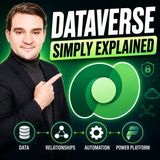
The core idea is that data, rules and access control live together in one place. Tables define the structure of business information, relationships connect those tables, security roles determine who may see or change records, and business logic enforces how the data behaves. Because these elements are part of the platform, applications built on Dataverse do not have to re-implement them individually. This is the reason the platform is described as more than a database: the episode "Dataverse - Simply Explained" presents it as secure, relational data storage with built-in business logic, security, automation and governance, which allows organizations to build business applications without managing complex infrastructure.
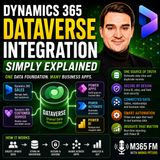
Dataverse is closely tied to Dynamics 365. The episode "Dynamics 365 Dataverse Integration - Simply Explained" says that Dataverse is easier to understand once Dynamics 365 and Dataverse are no longer seen as two separate systems that constantly need to synchronize customer data. For Dynamics 365 applications such as Sales and Customer Service, Dataverse provides the shared data foundation underneath the applications. Accounts, contacts, leads, opportunities, cases, activities, relationships, permissions and business rules can all live within this structured environment.
Several other products and concepts connect to Dataverse. Model-driven apps are built directly on its tables. Power Fx, the formula language of Power Platform, is related to it, as is AI Builder. In practice this means that a maker can build an app, automate a process or add AI capabilities while all of them read and write the same governed tables. A typical decision around Dataverse is therefore whether business data should be kept in one managed, relational store with shared security rather than spread across independent sources.
Security is a recurring theme. The episode "Dataverse Security - Simply Explained" explains how Microsoft enables organizations to control exactly who can view, edit, create or delete data while maintaining governance, compliance and scalability. The episode stresses that, unlike with traditional databases, security is built directly into the platform rather than added afterwards. This matters for any scenario in which many users, apps and automations touch the same data.
The newer episodes look at Dataverse in the context of AI. "The Death of the Chatbot: Why Your Dataverse Strategy Is Broken" argues that organizations often invest in enterprise data infrastructure without getting the expected value, and that the problem can lie in an approach that fails to deliver scalable governance and security rather than in the technology itself. The episode names governance debt, unmonitored shadow AI and uncontrolled "ghost agents" among the failure factors, alongside technical, strategic and human causes.
"THE DEATH OF THE PROXY: Architecting Dataverse for the Agent Fabric" covers the connection between AI assistants and Dataverse. According to the episode, Microsoft's recommended architecture for connecting assistants such as Claude Desktop to Dataverse long relied on a local STDIO proxy, which was simple, easy to install and suited to individual developers experimenting with AI-powered workflows. The episode says that enterprise AI has moved on to multiple clients, platforms and business systems, that this shift changes the architecture, and that the proxy model has reached its limits, with Streamable HTTP presented as the more fitting basis. Together, the episodes position Dataverse as the governed data layer that apps, Dynamics 365 and AI agents share.
Overview compiled with AI from M365.FM episodes and the facts on this page. You can improve it with the edit button below.
Dataverse isn’t “included.” It’s a premium, enterprise-grade platform with costs that stack fast: licenses, capacity, environments, storage (db/file/log), and API limits. Most sticker shock comes from assumptions—thinking M365 covers Dataverse, that guests…
Dataverse is Microsoft's intelligent cloud data platform that powers Power Apps, Power Automate, Dynamics 365, and the wider Power Platform. While many people think of it as just another database, Dataverse is much more than that. It provides secure…
When the same customer lives in five spreadsheets and tools, nobody knows which copy to trust. This episode is for business users, makers and Dynamics 365 teams who want to understand what Dataverse is and how Dynamics 365 actually uses it. You will learn how…
In this in-depth episode, we reframe how you think about Microsoft Dataverse and the data models that underpin modern business applications. Rather than treating Dataverse as just a database, this conversation argues that your data model is your strategy —…
Dataverse is the core data foundation behind Power Platform apps, not just a database. This episode explains how it provides structured, secure, and scalable data storage with built-in relationships, logic, and governance. The key message is that your data…
Your “Simple” Excel App Is Quietly Wrecking Your Business (And You Won’t See It Until It’s Expensive) Stop wiring Power Apps into spreadsheets and calling it “production.” Every shared Excel file is a glass elevator: silent data loss, last-save-wins…
AI inside the Microsoft Power Platform isn’t just about 'Copilot writes formulas' anymore. In 2025, Microsoft introduced four innovative capabilities that transform how apps, data, and automation are developed: Dataverse Prompt Columns, AI Form Filler / Form…
In this episode, we break down the myth that “SharePoint lists are a database for Power Apps” and show why that belief quietly kills performance, scalability, and data integrity. You’ll learn exactly where SharePoint list–backed Power Apps fall apart…
The episode argues that legacy Power Apps portals (now Power Pages) and similar older solutions act as a “silent budget killer” inside organizations. They continue to run and consume resources, but deliver little ongoing value. The core issue is not just the…
Breaking the Scale Barrier explores what it really takes to build scalable multi-tenant SaaS solutions with Microsoft Power Pages and Dataverse. Instead of focusing on simple customer portals or low-code demos, the episode dives into the architectural…
In this episode of the M365.FM Podcast, we explore why mastering Dataverse business skills is becoming one of the most important capabilities for organizations building scalable solutions on Microsoft Power Platform. The discussion goes far beyond tables and…
Custom integrations have long been one of the biggest bottlenecks in enterprise applications, but Dataverse MCP is changing that. In this episode of the M365.fm podcast, Mirko Peters is joined by Microsoft MVP Nathan Rose to explore how the Model Context…
Top 5 Misconfigured Permissions That Lead to Dataverse Leaks · Mirko Peters Welcome back to the podcast! As we continue our deep dive into cloud governance and platform safety, I wanted to expand on some critical security challenges we face…
Unmasking the SharePoint Lie: Why Your Power App is Slow · Mirko Peters Welcome back to the blog! If you have ever built a low-code business application using the Microsoft Power Platform, chances are you started with a SharePoint list …
Getting Started with Microsoft Power Pages: A Low-Code Guide · Mirko Peters Welcome to the ultimate guide on getting started with Microsoft Power Pages! In today's fast-paced digital landscape, organizations need to connect with external au…
Mastering Dataverse Security Roles and Access Levels · Mirko Peters Welcome back to the podcast companion blog, where we dive deeper into the core technologies powering the modern Microsoft ecosystem. Today, we are expanding on a to…
Questions marked with AI were written with AI from the facts on this page.
What is Dataverse? (AI)
Dataverse is Microsoft's managed data platform behind Power Platform and Dynamics 365. It stores tables with relationships, security roles and business logic so apps, automations and agents use one governed data source.
How does Dataverse relate to Dynamics 365? (AI)
According to the episode "Dynamics 365 Dataverse Integration - Simply Explained", Dataverse is the shared data foundation under Dynamics 365 applications such as Sales and Customer Service. Accounts, contacts, leads, cases and permissions can live in that environment rather than in a separate system.
How is data protected in Dataverse? (AI)
The episode "Dataverse Security - Simply Explained" says security is built into the platform. Organizations control who can view, edit, create or delete data through it, with governance, compliance and scalability in mind.
Is Dataverse included with Microsoft 365?
No. The episode calls Dataverse a premium, enterprise-grade platform. Costs include licenses, capacity, environments, storage and API limits, so assuming Microsoft 365 covers it leads to sticker shock. · From the episode: Avoid the Dataverse Licensing Trap in Power Apps
Why do Power Apps projects with Dataverse become expensive?
Costs stack quickly through licenses, capacity, extra environments, database, file and log storage, and API limits. Assumptions that guests are free or that storage is cheap make budgets unrealistic. · From the episode: Avoid the Dataverse Licensing Trap in Power Apps
When should I use Dataverse?
Use Dataverse when governance, security and relational consistency truly matter for the solution. If those needs are not present, the episode says cheaper setups give most of the value without paying for premium capacity. · From the episode: Avoid the Dataverse Licensing Trap in Power Apps
What are cheaper alternatives to Dataverse?
SharePoint Lists, SQL or a hybrid of the two are the alternatives named. The episode says they deliver roughly 80 percent of the value without premium connectors or the capacity burn that Dataverse brings. · From the episode: Avoid the Dataverse Licensing Trap in Power Apps
What does treating Dataverse as a graduation platform mean?
Start prototypes on Lists or SQL and move to Dataverse only when scale, audit and security demand it. This avoids paying premium prices before the project needs premium features. · From the episode: Avoid the Dataverse Licensing Trap in Power Apps
Relationship map of Dataverse: linked topics
Related topics in brief
Topics linked to Dataverse, each briefly explained:
Microsoft – Organization· Developed by Microsoft Corporation is a technology company that develops software and cloud services such as Microsoft 365, Azure and Dynamics 365.
Microsoft tool – Category· Is a Microsoft tool is a broad category for software products and services developed by Microsoft, used to group offerings and to frame tool-selection decisions.
Power Platform – Low-code tool by Microsoft· Part of Microsoft's low-code family consisting of Power Apps, Power Automate, Power BI, Power Pages and Copilot Studio. Together with Dataverse it lets business users build apps, automations, reports and agents.
Dynamics 365 – Business application by Microsoft· Related to Microsoft's family of business applications for sales, customer service, finance, supply chain and more, including Business Central for small and mid-sized companies. It builds on Dataverse and Power Platform.
Model-driven app – Concept· Related to Power Apps app type generated from the Dataverse data model, with forms, views and business process flows laid out automatically.
Power Fx – Concept· Related to Microsoft's open-source low-code formula language, modelled on Excel formulas, used in Power Apps, Power Automate, Dataverse and Copilot Studio.
AI Builder – Low-code tool by Microsoft· Related to Power Platform capability that adds prebuilt and custom AI models, such as document processing, text classification and prompts, to apps and flows.
Power Apps – Low-code tool by Microsoft· Related to A low-code tool for building custom business apps for web and mobile. Canvas apps give full control over the layout, while model-driven apps are generated from the data model in Dataverse.
Dual-write – Concept· Related to Near real-time, bi-directional data integration between Dynamics 365 finance and operations apps and Dataverse.
Knowledge source – Concept· Related to Content an agent in Copilot Studio can ground its answers on, such as SharePoint sites, files, websites, Dataverse tables or connectors.
Work IQ: Business Skills to manage your business processes in Work IQ MCP
Business skills are natural-language instructions that capture how your organization gets work done. They represent your business processes, policies, and domain knowledge in a format that agents can understand and follow. Each skill describes how to complete a specific type of work—the steps involved, the information required, and the business rules that apply.
Agents discover and use the business skills they have access to as needed at runtime using Work IQ MCP to complete tasks according to your organization's processes. When multiple agents use the same skill, they follow the same process, ensuring consistent behavior across your…
GA: November CY2026 · Preview: September CY2026
Older updates (13)In developmentMicrosoft 365 Roadmap Microsoft Copilot (Microsoft 365): Copilot Cowork: Access Business Applications with Work IQ
Users can access Business Applications through Work IQ in Copilot Cowork and use Business Skills to complete end-to-end business processes grounded in their enterprise data and apps. This helps users move from finding the right business application to taking action across key workflows with less context switching.
GA: December CY2026 · Preview: September CY2026
In developmentMicrosoft 365 Roadmap Microsoft Dataverse: Enable AI powered business workflows in Work IQ with Dataverse - Build Dataverse solutions with coding agents using Dataverse skills
Build Dataverse solutions by using coding agents with natural language prompts. For example, "I'm building a recruiting system for Zava Construction. I need tables for Positions, Candidates, Interviewers, Interviews, and Feedback - with lookups, a many-to-many relationship between Candidates and Positions, and a self-referential interview chain. Create everything in a Zava Recruiting solution, load sample data, and show me which candidates are currently interviewing."
From this prompt, the agent autonomously:
Discovers your Dataverse environment and configures MCP.
Creates the solution by using the Microsoft Power Platform CLI.
Builds five…
GA: February CY2027 · Preview: June CY2026
In developmentMicrosoft 365 Roadmap Microsoft Dataverse: Enable semantic data understanding for agentic use
Give AI agents and Copilot a true understanding of your business data — not just raw schema — so they can answer questions accurately with less manual configuration.
Learns from the systems you already run — Automatically extracts semantic knowledge from views, forms, and metadata already defined in your Dataverse environment, reducing agent deployment from days of manual setup to near-zero effort.
Full visibility for makers — View generated semantic knowledge per entity — including name, description, and sample questions — directly in the Power Apps maker portal. Search for understanding gaps and enrich missing context with a built-in…
GA: November CY2026 · Preview: June CY2026
In developmentMicrosoft 365 Roadmap Microsoft Dataverse: Add users without licenses to activity recipient fields
Enable active Microsoft Entra users without Dataverse or Power Apps licenses as activity recipients. Created user records remain disabled and do not grant Dynamics 365 app access.
LaunchedMicrosoft 365 Roadmap Microsoft Dataverse: Build your low code hyperscale backend on Dataverse - Build your agentic flows with Dataverse SDK for Python
The Microsoft Dataverse SDK for Python empowers data scientists and developers to build intelligent, compliant, and scalable agentic flows that integrate seamlessly with Dataverse. In the agentic age, where autonomous agents orchestrate workflows and act on behalf of users, the SDK provides the essential tools to interact programmatically with enterprise data platforms. The SDK supports structured data access, composable APIs, and governance features that are critical for building trustworthy and efficient agents.
Key capabilities can include:
Autonomous data agents that can query, update, and evaluate data quality
Form prediction and…
GA: June CY2026 · Preview: November CY2025
LaunchedMicrosoft 365 Roadmap Microsoft Dataverse: Activate Enterprise Data in Copilot - Create Dataverse agent users with Microsoft Entra agent identity
Organizations can securely deploy AI agents to access and interact with Dataverse data by using enterprise‑managed Microsoft Entra agent identities. This feature enables agents to be provisioned as Dataverse agent users with dedicated, least‑privileged security roles based on their intended capabilities. This feature ensures agents have only the access required to perform tasks autonomously or on behalf of users.
By using identity‑based role assignment and full auditing of agent‑driven actions, organizations can enforce security and compliance policies across both human users and AI agents while maintaining traceability of data access and…
GA: August CY2026 · Preview: June CY2026
LaunchedMicrosoft 365 Roadmap Microsoft Dataverse: Finance and operations cross application integration - Monitor data management framework with Azure Monitor Application Insights
By integrating data management framework telemetry for Dynamics 365 finance and operations apps, organizations can gain deeper visibility into data management executions, such as import and export jobs. This integration streams telemetry directly into the customer's own Azure Application Insights instance.
By using this integration, customers can:
Monitor import and export data management functions with start and end times.
Monitor job status from source to staging and staging to target.
Monitor failures with error messages at a granular level.
Set up alerts and dashboards for proactive monitoring.
Accelerate issue resolution.
Business…
GA: June CY2026 · Preview: April CY2026
LaunchedMicrosoft 365 Roadmap Microsoft Dataverse: Improved enterprise experiences in Power Platform - Improve bulk delete user experience
As you scale your data management operations, bulk delete must be predictable, transparent, and safe to operate across environments. In this release, Microsoft enhances bulk delete with an improved error handling experience and solution aware configuration support, delivering a more consistent, reliable, and enterprise‑ready data cleanup workflow.
This release focuses on two core improvements that directly address admin pain points around visibility, consistency, and operational risk when managing bulk delete jobs at scale.
Key improvements:
Actionable error handling with an intuitive UI. Bulk delete now provides clear, job‑ and record‑level…
GA: June CY2026 · Preview: April CY2026
LaunchedMicrosoft 365 Roadmap Microsoft Dataverse: Improved enterprise experiences in Power Platform - Enhance Dataverse record descriptions for Copilot /mention
End users of Microsoft 365 Copilot will see improved Microsoft Dataverse, Dynamics 365, and Power Apps record references in Context IQ with richer, more descriptive labels that include environment, app, and table information. This makes it easier to identify and select the correct records during Copilot interactions.
Business Value:
Enables Microsoft 365 Copilot to surface business data with meaningful context, reducing confusion from generic labels and helping users quickly identify the right records to drive faster workflows and more reliable decision-making.
Enabled for:
Enabled by admins/makers/marketers for end users
GA: August CY2026 · Preview: July CY2026
In developmentMicrosoft 365 Roadmap Microsoft Dataverse: Microsoft 365 collaboration - Discover, build, customize, and extend with management MCP server
The management MCP server is a build surface and registry for agent-ready tools available within a customer's environment. It exposes an addressable endpoint where developers and agents can discover, assemble, and deploy MCP servers made from trusted components including connector actions, tools from other MCP servers, and custom APIs.
Discover available tools and servers
Find MCP servers authored, hosted, or certified by Microsoft
Query and explore over 1,470 connectors and their individual actions
Discover custom APIs available in your organization or from partner teams
Create and customize MCP servers
Build new MCP servers by selecting…
GA: December CY2026 · Preview: March CY2026
In developmentMicrosoft 365 Roadmap Microsoft Dataverse: Prompt column values in bulk for existing records (backfill)
Prompt columns can now generate AI values for records that already exist in your table, not just new or updated ones. Makers can choose to apply a prompt to existing records in bulk, optionally filtered to just the rows they need, so historical data gets the same AI-generated insights as incoming data, without touching each record one at a time.
GA: November CY2026
In developmentMicrosoft 365 Roadmap Power Apps: Prompt Columns - multiple lines of text output
Prompt columns can now store multilple lines of text as prompt output, enabling longer and detailed AI-generated insights to be stored in your tables.
GA: November CY2026
In developmentMicrosoft 365 Roadmap Dynamics 365 Finance and Operations cross-app: Migrate finance and operations environments from Lifecycle Services to Power Platform admin center
The self-service environment migration feature moves management of an existing finance and operations apps environment from Microsoft Dynamics Lifecycle Services to the Microsoft Power Platform admin center.
GA: December CY2026 · Preview: September CY2026
Summaries of official Microsoft release information, checked daily.
Community wiki
Short info above, community knowledge below: add practical tips, examples or corrections. New contributions are reviewed first; trusted members publish directly.
Experts and companies for this topic
Community members with expertise in Dataverse:
Elliot M. · Microsoft MVP | Team Lead Jumpstart, Copilot & Agents at Witivio
Marcel L. · Microsoft MVP | Power Automate & Copilot Studio for SMBs in Switzerland | Founde
 EN
 Deutsch
 Español
 Français
 Italiano
 Português
 Nederlands
 Polski
 Bahasa Indonesia
 Русский
 Українська
 العربية
 עברית
 日本語
 한국어