

 Apple Podcasts
 Spotify
 Youtube Music
 Spreaker
 Podchaser
 Amazon Music
Everyone thinks their Azure outages and breaches start with networks, costs, or misconfigured virtual machines, but this episode argues that the real failure almost always begins much higher up, in identity itself. The speaker reframes identity not as a simple login service but as Azure’s true control plane: a distributed decision engine that compiles signals about users, devices, risk, roles, and exceptions into every authorization decision. Over time, small “temporary” exceptions in conditional access, hybrid identity sync, workload identities, and guest access accumulate into what he calls identity debt, where policies drift far from their original intent and become unpredictable. Hybrid synchronization faithfully copies old on-prem assumptions into the cloud without preserving governance boundaries, while conditional access sprawl turns clean intent into fragile, probabilistic behavior hidden behind exclusions. Networks, firewalls, and endpoints cannot compensate for this, because they never see the authorization compiler that actually issues tokens. The episode shows how this debt is observable in logs today, why outages and incidents expose it so painfully, and why governance must focus on lifecycle, ownership, and measurement. The core message is blunt: if you don’t deliberately redesign identity as the control plane, break inherited privilege, and reduce exceptions, Azure will continue to perfectly enforce decisions you no longer understand or control.






Entra ID acts as a Conditional Chaos Engine by integrating various identity signals. This integration helps you enforce security and resilience across your cloud environment. With over 70% of cloud breaches stemming from compromised identities, managing identity debt becomes critical. Controlled chaos testing reveals vulnerabilities in your security posture, allowing you to address them proactively. Identity serves as the control plane in Microsoft Azure’s security model, ensuring that your access management remains robust and reliable.
Key Takeaways
- Entra ID acts as a control plane for identity management, enhancing security in cloud environments.
- Managing identity debt is crucial. It helps prevent security risks from outdated or excessive permissions.
- Implement Zero Trust principles. Always verify access requests to reduce the risk of breaches.
- Use Multi-Factor Authentication (MFA) to add an extra layer of security for user access.
- Conduct chaos testing to identify weaknesses in your identity systems without affecting live operations.
- Regularly review and adjust access permissions to ensure users have only what they need.
- Automate chaos testing to improve resilience and quickly identify issues in your identity management.
- Embrace continuous improvement strategies to adapt to evolving security threats and enhance your defenses.
Understanding Entra ID
Entra ID as a Control Plane
Entra ID serves as Microsoft Azure’s identity and access management solution. It acts as a sophisticated control plane that integrates various identity signals to enhance security and streamline access management. This integration allows you to make informed decisions based on user, device, and risk factors.
Here are some core architectural features that position Entra ID as the control plane for Microsoft Azure:
- Identity lifecycle management: You can manage the creation, retrieval, deletion, and updating of identities. This ensures that identities align with your organizational needs.
- Support for human and non-human identities: Entra ID accommodates both user identities and service principals. This flexibility allows for a diverse range of applications.
- Governance capabilities: Features like access certification, auditing, and reporting enhance security and compliance. These capabilities provide insights into user access and actions.
Entra ID operates as a distributed decision engine. It integrates signals from various components to make access decisions. The table below outlines how these components work together:
| Component | Description |
|---|---|
| User identity | Identifies who is accessing resources. |
| Device trust | Assesses if the endpoint is compliant and secure. |
| Data sensitivity | Determines the level of access being requested. |
Identity Debt and Its Risks
Identity debt accumulates over time in cloud environments. It consists of temporary exceptions, legacy assumptions, and sprawling conditional access policies. This buildup can lead to unpredictable and fragile security postures.
Common causes of identity debt include:
| Cause of Identity Debt | Description |
|---|---|
| Stale or orphaned accounts | Accounts that are no longer in use but remain active, increasing risk. |
| Right-sizing privileges | Ensuring users have only the access they need, reducing unnecessary permissions. |
| Rotating credentials | Regularly changing passwords and keys to enhance security. |
| Enforcing MFA | Implementing multi-factor authentication to strengthen access controls. |
| Discovering and closing backdoor accounts | Identifying unauthorized access points and removing them. |
| Governance of machine and AI identities | Managing non-human identities to prevent oversight and risk accumulation. |
| Blind spots in identity attack surface | Lack of visibility into identity management leads to underestimating the problem. |
| Neglecting non-human identities | Focusing only on human users while ignoring machine identities, which are growing rapidly. |
Unmanaged identity debt poses several risks, including:
| Risk Type | Description |
|---|---|
| Access Sprawl | Growing systems create more unmanaged access points. |
| Access Gaps | New access is granted faster than it’s removed. |
| Access Buildup | Role changes slowly increase risk. |
| Expanded Entry Points | Each credential creates a potential entry point. |
| Too Much Access | Accumulated permissions increase the impact of breaches. |
| Monitoring Blind Spots | Dormant accounts receive limited scrutiny. |
By addressing identity debt, you can significantly improve your security posture and reduce the risks associated with unmanaged identities.
Microsoft Entra and Identity Resilience
Zero Trust and Conditional Access
Microsoft Entra ID embodies the principles of Zero Trust, which fundamentally shifts how you approach security. Instead of assuming that everything inside your network is safe, Zero Trust requires you to verify every access request. This approach significantly reduces the risk of security breaches.
Here are key components of Zero Trust and how they enhance your security posture:
| Principle/Component | Description |
|---|---|
| Always Verify | Requires authentication for every access request, reducing risks from credential abuse. |
| Least Privilege Access | Limits user permissions to the minimum necessary, curtailing potential damage from compromised accounts. |
| Assume Breach | Designs security with the expectation of a breach, focusing on containment and rapid response. |
| Continuous Monitoring and Logging | Enables real-time detection of anomalies and policy violations, improving overall security posture. |
| Microsegmentation | Isolates network segments to restrict lateral movement of attackers, enhancing breach containment. |
| Multi-Factor Authentication (MFA) | Adds layers of security to block credential theft and replay attacks. |
| Compliance Support | Aligns with regulatory requirements by enforcing strict access controls and continuous validation. |
By implementing these principles, you can create a robust security framework that adapts to evolving threats. Microsoft Entra ID supports this framework through features like conditional access policies. These policies allow you to set specific conditions under which users can access sensitive applications, enhancing security while maintaining usability.
Lifecycle Management and Privileged Access
Effective lifecycle management is crucial for maintaining identity resilience. You need to manage privileged access carefully to minimize risks. Here are best practices to follow:
- Identify and inventory all privileged accounts to ensure proper management throughout their lifecycle.
- Apply the principle of least privilege to minimize potential attack vectors by granting users only the access necessary for their job functions.
- Implement Multi-Factor Authentication (MFA) for all privileged access to add an additional layer of security.
- Ensure continuous monitoring and auditing of privileged account activity to detect anomalous behavior and enhance security.
Statistics show that access-related vulnerabilities account for 83% of cloud security breaches. Larger organizations, especially those with over 10,000 employees, face a higher risk of data breaches due to misconfigured permissions and insider threats. By focusing on lifecycle management and privileged access, you can significantly reduce these risks.
Microsoft Entra ID provides tools for just-in-time access through Privileged Identity Management (PIM). This feature ensures that high-privilege accounts are only accessible when necessary, reducing the risk of credential compromise. Additionally, Entra ID’s access review tools enable quarterly audits on user permissions, ensuring that only necessary access is maintained.
By adopting these strategies, you can transform your identity management approach from reactive to proactive, enhancing your overall security posture and resilience.
Failure Modes in Identity Systems
Common Identity Failures
Identity systems, including Microsoft Entra ID, can experience various failure scenarios that disrupt operations and compromise security. Here are some frequent failures you might encounter:
- Service disruptions: These can cause authentication and access outages, preventing users from logging into essential applications.
- Cyberattacks and misconfigurations: These issues can lead to the loss of Conditional Access and Multi-Factor Authentication (MFA) controls, exposing your organization to risks.
- Communication breakdowns: Dependency on Entra ID-integrated platforms can create gaps in communication, affecting user access.
- Compliance and governance gaps: Loss of access logs and audit trails can hinder your ability to meet regulatory requirements.
- Cascading failures: In hybrid environments, syncing on-premises Active Directory with Entra ID can lead to widespread issues.
- Temporary write availability issues: These can occur during replica failover, impacting access to critical resources.
These failures can result in significant operational challenges. For instance, users may find themselves unable to log into Microsoft 365 and third-party SaaS applications. Administrators might also lose access to the management portal, complicating recovery efforts.
Impact on Security and Operations
The consequences of identity failures extend beyond immediate access issues. They can severely impact your organization's security posture and operational continuity. A notable example is the Snowflake data theft campaign in 2024, which targeted over 100 enterprise customers, including Ticketmaster and Santander Bank. Attackers exploited compromised credentials to bypass systems lacking enforced MFA, leading to the theft of hundreds of millions of customer records. This incident illustrates the severe consequences of identity failures.
Moreover, identity system failures can disrupt critical services. For example, a recent Azure outage lasted over 10 hours, affecting Managed Identities for Azure Resources. This incident exemplifies how authentication issues can hinder your ability to create or manage Azure resources, increasing the risk of service disruption and operational inefficiencies.
Here are some specific impacts you may face due to identity failures:
- Authentication and authorization disruptions: These can lead to service outages.
- Degraded performance: Dependent services may experience reduced functionality.
- Halted development workflows: Identity misconfigurations can stop progress on critical projects.
To mitigate these risks, consider implementing disaster recovery planning. Strategies such as hybrid identity models, emergency admin accounts, and independent communication channels can help you prepare for potential failures.
Deploying Chaos Testing with Entra ID
Planning Controlled Failures
To effectively implement chaos testing with Entra ID, you need to plan controlled failures carefully. Start by conducting chaos testing in nonproduction environments. This approach allows you to simulate real-world conditions using synthetic transactions. You can identify process gaps, human errors, and architectural flaws without impacting your live systems. Here are some methodologies to consider:
- Begin with Game Days: Organize game days that focus on specific scenarios. These events help your team practice and refine their response to potential failures.
- Limit Experiment Scope: Focus on shutting down only one instance at a time. Clearly define the purpose and objectives of each test to maintain clarity.
- Align with Service-Level Agreements: Ensure that your tests operate within established service-level agreements and error budgets. Choose appropriate timeframes for testing, such as during work hours, to have full team availability.
- Conduct Disaster Recovery Drills: Validate your process controls through disaster recovery drills. Start with fully simulated exercises for training, then progress to real drills in nonproduction environments. Only conduct real drills in production after successful prior tests.
- Define Workload Recovery Scenarios: Prepare for incidents by conducting drills that mimic real situations. Follow checklists and document findings for continuous improvement.
- Train Your Teams: Equip your teams with training on incident management and communication tools. Familiarize them with relevant test scenarios to enhance their readiness.
- Include Specialized Expertise: Involve experts in early disaster recovery drills. Their knowledge on multiregion design and failover strategies can be invaluable.
By following these methodologies, you create a structured and controlled approach to chaos testing. This ensures safety while maximizing learning opportunities.
Automation in Chaos Testing
Automation plays a crucial role in enhancing the effectiveness of chaos testing. With Microsoft Entra, you can automate chaos experiments to improve resilience and security. Automated chaos testing allows you to integrate these experiments into your regular testing processes. This integration ensures compliance with regulations like GDPR, which require regular testing.
Automated chaos experiments validate resilience during infrastructure changes, such as API throttling and token expirations. By simulating various disruptions, you can observe how identity and access systems react under stress. This process helps you define failure modes and refine your incident response plans. Continuous automation leads to faster identification and resolution of issues, boosting system resilience.
Additionally, automating chaos testing helps scale your testing efforts. You can conduct tests more efficiently, leading to valuable insights that enhance incident response times. This proactive approach supports ongoing improvements in your identity management framework.
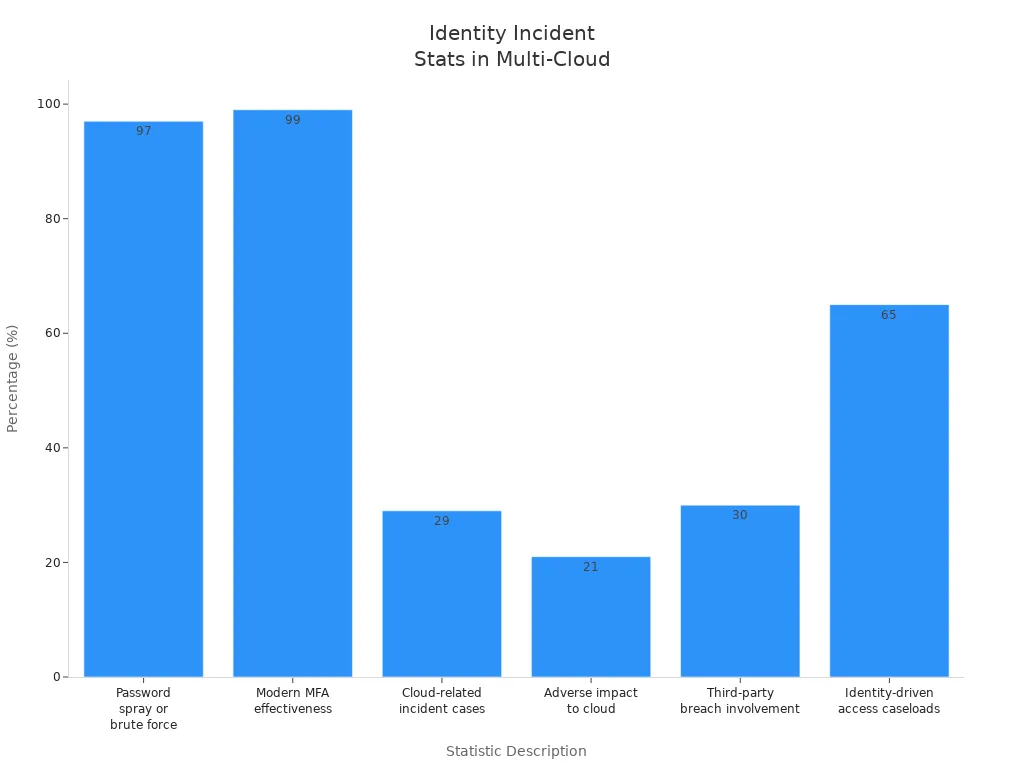
Multi-Cloud Security with Entra

Challenges in Multi-Cloud Identity
Managing identity across multiple cloud platforms presents several challenges. You may encounter inconsistencies in permissions due to different teams managing access differently. This inconsistency can slow down audits and complicate your security posture. Here are some common challenges you might face:
- Fragmentation of Identity Frameworks: Different cloud providers have their own identity frameworks. This fragmentation leads to silos that increase risk and hinder visibility.
- Inconsistent Access Policies: Varying access policies across platforms complicate compliance efforts. You may struggle to enforce a cohesive security posture.
- Visibility Gaps: Organizations often face visibility gaps that make it difficult to manage access controls effectively. This lack of oversight can leave security vulnerabilities open.
- Complexity in User Management: Managing user identities and access controls becomes complex due to varying authentication mechanisms. You may find it challenging to maintain a unified view of user permissions.
- De-provisioning Risks: Failure to de-provision users in one cloud can leave security vulnerabilities open. This oversight complicates the identification of risky permission combinations.
These challenges highlight the need for a robust identity management solution that can streamline processes across multiple cloud environments.
Entra’s Role in Unified Security
Microsoft Entra plays a crucial role in unifying security management across different cloud providers. It allows you to manage access policies from a single portal, which is essential for maintaining consistent security. This integration supports Zero Trust principles by ensuring that policies are uniformly enforced, minimizing potential security gaps.
Key components of multi-cloud security, such as Identity and Access Management (IAM), are vital for managing identities and permissions. Entra ensures that only authorized users and services have access, which is crucial for maintaining a consistent security posture.
Entra ID enhances security through features like real-time risk assessment and conditional access. For instance, Entra ID Protection uses extensive threat intelligence to detect and respond to identity-based threats swiftly. Additionally, the implementation of single sign-on capabilities simplifies user experiences and reduces the complexity associated with managing multiple authentication methods.
Here’s a summary of how Entra ID improves security in multi-cloud environments:
- Real-time Risk Assessment: Quickly identifies and mitigates identity-based threats.
- Improved Security: Utilizes certificate-based authentication and conditional access policies to enhance access control.
- Simplified Identity Management: Streamlines user experiences with single sign-on capabilities.
By leveraging Entra ID, you can effectively reduce complexity and improve security in your multi-cloud deployments.
Iterating in Chaos Scenarios
Learning from Failures
You can gain valuable insights from failures in identity management. These lessons help you improve your security posture and resilience. Here are some key takeaways:
- Pre-planned solutions are essential for effective identity management during incidents.
- Adequate resources, including identity supplies and communication equipment, are critical for successful operations.
- Establish effective communication systems to ensure coordination among responders.
- A defined issuance process and tracking of credentials maintain order and accountability.
- The importance of having a centralized database streamlines the credentialing process.
By analyzing these failures, you can identify weaknesses in your identity management strategy. This proactive approach allows you to address vulnerabilities before they lead to significant issues.
Continuous Improvement and Adaptation
Continuous improvement is vital for adapting your identity management to evolving threats. You should implement several strategies to enhance your resilience:
| Strategy | Description |
|---|---|
| Ongoing Governance Structures | Establish governance with executive sponsorship and cross-functional collaboration to ensure accountability and adaptability. |
| Regular Metrics and Reporting | Use key performance indicators to identify areas for improvement and demonstrate program value. |
| Periodic Reassessment | Regularly reassess against maturity models to track progress and adjust priorities as threats evolve. |
In addition to these strategies, consider the following practices:
- Continuous behavior monitoring
- Instant anomaly alerting
- Adaptive policy adjustments
Regular access reviews and credential rotation are essential components of a proactive governance model. These practices help you ensure that access rights remain appropriate and reduce the risk of credential compromise.
You can also enhance your identity security by implementing iterative adaptation. For example, a phased rollout helps stabilize outcomes before full deployment. Aggressive tracking of false positives and negatives is crucial for maintaining security effectiveness. Moreover, AI models can enhance detection capabilities by learning from new attack types. Adaptive security solutions automate responses to emerging threats, improving your overall security posture.
By embracing these continuous improvement strategies, you can transform your identity management approach. This transformation will help you stay ahead of evolving threats and maintain a robust security framework.
Microsoft Entra ID transforms identity management from chaotic to controlled through conditional chaos testing. By simulating disruptions, you can observe system behavior and validate recovery workflows. This proactive approach enhances your security posture and resilience.
Embracing resilience, lifecycle management, and zero-trust principles is essential for securing modern cloud environments. These strategies help you minimize identity debt and strengthen your security posture.
Adopt Microsoft Entra ID’s approach to reduce risks and ensure continuity in your identity management practices.
FAQ
What is Entra ID’s role in cloud security?
Entra ID acts as the control plane for identity and access management. It integrates signals from users, devices, and risk factors to enforce secure access across your cloud environment.
How does Entra ID help reduce identity debt?
You can manage lifecycle events, enforce least privilege, and regularly review access. These actions prevent stale accounts and excessive permissions, reducing identity debt and improving security.
Can Entra ID support multi-cloud security posture?
Yes. Entra ID unifies identity management across clouds, providing consistent policies and real-time risk assessment to strengthen your multi-cloud security posture.
What is the benefit of single sign-on with Entra ID?
Single sign-on simplifies user access by allowing you to log in once and reach multiple applications securely. This reduces password fatigue and improves productivity.
How does Entra ID handle synchronization?
Entra ID supports directory synchronization to keep identities consistent between on-premises and cloud. This ensures your access controls stay up to date across environments.
What is controlled chaos testing in Entra ID?
Controlled chaos testing simulates failures to reveal weaknesses. You can observe system behavior and validate recovery workflows, turning chaos into insight for stronger resilience.
How does Entra ID enable true passwordless access?
Entra ID supports modern authentication methods like biometrics and hardware keys. These methods eliminate passwords, reducing risks from credential theft and improving user experience.
How do I recover from conditional access misroutes?
You should have predefined recovery workflows and emergency admin accounts. Entra ID’s monitoring helps detect misroutes early, allowing you to restore access quickly and maintain security.
🚀 Want to be part of m365.fm?
Then stop just listening… and start showing up.
👉 Connect with me on LinkedIn and let’s make something happen:
- 🎙️ Be a podcast guest and share your story
- 🎧 Host your own episode (yes, seriously)
- 💡 Pitch topics the community actually wants to hear
- 🌍 Build your personal brand in the Microsoft 365 space
This isn’t just a podcast — it’s a platform for people who take action.
🔥 Most people wait. The best ones don’t.
👉 Connect with me on LinkedIn and send me a message:
"I want in"
Let’s build something awesome 👊
1
00:00:00,000 --> 00:00:01,960
Most organizations think their Azure problems
2
00:00:01,960 --> 00:00:04,320
are cost network or VM configuration.
3
00:00:04,320 --> 00:00:05,160
They are not.
4
00:00:05,160 --> 00:00:06,600
Your failures start in identity
5
00:00:06,600 --> 00:00:09,240
because identity is Azure's control plane.
6
00:00:09,240 --> 00:00:12,160
And when conditional access fails during an MFA outage,
7
00:00:12,160 --> 00:00:15,080
responders discover the break glass path wasn't protected.
8
00:00:15,080 --> 00:00:16,480
It was hidden from observation.
9
00:00:16,480 --> 00:00:17,720
We didn't design this wrong.
10
00:00:17,720 --> 00:00:19,080
We stopped designing it.
11
00:00:19,080 --> 00:00:21,320
And the system kept accepting every exception we gave it.
12
00:00:21,320 --> 00:00:24,680
Today I'll show why identity debt accumulates by default,
13
00:00:24,680 --> 00:00:26,480
how it spreads through hybrid sync,
14
00:00:26,480 --> 00:00:28,560
conditional access sprawl workload identities
15
00:00:28,560 --> 00:00:30,360
and B2B guests and how to measure it.
16
00:00:30,360 --> 00:00:32,480
If you can't inventory it, you don't control it.
17
00:00:32,480 --> 00:00:34,600
If you can't measure it, you can't pay it down.
18
00:00:34,600 --> 00:00:37,360
Later I'll show you how to see this drift in your own logs
19
00:00:37,360 --> 00:00:38,360
without a lab.
20
00:00:38,360 --> 00:00:42,920
The foundational misunderstanding, identity as control plane.
21
00:00:42,920 --> 00:00:46,320
Most teams treat Microsoft and RID like a login service.
22
00:00:46,320 --> 00:00:47,280
They are wrong.
23
00:00:47,280 --> 00:00:48,840
Architecturally it is something else.
24
00:00:48,840 --> 00:00:51,880
A distributed decision engine that compiles identity signals
25
00:00:51,880 --> 00:00:54,760
into authorization across Azure M365
26
00:00:54,760 --> 00:00:57,200
and every federated app you've consented.
27
00:00:57,200 --> 00:00:58,880
That distinction matters.
28
00:00:58,880 --> 00:01:01,920
Every sign in every token refresh, every app consent
29
00:01:01,920 --> 00:01:03,280
routes through this engine.
30
00:01:03,280 --> 00:01:05,080
Your policy isn't a static document.
31
00:01:05,080 --> 00:01:07,840
It's an executable program that evaluates users' devices,
32
00:01:07,840 --> 00:01:09,800
risk, protocol and exclusions,
33
00:01:09,800 --> 00:01:11,480
then emits allow deny or prompt.
34
00:01:11,480 --> 00:01:13,440
The more you patch exceptions on to intent,
35
00:01:13,440 --> 00:01:16,000
the more your outputs become probabilistic.
36
00:01:16,000 --> 00:01:18,680
Deterministic policy becomes conditional chaos.
37
00:01:18,680 --> 00:01:20,560
Define this one so it sticks.
38
00:01:20,560 --> 00:01:22,120
Entropy generator.
39
00:01:22,120 --> 00:01:25,160
An identity control that increases state complexity
40
00:01:25,160 --> 00:01:26,920
faster than it reduces risk
41
00:01:26,920 --> 00:01:28,480
when exceptions are added.
42
00:01:28,480 --> 00:01:30,600
Conditional access without lifecycle ownership
43
00:01:30,600 --> 00:01:32,120
is an entropy generator.
44
00:01:32,120 --> 00:01:35,280
Hybrid sync without translation rules is an entropy generator.
45
00:01:35,280 --> 00:01:38,440
Workload identities without ownership are entropy generators.
46
00:01:38,440 --> 00:01:40,840
Guests without lifecycle are entropy generators.
47
00:01:40,840 --> 00:01:42,360
These pathways accumulate.
48
00:01:42,360 --> 00:01:46,480
Here is the dead pattern wheel reference throughout.
49
00:01:46,480 --> 00:01:49,400
Intent, translation, exception,
50
00:01:49,400 --> 00:01:51,080
often, persistence.
51
00:01:51,080 --> 00:01:54,720
Intent, least privilege, MFA, no legacy protocols.
52
00:01:54,720 --> 00:01:58,320
Translation will sync AD at baseline CA on-board apps,
53
00:01:58,320 --> 00:02:00,680
exception, temporarily exclude this group,
54
00:02:00,680 --> 00:02:02,240
this app, this vendor.
55
00:02:02,240 --> 00:02:03,000
Often.
56
00:02:03,000 --> 00:02:06,720
Owner left controls till exists, no telemetry ties it to risk.
57
00:02:06,720 --> 00:02:08,800
Persistence, temporary became permanent,
58
00:02:08,800 --> 00:02:10,400
blast radius increased.
59
00:02:10,400 --> 00:02:13,000
The authorization graph mutates at every exception.
60
00:02:13,000 --> 00:02:16,880
Groups nest, rolls a crew, service principles acquire directory,
61
00:02:16,880 --> 00:02:17,800
read write.
62
00:02:17,800 --> 00:02:21,360
All just for now, guests are excluded
63
00:02:21,360 --> 00:02:23,080
until the migration ends.
64
00:02:23,080 --> 00:02:25,520
Your control plane remembers everything you told it
65
00:02:25,520 --> 00:02:27,520
long after you forgot why.
66
00:02:27,520 --> 00:02:29,840
Over time, policies drift away from intent.
67
00:02:29,840 --> 00:02:31,040
That's identity dead.
68
00:02:31,040 --> 00:02:34,720
Why networks and endpoints can't compensate?
69
00:02:34,720 --> 00:02:36,880
They don't see the authorization compiler.
70
00:02:36,880 --> 00:02:39,120
Firewalls don't evaluate interest device filters.
71
00:02:39,120 --> 00:02:42,720
EDR doesn't understand CA's exclude break glass claws.
72
00:02:42,720 --> 00:02:44,880
You can harden hosts and segment subnets,
73
00:02:44,880 --> 00:02:46,760
but the decision to issue a token
74
00:02:46,760 --> 00:02:49,000
and what that token can do lives above them.
75
00:02:49,000 --> 00:02:50,760
When identity is the control plane,
76
00:02:50,760 --> 00:02:53,320
everything below it becomes best effort containment.
77
00:02:53,320 --> 00:02:55,120
Let me ground this in system behavior.
78
00:02:55,120 --> 00:02:57,600
Synchronization compiles on-prem groups semantics
79
00:02:57,600 --> 00:03:00,960
into a flat tenant with rolls, scopes and admin units.
80
00:03:00,960 --> 00:03:02,960
OU intent is lost in translation.
81
00:03:02,960 --> 00:03:05,000
If synced admins arrive with broad rights
82
00:03:05,000 --> 00:03:07,120
as your inherits over permissioned identities
83
00:03:07,120 --> 00:03:08,200
deterministically.
84
00:03:08,200 --> 00:03:11,720
Conditional access compiles, if then logic at runtime.
85
00:03:11,720 --> 00:03:13,560
It's an execution engine, not governance.
86
00:03:13,560 --> 00:03:16,760
Every exclusion is a branch that bypasses your policy pipeline,
87
00:03:16,760 --> 00:03:19,240
branches multiply, coverage fragments.
88
00:03:19,240 --> 00:03:21,240
Report only purgatory feels safe
89
00:03:21,240 --> 00:03:23,200
until an outage proves otherwise.
90
00:03:23,200 --> 00:03:25,560
Tokens are short-lived, but refresh is long-lived.
91
00:03:25,560 --> 00:03:27,680
If an identity's standing privilege is wrong,
92
00:03:27,680 --> 00:03:30,560
short-lived tokens just refresh the wrong decision every hour.
93
00:03:30,560 --> 00:03:33,000
Least privilege must exist before the token is minted
94
00:03:33,000 --> 00:03:34,400
not after it's used.
95
00:03:34,400 --> 00:03:36,160
Workload identities never see MFA.
96
00:03:36,160 --> 00:03:37,000
That's by design.
97
00:03:37,000 --> 00:03:38,960
They either have secrets, certificates
98
00:03:38,960 --> 00:03:40,680
or federated credentials.
99
00:03:40,680 --> 00:03:43,320
If they're overscoped, you won't get a helpful prompt.
100
00:03:43,320 --> 00:03:44,920
You'll get silent drift in your tenant.
101
00:03:44,920 --> 00:03:46,680
Guests don't share your assumptions.
102
00:03:46,680 --> 00:03:48,600
Cross tenant trust settings, access reviews
103
00:03:48,600 --> 00:03:50,800
and group nesting rules either in code,
104
00:03:50,800 --> 00:03:52,680
the trust boundary or dissolve it.
105
00:03:52,680 --> 00:03:54,360
Temporary collaboration without life cycle
106
00:03:54,360 --> 00:03:56,280
becomes privilege persistence.
107
00:03:56,280 --> 00:03:57,560
Now the uncomfortable truth.
108
00:03:57,560 --> 00:04:00,000
Your identity program likely lacks life cycle.
109
00:04:00,000 --> 00:04:02,560
There is no practice path to remove an exception,
110
00:04:02,560 --> 00:04:05,200
rotate a secret, decommissioned a vendor,
111
00:04:05,200 --> 00:04:06,280
or retire a policy.
112
00:04:06,280 --> 00:04:07,560
Therefore, the exceptions win.
113
00:04:07,560 --> 00:04:10,880
Governance requires ownership, review and expiry.
114
00:04:10,880 --> 00:04:13,360
The execution engine only enforces whatever remains.
115
00:04:13,360 --> 00:04:15,080
Measurement must arrive early.
116
00:04:15,080 --> 00:04:17,040
If you can't inventory exclusions,
117
00:04:17,040 --> 00:04:19,080
legacy author temps, non-expiring secrets,
118
00:04:19,080 --> 00:04:20,880
broad graph grants, privileged guests
119
00:04:20,880 --> 00:04:22,600
and synced admins you're guessing,
120
00:04:22,600 --> 00:04:25,520
start thinking in queries, not dashboards.
121
00:04:25,520 --> 00:04:28,320
Sign-in logs filtered for excluded from policy.
122
00:04:28,320 --> 00:04:30,840
KQL for legacy protocol usage over time,
123
00:04:30,840 --> 00:04:33,760
graph queries for service principles with directory,
124
00:04:33,760 --> 00:04:34,680
and no owner.
125
00:04:34,680 --> 00:04:36,800
Access review completion rates for privileged groups
126
00:04:36,800 --> 00:04:37,640
and guests.
127
00:04:37,640 --> 00:04:39,480
Identity debt is not theoretical.
128
00:04:39,480 --> 00:04:40,160
It's observable.
129
00:04:40,160 --> 00:04:42,560
The logs tell you where the control plane is already diverging
130
00:04:42,560 --> 00:04:43,560
from intent.
131
00:04:43,560 --> 00:04:46,240
Once you see that divergence, the case studies make sense.
132
00:04:46,240 --> 00:04:48,520
And once you accept identity as the control plane,
133
00:04:48,520 --> 00:04:52,360
you'll stop expecting networks to fix authorization.
134
00:04:52,360 --> 00:04:56,000
Case study context one, hybrid identity debt propagation,
135
00:04:56,000 --> 00:04:59,000
hybrid is where Azure inherits debt deterministically,
136
00:04:59,000 --> 00:05:00,760
active directory synchronizes objects.
137
00:05:00,760 --> 00:05:02,280
It does not synchronize intent.
138
00:05:02,280 --> 00:05:04,280
That distinction matters because the minute you flip
139
00:05:04,280 --> 00:05:05,600
on synchronization,
140
00:05:05,600 --> 00:05:07,680
Entra compiles your on-prem assumptions
141
00:05:07,680 --> 00:05:10,960
into a flat tenant with rolls, scopes and admin units.
142
00:05:10,960 --> 00:05:14,000
OU hierarchy, GPO scoping, and delegated OU rights
143
00:05:14,000 --> 00:05:15,280
don't exist in Entra.
144
00:05:15,280 --> 00:05:17,520
They collapse into groups, role assignments,
145
00:05:17,520 --> 00:05:19,760
and if you build them administrative units.
146
00:05:19,760 --> 00:05:21,480
The translation throws away structure
147
00:05:21,480 --> 00:05:23,240
you relied on for least privilege.
148
00:05:23,240 --> 00:05:24,640
Here's what the system actually does.
149
00:05:24,640 --> 00:05:27,640
It reads users and groups, applies attribute flows,
150
00:05:27,640 --> 00:05:29,640
projects identities into the tenant,
151
00:05:29,640 --> 00:05:31,880
and links them to your authorization graph.
152
00:05:31,880 --> 00:05:33,880
If a domain admin is also an exchange admin
153
00:05:33,880 --> 00:05:36,880
and sits in three legacy IT all access groups,
154
00:05:36,880 --> 00:05:38,920
synchronization doesn't challenge that design.
155
00:05:38,920 --> 00:05:39,840
It preserves it.
156
00:05:39,840 --> 00:05:40,880
Azure doesn't ask why.
157
00:05:40,880 --> 00:05:43,480
It accepts the input and emits tokens accordingly.
158
00:05:43,480 --> 00:05:46,120
Dead signals show up early if you know where to look.
159
00:05:46,120 --> 00:05:47,520
Start with the obvious one.
160
00:05:47,520 --> 00:05:49,000
Sync global administrators.
161
00:05:49,000 --> 00:05:52,280
If any global admin accounts are on-prem and synchronized,
162
00:05:52,280 --> 00:05:54,560
Azure now trusts your domain controller health
163
00:05:54,560 --> 00:05:56,440
to guard the tenant's most powerful role.
164
00:05:56,440 --> 00:05:58,480
That's not resilience, that is coupling.
165
00:05:58,480 --> 00:06:00,120
If those accounts share passwords,
166
00:06:00,120 --> 00:06:03,080
if those admins sign in from unmanaged devices,
167
00:06:03,080 --> 00:06:04,320
Entra will honor that path
168
00:06:04,320 --> 00:06:06,640
because synchronization blessed the identity.
169
00:06:06,640 --> 00:06:08,960
You just extended your blast radius across planes.
170
00:06:08,960 --> 00:06:11,440
Second signal, legacy protocol residues.
171
00:06:11,440 --> 00:06:13,200
You said block legacy authentication,
172
00:06:13,200 --> 00:06:15,760
but exchange online still honors IMAP or Pope
173
00:06:15,760 --> 00:06:17,680
for certain mailboxes because a temporary exception
174
00:06:17,680 --> 00:06:18,760
sits in the tenant.
175
00:06:18,760 --> 00:06:20,680
Password spray hits legacy endpoints.
176
00:06:20,680 --> 00:06:23,400
The CA policy that would have blocked it never evaluates
177
00:06:23,400 --> 00:06:25,840
because legacy auth doesn't support modern claims.
178
00:06:25,840 --> 00:06:29,080
Hybrid made it easy to believe we blocked it on the firewall.
179
00:06:29,080 --> 00:06:31,800
The authorization compiler never checked your firewall.
180
00:06:31,800 --> 00:06:33,440
Third signal, flat group structures.
181
00:06:33,440 --> 00:06:36,320
On-prem you used OU's to reflect departments, regions,
182
00:06:36,320 --> 00:06:37,560
and admin boundaries.
183
00:06:37,560 --> 00:06:39,440
In Entra there is no OU tree.
184
00:06:39,440 --> 00:06:41,480
If you synchronize raw groups with vague names
185
00:06:41,480 --> 00:06:44,040
and broad membership, you manufacture universal keys.
186
00:06:44,040 --> 00:06:45,720
Those groups become assignments scaffolding
187
00:06:45,720 --> 00:06:47,520
for app roles and Azure RBX.
188
00:06:47,520 --> 00:06:50,720
They drift from HR London to HR to everyone who asked.
189
00:06:50,720 --> 00:06:53,960
And nobody notices because membership still syncs cleanly.
190
00:06:53,960 --> 00:06:56,840
Clean replication of bad semantics is still bad.
191
00:06:56,840 --> 00:06:57,960
Now the failure modes.
192
00:06:57,960 --> 00:07:00,720
Failure mode one shared admins.
193
00:07:00,720 --> 00:07:04,080
A help desk service account with domain admin privileges
194
00:07:04,080 --> 00:07:06,160
created to work around a legacy tool
195
00:07:06,160 --> 00:07:07,960
is synchronized into Entra.
196
00:07:07,960 --> 00:07:10,800
Added to a group that has global reader for convenience,
197
00:07:10,800 --> 00:07:13,280
then later elevated to privilege role administrator
198
00:07:13,280 --> 00:07:14,800
during a migration.
199
00:07:14,800 --> 00:07:16,040
Nobody rotated the password.
200
00:07:16,040 --> 00:07:17,360
Nobody added PM.
201
00:07:17,360 --> 00:07:20,080
That identity now escalates in the cloud
202
00:07:20,080 --> 00:07:22,680
with the same shared secret that half the team knows.
203
00:07:22,680 --> 00:07:25,320
Failure mode two, NTLM and IMAP ghosts.
204
00:07:25,320 --> 00:07:27,240
Your password hash sync works.
205
00:07:27,240 --> 00:07:30,320
Your pass through agent is healthy and federation is gone.
206
00:07:30,320 --> 00:07:33,280
But pop and IMAP are still enabled for a handful of mailboxes
207
00:07:33,280 --> 00:07:36,560
because a third party archive are needed for a week.
208
00:07:36,560 --> 00:07:39,160
Six months later, the same mailbox becomes the foothold
209
00:07:39,160 --> 00:07:40,360
for a password spray.
210
00:07:40,360 --> 00:07:42,120
Conditional access never saw the traffic.
211
00:07:42,120 --> 00:07:46,000
Your logs show legacy auth succeeded from an unexpected ASN.
212
00:07:46,000 --> 00:07:48,800
But your policy engine wasn't called failure mode three
213
00:07:48,800 --> 00:07:50,120
or use semantics lost.
214
00:07:50,120 --> 00:07:52,040
You delegated or you scoped admin rights
215
00:07:52,040 --> 00:07:53,680
to a regional IT team on prem.
216
00:07:53,680 --> 00:07:56,040
In Entra, you never created admin units.
217
00:07:56,040 --> 00:07:58,920
The same team asks for app admin to manage a local SAS.
218
00:07:58,920 --> 00:08:01,600
Your grant application administrator, tenant-wide,
219
00:08:01,600 --> 00:08:04,520
intent was regional scope, translation yielded tenant scope,
220
00:08:04,520 --> 00:08:06,640
that is not drift, that is design omission.
221
00:08:06,640 --> 00:08:09,760
Hybrid also breaks privilege boundaries during incidents.
222
00:08:09,760 --> 00:08:12,600
During a domain controller outage, password hash sync stays
223
00:08:12,600 --> 00:08:15,160
good long enough to keep authenticating cloud users.
224
00:08:15,160 --> 00:08:16,680
That feels like resilience.
225
00:08:16,680 --> 00:08:19,200
Then your responders realize their on-prem admin identities
226
00:08:19,200 --> 00:08:21,240
were also their cloud admin identities.
227
00:08:21,240 --> 00:08:24,280
They can't isolate one plane without sacrificing the other.
228
00:08:24,280 --> 00:08:26,000
Privilege accretion survived sync
229
00:08:26,000 --> 00:08:28,920
and now outage handling must account for two control planes
230
00:08:28,920 --> 00:08:30,280
with one set of credentials.
231
00:08:30,280 --> 00:08:32,680
Here's the uncomfortable truth surfacing again.
232
00:08:32,680 --> 00:08:35,800
Lift and sync erodes least privilege before day one.
233
00:08:35,800 --> 00:08:37,640
Not because synchronization is flawed,
234
00:08:37,640 --> 00:08:39,760
but because translation from OU based governance
235
00:08:39,760 --> 00:08:42,400
to role-based cloud scope was never designed.
236
00:08:42,400 --> 00:08:43,920
You synchronized identities.
237
00:08:43,920 --> 00:08:45,760
You did not synchronize boundaries.
238
00:08:45,760 --> 00:08:48,160
If you're an identity architect, this is where your design
239
00:08:48,160 --> 00:08:48,880
leaked.
240
00:08:48,880 --> 00:08:51,320
You assumed OU semantics would survive a platform
241
00:08:51,320 --> 00:08:52,840
that doesn't have OUs.
242
00:08:52,840 --> 00:08:54,120
So what should you observe today?
243
00:08:54,120 --> 00:08:56,080
Entra users flagged on-premises synced
244
00:08:56,080 --> 00:08:59,000
who hold global administrator, privileged role administrator
245
00:08:59,000 --> 00:09:00,760
or application administrator.
246
00:09:00,760 --> 00:09:04,120
Sign-in logs showing client app legacy authentication events
247
00:09:04,120 --> 00:09:06,080
tied to synchronized users.
248
00:09:06,080 --> 00:09:09,040
Groups with generic names used in Azure R back assignments
249
00:09:09,040 --> 00:09:11,040
at subscription or management group scope,
250
00:09:11,040 --> 00:09:13,200
whose owners are synchronized and unaccountable.
251
00:09:13,200 --> 00:09:16,240
No admin units or admin units without role assignments,
252
00:09:16,240 --> 00:09:18,680
meaning your regional delegations are fiction.
253
00:09:18,680 --> 00:09:21,080
Once you see those, the fixed pattern becomes obvious
254
00:09:21,080 --> 00:09:24,480
in the next section, break the inheritance, localize power,
255
00:09:24,480 --> 00:09:27,320
and separate cloud admin lifecycle from on-prem.
256
00:09:27,320 --> 00:09:29,360
Because until you sever those couplings,
257
00:09:29,360 --> 00:09:31,360
Azure will continue to faithfully compile
258
00:09:31,360 --> 00:09:33,560
your oldest assumptions into today's authorization
259
00:09:33,560 --> 00:09:34,720
decisions.
260
00:09:34,720 --> 00:09:35,880
Hybrid identity.
261
00:09:35,880 --> 00:09:38,080
Break the inheritance, localize power.
262
00:09:38,080 --> 00:09:39,720
The thing most people miss is simple.
263
00:09:39,720 --> 00:09:41,240
The cloud will faithfully preserve
264
00:09:41,240 --> 00:09:43,000
whatever privilege accretion you hand it.
265
00:09:43,000 --> 00:09:44,240
It does not negotiate.
266
00:09:44,240 --> 00:09:46,480
If you want least privilege, you have to assert it here
267
00:09:46,480 --> 00:09:48,760
at the control plane with constructs
268
00:09:48,760 --> 00:09:52,080
the engine actually understands why this matters.
269
00:09:52,080 --> 00:09:55,080
When admin identities and permissions flow from AD to Entra
270
00:09:55,080 --> 00:09:57,120
without redesign, you are not integrating.
271
00:09:57,120 --> 00:09:58,680
You are extending blast radius,
272
00:09:58,680 --> 00:09:59,880
every incident, every exception,
273
00:09:59,880 --> 00:10:02,240
every shared account now spans two planes.
274
00:10:02,240 --> 00:10:04,040
The reason this works is deterministic.
275
00:10:04,040 --> 00:10:07,080
Synchronization copies objects, authorization compiles them.
276
00:10:07,080 --> 00:10:09,560
If you remember nothing else, remember this.
277
00:10:09,560 --> 00:10:12,000
Break the inheritance before you attempt control.
278
00:10:12,000 --> 00:10:13,000
What to change?
279
00:10:13,000 --> 00:10:16,600
You need three moves that reassert intent in cloud-native terms.
280
00:10:16,600 --> 00:10:19,040
Cloud-only admin identities that never synchronize.
281
00:10:19,040 --> 00:10:22,160
Roadscope that matches reality in forced-wire admin units.
282
00:10:22,160 --> 00:10:25,200
Just in time access, so privilege exists only when needed.
283
00:10:25,200 --> 00:10:28,240
Let me show you exactly how to anchor each one.
284
00:10:28,240 --> 00:10:30,280
First, cloud-only admin roles.
285
00:10:30,280 --> 00:10:32,960
Create administrator accounts that live only in Entra.
286
00:10:32,960 --> 00:10:35,400
No on-prem UPN, no synchronization object,
287
00:10:35,400 --> 00:10:37,360
and no password sync dependency.
288
00:10:37,360 --> 00:10:40,040
Assign them administrative roles through privilege identity
289
00:10:40,040 --> 00:10:42,160
management so they are eligible not standing.
290
00:10:42,160 --> 00:10:44,240
The reason this works is you've removed the coupling
291
00:10:44,240 --> 00:10:47,080
to domain controller, health, and local machine posture.
292
00:10:47,080 --> 00:10:49,480
Your cloud admin credential can be fenced
293
00:10:49,480 --> 00:10:52,120
with phishing resistant strengths and device requirements.
294
00:10:52,120 --> 00:10:53,960
The on-prem account can't satisfy.
295
00:10:53,960 --> 00:10:55,760
Once you nail that everything else clicks,
296
00:10:55,760 --> 00:10:58,600
passwords for operational identities stop being your incident
297
00:10:58,600 --> 00:11:01,160
workaround and break glass becomes a tested path,
298
00:11:01,160 --> 00:11:02,240
not an assumption.
299
00:11:02,240 --> 00:11:04,960
Second, localize power with administrative units.
300
00:11:04,960 --> 00:11:07,040
OU semantics don't translate, therefore you must
301
00:11:07,040 --> 00:11:08,920
reintroduce scope deliberately.
302
00:11:08,920 --> 00:11:12,280
Build admin units aligned to the natural seams of your organization,
303
00:11:12,280 --> 00:11:15,800
region, subsidiary, or function, and place the users and groups
304
00:11:15,800 --> 00:11:18,200
that truly belong to that scope inside.
305
00:11:18,200 --> 00:11:20,920
Then delegate only the roles that team needs
306
00:11:20,920 --> 00:11:23,120
against that admin unit, not the tenant.
307
00:11:23,120 --> 00:11:25,600
Helpdesk user administrator, groups administrator,
308
00:11:25,600 --> 00:11:27,080
limited to that boundary.
309
00:11:27,080 --> 00:11:29,880
The game changer nobody talks about is what you don't add.
310
00:11:29,880 --> 00:11:33,600
Never add the group itself if your intent is to manage the people.
311
00:11:33,600 --> 00:11:34,760
Add the users.
312
00:11:34,760 --> 00:11:36,920
Otherwise you've created an elevation path
313
00:11:36,920 --> 00:11:38,360
by membership manipulation.
314
00:11:38,360 --> 00:11:40,000
That distinction matters.
315
00:11:40,000 --> 00:11:42,160
Third, enforce just in time with PIM.
316
00:11:42,160 --> 00:11:43,800
Standing privilege is not resilience,
317
00:11:43,800 --> 00:11:44,800
it's security dead.
318
00:11:44,800 --> 00:11:46,560
Make every privilege role eligible,
319
00:11:46,560 --> 00:11:48,920
require strong authentication at activation.
320
00:11:48,920 --> 00:11:51,520
Add an authentication context if you want a compliant device
321
00:11:51,520 --> 00:11:53,440
or a known location for elevation.
322
00:11:53,440 --> 00:11:55,760
Set maximum durations that reflect real work,
323
00:11:55,760 --> 00:11:57,240
not eight hour defaults.
324
00:11:57,240 --> 00:12:00,400
The reason this works is you're forcing the authorization compiler
325
00:12:00,400 --> 00:12:02,680
to re-evaluate risk and controls at the moment
326
00:12:02,680 --> 00:12:05,160
privilege materializes, not after the fact.
327
00:12:05,160 --> 00:12:06,960
And yes, document approvals.
328
00:12:06,960 --> 00:12:09,920
If nobody approves anything, then time is your only guardrail.
329
00:12:09,920 --> 00:12:11,840
Treat durations as blast radius windows.
330
00:12:11,840 --> 00:12:13,360
Now here's where most people mess up.
331
00:12:13,360 --> 00:12:15,520
They block synchronized global admins,
332
00:12:15,520 --> 00:12:17,640
but leave synchronized application administrators,
333
00:12:17,640 --> 00:12:19,120
cloud-app security administrators,
334
00:12:19,120 --> 00:12:21,520
or exchange administrators intact rationalizing.
335
00:12:21,520 --> 00:12:22,880
It's not global, it's not.
336
00:12:22,880 --> 00:12:25,200
It is not, but those roles compose attack parts
337
00:12:25,200 --> 00:12:27,760
when combined with app ownership and consent flows.
338
00:12:27,760 --> 00:12:29,760
Remove synchronization for any identity
339
00:12:29,760 --> 00:12:31,560
that holds tenant-level roles.
340
00:12:31,560 --> 00:12:33,400
If you must delegate to synchronized users
341
00:12:33,400 --> 00:12:35,200
for business operations, keep those roles
342
00:12:35,200 --> 00:12:38,000
scoped to admin units or application objects
343
00:12:38,000 --> 00:12:41,240
and keep the path to tenant-wide rights cloud-only.
344
00:12:41,240 --> 00:12:43,880
Evidence you can pull today to verify progress.
345
00:12:43,880 --> 00:12:46,440
Entra users list-filtered to on-prem sync enabled
346
00:12:46,440 --> 00:12:48,840
equals true intersecting with directory role assignments.
347
00:12:48,840 --> 00:12:51,920
That surface should be empty for tenant-wide privilege roles.
348
00:12:51,920 --> 00:12:55,640
Role assignment inventory where scope equals what tenant root.
349
00:12:55,640 --> 00:12:58,080
Every principle here should be cloud-only,
350
00:12:58,080 --> 00:13:01,040
pimp, eligible, and bound to phishing-resistant strengths.
351
00:13:01,040 --> 00:13:03,000
Admin units with role assignments.
352
00:13:03,000 --> 00:13:05,280
If you have admin units, but zero assignments,
353
00:13:05,280 --> 00:13:07,000
you've built boxes with no locks.
354
00:13:07,000 --> 00:13:08,520
You haven't localized power.
355
00:13:08,520 --> 00:13:10,480
You've only drawn a map.
356
00:13:10,480 --> 00:13:12,080
Common mistakes to avoid.
357
00:13:12,080 --> 00:13:14,480
Treating AD groups is truth for cloud roles.
358
00:13:14,480 --> 00:13:15,920
Group membership in a synced group
359
00:13:15,920 --> 00:13:17,920
is not a control boundary in Entra.
360
00:13:17,920 --> 00:13:19,360
It's an entropy generator.
361
00:13:19,360 --> 00:13:21,800
If you need a group to receive a privilege role,
362
00:13:21,800 --> 00:13:25,000
make it a cloud-only group flag to accept directory roles
363
00:13:25,000 --> 00:13:27,600
and keep membership assigned, not dynamic.
364
00:13:27,600 --> 00:13:30,560
Ignoring privileged access workstations for cloud auth.
365
00:13:30,560 --> 00:13:33,080
If your admins can elevate from unmanaged devices,
366
00:13:33,080 --> 00:13:35,680
your compliant device story is a slogan.
367
00:13:35,680 --> 00:13:38,600
Type in activation to an authentication context
368
00:13:38,600 --> 00:13:41,120
that enforces a compliant, registered device
369
00:13:41,120 --> 00:13:43,840
or a hardware backed passkey, relying on pass-through
370
00:13:43,840 --> 00:13:45,680
or federation to keep auth on-prem.
371
00:13:45,680 --> 00:13:48,440
federation does not change where authorization happens.
372
00:13:48,440 --> 00:13:50,520
Conditional access still compiles in Entra.
373
00:13:50,520 --> 00:13:53,080
You've added fragility without gaining control.
374
00:13:53,080 --> 00:13:54,680
Quick win you can achieve today.
375
00:13:54,680 --> 00:13:57,120
Icelate breakglas from synchronization.
376
00:13:57,120 --> 00:13:59,360
Create two cloud-only emergency access accounts
377
00:13:59,360 --> 00:14:00,960
with long-valtered passwords
378
00:14:00,960 --> 00:14:02,680
and no conditional access enforcement
379
00:14:02,680 --> 00:14:04,400
other than location-allow listing,
380
00:14:04,400 --> 00:14:05,880
then verify two things.
381
00:14:05,880 --> 00:14:09,200
They sign in and their sign-ins show up in your logs.
382
00:14:09,200 --> 00:14:11,320
If you can't see them, you can't trust them.
383
00:14:11,320 --> 00:14:12,880
Then enumerate synchronized admins,
384
00:14:12,880 --> 00:14:15,240
remove tenant-wide roles from any synced principle
385
00:14:15,240 --> 00:14:17,120
and replace those parts with pimp-eligible
386
00:14:17,120 --> 00:14:19,840
cloud-only accounts scoped through admin units.
387
00:14:19,840 --> 00:14:22,120
That severing of inheritance is the pivot.
388
00:14:22,120 --> 00:14:25,120
Once you do it, your hybrid story stops being a liability
389
00:14:25,120 --> 00:14:26,680
and starts being a choice.
390
00:14:26,680 --> 00:14:29,960
Case study context two, conditional access policies sprawl.
391
00:14:29,960 --> 00:14:31,800
Once you sever hybrid inheritance,
392
00:14:31,800 --> 00:14:33,720
the next entropy generator is waiting.
393
00:14:33,720 --> 00:14:36,760
Conditional access, it starts elegant, a few clear policies.
394
00:14:36,760 --> 00:14:39,040
Then the complaints arrive, the outages happen
395
00:14:39,040 --> 00:14:41,880
and the execution engine gets paved over with exceptions.
396
00:14:41,880 --> 00:14:44,600
Two years in, CA becomes identity-dead central.
397
00:14:44,600 --> 00:14:47,120
The symptom pattern is consistent, policy per problem,
398
00:14:47,120 --> 00:14:48,640
exclusions per complaint,
399
00:14:48,640 --> 00:14:50,360
someone can't access a legacy app
400
00:14:50,360 --> 00:14:53,000
so you create an app-specific policy with a bypass.
401
00:14:53,000 --> 00:14:54,680
An executive gets prompted too often,
402
00:14:54,680 --> 00:14:56,000
so you exclude a group.
403
00:14:56,000 --> 00:14:57,320
A vendor needs temporary access
404
00:14:57,320 --> 00:14:59,480
so you carve out a location-allow list.
405
00:14:59,480 --> 00:15:00,720
None of these are governance,
406
00:15:00,720 --> 00:15:03,000
they are branches in code you no longer review.
407
00:15:03,000 --> 00:15:06,120
Branches multiply, dead signals are loud if you listen.
408
00:15:06,120 --> 00:15:09,160
Pause here, this is the mistake most teams don't see.
409
00:15:09,160 --> 00:15:12,120
The first is the comfort phrase, exclude break glass.
410
00:15:12,120 --> 00:15:13,880
You meant to protect emergency access.
411
00:15:13,880 --> 00:15:16,880
Instead, you hid it from evaluation and from observation.
412
00:15:16,880 --> 00:15:18,560
If a sign in never meets a policy,
413
00:15:18,560 --> 00:15:21,320
it never emits the telemetry tie to that policy.
414
00:15:21,320 --> 00:15:23,240
Break glass wasn't protected, it was invisible.
415
00:15:23,240 --> 00:15:25,080
That distinction matters.
416
00:15:25,080 --> 00:15:28,240
Second signal, app-specific bypasses with no owner.
417
00:15:28,240 --> 00:15:30,360
Look for policies that target one application
418
00:15:30,360 --> 00:15:32,720
and exclude one or two groups temporarily.
419
00:15:32,720 --> 00:15:34,720
If the policy object has no business owner,
420
00:15:34,720 --> 00:15:36,960
no expiry and no last-reviewed note,
421
00:15:36,960 --> 00:15:39,080
you're running unordated code in production.
422
00:15:39,080 --> 00:15:40,600
Ownership is governance.
423
00:15:40,600 --> 00:15:42,760
Everything else is drift.
424
00:15:42,760 --> 00:15:45,400
Third signal, overlapping controls.
425
00:15:45,400 --> 00:15:48,600
You require MFA in one policy for all cloud apps.
426
00:15:48,600 --> 00:15:51,920
You require fishing resistance strengths for privileged roles.
427
00:15:51,920 --> 00:15:54,000
You block legacy protocols in a third,
428
00:15:54,000 --> 00:15:55,760
but then you exclude trusted locations
429
00:15:55,760 --> 00:15:57,480
on the first exclude service accounts
430
00:15:57,480 --> 00:15:59,760
on the second and carve out IMAP on the third.
431
00:15:59,760 --> 00:16:02,560
The evaluation pipeline can produce contradictory results
432
00:16:02,560 --> 00:16:03,840
across paths.
433
00:16:03,840 --> 00:16:05,400
The outcome is probabilistic.
434
00:16:05,400 --> 00:16:08,440
Access depends on which branch short circuits first.
435
00:16:08,440 --> 00:16:11,200
If you remember nothing else from this section, remember this.
436
00:16:11,200 --> 00:16:13,160
Conditional access debt hides in the paths
437
00:16:13,160 --> 00:16:14,560
where policy never runs.
438
00:16:14,560 --> 00:16:15,720
If you don't fix those branches,
439
00:16:15,720 --> 00:16:18,560
your next outage will be negotiated with exceptions you can't see.
440
00:16:18,560 --> 00:16:20,760
Here's the near miss, most teams don't forget.
441
00:16:20,760 --> 00:16:23,120
An MFA provider outage overlaps with your MFA
442
00:16:23,120 --> 00:16:24,480
for all users' policy.
443
00:16:24,480 --> 00:16:26,320
Your responders try to use break glass.
444
00:16:26,320 --> 00:16:27,640
It works, technically.
445
00:16:27,640 --> 00:16:30,520
But because the account and path were excluded from policy,
446
00:16:30,520 --> 00:16:32,680
the sign-in doesn't appear where the team expects.
447
00:16:32,680 --> 00:16:34,120
No alert, no visibility.
448
00:16:34,120 --> 00:16:36,040
The responders assume they're still blocked.
449
00:16:36,040 --> 00:16:37,240
Minutes turn to hours.
450
00:16:37,240 --> 00:16:39,000
The incident drags because the escape hatch
451
00:16:39,000 --> 00:16:40,840
was never validated under failure
452
00:16:40,840 --> 00:16:43,360
and the telemetry was never wired to observation.
453
00:16:43,360 --> 00:16:44,840
If you're a security leader,
454
00:16:44,840 --> 00:16:46,840
this is the metric you should demand.
455
00:16:46,840 --> 00:16:49,400
How many privileged sign-ins show conditional access,
456
00:16:49,400 --> 00:16:50,760
not applied and why?
457
00:16:50,760 --> 00:16:53,200
Root cause every time treating conditional access
458
00:16:53,200 --> 00:16:54,440
like governance, it is not.
459
00:16:54,440 --> 00:16:57,880
It's an execution engine that compiles if then rules at sign-in.
460
00:16:57,880 --> 00:17:00,840
It will enforce perfectly even when what remains is wrong.
461
00:17:00,840 --> 00:17:02,720
Governance implies life cycle, ownership,
462
00:17:02,720 --> 00:17:05,680
review, expiry, measurement, CA does none of that for you.
463
00:17:05,680 --> 00:17:08,680
Report only mode feels like safety, but it's often pergatory.
464
00:17:08,680 --> 00:17:11,840
Policy sit there indefinitely because turning them on is scary.
465
00:17:11,840 --> 00:17:15,440
Meanwhile, temporary exceptions remain the only enforced code.
466
00:17:15,440 --> 00:17:17,320
Before we continue, you need to understand
467
00:17:17,320 --> 00:17:19,240
the evaluation flow at a glance.
468
00:17:19,240 --> 00:17:21,560
The engine loads applicable policies based
469
00:17:21,560 --> 00:17:25,000
on user, group, role, app and conditions.
470
00:17:25,000 --> 00:17:26,520
It processes blocks first.
471
00:17:26,520 --> 00:17:29,000
If any policy says block, access ends,
472
00:17:29,000 --> 00:17:32,040
then it applies grant controls, combining requirements
473
00:17:32,040 --> 00:17:35,320
with ant logic unless you explicitly configure OR.
474
00:17:35,320 --> 00:17:38,040
Exclusions remove objects from the policy scope
475
00:17:38,040 --> 00:17:39,320
before evaluation.
476
00:17:39,320 --> 00:17:41,040
That's the pathway where dead hides.
477
00:17:41,040 --> 00:17:43,480
You bypass the compiler altogether.
478
00:17:43,480 --> 00:17:45,280
Let's ground this before moving on.
479
00:17:45,280 --> 00:17:47,720
If a sign-in is excluded, no amount of monitoring
480
00:17:47,720 --> 00:17:49,920
will ever show you the control that didn't run.
481
00:17:49,920 --> 00:17:52,840
Evidence you can pull without clicking through every policy.
482
00:17:52,840 --> 00:17:55,520
Sign-in logs filtered for conditional access,
483
00:17:55,520 --> 00:17:58,000
not applied with a reason of user excluded
484
00:17:58,000 --> 00:17:59,640
or application excluded.
485
00:17:59,640 --> 00:18:00,760
Those are the blind paths.
486
00:18:00,760 --> 00:18:03,120
If they appear for privileged roles or sensitive apps,
487
00:18:03,120 --> 00:18:05,040
you have unordited code running.
488
00:18:05,040 --> 00:18:07,160
A KQL trend of legacy protocol attempts
489
00:18:07,160 --> 00:18:08,800
alongside CA results.
490
00:18:08,800 --> 00:18:11,440
If legacy traffic shows up and CA is not applied,
491
00:18:11,440 --> 00:18:13,920
you're relying on a block that never evaluates.
492
00:18:13,920 --> 00:18:16,120
That's not control, that's hope.
493
00:18:16,120 --> 00:18:19,120
A policy inventory showing count, targets and exclusions.
494
00:18:19,120 --> 00:18:20,960
If your policy count grows linearly
495
00:18:20,960 --> 00:18:23,840
while your coverage of all cloud apps shrinks,
496
00:18:23,840 --> 00:18:26,160
your trading simplicity for fragmentation.
497
00:18:26,160 --> 00:18:28,920
Now the behavioral mistake, trusted locations are treated
498
00:18:28,920 --> 00:18:30,760
as a get out of prompts zone.
499
00:18:30,760 --> 00:18:33,520
The network feels safe, but conditional access has no context
500
00:18:33,520 --> 00:18:36,880
of whether that IP range actually binds to managed devices
501
00:18:36,880 --> 00:18:38,200
or whether the traffic is proxied.
502
00:18:38,200 --> 00:18:40,200
You just taught the compiler to trust a CIDR
503
00:18:40,200 --> 00:18:41,600
more than a device posture.
504
00:18:41,600 --> 00:18:43,920
That choice outlives the justification.
505
00:18:43,920 --> 00:18:47,440
Another recurring trap, service accounts excluded from policies.
506
00:18:47,440 --> 00:18:49,880
There is no such identity class in Entra for CA.
507
00:18:49,880 --> 00:18:52,720
You created a group, you labeled it, you excluded it,
508
00:18:52,720 --> 00:18:54,720
you now have human principles hiding in a category
509
00:18:54,720 --> 00:18:57,000
the engine cannot distinguish from automation.
510
00:18:57,000 --> 00:18:59,400
Workload identities don't even evaluate CA.
511
00:18:59,400 --> 00:19:00,600
Humans do.
512
00:19:00,600 --> 00:19:03,240
Your exclusion is an entropy generator misapplied to people.
513
00:19:03,240 --> 00:19:06,320
And then there's report only limbo, team stage 10 policies,
514
00:19:06,320 --> 00:19:08,200
wait for the perfect moment to turn them on
515
00:19:08,200 --> 00:19:09,560
and leave them inert for quarters.
516
00:19:09,560 --> 00:19:12,680
Meanwhile, incident reviews keep pointing at the same gaps.
517
00:19:12,680 --> 00:19:15,360
If a policy sits in report only for more than a sprint,
518
00:19:15,360 --> 00:19:16,400
it isn't staging.
519
00:19:16,400 --> 00:19:18,040
It is in decision encoded.
520
00:19:18,040 --> 00:19:19,760
What should you recognize in your tenant today?
521
00:19:19,760 --> 00:19:21,520
Policies that target all cloud apps
522
00:19:21,520 --> 00:19:24,720
but exclude one or more executive groups, emergency access
523
00:19:24,720 --> 00:19:26,040
or entire locations.
524
00:19:26,040 --> 00:19:28,400
App targeted policies with no metadata on owner,
525
00:19:28,400 --> 00:19:31,560
reason or expiry, conflicting ground controls across paths.
526
00:19:31,560 --> 00:19:34,360
MFA required here, fishing resistant only there,
527
00:19:34,360 --> 00:19:36,440
device compliance waived somewhere else.
528
00:19:36,440 --> 00:19:38,440
Not applied sign-ins for privileged roles.
529
00:19:38,440 --> 00:19:40,320
If you see those, you've confirmed sprawl.
530
00:19:40,320 --> 00:19:42,760
The fix is not more policies, it's fewer branches,
531
00:19:42,760 --> 00:19:44,760
stronger strengths for high value roles
532
00:19:44,760 --> 00:19:48,000
and a hard stop on exclusions without an owner and a clock.
533
00:19:48,000 --> 00:19:50,560
The execution engine will enforce whatever remains,
534
00:19:50,560 --> 00:19:52,520
make sure what remains reflects intent.
535
00:19:52,520 --> 00:19:55,440
Conditional access as authorization compiler,
536
00:19:55,440 --> 00:19:57,320
baseline, strengths and blocks.
537
00:19:57,320 --> 00:19:58,840
This is the uncomfortable truth.
538
00:19:58,840 --> 00:20:01,120
Conditional access is an authorization compiler.
539
00:20:01,120 --> 00:20:02,800
It takes context at runtime,
540
00:20:02,800 --> 00:20:04,280
who you are, what you're touching,
541
00:20:04,280 --> 00:20:06,200
where you're coming from the device posture
542
00:20:06,200 --> 00:20:07,760
and compiles it into a decision.
543
00:20:07,760 --> 00:20:09,720
Baseline first, then strengths, then blocks.
544
00:20:09,720 --> 00:20:12,080
Keep the surface small, keep the branches obvious.
545
00:20:12,080 --> 00:20:13,680
Everything else is entropy.
546
00:20:13,680 --> 00:20:14,960
Why start with a baseline?
547
00:20:14,960 --> 00:20:17,240
Because the compiler needs a predictable core.
548
00:20:17,240 --> 00:20:20,440
If you try to reason about 10 overlapping policies you won't.
549
00:20:20,440 --> 00:20:22,040
So set three and mean them.
550
00:20:22,040 --> 00:20:24,360
Baseline one, block legacy authentication.
551
00:20:24,360 --> 00:20:27,480
Not reduced, not softened, not except four, block it.
552
00:20:27,480 --> 00:20:30,120
Legacy protocols don't emit the signals the compiler needs.
553
00:20:30,120 --> 00:20:32,640
They bypass the policy pipeline by definition.
554
00:20:32,640 --> 00:20:35,800
If you leave any door open, your logs become a weather report.
555
00:20:35,800 --> 00:20:37,280
Interesting, not controlling.
556
00:20:37,280 --> 00:20:39,880
Baseline two, MFA for all users, yes all.
557
00:20:39,880 --> 00:20:41,960
The compiler should always have a second factor
558
00:20:41,960 --> 00:20:44,360
to resolve risk when signals are ambiguous.
559
00:20:44,360 --> 00:20:46,000
Use it as a flaw, not a ceiling.
560
00:20:46,000 --> 00:20:47,560
You are not promising perfect assurance.
561
00:20:47,560 --> 00:20:49,360
You are avoiding single factor chaos.
562
00:20:49,360 --> 00:20:51,320
Baseline three, fishing resistant strengths
563
00:20:51,320 --> 00:20:52,640
for admins and critical apps.
564
00:20:52,640 --> 00:20:54,800
This is where the baseline becomes opinionated.
565
00:20:54,800 --> 00:20:56,400
A privileged token minted on the back
566
00:20:56,400 --> 00:20:58,480
of a push notification is a time bomb.
567
00:20:58,480 --> 00:21:00,640
Strengths, phyto2, certificate-based,
568
00:21:00,640 --> 00:21:04,720
pass keys, bind the assertion to a device or a key.
569
00:21:04,720 --> 00:21:06,480
That distinction matters.
570
00:21:06,480 --> 00:21:08,200
The thing most people miss is that strengths
571
00:21:08,200 --> 00:21:10,160
are not just harder MFA.
572
00:21:10,160 --> 00:21:12,160
They collapse entire classes of failure.
573
00:21:12,160 --> 00:21:15,720
No prompt bombing, no shared OTPs, no sim swap recovery.
574
00:21:15,720 --> 00:21:17,800
When you require a fishing resistant strength,
575
00:21:17,800 --> 00:21:19,600
the compiler can stop asking the network
576
00:21:19,600 --> 00:21:21,120
to be your identity perimeter.
577
00:21:21,120 --> 00:21:21,920
That is the shift.
578
00:21:21,920 --> 00:21:24,680
Now how to express that cleanly without building a labyrinth?
579
00:21:24,680 --> 00:21:26,600
Think in three policies, not 13.
580
00:21:26,600 --> 00:21:29,320
Policy A, block legacy authentication.
581
00:21:29,320 --> 00:21:31,600
Target all users, all cloud apps, client apps,
582
00:21:31,600 --> 00:21:33,200
conditions set to legacy protocols.
583
00:21:33,200 --> 00:21:34,960
No exclusions, you do not need to be clever.
584
00:21:34,960 --> 00:21:36,200
You need to be complete.
585
00:21:36,200 --> 00:21:38,760
The policy B require MFA for all cloud apps.
586
00:21:38,760 --> 00:21:40,440
Target all users, all cloud apps.
587
00:21:40,440 --> 00:21:42,920
Ground controls require multi factor authentication.
588
00:21:42,920 --> 00:21:45,040
Minimal exclusions for break class only
589
00:21:45,040 --> 00:21:47,240
and time boxed, owned and logged.
590
00:21:47,240 --> 00:21:50,080
If an exception does not have an owner and an expiry,
591
00:21:50,080 --> 00:21:51,440
it is not an exception.
592
00:21:51,440 --> 00:21:52,120
It's an often.
593
00:21:52,120 --> 00:21:56,480
Policy C, require phishing resistant authentication
594
00:21:56,480 --> 00:21:59,120
strengths for privileged roles and high value apps.
595
00:21:59,120 --> 00:22:01,360
Target directory roles and the specific enterprise apps
596
00:22:01,360 --> 00:22:04,760
that move money, modify policy or administer identity.
597
00:22:04,760 --> 00:22:06,800
Ground controls require authentication strength,
598
00:22:06,800 --> 00:22:09,320
phishing resistant or consider also an authentication
599
00:22:09,320 --> 00:22:10,680
context for PM activation.
600
00:22:10,680 --> 00:22:12,600
So elevation inherits the same bar.
601
00:22:12,600 --> 00:22:14,880
This next part separates beginners from pros
602
00:22:14,880 --> 00:22:16,680
to not stack overlapping policy scopes
603
00:22:16,680 --> 00:22:19,320
that silently weaken the strongest requirement.
604
00:22:19,320 --> 00:22:21,720
The compiler evaluates blocks first,
605
00:22:21,720 --> 00:22:23,320
then it combines ground requirements
606
00:22:23,320 --> 00:22:26,840
with and logic inside a policy, but across policies,
607
00:22:26,840 --> 00:22:29,080
the effective result is the union of requirements
608
00:22:29,080 --> 00:22:31,080
applied to the requests path.
609
00:22:31,080 --> 00:22:33,520
If a weaker policy excludes the object, it vanishes.
610
00:22:33,520 --> 00:22:35,280
That's why branches matter more than counts.
611
00:22:35,280 --> 00:22:37,560
Once you nail the baseline, everything else clicks,
612
00:22:37,560 --> 00:22:39,960
you isolate high value paths with strengths.
613
00:22:39,960 --> 00:22:42,280
You block the unobservable legacy flows.
614
00:22:42,280 --> 00:22:44,360
You stop treating MFA as a universal solvent
615
00:22:44,360 --> 00:22:45,960
and start using it as table stakes.
616
00:22:45,960 --> 00:22:47,520
Now, the blocks.
617
00:22:47,520 --> 00:22:49,360
There are only two that deserve to exist.
618
00:22:49,360 --> 00:22:52,120
Block one, legacy authentication, we already covered it.
619
00:22:52,120 --> 00:22:53,240
It's non-negotiable.
620
00:22:53,240 --> 00:22:54,880
Block two, known bad risk.
621
00:22:54,880 --> 00:22:58,000
If you have Entra ID protection, P2, high user risk
622
00:22:58,000 --> 00:23:00,720
and high sign in risk are blocks, not prompts.
623
00:23:00,720 --> 00:23:03,120
If the engine believes the credential is owned by someone else,
624
00:23:03,120 --> 00:23:05,080
you don't negotiate, you cut power.
625
00:23:05,080 --> 00:23:07,200
Everything else, use grant controls, not blocks.
626
00:23:07,200 --> 00:23:09,320
You want the compiler to shape the assurance
627
00:23:09,320 --> 00:23:11,840
to the action not strand users on the wrong side of a line
628
00:23:11,840 --> 00:23:14,160
because they moved from Wi-Fi to LTE.
629
00:23:14,160 --> 00:23:16,200
Evidence that you can pull to prove this is working
630
00:23:16,200 --> 00:23:17,280
is straightforward.
631
00:23:17,280 --> 00:23:20,880
Policy evaluation flow, where legacy protocol requests show
632
00:23:20,880 --> 00:23:23,520
blocked by policy, legacy authentication
633
00:23:23,520 --> 00:23:26,360
with zero not applied for legacy client apps.
634
00:23:26,360 --> 00:23:29,040
If you see not applied, you don't have control.
635
00:23:29,040 --> 00:23:30,000
You have a story.
636
00:23:30,000 --> 00:23:32,680
Authentication methods, registration, showing coverage
637
00:23:32,680 --> 00:23:35,200
of phishing resistant credentials for every principle
638
00:23:35,200 --> 00:23:36,440
in a privileged role.
639
00:23:36,440 --> 00:23:39,320
If a role has members with only passwords and OTPs,
640
00:23:39,320 --> 00:23:42,000
you've labeled risk admin, sign in logs filtered
641
00:23:42,000 --> 00:23:44,200
to privileged roles with authentication requirement,
642
00:23:44,200 --> 00:23:45,480
phishing resistant.
643
00:23:45,480 --> 00:23:47,720
If that field isn't present, you required nothing.
644
00:23:47,720 --> 00:23:48,800
You hoped.
645
00:23:48,800 --> 00:23:50,640
Here's the shortcut nobody teaches.
646
00:23:50,640 --> 00:23:52,920
Reduce your policy count before you raise
647
00:23:52,920 --> 00:23:54,000
your policy bar.
648
00:23:54,000 --> 00:23:56,440
Every policy you don't need is a branch you won't debug
649
00:23:56,440 --> 00:23:58,520
at 2a, inventory exclusions with owners,
650
00:23:58,520 --> 00:24:00,480
delete or time box anything without one.
651
00:24:00,480 --> 00:24:02,920
Move trusted location logic to authentication context
652
00:24:02,920 --> 00:24:05,400
tied to device compliance instead of CIDOs.
653
00:24:05,400 --> 00:24:08,360
Treat service accounts as what they are, humans or workloads.
654
00:24:08,360 --> 00:24:09,440
Humans evaluate CA.
655
00:24:09,440 --> 00:24:11,720
Workloads do not exclude neither by label.
656
00:24:11,720 --> 00:24:13,520
Common mistakes to avoid.
657
00:24:13,520 --> 00:24:16,360
Requiring MFA for admins but not requiring strengths.
658
00:24:16,360 --> 00:24:18,680
You just made prompt spam your last line of defense,
659
00:24:18,680 --> 00:24:20,360
using report only as a parking lot.
660
00:24:20,360 --> 00:24:22,600
If a policy can't go to on within a sprint,
661
00:24:22,600 --> 00:24:25,320
it belongs in backlog refinement, not production.
662
00:24:25,320 --> 00:24:27,760
Carving permanent location-based bypasses.
663
00:24:27,760 --> 00:24:29,920
The compiler can't see the difference between your office
664
00:24:29,920 --> 00:24:31,360
and an IP-sproofed range.
665
00:24:31,360 --> 00:24:32,520
Device posture is real.
666
00:24:32,520 --> 00:24:34,600
IP space is theater, quick win.
667
00:24:34,600 --> 00:24:36,000
Cut to three policies.
668
00:24:36,000 --> 00:24:38,640
Require strengths for anyone who can change authorization
669
00:24:38,640 --> 00:24:41,120
or compute and run a not applied sign-in report
670
00:24:41,120 --> 00:24:42,360
for privileged roles.
671
00:24:42,360 --> 00:24:45,080
If the list is non-empty, you have blind parts.
672
00:24:45,080 --> 00:24:46,720
Reduce them before you add anything else.
673
00:24:46,720 --> 00:24:48,760
The authorization compiler will enforce what remains.
674
00:24:48,760 --> 00:24:50,640
Make sure it's worth enforcing.
675
00:24:50,640 --> 00:24:52,160
Case study context three.
676
00:24:52,160 --> 00:24:54,680
Service principles and workload identities.
677
00:24:54,680 --> 00:24:56,760
This is where the control plane goes quiet.
678
00:24:56,760 --> 00:24:58,920
No prompts, no pop-ups, no human in the loop.
679
00:24:58,920 --> 00:25:00,760
Service principles and managed identities
680
00:25:00,760 --> 00:25:03,200
are production identities that never see MFA
681
00:25:03,200 --> 00:25:06,840
and rarely see owners when they drift, they drift silently.
682
00:25:06,840 --> 00:25:07,800
Why this matters?
683
00:25:07,800 --> 00:25:09,320
The system treats a workload the same way
684
00:25:09,320 --> 00:25:11,160
it treats a person in one critical regard.
685
00:25:11,160 --> 00:25:13,560
It means tokens that can administer your tenant.
686
00:25:13,560 --> 00:25:16,080
But unlike people, workloads don't get challenged.
687
00:25:16,080 --> 00:25:19,320
If the scope is wrong, the compiler says yes at machine speed.
688
00:25:19,320 --> 00:25:20,880
The dead signals are consistent.
689
00:25:20,880 --> 00:25:22,400
Long-lived client secrets.
690
00:25:22,400 --> 00:25:24,640
Broad graph scopes like directory.
691
00:25:24,640 --> 00:25:26,320
Read right all for the pipeline.
692
00:25:26,320 --> 00:25:28,120
Enterprise applications with no owner.
693
00:25:28,120 --> 00:25:30,240
Certificates that expire in 2034.
694
00:25:30,240 --> 00:25:31,640
Sign-in logs that never show up
695
00:25:31,640 --> 00:25:33,200
because nothing interactive happens.
696
00:25:33,200 --> 00:25:35,600
That is not resilience, that is unobserved authority.
697
00:25:35,600 --> 00:25:37,480
Here's the pattern you've already seen.
698
00:25:37,480 --> 00:25:38,880
Applied to automation.
699
00:25:38,880 --> 00:25:41,120
Intent, translation, exception.
700
00:25:41,120 --> 00:25:42,280
Often persistence.
701
00:25:42,280 --> 00:25:43,440
If you remember nothing else
702
00:25:43,440 --> 00:25:46,080
from the workload identity section, remember this.
703
00:25:46,080 --> 00:25:48,600
Every temporary elevation for a pipeline
704
00:25:48,600 --> 00:25:50,400
becomes a permanent attack path
705
00:25:50,400 --> 00:25:52,560
unless someone owns its life cycle.
706
00:25:52,560 --> 00:25:55,720
Intent, let the pipeline create app registrations
707
00:25:55,720 --> 00:25:57,000
and assign roles.
708
00:25:57,000 --> 00:26:00,680
Translation, grant directory, read right.
709
00:26:00,680 --> 00:26:02,920
All to the service principle, it's easier.
710
00:26:02,920 --> 00:26:05,840
Exception, skip rotation until after the release,
711
00:26:05,840 --> 00:26:07,240
extend the secret.
712
00:26:07,240 --> 00:26:10,680
Often, the dev who created it left,
713
00:26:10,680 --> 00:26:13,120
the app still works, nobody owns it.
714
00:26:13,120 --> 00:26:16,000
Persistence, it ships features nobody questions the scope.
715
00:26:16,000 --> 00:26:17,800
Now the incident pattern most teams deny
716
00:26:17,800 --> 00:26:19,360
until the post-mortem.
717
00:26:19,360 --> 00:26:21,880
A CICD variable leaks in a console log,
718
00:26:21,880 --> 00:26:23,640
a wiki page or an artifact.
719
00:26:23,640 --> 00:26:25,240
That variable is a client secret
720
00:26:25,240 --> 00:26:27,640
for a service principle with graph write permission.
721
00:26:27,640 --> 00:26:28,920
There is no owner to call.
722
00:26:28,920 --> 00:26:30,760
There is no rotation policy to enforce.
723
00:26:30,760 --> 00:26:32,440
The attacker doesn't need to guess a password.
724
00:26:32,440 --> 00:26:35,240
They call graph and modify app permissions,
725
00:26:35,240 --> 00:26:37,480
add credentials to an existing enterprise app
726
00:26:37,480 --> 00:26:40,280
or consent a high-risk API on behalf of your tenant.
727
00:26:40,280 --> 00:26:42,240
Nothing prompts, nothing alerts,
728
00:26:42,240 --> 00:26:44,200
unless you instrumented the right logs.
729
00:26:44,200 --> 00:26:45,120
Root cause.
730
00:26:45,120 --> 00:26:46,480
Treating a workload identity
731
00:26:46,480 --> 00:26:48,680
like a convenience instead of a principle.
732
00:26:48,680 --> 00:26:50,440
If a principle can write your directory,
733
00:26:50,440 --> 00:26:51,960
it is a shadow admin.
734
00:26:51,960 --> 00:26:53,200
Before we continue,
735
00:26:53,200 --> 00:26:55,640
you need to draw the boundary in your head.
736
00:26:55,640 --> 00:26:59,240
Service principle, managed identity and federated workload.
737
00:26:59,240 --> 00:27:01,440
The service principle is an app identity you create
738
00:27:01,440 --> 00:27:03,960
and credential with a secret or certificate.
739
00:27:03,960 --> 00:27:06,080
A managed identity is a special service principle
740
00:27:06,080 --> 00:27:08,520
as your creates and rotates for a resource.
741
00:27:08,520 --> 00:27:10,680
A federated credential lets an external system
742
00:27:10,680 --> 00:27:11,920
like GitHub Actions,
743
00:27:11,920 --> 00:27:14,840
exchange its token for yours without storing secrets.
744
00:27:14,840 --> 00:27:16,600
Each solves a different coupling problem.
745
00:27:16,600 --> 00:27:18,600
None solves over permission on its own.
746
00:27:18,600 --> 00:27:20,760
That shows up first where you gave yourself speed.
747
00:27:20,760 --> 00:27:22,200
Secrets over certificates.
748
00:27:22,200 --> 00:27:23,680
Certificates over federation.
749
00:27:23,680 --> 00:27:25,560
Owners set to the developer who created it.
750
00:27:25,560 --> 00:27:28,520
Expires set to never because rotation would break the weekend release.
751
00:27:28,520 --> 00:27:29,600
That's not an accident.
752
00:27:29,600 --> 00:27:32,440
That is design emission disguised as velocity.
753
00:27:32,440 --> 00:27:34,480
Evidence you can pull without a clicking class.
754
00:27:34,480 --> 00:27:36,160
A graph query for enterprise applications
755
00:27:36,160 --> 00:27:38,640
with app role assignments matching directory.
756
00:27:38,640 --> 00:27:40,400
And no owners, that is your high-risk list.
757
00:27:40,400 --> 00:27:43,120
If an app can write directory objects and nobody owns it,
758
00:27:43,120 --> 00:27:44,920
you have an attack path with no steward.
759
00:27:44,920 --> 00:27:46,960
Credential inventory for application registrations
760
00:27:46,960 --> 00:27:49,200
showing key credentials and password credentials
761
00:27:49,200 --> 00:27:51,000
with expiry dates beyond one year.
762
00:27:51,000 --> 00:27:53,920
Long duration correlates with forgotten rotation paths.
763
00:27:53,920 --> 00:27:56,400
Sign-in logs filtered by service principle sign-ins
764
00:27:56,400 --> 00:27:59,240
with unusual consent or app role assignment activity.
765
00:27:59,240 --> 00:28:00,320
Yes, these exist.
766
00:28:00,320 --> 00:28:02,200
If you're not looking, you won't see drift.
767
00:28:02,200 --> 00:28:03,680
Now the common failure modes.
768
00:28:03,680 --> 00:28:06,360
Failure one, one key to rule them all.
769
00:28:06,360 --> 00:28:08,520
A single service principle in a build system
770
00:28:08,520 --> 00:28:10,560
holds subscription contributor,
771
00:28:10,560 --> 00:28:12,920
key vault secrets officer and graph write.
772
00:28:12,920 --> 00:28:14,600
The pipeline needs one of those at a time.
773
00:28:14,600 --> 00:28:16,400
The principle has all of them all the time.
774
00:28:16,400 --> 00:28:18,200
Compromise equals tenant modification
775
00:28:18,200 --> 00:28:20,600
plus secrets, exfiltration plus infrastructure control.
776
00:28:20,600 --> 00:28:21,960
That is not least privileged.
777
00:28:21,960 --> 00:28:23,920
That is consolidation of blast radius.
778
00:28:23,920 --> 00:28:26,240
Failure two forever secret.
779
00:28:26,240 --> 00:28:28,080
A client secret created during an outage
780
00:28:28,080 --> 00:28:30,040
to get prod back never rotates.
781
00:28:30,040 --> 00:28:32,080
Ten months later, someone screenshots
782
00:28:32,080 --> 00:28:33,720
an environment variables page.
783
00:28:33,720 --> 00:28:35,360
The screenshot lands in a ticket.
784
00:28:35,360 --> 00:28:36,640
The secret remains valid.
785
00:28:36,640 --> 00:28:38,120
The attacker doesn't need to fish.
786
00:28:38,120 --> 00:28:40,240
They authenticate as you.
787
00:28:40,240 --> 00:28:42,720
Failure three, no owner, no review.
788
00:28:42,720 --> 00:28:45,240
An external SAS integration created via admin consent
789
00:28:45,240 --> 00:28:46,280
has owner none.
790
00:28:46,280 --> 00:28:47,600
It keeps working for years.
791
00:28:47,600 --> 00:28:48,800
The vendor changes scopes.
792
00:28:48,800 --> 00:28:50,080
Nobody gets notified.
793
00:28:50,080 --> 00:28:52,800
Your tenant silently accepts newly requested permissions
794
00:28:52,800 --> 00:28:54,840
because the app already existed.
795
00:28:54,840 --> 00:28:57,320
Governance failed at the first step, ownership.
796
00:28:57,320 --> 00:28:58,600
The uncomfortable truth.
797
00:28:58,600 --> 00:29:00,720
Conditional access won't save you here.
798
00:29:00,720 --> 00:29:02,360
Workloads do not evaluate CA.
799
00:29:02,360 --> 00:29:04,000
You cannot fix scope at sign-in.
800
00:29:04,000 --> 00:29:05,960
You can only fix scope at definition.
801
00:29:05,960 --> 00:29:07,520
What should you recognize today?
802
00:29:07,520 --> 00:29:10,440
Enterprise apps with broad graph permissions and no owners.
803
00:29:10,440 --> 00:29:12,480
Application credentials with long aspirations
804
00:29:12,480 --> 00:29:14,640
or end date time missing.
805
00:29:14,640 --> 00:29:16,440
Build systems using service principles
806
00:29:16,440 --> 00:29:19,040
with tenant-level scopes when a managed identity
807
00:29:19,040 --> 00:29:21,120
scoped to a resource would suffice.
808
00:29:21,120 --> 00:29:23,320
Human accounts labeled service excluded from CA
809
00:29:23,320 --> 00:29:25,360
because a pipeline needed a token.
810
00:29:25,360 --> 00:29:27,440
Humans evaluate CA workloads don't.
811
00:29:27,440 --> 00:29:30,240
This is a category error turned into an exception.
812
00:29:30,240 --> 00:29:32,360
Once you see those, the next move becomes obvious.
813
00:29:32,360 --> 00:29:34,320
Prefer managed identities in Azure
814
00:29:34,320 --> 00:29:36,760
to eliminate secret handling where possible.
815
00:29:36,760 --> 00:29:39,000
Use certificates over client secrets
816
00:29:39,000 --> 00:29:41,000
when you must create app registrations,
817
00:29:41,000 --> 00:29:45,360
federate external CIR-CD to avoid storing credentials
818
00:29:45,360 --> 00:29:49,240
and most importantly, cut scopes to the minimum operation needed.
819
00:29:49,240 --> 00:29:51,280
Treat workload identities as production identities
820
00:29:51,280 --> 00:29:53,320
with life cycle, ownership and rotation
821
00:29:53,320 --> 00:29:55,160
because the compiler will keep saying yes
822
00:29:55,160 --> 00:29:57,840
until you change what it's allowed to say yes to.
823
00:29:57,840 --> 00:30:01,280
Workload identities from shadow admin to governed principle.
824
00:30:01,280 --> 00:30:03,840
The foundational mistake is thinking of a service principle
825
00:30:03,840 --> 00:30:04,680
as a convenience.
826
00:30:04,680 --> 00:30:06,160
It isn't. It is a principle.
827
00:30:06,160 --> 00:30:09,040
If it can write directory objects, assign app roles
828
00:30:09,040 --> 00:30:12,120
or mint tokens that manipulate subscriptions, it is a shadow admin.
829
00:30:12,120 --> 00:30:14,840
The system doesn't care that it runs at 2 a.m. and never prompts.
830
00:30:14,840 --> 00:30:17,360
Authority without observation is still authority.
831
00:30:17,360 --> 00:30:18,360
Why this matters?
832
00:30:18,360 --> 00:30:20,040
Workload identities outnumber humans
833
00:30:20,040 --> 00:30:22,600
and the compiler never asks them for MFA.
834
00:30:22,600 --> 00:30:25,280
The consequences of doing this wrong are predictable.
835
00:30:25,280 --> 00:30:28,400
Silent privilege, durable access and escalation parts
836
00:30:28,400 --> 00:30:29,920
with no human in the loop.
837
00:30:29,920 --> 00:30:32,360
The benefit of getting it right is equally predictable.
838
00:30:32,360 --> 00:30:35,960
Scoped authority, visible ownership and bounded blast radius.
839
00:30:35,960 --> 00:30:36,960
That distinction matters
840
00:30:36,960 --> 00:30:39,200
because conditional access can't save you here.
841
00:30:39,200 --> 00:30:41,600
Your only control is definition and life cycle.
842
00:30:41,600 --> 00:30:44,920
What to do instead is not complex, but it is non-negotiable.
843
00:30:44,920 --> 00:30:47,840
First, prefer managed identities in Azure wherever possible.
844
00:30:47,840 --> 00:30:50,240
A managed identity is still a service principle,
845
00:30:50,240 --> 00:30:52,840
but the platform owns the credential and rotates it.
846
00:30:52,840 --> 00:30:56,120
You remove the class of failure called forever secret.
847
00:30:56,120 --> 00:30:57,640
More importantly, you reduce coupling.
848
00:30:57,640 --> 00:30:59,800
The identity exists in the boundary of the resource
849
00:30:59,800 --> 00:31:01,840
so it scope tends to match reality.
850
00:31:01,840 --> 00:31:04,480
A function gets function level permission to a storage account,
851
00:31:04,480 --> 00:31:06,960
not tenant level graph write for convenience.
852
00:31:06,960 --> 00:31:09,720
Second, when you must create app registrations,
853
00:31:09,720 --> 00:31:12,160
choose certificates over client secrets.
854
00:31:12,160 --> 00:31:16,080
A certificate with a sane expiry and storage in Key Vault is not perfect,
855
00:31:16,080 --> 00:31:18,440
but it collapses the easiest leak path,
856
00:31:18,440 --> 00:31:22,320
screenshots of environment variables and plain text config files.
857
00:31:22,320 --> 00:31:24,360
Pair that with short validity windows
858
00:31:24,360 --> 00:31:26,760
and a rotation schedule you actually practice.
859
00:31:26,760 --> 00:31:30,120
If you cannot rotate on demand, you do not control the principle.
860
00:31:30,120 --> 00:31:32,920
You are borrowing time from your future incident.
861
00:31:32,920 --> 00:31:34,720
Third, write size scopes.
862
00:31:34,720 --> 00:31:36,640
The reason this clicks is straightforward.
863
00:31:36,640 --> 00:31:39,080
Workload identities never get challenged at runtime.
864
00:31:39,080 --> 00:31:43,160
If you grant directory, read write all the compiler will say yes every time.
865
00:31:43,160 --> 00:31:46,240
Move to the minimum graph permission that encodes the operation.
866
00:31:46,240 --> 00:31:50,120
Use app roles on your APIs instead of broad graph grants where possible.
867
00:31:50,120 --> 00:31:53,800
At the Azure control plane, stop handing contributor at subscription
868
00:31:53,800 --> 00:31:57,320
when a resource group role or a single resource data action would suffice.
869
00:31:57,320 --> 00:31:59,000
Scope is your only guardrail.
870
00:31:59,000 --> 00:32:01,560
Fourth, assign owners and enforce life cycle.
871
00:32:01,560 --> 00:32:03,720
Owner, none is govern instead.
872
00:32:03,720 --> 00:32:08,040
Every enterprise app and app registration must have at least one accountable owner
873
00:32:08,040 --> 00:32:12,240
who is not a departed developer or a group with unknown membership.
874
00:32:12,240 --> 00:32:17,200
Owners approve permission changes, own rotation and get paged when the principle trips and alert.
875
00:32:17,200 --> 00:32:20,720
Without an owner, you will always choose product velocity over control,
876
00:32:20,720 --> 00:32:23,560
not because you're reckless, but because nobody is responsible.
877
00:32:23,560 --> 00:32:27,960
Let me show you exactly how to make this practical without turning this into a clicking class.
878
00:32:27,960 --> 00:32:31,040
Inventory the threat surface with three queries in one report,
879
00:32:31,040 --> 00:32:34,920
graph enterprise apps with app role assignments matching directory,
880
00:32:34,920 --> 00:32:36,680
and owners count equal zero.
881
00:32:36,680 --> 00:32:38,880
That is your shadow admin without a steward list.
882
00:32:38,880 --> 00:32:43,360
Work that queue first, graph application registrations where password credentials and daytime
883
00:32:43,360 --> 00:32:45,480
is null or greater than three 65 days.
884
00:32:45,480 --> 00:32:47,280
Those are your forever secrets.
885
00:32:47,280 --> 00:32:51,440
Set rotation deadlines and replace secrets with certificates or federated credentials.
886
00:32:51,440 --> 00:32:55,320
Graph service principles granted roles at subscription or management group scope.
887
00:32:55,320 --> 00:32:56,680
Map each to a workload.
888
00:32:56,680 --> 00:32:59,440
If the assignment doesn't line up with a resource that needs it,
889
00:32:59,440 --> 00:33:01,720
you found consolidated blast radius.
890
00:33:01,720 --> 00:33:06,720
Sign-in logs, service principle sign-ins with consent or app role assignment activity.
891
00:33:06,720 --> 00:33:10,520
Nothing interactive should be consenting to anything if you see it that's drift.
892
00:33:10,520 --> 00:33:13,640
Then constraint creation, this is the game changer nobody talks about.
893
00:33:13,640 --> 00:33:15,320
Most drift starts at birth.
894
00:33:15,320 --> 00:33:18,400
Guard rails at creation are cheaper than cleanups later.
895
00:33:18,400 --> 00:33:24,000
Disallow user consent for apps, require admin consent workflow with ownership as a prerequisite,
896
00:33:24,000 --> 00:33:28,440
require a tag or application ID in the display name that maps to a system of record.
897
00:33:28,440 --> 00:33:31,360
If you can't trace a principle to a service, you won't decommission it.
898
00:33:31,360 --> 00:33:35,400
Enforced conditional access for admin consent portals with fishing resistant strengths
899
00:33:35,400 --> 00:33:36,920
for the humans who approve.
900
00:33:36,920 --> 00:33:40,040
The workload doesn't evaluate CA, but your approver does.
901
00:33:40,040 --> 00:33:41,600
Now the migration choices.
902
00:33:41,600 --> 00:33:46,120
If a pipeline runs in Azure, switch to a user assigned managed identity and scope it to the
903
00:33:46,120 --> 00:33:47,120
resource it touches.
904
00:33:47,120 --> 00:33:50,600
If it runs outside Azure, federate its identity instead of storing secrets.
905
00:33:50,600 --> 00:33:54,160
GitHub actions, for example, can exchange its token for yours on every run.
906
00:33:54,160 --> 00:33:58,000
Reserve app registrations with certificates for systems that neither run in Azure nor
907
00:33:58,000 --> 00:33:59,480
support federation.
908
00:33:59,480 --> 00:34:04,560
This sequence eliminates entire classes of credential handling, common mistakes to avoid.
909
00:34:04,560 --> 00:34:07,240
Consolidating roles for convenience on one principle.
910
00:34:07,240 --> 00:34:11,160
That is an entropy generator with root on three planes, split duties, one identity
911
00:34:11,160 --> 00:34:12,160
per function.
912
00:34:12,160 --> 00:34:15,000
Relying on service human accounts to acquire tokens.
913
00:34:15,000 --> 00:34:17,160
Humans evaluate CA, workloads don't.
914
00:34:17,160 --> 00:34:22,040
Your exclusion to make the pipeline work just created a persistent blind path for people.
915
00:34:22,040 --> 00:34:26,120
Treating key voters governance, storing a secret safely is not the same as scoping the
916
00:34:26,120 --> 00:34:27,760
principle correctly.
917
00:34:27,760 --> 00:34:30,360
Resort over permission is still over permission.
918
00:34:30,360 --> 00:34:32,120
Evidence of improvement looks like this.
919
00:34:32,120 --> 00:34:36,120
The high-risk graph list shrinks to zero or to a small justified set with owners.
920
00:34:36,120 --> 00:34:40,560
Credential lifetimes collapse to 90 days or certificates with automated rotation.
921
00:34:40,560 --> 00:34:45,280
Service principle sign-in logs, stabilize to predictable patterns, tie to change windows,
922
00:34:45,280 --> 00:34:47,000
not ad hoc admin activity.
923
00:34:47,000 --> 00:34:50,720
Roll assignments move down from subscription to resource group or resource level and
924
00:34:50,720 --> 00:34:54,400
from built-in contributor to narrowly defined data actions.
925
00:34:54,400 --> 00:34:56,320
Quick win, you can achieve today.
926
00:34:56,320 --> 00:34:59,120
Make your top 10 enterprise apps with directory.
927
00:34:59,120 --> 00:35:03,840
And no owner, assign owners remove unnecessary scopes and replace secrets with certificates.
928
00:35:03,840 --> 00:35:08,720
Then switch one high value pipeline to a user assigned managed identity with resource level
929
00:35:08,720 --> 00:35:09,720
scope.
930
00:35:09,720 --> 00:35:13,200
You will have removed a shadow admin, cut a blast radius in half and proven to your developers
931
00:35:13,200 --> 00:35:15,160
that governance can be faster than drift.
932
00:35:15,160 --> 00:35:17,160
Work load identity is production identity.
933
00:35:17,160 --> 00:35:19,760
Govern it like it can change your tenant because it already can.
934
00:35:19,760 --> 00:35:21,200
Case study context 4.
935
00:35:21,200 --> 00:35:23,920
B2B guest access undermining governance.
936
00:35:23,920 --> 00:35:26,720
Personal users are where your assumptions fail fastest.
937
00:35:26,720 --> 00:35:31,000
Guests don't inherit your norms, your device posture or your escalation culture.
938
00:35:31,000 --> 00:35:34,840
Architecturally, they are identities from another tenant that your control plane chooses
939
00:35:34,840 --> 00:35:36,080
to trust.
940
00:35:36,080 --> 00:35:40,400
That distinction matters because once you invite them, enter, compile their assertions into
941
00:35:40,400 --> 00:35:44,560
your authorization graph exactly like a member unless you encode the boundary.
942
00:35:44,560 --> 00:35:46,360
The pattern is predictable.
943
00:35:46,360 --> 00:35:48,440
Evender is added temporarily for a migration.
944
00:35:48,440 --> 00:35:52,880
They can't pass your prompts so someone excludes the guest group from MFA just for a
945
00:35:52,880 --> 00:35:53,880
week.
946
00:35:53,880 --> 00:35:59,040
The guest is also placed in a nested group tied to a privileged app role to speed up testing.
947
00:35:59,040 --> 00:36:01,080
Months pass, the project ends.
948
00:36:01,080 --> 00:36:02,760
Nobody runs an access review.
949
00:36:02,760 --> 00:36:07,160
The vendor consultant changes jobs, their guest object persists with the same assignments.
950
00:36:07,160 --> 00:36:11,640
Your tenant now hosts a privileged identity controlled by another company's life cycle.
951
00:36:11,640 --> 00:36:13,440
Dead signals show up in three places.
952
00:36:13,440 --> 00:36:15,080
First, hard exclusions.
953
00:36:15,080 --> 00:36:19,760
If you see conditional access policies that explicitly exclude guests and external users
954
00:36:19,760 --> 00:36:21,840
you've dissolved your perimeter.
955
00:36:21,840 --> 00:36:25,240
Guests become the path of least resistance into sensitive apps because they never meet
956
00:36:25,240 --> 00:36:26,960
the compiler's requirements.
957
00:36:26,960 --> 00:36:29,320
Second, missing reviews.
958
00:36:29,320 --> 00:36:33,760
Access review configurations that target guests but list no reviewers assigned or never
959
00:36:33,760 --> 00:36:39,320
complete are governance in name only without a human accountability loop time always wins.
960
00:36:39,320 --> 00:36:41,720
Third, nested groups.
961
00:36:41,720 --> 00:36:43,920
Guests rarely get direct role assignments.
962
00:36:43,920 --> 00:36:48,600
They arrive via a group mapped into an app role or an Azure R-Back assignment.
963
00:36:48,600 --> 00:36:51,200
Nesting hides privileged escalation under collaboration.
964
00:36:51,200 --> 00:36:53,200
Now the near miss that turns into a headline.
965
00:36:53,200 --> 00:36:57,200
A partner system integrator is added as a guest admin during a rollout.
966
00:36:57,200 --> 00:37:01,280
To keep velocity the project team excludes the guest group from phishing resistant requirements
967
00:37:01,280 --> 00:37:04,200
and carves a trusted location for their office IPs.
968
00:37:04,200 --> 00:37:05,760
The partner later merges.
969
00:37:05,760 --> 00:37:08,920
The engineers home tenant changes IDP behaviors.
970
00:37:08,920 --> 00:37:10,920
Their device compliance post year drifts.
971
00:37:10,920 --> 00:37:15,160
Meanwhile the exclusion persists and attack compromises the partner account through a commodity
972
00:37:15,160 --> 00:37:16,160
fish.
973
00:37:16,160 --> 00:37:19,960
Your logs show a legitimate guest accessing an enterprise app with admin privileges from
974
00:37:19,960 --> 00:37:21,000
an allowed IP.
975
00:37:21,000 --> 00:37:23,560
There is no MFA challenge because you excluded it.
976
00:37:23,560 --> 00:37:26,560
There is no device check because you trusted a CIDR.
977
00:37:26,560 --> 00:37:28,360
There is no review because the project closed.
978
00:37:28,360 --> 00:37:29,360
That is not a bypass.
979
00:37:29,360 --> 00:37:30,760
That is your policy.
980
00:37:30,760 --> 00:37:34,440
Root cause treating external collaboration as a people problem instead of a control plane
981
00:37:34,440 --> 00:37:35,440
problem.
982
00:37:35,440 --> 00:37:39,920
You invited identities you don't govern then applied weaker policies to avoid friction.
983
00:37:39,920 --> 00:37:43,400
You delegated privilege by group nesting a mechanism that composes invisibly.
984
00:37:43,400 --> 00:37:44,840
You never enforce life cycle.
985
00:37:44,840 --> 00:37:48,480
The execution engine enforced what remained before we continue you need to understand
986
00:37:48,480 --> 00:37:53,600
cross tenant trust inbound trust controls which signals you accept from an external tenant
987
00:37:53,600 --> 00:37:58,400
has the user done MFA there are they on a compliant device there are they hybrid joined
988
00:37:58,400 --> 00:38:02,720
if you don't configure inbound trust your compiler cannot reuse those assurances it will
989
00:38:02,720 --> 00:38:07,440
either prompt again or if you excluded guests prompt never outbound trust defines what
990
00:38:07,440 --> 00:38:12,640
your users carry into others both require intent neither exists by default in a way that matches
991
00:38:12,640 --> 00:38:17,040
your risk evidence you can pull without a clicking class sign in logs filtered to use
992
00:38:17,040 --> 00:38:22,920
a type guest with conditional access not applied due to user excluded or application excluded
993
00:38:22,920 --> 00:38:27,520
if this intersects with high value apps you've encoded exception as design access review
994
00:38:27,520 --> 00:38:32,160
summaries showing privilege groups with guests and completion rates below 100% or reviewers
995
00:38:32,160 --> 00:38:37,400
said to auto apply disabled that's persistence by paperwork enterprise app role assignments
996
00:38:37,400 --> 00:38:42,240
where principles are groups containing guests expand the groups if guests resolve to privileged
997
00:38:42,240 --> 00:38:46,880
paths you've hidden escalation in membership cross tenant access settings inbound trust
998
00:38:46,880 --> 00:38:51,760
not configured to accept strong signals or configured broadly without tenant allow lists
999
00:38:51,760 --> 00:38:57,920
everyone can bring their MFA is not a policy it's a wish common mistakes to avoid blanket guest
1000
00:38:57,920 --> 00:39:02,640
exclusions from MFA to avoid friction friction move to incident response using group nesting to
1001
00:39:02,640 --> 00:39:07,520
convey app admin instead of granting time bound access via entitlement management with expiration
1002
00:39:07,520 --> 00:39:12,480
nesting is durable packages can expire confusing redemption with governance a guest clicking
1003
00:39:12,480 --> 00:39:17,440
and invite proves email control once it does not prove ongoing legitimacy or need assuming
1004
00:39:17,440 --> 00:39:22,720
they're in our teams equals they are safe teams is an app authorizations bands far beyond chat
1005
00:39:22,720 --> 00:39:27,840
the uncomfortable truth guests bypass your internal assumptions unless you force convergence
1006
00:39:27,840 --> 00:39:32,800
you must either accept external strong signals explicitly via cross tenant trust or require
1007
00:39:32,800 --> 00:39:37,600
your own strengths anything in between is ambiguity the compiler will resolve in favor of whatever
1008
00:39:37,600 --> 00:39:41,920
branch excludes the object what should you recognize today policies excluding guests and
1009
00:39:41,920 --> 00:39:47,840
external users or trusted locations that exist solely for vendor IPs guest objects with last sign
1010
00:39:47,840 --> 00:39:52,240
in older than your review cadence still holding app roles or group memberships no entitlement
1011
00:39:52,240 --> 00:39:58,080
management catalogs for external access all guest provisioning done at hawk no quarterly access
1012
00:39:58,080 --> 00:40:02,880
reviews scope to privileged groups that include guests or reviews that complete with don't know
1013
00:40:02,880 --> 00:40:08,640
decisions auto applied to approve the fix pattern is simple not optional constraint in bound trust
1014
00:40:08,640 --> 00:40:13,280
require phishing resistant strengths for guests accessing high value apps or accept external
1015
00:40:13,280 --> 00:40:18,240
strengths only from allow listed tenants replace ad hoc nesting with entitlement packages that
1016
00:40:18,240 --> 00:40:23,760
expire by default attach access reviews and deny role elevation by group membership and turn on
1017
00:40:23,760 --> 00:40:28,480
reviews with accountable reviewers not self review for vendors external identities are not special
1018
00:40:28,480 --> 00:40:33,680
users they are another control plane input treat them as such or they will become your most durable
1019
00:40:33,680 --> 00:40:39,840
exceptions external identities constraint trust enforce life cycle guests don't break your tenant your
1020
00:40:39,840 --> 00:40:44,800
tenant breaks itself by trusting guests without constraints architecturally a guest is just an external
1021
00:40:44,800 --> 00:40:49,920
principle whose assertions you decide to accept that means two questions matter more than everything
1022
00:40:49,920 --> 00:40:54,400
else what signals will you trust from their home tenant and how long will that trust persist without
1023
00:40:54,400 --> 00:41:00,240
human review if you're a security leader this is your job decide what you will trust from whom
1024
00:41:00,240 --> 00:41:05,120
and for how long explicitly not by accident why this matters external identities bypass your
1025
00:41:05,120 --> 00:41:10,560
internal assumptions by default they don't share your device posture your escalation paths or your
1026
00:41:10,560 --> 00:41:15,280
training if you don't encode boundaries the authorization compiler will treat them like members
1027
00:41:15,280 --> 00:41:20,720
on every path you forgot to protect that distinction matters so draw the boundary in the only place
1028
00:41:20,720 --> 00:41:27,680
that works the control plane first principle require strengths or explicitly accept external strengths
1029
00:41:27,680 --> 00:41:32,720
if a guest touches anything high value identity admin finance apps policy surfaces your options
1030
00:41:32,720 --> 00:41:37,440
are binary either require fishing resistant authentication in your tenant or configure inbound
1031
00:41:37,440 --> 00:41:42,080
cross tenant trust to accept fishing resistant signals from allow listed tenants only guests to
1032
00:41:42,080 --> 00:41:47,440
MFA somewhere is not a control with ambiguity second principle deny elevation by nesting group
1033
00:41:47,440 --> 00:41:53,280
nesting is durable opaque and composes privilege silently if a guest needs elevated access package it
1034
00:41:53,280 --> 00:41:57,280
use entitlement management with an access package that includes the app role or group
1035
00:41:57,280 --> 00:42:02,480
an expiry and an access review time boxes are blast radius windows nesting is persistence disguised
1036
00:42:02,480 --> 00:42:08,320
as convenience third principle enforce life cycle governance is not an invite email it's an ownership
1037
00:42:08,320 --> 00:42:13,120
loop assign a business owner for every external access package require justification and an
1038
00:42:13,120 --> 00:42:18,160
expiry at issuance attach a quarterly access review with accountable reviewers and auto apply
1039
00:42:18,160 --> 00:42:23,280
results don't know should never become a proof if a review account voucher access ends these are not
1040
00:42:23,280 --> 00:42:28,320
bureaucratic steps there entropy breaks before we continue you need to calibrate trust inbound
1041
00:42:28,320 --> 00:42:33,760
cross tenant settings that you accept three external assurances has the user completed MFA is the
1042
00:42:33,760 --> 00:42:38,320
device compliant is it hybrid joint none of these are universal if you accept them broadly your
1043
00:42:38,320 --> 00:42:43,040
outsourcing your perimeter to unknown policies accept them from named tenants with which you have
1044
00:42:43,040 --> 00:42:48,080
contractual assurance or don't accept them at all then require your own strengths evidence you
1045
00:42:48,080 --> 00:42:53,680
can surface quickly without turning this into a clicking class sign in logs for user type equals
1046
00:42:53,680 --> 00:42:59,440
guest where conditional access equals not applied due to exclusion access review statistics for
1047
00:42:59,440 --> 00:43:04,880
privilege groups that include guests with completion rates below 100% enterprise app role assignments
1048
00:43:04,880 --> 00:43:10,320
where the principle is a group containing guests inbound trust configured to trust all external MFA
1049
00:43:10,320 --> 00:43:15,120
each of those is a path of least resistance each is a policy choice now make the compiler do the
1050
00:43:15,120 --> 00:43:20,320
hard work define an authentication context called external privilege bind it to a conditional access
1051
00:43:20,320 --> 00:43:25,280
policy that requires fishing resistant strengths require that context for admin portals finance
1052
00:43:25,280 --> 00:43:30,400
systems and any app that modifies authorization link per activation for directory roles to the same
1053
00:43:30,400 --> 00:43:35,520
context if a guest ever elevates they meet the same bar as members create entitlement catalogs
1054
00:43:35,520 --> 00:43:41,520
per vendor or program package the minimum roles with a default 30 day expiry require sponsor approval
1055
00:43:41,520 --> 00:43:47,520
and business justification attach an access review that triggers at 25 days auto apply removal if the
1056
00:43:47,520 --> 00:43:52,880
review doesn't complete you are encoding decay into the privilege life cycle deny role elevation by
1057
00:43:52,880 --> 00:43:57,840
group membership in your process if a team asks to nest a guest containing group into an app role
1058
00:43:57,840 --> 00:44:03,040
the answer is no offer an expiring package instead nesting produces invisible escalation packages
1059
00:44:03,040 --> 00:44:08,240
produce predictable expiry constraint in bound trust maintain an allow list of partner tenants you
1060
00:44:08,240 --> 00:44:12,720
will accept strong signals from for everyone else require your own strength if a vendor says their
1061
00:44:12,720 --> 00:44:18,320
devices are compliant trust but verify by not trusting externally unless you've onboarded that tenant
1062
00:44:18,320 --> 00:44:23,520
explicitly common mistakes to avoid creating guest exclusion conditional access groups you've
1063
00:44:23,520 --> 00:44:27,680
taught the compiler to bypass policy for the identities least likely to meet your assumptions
1064
00:44:27,680 --> 00:44:33,440
assigning guests to tenant wide roles temporarily tenant wide is never temporary any privileged guest
1065
00:44:33,440 --> 00:44:38,880
path must be time bound and tied to an access review treating teams membership as governance teams
1066
00:44:38,880 --> 00:44:44,720
is collaboration authorization spans exchange sharepoint apps and azure if a guest exists only
1067
00:44:44,720 --> 00:44:49,520
because they're in a team they should not inherit anything outside that teams scope setting reviews
1068
00:44:49,520 --> 00:44:54,400
to self review for vendors self approval is not oversight make the sponsor accountable proof you can
1069
00:44:54,400 --> 00:44:59,840
show yourself in a week guests sign in to high value apps now show authentication requirement
1070
00:44:59,840 --> 00:45:07,520
phishing resistant or external MFA accepted trusted tenant no not applied access reviews for
1071
00:45:07,520 --> 00:45:12,880
privileged groups that include guests complete at 100% with auto apply enabled stale guests are
1072
00:45:12,880 --> 00:45:18,080
removed automatically entitlement packages exist for the top three vendors each with default expiry
1073
00:45:18,080 --> 00:45:23,600
and a named sponsor cross tenant in bound trust is set to none by default with a short allow list
1074
00:45:23,600 --> 00:45:28,880
populated intentionally the uncomfortable truth remains external identities are not special users
1075
00:45:28,880 --> 00:45:33,520
they are inputs to your authorization compiler constraint what you trust enforce when it ends
1076
00:45:33,520 --> 00:45:38,000
without that the most durable exceptions in your tenant will belong to people you don't employ
1077
00:45:38,000 --> 00:45:44,000
define the model identity debt and measurement signals identity debt is not a vibe it's an
1078
00:45:44,000 --> 00:45:48,960
operational state standing privilege plus ungoverned exceptions plus unowned identities when those
1079
00:45:48,960 --> 00:45:54,320
three coexist the authorization compiler in its decisions that diverge from intent and entropy
1080
00:45:54,320 --> 00:45:58,480
gross you don't need a philosophy to see it just a model in the right signals start with the model
1081
00:45:58,800 --> 00:46:03,920
standing privilege is any permission that exists outside the window of work tenant wide rolls
1082
00:46:03,920 --> 00:46:08,720
assigned permanently service principles with broad scopes that never expire group memberships
1083
00:46:08,720 --> 00:46:13,440
that convey ab admin until further notice ungoverned exceptions are branches in the execution
1084
00:46:13,440 --> 00:46:19,600
path with no owner and no end conditional access exclusions trusted locations report only policies
1085
00:46:19,600 --> 00:46:24,240
that make you feel good but do nothing legacy protocol carve outs that were temporary
1086
00:46:24,240 --> 00:46:30,080
unowned identities are principles human or workload without accountable stewards owner none on enterprise
1087
00:46:30,080 --> 00:46:34,720
apps service principles tied to departed developers guests without sponsors combine any two you get
1088
00:46:34,720 --> 00:46:39,600
risk combine all three you get debt now measure it if you can't inventory it you don't control it if
1089
00:46:39,600 --> 00:46:44,160
you can't measure it you can't pay it down so define a minimal signal set that maps directly
1090
00:46:44,160 --> 00:46:49,200
to the model and is cheap to collect if you're a security leader this is the part you should be
1091
00:46:49,200 --> 00:46:53,840
asking for in every review show me the signals that prove our intent still matches what the compiler
1092
00:46:53,840 --> 00:46:59,920
actually enforces signal one exclusions inventory conditional access policies for user group and
1093
00:46:59,920 --> 00:47:05,440
application exclusions the question is simple which paths bypass the compiler count them tag owner
1094
00:47:05,440 --> 00:47:10,560
stamp experience any exclusion without an owner and a clock is an orphan branch signal to legacy
1095
00:47:10,560 --> 00:47:15,600
authentication plot legacy protocol activity over time you're not proving an attack you're proving
1096
00:47:15,600 --> 00:47:20,560
unobservable access a flatline at zero means your block legacy policy is complete anything
1097
00:47:20,560 --> 00:47:26,640
above zero is either drift or an exception both are debt signal three non-expiring secrets and
1098
00:47:26,640 --> 00:47:31,520
long live credentials pull application registrations and enterprise apps with password credentials or key
1099
00:47:31,520 --> 00:47:37,360
credentials that are null or beyond 365 days filter for high risk scopes directory and flag those
1100
00:47:37,360 --> 00:47:43,680
with no owners that is shadow admin without lifecycle signal four broad scopes enumerate service
1101
00:47:43,680 --> 00:47:48,720
principles with graph permissions beyond what their workload needs and azure role assignments at
1102
00:47:48,720 --> 00:47:54,080
subscription or management groups scope the metric isn't only how many that it's how many with scopes
1103
00:47:54,080 --> 00:48:00,240
that don't map to a resource you can name signal five guest privilege list guest users in privilege
1104
00:48:00,240 --> 00:48:05,040
groups or app roles especially those introduced by anested groups cross reference with access
1105
00:48:05,040 --> 00:48:09,440
review completion if guests hold durable privilege and reviews don't complete with auto-apply you've
1106
00:48:09,440 --> 00:48:15,200
encoded persistence signal six synchronized admins join directory role assignments against on-prem
1107
00:48:15,200 --> 00:48:21,120
sync enabled any tenant wide role bound to a synced identity is coupling across planes that's not a
1108
00:48:21,120 --> 00:48:26,240
red dot that's a design decision to unwind translate those signals into a measurement set you can run
1109
00:48:26,240 --> 00:48:30,880
every week without a ceremony exception inventory count of CA exclusions with owner and expire
1110
00:48:30,880 --> 00:48:36,080
coverage secure score identity deltas not as a single number but as change over time for identity
1111
00:48:36,080 --> 00:48:42,720
controls you care about legacy off disabled MFA coverage privileged identity protections policy
1112
00:48:42,720 --> 00:48:48,720
count versus coverage number of CA policies and percentage of sign-ins evaluating at least one
1113
00:48:48,720 --> 00:48:53,840
baseline policy access review completion rates for privilege groups and guest catalogs these are
1114
00:48:53,840 --> 00:48:58,640
not vanity metrics they tell you where governance exists in practice minimal telemetry required to
1115
00:48:58,640 --> 00:49:03,760
support this three places sign-in logs filtered to conditional access not applied with reasons user
1116
00:49:03,760 --> 00:49:09,280
excluded or application excluded and client app legacy authentication enterprise app owner coverage
1117
00:49:09,280 --> 00:49:14,320
from graph giving you a consistent owner count per high risk principle access review outcomes with
1118
00:49:14,320 --> 00:49:19,600
completion status and auto-apply flags that's it you can add more later the goal is directional truth
1119
00:49:19,600 --> 00:49:25,200
with low overhead you'll notice what's missing screenshots of portals checklists of toggles
1120
00:49:25,200 --> 00:49:30,080
and weekly hand counting those are how you drift the compiler does not care how you feel about
1121
00:49:30,080 --> 00:49:34,720
complexity it cares what you told it yesterday your measurement must reflect that machine readable
1122
00:49:34,720 --> 00:49:39,360
inputs and machine observable outcomes now anchor this to the identity data accumulation loop so your
1123
00:49:39,360 --> 00:49:44,080
team speaks the same language intent leads to translation translations born exceptions exceptions
1124
00:49:44,080 --> 00:49:50,000
often when owners leave or from persist and mutate the authorization graph your signals map to each
1125
00:49:50,000 --> 00:49:56,000
step secure score and policy coverage show intent drifting at translation CA exclusions and not
1126
00:49:56,000 --> 00:50:02,160
applied sign-ins expose exceptions owner none and long live credentials identify orphans guest
1127
00:50:02,160 --> 00:50:07,200
reviews and rotation metrics reveal persistence you're not auditing feelings you're tracing state
1128
00:50:07,200 --> 00:50:12,640
propagation two portions first don't normalize debt into averages a single service principle with
1129
00:50:12,640 --> 00:50:20,000
directory read right all and no owner is not balanced by 10 low risk apps with owners this is blast
1130
00:50:20,000 --> 00:50:25,680
radius math not sentiment analysis second resist score chasing if a metric can go up while risk
1131
00:50:25,680 --> 00:50:31,040
stays flat drop it prefer signals that correspond to real blocking behavior or real life cycle action
1132
00:50:31,040 --> 00:50:36,240
the payoff is simple with six signals and three reports you can say something useful at any scale
1133
00:50:36,240 --> 00:50:41,200
where the compiler is bypassed where privilege is permanent where nobody is accountable that's
1134
00:50:41,200 --> 00:50:45,760
the definition of identity debt operationalized and once it's visible repayment stops being theater
1135
00:50:45,760 --> 00:50:50,880
it becomes work ship this week minimal enforceable baseline this is the part everyone postpones
1136
00:50:50,880 --> 00:50:55,280
don't you can ship a minimal enforceable baseline this week that reduces blast radius before it
1137
00:50:55,280 --> 00:51:00,000
reduces flexibility it won't fix history it will stop adding interest start with three baseline
1138
00:51:00,000 --> 00:51:05,040
policies the authorization compiler can execute without ambiguity policy one block legacy
1139
00:51:05,040 --> 00:51:10,640
authentication target all users all cloud apps client apps legacy protocols only no exclusions
1140
00:51:10,640 --> 00:51:15,360
this removes the unobservable path your logs go from we think to we blocked if someone claims
1141
00:51:15,360 --> 00:51:21,040
a business dependency they owe you a protocol upgrade plan not an exception policy to require
1142
00:51:21,040 --> 00:51:27,440
MFA for all users target all users all cloud apps grant multi factor authentication exclusions only
1143
00:51:27,440 --> 00:51:32,560
the two emergency accounts with an expiry and an owner attach an alert to any sign in where conditional
1144
00:51:32,560 --> 00:51:38,000
access equals not applied due to exclusion if you can't see the break glass path it doesn't exist
1145
00:51:38,000 --> 00:51:43,120
policy three require fishing resistant strengths for privileged roles and critical apps
1146
00:51:43,120 --> 00:51:48,560
target directory roles and named enterprise apps that modify identity money or policy
1147
00:51:48,560 --> 00:51:52,640
grant authentication strength fishing resistant
1148
00:51:52,640 --> 00:51:57,840
gassard kei dahin and disinati yad sad saddan optionally require an authentication context that
1149
00:51:57,840 --> 00:52:03,600
enforces compliant device for pm activation this collapses prompt bombing and oTP social engineering
1150
00:52:03,600 --> 00:52:08,240
on the parts that matter governance moves next these are not toggles they are intent encoded
1151
00:52:08,240 --> 00:52:12,960
to test it break glass accounts cloud only long vaulted passwords excluded only from MFA
1152
00:52:12,960 --> 00:52:17,920
and allow listed by location to a narrow egress you control document where they live who can open
1153
00:52:17,920 --> 00:52:22,880
the vault and how long it takes validate sign and showing logs and that only the baseline block legacy
1154
00:52:22,880 --> 00:52:27,840
policy evaluates put a calendar reminder to test monthly break glass isn't a username it's a
1155
00:52:27,840 --> 00:52:33,280
practice pathway privilege identity management for every tenant wide role set assignments to eligible
1156
00:52:33,280 --> 00:52:38,480
require strong authentication at activation set durations measured in work not days and require
1157
00:52:38,480 --> 00:52:43,840
justification if you have p2 link and authentication context so elevation inherits fishing resistant
1158
00:52:43,840 --> 00:52:49,360
requirements and device posture make the compiler reevaluate risk at the moment privilege appears
1159
00:52:49,360 --> 00:52:54,080
exclusions with clocks and owners inventory current conditional access exclusions for each add an
1160
00:52:54,080 --> 00:52:59,680
owner a business reason and an expiry within 30 days anything without those three gets removed
1161
00:52:59,680 --> 00:53:04,880
this single step converts offense into time box debt you can actually pay down now life cycle for
1162
00:53:04,880 --> 00:53:10,720
nonhumans owner required on enterprise apps and app registrations hard rule no owner no production
1163
00:53:11,440 --> 00:53:18,000
surface a weekly report of owner none on principles with directory scopes and rooted to the identity queue
1164
00:53:18,000 --> 00:53:23,120
replace secrets with certificates where secrets still exist target 90 day lifetimes or automated
1165
00:53:23,120 --> 00:53:28,560
rotation for pipelines outside azure move to federated credentials for those inside switch to user
1166
00:53:28,560 --> 00:53:33,040
assigned managed identities scoped to resources they touch you're not chasing perfection you're
1167
00:53:33,040 --> 00:53:37,920
removing forever secrets and shrinking scope guest lifecycle in one move entitlement management
1168
00:53:37,920 --> 00:53:43,280
for external access create a catalog per top vendor package only the roles they need attach a 30 day
1169
00:53:43,280 --> 00:53:49,520
expiry require a sponsor and attach an access review at day 25 with auto apply block group nesting as
1170
00:53:49,520 --> 00:53:54,080
an elevation mechanism in your process if someone asks to nest the answer is use the package
1171
00:53:54,080 --> 00:54:00,480
time boxes are entropy breaks nesting is persistence scope guardrails for hybrid zero synchronized
1172
00:54:00,480 --> 00:54:05,520
global administrators cloud only admin accounts for tenant wide rolls admin units that reflect real
1173
00:54:05,520 --> 00:54:10,560
seams region subsidiary function with role assignments inside them that lets you retain regional
1174
00:54:10,560 --> 00:54:15,760
delegation without spraying tenant scope it also decouples on prem health from cloud admin parts
1175
00:54:15,760 --> 00:54:20,080
evidence beats belief prove the baseline with four checks you can run in an hour sign in logs where
1176
00:54:20,080 --> 00:54:25,200
client app equals legacy authentication and conditional access equals blocked trend should converge
1177
00:54:25,200 --> 00:54:30,080
to zero attempts or 100 percent blocked any not applied means drift conditional access not
1178
00:54:30,080 --> 00:54:35,040
applied to privileged roles the target is empty if you see exclusions firing for admins you have
1179
00:54:35,040 --> 00:54:40,320
blind parts authentication methods for members of privilege roles the column you care about reads
1180
00:54:40,320 --> 00:54:44,960
phishing resistant registered if it's empty your admin label equals risk enterprise apps with
1181
00:54:44,960 --> 00:54:50,560
directory and owners count equals zero that q is your shadow admin list work at the sprint you'll get
1182
00:54:50,560 --> 00:54:56,720
pushback will break operations standing privilege is the break PM is the safety too many prompts
1183
00:54:56,720 --> 00:55:01,280
strengths for admins risk based prompts for users block legacy and prompt noise drops
1184
00:55:01,280 --> 00:55:07,280
that we trust our network the compiler doesn't it trust signals guests slow us down packages with
1185
00:55:07,280 --> 00:55:12,400
expiry are faster than incidents the order matters less than momentum ship the three policies
1186
00:55:12,400 --> 00:55:18,400
validate break glass turn on pym time box exclusions assign owners replace one secret with a certificate
1187
00:55:18,400 --> 00:55:22,880
and one pipeline with a managed or federated identity create one external access package with
1188
00:55:22,880 --> 00:55:27,680
an auto applied review then schedule the rest this baseline isn't a destination it's a floor it
1189
00:55:27,680 --> 00:55:33,680
reduces blast radius before it reduces flexibility it trades invisible ambiguity for visible control
1190
00:55:33,680 --> 00:55:39,280
and it gives you a control plane that enforces intent not memory evidence without demos queries logs
1191
00:55:39,280 --> 00:55:43,680
diagrams we're not doing a clicking class we're going to show you how the control plane behaves with
1192
00:55:43,680 --> 00:55:48,480
three artifacts you can screenshot annotate and repeat diagrams logs and short queries
1193
00:55:48,480 --> 00:55:52,560
no theatrics just state and flow start with the diagrams you'll reference all year
1194
00:55:52,560 --> 00:56:01,440
diagram one conditional access evaluation flow at the top request context user role app device location
1195
00:56:01,440 --> 00:56:07,920
risk branch one exclusion strip objects from scope before evaluation branch two blocks short
1196
00:56:07,920 --> 00:56:13,040
circuit branch three grant controls combined with and inside a policy effective requirements are
1197
00:56:13,040 --> 00:56:18,000
the union across applicable policies outcome decision plus the telemetry you expect if the policy
1198
00:56:18,000 --> 00:56:23,280
actually applied label the left edge entropy generators and pin exclusions there it teaches why
1199
00:56:23,280 --> 00:56:30,960
not applied equals blind path diagram to identity that accumulation loop intent translation exception
1200
00:56:30,960 --> 00:56:36,560
often persistence rapid circle arrow around it and note the compiler sits across every hop you will
1201
00:56:36,560 --> 00:56:42,000
point to this when someone argues their one temporary bypass can't hurt now the logs because screenshots
1202
00:56:42,000 --> 00:56:48,720
of state beat opinions log one sign in filtered to privilege rolls where conditional access result equals
1203
00:56:48,720 --> 00:56:54,720
not applied at columns for result detail and authentication requirement if the detail says user
1204
00:56:54,720 --> 00:57:00,400
excluded or application excluded that's unordered code running if authentication requirement is blank
1205
00:57:00,400 --> 00:57:06,080
the compiler required nothing one screenshot one truth log two legacy authentication filter sign in
1206
00:57:06,080 --> 00:57:11,760
where client app equals legacy authentication trend the count by day overlay conditional access result
1207
00:57:11,760 --> 00:57:17,280
a block the target is a hundred percent blocked or zero volume anything else is drift hiding in a protocol
1208
00:57:17,280 --> 00:57:23,920
not a network rule log three guest access to high value apps filter on user type equals guest and app
1209
00:57:23,920 --> 00:57:28,640
equals the admin portals or finance systems add authentication requirement and conditional access
1210
00:57:28,640 --> 00:57:34,080
result if you see not applied or MFA accepted external without inbound trust allow listing
1211
00:57:34,080 --> 00:57:39,760
you've encoded ambiguity snap the trend before and after you constrain trust query next keep them
1212
00:57:39,760 --> 00:57:45,280
short readable and survivable in a change window graph query for shadow admins without a steward
1213
00:57:45,280 --> 00:57:50,800
enterprise apps where app role assignments match directory and owners count equals zero that list
1214
00:57:50,800 --> 00:57:55,680
is your emergency queue work at first graph query for forever secrets application registrations where
1215
00:57:55,680 --> 00:58:02,080
password credentials and date time is null or greater than 365 days sought by high risk scopes present
1216
00:58:02,080 --> 00:58:07,440
on related service principles tag and owner set a rotation date replace secrets with certificates
1217
00:58:07,440 --> 00:58:12,480
or federation graph query for scope bloat service principles with role assignments advornish tenant
1218
00:58:12,480 --> 00:58:17,520
or subscription scope join to their display names and tags if you can't map to a living workload
1219
00:58:17,520 --> 00:58:24,240
you found consolidated blast radius KQL excerpts you can paste into a workbook KQL privileged
1220
00:58:24,240 --> 00:58:31,200
sign in with blind paths sign in logs where is not empty tenant ed where tostring identity info
1221
00:58:31,200 --> 00:58:36,160
rolls has any global administrator privilege draw administrator application administrator
1222
00:58:36,160 --> 00:58:41,840
summarize attempts in count as you see the blind paths count if result type equals and conditional
1223
00:58:41,840 --> 00:58:50,320
access status xe-post in not applied by bn time generated one d KQL legacy of blocked versus not
1224
00:58:50,320 --> 00:58:58,400
applied sign in logs where client abused eeklil legacy authentication summarize blocked count if
1225
00:58:58,400 --> 00:59:05,840
conditional access status xos failure not applied count if conditional access status xos
1226
00:59:05,840 --> 00:59:12,880
not applied by bn time generated one d KQL guests hitting sensitive apps sign in logs
1227
00:59:12,880 --> 00:59:21,680
where user type xos guest and app display name in microsoft entra admin center as your portal s a p s
1228
00:59:21,680 --> 00:59:30,160
for hana summarize mfa req our count if authentication requirement has fishing resistant not applied
1229
00:59:30,160 --> 00:59:37,680
count if conditional access status eklur not applied by bn time generated one d add one workbook chart
1230
00:59:37,680 --> 00:59:44,080
per query left access is count color the not applied series in red architects learn fast when red
1231
00:59:44,080 --> 00:59:50,480
fades over time for workload identities you won't see prompts you'll see changes KQL service principle
1232
00:59:50,480 --> 00:59:56,800
consent an app role activity audit logs where a a de operation type in consent to application
1233
00:59:56,800 --> 01:00:04,240
add app role assignment to service principle extend actor equals toastering initiated by app.service
1234
01:00:04,240 --> 01:00:11,360
principle display name my summarize events count by bn time generated one d actor if that chart spikes
1235
01:00:11,360 --> 01:00:16,240
outside change windows you're watching drift finally create a one page evidence board top row the
1236
01:00:16,240 --> 01:00:21,920
two diagrams middle row four tiles privilege not applied legacy blocked guests strengths shadow
1237
01:00:21,920 --> 01:00:28,640
admins without owners bottom row owner non count exclusions with owner and expiry coverage secrets 365 days
1238
01:00:28,640 --> 01:00:34,960
count update weekly no meetings no narration the board tells you if entropy is growing or shrinking
1239
01:00:34,960 --> 01:00:40,160
this is the point you don't need a lab you need artifacted truth diagrams to align mental models
1240
01:00:40,160 --> 01:00:44,880
logs to show flow under the compiler queries to find the places policy never ran that's evidence
1241
01:00:44,880 --> 01:00:51,120
without demos that's how you govern at scale paying down identity debt and 90 day remediation cadence
1242
01:00:51,120 --> 01:00:56,480
this is not a heroic weekend it's a boring disciplined loop that shrinks blast radius on a schedule
1243
01:00:56,480 --> 01:01:01,520
90 days is enough to move the compiler from ambiguity to intent without paralyzing operations
1244
01:01:01,520 --> 01:01:10,000
three phases clear artifacts no ceremonies days 30 inventory isolate and stop the bleeding
1245
01:01:10,000 --> 01:01:15,040
you're not fixing history your halting interest start with exclusions pull every conditional access
1246
01:01:15,040 --> 01:01:21,280
policy and export the exclusions for each stamp and owner a reason and an expiry anything without
1247
01:01:21,280 --> 01:01:26,800
all three gets removed or sunset in seven days create a weekly alert on silence where conditional
1248
01:01:26,800 --> 01:01:32,480
access not applied due to exclusion scope to privilege rolls if a break glass path is excluded
1249
01:01:32,480 --> 01:01:37,840
at visibility now allow list the egress exclude only from mfa and validate silence show in logs if
1250
01:01:37,840 --> 01:01:43,040
you can't see it it's not a control disabled legacy protocols everywhere don't negotiate with i-map
1251
01:01:43,040 --> 01:01:47,920
pop or basic off expect noise the noise is deferred work returning to sender lock trend should
1252
01:01:47,920 --> 01:01:52,320
converge to zero attempts or one hundred percent blocked stage pm for tenant wide rolls make
1253
01:01:52,320 --> 01:01:57,520
assignments eligible require strong auth at activation set durations you can defend and require
1254
01:01:57,520 --> 01:02:03,120
justification if you have authentication contacts tie elevation to a fishing resistant strength
1255
01:02:03,120 --> 01:02:08,880
the goal is the first elevation that reevaluates risk inventory non-human authority query enterprise
1256
01:02:08,880 --> 01:02:15,600
apps with directory and no owners application registrations with secrets older than 365 days or null
1257
01:02:15,600 --> 01:02:20,560
end dates and service principles holding subscription or tenant scope rolls that list is your shadow
1258
01:02:20,560 --> 01:02:27,040
admin queue don't debate names tag owners and publish the queue finally test break glass two cloud
1259
01:02:27,040 --> 01:02:33,760
only accounts long vaulted passwords mfa excluded location allow listed execute a sign in and
1260
01:02:33,760 --> 01:02:38,640
capture the evidence visible in logs blocked by legacy policy not blocked by strengths put the
1261
01:02:38,640 --> 01:02:44,800
test on a calendar days 31 60 replace the worst paths and collapse scope this is where velocity
1262
01:02:44,800 --> 01:02:50,240
returns replace secrets with rotation for the top 10 application registrations with forever secrets
1263
01:02:50,240 --> 01:02:54,960
switch to certificates with 90 day validity or federated credentials store private keys in
1264
01:02:54,960 --> 01:02:59,840
key vault and rehearse rotation if you can't rotate on demand you don't own the principle move
1265
01:02:59,840 --> 01:03:05,200
pipelines if the automation runs in azure convert to user assigned managed identities scope to the
1266
01:03:05,200 --> 01:03:11,440
smallest resource they touch if it runs outside azure federate identity hg get up or idc to remove
1267
01:03:11,440 --> 01:03:16,480
stored credentials this removes entire classes of failure screenshots of environment variables
1268
01:03:16,480 --> 01:03:22,160
exported configs copied secrets trim conditional access to a baseline reduced to three policies block
1269
01:03:22,160 --> 01:03:28,080
legacy mfa for all fishing resistant strengths for admins and critical apps delete policies that
1270
01:03:28,080 --> 01:03:34,400
overlap or weaken the bar any remaining exclusion needs an owner and a clock move trusted locations logic
1271
01:03:34,400 --> 01:03:40,320
into authentication contacts bound to device compliance stop trusting ciders as identity turn on
1272
01:03:40,320 --> 01:03:45,200
access reviews target privilege groups and guest catalogs assign accountable reviewers not
1273
01:03:45,200 --> 01:03:50,480
self review enable auto apply and set a cadence that aligns with risk reviews that don't complete
1274
01:03:50,480 --> 01:03:55,200
are not neutral their persistence localized power create administrative units that reflect real
1275
01:03:55,200 --> 01:04:01,040
seams and delegate roles inside them remove synchronized tenant wide roles ensure every principle
1276
01:04:01,040 --> 01:04:07,280
with our scope is cloud only and pimp eligible you're converting o unostalgia into scoped control
1277
01:04:07,280 --> 01:04:12,880
days 61 90 right size in force strengths and institutionalized decay this locks in the gains
1278
01:04:12,880 --> 01:04:18,640
right size graph permissions replace directory boom read right all with the minimum app roles required
1279
01:04:18,640 --> 01:04:25,120
by each workload or move to your own apis with app roles for azure are back drop scope from subscription
1280
01:04:25,120 --> 01:04:30,960
to resource group or resource and from contributor to precise data actions this is not paperwork it's
1281
01:04:30,960 --> 01:04:36,080
the only guard rail machines will see enforce fishing resistant for the parts that matter validate that
1282
01:04:36,080 --> 01:04:40,720
every member of a privileged role has a registered fishing resistant method where they don't pause
1283
01:04:40,720 --> 01:04:46,000
elevation eligibility until they do for pimp require the same strength via authentication context
1284
01:04:46,000 --> 01:04:51,520
elevation should not lower the bar institutionalize expiry entitlement packages for external access
1285
01:04:51,520 --> 01:04:58,000
get 30 day defaults a sponsor and review that day 25 with auto apply conditional access exclusions
1286
01:04:58,000 --> 01:05:04,560
expire by default application credentials expire by policy owner none triggers a ticket not a shrug
1287
01:05:04,560 --> 01:05:10,880
measure weekly three charts privilege sign-ins with not applied legacy auth blocked versus not applied
1288
01:05:10,880 --> 01:05:16,560
and guest hitting sensitive apps with authentication requirement at two counts owner none for high-risk
1289
01:05:16,560 --> 01:05:22,560
enterprise apps and secrets 365 days if red doesn't fade you didn't change state you changed
1290
01:05:22,560 --> 01:05:27,840
slogans close with the after action loop for every incident or near miss map it onto the identity
1291
01:05:27,840 --> 01:05:33,680
debt accumulation loop where did intent fail translation exception often persistence at a guard rail
1292
01:05:33,680 --> 01:05:39,280
at birth consent workflow requires an owner app creation requires tags break glass tests are
1293
01:05:39,280 --> 01:05:45,200
monthly exclusions auto expire you are encoding decay breaks what about objections will break operations
1294
01:05:45,200 --> 01:05:51,920
standing privilege is the break pim is the safety too many prompts strengths for admins risk-based
1295
01:05:51,920 --> 01:05:56,960
prompts for users vendors can't meet your bar allowless trusted tenants and accept their strengths
1296
01:05:56,960 --> 01:06:02,080
or require yours anything in between is ambiguity 90 days won't make you perfect it will make
1297
01:06:02,080 --> 01:06:06,720
ambiguity expensive that's the point the compiler will enforce what remains make sure what remains
1298
01:06:06,720 --> 01:06:11,840
reflects intent then repeat the loop entropy never stops neither should you objections rebuttals
1299
01:06:11,840 --> 01:06:16,720
and system behavior will break operations the system already did standing privilege is the
1300
01:06:16,720 --> 01:06:22,160
operational break you just don't notice until an incident forces a rollback privileged identity
1301
01:06:22,160 --> 01:06:28,240
management is the safety harness that converts always on risk into on when needed control architects
1302
01:06:28,240 --> 01:06:32,960
don't argue with gravity they install guardrails eligibility with justifications and short
1303
01:06:32,960 --> 01:06:38,320
activation windows is that guard rail the compiler re-evaluates risk at elevation that's not friction
1304
01:06:38,320 --> 01:06:43,200
that's intent enforced at the moment damage becomes possible too many prompts prompts are a symptom
1305
01:06:43,200 --> 01:06:47,440
of weaker assurance not a design goal when you require fishing resistant strengths for admins
1306
01:06:47,440 --> 01:06:53,760
and high value apps the prompts collapse no OTPs to retip no push fatigue no SMS fallbacks a device
1307
01:06:53,760 --> 01:06:59,520
bound assertion turns naggy MFA into a zero interaction key assertion for everyone else risk-based
1308
01:06:59,520 --> 01:07:04,320
prompts plus blocked legacy author reduce noise at the source you don't win by tuning prompts you win
1309
01:07:04,320 --> 01:07:09,760
by removing the failure class that created them we trust our network the compiler doesn't it sees
1310
01:07:09,760 --> 01:07:16,560
signals device posture roll absensitivity risk a c_id_r is not a signal it's a story trusted
1311
01:07:16,560 --> 01:07:21,360
locations teach the authorization compiler to treat an IP range as identity that's how you
1312
01:07:21,360 --> 01:07:26,800
smuggle and manage browsers and proxy sessions into privileged parts replace location bypasses
1313
01:07:26,800 --> 01:07:32,240
with authentication contexts bound to compliant devices you are moving trust from a route to
1314
01:07:32,240 --> 01:07:38,000
an attested state that distinction matters guests slow us down incidents slow you down more entitlement
1315
01:07:38,000 --> 01:07:42,960
packages with default expiry and auto applied access reviews ship faster than ad hoc nesting
1316
01:07:42,960 --> 01:07:49,120
because they encode the exit on issue no retro hunts no who approved this archaeology a 30 day
1317
01:07:49,120 --> 01:07:53,760
window with a sponsor you can name beats a nested group that outlifts the project and the vendor
1318
01:07:53,760 --> 01:07:58,880
external collaboration is a control plane choice encoded ones reuse it forever vendors can't
1319
01:07:58,880 --> 01:08:03,840
meet fishing resistant some can some can't the system already supports in bound trust allow list
1320
01:08:03,840 --> 01:08:08,800
tenants whose posture you contractually trust and accept their strong signals for everyone else
1321
01:08:08,800 --> 01:08:13,600
require your strength at your boundary you're not outlawing collaboration you're removing ambiguity
1322
01:08:13,600 --> 01:08:18,560
the compiler can't resolve safely absent explicit trust prompts are not friction they're your last
1323
01:08:18,560 --> 01:08:24,240
defense our admins need constant access they need constant ability to obtain access not standing
1324
01:08:24,240 --> 01:08:29,120
privileged the difference is blast radius with pm an alertable audible elevation stands in for
1325
01:08:29,120 --> 01:08:34,880
24 by 7 key pair it with short activation and authentication context you didn't slow an admin
1326
01:08:34,880 --> 01:08:40,320
you published a state change operations learns to plan work in windows incidents inherit accountability
1327
01:08:40,320 --> 01:08:45,680
by design this breaks automation workloads do not evaluate conditional access you break automation
1328
01:08:45,680 --> 01:08:51,120
when you miss label human accounts as service managed identities certificates and federated
1329
01:08:51,120 --> 01:08:55,600
credentials give machines the tokens they need without prompting scope is where you control them
1330
01:08:55,600 --> 01:09:00,560
if a pipeline fails after you remove directory read right or you didn't break automation
1331
01:09:00,560 --> 01:09:06,160
you revealed a design omission an overbroad grant that never matched the operation fix scope automation
1332
01:09:06,160 --> 01:09:11,360
returns our executives will hate this executives hate headlines more give them two things
1333
01:09:11,360 --> 01:09:16,160
strengths where privilege exists and fewer prompts where it doesn't for day-to-day usage prompt
1334
01:09:16,160 --> 01:09:21,360
frequency drops when legacy auth is blocked and risk-based CA is clean for privileged access the
1335
01:09:21,360 --> 01:09:26,720
requirement is non-negotiable a compromised executive token is a governance event the compiler
1336
01:09:26,720 --> 01:09:35,120
can't distinguish CEO from attacker using CEO strengths do this seems complex the current state is
1337
01:09:35,120 --> 01:09:41,520
complex overlapping policies phantom exclusions often secrets guests nested into admin roles the
1338
01:09:41,520 --> 01:09:47,520
baseline is simpler by construction three policies PM for privilege expiry by default owners on
1339
01:09:47,520 --> 01:09:54,080
principles fewer branches to debug at 2 a.m. less surface to explain in an audit complexities already
1340
01:09:54,080 --> 01:09:59,040
here you're deciding who owns it the system deterministically or humans improvisationally
1341
01:09:59,040 --> 01:10:04,000
will handle this with monitoring monitoring sees what the compiler executed it does not see what it
1342
01:10:04,000 --> 01:10:09,120
excluded conditional access not applied is a blind path no detection logic can infer a control
1343
01:10:09,120 --> 01:10:15,280
that never ran prevention isn't fashionable its physics reduce unobservable flows then monitor
1344
01:10:15,280 --> 01:10:21,280
the rest alerts mean something when the policy graph is small and intentional this will take too long
1345
01:10:21,280 --> 01:10:26,720
nonsense the system rewards order three policies ship this week PM can turn on in an afternoon
1346
01:10:26,720 --> 01:10:32,000
owners can be stamped by report secrets can be swapped for certificates one pipeline at a time
1347
01:10:32,000 --> 01:10:36,320
entitlement packages can start with one vendor you're not migrating platforms you're replacing
1348
01:10:36,320 --> 01:10:41,360
entropy generators with guardrails in place with evidence if you remember nothing else the authorization
1349
01:10:41,360 --> 01:10:46,560
compiler enforces what remains objections ask you to preserve ambiguity system behavior does
1350
01:10:46,560 --> 01:10:52,480
not negotiate it compiles inputs into decisions every time at scale change the inputs the outcomes follow
1351
01:10:52,480 --> 01:10:58,320
checklist what you can validate this week three policies exist applied and visible legacy
1352
01:10:58,320 --> 01:11:04,080
authentication is blocked tenant wide with zero exclusions confirmation sign-in logs show client app
1353
01:11:04,080 --> 01:11:08,880
exor legacy authentication and conditional access equal blocked with no not applied MFA for all
1354
01:11:08,880 --> 01:11:14,480
users is enabled exclusions exist only for two break glass accounts each with owner and expiry
1355
01:11:14,480 --> 01:11:20,160
confirmation conditional access policy be lists exactly two exclusions alert wired for any not
1356
01:11:20,160 --> 01:11:24,320
applied due to exclusion fishing resistant strengths are required for privileged roles and
1357
01:11:24,320 --> 01:11:30,640
named critical apps confirmation privilege sign-ins show authentication requirement equals fishing
1358
01:11:30,640 --> 01:11:36,320
resistant break glass is real tested and observable two cloud only accounts long vaulted passwords
1359
01:11:36,320 --> 01:11:41,920
excluded from MFA only allow listed to a narrow egress confirmation a scheduled monthly sign-in
1360
01:11:41,920 --> 01:11:46,560
appears in logs blocked by legacy policy not blocked by strengths evidence archived privileged
1361
01:11:46,560 --> 01:11:51,520
identity management is on not promised all tenant wide rolled set to eligible short activation
1362
01:11:51,520 --> 01:11:56,720
windows justification required an activation bound to an authentication context that enforces
1363
01:11:56,720 --> 01:12:01,360
fishing resistant strength confirmation one successful activation event captured with risk
1364
01:12:01,360 --> 01:12:07,040
re-evaluation in audit logs conditional access exclusions are governed every exclusion in every policy
1365
01:12:07,040 --> 01:12:12,720
has an owner a business reason and an expiry else 30 days confirmation exported policy inventory
1366
01:12:12,720 --> 01:12:18,080
shows 100% coverage a weekly task checks aspirations and removes or renews with justification
1367
01:12:18,080 --> 01:12:23,600
workload identities have stewards and lifetimes enterprise apps with directory permissions have
1368
01:12:23,600 --> 01:12:30,400
named owners owner non-count is zero or a known tracked queue confirmation graph report lists owners
1369
01:12:30,400 --> 01:12:36,720
for high-risk apps exceptions carry tickets application credentials have sane lifetimes secrets
1370
01:12:36,720 --> 01:12:42,800
it was 90 days or certificates with automated rotation end date time null so 365 days count is shrinking
1371
01:12:42,800 --> 01:12:48,320
confirmation weekly delta report scope is right sized service principles with subscription or tenant
1372
01:12:48,320 --> 01:12:53,360
scope map to living workloads unnecessary contributor grants are replaced with resource level
1373
01:12:53,360 --> 01:13:00,000
least privilege roles or data actions confirmation role assignment export shows scope moved down
1374
01:13:00,000 --> 01:13:05,760
and role names tightened external identities are constrained by design inbound cross tenant trust
1375
01:13:05,760 --> 01:13:11,120
is none by default with a short allow list for high-value apps guests meet fishing resistant
1376
01:13:11,120 --> 01:13:16,480
strength or supply trusted external MFA only from named tenants confirmation guests sign in to
1377
01:13:16,480 --> 01:13:23,040
sensitive apps show authentication requirement present no not applied entitlement packages exist
1378
01:13:23,040 --> 01:13:29,840
for top vendors with 30 day expiry sponsor and access reviews at day 25 with auto apply confirmation
1379
01:13:29,840 --> 01:13:36,480
access review completion it 100% stale guests removed measurements exist and update weekly
1380
01:13:36,480 --> 01:13:41,840
three charts privileged not applied counts legacy auth blocked versus not applied guests hitting
1381
01:13:41,840 --> 01:13:48,640
sensitive apps with authentication requirement present two counters owner none high risk and secrets
1382
01:13:48,640 --> 01:13:54,400
365 days confirmation a single evidence board shows red fading week over week one migration
1383
01:13:54,400 --> 01:14:00,240
proof a pipeline switch to a user assigned managed identity scope to a single resource and one forever
1384
01:14:00,240 --> 01:14:05,840
secret replaced with a certificate confirmation successful run logs plus retired credential ID
1385
01:14:05,840 --> 01:14:10,960
if any item fails you don't debate intent you adjust inputs to the authorization compiler key
1386
01:14:10,960 --> 01:14:16,640
takeaway and next move identity debt is standing privilege plus ungoverned exceptions plus unowned
1387
01:14:16,640 --> 01:14:22,080
identities inputs that the authorization compiler will faithfully turn into probabilistic outcomes
1388
01:14:22,080 --> 01:14:27,280
reduce ambiguity intent becomes enforceable ship the baseline this week three conditional access
1389
01:14:27,280 --> 01:14:33,360
policies tested break glass p_i_m_ for privilege owners and expires on exclusions one pipeline to manage
1390
01:14:33,360 --> 01:14:38,400
or federated identity subscribe for the deep dive on turning conditional access from execution
1391
01:14:38,400 --> 01:14:42,080
engine into enforceable policy

Founder of m365.fm, m365.show and m365con.net
Mirko Peters is a Microsoft 365 expert, content creator, and founder of m365.fm, a platform dedicated to sharing practical insights on modern workplace technologies. His work focuses on Microsoft 365 governance, security, collaboration, and real-world implementation strategies.
Through his podcast and written content, Mirko provides hands-on guidance for IT professionals, architects, and business leaders navigating the complexities of Microsoft 365. He is known for translating complex topics into clear, actionable advice, often highlighting common mistakes and overlooked risks in real-world environments.
With a strong emphasis on community contribution and knowledge sharing, Mirko is actively building a platform that connects experts, shares experiences, and helps organizations get the most out of their Microsoft 365 investments.