 EN
 Deutsch
 Español
 Français
 Italiano
 Português
 Nederlands
 Polski
 Bahasa Indonesia
 Русский
 Українська
 العربية
 עברית
 हिन्दी
 日本語
 한국어
2026-09-03 · Season 2
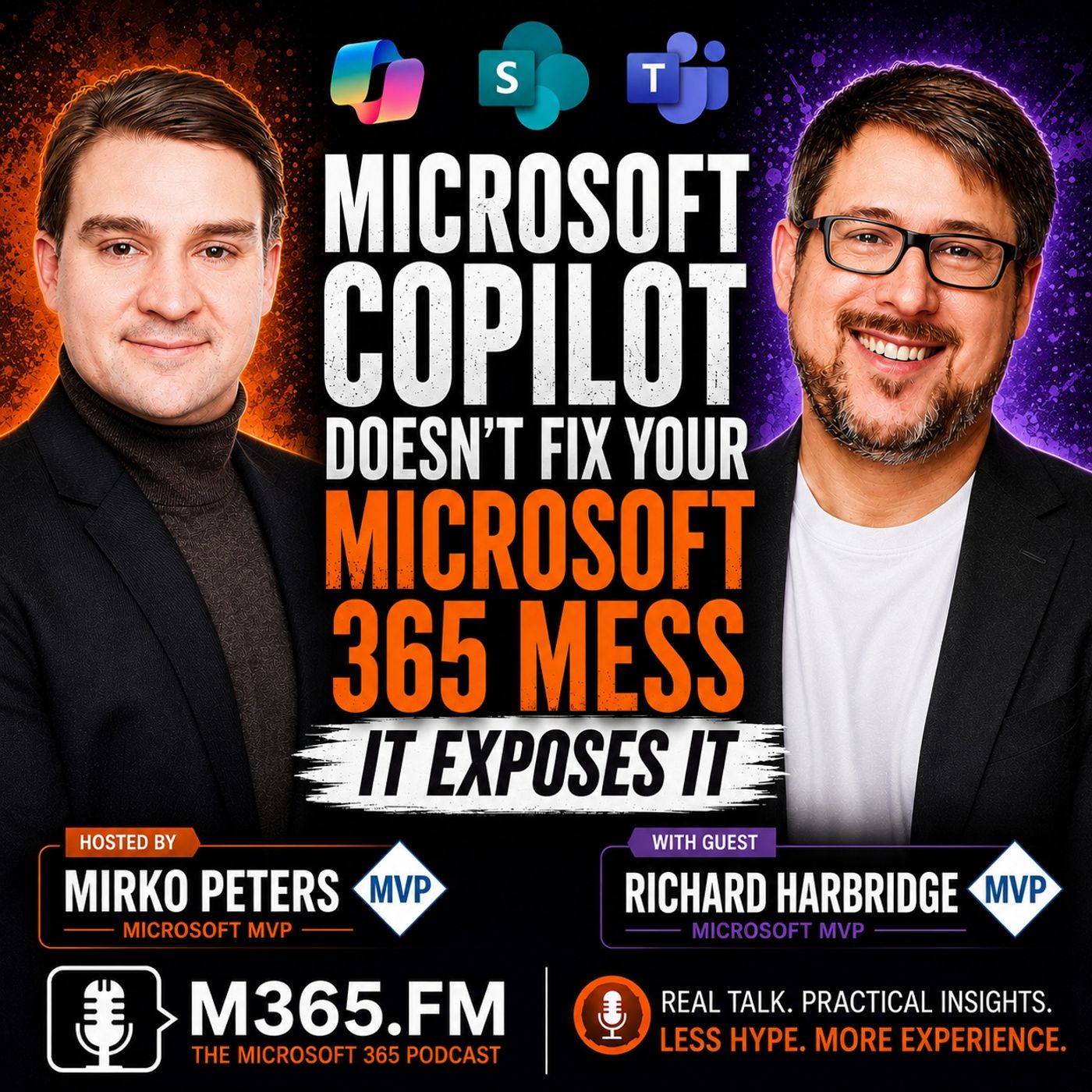
Copilot Inherits Your Mess: Modernizing Microsoft 365 for AI with Richard Harbridge [MVP]
Show notes
Microsoft 365 Copilot doesn’t arrive in a clean Microsoft 365 tenant. It arrives in an environment that organizations have been building for years — full of SharePoint sites, Teams, OneDrive content, duplicate documents, historic migrations, guest accounts, inconsistent permissions, forgotten workspaces, broken ownership models, and content nobody has reviewed in years.For traditional Microsoft 365 management, much of this technical debt could remain relatively hidden. AI changes that.In this episode of M365.FM, Mirko Peters talks with Richard Harbridge, Microsoft MVP and industry advisor at ShareGate, about why AI readiness is fundamentally connected to Microsoft 365 modernization and governance.The conversation moves beyond the question of how to deploy Copilot and focuses instead on a more important question: What kind of Microsoft 365 environment are we actually giving AI access to? COPILOT DOESN’T CREATE THE MESS — IT AMPLIFIES IT One of the central ideas in this conversation is that Microsoft Copilot is not necessarily creating entirely new governance problems. Instead, AI makes existing problems significantly more visible and consequential.Organizations have accumulated years of decisions around permissions, sharing, workspace creation, ownership, migrations, external access, inactive content and collaboration.Richard describes this accumulation using the concept of “sprawl.”Sprawl itself is not automatically bad. A growing number of Teams, SharePoint sites and other resources can be evidence that people are successfully adopting Microsoft 365.The problem begins when that growth happens faster than the organization’s ability to manage it.Temporary permissions become permanent. Old collaboration spaces remain accessible. Ownership changes. Business structures evolve. Content stays online long after its original purpose has disappeared.Copilot then operates on top of that existing environment. MICROSOFT 365 SPRAWL IS BIGGER THAN TEAMS AND SHAREPOINT When people hear “Microsoft 365 sprawl,” they often immediately think about too many Teams or SharePoint sites.But Richard argues that sprawl is multidimensional.Organizations can experience workspace sprawl, permission and access sprawl, ownership problems, inactive resources, lifecycle problems, administrative complexity, conditional access sprawl and increasingly integration and connector sprawl.The rise of AI adds another dimension.Microsoft 365 environments increasingly connect data, applications, AI systems and agents. That means organizations need to think beyond individual workloads and start looking at Microsoft 365 as an interconnected ecosystem.Governance can no longer be treated purely as “SharePoint governance” or “Teams governance.” THE CONFIDENCE GAP IN MICROSOFT 365 GOVERNANCE Richard shares an especially interesting finding from ShareGate’s research.A very large percentage of IT leaders report being highly confident in their Microsoft 365 governance. Yet a significant portion of those same organizations report that Copilot has surfaced content that users arguably should not have been able to discover — or they suspect this may have happened but do not know how to verify it.That creates an important distinction between having governance controls available and actually having a continuously governed environment.Policies, configuration options and administrative controls alone do not guarantee that an organization understands its current Microsoft 365 state.AI can expose that gap very quickly. DID MICROSOFT MAKE COLLABORATION TOO EASY? Microsoft Teams, SharePoint and OneDrive are successful partly because Microsoft has made collaboration extremely easy.But easy collaboration also makes it easy to create more resources.One response organizations have traditionally used is restricting workspace creation. Richard explains why that alone does not solve the problem.A workspace created today may serve an entirely different purpose six months, one year or two years later.Its owners may change.The organization may restructure.The project may finish.The content may become irrelevant.The people who originally understood why the workspace existed may leave.Governance therefore cannot stop at provisioning.Organizations need lifecycle processes, reviews, attestations and signals that continuously determine whether resources are still appropriate. GOVERNANCE HAS TO BECOME CONTINUOUS One-time cleanup projects are not enough.An organization can spend months cleaning its Microsoft 365 environment before deploying Copilot, but without continuous governance, the same problems will gradually return.That means organizations need repeatable processes around ownership, permissions, inactivity, lifecycle management, archiving and retirement.The objective is not to eliminate Microsoft 365 sprawl completely.It is to turn unmanaged sprawl into managed sprawl. WHERE SHOULD ORGANIZATIONS START BEFORE SCALING COPILOT? Imagine an enterprise with 10,000 employees, thousands of Teams and SharePoint sites, years of accumulated content and inconsistent permissions.Where should it begin?Richard recommends looking at the specific types of sprawl and identifying where the organization carries the greatest risk.For one company, that might be access control and oversharing.For another, it might be inactive content and lifecycle management.For another organization, privileged identities or administrative management may represent the larger problem.Instead of treating Microsoft 365 governance as one enormous cleanup exercise, organizations can break the problem into measurable categories and prioritize the areas where improvement matters most. COPILOT ADOPTION SHOULD BE TEAM-BASED The conversation also challenges one traditional Microsoft technology adoption model.Organizations frequently deploy new technologies through distributed champions.Richard argues that Copilot benefits from a more team-oriented adoption model.Rather than distributing a small number of licenses across unrelated champions throughout an organization, companies can benefit from saturating teams with AI capabilities so that people learn together, develop shared practices and integrate Copilot into collaborative workflows.AI adoption is not only about giving individuals another productivity tool.It changes how teams work together. MAKING MICROSOFT 365 RISK MEASURABLE Governance initiatives often struggle because their value is difficult to communicate to business leaders.The conversation explores ShareGate’s Risk Radar, which is designed to help organizations evaluate different categories of Microsoft 365 sprawl, compare maturity against benchmarks and understand which areas deserve attention.An important part of this approach is translating governance risk into financial terms.Instead of asking leadership for time and resources simply because “we need better governance,” IT teams can connect improvements to the potential cost of unmanaged risk.That makes Microsoft 365 modernization and governance easier to position as a business investment rather than another administrative IT project. AI AGENTS MAKE GOVERNANCE EVEN MORE IMPORTANT Copilot is only part of the story.As organizations begin creating and deploying more AI agents, governance becomes substantially more complex.Agents can change over time. They can interact with tools, data and other systems. Their ownership can become unclear. Permissions can evolve, and organizations will eventually have to deal with agent lifecycle management at scale.Who owns an agent?Who reviews it?What resources can it access?What happens when its original owner leaves?When should an agent be retired?When should multiple agents be consolidated?These questions look remarkably similar to problems organizations already experience with Teams, SharePoint sites and other Microsoft 365 resources — except AI increases both the speed and potential impact. GOVERNANCE FROM THE RESOURCE UP Richard discusses the importance of looking at governance from the underlying resources upward.An AI experience may sit on top of SharePoint, Microsoft 365 data, Power Platform resources, connectors, permissions and other systems.Organizations therefore cannot govern only the visible AI interface.They need to understand the complete chain of resources, data and permissions supporting it.This becomes increasingly important as agents gain more capabilities and organizations move from relatively simple assistants toward agents that can take action. THE FUTURE IS “EVERYTHING GOVERNANCE ”Looking several years ahead, Richard expects Microsoft governance to become significantly more holistic.Instead of separate conversations about SharePoint governance, Teams governance, Power Platform governance and AI governance, organizations increasingly need to understand how all of these layers interact.Microsoft Purview is highlighted as an important part of this evolution, particularly as Microsoft expands capabilities around data security and posture management.Governance professionals therefore need to broaden their perspective beyond the administration interface or workload they traditionally specialized in.AI sits across boundaries.Governance increasingly has to do the same. Become a supporter of this podcast: https://www.spreaker.com/podcast/m365-fm-microsoft-365-azure-cloud-power-platform-ai--6704921/support.
Apple Podcasts · Spotify · YouTube · YouTube Music · Deezer
Host: Mirko Peters
Guests
Related articles
Transcript
Read the full transcript
Welcome back everybody to the MC65 and then podcasts. Microsoft co-pilot doesn't arrive in the clean Microsoft 365 temp it's arrived in an I went environment. You have been building for years, all share power signs, a bottle, a team's duplicate documents, oversharing, broke ownership models, guest accounts, historic migrations, and so on and so on and so on. And thousands or millions of files nobody has looked at in years. For traditional Microsoft 365 management, much of that's called remind hidden technical depth where they are change. Co-pilot and the agents that follow increase leave depend on the content permissions, structure meter and governance already inside Microsoft 365. So perhaps the biggest challenge with enterprise isn't deploying it's dealing with everything in it. AI in it today I'm joining by Richard Harpich Microsoft MVP, auto global recognized speaker and practical industry advisor at chargate, which brings around two decades of Microsoft 365. Leadership experience has advised how much of IT teams moving petabytes of data contributes to product support more than 100,000 IT professionals and world organizations around the world of Microsoft 365 modernization migration governance and adapt to today. We are going to explore the connection between Microsoft 365 modernization and I readiness. We'll discuss migration, consideration, permission, oversharing, counting lifecycle, teams and SharePoints, pro co-pilot readiness and so on. Yeah, Richard welcome to the MC65 and podcast. A pleasure to be here. Yeah, 30 years of experience, how did you career in the Microsoft topics now? I think the way we frame that is like how many AI years is that and that's like five or six AI years, which is pretty good, you know, it was like like two decades or so normal tech time. No, it's I came from Dev and architecture background building solutions on Microsoft 365. I was sorry at the time SharePoint and some of the underlying technologies. And then when Office 365 and before it be paused came around, I was like, whoa, this is the cloud is pretty cool. Went through that big cloud transformation and helped many, many customers, both at Microsoft and in some companies that I ran do that. And then now, oh, I feel like the big transition that's been doing it with the last four or five years has been this AI transformation. And so kind of like the cloud transformation before working through that with customers. Today with SharePoint, which is a pretty well-known Microsoft 365 vendor for getting you into Microsoft 365 for migrations or consolidation or the governance tool sets as well within Microsoft 365. Yeah, I read a little bit of your stuff on on LinkedIn and then on the websites that I see. One of your actual core arguments is that co-pilot doesn't arrive in the clean Microsoft 365 and why I'm at what do's that mean in practice? Yeah, I don't think anyone has a clean Microsoft 365 environment like we all inherit this mess. I always think of this analogy with sediments. You think of visually, you have these layers of sediments that accrue as your organization, as restructures, as you merge, you acquire organizations as you adopt different waves of technology in the Microsoft 365 stack, because there's feedback, there's all these different workloads. And the more you accumulate this, that's kind of represented a sprawl, the more you have this type of sprawl, the more fragmentation exists, the more great decisions at the time, these temporary permissioning decisions or access scenarios that you inherit those. Those previous decisions aren't often reviewed, they're not these temporary exceptions become permanent and that's kind of where AI is landing in orgs. And whether that's co-pilot or for some organizations called Enterprise, fundamentally, most of us still use Microsoft 365 as the core and our stone of our resources are unstructured data, et cetera. And so I find that most organizations can acknowledge that AI is hard to understand, right? Like there were still figuring out governance and things like that around it. But it's surprising to me that so few organizations understand that they're Microsoft 365 environment and the mess that it's in, the current state, it's in, makes a big difference in terms of how quickly and responsibly you can accelerate with AI. Now often we read the argument that companies say co-pilot creates the governance problems or is it from your perspective only exposing the problems the organization already had? Yeah, I've always liked the mental model of sprawl, right? Because sprawl is pretty intuitive. I've tried a lot of different things over the years. You can imagine doing this for a very long time and more recently with 100,000 plus people who use Shurgate, it's been really fun talking to lots and lots of CIOs and meters. And what we found is that the word sprawl kind of resonates with people, right? We all understand the idea. It's not necessarily bad. Sometimes it's evidence that people are adopting the platform to getting value from it. But this idea of unmanaged sprawl is something that everyone generally gets like, oh, that's not a good thing. And the problem there is when people start to think of sprawl is one-dimensional, right? So and I get this, like we all do this, right? So I think of sprawl, I think immediately maybe have SharePoint sites and teams and how those sprawl. Or I think of access and I think of permissioning and how we have links. And we have sprawling links and we have everyone except external users and we have all these access and permission sprawls. But I think the bigger thing to think about is that it's not limited to just those things, right? You can have ownership sprawling issues. You can have life cycle and inactivity type issues. That's a type of sprawl. You have retirement, like how do you do the archiving and the governance of that? You have these different layers from everything from admin management and how that is dealt with to conditional access policies. Again, it doesn't need to be just a SharePoint and Teams thing. You can look at the broader stack of Microsoft 365. We have sprawls, conditional access rules and things like that. You also have connectors like how are we doing search and connectors and integration sprawl? And that's especially true in Microsoft 365 with this AI error. We're more and more of this ecosystem and connectors matter. How many of our orgs are reviewing those? And thinking like, hey, MCP and federated connections are now available. Are we using those instead of using say the traditional graph slash Microsoft co-pilot connectors? So the list goes on and on and I think the mistake a lot of us make just like we're doing a migration or any other project, we know what we know and we frame it based on that. And when you think of Microsoft 365 more holistically and you think of those different types of sprawl categories, it allows you to understand that almost all of those are impacted or amplified by AI. So instead of just thinking like, oh yes, of course, we have some interesting stats on this. We do these state of Microsoft 365 surveys. And so in this year, we found 93% globally of IT leaders who run and manage Microsoft 365. They were basically saying, hey, we're very confident, we're highly confident in our governance. And those same people, same cohort, 29% said, but co-pilot has surfaced content, it shouldn't have over shared content, et cetera. Or they also, eight percent say, well, we think it has, but we don't know how to check it. So that's like 30, what is it? 36, 37%. And then if you look at just US, because I like to pick on regions, so the US is even more confident and 94% confident. And then you also have them being like 47%, combining the don't know in the exposures. So we know that the reality is different than what we have checkmarks, we have options, but we're not using them, we're not proactive we're using them. And I think that goes back down to this idea that is it managed sprawl or is it unmanaged sprawl? And so I think for a lot of people, they get that there's a debt, there's a cost that's accumulating and they need to resolve it. But for many, I think they struggle to determine how to address that in an effective manner, right? To really start to solve, not just like cleanup acts, activity, but like in a continuous model, some of these challenges. - I think in companies, so most people work with, our family out with teams, SharePoint and OneDrive. And I think that's also be the famous sprawl candidates. So I think it's because Microsoft makes collaboration, so incredible, easy for everyone. Did we accurately make workspace creation too easy? Is this the kind of problem? - Yeah, I think what happens is anytime sprawl outpaces like our management, that's the problem, right? So I think for a lot of works, we said, oh, we'll control that. So you lock to hand creation, right? As the, just particularly on workspaces. And so, okay, that's gonna solve our problem. And so what ends up happening as a few things? Number one, when you create a workspace, what it is six months or a year from now or two years from now, it's maybe fundamentally different than what it was started as, right? This happens a lot with ownership shifts and just restructuring in the nature of business. So one of the things that's really important is those attestations, those reviews, those other cycles, because it's not just about like capturing at the creation, right? Hey, which department does this relate to? This is really to a customer or things like that. It's, it's understanding that there's this life cycle and that the business itself changes over time. And so we can look at signals for that. There's a lot of different signals we can look at like from oversharing risks and inactivity, and things like that, they're, I think, relatively intuitive. But then there's these other layers and I would say they're like business logic signals. And if we don't capture and reference them somewhere, then we won't be able to make a lot of decisions. So you know, you could argue while the whole point of that is ownership. But I'll tell you one of the secrets, even on that example of provisioning when sprawls outpacing our governance, one of the best things you can actually do isn't having those forms that people fill out. And you know, like here's what's your business reasoning and all that other stuff? It's actually really simple. When a new site is created, like I have a new team or a new private channel, whatever it is, what you do is you take like a department lead or a group of leaders within that department and you notify them. That's it. So you know, this person is in department X and they're creating a space, you know, which is probably in some way related to department X. I mean, you can actually ask these questions and figure it out. But even if you didn't have it, you can make that assumption. Why not notify that group that, hey, this space exists now? And the reason that's useful is sometimes a little of the name of the space in the fact that someone created it, creates a discussion and often you see these places that are orphaned because they created it not knowing, oh, I don't know, we have another place for this. And so, you know, that is an example of a really minor preventative nudge, a thing that you can do that doesn't require you to, you know, have perfect ownership, doesn't require to have all these other things, but it can at least reduce the volume of those activities. So then if I have a department set of leaders or whatever that I can communicate, these types of insights into, like, hey, there's a new space for you. Why not also communicate to those leaders periodically? Hey, there's a bunch of inactive sites or spaces. And maybe as an organization, we can get a little bit more comfortable with archiving 'cause no one wants to lead stuff, I get you. But we can archive that content. And so you can use that as a system to both notify, of course, the owners of those spaces, but where ownership starts to break down, we can now use these, quote of these representatives of those departments to help with those discussions. So what you're doing is you're scaffolding, you know, better governance as a baseline and then you're using it. But again, that might be mature for this organization, and that might be very immature for another organization. And this is what I mean where sprawl has all these different types. So you might have a really great maturity on provisioning and understanding our spaces and doing things like that. But in that same organization, they might be really bad when it comes to access. And they have a lot of guest access that just kind of languishes and is not managed well. So you kind of have to look at different layers of your governance journey and go through that exercise we just did of what's like a simple thing I can do that makes it better. What it might not seem? So you need to see, I think, visibility is a big gap, a lot of organizations struggle with today. Like where are the risks in my environment, what are the challenges in my environment? And then once you've seen those and you find and prioritize them, it's this fix and automation optimally, some way that you can continually do that. So you can move on to the very time-intensive work of transforming your organization with AI and the demands that that brings. Because right now we're just talking about Microsoft 365 governance, which is a resource for agents, but agents in AI itself has all these new governance layers that we have to tackle. And so that needs capacity. And so this is better and faster we can deal with this, the faster we can safely push on that accelerator for AI in a responsible way. - I think I had a firm, I was a little bit shocked. They have a governance rule of the Austin six months, no activity, they deleted. And I say, oh, what's with your project, documentation, they're all. So did we have something like expiration policies or should we, how can we handle this? - Yeah, I think when you talk about expiration policies and things like that, the caution, I think a lot of organizations have is, do I have the authority to do this action? And I think this comes back down to two ideas. One, is it auditable? Like sometimes people are really cautious 'cause they just don't know if it's stored and tracked in a way so that it's visible and there's clarity there. Number two, I think that history matters. Number two, I think we need recoverable. So if I do something, some remediation action, can I restore it? Can I convert it back if there's noise or feedback? And I think out of the box that can be challenging with some things. I think archiving is an easier one, but at doing it at scale is hard to do that retrieval. So now you're writing scripts, you're doing other things. Similarly, a lot of times we wanna have stages, right? We don't wanna just archive it to your point. We wanna notify them and then we wanna message that department lead and we wanna go through two or three steps before we take that action, that remediation action. And I think that's the key is a lot of the, it's not that we don't know how to do this. It's that each of those actions that we're describing require scripting, like I wish it was out of the box, but it's not, right? We require us to write some scripts or we require us to do our own formal automation. And I think that's why, and I'm not saying that it needs to be shared, but I think that's why toolenders can help because it offsets the effort in implementing some of those patterns. And even if you're not using the tool vendors, I think the key in that scenario or sequence is can I make sure that whatever I automate is restorable, recoverable, undueable. And when you start to look at your automations in that way, it suddenly becomes a little less problematic to be a little bit more, I don't wanna say aggressive as a posture, but it may be a little bit more proactive in your posture, right? When it comes to inactivity, when it comes to permissioning, I'll give you another example just on permissioning. We all know that we should have expires. So if you have a guest link, an external link, we should be expire after X-Day, 14 days, whatever your organizational baseline is. And you can configure that. And actually most organizations brand new tenants actually will have that as a default. Like there's all this great stuff might be left on, but again, we all have tenants that are brand new. So what we have to do is we need to go, okay, yes, we'll go change the sharing so that by default when you click the share button, it goes and shares with named people, and then they have to click everyone in the org, they have to click on the everyone, including external or whatever. So when they, we enable that guest link model, the trick is the legacy you've already inherited. So you can look across organization, this is the C part, the visibility part, and you can see all of the links, these are anonymous like guest links that have existed in your environment that are over X-Day's old. I mean, that's a pretty easy script or whatever you could run. So get that visibility. Then when you see that visibility, if you have a new policy and your policies look, all these external links should expire after 14 days. Why not consider an approach where we actually take the ones that are three months old, maybe it's not 14 days, but like, get rid of them, like delete the link, like we don't need that link anymore. And what would happen is if we delete that link and someone says, oh, oh, I need that access, they can go through the process of resharing it, or again, this is the trick with a small percentage of these, maybe IT's available to restore that. And so that becomes the idea of your pattern of behavior, like what is the right approach? But I think for a lot of organizations, that would allow you to delete a lot of those old links, a lot of those, you know, historic risks. And I think this isn't just true for this. I think this could also be true for everyone in the org links too, right? There's a whole discussion about like, you could determine is this in a calm space, right? Is this in a communication internet site? Great, then we don't need to do anything around it. But if it's in like what looks to be a pretty private team site and you have this everyone in the org link on that content, and you've notified people and you've done the normal stuff, maybe that's an opportunity to take that extra step and say, you know what, maybe we should delete it for this team site because we've determined the content that we're looking at that has this link, has a sensitive information type. So you know, even though it could be shared with everyone in your work, it's a pretty high risk scenario, and maybe it's better to be a little bit more, again, proactive here with notifications, because it's pretty easy for them to reshare it if that's the case while, you know, relabeling it because maybe the labels incorrect and it's not, you know, it's a false positive for being, you know, PII or whatever it is. So I think like, this is what I mean, there's this nuance and, but at the end of the day, you just need that confidence to be able to implement these things and that goes down to, you know, how do you phase that action so that you can do it in a way that, you know, it's easier, faster and especially more recoverable? - I think Gunnitz has often bad reputation. It's framed as IP says no. (laughs) But is it possible to, I think like, yeah, governance as a self-service for the employees? - Yeah, so I mean, distributed governance is definitely on the rise, which I think is really positive and we need it, right? So in order to scale in the world of AI, you know, the demands are very, very high. And so your organization is changing very, very rapidly that technology or adopting is changing rapidly and even like the content, like, you know, we see this growth in the type of content, right? Think of HTML, this is a great example just as a quick digression. You think of like a PowerPoint presentation, okay, that PowerPoint presentation we can secure, right? It has, you know, PI or whatever, we can do different determinations. When it's an HTML dashboard and that dashboard is pulling from six documents, which is real thing today, like people are by coding this stuff all the time. So when you have that pulling from, or we're using co-work to do it, you have it pulling from multiple documents, you know, the documents might be secure, but is this artifact, is HTML is that, you know, appropriately labeled, you know, that that might have cashed or even stored the content in the HTML. A lot of times what they do is they have like a button that retrieves, but it actually stores in the HTML. So then that becomes another problem. But this is what I mean, and it's not one HTML, it's many files as we all know, it's like JavaScript and all sorts of things. And so what ends up happening is we, our landscape is rapidly evolving. And for, I think a lot of organizations, when we want to address that pain point, we have to have an approach that allows us to distribute that with the org. Because if IT just took all that cost of ownership on internally and tried to manage all these changes, they would fail. So one way to do that, and Microsoft themselves have released some new stuff here, is you can actually have site owners, you know, people who are responsible for a site, or a Microsoft team or a channel, you can give them a little bit more agencies so that they can see the things that I was talking about earlier, like these risks within their environments, these attestation gaps, those things you've asked them for, but that they haven't provided. So you can do a little bit of that just to distribute that. I think another piece of that is if you're going to reach out to someone, you can do it in a more combined way. So, or you can be more proactive with recommendations. I actually really recommend, you know, IT is really good at making judgment calls, believe it or not, on some of these technical things, like what options I should take. And so while we might not be able to say that these people should have access, we can make it really easy for them to click one button to remove that person, right? Instead of them having to go through the UX and actually remove a person. So we can simplify a little bit of that by building our own little tools. One of my favorite examples of this, I don't know if you've played with it. I love using agents as an admin. So when I'm using, when I'm trying to distribute governance across the organization, what I often will start with is a natural conversation, you know, in cloud or co-pilot or whatever tool you like. And I'll say, okay, I'll give you an example. I was working the other day on, you know, this organization that has a lot of ownership issues. So we were looking at, what are all the owners, you know, where are those sites that have only X owners? Cool. If it has only X owners and they have not, those same owners have not signed in. So we're looking at entry data, right? If they haven't signed in within X amount of time, then I think that that's not a stable owner, right? 'Cause that owner is not around. They might be, you know, a orphaned object within AD or Entra. And so that was the second layer. And then the third layer of that same conversation was low to the activity of that site, in order they inactive, are they highly active, et cetera. And then I added another layer of sensitive information types in this whole time, sometimes I'm using the share gate MCP, sometimes I'm using the Microsoft Enterprise MCP, sometimes I'm just using graph calls, like, you know, kind of traditional scripting things. But I'm writing very little of it, right? Like I'm using just like a very carefully with guardrails, I'm going a lot of retrieve, a lot of read information. I take all that and I'm like, you know, now we need to find a way to distribute this. So now we know which owners are likely to respond, which owners seem to be like logging in, seem to be active. So we're gonna notify them, but why notify them just in mail? Why not also notify them in teams or Slack or whatever your organization uses. And so in this instance, again, it created all the communication, right, within that conversation thread. And then once I created that communication, I literally used my identity very carefully to then communicate those things across those different spaces. Again, just using API calls, traditional stuff. So I think a modern admin, I'm not saying you should do this, you know, without guardrails and safety, but I think a modern admin can work in a really natural way and scale what they're doing with different techniques, different channels, different approaches, and layers if they're using MCP, if they're doing all these things. But if they're not doing those things, you try to do half of what I just described traditionally, I would never have the time, because I'd be still working on doing the export, right, of data access governance reports along with like the SharePoint Admin Center reports and then collating those, like I'd be doing all these layered activities and then I have to go look at MTROS so I'd have to do some other report at Entra Admin Center. So like those are like just that alone was like five different admin centers and like six different reports that I'd have to pull down and then analyze. And so I think that's the difference. Like if you're working in that traditional, very manual approach, or if you have to work with multiple people, you have to work with the Entra Admin just to get that information on sign in this example, it makes it really, really problematic. So I think that's the trick is you have to work in a modern way and by working in a modern way that allows us to both distribute governance more effectively and also get on top of it faster. - Well, when I see or actually a lot of companies adapt co-pilot in their environments and I see the governance dudes and there are the Dutch dudes and there are often treat us, yeah, separate disciplines. Should there be or should it more be a team play? - Yeah, so can I pick on like something that I just I think under it underpins this problem, right? So a new probably feels the same way. I don't wanna say hey, how do I frame this in it more constructively. I'm starting to really actively dislike the term AI readiness. Okay, so because AI readiness kind of feels like that first to positions IT as oh, you're binary, you're just making it ready or not, right? And then we do the innovation, whoever that innovation team is which sometimes is an IT just to be clear. But AI doesn't work that way. So I think, you know, ready sounds finished, it sounds like a checklist, this is the wrong language. So let's start with that 'cause I think it's just a great one that encapsulates this problem. So the technology changes, your organization's constantly changing your data's changing, your risk changes, right? Hopefully your ambition with AI changes too, right? You're over here. And I think we're actually using the word readiness to describe many different things that IT is responsible for and governance people are responsible for. So, you know, what do we really wanna do with AI? Well, I think that's our ambition. So we have to have an ambition. What is it we wanna do with AI? And that of course can be multidisciplinary and quite comprehensive in our work. Then can we support that ambition? You know, and can we do it responsibly? I think that's fizzing. And I think like instead of AI readiness, it's AI fit, are you AI fit? I think it's a better way to think about it, right? 'Cause you know, fitness, you kind of, you use this idea of like fitness is a recurring thing, you practice it, you get better at it, right? There's like, I just for language, I think it's a really good term. So that's fitness. And then how quickly can we turn it into value? You know, I think that's acceleration. So when we say AI readiness, what we really mean is we want to say, what's our AI ambition? What is our AI fitness? And essentially how quickly can we turn it into value or how can we responsibly accelerate it? And in that framing, it becomes not being AI ready. It becomes as your ambition rises, your fitness has to rise with it and better fitness gives you the confidence to accelerate responsibly. So we in that framing, going back to governance, governance isn't just ready. It's not a check mark, hey, our risk is mitigated. Governance is about making sure that our fitness is cost effective. Like we can be fit, right? That we're not, you know, our sprawl that I just mentioned, all that sprawl that we mentioned is not weighing us down. It's not holding us back. It's not creating exposure risk and other things like that. That's part of it, sure. But it's also the ability to responsibly accelerate. And I think that's really important that traditional IT governance owns because when you say I have a shadow AI or I have a tool or I have a new multi agent thing that I want to explore and use in the organization, we should be able to say, well, here's how you can safely do that. And there should be like a landing pat think of a radar, right? A way for people to land safely whatever that workload or scenario is much faster. I think that that proactive, that progressive, that, you know, continuous model of governance is what we want to be aligned with because that is the real differentiator over time. I'll be, I'll be even more ambitious here. I think in the, in the broader ecosystem, you kind of make money in career in two ways in IT. You either drive the innovation, a business transformation, you know, process memory and automation with AI or you do that other side, the governance, I'm calling it broadly, this governance side, right? And I think that other side is more competitively advantaged over time because most orgs really make their, you know, make their money based on capital P processes or capital A automation. And what those are is like what's in European, what's in CRM? It's like those core systems and experiences. But the exceptions in the business, those live in Microsoft 365, right? You and me, we have emails, we go back and forth. That's I'm going to call lowercase p process or lowercase a automation. That work that exists, that opportunity that exists totally sits within co-pilot, totally sits within Microsoft 365. And if you can be associated with making that data more valuable, you know, accelerating the automation and improvement of what we get out of that data, I think that that is your competitive advantages and org because almost every org has your P and CRM and all these other systems, right? What we have different is how we handle, you know, the people processes, the lowercase p, the lowercase a automations. And you know, that's an interesting space on both, in both cases, you want to live closer to that, whether you're on the innovation side or the governance side, but again, the secret I think is if you're just saying, oh, no, no, I'm just about AI readiness and you're limiting both your career and your IT proactive ability to impact AI in that way, then you are going to be less and less relevant as AI continues. But what are the real challenges in governance now with co-pilot, I think, for a lot of people, it makes not a different if they have a bad search results and share point on the search, are they used co-pilot? What does the big change, especially when we look at governance, what role-play is co-pilot here? Yeah, I think there is a scaling thing here, right? Part of it isn't so much that, I mean, there is changes, I used an example earlier of a co-pilot notebook, I mean, there are lots of things that add layers of new patterns for governance and new considerations, you know, for us to manage. But I think part of it is that a lot of our, we all know we have this debt, right? We have this accumulated, I'm going to use the word sprawl, we have all this sprawl and it's accumulating over time. And what happens, even when we're managing it, what happens is at some point that starts to have a cost. And I think that there are sort of two major things that happen when we have that cost accumulating. We either, we either change our approach and we improve our governance posture, we do that to manage it better. And that means that things like oversharing are more managed, like there's more proactive actions that we're taking, you know, we have more confidence in it. Same thing with labeling, you know, purview, everything in purview, right? The same idea. I think the other one, and this is just my opinion, I think one that people really miss is consolidation. So sometimes what happens is the interest accumulates so quickly, it just builds and builds on your sprawl that it's something you have to make a move, right? And sometimes this is triggered because we have an M&A, that's a big move, right? So you have hundreds of potentially new users with all their content and all their, you know, their sprawl merging with your sprawl. And now all of a sudden you're like, well, of course, now we need to, you know, we need to do something, we have to take action there. And that becomes merging and consolidating and all the hard logic there. And I think in that way, you know, migrations, projects, I think everyone's really familiar with, become these really interesting opportunities using that sediment analogy I gave earlier to excavate through all those layers. When you get a real picture of like, what is all the content? What is our, it's tenant look like? What are all the things within it? You get this really interesting picture of that during these consolidation events. And when you get that picture, you spend a lot of time, like, who's gonna validate it when we, you know, transition it over, which department does it really do? You get all this information, many orgs leave it. They just move, like it ages in like a few months, it's no longer up to date. Why not use that as an opportunity to keep that momentum going? And so, you know, if you can have a consolidation event, and by the way, this doesn't need to be like Google to Microsoft 365 or, you know, legacy, deleting edge, like going from file shares or SharePoint server to Microsoft 365, it could just be as simple as, you know, it's been X years we've had all these restructures. We have a bunch of teams that are similar. We should work on consolidating those together. I like figuring out a new structure with, you know, shared and private channels and so on and so forth. Maybe they were even built before private channels and shared channels even existed. So it's a good opportunity to kind of collate those new architectures. So that is a consolidation activity, but when you do a consolidation activity it gives you this disability where you work with the business and you can resolve and improve a lot of these things. And so I think a lot of the, there's sort of two hammers we have in IT that we use to do a lot of our work. We have solution projects, right? So you have an automation that we were talking about earlier, we have something like that, and that gives you that same year excavating, you're getting that context, and then, you know, you have a budget, everything associated with that. You use that as one way to do it, and then you can get an understanding of what are these new, you know, information types, what are these new, you know, governance constructs that we need to plan for and understand. And then the other one is, I think, consolidation. And I think consolidation can be a very proactive thing. And organizations can do a much better job of it, because you are, most organizations have already, in fact, 96% of organizations, again, this is interesting survey data from the, yes, your survey from 900 plus IT leaders, 96% have had a migration of last two years. Like, it's, the number, I think it's the number two, but it's very rapidly rising. The number two reason people even do a migration or consolidation is for AI. I want to AI enable my file, sure. I want to AI enable, you know, I want to get off of Google and Microsoft, because I really want all my data in WorkIQ, so my connectors and everything else are more clean. Whatever your journey is, like, that is driving a huge number of these migrations. I can, I think, they're just, they're big buckets of budget and time in the, in the environments, those are really good opportunities to get a better understanding of what we're not migrating. Not just the content, but the ecosystem around it. And I'll just give one last example of this, I'm sorry, this is a bit long. So one of these organizations we're working with recently, they had really went crazy with something called SharePoint Premium or Autofill columns. So in co-pilot, you can have each document, like a leasing library, each leases basically have a co-pilot prompt run against it, and it extracts, you know, you know, what's the location? What kind of building is this? You know, all these contract clauses, all sorts of things. You just want to extract it into metadata. And that's really nice for views and filtering and search and whatever, but the real reason for it is because that metadata can be ingested at a scale with co-pilot that individual content can't, right? Because if you asked a question like, I have 3,000 leases and I say something like, okay, grab me all the ones that relate to this, it will grab the first 20 or whatever, it'll grab as many as it can fit in the context length, but then it'll kind of end there. And when you do this with the metadata, it can grab all of them and just look at all of them, you know, and really give you the right results. So these organizations had done this in many places. And this is, by the way, not a unique thing. This happens all the time. But it's an example where, you know, and they use Sharegate, so that migration worked well, they migrated labels, you know, the content itself came across, all the metadata is coming across fine. But when they added new lease agreements, they're not automatically extracting that metadata. And so these other things like agents, not the things that don't work correctly. And so that was a migration fail, not because the, you know, the lift and shift went really well, they did everything right. It's that the part of the ecosystem that they missed was they have to rebuild those models. They have to build, you know, SharePoint Premium Legacy models as Auto-Fill Colms. And once they had reestablished those Auto-Fill Colms, they were, they were a checkmark again, right? But the problem is the timing. That all came out right when they're like trying to finish, right, as a course of every migration does. And so what are they gonna do? And what is every customer hope who's over here is this gonna do? Is they're gonna think of, oh, what about this, right? What about Power Platform? What about, you know, my, flows and automations around my libraries of content that were migrating? What about, you know, the example of Auto-Fill Colms? What about SharePoint skills? What about all these new things, especially in the co-pilot era, that need to also migrate when we migrate, say, SharePoint data. And I think that is what we're talking about. There's this growing expectation for IT to cover all of these things. And I think migration's just an easier way to frame it than to talk about governance, but it's the same problem with governance. It's the exact same issue of, okay, are we even governing, you know, co-pilot notebooks of these technical locations? Are we governing one note notebooks? Are we governing like there's old categories of stuff? Many organizations don't consider in their governance planning. And yet, now you could, you couldn't, you know, couldn't even do labels, right, on notebooks, you know, and at the various assets of notebooks a little while ago, but now it's functionally available in Microsoft 365, I think of this year, right, was that feature set that came out from the roadmap. So that has to change the way you govern as well. - Well, I think it's, when we think co-pilot for the most people that's co-pilot, I say it's a check bot, and now we get more of these, I say, autonomous systems that are, yeah, it's also work for work for me. It's not only answer questions, how did this change governance? - Yeah, I think, you know, there's two ways to think about that, right, there's how AI gets embedded into like workflows and the existing things that we were describing, right? Does it live in SharePoint? Does it live in, you know, 'cause sometimes it does, does it live as an agent in the power platform stack and we think about it more of a power platform governance discussion, does it think, do we think of it across? So a couple of things, one, all AI, whatever type you're dealing with, if we're talking about Microsoft 365 world, it's gonna interface with Microsoft 365 data in some way. And so if it's doing that, think of a resource up approach. So we need to do governance from a resource up perspective. That's by the way, the most mature area, it's the most accessible area, and then we also need to deal with it from a top down. So when I say top down, I mean like the agent, you know, the agent model itself, right? And then the tools the agents can call and all these things that you kind of do from a higher level and then you work your way down. And both of those make sense. So in Microsoft 365 terms, you have agent 365, which is kind of that top down and a little bit of resource up, but most of the resource up is the purview and a SharePoint Advanced Management and these other spaces, right, within the Microsoft stack. So that's one way to think about it. And by doing that, you're able to support these new agent growth. The other one, and I think this is really more fundamental, organizations should do the same things we've always been doing when it comes to the next generation of agents, right? And that's to learn from our mistakes, right? So Microsoft 365 sprawls already taught us that democratized creation is incredibly powerful, but that's gonna require scalable governance and scalable retirement and scalable consolidation in these types of things. And consolidation matters by the way for this. So you might ask today, who owns the agent? Can I answer that? What can it access and can it do it responsibly? And are we checking that regularly? You might check that at the beginning of an agent, but you have to check that 'cause an agent can really dynamic and change a lot in three months, right, like there's a lot of innovation and progress that's being made both by people who are owning these agents and more. What can it do? Again, it's increasingly making decisions. We actually see agents now making permission requests. So we have permissions for all before, but now you actually have, and by the way, people don't spend tokens going, hey, check all the permissions that you asked for and double check if we still need them. You know what I mean? That's not a, we should, but it's not really in the design of a lot of these agents today. Who can use it? What systems does it connect to? Is it still needed? This is a big one. There's actually a huge number of organizational studies that are showing now that a lot of those earlier agents we built with AI that aren't maintained, not the ones that we continue, but that they're really built poorly, and there are great opportunities to retire it and rebuild them because it's so easy to do that now and it can be done in a better way. And so the lesson isn't to slow down creation, right? We learn that. You can't do that in the SharePoint sites and you name it, right? And Microsoft 365, what we learned is we have to make sure our ability to govern, retire things, consolidate things, scales with our ability to create them. And I think that goes back to those questions. We can answer these questions on a per agent basis today for, I'll say that the capital P process agents that IT is help colonally, right? But I am confident most orgs can't say the same for the vast array of agents and even, you know, vibe coded solutions across the organization today. And in both those instances, we have to find a way to be able to answer those same questions, who owns it, what can it be access, what can it do, et cetera. We need to be able to answer that for all of those so that we can work on consolidation, retirement, things like that because they are exposure risks. And then you know, you know, they may think, oh, it doesn't have access to things, but increasingly they have their own digital identities. And so that digital identity has literally access to a bunch of resources, kind of like you're sharing the examples. And unlike a person where we can ask that person to review it and make sure that they still need access, that's harder with agents because you can often have relationships with your agents, you have relationships with your people who really owns the agent and is accountable for the agent is also sometimes really opaque, besides like a department or a shared sense of ownership or accountability. So these are all things that we're all working through, but at the end of the day, it comes down to being able to scale that. And if you don't accept that, you will be your cost of ownership will keep increasing and you will never catch up, right? Just like we did with Microsoft 365. - Yeah, we see on one side, we have to do a lot of governance for to have a good experience with AI, but on the other side, called AI us help to be better in governance. - Absolutely, no. And I think my example earlier, I know it was like quick and it'd be easier if I could show like on screen, but like that example working with like, it doesn't need to be MCPs, but that idea of working like with agents to scale your governance, I think is a good example of a signal that suggests your organization is more mature, assuming you have guardrails and you're doing it in the right way. And that's fundamentally different than saying, oh yeah, we use the SharePoint admin agent, which is great, like use the skills, storage skills, et cetera, but there's so many limitations with that where you need an extra layer, right? It's just not gonna get to the level action ability that you need in order to do something, right? To take some sort of action. You would just give you that broader visibility that there is challenges or risks. It's up to you then to take that in script or do it all those extra steps. But why not do that with the support of AI or a great tool like ShareGate? And that's interesting. I think a little bit about how looks, we say, ShareGate or from your perspective, we have an organization, I say, 10,000 employees, stealth of teams, SharePoint sites, years of content and very inconsistent permissions and they want to deploy co-pilot. Where do they start? What's your roadmap for trust ones? Yeah, I mean, most organizations today they'll do piloting and then they'll scale so I won't really talk about like the adoption pattern. I think that's kind of well established. I will say, just two quick notes. Most orgs make a mistake. We all are used to the champion model. So you give it to these distributed champions across teams, just fundamentally the wrong approach with co-pilot. The way it works is a team-based adoption model. So you really want to saturate a team with AI together because then they learn better together and so on and so forth. So there are little things like that if we wanted to talk about it that are tactically important. But I think the other way to look at it, because again, I'm such a governance mind of personally is I think of like, how do I roll this out in sequencing a really decent sprawl? And so I think then what you're trying to do is find where your sprawl risk is higher. And I think for some organizations, it's going to be access control. For some, it's going to be life cycle and then activity and that type of stuff. And for others, it's going to be like privilege, identity management, and all these other things, right? It's going to be the admin stuff. So for that, we did this exercise where we found it was helpful to split up the types of sprawl because that's informative to an organization. And then perfect world, you'd be able to benchmark yourself, you'd be able to say, well, let me answer a couple of questions. And then you show me where I should prioritize and focus. And so we actually took some time and built that in Sharegate. It's a free solution. Anyone can use it. It's called the risk radar. Go link in the show notes or something. But basically, the idea behind it is that we have this experience where you can go in, you can see the 13 types of sprawl. You can see industry baselines. So that's really helpful because you might be like, oh, we're really behind. Trust me, like the average out of five on a maturity scale is like 1.4. It's like really low for like a mid-size organization. But you can kind of see where you're found behind. And then you can actually see, OK, right now we're at a two in access and oversharing and all those things like for sprawl maturity. If we want to get to a three or four, what does that mean? And so that's where, you know, we have these specific actions that you take. There's a bit of framing. And then the thing I really like about this tool is it puts a dollar value to what we just described. So if I am trying to champion us, not just rolling out co-pilot, but spending the right time-- not just to clean up exercise, but a continual posture thing-- then I can present that and say, like, here's industry defensible data that suggests that the costs risk of us not doing this, these scenarios that are extremely likely that do occur, they have these kinds of cost consequences in our org and based on your data. And so based on that, I have a number now I can throw back to IT and say, basically, I'm asking for only my time for weeks to do these actions. And then we'll have a nice automated process. If you can give me whatever that is $6,000 or $10,000 worth of my time, then that would save us hundreds of thousands or millions. And now you can show that using the way that this calculates within that tool. So yeah, I hate to position a tool. Especially in an audio thing. But I think that's one way to tackle it that would really help. And I encourage people to try that sprawl risk greater. But I think the sort of secondary thing that I'm highlighting there is, you need to come in and say, yeah, we're going to roll it out properly, but it's not going to end. It's not AI ready and it's done. It's AI fitness. And so if we're going to be doing this fitness thing, we're going to be doing this governance thing. I need budget. I need a way to present that business case so that it sustains post that initial launch. And I think that's really critical for organizations to do. And the more we can champion that, the more you're going to get so much more value out of your AI, regardless of what AI you use. Because everything I just described, if I'm using cloud enterprise and not co-pilot two years from our event today, I would get the same benefits because it's still using the connectors retrieving against the Microsoft 365 data. All these things are still true, regardless of the ecosystem, although of course, in Microsoft it's even more pronounced. Awesome. I have to check the terrata. It's really cool. But I often use the white papers and the studies from Chargate. But let's say concrete how when people say, OK, we will use Chargate. How fast you will say they can get AI ready and how fast they can see, I say, a return of invest immediately. So a lot of people when they first run it, there's this tenant report. And this doesn't need to be shared yet. But if you just think about governance, you do like a tenant assessment. When you run that, you're going to get immediate visibility into a high priority things that you should address. And some of them are really obvious. Like I think everyone except external users for private teams with confidence, labels and stuff on them. Those are pretty good indicators that there's a mismatch, and there's something that we can resolve there. Or you have a lot of active content that, based on all these other indicators, have the owners, and like I said, who are the owners and are they active or not, and all these other insights. And that allows you to say, OK, let's archive these. Let's bulk archive a bunch of these. So there are quick actions like that. And then there are more actions within there. Licensing is a great example. I find this very frustrating with Microsoft. We've been doing this for many years. But we've really got co-pilot licenses. We just had this big E7. I know you talked about it on your one of your last episodes. Those are big cost impacts. And you really like to see a way to say, not just, do we have the license allocated, but is it being used effectively? So being able to do that report and share a data as an example saves a lot of time. So there's definitely low-hanging fruits that any hero admin could go and do, and resolve a bunch of issues. And then there's going to be this nice backlog of other things you should do that might require that back-and-forth with the business. But now you have the data, you have the insights, you have the way you can click, it's easy to do. But now it becomes a discussion of, we need to discuss it as a team of committee, whatever it is. And so I think that slows it down. The functional work, I think, is quite rapid nowadays in what I just described, especially if you're using MCP or something, which I think just unlocks so much more value with some of these solutions. And that's for more partners or people who are working in a proactive way. And they want to mature their own career journey. I would live with good tools, like share gate to the polls of the data and does all that hard work for you together so you can create really cool HTML presentations or you could take your-- my favorite one I've done recently is we take the-- every IT group has meetings, and they have different PowerPoint presentations in like meeting agendas, transcripts, et cetera. You take that data and you say, where could I insert these governance insights? Where's the natural place in our normal flow? Where I could bring these things up and maybe it could be a way to add value, context, or even action, like to drive an action that I want to take. And it's interesting because it'll analyze that and go, oh yeah, here's like this data point around these particular users and groups. It relates to this discussion that you're having. This is a great thing, so you can do a chat, a team's message follow up for it. You can send in a little email like this, but it feels like it's in the context of your flow of work because it's able to do that. So that's just an example again with a little bit of agent work, you can use co-pilot or something to look at, hey, I've got this governance inside where are the good opportunities where I could naturally float in. And then that becomes-- it just becomes natural. It just becomes a thing where I have automated prompt, and it runs daily, and it's basically like, hey, based on the meetings I have coming up today or the meetings that happened yesterday, what are some good opportunities for me to be that governance champion and to insert some stuff. And it's like, oh, you're meeting with Sue who runs five SharePoint sites, great opportunity to bring up with Sue that, hey, these things are a bit overshared and maybe you'd like to archive two of them, like things like that. That's the way to get the crew up. But when we look a little bit in the future of Microsoft 365 governance, what did you think where-- what is home-- yeah, where do you-- I don't know, I don't know anything. Where's Microsoft governance heading over in the last the next three or five years from your perspective? Yeah, I mean, OK. I'll say three things. One, it's less your SharePoint governance or your team's governance. Your everything governance, right? And I think that's important. So I actually talk to a lot of people who don't play with PerView. And I think PerView has a lot of really powerful tools, and insights and capabilities, and it's growing really rapidly. And I think that's a good example of an area that I think more people should play with. I think everyone who's listening to this, if you're never going to pervue person, at least dip or toes into it, I think that's important. Because there's a lot of tools within that for DPSM and others like DataSPM, Data Security Posture Management, other tools where you can do some scale motions, and it's kind of in English, but it's the future. So I think that's important. The second one, besides being more holistic, and all of us need to do that. So get outside if you're in a Teams ad menu, you're just a SharePoint adman, stop. Like make your way out of that into the broader thing. The second thing that I think would be important for the future of this is to understand, when I say the scale is different, it's, we are in the early stages of AI today. And you're gonna see is the complexity of agents on top of agents, on top of like inference engines, et cetera, is gonna be all about extracting value out of your data. And it'll be more and more consequential to make sure that the best data is well governed, is understandable to AI and more. And so while traditional library sciences might go down, like people don't need to search for stuff in the way that they use to, it doesn't mean that the value of understanding your data and doing all this work around it is not valuable. It really is. And that includes creating new artifacts from existing artifacts with AI support or with IT support. So like sometimes there's a lot of work that needs to go into a data model. And the data model is extracting from like 10 different things, like a price sheet and this and that and all these other things. But it needs to be maintained in a way that makes sure that it's always looking at the right data sources, right? And there's real work there. You see in scaling up in organizations. So that's, I think a broad positioning statement, but I think in general IT, we need to get in a position where we're able to do that deep work, you know, that deep focus work that works is really valuable around data and working with a business line to business and the business to do that. And I don't think that's gonna happen if we're all busy fighting fires. So we got to get away from this like very reactive model. And I'd say the last common I just have on governance is, you know, if the word governance isn't working in your org, you can call it whatever you want. And I think that's, you know, a key concept here, right? You know, I'm just saying it's that work of organizing, optimizing, you know, securing, sure, and being responsible for the business content that we have. And whatever that content in data is formed as. And I think if you're in that space, even as people, unfortunately, we will see disruption there, even if people move around and things like that happen, you'll be in a relatively more longevity space because you know, you're all about the shared data that many of these models don't have. It's, you know, the arguably the competitive insights that you have as an organization. So, so yeah, I think that's an interesting, you know, I'm not saying it's future-proofed or career-safe, but I think the closer you get to doing that, I think generally speaking, it's pretty resilient compared to some of the other disruptions. Like even the innovation side, I'm seeing a lot of people really impacted by the business taking on more of that, you know, prototyping and building with the vibe coding, whatever. And so, you know, it's a, it's always a turbulent space on there. I think the data on the governance side tends to be a bit more stable because it's policy and law driven and compliance driven and all these other layers to it. - Yeah, that's, that's interesting. Well, once the word was, what's, what makes governance sexy, what, what use you, when you have any people that want to like this world? - I mean, it's kind of cool, right? Like, you know, I like people in tech, right? So, you know, there's a course other, we're talking about Microsoft 365 governance mainly in today's discussion. Of course, there's, you know, there's Azure data governance, there's also other layers of governance. I've personally, I've never really loved like, being really deep in fabric or Azure because I miss the people. I miss the complexity that people add to everything for governance. So the very thing that's the most frustrating part, you know, of, you know, agent in Microsoft 365 governance and power platform governance, whatever you wanna call it, is the thing that I actually like the most, it's the, it's the people dynamic. And so, for me, I look at this lens of governance, I find it really fun because anything I do in the space is empowering people to do more. And it's empowering people to do more safely and responsibly. And it's almost always at a scaled model where I'm not individually coaching people. I'm really thinking about those patterns, those playbooks, those, those things that I can do, that gets sort of the noise, the clutter, you know, just makes it easier for people. And I think that's sexy. I think that's a really fun space to be in where I can still play with these tools and use them myself to do those actions that I just described. But I don't, I don't need to be, you know, in a medical organization doing the surgeries. I don't need to be, you know, in another organization doing like really complex financial planning or something. I get to do, you know, governance planning, I get to do technology planning. And, you know, just, again, I think there's a few lenses to that, but I've always liked adoption. And I've always liked governance because I think that revolves around people and a lot of the complexity run into relates to the way people use it or adopted or the people part of it. So that's what I think is sexy. But I'm sure there might be listeners who are big data people and they love Azure and like deeper stuff there. And they're like, you know what, the data is sexy and cool, right? It's just for me, it's that hardness, the, the, why it's such a hard problem, I think is really related to the way people in processes intermingle and orcs. Yeah, cool. So I have a rapid fire out in every recession. Oh, yeah, go for it. You saw short, short, short questions and short short. And my answer is never go together, but I'll jump at best. So central life governance are distributed ownership. I think I'll always distributed ownership where centralized governance is about templating, automation, improvement and how do we do better? So visibility should be centralized. We need to have that because you need to be able to look at things holistically. I think this is really important, but absolutely in order to scale and maintain things, you've got to have a distributed model. You know, we're honestly distributed. Oversharing technical program or organization problem? Okay, so I agree is going to always happen for lots of reasons. It's a natural part of business for oversharing. What I think is important is that there is different tiers or levels of impact. So when you have certain risks, risky risk oversharing, that's what we're talking about. And there's ways that you can actually, I think, with signals and other things, especially modern AI tools, you can really determine what is safe and unsafe risk for your threshold as your organization. And that can be different for different works. But based on the information type and everything else, but I will definitely say that is absolutely a technical problem. Like we should be very clear that we have a business authority to do that and make sure that people aren't doing unsafe things. And we should be resolving that. Anything outside of that, that more nebulous thing, where the cost consequences are pre-minor and things like that. Then I'd say, yeah, that's going to naturally happen. Let's just try and make it a little bit less impactful if it affects things like relevancy in AI and things like that. So they think there's still, there's an optimization expectation, an expectation I need to support that. But yeah, I would say it's technical for the majority of those, especially based on risk. And is there one or a key metric? Like every governor specialist should check all look at? You know, we used to say like, there's a co-pilot readiness score, all these like aggregates. I actually think I'm really leaning towards this idea of sprawl maturity as a way to measure this and it feels defensively and easier. Because I've tried a lot at other things over the years. And it's just intuitive for people to be like, not all of governance, but specifically my workspace sprawl. My sharing sprawl. Like these particular categories you can measure and you can feel like, is it we had a four? Or we had a managed or even an adaptive state, like a five, like a high level state? Or we, you know, the earlier ones are like unseen, you know, visible. Do we have an inventory, right, of what's going on? But we can't action it. We're not controlling for it. I think those are really good indicators for where you are. So I'm actually a big fan of like those very IT, you know, centric leadership centric data points that are in that radar that I was mentioning earlier. But you know, outside of that ROI, of course, has someone to spin at this for a long time, but you know, see return on investment and how are you driving that? And that's true for everything from IT spend and behind the scene stuff to, you know, this latest AI innovation work that we're doing. And so yeah, that would be the mecha-mega thing if I'm talking to a senior exec. But as a IT pro, I find my, netrick that I'm really loving right now is that maturity of each sprawl type. And that helps me kind of think about where my gap is as an organization and where I want to improve. Yeah, awesome. So what's the next guest, Altrou, in which, what questions will you ask? Oh, man. I mean, you can definitely invite like Sam Altman and others, they'll find it like, where is the next model? No, I think, you know, there are, there's so many amazing people doing amazing work in Microsoft 365. I think sometimes there are people like go back to time and time again. And so like Susan Hanley on Internet, comms governance is like, because I'd spend a lot of time in that space, I really just find she's so good at like taking a lot of this complexity and simplifying it to like, here's what you should do and why it's consistent with what we've done before. Um, you know, Diego is somebody, uh, uh, Diego de Silva and I have done like some other cast and stuff together. I always like his, he's got like a, he's just excited. He's very exciting guy. So he's a great person to like share perspectives. And again, he does a great job of, you know, simplifying some of those key messages. I don't know. The list goes on more cashmains like one of my favorite people for like those brainworms. Like, he'll say something and like, oh, that's such a good way of framing that problem. And then it's like in my head for months at a time, uh, you know, from a more technical perspective. Anyways, I'm going to keep going on those list. I got like 300 people in my life there that I would recommend. Yeah. Yeah, awesome. So then, um, yeah, when, uh, I say people, I listen to us can take one, one key lesson from this session. What should it be? You know, I think, of course, everyone knows governance needs to be continuous. I think my takeaway is that I think sprawl and the things that make governance challenging for Microsoft 365 is noble. It's identifiable and it's measurable even. And if you have those things in place, uh, with whether it's tooling or just like your own approach, uh, I think you're going to be in a really good place. So don't feel like it, it's, you know, it can feel overwhelming. It can feel a noble, it can feel an impossible, you know, tilting out windows. It is not, uh, and, uh, and I think any incremental movement and progress there, uh, it should be celebrated. So if anything might take away is, you know, pat yourself on the back. You, I'm sure everyone who's listening has done heroic things, uh, you've done a great job making things better. Just keep doing that magic that you're doing because it does make a difference. And I see you, uh, you know, if, uh, if no one else does and acknowledge the hard work. Yeah. Then, Richard, thank you for joining me today. Uh, I'm talking behind, uh, the simple questions of how to deploy a co-pilot into much more important questions of what kind of M665 and, uh, or, um, and we act really giving a, a, access to, um, yeah, I, I, I, doesn't erase years of, uh, Microsoft 365 decision. It's in here. It's them that permission we created. So the content we keep up, the teams we are on that share point, science before God and so on. Uh, yeah. And, um, that means AI readiness isn't just an AI project. Uh, project. It's, uh, yeah, Microsoft C-Lion organization operation governance. It's, it's a challenge. And, uh, I think, uh, the people should, should take this challenge, uh, it will be helpful. And, yeah, for all the listeners, you find all the links, uh, from, uh, Richard in the, uh, show notes, uh, on the M665 and podcast page. And, yeah, thank you again so much for joining me today. Awesome. Thanks for having me. Thanks for watching.