


 Apple Podcasts
 Spotify
 Youtube Music
 Spreaker
 Podchaser
 Amazon Music
 Shared Data Reservoirs for Multi-Tenant Microsoft 365
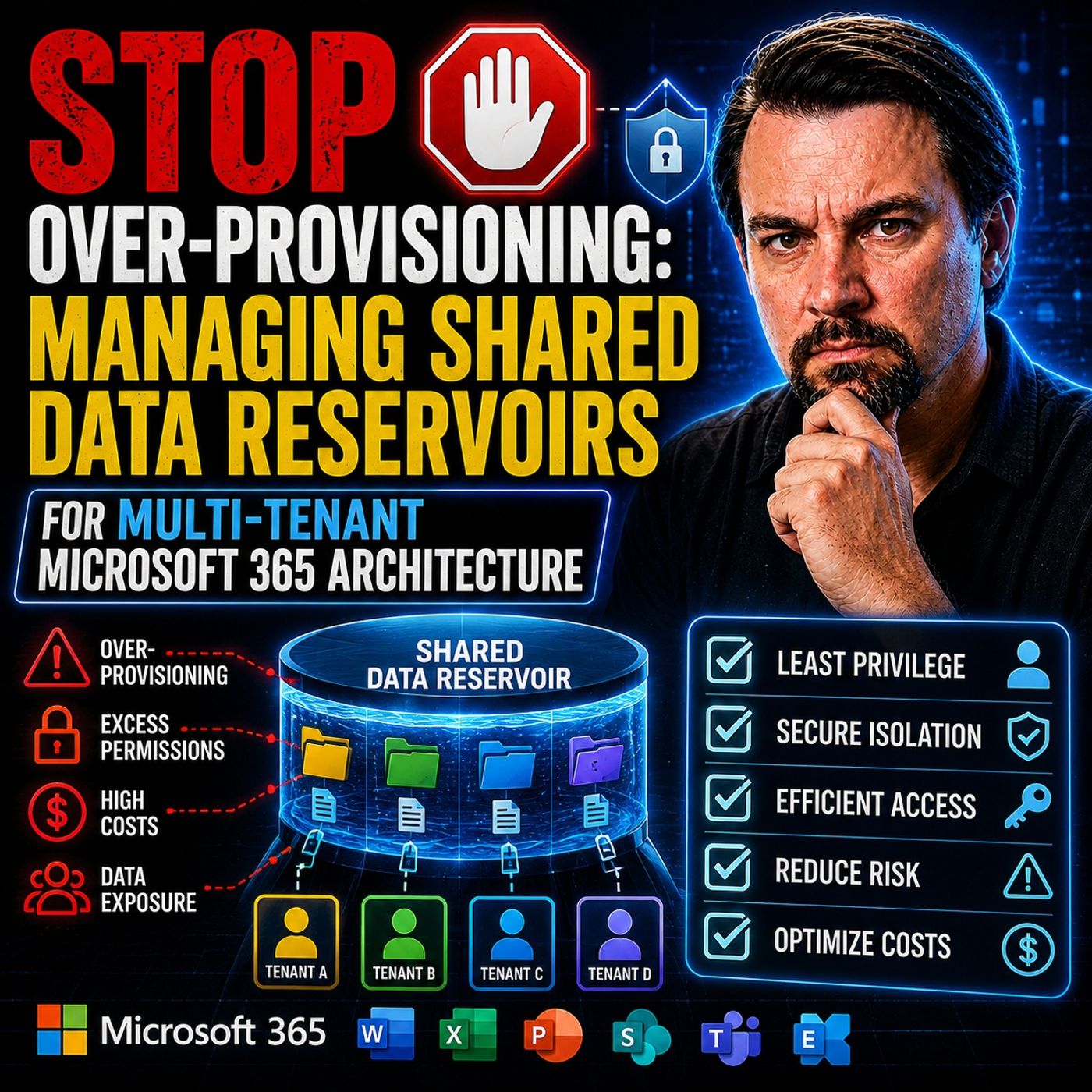
In this episode of the M365.fm podcast, Mirko Peters explores why many Microsoft 365 environments are wasting enormous amounts of money through over-provisioned storage, oversized safety buffers, and rigid quota management strategies. Traditional “just in case” capacity planning often leaves organizations paying for storage, performance, and licensing resources that remain unused while operational complexity continues to grow.
The episode explains how static quota models across SharePoint Online, OneDrive, Teams, Power Platform, Azure storage, and multi-tenant workloads create fragmented infrastructure, dark data silos, and long-term cost inefficiencies. Mirko challenges the outdated “buffer mentality,” where organizations continuously add extra capacity to avoid outages, resulting in idle resources and inflated cloud spending.
A major focus of the discussion is the shift toward elastic shared data reservoirs. Instead of isolated storage silos and fixed allocations, organizations can build centralized, scalable resource pools that dynamically distribute storage and performance where demand actually exists. The episode covers architectural concepts such as Azure Elastic SAN, Azure SQL Hyperscale, elastic storage pools, shared performance layers, and tenant-wide scaling models designed for modern multi-tenant Microsoft 365 environments.
Mirko also discusses how automation, orchestration, governance, and dynamic scaling strategies can dramatically improve operational efficiency while reducing infrastructure waste. The episode highlights the importance of treating cloud resources as flexible, shared services rather than static containers locked to individual workloads or departments.
You need to stop over-provisioning in your multi-tenant m365 setup. Static quotas often create waste and hidden costs. Elastic shared data reservoirs help you avoid these pitfalls by letting your storage scale with real demand. Automation and orchestration ensure your environment stays responsive and ready for future AI workloads. With elastic pools, you gain several advantages:
| Benefit | Description |
|---|---|
| Optimized Resource Allocation | Share resources across tenants and reduce excess. |
| Reduced Management Overhead | Simplify maintenance and need fewer engineers. |
| Cost-Effective Scaling | Scale up or down without paying for unused capacity. |
Key Takeaways
- Stop over-provisioning by switching from static quotas to elastic shared data reservoirs. This change allows your storage to scale with actual demand.
- Reduce costs by only paying for the resources you use. Elastic models prevent waste from unused capacity in your multi-tenant environment.
- Enhance security by minimizing risks associated with over-provisioning. Proper resource allocation reduces misconfigurations and compliance challenges.
- Automate policy enforcement to ensure consistent application across all tenants. Automation saves time and improves compliance.
- Consolidate shared data to improve collaboration and reduce silos. A unified tenant enhances teamwork and resource sharing.
- Implement real-time monitoring to quickly identify and address issues. This proactive approach helps maintain business continuity.
- Regularly review and update your data management practices. Continuous improvement keeps your environment efficient and secure.
- Engage in thorough migration planning to avoid disruptions. A phased approach allows for manageable transitions and minimizes risks.
Over-Provisioning in Multi-Tenant M365
Causes and Risks
You often see over-provisioning when you use static quota models in your multi-tenant m365 environment. These models assign fixed storage or resource limits to each tenant, regardless of their actual usage. When you manage multiple tenants, you may feel tempted to add extra capacity as a safety net. This approach leads to wasted resources and higher costs.
Over-provisioning also introduces several risks. When you allocate more resources than needed, you create opportunities for misconfiguration and security gaps. The following table shows some common risks you face when you over-provision in environments with multiple tenants:
| Risk Type | Description |
|---|---|
| Common Misconfiguration Types | Overly permissive access controls, inconsistent role definitions, and improper permission inheritance can lead to privilege escalation. |
| Supply Chain Vulnerabilities | One tenant's compromised instance can affect others, as shared infrastructure increases the attack surface. |
| Update/Upgrade Risks | Platform-wide changes can introduce vulnerabilities across all tenants simultaneously, complicating security. |
| Compliance Complexity | Difficulty in isolating tenant-specific audit trails and access logs complicates compliance with regulations like GDPR and HIPAA. |
When you manage multiple tenants, you must pay close attention to these risks. Over-provisioning does not just waste money. It can also make your environment less secure and harder to control.
Financial and Operational Impact
Static quota models can drain your budget. You pay for storage and resources that tenants never use. This waste adds up quickly, especially when you support multiple tenants with different needs. You may think that extra capacity gives you peace of mind, but it actually leads to financial loss.
Operationally, over-provisioning makes your job harder. You must track unused resources, manage complex permissions, and handle compliance challenges. When you have multiple tenants, these tasks multiply. You spend more time on maintenance and less time on innovation.
The m365.fm podcast episode "Stop Over-Provisioning" highlights the need for a new approach. You should move away from static quotas and adopt elastic models. These models let you scale resources up or down based on real demand. Here are some reasons why you need this shift:
- Traditional resource allocation models cannot adapt to changing demands.
- Dynamic resource allocation uses time series analysis to predict and adjust resource needs.
- AI and machine learning can help predict demand, but complex environments require even more robust solutions.
When you use elastic shared data reservoirs, you can stop over-provisioning and manage your multi-tenant m365 environment more efficiently. You save money, reduce risk, and prepare your system for future growth.
Challenges of Shared Data Reservoirs
Resource Waste
When you manage shared data reservoirs in a multi-tenant Microsoft 365 environment, you often see resource waste. Many organizations allocate more storage than needed. This happens because you want to avoid running out of space, but it leads to unused capacity. Over time, these unused resources add up and increase your costs. You may also find that dark data—files and information that no one uses—continues to grow. This makes it harder to manage your environment and can create new risks for compliance. If you do not address resource waste, you will struggle to keep your system efficient and cost-effective.
Security and Compliance
You face unique security and compliance challenges when you use shared data reservoirs. Sensitive files can become exposed if you do not manage data properly. This can lead to data leaks and put your organization at risk. You must also ensure that your data remains accurate. If you use outdated or incorrect information, AI tools may produce misleading results. This can affect your decision-making and create new compliance issues.
Note: You need to pay close attention to regulations like GDPR. Without clear visibility into how AI tools use your data, you may struggle to meet compliance requirements.
Here is a table that highlights some of the main security and compliance challenges:
| Challenge Area | Description |
|---|---|
| Information discovery risks | Sensitive files may be easily exposed due to poor data management, leading to potential data leaks. |
| Content accuracy risks | AI outputs can be misleading if based on outdated or incorrect data, which can result in poor decision-making. |
| Security and GDPR risks | Ensuring compliance with GDPR while using AI tools is challenging, especially without visibility into AI operations. |
You must create strong policies to protect your data. Regular audits help you maintain compliance and improve your security posture. If you ignore these challenges, you risk fines and damage to your reputation.
Operational Complexity
Managing shared data reservoirs brings operational complexity. You need to decide how much isolation each tenant requires. Larger tenants may need stricter controls, while smaller ones may not. You must enforce data access controls to prevent leaks between tenants. This requires careful planning and ongoing monitoring.
- You need to manage data isolation based on tenant size and security needs.
- You must enforce strict data access controls to prevent leaks.
- You should apply resource limits and monitor usage to ensure fair access and stable performance.
Compliance adds another layer of complexity. You must track who accesses data and when. This helps you meet audit requirements and maintain trust with your users. If you do not manage these tasks well, your environment can become difficult to control.
Inventory and Dependency Mapping
Before you can optimize your multi-tenant Microsoft 365 environment, you need a clear understanding of your shared data and dependencies. This process starts with a thorough inventory. When you know what data you have and how tenants depend on it, you can make smarter decisions about resource allocation and security.
Identify Shared Data
You should begin by identifying all shared data across your tenants. This step helps you avoid blind spots and ensures you do not overlook critical files or mailboxes. Start by understanding the challenges of Microsoft 365 data access and sharing. Many organizations struggle with tracking who owns what and how data moves between tenants.
To get a complete picture, follow these best practices:
- Review your current governance policies for data access and sharing.
- Use PowerShell to connect to Exchange Online and manage mailboxes across client tenants.
- Generate audit reports to identify inactive or unused mailboxes.
- Check the last logon timestamp for each shared mailbox to spot dormant accounts.
Tip: Regularly reviewing shared mailboxes and their activity helps you reduce dark data and improve security.
Map Tenant Dependencies
Mapping tenant dependencies gives you insight into how tenants interact with shared resources. You need to know which tenants rely on specific data sets or applications. This knowledge helps you prevent disruptions during migrations or policy changes.
Consider these steps to map dependencies:
- List all shared resources, such as SharePoint sites, Teams channels, and shared mailboxes.
- Document which tenants access each resource.
- Identify critical dependencies, such as shared workflows or automated processes.
- Note any cross-tenant permissions or delegated access.
A simple table can help you visualize these relationships:
| Shared Resource | Tenant A | Tenant B | Tenant C |
|---|---|---|---|
| Shared Mailbox 1 | ✅ | ✅ | |
| SharePoint Site X | ✅ | ✅ | |
| Teams Channel Z | ✅ | ✅ |
This mapping allows you to spot potential risks and plan for changes without causing downtime.
Tools for Inventory
You have several tools at your disposal to streamline inventory and dependency mapping. PowerShell remains a powerful option for managing and reporting on Microsoft 365 resources. You can use scripts to connect to Exchange Online, list all shared mailboxes, and pull activity logs.
Other tools include:
- Microsoft 365 Compliance Center for audit and activity reports.
- Azure AD for tracking user and group access.
- Third-party inventory solutions for more advanced reporting and visualization.
Note: Automating your inventory process saves time and reduces errors. Schedule regular audits to keep your data map up to date.
By building a detailed inventory and mapping dependencies, you set the foundation for efficient, secure, and cost-effective management of your shared data reservoirs.
Policy and Automation for Stop Over-Provisioning
Standardize Data Policies
You need clear and consistent data policies to stop over-provisioning in your multi-tenant m365 environment. Standardizing these policies helps you manage resources, improve security, and keep your system efficient. When you set up strong policies, you make it easier to control how tenants use shared data reservoirs. This step also supports compliance and reduces the risk of data leaks.
To create effective policies, follow these best practices:
- Gather requirements from your organization. Understand what your teams need before you choose any technology.
- Assess your technical options. Make sure your choices fit your current architecture and do not promise more than you can deliver.
- Design a user provisioning process. Focus on how users will request access or resources. This approach improves their experience and helps your team reduce manual work.
- Establish a clear provisioning policy. Pick the right technology based on your needs, technical skills, and user expectations.
When you use these steps, you build a strong foundation for management and security. You also set the stage for automation and elastic scaling.
Automate Enforcement
Automated enforcement of your data policies is key to stop over-provisioning. Automation lets you apply rules across all tenants without manual effort. This approach improves management, boosts security, and ensures compliance. You can use tools that monitor, report, and enforce your policies in real time.
Here is a table showing some of the most effective automation features for multi-tenant m365 environments:
| Feature | Description |
|---|---|
| Audit & Backup | Provides detailed audit trails and the ability to restore configurations to a desired state. |
| Baselines & Compliance | Establishes best-practice baselines and tracks configuration compliance. |
| Monitoring & Reporting | Offers holistic reports and proactive alerts for changes and issues. |
| Multi-Tenant Management | Enables application of a single set of policies across multiple tenants for standardization. |
| Automated Provisioning | Allows deployment of new environments from customizable templates with a single click. |
You can also use Microsoft Graph API to manage multiple tenants. Automation helps you pull security and compliance reports from all accounts. You can automate report generation and data collection, which helps you keep up with changes and spot issues early. Automated enforcement ensures that your policies stay active and effective, even as your environment grows.
By using automation, you reduce manual work and make management more reliable. You also improve your security posture and keep your system ready for audits.
Orchestration and Elastic Scaling
Orchestration takes automation to the next level. It coordinates different management tasks and makes sure your resources scale with demand. In a multi-tenant m365 setup, orchestration helps you stop over-provisioning by adjusting resources in real time. This process keeps your environment efficient and prevents performance problems.
Orchestration in Microsoft 365 shared data reservoirs automates resource management based on real-time metrics, enabling proactive scaling to meet demand. This prevents performance issues and ensures efficient resource distribution across tenants. For instance, when utilization reaches 80%, the orchestration engine triggers a scaling event, allowing for a buffer to manage demand effectively. Additionally, techniques like sharded orchestration and Delta queries optimize API calls, enhancing the system's responsiveness and scalability.
You can use technologies like Azure Elastic SAN to support elastic shared data reservoirs. These tools let you add or remove storage as needed, so you only pay for what you use. Orchestration engines watch your usage and trigger scaling events before you run into problems. This approach keeps your tenants happy and your costs under control.
When you combine automation and orchestration, you gain full control over your management processes. You improve security, reduce waste, and prepare your system for future growth. This strategy is essential if you want to stop over-provisioning and keep your multi-tenant m365 environment running smoothly.
Consolidate and Tenant Consolidation Strategies
Consolidate Shared Data
You need to consolidate shared data to improve efficiency in your Microsoft 365 environment. When you bring all your objects and users into one place, you make it easier for everyone to work together. You also reduce the risk of wasted resources and extra costs. Many organizations think that keeping large storage buffers is safe, but this approach leads to financial waste.
In the context of cloud services, you want to end up in a situation where all your objects and users are in the same tenant because this allows for the best end-user experience, for example with being able to easily collaborate or share documents – all much easier within the confines of a single, unified tenant.
You should consolidate shared data for several reasons:
- Mergers or acquisitions often require you to combine IT resources.
- Centralization helps you cut down on IT overhead and avoid license overprovisioning.
- Security or compliance rules may require you to keep data in one region.
When you consolidate, you create a single source of truth. This makes it easier to manage permissions, track usage, and keep your data secure.
Tenant Consolidation Approaches
Tenant consolidation is a key step in reducing over-provisioning and improving your Microsoft 365 setup. You should follow a clear process to make tenant consolidation successful. Start with a full assessment of your environment. Look at users, licenses, groups, SharePoint, Teams, OneDrive, email, and security settings. This helps you understand what you need to move and what you can leave behind.
| Approach | Description |
|---|---|
| Pre-migration assessment and planning | Conduct a thorough audit and inventory of users, licenses, groups, SharePoint, Teams, OneDrive, email, security policies, and compliance settings. |
| Analyze migration scope and approach | Determine the right migration approach by analyzing the number of users, mailboxes, and data volume, which informs the timeline and tool selection. |
| Continuous planning | Emphasize ongoing planning and analysis throughout the tenant consolidation project to ensure success. |
Tenant consolidation works best when you plan each step. You should keep reviewing your progress and adjust your plan as needed. This helps you avoid surprises and keeps your project on track.
Avoiding Data Silos
When you consolidate tenants, you also need to avoid data silos. Data silos happen when information gets trapped in separate systems or teams. This slows down communication and makes it hard to find what you need. By using tenant consolidation, you help everyone access shared resources more easily.
- Consolidating Microsoft 365 tenants enhances communication and data sharing across the organization.
- A unified tenant allows employees to access shared resources seamlessly, which helps eliminate data silos.
- Improved teamwork leads to increased productivity as information flows more freely.
In corporate integrations, keeping separate infrastructures slows synergy capture and complicates governance. A single directory and common toolset accelerates team and process integration. Consolidation enables shared calendars, unified information repositories, and a consistent security model.
You should focus on tenant consolidation to keep your organization agile and connected. When you consolidate, you break down barriers and help your teams work better together.
Migration and Lifecycle Management
Migration Planning
Migration planning is the foundation of a successful migration. You need to start migration planning early to avoid surprises during migration. Begin by defining clear objectives for your migration. Align your migration planning with compliance goals and business needs. Identify key stakeholders who will support your migration. Gather their requirements to shape your migration plan. Establish privacy guidelines to protect employee rights during migration. Develop a communication strategy to keep everyone informed about migration progress. Regularly update your monitoring policies to reflect regulatory changes that may affect migration. Train your team on security awareness and compliance best practices before migration begins.
Tip: Migration planning should include a review of all tenants and their dependencies. This ensures your migration plan covers every aspect of your environment.
Phased Migration
A phased migration reduces risk and makes the migration process manageable. You should break your migration into smaller steps. Start with a pilot migration to test your migration tooling and cutover process. Use feedback from the pilot migration to improve your migration plan. Move on to the next phase of migration only when you achieve cutover readiness. Each migration phase should include a clear cutover point. Communicate cutover dates to all users so they know when migration will affect them. Use migration tooling to automate repetitive migration tasks and monitor migration progress. Track cutover events and resolve issues quickly to keep migration on schedule.
- Test migration tooling before each cutover.
- Schedule cutover windows during low-usage periods.
- Validate data after each migration cutover.
- Document lessons learned after each migration phase.
A phased migration helps you manage migration for multiple tenants. You can adjust your migration plan as you learn from each migration cutover.
Lifecycle Management
Lifecycle management keeps your shared data reservoirs healthy after migration. You need to automate policy enforcement across all workspaces. Standardize processes to reduce shadow IT after migration. Empower users with the right tools for ongoing management. Automate critical aspects of Microsoft Teams and SharePoint to maintain efficiency. Improve user adoption and technology awareness through interactive instruction after migration. Develop successful post-migration plans and better business processes. Implement a tangible information governance plan for Microsoft 365. Receive actionable advice on change management and best practices to support lifecycle management.
- Define clear objectives for lifecycle management.
- Identify key stakeholders for ongoing management.
- Establish privacy guidelines for all users.
- Develop a communication strategy for lifecycle management.
- Regularly update monitoring policies to reflect changes.
- Train your team on security awareness and compliance.
Note: Lifecycle management is not a one-time task. You must review and update your processes regularly to keep your environment secure and efficient after migration.
Monitoring and Continuous Improvement

Real-Time Monitoring
You need real-time monitoring to keep your Microsoft 365 environment healthy. Monitoring helps you spot problems before they disrupt collaboration. When you use integrated monitoring, you can track activity across all tenants. This approach supports continuity and helps you respond quickly to issues. You see how users interact with shared data and where collaboration slows down. If you notice a drop in collaboration, you can act fast to restore continuity. Real-time monitoring also protects business continuity by alerting you to security threats or unusual activity. You keep your collaboration tools running and avoid downtime. This level of visibility ensures that continuity stays strong, even as your environment grows.
Tip: Set up alerts for key collaboration metrics. This helps you maintain collaboration continuity and respond to problems before they affect users.
Reporting and Analytics
Reporting and analytics give you the power to improve collaboration and manage shared data better. You can use dashboards to see how collaboration flows between teams and departments. Analytics show you where collaboration is strong and where it needs help. When you review reports, you find underused resources and can shift them to support better collaboration. This process boosts business continuity and keeps your environment efficient.
Here is a table that shows how reporting and analytics improve management in multi-tenant Microsoft 365 setups:
| Benefit | Description |
|---|---|
| Unified Governance | Enforces consistent security baselines across every subsidiary or department. |
| Operational Efficiency | Monitors global AVD performance metrics from one dashboard, improving response times and management. |
| Resource Optimization | Identifies underutilized AVD host pools to consolidate licenses and reduce Azure spending. |
| Reduced MTTR | Centralized visibility can decrease mean time to resolution by up to 30% in multi-tenant environments. |
You use these insights to support collaboration continuity and make smarter decisions. When you track collaboration trends, you can plan for growth and avoid bottlenecks. Analytics also help you measure the success of your collaboration strategies. You see which tools drive the most collaboration and which need improvement. This data-driven approach strengthens continuity and supports business continuity for all users.
Feedback and Optimization
You should always seek feedback to improve collaboration and maintain continuity. Ask users how well collaboration tools support their work. Use surveys, interviews, or direct feedback channels. When you listen to users, you find gaps in collaboration continuity and can fix them quickly. Optimization means you adjust your processes based on what you learn. You might change settings, add training, or update policies to boost collaboration.
Continuous improvement keeps your collaboration environment strong. You review monitoring data, analyze reports, and act on feedback. This cycle supports business continuity and ensures that collaboration never stops. You build a culture of collaboration where everyone works together to maintain continuity. Over time, you see better results, fewer disruptions, and stronger collaboration continuity.
Note: Make feedback a regular part of your collaboration strategy. This habit helps you spot trends and keep continuity at the center of your operations.
Productivity and Downtime Avoidance
Communication and Change Management
You need strong communication and effective change management to keep productivity high and avoid downtime in your Microsoft 365 environment. When you plan for change, you help your team adjust quickly. Clear communication reduces confusion and keeps everyone focused on their tasks. If you do not explain each change, you risk unexpected downtime and lost productivity.
Start by sharing your change plans early. Use simple language so everyone understands what will happen and when. Give your team time to ask questions about each change. You can use regular updates, emails, or team meetings to keep everyone informed. When you involve your team in the change process, you build trust and reduce resistance.
Elastic data management helps you avoid downtime during change. Resources scale automatically, so you do not need to worry about sudden spikes in demand. This means your team can keep working with no downtime, even when you make big changes. Here is a table that shows how elastic management supports productivity:
| Aspect | Description |
|---|---|
| Automatic Scaling | Resources adjust automatically to demand fluctuations, minimizing downtime during disruptions. |
| Disaster Recovery Support | Rapid provisioning of resources aids in quick recovery, reducing downtime without manual effort. |
| Focus on Strategic Projects | IT teams can concentrate on initiatives that enhance business growth rather than routine tasks. |
You also gain auto scale-up capabilities, which ensure that there is no downtime during resource adjustments. This lets your team stay productive, even when you make changes to your environment.
Testing and Validation
Testing and validation protect your environment from unexpected downtime during change. You need to check every update before you apply it to your live system. This step helps you catch problems early and avoid disruptions.
Follow these best practices for testing and validation:
- Pin model versions for each environment to keep results consistent.
- Set clear promotion paths for updates to reduce the risk of downtime.
- Control tool access to limit unexpected change.
- Separate environments to maintain data integrity and security.
You should also design a reproducible environment model and provide clear documentation for every change. Make sure updates do not cause downtime. Capture logs for debugging and audits. Maintain strong governance by keeping environments separate and validating updates in a staging area before moving to production.
Unified Tenant Configuration Management APIs in Microsoft Graph help you manage change more effectively. These tools let you detect configuration drift before it leads to downtime. By shifting to proactive governance, you keep your shared data management secure and reliable.
Testing and validation give you confidence that each change will not cause downtime. When you follow these steps, you protect productivity and keep your Microsoft 365 environment running smoothly.
You can transform your Microsoft 365 environment by moving from static quotas to elastic shared data management. Automation, consolidation, and continuous improvement help you boost security, cut costs, and streamline operations. When you focus on security, you protect data and support compliance. You also see measurable results:
- Time saved through automation
- Reduction in manual processes
- Improved compliance scores
- Higher user adoption rates
Review your current practices. Use this blueprint to strengthen security and drive better outcomes.
FAQ
What is over-provisioning in Microsoft 365?
Over-provisioning happens when you assign more storage or resources than your tenants actually use. This leads to wasted money and unused capacity. You can avoid this by switching to elastic, demand-based resource management.
How do elastic shared data reservoirs help my organization?
Elastic shared data reservoirs let you scale storage up or down based on real usage. You only pay for what you need. This approach saves money and keeps your environment efficient.
Why should I automate policy enforcement?
Automation ensures that your data policies apply consistently across all tenants. You reduce manual work, improve security, and keep your system compliant. Automation also helps you react quickly to changes.
What tools can I use for inventory and dependency mapping?
You can use PowerShell, Microsoft 365 Compliance Center, and Azure AD. These tools help you track shared resources, user access, and tenant dependencies. Third-party solutions can offer advanced reporting.
How does tenant consolidation improve collaboration?
Tenant consolidation brings all users and data into one environment. This makes sharing and teamwork easier. You remove barriers, reduce silos, and boost productivity.
What role does real-time monitoring play in Microsoft 365 management?
Real-time monitoring lets you spot issues before they affect users. You can track activity, detect security threats, and maintain business continuity. Monitoring helps you keep your environment healthy.
How can I avoid downtime during changes or migrations?
You should test and validate every update before going live. Use clear communication and change management plans. Elastic scaling ensures resources adjust automatically, so users stay productive.
🎧 Listen to this episode
Want a practical explanation of Shared Data Reservoirs for Multi-Tenant Microsoft 365? This episode breaks down the topic in clear language and shows why it matters for Microsoft 365, Azure, Power Platform, security, AI, and modern work.
Listen to this episode if you want to:
- Understand the key concepts behind Shared Data Reservoirs for Multi-Tenant Microsoft 365
- See how it fits into the wider Microsoft technology ecosystem
- Learn where it can create practical value for your organization
You may also enjoy these related M365 FM episodes:
- Building Multi-Tenant SaaS with Power Pages and Dataverse
- Multi-Tenant Microsoft Copilot Governance Strategy
- Fix Multi-Tenant SPFx Authentication
- From Data to Intelligent Agents: Building Trusted Enterprise AI with Microsoft AI Foundry with Shubhangi Goyal [MVP]
- Microsoft Graph Data Connect - Simply Explained
Discover more practical Microsoft conversations on M365 FM.
🚀 Want to be part of m365.fm?
Then stop just listening… and start showing up.
👉 Connect with me on LinkedIn and let’s make something happen:
- 🎙️ Be a podcast guest and share your story
- 🎧 Host your own episode (yes, seriously)
- 💡 Pitch topics the community actually wants to hear
- 🌍 Build your personal brand in the Microsoft 365 space
This isn’t just a podcast — it’s a platform for people who take action.
🔥 Most people wait. The best ones don’t.
👉 Connect with me on LinkedIn and send me a message:
"I want in"
Let’s build something awesome 👊
1
00:00:00,000 --> 00:00:02,680
Your Microsoft 365 environment is likely suffering
2
00:00:02,680 --> 00:00:05,440
from a fiscal hemorrhage that most admins completely overlook.
3
00:00:05,440 --> 00:00:07,640
The assumption is that you need massive safety margins
4
00:00:07,640 --> 00:00:09,360
and static quotas to keep things running,
5
00:00:09,360 --> 00:00:11,560
but in reality, you're just paying for storage
6
00:00:11,560 --> 00:00:14,000
that sits idle while your budget disappears.
7
00:00:14,000 --> 00:00:16,480
Most organizations treat M365 storage
8
00:00:16,480 --> 00:00:18,080
like a rigid filing cabinet.
9
00:00:18,080 --> 00:00:21,200
The top 1% treated like a fluid reservoir.
10
00:00:21,200 --> 00:00:23,120
The structural flaw isn't the data itself,
11
00:00:23,120 --> 00:00:25,720
but the static quotas that create dark data silos
12
00:00:25,720 --> 00:00:28,200
and capacity you pay for but never actually touch.
13
00:00:28,200 --> 00:00:29,880
If you don't shift to an elastic model,
14
00:00:29,880 --> 00:00:32,520
data growth will outpace your budget by 2026
15
00:00:32,520 --> 00:00:34,280
and that leads to throttling paralysis.
16
00:00:34,280 --> 00:00:35,800
In the next 24 minutes,
17
00:00:35,800 --> 00:00:38,280
we are re-engineering your multi-tenant architecture
18
00:00:38,280 --> 00:00:40,320
to make it scale precisely with demand.
19
00:00:40,320 --> 00:00:42,720
You will move from being a victim of over-provisioning
20
00:00:42,720 --> 00:00:44,640
to an architect of efficiency.
21
00:00:44,640 --> 00:00:47,320
From rigid silos to the fluid reservoir model,
22
00:00:47,320 --> 00:00:50,600
we have to move from rigid silos to the fluid reservoir model.
23
00:00:50,600 --> 00:00:53,920
It starts with changing how you think about capacity.
24
00:00:53,920 --> 00:00:56,040
The myth of the buffer mentality.
25
00:00:56,040 --> 00:00:58,480
The old model is built on a specific type of fear
26
00:00:58,480 --> 00:01:02,240
and specifically, it is the fear of that 2am support call
27
00:01:02,240 --> 00:01:05,720
where a tenant hits a hard limit and everything just stops.
28
00:01:05,720 --> 00:01:08,920
To avoid that call, you end up over-provisioning your resources.
29
00:01:08,920 --> 00:01:11,440
You add a 30% buffer to every single account
30
00:01:11,440 --> 00:01:13,280
because you think you are playing it safe,
31
00:01:13,280 --> 00:01:15,720
but in reality, you are just paying for empty space
32
00:01:15,720 --> 00:01:17,000
that nobody is using.
33
00:01:17,000 --> 00:01:18,360
The assumption is broken.
34
00:01:18,360 --> 00:01:19,840
Now that we've exposed the waste,
35
00:01:19,840 --> 00:01:22,080
let's look at the infrastructure that fixes it.
36
00:01:22,080 --> 00:01:23,960
We have diagnosed the fiscal leak,
37
00:01:23,960 --> 00:01:27,280
so now we need to build the container that actually stops it.
38
00:01:27,280 --> 00:01:29,720
This is where we move from a strategy of guessing
39
00:01:29,720 --> 00:01:31,040
to a strategy of pooling,
40
00:01:31,040 --> 00:01:33,040
which means we are moving away from the silo
41
00:01:33,040 --> 00:01:34,200
and toward the reservoir.
42
00:01:34,200 --> 00:01:36,040
It is a shift in the model itself.
43
00:01:36,040 --> 00:01:37,880
Architecting the elastic reservoir.
44
00:01:37,880 --> 00:01:40,560
Moving to an elastic reservoir requires a total shift
45
00:01:40,560 --> 00:01:42,160
in how we think about data storage
46
00:01:42,160 --> 00:01:44,640
across the entire Microsoft 365 fabric.
47
00:01:44,640 --> 00:01:46,560
In the old model, we fragmented everything.
48
00:01:46,560 --> 00:01:48,200
We gave every tenant its own bucket
49
00:01:48,200 --> 00:01:50,000
and every business unit its own draw,
50
00:01:50,000 --> 00:01:52,320
but this fragmentation is exactly why
51
00:01:52,320 --> 00:01:54,800
you have so much idle capacity sitting around.
52
00:01:54,800 --> 00:01:56,520
When you split things up this way,
53
00:01:56,520 --> 00:01:58,880
you lose the ability to use the law of large numbers
54
00:01:58,880 --> 00:01:59,720
to your advantage.
55
00:01:59,720 --> 00:02:02,040
Some tenants are quiet while others are loud
56
00:02:02,040 --> 00:02:03,400
and in a fragmented model,
57
00:02:03,400 --> 00:02:05,040
the quiet ones waste money
58
00:02:05,040 --> 00:02:07,600
while the loud ones hit performance walls.
59
00:02:07,600 --> 00:02:09,280
The elastic reservoir model fixes this
60
00:02:09,280 --> 00:02:10,640
by pulling those scattered stores
61
00:02:10,640 --> 00:02:12,240
into a single high-density pool.
62
00:02:12,240 --> 00:02:15,000
This isn't just about moving files from one place to another.
63
00:02:15,000 --> 00:02:16,960
It's about re-engineering the storage logic,
64
00:02:16,960 --> 00:02:18,960
so capacity acts like a fluid resource
65
00:02:18,960 --> 00:02:21,200
that flows wherever it is needed in real time.
66
00:02:21,200 --> 00:02:23,640
To build this, we have to use Azure Elastic Sand
67
00:02:23,640 --> 00:02:25,720
as the foundation of our modern reservoir.
68
00:02:25,720 --> 00:02:27,760
Traditional storage models usually force you
69
00:02:27,760 --> 00:02:29,720
to buy performance and volume together,
70
00:02:29,720 --> 00:02:31,200
which means if you need more IOPS,
71
00:02:31,200 --> 00:02:32,720
you have to buy more gigabytes.
72
00:02:32,720 --> 00:02:33,840
If you need more gigabytes,
73
00:02:33,840 --> 00:02:36,320
you often end up paying for IOPS you don't even use.
74
00:02:36,320 --> 00:02:38,040
Azure Elastic Sand breaks that link.
75
00:02:38,040 --> 00:02:40,600
It allows us to use base units for our performance floor
76
00:02:40,600 --> 00:02:43,680
and capacity only units to scale the volume independently.
77
00:02:43,680 --> 00:02:45,920
This is a massive shift for multi-tenant architecture
78
00:02:45,920 --> 00:02:47,680
because it means we can set a high performance floor
79
00:02:47,680 --> 00:02:50,960
for the whole organization while adding cheap bulk capacity
80
00:02:50,960 --> 00:02:52,640
as the total data grows.
81
00:02:52,640 --> 00:02:54,080
You aren't overpaying for performance
82
00:02:54,080 --> 00:02:55,640
on every single tenant anymore.
83
00:02:55,640 --> 00:02:57,680
You are buying performance once for the reservoir
84
00:02:57,680 --> 00:02:59,720
and scaling the volume elastically.
85
00:02:59,720 --> 00:03:01,760
But sharing a pool like this creates a new risk
86
00:03:01,760 --> 00:03:03,240
known as the noisy neighbor.
87
00:03:03,240 --> 00:03:05,280
In a poorly designed shared environment,
88
00:03:05,280 --> 00:03:07,600
one tenant's massive data in gestion can starve
89
00:03:07,600 --> 00:03:08,960
another tenant search performance
90
00:03:08,960 --> 00:03:10,640
and slow everything down.
91
00:03:10,640 --> 00:03:12,600
We solve this through multi-tenant logic
92
00:03:12,600 --> 00:03:15,120
that creates logical isolation within the shared pool.
93
00:03:15,120 --> 00:03:17,080
We use resource governance policies
94
00:03:17,080 --> 00:03:19,240
to make sure that even though the physical capacity
95
00:03:19,240 --> 00:03:21,600
is shared, the performance stays predictable for everyone.
96
00:03:21,600 --> 00:03:23,720
This isn't about building walls to keep people out.
97
00:03:23,720 --> 00:03:26,280
It's about building traffic lanes to keep things moving.
98
00:03:26,280 --> 00:03:28,600
We use Azure SQL hyperscale elastic pools
99
00:03:28,600 --> 00:03:31,160
to manage our structured data within the same reservoir
100
00:03:31,160 --> 00:03:32,000
philosophy.
101
00:03:32,000 --> 00:03:34,120
These pools allow us to share CPU, memory,
102
00:03:34,120 --> 00:03:37,680
and resilient SSD cache across up to 25 different databases.
103
00:03:37,680 --> 00:03:40,280
Instead of each database having its own fixed resources,
104
00:03:40,280 --> 00:03:41,680
they all draw from the pool.
105
00:03:41,680 --> 00:03:43,480
So when one database is idle,
106
00:03:43,480 --> 00:03:45,240
its resources are immediately available
107
00:03:45,240 --> 00:03:46,960
for another one running a heavy report
108
00:03:46,960 --> 00:03:48,840
or an AI indexing job.
109
00:03:48,840 --> 00:03:50,640
This logic extends into the power platform
110
00:03:50,640 --> 00:03:52,840
through a shift toward entitlement-based scaling.
111
00:03:52,840 --> 00:03:55,320
For years, we managed environments through fixed tiers
112
00:03:55,320 --> 00:03:58,720
like a tier two sandbox or a tier three production environment.
113
00:03:58,720 --> 00:04:01,240
If you outgrow that tier, you face a manual upgrade
114
00:04:01,240 --> 00:04:03,880
and significant downtime while the system caught up.
115
00:04:03,880 --> 00:04:05,120
In the elastic reservoir model,
116
00:04:05,120 --> 00:04:07,880
we moved toward tenant-wide power platform requests, pools,
117
00:04:07,880 --> 00:04:08,920
or PPR pools.
118
00:04:08,920 --> 00:04:11,280
We stopped thinking about what a specific environment needs
119
00:04:11,280 --> 00:04:13,080
and start looking at the total entitlement
120
00:04:13,080 --> 00:04:14,280
of the entire tenant.
121
00:04:14,280 --> 00:04:17,320
This allows the system to auto-adjust application object
122
00:04:17,320 --> 00:04:19,840
to server instances up to 80 per environment
123
00:04:19,840 --> 00:04:21,680
without you ever touching a slider.
124
00:04:21,680 --> 00:04:24,520
The infrastructure scales based on the actual request volume,
125
00:04:24,520 --> 00:04:26,520
rather than a pre-purchased tier
126
00:04:26,520 --> 00:04:29,640
that might sit 50% empty for most of the month.
127
00:04:29,640 --> 00:04:32,880
The financial impact of this architectural shift is massive.
128
00:04:32,880 --> 00:04:34,240
Let's look at a concrete case study
129
00:04:34,240 --> 00:04:37,560
of a large organization managing a 50-terabyte data reservoir.
130
00:04:37,560 --> 00:04:39,000
Under the old static model,
131
00:04:39,000 --> 00:04:41,560
they were managing 10 different 50-terabyte silos
132
00:04:41,560 --> 00:04:44,120
and paying for 500 terabytes of provision space
133
00:04:44,120 --> 00:04:46,800
just to make sure no single unit ever hit a limit.
134
00:04:46,800 --> 00:04:48,520
By re-engineering for elasticity
135
00:04:48,520 --> 00:04:50,720
and consolidating into a single shared reservoir
136
00:04:50,720 --> 00:04:52,040
with automated scaling,
137
00:04:52,040 --> 00:04:55,360
they cut their monthly total cost of ownership by 30%.
138
00:04:55,360 --> 00:04:57,760
They stopped paying for the empty gaps between the silos
139
00:04:57,760 --> 00:04:59,600
and started paying for the actual aggregate data
140
00:04:59,600 --> 00:05:02,400
plus a small elastic margin that scales with them.
141
00:05:02,400 --> 00:05:05,600
This is the difference between owning 10 half empty parking lots
142
00:05:05,600 --> 00:05:08,840
and owning one dynamic garage that adjusts its size
143
00:05:08,840 --> 00:05:11,200
based on the number of cars currently inside.
144
00:05:11,200 --> 00:05:12,600
This architecture also prepares you
145
00:05:12,600 --> 00:05:14,120
for the arrival of co-pilot.
146
00:05:14,120 --> 00:05:17,000
AI indexing is a high velocity high demand operation
147
00:05:17,000 --> 00:05:19,000
that can easily overwhelm the system.
148
00:05:19,000 --> 00:05:22,000
If you try to run co-pilot against static fragmented silos,
149
00:05:22,000 --> 00:05:23,640
you will hit performance bottlenecks
150
00:05:23,640 --> 00:05:26,640
or trigger massive overage charges that you didn't plan for.
151
00:05:26,640 --> 00:05:28,040
The elastic reservoir handles this
152
00:05:28,040 --> 00:05:29,800
by allowing the indexing service to draw
153
00:05:29,800 --> 00:05:32,000
from the shared performance pool of the elastic sand.
154
00:05:32,000 --> 00:05:33,520
The reservoir absorbs the spike
155
00:05:33,520 --> 00:05:35,720
and then releases those resources back to the pool
156
00:05:35,720 --> 00:05:37,480
once the indexing is complete.
157
00:05:37,480 --> 00:05:39,600
You aren't building a permanent expensive bridge
158
00:05:39,600 --> 00:05:41,440
just to handle a once a week traffic spike.
159
00:05:41,440 --> 00:05:43,400
You are building a system that grows and shrinks
160
00:05:43,400 --> 00:05:44,560
as the data flows.
161
00:05:44,560 --> 00:05:47,400
However, architecture is only the foundation.
162
00:05:47,400 --> 00:05:49,720
You can build the most beautiful reservoir in the world,
163
00:05:49,720 --> 00:05:52,640
but if the valves are stuck, the water isn't going to move.
164
00:05:52,640 --> 00:05:54,280
To make this work, we need an engine
165
00:05:54,280 --> 00:05:55,600
that handles the orchestration.
166
00:05:55,600 --> 00:05:57,720
We need to move away from the manual extensions
167
00:05:57,720 --> 00:05:59,680
and the temporary 30-day increases
168
00:05:59,680 --> 00:06:01,200
that define legacy administration.
169
00:06:01,200 --> 00:06:03,160
We need a system that watches the utilization
170
00:06:03,160 --> 00:06:04,360
and moves the sliders for us.
171
00:06:04,360 --> 00:06:06,560
We need to understand the mechanics of how Microsoft
172
00:06:06,560 --> 00:06:08,040
actually throttles these requests
173
00:06:08,040 --> 00:06:10,440
and how we can use that knowledge to our advantage.
174
00:06:10,440 --> 00:06:12,880
The shift from a static model to an elastic one
175
00:06:12,880 --> 00:06:16,120
is a shift from manual oversight to automated orchestration.
176
00:06:16,120 --> 00:06:18,200
It requires us to understand the token buckets,
177
00:06:18,200 --> 00:06:19,960
the API limits and the trigger logic
178
00:06:19,960 --> 00:06:21,600
that keeps the reservoir healthy.
179
00:06:21,600 --> 00:06:25,120
That is the next step in our journey from waste to efficiency.
180
00:06:25,120 --> 00:06:27,360
We have the reservoir and now we need the pump.
181
00:06:27,360 --> 00:06:29,960
We need to look at how we orchestrate this dynamic scaling
182
00:06:29,960 --> 00:06:33,240
to ensure the flow never stops even as the volume grows.
183
00:06:33,240 --> 00:06:36,720
Architecture is the foundation, but automation is the engine.
184
00:06:36,720 --> 00:06:39,400
Building a reservoir is a structural victory,
185
00:06:39,400 --> 00:06:41,000
but a structure without a heartbeat
186
00:06:41,000 --> 00:06:43,080
is just a monument to wasted engineering.
187
00:06:43,080 --> 00:06:45,000
You can have the most sophisticated elastic sand
188
00:06:45,000 --> 00:06:46,880
configuration in the world and still fail
189
00:06:46,880 --> 00:06:48,880
if your scaling logic depends on a human being
190
00:06:48,880 --> 00:06:50,560
clicking a button in a portal.
191
00:06:50,560 --> 00:06:52,360
Automation is the heartbeat of the system.
192
00:06:52,360 --> 00:06:53,680
It is the difference between a system
193
00:06:53,680 --> 00:06:57,080
that barely survives a spike and one that actually thrives on it.
194
00:06:57,080 --> 00:06:59,920
We are moving away from the era of administrative intervention
195
00:06:59,920 --> 00:07:02,320
and into the era of autonomous orchestration.
196
00:07:02,320 --> 00:07:04,640
This shift requires us to stop looking at dashboards
197
00:07:04,640 --> 00:07:07,640
and start writing the logic that makes those dashboards irrelevant.
198
00:07:07,640 --> 00:07:09,720
We are moving from the foundation to the engine.
199
00:07:09,720 --> 00:07:12,000
When the system can sense its own limits and adjust itself
200
00:07:12,000 --> 00:07:15,040
in real time, the friction of manual management disappears.
201
00:07:15,040 --> 00:07:18,360
This is where the true efficiency of the cloud finally pays off.
202
00:07:18,360 --> 00:07:20,600
The orchestration of dynamic scaling.
203
00:07:20,600 --> 00:07:23,280
The biggest mistake in modern M365 administration
204
00:07:23,280 --> 00:07:26,040
is treating a capacity crisis like a one-time event.
205
00:07:26,040 --> 00:07:27,400
When a tenant hits a storage limit,
206
00:07:27,400 --> 00:07:29,960
the standard response is to request a temporary increase.
207
00:07:29,960 --> 00:07:31,040
But that's a losing game.
208
00:07:31,040 --> 00:07:33,280
Microsoft offers these 30-day extensions
209
00:07:33,280 --> 00:07:36,200
to keep you from going underwater, but relying on them
210
00:07:36,200 --> 00:07:38,360
is like using a bucket to bail out a ship
211
00:07:38,360 --> 00:07:39,480
with a hole in the hull.
212
00:07:39,480 --> 00:07:40,440
It's a band-aid.
213
00:07:40,440 --> 00:07:41,440
It's reactive.
214
00:07:41,440 --> 00:07:44,480
In an elastic model, we replace that manual desperation
215
00:07:44,480 --> 00:07:46,960
with a strategy of continuous orchestration.
216
00:07:46,960 --> 00:07:48,840
We build a system that anticipates the wall
217
00:07:48,840 --> 00:07:50,400
before the tenant ever hits it.
218
00:07:50,400 --> 00:07:52,560
This requires a deep understanding of the token bucket
219
00:07:52,560 --> 00:07:55,440
architecture that now governs the Azure Resource Manager.
220
00:07:55,440 --> 00:07:58,520
In 2024, Microsoft moved away from instance-based limits
221
00:07:58,520 --> 00:08:00,360
and replaced them with a regional token bucket
222
00:08:00,360 --> 00:08:02,360
system for all RM operations.
223
00:08:02,360 --> 00:08:04,160
You should think of this as a credit system
224
00:08:04,160 --> 00:08:07,120
where you have a bucket that refills at a specific rate,
225
00:08:07,120 --> 00:08:10,040
like 25 tokens per second for read operations.
226
00:08:10,040 --> 00:08:12,120
Every time you pull the system for storage metrics,
227
00:08:12,120 --> 00:08:14,680
you consume a token, and if you burst your requests,
228
00:08:14,680 --> 00:08:15,960
you empty the bucket.
229
00:08:15,960 --> 00:08:19,240
Once it is empty, the system returns a 429 error,
230
00:08:19,240 --> 00:08:20,880
which means your orchestration logic
231
00:08:20,880 --> 00:08:23,120
must be aware of this refill rate.
232
00:08:23,120 --> 00:08:24,800
If your automation is too aggressive,
233
00:08:24,800 --> 00:08:26,760
it will throttle itself out of existence.
234
00:08:26,760 --> 00:08:29,800
The goal is to design scaling events that respect the bucket
235
00:08:29,800 --> 00:08:32,800
while ensuring the reservoir stays ahead of the data stream.
236
00:08:32,800 --> 00:08:34,200
You need to paste your scaling request
237
00:08:34,200 --> 00:08:36,200
to match the refill rate of the region.
238
00:08:36,200 --> 00:08:37,920
This brings us to the trigger logic.
239
00:08:37,920 --> 00:08:41,120
Most admins wait for the 95% notification from Microsoft,
240
00:08:41,120 --> 00:08:43,280
but by the time that email hits your inbox,
241
00:08:43,280 --> 00:08:44,800
you are already in the danger zone.
242
00:08:44,800 --> 00:08:46,280
Because of the latency in reporting,
243
00:08:46,280 --> 00:08:49,520
you might actually be at 98% by the time you see the alert.
244
00:08:49,520 --> 00:08:52,040
In an elastic reservoir, we set our automated thresholds
245
00:08:52,040 --> 00:08:53,760
at 80% utilization.
246
00:08:53,760 --> 00:08:55,720
When the aggregate pool hits that mark,
247
00:08:55,720 --> 00:08:58,200
the orchestration engine fires a scaling event,
248
00:08:58,200 --> 00:09:00,600
which gives the system a 15% buffer
249
00:09:00,600 --> 00:09:03,080
to complete the expansion before the tenant ever feels
250
00:09:03,080 --> 00:09:03,840
the pressure.
251
00:09:03,840 --> 00:09:04,880
We are not just scaling.
252
00:09:04,880 --> 00:09:06,200
We are front running the demand.
253
00:09:06,200 --> 00:09:08,400
We use Azure API management as a buffer
254
00:09:08,400 --> 00:09:10,080
for these high velocity operations
255
00:09:10,080 --> 00:09:11,880
because it acts as a shock absorber.
256
00:09:11,880 --> 00:09:14,400
It cures the scaling requests and handles the retry
257
00:09:14,400 --> 00:09:16,200
so that your primary storage operations
258
00:09:16,200 --> 00:09:17,640
never see a 429.
259
00:09:17,640 --> 00:09:19,480
The real challenge in multi-tenant orchestration
260
00:09:19,480 --> 00:09:20,960
is the API tags.
261
00:09:20,960 --> 00:09:22,320
When you are managing a single tenant,
262
00:09:22,320 --> 00:09:23,240
the limits are generous,
263
00:09:23,240 --> 00:09:25,640
but when you are orchestrating across 50 tenants,
264
00:09:25,640 --> 00:09:27,400
those limits become a cage.
265
00:09:27,400 --> 00:09:29,720
Every call to the graph API or the ARM provider
266
00:09:29,720 --> 00:09:31,680
counts against your subscription quota.
267
00:09:31,680 --> 00:09:33,920
If you try to scale 10 tenants simultaneously,
268
00:09:33,920 --> 00:09:35,920
you will trigger a too many requests reality
269
00:09:35,920 --> 00:09:38,120
that can stall your entire infrastructure.
270
00:09:38,120 --> 00:09:40,680
To solve this, we implement a sharded orchestration pattern
271
00:09:40,680 --> 00:09:42,000
and distribute the scaling logic
272
00:09:42,000 --> 00:09:43,920
across multiple service principles.
273
00:09:43,920 --> 00:09:45,560
Each principle has its own bucket.
274
00:09:45,560 --> 00:09:46,800
And by spreading the load,
275
00:09:46,800 --> 00:09:49,440
we effectively multiply our request ceiling.
276
00:09:49,440 --> 00:09:50,520
We are not breaking the rules.
277
00:09:50,520 --> 00:09:51,960
We are using the architecture
278
00:09:51,960 --> 00:09:54,000
as it was intended to be used at scale.
279
00:09:54,000 --> 00:09:56,600
We also have to optimize the data we are actually pulling.
280
00:09:56,600 --> 00:09:58,720
If your orchestration engine is constantly scanning
281
00:09:58,720 --> 00:10:01,400
every site for growth, you are wasting tokens.
282
00:10:01,400 --> 00:10:02,960
Instead, we use Delta queries
283
00:10:02,960 --> 00:10:04,760
and only ask the system for what has changed
284
00:10:04,760 --> 00:10:05,880
since the last check.
285
00:10:05,880 --> 00:10:08,600
This reduces the payload size and the number of API calls
286
00:10:08,600 --> 00:10:12,360
by up to 80%, which makes the throttling tags manageable.
287
00:10:12,360 --> 00:10:13,560
We also batch our requests.
288
00:10:13,560 --> 00:10:16,160
Instead of sending 50 individual scaling commands,
289
00:10:16,160 --> 00:10:18,240
we wrap them into a single batch operation
290
00:10:18,240 --> 00:10:19,640
where the provider supports it.
291
00:10:19,640 --> 00:10:21,560
This efficiency is what allows the reservoir
292
00:10:21,560 --> 00:10:22,840
to feel truly fluid.
293
00:10:22,840 --> 00:10:24,720
It ensures that the pump is always primed
294
00:10:24,720 --> 00:10:26,120
and ready to move resources
295
00:10:26,120 --> 00:10:28,280
without triggering the very defensive mechanisms
296
00:10:28,280 --> 00:10:29,920
designed to protect the cloud.
297
00:10:29,920 --> 00:10:31,920
The orchestration layer must also be aware
298
00:10:31,920 --> 00:10:34,120
of the throttling paralysis that happens
299
00:10:34,120 --> 00:10:35,560
during massive data events.
300
00:10:35,560 --> 00:10:37,960
When a new business unit migrates 10 terabytes of data
301
00:10:37,960 --> 00:10:40,200
in a single weekend, the standard scaling logic
302
00:10:40,200 --> 00:10:41,600
might struggle to keep up.
303
00:10:41,600 --> 00:10:43,680
This is where we implement predictive bursting.
304
00:10:43,680 --> 00:10:46,280
We look at the ingestion rate, not just the current volume.
305
00:10:46,280 --> 00:10:48,640
If the rate of change exceeds a certain slope,
306
00:10:48,640 --> 00:10:51,200
the engine triggers a double step scaling event.
307
00:10:51,200 --> 00:10:53,720
It doesn't just add a terabyte, it adds five.
308
00:10:53,720 --> 00:10:55,240
We are building a system that understands
309
00:10:55,240 --> 00:10:56,400
the momentum of data.
310
00:10:56,400 --> 00:10:58,760
We are moving from a world where we react to a number
311
00:10:58,760 --> 00:11:00,640
to a world where we respond to a trajectory.
312
00:11:00,640 --> 00:11:03,760
This level of orchestration creates a silent efficiency.
313
00:11:03,760 --> 00:11:05,840
The users never see a storage full error
314
00:11:05,840 --> 00:11:07,680
and the finance team never sees a massive,
315
00:11:07,680 --> 00:11:08,840
un-predicted, overage bill.
316
00:11:08,840 --> 00:11:10,160
The system just works.
317
00:11:10,160 --> 00:11:12,560
But even the most perfect scaling logic is dangerous
318
00:11:12,560 --> 00:11:14,480
if it lacks a governance backbone.
319
00:11:14,480 --> 00:11:16,760
If you allow the reservoir to scale infinitely
320
00:11:16,760 --> 00:11:18,600
without oversight, you aren't being efficient.
321
00:11:18,600 --> 00:11:20,560
You're just being fast at wasting money.
322
00:11:20,560 --> 00:11:22,360
You need a set of rules that define
323
00:11:22,360 --> 00:11:24,800
who gets to use the reservoir and for how long.
324
00:11:24,800 --> 00:11:26,960
You need to ensure that the data flowing into your pool
325
00:11:26,960 --> 00:11:28,400
is actually supposed to be there.
326
00:11:28,400 --> 00:11:30,000
This is where we move from the engine
327
00:11:30,000 --> 00:11:32,000
to the precision instruments of governance.
328
00:11:32,000 --> 00:11:33,760
We need to look at how we centralize policy
329
00:11:33,760 --> 00:11:35,080
while delegating the execution.
330
00:11:35,080 --> 00:11:38,360
We need to ensure the reservoir stays clean even as it grows.
331
00:11:38,360 --> 00:11:39,960
The engine provides the power,
332
00:11:39,960 --> 00:11:41,880
but governance provides the direction.
333
00:11:41,880 --> 00:11:44,880
That is the next shift in our re-engineering process.
334
00:11:44,880 --> 00:11:46,720
We have built the pump and now we need the meters
335
00:11:46,720 --> 00:11:47,560
and the filters.
336
00:11:47,560 --> 00:11:50,080
We are moving into the realm of precision governance.
337
00:11:50,080 --> 00:11:52,120
Even the best scaling logic fails
338
00:11:52,120 --> 00:11:53,800
without a governance backbone.
339
00:11:53,800 --> 00:11:56,720
Scaling is not an end state, it is a capability.
340
00:11:56,720 --> 00:11:58,560
If you scale junk, you simply end up
341
00:11:58,560 --> 00:11:59,600
with a bigger pile of junk.
342
00:11:59,600 --> 00:12:00,440
You need a filter.
343
00:12:00,440 --> 00:12:02,960
You need a way to distinguish between a healthy data surge
344
00:12:02,960 --> 00:12:04,080
and a toxic leak.
345
00:12:04,080 --> 00:12:05,760
That is the role of the governance backbone.
346
00:12:05,760 --> 00:12:07,520
Without it, your elastic reservoir
347
00:12:07,520 --> 00:12:09,720
becomes a bottomless pit of liability.
348
00:12:09,720 --> 00:12:11,360
We are moving from the volume of the pump
349
00:12:11,360 --> 00:12:12,920
to the precision of the meter.
350
00:12:12,920 --> 00:12:15,440
Speed without control is just a crash waiting to happen.
351
00:12:15,440 --> 00:12:17,920
We have the engine and now we need the steering.
352
00:12:17,920 --> 00:12:20,760
We need to ensure that every bite in the pool belongs there.
353
00:12:20,760 --> 00:12:23,200
That is how you maintain a high performance environment
354
00:12:23,200 --> 00:12:25,440
and you do it through precision instruments.
355
00:12:25,440 --> 00:12:27,480
Governance as a precision instrument.
356
00:12:27,480 --> 00:12:30,720
Moving toward an elastic reservoir requires a fundamental shift
357
00:12:30,720 --> 00:12:32,480
in how you think about control
358
00:12:32,480 --> 00:12:35,720
and that starts with the hub and spoke governance model.
359
00:12:35,720 --> 00:12:39,160
In a traditional setup, IT tries to own every single interaction.
360
00:12:39,160 --> 00:12:41,720
They act as the gatekeepers, they approve every site.
361
00:12:41,720 --> 00:12:44,800
They review every permission, they manually check every request.
362
00:12:44,800 --> 00:12:45,880
But here is the problem.
363
00:12:45,880 --> 00:12:48,040
This model breaks the moment you try to scale.
364
00:12:48,040 --> 00:12:49,720
It creates a level of friction
365
00:12:49,720 --> 00:12:52,400
that users will eventually find a way to bypass,
366
00:12:52,400 --> 00:12:54,640
which is exactly how shadow IT starts.
367
00:12:54,640 --> 00:12:56,480
The hub and spoke model changes that dynamic
368
00:12:56,480 --> 00:12:59,800
by separating global strategy from local execution.
369
00:12:59,800 --> 00:13:01,880
Microsoft purview acts as your hub.
370
00:13:01,880 --> 00:13:04,280
This is where you centralize your global policies
371
00:13:04,280 --> 00:13:07,720
so you only have to define what highly confidential means one time.
372
00:13:07,720 --> 00:13:09,840
You set your retention rules for the entire tenant
373
00:13:09,840 --> 00:13:13,800
in a single location, but you delegate the actual execution to the spokes.
374
00:13:13,800 --> 00:13:15,360
The spokes are your business units.
375
00:13:15,360 --> 00:13:18,520
These are the people who actually understand the context of their data
376
00:13:18,520 --> 00:13:21,640
and they are the ones who should be managing day-to-day membership.
377
00:13:21,640 --> 00:13:24,640
They decide who needs access to a specific project reservoir
378
00:13:24,640 --> 00:13:26,360
because they are the ones doing the work.
379
00:13:26,360 --> 00:13:28,240
This separation of duties is the only way
380
00:13:28,240 --> 00:13:31,080
to manage a multi-tenant architecture effectively.
381
00:13:31,080 --> 00:13:33,760
It allows the central team to focus on the guardrails
382
00:13:33,760 --> 00:13:35,840
while the business units focus on the output.
383
00:13:35,840 --> 00:13:37,920
This is where we move away from manual checklists
384
00:13:37,920 --> 00:13:39,480
and implement policy as code.
385
00:13:39,480 --> 00:13:41,160
Instead of hoping people follow the rules,
386
00:13:41,160 --> 00:13:44,200
we start writing scripts that enforce those rules automatically.
387
00:13:44,200 --> 00:13:46,320
Consider the common problem of often sites.
388
00:13:46,320 --> 00:13:48,320
A project ends, the team moves onto something else,
389
00:13:48,320 --> 00:13:50,240
but the SharePoint site just sits there.
390
00:13:50,240 --> 00:13:52,400
It stays active, consuming your capacity
391
00:13:52,400 --> 00:13:55,160
and creating a massive security risk for no reason.
392
00:13:55,160 --> 00:13:57,120
In our reservoir model, we use automation
393
00:13:57,120 --> 00:13:58,840
to identify that inactivity.
394
00:13:58,840 --> 00:14:01,680
If a site has no file modifications for 60 days,
395
00:14:01,680 --> 00:14:04,000
the system flags it and sends a message to the owner.
396
00:14:04,000 --> 00:14:06,960
If nobody responds, the site is archived automatically.
397
00:14:06,960 --> 00:14:08,760
The capacity is immediately reclaimed
398
00:14:08,760 --> 00:14:10,320
and returned to the shared pool
399
00:14:10,320 --> 00:14:12,440
without an admin ever having to lift a finger.
400
00:14:12,440 --> 00:14:13,720
This is not a manual task.
401
00:14:13,720 --> 00:14:16,400
It is a background process that keeps the reservoir lean.
402
00:14:16,400 --> 00:14:18,960
The same logic applies to your E5 licenses.
403
00:14:18,960 --> 00:14:21,520
These are expensive assets that often go to waste.
404
00:14:21,520 --> 00:14:23,200
If a user has an E5 seat,
405
00:14:23,200 --> 00:14:25,760
but hasn't touched a premium feature in 90 days,
406
00:14:25,760 --> 00:14:27,280
the system should downgrade them.
407
00:14:27,280 --> 00:14:29,400
You stop the fiscal leak the moment it starts.
408
00:14:29,400 --> 00:14:31,120
This level of precision is mandatory
409
00:14:31,120 --> 00:14:32,960
if you are planning a co-pilot rollout.
410
00:14:32,960 --> 00:14:34,560
AI does not respect your intentions.
411
00:14:34,560 --> 00:14:36,080
It only respects your configuration.
412
00:14:36,080 --> 00:14:38,160
If your reservoir is cluttered with sensitive data
413
00:14:38,160 --> 00:14:40,800
that has the wrong permissions, co-pilot will find it.
414
00:14:40,800 --> 00:14:42,040
It will surface that information
415
00:14:42,040 --> 00:14:44,400
in a natural language query to anyone who asks.
416
00:14:44,400 --> 00:14:46,160
We use sensitivity-based isolation
417
00:14:46,160 --> 00:14:47,600
to prevent this from happening.
418
00:14:47,600 --> 00:14:49,760
We apply labels that act as a hard barrier
419
00:14:49,760 --> 00:14:51,000
for AI grounding.
420
00:14:51,000 --> 00:14:52,920
If a document is labeled as restricted,
421
00:14:52,920 --> 00:14:55,320
we configure a co-pilot to ignore it entirely.
422
00:14:55,320 --> 00:14:57,040
The AI can still help you write a memo,
423
00:14:57,040 --> 00:15:00,280
but it cannot pull data from those restricted files to do it.
424
00:15:00,280 --> 00:15:01,800
This creates a safe innovation zone.
425
00:15:01,800 --> 00:15:04,080
It allows your citizen developers to build agents
426
00:15:04,080 --> 00:15:06,040
without the risk of data leakage.
427
00:15:06,040 --> 00:15:07,920
You are not blocking the technology.
428
00:15:07,920 --> 00:15:09,400
You are simply narrowing the scope
429
00:15:09,400 --> 00:15:10,640
of what it is allowed to see.
430
00:15:10,640 --> 00:15:12,960
To make any of this work, you need a baseline.
431
00:15:12,960 --> 00:15:14,880
You cannot manage what you have not measured.
432
00:15:14,880 --> 00:15:16,360
We use a 20-point audit
433
00:15:16,360 --> 00:15:18,200
to establish the health of the reservoir
434
00:15:18,200 --> 00:15:19,720
before we start making changes.
435
00:15:19,720 --> 00:15:22,280
This audit covers everything from guest access settings
436
00:15:22,280 --> 00:15:24,240
to your external sharing policies.
437
00:15:24,240 --> 00:15:26,240
In the first 30 days of re-engineering,
438
00:15:26,240 --> 00:15:28,960
you must hit a secure score of 55%.
439
00:15:28,960 --> 00:15:32,480
If you are lower than that, your reservoir is effectively a swamp.
440
00:15:32,480 --> 00:15:35,440
You have too much dark data sitting around.
441
00:15:35,440 --> 00:15:38,400
This is information that has no owner and no classification,
442
00:15:38,400 --> 00:15:40,680
and it is the primary source of compliance drift.
443
00:15:40,680 --> 00:15:44,360
Drift is the slow, silent decay of your security posture.
444
00:15:44,360 --> 00:15:46,320
It happens when an admin makes a quick change
445
00:15:46,320 --> 00:15:49,160
to help a user or a permission is granted just for a day,
446
00:15:49,160 --> 00:15:50,920
but never actually revoked.
447
00:15:50,920 --> 00:15:53,840
Automated lifecycle management is the only cure for this drift.
448
00:15:53,840 --> 00:15:55,800
The system continuously scans the environment
449
00:15:55,800 --> 00:15:59,040
and compares the current state to your policy as code definitions.
450
00:15:59,040 --> 00:16:00,880
If it finds a discrepancy, it fixes it,
451
00:16:00,880 --> 00:16:04,160
it resets the permission, it reapplies the label.
452
00:16:04,160 --> 00:16:06,880
And it keeps the reservoir in a state of constant compliance.
453
00:16:06,880 --> 00:16:09,000
This level of precision changes the relationship
454
00:16:09,000 --> 00:16:11,360
between IT and the rest of the business.
455
00:16:11,360 --> 00:16:13,480
You are no longer the department of no.
456
00:16:13,480 --> 00:16:15,440
You are the department of safe flow.
457
00:16:15,440 --> 00:16:17,960
You provide a high-density elastic resource
458
00:16:17,960 --> 00:16:19,960
and the automation that keeps it clean.
459
00:16:19,960 --> 00:16:22,160
You provide the guardrails that allow the business
460
00:16:22,160 --> 00:16:24,040
to move fast without breaking things.
461
00:16:24,040 --> 00:16:26,120
The reservoir stays healthy because the governance
462
00:16:26,120 --> 00:16:27,720
is baked into the code itself.
463
00:16:27,720 --> 00:16:29,040
It is not an afterthought.
464
00:16:29,040 --> 00:16:31,040
It is the very fabric of the architecture,
465
00:16:31,040 --> 00:16:33,680
but governance only works if the boundaries are secure.
466
00:16:33,680 --> 00:16:36,280
We have built a shared pool, automated the flow,
467
00:16:36,280 --> 00:16:37,480
and applied the filters.
468
00:16:37,480 --> 00:16:40,080
Now we have to ensure that the tenants cannot see each other.
469
00:16:40,080 --> 00:16:42,440
We have to defend the perimeter in an environment
470
00:16:42,440 --> 00:16:43,960
that was designed for sharing.
471
00:16:43,960 --> 00:16:45,920
We need to assume the environment is hostile.
472
00:16:45,920 --> 00:16:48,040
We need to look at how we isolate the identities.
473
00:16:48,040 --> 00:16:50,520
We need to ensure the tenant ID survives every single jump
474
00:16:50,520 --> 00:16:51,360
in the stack.
475
00:16:51,360 --> 00:16:53,160
That is the next stage of the deep dive.
476
00:16:53,160 --> 00:16:54,680
We are moving from the rules of the pool
477
00:16:54,680 --> 00:16:55,840
to the walls of the container.
478
00:16:55,840 --> 00:16:57,760
We are moving from governance to isolation.
479
00:16:57,760 --> 00:16:58,520
The meters are set.
480
00:16:58,520 --> 00:16:59,840
Now we look at the locks.
481
00:16:59,840 --> 00:17:00,800
We've built the system.
482
00:17:00,800 --> 00:17:02,680
Now we have to defend the boundaries on.
483
00:17:02,680 --> 00:17:05,000
Efficiency is a vulnerability if it isn't armoured.
484
00:17:05,000 --> 00:17:07,440
We have pooled the resources, automated the triggers,
485
00:17:07,440 --> 00:17:08,640
and metered the flow.
486
00:17:08,640 --> 00:17:10,800
But in a shared architecture, the greatest risk
487
00:17:10,800 --> 00:17:12,240
isn't the volume of data.
488
00:17:12,240 --> 00:17:13,440
It's the proximity of it.
489
00:17:13,440 --> 00:17:15,160
When you remove the physical silos,
490
00:17:15,160 --> 00:17:17,120
you remove the hard walls that used to protect
491
00:17:17,120 --> 00:17:18,240
one tenant from another.
492
00:17:18,240 --> 00:17:20,760
You are trading physical distance for logical depth.
493
00:17:20,760 --> 00:17:22,560
This means the perimeter is no longer a fence
494
00:17:22,560 --> 00:17:23,680
around a server.
495
00:17:23,680 --> 00:17:25,720
It is a cryptographic signature on a packet.
496
00:17:25,720 --> 00:17:27,080
We have built a high-density system,
497
00:17:27,080 --> 00:17:29,400
and now we have to ensure it is a high-security system.
498
00:17:29,400 --> 00:17:31,360
We are moving from the fluidity of the reservoir
499
00:17:31,360 --> 00:17:32,600
to the rigidity of the lock.
500
00:17:32,600 --> 00:17:34,560
We are moving from the pool to the perimeter.
501
00:17:34,560 --> 00:17:35,920
The system is built.
502
00:17:35,920 --> 00:17:37,480
Now we defended.
503
00:17:37,480 --> 00:17:39,840
Tenant isolation and the hostile environment.
504
00:17:39,840 --> 00:17:41,840
The starting point for a multi-tenant architect
505
00:17:41,840 --> 00:17:42,760
is a dark one.
506
00:17:42,760 --> 00:17:45,560
You have to assume you are working in a hostile environment.
507
00:17:45,560 --> 00:17:46,880
When you design the system,
508
00:17:46,880 --> 00:17:49,000
you must do so with the absolute conviction
509
00:17:49,000 --> 00:17:50,720
that every tenant in your reservoir
510
00:17:50,720 --> 00:17:53,520
is actively trying to compromise every other tenant.
511
00:17:53,520 --> 00:17:55,680
This isn't just a cynical way of looking at the world.
512
00:17:55,680 --> 00:17:58,200
It is the defensive posture you are forced to take
513
00:17:58,200 --> 00:18:01,320
if you want to survive in a world of shared resources.
514
00:18:01,320 --> 00:18:05,400
In Microsoft 365, isolation isn't a single switch
515
00:18:05,400 --> 00:18:06,680
you flip and forget about.
516
00:18:06,680 --> 00:18:09,640
It is a layered defense that starts at the identity layer
517
00:18:09,640 --> 00:18:11,840
and doesn't stop until it reaches the storage bit.
518
00:18:11,840 --> 00:18:13,480
If you don't treat every single boundary
519
00:18:13,480 --> 00:18:15,080
as a potential breach point,
520
00:18:15,080 --> 00:18:17,120
your elastic model will fail the very first time
521
00:18:17,120 --> 00:18:19,080
a user runs a sophisticated query.
522
00:18:19,080 --> 00:18:20,520
The most critical decision you will make
523
00:18:20,520 --> 00:18:22,440
is the choice between row-level security
524
00:18:22,440 --> 00:18:23,840
and container separation.
525
00:18:23,840 --> 00:18:25,600
Row-level security or RLS
526
00:18:25,600 --> 00:18:28,280
represents the peak of efficiency for a developer.
527
00:18:28,280 --> 00:18:30,520
It allows you to store data from multiple tenants
528
00:18:30,520 --> 00:18:31,840
in the same database table
529
00:18:31,840 --> 00:18:35,080
while using a tenant ID to filter the results in real time.
530
00:18:35,080 --> 00:18:36,880
The model is fast and it is cheap,
531
00:18:36,880 --> 00:18:38,800
but it is also incredibly brittle.
532
00:18:38,800 --> 00:18:40,440
A single error in your query logic
533
00:18:40,440 --> 00:18:42,640
can leak an entire table to the wrong user,
534
00:18:42,640 --> 00:18:44,480
which is why we shift to container separation
535
00:18:44,480 --> 00:18:46,040
for highly regulated data.
536
00:18:46,040 --> 00:18:47,680
We still use the shared elastic pool
537
00:18:47,680 --> 00:18:49,040
for the underlying hardware,
538
00:18:49,040 --> 00:18:51,200
but we shard the infrastructure at the database level
539
00:18:51,200 --> 00:18:53,520
so each tenant gets its own logical container.
540
00:18:53,520 --> 00:18:55,880
This adds a layer of physical logical mapping
541
00:18:55,880 --> 00:18:57,400
that prevents a simple coding error
542
00:18:57,400 --> 00:18:59,520
from becoming a cross-tenant catastrophe.
543
00:18:59,520 --> 00:19:01,360
Identity has become your new perimeter.
544
00:19:01,360 --> 00:19:04,280
In the old world, we relied on firewalls to keep people out.
545
00:19:04,280 --> 00:19:06,640
In the reservoir model, we use EntraID governance
546
00:19:06,640 --> 00:19:08,520
as our primary source of authority.
547
00:19:08,520 --> 00:19:10,920
It doesn't just check a password to see if it matches,
548
00:19:10,920 --> 00:19:13,120
it verifies the entire context of the request
549
00:19:13,120 --> 00:19:15,440
to ensure the user is coming from a known device.
550
00:19:15,440 --> 00:19:17,320
The system checks if they are in a geography
551
00:19:17,320 --> 00:19:19,840
that matches their tenant's data residency requirements
552
00:19:19,840 --> 00:19:21,480
and if that context doesn't match,
553
00:19:21,480 --> 00:19:23,120
access to the reservoir is blocked
554
00:19:23,120 --> 00:19:25,440
before the storage layer is even touched.
555
00:19:25,440 --> 00:19:28,080
This is where we implement tenant context propagation.
556
00:19:28,080 --> 00:19:29,520
You must ensure that the tenant ID
557
00:19:29,520 --> 00:19:32,040
is baked into every single layer of the stack.
558
00:19:32,040 --> 00:19:33,960
When a request hits your API gateway,
559
00:19:33,960 --> 00:19:35,240
the ID is verified,
560
00:19:35,240 --> 00:19:36,600
and then it is carried in the header
561
00:19:36,600 --> 00:19:38,440
as it moves to the compute layer.
562
00:19:38,440 --> 00:19:40,120
When it finally hits the storage layer,
563
00:19:40,120 --> 00:19:42,440
the ID is checked against the access control list
564
00:19:42,440 --> 00:19:43,880
of the specific container.
565
00:19:43,880 --> 00:19:45,640
If that chain is broken at any point,
566
00:19:45,640 --> 00:19:47,360
the request must fail immediately
567
00:19:47,360 --> 00:19:50,440
because isolation is only as strong as its weakest handoff.
568
00:19:50,440 --> 00:19:52,440
This brings us to the problem of the co-pilot leak.
569
00:19:52,440 --> 00:19:54,840
Generative AI is a master at finding connections
570
00:19:54,840 --> 00:19:56,240
where humans might miss them.
571
00:19:56,240 --> 00:19:57,760
If your isolation logic is weak,
572
00:19:57,760 --> 00:20:00,600
an AI agent could potentially ground its answers in data
573
00:20:00,600 --> 00:20:02,640
that actually belongs to a neighboring tenant.
574
00:20:02,640 --> 00:20:04,360
Imagine an executive in tenant A
575
00:20:04,360 --> 00:20:07,520
asking for a summary of recent contract negotiations,
576
00:20:07,520 --> 00:20:10,040
only for the AI to pull a draft from tenant B
577
00:20:10,040 --> 00:20:12,720
because they share a poorly isolated search index.
578
00:20:12,720 --> 00:20:14,360
This is the ultimate nightmare scenario
579
00:20:14,360 --> 00:20:16,080
for multi-tenant architecture.
580
00:20:16,080 --> 00:20:18,440
We prevent this by enforcing physical logical mapping
581
00:20:18,440 --> 00:20:19,520
at the search index level.
582
00:20:19,520 --> 00:20:21,640
We don't just filter the results after the fact
583
00:20:21,640 --> 00:20:23,160
we isolate the index itself,
584
00:20:23,160 --> 00:20:25,640
so the AI only sees data explicitly tagged
585
00:20:25,640 --> 00:20:27,800
with the user's validated tenant ID.
586
00:20:27,800 --> 00:20:29,560
This is why your Entra ID configuration
587
00:20:29,560 --> 00:20:32,240
is actually more important than your storage capacity.
588
00:20:32,240 --> 00:20:33,640
If your identity layer is soft,
589
00:20:33,640 --> 00:20:35,360
your reservoir is wide open.
590
00:20:35,360 --> 00:20:37,080
We also have to account for the noisy neighbor
591
00:20:37,080 --> 00:20:38,640
from a security perspective.
592
00:20:38,640 --> 00:20:40,760
A denial of service attack on one tenant
593
00:20:40,760 --> 00:20:43,600
shouldn't be allowed to paralyze the entire reservoir.
594
00:20:43,600 --> 00:20:45,800
We use Azure resource manager quotas
595
00:20:45,800 --> 00:20:48,000
to cap the maximum consumption per tenant.
596
00:20:48,000 --> 00:20:50,280
This ensures that even if one tenant's identity
597
00:20:50,280 --> 00:20:52,640
is compromised and used to launch a massive data
598
00:20:52,640 --> 00:20:54,560
egress, the damage is contained,
599
00:20:54,560 --> 00:20:55,880
the reservoir doesn't drain,
600
00:20:55,880 --> 00:20:57,240
and the neighboring tenants don't even
601
00:20:57,240 --> 00:20:58,760
feel a dip in their performance.
602
00:20:58,760 --> 00:21:00,240
You are using logical isolation
603
00:21:00,240 --> 00:21:03,000
to create the same effect as a physical air gap.
604
00:21:03,000 --> 00:21:04,760
It is a layered approach that uses
605
00:21:04,760 --> 00:21:06,360
Entra for logical isolation,
606
00:21:06,360 --> 00:21:08,120
containers for storage isolation,
607
00:21:08,120 --> 00:21:10,560
and arm quotas for performance isolation.
608
00:21:10,560 --> 00:21:12,760
This is how you defend the boundaries of a shared system.
609
00:21:12,760 --> 00:21:15,720
You build a container that is as rigid as it is elastic.
610
00:21:15,720 --> 00:21:17,480
But isolation is only half the battle,
611
00:21:17,480 --> 00:21:19,320
and the other half is proving that it actually works.
612
00:21:19,320 --> 00:21:21,160
You need to see the results of this re-engineering
613
00:21:21,160 --> 00:21:22,080
in the numbers.
614
00:21:22,080 --> 00:21:25,200
You need to look at the fiscal impact of these choices.
615
00:21:25,200 --> 00:21:26,520
We have built the defense,
616
00:21:26,520 --> 00:21:28,080
and now we have to look at the return.
617
00:21:28,080 --> 00:21:30,040
We are moving from the security of the container
618
00:21:30,040 --> 00:21:31,320
to the success of the model.
619
00:21:31,320 --> 00:21:33,680
We are moving from isolation to ROI.
620
00:21:33,680 --> 00:21:36,080
Let's look at the actual fiscal impact of this shift.
621
00:21:36,080 --> 00:21:38,880
Architecture and security are the technical requirements,
622
00:21:38,880 --> 00:21:41,320
but the boardroom only speaks the language of capital.
623
00:21:41,320 --> 00:21:44,120
We have built a system that is resilient and isolated.
624
00:21:44,120 --> 00:21:46,800
But the ultimate validation of an elastic reservoir
625
00:21:46,800 --> 00:21:49,120
is its ability to transform your balance sheet.
626
00:21:49,120 --> 00:21:51,000
We are moving from the integrity of the container
627
00:21:51,000 --> 00:21:53,320
to the measurable performance of the investment.
628
00:21:53,320 --> 00:21:55,280
It is time to look at the numbers.
629
00:21:55,280 --> 00:21:57,760
Fiscal impact and the 2026 ROI.
630
00:21:57,760 --> 00:21:59,800
To measure the success of this re-engineering,
631
00:21:59,800 --> 00:22:02,280
we look at the effective savings rate, or ESR.
632
00:22:02,280 --> 00:22:04,920
This is the metric that separates standard IT departments
633
00:22:04,920 --> 00:22:06,400
from elite architects.
634
00:22:06,400 --> 00:22:09,800
In 2024 and 2025, cloud optimization benchmarks
635
00:22:09,800 --> 00:22:14,080
showed that the median compute ESR was essentially 0%.
636
00:22:14,080 --> 00:22:15,920
Most organizations were paying exactly what
637
00:22:15,920 --> 00:22:18,160
the sticker price demanded because they lacked the flexibility
638
00:22:18,160 --> 00:22:19,080
to optimize.
639
00:22:19,080 --> 00:22:22,040
However, top performers who implemented the elastic logic
640
00:22:22,040 --> 00:22:25,600
we have discussed achieved compute savings of 46%.
641
00:22:25,600 --> 00:22:27,640
They didn't do this by cutting services,
642
00:22:27,640 --> 00:22:30,560
but instead by eliminating the gap between what they provisioned
643
00:22:30,560 --> 00:22:31,920
and what they actually used.
644
00:22:31,920 --> 00:22:34,680
Let's quantify this for a 1,000 user institution.
645
00:22:34,680 --> 00:22:37,560
In a static model, you are likely over-provisioning storage
646
00:22:37,560 --> 00:22:41,240
and licenses by at least 30% to handle the safety margin.
647
00:22:41,240 --> 00:22:44,720
If your annual M365 spend is $100,000,
648
00:22:44,720 --> 00:22:48,120
you are effectively throwing $30,000 into a dark data
649
00:22:48,120 --> 00:22:49,880
silo that no one ever touches.
650
00:22:49,880 --> 00:22:52,480
By moving to a pooled model, you align your infrastructure
651
00:22:52,480 --> 00:22:55,160
costs one to one with revenue generating activity.
652
00:22:55,160 --> 00:22:57,960
You stop paying for the what if and start paying for the what is.
653
00:22:57,960 --> 00:23:01,120
In the educational sector, where Microsoft mandated pooled
654
00:23:01,120 --> 00:23:04,120
storage transitions in late 2024, institutions
655
00:23:04,120 --> 00:23:06,400
that embraced the shift saw immediate relief
656
00:23:06,400 --> 00:23:08,960
from the unlimited storage traps that previously
657
00:23:08,960 --> 00:23:11,480
led to massive over-age penalties.
658
00:23:11,480 --> 00:23:13,200
The real advantage of the elastic reservoir
659
00:23:13,200 --> 00:23:15,200
is the pay as you grow model.
660
00:23:15,200 --> 00:23:17,880
In a static architecture, data growth is a fiscal threat.
661
00:23:17,880 --> 00:23:19,760
Every time your users generate more content
662
00:23:19,760 --> 00:23:21,920
or your AI agents index more files,
663
00:23:21,920 --> 00:23:23,920
you have to buy another block of capacity.
664
00:23:23,920 --> 00:23:25,720
It is a stair-step cost model that always
665
00:23:25,720 --> 00:23:27,400
keeps you over-provisioned.
666
00:23:27,400 --> 00:23:29,840
elasticity turns that into a smooth slope.
667
00:23:29,840 --> 00:23:32,080
Your costs scale incrementally, bite-by-byt,
668
00:23:32,080 --> 00:23:33,280
request-by-request.
669
00:23:33,280 --> 00:23:35,600
By 2026, the cost of doing nothing and staying
670
00:23:35,600 --> 00:23:39,680
on a static architecture will manifest as a 50 to 100%
671
00:23:39,680 --> 00:23:41,480
year-over-year data growth tax.
672
00:23:41,480 --> 00:23:43,560
Without elasticity, your budget will be consumed
673
00:23:43,560 --> 00:23:45,440
by storage maintenance before you can even
674
00:23:45,440 --> 00:23:46,480
think about innovation.
675
00:23:46,480 --> 00:23:48,560
We also have to account for the operational excellence
676
00:23:48,560 --> 00:23:50,000
that comes with maturity.
677
00:23:50,000 --> 00:23:52,080
Reengineering isn't a weekend project,
678
00:23:52,080 --> 00:23:54,560
and it follows a three to four-year maturity path.
679
00:23:54,560 --> 00:23:57,280
In the first six to 12 months, you focus on consolidation
680
00:23:57,280 --> 00:24:00,240
by identifying the dark data and draining the silos.
681
00:24:00,240 --> 00:24:02,160
By year three, you are in the optimization phase.
682
00:24:02,160 --> 00:24:05,840
This is where you realize the final ROI check of 30 to 60 minutes
683
00:24:05,840 --> 00:24:08,000
of daily time savings for every user,
684
00:24:08,000 --> 00:24:10,320
because you have a governed elastic reservoir.
685
00:24:10,320 --> 00:24:13,160
Your AI tools perform better and find information faster.
686
00:24:13,160 --> 00:24:15,000
They don't get stuck in the throttling paralysis
687
00:24:15,000 --> 00:24:16,360
of a fragmented system.
688
00:24:16,360 --> 00:24:17,800
You aren't just saving money on storage,
689
00:24:17,800 --> 00:24:20,480
but you are buying back the most expensive resource
690
00:24:20,480 --> 00:24:22,560
in your organization, which is human time.
691
00:24:22,560 --> 00:24:24,680
The fiscal impact is a virtuous cycle.
692
00:24:24,680 --> 00:24:26,640
The savings from storage optimization fund,
693
00:24:26,640 --> 00:24:28,720
the Advanced Security Tools in E5,
694
00:24:28,720 --> 00:24:31,600
and those security tools enable safer AI adoption.
695
00:24:31,600 --> 00:24:33,400
That AI adoption drives the productivity
696
00:24:33,400 --> 00:24:36,240
that justifies the entire M365 investment.
697
00:24:36,240 --> 00:24:38,680
You are moving from a victim of over-provisioning
698
00:24:38,680 --> 00:24:41,120
to an architect of elastic efficiency.
699
00:24:41,120 --> 00:24:43,440
The numbers don't just show a lower bill,
700
00:24:43,440 --> 00:24:45,720
but they show a more capable organization.
701
00:24:45,720 --> 00:24:48,200
You have successfully replaced a fiscal hemorrhage
702
00:24:48,200 --> 00:24:50,040
with a precision engine for growth.
703
00:24:50,040 --> 00:24:51,720
Now it is time to take these principles
704
00:24:51,720 --> 00:24:53,360
and apply them to your own environment.
705
00:24:53,360 --> 00:24:55,320
We have the model and the metrics.
706
00:24:55,320 --> 00:24:57,720
So now we need the first step on the road map.
707
00:24:57,720 --> 00:25:00,400
It's time to move from theory to implementation.
708
00:25:00,400 --> 00:25:01,640
The architectural theory is sound
709
00:25:01,640 --> 00:25:03,800
and the fiscal logic is undeniable.
710
00:25:03,800 --> 00:25:06,720
But a blueprint doesn't save money and only execution does.
711
00:25:06,720 --> 00:25:09,760
We are shifting from the what and the why to the immediate how.
712
00:25:09,760 --> 00:25:11,800
You have the vision of the elastic reservoir
713
00:25:11,800 --> 00:25:13,840
and now you need to turn the first valve.
714
00:25:13,840 --> 00:25:15,800
We are moving from the boardroom strategy
715
00:25:15,800 --> 00:25:17,360
to the administrators' console
716
00:25:17,360 --> 00:25:19,840
to begin the 90-day transformation.
717
00:25:19,840 --> 00:25:21,640
The static quota trap doesn't have to control
718
00:25:21,640 --> 00:25:22,800
your environment anymore,
719
00:25:22,800 --> 00:25:24,440
and you can choose to become an architect
720
00:25:24,440 --> 00:25:26,440
of elastic efficiency instead.
721
00:25:26,440 --> 00:25:28,560
Your first move is a 20-point purview audit.
722
00:25:28,560 --> 00:25:30,280
You should finish this within the next seven days
723
00:25:30,280 --> 00:25:32,840
to find your three biggest dark data reservoirs.
724
00:25:32,840 --> 00:25:34,600
Once you see where the waste is hiding,
725
00:25:34,600 --> 00:25:36,840
the consolidation process can start immediately.
726
00:25:36,840 --> 00:25:37,840
But here's the problem.
727
00:25:37,840 --> 00:25:39,680
Most people stop at the audit.
728
00:25:39,680 --> 00:25:41,200
If this shift in multi-tenant logic
729
00:25:41,200 --> 00:25:42,960
changed how you think about infrastructure,
730
00:25:42,960 --> 00:25:45,240
follow me, Mirko Peters, on LinkedIn.
731
00:25:45,240 --> 00:25:46,720
I want to hear your audit results
732
00:25:46,720 --> 00:25:48,280
so we can use those specific numbers
733
00:25:48,280 --> 00:25:49,760
to shape our next deep dive.
734
00:25:49,760 --> 00:25:51,800
If this breakdown helped you leave a review,
735
00:25:51,800 --> 00:25:54,960
it helps more architects find the signal in the noise.

Founder of m365.fm, m365.show and m365con.net
Mirko Peters is a Microsoft 365 expert, content creator, and founder of m365.fm, a platform dedicated to sharing practical insights on modern workplace technologies. His work focuses on Microsoft 365 governance, security, collaboration, and real-world implementation strategies.
Through his podcast and written content, Mirko provides hands-on guidance for IT professionals, architects, and business leaders navigating the complexities of Microsoft 365. He is known for translating complex topics into clear, actionable advice, often highlighting common mistakes and overlooked risks in real-world environments.
With a strong emphasis on community contribution and knowledge sharing, Mirko is actively building a platform that connects experts, shares experiences, and helps organizations get the most out of their Microsoft 365 investments.




