


 Apple Podcasts
 Spotify
 Youtube Music
 Spreaker
 Podchaser
 Amazon Music
 Power Platform Managed Environments Need Pro-Dev Practices
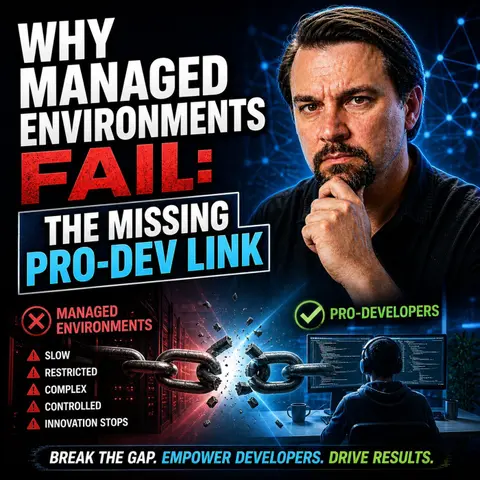
The episode argues that Managed Environments in the Power Platform often fail to deliver on their promise because organizations misunderstand what they actually solve. They are introduced as a governance layer meant to bring control, visibility, and order to low-code environments—but in practice, they frequently slow things down without enabling real delivery.
The core problem is the missing connection between low-code governance and professional development practices. Companies tend to focus heavily on restrictions, policies, and administrative controls, but they don’t invest in proper engineering foundations like ALM, architecture, testing, and scalable design. As a result, the platform becomes constrained without becoming more reliable or production-ready.
This creates a gap: citizen developers are limited by governance, while pro developers are not properly integrated into the platform. Instead of working together, both worlds operate separately. The outcome is neither agility nor quality—just friction.
The episode emphasizes that Managed Environments are not a complete solution on their own. They need to be combined with a strong engineering model. Governance should not just restrict behavior; it should enable structured, scalable development.
The key takeaway is that success in the Power Platform requires bridging the gap between low-code makers and professional developers. Without that link, Managed Environments don’t fix the chaos—they just reorganize it into a slower, more controlled form.
You often see a disconnect between power platform governance and delivery in large organizations. Many teams struggle to turn policies into real results. Complex coordination and balancing innovation with control can slow progress. In your environment, bottlenecks and resource constraints may limit agility and engagement. The table below highlights common challenges:
| Challenge | Description |
|---|---|
| Complex coordination | Central and local teams must communicate and align effectively. |
| Bottlenecks | Delays occur when central teams handle too many requests. |
| Employee disengagement | Teams lose ownership and motivation during the process. |
You need strategies to bridge the gap and make governance work in practice.
Key Takeaways
- Understand governance as the framework for managing data, apps, and reports securely.
- Align governance with delivery to balance control and innovation in your organization.
- Implement practical tools like approval workflows to bridge the gap between policy and practice.
- Foster a culture that supports governance by involving both IT and business teams in discussions.
- Monitor key metrics to measure the success of your governance strategy and make necessary adjustments.
- Use Managed Environments to enhance control and visibility over your Power Platform solutions.
- Empower teams with training and resources to encourage adoption and innovation.
- Adopt a dual approach to governance that accommodates both low-code and pro-code development needs.
Understanding Power Platform Governance
Governance Defined
You need a clear understanding of governance to manage your Power Platform environment. Governance means setting up rules, roles, and processes to keep your data, apps, and reports secure and compliant. It helps you control who can create, share, and change solutions. Good governance also supports adoption by making sure everyone knows their responsibilities.
Here is a table that shows important aspects of Power Platform governance:
| Aspect | Description |
|---|---|
| Audit Logging | Tracks changes and access to data for compliance and reporting. |
| Compliance | Ensures your organization meets legal and industry standards. |
| Governance Framework | Defines roles for admins and users, and sets up policies for security and data governance. |
| Continuous Improvement | Uses feedback and audits to update governance practices as your needs change. |
You should also create a governance strategy that includes regular audits, a central place for training, and clear policies. This approach helps you manage risk and support innovation.
Delivery Explained
Delivery focuses on building and launching solutions that solve business problems. You and your team use Power Platform tools to create apps, automate tasks, and build BI reports. Delivery needs structure, clear roles, and a plan that matches your organization’s goals.
Here is how delivery differs from governance:
| Aspect | Governance Process | Delivery Process |
|---|---|---|
| Focus | Risk management, security, and enabling users | Structured roles and project alignment |
| Objectives | Empower users and minimize risks | Meet business goals and deliver value |
| Challenges | Overloaded IT, lack of control, slow adoption | Fast pace, unclear ownership, lifecycle management issues |
You must balance delivery speed with control. If you move too fast, you risk losing control over data and reporting. If you move too slow, you may block innovation.
Interdependencies
Governance and delivery depend on each other. You need governance to set boundaries and protect your environment. At the same time, you need delivery to drive adoption and show the value of Power Platform. When you align governance frameworks with delivery, you support both compliance and business goals.
- Governance gives you control and helps you manage change.
- Delivery brings innovation and solves real problems.
- Both need clear policies, strong data governance, and good reporting.
Tip: Involve both IT and business teams in your governance board. This helps you create policies that work for everyone and support Power BI governance and BI reporting needs.
When you connect governance and delivery, you build a strong foundation for Power Platform success. You can manage risk, support change control, and drive adoption across your organization.
The Missing Link in Governance Models
Policy vs. Practice
You often see a gap between governance policies and real-world delivery. Policies set rules for your environment, but they do not always translate into effective action. Many organizations struggle to track active makers and solutions in production. This lack of visibility leads to ungoverned solutions and weak accountability. You may find that your governance foundation does not support sustainable community growth. As a result, adoption slows and the value of the platform remains unrealized.
You can address this gap by using practical tools and workflows. For example, you might:
- Implement approval workflows for new environment requests.
- Set up formal approval processes for changes to data policies.
- Use automation kits like the CoE Starter Kit to manage requests.
- Establish workflows for user management changes.
- Review and approve governance settings regularly.
These steps help you align your governance strategy with real-world needs. You gain control over data and reporting, which supports compliance and bi governance. You also build a foundation for change control and strategic decision-making.
The Human Factor
Culture shapes how you approach governance. Your organization’s size and values influence what good governance looks like. You need to tailor your governance model to fit your unique context. Corporate culture determines how teams respond to policies and how they adopt new practices.
Consider these points:
- Governance models must match your organizational culture.
- Culture affects the effectiveness of governance.
- You should define governance based on your team’s needs and values.
When you align governance with culture, you encourage innovation and adoption. You empower teams to make decisions and share insights. This approach helps you build a strong bi community and supports power bi governance.
Note: Involve your business and IT teams in governance discussions. This creates a sense of ownership and improves adoption.
The Ghost Town Effect
You may notice the ghost town effect when initial governance measures create excitement but fail to sustain engagement. Teams start strong, but adoption drops as the platform becomes difficult to use for complex solutions. Delays and unclear ownership cause frustration. Confidence in the platform fades, and teams quietly abandon tools meant to boost productivity.
This effect leads to shadow IT, where teams move critical workloads to unmanaged systems. You lose control and visibility, making compliance and reporting harder. The ghost town effect blocks innovation and reduces the value of your environment.
To prevent this, you need a governance strategy that supports both simple and advanced workloads. You should focus on clear ownership, strong change control, and regular communication. These steps help you maintain adoption and drive bi insights across your organization.
Tip: Track key metrics like active makers and solutions in production. This gives you real insights into adoption and helps you adjust your governance strategy.
You bridge the gap between policy and practice by focusing on culture, practical workflows, and ongoing engagement. You build a sustainable environment that supports governance, delivery, and innovation.
Managed Environments: Promise vs. Reality

Control and Visibility
Managed Environments in Power Platform offer you a structured way to manage your environment. You gain tools that help you set clear policies, assign ownership, and monitor activity. This approach supports power platform governance by giving you more control and visibility over your data, apps, and users. You can break large environments into smaller, focused ones. Each environment has a clear owner, which makes accountability simple. Admin tools provide summary insights, so you can track bi usage and reporting with ease.
Here is a table that shows the main benefits of Managed Environments, as recognized by Microsoft and industry experts:
| Benefit | Description |
|---|---|
| Governance | Tools for managing Power Platform at scale with less effort. |
| Security | Enterprise-grade features like data loss prevention and access management. |
| Compliance | Standardized processes and automated data validation. |
| Innovation | Rapid innovation within a secure and controlled environment. |
| Risk Mitigation | Balances creativity with risk management for data integrity and regulatory compliance. |
You can use these features to support bi governance and power bi governance, ensuring that your organization meets compliance needs while encouraging innovation.
Productivity Barriers
You may face productivity barriers when you use Managed Environments. Sometimes, teams resist change because they worry about data loss or do not see the value in new tools. Some people think Power Platform is only for demos, not for real business solutions. Others may not have enough time or support to learn new ways of working. Leaders might not buy in, which slows adoption and makes it hard to build momentum.
Here are some common productivity barriers and ways to address them:
- IT teams may fear data loss. You can show them the strong governance and security features.
- Some users do not know what to build. Host show-and-tell sessions to spark ideas.
- Developers may worry about job security. Explain how they can add value by building APIs and custom components.
- People may not have time or training. Offer support and highlight how Power Platform saves time.
You can overcome these barriers by communicating benefits, providing training, and recognizing hard work. This strategy helps you drive adoption and build a strong bi community.
Shadow IT Risks
Shadow IT happens when teams use tools outside your approved environment. This can create risks for data security, compliance, and reporting. In large enterprises, shadow IT can account for up to 40% of IT spending. About 41% of employees use shadow IT practices, and 57% of small and medium businesses struggle with shadow technology.
You can reduce shadow IT risks by using clear governance policies and strong change control. Assign ownership, monitor bi usage, and keep communication open. When you support both business and IT teams, you build trust and keep critical workloads inside your managed environment.
Tip: Use M365.fm resources to stay updated on best practices for power platform governance, bi governance, and power bi governance. This helps you align your strategy with your organization’s goals and maintain compliance.
Dual Approach to Governance

Low-Code vs. Pro-Code Needs
You face a unique challenge when you try to balance low-code and pro-code development in your environment. Low-code tools let business users build apps quickly, while pro-code solutions require deeper engineering skills. You need a governance model that supports both approaches. Managed Environments give IT admins insight cards to monitor top makers, apps, and flows. Solution Checker tools alert you when solutions break security or performance rules. Automated ALM support helps you move solutions securely and keeps audit trails for compliance. These tools help you maintain control and quality as you scale your adoption.
| Governance Approach | Description |
|---|---|
| Managed Environments | IT admins use insight cards to monitor makers, apps, and flows for tenant hygiene. |
| Solution Checker Tool | Alerts IT about security, performance, or reliability issues before production deployment. |
| Automated ALM Support | Simplifies lifecycle management and provides visibility and audit trails for IT. |
You need to match your governance strategy to the needs of both business users and professional developers. This approach supports innovation and ensures your bi solutions meet compliance standards.
Separating Workloads
You must separate workloads to keep your environment organized and secure. Environment segmentation helps you create tiers for development, testing, staging, and production. Managed Environments apply unified policies across these tiers, supporting governance and security. Secure ALM pipelines protect your data and help you meet regulatory requirements. You should communicate with makers and users to gain support for your environment strategy. Make sure low-code developers know where to build their applications.
| Key Component | Description |
|---|---|
| Environment Segmentation | Tiered environments for development, testing, staging, and production. |
| Managed Environments | Unified policies for governance and security across all environments. |
| Secure ALM Pipelines | Regulatory compliance and collaboration without data leakage. |
- Identify if a low-code app can reduce manual work.
- Assess the risk of the low-code solution.
- Decide if the process needs stronger engineering discipline for compliance or customer commitments.
This process helps you keep bi workloads organized and supports power bi governance.
Fusion of Business and Engineering
You drive innovation when you bring business and engineering teams together. Fusion teams include business technologists, professional developers, and IT departments. You collaborate and co-develop apps using Power Apps, which bridges the gap between business and engineering. Co-development best practices reduce silos and optimize application delivery. You build a strong bi community by encouraging teamwork and sharing insights.
Tip: Form fusion teams to enhance collaboration and support bi governance. This approach helps you manage change and build solutions that meet business needs.
You create a governance model that adapts to your organization’s needs. You support adoption, maintain control, and foster innovation. This dual approach helps you build a sustainable environment for power platform governance.
Embedding Lifecycle Practices
Source Control
You need to treat your Power Platform solutions like any other software project. Source control helps you track every change, protect your work, and improve collaboration. When you use source control, you can roll back mistakes and see who made each update. This practice builds trust and keeps your environment organized.
To integrate source control into your governance model, follow these steps:
- Set up continuous integration pipelines for your solutions.
- Connect these pipelines to your source control system.
- Run the pipeline every time someone creates a pull request. This should include tests and security checks.
- Give real-time feedback on quality by showing test results in pull requests.
- Display build status with small reports or badges in your source control system.
These steps help you maintain control and support bi governance. You can see the current state of your solutions and make better decisions about adoption and change.
Release Pipelines
Release pipelines automate how you move solutions from development to production. They help you deliver updates faster and with fewer errors. You can use release pipelines to enforce policies and keep your data safe.
Here is a table that shows how release pipelines improve your Power Platform projects:
| Benefit/Feature | Description |
|---|---|
| Centralized Management | Admins can govern projects at scale with less effort, ensuring compliance. |
| Improved Productivity | Pipelines boost productivity for makers, developers, and admins. |
| Cost Efficiency | Lower total cost of ownership through streamlined processes. |
| Compliance and Safety | Secure environments with approval-based deployments and audit logs. |
| Scalability | Pipelines adapt to your business needs and support gradual ALM adoption. |
Release pipelines help you manage bi workloads and keep your environment secure. You can deliver value quickly while following your organization’s policies.
Ownership Models
Clear ownership is key for lifecycle management. You should not treat ownership as an afterthought. It forms the foundation for responsible Power Platform use. You need to make sure every app, flow, and report has a clear owner.
Follow these steps to build strong ownership models:
- Recognize that ownership is essential for governance and bi success.
- Assign co-owners for all non-personal assets. This gives you backup if someone leaves or changes roles.
- Use service accounts or application users for critical or long-running automations.
You can also use tools like the Center of Excellence Starter Kit to track ownership. PowerShell scripts help you audit and fix ownership gaps. Some organizations use Syskit Point for extra management features.
When you set up strong ownership models, you support adoption and keep your environment healthy. You also make it easier to manage bi solutions and protect your data.
CI/CD Integration
You can boost your Power Platform projects by integrating CI/CD practices. CI/CD stands for Continuous Integration and Continuous Delivery. These practices help you automate the process of building, testing, and deploying solutions. You gain faster releases, fewer errors, and better quality. You also keep your environment organized and secure.
You start by connecting your Power Platform solutions to a source control system. This system tracks every change and protects your work. You can set up pipelines that run tests and check for issues each time you update your solution. These pipelines help you catch problems early and keep your bi workloads running smoothly.
Here is a simple workflow for CI/CD integration:
- You commit your solution to source control.
- The pipeline runs tests and checks for security issues.
- You review the results and fix any errors.
- The pipeline deploys your solution to a test environment.
- You approve the deployment and move it to production.
Tip: Use automated pipelines to enforce your policies and keep your data safe. You can set rules that block deployments if tests fail or if security checks find problems.
You can use tools like Azure DevOps or GitHub Actions to build your pipelines. These tools let you automate tasks and keep your bi solutions up to date. You can also set up approval steps to make sure only trusted changes reach production. This gives you more control and helps you meet compliance requirements.
Here is a table that shows the benefits of CI/CD integration:
| Benefit | Description |
|---|---|
| Faster Releases | You deliver bi solutions quickly and respond to business needs. |
| Fewer Errors | Automated tests catch mistakes before they reach users. |
| Stronger Control | You enforce policies and protect your environment. |
| Better Quality | You improve bi solution quality with regular testing. |
| Data Security | Pipelines keep your data safe and support compliance. |
You can also use CI/CD to support change management. When you automate deployments, you reduce manual work and make it easier to track updates. You build trust in your environment and encourage teams to adopt best practices.
Note: CI/CD integration is not just for developers. Business users can benefit from automated testing and deployment. You help everyone deliver bi solutions faster and with more confidence.
You create a strong foundation for Power Platform governance when you embed CI/CD practices. You support innovation, maintain control, and protect your data. You also make it easier to enforce your policies and drive adoption across your organization.
Aligning Governance with Delivery
Collaborative Models
You can align governance with delivery by adopting collaborative models that fit your organization’s culture and user needs. Many successful companies use a mix of centralized and decentralized approaches. For example:
- Equinor blends central and local teams, letting decentralized groups develop solutions while keeping overall control.
- Zurich organizes nearly 20 teams by business unit or country, balancing governance with empowerment.
- Schlumberger supports innovation through a strong Center of Excellence, which maintains compliance and control.
These models show that you can create an environment where business and IT teams work together. You set clear policies, but you also give teams the freedom to solve problems and share insights. This approach helps you manage bi workloads and adapt to change.
Empowering Teams
Empowering both IT and business users is key to successful Power Platform governance. You can use several practical methods to support your teams:
| Method | Description |
|---|---|
| Governance-first approach | Set guardrails before adoption, creating safe boundaries for innovation. |
| Center of Excellence (CoE) | Build an operational backbone for governance, enabling faster and safer development. |
| Data Loss Prevention (DLP) | Use policies to ensure responsible and secure use of data across the platform. |
| Community of practice | Foster user enablement and training, giving citizen developers resources and support. |
You can also provide training programs, establish governance templates, and create communities of practice. These steps help you build skills, encourage collaboration, and support bi adoption. When you empower teams, you unlock new insights and drive better results.
Measuring Success
You need to measure how well your governance aligns with delivery. Tracking the right metrics gives you a clear view of progress and highlights areas for improvement. Here are some common metrics:
| Metric | Description |
|---|---|
| Incident response time | Time taken to identify and resolve issues before and after implementation. |
| Efficiency improvement | Time saved on tasks after using Power Platform solutions. |
| Revenue increase | Impact on revenue after new applications or processes go live. |
| Employee productivity | Output and time taken to complete tasks before and after implementation. |
| Total cost of ownership | All costs of owning and maintaining systems compared to Power Platform costs. |
| Employee satisfaction | Survey results and analytics before and after new system implementation. |
| Brand reputation | Public perception of your company’s products and services. |
| Employee skills and capabilities | Workforce skills and knowledge contributing to success. |
| Innovation | Ability to develop new products or services that meet market demands. |
You can use these metrics to gain bi insights and show the value of your governance strategy. Regular measurement helps you adjust your approach, maintain control, and support ongoing improvement.
Tip: Align your metrics with business goals to ensure your governance delivers real value.
You can bridge the gap between governance and delivery by adopting adaptive, dual-mode governance and strong lifecycle practices. This approach helps you manage risks, support innovation, and improve efficiency. Start by assessing your Managed Environments, defining clear roles, and using tools like the CoE Starter Kit for monitoring. For ongoing improvement, review resources such as the Microsoft Power Customer Advisory Team and stay updated on Power Platform features. These steps help you build a secure, flexible, and effective governance strategy.
🎧 Listen to this episode
Want a practical explanation of Power Platform Managed Environments Need Pro-Dev Practices? This episode breaks down the topic in clear language and shows why it matters for Microsoft 365, Azure, Power Platform, security, AI, and modern work.
Listen to this episode if you want to:
- Understand the key concepts behind Power Platform Managed Environments Need Pro-Dev Practices
- See how it fits into the wider Microsoft technology ecosystem
- Learn where it can create practical value for your organization
You may also enjoy these related M365 FM episodes:
- Azure Managed Disks - Simply Explained
- Managed Identities - Simply Explained
- Power Platform Governance Best Practices with Craig White [MVP]
- Use Managed Identity with PowerShell for Microsoft Graph
- Migrate Azure File Sync to Managed Identity
Discover more practical Microsoft conversations on M365 FM.
🚀 Want to be part of m365.fm?
Then stop just listening… and start showing up.
👉 Connect with me on LinkedIn and let’s make something happen:
- 🎙️ Be a podcast guest and share your story
- 🎧 Host your own episode (yes, seriously)
- 💡 Pitch topics the community actually wants to hear
- 🌍 Build your personal brand in the Microsoft 365 space
This isn’t just a podcast — it’s a platform for people who take action.
🔥 Most people wait. The best ones don’t.
👉 Connect with me on LinkedIn and send me a message:
"I want in"
Let’s build something awesome 👊
1
00:00:00,000 --> 00:00:02,480
Managed environments were supposed to fix the mess.
2
00:00:02,480 --> 00:00:05,080
The promise was simple, more control, better visibility,
3
00:00:05,080 --> 00:00:06,400
and an end to the chaos.
4
00:00:06,400 --> 00:00:08,360
But in reality, for most organizations,
5
00:00:08,360 --> 00:00:09,720
they do the exact opposite.
6
00:00:09,720 --> 00:00:11,320
They lock the platform down just enough
7
00:00:11,320 --> 00:00:13,620
to slow down real work, yet they don't provide
8
00:00:13,620 --> 00:00:16,040
nearly enough support for what serious delivery actually
9
00:00:16,040 --> 00:00:16,920
requires.
10
00:00:16,920 --> 00:00:19,760
Teams buy into the governance story, flip on the controls,
11
00:00:19,760 --> 00:00:22,240
and pay the premium price tag, only to wonder
12
00:00:22,240 --> 00:00:24,560
why their most important apps have stalled.
13
00:00:24,560 --> 00:00:26,560
They watch as releases feel more risky,
14
00:00:26,560 --> 00:00:28,600
and notice that their best developers are quietly
15
00:00:28,600 --> 00:00:30,160
moving the hard work somewhere else.
16
00:00:30,160 --> 00:00:31,160
That's where it breaks.
17
00:00:31,160 --> 00:00:33,040
The problem here isn't the existence of governance
18
00:00:33,040 --> 00:00:34,840
because you absolutely need it to function.
19
00:00:34,840 --> 00:00:36,440
The real issue is the model behind it.
20
00:00:36,440 --> 00:00:38,920
Most teams build guard rails designed for casual makers,
21
00:00:38,920 --> 00:00:40,660
then they try to force professional development
22
00:00:40,660 --> 00:00:42,560
work through that same narrow lane.
23
00:00:42,560 --> 00:00:45,280
This happens even when the app depends on source control,
24
00:00:45,280 --> 00:00:47,400
repeatable deployments, and stable integrations
25
00:00:47,400 --> 00:00:48,960
across multiple systems.
26
00:00:48,960 --> 00:00:51,640
Friction starts to pile up, ownership becomes fuzzy,
27
00:00:51,640 --> 00:00:53,960
and delivery slows to a crawl until trust in the system
28
00:00:53,960 --> 00:00:54,920
eventually drops.
29
00:00:54,920 --> 00:00:56,840
What I want to do here is straightforward.
30
00:00:56,840 --> 00:00:58,320
I want to show you why this fails.
31
00:00:58,320 --> 00:01:00,680
Identify exactly where the missing link sits,
32
00:01:00,680 --> 00:01:02,600
and show you what the bridge to a better system
33
00:01:02,600 --> 00:01:04,280
actually looks like.
34
00:01:04,280 --> 00:01:06,480
The ghost town effect of locked governance.
35
00:01:06,480 --> 00:01:08,680
The first pattern most teams miss is what I call
36
00:01:08,680 --> 00:01:11,480
the ghost town effect on paper everything looks clean.
37
00:01:11,480 --> 00:01:13,760
The policies are in place, sharing is tighter,
38
00:01:13,760 --> 00:01:16,200
and connector use is finally under control.
39
00:01:16,200 --> 00:01:19,040
Admins can see more of what exists than ever before,
40
00:01:19,040 --> 00:01:22,480
so it feels like progress, and in one sense, it is.
41
00:01:22,480 --> 00:01:24,160
Managed environments can reduce chaos,
42
00:01:24,160 --> 00:01:26,440
but they only manage the specific kind of chaos
43
00:01:26,440 --> 00:01:29,560
they were built for, which is mostly unmonitored maker activity
44
00:01:29,560 --> 00:01:32,920
and weak operational hygiene around low-code assets.
45
00:01:32,920 --> 00:01:34,200
That part matters.
46
00:01:34,200 --> 00:01:36,160
But the moment you treat that specific model
47
00:01:36,160 --> 00:01:37,960
as your entire operating strategy,
48
00:01:37,960 --> 00:01:40,480
adoption starts freezing instead of scaling.
49
00:01:40,480 --> 00:01:43,400
The platform becomes better governed for simple use cases,
50
00:01:43,400 --> 00:01:45,360
but it simultaneously becomes much harder
51
00:01:45,360 --> 00:01:48,440
to use for the complex projects that carry real business
52
00:01:48,440 --> 00:01:50,320
weight across departments and systems.
53
00:01:50,320 --> 00:01:51,360
And that change is subtle.
54
00:01:51,360 --> 00:01:52,880
You don't see this as a sudden failure.
55
00:01:52,880 --> 00:01:55,000
Instead, you see it as a series of delays.
56
00:01:55,000 --> 00:01:57,040
One team wants to connect to a system that requires
57
00:01:57,040 --> 00:02:00,000
a more complex design, while another app needs a proper test
58
00:02:00,000 --> 00:02:02,000
path before it can go into production.
59
00:02:02,000 --> 00:02:03,680
A flow might need stronger ownership
60
00:02:03,680 --> 00:02:05,600
because the original builder changed roles,
61
00:02:05,600 --> 00:02:07,840
but the business unit weights through connector reviews
62
00:02:07,840 --> 00:02:09,440
and approval friction.
63
00:02:09,440 --> 00:02:11,080
Nothing looks dramatic in the moment,
64
00:02:11,080 --> 00:02:13,560
but the energy is slowly leaking out of the platform.
65
00:02:13,560 --> 00:02:14,840
People stop asking.
66
00:02:14,840 --> 00:02:17,040
That is the specific moment most of your dashboards
67
00:02:17,040 --> 00:02:18,080
will never show you.
68
00:02:18,080 --> 00:02:19,400
Your inventory might look healthier
69
00:02:19,400 --> 00:02:22,040
even as confidence gets worse, because the real issue
70
00:02:22,040 --> 00:02:24,360
isn't whether the platform is visible to IT.
71
00:02:24,360 --> 00:02:26,040
The issue is whether the platform can actually
72
00:02:26,040 --> 00:02:29,400
deliver results once a request moves beyond a simple departmental
73
00:02:29,400 --> 00:02:32,040
app and starts touching real enterprise dependencies.
74
00:02:32,040 --> 00:02:33,680
So what happens next is predictable.
75
00:02:33,680 --> 00:02:35,720
Business teams go quiet and build far less
76
00:02:35,720 --> 00:02:38,120
than they originally planned, while the pro-dev teams
77
00:02:38,120 --> 00:02:39,960
root around the power platform entirely.
78
00:02:39,960 --> 00:02:41,240
They don't want a delivery path that
79
00:02:41,240 --> 00:02:43,920
depends on manual movements and unclear ownership,
80
00:02:43,920 --> 00:02:46,040
especially when integration patterns don't hold up
81
00:02:46,040 --> 00:02:46,880
under pressure.
82
00:02:46,880 --> 00:02:48,240
What you might call governed adoption
83
00:02:48,240 --> 00:02:50,240
is actually just quiet abandonment.
84
00:02:50,240 --> 00:02:52,160
And when your delivery capacity stays below what
85
00:02:52,160 --> 00:02:54,640
the business demands, Shadow IT doesn't just disappear.
86
00:02:54,640 --> 00:02:55,360
It shifts.
87
00:02:55,360 --> 00:02:59,040
Research shows that Shadow IT still consumes about 30% to 40%
88
00:02:59,040 --> 00:03:01,160
of IT spend in large enterprises, which
89
00:03:01,160 --> 00:03:03,200
proves that tighter control by itself
90
00:03:03,200 --> 00:03:05,040
doesn't remove the underlying need.
91
00:03:05,040 --> 00:03:07,240
It only changes where that unmet demand goes.
92
00:03:07,240 --> 00:03:08,960
You might shrink one kind of sprawl,
93
00:03:08,960 --> 00:03:11,360
but hidden side systems start growing somewhere else.
94
00:03:11,360 --> 00:03:13,120
This is why cleaning up your default environment
95
00:03:13,120 --> 00:03:15,640
can look like a win while the actual problem gets worse.
96
00:03:15,640 --> 00:03:17,680
The visible mess might shrink, but the enterprise
97
00:03:17,680 --> 00:03:20,160
need for absent automations never goes away.
98
00:03:20,160 --> 00:03:22,760
If the governed path feels too slow or too brittle
99
00:03:22,760 --> 00:03:24,920
for people to use, they will find another way
100
00:03:24,920 --> 00:03:26,200
to get their work done.
101
00:03:26,200 --> 00:03:27,840
Sometimes that means using another platform,
102
00:03:27,840 --> 00:03:29,800
and sometimes it means going back to spreadsheets
103
00:03:29,800 --> 00:03:30,880
and personal accounts.
104
00:03:30,880 --> 00:03:32,360
And then the cost shows up.
105
00:03:32,360 --> 00:03:34,160
It isn't just about security exposure.
106
00:03:34,160 --> 00:03:36,480
It shows up as waste in the form of underused environments
107
00:03:36,480 --> 00:03:39,320
and premium licenses attached to apps that nobody wants to touch.
108
00:03:39,320 --> 00:03:40,840
Solutions are left in place because nobody
109
00:03:40,840 --> 00:03:43,480
trust the release path enough to try and improve them.
110
00:03:43,480 --> 00:03:46,480
You end up with orphaned flows that are still vital to a process,
111
00:03:46,480 --> 00:03:48,080
but they aren't important enough for anyone
112
00:03:48,080 --> 00:03:49,960
to take proper ownership of them.
113
00:03:49,960 --> 00:03:51,840
Over time, the tenant fills up with assets
114
00:03:51,840 --> 00:03:54,040
that are technically governed but operationally dead.
115
00:03:54,040 --> 00:03:54,920
That is the ghost town.
116
00:03:54,920 --> 00:03:56,840
The structure is there, the policy is there,
117
00:03:56,840 --> 00:03:58,080
and the platform is there.
118
00:03:58,080 --> 00:03:59,400
But the real work moved elsewhere
119
00:03:59,400 --> 00:04:01,880
because the system was designed to control makers
120
00:04:01,880 --> 00:04:03,520
instead of carrying software delivery.
121
00:04:03,520 --> 00:04:05,680
Once you see that, the deeper split becomes obvious.
122
00:04:05,680 --> 00:04:07,600
You have low-code governance on one side
123
00:04:07,600 --> 00:04:10,080
and software delivery on the other.
124
00:04:10,080 --> 00:04:12,240
The hidden wall between low-code and pro-code.
125
00:04:12,240 --> 00:04:15,480
Once you see that split, the next problem comes into focus fast.
126
00:04:15,480 --> 00:04:17,400
Most organizations still run power platform
127
00:04:17,400 --> 00:04:19,320
with a citizen, develop a governance model,
128
00:04:19,320 --> 00:04:20,880
even when the workload clearly stopped
129
00:04:20,880 --> 00:04:23,080
being citizen development a long time ago.
130
00:04:23,080 --> 00:04:25,640
The app may start as a quick business fix, but then it grows.
131
00:04:25,640 --> 00:04:29,160
More users, more data, more dependencies, more teams touching it.
132
00:04:29,160 --> 00:04:31,240
At that point, it isn't just a handy app anymore.
133
00:04:31,240 --> 00:04:32,760
It's part of the business system.
134
00:04:32,760 --> 00:04:35,400
But the operating model around it often stays exactly the same.
135
00:04:35,400 --> 00:04:37,440
That's the wall because enterprise apps
136
00:04:37,440 --> 00:04:38,880
don't end at screens and flows.
137
00:04:38,880 --> 00:04:41,040
They live inside change, requirements shift,
138
00:04:41,040 --> 00:04:44,680
teams change, systems upstream change, security rules change.
139
00:04:44,680 --> 00:04:47,880
So the thing that matters most is not only how fast you can build it.
140
00:04:47,880 --> 00:04:50,920
It's how safely you can change it later without breaking production,
141
00:04:50,920 --> 00:04:54,400
exposing data or losing track of what version is actually running.
142
00:04:54,400 --> 00:04:57,600
Makers and ProDevs usually optimize for different things.
143
00:04:57,600 --> 00:04:59,200
Makers work close to the process.
144
00:04:59,200 --> 00:05:02,360
They want speed because they're solving a problem they can see right now.
145
00:05:02,360 --> 00:05:03,080
That's valid.
146
00:05:03,080 --> 00:05:06,040
It's often the whole reason power platform works in the first place.
147
00:05:06,040 --> 00:05:08,400
ProDevs look at the same app and ask a different question.
148
00:05:08,400 --> 00:05:10,920
Not just can we build it, they ask can we keep changing this
149
00:05:10,920 --> 00:05:13,680
for the next year with confidence while multiple people touch it,
150
00:05:13,680 --> 00:05:15,200
while releases happen under pressure
151
00:05:15,200 --> 00:05:17,240
and while downstream systems keep moving.
152
00:05:17,240 --> 00:05:18,600
Those are not competing goals.
153
00:05:18,600 --> 00:05:20,480
They're different layers of the same system,
154
00:05:20,480 --> 00:05:22,800
but here's where most teams get stuck.
155
00:05:22,800 --> 00:05:26,440
Managed environments handle access, monitoring and policy.
156
00:05:26,440 --> 00:05:27,560
They help with administration.
157
00:05:27,560 --> 00:05:29,960
They give you more control over where things live
158
00:05:29,960 --> 00:05:32,280
and how people behave inside the platform.
159
00:05:32,280 --> 00:05:35,200
What they do not do is replace software lifecycle discipline.
160
00:05:35,200 --> 00:05:37,240
They don't magically create source control habits.
161
00:05:37,240 --> 00:05:39,080
They don't create a branching strategy.
162
00:05:39,080 --> 00:05:40,480
They don't validate builds.
163
00:05:40,480 --> 00:05:42,360
They don't define release approvals,
164
00:05:42,360 --> 00:05:45,400
roll back parts or interface contracts between systems.
165
00:05:45,400 --> 00:05:46,760
And when those things are missing,
166
00:05:46,760 --> 00:05:49,280
every serious app starts turning into a one off.
167
00:05:49,280 --> 00:05:50,560
One team knows how it works.
168
00:05:50,560 --> 00:05:52,240
One person knows how it deploys.
169
00:05:52,240 --> 00:05:54,040
One manual sequence moves it forward.
170
00:05:54,040 --> 00:05:57,320
One undocumented assumption holds the integration together
171
00:05:57,320 --> 00:06:00,520
that's manageable right up until someone leaves the app gets copied
172
00:06:00,520 --> 00:06:02,840
or a production issue lands on a Friday afternoon
173
00:06:02,840 --> 00:06:05,160
and nobody can tell whether the latest fix ever made it
174
00:06:05,160 --> 00:06:08,280
through all environments in a clean repeatable way.
175
00:06:08,280 --> 00:06:10,640
This clicked for me when I saw how many teams were calling
176
00:06:10,640 --> 00:06:13,440
enterprise apps low code as if that removed the need
177
00:06:13,440 --> 00:06:14,240
for engineering.
178
00:06:14,240 --> 00:06:14,920
It doesn't.
179
00:06:14,920 --> 00:06:16,360
Low code changes how you build.
180
00:06:16,360 --> 00:06:18,760
It does not remove the need to manage change.
181
00:06:18,760 --> 00:06:20,520
If anything, it makes that more urgent
182
00:06:20,520 --> 00:06:22,720
because the platform lowers the barrier to creation
183
00:06:22,720 --> 00:06:25,800
far faster than most organizations raise the maturity
184
00:06:25,800 --> 00:06:26,920
of delivery around it.
185
00:06:26,920 --> 00:06:28,680
So the missing link is pretty clear.
186
00:06:28,680 --> 00:06:30,840
You need source control for shared solutions.
187
00:06:30,840 --> 00:06:33,360
You need branching when several people work at once.
188
00:06:33,360 --> 00:06:35,240
You need build validation before release.
189
00:06:35,240 --> 00:06:37,960
You need deployment approvals for higher risk changes.
190
00:06:37,960 --> 00:06:41,280
You need a roll back path when inputs fail or dependencies break.
191
00:06:41,280 --> 00:06:43,520
And you need clear contracts for how apps and flows
192
00:06:43,520 --> 00:06:46,840
talk to other systems so integration doesn't depend on guesswork.
193
00:06:46,840 --> 00:06:50,800
Research around CICD maturity keeps pointing in the same direction.
194
00:06:50,800 --> 00:06:53,440
Teams with stronger DevOps practices get better deployment
195
00:06:53,440 --> 00:06:55,440
reliability that shouldn't surprise anyone.
196
00:06:55,440 --> 00:06:57,440
Change becomes safer when it's repeatable.
197
00:06:57,440 --> 00:06:59,680
And this is exactly where the simpler native experience
198
00:06:59,680 --> 00:07:01,440
in Power Platform starts to top out.
199
00:07:01,440 --> 00:07:02,840
Native pipelines help.
200
00:07:02,840 --> 00:07:05,560
They reduce friction for smaller teams in simpler parts.
201
00:07:05,560 --> 00:07:06,400
That matters.
202
00:07:06,400 --> 00:07:08,920
But once multiple developers, multiple environments,
203
00:07:08,920 --> 00:07:12,320
and unfinished work start colliding, orchestration becomes the issue.
204
00:07:12,320 --> 00:07:14,000
That's where Azure DevOps still matters.
205
00:07:14,000 --> 00:07:17,200
Not because every Power Platform team needs maximum complexity.
206
00:07:17,200 --> 00:07:19,200
But because serious delivery needs a system
207
00:07:19,200 --> 00:07:22,040
that can coordinate artifacts, secrets, approvals,
208
00:07:22,040 --> 00:07:25,040
reusable YAML and environment specific release steps
209
00:07:25,040 --> 00:07:26,760
without relying on memory.
210
00:07:26,760 --> 00:07:30,160
Once that wall between low code and pro code goes unaddressed,
211
00:07:30,160 --> 00:07:32,600
the first thing that starts failing isn't policy.
212
00:07:32,600 --> 00:07:33,560
It's delivery.
213
00:07:33,560 --> 00:07:36,120
Why delivery fails without embedded CICD?
214
00:07:36,120 --> 00:07:38,360
This is usually where teams feel the pain first,
215
00:07:38,360 --> 00:07:41,040
because delivery is the part nobody can fake for long.
216
00:07:41,040 --> 00:07:42,720
You can live with rough governance for a while.
217
00:07:42,720 --> 00:07:45,280
You can live with weak ownership longer than you should.
218
00:07:45,280 --> 00:07:48,120
But once releases start slipping, imports fail, variables drift,
219
00:07:48,120 --> 00:07:51,480
and nobody can explain exactly what change between test and production,
220
00:07:51,480 --> 00:07:53,160
the platform stops feeling safe.
221
00:07:53,160 --> 00:07:55,560
Manual export and import is the usual starting point.
222
00:07:55,560 --> 00:07:56,880
At first, it looks fine.
223
00:07:56,880 --> 00:08:00,880
One person exports a solution from development, imports it into test,
224
00:08:00,880 --> 00:08:04,040
fixes a connection reference, updates an environment variable,
225
00:08:04,040 --> 00:08:06,000
then repeats the same thing for production.
226
00:08:06,000 --> 00:08:08,400
For a small setup once in a while, that can work.
227
00:08:08,400 --> 00:08:10,280
The problem starts when the team grows,
228
00:08:10,280 --> 00:08:14,000
the app matters more, or compliance expects a real trail of who changed what,
229
00:08:14,000 --> 00:08:15,600
when and with which approval.
230
00:08:15,600 --> 00:08:17,880
Then the cracks open fast, a solution gets moved,
231
00:08:17,880 --> 00:08:20,760
but the variable values don't match the target environment.
232
00:08:20,760 --> 00:08:22,600
A connection maps to the wrong identity.
233
00:08:22,600 --> 00:08:25,600
Someone imports the wrong version because naming was close enough.
234
00:08:25,600 --> 00:08:28,560
The app works in dev, fails in test, then gets patched by hand
235
00:08:28,560 --> 00:08:30,280
because the release window is closing.
236
00:08:30,280 --> 00:08:32,560
After that, production no longer matches source.
237
00:08:32,560 --> 00:08:35,680
Now every future release carries old confusion inside it.
238
00:08:35,680 --> 00:08:37,040
This is the thing most people miss.
239
00:08:37,040 --> 00:08:39,440
Managed environments add order around the container,
240
00:08:39,440 --> 00:08:42,200
but CICD controls movement through the container.
241
00:08:42,200 --> 00:08:43,240
Those are different jobs.
242
00:08:43,240 --> 00:08:45,920
One helps govern the space, the other governs change.
243
00:08:45,920 --> 00:08:50,480
And change is where most enterprise risks it's because every change can break a dependency,
244
00:08:50,480 --> 00:08:54,200
expose a bad assumption, or leave one environment out of sync with the others.
245
00:08:54,200 --> 00:08:58,600
So the path has to be explicit in development teams work with unmanaged solutions.
246
00:08:58,600 --> 00:09:02,400
Those changes need to move into source control, not just into another environment.
247
00:09:02,400 --> 00:09:06,600
From there, the build process creates the managed artifact that should go forward.
248
00:09:06,600 --> 00:09:09,320
That artifact gets promoted into test and production
249
00:09:09,320 --> 00:09:14,200
through gated deployment steps with approvals, configuration handling, connection mapping,
250
00:09:14,200 --> 00:09:17,880
and post-deploy validation built into the path instead of left to memory.
251
00:09:17,880 --> 00:09:20,640
That flow matters because it gives you repeatability.
252
00:09:20,640 --> 00:09:22,960
If a release fails, you know what artifact moved.
253
00:09:22,960 --> 00:09:24,960
If production breaks, you know what changed.
254
00:09:24,960 --> 00:09:27,840
If audit asks who approved the release, you can answer.
255
00:09:27,840 --> 00:09:30,960
If rollback is needed, the previous release artifact exists.
256
00:09:30,960 --> 00:09:34,440
Research on Power Platform ALM keeps landing on the same point.
257
00:09:34,440 --> 00:09:37,760
Build tools and azure pipelines remove a lot of the brittle manual work
258
00:09:37,760 --> 00:09:41,400
by automating export, build, import, variable handling,
259
00:09:41,400 --> 00:09:44,560
and storing release artifacts for traceability and rollback.
260
00:09:44,560 --> 00:09:46,720
That's where azure DevOps earns its place.
261
00:09:46,720 --> 00:09:49,680
Not because native Power Platform pipelines are useless, they aren't.
262
00:09:49,680 --> 00:09:52,360
They help smaller teams, and they lower the barrier for teams
263
00:09:52,360 --> 00:09:54,240
that need a cleaner path than manual imports.
264
00:09:54,240 --> 00:09:56,480
Microsoft has pushed them hard for that reason,
265
00:09:56,480 --> 00:09:58,920
but they don't remove the need for deeper orchestration
266
00:09:58,920 --> 00:10:03,960
when multiple development environments, shared resources, approvals, service connections,
267
00:10:03,960 --> 00:10:08,520
reusable yaml, and secret handling all start colliding in one release process.
268
00:10:08,520 --> 00:10:10,440
Now you're in real delivery territory.
269
00:10:10,440 --> 00:10:12,840
You need service connections with least privilege.
270
00:10:12,840 --> 00:10:14,680
You need secrets outside the solution.
271
00:10:14,680 --> 00:10:17,440
Often in Key Vault, you need reusable pipeline definitions,
272
00:10:17,440 --> 00:10:20,360
so every app team isn't inventing release logic from scratch.
273
00:10:20,360 --> 00:10:22,320
You need smoke tests after deployment.
274
00:10:22,320 --> 00:10:26,120
And you need enough isolation that unfinished resources from one developer
275
00:10:26,120 --> 00:10:27,880
don't pollute the work of another.
276
00:10:27,880 --> 00:10:31,040
Native simplicity helps until team complexity catches up.
277
00:10:31,040 --> 00:10:33,120
After that, simplicity becomes a ceiling.
278
00:10:33,120 --> 00:10:35,480
The business cost is bigger than technical annoyance.
279
00:10:35,480 --> 00:10:39,520
Week ALM slows releases, creates rework, and teaches teams to fear change.
280
00:10:39,520 --> 00:10:42,520
That's when systems become untouchable, not because they're stable,
281
00:10:42,520 --> 00:10:45,280
but because nobody trusts the path enough to improve them.
282
00:10:45,280 --> 00:10:48,120
So fixes get delayed, enhancements get cut,
283
00:10:48,120 --> 00:10:49,880
everyone starts saying, "Leave it alone"
284
00:10:49,880 --> 00:10:52,640
because touching it feels "riskier" than the problem itself.
285
00:10:52,640 --> 00:10:55,000
From an executive view, that's the real gap.
286
00:10:55,000 --> 00:10:57,520
Governance without release engineering can protect policy,
287
00:10:57,520 --> 00:10:59,120
but it can't protect delivery.
288
00:10:59,120 --> 00:11:02,320
An enterprise platform don't fail only when someone breaks a rule.
289
00:11:02,320 --> 00:11:04,520
They fail when change becomes too risky to ship.
290
00:11:04,520 --> 00:11:06,040
Most teams govern access first.
291
00:11:06,040 --> 00:11:10,000
The stronger teams govern change first because that's where operational risk actually shows up.
292
00:11:10,000 --> 00:11:11,360
And deliveries only half of it.
293
00:11:11,360 --> 00:11:14,000
The other half sits in the way these systems connect.
294
00:11:14,000 --> 00:11:17,280
Why integration debt turns managed platforms into liabilities?
295
00:11:17,280 --> 00:11:21,280
This is the moment where most managed environment strategies start looking solid to the admin
296
00:11:21,280 --> 00:11:23,560
but completely fall apart for the business.
297
00:11:23,560 --> 00:11:25,520
The platform looks controlled on the surface,
298
00:11:25,520 --> 00:11:29,040
but underneath the integration model is getting more fragile every single month.
299
00:11:29,040 --> 00:11:33,120
Standard connectors are the reason power platform gets traction so quickly in the first place.
300
00:11:33,120 --> 00:11:36,120
They allow teams to move early, connect common services,
301
00:11:36,120 --> 00:11:39,200
and prove value without waiting for a six month engineering cycle.
302
00:11:39,200 --> 00:11:43,120
That is genuinely useful because it lowers the startup cost of solving a real problem.
303
00:11:43,120 --> 00:11:45,840
But enterprise scale rarely stays inside that simple bubble for long,
304
00:11:45,840 --> 00:11:48,920
and eventually the app is going to need data from a legacy system,
305
00:11:48,920 --> 00:11:51,400
an ERP or a line of business API.
306
00:11:51,400 --> 00:11:54,240
These systems come with stricter security, heavier traffic,
307
00:11:54,240 --> 00:11:56,680
and much more serious consequences when they fail.
308
00:11:56,680 --> 00:12:00,880
That is exactly where teams start stretching low-code patterns way past their design limits.
309
00:12:00,880 --> 00:12:02,800
The app still looks simple to the user,
310
00:12:02,800 --> 00:12:05,040
and the flow still runs but behind the scenes.
311
00:12:05,040 --> 00:12:07,760
Every connection is carrying heavy assumptions.
312
00:12:07,760 --> 00:12:11,360
You have assumptions about authentication, retries, endpoint behavior,
313
00:12:11,360 --> 00:12:13,240
payload shape, and error handling.
314
00:12:13,240 --> 00:12:16,880
If those assumptions live separately inside every individual app or flow,
315
00:12:16,880 --> 00:12:20,720
your tenant starts filling up with scattered logic that nobody can actually govern.
316
00:12:20,720 --> 00:12:23,120
The logic isn't centralized anywhere stable enough to control,
317
00:12:23,120 --> 00:12:24,840
so it just floats around in the background.
318
00:12:24,840 --> 00:12:27,120
And this is why the RAPA layer matters so much.
319
00:12:27,120 --> 00:12:32,680
A ProDev Integration strategy creates a stable interface between the Power Platform and your external systems.
320
00:12:32,680 --> 00:12:34,360
This isn't just a connector definition.
321
00:12:34,360 --> 00:12:39,960
It is a real interface layer with reusable authentication, endpoint control, and version discipline.
322
00:12:39,960 --> 00:12:42,560
By building this way, the app team works against a clean contract
323
00:12:42,560 --> 00:12:46,840
while the integration team controls how the external call behaves under a heavy load.
324
00:12:46,840 --> 00:12:51,840
Without that layer, every maker or fusion team ends up solving the same difficult problem in their own way.
325
00:12:51,840 --> 00:12:54,400
One flow might retry three times before giving up,
326
00:12:54,400 --> 00:12:56,400
while another just times out immediately.
327
00:12:56,400 --> 00:13:00,520
One app stores its logic in a formula and another depends entirely on a personal connection
328
00:13:00,520 --> 00:13:02,760
that will break the moment someone leaves the company.
329
00:13:02,760 --> 00:13:07,080
A third team might use a custom connector that nobody ever reviewed for security.
330
00:13:07,080 --> 00:13:09,680
Now, the business thinks it has 10 successful apps,
331
00:13:09,680 --> 00:13:14,560
but in reality, it has 10 private integration projects hiding inside 10 different solutions.
332
00:13:14,560 --> 00:13:15,960
That isn't what scale looks like.
333
00:13:15,960 --> 00:13:18,600
That is just fragmentation with a friendly user interface.
334
00:13:18,600 --> 00:13:21,360
And custom connectors by themselves are not going to fix this.
335
00:13:21,360 --> 00:13:24,320
They can be useful, but they are not automatically safe.
336
00:13:24,320 --> 00:13:26,520
And they are definitely not automatically governed.
337
00:13:26,520 --> 00:13:30,640
Research keeps warning us that custom connectors can bypass the intent of DLP controls
338
00:13:30,640 --> 00:13:32,080
if your governance is weak.
339
00:13:32,080 --> 00:13:35,240
The answer to integration debt is never let's just build more connectors
340
00:13:35,240 --> 00:13:37,080
because if your ownership model is sloppy,
341
00:13:37,080 --> 00:13:39,520
you have only moved the risk into a different box.
342
00:13:39,520 --> 00:13:42,160
So ProDev integration work has to go one level deeper.
343
00:13:42,160 --> 00:13:46,480
You need clear endpoint ownership and a deliberate design for how you handle authentication.
344
00:13:46,480 --> 00:13:50,120
You need retry logic that respects both the platform limits and the systems downstream
345
00:13:50,120 --> 00:13:51,560
so you don't crash your own servers.
346
00:13:51,560 --> 00:13:56,120
You need versioning, so one small change doesn't quietly break five different apps at the same time.
347
00:13:56,120 --> 00:13:59,280
You need telemetry that actually shows where a failure started
348
00:13:59,280 --> 00:14:03,640
and you need someone accountable for the interface when the external system inevitably changes.
349
00:14:03,640 --> 00:14:06,960
Private connectivity makes this even more obvious to everyone involved.
350
00:14:06,960 --> 00:14:10,520
VNet support can help the security by keeping your traffic off the public internet
351
00:14:10,520 --> 00:14:13,760
and for some organizations that is a non-negotiable requirement.
352
00:14:13,760 --> 00:14:18,200
But secure routing also raises the bar for design because now things like latency,
353
00:14:18,200 --> 00:14:21,640
DNS and subnet planning start shaping the user experience.
354
00:14:21,640 --> 00:14:25,640
A secure connection that performs badly is still going to break the trust of your users.
355
00:14:25,640 --> 00:14:29,280
So when you look one layer deeper, the structural split becomes very clear.
356
00:14:29,280 --> 00:14:31,560
Manage environments govern where things run,
357
00:14:31,560 --> 00:14:34,040
but rappers govern how systems talk to each other.
358
00:14:34,040 --> 00:14:37,160
Those are not the same thing and treating them as if they are is the fastest way
359
00:14:37,160 --> 00:14:39,600
to turn a governed platform into a massive liability.
360
00:14:39,600 --> 00:14:41,720
Your environment might be locked down and fully visible,
361
00:14:41,720 --> 00:14:45,840
but the actual business transaction still depends on brittle calls and weak observability.
362
00:14:45,840 --> 00:14:48,520
Then the costs start arriving from every sided ones.
363
00:14:48,520 --> 00:14:51,560
Throtling starts showing up in your logs and dependencies break in ways
364
00:14:51,560 --> 00:14:53,880
that are almost impossible to trace back to the source.
365
00:14:53,880 --> 00:14:59,000
Performance slips so slowly that nobody reacts until the users have already stopped trusting the app entirely.
366
00:14:59,000 --> 00:15:00,800
You keep the premium features switched on,
367
00:15:00,800 --> 00:15:03,960
but the reliability of the system never catches up to the price you're paying.
368
00:15:03,960 --> 00:15:07,160
And once you start sitting AI agents and co-pilot scenarios,
369
00:15:07,160 --> 00:15:10,240
on top of that kind of foundation, the gap becomes impossible to ignore.
370
00:15:10,240 --> 00:15:13,280
Or why AI and co-pilot make the gap impossible to ignore?
371
00:15:13,280 --> 00:15:18,400
AI is where this stops being a boring governance discussion and starts becoming a fundamental operating model problem.
372
00:15:18,400 --> 00:15:21,320
Because co-pilot changes the entire role of the power platform,
373
00:15:21,320 --> 00:15:25,200
it is no longer just a place to build a simple app or automate a basic workflow.
374
00:15:25,200 --> 00:15:29,240
It starts acting like a control layer across your work, your data and your connected systems.
375
00:15:29,240 --> 00:15:33,600
That shift is massive because the weak foundations that stayed hidden in a normal project
376
00:15:33,600 --> 00:15:37,600
get exposed the moment an agent starts pulling live context, the speed changes,
377
00:15:37,600 --> 00:15:39,120
and so does the blast radius.
378
00:15:39,120 --> 00:15:43,560
A basic app can fail quietly inside one small department for a long time without anyone noticing.
379
00:15:43,560 --> 00:15:46,800
An AI-driven experience can cross tools and uses much faster,
380
00:15:46,800 --> 00:15:51,120
which means permission mistakes and weak connector patterns stop being small floors.
381
00:15:51,120 --> 00:15:52,840
They turn into visible business risks.
382
00:15:52,840 --> 00:15:56,960
If your app lifecycle is shaky, AI is just going to scale that shakiness.
383
00:15:56,960 --> 00:16:01,080
If your integration layer is brittle, AI is going to lean on it until it snaps.
384
00:16:01,080 --> 00:16:04,840
If your ownership model is fuzzy, nobody will know who is supposed to fix the agent
385
00:16:04,840 --> 00:16:06,800
when it starts returning the wrong information.
386
00:16:06,800 --> 00:16:10,520
That is why so many organizations hit a wall just a few weeks after they start.
387
00:16:10,520 --> 00:16:12,960
The tool still works and the demo still look great,
388
00:16:12,960 --> 00:16:17,720
but the momentum stalls because governance was treated like a checklist instead of a living function.
389
00:16:17,720 --> 00:16:23,640
Research into Microsoft 365 co-pilot shows that many roll-out stall between week six and week 12 for this exact reason.
390
00:16:23,640 --> 00:16:25,960
It isn't because the AI stopped being useful,
391
00:16:25,960 --> 00:16:31,240
it's because the organization ran into the harder layers of data exposure and missing release discipline.
392
00:16:31,240 --> 00:16:33,840
That timing makes perfect sense when you think about it.
393
00:16:33,840 --> 00:16:40,000
Early pilots run on pure enthusiasm in a very narrow scope, but later phases run into actual production conditions.
394
00:16:40,000 --> 00:16:44,600
You deal with real data, real approvals and all the messy edge cases of a real business.
395
00:16:44,600 --> 00:16:48,080
That is where course controls start frustrating everyone.
396
00:16:48,080 --> 00:16:50,600
Read only visibility for admins is a good start,
397
00:16:50,600 --> 00:16:53,760
but teams also need a safe way to move their changes into production.
398
00:16:53,760 --> 00:16:56,240
Tendent-wide blocks might reduce your exposure,
399
00:16:56,240 --> 00:17:02,080
but they also punish people with legitimate use cases because the organization never built a more precise model.
400
00:17:02,080 --> 00:17:04,200
And AI is not patient with weak architecture.
401
00:17:04,200 --> 00:17:11,240
An agent calling into five different systems does not care that one of those systems still depends on a manual import or an undocumented connector.
402
00:17:11,240 --> 00:17:14,400
It just makes that weakness visible much sooner than a human would.
403
00:17:14,400 --> 00:17:19,320
You see abandoned pilots and licenses assigned to experiments that never moved past the proof of concept stage.
404
00:17:19,320 --> 00:17:22,200
Business leaders lose confidence not because they hate the technology,
405
00:17:22,200 --> 00:17:25,600
but because the platform feels unpredictable once it leaves the sandbox.
406
00:17:25,600 --> 00:17:28,680
This is also where the risk of your connectors changes shape entirely.
407
00:17:28,680 --> 00:17:32,360
Before AI, a weak integration might only hurt one specific app.
408
00:17:32,360 --> 00:17:34,440
With co-pilot and agent scenarios,
409
00:17:34,440 --> 00:17:37,880
those connectors become parts for actions, knowledge and decisions.
410
00:17:37,880 --> 00:17:43,200
That means bad endpoint discipline or poor DLP enforcement can spread consequences across your entire tenant.
411
00:17:43,200 --> 00:17:45,320
The platform is touching more systems at once,
412
00:17:45,320 --> 00:17:50,520
and the old split between low-code administration and engineering discipline is now impossible to ignore.
413
00:17:50,520 --> 00:17:53,360
So the answer isn't to pull back on governance or go slower.
414
00:17:53,360 --> 00:17:59,000
It is also not about going loser and hoping that speed solves your maturity problems because that never works.
415
00:17:59,000 --> 00:18:01,360
AI actually raises the need for control,
416
00:18:01,360 --> 00:18:04,000
but it changes the kind of control that matters most.
417
00:18:04,000 --> 00:18:05,720
You still need visibility and policy,
418
00:18:05,720 --> 00:18:10,760
but underneath that, you need release engineering that is strong enough to support what the AI is actually doing.
419
00:18:10,760 --> 00:18:14,200
Otherwise, every new pilot you launch is just going to land on the same weak floor,
420
00:18:14,200 --> 00:18:17,880
which brings us to the model that actually works because this problem doesn't need less structure.
421
00:18:17,880 --> 00:18:19,560
It needs the right structure.
422
00:18:19,560 --> 00:18:22,400
The model that works, governance with a Pro Dev spine.
423
00:18:22,400 --> 00:18:25,520
The model that actually holds up isn't about being anti-maker,
424
00:18:25,520 --> 00:18:27,480
and it certainly isn't about being anti-governance.
425
00:18:27,480 --> 00:18:31,160
It just stops pretending that every single workload belongs in the same lane.
426
00:18:31,160 --> 00:18:33,040
The first shift starts with zoning.
427
00:18:33,040 --> 00:18:37,400
Simple department tools that carry low risk and stay within local ownership can remain maker-led,
428
00:18:37,400 --> 00:18:40,120
because that is exactly where low-code is supposed to shine.
429
00:18:40,120 --> 00:18:43,960
But when you move to shared business apps that cross teams or touch sensitive data,
430
00:18:43,960 --> 00:18:45,240
you need a fusion model.
431
00:18:45,240 --> 00:18:47,800
This is where business context stays close to the users,
432
00:18:47,800 --> 00:18:51,560
but engineering practices start shaping how the solution is actually delivered.
433
00:18:51,560 --> 00:18:56,120
Anything operationally critical or externally integrated needs clear Pro Dev ownership,
434
00:18:56,120 --> 00:18:59,840
even if parts of the experience still live inside the power platform.
435
00:18:59,840 --> 00:19:03,880
That separation removes a massive amount of confusion almost immediately.
436
00:19:03,880 --> 00:19:06,200
Now, governance can finally do its actual job.
437
00:19:06,200 --> 00:19:11,000
Managed environments become the policy and operations layer instead of trying to be the entire architecture.
438
00:19:11,000 --> 00:19:15,440
They define the conditions for how things run and they help with visibility, controls and administration.
439
00:19:15,440 --> 00:19:18,720
But they stop carrying expectations, they were never built to handle.
440
00:19:18,720 --> 00:19:20,080
They are not the release engine,
441
00:19:20,080 --> 00:19:25,040
they are not the integration design, most importantly, they are not a substitute for real engineering decisions.
442
00:19:25,040 --> 00:19:27,280
From there, the next move is simple.
443
00:19:27,280 --> 00:19:28,720
Yet most teams skip it.
444
00:19:28,720 --> 00:19:30,960
You have to bring source control in early.
445
00:19:30,960 --> 00:19:33,680
Don't wait until the app becomes serious to do this.
446
00:19:33,680 --> 00:19:36,880
The moment an app has shared ownership or production dependency,
447
00:19:36,880 --> 00:19:39,560
source control needs to be part of the normal path.
448
00:19:39,560 --> 00:19:41,560
This shift changes how everyone behaves,
449
00:19:41,560 --> 00:19:44,160
work becomes trackable, reviews become possible,
450
00:19:44,160 --> 00:19:46,160
and recovery is no longer a guessing game.
451
00:19:46,160 --> 00:19:50,440
The team starts building with change in mind instead of just hoping the app stays simple forever.
452
00:19:50,440 --> 00:19:52,760
Then you have to standardize the release path.
453
00:19:52,760 --> 00:19:55,680
This isn't about one clever pipeline for one specific team.
454
00:19:55,680 --> 00:20:00,280
You need a repeatable path across the entire platform that covers building, validating and deploying.
455
00:20:00,280 --> 00:20:04,560
When you look at Azure DevOps integration for power platform, the pattern is always the same.
456
00:20:04,560 --> 00:20:09,680
You export unmanaged files for source control, build managed artifacts and deploy through control stages.
457
00:20:09,680 --> 00:20:13,040
You have to parameterize environment variables and map connections correctly
458
00:20:13,040 --> 00:20:16,920
so that rolling back a version is a real capability instead of just a theory.
459
00:20:16,920 --> 00:20:19,200
Native pipelines still work for simple scenarios,
460
00:20:19,200 --> 00:20:22,400
but the platform needs an enterprise route for when the use case grows up.
461
00:20:22,400 --> 00:20:24,400
Integration needs that same level of discipline.
462
00:20:24,400 --> 00:20:27,880
You need to set approved patterns for external access and use wrapper services
463
00:20:27,880 --> 00:20:30,200
whenever the business risk justifies them.
464
00:20:30,200 --> 00:20:33,080
Keep your secrets outside the solution by using Key Vault
465
00:20:33,080 --> 00:20:35,640
and define environment specific configurations
466
00:20:35,640 --> 00:20:38,280
instead of hard coding assumptions into your flows.
467
00:20:38,280 --> 00:20:40,200
You have to make endpoint ownership explicit.
468
00:20:40,200 --> 00:20:43,680
Someone needs to decide who monitors failures, who versions the interface
469
00:20:43,680 --> 00:20:46,440
and who approves changes that affect more than one solution.
470
00:20:46,440 --> 00:20:48,360
Once those answers are visible to everyone,
471
00:20:48,360 --> 00:20:50,520
the platform becomes much easier to trust.
472
00:20:50,520 --> 00:20:52,680
The way we measure success needs to change too.
473
00:20:52,680 --> 00:20:55,760
Too many teams still judge their maturity by inventory counts,
474
00:20:55,760 --> 00:20:57,880
like how many apps or environments they have.
475
00:20:57,880 --> 00:21:00,480
While that is useful data, it doesn't tell the whole story.
476
00:21:00,480 --> 00:21:04,160
You should be looking at release frequency, fail deployments and often apps.
477
00:21:04,160 --> 00:21:08,520
Look at unused premium licenses or open connector risks that nobody has resolved yet.
478
00:21:08,520 --> 00:21:10,440
These are the real operating signals.
479
00:21:10,440 --> 00:21:14,200
They show you whether the platform is actually healthy or if it's just full of clutter.
480
00:21:14,200 --> 00:21:16,440
For leadership, the message is very clear.
481
00:21:16,440 --> 00:21:20,160
The platform works when governance reduces risk without slowing change to a crawl
482
00:21:20,160 --> 00:21:21,920
because that balance is the entire point.
483
00:21:21,920 --> 00:21:26,440
If control stops delivery, the business will just find a way to route around you.
484
00:21:26,440 --> 00:21:30,000
If speed ignores engineering, the platform eventually turns unstable.
485
00:21:30,000 --> 00:21:32,240
The middle path is governance with a Pro Dev spine
486
00:21:32,240 --> 00:21:36,240
where low code stays fast because engineering is carrying the heavy load underneath.
487
00:21:36,240 --> 00:21:38,400
So test your model on just one app this week.
488
00:21:38,400 --> 00:21:41,800
Check the release path, the integration pattern and the ownership model.
489
00:21:41,800 --> 00:21:45,080
If any of those still depend on manual effort or tribal knowledge,
490
00:21:45,080 --> 00:21:48,000
the risk is already sitting in your production environment.
491
00:21:48,000 --> 00:21:51,440
Managed environments don't fail because the idea of governance is wrong.
492
00:21:51,440 --> 00:21:55,280
They fail because governance was asked to do the job of engineering and release control
493
00:21:55,280 --> 00:21:57,000
and it simply can't do those things.
494
00:21:57,000 --> 00:21:58,440
Do one practical check this week.
495
00:21:58,440 --> 00:22:01,840
Pick one business critical app and inspect three specific things.
496
00:22:01,840 --> 00:22:04,960
The release path, the integration pattern and the ownership model.
497
00:22:04,960 --> 00:22:08,360
If any of those rely on manual steps or undocumented fixes,
498
00:22:08,360 --> 00:22:10,440
then your risk isn't some future problem.
499
00:22:10,440 --> 00:22:11,720
It is a current reality.
500
00:22:11,720 --> 00:22:15,360
If this changed how you think about the power platform, subscribe to the podcast.
501
00:22:15,360 --> 00:22:18,600
Leave a review so more leaders find this before their strategy stalls
502
00:22:18,600 --> 00:22:22,080
and connect with me, Mirko Peters on LinkedIn to suggest the next topic.

Founder of m365.fm, m365.show and m365con.net
Mirko Peters is a Microsoft 365 expert, content creator, and founder of m365.fm, a platform dedicated to sharing practical insights on modern workplace technologies. His work focuses on Microsoft 365 governance, security, collaboration, and real-world implementation strategies.
Through his podcast and written content, Mirko provides hands-on guidance for IT professionals, architects, and business leaders navigating the complexities of Microsoft 365. He is known for translating complex topics into clear, actionable advice, often highlighting common mistakes and overlooked risks in real-world environments.
With a strong emphasis on community contribution and knowledge sharing, Mirko is actively building a platform that connects experts, shares experiences, and helps organizations get the most out of their Microsoft 365 investments.