Microsoft Purview Multi-Cloud Governance
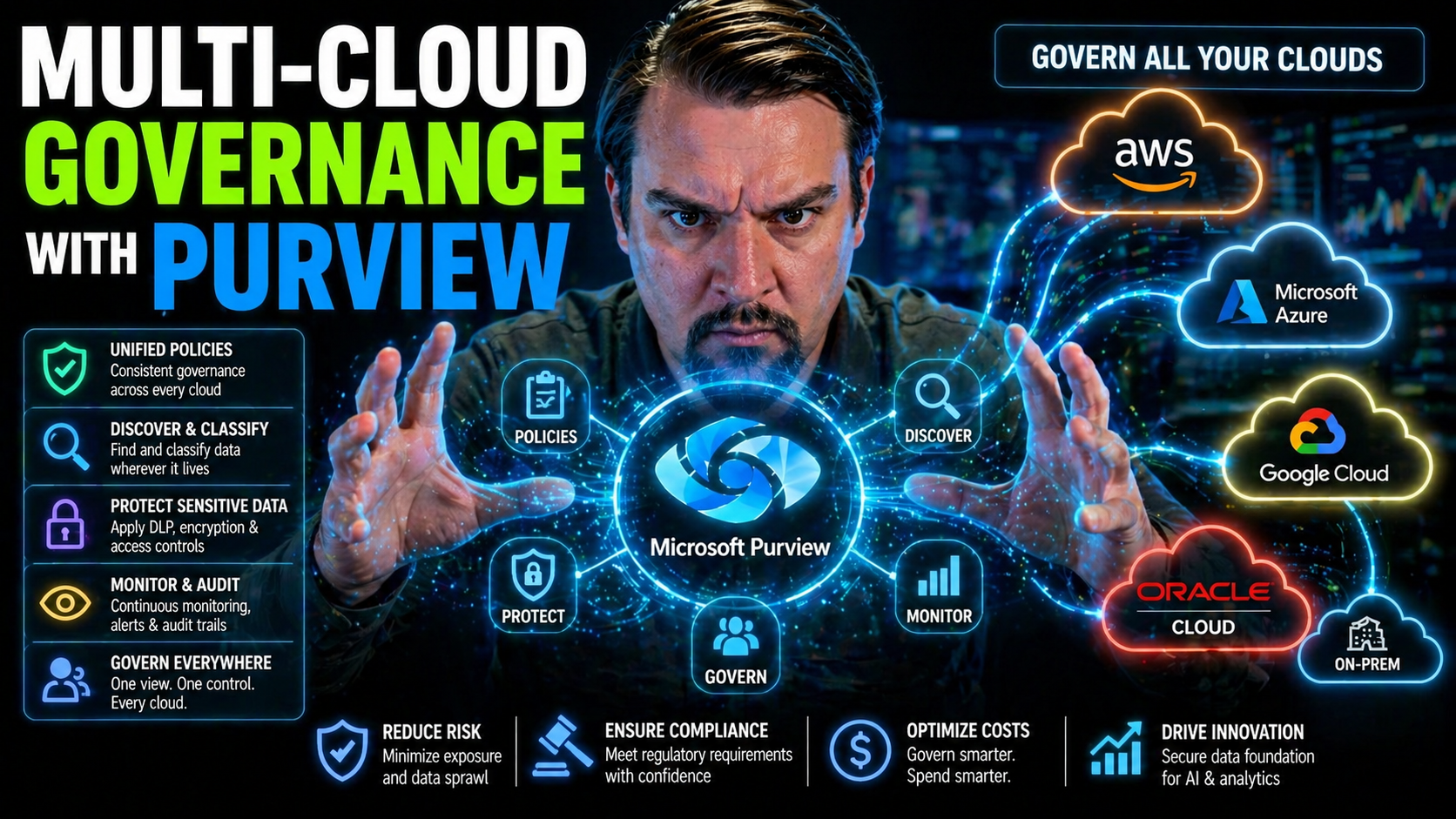
Quick Answer: Microsoft Purview multi-cloud governance helps organisations discover, classify, and govern data across Microsoft, AWS, Google Cloud, and on-premises environments. Start with a clear data-owner model and the highest-risk data domains, document the sources and scanning scope, validate classification quality, then connect findings to access, retention, protection, and review processes.
Governing data across several different clouds doesn’t have to be a wild goose chase. With Microsoft Purview, you get a comprehensive platform designed to wrestle data chaos into submission—across Azure, AWS, Google Cloud, and hybrid or on-prem setups. This guide is your go-to resource for making sense of multi-cloud data governance, highlighting actionable steps and real-world benefits for enterprise teams.
You’ll find out how Purview helps you untangle regulatory headaches, plug security gaps, and create order out of digital disorder—no matter where your data wanders. We’ll walk through Purview’s practical features, see where it fits into your existing strategy, and dig into use cases from migrations to AI preparation. If you need unified control, strong compliance, and fewer surprises in your cloud data strategy, you’re in the right place.
Understanding Microsoft Purview for Multi-Cloud Governance
If you’ve ever felt like your organization’s data is scattered from here to kingdom come, you’re not alone. Microsoft Purview steps up as a platform that brings all your data—across every cloud and even on-premises—under one watchful eye. In a world where data sprawls faster than a summer weed, that kind of oversight isn’t just comforting; it’s a necessity for regulatory compliance and operational sanity.
Purview is engineered for more than just checking a compliance box. It’s architected to give you the tools to classify, monitor, and govern data wherever it lives. That’s especially handy for businesses embracing a mix of Azure, AWS, and Google Cloud—plus whatever legacy systems you still keep running in the back room.
The growing buzz about Purview has plenty to do with its strategic value: it helps businesses build a robust, future-ready data governance foundation instead of patching holes in a leaky ship. With capabilities designed for the modern cloud estate, Purview empowers you to keep up with new regulations, complex multi-cloud architectures, and rising demands for secure, agile analytics. As we step further into the details, consider how your organization’s needs match up to the core strengths of Purview—and what it can do for your compliance mandates, security risks, and evolving cloud ambitions.
What Is Microsoft Purview and Why It Matters in Multi-Cloud Environments
Microsoft Purview is a unified data governance platform that helps organizations map, classify, secure, and monitor information across Azure, AWS, Google Cloud, and on-premises environments. It’s built to combat the complexities of hybrid data landscapes, giving you control over scattered assets while ensuring compliance with regulations like GDPR and HIPAA. At its heart, Purview lets you centralize policies, streamline audits, and discover sensitive data—no matter where it’s hiding.
This matters because businesses rarely keep all their data in one place anymore. With multi-cloud strategies come new risks, compliance challenges, and opportunities for information to slip through the cracks. Purview stands out by offering a way to prevent document chaos and enable regulatory alignment, as highlighted in this podcast episode focused on audit readiness and document management with Purview and SharePoint. Its real strength is turning scattered data chaos into order and insight.
Microsoft Purview as a Strategic Data Governance Investment
Microsoft Purview isn’t just a new toy for IT—enterprises are treating it as a strategic, long-term investment in data control and risk management. By weaving Purview into their data governance fabric, organizations gain lasting ROI through better regulatory alignment, reduced insider risks, and streamlined information protection. It’s more than a quick-fix: successful adoption trends show Purview evolving as the backbone for scalable, cross-cloud data strategies.
Purview’s value shines brightest when deeply integrated with key Microsoft services and data estates. Real-world cases show ROI through proactive policy enforcement, measurable risk reduction, and support for major transformations like Copilot deployments and Power Platform automation, as discussed in this episode on advanced Copilot agent governance. For enterprises looking to future-proof governance, Purview is proving to be a foundational solution rather than just a stopgap measure.
Core Capabilities of Microsoft Purview for Multi-Cloud Environments
Next up, let’s pull back the curtain on the tech that makes Microsoft Purview a true cross-cloud heavyweight. In a landscape where data can be scattered across Azure, AWS, Google Cloud, or even that trusty server in the supply closet, Purview unifies the chaos. Its secret weapon? A blend of automated scanning, rock-solid classification, and high-visibility data mapping—all stitched together into a single oversight layer.
Purview is more than a labeling tool. It brings together automatic metadata scans, scalable data classification, detailed lineage tracing, and centralized policy management. It’s not about a patchwork of duct tape solutions—it’s about building one source of truth, one playbook for every cloud. This approach makes governance teams faster, compliance audits simpler, and your data ecosystem more predictable.
We’ll dive deeper into each capability—discovery, classification, lineage, and policy management—in the following sections. If you’re worried about scattered spreadsheets, rogue data flows, or oversight headaches, you’ll see how Purview helps you regain control while maintaining flexibility. For those dealing with audit readiness and sensitive information management, resources like this podcast episode can add further context on how Purview fits into a larger compliance and information management strategy.
Automatic Discovery and Scalable Data Classification
- Automated scanning: Purview automatically sweeps through your Azure, AWS, Google Cloud, and on-prem sources, discovering files, tables, and databases—no endless manual inventories required.
- Classification rules: Using built-in and custom policies, Purview identifies financial data, PII, health records, and more with consistent, scalable tagging—reducing the risk of missed sensitive information.
- Multi-cloud scale: The platform is built to handle data estates of every size, supporting hybrid environments seamlessly so nothing falls through the cracks.
- Key benefits: Always-updated data inventories, faster risk detection, and the ability to automate protection for your most critical data assets without extra hands on deck.
End-to-End Data Lineage and Enhanced Visibility Across Clouds
- Data flow mapping: Purview traces how data moves from source to destination, mapping hops between clouds, databases, and applications for full end-to-end traceability.
- Lineage visualization: You get a bird’s-eye view of every transformation—who’s touched the data, which processes have shaped it, and where it lands next—enabling both troubleshooting and compliance.
- Anomaly detection: By visualizing data lineage, you can quickly spot unexpected transfers or irregular usage patterns that might signal breaches or policy violations.
- Audit-readiness: Purview’s lineage tools make it easier to provide auditors with definitive evidence of controlled, monitored data flows across your entire cloud estate.
Centralized Data Governance With Microsoft Purview Across Clouds
Microsoft Purview enables organizations to centralize policy creation, monitoring, and enforcement—no matter where the data resides. Even if your information stretches from Azure blob storage to an AWS Redshift cluster or a Google Cloud data lake, you can apply governance controls from one unified interface.
This approach eliminates data silos, reduces inconsistencies, and helps maintain uniform data protection. Governance teams benefit from a “single pane of glass” view, allowing them to spot issues, enforce policies, and conduct audits much more efficiently. For those striving to prevent document disorder or enforce regulatory compliance, as highlighted in this ECM-focused podcast, Purview’s centralization is a crucial step toward oversight and order.
Implementing Multi-Cloud Governance With Purview: A Practical Guide
Knowing the “why” is only half the battle—you’ve got to know “how” to actually roll out effective governance across multi-cloud estates. Purview walks you through a practical, staged roadmap: define your governance objectives, map out every bit of data you own, and then apply the right labels and policies to keep it all under control.
With cloud sprawl on the rise, bringing structure to your data world starts with clear goals and a solid inventory. From there, consistency in labeling and policy application across all platforms is what shields you from regulatory drama and operational blind spots.
But governance isn’t just about set-and-forget rules—it demands real-time vigilance. Purview allows organizations to continuously monitor, audit, and quickly remediate any breakdowns in data protection or policy compliance. Whether you’re technical, compliance-focused, or somewhere in between, this guide will meet you at every practical step, helping you move from planning to protection. For deeper dives into topics like ECM collaboration and audit readiness, check out resources such as this podcast episode on building your Purview shield or advice on activity auditing at this page.
Define Governance Objectives and Inventory Data Assets
Before you dive into policies and labels, get your priorities straight. Clarify what governance means for your business—whether it’s compliance with global laws, airtight security, or supporting data-driven productivity. Objectives drive everything else.
Then, make a comprehensive inventory of your data assets wherever they sit: Azure, AWS, Google Cloud, SaaS apps, on-premises databases. Map your information sources to business functions and risks so you can prioritize what deserves tighter oversight. This upfront work makes later enforcement and auditing smoother, just like building a strong ECM foundation as described in this ECM governance episode.
Apply Classification Labels and Assign Data Policies Consistently
- Configure data classification labels: In Purview, set up sensitivity labels that identify data types like PII, financials, or health records, tailored for each business need.
- Assign policies at scale: Apply classification rules and governance policies (like Data Loss Prevention or access restrictions) that inherit across hybrid and multi-cloud sources, so standards follow the data wherever it moves.
- Enforce and monitor consistency: Purview ensures policies travel with your data, reducing holes in protection when assets move between platforms.
- Design tip: Keep your labeling schemes intuitive and easy for non-technical users to understand, just like connector handling in DLP for developers (guidance here).
Monitor, Audit, and Take Proactive Health Actions
- Continuous monitoring: Use Purview to keep tabs on changes to data, user access, and policy enforcement in real time, across all your clouds.
- Comprehensive auditing: Set up audit logs and analytics for quick investigation of incidents, suspicious activity, or compliance gaps—see real-world techniques in this Purview Audit guide.
- Trigger health actions: Automate alerts, policy remediation, or even access blocks when non-compliance or risky behavior pops up. This keeps IT and auditors proactive, not just reactive.
- Benefit: Real-time oversight means faster response to threats and a healthier, more compliant data estate—mirroring best practices from continuous compliance strategies like those in Defender for Cloud.
Compliance and Risk Management in Multi-Cloud Environments
In today’s regulatory minefield, keeping up with standards like GDPR, HIPAA, CCPA, or international privacy mandates isn’t a choice—it’s a requirement for sustained business operations and customer trust. With cloud data scattered far and wide, traditional compliance playbooks buckle under pressure. That’s where Microsoft Purview steps in to modernize your approach.
Purview offers controls that help you align with complex regulations, reduce the risk of data breaches, and detect threats from within. But compliance isn't just about the legal alphabet soup: it’s about giving your board, customers, and partners reason to trust your data practices—no matter what cloud or country is involved.
The upcoming sections will break down how Purview directly supports regulatory assurance, measurable risk mitigation, and insider threat governance. Expect a blend of practical steps and strategic insights, especially crucial for organizations enabling AI workloads, managing sensitive business data, and addressing new types of Shadow IT. To see these principles applied in real-world tech, guides like this Copilot governance episode and this Foundry/Shadow IT podcast make a strong case for Purview’s governance fundamentals.
Regulatory Compliance Assurance in Multi-Cloud Environments
- Audit-ready policy management: Purview enables centralized creation and tracking of data governance policies that align with global regulations like GDPR, HIPAA, CCPA, and more—covering every cloud endpoint.
- Evidence gathering and reporting: Built-in dashboards, compliance scores, and cross-cloud reports empower compliance leaders to quickly generate evidence for audits and regulatory filings.
- Third-party and Microsoft 365 integration: By integrating with platforms such as Microsoft 365 and leveraging stable dashboards, Purview supports unified audit trails and version tracking. For more on hidden compliance pitfalls, listen to this discussion on compliance drift.
- Automated data retention: Supports enforcement of retention and deletion rules tied directly to regulatory needs—great for proving “data minimization” in privacy audits.
Reducing Risk of Breaches and Non-Compliance
- Data protection controls: Purview deploys DLP, encryption, and classification policies to automatically shield sensitive or critical data from unauthorized access and exfiltration.
- Incident response automation: The system can trigger alerts, lock down resources, or reassign access in real time, helping you contain threats before they turn into breach headlines.
- Continuous policy alignment: With automated policy checks, your data protection does not lag behind business changes or cloud migrations, greatly reducing the odds of accidental non-compliance.
- Practical gains: Organizations see a measurable drop in breach risk and compliance fines by building adaptive, connected security models as described in this Power Platform DLP episode.
Insider Threat Management and Governance
- Behavioral monitoring: Purview uses activity tracking and user behavior analytics to catch unusual data access—like excessive downloads or cross-cloud transfers by internal users.
- Policy-based access control: It enforces need-to-know principles and role-based permissions, deterring both accidental leaks and malicious actors within your team.
- Anomaly detection integrations: Combine Purview with advanced monitoring tools and AI-driven models, as discussed in this AI agent governance episode, to uncover insider risks not easily spotted by legacy controls.
- Operational playbooks: Risk operations teams can operationalize response workflows—alerts, investigation, and remediation—using insights that go beyond just access logs, helping tackle new hybrid work and AI risks head on.
Integration, Architecture, and Operational Efficiency
Getting the governance right is just part of the journey; deploying Purview across a complex ecosystem and ensuring it plays nice with your existing tools is where theory meets reality. Microsoft Purview is built with deep integration hooks across the Microsoft universe—think Azure, Power BI, Microsoft 365, and now Microsoft Fabric—but it also extends to non-Microsoft clouds, databases, and SaaS platforms you probably use.
This section looks at how Purview can connect seamlessly into your hybrid world, detailing integration best practices, architectural patterns for secure deployment, and network/security essentials for large-scale rollouts. With today’s demands, the goal is agility, strong architecture, and the ability to scale without opening security holes or creating more governance silos.
Operational efficiency is about more than having the right dashboard. It’s about driving real collaboration between IT, security, risk, and business teams—bridging the gap so governance is an enabler, not an obstacle. We’ll build on these themes in the details, but for foundational thinking on data ecosystem governance, this Microsoft Fabric podcast and this Power Platform security episode offer more insights into making governance stick and enabling innovation without compromising control.
Integration With Microsoft and Third-Party Tools
- Microsoft 365 & Azure Ecosystem: Connects natively with SharePoint, Exchange, Teams, Azure Data Lake, and Azure SQL, providing a single governance layer across collaboration and infrastructure platforms.
- Power BI and Fabric: Purview integrates with Power BI and Microsoft Fabric, bringing governance controls and lineage insights directly into analytics and business intelligence workflows. More on this in this episode.
- Hybrid and external sources: Supports AWS S3, Google Storage, databases, SaaS apps, and on-premises systems for unified policy enforcement everywhere.
- Security and compliance benefit: Integrating Purview with Power Platform, as highlighted in this security best practices podcast, brings cross-cloud compliance, identity, and connector oversight.
Architecture, Connectivity, and Network Security for Purview
- Scalable deployment: Build Purview in secure cloud segments, and connect to multi-region data zones for global coverage without overexposing sensitive data.
- Segregated network design: Use private endpoints, virtual networks, and managed identities to reduce exposure and ensure that governance can’t be sidestepped by network tricks.
- Multi-cloud integration patterns: Establish secure data connectors and authentication brokers to span Azure, AWS, and Google Cloud, maintaining policy consistency.
- Avoiding pitfalls: Don’t depend just on visibility—deploy enforcement mechanisms like Azure Policy, Management Groups, and RBAC with PIM, which are explained further in this Azure governance strategy episode.
Operational Efficiency and Cross-Team Collaboration
- Streamlined governance workflows: Purview automates routine checks, labeling, and review tasks, letting teams focus on exceptions, not manual grunt work.
- Unified policy engine: Everyone—security, compliance, IT, and the business—speaks the same policy language and can review the same dashboards.
- Cross-team enablement: Central oversight enables data stewards, business users, and governance boards (as discussed in this governance board podcast) to collaborate responsibly while supporting innovation, even with AI and new tech in the mix.
Business Value and Real-World Use Cases for Multi-Cloud Governance
“Show me the ROI”—it sounds familiar, right? At the end of the day, governance needs to move the business forward, not just keep auditors happy. Microsoft Purview proves its worth by not only reducing risks but also by unlocking self-service data access and building a reliable platform for your analytics and AI ambitions.
This section makes the case with stories and use cases that go beyond compliance. You’ll find examples of how Purview enables secure, governed self-service for business users, supports domain-centric governance patterns, and delivers real gains in cloud migrations and AI transformation projects. In this climate, those who treat governance as a growth enabler—not just a checkbox—are the ones pulling ahead.
Looking for practical proof? Guides like this Copilot Learning Center discussion unpack how centralizing governance, automation, and learning can directly improve adoption rates, cut support tickets, and show tangible business value. It’s all about using Purview not just for control, but for measurable organizational results.
Enabling Self-Service Access and Sensitive Data Protection
Purview’s policy-driven governance lets business users discover and analyze data freely, but safeguards sensitive information through labeling, encryption, and granular access controls. That way, analysts can self-serve for productivity, but compliance officers sleep soundly at night—knowing health records, financials, and personal info stay protected.
This balance empowers innovation without introducing compliance gaps or risking regulatory fines. It’s a level up from basic file shares or quick app builds, as seen when comparing Dataverse-led governance to SharePoint Lists in this in-depth discussion on long-term value and cost.
Supporting Business Domains and Curating Data Products
- Domain-focused oversight: Purview lets you set custom business glossaries, policies, and data product catalogs for each major business domain, supporting data-as-a-product strategies.
- Reusable data products: Teams can curate, tag, and publish trusted data sets and sources for enterprise-wide reuse, improving consistency and reducing rework.
- Increased data quality and discoverability: Central governance ensures that analytic and AI workloads draw from reliable, well-documented sources—preventing data sprawl and boosting user trust.
- Collaboration anchor: Transparency in data ownership and access, as explained in this episode on sustainable access governance, further supports responsible collaboration without productivity loss.
Use Cases: Migration, Compliance, and AI Readiness
- Cloud migration success: Purview provides a real-time inventory and lineage map that helps migration teams find, classify, and move critical datasets with less manual discovery.
- Regulatory compliance: Consistent cross-cloud policy enforcement means organizations can adapt faster to new or changing regulatory requirements.
- AI enablement and Copilot readiness: By governing data inputs—with tools such as sensitivity labeling and DLP for AI-generated content (guidance here)—Purview paves the way for more reliable, secure Copilot and enterprise AI adoption.
- AI governance at scale: Purview’s accountability tools and lifecycle controls, as discussed in this AI agent governance podcast, prevent identity drift, shadow automations, and operational chaos.
Conclusion and Ongoing Governance Considerations
Wrapping up, Microsoft Purview emerges not just as a toolkit, but as a cornerstone for future-ready, sustainable data governance across clouds. This guide has shown how the right strategy, technology, and operational approach can turn data chaos into a controlled, valuable business asset—supporting regulatory demands, business agility, and digital innovation all at once.
The journey to mature governance is ongoing. The most successful organizations continuously refine their policies, close knowledge gaps, and foster cross-team vigilance to stay ahead of threats, compliance shifts, and technology surprises. It’s less about a single “done” moment and more about building a practice—one that scales with your data and adapts as new clouds, platforms, and AI agents come into play.
Stay aware of blind spots, such as gaps in external sharing or automation, as addressed in resources like this practical control framework, and always be ready to enforce your governance framework at the pace of business, like the 48-hour readiness model in this podcast episode. If you’re ready to strengthen your multi-cloud governance, Purview offers a proven path—provided you keep the culture and controls up to speed with the technology.
Key Takeaways for Building a Sustainable Governance Practice
- Establish clear, evolving governance goals: Define and regularly revisit your compliance, security, and business objectives to keep governance aligned with changing risks and opportunities.
- Drive cross-team collaboration: Tear down silos between IT, business, compliance, and security teams using unified dashboards, shared workflows, and governance boards for accountability.
- Refine policies and automate enforcement: Continuously improve classification rules, role-based access, and health checks. Automate wherever possible to reduce manual effort and errors.
- Build the business case: Tie governance results to cost savings, business agility, regulatory resilience, and AI readiness. Show measurable value to secure ongoing investment.
Limitations and Points for Vigilance in Purview Adoption
- Unstructured data support: Purview currently has gaps in full-featured governance for some massive, unstructured data types or non-Microsoft platforms—watch for roadmap updates or third-party tools for coverage.
- Skilled resource requirements: Running Purview well demands skilled staff for setup, policy design, and ongoing management. Training and documentation are vital to avoid misconfigurations.
- Integration delays and blind spots: Some integration scenarios—especially with emerging SaaS or Google Cloud sources—may lag behind, creating short-term governance gaps.
- Mitigation approach: Fill these gaps by supplementing with enhanced auditing, automation, and real-time alerts as illustrated in this external sharing risk framework. Remain vigilant and treat governance as a continuous improvement process, not a one-time deployment.
You Should Also Listen To
If you are exploring Microsoft Purview multi-cloud governance, these podcast episodes add practical context from Microsoft 365 architecture, governance, security, and AI. Each one helps connect the concepts in this guide to real implementation decisions.
- Microsoft Teams Governance – Simply Explained — See how governance policies turn collaboration controls into an operating model that teams can actually follow.
- Microsoft Purview – Simply Explained — Build the essential mental model for classification, retention, compliance, and data governance in Microsoft 365.
- Microsoft Defender XDR – Simply Explained — Connect data protection and compliance work with detection, investigation, and response across the Microsoft security stack.
- Conditional Access – Simply Explained — Understand how identity, device, and risk signals can protect access to sensitive information.
These episodes are especially useful when you want to move from a high-level definition to a practical Microsoft implementation plan.
Build multi-cloud governance from accountable data domains
- Assign a business owner and technical owner to each priority data domain.
- Document source systems, scanning coverage, classifications, and refresh ownership.
- Define how sensitive-data findings trigger protection, retention, access, or remediation actions.
- Review gaps and false positives before expanding to additional clouds and repositories.
Use Microsoft Learn’s Purview documentation for current multi-cloud capabilities.
Frequently asked questions
Does multi-cloud governance mean every cloud works identically?
No. Use one governance model, but validate each source’s supported metadata, scanning, protection, and operational requirements.
🎧 You Should Also Listen To
These episodes expand the governance and protection context behind this Microsoft Purview topic.
- Microsoft Purview – Simply Explained provides the broad platform view for compliance, audit, retention, and information governance.
- Microsoft Purview Information Protection – Simply Explained explains classification and persistent protection for sensitive data.
- Microsoft Purview Data Loss Prevention (DLP) – Simply Explained adds the policy and prevention layer for risky data movement.
Last reviewed: July 2026. Multi-cloud capabilities and source support evolve frequently.

Microsoft MVP | Host of M365.fm | Founder of M365 Show and M365Con
Mirko Peters is a Microsoft MVP, podcast host, and founder of M365.fm, M365 Show, and M365Con. His work connects Microsoft practitioners through podcast interviews, livestreams, and community events.
At M365.fm, Mirko hosts conversations with Microsoft MVPs, product experts, architects, and community contributors. Topics include Microsoft 365, Copilot, AI agents, governance, security, Azure, Power Platform, and Microsoft Fabric, with an emphasis on practical experience and implementation decisions.
M365.fm is the podcast and learning platform. M365 Show brings experts together for livestreams, while M365Con provides an online conference setting for community learning.
Official website: Mirko Peters (https://www.mirkopeters.com/). Recognition: Mirko Peters — Microsoft MVP profile (https://mvp.microsoft.com/de-DE/mvp/profile/9b0ca797-db5a-493a-a845-8b9158046cf5). Connect on LinkedIn (https://www.linkedin.com/in/m365showpodcast/).