

 Apple Podcasts
 Spotify
 Youtube Music
 Spreaker
 Podchaser
 Amazon Music
This episode explores how the Eisenhower Matrix comes to life inside Microsoft 365, especially when paired with the intelligence of Copilot. The hosts start by revisiting the idea behind the urgent–important matrix and why it still matters in a world where workloads move faster than ever. They explain how categorizing tasks into what needs immediate attention, what should be scheduled, what can be delegated, and what can simply be dropped brings clarity to the constant noise of digital work. But where the conversation gets interesting is in how Microsoft 365 turns this old-school productivity model into something dynamic, automated, and deeply integrated.
From there, the discussion shifts to Copilot’s role. Instead of manually sorting tasks, Copilot can scan Outlook, Teams, Planner, and other Microsoft 365 data to surface what actually deserves your attention. Deadlines, commitments, and buried messages suddenly become visible, because the AI does the heavy lifting of identifying urgency and importance. The hosts describe how this transforms the Eisenhower Matrix from a conceptual exercise into something that updates itself in real time as priorities shift.
Outlook and Teams also play a big part in this episode. Tagging, flagging, scheduling, and delegating become far more powerful when framed through the matrix. The conversation highlights how Microsoft 365 tools naturally fit into the quadrants: urgent tasks jump out in Outlook, important long-term work gets blocked into the calendar, delegations flow through Teams channels, and the noise drops away when you consciously eliminate low-value items. Together with Copilot, these tools form a workflow that feels less like micromanaging your day and more like steering it intentionally.






You keep adding tasks, but to-do lists don’t work for real productivity. Most days, you pour effort into crossing things off, yet you still feel stuck. Have you ever wondered why you stay busy without making progress?
73% of employees say they feel busy but not productive when using traditional to-do lists.
You’re not alone. Think about your daily productivity—how often do you finish what matters most? If you’re tired of feeling overwhelmed, you can find better ways to manage your effort.
Key Takeaways
- To-do lists can create overwhelm by encouraging endless tasks, making it hard to focus on what truly matters.
- Prioritizing tasks is essential. Use a priority list to identify urgent and important tasks instead of treating all tasks as equal.
- Match your tasks to your energy levels. Schedule important work for when you feel most alert to boost productivity.
- Be flexible. Adapt your task list to changes in your day instead of sticking to a rigid plan.
- Focus on quality over quantity. Completing fewer important tasks can lead to greater satisfaction and better results.
- Use digital tools like Microsoft 365 to automate tasks and keep track of deadlines, making your workflow smoother.
- Regularly review your progress to adjust your strategies and stay on track with your goals.
- Shift your mindset. View tasks as flowing like a river, allowing you to adapt and let go of guilt over unfinished work.
9 Surprising Facts about Asks and Microsoft Lists
If you want to handle to-do lists with microsoft, these nine surprising facts about "Asks" and Microsoft Lists in Microsoft 365 will help you work faster and smarter.
- Microsoft Lists is not just a list app: Microsoft Lists is built on SharePoint and integrates with Teams, Power Automate and Power Apps, so lists can become workflows, approval processes, and custom apps without leaving Microsoft 365.
- "Asks" can be automated: You can convert an Ask (a request assigned to someone) into automated notifications and reminders using Power Automate, ensuring no request falls through the cracks.
- Rules and conditional formatting are powerful: Lists supports conditional formatting and rules that visually highlight overdue Asks, priority changes, or status updates so your to-do lists with Microsoft appear dynamically based on data.
- Custom forms per Ask: Using Microsoft Lists with Power Apps, you can replace the default form for an Ask with a tailored form (custom fields, validation, and UI) to capture exactly the information you need.
- Offline and mobile access: Lists can be accessed via the Microsoft Lists mobile app and through Teams, letting users manage Asks and to-do lists with Microsoft even when offline; changes sync when connectivity returns.
- Integrates with Planner and Tasks: You can link or sync items between Microsoft Lists and Planner/To Do so that Asks in a List can become actionable tasks across the Microsoft 365 task ecosystem.
- Unique views for different stakeholders: A single List can expose multiple views (grid, gallery, calendar) so managers see a timeline of Asks while individual contributors see personal filtered to-do lists with Microsoft tailored to them.
- Security and compliance built-in: Lists inherit SharePoint and Microsoft 365 security controls, versioning, and retention policies, so Asks and audit trails meet enterprise compliance requirements without extra tools.
- Low-code connectors expand capability: With Power Automate connectors and Microsoft Graph, you can route Asks from email, forms, or external systems into a List and trigger actions—turning simple to-do lists with Microsoft into integrated business processes.
Why To-Do Lists Don’t Work
Overwhelm from Endless Tasks
Have you ever looked at your never ending to-do list and felt a wave of overwhelm? You keep adding more tasks, thinking you’ll finally get ahead, but the list just grows. This creates mental overload and makes it hard to focus on what really matters. When you try to cram too much into your days, you end up feeling busy but not productive.
The fundamental flaw with to-do lists is that it assumes that we have unlimited time and hence encourages us to keep adding as many tasks as we want. We can only do our best work when we say no to a hundred things and just focus on the very few things that really matter. To-do lists take the focus away from making the hard choices we need to make to create an impact and let us hoard as many tasks as we want.
You might think you’re getting things done, but in reality, you’re just spinning your wheels. The more you add, the harder it becomes to see your top 3 tasks for the day. This constant overload can lead to procrastination, because it’s tough to know where to start. When you try to cram too much into your days, you end up feeling stuck and frustrated.
Lack of Prioritization
A daily to-do list often treats every task as equal. You might find yourself checking off the easy stuff first, while the urgent tasks that actually move you forward get pushed aside. Without a clear system for prioritizing, you risk spending your energy on things that don’t matter.
- Without prioritization, individuals may focus on easier tasks rather than those that have a higher impact.
- This can lead to a long to-do list with few tasks actually completed.
- Attaching time blocks to tasks can enhance focus and productivity, making task management more effective.
You need a way to sort urgent tasks from the rest. Otherwise, you’ll spend your day reacting instead of planning. Productivity experts suggest using a priority list system, which helps you spot immediate, important, and less important tasks. This approach combines the best parts of the Eisenhower Matrix and the Triage method, so you know exactly where to start.
- The priority list system is more effective than traditional to-do lists.
- It helps individuals identify immediate, important, and insignificant tasks, guiding them on where to start.
- The system combines elements of the Eisenhower Matrix and the Triage method to prioritize tasks effectively.
When you focus on urgent tasks first, you make real progress instead of just staying busy.
Ignoring Time and Energy
To-do lists don’t work when they ignore how much time and energy you actually have. You might write down ten tasks, but if you’re tired or your day is packed with meetings, you won’t get through them. This leads to more overwhelm and less satisfaction.
- A study published in the Western Journal of Nursing Research shows that effective time management strategies can significantly increase productivity, especially in complex work environments.
- A 2014 study from the University of Wuerzburg found that managing time effectively reduces perceived stress and anxiety among students, demonstrating the broader benefits of time management.
The research indicates that the balance between meeting time and individual task time significantly affects knowledge workers' energy levels. It was found that excessive meeting time relative to individual tasks leads to fewer opportunities for energy-replenishing breaks, negatively impacting task performance and job satisfaction. Additionally, the study highlights the 'pressure complementarity effect,' where pairing high-pressure tasks with low-pressure meetings can enhance energy levels throughout the workday.
You need to match your urgent tasks to the times when you have the most energy. If you ignore your natural rhythms, you’ll struggle to finish your list. Smart time management means planning your urgent tasks for when you feel most alert and saving routine work for low-energy moments. This way, you avoid burnout and actually get things done.
Inflexibility to Change
You know how your day can flip upside down in a moment. Maybe your boss drops a new project on your desk. Maybe a meeting runs long. Life at work rarely goes as planned. Traditional to-do lists don’t handle these surprises well. They lock you into a fixed set of tasks. When things shift, your list doesn’t shift with you.
You might start the day with a clear plan, but one email or phone call can change everything. Suddenly, your priorities look different. Your to-do list, though, stays the same. It doesn’t care if something urgent pops up. It doesn’t help you adjust.
This lack of flexibility can make you feel stuck. You try to squeeze new tasks into your already packed list. You scramble to finish what you wrote down in the morning. If you can’t check everything off, you feel like you failed—even if you handled more important work.
- Traditional to-do lists often become a burden when priorities change.
- They don’t help you adapt to new demands or unexpected events.
- Unfinished tasks can leave you feeling frustrated and defeated.
You need a system that moves with you. Real productivity means you can shift gears without guilt. Self-regulation strategies, like prioritizing and goal setting, help you manage changing tasks. When you develop backup plans, you stay ready for anything. You don’t just react—you respond with intention.
Imagine using a tool that lets you drag and drop tasks as your day changes. You can re-prioritize on the fly. You can focus on what matters most, even when the unexpected happens. That’s how you turn chaos into progress.
Don’t let a rigid list control your day. Choose a flexible approach that supports you, no matter what comes your way.
Drawbacks of To-Do Lists
Stress and Overwhelm
You probably know the feeling. You look at your daily to-do list and see a mountain of tasks. Your mind starts racing. You feel stress before you even begin. This is one of the biggest drawbacks of to-do lists. They can make you feel overwhelmed, not empowered.
- Constantly thinking about your tasks leads to anticipatory stress and fatigue.
- The stress you feel from just thinking about your to-do list can be as strong as the stress you feel when actually doing the work.
- Worrying about your tasks becomes a habit. This rumination can drain your energy and make you less effective.
When you focus on too many things, you lose sight of your top 3 tasks. You spend your effort on everything at once, which leads to procrastination. You might even avoid getting things done because the overwhelm feels too heavy. If you keep pushing yourself, you risk burnout. That’s why to-do lists don’t work for real productivity.
False Productivity
You might feel productive when you write out your to-do list. You check off a few easy tasks and get a quick boost. But does this really move you forward? Traditional to-do lists can trick you into thinking you’re making progress, even when you’re not.
Liana Sayer, the director of the University of Maryland’s Time Use Laboratory, noted that creating lists can stem anxiety and provide a momentary sense of control, but ultimately, the non-completion of these lists can lead to increased stress rather than actual productivity.
You can spend hours organizing your tasks, but if you don’t finish the important ones, you’re not really getting things done. This false sense of productivity keeps you busy, not effective. You need a system for mitigating the drawbacks of to-do lists, so you focus on what matters most.
Guilt from Unfinished Tasks
Leaving tasks unfinished can weigh on your mind. You might feel guilty or even ashamed when you see unchecked boxes at the end of the day. This guilt is more than just a feeling—it’s a real psychological effect.
- Unfinished tasks lead to feelings of dissatisfaction and anxiety.
- Your brain sees these tasks as unmet goals and pushes you to finish them. This is called the Zeigarnik Effect, which explains why you remember incomplete tasks better than completed ones.
- Many people feel shame about unfinished work, which can make the problem worse.
This mental tension can sometimes motivate you to finish your tasks. But if the stress builds up, it can lead to burnout instead of better productivity. You need a way to manage your tasks that helps you feel accomplished, not defeated.
If you want to move past the drawbacks of to-do lists, start by focusing on your top 3 tasks, matching your effort to what matters most, and using tools that help you adapt. That’s how you start getting things done for real.
Traditional To-Do Lists vs. Real Productivity
Quantity Over Quality
You might think that checking off as many items as possible means you had a productive day. But focusing on quantity over quality can actually hurt your results. When you rush through a long list, you often miss the chance to do your best work. You may finish a lot of small tasks, but you rarely make progress on the big things that matter.
Take a look at what research shows:
| Source | Findings |
|---|---|
| Harvard Business Review | A task-completion mindset can reduce creativity and critical thinking, leading to less impactful work. |
| Stanford University | Employees focusing on quality produced more impactful results and felt more satisfied with their work. |
| McKinsey & Company | Companies prioritizing impact over output see better engagement, higher retention, and more innovation. |
When you focus on quality, you feel more satisfied and see better results. Your workflow becomes more meaningful, and you start to enjoy your work instead of just racing to the finish line.
No Goal Alignment
A to-do list often grows without any real connection to your bigger goals. You add tasks as they come up, but you rarely stop to ask if they help you move forward. This lack of alignment can leave you feeling busy but not truly productive.
“Traditional to-do lists are linear and often overlook external factors like meeting schedules. Modern systems, such as the Kanban board, allow for real-time task status visibility, which led to a 15% reduction in duplication of effort and improved project delivery times by two weeks.”
When your workflow connects to your goals, you know why each task matters. You stop wasting time on things that don’t help you grow. You also avoid the trap of constant reprioritization, which studies show can eat up 30 minutes a day and leave 40% of your tasks unfinished.
Poor Progress Tracking
It’s easy to lose track of your progress when you rely on traditional to-do lists. You might check off tasks, but you don’t always see how far you’ve come or what’s left to do. This can make you feel stuck, even when you’re working hard.
Here’s how different methods compare:
| Method | Effectiveness (%) | Description |
|---|---|---|
| Timeboxing | 68% | Increased progress when timeboxing calendar. |
| Goal Clarity | 55% | Improved clarity of goals when using timeboxing. |
| Organized To-Do List | 1.4x more likely | Organized individuals are more likely to delete uncompleted tasks, enhancing productivity. |
When you use better tracking methods, your workflow becomes clearer. You see your wins and know exactly what to tackle next. This helps you stay motivated and keeps your productivity on track.
Alternatives to To-Do Lists

Prioritization with Eisenhower Matrix
You want to make progress, not just stay busy. The Eisenhower Matrix helps you sort your tasks by priority. You divide your work into four quadrants: urgent and important tasks, important but not urgent tasks, urgent but not important tasks, and tasks that are neither urgent nor important. This system gives you a clear priority list every day.
When you use the Eisenhower Matrix, you stop treating every task as equal. You focus on important tasks first. You spend your energy where it matters most. You build a priority list that guides your day. You don’t waste time on things that don’t move you forward.
Let’s look at how people manage their work:
| Statistic | Value |
|---|---|
| Percentage of people with a proper time management system | 18% |
| Percentage of people using a to-do list, email inbox, or calendar | 58% |
| Percentage of people with no system, just doing what seems important | 24% |
| Percentage of Eisenhower Matrix users feeling their work is under control | 100% |
| Percentage of people feeling their work is never or very rarely under control (dealing with whatever comes up) | 28% |
| Percentage of people who never feel under control at work | 12.5% |
| Percentage of Eisenhower Matrix users feeling their work is under control every day | 50% |
| Percentage of Eisenhower Matrix users feeling their work is under control four out of five days | 50% |
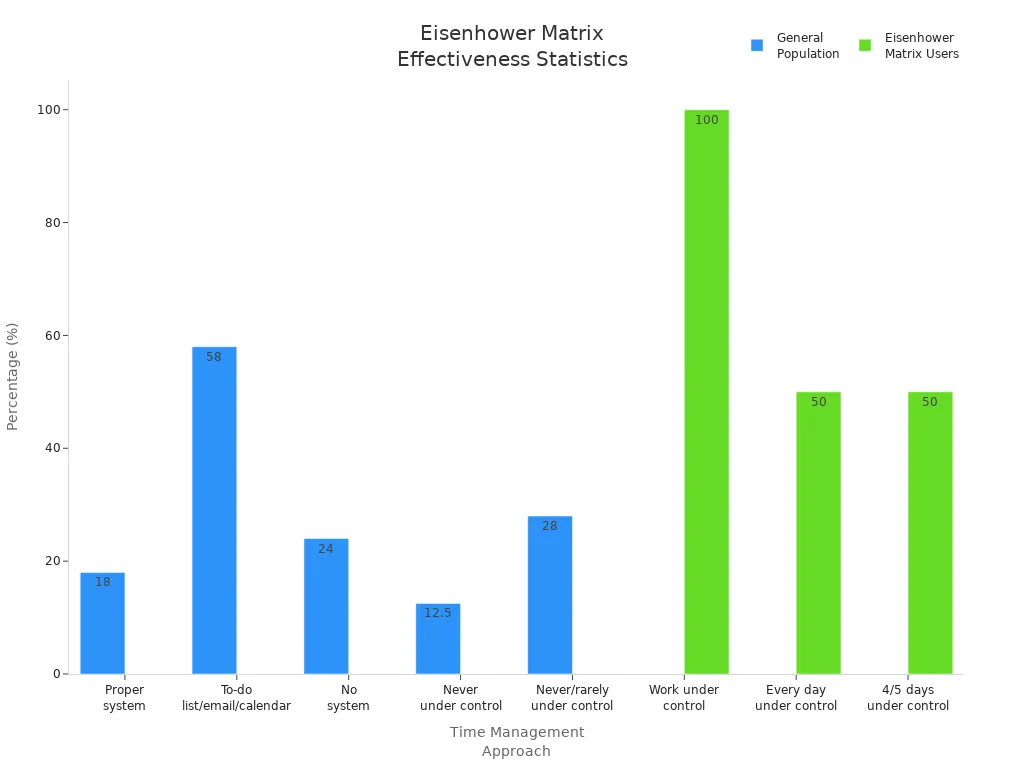
You see that people who use the Eisenhower Matrix feel more in control. You can build a priority list that keeps you focused. You don’t just react to what comes up. You choose your important tasks and tackle them with intention.
Microsoft 365 makes this process even easier. Copilot scans your Outlook, Teams, and Planner. It finds deadlines and commitments. You get a priority list that updates in real time. You can tag, flag, and delegate tasks. You see urgent and important tasks right in your calendar. You spend less time sorting and more time doing.
Time-Blocking and Scheduling
You want to protect your time and focus. Time-blocking is a productivity hack that helps you schedule your important tasks. You set aside blocks of time for each priority. You don’t let distractions take over. You build a priority list that matches your schedule.
When you use time-blocking, you give each priority a place in your day. You don’t just write down tasks. You decide when you will do them. You focus on important tasks during your best hours. You save routine work for later.
Microsoft 365 lets you drag and drop tasks into your calendar. You can see your priority list and schedule at a glance. You get reminders for important tasks. You can adjust your blocks if your day changes. You stay flexible and focused.
Time-blocking helps you avoid the trap of multitasking. You don’t jump from one thing to another. You finish your important tasks before moving on. You feel more productive and less overwhelmed.
Matching Tasks to Energy
You know your energy changes throughout the day. You don’t always feel ready to tackle important tasks. Matching your tasks to your energy helps you build a smarter priority list. You focus on important tasks when you feel most alert.
Research shows that:
- Cognitive abilities change during the day because of circadian rhythms.
- Steven Chase says managing your energy is more important than managing your time. Energy is multidimensional.
- Chronobiology research finds that your brain works best at certain times. You should do complex tasks when your mind is sharp.
- A study of over 400 knowledge workers found that mixing high-pressure tasks with low-pressure meetings boosts energy.
You can use Microsoft 365 to track your energy patterns. You schedule important tasks for your peak hours. You build a priority list that fits your natural rhythms. You save routine work for low-energy times.
You don’t have to force yourself to work when you feel tired. You focus on important tasks when you feel strong. You build habits that support your productivity. You feel more satisfied and less stressed.
You can combine these strategies to create a priority list that works for you. You focus on important tasks, protect your time, and match your work to your energy. You move beyond the to-do list and build a system that supports real productivity.
Habit Stacking
You want to make lasting changes, but starting new routines can feel tough. That’s where habit stacking comes in. This method helps you build new behaviors by connecting them to things you already do every day. Instead of trying to remember a new task, you link it to a habit you never forget.
Let’s break it down. Imagine you pour a cup of coffee every morning. You can use that moment as a cue. Right after you pour your coffee, you write down three things you’re grateful for. The coffee becomes your reminder. Over time, this new action feels automatic because it’s tied to something you already do.
When you stack a new habit onto an existing routine, you reduce decision fatigue. You don’t have to think about when or how to start. The cue is already there, waiting for you.
Behavioral science shows that this approach works because it uses the habit loop. You have a cue (pouring coffee), a routine (writing your gratitude list), and a reward (feeling positive). By repeating this loop, you build strong neural pathways. The new behavior becomes part of your day, not just another item on your list.
Here’s how you can try habit stacking:
- Pick a habit you already do, like brushing your teeth.
- Choose a new action you want to add, such as reviewing your top three priorities for the day.
- Always do the new action right after the old one.
This simple system makes new behaviors stick. You don’t have to rely on willpower. You just follow your routine, and the new habit grows naturally.
Habit stacking helps you create a chain of positive actions. You can use it to boost your productivity, improve your focus, or even take better care of yourself. Over time, these small changes add up. You feel more in control and less overwhelmed by your day.
Try stacking one new habit this week. You might be surprised at how easy it feels to make progress when you build on what you already do.
Implementing New Productivity Systems
Prioritize and Schedule Tasks
You want to get more done without feeling overwhelmed. Start by picking your Most Important Tasks (MITs) for the day. Focus on one to three key items that push you closer to your goals. Break big projects into smaller chunks. This makes your work feel less intimidating and helps you see progress. Try agile prioritization—sort your work by value and urgency. This way, you can adapt when things change.
For example, if you work in an architectural firm, you might choose finalizing blueprint modifications as your MIT. Even if other things pop up, you know what matters most. If a task takes less than 15 minutes, do it right away. This clears your mind for bigger challenges. Block out time for deep work. Turn off distractions and give your full attention to important projects. Set clear goals for yourself. When you know what you want to achieve, it’s easier to stay on track.
Microsoft 365 makes this process smoother. Use Planner to organize your priorities. Drag and drop tasks into your calendar. Let Copilot help you spot deadlines and commitments. You’ll always know what comes next.
Use Digital Tools for Automation
You don’t have to do everything by hand. Digital tools can save you hours each week. With Microsoft 365 and Copilot, you can draft emails, blogs, or reports much faster. Research that used to take hours now takes minutes. Repetitive work like formatting or proofreading becomes quick and easy.
Let Copilot scan your Outlook and Teams for upcoming deadlines. Use To-Do to keep track of what’s urgent. Automate reminders so nothing slips through the cracks. When you let technology handle routine work, you free up time for creative thinking and problem-solving.
Review and Adjust Regularly
You want your system to keep working for you. Set aside time each week to review your progress. Look at what you finished and what still needs attention. Pair results with early signs of progress. This helps you catch problems before they grow.
Mix numbers with feedback from your team or clients. This gives you a full picture of how things are going. Many professionals find that regular reviews help them cut out wasted time. One freelance designer boosted her project completion rate from 70% to 95% just by adding a weekly review.
Check your habits, too. Sometimes you’ll spot patterns you didn’t notice before. Set clear goals and revisit them often. This keeps you moving in the right direction. With Microsoft 365, you can track trends and adjust your workflow as needed. Your productivity system should grow with you.
Tip: Small tweaks each week can lead to big improvements over time. Stay flexible and keep learning what works best for you.
Real-Life Shifts from To-Do Lists
Case Study: Overcoming Overwhelm
Imagine you start every morning staring at a long list. You feel the overwhelm before you even begin. That’s what happened to Jamie, a project manager who always felt behind. Jamie tried to finish everything but ended each day with more stress and less progress.
Jamie decided to try a new approach. Instead of a giant list, Jamie picked a focus 3 tasks system. Each morning, Jamie wrote down just three things to finish. One big item and two smaller ones. Jamie kept a running tab of what got done each day. This simple change made a huge difference.
“I stopped feeling like I was drowning in work. When I picked my focus 3 tasks, I knew exactly where to start. I could see my wins, even on busy days.”
Jamie followed a step-by-step plan:
- For the first two weeks, Jamie used a daily template and picked only one must-do focus 3 tasks item each day.
- In weeks three and four, Jamie increased to two or three must-do focus 3 tasks and added a “nice-to-do” category.
- By weeks five and six, Jamie set up a weekly reset and checked in with a coworker for support.
Jamie’s journal became a tool for tracking progress. Jamie even made a list of things to stop doing, which helped clear out distractions. The focus 3 tasks method turned chaos into clarity.
Productivity Transformation Stories
You might wonder if this approach works for others. Many people have found that switching to a focus 3 tasks system changes everything. Here’s what they did:
- They captured everything in a good-looking journal with an index.
- Each day, they listed one big focus 3 tasks item and a few small ones.
- They made time to review what they finished and what still needed attention.
- They created a “stop doing” list to cut out low-value habits.
Let’s look at a quick table showing the steps many people follow:
| Week | What to Do |
|---|---|
| 1–2 | Start with one must-do focus 3 tasks daily |
| 3–4 | Increase to 2–3 must-do focus 3 tasks |
| 5–6 | Add weekly reset and accountability partner |
People who use the focus 3 tasks method say they feel more in control. They see real progress, not just a list of unfinished items. You can try this too. Start small. Pick your focus 3 tasks each morning. Track your wins. Watch your productivity grow.
Tips for Moving Beyond To-Do Lists
Mindset Shifts
You want to break free from the old way of thinking about productivity. The first step is to shift your mindset. Instead of seeing your tasks as a static bucket that fills up and never empties, picture them as a flowing river. Tasks come and go. You can let some float by without guilt. This flexible approach helps you adapt when things change.
Here are a few mindset shifts that can make a big difference:
- See your work as a river, not a bucket. This helps you stay flexible and adjust your focus as priorities shift.
- Let go of guilt about unfinished tasks. Focus on what you can achieve today, not what you missed yesterday.
- Start your day with a sense of sufficiency. Any progress is a win. Every accomplishment is a bonus, not an obligation.
When you make these shifts, you stop letting procrastination control your day. You focus on what matters most and put your effort where it counts. You build habits that support your goals, not just your to-do list.
Tip: Celebrate small wins. Each step forward is proof of your effort and focus.
Staying Consistent
You know that building a new system takes time. Consistency is the secret to making your new approach stick. You don’t have to do everything at once. Start with a few simple strategies and build from there.
Here’s a table with proven ways to stay consistent and keep your focus strong:
| Strategy | Description |
|---|---|
| Automation | Automate repeatable tasks to save effort for creative work. |
| Standard Operating Procedures | Create SOPs for routine workflows to improve quality and focus. |
| Template Library | Use templates to cut setup time and keep your focus on important work. |
| Recovery Practices | Prioritize sleep and recovery to boost focus and productivity. |
| Structured Weekly Reviews | Review your week to plan tasks and schedule recovery, keeping your focus sharp. |
| Prioritization | Use methods like Eisenhower to focus on what matters most. |
| Timeboxing | Block time for deep work and protect your focus from distractions. |
| Workflow Optimization | Streamline your process with systems like Kanban to keep your focus clear. |
| Visibility of Wins | Track your daily wins to stay motivated and reinforce your focus. |
You can use these strategies to keep your focus steady, even when life gets busy. Protect your effort by automating routine work. Build templates for common tasks. Make time for recovery so your focus stays sharp. Review your progress each week and adjust as needed.
Remember, consistency grows from small, repeated actions. When you focus on your top priorities and celebrate your wins, you build momentum. Over time, your effort turns into lasting change.
Note: Progress is not about perfection. It’s about showing up, focusing your effort, and moving forward—one day at a time.
You’ve seen why traditional to-do lists don’t work for real productivity. When you rely on a to-do list, you often feel stuck and risk burnout from unfinished tasks. Try prioritizing, scheduling, and using tools like Microsoft 365 to stay focused. You can break free from old habits and find a system that fits your style. Start today—choose what matters, take action, and watch your productivity grow.
Checklist: Handle to-do lists with Microsoft 365
get started with microsoft to-do: information helpful for task management
What is Microsoft To Do and how does it help me handle to-do lists with Microsoft?
Microsoft To Do is a task management app designed to help you create and manage daily tasks, shopping lists and planned lists in one place. It integrates with Outlook and Microsoft 365 so flagged email can become tasks, giving you an overview of multiple lists and helping you stay organized across devices. The intelligent interface and seamless integration make it versatile for personal and light project management.
How do I get started quickly with Microsoft To Do?
To get started quickly, sign in with your Microsoft account, create a new list, then add tasks and set due dates or reminders. Use “My Day” to select tasks to focus on each day and drag tasks into My Day. You can sync across devices so changes on desktop, mobile or web are reflected automatically.
Can I sync my task list across devices and with Outlook?
Yes. Microsoft To Do sync across devices and integrates with Outlook. Flagged email in Outlook can be imported as tasks, and completed tasks are synchronized automatically. Ensure you’re signed into the same Microsoft account on each device and that sync is enabled to avoid failure to update across devices.
How do I organize tasks and categorize multiple tasks or lists?
You can organize tasks by creating multiple lists to organize different projects or areas of life, using steps (subtasks), adding notes, due dates and reminders, and by assigning importance with flags. Use tags in task titles or prefixes to categorize, and use My Day and planned list views for daily tasks and upcoming deadlines.
Is there a way to collaborate and share lists with team members or family?
Yes. You can share lists to organize collaborative tasks with team members or family. Use the share lists feature to invite collaborators; shared lists sync automatically for all participants. For deeper collaboration with Microsoft Teams or Planner, integrate To Do with Teams or use Planner for complex project management and assignment capabilities.
How do I assign tasks and manage assignments in a team environment?
Microsoft To Do itself does not provide formal task assignment to specific team members; it’s primarily for individual task management and shared lists. For assignment and collaboration with roles, use Planner within Microsoft Teams or SharePoint where you can assign tasks, track progress, and manage multiple tasks and team members. You can still use To Do to manage personal work items and link to Planner tasks for a full collaboration workflow.
Can I see tasks in a calendar view or export to Excel for project management?
To Do offers a planned list and due date views but does not have a native calendar grid view. You can sync tasks with Outlook calendar by creating tasks with due dates or use Planner for deeper calendar integration. For export, use Power Automate or copy tasks to Excel manually for project management and reporting.
What happens if I experience a sync failure or I’m not seeing updates?
If synchronization fails, check your internet connection, sign out and back in, ensure the app is updated, and verify storage limits on your account. Microsoft support pages and the app’s feedback option can help diagnose issues. Common fixes include toggling sync, restarting the app or device, and ensuring you’re using the correct Microsoft account.
How do I convert flagged email into tasks and stay on top of inbox actions?
Flagged email in Outlook can appear in Microsoft To Do as tasks if you enable Outlook integration. Flag important messages in your inbox; they appear in the Flagged Email list in To Do, making it easy to turn email into actionable tasks and keep everything in one place.
What intelligent features or automation can help me stay organized?
Microsoft To Do offers intelligent suggestions in My Day to help you pick tasks, recurring task support, reminders, and integration with Microsoft Planner and Teams. Use Power Automate to create automated flows—such as automatically creating a task from an email or form submission—to reduce manual work and keep lists synchronized.
How can I use Microsoft To Do with Microsoft Teams and SharePoint for collaboration?
Use Microsoft To Do for personal task management and combine it with Tasks by Planner and To Do in Microsoft Teams to view both Planner tasks and To Do tasks in one app. For document-centric workflows, use SharePoint task lists or Planner for assignments and connect them to Teams channels for a collaborative environment that keeps tasks and files together.
Can I customize the interface and icons to make lists easier to scan?
You can personalize lists with themes and emojis, which act like icons to visually distinguish lists (shopping lists, work, personal). Use consistent naming conventions and prefixes to make categorization and scanning easier. While customization is limited compared to full project tools, these interface tweaks help you stay organized.
Is Microsoft To Do suitable for project management or multiple tasks based projects?
Microsoft To Do is best for daily tasks, to-do lists and personal task management. For complex project management with assignments, dependencies, and a calendar view, use Planner or Project. You can combine To Do and Planner: To Do for individual task lists and Planner for team-based, collaborative project management.
How do I create recurring tasks and plan daily tasks efficiently?
Create recurring tasks by setting a repeat frequency when adding a task. Use My Day each morning to select daily tasks from multiple lists, and rely on the planned list view to see upcoming deadlines. This routine helps you stay on top of daily tasks and reduces the chance of missing recurring responsibilities.
Where can I give feedback or get help if I find a mistake or need support?
Use the Give feedback option in the app to report bugs or request features, or visit Microsoft Support for troubleshooting articles and help. The app includes help content and links to support resources to resolve common issues or to request new capabilities.
🚀 Want to be part of m365.fm?
Then stop just listening… and start showing up.
👉 Connect with me on LinkedIn and let’s make something happen:
- 🎙️ Be a podcast guest and share your story
- 🎧 Host your own episode (yes, seriously)
- 💡 Pitch topics the community actually wants to hear
- 🌍 Build your personal brand in the Microsoft 365 space
This isn’t just a podcast — it’s a platform for people who take action.
🔥 Most people wait. The best ones don’t.
👉 Connect with me on LinkedIn and send me a message:
"I want in"
Let’s build something awesome 👊
Ever close your laptop after a full workday and think, 'Wait... what did I actually accomplish today?' You're not alone. Most professionals spend more time juggling task lists than actually completing them. But here’s the twist: it’s not about doing more, it’s about deciding what matters most — and then letting the right tools help you get it done. Today, we’ll show you how Eisenhower’s timeless prioritization method combined with Microsoft 365 Copilot can take you from overwhelm to clarity, without adding another productivity app you’ll just ignore.
The Hidden Trap of Task Lists
Crossing something off your to-do list feels great. A clean little checkmark, a line through the text, maybe even a digital confetti animation if the app is feeling generous. But here’s the question: if we’re checking off so many things, why do our task lists keep getting longer instead of shorter? The truth is, lists make us feel productive while quietly hiding the real problem—what actually matters and what doesn’t. And that’s where most of us fall into the trap. We’re busy, yes. But we’re not moving forward in any meaningful way.Think about what your list usually looks like. It holds everything from “book dentist appointment” to “prepare client presentation” to “download software update.” Each one of those sits side by side as if they weigh the same. A two-minute errand gets placed right next to something that could impact your career for months. The list doesn’t tell you which ones deserve the bulk of your attention. It just keeps stacking them together. And so when you open it up, you get this overwhelming sense of pressure. The instinct is to grab the low-hanging fruit. Clear out an email, tick off a small admin task, maybe send that invoice. Suddenly you’ve crossed out half a dozen things and it feels like progress. But your most critical project? It hasn’t moved an inch.Research shows a startling percentage of work time—roughly 70 percent for many professionals—goes to juggling tasks, reshuffling them, or creating multiple lists, not to actually doing the work itself. It’s like rearranging furniture in your office all day instead of sitting down to finish the report. You’ve definitely expended energy, but where’s the real result? That’s the illusion of productivity these lists deliver. They keep us occupied, but not effective.Picture two colleagues to make this concrete. One of them runs through a day checking off twenty quick items. Clearing inboxes, setting up recurring meetings, forwarding documents. At the end of the day, their list looks empty and satisfying. The other person spends most of their day writing one high-quality project proposal and preparing for a critical client meeting. They checked off only two items. Now if we ask who achieved more, the answer is obvious: two significant tasks carry more weight than twenty trivial ones. But the first person still feels better, because that long list of ticks tricks the brain into thinking big progress was made.This is the core problem. Most task lists flatten everything down into one level. They don’t signal urgency. They don’t convey importance. They simply present raw input, almost like dumping everything into a spreadsheet with no sorting. It creates noise, not direction. And when the day ends, many of us find ourselves wondering: what exactly took all those hours? You know you were busy, your calendar looks packed, but you struggle to put your finger on one meaningful advance.Here’s a typical scenario. You start with the best intentions. You sit down after your morning coffee, open your favorite to-do app, and decide to “clear the board.” Three hours later the inbox looks tidy, you responded to a dozen quick requests, and you rescheduled a meeting that didn’t really matter. But the key deliverable—the one your boss is depending on tomorrow—is still untouched. The day leaves you tired but unsatisfied, as though you were spinning your wheels in place.It’s important to stress: this isn’t a personal weakness. It’s not that you lack discipline, or that you need to “try harder.” It’s built into the way lists function. They are designed to capture volume, not to provide judgment. And when left unchecked, that structure steers us toward immediate wins rather than thoughtful priorities. It’s a system-level flaw, not an individual failure.That’s why task lists often generate more chaos than clarity. They give us a growing wall of unchecked boxes, but no reliable guidance on what to tackle first, what to save for later, and what to simply ignore. Without that kind of filtering, it feels like we’re always paddling just to keep our head above the waterline, never steering the boat anywhere new.But there are better ways to approach the problem. Methods exist that don’t just record your workload, but help you weigh it. They provide a framework for figuring out where your effort has the greatest impact. And interestingly, one of the most effective approaches was laid out decades ago, long before digital task apps filled our phones. It still cuts sharper than many of the tools we use today—and that’s where the next part of our conversation begins.
The Eisenhower Matrix in the Modern Office
Imagine opening your inbox in the morning and instead of being hit with a wall of subject lines, everything is already split into four simple boxes. One shows you the items you should act on right away. Another tells you what can wait until later. A third directs you to hand things off. And the last one? It gives you permission to ignore them completely. No scrolling, no color-coding, no endless guessing which fire burns the hottest. Just an instant visual cue of where your time should go. That’s the promise behind the Eisenhower Matrix, a framework that has been floating around productivity circles for decades but still feels surprisingly modern in an office where every ping and notification claims to be urgent. The core idea is easy enough: urgency and importance are not the same. Urgent items demand immediate attention. They push to the front of your mind because of time pressure. Important items, on the other hand, connect directly to long-term goals, results, and values. When you cross those off, your future work becomes easier or more meaningful. The challenge is that most people in today’s hybrid workplace treat those two categories as identical. The moment something flashes on screen, it gets a top spot regardless of whether it truly matters. You get stuck in a cycle of responding, forwarding, and “just quickly” handling requests while bigger objectives stall out. Think about a meeting request that shows up late in the afternoon with subject line in all caps: “URGENT DISCUSSION TODAY.” It feels like a must-attend. Your first instinct is to clear your schedule and accept. But if you pause and ask whether it’s actually important to your role or goals, the answer might be no. Maybe the meeting is mostly for information-sharing or decisions you aren’t central to. In the matrix, that’s urgent but not important—something to delegate or even decline politely. Now compare that with progress on a project milestone due in three months. Nobody is emailing you about it today, there’s no flashing reminder, but turning in a stellar draft will directly impact your results. That lands in important but not urgent—the space where the real gains come from. Yet that space is usually neglected because our attention has been hijacked by the latest request. What most workers end up doing is collapsing both categories into one. Everything goes into the “urgent” bucket. Emails, notifications, Teams mentions, meeting invites—they all get the same treatment, which means true priorities lose their spot on the calendar. You feel busy all day, even overwhelmed, but not necessarily moving ahead. This is why the Eisenhower Matrix remains relevant. Its strength is how brutally simple it is. Two axes, four boxes, no fluff. It doesn’t ask you to track, tag, or build elaborate digital setups. It’s not about adding yet another dashboard, it’s about filtering the noise down to what deserves focus. The catch is also obvious. Making a grid on paper is easy. The problem is living inside it during a real workweek packed with shifting demands. You can draw it out, fill in tasks neatly, and by the following afternoon it’s already out of sync. Messages arrived, priorities flipped, something you planned to ignore suddenly became urgent because a deadline appeared. The matrix works when you apply it consistently. But consistency requires manual effort most people can’t sustain without it becoming another job in itself. That’s the paradox. The Eisenhower method gives clarity, sharpens your attention, and trims down decision fatigue. But it only delivers if you keep sorting new tasks into those four boxes as they arrive. Anyone who has tried knows it’s not the grid that fails, it’s the upkeep. In the middle of back-to-back meetings, the last thing you want is to redraw quadrants or drag items around in yet another app. So the concept slips, and before long you’re back in the comfortable mess of one long unordered list. Which is why the real opportunity in modern workplaces isn’t the matrix on its own, but pairing it with tools that can do the sorting for you. Imagine the same principle embedded right inside your inbox, your project software, and your chats—tasks routed automatically into the right quadrant without you even thinking about it. The logic stays the same, but the maintenance disappears. And that’s exactly where AI-driven assistants begin to change the equation.
Microsoft 365: Tools You’re Not Fully Using
If you’re paying for Microsoft 365 every month and still juggling task managers like Todoist, Trello, or Notion, the obvious question is—why? The suite in front of you already carries a full set of task management tools, but most people treat them as scattered extras instead of a connected system. Outlook, To Do, Planner, Teams, Lists—they’re all designed to work together, yet in practice they often sit in silos. That disconnect is the main reason so many professionals leave the ecosystem and bolt on third-party apps, even though they’re paying for overlapping features twice. Let’s look at what’s sitting unused. Microsoft To Do is the most eye-level piece. It’s built around personal task tracking, integrated directly with Outlook emails and flagged items. You check an email that needs follow-up, flag it, and suddenly it shows up in To Do. For planning larger efforts, Planner takes over, giving you buckets and assignments that look a little like Trello but tie directly into Teams. Then you’ve got Microsoft Lists, an underrated tool that can carry structured information—deadlines, owners, progress—that goes beyond the limits of sticky notes or simple tasks. Add Teams into the mix, which now surfaces assigned tasks directly where conversations happen, and you can see the intention: a single workflow where information flows naturally between tools without copy-paste overhead. The problem is that most people don’t experience it that way. They see To Do on their phone, Planner in Teams, Lists in SharePoint, and Outlook living on its own island. Nothing screams “connected system” when you’re manually moving the same work across them. That’s why you get what I’d call the “duplicate task spiral.” Something lands in your Outlook inbox. You know it matters, so maybe you copy it into To Do, while also adding it into Planner because your team is tracking milestones there, and to be safe, you note it down in your personal app of choice. The same assignment is now living in three or four places, and each needs updating. Instead of saving time, you’ve multiplied the admin. We’ve all seen this play out. A task that starts in an email gets forgotten because while it sat flagged in Outlook, it never found its way into the list the manager was watching. Or somebody took time to create a detailed plan in Planner, but the moment daily reminders were needed, they defaulted back to yet another standalone tool. It’s wasted motion, and it’s the kind of friction that makes people say “these tools don’t work,” even though the real issue is how they were fragmented. Here’s a more concrete scenario. Picture a project manager overseeing a rollout. Early on, they tried keeping personal notes in To Do, assigning tasks in Planner, logging ongoing issues in Lists, and juggling client updates in Outlook. Four tools equals four incomplete pictures. The team kept missing subtle dependencies and duplicate work crept in. Eventually, they consolidated. Planner became the central project map. Teams surfaced those Planner tasks in context. To Do quietly pulled in individual assignments so nobody had to manually re-enter them. Within weeks, confusion dropped because the same ecosystem was being used as designed. Nothing radical changed—the tools didn’t suddenly add features—but the shift came from using them as a connected whole rather than as isolated apps. And that’s the part most people overlook. The strength of the Microsoft 365 environment isn’t that it offers dozens of overlapping apps. The strength is the invisible wiring behind them—the way flagged emails turn into To Do items, the way Planner tasks surface inside Teams, the way Lists can be tracked alongside SharePoint data. If you lean into those connections, you don’t spend time moving data around; it already flows. If you ignore them, the entire setup feels like a messy bundle of half-finished products. That’s why the advice here isn’t “go find another app.” It’s to better use the ecosystem you already have. You’re paying for it, and it’s fully capable of handling both personal and team-level task management when approached holistically. But managing that flow still carries one weak point: deciding where every new task belongs. That judgment call—urgent or not, team project or personal note—consumes energy. And this is exactly the spot where Microsoft 365 Copilot can change the game, taking that classification work off your shoulders and routing tasks where they should live.
When Copilot Meets Eisenhower
What if your inbox could actually sort itself into Eisenhower’s four quadrants without you ever lifting a finger? No dragging tasks into boxes, no deciding if something is urgent or important, and no guilt at the end of the week when you realize your neat little grid hasn’t been touched since Monday morning. That’s the role Microsoft 365 Copilot steps into. It doesn’t replace the framework. It makes the framework usable in the chaos of real work. Copilot lives inside the tools most of us already depend on. Outlook, Teams, Word, Excel, Planner—they’re all points where tasks are created every single day. The AI isn’t there just to summarize or draft; it can identify action items and immediately categorize them against a decision framework. This means the long-standing problem with the Eisenhower method—keeping the matrix updated—suddenly feels less like maintenance and more like breathing. You don’t manage the list, you just see where things land. Here’s the frustration that many of us know well. Even with solid setups, decision fatigue creeps in. Outlook rules, task flags, complicated folder systems—they all keep tasks somewhere visible, but they still require you to make the judgment call over and over. By noon, you’ve already wasted plenty of brainpower deciding what should come first, and you haven’t even touched the big assignment yet. Copilot reduces that overhead by front-loading the routine sorting step. Instead of weighing every single item, you see them pre-placed in the right category and can immediately focus attention where it counts. Take meeting notes as a clear example. Most Teams calls end with someone saying, “I’ll send a recap,” and then it’s up to individuals to skim it later and pull their own actions out of it. Copilot automates that step. It can scan the notes, extract the next steps, and tag them based on urgency and importance. A short-term action like “Send confirmation email before 5 PM” appears in Urgent/Not Important—that’s a quick administrative task. Something like “Draft strategy outline for Q3 product launch” shows up in Important/Not Urgent—something strategic with long-term value but no immediate deadline. Instead of you scrolling back through chat logs or minutes, the work is already sorted. Picture this in action: you wrap up a late-morning Teams meeting. As soon as the recording ends, Copilot posts a summary in the meeting chat. Alongside the notes, you see two tasks extracted. One is “Prepare client-facing presentation for next Friday” listed under Important/Not Urgent. The other is “Confirm tomorrow’s call with supplier” placed under Urgent/Not Important. With zero effort, your quadrants are populated. The framework lives right inside the workflow instead of being a side hobby you try to maintain. That changes how you close out the day. You aren’t weighing dozens of loose to-do’s—you’re seeing a shaped view of priorities. And here’s the deeper shift. Copilot isn’t just shaving minutes. It’s moving the mental load away from organization into execution. Humans struggle when forced to make repetitive micro-decisions. Should this email get flagged? Is this note something I should add to Planner? Do I file it under personal or team? Each choice in isolation feels small, but stacked together they drain the energy you need to actually finish meaningful work. With Copilot laying the groundwork, you regain that energy. The margin that once went to sorting now goes to producing. Now, the catch—and it’s an important one. Copilot is only as smart as the prompts guiding it. If you ask for “summarize tasks,” you’ll get a plain list. If you frame the request to use urgency and importance as categories, you’re effectively teaching it to mirror the Eisenhower approach. Without that clarity, the AI will fall back on generic summaries that leave you right where you started. This is where expert use comes in. Knowing how to phrase prompts to reflect your priorities transforms Copilot from a clever summarizer into a decision-making partner. That’s the payoff. We finally have a way to operationalize the Eisenhower Matrix in real time across the Microsoft 365 environment. No manual grids on paper, no abandoned apps, no hope-and-pray systems. It’s an intelligent layer that bridges task capture and prioritization. And because it’s woven into the suite, it applies whether the task comes from an email, a chat, a document, or a meeting. The real question then becomes: how do you actually talk to Copilot in the right way, and how do you automate the routing of those categorized tasks into the right tools? That’s where the practical setup matters most, and it’s exactly what we’ll walk through next.
Practical Prompts and Automation Tricks
Here’s the missing piece—knowing how to speak Copilot’s language so it understands your priorities the same way you do. The Eisenhower Matrix only works if every task gets filtered through urgency and importance. Copilot is capable of doing that, but only if you tell it explicitly. It won’t magically decide for you. This is where the right prompts come in. People often type vague requests like “summarize tasks” or “make a list of action items,” which gives you a plain dump of text. Sure, it’s convenient, but all you’ve done is recreate the endless list you were trying to escape. To flip that, you need to direct Copilot with clear structure—define urgency, define importance, and tell it to categorize using the Eisenhower framework. Without those directions, it guesses, and when it guesses, you quickly slide back into the old chaos you were trying to get out of. So what does a better instruction look like? Instead of “summarize today’s meeting,” you type something along the lines of, “List all upcoming tasks from this meeting and place them into urgent/important categories using the Eisenhower Matrix.” That small change completely alters the output. Instead of a text block with ten items, you’re handed a four-box breakdown. Urgent and important together in one section, urgent but not important in another, important but not urgent neatly grouped, and a final section for everything not worth your time. You’ve turned what could have been a mess of unsorted notes into a decision-ready view. The framework is honored, but without you having to hand-sort line by line. Picture how this plays out for a professional managing competing requests. They set Copilot rules as part of their daily workflow. Anything Copilot labels urgent but not important gets automatically pushed into Planner, where small tactical items can be shared or delegated. Anything labeled important but not urgent gets booked directly into Outlook as calendar time blocks, ensuring strategic work isn’t perpetually delayed. Suddenly, the Eisenhower Matrix isn’t just a diagram someone once taught in a training session; it’s operational and alive inside Microsoft 365. The professional doesn’t need to sit with pen and paper crossing items into quadrants—they simply see where Copilot has placed them, and the system moves them into the right home automatically. Here’s where the twist adds serious weight. You can extend Copilot’s categorization with Microsoft Power Automate. Copilot does the thinking—assigning urgency and importance—but Power Automate does the routing. Tasks sorted as urgent/important could generate Planner cards assigned to you or your team. Urgent but not important can be delegated automatically, sent to a shared queue, or even emailed out as small action requests. Important but not urgent? Those could generate calendar holds so deep work gets the protected time it needs. The final category—neither urgent nor important—doesn’t just clutter your lists, it can be archived or logged silently. That means your list stays clean, your calendar tells you where to focus, and no extra steps are needed to drag or copy anything. Once those rules are set, the manual overhead nearly vanishes. You aren’t spending minutes each morning triaging yesterday’s tasks or dragging cards across boards. Copilot categorizes, Automate routes, and you begin your day already positioned on what matters most. It’s not about shaving seconds; it’s about eliminating an entire layer of work that never produced results in the first place. This change is key, because real productivity gains don’t come from typing faster or multitasking harder—they come from protecting focus. And protecting focus is impossible when you’re stuck in endless micro-decisions about where each to-do fits. The insight here is simple but powerful. Prompts are the control lever. Automations are the execution engine. Combine them, and Copilot evolves from a neat AI assistant that spits out summaries into a system-level implementation of Eisenhower thinking. For once, the promise of “smart productivity tools” isn’t about adding more checkboxes but about removing them altogether. You no longer balance piles of lists or half-informed guesses—you act on what matters as soon as it surfaces. With this setup in place, workdays start to feel different. There’s less fidgeting between apps, less guilt over abandoned notes, and fewer moments staring at a crowded task list that doesn’t tell you where to start. Instead, you’re consistently addressing the right work, at the right time, without draining yourself over administration. That’s what reclaiming control looks like. The tools bend around the framework instead of the framework bending to the tools. And with Copilot and Automate working together in the background, clarity finally comes built-in to everyday work.
Conclusion
The real shift isn’t adding more tools. It’s about making fewer, stronger decisions and letting AI take care of the routine sorting. We’ve all felt the grind of endless lists that say everything matters. Copilot, with the right prompts, changes that by giving you a clean way to see what actually deserves your focus. Try it today. Ask Copilot to place tasks into urgent and important categories and watch how the noise starts to clear. Tomorrow’s productivity isn’t built on longer lists, but on smaller, sharper ones that keep your energy on the work that really counts.
This is a public episode. If you'd like to discuss this with other subscribers or get access to bonus episodes, visit m365.show/subscribe

Founder of m365.fm, m365.show and m365con.net
Mirko Peters is a Microsoft 365 expert, content creator, and founder of m365.fm, a platform dedicated to sharing practical insights on modern workplace technologies. His work focuses on Microsoft 365 governance, security, collaboration, and real-world implementation strategies.
Through his podcast and written content, Mirko provides hands-on guidance for IT professionals, architects, and business leaders navigating the complexities of Microsoft 365. He is known for translating complex topics into clear, actionable advice, often highlighting common mistakes and overlooked risks in real-world environments.
With a strong emphasis on community contribution and knowledge sharing, Mirko is actively building a platform that connects experts, shares experiences, and helps organizations get the most out of their Microsoft 365 investments.