
Dive into the governance, security, and architecture of the Microsoft Power Platform, focusing on tools like Power Apps and Power Automate. Learn how to implement scalable solutions that are compliant and efficient.
![Microsoft Planner for Enterprise PPM with Erik van Hurck [MVP]](https://d3wo5wojvuv7l.cloudfront.net/t_rss_itunes_square_1400/images.spreaker.com/original/06ed3a1c52b2a9c35542d4c384c9f144.jpg "Microsoft Planner for Enterprise PPM with Erik van Hurck [MVP]")
June 29, 2026
Microsoft Planner for Enterprise PPM with Erik van Hurck [MVP]
In this episode of the M365 FM Podcast, Mirko Peters is joined by Microsoft MVP Erik van Hurck to explore how Microsoft Planner is evolving from a simple task management tool into a powerful enterprise Project and Portfolio Management (PPM) platform. Erik shares how organizations can move beyond personal to-do lists and team task boards to manage complex projects, portfolios, resources, and strategic initiatives using the Microsoft ecosystem. The conversation covers the latest capabilities in Microsoft Planner Premium, portfolio management, roadmap planning, resource allocation, reporting, and how Planner integrates with Microsoft Teams, Power Platform, and Microsoft 365. The episode also discusses when Planner is the right choice compared to traditional project management tools, how organizations can scale from small teams to enterprise PMOs, and why governance and standardized processes are essential for long-term success. Erik provides practical advice for project managers, I…
Guests: Mirko Peters , Erik van Hurck
![Copilot Studio AI Agents and RAG with Nilüfer Doğan [MVP]](https://d3wo5wojvuv7l.cloudfront.net/t_rss_itunes_square_1400/images.spreaker.com/original/dcd2a8cc504197846a71af23bbeb0707.jpg "Copilot Studio AI Agents and RAG with Nilüfer Doğan [MVP]")
June 27, 2026
Copilot Studio AI Agents and RAG with Nilüfer Doğan [MVP]
In this episode, Mirko Peters is joined by Microsoft MVP Nilüfer Doğan to explore how Microsoft Copilot Studio is transforming enterprise automation through AI agents, Retrieval-Augmented Generation (RAG), and low-code development. Rather than building simple chatbots, organizations can now create intelligent agents capable of understanding business context, accessing enterprise knowledge, and automating complex workflows. The conversation explains how Copilot Studio enables businesses to combine Microsoft 365, Power Platform, Dataverse, and external data sources into powerful AI-driven solutions. Nilüfer shares practical insights into designing agents that go beyond answering questions by taking actions, integrating with business systems, and supporting employees in their daily work. A major focus is on Retrieval-Augmented Generation (RAG), showing how AI agents can securely retrieve relevant company information instead of relying solely on the underlying language model. The ep…
Guests: Mirko Peters , Nilüfer Doğan
June 25, 2026
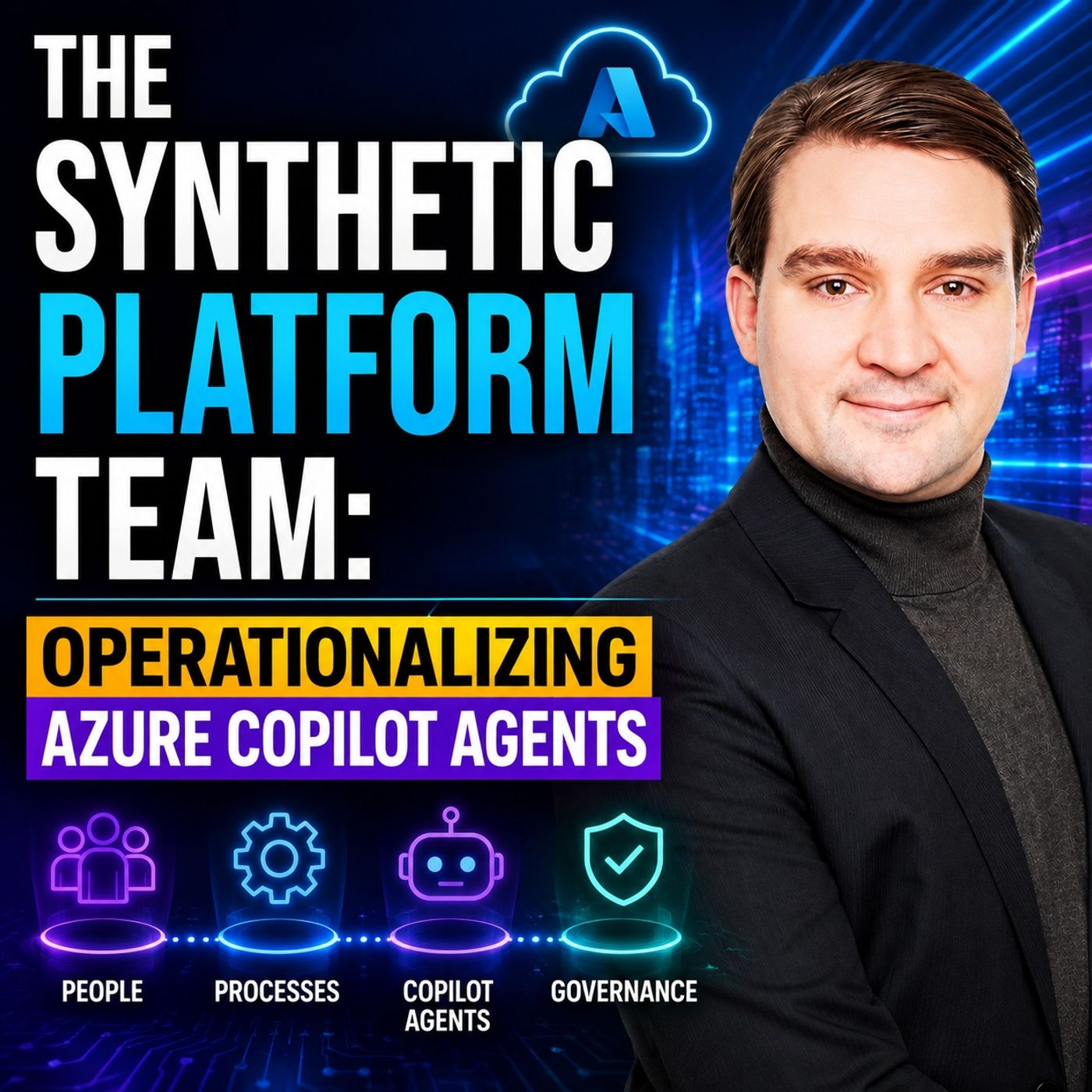
Azure Copilot Agents: Building a Synthetic Platform Team
Building AI agents is no longer just a development challenge—it’s an operational one. In this episode of the M365 FM Podcast, we explore the concept of the Synthetic Platform Team and how organizations can successfully operationalize Azure Copilot Agents at enterprise scale. Rather than treating AI agents as isolated applications, the discussion introduces a platform engineering approach where reusable infrastructure, governance, observability, and automation become the foundation for every agent. The episode explains how platform teams can standardize identity, security, model access, prompt management, deployment pipelines, monitoring, and cost optimization while giving development teams the freedom to build innovative AI solutions. Topics include Azure AI Foundry, Azure OpenAI, Copilot technologies, Infrastructure as Code, CI/CD, telemetry, policy enforcement, and lifecycle management for AI agents. Listeners will learn why successful enterprise AI depends less on individual …
Guest: Mirko Peters
![Dataverse MCP Integration with Nathan Rose [MVP]](https://d3wo5wojvuv7l.cloudfront.net/t_rss_itunes_square_1400/images.spreaker.com/original/86ec769c00d5ee947b3b44833e6ed7da.jpg "Dataverse MCP Integration with Nathan Rose [MVP]")
June 24, 2026
Dataverse MCP Integration with Nathan Rose [MVP]
Custom integrations have long been one of the biggest bottlenecks in enterprise applications, but Dataverse MCP is changing that. In this episode of the M365.fm podcast, Mirko Peters is joined by Microsoft MVP Nathan Rose to explore how the Model Context Protocol (MCP) and Dataverse are transforming the way AI agents connect with business data. The discussion explains why traditional APIs, custom connectors, and one-off integrations struggle to scale in an AI-first world. Instead, Dataverse MCP introduces a standardized, secure, and context-aware approach that allows Microsoft Copilot Studio and AI agents to access enterprise data with far less custom development. Nathan shares practical insights into MCP architecture, governance, security, and how organizations can build reusable integrations instead of maintaining complex point-to-point connections. The conversation also covers the future of agentic AI, Microsoft's vision for interoperable AI systems, and what developers, arch…
Guest: Mirko Peters
![Enterprise AI Agents with Sailaja Mantripragada [MVP-MCT]](https://d3wo5wojvuv7l.cloudfront.net/t_rss_itunes_square_1400/images.spreaker.com/original/8ad0790ed3b3ee91ea22f9c5fc77b6f7.jpg "Enterprise AI Agents with Sailaja Mantripragada [MVP-MCT]")
June 24, 2026
Enterprise AI Agents with Sailaja Mantripragada [MVP-MCT]
In this episode of the M365 FM podcast, Sailaja Mantripragada explores how organizations can move beyond simple AI assistants and build enterprise-grade AI agents using Microsoft Copilot Studio and the Power Platform. The conversation focuses on creating intelligent, business-driven agents that deliver measurable value while remaining secure, compliant, and governable. Sailaja shares practical insights from real-world enterprise projects, explaining how organizations can design AI agents that integrate with business processes, automate complex workflows, and leverage organizational knowledge through Microsoft 365, Dataverse, and Power Platform services. The discussion highlights the importance of balancing innovation with governance, ensuring that AI solutions remain aligned with security, compliance, and responsible AI principles. A major theme of the episode is AI governance. Sailaja discusses why governance must be built into AI initiatives from the beginning rather than adde…
Guest: Mirko Peters
June 23, 2026
Dataverse Business Skills for Scalable Power Platform Solutions
In this episode of the M365.FM Podcast, we explore why mastering Dataverse business skills is becoming one of the most important capabilities for organizations building scalable solutions on Microsoft Power Platform. The discussion goes far beyond tables and columns, focusing on how Dataverse can be used to capture business knowledge, processes, and operational intelligence in a way that supports long-term growth and automation. You’ll learn why successful Power Apps, Power Automate solutions, and AI-powered business processes depend on strong data modeling foundations rather than simply creating forms, workflows, or user interfaces. The episode highlights how well-designed Dataverse structures help organizations maintain consistency, improve governance, and reduce technical debt as applications scale across departments and business units. The conversation also examines the emerging role of Dataverse business skills, showing how organizations can transform business processes int…
Guest: Mirko Peters
![Game-Inspired Enterprise UX with Sandra Kiel [MVP]](https://d3wo5wojvuv7l.cloudfront.net/t_rss_itunes_square_1400/images.spreaker.com/original/a2357c83cffa67f87c515e52ac7ac167.jpg "Game-Inspired Enterprise UX with Sandra Kiel [MVP]")
June 22, 2026
Game-Inspired Enterprise UX with Sandra Kiel [MVP]
In this episode of the M365 Show, Mirko Peters sits down with Sandra Kiel to explore a fascinating question: what can enterprise software learn from video games? Drawing on her unique background in gaming, user experience, and Microsoft technologies, Sandra explains why many business applications struggle with adoption while games keep millions of people engaged for hours. The conversation dives into the psychology behind successful game design and how those same principles can transform workplace software. Sandra discusses concepts such as clear goals, instant feedback, progression systems, and user motivation. Rather than focusing on gamification as points and badges, she emphasizes designing experiences that make users feel confident, capable, and motivated to continue. Mirko and Sandra examine why many enterprise tools overwhelm users with complexity and how game-inspired design patterns can improve onboarding, learning, and long-term adoption. They also discuss the growing …
Guests: Mirko Peters , Sandra Kiel
![From SharePoint Developer to Power Platform Architect with Michel Mendes [MVP]](https://d3wo5wojvuv7l.cloudfront.net/t_rss_itunes_square_1400/images.spreaker.com/original/aa5dfe6fe28b65b7edf5c1a4ef5d9d74.jpg "From SharePoint Developer to Power Platform Architect with Michel Mendes [MVP]")
June 16, 2026
From SharePoint Developer to Power Platform Architect with Michel Mendes [MVP]
Most organizations believe they are building AI agents. In reality, many are still deploying advanced chatbots that operate within isolated applications. These systems can answer questions and generate content, but they lack persistence, long-term memory, and the ability to coordinate work across enterprise systems. In this episode, we explore one of the most important shifts happening in enterprise AI: the evolution from standalone conversational experiences to connected agent ecosystems. Instead of treating AI as a feature inside Microsoft Teams, Slack, or individual business applications, organizations are beginning to build persistent agent fabrics that can collaborate, share context, and execute tasks across multiple platforms. We discuss why memory, orchestration, identity, and governance are becoming critical components of modern AI architectures. The conversation examines how enterprises are moving beyond simple prompt-response interactions toward systems where AI agents…
Guests: Mirko Peters , Michel Mendes
June 15, 2026
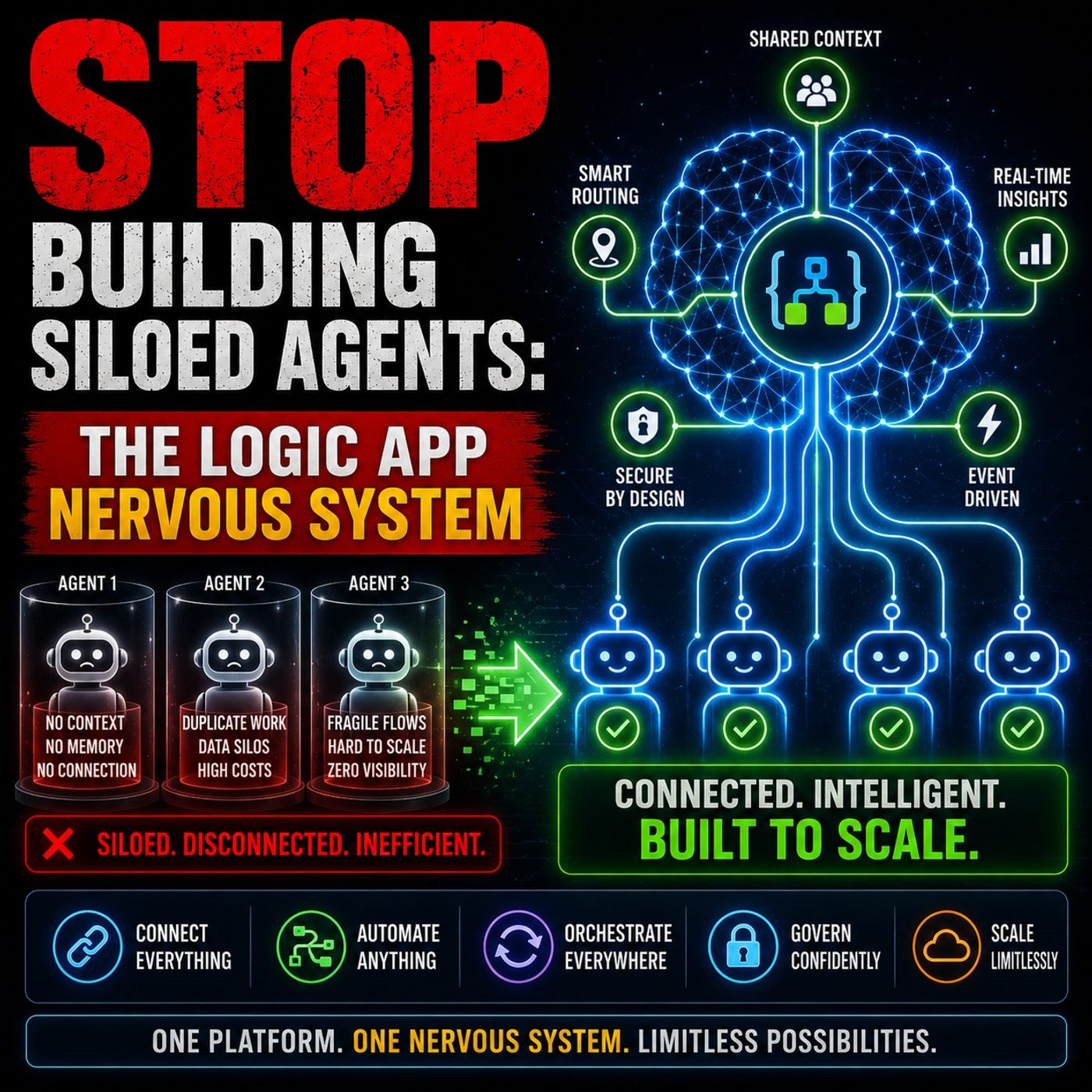
Azure Logic Apps for Multi-Agent AI Orchestration
In this episode, we explore why many organizations are making a critical mistake when building AI solutions: creating agents that operate in isolation. While individual agents can be powerful, they often become disconnected silos that lack the ability to coordinate across systems, processes, and business functions. The conversation focuses on Azure Logic Apps as the “nervous system” for enterprise AI, providing the orchestration layer that connects agents, applications, and workflows. Rather than viewing agents as standalone tools, organizations should design them as part of a larger ecosystem where events, messages, and automated processes enable collaboration and intelligent decision-making. We discuss the principles of event-driven architecture, the role of integration in modern AI systems, and how Logic Apps can connect Microsoft 365, Azure services, business applications, and external platforms. The episode also covers governance, scalability, and operational visibility, sh…
Guest: Mirko Peters
![Multi-Agent AI with Copilot Studio and David Lorenzo Lopez [MVP]](https://d3wo5wojvuv7l.cloudfront.net/t_rss_itunes_square_1400/images.spreaker.com/original/34bb09b3edbf3909d3f440dbeafad2ad.jpg "Multi-Agent AI with Copilot Studio and David Lorenzo Lopez [MVP]")
June 15, 2026
Multi-Agent AI with Copilot Studio and David Lorenzo Lopez [MVP]
Multi-Agent Systems, Copilot Studio, Microsoft Agent Framework, Intelligent Automation, AI Orchestration, Microsoft Foundry, Artificial Intelligence, David Lorenzo Lopez, MC65 Podcast, Generative AI, Autonomous Agents, Enterprise AI, Microsoft Azure, Microservices Architecture, LLM Agents, AI for Business, GPT-3.5, Software Development, Microsoft Ecosystem
Guests: Mirko Peters , David Lorenzo Lopez
![Agentic AI with Copilot Studio and Dataverse MCP with Nathan Rose [MVP]](https://d3wo5wojvuv7l.cloudfront.net/t_rss_itunes_square_1400/images.spreaker.com/original/23ba273cbdaa9f2d9eda51ad32085bf8.jpg "Agentic AI with Copilot Studio and Dataverse MCP with Nathan Rose [MVP]")
June 10, 2026
Agentic AI with Copilot Studio and Dataverse MCP with Nathan Rose [MVP]
In this episode of the M365.fm podcast, Nathan Rose joins the show to explore how Copilot Studio, Dataverse, and the Model Context Protocol (MCP) are shaping the future of agentic AI in Microsoft 365. The conversation dives into how organizations can move beyond simple chatbots and build intelligent agents that understand intent, access business data, and take meaningful actions across systems. Nathan explains why Dataverse has become a critical foundation for AI-powered business applications, providing structured data, security, and governance that enterprise AI solutions require. The discussion then focuses on MCP, an emerging open standard that enables AI agents to connect with external tools, data sources, and business systems in a more consistent and scalable way. Listeners will learn how MCP reduces integration complexity, allowing Copilot Studio agents to interact with Dataverse, Dynamics 365, Microsoft services, and even third-party systems without relying on large numbe…
Guests: Mirko Peters , Nathan Rose
![Power Platform ALM with Parvez Ghumra [MVP]](https://d3wo5wojvuv7l.cloudfront.net/t_rss_itunes_square_1400/images.spreaker.com/original/e90cc54455414d8ebd360647fab45609.jpg "Power Platform ALM with Parvez Ghumra [MVP]")
June 9, 2026
Power Platform ALM with Parvez Ghumra [MVP]
In this episode of the M365 Voice podcast, host Mirko Peters is joined by Parvez Ghumra to explore the critical role of Application Lifecycle Management (ALM) in the Power Platform. The conversation moves beyond simple solution deployments and dives into what it takes to build enterprise-ready Power Platform solutions that are scalable, maintainable, and governed effectively. Parvez shares his journey from traditional software development into the low-code world and explains why citizen development and professional development must work together. Listeners will learn how source control, automated deployments, Azure DevOps, GitHub, and governance practices can transform Power Platform projects from manual, error-prone processes into reliable enterprise delivery pipelines. The discussion also covers common ALM challenges, how organizations can avoid deployment pitfalls, and practical strategies for introducing DevOps principles into Power Platform environments. Whether you're a ma…
Guests: Mirko Peters , Parvez Ghumra

June 5, 2026
Connect Microsoft Copilot to Predictive Power BI
This episode explores how organizations can connect Microsoft Copilot with the predictive capabilities of Power BI to move beyond simple reporting and toward proactive, data-driven decision-making. The discussion highlights that while Copilot excels at natural language interactions and summarizing information, its real business value increases when it can access trusted analytical models, forecasts, and governed business data from Power BI. The episode explains that many organizations still use Power BI primarily as a dashboard destination. However, the future lies in treating Power BI as a semantic and analytical layer that feeds AI-powered experiences. Instead of navigating reports manually, users can ask questions in natural language through Copilot and receive contextual answers backed by governed Power BI models. A key theme is predictive analytics. By combining Copilot with Power BI datasets, organizations can surface forecasts, trends, risk indicators, and business predic…
Guest: Mirko Peters
![Microsoft 365 Copilot Extensibility with Gautam Sheth [MVP]](https://d3wo5wojvuv7l.cloudfront.net/t_rss_itunes_square_1400/images.spreaker.com/original/0d09e6adda79b6f41944f0d02b5987e9.jpg "Microsoft 365 Copilot Extensibility with Gautam Sheth [MVP]")
June 5, 2026
Microsoft 365 Copilot Extensibility with Gautam Sheth [MVP]
In this episode of M365.fm, host David Warner speaks with MVP Gautam Sheth about Microsoft 365 Copilot extensibility and how organizations can go beyond the out-of-the-box Copilot experience. Gautam explains the different extensibility options available, including declarative agents, custom engine agents, Copilot connectors, and plugins, helping listeners understand when and why each approach should be used. The discussion focuses on practical steps for extending Copilot with organizational knowledge, business processes, and external systems to deliver more relevant and actionable AI experiences. Gautam highlights the importance of grounding Copilot in enterprise data, leveraging Microsoft Graph, and designing solutions that align with real business scenarios rather than simply adding AI for its own sake. The episode also covers governance, security, and adoption considerations, emphasizing that successful Copilot implementations require a balance between technical capabilities …
Guests: Mirko Peters , Gautam Sheth
June 4, 2026
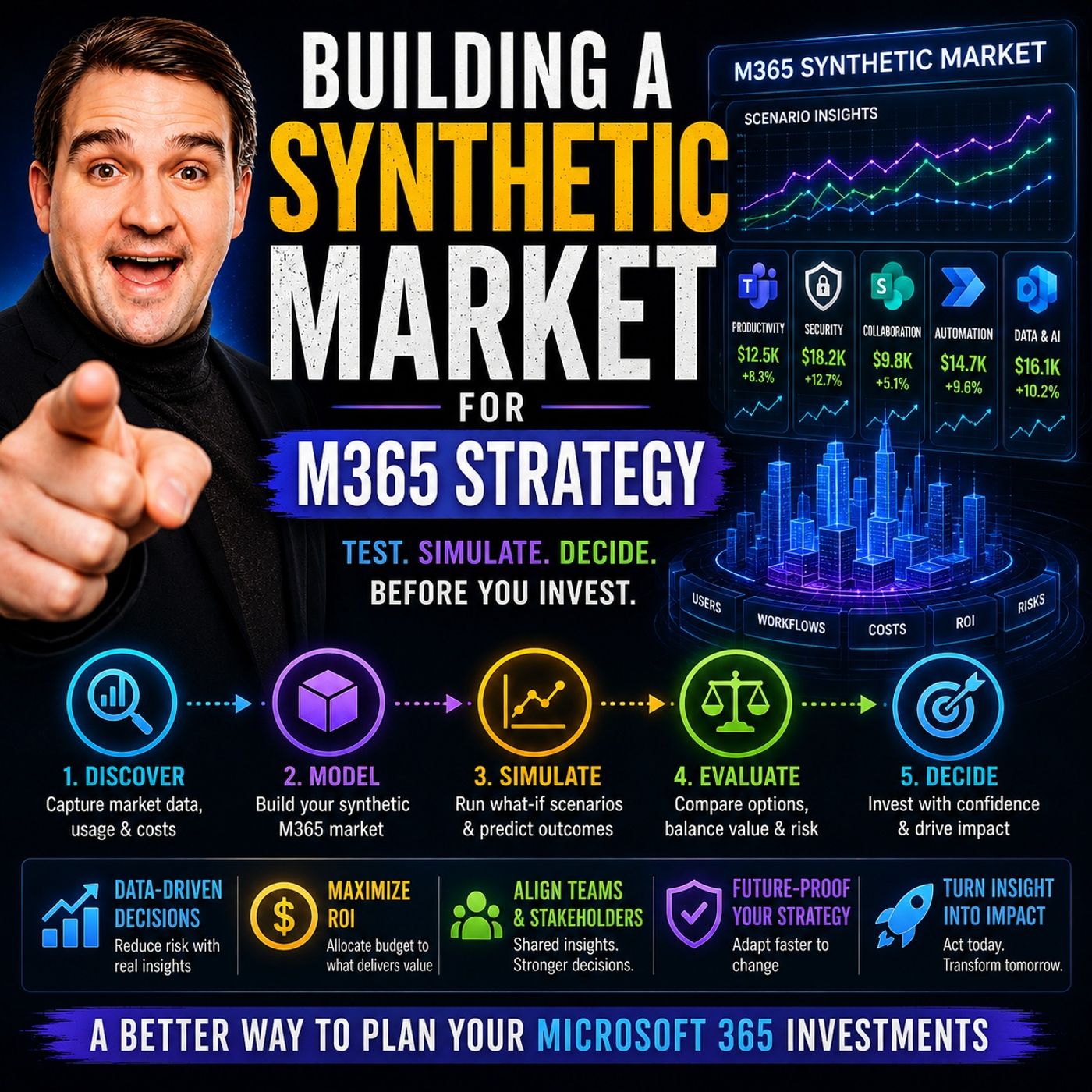
Building a Synthetic Market for Microsoft 365 Strategy
In this episode, Mirko Peters explores why successful Microsoft 365 strategy should be approached like building a synthetic market rather than deploying technology in isolation. The core idea is that Microsoft 365 creates an internal economy where information, collaboration, automation, governance, and AI capabilities continuously interact. Organizations that focus only on individual tools such as Teams, SharePoint, Power Platform, or Copilot often miss the larger system dynamics that drive long-term value. The discussion highlights that every platform decision creates incentives and behaviors. Poor governance can encourage content sprawl, uncontrolled workspace growth, and fragmented knowledge, while well-designed governance creates trust, discoverability, and sustainable adoption. The episode argues that strategy is not about maximizing feature usage but about shaping the conditions that allow productive behaviors to emerge naturally across the organization. A key theme is tha…
Guest: Mirko Peters
![Leading AI Transformation and Community with Areti Iles [MVP]](https://d3wo5wojvuv7l.cloudfront.net/t_rss_itunes_square_1400/images.spreaker.com/original/bdb673dbc4e48fced74872c39febd010.jpg "Leading AI Transformation and Community with Areti Iles [MVP]")
June 3, 2026
Leading AI Transformation and Community with Areti Iles [MVP]
Quick answer: AI transformation leadership with Areti Iles is covered in this M365 FM episode with a practical focus on how it works, where it fits, and the architecture, security, governance, or operational choices that matter in real Microsoft environments. In this episode of the M365 FM Podcast, Mirko Peters welcomes Areti Iles, Microsoft MVP, Head of Professional Services at Telefonica Tech’s AI Business Solutions Division, community leader, mentor, conference organizer, and one of the most...
Guests: Mirko Peters , Areti Iles
![Power Apps Code Apps with Carike Botha [MVP]](https://d3wo5wojvuv7l.cloudfront.net/t_rss_itunes_square_1400/images.spreaker.com/original/cccc00c2c1dcebaa584de93078f0ce25.jpg "Power Apps Code Apps with Carike Botha [MVP]")
June 2, 2026
Power Apps Code Apps with Carike Botha [MVP]
In this episode of the M365 FM Podcast, Mirko Peters sits down with Carike Botha (MVP) to explore the evolution of Power Apps from traditional low-code development to the emerging world of pro-code applications. The discussion challenges the common assumption that low-code platforms eliminate the need for developers, showing instead how modern Power Platform solutions increasingly blend citizen development with professional software engineering. Carike explains how Power Apps has matured beyond simple forms and workflows, enabling developers to build scalable, maintainable, and enterprise-grade solutions. The conversation highlights the introduction of code-first capabilities, deeper integration with development tools, and the growing importance of software architecture, source control, testing, and governance within the Power Platform ecosystem. The episode also examines where low-code approaches excel and where pro-code techniques become essential. As organizations build more …
Guests: Mirko Peters , Carike Botha
![Scaling Copilot Studio with Isha Kapoor [MVP]](https://d3wo5wojvuv7l.cloudfront.net/t_rss_itunes_square_1400/images.spreaker.com/original/dbcdccd17b20b5f4967176d898265308.jpg "Scaling Copilot Studio with Isha Kapoor [MVP]")
June 1, 2026
Scaling Copilot Studio with Isha Kapoor [MVP]
In this episode of the M365.fm podcast, Mirko Peters sits down with Microsoft MVP Isha Kapoor to explore what it really takes to scale Microsoft Copilot Studio in large enterprise environments. The conversation moves beyond simple chatbot scenarios and focuses on the architectural, governance, and operational challenges organizations face when deploying AI-powered agents at scale. Isha shares practical insights into designing enterprise-grade Copilot Studio solutions that remain secure, maintainable, and aligned with business goals. The discussion highlights why successful AI adoption requires more than technology alone. Governance, data quality, security controls, lifecycle management, and clear ownership models are critical factors that determine whether AI initiatives succeed or fail. The episode examines how enterprises can balance innovation with control while empowering business teams to build and use AI agents responsibly. Topics include agent orchestration, integration w…
Guests: Mirko Peters , Isha Kapoor
May 29, 2026
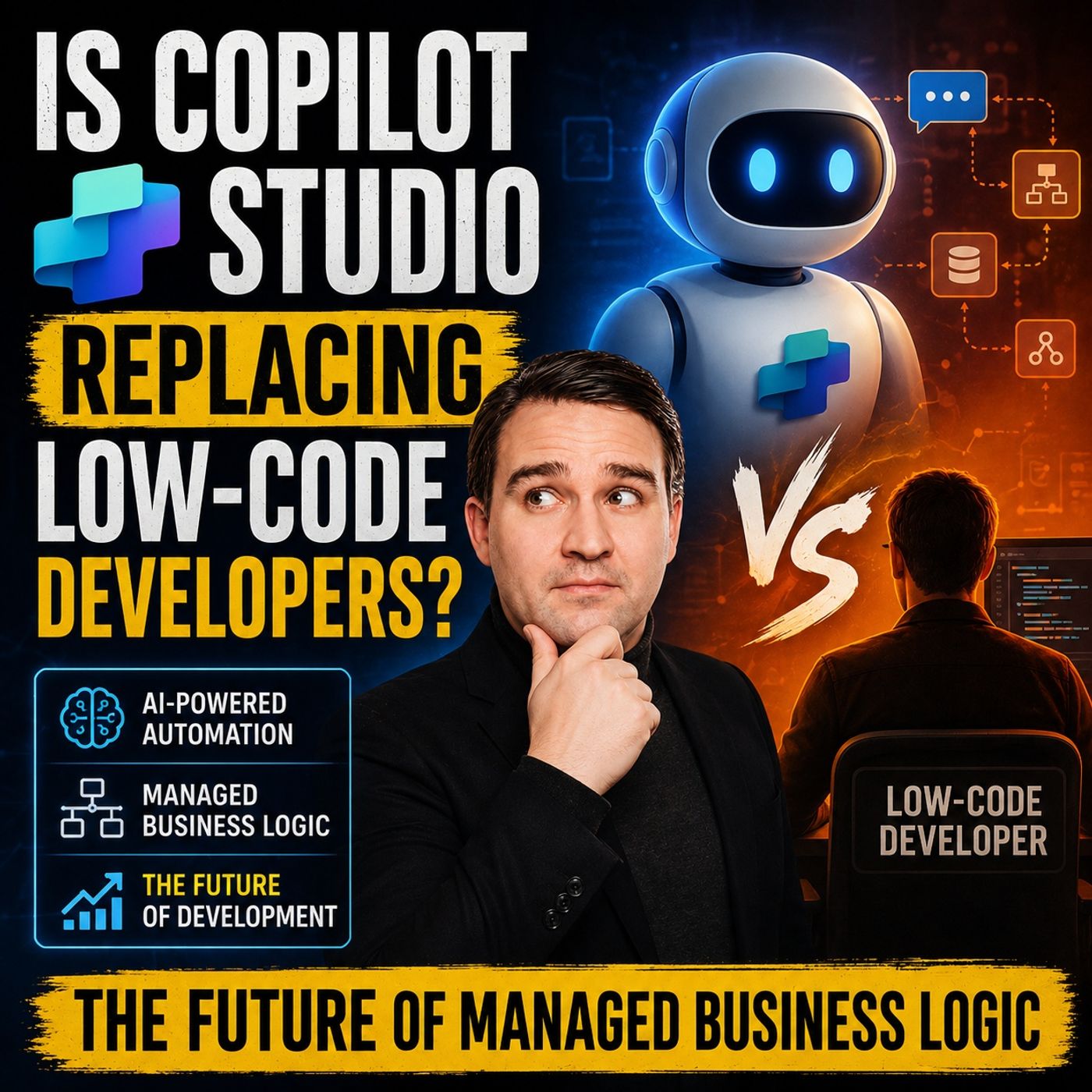
Will Copilot Studio Replace Low-Code Developers?
Quick answer: will Copilot Studio replace low-code developers is covered in this M365 FM episode with a practical focus on how it works, where it fits, and the architecture, security, governance, or operational choices that matter in real Microsoft environments. You see Copilot Studio empowering you as a low-code developer, not Copilot Studio replacing your role. This platform acts as a catalyst in enterprise AI architecture, transforming your experience from UI-centric tools to AI-first orches...
Guest: Mirko Peters

May 28, 2026
Building Multi-Tenant SaaS with Power Pages and Dataverse
Breaking the Scale Barrier explores what it really takes to build scalable multi-tenant SaaS solutions with Microsoft Power Pages and Dataverse. Instead of focusing on simple customer portals or low-code demos, the episode dives into the architectural decisions that become critical once a platform must support multiple customers, strict security boundaries, enterprise governance, and large-scale growth. The conversation explains why many Power Platform projects struggle when they move beyond a single environment and how proper tenant isolation, identity management, API strategy, and automation can determine whether a SaaS platform succeeds or fails. It also examines the balance between low-code simplicity and the need for pro-code extensibility when scaling enterprise applications. Topics include Dataverse design for tenant separation, authentication with Microsoft Entra External ID, governance and ALM practices, performance considerations, API limitations, and patterns for comb…
Guest: Mirko Peters
May 27, 2026
Modern Microsoft 365 Automation Beyond PowerShell Scripts
For years, PowerShell scripts were the foundation of Microsoft 365 automation. IT admins built massive script libraries to onboard users, assign licenses, provision devices, configure Exchange, manage permissions, and automate repetitive operational work across cloud and hybrid environments. But enterprise IT is changing fast. In this episode, we explore why traditional PowerShell-driven automation is becoming increasingly obsolete in modern Microsoft 365 environments. Static scripts struggle to keep up with rapidly changing APIs, evolving security models, Zero Trust architectures, AI-driven workflows, and the growing complexity of cloud-native services. We break down how Microsoft Graph, event-driven architectures, low-code automation, Copilot, AI agents, and modern orchestration platforms are reshaping enterprise automation. Instead of maintaining fragile scripts that constantly require updates, organizations are moving toward adaptive, API-first, and AI-assisted automation…
Guest: Mirko Peters
![From Microsoft Lync to Teams with Carsten Lund Meilbak [MVP]](https://d3wo5wojvuv7l.cloudfront.net/t_rss_itunes_square_1400/images.spreaker.com/original/43f2590365f3110707cfbd0fb3be6214.jpg "From Microsoft Lync to Teams with Carsten Lund Meilbak [MVP]")
May 26, 2026
From Microsoft Lync to Teams with Carsten Lund Meilbak [MVP]
In this episode of the M365.fm podcast, Mirko Peters speaks with Microsoft MVP Carsten Lund Meilbak about the evolution of enterprise communication and collaboration — from the early days of Microsoft Lync and Skype for Business to the modern Microsoft Teams ecosystem. The conversation explores how collaboration platforms have changed from simple messaging and voice solutions into fully integrated hubs for meetings, telephony, teamwork, apps, and AI-powered productivity. Carsten shares his personal journey through the Microsoft collaboration space and explains how organizations adapted to major platform transitions over the years. The discussion highlights the technical and cultural shifts that accompanied the move from traditional on-premises communication systems toward cloud-first collaboration with Microsoft Teams. A major focus of the episode is how Teams transformed workplace communication by combining chat, meetings, calling, file collaboration, and integrations into a si…
May 25, 2026
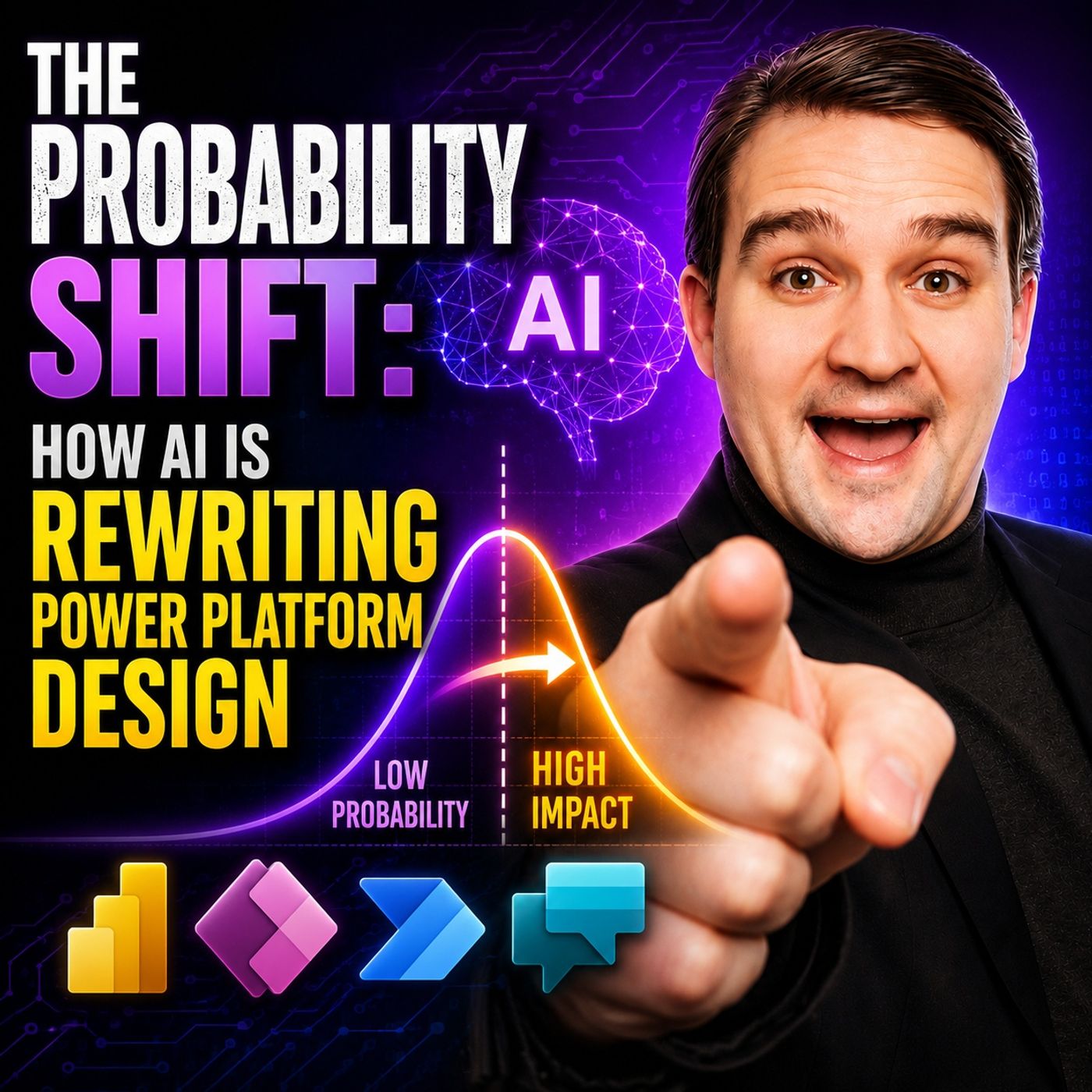
How Probabilistic AI Changes Power Platform Design
Traditional Power Platform automation was built on deterministic logic: structured data, predictable inputs, and fixed rule-based workflows. This article explains how AI is fundamentally changing that model by introducing probabilistic systems that operate on likelihood instead of certainty. In modern enterprises where data is incomplete, ambiguous, or constantly changing, rigid “if-this-then-that” logic is no longer sufficient. The podcast explores how AI-driven workflows now rely on confidence scores and contextual reasoning rather than binary outcomes. Instead of returning simple true-or-false answers, AI systems evaluate how likely something is to be correct and make decisions based on probability. This shift changes how Power Platform solutions must be designed, governed, and trusted. A key theme is that modern automation architectures should embrace uncertainty instead of trying to eliminate it. By combining AI with governance models such as human review and escalation pat…
Guest: Mirko Peters
May 25, 2026
How to Govern Microsoft Copilot in the Enterprise
Enterprise governance for Microsoft Copilot is no longer optional. As AI becomes deeply integrated into Microsoft 365, organizations must rethink how they manage security, compliance, permissions, and operational control. Traditional governance models were designed for static collaboration environments, but Copilot changes the landscape by turning existing data into instantly accessible intelligence. The core message across M365.fm discussions is clear: Copilot does not create governance problems — it exposes the ones already hidden inside the organization. A major challenge for enterprises is oversharing and uncontrolled access to files, Teams, SharePoint sites, and sensitive information. Copilot can surface content users already have permission to access, which means weak governance structures become visible immediately. Organizations therefore need strong identity management, role-based access controls, sensitivity labels, lifecycle management, and continuous auditing before sca…
Guest: Mirko Peters