 EN
 Deutsch
 Español
 Français
 Italiano
 Português
 Nederlands
 Polski
 Bahasa Indonesia
 Русский
 Українська
 العربية
 עברית
 हिन्दी
 日本語
 한국어
2026-09-17 · Season 3
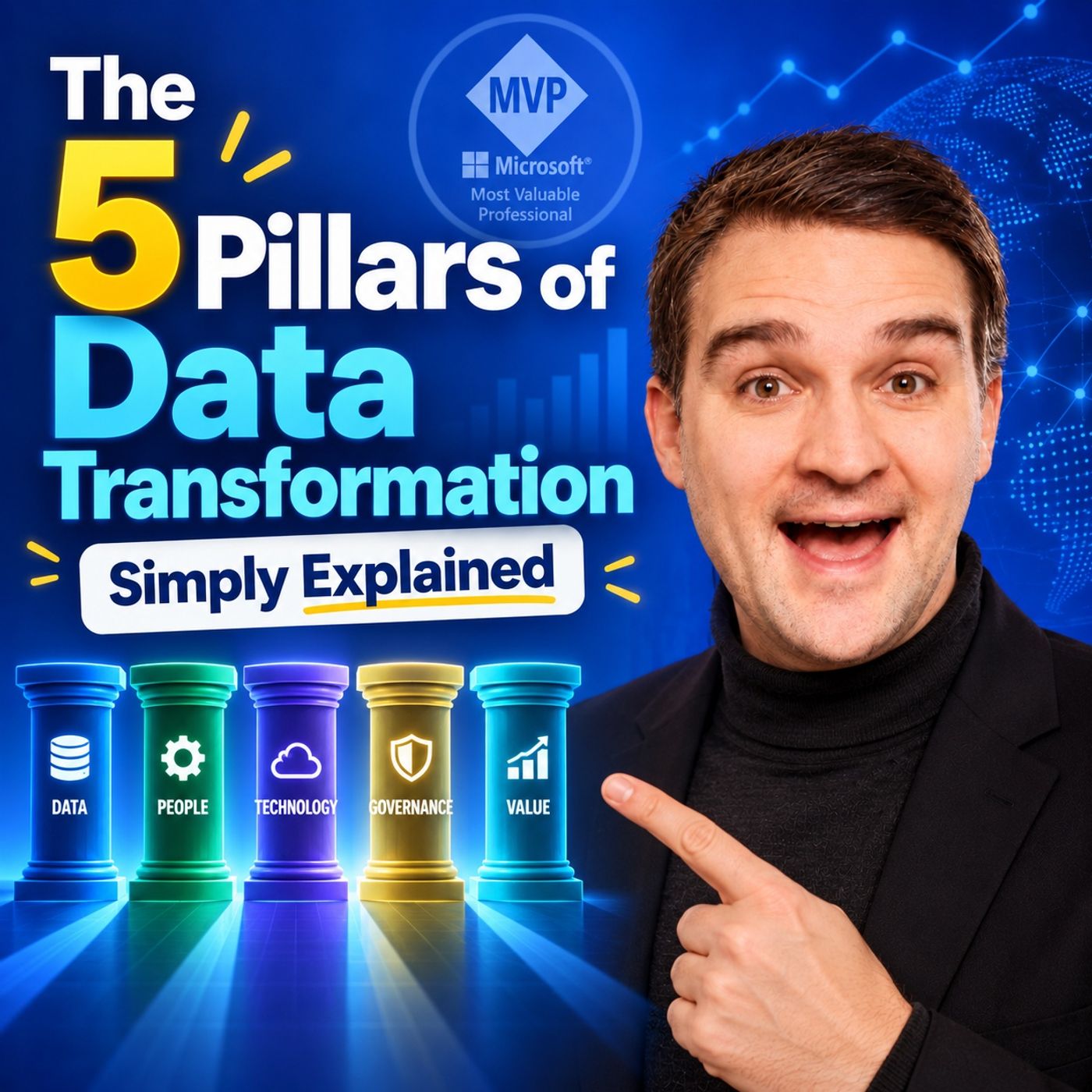
The 5 Pillars of Data Transformation - Simply Explained
Show notes
AI was supposed to clear the backlog, accelerate decisions, and give every team a smarter way to work. Instead, many organizations now have Microsoft Copilot, Power BI, Microsoft Fabric, AI agents, and more data than ever before—while important decisions still crawl through meetings because nobody fully trusts the numbers or knows who can act on them. The technology spend keeps rising. The action does not. The problem is often not a lack of AI. It is the absence of an operating model connecting data, meaning, governance, technology, people, and accountability. In this episode of M365 FM – Simply Explained, we break down the five pillars organizations need to build a reliable foundation for data transformation and AI. WHAT YOU WILL LEARN In this episode, we explore:
- Why AI cannot compensate for unreliable data
- How data governance creates trust before automation begins
- Why data quality should depend on the decision being made
- How Microsoft Purview can support governance and data discovery
- How Microsoft Fabric supports modern analytics and data platforms
- Why semantic models matter for Power BI and AI
- How conflicting definitions create conflicting dashboards
- Why business glossaries matter for humans and AI agents
- How data ownership affects AI readiness
- Why access, security, and permissions must be defined before AI scales
- How Copilot and AI agents depend on trusted business context
- Why human accountability remains critical even when AI generates the answer
PILLAR 1: DATA GOVERNANCE – TRUST BEFORE AUTOMATION Data governance often sounds like policies, compliance meetings, documentation, and bureaucracy. In practice, governance answers a few very simple questions:
- Who owns this data?
- Who is allowed to access it?
- Where did the data come from?
- Can we trust it for this particular use case?
- What are people allowed to do with it?
- What are AI systems allowed to do with it?
Without clear answers, AI does not solve a data problem. It can spread the problem faster. Imagine a leadership team preparing a sales forecast. Sales presents one revenue number. Finance presents another. Both numbers come from systems that appear authoritative. The meeting suddenly stops being about future decisions. Instead, everyone starts arguing about which spreadsheet or dashboard is correct. The underlying problem may be that:
- The CRM contains one version of revenue
- The finance system contains another
- Manual exports introduce additional differences
- Nobody owns the definition of revenue
- Nobody owns the quality of the source data
- Nobody can clearly explain which number should drive the forecast
The company ends up debating the past instead of deciding the future. WHAT HAPPENS WHEN AI ENTERS THE PICTURE? Now imagine someone asks an AI agent: “Which sales region is falling behind?” The answer may arrive within seconds. But it could be based on:
- Duplicate customer records
- Outdated account assignments
- Missing opportunities
- Incorrect forecast stages
- Old data
- Incorrect permissions
- Information the user should not have been able to access
The answer can sound confident. That does not automatically make it trustworthy. Governance creates the working agreement around the data before automation starts using it. A strong governance model typically establishes:
- Named data owners
- Clear responsibilities
- Data classifications
- Access rules
- Source-system documentation
- Data quality expectations
- Auditability
- Policies for sensitive information
- Rules for AI and automation
Microsoft technologies can support this process. Microsoft Purview can help organizations discover, classify, understand, and govern information. Microsoft Fabric can help bring data together, prepare it, analyze it, monitor it, and make it available for reporting and AI scenarios. But technology cannot decide everything. Organizations still need people to decide:
- Who owns customer data
- Which definitions are authoritative
- What data quality is acceptable
- Who should have access
- When an AI-generated answer is safe to use
- Who remains responsible for the final decision
DATA QUALITY MUST MATCH THE DECISION Many organizations approach data quality as if every field in every system needs to be perfect. That is rarely realistic. Data quality should instead be evaluated against the business decision being made. For a sales forecast, the most important fields might include:
- Opportunity stage
- Expected close date
- Forecast amount
- Account owner
- Territory
- Probability
- Customer status
Other fields may be less important for that specific decision. The better question is therefore not: “How do we clean all of our data?” The better question is: “Which data must we trust for this decision?” That makes the problem smaller, more measurable, and much easier to manage. Become a supporter of this podcast: https://www.spreaker.com/podcast/m365-fm-microsoft-365-azure-cloud-power-platform-ai--6704921/support.
Apple Podcasts · Spotify · YouTube · Deezer
Host: Mirko Peters
Related articles
Transcript
Read the full transcript
We were promised AI would speed up the business, but many teams now produce answers faster and still can't decide what to do. Copilot writes the brief, BI fills the dashboard, and the meeting ends with the same question. Which number do we trust? And that costs more than a few wasted licenses. It turns expensive AI and data projects into noise while people spend their day checking reports, chasing definitions, and waiting for someone else to make the call. The result is stalled, decisions and frustrated teams. You might think the gap is better AI. It isn't. The real tension here is a missing operating system for data and people. There are five pillars behind that system. And the last one decides who carries responsibility when the answer causes harm. Welcome to the M365FM podcast where we explore the people, ideas and technologies shaping the future of work. Before your next AI rollout will run a simple test to find the pillar that's already cracking. Pillar one data governance trust before automation. So here's a hard question when AI gives your team an answer. Where did that answer come from? Who owns the source and should that person even have access to it? AI doesn't clean up confusion by itself. It can search across more files, summarize more records and send a recommendation in seconds. But it also moves bad data faster. Consider a customer record with the wrong status, two systems that disagree on revenue or a sensitive file sitting in the wrong place. AI can turn that small problem into a fast, confident decision that spreads across the whole organization. That's why data governance has to come first in the stack. Simply explained governance is the agreement that tells everyone what data exists, who looks after it, who can use it, how reliable it needs to be, and what rules apply before it moves into a report, a model or an AI prompt. Think of it as the operating manual for your data, the thing that keeps everyone on the same page. Picture a planning meeting sales reports 10 million in forecast revenue, finance reports 8 million, both reports look polished and credible. But leadership can't plan hiring, spending or targets because the room spends an hour arguing about which number counts. Both teams believe their number is right and both have data to back it up. The intention behind the meeting was simple. One forecast the business could use to make real decisions. But underneath the polished reports, sales included likely deals while finance only counted signed contracts. Nobody owned the shared definition and nobody had been asked to settle it before the meeting. Neither side was wrong. They just had different definitions, missed that decision often enough and planning turns into guesswork with better charts. Governance gives that situation a clear path forward instead of endless debate. A named owner takes responsibility for the revenue data set. The business writes down in plain language what revenue means for that specific forecast. Teams can see the source systems, how recently the data refreshed, and what checks flagged missing or unusual records. Access rules keep payroll, customer details and contracts away from people and tools that don't need them. That sounds dry and administrative until an AI assistant receives a broad request like show me our highest risk customers. Without governance, it may pull old account notes, incomplete payment records and data the request I shouldn't even see. With governance, the data has labels, approved sources, permissions and a named person who can answer when the output looks wrong. You don't need a giant policy document to begin. Just pick one data set tied to a live decision. Name the business owner, not just the technical contact, write down where the data comes from and how it flows through the organization. Classify anything sensitive, decide who can read it and who can change it, then track a few quality checks that matter. Duplicates missing fields, stale records or values outside an expected range. Microsoft tools can support this work in a practical way. Microsoft purview helps teams discover data, apply sensitivity labels, track where data moves and manage access. Microsoft fabric brings data and reporting work closer together so people don't build five separate copies of the same source, but tools can't decide whether a sales director or finance lead owns the meaning of forecast revenue. People still need to agree and document it. No tool can automate that human decision. Many teams reverse the order and pay the price. They launch an AI pilot, connect every source they can reach and start talking about governance after someone finds a bad answer or a data exposure. By then, trust has already taken a hit. The better move is smaller and earlier set the rules around the data that feeds the use case before the model starts using it. Still, even trusted data doesn't solve every argument. Two teams can look at the same clean data and give the same word completely different meanings. That's a problem governance alone can't fix. Pillar two semantic layer one meaning for humans and machines. You can clean a data source until it sparkles, but if three departments define the same word differently, you still have chaos. Ask your sales team to define customer and they'll say a prospect who signs a contract, ask support and they'll say someone who opens an account, ask finance and they'll tell you it's only a customer after the first invoice clears. None of them are wrong. They're just answering different business questions without realizing it. That's where semantic layer changes everything. Simply explained, it's a shared business dictionary with pre-approved calculations baked right in. You define a term once, store the logic once and reuse it everywhere from a power BI report to an AI prompt asking which customer accounts are at risk this quarter. Here's the head fake. You think more dashboards will settle the disagreement, but they actually make it worse. When every analyst writes their own formula for profit or monthly growth, you end up with five clean reports that tell five slightly different stories. People stop solving problems and start defending their spreadsheets. Picture an operations lead and a finance manager sitting in the same meeting. Operations reports orders up 12% because they count and order the moment it ships. Finance reports a lower number because they wait for the invoice to post. Both numbers trace back to a real system. Both calculations fit their own work, but the executive asks one plain question. Did the business grow and nobody can answer without a debate? The intention is a shared view of performance. The obstacle is buried in the calculation logic that works locally while nobody agreed which logic should guide the company conversation. If that confusion reaches an AI assistant, the assistant sounds confident while quietly switching meanings behind the scenes. A semantic layer stops that drift by putting business meaning in a place everyone can inspect. Start with a glossary. Keep it plain. Active customer might mean an account with at least one paid transaction in the last 90 days. Gross profit might mean revenue minus direct cost before overhead. The wording matters because a new analyst, a sales leader and an AI tool all need to reach the same meaning. Next, certify the measures people actually use to run the business. A certified measure isn't a magic stamp. It's a calculation the right business people reviewed, approved and agreed to reuse. Put business-friendly names on fields too. Cust Act V. Filge might make sense to the person who built the source table, but active customer gives a report user and an AI assistant far less room to guess. You'll also need to retire duplicate logic. That's usually the uncomfortable part. Someone spent months perfecting a local report and now the shared measure gives a different result. Don't hide the difference. Put both formulas side by side, identify the rule that changed the number and decide which fits the business question. A shared definition only works when people stop keeping private versions in the background. In Microsoft terms, a power BI semantic model can hold those approved relationships, measures and field names in one reusable layer. Fabric can connect that model to the broader data work, so reporting, analysis and AI aren't each inventing their own version of the business. But technology can't settle a business dispute by itself. The governed definitions underneath still matter. Once people share the same language, the conversation gets cleaner. But even perfect definitions can't rescue a report built around the wrong question. We need to stop asking what can we measure and ask something far more useful? What decision needs to change? Pillar three clarity start with the decision. Once everyone uses the same words, there's another problem waiting. A team can still measure everything and decide nothing. You know the dashboard, dozens of charts, filters, trends, maps, scorecards, and still nobody can answer the one question that brought them into the meeting. That's the dashboard trap. People start with available data, then build views around whatever they can count. Website visits support ticket sales activity, product usage, costs, customer feedback. It all feels useful, but useful information isn't the same as a decision to real clarity. Start somewhere else. You name the decision before you build the report. You name the person who will make that decision. The date they need to make it, the action they can take and the measure that tells them when to act. Suddenly a report has a job helping someone choose rather than giving everyone more material to discuss. This sounds simple, but it changes the work. Without it, a team can spend months connecting sources, testing visuals and refining prompts for a report that never changes a single behavior. The report might look impressive. It might even attract a lot of views. But if nobody can point to an action that triggered, it's just a screen full of delayed decisions. Imagine a customer team worried about churn. They build a dashboard with retention trends, satisfaction scores, product usage, support history, contract value and customer segments. Every chart looks sensible, then someone asks, which customers do we contact? This week. The room goes quiet. The team wanted to keep more customers. Their obstacle wasn't missing charts. Nobody agreed on the threshold that signals risk, who owns the customer outreach, or what should happen after an account crosses that line. If a customer's usage falls by 20%, does account management call them? Does support review their recent tickets? Does anyone act before renewal talks start? A clear decision could sound like this. Every Monday, the customer success lead will decide which accounts need outreach within five business days based on a defined risk score. That sentence forces useful questions into the open, which accounts count as high risk, who owns the risk score? When does the team review it? What kind of outreach follows? And how will they know if it worked? Write that sentence before anyone asks for a dashboard, then define the choice in plain words. Maybe the choice is whether to contact an account, offer training, bring in an executive sponsor, or accept that the account will leave. Name the decision owner, set the trigger, name the next action. If the measure can't help the owner take that action, it doesn't belong on the first version of the report. And this is where AI and BI settle into their real roles. BI helps you see the pattern, which customer groups leave more often? When usage drops, whether support delays connect to cancellations, AI can scan notes, summarize themes, research account history, and suggest options faster than a person digging through 10 systems. But neither tool chooses which trade off your business accepts. Maybe the account needs a costly rescue effort. Maybe your team has limited capacity and must focus on customers with an upcoming renewal. That call includes money, relationships, timing, and risk. A person owns it, a clear question can cut more waste than another data source. Instead of asking, what else can we measure about churn? Ask, what decision are we unable to make every week? The first question expands the work. The second one gives it a boundary. Still, even a well-defined decision can freeze when someone notices. The numbers don't support the plan and nobody feels safe enough to say it out loud. Pillar 4. Psychological safety. Let the data challenge the room. A great decision only works if someone can question the evidence behind it. But in most data projects, the pattern is the same. Somebody spots a bad source, a weak assumption, or a number that doesn't match what they see on the ground. And then they stay quiet because the room already feels settled. That silence looks efficient in the moment. The meeting finishes on time, the launch date sticks, and nobody has to sit through an awkward disagreement. But here's what nobody accounts for. The problem doesn't disappear. It travels downstream to customers, finance, or the person who trusted that AI output without seeing the crack underneath. Psychological safety means you can speak up without paying a social price for it. You can ask, where did this number come from? You can admit you don't fully understand a metric. You can flag a risk. You can disagree with a senior leader, an analyst, or the AI itself, and still be seen as someone who helps the team. But here's the head fake. Conflict doesn't break a data transformation. Avoiding conflict breaks it. Good conflict tests whether a claim can survive real questions. It turns a polite meeting into a genuinely better decision process. Imagine an analyst preparing a customer targeting model for a big campaign. While checking the data, she notices one customer segment barely appears in the training set. The model might recommend less support for those customers simply because it learned almost nothing about their needs. She spots the gap early. But the campaign launch date has been announced. Leaders are excited about the AI work, and she worries that raising the issue will make her look like she's blocking progress. So she adjusts nothing and says nothing. The model goes live. The team treats the output as neutral because it came from the data. But the missing segment didn't vanish. It just became invisible inside the decision. That small silence turns into a customer problem that people could have caught before launch. You need a routine that makes challenge normal, not personal. In decision meetings, assign one person to play the challenger. Their job isn't to win an argument. It's to ask, what would prove the current conclusion wrong? Which source might be incomplete? Which customer group is missing? What assumption are we treating as fact? That one role shifts the energy in the room. Questions stop sounding like criticism because someone was asked to bring them. You can rotate the role so the same person doesn't become the permanent skeptic. When a result fails, separate learning from blame. Ask what the team knew at the time, what evidence they used, and where the process let a weak assumption through. If people expect punishment for every mistake, they'll hide errors until the damage spreads. If they know the team will inspect the process fairly, they'll surface problems while they're still time to act. Write down unresolved assumptions too. Don't let them fade because the agenda moved on. The short list can say, we don't yet know whether this behavior applies to new customers, or that source has a three day delay. Those notes give the decision owner an honest picture of uncertainty. And keep the challenge focused on the work, not the person. Don't say, your analysis is wrong. Say, this result depends on a source that excludes this segment. What does that do to the recommendation? You're testing the claim, not attacking the person who brought it. This connects directly to governance. The data owner might discover missing fields, old records, or access problems that affect an AI use case. If reporting that issue creates trouble for them, that issue stays hidden while the model spreads it to more people. A safe route for reporting data failures protects everyone downstream. Open debate improves the quality of decisions, but evidence can still be incomplete. At some point, somebody has to weigh the uncertainty, choose a path, and accept the consequences. That takes us from team confidence to individual responsibility. Number five, human judgment, responsibility can't be automated. AI can predict a likely outcome, summarise thousands of notes, and recommend the next move, all at incredible speed. But here's the thing it cannot do. Carry the consequences when that recommendation harms a customer, misses a risk, or sends money in the wrong direction. That responsibility stays with people. Human judgment is where you take the output, place it inside the real business context, and decide what to do with it. You weigh what the data knows against what it can't know. You consider ethics, uncertainty, relationships, timing, and the cost of being wrong. Then a name person makes the final call. Imagine a customer support model that groups accounts by cost, ticket, volume, and recent revenue. It flags several accounts as low value and recommends cutting their support. On screen, that recommendation looks sensible. They spend little, they raise many tickets. The model did exactly what it was asked to do, but one of those accounts is a large strategic partner. Their current spending looks small because they're still in a pilot phase. Their contract renewal is six months away, and losing their trust could kill a much bigger deal across the entire business. That relationship doesn't live in the training data. It only exists in a sales leader's notes or in hallway conversations that never reach the CRM. If the team follows the output without thinking, they save a little support cost and risk a massive loss. This is where the human comes in. Someone has to ask what context is missing, that someone has to decide whether the recommendation fits the wider goal, and someone has to own the result after it goes out into the world. The stakes rise fast when automated suggestions influence hiring, credit, service access, budgets, or customer treatment. A model can rank applicants, flag accounts for review, or propose where to cut spending. But it doesn't explain the decision to the person turned down, the customer affected, or the board asking why the business accepted that risk. You do. So name a decision owner for every AI supported process, not the person who built the model, not the person who clicked approved because the queue was full. Name the role that can weigh the evidence and answer for the outcome. Require a confidence check too. If an AI response relies on weak evidence, incomplete sources, or a low confidence prediction, the process should make that visible before anyone acts. Teams also need source checks. Can the owner see which information shaped the recommendation? Can they tell what data is missing old or outside the model's view? Set escalation rules before the tough case lands on someone's desk. A low risk recommendation can move through normal review, but a decision involving a large customer, a protected group, a big budget, or unclear evidence should go to someone with the right authority. That isn't slowing work down. It stops speed from becoming carelessness. Keep a record when people override AI too. Log what the model recommended, what the person decided instead, and why. Over time, those records show where the model lacks context, where policy needs to change, and where people keep correcting the same blind spot. Human in the loop sounds reassuring, but it only works when the human has real power to change the outcome. A rubber stamp at the end of an automated chain isn't judgment. If the system already sent the email, remove the service level, or triggered the budget cut, then the person is just watching the damage arrive. The review needs to happen while a choice still exists. All five pillars meet here. Judgment depends on people raising concerns, on a clear decision, on shared business meaning, and on data you can trust. Remove one of those supports, and the final decision owner ends up guessing, with a polished AI answer in front of them, that brings us back to the promise behind every new platform, co-pilot license, and data project. Before you buy another tool, find the part of the decision system that already fails. Implementation and payoff. You might think the problem is the technology. The real tension is the questions we don't ask. Pick one live use case, a report your team uses weekly, or a co-pilot prompt that drives decisions. Run it through five checks. Data trust. Do we believe the numbers? Term alignment. Does everyone mean the same thing? Decision impact. What actually changes? Safe challenge. Can people push back ownership? Who makes the final call? Map answers on one page. Data owner. Business definition. Decision owner. Concern channel. Accountable person. That page shows your weakest link fast. You stop building reports. Nobody acts on. Get AI answers. People believe. And when someone asks, why did we do that? You have a clear answer. Tools upgrade every six months. Those five questions remain. AI works best when data, decisions, and people carry responsibility. This week audit one report, one co-pilot prompt, or one power platform flow against those five pillars. Don't score it on polish. Ask if each pillar has an owner and a clear answer. If there's a gap, pause the automation. Fast output from unclear data or unknown decisions only deepens the risk. Subscribe to M365FM to master the tools and the mindset shaping the future of work because the next AI answer needs someone who can defend it.