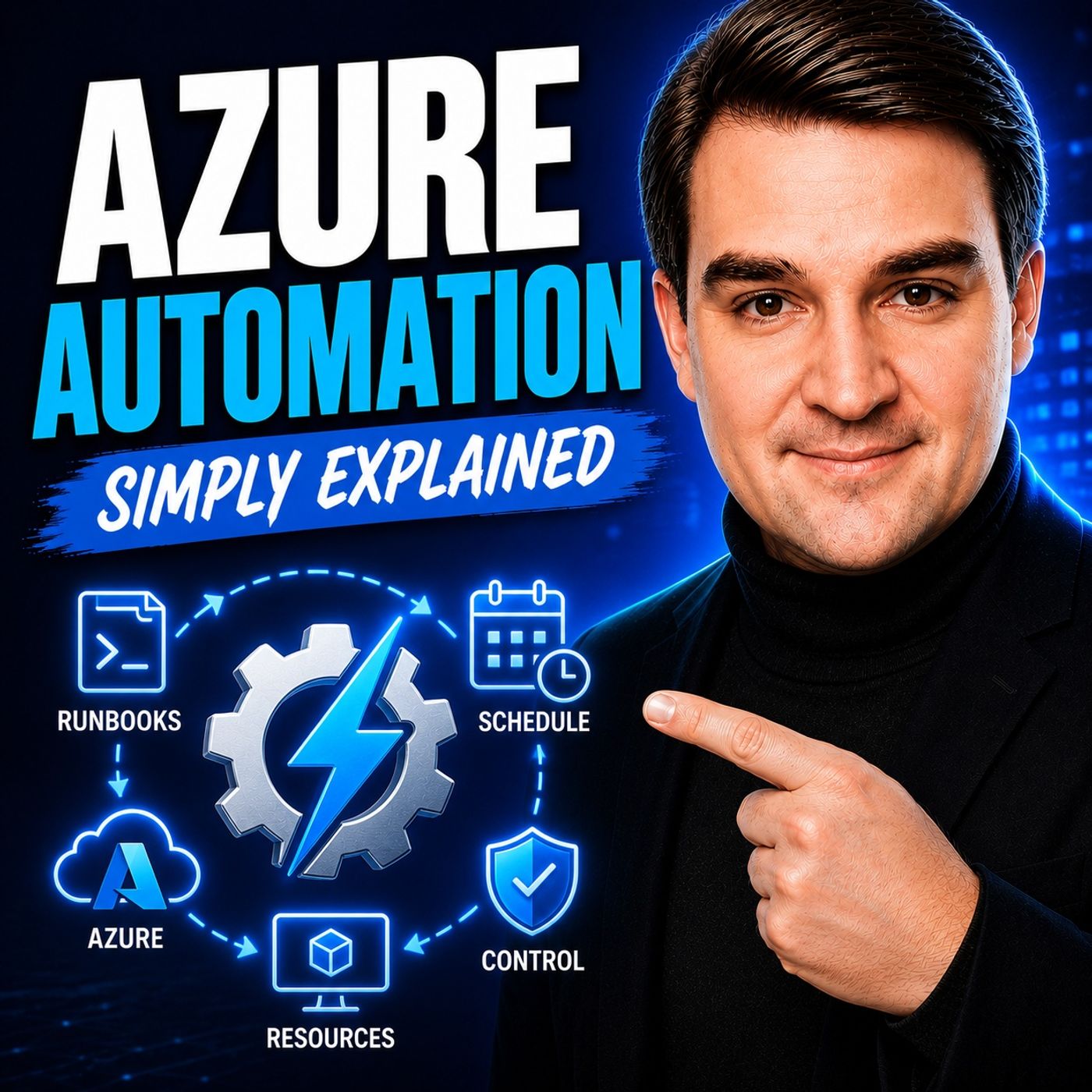
Mastering Azure Automation Runbooks: A Practical Guide
Welcome back to the podcast companion blog! In this post, we are expanding heavily on our latest episode to give you a comprehensive, technical, and practical guide to mastering Azure Automation runbooks. Whether you are an IT administrator looking to reduce tedious tasks or an enterprise cloud architect aiming to optimize your broader Microsoft cloud strategy, understanding how to effectively create, test, and secure your runbooks is an absolute necessity.
If you have ever felt bogged down by repetitive configuration changes, routine virtual machine startups, or the overhead of managing manual IT infrastructure interventions, this guide will show you how to put your environment on autopilot. To complement everything we discuss in this article, make sure you check out the corresponding podcast episode Azure Automation - Simply Explained, where we break down these exact concepts in a clear, conversational format.
Azure Automation Overview
Azure Automation is designed to simplify your IT operations. It offers a robust range of features that set it apart from traditional automation solutions. Let's look at some key features that make this platform exceptionally powerful for modern cloud workloads:
Key Features
| Feature | Description |
|---|---|
| Global Deployment | Azure Automation can be set up worldwide with a simple click, enhancing accessibility and regional resilience. |
| Cost Efficiency | Operates on a pay-as-you-go model, with the first 500 minutes of execution time provided completely free. |
| Extensive Integration Options | Over 800 vendor-supported PowerShell Integration Modules available for various cloud and hybrid services. |
| Multiple Programming Options | Supports graphical, PowerShell, and Python runbooks, catering to diverse development and administrative skill sets. |
| Hybrid Worker Capability | Allows execution of runbooks on-premises or in multi-cloud architectures, interacting safely with local resources. |
| Minimal Upfront Investment | Low initial costs due to the cloud-native nature of the platform and the flexible consumption-based pricing model. |
These features combine to make Azure Automation an essential cloud-native automation platform capable of meeting demanding enterprise requirements.
How It Works
Understanding the fundamental architecture of Azure Automation is crucial for leveraging its full operational potential. Here is a breakdown of the core components involved:
- Automation Account: This serves as the secure administrative container for all your automation assets, credentials, and runbooks.
- Runbooks: These are the core workflows and scripts that execute your specific automation tasks.
- Modules: Pre-built cmdlets and libraries that your runbooks utilize to interact with Azure resources.
- Assets: Shared variables, credentials, connections, and certificates that support your automation tasks safely.
- Hybrid Workers: Infrastructure components that allow you to execute runbooks on machines residing completely outside of the Azure cloud.
You can initiate automation tasks in several flexible ways depending on your architectural patterns:
- Manually directly from the Azure portal interface.
- Attached to a recurring or one-off time schedule.
- Exposed securely through a webhook for external application calls.
- Integrated directly with monitoring, event, or alert systems for automatic incident remediation.
When you trigger a job, Azure Automation executes the workflow in a sandboxed environment, records the output streams, and maintains granular status information such as queued, running, completed, or failed. This comprehensive job history serves dual purposes as both a reliable audit trail and a powerful troubleshooting tool.
Understanding Runbooks in Azure Automation
Runbooks are the heart and soul of Azure Automation. They define the precise logic and steps that you want to automate across your environments. Understanding the different types of runbooks helps you choose the right tool for your specific engineering needs.
Types of Runbooks
Azure Automation provides several distinct types of runbooks, each tailored for different operational scenarios and script styles:
| Type | Description |
|---|---|
| PowerShell | Textual runbook based on Windows PowerShell scripting. The currently recommended runtime version is PowerShell 7.4. |
| PowerShell Workflow | Textual runbook based on legacy Windows PowerShell Workflow scripting frameworks. |
| Python | Textual runbook based on Python scripting. The recommended and fully supported version is Python 3.10. |
| Graphical | Visual runbook based on underlying PowerShell, created directly in the Azure portal's drag-and-drop graphical editor. |
| Graphical PowerShell Workflow | Visual runbook based on PowerShell Workflow, built using the graphical authoring canvas in the portal. |
Every runbook type comes with its own unique set of advantages and limitations. For instance, graphical runbooks require minimal upfront PowerShell knowledge, making them exceptionally user-friendly for junior staff or system operators. However, they cannot easily be edited outside the Azure portal ecosystem. On the other hand, traditional text-based scripts allow for highly complex logic, robust error handling, and seamless integration with source control systems like GitHub or Azure DevOps.
Creating and Managing Runbooks
Developing robust automation runbooks requires adherence to established industry best practices. Here are essential tips to ensure your scripts run smoothly in production environments:
- Always thoroughly test your code in the portal’s dedicated test pane before publishing it to production users.
- Use calendar schedules to turn one-off emergency scripts into predictable, repeatable operational workflows.
- Implement secure webhooks to allow external systems, applications, and CI/CD pipelines to trigger runbooks safely.
- Store sensitive credentials, secrets, and connection strings securely using managed identities and Azure Key Vault integration.
- Follow strict least privilege principles by applying Role-Based Access Control (RBAC) to limit execution permissions.
- Continuously monitor runbook execution through comprehensive job history logs, streams, and diagnostic settings.
When you design runbooks, always keep them modular, small, and tightly focused on a single responsibility. This design philosophy dramatically eases future maintenance burdens and improves execution performance. Standardize your naming conventions across teams to prevent deployment confusion, and always document your script inputs, expected outputs, and external dependencies clearly.
Benefits of Azure Automation
Implementing Azure Automation yields profound advantages that can completely transform your organization's IT operations. By adopting this service, you unlock significant cost reductions, increased day-to-day efficiency, and a substantially hardened security posture.
Cost Reduction
One of the most compelling selling points of Azure Automation is its proven ability to drive down operational overhead. Organizations that strategically embrace automation achieve remarkable financial savings. Industry analyses reveal that companies optimizing their cloud estates with automation can save millions in total potential lifecycle costs through direct cloud compute savings and drastic improvements in engineering productivity.
IT leaders consistently report that automated resource scheduling—such as shutting down non-production development environments during nights and weekends—drastically curtails wasteful cloud spend. These direct cost optimizations free up crucial budget space, allowing organizations to fund new strategic software initiatives and support ongoing business expansion without inflating their operational budgets.
Increased Efficiency
Azure Automation drastically boosts organizational efficiency. By eliminating manual, repetitive human toil, you free up your valuable engineering and IT support staff to focus on high-value, revenue-driving strategic projects.
To properly measure this newfound efficiency, organizations frequently track key operational metrics:
| Metric | Description |
|---|---|
| Resource Utilization Efficiency | Measures how effectively cloud resources are leveraged to deliver services, indicating less waste and higher economic value. |
| Automation Rate in Cost Optimization | Tracks the exact proportion of cost-saving actions performed automatically, indicating lower ongoing operational expenses. |
| SCI Score for Sustainability | Measures the carbon impact of software applications, providing key insights into corporate sustainability and green IT initiatives. |
The Software Carbon Intensity (SCI) score is increasingly vital as modern organizations strive to meet strict internal environmental sustainability targets while running highly efficient cloud workloads.
Enhanced Security
Security remains a paramount priority for every enterprise. Azure Automation introduces powerful guardrails to protect your estate. By automating frequent, time-consuming, and error-prone administrative tasks, you eliminate the risks associated with manual human configuration mistakes.
| Benefit | Description |
|---|---|
| Save Time and Lower Overhead | Automates mundane tasks, reducing the burden on IT staff and minimizing costly human configuration mistakes. |
| Consistency and Reliability | Enables the creation of reusable runbooks, leading to completely predictable and reliable IT operational processes. |
| No Infrastructure Maintenance | Microsoft manages backend platform updates and patching, allowing your team to focus exclusively on business logic. |
Furthermore, Azure Automation provides deep compliance support. It integrates natively with built-in credential vaults, enforces strict Role-Based Access Control (RBAC), and generates immutable, audit-ready logs to guarantee secure, transparent operations across both cloud and hybrid servers.
Automation Accounts in Azure
Automation accounts act as the foundational management boundary for all your automation tasks within the Azure ecosystem. They provide a centralized hub where you can organize, govern, and control your entire inventory of scripts, modules, credentials, and schedules.
Centralized Management
Centralized administration simplifies complex IT landscapes dramatically. Here are the core advantages of managing your assets through dedicated Automation Accounts:
| Benefit | Description |
|---|---|
| Automate Repetitive Tasks | Runbooks simplify virtual machine lifecycle management, security patching, and automated resource provisioning. |
| Configuration Management | Desired State Configuration (DSC) enforces strict environment consistency across servers. |
| Process Automation | Workflows can be scheduled or event-driven, enabling completely seamless, hands-off operations. |
| Cost Optimization | Eliminating manual human intervention directly results in lower operational labor costs. |
| Hybrid Capabilities | Hybrid Worker Groups extend your automation reach safely into on-premises data centers and multi-cloud environments. |
Centralized governance saves time, minimizes human error, and ensures that company processes execute with absolute uniformity every single time.
Scheduling and Triggers
The robust scheduling capabilities built into Azure Automation allow you to orchestrate workloads with pinpoint precision. You can configure automated jobs to fire at exact calendar dates, recur on interval patterns, or respond dynamically to external webhooks and system events.
State verification is a critical best practice in automated enterprise workflows. It ensures that your scripts inspect the live environment and only execute modifications when truly necessary, preventing redundant operations, race conditions, and accidental configuration drift.
Practical Applications of Process Automation
Azure Automation plays a vital role across multiple technical domains, including day-to-day IT operations, modern DevOps pipelines, and continuous cloud resource optimization.
IT Operations
In modern IT administration, Azure Automation streamlines frequently repeated, high-overhead tasks:
- Virtual Machine Management: Automate the scheduled startup, shutdown, and scaling of development and test VMs.
- Configuration Management: Enforce standardized registry settings, local user policies, and security baselines across servers.
- Log Management: Automate log file archiving, rotation, and cleanup based on storage constraints.
- Database Maintenance: Automate database index defragmentation, routine exports, and transactional log backups.
- Data Ingestion: Schedule automated data feeds and manage nightly Extract, Transform, Load (ETL) processing jobs.
- Security Response: Automatically verify security agent health and apply emergency remediation patches.
- Event-Driven Remediation: Automatically process monitoring alerts to execute rapid self-healing incident responses.
DevOps Integration
Azure Automation integrates seamlessly into modern continuous integration and continuous deployment (CI/CD) pipelines. By combining Azure DevOps or GitHub Actions with Azure Automation runbooks, engineering teams can automate pre-deployment environment validation, infrastructure provisioning, and post-deployment integration checks, drastically accelerating software delivery velocity while lowering deployment failure rates.
Comparing Azure Automation with Other Tools
When evaluating cloud automation platforms, engineers often compare Azure Automation against serverless compute offerings like AWS Lambda or Google Cloud Functions. While serverless functions excel at rapid, event-driven micro-execution, Azure Automation is purpose-built for comprehensive IT administrative workflows, long-running operational jobs, credential management, and hybrid enterprise orchestration.
In summary, Azure Automation fundamentally transforms how modern organizations manage complex IT infrastructure. By streamlining repetitive processes, eliminating manual errors, and enforcing strict security controls, this powerful service frees your team to focus on strategic innovation. To deepen your understanding and hear real-world architectural insights, be sure to listen to our companion podcast episode Azure Automation - Simply Explained today!
FAQ
What is Azure Automation?
Azure Automation is a fully managed cloud service designed to automate repetitive IT administrative tasks. It helps organizations streamline operations, eliminate human error, and enhance overall efficiency across Azure, multi-cloud, and hybrid on-premises environments.
How do I create a runbook in Azure Automation?
To create a new runbook, navigate to your Azure Automation account in the portal, select "Runbooks" from the menu, and click "Create a runbook." Choose your preferred authoring type, write or paste your script code, test it thoroughly in the test pane, and publish it.
Can I use Azure Automation for on-premises resources?
Yes, Azure Automation supports Hybrid Runbook Workers. This powerful capability allows you to execute PowerShell and Python runbooks directly on your local, on-premises servers or edge hardware, enabling centralized cloud management of physical data centers.
What programming languages does Azure Automation support?
Azure Automation supports multiple languages and authoring formats, including PowerShell (with a recommended 7.4 runtime), Python (version 3.10), and visual drag-and-drop graphical runbooks for administrators who prefer low-code workflows.
How does Azure Automation enhance security?
Azure Automation enhances operational security by removing manual human intervention from sensitive tasks. It also features native integration with managed identities and Azure Key Vault for secure credential and secret storage without hardcoding sensitive data.
Can I schedule runbooks in Azure Automation?
Yes, you can easily attach calendar schedules to any runbook. This allows you to automate routine maintenance jobs, automated backups, and resource scaling tasks to execute at precise times without manual oversight.
What are the cost implications of using Azure Automation?
Azure Automation operates on a flexible consumption-based pay-as-you-go pricing model. Notably, the first 500 minutes of runbook execution time each month are provided completely free of charge, making basic administrative automation extremely cost-effective.
🎧 Listen to this episode
Want a practical, engaging explanation of Azure Automation? This podcast episode breaks down the topic in clear language and demonstrates why it matters for Microsoft 365, Azure, Power Platform, security, AI, and modern digital work.
Listen to this episode if you want to:
- Understand the foundational concepts and architecture behind Azure Automation
- See how it fits neatly into the broader Microsoft cloud ecosystem
- Learn where it can immediately create practical operational value for your organization
You may also enjoy these related M365 FM episodes:
- PowerShell vs Bicep for Azure Infrastructure Automation
- Microsoft Graph Security Automation for Microsoft 365
- Microsoft Graph Automation Architecture: Beyond Scripts
- Microsoft Graph and PowerShell for Enterprise Automation
- Modern Microsoft 365 Automation Beyond PowerShell Scripts
Discover more practical Microsoft conversations and deep-dives on M365 FM.
Last reviewed: July 2026.
Who Should Listen
This episode is engineered specifically for Microsoft 365 administrators, cloud architects, IT directors, and technical practitioners who need a practical, real-world understanding of Azure Automation before planning, architecting, implementing, or supporting enterprise cloud automation initiatives.

Founder of M365 Show, M365con.net & m365.fm
Mirko Peters is a Microsoft 365 expert, content creator, and founder of m365.fm, a platform dedicated to sharing practical insights on modern workplace technologies. His work focuses on Microsoft 365 governance, security, collaboration, and real-world implementation strategies.
Through his podcast and written content, Mirko provides hands-on guidance for IT professionals, architects, and business leaders navigating the complexities of Microsoft 365. He is known for translating complex topics into clear, actionable advice, often highlighting common mistakes and overlooked risks in real-world environments.
With a strong emphasis on community contribution and knowledge sharing, Mirko is actively building a platform that connects experts, shares experiences, and helps organizations get the most out of their Microsoft 365 investments.