 EN
 Deutsch
 Español
 Français
 Italiano
 Português
 Nederlands
 Polski
 Bahasa Indonesia
 Русский
 Українська
 العربية
 עברית
 हिन्दी
 日本語
 한국어
2026-07-22 · Season 3
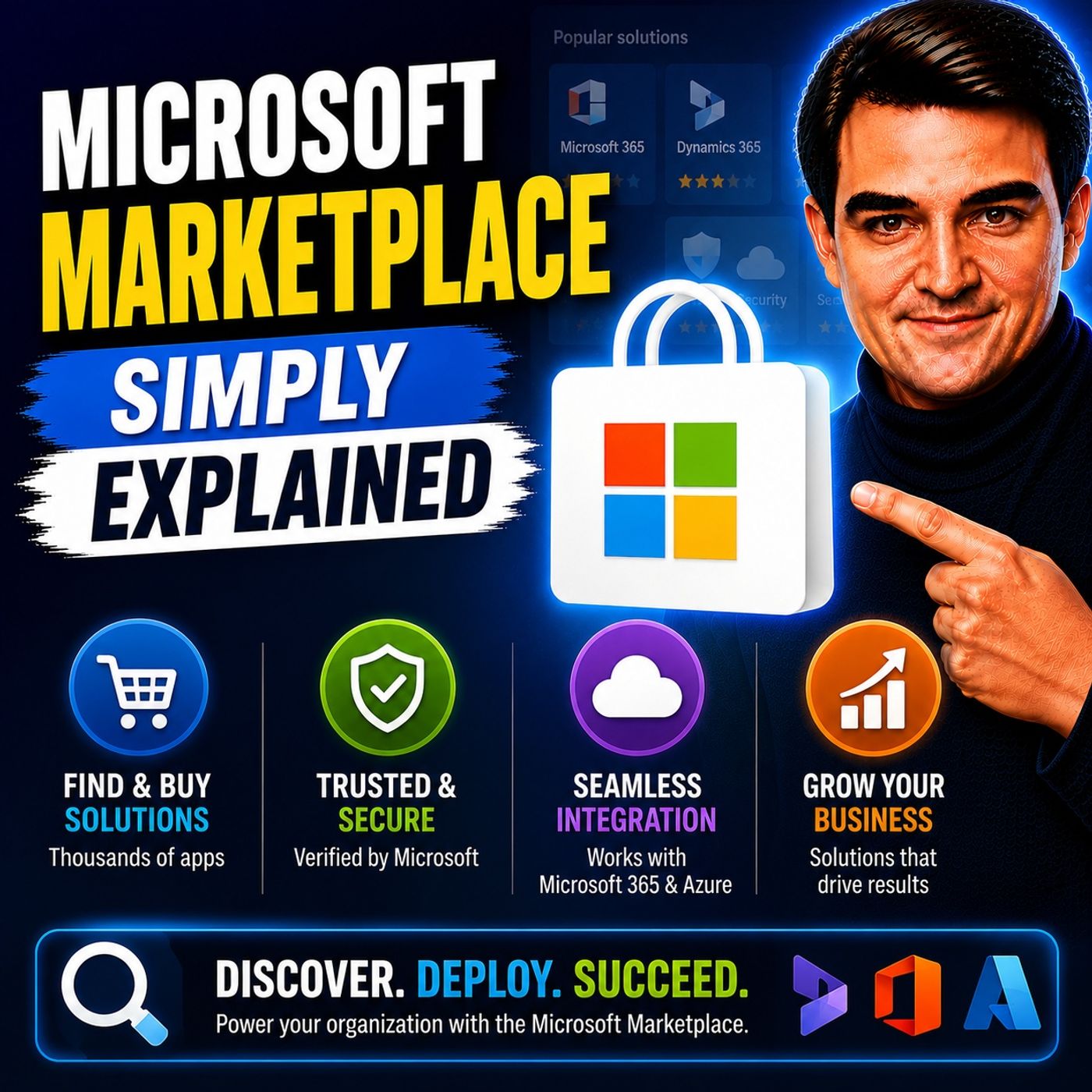
Microsoft Marketplace - Simply Explained
Show notes
Welcome to another episode of Knowledge Nuggets with Mirko Peters. Today we're exploring https://www.m365.fm/categories/simply-explained/ Marketplace, one of the most important platforms in the Microsoft ecosystem—and one that's often misunderstood. When most people hear the word Marketplace, they imagine something similar to an app store where you browse a few applications, click Buy, and you're done. While that's certainly part of the story, Microsoft Marketplace has evolved into something much bigger. Today it's a global commerce platform that connects customers, software vendors, consultants, AI solutions, and cloud services through a single purchasing experience. Whether you're an IT administrator looking for infrastructure, a business leader searching for a https://www.m365.fm/power-platform-simply-explained/ solution, or a software vendor trying to reach millions of Microsoft customers, Marketplace plays a central role. By the end of https://www.m365.fm/microsoft-marketplace-simply-explained/, you'll understand what Microsoft Marketplace actually is, why it exists, how it simplifies software procurement, and why it's becoming one of Microsoft's most important growth platforms. WHY MICROSOFT CREATED MARKETPLACE Before cloud marketplaces existed, buying enterprise software was surprisingly complicated. Every vendor had its own website, its own pricing model, its own contract, and its own billing process. If an organization wanted a security platform from one company, a reporting solution from another, and an AI tool from a third, procurement quickly became a project of its own. IT departments spent weeks evaluating vendors, finance teams had to process multiple invoices every month, and legal departments reviewed countless contracts that often covered very similar services. Even after the software had been purchased, deployment could still involve manual licensing, configuration, and user provisioning. Microsoft recognized that the buying experience itself had become a problem. Organizations didn't necessarily need fewer software vendors—they needed a simpler way to discover, evaluate, purchase, and manage them. That's exactly what Microsoft Marketplace delivers. Instead of maintaining dozens of independent vendor relationships, organizations can purchase solutions through the same Microsoft relationship they already use for Azure and Microsoft 365. The result is a procurement process that's dramatically simpler, faster, and easier to manage. WHAT IS MICROSOFT MARKETPLACE? At its core, Microsoft Marketplace is Microsoft's unified commercial platform for cloud solutions. Rather than being limited to applications, Marketplace offers an enormous range of commercial products including SaaS solutions, Azure infrastructure, virtual machines, managed applications, https://www.m365.fm/ai-agents-simply-explained/, consulting services, business applications, and Power Platform extensions. Every solution published on the platform has gone through Microsoft's validation process before becoming available to customers. A useful way to think about Marketplace is as a digital shopping mall. Instead of every software company building its own storefront, Microsoft provides the building. Customers enter through a single front door, compare products, read documentation, start free trials, purchase subscriptions, and deploy solutions without ever leaving the Microsoft ecosystem. Because everything integrates with Microsoft accounts, Azure subscriptions, and Microsoft 365 tenants, customers spend less time managing vendors and more time deploying technology that actually solves business problems. TWO STOREFRONTS, ONE PLATFORM One area that often causes confusion is the relationship between Azure Marketplace and AppSource. Although Microsoft now presents one unified Marketplace experience, the platform still serves two different audiences. Azure Marketplace is primarily designed for technical buyers. Cloud architects, developers, infrastructure engineers, and Azure administrators typically visit Azure Marketplace when searching for virtual machines, managed applications, containers, security appliances, databases, or cloud-native SaaS services that integrate directly with Azure. AppSource, on the other hand, focuses on business users. Marketing departments, HR teams, finance professionals, sales organizations, and operations managers generally discover business applications, Microsoft Teams extensions, Dynamics 365 solutions, and Power Platform applications through AppSource. The important point is that customers don't need to understand this distinction. A software vendor can publish a single solution, and Microsoft automatically presents it through the most appropriate storefront depending on who is searching and what they're looking for. This unified experience removes unnecessary complexity while ensuring both technical and business audiences discover relevant solutions. BUYING SOFTWARE HAS NEVER BEEN EASIER One of Marketplace's biggest strengths is how dramatically it simplifies procurement. Instead of contacting vendors individually, customers search Marketplace, compare available products, review documentation, examine customer ratings, and often start a free trial within minutes. If the solution meets their requirements, purchasing becomes equally straightforward. Marketplace supports several commercial models, including subscription licensing, pay-as-you-go services, bring-your-own-license scenarios, and private offers for enterprise agreements. Perhaps even more valuable is the integration with Microsoft's existing billing infrastructure. Organizations don't receive another vendor invoice or need another purchasing workflow. Instead, Marketplace purchases are added to their existing Microsoft agreement, allowing Azure services, Microsoft 365 subscriptions, and Marketplace solutions to appear together on consolidated billing. For procurement and finance teams, this eliminates significant administrative overhead while giving IT departments much faster access to new technology. WHY SOFTWARE VENDORS LOVE MARKETPLACE Marketplace doesn't only benefit customers—it has become one of the most important sales channels for Microsoft partners. Publishing a solution on Marketplace immediately exposes it to millions of organizations already working inside Microsoft's cloud ecosystem. Instead of convincing customers to visit another website, partners appear directly where purchasing decisions are already being made. Their applications can be discovered through Azure, Microsoft Teams, Microsoft 365, Copilot, and Microsoft's administration portals. This dramatically increases visibility while reducing customer acquisition costs. Marketplace also enables participation in Microsoft's co-sell programs, where Microsoft sales teams actively recommend partner solutions during customer engagements. For many software companies, Marketplace has evolved from an optional distribution channel into a fundamental part of their overall go-to-market strategy. As Microsoft continues investing in partner incentives and Marketplace Rewards, the platform is becoming increasingly important for software vendors building on Azure and Microsoft 365. AI IS CHANGING THE MARKETPLACE EXPERIENCE Like many Microsoft products, Marketplace is rapidly being transformed by artificial intelligence. Instead of requiring customers to search using exact product names, Marketplace increasingly supports natural language queries. Rather than typing "project management software," a customer might simply ask for "an AI agent that helps coordinate projects inside Microsoft Teams." Marketplace understands the request, recommends relevant solutions, highlights important differences, and even generates side-by-side comparisons that explain which product best matches the customer's requirements. Product pages are also becoming more interactive through AI-powered assistants capable of answering licensing, deployment, integration, and compatibility questions. At the same time, Marketplace has introduced dedicated sections for Microsoft 365 Copilot agents and AI-powered business applications, making it much easier for organizations to discover intelligent solutions that integrate directly into their existing Microsoft environment. Instead of simply becoming a larger software catalog, Marketplace is evolving into an intelligent advisor that actively helps customers make better purchasing decisions. EVERYTHING CONNECTS THROUGH THE MICROSOFT ECOSYSTEM Perhaps the greatest strength of Microsoft Marketplace isn't the number of available products—it's how seamlessly everything integrates. When a customer purchases a solution through Marketplace, they're not simply buying software. They're extending their existing Microsoft environment. Authentication works through Microsoft Entra ID. Existing https://www.m365.fm/conditional-access-simply-explained/ policies continue protecting users. Billing flows through established Microsoft agreements. Azure subscriptions provision resources automatically, while Microsoft Teams, Copilot, Dynamics 365, and Microsoft 365 can immediately surface newly purchased applications. This level of integration dramatically reduces deployment complexity while maintaining the governance, identity management, and security controls organizations have already invested in. Rather than introducing another isolated platform, Marketplace strengthens the Microsoft ecosystem by allowing customers to extend it safely with trusted third-party solutions. Become a supporter of this podcast: https://www.spreaker.com/podcast/m365-fm-microsoft-365-azure-cloud-power-platform-ai--6704921/support.
Apple Podcasts · Spotify · YouTube · YouTube Music · Deezer
Host: Mirko Peters
Guests
Related articles
Transcript
Read the full transcript
Today's topic is Microsoft Marketplace. Is it just a store for buying apps? Like the iTunes store for businesses? Actually, it's much more than that. By the end of this episode, you'll understand how it powers how companies discover, try, and buy everything from a simple SaaS tool to a full AI agent and why that matters for you. We'll look at the two storefronts, how procurement works behind the scenes and what that means for partners. So grab your coffee and let's dive in. The problem marketplace solves. Let's go back to how I'd procurement worked before the marketplace. Say you run a small company and you need three things, a security tool, a data dashboard, and a time tracking app, all from different vendors. 20 years ago, that meant opening separate tabs for each vendor's website, signing up for each one individually, negotiating pricing over the phone and getting a purchase order approved. You hoped they'd all work together. Then at the end of the month, three different invoices arrived, each with its own billing cycle, tax treatment, and support line, scale that up to a company with 50 vendors or 500 and the friction becomes enormous. Procurement teams spend weeks just getting a single tool approved and paid for. And that's before anyone even uses it. Microsoft looked at this mess and thought, what if all these services work together? What if you could discover, try, buy, and manage everything from one single place? That's exactly what the marketplace solves. It brings everything under one roof, so you don't have to chase down different vendors and contracts. Instead of hunting down each vendor separately, you go to one website, search for what you need, read reviews, compare pricing, and start a free trial, all without leaving the page. When you're ready to buy, just click a button. The licenses are set up automatically, billing flows through your existing Microsoft agreement, and you get one invoice and one support channel. This matters whether you're a five person start-up or a Fortune 500 company. For small businesses, it removes the headache of managing dozens of vendor relationships. For large enterprises, it brings all buying into one central place and IT and finance teams love that. A start-up needing a data visualization tool can now find it right where they manage their Azure subscription without needing a separate account, login, or approval process. Here's the bottom line. Marketplace takes the chaos of fragmented software buying and turns it into one streamlined experience. What is Microsoft Marketplace? So what exactly is Microsoft Marketplace? Here's the simplest definition. It's a single platform, Marketplace, Microsoft.com that hosts thousands of cloud solutions from Microsoft and its partners. Think of it like a digital mall. Every vendor has passed Microsoft's validation, every product is ready to buy, and every purchase is backed by the same infrastructure that runs Azure and Microsoft 365. A lot of people think Marketplace is just an app store. It's not. An app store sells you software you download to your phone. Marketplace sells you infrastructure, virtual machines, containers, manage databases. It also sells consulting services from certified partners and AI agents that plug directly into Microsoft 365 copilot. This isn't just software. It's the full stack from the server up to the user interface. Let me give you a bit of history. Microsoft used to run two separate marketplaces. Azure Marketplace for technical buyers and app source for business users. Separate sites, separate catalogs, separate experiences. A few years ago, Microsoft combined them into one unified catalog. Now Marketplace.Microsoft.com acts as the single front door. When you search for a solution, it pulls from both storefronts at once. The split still exists underneath. We'll get to that in a moment, but the experience is now seamless. The reach here is huge. Marketplace surfaces solutions to 95% of the Fortune 500 companies that use Azure, not a small audience. These are the world's biggest enterprises actively looking for tools to run their business. And it's not just Azure customers. Marketplace also reaches 400 million monthly active teams users and 20 million paid Microsoft 365 co-pilot seats. When a partner lists their solution here, it doesn't just sit on a shelf. It appears inside the tools people use every day. So think of Marketplace like a digital mall. Every vendor is pre-screened. Every product can be bought with a click and everything ties into your existing Microsoft relationship. It's the single place where cloud software gets discovered, bought and delivered, or within the ecosystem you're already using. The two doors, Azure Marketplace versus AppSource. Now here's where people get confused. Microsoft Marketplace has two storefronts, same catalog underneath, but two different doors, one for technical buyers and one for business users. Azure Marketplace is for the technical crowd, developers, IT pros, cloud engineers, the people who think in terms of infrastructure. When you browse Azure Marketplace, you'll find virtual machines, containers, managed applications and SaaS tools that run alongside Azure. The kind of stuff you deploy, not just install. For example, say you need a firewall solution from a partner. You'd search Azure Marketplace, find one pre-configured for your environment and deploy it directly into your Azure subscription with a few clicks. No downloading, no manual setup, it just works. AppSource is the other door. This one's for business users, marketing managers, sales directors, operations leads. The people who need tools that make their daily work easier. AppSource offers business applications, power platform solutions, teams integrations and Dynamics 365 add-ins. Think of a project management tool that plugs into Teams, a survey app inside Excel or a customer service dashboard connected to Dynamics 365. These are solutions you use, not ones you deploy. Here's an easy way to tell them apart. If you're an IT admin buying infrastructure, you'll land on Azure Marketplace. If you're a marketing manager buying a survey tool, you'll land on AppSource. Now here's the smart part. Partners can list a single solution in both storefronts at once. They submit one offer through Partner Center, Tag it for the right audience and Microsoft Surfaces it, wherever it fits. A security tool might appear in Azure Marketplace for the IT team and in AppSource for the business users who need to see its compliance reports. Same product, two doors. Think of it this way. Azure Marketplace is the hardware store. You go there for the pipes, the wiring, the structural stuff, AppSource is the furniture store. You go there for the things that make the space usable, same building, different aisles. For buyers, how procurement actually works. So let's walk through what it's actually like to buy something on Marketplace. You land on the site, type what you need into the search bar and browse the results. Each listing shows a description, screenshots, pricing and ratings from other customers. When you find something that looks right, you click into the product details page. That's where you see the real information, supported integrations, deployment requirements and whether it's eligible for certain benefits. Then you decide how you want to buy. Marketplace offers several pricing models, pay as you go means your build based on usage, by the hour, by the user, by the transaction. Bring your own license or BYOL, lets you use a license you already own and only pay for the Azure infrastructure underneath. Free trials are common. Most SaaS offers let you test the full product for a set period before committing. And for larger deals, partners can create custom private offers with negotiated pricing, special terms and dedicated support. Now, there's a feature called Azure consumption commitment or MASSIC. If your organization has signed an Azure agreement, promising to spend a certain amount on Azure services over time, eligible marketplace purchases count toward that commitment. So when you buy a partners tool through marketplace, that spend goes toward your existing Azure budget, not a separate line item. Your finance team doesn't need to approve a new vendor and your procurement department doesn't need to issue a new purchase order because the money was already allocated. You're just spending it smarter. The checkout process is fully integrated. When you click buy now, the system provisions the licenses automatically, users get access immediately and billing flows through your existing as your subscription or Microsoft billing agreement. You get one invoice at the end of the month covering both your Azure infrastructure and your marketplace software. No separate accounts, no manual reconciliation. Most SaaS offers include a free trial period so you can test the product with your real data in your real environment before committing a single dollar. If it works, you upgrade. If it doesn't, you walk away with no risk. That's the buyer experience in a nutshell. Search, compare, trial, buy, or within the ecosystem you're already using. And because everything ties back to your Microsoft agreement, procurement becomes a background process instead of a roadblock for partners. Why list on marketplace? Now let's flip the camera around. Why would a software company put their product on Microsoft marketplace? What's in it for them? The numbers tell a pretty clear story. A study by Omdia found that 88% of partners say marketplace drives their revenue growth. 75% say it helps them close deals faster. And 69% report larger deals than they'd get through direct sales alone. Those aren't small improvements. They're major shifts in how a business operates. Think about the reach when a partner lists on marketplace, their solution doesn't just sit on a website waiting to be found. It surfaces inside the tools millions of people use every day. It appears in the Azure portal for IT teams shows up in the Microsoft 365 admin center for business users and integrates into teams, co-pilot, and the places where work actually happens. That's organic distribution that would cost a fortune to build from scratch. Then there's the CoSEL opportunity. Microsoft's CoSEL program lets their own sales team recommend partner solutions to customers. And starting in 2026, CoSEL eligibility requires marketplace presence. If you want a Microsoft account executive to pitch your product during a customer meeting, it needs to be transactable on marketplace. That's a strong incentive. Marketplace isn't just another channel. It's becoming the channel. Microsoft also sweetens the deal with marketplace rewards now included in the ISV success program at no extra cost. This gives partners access to marketing support, technical resources, and even Azure sponsorship. Free Azure credits they can use to offset customer deployment costs or fund free trials. The better a partner performs, the more benefits they unlock in this performance-based system that rewards growth. And the results speak for themselves. Take Xamode AI, a company that builds AI-powered automation tools. After listing managed applications on marketplace, they saw a 6X increase in revenue, not a small bump, but a complete transformation, or integral, a company that pivoted from systems integrator to ISV. They reached $100 million in Azure-consumed revenue every six months through marketplace alone. Within a year of listing, they had customers in 44 countries, and the next year over 100 countries, all without building a massive field sales team. For partners, the message is clear. Marketplace isn't a side experiment. It's the primary route to market for any software company building on Microsoft's platform. New and coming soon, intelligent discovery and AI apps, Microsoft isn't slowing down with marketplace. Two big changes are reshaping how you find and buy software right now. First up, smart search. This new experience understands plain English. Instead of typing keywords like project management tool for teams, you can just ask a normal question. Find me a collaboration agent that works with Microsoft 365. The search bar gets the context. It turns your question into suggested filters, industry, category, use case. And those suggestions update as you ask more questions, say you're looking for agents, you type that in. The results narrow to agent solutions, then you ask which ones work best for collaboration. The system keeps the filters, category and topic in sync, updating the suggestions so the next best step is always right there. It handles comparisons in a genuinely useful way too. Pick a few products. In seconds, marketplace builds a side-by-side table that explains the differences in plain language. You can even type in extra factors that matter to your company even like how does each one handle compliance? And the comparison updates on the spot. It highlights which solution fits best and tells you why. Product detail pages now have an interactive chat too. Instead of reading through every section you just ask, does this integrate with teams? Or what's the pricing for 50 users? The assistant answers based on the publisher's listing and technical specs. It surfaces what matters for deployment, adoption, and governance without you having to dig. Second, there's a whole new category for AI apps and agents. Marketplace now has a section dedicated to solutions that plug directly into Microsoft 365 Copilot. These aren't just chatbots. They're agents that automate workflows, pull data from multiple systems, and take actions inside the tools you already use. Microsoft showed a great demo. Carlos, an IT leader at a company called Zava, needs to help his operations team automate business processes. He searches Marketplace, finds UI paths, a Gentech automation tool, and sees its Azure benefit eligible, meaning it counts toward their existing Azure commitment. He also sees it offers a Copilot agent integration. He buys it through the standard checkout, provisions licenses in the admin center, and assigns it to his team. The next day, Crystal from Operations opens Microsoft 365 Copilot and sees the new UI path agent in a sidebar. She starts using it right away, full functionality inside Copilot. That's the goal, discover, buy, deploy, use, all within the same ecosystem. No separate logins, no manual setup, no procurement delays. Smart search and AI agents are turning Marketplace from a catalog you browse into a partner that helps you find exactly what you need. And that's only going to get faster. How it all connects, the integration story. So we've covered the pieces, the two storefronts, how buying works, why partners list there, what's coming with AI. But here's the part that ties everything together. And most people miss it. Marketplace isn't just a catalog. It's a commerce engine wired into the Microsoft ecosystem. When you buy a SAS app through Marketplace, it's not just a purchase, it's a provisioning event. The system creates the subscription, assigns the licenses, and makes the app available in your tenant automatically. Your users don't need to sign up for a separate account. They don't need to remember a different login. The app just shows up in their Microsoft 365 app launcher or in Teams or inside Copilot. That integration goes deeper than convenience. It's tied to identity through Microsoft EntraID. When a partner lists their solution, it inherits your company's security policies, multi-factor authentication, conditional access, data residency rules, all the governance you've already set up for Microsoft 365 applies to the Marketplace app too. No gaps, no shadow-wide. Billing works the same way. The purchase goes onto your existing Azure subscription or Microsoft billing agreement. One invoice at the end of the month covers your Azure infrastructure, your Microsoft 365 seats, and your Marketplace software. Finance teams don't need to reconcile three different vendor invoices. Procurement doesn't need to issue separate purchase orders. It all rolls up into the same system. For partners, this integration means their solution doesn't just sit on a shelf. It appears in context when someone searches for file sharing in Teams, relevant Marketplace apps show up. When an admin browsers the Microsoft 365 admin center, partner solutions appear alongside Microsoft's own tools. When a user opens Copilot, available agents are right there. The distribution is built into the platform. Here's the aha moment. Marketplace is the glue between a customer's need and a curated validated solution all inside the ecosystem they're already using. The customer doesn't go shopping for software. They go shopping for a solution to a problem they have right now. Marketplace surfaces, what fits, handles the transaction, provisions access, and manages billing. Everything just works. That's why 75% of partners say Marketplace helps them close deals faster. It's not just the visibility, it's that procurement friction disappears. The customer doesn't need to evaluate a new vendor's security. They don't need to negotiate a new contract. They don't need to set up a new billing relationship. The deal goes from interesting to done in the time it takes to click a button. Actionable takeaways. All right, let's make this practical. Here's what you should do next, depending on who you are. If you're a buyer, someone who actually purchases software for your company, head over to Marketplace. Microsoft.com to start your search. That's where you'll find vetted solutions that actually work with what you already have. And it's the single place to check before you sign up or anything new. If it's on Marketplace, you'll avoid the headache of managing yet another vendor relationship. Now, look for the Azure Benefit Eligible Badge. That little tag tells you the purchase counts to what your Azure consumption commitment. If your company already has an Azure agreement, buying through Marketplace lets you use budget you've already committed. And that's essentially free money. Don't leave it sitting on the table. Here's another tip. Use the free trials. Most SaaS offers on Marketplace let you test the full product before buying no credit card required and no sales call. Just click and try. If it works upgrade, if it doesn't move on, zero risk. If you're a partner building software on Microsoft's platform, your next move is straightforward. List your solution on Marketplace. Starting in 2026, co-sale support requires it. If you want Microsoft sales team recommending your product, it needs to be transactable on Marketplace. And that's not a suggestion, it's the new reality. Start with a transactable offer, either SaaS or a managed application. That's what unlocks the billing infrastructure, the Mac benefits and the co-sale incentives. A simple listing gets you visibility, but a transactable offer gets you actual revenue. Take advantage of Marketplace rewards too. It's included in the ISV success program at no extra cost, giving you marketing support, technical resources, and as your sponsorship to offset deployment costs. Even if you're a small shop with a single product, those benefits can accelerate your growth significantly. Your next move, go to Marketplace, Microsoft.com today. Search for something your team needs and see what's available. Chances are your next software purchase is already there. So that's Microsoft Marketplace, not just a store, but the central hub where Cloud Software gets discovered, bought and delivered. Whether you're buying or selling Marketplace, reduces friction and unlocks reach, you couldn't get any other way. Subscribe on your favorite podcast platform and share this with a colleague who's just starting their cloud journey. I'll see you in the next episode.