Decoding Azure Marketplace vs. AppSource: Which Storefront Do You Need?
Welcome back to the blog! If you have ever navigated the vast and sometimes overwhelming world of enterprise software procurement, you know that finding the right tools is only half the battle. Once you locate a solution, you still have to deal with vendor onboarding, contract reviews, security compliance, and separate billing cycles. It is a process that has historically drained time, patience, and resources from IT departments and business units alike. But what if there was a unified ecosystem designed to streamline all of that? In the modern cloud era, Microsoft has built a massive global commerce engine to solve this exact problem: the Microsoft Marketplace. However, even seasoned technology professionals often find themselves scratching their heads over the distinction between its two primary storefronts: Azure Marketplace and AppSource. Today, we are going to dive deep into how these platforms work, why Microsoft structured them this way, and how you can determine which storefront you actually need for your organization.
Introduction to Microsoft Marketplace
When most people hear the word marketplace in a consumer context, they picture a mobile app store where they browse casual games, click download, and get on with their day. While Microsoft Marketplace shares that same consumer-grade simplicity in its user interface, it has evolved into a powerhouse enterprise commerce platform. It connects software vendors, independent consultants, cloud architects, business leaders, and everyday end users through a single, secure purchasing experience.
At its core, Microsoft Marketplace acts as a massive digital catalog and distribution channel. Whether you are looking for complex infrastructure components, virtual machines, software-as-a-service solutions, managed applications, AI-powered agents, or consulting services, you can find them here. But it is much more than just a place to browse software. Every single solution listed on the platform must pass Microsoft’s rigorous validation processes, ensuring that what you deploy meets high standards of security, performance, and compatibility. By bridging the gap between independent software vendors and millions of Microsoft cloud customers, the marketplace has fundamentally changed how organizations discover, evaluate, and acquire the technology they need to drive their businesses forward.
Why Microsoft Created Marketplace
To truly appreciate the value of Microsoft Marketplace, we have to remember what software procurement looked like before cloud marketplaces became mainstream. Not long ago, buying enterprise software was an administrative nightmare. If an organization wanted to deploy a comprehensive technology stack, they had to deal with dozens of different vendors independently. Every single vendor maintained its own proprietary website, its own unique pricing model, its own legally binding contracts, and its own separate monthly or annual invoicing process.
Imagine an enterprise wanting to adopt a cloud security platform from Company A, a reporting and analytics tool from Company B, and an AI productivity assistant from Company C. Suddenly, the IT department is spending weeks evaluating separate systems. The finance team is forced to untangle multiple invoices with entirely different payment terms. Meanwhile, the legal department is bogged down reviewing three different sets of terms and conditions that often cover identical underlying liability clauses. Even after the ink dried on all those contracts, the deployment phase still required manual user provisioning, complex license key management, and tedious configuration.
Microsoft recognized that the traditional buying process itself had become a massive bottleneck for digital transformation. Organizations did not necessarily want fewer software vendors, but they desperately needed a radically simpler way to manage them. By creating a unified marketplace, Microsoft eliminated the need to maintain dozens of separate vendor relationships. Instead, organizations can leverage the exact same commercial relationship and invoicing mechanism they already use for Azure and Microsoft 365. The result is a procurement workflow that is faster, transparent, and dramatically easier to govern.
Understanding the Two Storefronts: Azure Marketplace vs. AppSource
One of the most common points of confusion for newcomers—and even experienced administrators—is the relationship between Azure Marketplace and AppSource. If Microsoft promotes a unified commercial platform, why are there two distinct names and user interfaces?
The answer lies in understanding the different personas that make up an enterprise buying committee. While organizations buy software as a single entity, the people doing the searching and evaluating have very different job roles and technical requirements.
Azure Marketplace is primarily engineered for technical buyers. When cloud architects, developers, infrastructure engineers, and systems administrators are hunting for virtual machines, containerized applications, database solutions, developer tools, security appliances, or deep cloud-native SaaS services that tie directly into Azure infrastructure, they head straight to Azure Marketplace. These solutions are deeply technical, often interacting directly with cloud resource groups, networking configurations, and subscription management.
On the other side of the coin, AppSource is tailored specifically for business users and functional leaders. Marketing directors, human resources professionals, finance managers, sales operations teams, and executive leaders typically do not care about virtual machine sizing or cloud storage configurations. They care about business outcomes. They visit AppSource to discover line-of-business applications, Microsoft Teams extensions, Dynamics 365 integrations, and Power Platform solutions that streamline workflows, automate reporting, or enhance customer relationship management.
Despite serving these distinct audiences, the beauty of the modern Microsoft ecosystem is that you do not need to overthink the boundary. Independent software vendors publish their solutions into a unified backend, and Microsoft’s intelligent routing automatically presents the application through the most relevant storefront depending on who is searching and what problem they are trying to solve.
How Microsoft Unifies Technical and Business Buyers
Bringing technical and business buyers together under a single digital roof requires a tremendous amount of structural coordination behind the scenes. Microsoft achieves this unification by ensuring that both storefronts share a common taxonomy, a unified security baseline, and a synchronized identity model.
When a business analyst looks for a Power Platform solution on AppSource, or an infrastructure engineer looks for a containerized security tool on Azure Marketplace, both users benefit from the exact same underlying trust framework. They can read verified customer reviews, review transparent pricing details, examine security compliance documentation, and initiate purchases without ever needing to step outside of the trusted Microsoft environment.
Furthermore, this unification empowers organizations to break down traditional silos between IT and business units. Too often, IT departments operate in a bubble, purchasing infrastructure without understanding the daily needs of business units, while business teams buy SaaS tools independently, creating shadow IT risks. By routing all software discovery through a centralized marketplace, IT administrators maintain visibility and governance over what is being brought into the organization, while business leaders retain the autonomy to find applications that directly improve their departmental productivity.
Simplifying Enterprise Procurement and Billing
Perhaps the most compelling argument for utilizing Microsoft Marketplace is how dramatically it simplifies the mechanics of procurement and financial management. Anyone who has ever tried to add a new vendor to an enterprise procurement system knows that it can take weeks or even months of security reviews, vendor onboarding forms, and contract negotiations.
Marketplace short-circuits this entire administrative overhead. Because the software vendors have already been vetted by Microsoft, and because the legal terms of purchase are standardized through Microsoft’s publisher agreements, organizations can often acquire new software with just a few clicks.
Moreover, the commercial flexibility built into Marketplace supports multiple purchasing models. Whether your organization prefers standard software-as-a-service subscriptions, consumption-based pay-as-you-go pricing, bring-your-own-license (BYOL) scenarios, or private offers negotiated directly with a vendor for customized enterprise pricing, the platform handles it seamlessly.
Then there is the magic of consolidated billing. Instead of forcing your finance department to process a brand-new monthly invoice from a boutique software vendor halfway across the world, all Marketplace purchases can roll directly into your existing enterprise agreement or cloud solution provider billing structure. Your Azure consumption, your Microsoft 365 seat licenses, and your newly acquired marketplace solutions all appear on a single, unified Microsoft invoice. For procurement and finance teams, this eliminates administrative bloat, reduces processing costs, and provides crystal-clear visibility into total cloud and software spend.
The Role of AI in Marketplace Discovery
As the volume of available solutions in Microsoft Marketplace continues to grow exponentially, finding the exact needle in the haystack could easily become overwhelming. This is where artificial intelligence steps in to completely revolutionize the user experience.
Gone are the days when you had to rely strictly on rigid keyword searches or exact product names to find what you needed. Modern marketplace search is increasingly driven by natural language queries. Instead of typing a generic phrase like "project management software," a modern user can type a conversational request, such as "show me an AI-powered agent that helps coordinate cross-functional projects inside Microsoft Teams while complying with European data residency rules."
The marketplace engine understands the intent behind the query, parses the technical specifications, and recommends highly targeted solutions. It can even generate side-by-side comparison tables highlighting the subtle differences between competing products, helping buyers make informed decisions quickly. Additionally, AI-driven virtual assistants embedded within product pages are now capable of answering complex questions regarding licensing tiers, integration prerequisites, and cross-platform compatibility in real time. Marketplace is no longer just a static software catalog; it is evolving into an intelligent procurement advisor.
Conclusion and Next Steps
Navigating the digital procurement landscape does not have to be a frustrating exercise in managing disjointed vendor relationships, complex contracts, and fragmented invoices. By unifying technical infrastructure tools and business productivity applications into a single, cohesive commerce platform, Microsoft Marketplace empowers organizations to discover, evaluate, purchase, and deploy software with unprecedented speed and confidence. Whether you are an infrastructure architect diving into Azure Marketplace or a business leader exploring AppSource, the underlying benefits remain the same: streamlined procurement, consolidated billing, robust security, and seamless integration with the Microsoft ecosystem you already rely on every day.
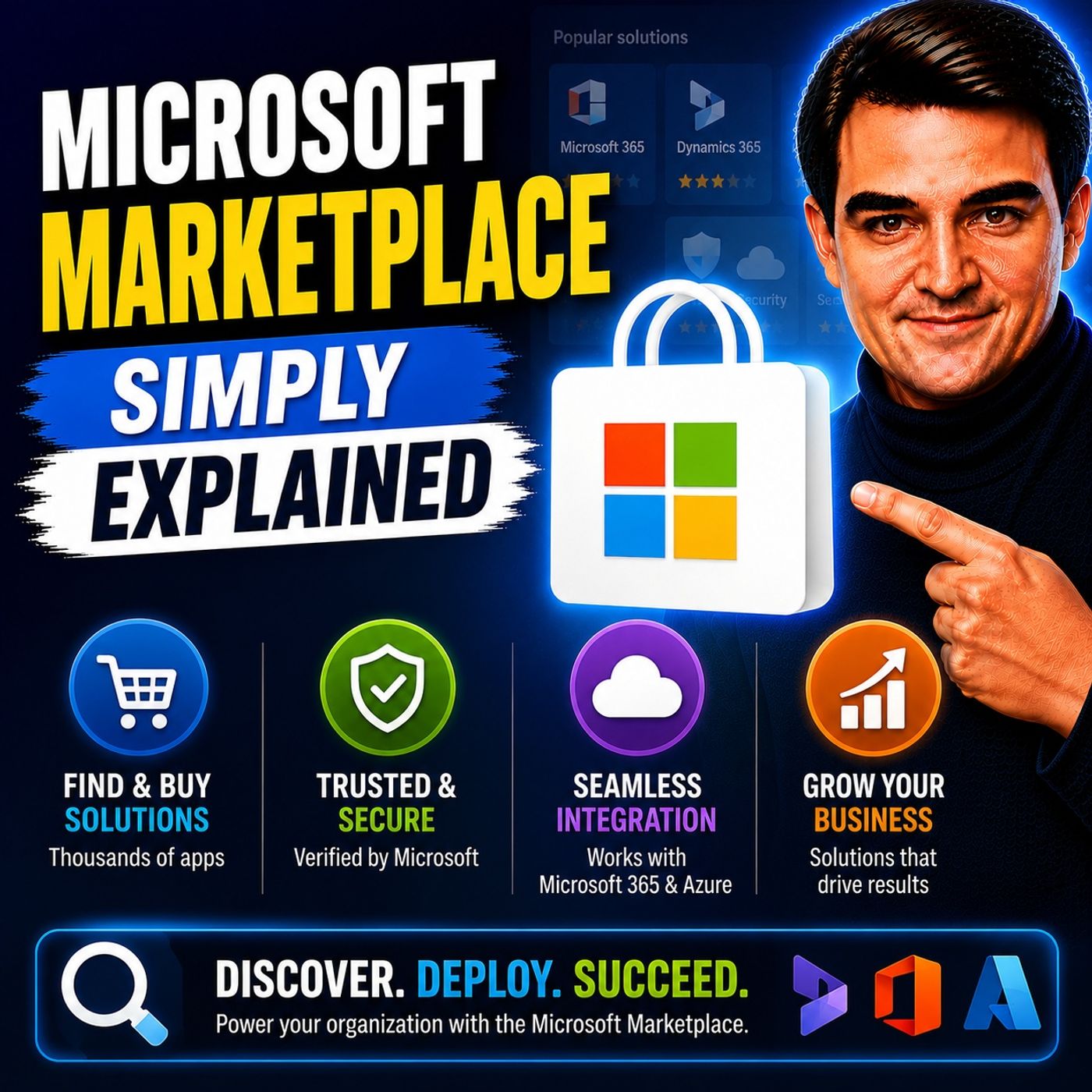
If you want to deepen your understanding of how these commerce platforms operate in the real world and what they mean for your architectural and governance strategies, you will definitely want to listen to our dedicated podcast discussion. For a practical, no-nonsense breakdown of these concepts, check out the related episode, Microsoft Marketplace - Simply Explained.

Founder of M365 Show, M365con.net & m365.fm
Mirko Peters is a Microsoft 365 expert, content creator, and founder of m365.fm, a platform dedicated to sharing practical insights on modern workplace technologies. His work focuses on Microsoft 365 governance, security, collaboration, and real-world implementation strategies.
Through his podcast and written content, Mirko provides hands-on guidance for IT professionals, architects, and business leaders navigating the complexities of Microsoft 365. He is known for translating complex topics into clear, actionable advice, often highlighting common mistakes and overlooked risks in real-world environments.
With a strong emphasis on community contribution and knowledge sharing, Mirko is actively building a platform that connects experts, shares experiences, and helps organizations get the most out of their Microsoft 365 investments.