
Examine cloud infrastructure design and operations in Microsoft Azure, emphasizing security, management, and integration with on-premises environments. Discover architectural choices that impact performance and cost.
July 5, 2026
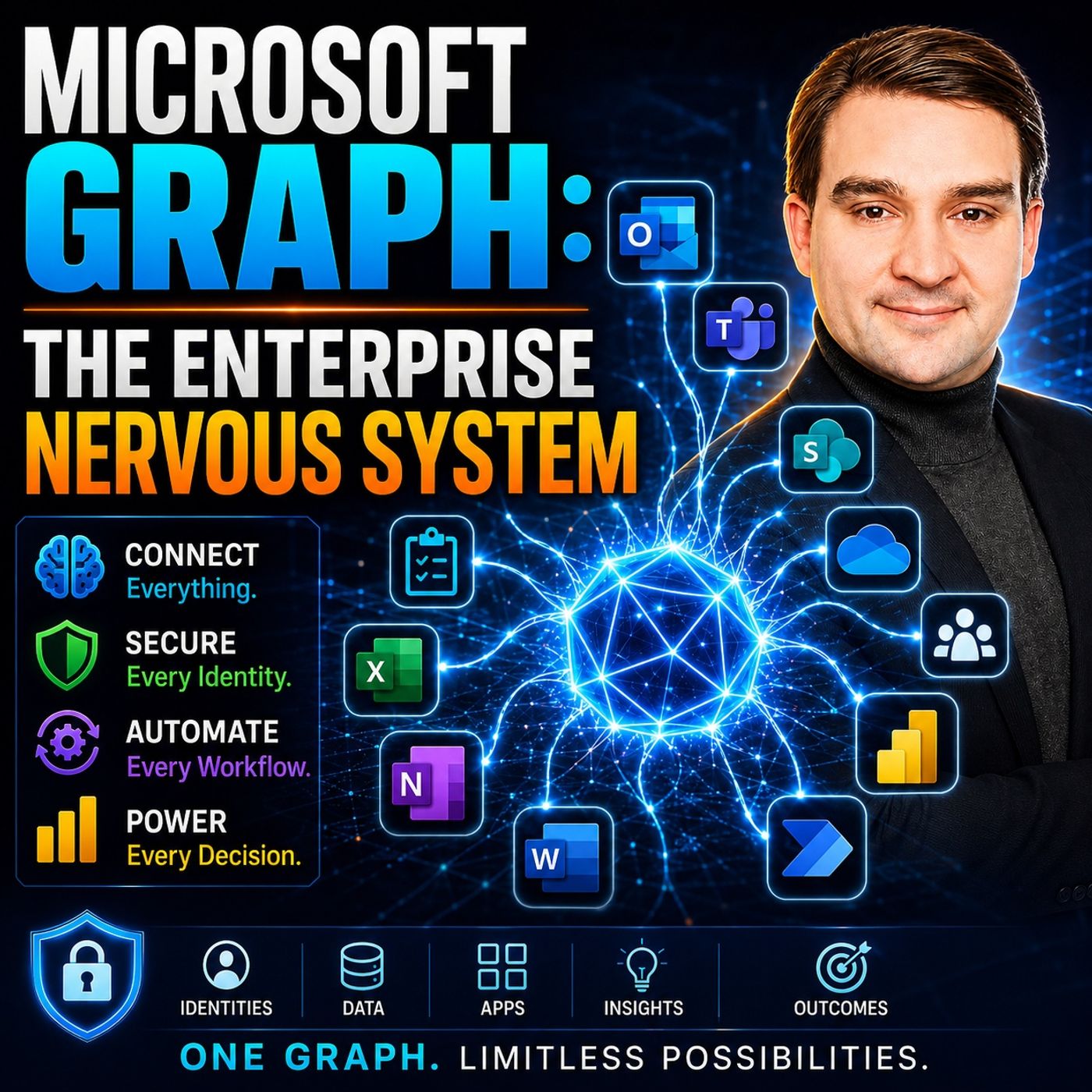
Microsoft Graph: The Enterprise Nervous System
Microsoft Graph is far more than a REST API—it acts as the enterprise nervous system that connects people, identities, files, conversations, meetings, permissions, and business processes across Microsoft 365. In this episode, we explore why understanding these relationships is the key to building truly intelligent applications, automations, and AI experiences rather than isolated point solutions. You'll learn how Microsoft Graph creates a unified layer across services like Teams, SharePoint, Outlook, OneDrive, and Entra ID, allowing developers and architects to retrieve context instead of disconnected data. The episode explains why modern AI solutions such as Microsoft Copilot depend on Graph to understand not just where information is stored, but how users, content, and business activities are connected in real time. We also examine the shift from traditional, static data models toward relationship-driven architectures that enable smarter search, automation, security, and enter…
Guest: Mirko Peters
July 4, 2026
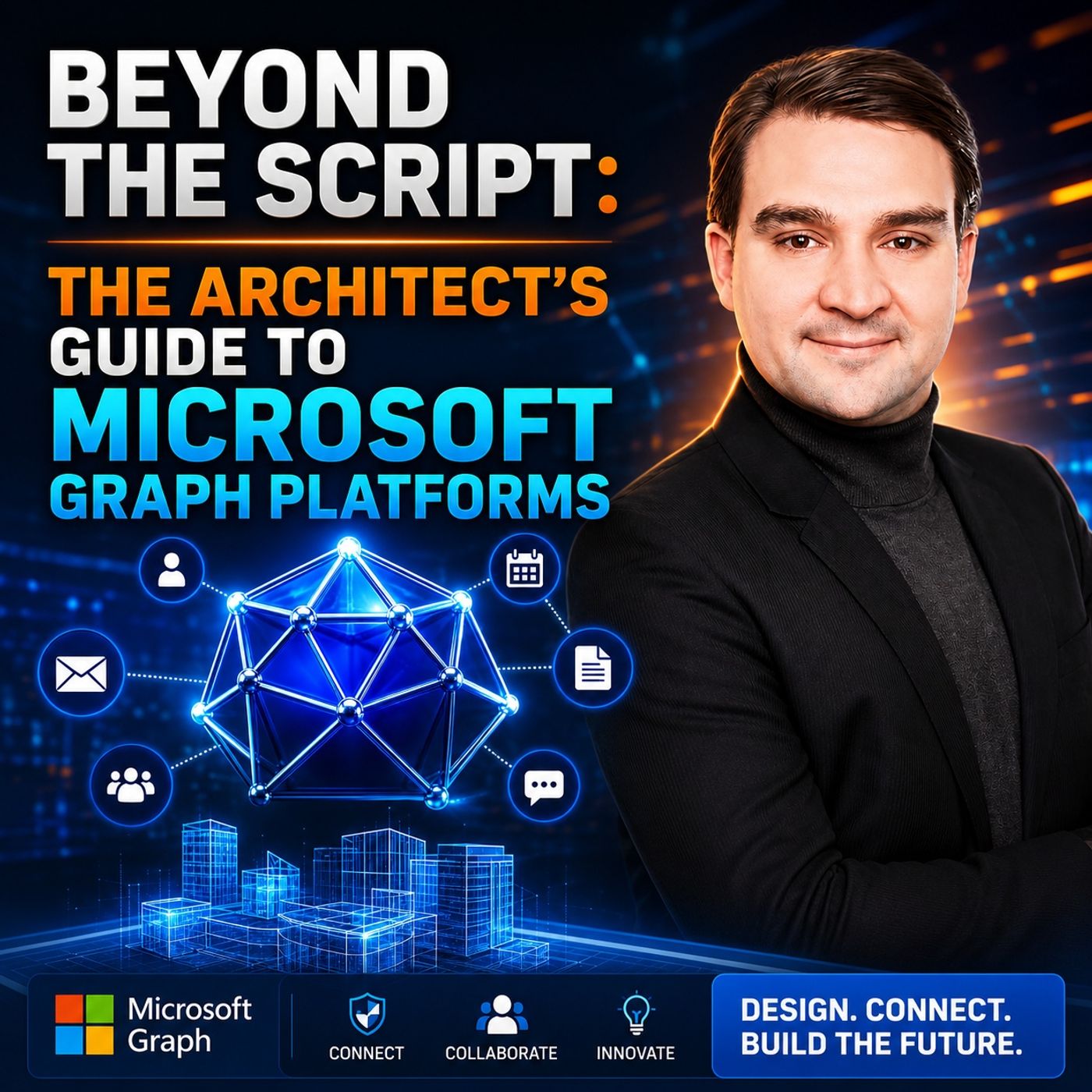
Microsoft Graph Automation Architecture: Beyond Scripts
Automation is essential for digital transformation, but many organizations unintentionally create fragile, difficult-to-manage environments by relying on hundreds of disconnected PowerShell scripts and individual Power Automate flows. While each script may solve a specific problem, together they introduce technical debt, undocumented dependencies, and operational risk that become increasingly difficult to maintain as the business grows. This episode explains why modern enterprises are moving away from script-centric automation toward platform-based architectures built on Microsoft Graph, Azure Logic Apps, Azure Functions, Managed Identities, and governance-first design. Microsoft Graph serves as the central orchestration layer, providing a consistent interface across Microsoft 365 services such as Teams, SharePoint, Exchange, OneDrive, and Entra ID. Event-driven technologies like Graph Subscriptions and Delta Queries enable scalable, resilient automation that reacts in real time wh…
Guest: Mirko Peters
July 4, 2026
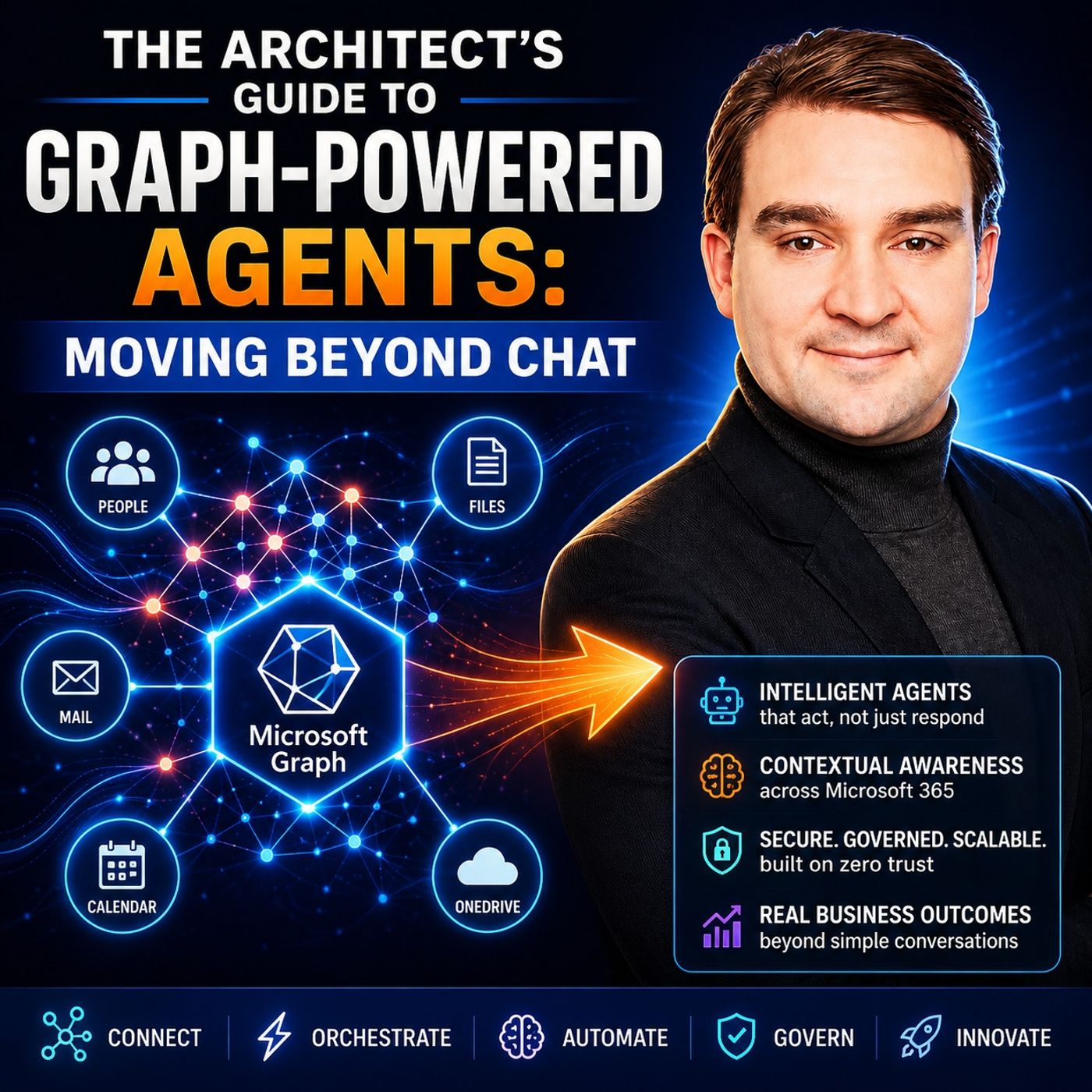
Graph-Powered AI Agents: An Enterprise Architecture Guide
Most organizations think they're building AI agents, but in reality they're still creating advanced chatbots. This episode explains why the future of Microsoft AI lies beyond conversational interfaces and focuses on Graph-powered, enterprise-grade agents that can understand business context, execute actions, and collaborate across multiple systems. The discussion explores how Microsoft Graph serves as the operational backbone for intelligent agents by providing secure access to Microsoft 365 data, identities, files, Teams, Outlook, SharePoint, and business applications. Rather than relying on prompts alone, successful agents combine Graph, semantic context, orchestration, memory, and governance to deliver reliable business outcomes. Listeners learn why enterprise AI requires architectural thinking instead of chatbot design. Topics include agent orchestration, delegated versus application permissions, event-driven workflows, Microsoft Graph APIs, knowledge retrieval, security bou…
Guest: Mirko Peters
July 3, 2026
How Microsoft Graph Connects Microsoft 365 Data and Context
Microsoft Graph is much more than a REST API—it is the hidden logic that connects Microsoft 365. Instead of treating Outlook, Teams, SharePoint, OneDrive, Entra ID, and other services as isolated products, Microsoft Graph exposes the relationships between people, files, meetings, messages, devices, and permissions through a single, unified platform. This episode explains that the real value of Microsoft Graph lies in its ability to understand context. A user is connected to colleagues, documents, calendars, chats, and business processes, allowing applications and AI to retrieve meaningful information instead of disconnected data. This relationship model powers experiences such as Microsoft Copilot, intelligent search, automation, and personalized insights. The discussion also explores how developers and IT professionals can use Microsoft Graph to simplify integrations, automate administrative tasks, and build applications that work consistently across the Microsoft ecosystem. To…
Guest: Mirko Peters
July 2, 2026
Microsoft Graph and PowerShell for Enterprise Automation
Microsoft Graph is far more than just another API—it is the operational backbone of Microsoft 365. This episode explains why relying solely on admin portals limits scalability, visibility, and automation, while Microsoft Graph provides a unified interface for managing identities, users, groups, Teams, SharePoint, security, compliance, and business data across the entire Microsoft ecosystem. The discussion explores how Microsoft Graph PowerShell enables administrators to automate repetitive tasks, manage large environments consistently, and build governance processes that simply cannot be achieved through manual portal administration. Understanding authentication, OAuth, delegated and application permissions, service principals, and least-privilege access is presented as essential for building secure enterprise automation. The episode also highlights Microsoft's AI strategy, explaining that services such as Microsoft Copilot, Copilot Studio, AI agents, and future intelligent work…
Guest: Mirko Peters
June 28, 2026
Terraform vs Azure Bicep: Which IaC Tool Should You Choose?
In this episode of the M365.fm podcast, we explore one of the most debated Infrastructure as Code (IaC) questions in the Azure ecosystem: should you choose Terraform or Azure Bicep? Rather than declaring a universal winner, the discussion explains why the right choice depends on your organization's architecture, cloud strategy, and operational requirements. The episode compares both technologies across key areas including multi-cloud support, Azure-native integration, state management, modularity, developer experience, governance, and long-term maintainability. You'll learn why Bicep is often the preferred choice for Azure-only environments thanks to its native ARM integration, simpler syntax, and immediate support for new Azure services. In contrast, Terraform excels in multi-cloud and hybrid scenarios where a single tool is needed to manage infrastructure across Azure, AWS, Google Cloud, and other platforms. The conversation also covers migration considerations, team skills, d…
Guest: Mirko Peters

June 27, 2026
Enterprise AI Agent Fabric: Architecture Beyond Chatbots
In this episode of M365.fm, we explore why the future of enterprise AI is moving beyond chatbots toward a coordinated network of intelligent agents known as the Agent Fabric. Instead of relying on a single Copilot to answer questions, organizations can build specialized AI agents that own specific business capabilities and collaborate to complete end-to-end workflows. The discussion explains why prompt engineering alone is no longer enough. Real business value comes from designing architectures where events trigger autonomous workflows, specialized agents perform domain-specific reasoning, and orchestration agents coordinate tasks while involving humans only when necessary. This approach improves consistency, scalability, governance, and measurable business outcomes. A major focus is the importance of data architecture. AI can only deliver reliable results when information is well-structured, semantically organized, and governed. The episode highlights metadata, knowledge modeli…
Guest: Mirko Peters
June 26, 2026
AI Agent Identity Security: Beyond Service Accounts
AI agents are often managed like traditional service accounts—but that mindset creates serious security and governance risks. This episode explains why AI agents should be treated as autonomous digital identities with their own lifecycle, permissions, and accountability instead of static technical accounts. The discussion highlights that agents don't just authenticate to services—they make decisions, access business data, trigger workflows, and interact with multiple systems. Because of this, identity becomes the primary security boundary. Organizations should assign every agent its own identity, apply least-privilege access, enforce Zero Trust principles, and continuously monitor behavior rather than relying on broad, long-lived permissions. The episode also covers the importance of lifecycle management for non-human identities. Just like employees, AI agents require onboarding, role assignments, permission reviews, auditing, and secure decommissioning. Without proper governanc…
Guest: Mirko Peters
June 25, 2026
Azure Copilot Agents: Building a Synthetic Platform Team
Building AI agents is no longer just a development challenge—it’s an operational one. In this episode of the M365 FM Podcast, we explore the concept of the Synthetic Platform Team and how organizations can successfully operationalize Azure Copilot Agents at enterprise scale. Rather than treating AI agents as isolated applications, the discussion introduces a platform engineering approach where reusable infrastructure, governance, observability, and automation become the foundation for every agent. The episode explains how platform teams can standardize identity, security, model access, prompt management, deployment pipelines, monitoring, and cost optimization while giving development teams the freedom to build innovative AI solutions. Topics include Azure AI Foundry, Azure OpenAI, Copilot technologies, Infrastructure as Code, CI/CD, telemetry, policy enforcement, and lifecycle management for AI agents. Listeners will learn why successful enterprise AI depends less on individual …
Guest: Mirko Peters

June 22, 2026
Microsoft Refine (Rayfin) as Backend as a Service
In this episode of the M365.fm Podcast, Mirko Peters explores whether custom APIs are becoming obsolete and how Microsoft’s new Rayfin platform could fundamentally change the way enterprise applications are built. Traditionally, developers have spent countless hours creating backend services, authentication layers, databases, APIs, and infrastructure before delivering actual business value. Rayfin introduces a different approach by offering a Backend-as-a-Service (BaaS) model that automates much of this complexity. The episode examines how Rayfin enables developers to define data models, business logic, security policies, and APIs directly in code while Microsoft Fabric automatically provisions and manages the backend infrastructure. Instead of building and maintaining custom APIs from scratch, organizations can focus on application functionality while inheriting enterprise-grade governance, security, compliance, and scalability from the Fabric platform. Mirko discusses the broa…
Guest: Mirko Peters
June 20, 2026
High-Stakes Hybrid Events with Microsoft Teams and Mesh
Hybrid work has fundamentally changed how organizations connect employees, but creating engaging virtual events remains a major challenge. In this episode of the M365 FM Podcast, we explore what it really takes to engineer successful high-stakes hybrid events using Microsoft Teams Immersive Spaces and Microsoft Mesh. Rather than focusing on product marketing, the discussion examines the technical realities that determine whether an immersive event succeeds or fails. A key concept introduced is the “Ghost Town Effect” — when participants abandon virtual experiences due to poor performance, lagging avatars, broken spatial audio, synchronization issues, and low engagement. Even the most visually impressive virtual environments can quickly become ineffective if the user experience suffers. The episode explores the evolution of Microsoft Mesh and Teams Immersive Spaces, highlighting how organizations can move beyond traditional video meetings to create more interactive and collaborat…
Guest: Mirko Peters
![Conditional Access and Identity as Code with Jonathan Hope [MVP]](https://d3wo5wojvuv7l.cloudfront.net/t_rss_itunes_square_1400/images.spreaker.com/original/3e6179705b6758d5aee38b9f8816ebc1.jpg "Conditional Access and Identity as Code with Jonathan Hope [MVP]")
June 19, 2026
Conditional Access and Identity as Code with Jonathan Hope [MVP]
In this episode of M365 FM, Mirko Peters sits down with Microsoft MVP Jonathan Hope to explore why identity has become the most critical security boundary in modern cloud environments. As organizations move deeper into Microsoft 365, Azure, and cloud-native architectures, traditional network-based security models are no longer enough. Jonathan explains how Microsoft Entra ID acts as the control plane for security and why mismanaged identities, excessive permissions, and poorly maintained Conditional Access policies create significant risk. The conversation dives into the concept of “identity debt” — the gradual accumulation of exceptions, legacy configurations, guest accounts, workload identities, and hybrid synchronization issues that weaken an organization’s security posture over time. The episode covers practical strategies for implementing Zero Trust principles, designing effective Conditional Access policies, enforcing least-privilege access, and protecting privileged accou…
Guests: Mirko Peters , Jonathan Hope

June 17, 2026
MCP Architecture for Microsoft Copilot and AI Agents
AI agents are only as valuable as the systems they can access. While much of the industry focuses on models, prompts, and reasoning capabilities, the real challenge in enterprise AI is connectivity. In this episode, we take a deep architectural dive into the Model Context Protocol (MCP), the emerging standard that is rapidly becoming the integration layer for Microsoft Copilot, custom AI agents, Dynamics 365, Azure services, and enterprise applications. The discussion explores why traditional APIs were designed for developers and applications, not autonomous AI agents that need to dynamically discover capabilities, understand available tools, and execute actions across business systems. As organizations deploy more AI solutions, integration has become one of the biggest bottlenecks to scaling enterprise AI. MCP addresses this challenge by providing a standardized protocol that allows agents to interact with tools, resources, and external systems in a more intelligent and flexible w…
Guest: Mirko Peters
June 14, 2026
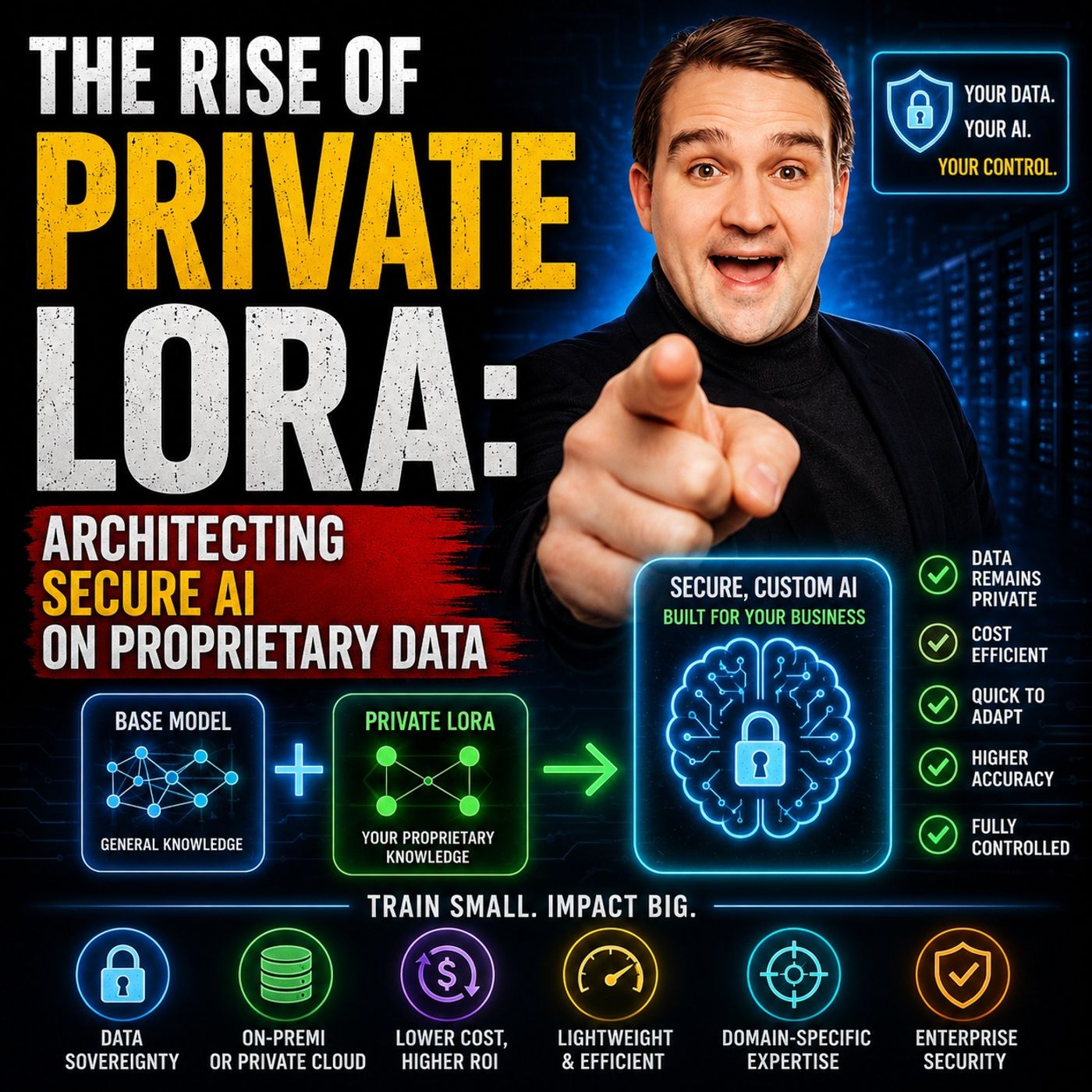
Private LoRA for Secure AI on Proprietary Enterprise Data
The rise of enterprise AI has created a fundamental challenge: how can organizations leverage powerful language models without exposing their most valuable proprietary data? In this episode of M365.fm, we explore the growing adoption of Private LoRA (Low-Rank Adaptation) as a practical architecture for secure AI systems built on sensitive enterprise information. Rather than sending confidential documents, intellectual property, customer records, or internal knowledge to public AI services, Private LoRA enables organizations to adapt and customize foundation models while keeping their data within controlled environments. The discussion explains why traditional fine-tuning approaches are often expensive, difficult to govern, and introduce significant security and compliance concerns. The episode breaks down how LoRA works by modifying only a small subset of model parameters, allowing organizations to create specialized AI capabilities without retraining entire large language model…
Guest: Mirko Peters
June 13, 2026
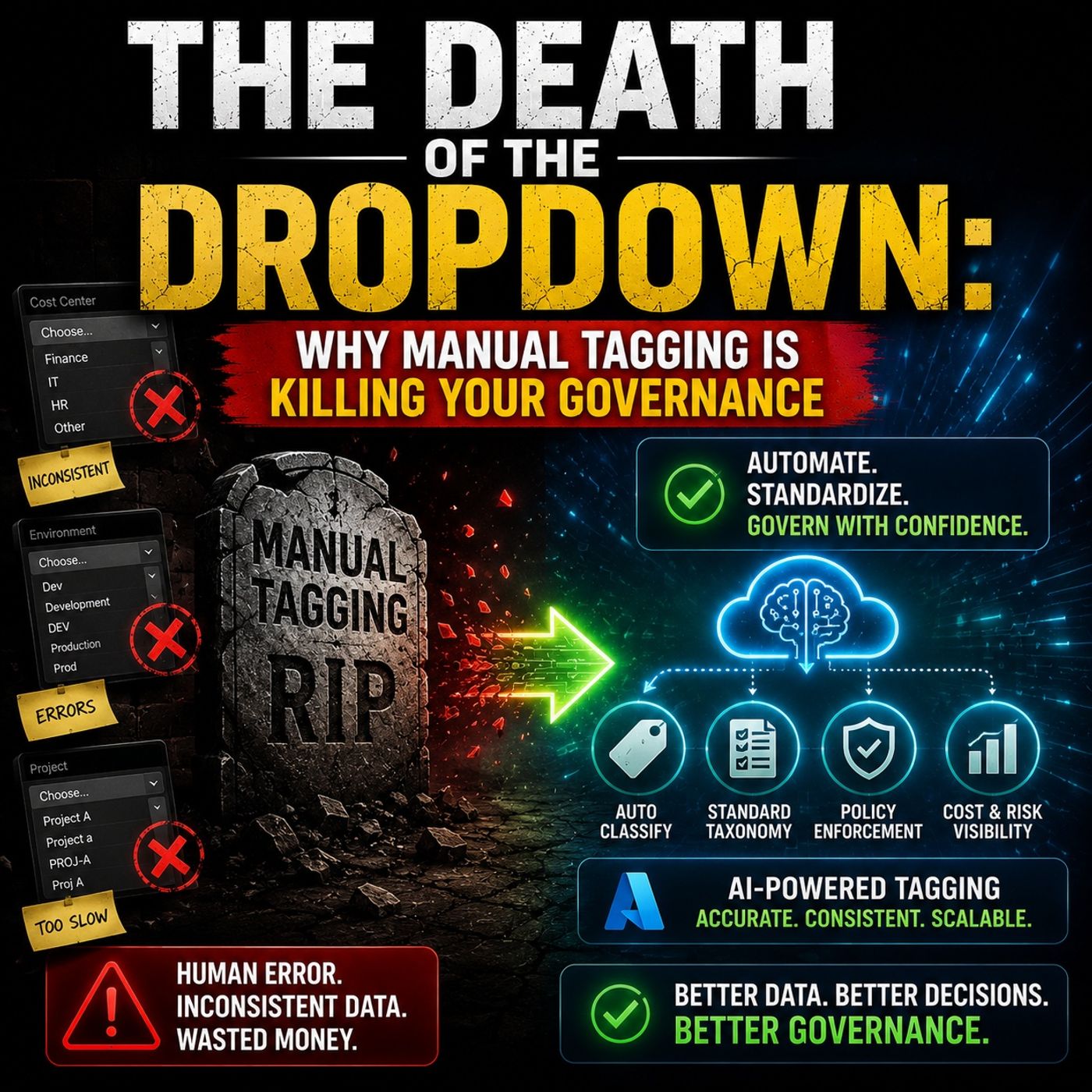
AI-Powered Metadata Classification for Microsoft 365 Governance
Manual tagging is dead—and it’s quietly undermining your Microsoft 365 governance strategy. In this episode, we explore why traditional metadata management based on dropdown menus, user-selected labels, and manual classification no longer works in modern organizations. The volume of content generated across SharePoint, Teams, OneDrive, Copilot, and Microsoft 365 has grown beyond what humans can reliably classify. The problem isn’t that users are unwilling to tag content—it’s that manual tagging is inconsistent, incomplete, and impossible to scale. When metadata quality declines, governance suffers. Search results become unreliable, retention policies lose effectiveness, compliance controls weaken, and AI tools like Microsoft Copilot struggle to understand and protect organizational data. The episode examines how Microsoft Purview and AI-powered classification are changing the game. Instead of relying on users to choose the correct label, modern governance systems can analyze …
Guest: Mirko Peters
June 12, 2026
Cryptographic Agility for Post-Quantum Security
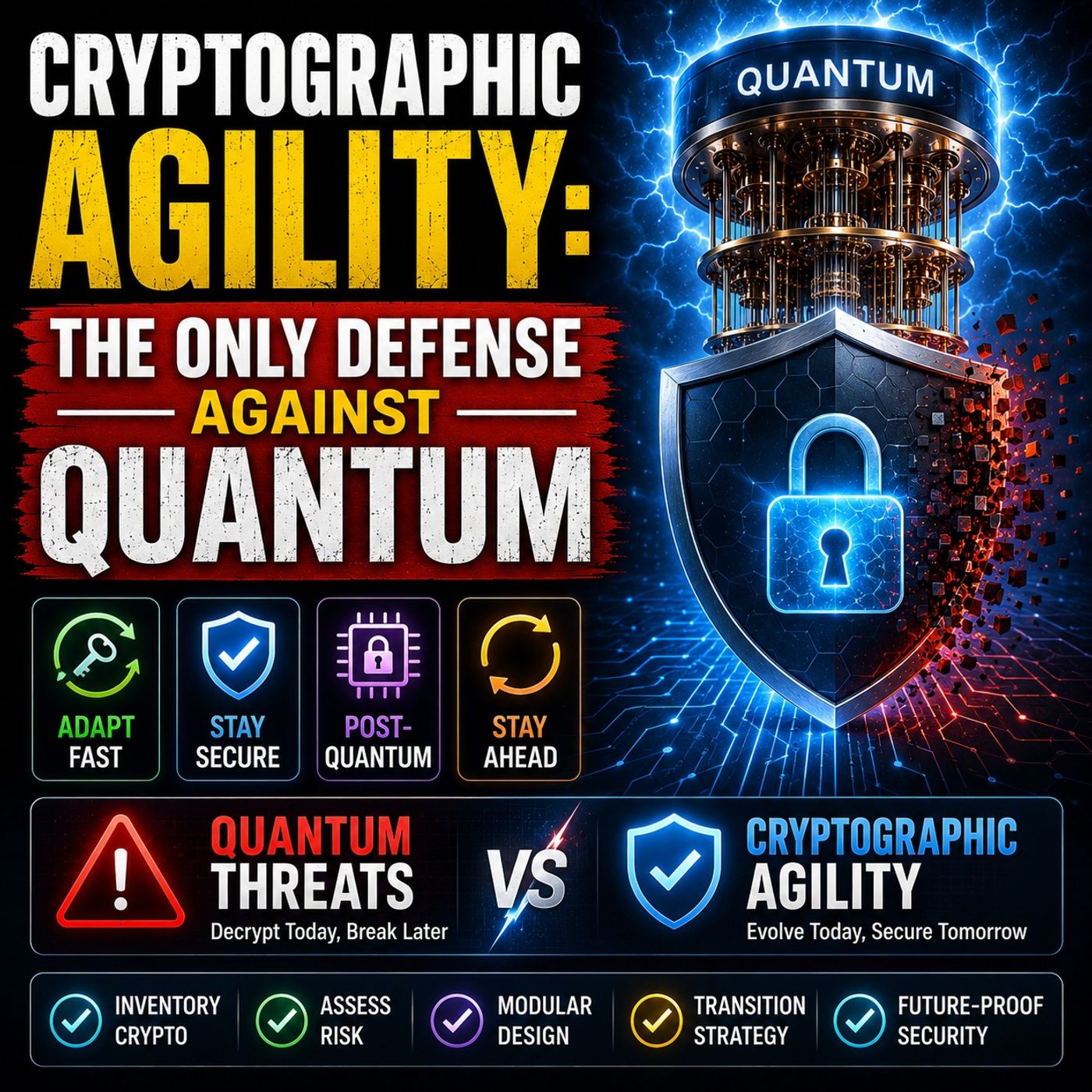
As quantum computing moves from theory toward reality, many organizations are focusing on replacing RSA and ECC with post-quantum cryptography. But in this episode of M365.fm, Mirko Peters argues that simply choosing a new algorithm is not enough. The real challenge is cryptographic agility: the ability to rapidly adapt, replace, and evolve cryptographic systems as threats, standards, and technologies change. The discussion explores why most enterprise environments are deeply dependent on cryptography in ways many organizations don't fully understand. Certificates, identity systems, VPNs, TLS connections, APIs, cloud workloads, IoT devices, and long-lived data all rely on cryptographic foundations that may become vulnerable in a post-quantum world. The biggest risk is not that quantum computers arrive tomorrow—it is that organizations cannot adapt quickly when change becomes necessary. The episode examines how crypto-agility shifts the conversation from algorithm selection to ar…
Guest: Mirko Peters
June 11, 2026
Cloud Latency and Edge Computing Strategy
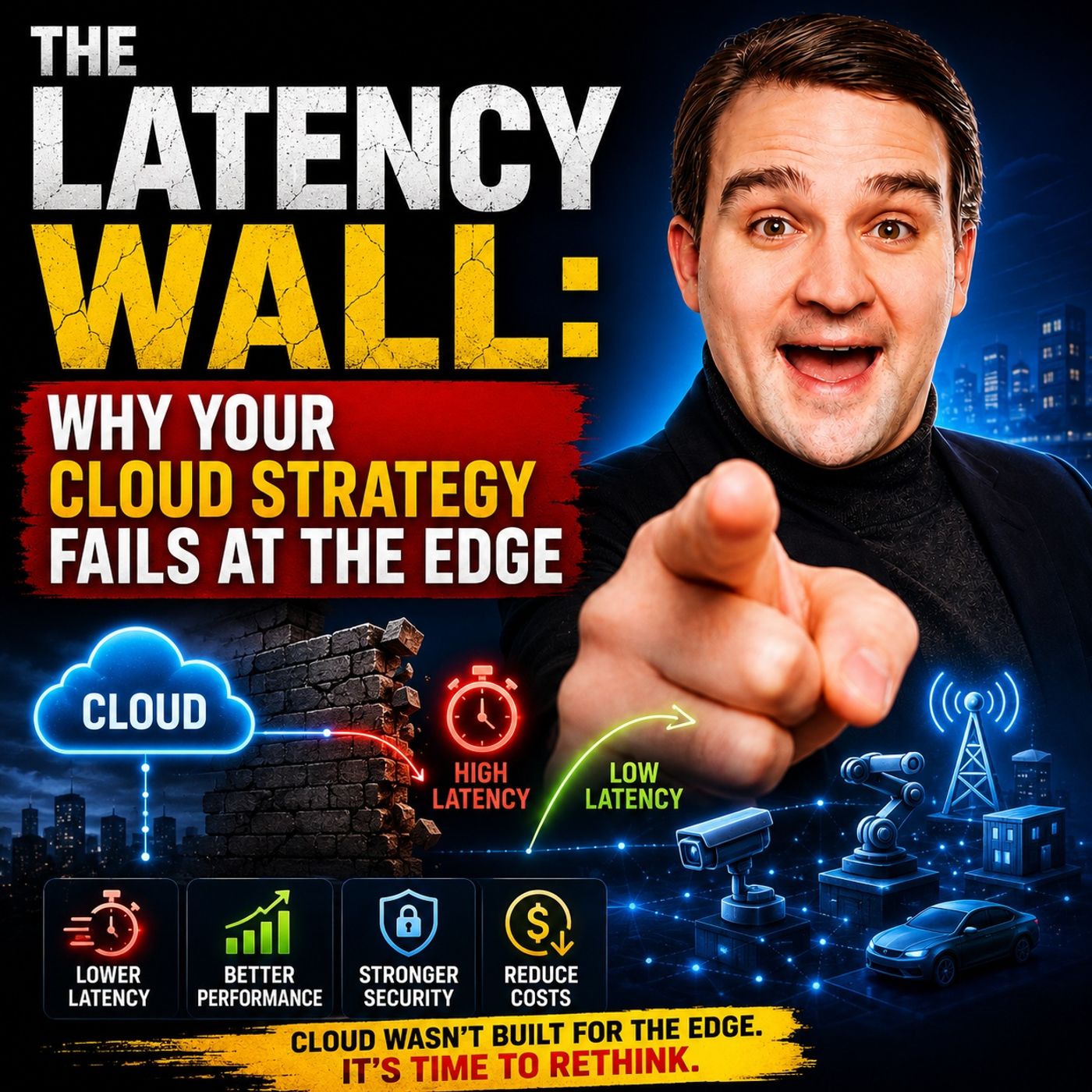
Cloud strategies often focus on scalability, cost optimization, and centralized services, but many organizations overlook one critical factor: latency. In this episode of M365 FM, Mirko Peters explores why network latency can become a major barrier to application performance and user experience, especially as businesses increasingly rely on cloud-based services. The discussion examines the concept of the “latency wall” and explains why simply moving workloads to the cloud does not automatically guarantee better performance. For applications that require real-time processing, industrial automation, IoT, AI inference, or low-latency user interactions, the physical distance between users, devices, and cloud datacenters can create significant challenges. The episode highlights how edge computing is emerging as a solution by bringing compute and data processing closer to where data is generated. Rather than sending every request to a centralized cloud region, organizations can levera…
Guest: Mirko Peters
![Azure Infrastructure as Code and DevOps with Maik van der Gaag [MVP]](https://d3wo5wojvuv7l.cloudfront.net/t_rss_itunes_square_1400/images.spreaker.com/original/e588d62438658e41497c6b5b793bf1ea.jpg "Azure Infrastructure as Code and DevOps with Maik van der Gaag [MVP]")
June 11, 2026
Azure Infrastructure as Code and DevOps with Maik van der Gaag [MVP]
What does the future of Azure look like, and how are Infrastructure as Code and DevOps transforming the way organizations build and manage cloud solutions? In this episode of M365 FM, host Mirko Peters is joined by Microsoft Azure MVP Maik van der Gaag for an in-depth discussion about modern cloud engineering, automation, and the evolving Azure ecosystem. Maik shares insights from his extensive experience helping organizations adopt cloud technologies and modern development practices. The conversation explores why Infrastructure as Code (IaC) has become a critical foundation for scalable and reliable cloud environments. Maik explains how tools such as Terraform and Bicep enable teams to automate deployments, improve consistency, reduce configuration drift, and accelerate delivery across Azure environments. Beyond the technology, the episode highlights the cultural side of DevOps. Successful cloud transformation is not only about tools and automation but also about collaborati…
Guests: Mirko Peters , Maik van der Gaag
June 10, 2026
How to Build Low-Cost AI Agents in Microsoft Cloud
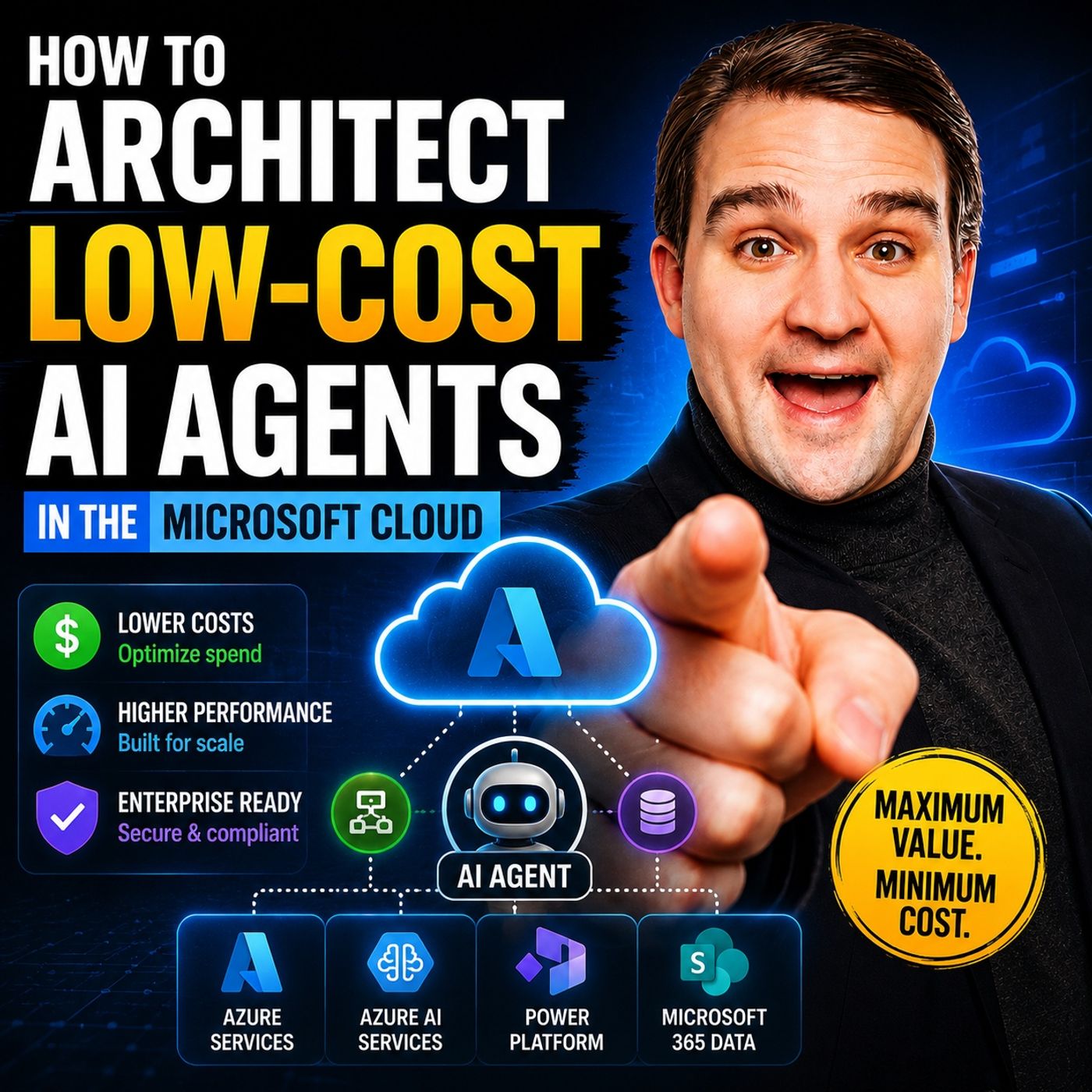
Learn how to build low-cost AI agents in Microsoft Cloud with Azure OpenAI, Copilot Studio, Power Platform, and practical cost controls.
Guest: Mirko Peters
June 8, 2026
HNSW vs DiskANN for Vector Search in Azure AI Search
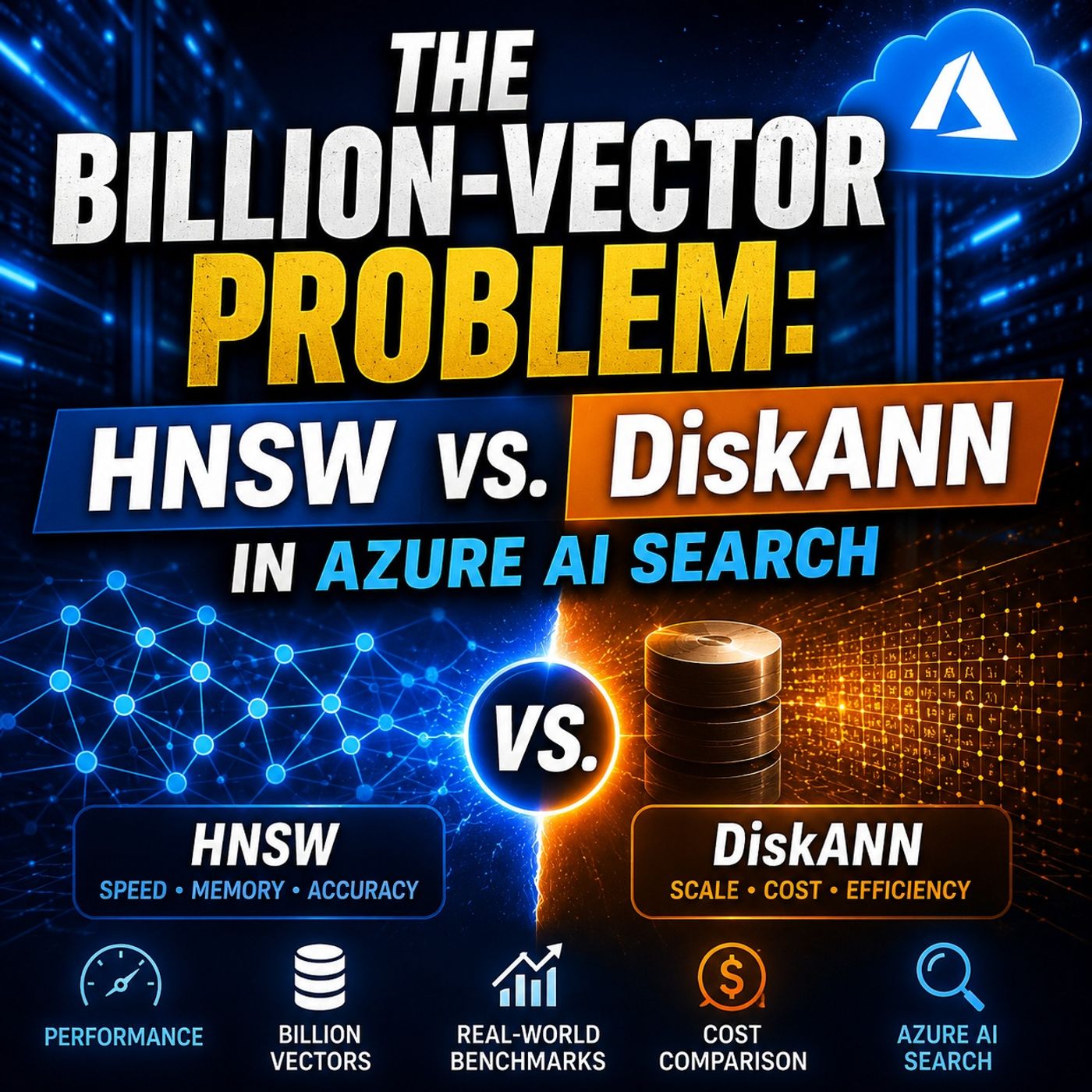
The explosion of AI-powered applications has created a new challenge: how do you efficiently search through billions of vector embeddings without exploding infrastructure costs? In this episode, we explore the “billion-vector problem” and compare two leading vector search algorithms available in Azure AI Search: HNSW (Hierarchical Navigable Small World) and DiskANN. While HNSW has become the industry standard thanks to its fast in-memory performance and high recall, it requires significant RAM as datasets grow. DiskANN, originally developed by Microsoft Research, takes a different approach by leveraging SSD storage to dramatically reduce memory requirements while maintaining excellent search accuracy at massive scale. We break down how each algorithm works, where they shine, and the trade-offs architects need to consider when designing Retrieval-Augmented Generation (RAG), semantic search, and AI agent solutions. The discussion covers performance, scalability, operational costs, up…
Guest: Mirko Peters
June 4, 2026
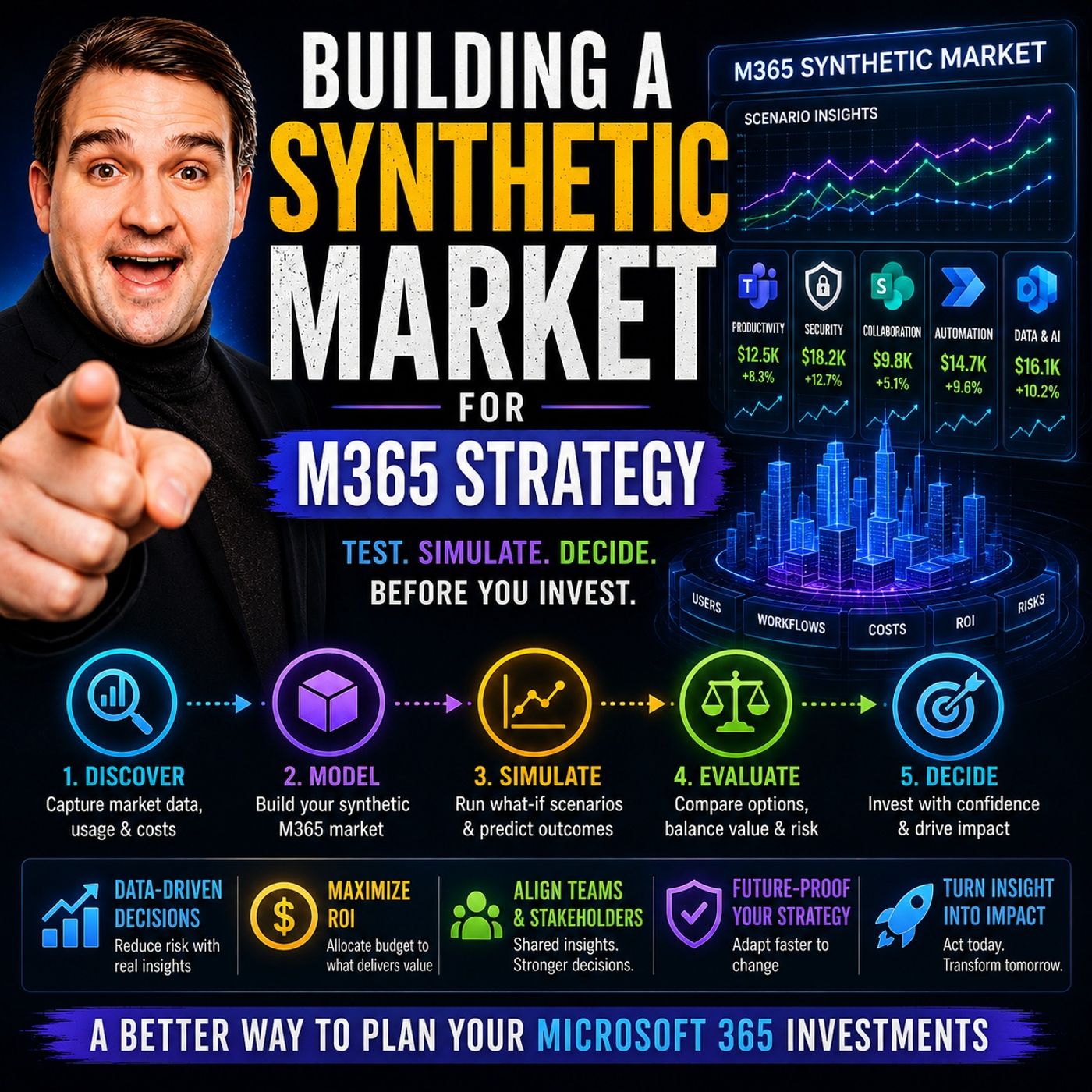
Building a Synthetic Market for Microsoft 365 Strategy
In this episode, Mirko Peters explores why successful Microsoft 365 strategy should be approached like building a synthetic market rather than deploying technology in isolation. The core idea is that Microsoft 365 creates an internal economy where information, collaboration, automation, governance, and AI capabilities continuously interact. Organizations that focus only on individual tools such as Teams, SharePoint, Power Platform, or Copilot often miss the larger system dynamics that drive long-term value. The discussion highlights that every platform decision creates incentives and behaviors. Poor governance can encourage content sprawl, uncontrolled workspace growth, and fragmented knowledge, while well-designed governance creates trust, discoverability, and sustainable adoption. The episode argues that strategy is not about maximizing feature usage but about shaping the conditions that allow productive behaviors to emerge naturally across the organization. A key theme is tha…
Guest: Mirko Peters

May 31, 2026
Build Microsoft Copilot Plugins with Azure Functions
This episode of The Pro Code Edge explores how developers can extend Microsoft 365 Copilot with custom plugins powered by Azure Functions. The discussion focuses on moving beyond out-of-the-box capabilities to create tailored enterprise solutions that connect Copilot with business systems, APIs, and proprietary data. Azure Functions are presented as an ideal platform for Copilot extensibility due to their serverless nature, scalability, and cost efficiency. By exposing business logic through secure APIs, developers can enable Copilot to retrieve information, execute processes, and interact with external applications using natural language. The hosts emphasize that successful Copilot plugins require strong architectural foundations. Key considerations include authentication with Microsoft Entra ID, authorization, security, monitoring, error handling, and governance. Enterprise-grade solutions must be designed with reliability, maintainability, and compliance in mind from the begi…
Guest: Mirko Peters

May 28, 2026
Microsoft Graph API Discovery for Enterprise Semantic Search
Enterprise search is no longer limited by storage capacity or indexing speed. The real challenge is the growing gap between when information is created and when it becomes discoverable. This article explores how Microsoft Graph API Discovery is changing enterprise search by shifting from traditional crawl-and-index models to a relationship-driven, real-time discovery architecture. Traditional enterprise search relies on scheduled indexing, which often creates delays, stale results, and fragmented knowledge across systems. As organizations generate data across Teams, SharePoint, Outlook, OneDrive, and other Microsoft 365 services, keeping search indexes current becomes increasingly difficult. Microsoft Graph approaches the problem differently. Instead of focusing solely on where information is stored, it understands how content, people, conversations, meetings, permissions, and business processes are connected. This graph-based model enables search experiences that are contextual…
Guest: Mirko Peters

May 25, 2026
Microsoft 365 Backup with Isolated Vault Architecture
Microsoft 365’s built-in redundancy keeps services running, but it does not guarantee business recovery after ransomware, insider threats, or accidental deletion. This article explains why many organizations wrongly assume synchronization equals protection, when in reality corrupted or deleted data can spread instantly across the environment. The core argument is that traditional backup strategies are no longer enough in modern cloud environments. Businesses need an isolated vault architecture — a logically separated and immutable recovery layer that cannot be compromised by the same identities, permissions, or attack paths affecting production systems. The article highlights how attackers increasingly target backup systems first, making “connected backups” a major weakness. A secure recovery strategy therefore requires isolation, immutability, strict access separation, and clean recovery points that survive tenant-wide compromise. It also emphasizes that resilience is not ju…
Guest: Mirko Peters