

The Latency Wall: Why Your Cloud Strategy Fails at the Edge

Cloud strategies often focus on scalability, cost optimization, and centralized services, but many organizations overlook one critical factor: latency. In this episode of M365 FM, Mirko Peters explores why network latency can become a major barrier to application performance and user experience, especially as businesses increasingly rely on cloud-based services.
The discussion examines the concept of the “latency wall” and explains why simply moving workloads to the cloud does not automatically guarantee better performance. For applications that require real-time processing, industrial automation, IoT, AI inference, or low-latency user interactions, the physical distance between users, devices, and cloud datacenters can create significant challenges.
The episode highlights how edge computing is emerging as a solution by bringing compute and data processing closer to where data is generated. Rather than sending every request to a centralized cloud region, organizations can leverage edge locations to reduce delays, improve responsiveness, and support new classes of applications.
Mirko also discusses the role of Azure Edge solutions, hybrid architectures, and distributed computing models in addressing latency-sensitive workloads. Security, data governance, operational complexity, and infrastructure planning are explored as key considerations when designing modern cloud architectures.
This episode is essential for cloud architects, IT leaders, and technology professionals who want to understand why latency matters and how edge computing is reshaping the future of cloud strategy.


You face the latency wall when your cloud strategy reaches the edge. In fast-moving industries, every millisecond matters. Delays in data processing can slow your operations, lower product quality, and cause you to lose your competitive edge. You need real-time insights to respond instantly. If you ignore latency, your migration to the edge can fail. Platforms like Azure Stack Edge help you process data locally and keep control, so you do not miss critical moments.
Key Takeaways
- Understand the latency wall: Delays in data processing can hinder real-time operations and impact your competitive edge.
- Embrace edge computing: Process data closer to its source to reduce latency and improve response times for critical applications.
- Adopt a hybrid strategy: Combine cloud and edge computing to optimize performance for both real-time tasks and long-term analytics.
- Monitor latency closely: Use real-time measurement systems to track delays and ensure your edge applications remain reliable.
- Prioritize local processing: Run AI models and data processing at the edge to enhance efficiency and minimize bandwidth usage.
- Plan for infrastructure needs: Build a robust edge-ready infrastructure with reliable connectivity and powerful compute nodes.
- Address security risks: Maintain consistent security measures across your edge and cloud environments to protect sensitive data.
- Continuously optimize your strategy: Regularly assess and adapt your edge computing solutions to meet evolving demands and maintain performance.
Why the Latency Wall Stops Cloud at the Edge
Centralized Cloud Model Limits
You may think the cloud can handle all your data needs, but the centralized model creates real limits at the edge. When you send data from remote sites to a distant data center, you face delays that can break real-time operations. The table below shows the main challenges you will encounter:
| Limitation Type | Description |
|---|---|
| Latency Challenges | Data must travel long distances for processing. This causes delays that can be critical for real-time tasks. |
| Scalability Constraints | Costs rise quickly as you add more devices. You may see bottlenecks in data processing. |
| Technical Challenges | Hybrid setups struggle with data sync, efficient exchange, and conflict resolution when many sites change data. |
You need to process data where it is created. If you rely only on the cloud, you risk missing the speed and scale that edge computing demands.
Latency Wall in Real-Time Operations
The latency wall blocks your cloud strategy when you need instant results. In many cases, cloud computing latency can exceed 20 milliseconds. Sometimes, it can even reach over 1,000 milliseconds if the network is poor. For real-time operations, these delays are not acceptable.
- In industrial automation, robots and process controls need responses in less than 20 milliseconds.
- Autonomous vehicles must make decisions within milliseconds to avoid accidents.
- High-speed manufacturing cannot afford a one-second delay, as it can lead to over 30 defective items.
- Automated ports and drone monitoring require split-second actions to prevent collisions.
As Dongwook Kim from 3GPP MCC explains: "Telecommunications is not an exception and, despite the continued efforts to enhance performance, there always is limit to where latency can be reduced (i.e. the theoretical minimum is the total length of distance divided by the speed of light)."
You cannot move your data fast enough to the cloud and back for these critical tasks. The latency wall makes it clear that you need edge computing for real-time and AI-driven applications.
Edge Needs Immediate Response
You must act fast at the edge. Many applications cannot wait for a round trip to the cloud. The table below shows how strict the latency requirements are for different edge use cases:
| Application Type | Required Latency |
|---|---|
| Robotics | < 10 ms |
| User-interactive tasks | < 50 ms |
| Virtual Reality | < 20 ms |
| Autonomous Vehicle Navigation | Within milliseconds |
| Industrial Automation | Within milliseconds |
- Autonomous robots need near real-time responses to stay safe.
- Industrial automation systems must process data within milliseconds to avoid risks.
- Computer vision alerts and automated quality checks depend on immediate data processing.
Waiting on a round trip to the cloud is not feasible when the application must respond immediately (think computer vision alerts, automated quality checks, or on-site operational systems).
In healthcare, the need for speed is even greater. Surgical telerobotics require latency below 10 milliseconds to keep patients safe. In industrial settings, edge AI applications need total latency of 12 milliseconds for effective inspection. You achieve this by running AI workloads on devices close to the action. This approach reduces compute distance and keeps your operations safe.
You cannot ignore the latency wall if you want your migration to the edge to succeed. You must design your strategy to process data locally, support AI, and meet the strict demands of modern industries.
Understanding the Latency Wall
What Is the Latency Wall?
You face the latency wall when your applications cannot get data fast enough for real-time action. This wall appears when the distance between your data source and the cloud creates delays that break your operations. The latency wall blocks your ability to make instant decisions at the edge. You see this most in industries that need split-second responses, like manufacturing, robotics, and autonomous vehicles.
The difference between cloud and edge becomes clear when you look at response times. Cloud computing often delivers latency between 20 and 100 milliseconds. Edge computing can cut this down to just 1 to 10 milliseconds. That difference can decide whether a robot arm stops in time or a vehicle avoids a collision.
How Latency Impacts Edge Computing
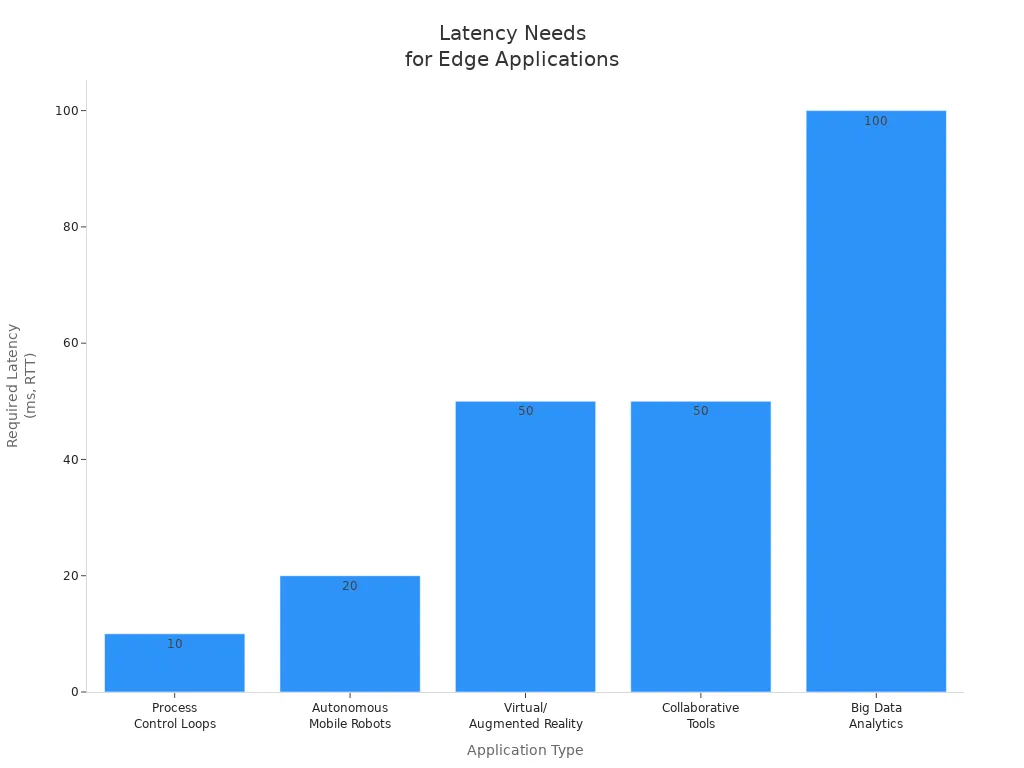
You need to understand how latency affects your systems. The table below shows how different applications respond to latency and where edge works best:
| Application Type | Required Latency (RTT) | Edge Suitability | Cloud Suitability |
|---|---|---|---|
| Process Control Loops | ≤ 10 ms | Mandatory; designed for real-time | Unsuitable; cannot ensure sub-10 ms |
| Autonomous Mobile Robots (AMR/AGV) | < 20 ms | Highly recommended; low response times | Limited; high risk |
| Virtual/Augmented Reality (VR/AR) | < 20 ms to 50 ms | Preferred; avoids backhaul delays | May exceed 50 ms, reducing quality |
| Collaborative Tools | < 50 ms | Suitable; local processing | Acceptable if data centers are nearby |
| Big Data Analytics | > 100 ms | Possible but not essential | Ideal; supports scalability |
Network Distance and Hops
Every time data travels across a network, it passes through routers and switches. Each "hop" adds delay. The farther your data must go, the more hops it takes, and the higher the latency. Edge computing reduces these hops by processing data close to where it is created. You get faster results and more reliable performance.
Bandwidth and Packet Loss
Bandwidth limits how much data you can send at once. If your network gets crowded, packets of data can get lost or delayed. This increases latency and can cause your applications to fail. Edge computing helps by handling most data locally, so only important information travels to the cloud. You save bandwidth and keep your systems running smoothly.
5G increases the speed the data travels at, and edge computing reduces the distance it travels before it is processed. In short, edge enhances the performance of 5G.
Measuring Latency at the Edge
You can measure latency at the edge using several methods. Real-time latency measurement systems use monitoring agents to track delays as they happen. Latency prediction algorithms look at past data to forecast future performance. Distributed monitoring architectures give you a full view of latency across all your edge nodes. Network path optimization helps you find the fastest route for your data.
| Method Type | Description |
|---|---|
| Real-time latency measurement systems | Systems that continuously measure and monitor latency in edge environments using monitoring agents. |
| Latency prediction algorithms | Algorithms that analyze historical data to forecast latency behavior and optimize performance. |
| Distributed monitoring architecture | Frameworks for monitoring latency across multiple nodes, providing visibility into end-to-end latency. |
| Network path optimization | Techniques for optimizing routing decisions to minimize latency in edge scenarios. |
You need to track latency closely to keep your edge applications reliable. If you do not measure and optimize, the latency wall will limit your success.
Technical and Business Impacts
Application Performance Issues
Real-Time Failures
You see the latency wall when your cloud strategy fails to deliver real-time insights at the edge. Latency disrupts your workload, especially when you run data-intensive ai workloads that demand instant responses. Edge computing reduces the time it takes for data to travel, which is crucial for applications like IoT devices, autonomous vehicles, and industrial automation. When you process video feeds from security cameras locally, you generate critical alerts instantly. This improvement boosts performance and keeps your operations safe.
You face migration failures when your workload cannot meet real-time requirements. The complexity of edge environments increases the risk of delayed responses. You must design your workload to handle real-time insights, or you risk missing key moments.
Data Sync Problems
Data synchronization creates complexity in edge deployments. You often deal with asynchronous communication between edge and cloud, which complicates real-time monitoring and alerting. Monitoring systems introduce computational overhead, forcing you to compromise on granularity and frequency. Network connectivity issues disrupt monitoring data transmission, creating gaps in latency metrics. Standardization gaps lead to inconsistent latency measurement across heterogeneous infrastructures. Centralized monitoring approaches struggle with managing large-scale edge deployments, causing performance bottlenecks and delayed alerts.
- Monitoring Overhead
- Network Connectivity Issues
- Standardization Gaps
- Scalability Challenges
- Asynchronous Communication
You must address these challenges to avoid migration failures and ensure your workload delivers consistent insights.
Security and Compliance Risks
You increase security and compliance risks when you do not manage latency in your cloud-to-edge strategy. Distributed architectures create complexity and expose your workload to new threats. Edge nodes may lack physical protection, increasing exposure to theft and unauthorized access. Inconsistent patching and policy enforcement create vulnerabilities that attackers exploit. You must maintain consistent security measures across distributed environments to protect your data and workload.
| Evidence | Description |
|---|---|
| SOC Reports for Cloud Security and Privacy | Highlights the importance of consistent security measures across distributed environments and the challenges posed by increased exposure and operational inconsistency. |
| The Impact Of 5G On Cloud Security Risks And Opportunities | Edge nodes may lack physical protection, increasing exposure to theft and unauthorized access, which can lead to security breaches. |
| The Impact Of 5G On Cloud Security Risks And Opportunities | Distributed architectures often suffer from inconsistent patching and policy enforcement, creating vulnerabilities that attackers exploit. |
You must address these risks to avoid migration failures and protect your workload from complexity.
Cost and Resource Strain
You face cost and resource strain when latency increases in edge computing environments. The complexity of managing data-intensive ai workloads grows as you scale your edge infrastructure. You see migration failures when your workload cannot meet performance targets. Upfront costs for testing latency performance can reach £10,200, with annual fees of £4,800. Subscription plans start at £85 per 1,000 m² per month, covering installation, maintenance, and management software. These plans reduce operational workload and complexity.
Edge architectures reduce latency by a factor of 2 to 10 compared to centralized models. This reduction is crucial for cost-effective performance in latency-sensitive applications. You gain real-time insights and predictive analytics while minimizing resource strain. You must optimize your workload and analytics to avoid migration failures and manage complexity.
Tip: You can achieve better performance and lower costs by processing data locally at the edge and sending only essential insights to the cloud.
Latency Wall: Real-World Cases
Industrial Automation
You see the impact of the latency wall most clearly in industrial automation. Factories depend on real-time control to keep production lines moving and to catch defects instantly. If you rely on the cloud for these tasks, you face delays that can cost thousands of dollars every minute. When you send data from a conveyor belt to the cloud for ai analysis, the round-trip latency can reach 800 milliseconds. During this delay, a defective part moves past the ejection station, making the insight useless.
The experiment with Cloud-based real-time control has concluded, and the results are definitive. For the distinct, unforgiving physics of the factory floor, the cloud is an absentee manager—too far away, too slow to react, and too unreliable to trust with the heartbeat of production. Latency is the enemy. In a world where unplanned downtime burns $22,000 every minute, the 800ms lag of the cloud is an operational tax that manufacturers can no longer afford to pay. Cloud AI introduces 800ms round-trip latency through image encoding, upload, network routing, queueing, inference, and return. On a conveyor belt moving at 2 m/s, the defective part travels 1.6 meters during this delay — overshooting the 1-meter ejection station by 60cm. The defect is correctly detected but the physics of the line render the insight worthless. How does edge AI achieve 12ms industrial inspection latency? By deploying quantized vision models on NVIDIA Jetson devices mounted directly on the conveyor, Veriprajna reduces compute distance from 500+ miles to under 1 meter and switches from public internet to PCIe/MIPI-CSI interfaces.
You solve this problem by using edge platforms like Azure Stack Edge. You process data and run ai models right next to the machines. This approach reduces latency and keeps your production line efficient.
Autonomous Vehicles
You face unique challenges when you operate autonomous vehicles. These vehicles must make decisions in milliseconds to stay safe. If you depend on the cloud for ai inference, you risk delays that can cause accidents. Edge computing helps you run ai models locally and synchronize sensor data for real-time action.
| Evidence Description | Explanation |
|---|---|
| Edge computing for DNN model inference | Utilizes model partitioning and right-sizing to reduce latency in autonomous vehicles. |
| Synchronization of sensor data | Collects data from sensors like steering angle and LiDAR simultaneously to mitigate latency caused by different operating frequencies. |
| Multi-task environment detection | Combines vehicle and lane detection models to enhance efficiency and reduce latency in processing. |
| Latency Source | Impact on Operations |
|---|---|
| Edge hardware limitations | Increases computational delays, affecting real-time processing. |
| Sensor data acquisition delays | Adds latency due to time required for data capture and transmission. |
| Synchronization challenges | Creates temporal inconsistencies, complicating coordination in robotic operations. |
You improve safety and efficiency by processing data at the edge. Azure Stack Edge supports these critical workloads, allowing you to filter and analyze data without relying on distant cloud servers.
Healthcare Telemetry
You see latency challenges in healthcare telemetry when you depend on the cloud for real-time analytics. Medical centers need instant access to patient data for diagnostics and monitoring. If you send data to the cloud, you risk delays and privacy concerns. Edge platforms like Azure Stack Edge help you process data locally and maintain compliance.
- A regional medical center faced significant latency issues due to centralized cloud processing, which delayed real-time analytics and raised privacy concerns.
- Edge servers enabled local data processing, resulting in an 80% reduction in data latency for diagnostic systems.
- The system ensured compliance with regulations like HIPAA and GDPR while maintaining continuous operation in remote clinics with limited connectivity.
You protect patient privacy and improve outcomes by using edge solutions. You keep data close to the source and support real-time decision-making.
Retail and Smart Spaces
You see the latency wall in retail and smart spaces every day. When you run a store or manage a smart building, speed matters. Customers expect fast checkouts, instant loyalty rewards, and real-time inventory updates. If your systems rely on distant cloud servers, you risk delays that frustrate shoppers and slow down your operations.
Latency affects the speed of transactions and customer interactions. You notice this when payment terminals take too long to process, or when digital signage lags behind real-time promotions. Slow systems can lead to lost sales and unhappy customers. You need to respond quickly to customer needs and manage inventory effectively.
Edge computing changes the game for retail and smart spaces. You process data locally, which reduces latency and enables real-time insights. This local processing lets you deliver fast, personalized experiences. You can track inventory as it moves, update prices instantly, and trigger alerts when shelves run low.
Tip: You improve operational efficiency by keeping sensitive information at the source. Edge computing enhances data privacy and reliability.
You benefit from edge solutions like Azure Stack Edge. This platform brings cloud capabilities closer to your store or smart space. You run AI models on-site, analyze customer behavior, and optimize store layouts without waiting for data to travel to the cloud and back. You save bandwidth by sending only essential insights to the cloud, which reduces costs and congestion.
Consider these advantages of edge computing in retail and smart spaces:
- You get low-latency processing for time-sensitive applications.
- You optimize bandwidth by handling data locally.
- You enhance reliability and improve data privacy.
You can use Azure Stack Edge to support self-checkout kiosks, smart shelves, and real-time video analytics. These tools help you detect theft, monitor foot traffic, and personalize offers. You keep your operations running smoothly, even during network disruptions.
Retailers who adopt edge computing gain a competitive advantage. You deliver seamless experiences, manage inventory with precision, and protect customer data. Smart spaces become more responsive, secure, and efficient. You overcome the latency wall by processing data where it matters most—right at the edge.
Overcoming the Latency Wall with Edge Computing
Hybrid Cloud-to-Edge Strategy
You need a hybrid cloud-to-edge strategy to overcome the latency wall. This approach lets you use the strengths of both the cloud and edge computing. You run latency-sensitive tasks at the edge, while you use the cloud for deep analytics and long-term storage. You gain flexibility and control by choosing where each workload runs best.
Key components of a hybrid cloud-to-edge strategy include:
- Workload optimization: You process real-time data at the edge and send large-scale analytics to the cloud.
- Vendor management and cost control: You select the right mix of edge and cloud vendors to match your needs and budget.
- Eliminating waste: You filter and pre-process data at the source, which reduces unnecessary data transmission.
- Holistic management: You use a unified management framework for both edge and cloud environments.
- Enhanced customer and employee experience: You deliver real-time AI insights at the edge for faster responses.
Azure Stack Edge supports this strategy by bringing cloud capabilities closer to your data. You can process AI workloads locally and keep your operations running smoothly, even when network connections are unstable.
Local Processing and AI at the Edge
You unlock real-time decision-making when you process data and run AI at the edge. Edge computing brings data processing closer to where it is generated. This reduces the time it takes for data to travel, which is critical for applications that need instant responses. You see this in autonomous vehicles, industrial automation, and robotics.
Edge AI enhances power efficiency by processing data locally. You use optimized inference models that run on devices with limited resources. This lets you deploy lightweight AI applications for tasks like object recognition, path planning, and anomaly detection. You minimize the amount of data sent over the network, which is important in environments with bandwidth limits.
You also gain autonomy. Devices can keep working even if the network connection drops. Drones use edge AI for real-time navigation and obstacle avoidance. Environmental sensors detect problems and trigger actions right away. Smart cameras analyze video feeds locally, which enables quick responses to security threats. Wearable health devices monitor vital signs and alert you to health issues immediately. Manufacturing systems identify defects on the spot using local image processing.
Azure Stack Edge delivers lower latency for AI inference and local decision-making.
You can trust your edge devices to keep your operations safe and efficient. You do not have to wait for cloud processing to make critical decisions.
Data Filtering and Bandwidth Savings
You improve efficiency and reduce costs by filtering data and saving bandwidth at the edge. Edge computing processes data locally and sends only important information to the cloud. This approach minimizes data transmission, which reduces latency and prevents network congestion.
You cut bandwidth usage by sending only relevant data, such as alerts or summaries. You avoid unnecessary uploads, which lowers your data transmission costs. This is essential as the number of connected devices grows. You keep your network running smoothly, even during peak times.
- You process data locally for ultra-low latency in applications like cloud gaming and real-time industrial control.
- You reduce bandwidth consumption on core networks by aggregating and filtering data at the source.
- You lower data plan costs by minimizing the volume of data sent to the cloud.
Azure Stack Edge helps you achieve these benefits. You can handle AI workloads at the edge, filter out noise, and send only what matters to the cloud. This strategy keeps your systems responsive and cost-effective.
Private 5G and MEC Integration
You can break through the latency wall by combining private 5G networks with Multi-access Edge Computing (MEC). This integration brings data processing even closer to where your devices operate. You no longer need to send every piece of data to a distant cloud. Instead, you process information right at the edge, often within the same building or campus.
Private 5G gives you a dedicated wireless network. You control who connects and how data flows. This control means you can guarantee high speeds and low delays. MEC lets you run applications and AI models near your devices. You get instant responses for tasks that cannot wait.
Here is how private 5G and MEC integration supports your critical applications:
- You process data locally, which reduces the distance data must travel. This leads to much lower latency.
- You enable near real-time responses for applications like autonomous vehicles and industrial automation.
- You improve responsiveness for remote healthcare, smart factories, and connected logistics.
When you use private 5G with MEC, you unlock new possibilities for your business. You can run advanced AI, monitor equipment, and control machines with split-second accuracy.
Azure Stack Edge works well with private 5G and MEC. You can deploy it on-site to handle AI workloads, video analytics, and sensor data. You keep your operations running, even if your connection to the public cloud drops. This setup is vital for industries where every millisecond counts.
The table below shows how private 5G and MEC integration benefits different industries:
| Industry | Benefit of 5G + MEC Integration | Example Use Case |
|---|---|---|
| Manufacturing | Ultra-low latency for machine control | Real-time defect detection |
| Healthcare | Fast, secure data for patient monitoring | Remote surgery assistance |
| Transportation | Reliable, instant communication | Autonomous vehicle navigation |
| Retail | Quick response for customer interactions | Smart checkout and inventory |
You can see that private 5G and MEC give you the speed and reliability you need. You support critical operations and keep your business ahead of the competition.
Building a Future-Proof Cloud-to-Edge Strategy
Assessing Latency Needs
You start your migration by understanding how latency affects your operations. Real-time applications demand strict latency requirements. Robot-assisted remote surgery needs very low latency to keep patients safe. Self-driving cars rely on minimal latency for quick decisions. You must plan your migration by identifying which tasks require instant responses. You can deploy micro edge data centers in places like office buildings or bus shelters to meet these needs. This planning step helps you avoid delays and ensures your migration supports critical workloads.
- Real-time applications need low latency for safety and efficiency.
- Micro edge data centers support fast processing in many locations.
- You must plan your migration to match the latency needs of each application.
Edge-Ready Infrastructure
You build your migration on strong infrastructure. Edge computing depends on reliable and scalable systems. You need powerful compute nodes for local processing. Storage solutions must handle real-time data with redundancy. High-speed connections like 5G and Wi-Fi 6 reduce delays. Edge orchestration and management software help you control your cloud environments. Security frameworks protect your data with encryption and anomaly detection. Monitoring tools track the health and performance of your edge nodes. AI and machine learning capabilities deliver real-time insights and automation.
- Compute nodes process data locally and support scalability.
- Storage solutions keep your data safe and ready for real-time access.
- Network connectivity ensures low latency and fast migration.
- Edge orchestration and management software unify your cloud environments.
- Security frameworks protect your infrastructure and data.
- Monitoring tools provide real-time insights into node performance.
- AI and machine learning enable automation and quick decision-making.
You must plan your migration to include these elements. This infrastructure supports your edge computing goals and keeps your migration on track.
Continuous Optimization
You keep your migration successful by focusing on optimization. You select use cases where latency is critical, such as autonomous vehicles or patient monitoring. You optimize AI models for hardware constraints, using techniques like model compression. You monitor and retrain edge models to maintain performance. This planning ensures your migration adapts to changing needs and keeps your cloud architecture efficient.
- Select use cases that need real-time responses.
- Optimize models for edge hardware and scalability.
- Monitor and retrain models for ongoing optimization.
Tip: Continuous planning and optimization help you avoid migration failures and keep your cloud environments responsive.
You must plan for ongoing adaptation. Azure Stack Edge gives you the tools to monitor, optimize, and scale your infrastructure. You gain real-time insights and keep your migration future-proof.
You face the latency wall when you rely on the cloud for real-time operations at the edge. Ignoring latency spikes and constant data transfer can cause delays, higher costs, and poor user experiences. Edge computing processes data closer to its source, which reduces latency and improves real-time performance. The hybrid cloud-to-edge strategy lets you optimize workloads for each use case. You should assess your architecture and separate time-sensitive tasks from long-term analysis. This approach helps you build a future-proof, latency-aware edge solution.
Risks of neglecting latency wall:
- Delays of 50–200 ms impact retail and AR/VR.
- Increased operational costs and power consumption.
- Real-time applications suffer from network dependence.
Value of edge and hybrid cloud-to-edge:
- Edge reduces latency.
- Enhances real-time processing.
- Hybrid strategy optimizes performance.
Take proactive steps to overcome latency challenges and ensure your edge and cloud environments stay responsive.
FAQ
What is the latency wall in cloud computing?
You hit the latency wall when data takes too long to travel between your devices and the cloud. This delay can break real-time applications and slow down your business.
Why does edge computing reduce latency?
Edge computing processes data close to where you create it. You get faster results because data does not need to travel far. This helps you run real-time applications smoothly.
How does Azure Stack Edge help with real-time processing?
Azure Stack Edge lets you process and analyze data locally. You can run AI models at the edge and send only important results to the cloud. This reduces delays and saves bandwidth.
Which industries benefit most from edge computing?
You see the biggest benefits in industries like manufacturing, healthcare, transportation, and retail. These fields need instant decisions and cannot wait for cloud round trips.
Can I use edge computing with my current cloud strategy?
Yes, you can combine edge computing with your cloud setup. You run time-sensitive tasks at the edge and use the cloud for storage and deep analytics. This hybrid approach gives you flexibility.
What is the role of private 5G in edge computing?
Private 5G gives you a fast, secure network for your devices. You use it with edge computing to get ultra-low latency and reliable connections for critical tasks.
How do I know if my application needs edge computing?
If your application needs instant responses or cannot afford delays, you need edge computing. Examples include robotics, autonomous vehicles, and real-time monitoring.
Does edge computing improve security?
Edge computing can improve security. You keep sensitive data close to its source and reduce the risk of exposure during transmission. You also control who accesses your data at the edge.
🚀 Want to be part of m365.fm?
Then stop just listening… and start showing up.
👉 Connect with me on LinkedIn and let’s make something happen:
- 🎙️ Be a podcast guest and share your story
- 🎧 Host your own episode (yes, seriously)
- 💡 Pitch topics the community actually wants to hear
- 🌍 Build your personal brand in the Microsoft 365 space
This isn’t just a podcast — it’s a platform for people who take action.
🔥 Most people wait. The best ones don’t.
👉 Connect with me on LinkedIn and send me a message:
"I want in"
Let’s build something awesome 👊
1
00:00:00,000 --> 00:00:02,720
There's a reason your Power BI dashboards refresh just fine
2
00:00:02,720 --> 00:00:04,280
while your production line status.
3
00:00:04,280 --> 00:00:06,400
The same cloud that makes your reports instant
4
00:00:06,400 --> 00:00:09,440
makes your robots unstable, and the fix isn't faster internet.
5
00:00:09,440 --> 00:00:11,240
It's a complete architectural inversion
6
00:00:11,240 --> 00:00:13,800
that most cloud teams haven't considered yet.
7
00:00:13,800 --> 00:00:15,200
The physics you can't cheat.
8
00:00:15,200 --> 00:00:17,120
Your cloud strategy was built on an assumption
9
00:00:17,120 --> 00:00:18,960
that worked beautifully for knowledge work.
10
00:00:18,960 --> 00:00:21,640
The assumption is that a few seconds of delay doesn't matter.
11
00:00:21,640 --> 00:00:24,240
A report that refreshes in a minute feels instant
12
00:00:24,240 --> 00:00:25,560
to the human reading it.
13
00:00:25,560 --> 00:00:28,520
A chatbot that responds in under a second feels instant.
14
00:00:28,520 --> 00:00:31,040
A workflow that completes in 10 seconds feels instant.
15
00:00:31,040 --> 00:00:34,160
Even a dashboard that takes 30 seconds to load is tolerated
16
00:00:34,160 --> 00:00:37,240
because the human brain is busy doing other things while it waits.
17
00:00:37,240 --> 00:00:39,240
But that assumption breaks the moment you connect
18
00:00:39,240 --> 00:00:41,520
physical machinery to digital systems.
19
00:00:41,520 --> 00:00:44,000
And in 2026 nearly every industrial organization
20
00:00:44,000 --> 00:00:45,280
is doing exactly that.
21
00:00:45,280 --> 00:00:47,600
A robotic arm performing a pick and place operation
22
00:00:47,600 --> 00:00:50,240
on a fast-moving conveyor doesn't have seconds.
23
00:00:50,240 --> 00:00:51,360
It has milliseconds.
24
00:00:51,360 --> 00:00:55,000
The arm must receive sensor data, process it, adjust its trajectory,
25
00:00:55,000 --> 00:00:59,000
and issue motor commands in a loop that repeats every one to 10 milliseconds.
26
00:00:59,000 --> 00:01:01,480
If the loop slows down, the arm misses the target.
27
00:01:01,480 --> 00:01:04,560
If the loop speeds up unpredictably, the arm overshoots.
28
00:01:04,560 --> 00:01:08,000
Jitter, which is the variability in latency from one loop to the next,
29
00:01:08,000 --> 00:01:10,640
is often more dangerous than consistently slow latency
30
00:01:10,640 --> 00:01:13,720
because control systems are tuned for predictable timing.
31
00:01:13,720 --> 00:01:16,240
A computer vision camera inspecting parts for defects
32
00:01:16,240 --> 00:01:17,400
doesn't have minutes.
33
00:01:17,400 --> 00:01:19,320
It has fractions of a second to flag a problem
34
00:01:19,320 --> 00:01:21,400
before the faulty part advances down the line,
35
00:01:21,400 --> 00:01:24,120
gets welded into a chassis, or packaged into a box
36
00:01:24,120 --> 00:01:26,000
that a customer will open.
37
00:01:26,000 --> 00:01:29,000
The cost of a misdefect isn't just the scrap cost of one part.
38
00:01:29,000 --> 00:01:33,360
It's the warranty claim, the recall, the brand damage, and the regulatory fine.
39
00:01:33,360 --> 00:01:36,360
An autonomous guided vehicle navigating a warehouse aisle
40
00:01:36,360 --> 00:01:38,320
doesn't have the luxury of waiting for a response
41
00:01:38,320 --> 00:01:40,520
from a cloud region 500 kilometers away.
42
00:01:40,520 --> 00:01:41,440
The vehicle is moving.
43
00:01:41,440 --> 00:01:42,800
The people around it are moving.
44
00:01:42,800 --> 00:01:44,120
The other vehicles are moving.
45
00:01:44,120 --> 00:01:46,720
A 300 millisecond delay between seeing an obstacle
46
00:01:46,720 --> 00:01:50,400
and deciding to stop is the difference between a near miss and a collision.
47
00:01:50,400 --> 00:01:52,240
The problem isn't that your cloud is slow.
48
00:01:52,240 --> 00:01:54,080
The problem is that physics doesn't negotiate.
49
00:01:54,080 --> 00:01:58,440
Light travels through fiber at roughly 200,000 kilometers per second.
50
00:01:58,440 --> 00:02:00,320
That sounds fast because it is fast.
51
00:02:00,320 --> 00:02:03,120
But it translates to about five microseconds of one way delay
52
00:02:03,120 --> 00:02:06,720
for every kilometer of fiber between your factory and the data center.
53
00:02:06,720 --> 00:02:07,880
Over a thousand kilometers,
54
00:02:07,880 --> 00:02:11,400
the physical minimum one-way latency is already about five milliseconds,
55
00:02:11,400 --> 00:02:13,760
which means a round trip takes at least 10 milliseconds
56
00:02:13,760 --> 00:02:17,800
before a single router, switch, firewall, or protocol handshake
57
00:02:17,800 --> 00:02:20,520
adds even one microsecond of overhead.
58
00:02:20,520 --> 00:02:23,960
In practice, real networks rarely achieve those theoretical minima.
59
00:02:23,960 --> 00:02:26,840
Traffic traverses multiple hops, detours through peering points,
60
00:02:26,840 --> 00:02:29,640
passes through encryption devices, and waits in queues.
61
00:02:29,640 --> 00:02:32,120
The effective round trip latency between an industrial site
62
00:02:32,120 --> 00:02:35,160
and a cloud region easily reaches 30 to 80 milliseconds
63
00:02:35,160 --> 00:02:37,040
in well-connected geographies,
64
00:02:37,040 --> 00:02:39,840
and it climbs much higher in remote regions.
65
00:02:39,840 --> 00:02:43,040
Under congestion, the round trip can spike to hundreds of milliseconds
66
00:02:43,040 --> 00:02:44,200
without warning.
67
00:02:44,200 --> 00:02:47,360
For a power BI dashboard, 30 milliseconds is nothing.
68
00:02:47,360 --> 00:02:49,360
It's below the threshold of human perception
69
00:02:49,360 --> 00:02:53,000
for a robotic control loop that needs to update every one to two milliseconds.
70
00:02:53,000 --> 00:02:56,360
30 milliseconds is 15 to 30 control cycles that never happened.
71
00:02:56,360 --> 00:02:59,520
It's slow and worse, it's unstable, it's unsafe.
72
00:02:59,520 --> 00:03:00,920
Jitter makes the problem worse.
73
00:03:00,920 --> 00:03:04,240
Jitter is the variability in latency from one packet to the next.
74
00:03:04,240 --> 00:03:06,320
A network might average 30 milliseconds,
75
00:03:06,320 --> 00:03:10,680
which sounds manageable until you realize that some packets arrive in 10 milliseconds
76
00:03:10,680 --> 00:03:13,360
and others arrive in 200 milliseconds.
77
00:03:13,360 --> 00:03:17,280
A control system tuned for predictable timing can't handle that variability.
78
00:03:17,280 --> 00:03:20,480
It overcorrects, then undercorrects, then overcorrects again.
79
00:03:20,480 --> 00:03:22,480
The result is oscillation, mechanical wear,
80
00:03:22,480 --> 00:03:24,560
and in the worst cases, collision or injury.
81
00:03:24,560 --> 00:03:28,400
Determinism, which is the consistency and predictability of response times,
82
00:03:28,400 --> 00:03:29,800
matters more than raw speed.
83
00:03:29,800 --> 00:03:33,040
A system that responds in five milliseconds every single time
84
00:03:33,040 --> 00:03:35,880
is more valuable than a system that averages three milliseconds,
85
00:03:35,880 --> 00:03:37,840
but occasionally spikes to 300.
86
00:03:37,840 --> 00:03:41,320
Protocol overhead adds another layer that cloud architects often overlook.
87
00:03:41,320 --> 00:03:44,520
Every packet traversing a wide area network passes through firewalls,
88
00:03:44,520 --> 00:03:48,000
load balances, encryption tunnels and protocol handshakes.
89
00:03:48,000 --> 00:03:49,920
Each of these elements adds a small delay,
90
00:03:49,920 --> 00:03:51,480
a few microseconds for encryption,
91
00:03:51,480 --> 00:03:53,560
a few milliseconds for firewall inspection,
92
00:03:53,560 --> 00:03:56,080
a few more for border gateway protocol convergence.
93
00:03:56,080 --> 00:03:58,280
In isolation, none of these overheads are large,
94
00:03:58,280 --> 00:04:00,480
but they are additive and they are variable.
95
00:04:00,480 --> 00:04:03,640
A firewall under load might queue packets for 10 milliseconds.
96
00:04:03,640 --> 00:04:06,440
A virtual private network tunnel might renegotiate its session,
97
00:04:06,440 --> 00:04:08,120
adding 100 milliseconds of delay.
98
00:04:08,120 --> 00:04:11,240
These aren't bugs, they are normal behaviors in a shared network,
99
00:04:11,240 --> 00:04:15,840
but normal behavior for a web application is catastrophic behavior for a control loop.
100
00:04:15,840 --> 00:04:18,120
And here's where the architectural mistake happens.
101
00:04:18,120 --> 00:04:21,360
Most cloud strategies were designed in a world where centralization
102
00:04:21,360 --> 00:04:24,320
delivered clear economies of scale and operational simplicity.
103
00:04:24,320 --> 00:04:26,400
Data lakes were built in a few large regions.
104
00:04:26,400 --> 00:04:29,040
Identity and security policies were centralized.
105
00:04:29,040 --> 00:04:31,800
Connectivity patterns assumed that branch locations and factories
106
00:04:31,800 --> 00:04:34,320
were essentially spokes feeding into a hub.
107
00:04:34,320 --> 00:04:37,240
This model works extraordinarily well for transactional systems,
108
00:04:37,240 --> 00:04:39,480
collaboration and offline analytics.
109
00:04:39,480 --> 00:04:42,960
It breaks when the edge becomes a locus of real-time decision making.
110
00:04:42,960 --> 00:04:46,920
The hub and spoke model assumes that the edge consumes intelligence from the center.
111
00:04:46,920 --> 00:04:50,120
The factory requests instructions, the cloud response, the factory executes,
112
00:04:50,120 --> 00:04:52,160
that pattern is fine for batch production schedules,
113
00:04:52,160 --> 00:04:54,200
inventory reports and quality summaries.
114
00:04:54,200 --> 00:04:57,200
It's catastrophic for closed loop control, safety interlocks,
115
00:04:57,200 --> 00:04:58,680
and real-time collision avoidance.
116
00:04:58,680 --> 00:05:01,560
In those scenarios, the edge doesn't need instructions from the center.
117
00:05:01,560 --> 00:05:04,800
The edge needs to be the center of its own local universe.
118
00:05:04,800 --> 00:05:08,600
When milliseconds matter, smart manufacturing provides some of the clearest examples
119
00:05:08,600 --> 00:05:12,400
of where the latency wall manifests, but it's not the only sector hitting the wall.
120
00:05:12,400 --> 00:05:17,200
The same physics applies in logistics, health care, energy, mining, ports and agriculture.
121
00:05:17,200 --> 00:05:21,520
Modern factories deploy fleets of industrial robots, automated guided vehicles,
122
00:05:21,520 --> 00:05:25,120
collaborative robots and computer numerical control machines.
123
00:05:25,120 --> 00:05:27,720
These devices depend on precise timing and coordination
124
00:05:27,720 --> 00:05:31,800
that most information technology professionals never encounter in their day-to-day work.
125
00:05:31,800 --> 00:05:34,800
A robot aligning itself with a moving target on a conveyor
126
00:05:34,800 --> 00:05:39,000
may need sensor readings and motion commands at intervals of 1 to 10 milliseconds.
127
00:05:39,000 --> 00:05:42,200
If the control loop that aligns the robot runs over a wide area network
128
00:05:42,200 --> 00:05:46,600
to a distant cloud region, the variability in latency creates a dangerous oscillation.
129
00:05:46,600 --> 00:05:48,600
The robot overshoot corrects, overshoots again,
130
00:05:48,600 --> 00:05:51,600
even if the average latency looks acceptable in lab conditions,
131
00:05:51,600 --> 00:05:55,400
occasional spikes or congestion events create hazardous conditions
132
00:05:55,400 --> 00:05:59,000
that simply don't exist when the control logic runs locally.
133
00:05:59,000 --> 00:06:01,400
Real-time computer vision is another workload
134
00:06:01,400 --> 00:06:03,600
that stresses traditional cloud strategies.
135
00:06:03,600 --> 00:06:07,000
A single high-definition video stream at 30 frames per second generates
136
00:06:07,000 --> 00:06:09,000
several megabits per second of raw data.
137
00:06:09,000 --> 00:06:12,200
A factory with 50 cameras is pushing hundreds of megabits per second.
138
00:06:12,200 --> 00:06:15,200
A logistics hub with 200 cameras is pushing gigabits.
139
00:06:15,200 --> 00:06:19,600
Streaming all of that footage to a cloud region for analysis is often cost prohibitive,
140
00:06:19,600 --> 00:06:22,000
but the bandwidth problem is only half the story.
141
00:06:22,000 --> 00:06:24,000
If the inspection must happen in real time,
142
00:06:24,000 --> 00:06:27,200
so the system can reject a faulty item before it leaves the conveyor
143
00:06:27,200 --> 00:06:30,200
or halt a machine when a human body enters a hazardous area,
144
00:06:30,200 --> 00:06:33,200
then the latency budget shrinks to tens of milliseconds.
145
00:06:33,200 --> 00:06:36,800
Sending each frame to a cloud region for inference and waiting for the result
146
00:06:36,800 --> 00:06:38,400
is usually impractical.
147
00:06:38,400 --> 00:06:40,400
Even if the average latency is low enough,
148
00:06:40,400 --> 00:06:43,600
variability in network conditions yields occasional slow responses
149
00:06:43,600 --> 00:06:46,400
that are unacceptable when safety or quality is at stake.
150
00:06:46,400 --> 00:06:49,000
A vision system that catches 99% of defects,
151
00:06:49,000 --> 00:06:52,400
but misses 1% because of network jitter isn't a quality system.
152
00:06:52,400 --> 00:06:53,400
It's a liability.
153
00:06:53,400 --> 00:06:57,400
Autonomous vehicles in industrial settings face a similar wall.
154
00:06:57,400 --> 00:06:59,400
An autonomous guided vehicle in a warehouse
155
00:06:59,400 --> 00:07:01,200
depends on dense, sensor fusion,
156
00:07:01,200 --> 00:07:05,400
and control algorithms to navigate safely among people, equipment and other vehicles.
157
00:07:05,400 --> 00:07:07,800
For collision avoidance and immediate maneuvering decisions,
158
00:07:07,800 --> 00:07:10,400
the vehicle must rely on local sensing and processing
159
00:07:10,400 --> 00:07:13,600
because delays of even a few hundred milliseconds can be unsafe.
160
00:07:13,600 --> 00:07:16,800
A cloud-only architecture that offloads too much of the autonomy
161
00:07:16,800 --> 00:07:19,000
stacked to a distant region is worse than inefficient.
162
00:07:19,000 --> 00:07:21,400
It's a safety risk that your insurance underwriter,
163
00:07:21,400 --> 00:07:24,600
your safety regulator and your operational technology team will reject.
164
00:07:24,600 --> 00:07:27,600
Healthcare environments add another dimension.
165
00:07:27,600 --> 00:07:29,600
Real-time telemetry from patient monitors,
166
00:07:29,600 --> 00:07:32,800
infusion pumps and imaging devices is clinically important
167
00:07:32,800 --> 00:07:34,400
and the data is highly sensitive.
168
00:07:34,400 --> 00:07:39,400
Many jurisdictions impose strict constraints on where health data can be stored and processed.
169
00:07:39,400 --> 00:07:43,000
A cloud-only approach where critical telemetry depends on a distant region
170
00:07:43,000 --> 00:07:45,600
fails both the latency test and the sovereignty test.
171
00:07:45,600 --> 00:07:49,000
In a telemetry system where a few seconds of delay might miss a cardiac event,
172
00:07:49,000 --> 00:07:50,600
centralization isn't a feature.
173
00:07:50,600 --> 00:07:52,000
It's a patient safety issue.
174
00:07:52,000 --> 00:07:57,400
Energy grids and critical infrastructure operate under some of the strictest reliability requirements of any sector.
175
00:07:57,400 --> 00:08:01,800
Grid protection systems often react in sub-cycle time scales to faults and disturbances.
176
00:08:01,800 --> 00:08:03,800
These functions will never move to the cloud.
177
00:08:03,800 --> 00:08:08,400
They belong close to the equipment and follow deterministic, hard real-time design principles.
178
00:08:08,400 --> 00:08:13,200
When utilities try to centralize too much operational control in shared information technology networks
179
00:08:13,200 --> 00:08:17,200
or cloud environments, they create dependencies that might fail during storms,
180
00:08:17,200 --> 00:08:19,200
cyber incidents or other disruptions.
181
00:08:19,200 --> 00:08:23,000
The consequences of a failed protective relay aren't measured in downtime dollars.
182
00:08:23,000 --> 00:08:24,200
They're measured in blackouts.
183
00:08:24,200 --> 00:08:27,000
Mining operations illustrate the problem at geographic scale.
184
00:08:27,000 --> 00:08:29,400
A surface mine might span tens of square kilometers.
185
00:08:29,400 --> 00:08:31,600
The pit is deep, the whole trucks are massive,
186
00:08:31,600 --> 00:08:34,200
and the network connecting the pit to the nearest town,
187
00:08:34,200 --> 00:08:37,800
let alone the nearest cloud region is often microwave or satellite.
188
00:08:37,800 --> 00:08:41,800
Autonomous whole trucks operating in these environments can't depend on a cloud control loop.
189
00:08:41,800 --> 00:08:45,200
They must make pathfinding, collision avoidance and loading decisions locally.
190
00:08:45,200 --> 00:08:47,800
The latency wall isn't an abstract concept in a mine.
191
00:08:47,800 --> 00:08:51,200
It's a physical reality created by distance, terrain and weather.
192
00:08:51,200 --> 00:08:54,200
Ports and maritime logistics present similar challenges.
193
00:08:54,200 --> 00:08:58,400
A container terminal might stretch across several kilometers of key, yard and gate.
194
00:08:58,400 --> 00:09:01,400
Automated stacking cranes, automated guided vehicles,
195
00:09:01,400 --> 00:09:05,400
and ship to shore cranes must coordinate in real time across a radio footprint
196
00:09:05,400 --> 00:09:07,200
that Wi-Fi can't cover reliably.
197
00:09:07,200 --> 00:09:10,800
Private 5G networks and ports aren't a technology upgrade.
198
00:09:10,800 --> 00:09:12,200
There are coverage necessity.
199
00:09:12,200 --> 00:09:17,600
Smart buildings and retail operations illustrate the latency wall in less dramatic but equally costly ways.
200
00:09:17,600 --> 00:09:22,200
An automated checkout system that depends on cloud-based facial recognition or item detection
201
00:09:22,200 --> 00:09:24,400
can't afford multi-second variability.
202
00:09:24,400 --> 00:09:28,800
A customer who waits 5 seconds for the register to authorize a purchase will abandon the cart.
203
00:09:28,800 --> 00:09:32,000
A dynamic pricing display that depends on cloud inventory lookups
204
00:09:32,000 --> 00:09:36,400
will show stale prices during a flash sale, creating customer complaints and revenue loss.
205
00:09:36,400 --> 00:09:38,400
These aren't safety critical scenarios,
206
00:09:38,400 --> 00:09:43,200
but they are revenue critical scenarios where the latency wall manifests as customer friction
207
00:09:43,200 --> 00:09:44,600
rather than mechanical failure.
208
00:09:44,600 --> 00:09:48,200
The common thread across all these scenarios isn't that the cloud is bad.
209
00:09:48,200 --> 00:09:52,200
The cloud is extraordinary for analytics, planning, optimization and monitoring tasks
210
00:09:52,200 --> 00:09:54,200
that tolerate seconds or minutes of delay.
211
00:09:54,200 --> 00:09:58,400
The thread is that a purely centralized strategy is insufficient for industries
212
00:09:58,400 --> 00:10:02,400
where milliseconds matter and where regulatory and physical constraints dominate.
213
00:10:02,400 --> 00:10:04,400
The old model versus the new model.
214
00:10:04,400 --> 00:10:08,200
Most organizations build their cloud strategies around a set of assumptions
215
00:10:08,200 --> 00:10:09,800
that made perfect sense at the time.
216
00:10:09,800 --> 00:10:14,600
Centralized data in a few hyperscale regions consolidate workloads into shared platforms,
217
00:10:14,600 --> 00:10:17,400
rely on global connectivity to bridge the last mile.
218
00:10:17,400 --> 00:10:22,600
These assumptions created enormous value for knowledge work, business intelligence and enterprise collaboration.
219
00:10:22,600 --> 00:10:26,000
They simplified procurement, reduced vendor management overhead
220
00:10:26,000 --> 00:10:28,400
and allowed central teams to enforce standards.
221
00:10:28,400 --> 00:10:31,200
But those same assumptions create a structural mismatch
222
00:10:31,200 --> 00:10:33,800
when the edge becomes a source of real-time decisions.
223
00:10:33,800 --> 00:10:37,200
In the old model, the factory floor was a consumer of central services.
224
00:10:37,200 --> 00:10:39,000
Data flowed from machines to the cloud,
225
00:10:39,000 --> 00:10:41,200
commands flowed from the cloud back down.
226
00:10:41,200 --> 00:10:43,600
The cloud was the brain, the edge was the body.
227
00:10:43,600 --> 00:10:46,000
This model worked because the edge didn't need to think.
228
00:10:46,000 --> 00:10:48,000
It just needed to report and execute.
229
00:10:48,000 --> 00:10:50,400
In the new model, the edge is also a brain.
230
00:10:50,400 --> 00:10:53,000
The factory floor makes local decisions in real time.
231
00:10:53,000 --> 00:10:56,800
It filters raw data into insights before anything leaves the building.
232
00:10:56,800 --> 00:11:00,000
It continues operating even when the wide-area connection drops.
233
00:11:00,000 --> 00:11:01,400
The cloud doesn't disappear.
234
00:11:01,400 --> 00:11:04,000
It shifts from being the primary control plane to being the training ground,
235
00:11:04,000 --> 00:11:06,600
the governance layer and the long-term analytics engine.
236
00:11:06,600 --> 00:11:08,200
This isn't a rejection of the cloud.
237
00:11:08,200 --> 00:11:09,000
It's a rebalancing.
238
00:11:09,000 --> 00:11:13,400
It's a recognition that different workloads belong at different layers of the edge to cloud continuum.
239
00:11:13,400 --> 00:11:17,200
The old model treats latency as a networking problem that can be optimized away
240
00:11:17,200 --> 00:11:21,000
with better bandwidth, content delivery networks or one acceleration.
241
00:11:21,000 --> 00:11:24,600
Engineers are trained to believe that if the link is slow, you add more bandwidth.
242
00:11:24,600 --> 00:11:27,200
If the root is long, you deploy a content delivery node.
243
00:11:27,200 --> 00:11:29,400
If the protocol is inefficient, you tune it.
244
00:11:29,400 --> 00:11:32,600
These are good instincts for web applications and file transfers.
245
00:11:32,600 --> 00:11:34,600
They are irrelevant for control loops.
246
00:11:34,600 --> 00:11:38,200
The new model recognizes that latency is a physics problem with a hard floor.
247
00:11:38,200 --> 00:11:40,400
The speed of light and fiber is a constant.
248
00:11:40,400 --> 00:11:43,400
The distance between your factory and the cloud region is a constant.
249
00:11:43,400 --> 00:11:47,800
The number of rooting hops is a variable, but not one you can reduce below a physical minimum.
250
00:11:47,800 --> 00:11:51,600
The only way to beat the latency wall is to move the compute closer to the workload.
251
00:11:51,600 --> 00:11:57,600
The old model assumes that more virtual CPUs in the cloud or a faster storage tier will improve end-to-end behavior.
252
00:11:57,600 --> 00:12:00,400
If the database is slow, provision a bigger instance.
253
00:12:00,400 --> 00:12:03,000
If the query is slow, add an index.
254
00:12:03,000 --> 00:12:06,200
These instincts are correct for transaction processing and analytics.
255
00:12:06,200 --> 00:12:07,800
They are wrong for control loops.
256
00:12:07,800 --> 00:12:14,200
Once you hit the latency wall, adding more cloud capacity does almost nothing to improve actual response times for millisecond scale tasks.
257
00:12:14,200 --> 00:12:17,400
Because the bottleneck is the network path, not the compute path.
258
00:12:17,400 --> 00:12:23,000
The old model backholes massive volumes of raw sensor and video data because the cloud is where the analytics tools live.
259
00:12:23,000 --> 00:12:25,000
The data science team needs the raw data.
260
00:12:25,000 --> 00:12:27,000
The machine learning pipeline needs the raw data.
261
00:12:27,000 --> 00:12:29,000
The compliance auditor needs the raw data.
262
00:12:29,000 --> 00:12:31,000
So every byte gets shipped upstream.
263
00:12:31,000 --> 00:12:34,000
The new model processes and filters that data at the edge,
264
00:12:34,000 --> 00:12:40,400
sending only metadata, anomalies and aggregates upstream which dramatically reduces backhaul costs and bandwidth requirements.
265
00:12:40,400 --> 00:12:42,600
The data science team still gets what they need.
266
00:12:42,600 --> 00:12:46,000
They just get it in a refined form that travels faster and costs less.
267
00:12:46,000 --> 00:12:49,000
The old model assumes connectivity is always available.
268
00:12:49,000 --> 00:12:50,600
The wide area network is reliable.
269
00:12:50,600 --> 00:12:52,600
The internet service provider is reliable.
270
00:12:52,600 --> 00:12:54,000
The cloud region is reliable.
271
00:12:54,000 --> 00:12:56,200
The new model designs for brownouts and outages.
272
00:12:56,200 --> 00:13:00,000
Ensuring that critical operations continue even when the one is impaired.
273
00:13:00,000 --> 00:13:02,000
This isn't pessimism, it's engineering.
274
00:13:02,000 --> 00:13:05,200
If your emergency shutdown system depends on a cloud connection,
275
00:13:05,200 --> 00:13:07,400
what happens when the fiber backhoe cuts the line?
276
00:13:07,400 --> 00:13:10,000
The shift from old model to new model isn't a software update.
277
00:13:10,000 --> 00:13:11,400
It's an architectural inversion.
278
00:13:11,400 --> 00:13:16,800
And most cloud teams haven't been trained to think this way because their entire career has been built around centralization.
279
00:13:16,800 --> 00:13:20,800
Their certifications, their playbooks, their vendor relationships and their mental models
280
00:13:20,800 --> 00:13:23,400
all assume that the cloud is the right place for compute.
281
00:13:23,400 --> 00:13:26,800
They need to unlearn that assumption for a specific class of workloads.
282
00:13:26,800 --> 00:13:28,600
This unlearning is harder than it sounds.
283
00:13:28,600 --> 00:13:31,000
Cloud architects are rewarded for consolidation.
284
00:13:31,000 --> 00:13:32,800
Fewer regions mean simpler governance.
285
00:13:32,800 --> 00:13:34,800
Fewer vendors mean simpler procurement.
286
00:13:34,800 --> 00:13:37,000
Centralized logging means simpler compliance.
287
00:13:37,000 --> 00:13:38,200
These are good instincts.
288
00:13:38,200 --> 00:13:42,800
But they become dangerous when applied indiscriminately to workloads that require physical proximity.
289
00:13:42,800 --> 00:13:45,400
The new model doesn't ask you to abandon centralization.
290
00:13:45,400 --> 00:13:49,200
It asks you to recognize that centralization has a domain of applicability
291
00:13:49,200 --> 00:13:51,800
and that domain ends where the latency wall begins.
292
00:13:51,800 --> 00:13:56,600
The organizational resistance to this inversion often manifests as a debate about cost.
293
00:13:56,600 --> 00:14:03,000
A cloud engineer sees the per hour cost of an Azure Stack Edge appliance and compares it to the per hour cost of a cloud virtual machine.
294
00:14:03,000 --> 00:14:04,800
The cloud virtual machine looks cheaper.
295
00:14:04,800 --> 00:14:09,400
But this comparison ignores the cost of bandwidth, the cost of downtime, the cost of scrap,
296
00:14:09,400 --> 00:14:13,000
the cost of regulatory fines and the cost of safety incidents.
297
00:14:13,000 --> 00:14:17,200
When the full cost of the old model is calculated, including the risks it externalizes,
298
00:14:17,200 --> 00:14:20,000
the new model is often the cheaper option by a wide margin.
299
00:14:20,000 --> 00:14:25,400
The problem is that the old models costs are hidden in operational budgets, insurance premiums and risk registers
300
00:14:25,400 --> 00:14:29,600
while the new models costs are visible in a capital expenditure line item.
301
00:14:29,600 --> 00:14:32,800
Finance teams need to be educated about the total cost of ownership,
302
00:14:32,800 --> 00:14:35,600
not just the invoice from the cloud provider.
303
00:14:35,600 --> 00:14:40,800
The cost of backhauling everything, the latency wall isn't the only force pushing enterprises toward the edge.
304
00:14:40,800 --> 00:14:45,600
There's a financial wall and for many organizations it's the one that actually gets leadership's attention.
305
00:14:45,600 --> 00:14:51,000
A single high definition camera at 30 frames per second generates several megabits per second of data.
306
00:14:51,000 --> 00:14:54,800
A factory with 50 cameras is pushing hundreds of megabits per second of raw video,
307
00:14:54,800 --> 00:14:57,600
a logistics hub with 200 cameras is pushing gigabits,
308
00:14:57,600 --> 00:15:02,400
streaming all of that footage to a cloud region for analysis is often cost prohibitive.
309
00:15:02,400 --> 00:15:06,800
The egress charges alone can exceed the value of the insights the cameras generate.
310
00:15:06,800 --> 00:15:11,400
If you're paying cloud egress fees on 100 megabits per second of continuous video,
311
00:15:11,400 --> 00:15:15,800
your annual network bill can run into six figures before you process a single frame.
312
00:15:15,800 --> 00:15:19,200
Edge-based computer vision changes the economics completely.
313
00:15:19,200 --> 00:15:24,200
When inference runs on a local GPU or a specialized accelerator in an Azure Stack Edge appliance,
314
00:15:24,200 --> 00:15:27,800
the camera streams travel only a few meters over the local network.
315
00:15:27,800 --> 00:15:32,800
The edge node detects defects, counts objects or flags safety violations locally.
316
00:15:32,800 --> 00:15:36,600
Only the results, the exceptions and the aggregated counts travel to the cloud.
317
00:15:36,600 --> 00:15:42,400
The bandwidth savings are enormous and the response times drop from hundreds of milliseconds to single digit milliseconds.
318
00:15:42,400 --> 00:15:48,800
The camera that used to consume 100 megabits per second of cloud bandwidth now consumes a few kilobits per second of exception data.
319
00:15:48,800 --> 00:15:51,600
Beyond bandwidth, there's the cost of physical infrastructure.
320
00:15:51,600 --> 00:15:56,400
ABI research found that moving to private 5G in a typical factory can save hundreds of thousands of dollars per year
321
00:15:56,400 --> 00:15:58,400
by avoiding ethernet cable drops.
322
00:15:58,400 --> 00:16:04,400
Each cable drop costs about $225 on average when you factor in cable, labor, installation, conduit
323
00:16:04,400 --> 00:16:07,400
and the downtime required to rewire a production line.
324
00:16:07,400 --> 00:16:12,800
In a large facility with thousands of drops, the cabling budget alone can justify a wireless migration.
325
00:16:12,800 --> 00:16:15,600
And the savings multiply when you consider reconfiguration.
326
00:16:15,600 --> 00:16:19,800
In the old model, moving a machine to a new location means installing new cable runs,
327
00:16:19,800 --> 00:16:23,600
which means production downtime, contractor costs and disruption.
328
00:16:23,600 --> 00:16:28,800
In the new model, you move the machine, update its network, slice configuration in the Azure portal
329
00:16:28,800 --> 00:16:30,800
and it reconnects wirelessly in minutes.
330
00:16:30,800 --> 00:16:34,400
But the real cost that backhauling hides is the cost of fragility.
331
00:16:34,400 --> 00:16:37,800
When your production line depends on a cloud connection for real-time decisions,
332
00:16:37,800 --> 00:16:40,400
every one outage becomes a production stoppage.
333
00:16:40,400 --> 00:16:44,200
Every peering dispute between internet providers becomes a potential liability.
334
00:16:44,200 --> 00:16:47,200
Every cloud region, brownout becomes a factory flow crisis.
335
00:16:47,200 --> 00:16:54,400
Every denial of service attack against your DNS provider can halt operations even though your factory itself was never targeted.
336
00:16:54,400 --> 00:16:56,400
The old model externalizes resilience.
337
00:16:56,400 --> 00:16:58,800
It assumes that the network is someone else's problem.
338
00:16:58,800 --> 00:17:00,200
The new model internalizes it.
339
00:17:00,200 --> 00:17:03,600
It designs systems that keep running when the outside world is having a bad day.
340
00:17:03,600 --> 00:17:05,200
Then there's the sovereignty constraint.
341
00:17:05,200 --> 00:17:09,600
Operational data in many industries may be subject to strict export restrictions
342
00:17:09,600 --> 00:17:12,800
that prevent it from leaving a facility or country in raw form.
343
00:17:12,800 --> 00:17:19,000
Healthcare data, defense data, energy grid, telemetry and financial transaction records often fall into this category.
344
00:17:19,000 --> 00:17:23,000
In the European Union, GDPR governs personal data processing at the edge
345
00:17:23,000 --> 00:17:29,800
and the AI Act reaching full enforcement in August 2026 introduces strict obligations for high-risk edge-based systems.
346
00:17:29,800 --> 00:17:35,400
The data Act focuses on data ownership, access and portability for information generated by connected products.
347
00:17:35,400 --> 00:17:41,400
NIS2 applies to essential and important entities across energy, transport, health and digital infrastructure,
348
00:17:41,400 --> 00:17:45,800
requiring robust cybersecurity measures and incident reporting within 24 hours.
349
00:17:45,800 --> 00:17:47,800
Some member states demand six hours.
350
00:17:47,800 --> 00:17:50,800
Outside the European Union, the picture is equally complex.
351
00:17:50,800 --> 00:17:58,000
China's cybersecurity law and data security law impose strict localization requirements for critical information infrastructure operators.
352
00:17:58,000 --> 00:18:04,400
Russia's data localization law requires personal data of Russian citizens to be stored on servers physically located in Russia.
353
00:18:04,400 --> 00:18:10,200
India's draft data protection bill and existing reserve bank of India guidelines mandate local storage for payment system data.
354
00:18:10,200 --> 00:18:16,000
Brazil's general data protection law follows the European model with cross-border transfer restrictions.
355
00:18:16,000 --> 00:18:22,200
Vietnam's cybersecurity law requires foreign technology firms to store data locally and establish local branches.
356
00:18:22,200 --> 00:18:26,400
A cloud-first strategy that routes all operational data to a single-hyper-scale region,
357
00:18:26,400 --> 00:18:31,200
regardless of where that region is located, violates multiple national laws simultaneously.
358
00:18:31,200 --> 00:18:36,800
The financial cost of non-compliance is rising. GDPR fines can reach 4% of global annual revenue.
359
00:18:36,800 --> 00:18:44,200
The AI Act introduces penalty frameworks for high-risk artificial intelligence systems that fail to meet data governance and documentation requirements.
360
00:18:44,200 --> 00:18:50,200
NIS2 penalties vary by member state, but can include large administrative fines and liability for management.
361
00:18:50,200 --> 00:18:55,000
These aren't theoretical risks. They've been levied against major technology and industrial companies,
362
00:18:55,000 --> 00:18:58,800
and the trend is towards stricter enforcement, not loser interpretation.
363
00:18:58,800 --> 00:19:05,000
A cloud-first strategy that naively assumes data can flow freely to a hyper-scale region violates these constraints by design.
364
00:19:05,000 --> 00:19:10,400
The new model keeps raw data on premises under local control, while still leveraging the cloud for model training,
365
00:19:10,400 --> 00:19:13,200
governance and cross-site analytics, where permitted.
366
00:19:13,200 --> 00:19:16,400
It's not about avoiding the cloud, it's about controlling the data path.
367
00:19:16,400 --> 00:19:21,400
Together, these factors reveal that a purely centralized strategy is insufficient for industries
368
00:19:21,400 --> 00:19:26,200
where milliseconds matter, where bandwidth costs matter, and where regulatory constraints matter.
369
00:19:26,200 --> 00:19:30,400
The cloud isn't the problem. The assumption that everything should run in the cloud is the problem,
370
00:19:30,400 --> 00:19:32,600
but knowing the problem is only half the battle.
371
00:19:32,600 --> 00:19:38,800
The architecture that fixes it is already being deployed, and the return on investment numbers are going to surprise you.
372
00:19:38,800 --> 00:19:40,600
What Private 5G actually does?
373
00:19:40,600 --> 00:19:42,800
Most people think 5G is about faster phones.
374
00:19:42,800 --> 00:19:46,200
In reality, for the enterprise, 5G is about deterministic networking.
375
00:19:46,200 --> 00:19:48,800
Wi-Fi is best effort. Private 5G is a guarantee.
376
00:19:48,800 --> 00:19:54,200
To understand why this matters, you need to understand the structural difference between the two technologies at a protocol level.
377
00:19:54,200 --> 00:19:59,200
Wi-Fi, even in its newest generation, uses unlicensed spectrum and contention-based access.
378
00:19:59,200 --> 00:20:04,000
Device is compete for airtime. When the network is lightly loaded, Wi-Fi can be very fast.
379
00:20:04,000 --> 00:20:07,400
When the network is crowded, when devices roam between access points,
380
00:20:07,400 --> 00:20:11,600
or when interference enters the environment from neighboring networks or industrial equipment,
381
00:20:11,600 --> 00:20:16,400
latency fluctuates unpredictably. Wi-Fi is perfect for knowledge work, office collaboration,
382
00:20:16,400 --> 00:20:18,800
and many non-critical internet of things applications.
383
00:20:18,800 --> 00:20:23,000
It is less ideal for deterministic latency-sensitive industrial control
384
00:20:23,000 --> 00:20:27,600
because its fundamental design prioritizes throughput over predictability.
385
00:20:27,600 --> 00:20:30,000
Private 5G uses scheduled access.
386
00:20:30,000 --> 00:20:33,400
The base station, called a Genoad B and 5G terminology,
387
00:20:33,400 --> 00:20:36,200
allocates time and frequency resources to each device,
388
00:20:36,200 --> 00:20:38,800
enforcing quality of service profiles per flow.
389
00:20:38,800 --> 00:20:43,600
Network slicing allows multiple logical networks to coexist on the same physical infrastructure,
390
00:20:43,600 --> 00:20:46,800
each with its own performance characteristics and security boundaries.
391
00:20:46,800 --> 00:20:52,000
One slice can carry safety critical robot commands with sub-10 millisecond latency and bounded jitter.
392
00:20:52,000 --> 00:20:54,000
Another slice can carry video surveillance.
393
00:20:54,000 --> 00:20:57,600
Another can handle employee devices. Each slice operates independently,
394
00:20:57,600 --> 00:21:00,800
and the scheduling mechanism guarantees that a burst of video traffic
395
00:21:00,800 --> 00:21:04,400
won't delay a safety command. This determinism isn't a configuration option
396
00:21:04,400 --> 00:21:06,000
it's built into the radio protocol.
397
00:21:06,000 --> 00:21:10,000
Ultra-reliable low-latency communication is a 3GPP service category
398
00:21:10,000 --> 00:21:12,800
designed to deliver latencies on the order of one millisecond
399
00:21:12,800 --> 00:21:15,600
and high reliability for critical applications.
400
00:21:15,600 --> 00:21:18,800
While achieving these figures in practice depends on careful design
401
00:21:18,800 --> 00:21:22,400
and proximity to the equipment, the architectural target is clear.
402
00:21:22,400 --> 00:21:25,200
Private 5G is designed for bounded predictable performance,
403
00:21:25,200 --> 00:21:27,200
not peak performance under ideal conditions.
404
00:21:27,200 --> 00:21:32,600
The industry doesn't benchmark Private 5G by asking how fast it goes on an empty channel.
405
00:21:32,600 --> 00:21:35,600
It benchmarks by asking how predictable it stays under load.
406
00:21:35,600 --> 00:21:41,200
By early 2026, the global Private 5G market reached about 7.57 billion dollars
407
00:21:41,200 --> 00:21:44,400
up from 5.08 billion dollars in 2025.
408
00:21:44,400 --> 00:21:47,800
Manufacturing alone accounts for 32 to 37% of that revenue,
409
00:21:47,800 --> 00:21:49,400
which tells you where the demand is coming from.
410
00:21:49,400 --> 00:21:52,600
It's not consumers downloading movies, it's industrial environments
411
00:21:52,600 --> 00:21:56,200
that need guaranteed connectivity for moving assets, dense sensor fields
412
00:21:56,200 --> 00:21:57,800
and mission-critical control loops.
413
00:21:57,800 --> 00:22:01,000
The growth trajectory is steep with analysts projecting the market
414
00:22:01,000 --> 00:22:03,400
to reach tens of billions by the early 2030s.
415
00:22:03,400 --> 00:22:06,600
Mobility is another area where 5G diverges sharply from Wi-Fi.
416
00:22:06,600 --> 00:22:08,600
In a large warehouse or production facility,
417
00:22:08,600 --> 00:22:11,800
autonomous guided vehicles and mobile robots move continuously.
418
00:22:11,800 --> 00:22:15,800
Wi-Fi handovers between access points can be sticky and disruptive.
419
00:22:15,800 --> 00:22:19,400
Devices cling to an access point too long, then drop, then reconnect.
420
00:22:19,400 --> 00:22:22,600
In a safety-critical scenario, that dropout is unacceptable.
421
00:22:22,600 --> 00:22:25,800
A robot that loses connectivity for even a few seconds while roaming
422
00:22:25,800 --> 00:22:29,400
might drift into an aisle, collide with a human worker or drop its payload.
423
00:22:29,400 --> 00:22:31,600
5G handovers are engineered for mobility.
424
00:22:31,600 --> 00:22:35,200
The device maintains session continuity as it moves between cells
425
00:22:35,200 --> 00:22:38,200
with latency and jitter that stay within engineered bounds.
426
00:22:38,200 --> 00:22:41,400
The handover isn't an afterthought in the protocol, it's a first-class feature.
427
00:22:41,400 --> 00:22:44,600
Security is built into the architecture at a deeper layer than Wi-Fi.
428
00:22:44,600 --> 00:22:47,800
Instead of shared passwords and certificates that can be copied or leaked,
429
00:22:47,800 --> 00:22:52,400
private 5G uses subscriber identity modules or embedded subscriber identity modules
430
00:22:52,400 --> 00:22:54,400
for hardware anchored identity.
431
00:22:54,400 --> 00:22:57,600
Each device has a unique, cryptographically strong identity
432
00:22:57,600 --> 00:23:00,800
that the network can authenticate, revoke and monitor individually.
433
00:23:00,800 --> 00:23:04,400
You can't shoulder surface him, you can't guess a 16-digit cryptographic key,
434
00:23:04,400 --> 00:23:06,600
and you can revoke a compromised device instantly
435
00:23:06,600 --> 00:23:10,200
without rotating a shared credential that affects every other device on the network.
436
00:23:10,200 --> 00:23:12,800
This isn't an add-on, it's the foundation of the access model.
437
00:23:12,800 --> 00:23:14,800
Spectrum is another differentiator.
438
00:23:14,800 --> 00:23:18,600
Private 5G networks use licensed, shared or lightly licensed spectrum
439
00:23:18,600 --> 00:23:21,400
that is protected from unlicensed interference.
440
00:23:21,400 --> 00:23:24,200
In the United States, the Citizens Broadband Radio Service band
441
00:23:24,200 --> 00:23:29,000
at 3.5 GHz allows enterprises to deploy private cellular networks
442
00:23:29,000 --> 00:23:32,000
without acquiring traditional mobile licenses.
443
00:23:32,000 --> 00:23:35,800
The 3TAPriRITY access system lets industrial users obtain priority licenses
444
00:23:35,800 --> 00:23:39,000
that protect their spectrum from general authorized access users.
445
00:23:39,000 --> 00:23:41,000
In Europe, local licensing regimes in Germany,
446
00:23:41,000 --> 00:23:45,000
the United Kingdom, France and the Netherlands have enabled dozens of factory-scale
447
00:23:45,000 --> 00:23:46,600
private 5G deployments.
448
00:23:46,600 --> 00:23:49,800
Japan, South Korea and Australia have also opened spectrum
449
00:23:49,800 --> 00:23:52,200
for local 5G enterprise use.
450
00:23:52,200 --> 00:23:55,600
This dedicated spectrum means your factory's radio environment is controlled.
451
00:23:55,600 --> 00:23:58,600
You're not competing with the neighbors' Wi-Fi, the coffee shop downstairs
452
00:23:58,600 --> 00:24:00,800
or the handheld barcode scanner on the next aisle.
453
00:24:00,800 --> 00:24:03,600
The radio access network itself is a major investment.
454
00:24:03,600 --> 00:24:06,200
An enterprise buyers need to understand the ecosystem.
455
00:24:06,200 --> 00:24:09,800
The G-Node B, which is the 5G equivalent of a cellular base station,
456
00:24:09,800 --> 00:24:12,800
connects to the 5G core through a front-hole or mid-hole link.
457
00:24:12,800 --> 00:24:16,800
Multiple vendor supply G-Node Bs that interoperate with Azure Private 5G core,
458
00:24:16,800 --> 00:24:21,800
including Nokia, Ericsson, Samsung and several specialized industrial radio suppliers.
459
00:24:21,800 --> 00:24:24,800
The choice of radio vendor affects coverage, power consumption,
460
00:24:24,800 --> 00:24:28,200
indoor versus outdoor performance and integration complexity.
461
00:24:28,200 --> 00:24:31,800
Microsoft maintains a partner ecosystem that validates specific radio combinations
462
00:24:31,800 --> 00:24:35,400
with Azure Stack Edge, which reduces the integration risk but doesn't eliminate it.
463
00:24:35,400 --> 00:24:37,800
You still need a radio engineer to plan the deployment,
464
00:24:37,800 --> 00:24:41,800
perform propagation modeling and optimize antenna placement in environments full of
465
00:24:41,800 --> 00:24:43,800
metal, concrete and moving equipment.
466
00:24:43,800 --> 00:24:46,800
Private 5G doesn't replace Wi-Fi in most facilities,
467
00:24:46,800 --> 00:24:48,800
the two technologies serve different layers of the stack.
468
00:24:48,800 --> 00:24:52,800
Wi-Fi remains the default for offices, collaboration spaces,
469
00:24:52,800 --> 00:24:54,800
guest access and general enterprise connectivity.
470
00:24:54,800 --> 00:24:57,800
Private 5G anchors the operational technology layer,
471
00:24:57,800 --> 00:25:01,800
where determinism, mobility and security are non-negotiable.
472
00:25:01,800 --> 00:25:05,800
The smartest architectures in 2026 are hybrid using each technology where it wins.
473
00:25:05,800 --> 00:25:10,800
Around 60% of businesses see converged Wi-Fi and 5G as key to enterprise flexibility,
474
00:25:10,800 --> 00:25:14,800
viewing them as complementary rather than competitive.
475
00:25:14,800 --> 00:25:17,800
Quality of service engineering in private 5G is worth understanding
476
00:25:17,800 --> 00:25:19,800
because it's fundamentally different from Wi-Fi quality of service.
477
00:25:19,800 --> 00:25:23,800
In Wi-Fi, quality of service tags like voice priority or video priority
478
00:25:23,800 --> 00:25:27,800
are suggestions that access points try to honor when spectrum is available.
479
00:25:27,800 --> 00:25:30,800
In 5G, quality of service is a contract.
480
00:25:30,800 --> 00:25:34,800
The network establishes a data radio bearer with specific guaranteed bit rates,
481
00:25:34,800 --> 00:25:37,800
maximum bit rates and delay budgets for each flow.
482
00:25:37,800 --> 00:25:41,800
If the network can't meet the contract, it rejects the bearer establishment
483
00:25:41,800 --> 00:25:43,800
rather than degrading performance silently.
484
00:25:43,800 --> 00:25:45,800
This is why 5G is called deterministic.
485
00:25:45,800 --> 00:25:46,800
It doesn't hope for low latency.
486
00:25:46,800 --> 00:25:50,800
It guarantees it or fails explicitly, which is exactly the behavior in engineer once
487
00:25:50,800 --> 00:25:52,800
when designing a safety system.
488
00:25:52,800 --> 00:25:54,800
Azure Stack Edge and the local core.
489
00:25:54,800 --> 00:25:58,800
Microsoft's answer to the local compute question is Azure Stack Edge.
490
00:25:58,800 --> 00:26:01,800
It's a ruggedized appliance that sits on your factory floor,
491
00:26:01,800 --> 00:26:03,800
in your warehouse or in your substation.
492
00:26:03,800 --> 00:26:05,800
And it runs as your services locally.
493
00:26:05,800 --> 00:26:08,800
But Azure Stack Edge is more than a server in a closet.
494
00:26:08,800 --> 00:26:12,800
In the private 5G architecture, it becomes the core of your mobile network.
495
00:26:12,800 --> 00:26:16,800
Azure Private 5G core is Microsoft's managed 5G core solution
496
00:26:16,800 --> 00:26:19,800
and it runs on Azure Stack Edge appliances on premises.
497
00:26:19,800 --> 00:26:22,800
The control plane is managed through the Azure portal,
498
00:26:22,800 --> 00:26:25,800
which means your information technology team provision slices,
499
00:26:25,800 --> 00:26:27,800
manages subscriber identities,
500
00:26:27,800 --> 00:26:30,800
and monitors performance using the same interfaces they already know
501
00:26:30,800 --> 00:26:34,800
from managing virtual machines, storage accounts, and Kubernetes clusters.
502
00:26:34,800 --> 00:26:38,800
But the user plane traffic, the actual data flowing between devices and applications,
503
00:26:38,800 --> 00:26:42,800
never leaves your facility unless you explicitly choose to send it.
504
00:26:42,800 --> 00:26:46,800
This distinction is critical, and it's one that many cloud professionals misunderstand at first.
505
00:26:46,800 --> 00:26:48,800
Cloud manage doesn't mean cloud dependent.
506
00:26:48,800 --> 00:26:52,800
The management plane, the orchestration layer, and the lifecycle operations live in Azure.
507
00:26:52,800 --> 00:26:54,800
The data plane lives on your premises.
508
00:26:54,800 --> 00:26:57,800
If the wide area connection drops, your local network keeps functioning.
509
00:26:57,800 --> 00:27:00,800
Your robots keep talking to your edge applications.
510
00:27:00,800 --> 00:27:03,800
Your cameras keep streaming to your local inference containers.
511
00:27:03,800 --> 00:27:06,800
The only thing you lose is the ability to push configuration changes
512
00:27:06,800 --> 00:27:09,800
or view remote dashboards until the link recovers.
513
00:27:09,800 --> 00:27:11,800
The factory doesn't stop because the internet hiccups.
514
00:27:11,800 --> 00:27:15,800
Azure Stack Edge Pro is the primary hardware platform for these deployments.
515
00:27:15,800 --> 00:27:18,800
It can host 102 accelerator cards to support GPU inferencing at the edge.
516
00:27:18,800 --> 00:27:20,800
In addition to network workloads,
517
00:27:20,800 --> 00:27:23,800
the network configuration supports network acceleration
518
00:27:23,800 --> 00:27:28,800
and specialized network functions such as packet core and software defined wide-area network customer premises equipment.
519
00:27:28,800 --> 00:27:34,800
This means the same appliance that runs your 5G core can also run your computer vision models,
520
00:27:34,800 --> 00:27:37,800
your predictive maintenance algorithms, and your digital twin simulations.
521
00:27:37,800 --> 00:27:40,800
You don't need a separate server for every function.
522
00:27:40,800 --> 00:27:43,800
You need one well-designed platform that handles multiple workloads.
523
00:27:43,800 --> 00:27:47,800
There are three deployment models that map directly to how enterprises are implementing this in 2026.
524
00:27:47,800 --> 00:27:49,800
In the virtual private model,
525
00:27:49,800 --> 00:27:53,800
the core functions share infrastructure with a mobile operator's enterprise core.
526
00:27:53,800 --> 00:27:57,800
Your traffic is logically isolated, but it exits through operator equipment.
527
00:27:57,800 --> 00:27:59,800
This is the fastest and cheapest way to deploy.
528
00:27:59,800 --> 00:28:01,800
But it offers the least dedicated control.
529
00:28:01,800 --> 00:28:04,800
It's a good fit for campus environments where cost is the primary driver
530
00:28:04,800 --> 00:28:07,800
and deterministic latency is less critical.
531
00:28:07,800 --> 00:28:11,800
In the hybrid model, signaling and control functions are shared or cloud hosted,
532
00:28:11,800 --> 00:28:16,800
while the user plane is localized on premises through a dedicated user plane function running on Azure Stack Edge.
533
00:28:16,800 --> 00:28:20,800
This model balances latency and data locality against complexity,
534
00:28:20,800 --> 00:28:24,800
and it's the pattern most mid-sized industrial sites are choosing in 2026.
535
00:28:24,800 --> 00:28:30,800
It gives you local breakout for sensitive traffic while still leveraging the operator's expertise for radio planning and spectrum management.
536
00:28:30,800 --> 00:28:34,800
In the standalone model, all core functions are dedicated and fully localized.
537
00:28:34,800 --> 00:28:37,800
This model provides the highest control and isolation,
538
00:28:37,800 --> 00:28:41,800
and it's the choice for mission-critical sites, defense adjacent facilities,
539
00:28:41,800 --> 00:28:46,800
and heavily regulated environments where even shared infrastructure is unacceptable.
540
00:28:46,800 --> 00:28:51,800
The trade-off is higher cost and operational complexity because your team owns the entire stack.
541
00:28:51,800 --> 00:28:56,800
Deutsche Telekom's campus network smart is a concrete example of the hybrid model in production.
542
00:28:56,800 --> 00:29:00,800
It uses Microsoft's Azure Private Multiaxcess Edge Compute Platform,
543
00:29:00,800 --> 00:29:03,800
including Azure Private 5G Core running on Azure Stack Edge,
544
00:29:03,800 --> 00:29:09,800
while Deutsche Telekom provides the radio access network components, spectrum, planning and managed services.
545
00:29:09,800 --> 00:29:15,800
The service is built as a pay-as-you-grow model, which reduces the upfront capital barrier that stops many Edge projects before they start.
546
00:29:15,800 --> 00:29:18,800
You don't need to buy a million dollar private network on day one.
547
00:29:18,800 --> 00:29:22,800
You start with a small deployment and expand as your use cases prove their value.
548
00:29:22,800 --> 00:29:27,800
Microsoft has also built explicit click and deploy integration for partner virtual network functions on Azure Stack Edge.
549
00:29:27,800 --> 00:29:32,800
Nokia Digital Automation Cloud can be deployed through Azure Network Function Manager,
550
00:29:32,800 --> 00:29:36,800
after which it connects to Nokia's Cloud for Sim Management and Radio orchestration.
551
00:29:36,800 --> 00:29:41,800
Silona Edge deploys similarly automatically calling home to the Silona orchestrator once it's running.
552
00:29:41,800 --> 00:29:46,800
Software-defined wide-area network functions like Velo Cloud can run on the same appliance,
553
00:29:46,800 --> 00:29:50,800
integrating your private 5G segment into your broader enterprise one.
554
00:29:50,800 --> 00:29:54,800
This ecosystem approach means you're not locked into a single vendor for every layer of the stack.
555
00:29:54,800 --> 00:29:58,800
For organizations already invested in Azure, the integration path is straightforward.
556
00:29:58,800 --> 00:30:03,800
Azure Stack Edge connects to Azure Arc, which means your on-premises Kubernetes clusters,
557
00:30:03,800 --> 00:30:08,800
your virtual machines and your containerized applications are managed through the same Azure resource manager interfaces,
558
00:30:08,800 --> 00:30:13,800
the same policy definitions and the same identity stack that governs your cloud workloads.
559
00:30:13,800 --> 00:30:18,800
The Edge isn't an alien environment, it's an extension of the cloud that happens to live in your building.
560
00:30:18,800 --> 00:30:22,800
The hardware itself deserves a closer look because it's not a generic server.
561
00:30:22,800 --> 00:30:28,800
Azure Stack Edge Pro is designed for industrial and remote environments with features that standard data center servers lack.
562
00:30:28,800 --> 00:30:34,800
It has redundant power supplies, solid state storage, and a form factor that fits into wiring closets or equipment rooms,
563
00:30:34,800 --> 00:30:37,800
rather than requiring a dedicated data center.
564
00:30:37,800 --> 00:30:41,800
The GPU-enabled variants can run computer vision inference, digital twin simulations,
565
00:30:41,800 --> 00:30:44,800
and virtual network functions concurrently.
566
00:30:44,800 --> 00:30:49,800
Network acceleration features allow the appliance to handle packet core workloads without choking the CPU,
567
00:30:49,800 --> 00:30:56,800
which means the same box that roots your 5G traffic can also host your machine learning container without performance contention.
568
00:30:56,800 --> 00:30:59,800
The partner ecosystem around Azure Stack Edge is expanding rapidly,
569
00:30:59,800 --> 00:31:09,800
Nokia Digital Automation Cloud, Celona Edge, and several software-defined wide-area network virtual network functions are available through Azure Network Function Manager with click and deploy experiences.
570
00:31:09,800 --> 00:31:15,800
This ecosystem approach matters because it allows you to mix and match best of breed components without becoming a systems integration company.
571
00:31:15,800 --> 00:31:20,800
You select the validated virtual network function, approve the deployment, and Azure handles the lifecycle.
572
00:31:20,800 --> 00:31:27,800
The partner handles the specialized configuration, your team focuses on the applications that create business value.
573
00:31:27,800 --> 00:31:35,800
Multiaxs Edge Computing explained. Multiaxs Edge Computing is the bridge between the 5G radio and the local compute power that makes real-time decisions possible.
574
00:31:35,800 --> 00:31:38,800
Without MEC, private 5G is just a very expensive wireless network.
575
00:31:38,800 --> 00:31:41,800
With MEC, it becomes an intelligent Edge platform.
576
00:31:41,800 --> 00:31:49,800
In simple terms, MEC means placing compute, storage, and application hosting, physically close to where data is generated and where actions must be taken.
577
00:31:49,800 --> 00:31:54,800
In Microsoft's ecosystem, this manifests through Azure Stack Edge devices, running containerized workloads,
578
00:31:54,800 --> 00:32:01,800
Azure Arc-enabled Kubernetes clusters, and specialized network functions that process traffic before it ever touches the public internet.
579
00:32:01,800 --> 00:32:03,800
The typical architecture looks like this.
580
00:32:03,800 --> 00:32:09,800
Industrial sensors, cameras, robots, and autonomous vehicles connect to private 5G radios distributed across the facility.
581
00:32:09,800 --> 00:32:14,800
Those radios feed into the Azure Private 5G core running on an Azure Stack Edge appliance.
582
00:32:14,800 --> 00:32:22,800
That same appliance hosts Kubernetes pods running computer vision models, predictive maintenance algorithms, digital twin simulations, or custom business logic.
583
00:32:22,800 --> 00:32:32,800
The data travels a few meters over a local network, gets processed in milliseconds, and only the results or exceptions are forwarded to Azure regions for long term storage, model retraining, or cross-site analytics.
584
00:32:32,800 --> 00:32:36,800
Containerized logic is what makes this architecture agile.
585
00:32:36,800 --> 00:32:45,800
Instead of installing monolithic software on industrial personal computers that require manual patching and physical maintenance, you deploy containerized applications through Azure Arc.
586
00:32:45,800 --> 00:32:52,800
A new version of your defect detection model is trained in the cloud, validated in a staging environment, and rolled out to edge devices through a DevOps pipeline.
587
00:32:52,800 --> 00:32:55,800
The update happens without a technician walking the factory floor.
588
00:32:55,800 --> 00:33:00,800
The rollback happens automatically if the new model fails validation against live data.
589
00:33:00,800 --> 00:33:03,800
This is how cloud-native practices extend to the physical world.
590
00:33:03,800 --> 00:33:07,800
Azure IoT Edge provides the run time for this containerized orchestration.
591
00:33:07,800 --> 00:33:11,800
It manages module deployment, monitors health, and handles offline operation gracefully.
592
00:33:11,800 --> 00:33:19,800
When connectivity is available, IoT Edge synchronizes telemetry, model updates, and configuration changes with Azure IoT Hub.
593
00:33:19,800 --> 00:33:23,800
When connectivity is lost, the edge devices continue running their last known good configuration.
594
00:33:23,800 --> 00:33:26,800
The facility doesn't stop because the internet hiccups.
595
00:33:26,800 --> 00:33:30,800
The local intelligence keeps working, and the cloud catches up when the link returns.
596
00:33:30,800 --> 00:33:34,800
The economics of MEEE are also compelling when you look at the full stack.
597
00:33:34,800 --> 00:33:45,800
Manufacturers deploying MEEE in 2024 through 2026 are seeing positive but highly use case dependent returns, with payback typically in 12 to 36 months when MEEE is tied to clearly monetized outcomes.
598
00:33:45,800 --> 00:33:49,800
The predictive maintenance use case is often payback in 3 to 6 months.
599
00:33:49,800 --> 00:33:52,800
Vision-based quality inspection typically pays back in 6 to 12 months.
600
00:33:52,800 --> 00:33:55,800
Energy optimization can pay back in 4 to 8 months.
601
00:33:55,800 --> 00:34:00,800
Digital twins, which are more complex, usually pay back in 12 to 18 months.
602
00:34:00,800 --> 00:34:04,800
The DevOps implications of MEEE are just as important as the financial ones.
603
00:34:04,800 --> 00:34:14,800
In traditional industrial information technology, updating software on a factory floor meant scheduling downtime, sending a technician with a laptop, and manually copying files to industrial personal computers.
604
00:34:14,800 --> 00:34:17,800
The process was slow, error prone, and expensive.
605
00:34:17,800 --> 00:34:20,800
Containerized Edge Computing changes this fundamentally.
606
00:34:20,800 --> 00:34:23,800
Your software development lifecycle now extends to the factory floor.
607
00:34:23,800 --> 00:34:26,800
A developer commits code to a repository in Azure DevOps.
608
00:34:26,800 --> 00:34:29,800
The continuous integration pipeline builds a container image.
609
00:34:29,800 --> 00:34:33,800
The continuous deployment pipeline pushes that image to Azure Container Registry.
610
00:34:33,800 --> 00:34:37,800
Azure IoT Edge pulls the updated module to the Edge device and rolls it out with zero downtime.
611
00:34:37,800 --> 00:34:42,800
If the new version fails a health check, the Edge runtime automatically rolls back to the previous version.
612
00:34:42,800 --> 00:34:49,800
This pattern is called Edge DevOps, and it's the reason why cloud native companies can operate thousands of Edge locations with a small platform team.
613
00:34:49,800 --> 00:34:55,800
The Edge device becomes just another node in your Kubernetes cluster. The deployment manifest is just another YAML file in your Git repository.
614
00:34:55,800 --> 00:34:59,800
The monitoring dashboard is just another panel in your Azure Monitor workspace.
615
00:34:59,800 --> 00:35:02,800
The skills your team already has translate directly.
616
00:35:02,800 --> 00:35:06,800
Another practical aspect of AMIEC that enterprise architects often overlook is storage.
617
00:35:06,800 --> 00:35:09,800
Edge nodes don't just process data. They buffer it.
618
00:35:09,800 --> 00:35:13,800
When a wide area network outage severs the connection between your factory and Azure,
619
00:35:13,800 --> 00:35:19,800
the Edge node continues collecting sensor data, buffering it locally, and running analytics against the cached data set.
620
00:35:19,800 --> 00:35:24,800
When connectivity returns, the node synchronizes the Buffet telemetry in batches, compresses it,
621
00:35:24,800 --> 00:35:27,800
and forwards it upstream without overwhelming the restored link.
622
00:35:27,800 --> 00:35:34,800
This store and forward capability is built into Azure IoT Edge and is essential for environments with intermittent connectivity,
623
00:35:34,800 --> 00:35:38,800
such as offshore platforms, remote mines, and rural agricultural sites.
624
00:35:38,800 --> 00:35:44,800
These returns don't come from the AMIEC hardware alone. They come from what the MEC enables. The Edge node is the platform.
625
00:35:44,800 --> 00:35:50,800
The application is the value. Without a clear use case, MEC is just an expensive server in a closet.
626
00:35:50,800 --> 00:35:54,800
With a clear use case, it's the infrastructure that turns raw data into real-time action.
627
00:35:54,800 --> 00:36:00,800
The event reasoning orchestration model, architecture diagrams are useful for planning, but they don't move production lines.
628
00:36:00,800 --> 00:36:03,800
So let me walk you through exactly how this works when a fault happens.
629
00:36:03,800 --> 00:36:10,800
Picture a high-speed automotive assembly line. A robotic arm is placing components onto a chassis, moving at a fixed speed.
630
00:36:10,800 --> 00:36:18,800
A vibration sensor on the arm detects an anomaly. The anomaly isn't catastrophic yet, but the pattern suggests a bearing failure within the next few hours.
631
00:36:18,800 --> 00:36:24,800
In a traditional cloud-first architecture, the sensor sends telemetry to a cloud region, the analytics engine processes it,
632
00:36:24,800 --> 00:36:29,800
and alert fires in a dashboard somewhere, and a maintenance engineer might see it within minutes or hours.
633
00:36:29,800 --> 00:36:37,800
By then, the arm may have already failed, stopping the line, scrapping in-process units, and requiring emergency repairs that cost ten times more than plant maintenance.
634
00:36:37,800 --> 00:36:45,800
In the new model, the sequence looks completely different. The vibration sensor streams data over the private 5G network to an edge node sitting 50 feet away.
635
00:36:45,800 --> 00:36:50,800
The Edge node runs a predictive maintenance container that processes the vibration signature in real-time.
636
00:36:50,800 --> 00:36:53,800
The model recognizes the bearing failure signature and generates a health score.
637
00:36:53,800 --> 00:37:05,800
Because the Edge node also hosts the manufacturing execution system connector, it can automatically reduce the arm's speed to a safe operating window, cure maintenance work order, and notify the line supervisor through Microsoft Teams.
638
00:37:05,800 --> 00:37:11,800
All of this happens in under ten milliseconds. The cloud doesn't even know it happened until the Edge node uploads a summary log ten seconds later.
639
00:37:11,800 --> 00:37:19,800
The cloud doesn't disappear in this scenario. The Edge node uploads aggregated health trends, anonymized vibration signatures, and maintenance outcomes to Azure for model retraining.
640
00:37:19,800 --> 00:37:25,800
The cloud data scientist improves the algorithm using patterns from hundreds of similar sensors across multiple sites.
641
00:37:25,800 --> 00:37:29,800
The improved model is validated and pushed back to the Edge through Azure IoT Edge.
642
00:37:29,800 --> 00:37:37,800
The local operation gets smarter over time, but the local operation never depends on the cloud to keep the line running. Let's look at another scenario.
643
00:37:37,800 --> 00:37:41,800
A computer vision system is inspecting weld quality on the same assembly line.
644
00:37:41,800 --> 00:37:45,800
A high resolution camera captures every weld as the chassis passes.
645
00:37:45,800 --> 00:37:51,800
The image streams over private 5G to a GPU enabled Azure Stack Edge appliance running a containerized vision model.
646
00:37:51,800 --> 00:37:55,800
The model evaluates the weld in under 100 milliseconds and flags a defect.
647
00:37:55,800 --> 00:38:01,800
A signal goes back over the 5G network to a reject station, which diverts the faulty chassis before it reaches the next assembly stage.
648
00:38:01,800 --> 00:38:07,800
Only the defect metadata, a thumbnail image, and the quality score are forwarded to the cloud for reporting and traceability.
649
00:38:07,800 --> 00:38:13,800
The raw video, which would have consumed massive bandwidth and incurred egress charges, never leaves the building.
650
00:38:13,800 --> 00:38:21,800
Now consider a healthcare scenario, a hospital deploys private 5G for real-time patient monitoring, mobile imaging cards, and connected surgical instruments.
651
00:38:21,800 --> 00:38:23,800
A patient's wearable cardiac monitor detects an arrhythmia.
652
00:38:23,800 --> 00:38:27,800
In the old model, the wearable buffers data and uploads it to the cloud every few minutes.
653
00:38:27,800 --> 00:38:35,800
In the new model, the wearable streams over a dedicated medical device slice of the private 5G network to an Edge node in the hospital's equipment room.
654
00:38:35,800 --> 00:38:41,800
The Edge node runs a validated cardiac analysis container that flags the arrhythmia in real time.
655
00:38:41,800 --> 00:38:49,800
Triggers a nurse alert through the hospital's integrated communication system and logs the event to the electronic health record through a secure on-premises gateway.
656
00:38:49,800 --> 00:38:57,800
The patient's protected health information never leaves the hospital's controlled environment, which satisfies both latency requirements and regulatory constraints.
657
00:38:57,800 --> 00:39:03,800
Finally consider a port scenario, a container terminal spans several kilometers of key, yard, and gate.
658
00:39:03,800 --> 00:39:10,800
Automated stacking cranes, automated guided vehicles, and ship-to-shore cranes must coordinate across a coverage area that Wi-Fi can't serve reliably.
659
00:39:10,800 --> 00:39:16,800
An automated guided vehicle carrying a 40-foot container approaches an intersection where another vehicle is already crossing.
660
00:39:16,800 --> 00:39:19,800
The vehicle's LiDAR and camera sensors detect the conflict.
661
00:39:19,800 --> 00:39:25,800
In the old model, this data might root to a cloud-based fleet management system, which calculates trajectories and sends commands back.
662
00:39:25,800 --> 00:39:31,800
The roundtrip takes too long. The vehicle's stop and wait, creating a traffic jam that propagates through the yard.
663
00:39:31,800 --> 00:39:36,800
In the new model, the sensor stream over a private 5G to an Edge node located in the terminal operation center.
664
00:39:36,800 --> 00:39:46,800
The Edge node runs a local fleet coordination container that processes all vehicle positions within the yard, calculates collision-free parts, and issues speed and steering commands in under 10 milliseconds.
665
00:39:46,800 --> 00:39:55,800
The vehicles never stop. The traffic flows. Only the aggregate throughput data, the exception reports, and the long-term utilization metrics travel to the cloud for terminal-wide optimization.
666
00:39:55,800 --> 00:40:02,800
In all four cases, the pattern is the same. The event happens at the source. The reasoning happens at the source. The orchestration happens at the source.
667
00:40:02,800 --> 00:40:07,800
The cloud provides governance, training, and long-term intelligence. But the milliseconds that matter are owned locally.
668
00:40:07,800 --> 00:40:15,800
If you attempted to run any of these loops through a cloud region, the roundtrip alone would consume 100 to 300 milliseconds, and that assumes ideal network conditions.
669
00:40:15,800 --> 00:40:20,800
Under congestion, peering delays, or regional load, the variability would make the control loop unstable.
670
00:40:20,800 --> 00:40:26,800
A robot that corrects its position based on 300 millisecond old data isn't a precision instrument. It's a hazard.
671
00:40:26,800 --> 00:40:38,800
A cardiac monitor that waits three minutes to upload a critical event isn't a safety system. It's a liability. The architectural inversion is simple to state, but difficult to internalize if your entire career has been built around centralized cloud architecture.
672
00:40:38,800 --> 00:40:46,800
The brain moves to the edge. The cloud becomes the nervous system, not the cerebrum. The edge handles reflexes. The cloud handles learning, both are necessary.
673
00:40:46,800 --> 00:40:51,800
But their roles are reversed from what most cloud professionals assume. And here's the part that gets leadership's attention.
674
00:40:51,800 --> 00:40:57,800
This isn't just an engineering fix. It's one of the highest-return infrastructure investments you can make right now.
675
00:40:57,800 --> 00:41:08,800
The real-world return. By now you're probably thinking this sounds expensive. It is. But the research shows it's also one of the highest-return infrastructure investments an industrial organization can make in 2026.
676
00:41:08,800 --> 00:41:19,800
ABI research analyzed private 5G deployments across automotive manufacturing, electronics manufacturing, third-party logistics and retail distribution warehousing. Their findings are striking.
677
00:41:19,800 --> 00:41:31,800
Operational cost savings from private 5G yielded an average return on investment of 28 times over a five-year analysis period. That means savings far exceeded cumulative network costs by a factor of nearly 30.
678
00:41:31,800 --> 00:41:50,800
For a technology category that sounds like science fiction to many executives, that return is anchored in real operational metrics. For a Tier 1 United States factory, the same analysis estimated potential value of up to $1 billion over five years when private 5G is fully leveraged for automation, cloud-based quality control and flexible production.
679
00:41:50,800 --> 00:42:01,800
Even an average factory can save hundreds of thousands of dollars per year on Ethernet cabling alone. Because wireless connectivity replaces physical drops that each cost about $225 to install and maintain.
680
00:42:01,800 --> 00:42:13,800
When you add the labor savings from eliminating cable damage, the downtime reduction from faster line reconfigurations and the flexibility to reconfigure layouts without rewiring, the infrastructure savings become a serious business case on their own.
681
00:42:13,800 --> 00:42:23,800
Cloud-based quality control enabled by 5G improved testing capacity by 25% in early deployments that translates directly into higher throughput and lower per unit cost.
682
00:42:23,800 --> 00:42:30,800
Higher inspection accuracy via edge-hosted vision models reduces defects and rework, which lowers scrap costs and improves yield.
683
00:42:30,800 --> 00:42:43,800
5G enabled autonomous guided vehicles allow dynamic routing and flexible production, which reduces idle time and supports smaller lot sizes with less change over overhead. The factory becomes more responsive to demand without requiring new capital equipment.
684
00:42:43,800 --> 00:42:56,800
The predictive maintenance story is even more dramatic. Manufacturers deploying multi-access edge computing tied to predictive maintenance models are seeing payback periods of 3 to 6 months and 3 year returns of 400 to 500%.
685
00:42:56,800 --> 00:43:05,800
Rotating equipment outfitted with vibration and temperature sensors generates health scores locally, allowing maintenance teams to intervene before failure stops the line.
686
00:43:05,800 --> 00:43:13,800
The average reduction in unplanned downtime on monitored assets runs between 20 and 50%, maintenance labor and parts costs drop 10 to 40%.
687
00:43:13,800 --> 00:43:24,800
The savings aren't theoretical, they're measured in hours of recovered production time. Vision-based quality inspection typically pays back in 6 to 12 months with 3 year returns of 250 to 350%.
688
00:43:24,800 --> 00:43:34,800
Investment per line ranges from 80 to 200,000 euros for cameras, edge GPU servers and software, but the scrap reduction in targeted defect categories often reaches 20 to 50%.
689
00:43:34,800 --> 00:43:43,800
First pass yield improves 2 to 5% points. Manual inspection labor drops 30 to 70%, the quality team stops sampling and starts inspecting every single part.
690
00:43:43,800 --> 00:43:58,800
Energy optimization via edge control pays back in 4 to 8 months with 3 year returns of 300 to 400%. Plants monitor HVAC, compressed air, ovens and furnaces through sensors that feed local optimization algorithms, which adjust set points in real time based on production conditions.
691
00:43:58,800 --> 00:44:06,800
A 5 to 15% reduction in energy usage on targeted systems is common, and in high consumption process industries, the absolute dollar savings are large.
692
00:44:06,800 --> 00:44:21,800
But the research also includes a sobering caveat that every executive should read twice. Brownfield plants, older facilities with legacy equipment and fragmented data infrastructure typically need an additional 6 to 12 months of payback time compared with modern greenfield sites.
693
00:44:21,800 --> 00:44:33,800
The edge hardware isn't the bottleneck, the data foundation is. If your programmable logic controllers speak proprietary protocols, your historians use incompatible formats and your manufacturing execution system was installed in the 1990s,
694
00:44:33,800 --> 00:44:40,800
the integration work will consume more time in budget than the 5G deployment itself. Another finding that should catch your attention.
695
00:44:40,800 --> 00:44:48,800
42% of manufacturers have deployed artificial intelligence in some form, but only 12% operate a true multi-site enterprise scale.
696
00:44:48,800 --> 00:44:59,800
Most are stuck in pilot purgatory, they proved the technology works on one line, they generated a nice case study, but they haven't built the platform, the governance or the organizational muscle to replicate it across the enterprise.
697
00:44:59,800 --> 00:45:10,800
The result is a portfolio of disconnected experiments that never compound into transformation. This is the pattern that separates companies that extract value from edge computing and companies that merely experiment with it.
698
00:45:10,800 --> 00:45:18,800
The winners treat MAKI as a shared platform that amortizes its cost across multiple use cases and multiple plants over a 3 to 5 year horizon.
699
00:45:18,800 --> 00:45:30,800
The marginal cost of adding the fourth or fifth application to an existing edge cluster is a fraction of the cost of the initial deployment. The losers treat each use case as a standalone project with its own infrastructure, its own vendor and its own maintenance burden.
700
00:45:30,800 --> 00:45:34,800
They never achieve scale because they're too busy rebuilding the foundation for every new idea.
701
00:45:34,800 --> 00:45:40,800
Third party logistics and warehousing present a specific ROI profile that differs from manufacturing.
702
00:45:40,800 --> 00:45:49,800
A large distribution center processing millions of packages per day can realize value from private 5G through automated sorting, robotic put away and real time inventory tracking.
703
00:45:49,800 --> 00:45:57,800
The labor savings from automated guided vehicles and autonomous mobile robots often reach 20 to 40% of intra logistics labor costs.
704
00:45:57,800 --> 00:46:06,800
Reduced line stoppages due to missing material, which typically dropped by over 30%, directly translate into faster order fulfillment and higher customer satisfaction scores.
705
00:46:06,800 --> 00:46:16,800
The payback period for warehouse automation via 5G and MEC typically runs 18 to 36 months, which is longer than predictive maintenance, but driven by labor cost arbitrage at scale.
706
00:46:16,800 --> 00:46:20,800
Energy and utilities offer another distinct ROI pattern.
707
00:46:20,800 --> 00:46:25,800
A wind farm with dozens of turbines spread across a rural landscape can't depend on fiber connectivity to each tower.
708
00:46:25,800 --> 00:46:31,800
Private 5G provides the back hole for turbine-condition monitoring, blade inspection drones and substation protection systems.
709
00:46:31,800 --> 00:46:40,800
Edge nodes at each substation process protection relay data locally, ensuring that fault isolation happens in milliseconds even when the wide area network is down.
710
00:46:40,800 --> 00:46:47,800
The avoided outage cost measured in dollars per minute of loss generation or distribution capacity often dwarfs the network investment.
711
00:46:47,800 --> 00:46:53,800
A single prevented outage during a peak demand period can pay for the entire edge infrastructure, but money isn't the only wall you'll hit.
712
00:46:53,800 --> 00:47:00,800
Even the most profitable edge deployment collapses if your data ends up somewhere it shouldn't. Data sovereignty is not optional.
713
00:47:00,800 --> 00:47:10,800
A large distribution center processing millions of packages per day can realize value from private 5G through automated sorting, robotic put away and real-time inventory tracking.
714
00:47:10,800 --> 00:47:18,800
The labor savings from automated guided vehicles and autonomous mobile robots often reach 20 to 40% of intra-logistics labor costs.
715
00:47:18,800 --> 00:47:27,800
Reduced line stoppages due to missing material, which typically dropped by over 30%, directly translate into faster order fulfillment and higher customer satisfaction scores.
716
00:47:27,800 --> 00:47:37,800
The payback period for warehouse automation via 5G and MEC typically runs 18 to 36 months, which is longer than predictive maintenance, but driven by labor cost arbitrage at scale.
717
00:47:37,800 --> 00:47:45,800
Data sovereignty is not optional. None of this matters if your data ends up somewhere it shouldn't. And in 2026 that's not a hypothetical risk.
718
00:47:45,800 --> 00:47:54,800
It's a regulatory mandate with teeth. The European Union has created a compliance stack that reads like an alphabet soup but carries the force of law across every industrial sector.
719
00:47:54,800 --> 00:48:00,800
GDPR still governs all processing of personal data at the edge including collection, storage, profiling and analytics.
720
00:48:00,800 --> 00:48:07,800
It requires visibility into what data is processed, where it resides, who can access it and how it moves across borders.
721
00:48:07,800 --> 00:48:13,800
Data subject rights including access, erasure and portability must be enforceable even when data is fragmented across edge nodes.
722
00:48:13,800 --> 00:48:19,800
If your edge deployment handles employee biometrics, patient telemetry or visitor tracking, GDPR applies in full force.
723
00:48:19,800 --> 00:48:28,800
The data act, phasing in through 2026, focuses on data ownership, access and portability for information generated by connected products and Internet of things devices.
724
00:48:28,800 --> 00:48:34,800
It requires that users can access and port data their devices generate, preventing lock-in by proprietary edge platforms.
725
00:48:34,800 --> 00:48:41,800
For multi-tenant edge clusters, this means your platform must expose APIs and governance mechanisms that allow data extraction in structured formats.
726
00:48:41,800 --> 00:48:45,800
You can't bury user data in a closed container and call it secure.
727
00:48:45,800 --> 00:48:58,800
The AI Act reaches full enforcement in August 2026, introducing obligations for high-risk edge-based systems like computer vision, quality inspection, autonomous vehicle control and predictive maintenance in safety critical contexts.
728
00:48:58,800 --> 00:49:08,800
Edge-based artificial intelligence likely falls under high-risk categories, which means logs, training data governance, robustness testing and documentation must be verifiable at the edge.
729
00:49:08,800 --> 00:49:14,800
You can't train a model in the cloud, deploy it to the edge and pretend the edge has no compliance obligations.
730
00:49:14,800 --> 00:49:21,800
The S2 applies to essential and important entities across energy, transport, health, digital infrastructure and public administration.
731
00:49:21,800 --> 00:49:31,800
It requires robust cybersecurity measures, risk management, vulnerability handling, continuity planning and incident reporting within 24 hours, some member states demand 6 hours.
732
00:49:31,800 --> 00:49:39,800
If your private 5G core is the backbone of a hospital's telemetry network or a substations protection system, NIS2 treats it as critical infrastructure.
733
00:49:39,800 --> 00:49:52,800
The Edge node isn't a secondary system, it's a regulated system. DORA, the Digital Operational Resilience Act primarily targets financial services, but sets a precedent that extends to any organization managing operational technology through third-party infrastructure.
734
00:49:52,800 --> 00:49:58,800
It imposes strict information and communication technology, risk management across the entire technology and third-party supply chain.
735
00:49:58,800 --> 00:50:02,800
You can't shift responsibility to your vendor or your open source dependencies.
736
00:50:02,800 --> 00:50:10,800
You must perform regular risk assessments of every hardware supplier, software component and managed service provider operating your Edge stack.
737
00:50:10,800 --> 00:50:19,800
Post-trains 2, European regulators increasingly require technical and procedural proof of data handling, which means contractual promises alone are no longer enough.
738
00:50:19,800 --> 00:50:23,800
Standard contractual clauses are necessary but no longer sufficient on their own.
739
00:50:23,800 --> 00:50:28,800
Organizations are building playbooks for cross-border transfer events and government access requests.
740
00:50:28,800 --> 00:50:33,800
Edge platforms must log and where possible prevent unexpected data egress to third countries.
741
00:50:33,800 --> 00:50:37,800
The architecture must enforce residency, not just asserted in the contract.
742
00:50:37,800 --> 00:50:43,800
44% of European organizations doubt that high-per-scale cloud providers can genuinely guarantee data sovereignty.
743
00:50:43,800 --> 00:50:47,800
That's not a fringe opinion, that's nearly half the market expressing a trust gap.
744
00:50:47,800 --> 00:50:57,800
In response, many organizations are turning to self-hosted systems and private edge for high-sensitivity workloads to ensure full control over data, infrastructure and access parts under European law.
745
00:50:57,800 --> 00:51:08,800
The practical prioritization emerging in 2026 places high priority on self-hosting customer databases, internal communications, document storage, analytics with user data and identity management.
746
00:51:08,800 --> 00:51:13,800
Public marketing sites and generic tools without sensitive data remain lower priority.
747
00:51:13,800 --> 00:51:21,800
51% of organizations see enhanced customer trust as a benefit of strong sovereignty and 33% see it as a competitive advantage.
748
00:51:21,800 --> 00:51:30,800
This is a market signal that compliance is becoming a differentiator. Customers, partners and regulators are increasingly asking for proof of data handling rather than verbal assurances.
749
00:51:30,800 --> 00:51:37,800
The organizations that can demonstrate verifiable sovereignty through their architecture will win contracts in defense, healthcare, energy and finance.
750
00:51:37,800 --> 00:51:45,800
The organizations that rely on contractual clauses alone will find themselves excluded from procurement processes that require technical evidence.
751
00:51:45,800 --> 00:51:54,800
The shift is from contract first compliance to architecture first compliance. Contracts can't override foreign laws. Only architecture can reliably prevent or limit cross-border access.
752
00:51:54,800 --> 00:52:05,800
In jurisdiction encryption key custody, infrastructure level access controls, geo-fencing of workloads and exportable audit trails are becoming baseline requirements, not advanced features.
753
00:52:05,800 --> 00:52:08,800
Your Chief Information Security Officer doesn't need another policy document.
754
00:52:08,800 --> 00:52:23,800
Your Edge Platform needs technical controls that prove compliance without human interpretation. By 2030, the European Union aims for 10,000 climate neutral and highly secure Edge nodes deployed across the continent, tightly connected to cloud infrastructure and common data spaces.
755
00:52:23,800 --> 00:52:34,800
The proposed Cloud and Artificial Intelligence Development Act, introduced in June 2026, targets tripling European data center capacity within 5 to 7 years with an explicit focus on digital sovereignty.
756
00:52:34,800 --> 00:52:41,800
The message from regulators is unambiguous, where data lives matters. Architecture is the only trustworthy answer. Security at the edge.
757
00:52:41,800 --> 00:52:49,800
Regulations tell you where data must stay. Security tells you who can touch it. And Private 5G introduces a security model that's fundamentally different from traditional enterprise wireless.
758
00:52:49,800 --> 00:52:57,800
The difference starts at the identity layer. Wi-Fi relies on shared passwords and certificates that can be copied, leaked or socially engineered.
759
00:52:57,800 --> 00:53:05,800
An employee writes a password on a whiteboard. A contractor shares a certificate over email. A device joins the wrong network because the network names look similar.
760
00:53:05,800 --> 00:53:15,800
These are not exotic attack scenarios. They are daily occurrences in enterprise environments. Private 5G relies on subscriber identity modules or embedded subscriber identity modules for hardware and CAD.
761
00:53:15,800 --> 00:53:23,800
Each device has a unique cryptographic identity that the network authenticates individually. You can't shoulder surface 16 digit cryptographic key.
762
00:53:23,800 --> 00:53:30,800
You can't guess a SIM and you can revoke a compromised device instantly without rotating a shared credential that affects every other device on the network.
763
00:53:30,800 --> 00:53:38,800
When an employee leaves, you don't change the factory Wi-Fi password and reconfigure 500 devices. You deprovision one SIM record in the Azure portal.
764
00:53:38,800 --> 00:53:41,800
Zero trust architecture maps naturally onto Private 5G.
765
00:53:41,800 --> 00:53:56,800
Mutual authentication between device and network is built into the protocol, not bolted on afterward. On the core side, mutual transport layer security between service-based interfaces, microsegmentation of slices, and continuous authorization based on device posture are all native capabilities.
766
00:53:56,800 --> 00:54:08,800
Network slicing enables logical separation of traffic, which means mission critical clinical or operational traffic can be isolated from guest or administrative traffic at the radio level instead of only at the firewall.
767
00:54:08,800 --> 00:54:15,800
A compromised guest laptop can't jump to the robot control slice because the slices are enforced by the base station scheduler.
768
00:54:15,800 --> 00:54:27,800
Industrial cybersecurity standards are also catching up to the Private 5G world. IEC 62443, the established framework for industrial control system security now maps directly to Private 5G components.
769
00:54:27,800 --> 00:54:32,800
The 5G core functions are treated as control system components within specific security zones.
770
00:54:32,800 --> 00:54:39,800
Subscriber identity modules, base stations, and Internet of Things gateways are classified as endpoints with defined security levels.
771
00:54:39,800 --> 00:54:49,800
This alignment is critical because it allows healthcare, energy, and manufacturing organizations to adopt Private 5G without inventing a new security vocabulary or hiring a separate audit team.
772
00:54:49,800 --> 00:54:56,800
Microsoft's Azure Private 5G core integrates into the security tooling that most Azure customers already operate.
773
00:54:56,800 --> 00:55:03,800
Azure Monitor collects metrics and logs, Microsoft Defender for Cloud Assets security posture, Microsoft EntraID governs administrative access.
774
00:55:03,800 --> 00:55:11,800
Azure Policy enforces configuration baselines. The Private 5G core doesn't sit outside your security ecosystem. It becomes another managed resource within it.
775
00:55:11,800 --> 00:55:18,800
Your security operation center doesn't need a separate screen for the factory network. It sees the factory network in the same dashboard as the Cloud tenant.
776
00:55:18,800 --> 00:55:24,800
But a word of caution is necessary. Private 5G isn't automatically secure just because it uses cellular protocols.
777
00:55:24,800 --> 00:55:35,800
Trend micros analysis of Private 5G deployments found that many lack mature multi-layered security, including next-generation firewalls, intrusion detection, and prevention, and continuous monitoring.
778
00:55:35,800 --> 00:55:45,800
Misconfigurations, unpatched components, and insecure integration with existing information technology and operational technology systems create risks that the radio layer can't fix.
779
00:55:45,800 --> 00:55:57,800
The 5G core and its management interfaces become high-value targets precisely because they control so much critical infrastructure, integrating the core into your identity stack, your security operation center, and your incident response framework isn't optional.
780
00:55:57,800 --> 00:56:05,800
It's the difference between a secure edge and an expensive vulnerability. You need intrusion detection that understands 5G control plane and user plane traffic.
781
00:56:05,800 --> 00:56:16,800
You need behavioral analytics that flags unusual device behavior like an infusion pump scanning network ports it shouldn't touch. You need incident response plans that cover compromised sims, rogue base stations, and misconfigured slices.
782
00:56:16,800 --> 00:56:21,800
And you need regular red teaming and tabletop exercises that include 5G specific scenarios.
783
00:56:21,800 --> 00:56:25,800
The supply chain is another attack surface that many organizations underestimate.
784
00:56:25,800 --> 00:56:34,800
You must treat 5G core software and radio firmware as critical assets, maintain software builds of materials, apply security patches promptly, and use secure update channels.
785
00:56:34,800 --> 00:56:48,800
Access suppliers for secure development practices and compliance certifications. If your edge hardware vendor has a vulnerability in their baseband processor, your entire private network is exposed regardless of how strong your sim based authentication is.
786
00:56:48,800 --> 00:56:51,800
One specific threat vector deserves mentioned because it's counterintuitive.
787
00:56:51,800 --> 00:57:03,800
Rogue base stations, sometimes called EM-SYCATCHERS or stingrays in the public cellular world, are devices that impersonate legitimate base stations to intercept traffic or force devices to downgrade to insecure protocols.
788
00:57:03,800 --> 00:57:11,800
In a private 5G network, this threat is reduced because the network uses mutual authentication. The device verifies the network's identity in both directions.
789
00:57:11,800 --> 00:57:24,800
But misconfiguration can disable this protection. If your deployment team skips certificate validation to solve a connectivity issue, they may have just opened a window for an attacker to park a rogue, G-Node B in your parking lot, and capture operational traffic.
790
00:57:24,800 --> 00:57:28,800
The technical safeguard exists, it must be enabled, tested, and monitored.
791
00:57:28,800 --> 00:57:43,800
Another emerging threat is artificial intelligence model poisoning at the edge. If an attacker gains access to your edge container registry or your model update pipeline, they can inject a subtly corrupted model that produces false negatives on defect detection or false positives on predictive maintenance alerts.
792
00:57:43,800 --> 00:57:51,800
The corrupted model might not be obviously wrong, it might just be slightly less accurate, causing your maintenance team to lose trust in the system over time.
793
00:57:51,800 --> 00:58:01,800
Curing the model supply chain validating model integrity with cryptographic signatures and monitoring model behavior for drift are essential practices that most organizations haven't implemented yet.
794
00:58:01,800 --> 00:58:08,800
The converged fabric, you won't replace your Wi-Fi overnight, the smart move is a converged fabric that uses each technology where it wins.
795
00:58:08,800 --> 00:58:12,800
Wi-Fi 7 is the default choice for indoor enterprise connectivity in 2026.
796
00:58:12,800 --> 00:58:23,800
By the third quarter of 2025, Wi-Fi 7 already accounted for 31.1% of enterprise access point revenues, and North American spending is shifting strongly toward the new standard.
797
00:58:23,800 --> 00:58:31,800
Wi-Fi 7 offers very high throughput, multilink operation for reduced congestion and improved efficiency for collaboration, video conferencing, and general office workloads.
798
00:58:31,800 --> 00:58:46,800
The wireless broadband alliance trials showed that Wi-Fi 7 delivers nearly double the throughput of Wi-Fi 6E in certain configurations and sustains over 1 gigabit per second at 40 feet from the access point using 6 gigahertz spectrum with 160 megahertz channels.
799
00:58:46,800 --> 00:58:56,800
For knowledge work, Wi-Fi 7 is the right tool, it doesn't merely suffice, it excels, it supports the laptops, tablets, phones, and augmented reality headsets that your office workers rely on.
800
00:58:56,800 --> 00:59:09,800
Multilink operation is the headline feature that distinguishes Wi-Fi 7 from its predecessor, it allows a device to transmit and receive across multiple frequency bands simultaneously, which reduces latency by avoiding congested channels rather than waiting for them to clear.
801
00:59:09,800 --> 00:59:25,800
In a clean indoor environment with few competing networks, Wi-Fi 7 can achieve one-way latencies in the 1-5 millisecond range under light load, but under moderate to heavy load, with many clients contending for airtime and neighboring access points causing interference, tail latency can spike to tens of milliseconds.
802
00:59:25,800 --> 00:59:31,800
For video conferencing and file transfers, those spikes are invisible, for robotic control they're unacceptable.
803
00:59:31,800 --> 00:59:38,800
Private 5G anchors the operational technology layer where determinism, mobility, and guaranteed quality of service are non-negotiable.
804
00:59:38,800 --> 00:59:47,800
In large outdoor sites like ports, mines, airports, and energy facilities, Wi-Fi coverage and interference management become challenging, and device mobility is critical.
805
00:59:47,800 --> 00:59:53,800
Private 5G handles these scenarios with engineered hand over behavior and predictable latency under load.
806
00:59:53,800 --> 01:00:00,800
The base station scheduler guarantees that a safety command gets through even when the network is carrying video telemetry and voice simultaneously.
807
01:00:00,800 --> 01:00:12,800
The converged model is already dominant in enterprise planning. Around 60% of businesses see converged Wi-Fi in 5G as key to enterprise flexibility, viewing them as complementary rather than competitive.
808
01:00:12,800 --> 01:00:20,800
Device and customer premises equipment vendors are integrating both technologies into single platforms to ensure consistent user experience.
809
01:00:20,800 --> 01:00:32,800
The long term vision is a single logical fabric where applications express requirements like latency, reliability, and bandwidth, and the network orchestrator decides whether traffic uses a Wi-Fi slice or a private 5G slice based on policy.
810
01:00:32,800 --> 01:00:40,800
This isn't science fiction, it's the architecture that Deutsche Telekom, Cisco, and several industrial integrators are deploying in 2026.
811
01:00:40,800 --> 01:00:43,800
Azure Arc is the management layer that makes this convergence practical.
812
01:00:43,800 --> 01:00:53,800
It extends Azure's management, policy, identity, and Kubernetes orchestration to both Wi-Fi connected and 5G connected edge devices as well as back to Azure regions.
813
01:00:53,800 --> 01:01:02,800
Your Azure Stack Edge appliances, your Arc enabled Kubernetes clusters, your on-premises virtual machines, and your cloud virtual machines all appear in the same Azure portal.
814
01:01:02,800 --> 01:01:09,800
The same resource groups, the same role-based access control, the same tagging policies, and the same DevOps pipelines govern the entire continuum.
815
01:01:09,800 --> 01:01:13,800
This matters because it prevents the edge from becoming a management silo.
816
01:01:13,800 --> 01:01:22,800
In too many organizations, the operational technology team manages the factory network, the information technology team, manages the corporate network, and neither talks to the cloud team.
817
01:01:22,800 --> 01:01:26,800
Azure Arc breaks down those walls by providing a unified control plane.
818
01:01:26,800 --> 01:01:29,800
The edge becomes part of the cloud estate, not an exception to it.
819
01:01:29,800 --> 01:01:36,800
Your cloud architect can define a Kubernetes policy that applies to clusters in Azure East US, Azure West Europe, and your factory flows simultaneously.
820
01:01:36,800 --> 01:01:43,800
Your security engineer can enforce a network rule that spans cloud virtual machines and edge appliances without learning a new tool.
821
01:01:43,800 --> 01:01:50,800
The edge to cloud continuum isn't a binary choice, and treating it as one leads to the same centralization fallacy that created the latency wall in the first place.
822
01:01:50,800 --> 01:01:56,800
At one extreme, embedded microcontrollers handle micro-second level control loops directly attached to sensors and actuators.
823
01:01:56,800 --> 01:02:00,800
These devices will never run Kubernetes or connect to Azure Arc.
824
01:02:00,800 --> 01:02:03,800
They exist in a world of real-time operating systems and bare metal programming.
825
01:02:03,800 --> 01:02:11,800
At the other extreme, global analytics platforms and artificial intelligence training systems operate in hyper scale data centers on historical data.
826
01:02:11,800 --> 01:02:13,800
Between those extremes, lie many layers.
827
01:02:13,800 --> 01:02:16,800
Industrial personal computers handle millisecond tasks.
828
01:02:16,800 --> 01:02:20,800
Facility local edge clusters host sub-hundred millisecond analytics.
829
01:02:20,800 --> 01:02:23,800
Metro-multi-access edge computing sites serve campus-level workloads.
830
01:02:23,800 --> 01:02:25,800
Regional data centers handle aggregation.
831
01:02:25,800 --> 01:02:30,800
And the global cloud handles model training, cross-site benchmarking, and governance.
832
01:02:30,800 --> 01:02:35,800
The convergence of Wi-Fi 7 and private 5G also creates interesting opportunities for device manufacturers.
833
01:02:35,800 --> 01:02:43,800
In 2026, several industrial device vendors are shipping dual radio modules that can associate with both Wi-Fi 7 and private 5G simultaneously.
834
01:02:43,800 --> 01:02:56,800
A ruggedized tablet carried by a maintenance technician might use Wi-Fi 7 for high bandwidth document downloads while in the break room, then seamlessly transition to private 5G for low latency augmented reality guidance when the technician walks onto the production floor.
835
01:02:56,800 --> 01:03:04,800
The device doesn't force the user to choose a network. The policy engine selects the optimal path based on application requirements, signal strength, and cost.
836
01:03:04,800 --> 01:03:08,800
This is the converged fabric in action. It's not two separate networks that users must navigate.
837
01:03:08,800 --> 01:03:20,800
It's one logical network that adapts to context. The art of architecting an edge-aware solution lies in decomposing applications so that each component runs at the layer where it best balances performance, cost, manageability, and compliance.
838
01:03:20,800 --> 01:03:35,800
Azure's platform is explicitly designed to span this continuum from Azure real-time operating systems and embedded software development kits through Azure Stack Edge devices and ARC enabled Kubernetes clusters to Azure regions and global software as a service like Microsoft 365.
839
01:03:35,800 --> 01:03:40,800
You don't need to abandon the tools you know, you need to apply them at the right layer.
840
01:03:40,800 --> 01:03:51,800
Deployment patterns that work knowing what to build is one thing, knowing how to roll it out without bankrupting the project is another. The research on multi-access edge computing and private 5G deployments reveals a clear pattern.
841
01:03:51,800 --> 01:03:57,800
Organizations that succeed follow a phased approach. Organizations that fail try to transform everything at once.
842
01:03:57,800 --> 01:04:03,800
Phase one is data foundation and pilots lasting roughly zero to six months. The goal isn't to deploy a factory wide-edge platform on day one.
843
01:04:03,800 --> 01:04:13,800
The goal is to establish connectivity for a small set of sensors or cameras, deploy a minimal edge footprint and choose two to three high return use cases with existing baselines.
844
01:04:13,800 --> 01:04:20,800
Predictive maintenance on a single critical asset line is a common starting point because the baseline is easy to measure and the return is fast.
845
01:04:20,800 --> 01:04:27,800
Vision-based quality inspection on one production cell is another good starter because the scrap cost is visible and the improvement is quantifiable.
846
01:04:27,800 --> 01:04:35,800
These pilots generate operational data, prove the technology works in your environment and create the financial evidence you need to justify scaling.
847
01:04:35,800 --> 01:04:41,800
During phase one, you also establish your data foundation. This is the least glamorous part of the project and the most important.
848
01:04:41,800 --> 01:04:54,800
You catalog your sensors, you standardize your telemetry formats. You build the integration points between your edge nodes and your existing manufacturing execution system, supervisory control and data acquisition system or enterprise resource planning system.
849
01:04:54,800 --> 01:05:01,800
If your factory runs on proprietary protocols from the 1990s, this integration work will take longer than the 5G deployment itself.
850
01:05:01,800 --> 01:05:06,800
Don't skip it. Don't outsource it to a vendor who doesn't understand your specific line.
851
01:05:06,800 --> 01:05:11,800
Your operations team must own this foundation because they're the ones who will live with it for the next decade.
852
01:05:11,800 --> 01:05:15,800
Phase two is validation in scaling planning lasting six to 12 months.
853
01:05:15,800 --> 01:05:23,800
Collect three to six months of operational data and quantify savings. Document unplanned downtime reductions, scrap rate improvements, energy savings and labor efficiencies.
854
01:05:23,800 --> 01:05:32,800
Compare the pilot performance against the baseline you established in phase one. Build a financial model that allocates edge platform costs across multiple use cases and multiple plans.
855
01:05:32,800 --> 01:05:39,800
The key output of phase two isn't more technology. It's a playbook that your operations team trusts and your finance team approves.
856
01:05:39,800 --> 01:05:47,800
Phase three is scaled deployment lasting 12 to 24 months. Expand edge clusters and use case coverage across multiple lines and sites.
857
01:05:47,800 --> 01:05:53,800
Add more advanced workloads like digital twins, autonomous scheduling or supply chain optimization.
858
01:05:53,800 --> 01:06:02,800
The marginal cost of adding a new application to an existing edge platform is much lower than the cost of the initial deployment which means your return on investment accelerates as you scale.
859
01:06:02,800 --> 01:06:12,800
A plant that started with predictive maintenance on one line might add vision inspection on three lines, energy optimization on the HVAC system and a digital twin for line balancing.
860
01:06:12,800 --> 01:06:21,800
All four use cases run on the same Azure stack edge appliances and the same private 5G radios. Phase four is operationalization lasting 24 to 36 months.
861
01:06:21,800 --> 01:06:27,800
Integrate edge applications with manufacturing execution systems, enterprise resource planning workflows and cloud analytics.
862
01:06:27,800 --> 01:06:33,800
Build an internal center of excellence to manage multi-access edge computing and artificial intelligence operations.
863
01:06:33,800 --> 01:06:43,800
Train your maintenance technicians to interpret edge generated health scores, train your quality engineers to adjust vision models, train your IT team to manage arc enabled Kubernetes clusters on the factory floor.
864
01:06:43,800 --> 01:06:49,800
The goal is to move from project mode to operational mode where edge intelligence is just how the factory runs.
865
01:06:49,800 --> 01:06:59,800
Two main perspectives compete for mind share in 2026. The use case first approach starts from concrete, high return objectives and justifies the edge platform as the cheapest, most reliable way to deliver them.
866
01:06:59,800 --> 01:07:08,800
This is the dominant pattern and the one that produces the fastest financial validation. It works because each use case has a clear owner, a clear baseline and a clear payback formula.
867
01:07:08,800 --> 01:07:21,800
The platform first approach treats the edge as shared plant wide infrastructure, similar to a manufacturing execution system or supervisory control and data acquisition system and amortizes its cost across a portfolio of applications over three to five years.
868
01:07:21,800 --> 01:07:28,800
This pattern is more common in large enterprises building standardized architectures across multiple plants, both approaches work but both have pitfalls.
869
01:07:28,800 --> 01:07:41,800
Under estimating integration complexity is the most common failure mode connecting edge nodes to legacy programmable logic controllers proprietary protocols and multiple enterprise resource planning systems takes longer than the vendor demo suggests.
870
01:07:41,800 --> 01:07:50,800
Pilot Purgatory is the second most common trap a pilot shows technical success but lacks rigorous financial validation which makes it impossible to secure funding for scaling.
871
01:07:50,800 --> 01:08:01,800
The third trap is lack of cross functional ownership projects run solely by information technology or engineering without operations by and struggle to scale because the people who must use the system weren't involved in designing it.
872
01:08:01,800 --> 01:08:09,800
If the maintenance team doesn't trust the predictive model, they won't act on its alerts. If the quality team doesn't understand the vision system, they'll override its decisions.
873
01:08:09,800 --> 01:08:21,800
The most important prerequisite for strong return on investment isn't the hardware its data quality and contextualization clean, tagged standardized data is the foundation that makes artificial intelligence and edge analytics valuable.
874
01:08:21,800 --> 01:08:35,800
A million dollar GPU cluster running on dirty data produces million dollar noise before you buy the edge appliance ordered your data fix your historians standardized your tags map your data flows the edge platform will amplify whatever data culture already exists.
875
01:08:35,800 --> 01:08:52,800
If your culture is disciplined the edge will make you faster if your culture is messy the edge will make your mess real time vendor selection is another critical decision that shapes your trajectory the multivander ecosystem around as your private multi access edge compute offers flexibility but also integration risk and analysis from analysis
876
01:08:52,800 --> 01:09:03,800
Mason noted that integration challenges across multivander equipment continue to stifle growth with system integrators facing genuine difficulties making equipment from different vendors into operate seamlessly.
877
01:09:03,800 --> 01:09:16,800
Microsoft's response has been to build a robust partner network and provide pre validated solutions to Azure network function manager but pre validated doesn't mean plug and play you still need skilled integrators who understand both the radio layer and the Azure layer.
878
01:09:16,800 --> 01:09:24,800
The organizations that shortcut the step by hiring the cheapest contractor often spend twice as much fixing the integration six months later.
879
01:09:24,800 --> 01:09:31,800
Another practical consideration is the staffing model for ongoing operations a private 5G edge deployment isn't a set it and forget it infrastructure.
880
01:09:31,800 --> 01:10:00,800
The radio environment changes as machines move walls are erected a new equipment introduces interference the artificial intelligence models drift as product mixes change seasonal lighting shifts and sensor calibration's degrade the containers require patching the Kubernetes clusters require upgrades and the security certificates require renewal someone needs to own this operational workload in successful deployments this is a dedicated platform team of three to five people who split their time between edge operations model validation and integration support in unsuccessful deployments this will be a lot of work.
881
01:10:00,800 --> 01:10:29,800
This work is added to an already overloaded network engineers desk and the system gradually falls into disrepair return on investment calculations should also include the cost of organizational change training programs cross functional workshops pilot site visits and external consulting for change management are real costs that belong in the business case too many edge projects present a technical return on investment that ignores the human cost of adoption the maintenance technician who has spent 20 years listening to bearings with a stethoscope won't trust a vibration algorithm.
882
01:10:29,800 --> 01:10:36,800
This is the vibration algorithm until someone explains how it works shows its track record and involves them in tuning the thresholds.
883
01:10:36,800 --> 01:10:55,800
The line supervisor who has always relied on visual inspection won't delegate quality control to a camera until they see the camera catch defects they missed these transitions take months not weeks and they require patience that aggressive project timelines rarely accommodate change management is the hidden multiplier that separates successful deployments from expensive failures.
884
01:10:55,800 --> 01:11:23,800
Your maintenance technicians need training to interpret edge generated health scores instead of relying on manual vibration checks your quality engineers need training to adjust vision model thresholds when the product mix changes your IT team needs training to manage our enabled Kubernetes clusters troubleshoot container failures and update based and firmware and your operational technology team needs training to trust the system enough to act on its alerts a predictive maintenance alert that the maintenance team ignores because they don't trust the algorithm isn't a return on investment.
885
01:11:23,800 --> 01:11:35,800
It's a sunk cost the organizational structure also matters the most successful edge deployments in to and so 26 establish across functional edge center of excellence that includes representatives from IT OT engineering quality safety and finance.
886
01:11:35,800 --> 01:11:44,800
This team owns the platform roadmap governs use case prioritization and manages vendor relationships it meets weekly during pilots monthly during scaling and quarterly during operation.
887
01:11:44,800 --> 01:11:58,800
Without this dedicated team edge projects drift between departments lose executive sponsorship and stall when the initial champions move to new roles what this means for your cloud strategy the hardest part of this transition isn't the hardware or the software.
888
01:11:58,800 --> 01:12:09,800
It's the gap between the people who run your network and the people who run your factory information technology and operational technology teams speak different languages cloud teams prioritized agility scalability and rapid iteration.
889
01:12:09,800 --> 01:12:38,800
They accept that systems may occasionally be unavailable for maintenance or updates they celebrate weekly releases and continuous deployment factory teams prioritize availability predictability and safety they know that a machine that stops unexpectedly can cause financial loss or physical damage technology cycles and operational technology are longer machines may operate for decades changes must be carefully validated a bad software update in the cloud causes a brief outage a bad software update on a safety system causes an injury when cloud oriented teams attempt to do.
890
01:12:38,800 --> 01:12:51,800
The oriented teams attempt to extend information technology architectures directly into operational technology environments without accounting for these differences they encounter resistance and the solutions they propose fail under real world conditions.
891
01:12:51,800 --> 01:13:06,800
The latency wall is a network problem but it's also a cultural wall a governance wall and a skills wall private 5G multi access edge computing and sovereign edge patterns represent a way to bridge the gap using cloud aligned technologies that operational technology teams can accept.
892
01:13:06,800 --> 01:13:18,800
They allow information technology teams to bring modern DevOps practices artificial intelligence and analytics into industrial contexts while maintaining the determinism isolation and resilience that operational technology demands.
893
01:13:18,800 --> 01:13:33,800
But achieving this requires careful design of latency budgets safety boundaries and fallback modes so that cloud dependencies never compromise core industrial operations your governance model must change latency budgets become architecture requirements not network optimization targets.
894
01:13:33,800 --> 01:14:00,800
Residency becomes a design constraint not a policy after thought security zones follow i.c. 6244 3 mappings instead of only corporate firewall rules change management for edge applications must include operational technology sign off not just information technology approval and the edge stops being an exception to your cloud strategy and starts being an extension of it this means your cloud center of excellence must learn operational technology concepts your network architects must understand control loops.
895
01:14:00,800 --> 01:14:20,800
Data scientists must learn that a model that scores 95% accuracy in the lab might fail on the factory floor because the lighting changed or the sensor drifted your DevOps engineers must accept that some updates can't happen during the day shift and your operational technology teams must learn that containers, Kubernetes and infrastructure as code are not threats to stability their tools for delivering stability at scale.
896
01:14:20,800 --> 01:14:40,800
So, if you have a policy budget should be written into your architecture review process the same way you review cost estimates and availability targets every edge application should have a documented latency requirement a measured baseline and a validation test that runs after every deployment if a new container version increases inference time from 50 milliseconds to 200 milliseconds the deployment should fail automatically.
897
01:14:40,800 --> 01:14:59,800
This isn't an information technology policy it's a safety policy data residency requirements should be modeled as data flow diagrams rather than only legal checklists your compliance team should be able to trace every bite from sensor to edge to cloud and demonstrate that raw operational data never crosses a jurisdictional boundary without explicit approval.
898
01:14:59,800 --> 01:15:11,800
This requires metadata tagging at the point of ingestion geofencing policies in your container orchestrator and audit logs that prove enforcement the architecture must prevent violations by design not detect them after the fact.
899
01:15:11,800 --> 01:15:19,800
The convergence of information technology and operational technology also changes your hiring and staffing models you need people who speak both languages.
900
01:15:19,800 --> 01:15:42,800
The ideal edge architect in 2026 understands Azure Kubernetes service programmable logic controllers and network quality of service they can write a helm chart and read a ladder logic diagram they can explain network slicing to a plant manager and explain safety interlocks to a cloud engineer these hybrid professionals are scarce and expensive which is why the organizations that invest in training their existing staff rather than hiring unicorn candidates are winning the talent war.
901
01:15:42,800 --> 01:16:11,800
The good news is that the tools you already use extend naturally as your arc manages Kubernetes clusters on the factory floor with the same policies that govern your cloud subscriptions Microsoft enter ID governs access to edge management interfaces Microsoft defender for cloud assesses the security posture of your Azure stack edge appliances power apps can interface with edge application programming interfaces to display real time occupancy or asset locations power automate can trigger workflows based on events detected by edge analytics power be I can visualise.
902
01:16:11,800 --> 01:16:30,800
Power be I can visualise both local metrics and aggregated cross site metrics the edge isn't an alien world it's Azure move closer to where the work happens but the skills gap is real most Microsoft 365 administrators have never configured a 5G network slice most power platform developers have never deployed a container to an edge Kubernetes cluster most
903
01:16:30,800 --> 01:16:43,800
Azure architects have never negotiated with a factory safety officer these gaps close through training through pilot projects that pair information technology and operational technology staff and through centres of excellence that document patterns and share them across sites.
904
01:16:43,800 --> 01:16:59,800
The shift from navigation to context if you've been listening to this channel for a while you'll recognise the deeper pattern work doesn't start with navigation anymore it starts with context your internet failed because it was designed for structure not for how people actually find answers pages hierarchies
905
01:16:59,800 --> 01:17:28,800
the assumption that people know what they're looking for that assumption is broken because today work doesn't start with navigation it starts with context your Azure landing zone slows you down because it was designed for control not for speed standardisation at the wrong layer creates friction not scale the governance model that enables a hundred developers in a software company might strangle a factory team that needs to move fast and your cloud strategy fails at the edge because it was designed for centralisation not for local decision making it assumes that intelligence lives in the cloud and the edges just a dumb terminal
906
01:17:28,800 --> 01:17:52,800
that assumption is broken the latency wall exists because we try to navigate every decision back to a central brain we assume that the right place for compute is wherever the data centre is largest we optimised for consolidation when we should have optimised for proximity we treated the edge as a consumer of central services when it needed to be a producer of local intelligence in the new model context lives at the edge data compute and decisions live where the work happens
907
01:17:52,800 --> 01:18:03,800
the cloud doesn't disappear it shifts from being the starting point to being the supporting layer it trains models it governs policies it connects sites it provides the long term intelligence that no single edge node could generate alone
908
01:18:03,800 --> 01:18:13,800
but the reflexes the real time responses the safety critical decisions all happen locally for Microsoft 365 and power platform professionals this shift is an opportunity not a threat
909
01:18:13,800 --> 01:18:19,800
the same skills you use to build cloud applications manage identities and secure data estates now extend to the edge
910
01:18:19,800 --> 01:18:33,800
the same low code tools can orchestrate physical workflows the same governance frameworks can span from the factory floor to the global tenant you don't need to become a radio engineer you need to understand that the edge is now part of your estate and your estate is no longer defined by geography
911
01:18:33,800 --> 01:18:43,800
consider a practical example that bridges the Microsoft 365 world and the industrial edge a quality manager uses power BI to monitor first pass yield across six factories
912
01:18:43,800 --> 01:19:01,800
in the old model the dashboard refreshes every hour from a cloud data warehouse that receives batch uploads from each site by the time the manager sees a yield drop at factory three 2000 effective units have already shipped in the new model the edge node at factory three streams real time yield data to a local power BI report that refreshes every minute
913
01:19:01,800 --> 01:19:10,800
when you drops below threshold power automate triggers a maintenance alert to the line supervisors teams channel creates a corrective action ticket in the local enterprise resource planning system
914
01:19:10,800 --> 01:19:34,800
and logs the exception for the quality managers consolidated dashboard the quality manager still sees the global view but the local action happens before the defect becomes a shipment this pattern applies across the Microsoft stack Microsoft teams becomes the alert layer for edge detected anomalies share point becomes the document repository for edge generated compliance logs power apps becomes the interface through which floor supervisors interact with edge hosted digital twins
915
01:19:34,800 --> 01:19:56,800
lists and loop become the coordination tools for cross site edge rollouts the edge doesn't replace Microsoft 365 it extends it into spaces where milliseconds matter the journey from the old model to the new model isn't a single project it's a capability that compounds over time the first edge node you deploy will feel awkward your team will struggle with the new tooling your operational technology colleagues will be skeptical your finance team will question the capital expenditure
916
01:19:56,800 --> 01:20:11,800
but the second deployment is easier the third is routine by the fifth your edge platform is just infrastructure and your teams are focused on applications that create value rather than cables that carry bits your cloud strategy wasn't fundamentally wrong it was just built for a world where milliseconds didn't matter
917
01:20:11,800 --> 01:20:25,800
now they do the organizations that win the next decade won't be the ones with the biggest cloud footprint there'll be the ones that learn to place intelligence where the work actually happens the latency wall isn't a ceiling it's a door walk through it and you stop managing infrastructure from a distance and start
918
01:20:25,800 --> 01:20:39,800
orchestrating outcomes where they actually matter if this changed how you think about architecture follow Mirko Peters on LinkedIn and subscribe to the m365 FM podcast for more deep dives that connect the dots you didn't know were connected

Founder of m365.fm, m365.show and m365con.net
Mirko Peters is a Microsoft 365 expert, content creator, and founder of m365.fm, a platform dedicated to sharing practical insights on modern workplace technologies. His work focuses on Microsoft 365 governance, security, collaboration, and real-world implementation strategies.
Through his podcast and written content, Mirko provides hands-on guidance for IT professionals, architects, and business leaders navigating the complexities of Microsoft 365. He is known for translating complex topics into clear, actionable advice, often highlighting common mistakes and overlooked risks in real-world environments.
With a strong emphasis on community contribution and knowledge sharing, Mirko is actively building a platform that connects experts, shares experiences, and helps organizations get the most out of their Microsoft 365 investments.

