


 Apple Podcasts
 Spotify
 Youtube Music
 Spreaker
 Podchaser
 Amazon Music
 Azure Copilot Agents: Building a Synthetic Platform Team
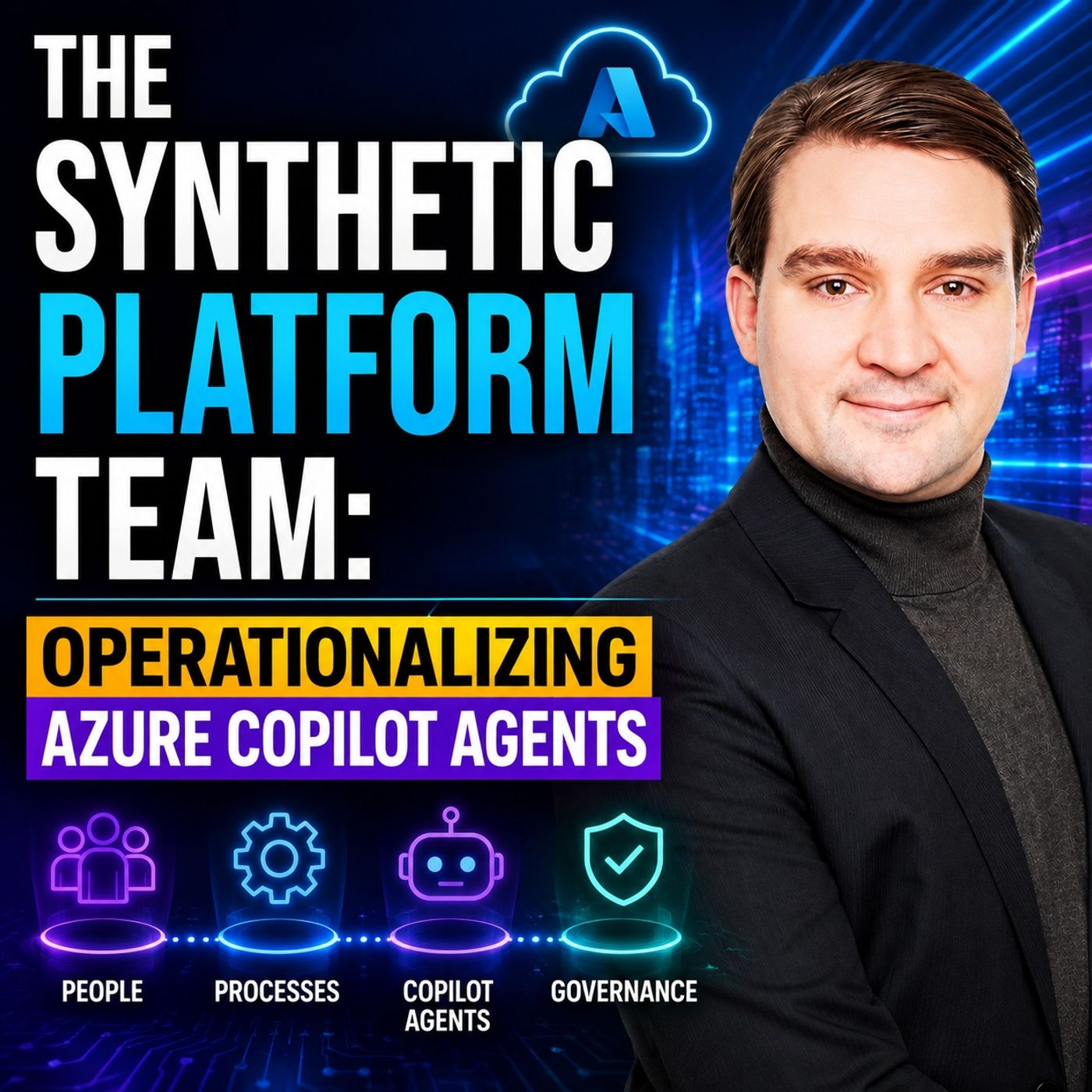
Building AI agents is no longer just a development challenge—it’s an operational one. In this episode of the M365 FM Podcast, we explore the concept of the Synthetic Platform Team and how organizations can successfully operationalize Azure Copilot Agents at enterprise scale. Rather than treating AI agents as isolated applications, the discussion introduces a platform engineering approach where reusable infrastructure, governance, observability, and automation become the foundation for every agent.
The episode explains how platform teams can standardize identity, security, model access, prompt management, deployment pipelines, monitoring, and cost optimization while giving development teams the freedom to build innovative AI solutions. Topics include Azure AI Foundry, Azure OpenAI, Copilot technologies, Infrastructure as Code, CI/CD, telemetry, policy enforcement, and lifecycle management for AI agents.
Listeners will learn why successful enterprise AI depends less on individual prompts and more on creating a scalable operating model that enables hundreds of reliable, secure, and maintainable agents. Whether you're an Azure architect, platform engineer, DevOps professional, or IT leader, this episode provides practical guidance for building an AI platform that supports long-term innovation without sacrificing governance, compliance, or operational excellence.
Quick answer: operationalizing Azure Copilot agents at scale is covered in this M365 FM episode with a practical focus on how it works, where it fits, and the architecture, security, governance, or operational choices that matter in real Microsoft environments.
Imagine your synthetic platform team facing a sprawling cloud environment with countless services, workloads, and dependencies. Traditional dashboards struggle to keep pace. You need ai to help you see connections and act quickly. Azure Copilot Agents give your synthetic platform team a unified ecosystem of intelligent agents that collaborate and share context. With ai, your synthetic platform team moves from reactive operations to proactive, agentic workflows. Teams have reported measurable gains after operationalizing ai with Azure Copilot Agents:
| Benefit Description | Measurable Impact |
|---|---|
| Reduction in modernization timelines | Dramatically reduced timelines for modernization efforts |
| Increased efficiency in modernization | 70% reduction in total modernization effort |
| Enhanced collaboration between teams | Improved communication and planning across teams |
You can expect actionable steps and clear outcomes as your synthetic platform team transforms cloud operations with ai.
Key Takeaways
- Azure Copilot Agents transform cloud operations by enabling proactive workflows and improving team collaboration.
- Operationalizing AI with Copilot Agents can reduce modernization timelines by up to 70%, enhancing efficiency.
- Strong collaboration and real-time communication are essential for success in cloud operations; use centralized knowledge bases and social tools.
- Adopt the agentic operations model to allow intelligent agents to make dynamic decisions based on real-time data.
- Regularly assess your platform's maturity to ensure readiness for integrating Copilot Agents and identify areas for improvement.
- Establish clear governance and compliance practices to protect data and build trust in AI operations.
- Use metrics like time saved and ticket deflection to measure the impact of Copilot Agents and demonstrate their value.
- Foster a feedback culture within your team to continuously improve workflows and enhance operational efficiency.
Synthetic Platform Team in Modern Cloud
Team Roles and Objectives
You play a key role in shaping cloud operations. Synthetic platform teams have evolved as cloud environments grow more complex. You see the rise of cloud-native technologies, which transform software development and enable scalable systems. Containers and Kubernetes help you build flexible infrastructures. Automation and security practices become essential in your daily work.
Platform engineering was adopted for increasing speed or velocity in delivering products. Centralized teams eliminate the need for each team to worry about infrastructure, thus increasing efficiency... They also enhance safety and security as everything is predefined, reducing errors. - Daniel, Cloud Engineer, Fortune 500 media company
You focus on self-service capabilities and curated toolchains. These simplify complexities for developers. Automated workflows boost productivity and efficiency. Security controls embedded in platforms help you operate safely.
[There are] two main problems that [our] platform engineering tools were designed to solve. The first was to facilitate the provisioning of services using a self-service model. … The second was to provide automatic support systems such as performance metrics and application availability. The goal was to enable developers to work faster and more efficiently, while having all the necessary information to troubleshoot and optimize their applications. - Alex, Lead Cloud Architect, large technology company
Collaboration Across Cloud Operations
You need strong collaboration to succeed in cloud operations. Real-time communication enhances project-level teamwork. Centralized knowledge bases let you share information easily. You can set up channels to connect with external experts for insights. Social business collaboration tools engage stakeholders. Cross-organization tools improve communication between IT teams and external partners.
You use copilot agents to streamline collaboration. Troubleshooting agents identify performance issues. Optimization agents provide cost-effective solutions. Deployment agents generate necessary infrastructure changes. Resiliency agents ensure backup strategies are in place. Observability agents set up monitoring for new configurations.
Value of Agentic Operations
Agentic operations deliver clear value for your team. Copilot agents help you achieve cost savings. One company saved $1.2M annually through ticket deflection and reduced support costs, while generating 15% employee growth with the same IT headcount. Copilot agents handle 40% of routine requests automatically. This lets your team focus on strategic initiatives and maintain 24/7 support coverage.
Copilot agents scale support and operations efficiently as your organization grows. Your team can focus on innovation and strategic initiatives that drive competitive advantage. You gain operational efficiency and cost savings, which help you deliver better outcomes.
Azure Copilot Agents Overview

Agentic Operations Model
You can transform your cloud operations by adopting the agentic operations model. This model uses agents that act as intelligent helpers, working together to manage your cloud environment. Unlike traditional automation, which depends on fixed rules, agentic operations use real-time data and goal-based reasoning. This means agents can adapt to changing situations and make decisions on the fly.
Here’s a comparison to help you see the difference:
| Capability | Traditional Automation | Agentic Operations |
|---|---|---|
| Decision-making | Based on predefined rules | Dynamic, informed by real-time data |
| Handling exceptions | Escalated to humans | Assessed dynamically |
| Execution paths | Designed upfront | Selected at runtime |
| Managing variability | Controlled through rules | Adapted through goals |
| Human oversight | Post-execution review | Human-in-the-loop at thresholds |
With agentic operations, you do not need to constantly redesign workflows. Agents scale easily and handle complex tasks by working together. You get more flexibility and can respond faster to new challenges.
Key Copilot Capabilities
Azure Copilot Agents give you a powerful set of features to streamline your work. You can use agents to update records, trigger workflows, and interact with real systems. This reduces delays and manual errors. Even if you are not a technical expert, you can create agents using natural language. This makes it easy for everyone on your team to use ai in their daily tasks.
Some of the most impactful capabilities include:
- Agents manage repeatable processes on their own, which improves efficiency.
- Multiple agents can coordinate and specialize, so complex jobs get done faster.
- You can control and govern agents to make sure they meet your organization’s needs.
- Copilot provides a central interface for managing all your agents and their actions.
Here is a look at the core components that support agentic operations:
| Component Layer | Functionality |
|---|---|
| Operator | Portal, CLI, or chat for interaction |
| Azure Copilot | Central management interface |
| Agent mode | Specialized agents for different tasks |
| Read layer | Insights from Resource Graph, Monitor, Advisor |
| Plan layer | Recommendations based on best practices |
| Act layer | Deployment tools and support ticket integration |
| Govern layer | RBAC, approvals, and logging for compliance |
These layers work together to give you a seamless experience with copilot and agents.
AI-Driven Insights
You gain a major advantage when you use ai-driven insights from Azure Copilot Agents. These agents continuously monitor your cloud environment and provide real-time feedback. For example, deployment agents manage resources efficiently, while observability agents give you a clear view of your operations. Optimization agents suggest ways to improve performance and save costs. Resiliency agents make sure your systems can recover from failures. Troubleshooting agents find and fix issues before they become problems.
- Continuous observability helps you understand what is happening in your cloud.
- Proactive issue detection means you can respond quickly.
- Automated recommendations from ai improve your operational efficiency.
Copilot agents work together in connected workflows. They analyze signals, understand the context, and help you make better decisions. You can anticipate problems and solve them faster, which leads to stronger cloud operations.
Readiness Assessment for Copilot Integration
Before you bring copilot and agents into your cloud operations, you need to check if your platform is ready. This step helps you avoid surprises and ensures a smooth transition. You will look at your technology, your data, and your team’s alignment.
Platform Maturity Evaluation
You should start by understanding where your platform stands today. A maturity model helps you see your current state and what you need to improve. The table below shows how you can measure your progress:
| Maturity Level | State of Technology and Data | Opportunity to Progress |
|---|---|---|
| 100: Initial | Fragmented agent work, unplanned data access, no standard architecture. | Define an initial technology plan and standardize platforms. |
| 200: Repeatable | Inconsistent platform choices, partially prepared data, basic integrations. | Standardize agent building practices and introduce basic telemetry. |
| 300: Defined | Documented technology plan, clear data architecture, established ALM practices. | Strengthen scalability and security, validate agent needs. |
| 400: Capable | Enterprise-grade technology foundations, automated deployments, centralized monitoring. | Shift to federated delivery and evolve standards. |
You should also check your use of low-code tools and your strategy for them. Review your understanding of generative AI and your governance policies. Look for any gaps in your data management and access controls. These steps help you see if your platform can support copilot and agents.
Identifying Integration Points
Next, you need to find the best places to connect copilot and agents with your existing workflows. You want to make sure agents can access the right data and perform tasks where they add the most value. The table below lists common integration points:
| Integration Point | Description |
|---|---|
| GitHub Issues | Assign tasks directly to copilot, integrating it into your existing workflow. |
| VS Code | Use for quick refactors while coding without needing to switch contexts. |
| Mobile app | Useful for handling small tasks or follow-ups when away from your desk. |
| Agents panel | Ideal for ad hoc tasks while browsing GitHub, especially during issue reviews. |
You can also use Power Platform connectors for no-code or low-code solutions. These connectors support Power Fx code, variables, and conditions. Built-in parsing and error handling make it easy to manage data. Prebuilt connectors need little setup, and custom connectors can be used by many agents. Application Insights helps you monitor agent activity and data flow.
- Power Platform connectors are user-friendly for no-code or low-code builders.
- Built-in parsing and error handling help you manage data.
- Custom connectors can be reused across multiple agents.
- Activity monitoring is integrated with Application Insights for data tracking.
Stakeholder Alignment
You need everyone on your team to work together for a successful copilot integration. Start by involving IT, security, compliance, and legal teams early. This ensures that all data policies and agent actions meet your organization’s standards. The table below shows strategies for alignment:
| Strategy | Description |
|---|---|
| Involve relevant departments | Engage IT, security, compliance, and legal teams from the beginning to ensure comprehensive alignment. |
| Define compliance requirements | Establish clear data residency, retention, and privacy policies to guide governance and security. |
| Align on business objectives | Identify key business scenarios and tasks to ensure the agent meets organizational needs effectively. |
| Focus on desired outcomes | Emphasize the value proposition and measurable KPIs to link agent development to business priorities. |
You should define clear data residency, retention, and privacy policies. Align your business goals with the tasks you want agents to perform. Focus on the outcomes you want, and set measurable KPIs. This approach helps you link agent development to your business priorities and ensures that copilot and agents deliver real value.
Tip: Early alignment with all stakeholders reduces risks and speeds up your copilot journey. Make sure everyone understands how agents will use data and support your goals.
Copilot Integration and Workflow Design
Mapping Processes to Agents
You start by mapping your core processes to the right agents. Begin with a list of your most common tasks in cloud operations. These tasks might include resource provisioning, monitoring, incident response, or deployment. Assign each task to a specialized agent. For example, a deployment agent can handle infrastructure rollouts, while an observability agent can track system health.
You should review your workflows and identify steps that require manual effort or frequent intervention. Assign agents to automate these steps. This approach helps you reduce errors and improve consistency. When you map processes to agents, you create a clear structure for your operations. Each agent has a defined role and responsibility. This structure makes it easier to manage your cloud environment.
Tip: Start with high-impact processes. Focus on areas where automation can save the most time or reduce risk.
You can use visual tools or flowcharts to map out your workflows. This helps you see where agents fit best. You can also use feedback from your team to refine your process mapping. Over time, you will find new opportunities to introduce agents and improve efficiency.
Automation Strategies
You can use several automation strategies to get the most from copilot and agents. One effective strategy is to use agents for repetitive tasks. For example, you can set up agents to monitor deployments and trigger alerts if something goes wrong. You can also use agents to automate ticket creation and resolution.
Many organizations have seen strong results with these strategies. Holland America Line used a copilot-powered travel assistant to answer guest questions. This reduced query resolution time from hours to seconds. Nsure integrated AI agents with Dynamics 365 to process insurance claims. This cut processing time by 40%. Virgin Money streamlined internal workflows with agents, which eliminated redundancies in customer service.
| Company | Automation Strategy | Result |
|---|---|---|
| Holland America Line | Copilot-powered travel assistant | Reduced guest query resolution from hours to seconds |
| Nsure | AI agents integrated with Dynamics 365 | Cut insurance processing time by 40% |
| Virgin Money | Streamlined internal workflows across customer service teams | Eliminated redundancies |
You can use agents to coordinate across different systems. For example, a deployment agent can work with a monitoring agent to ensure that new releases meet performance standards. You can also use agents to enforce compliance by checking configurations before deployment.
Note: Automation does not replace your team. Instead, it frees up your time for higher-value work.
You should review your automation strategies regularly. Look for new ways to use copilot and agents as your needs change. This helps you stay ahead in a fast-moving cloud environment.
Example Use Cases
You can apply copilot and agents to many real-world scenarios. Here are some examples:
- Automated Deployment Pipelines: You can use a deployment agent to manage infrastructure rollouts. The agent checks configurations, applies best practices, and monitors progress. If an issue arises, the agent notifies your team and suggests solutions.
- Continuous Monitoring and Alerting: An observability agent tracks system health. It analyzes logs and metrics in real time. When it detects anomalies, it creates alerts and recommends actions.
- Incident Response Automation: A troubleshooting agent can identify the root cause of incidents. It gathers data, suggests fixes, and even initiates recovery steps. This reduces downtime and speeds up resolution.
- Cost Optimization: An optimization agent reviews resource usage. It suggests changes to right-size workloads and reduce costs. You can act on these recommendations or let the agent make changes automatically.
- Security and Compliance Checks: A compliance agent reviews deployments for policy violations. It blocks risky changes and ensures that your environment meets regulatory standards.
You can combine multiple agents in a workflow. For example, a deployment agent can trigger a compliance agent to check new resources. If everything passes, the deployment continues. If not, the agent stops the process and alerts your team.
Callout: Start with one or two use cases. Expand as your team gains confidence with copilot and agents.
You will see faster deployments, fewer errors, and better use of your resources. Over time, you can automate more processes and unlock even greater value from your cloud operations.
AI Governance and Security
You need strong governance to build trust in ai operations. Responsible ai standards help you create a secure environment. You must follow operational practices that support accountability and transparency. When you use Azure Copilot Agents, you set up frameworks that protect your data and ensure compliance. You build trust by showing oversight and following responsible frameworks.
Access Controls
You must establish robust access controls to reduce risk and maintain security. Responsible operational practices require you to follow ai governance and security standards. Here are best practices for access controls:
- Implement least-privilege access for makers and users.
- Use Microsoft Entra ID and Conditional Access to manage agent interactions based on user context, device compliance, and location.
- Regularly audit permissions in Microsoft 365 to prevent excessive access.
- Restrict Copilot Studio access to trained and vetted groups.
- Enforce Multi-Factor Authentication for high-privilege accounts.
- Apply Conditional Access policies to agent endpoints.
- Audit and remediate sharing settings in SharePoint and OneDrive.
- Disable risky connectors at the tenant level and require explicit approval for new ones.
- Use Microsoft Purview to apply sensitivity labels and respect data classification.
Tip: Strong governance and oversight help you maintain trust and accountability in ai operations.
Compliance and Data Privacy
You must address compliance and data privacy standards to protect sensitive information. Responsible ai standards require you to manage risk and follow security frameworks. You need to ensure data residency for customer data, especially PII. You must keep PII within national borders to meet privacy laws. Security and compliance standards require you to use network segmentation and encryption. You must follow a Security Development Lifecycle to protect data.
- Data residency ensures compliance with national privacy laws.
- Security and compliance standards protect PII using encryption and segmentation.
- Responsible operational practices support risk management and accountability.
Note: You build trust by following compliance standards and maintaining transparency in data handling.
Monitoring and Auditing
You must monitor and audit ai operations to ensure responsible oversight. You use tools like Purview Audit Logs, DSPM for ai, Communication Compliance, Insider Risk Management, eDiscovery, Data Lifecycle Management, Microsoft Sentinel, Advanced Hunting & Threat Detection in Defender, Dataverse Conversation Transcripts, Application Insights, and third-party security platforms. Microsoft Copilot Security Monitoring maps permissions and tracks Copilot activity in real time. You detect suspicious query patterns and flag high-risk usage. Purview provides compliance and security monitoring to prevent inappropriate sharing of sensitive data.
| Tool | Purpose |
|---|---|
| Purview Audit Logs | Tracks activity for accountability |
| Microsoft Sentinel | Detects threats and manages risk |
| Application Insights | Monitors agent performance and security |
| Communication Compliance | Ensures responsible communication |
| Insider Risk Management | Flags risky behavior |
You maintain transparency and accountability by using these tools. Responsible ai governance and security standards require you to review logs and audit trails. You must act quickly to remediate risk and maintain trust.
Callout: Responsible oversight and strong governance frameworks help you manage risk and ensure compliance in ai operations.
Automating Deployment and Monitoring

Deployment Pipelines
You can automate deployment pipelines for Azure Copilot Agents by following a clear set of steps. Start by defining a pipeline with gated deployments. Use the Pre-Export Step to control when deployments move forward. Pause the pipeline to run tests with the Power CAT team’s application. Retrieve agent configuration and test sets from Dataverse. Create a new entry in the Agent Test Runs table with the configuration and Test Set ID. Run tests using the cat_RunCopilotTests action. Save the Agent Test Run ID and the pipeline deployment ID in a custom table. Evaluate the test results to decide if you should continue or stop the deployment.
Here is a summary of the main steps:
- Define a pipeline with gated deployments.
- Pause to execute tests using the Power CAT application.
- Retrieve agent configuration and test set from Dataverse.
- Create a new row in the Agent Test Runs table.
- Run tests with cat_RunCopilotTests.
- Save the Agent Test Run ID and deployment ID.
- Evaluate results and proceed or cancel deployment.
You can also use Copilot Studio to manage pipelines. The table below shows a simple workflow:
| Step | Description |
|---|---|
| 1 | Go to the Copilot Studio home page and select the Solutions menu. |
| 2 | Create a new pipeline and add a name and description. |
| 3 | Set the target environment to PROD and save the configuration. |
| 4 | Test the pipeline by deploying to the PROD environment. |
This process helps you ensure that only tested and approved agents reach production.
Real-Time Monitoring
You need real-time monitoring to keep your cloud operations reliable. Monitoring creates a continuous feedback loop. This loop improves system resilience and efficiency. You can detect and resolve issues quickly with real-time monitoring. This reduces operational overhead and helps your team stay focused on important tasks.
The Observability Agent connects signals from different parts of your environment. This agent gives you a unified view. You can move from issue detection to resolution much faster. Monitoring helps you spot trends and patterns before they become problems. You can set up alerts for unusual activity. Monitoring also helps you track agent performance and resource usage.
You should use dashboards and automated alerts for monitoring. These tools give you instant updates. Monitoring supports compliance by tracking changes and access. You can review logs and audit trails as part of your monitoring routine. Monitoring also helps you measure the impact of automation on your operations.
Tip: Monitoring is not a one-time task. Make monitoring a daily habit to keep your environment healthy.
Incident Response
You must prepare for incidents even with strong monitoring. Monitoring helps you spot issues early, but you need a plan to respond. Use agents to automate incident detection and response. When monitoring finds a problem, an agent can gather data, suggest fixes, and start recovery steps.
You can set up workflows where monitoring triggers incident response agents. These agents collect logs, notify your team, and even roll back changes if needed. Monitoring helps you track the progress of incident resolution. You can review each step and learn from every incident.
Monitoring also supports post-incident analysis. You can use monitoring data to improve your processes. Over time, monitoring helps you reduce downtime and increase reliability.
Callout: Combine monitoring with automated incident response to build a resilient cloud platform.
Continuous Improvement with AI Feedback
Usage Data Analysis
You can use Azure Copilot Agents to collect and analyze usage data every day. This data helps you understand how your cloud operations perform. You see which agents work best and where you need to make changes. AI agents give you real-time context, so you can make smart decisions about cost, performance, and efficiency. You do not need to wait for monthly reports. You get insights as soon as something happens.
Here is how usage data analysis supports your team:
| Evidence Description | Explanation |
|---|---|
| Continuous optimization | You use operational signals to improve cloud operations as part of your daily work. |
| Real-time context | AI agents give you up-to-date information for better decisions. |
| Early incident detection | You find issues sooner and solve them faster by grouping related signals. |
You can spot trends, fix problems early, and keep your cloud running smoothly.
Iterative Workflow Enhancement
You improve your workflows by using feedback from Copilot Agents. This process is not a one-time event. You make small changes, test them, and see what works best. You can use several techniques to enhance your workflows:
- Agent Flows help you automate parts of your workflow. You can handle complex tasks, like audits, with less effort.
- Deterministic Workflows give you control and make sure tasks run the same way every time. You can find and fix problems quickly.
- Natural Language Authoring lets you describe what you want in plain language. You do not need to be a coding expert to build or change workflows.
Tip: Start with one workflow. Use feedback to improve it step by step. Over time, you will see big gains in efficiency.
Feedback Culture
You build a strong feedback culture by using AI-driven insights. This culture helps your team grow and learn together. AI systems give you instant, personalized feedback. You do not have to wait for yearly reviews. You get advice and suggestions as you work.
The table below shows how a feedback culture supports your team:
| Key Aspect | Explanation |
|---|---|
| Personalized Feedback Mechanisms | AI gives you real-time, tailored feedback to help you improve your work right away. |
| Continuous Learning | You focus on learning and growing every day, not just during formal reviews. |
| Employee Engagement | You stay engaged with dynamic learning paths and feedback that help you build your career. |
Note: When you encourage feedback, your team becomes more agile and ready for change. Everyone benefits from shared learning and continuous improvement.
Best Practices and Pitfalls
Success Tips for Synthetic Platform Teams
You can set your synthetic platform team up for success by following proven practices. These practices help you get the most from Azure Copilot Agents and avoid common mistakes.
- Focus on governance and compliance from the start. Strong practices in these areas protect your data and build trust.
- Tailor agents to fit your business workflows. Custom agents improve efficiency and make your processes smoother.
- Measure your return on investment. Clear metrics show how well your practices work and where you can improve.
- Use advanced features like multi-approver workflows. These practices add control and flexibility to your operations.
- Take advantage of graphical user interfaces. Visual tools make it easier to manage agents and follow best practices.
Tip: Review your practices often. Update them as your team learns and your needs change.
Common Challenges
You may face challenges as you operationalize Copilot Agents. Knowing these pitfalls helps you prepare and apply the right practices to overcome them.
| Challenge | Solution |
|---|---|
| Over-Acceleration of Low-Code Development | Provide training and clear guidelines to reinforce best practices. |
| Governance Bottlenecks | Allocate enough resources to keep approval processes moving. |
| Integration Complexity with Non-Microsoft Solutions | Use technical expertise for custom API work and follow integration practices. |
| Security and Compliance on the Edge | Monitor agents closely and perform regular audits as part of your security practices. |
| User Saturation and Chatbot Fatigue | Curate your Agent Store and review inventory to keep only useful agents and practices. |
You should address these challenges with strong practices. Training, resource planning, and regular reviews help you avoid common pitfalls.
Lessons from Early Adopters
Early adopters have shared valuable lessons about operationalizing Copilot Agents. You can learn from their experiences and apply their practices to your own journey.
| Key Theme | Description |
|---|---|
| Proactive Tracking | Track agent impact early. This practice helps you capture insights quickly. |
| Stakeholder Involvement | Involve different teams. Diverse views improve your practices and outcomes. |
| Tailored Measurements | Align metrics with business goals. Track them as part of your practices. |
| Governance Strategies | Match governance to agent risk and maturity. Embed controls in your practices. |
| Continuous Improvement | Keep measuring and refining your practices to drive better results. |
Note: Early tracking and stakeholder involvement are practices that lead to long-term success.
You should embed these practices into your daily work. Make continuous improvement a habit. Review your practices, measure results, and adjust as needed. This approach helps you avoid pitfalls and ensures your synthetic platform team thrives with Azure Copilot Agents.
Measuring Success
Metrics and KPIs
You need clear metrics to measure the impact of Azure Copilot Agents. Tracking the right KPIs helps you see where agents add value and where you can improve. Start by focusing on categories that matter most to your team. These include productivity, efficiency, quality, and user satisfaction.
| Metric Category | Examples | Description |
|---|---|---|
| Productivity | Time Saved | Measures hours of work automated or accelerated by Copilot. |
| Efficiency | Ticket Deflection | Tracks the percentage of requests handled by Copilot. |
| Quality | Decision Quality | Assesses the speed and accuracy of decisions made with Copilot’s help. |
| User Satisfaction | Adoption Rates | Monitors the percentage of users actively using Copilot and their feedback. |
You can also track specific indicators:
- Hours saved
- Agent assisted hours
- Resolution rate
- Conversion lift
- Employee sentiment on AI
These metrics give you a full picture of how Copilot Agents affect your daily operations.
Operational Effectiveness
You want to know if Copilot Agents make your cloud workflows better. Start by checking how well agents perform in real tasks. Look at how quickly they solve problems and how often they help your team avoid errors. Set clear rules for automation so agents follow best practices every time.
| Aspect | Description |
|---|---|
| Monitoring agent effectiveness | See how well agents perform in your workflows. |
| Defining automation policies | Set rules for automated processes. |
| Continuous improvement | Keep evaluating and enhancing your operations. |
| Faster innovation cycles | Try new ideas and optimize quickly. |
| Improved reliability | Detect issues early and reduce mistakes. |
| Cost efficiency | Use automated recommendations to manage resources. |
You should review these aspects often. This helps you spot trends and make changes that boost reliability and cost savings.
Reporting Value
You need to show the value of Copilot Agents to your stakeholders. Use clear reports that highlight key wins. Share how many hours agents saved your team or how much faster you resolve incidents. Show adoption rates and user feedback to prove that agents make a difference.
Tip: Use visuals like charts or tables in your reports. These make it easy for everyone to see progress at a glance.
You can also compare before-and-after results. For example, show how ticket deflection improved or how decision quality increased. Regular reporting builds trust and helps you secure support for future AI projects.
By measuring success with the right metrics, you ensure that Azure Copilot Agents deliver real, lasting value to your organization.
You can transform your synthetic platform team by operationalizing Azure Copilot Agents. Start by assessing your readiness, mapping workflows, and aligning stakeholders. Embrace agentic operations to boost efficiency and decision-making in your cloud environment. Measure your progress with clear metrics and refine your approach over time. Stay committed to continuous improvement. Now is the time for you, as a technical leader, to champion AI-powered change and drive your organization forward.
FAQ
How do you get started with Azure Copilot Agents?
You begin by exploring the copilot studio guidance hub. This hub gives you step-by-step instructions. You can follow tutorials and set up your first agent quickly.
Can you deploy agents in Microsoft Teams?
Yes, you can deploy agents in Microsoft Teams. This lets your team access agents directly in chat. You improve collaboration and streamline workflows.
What is the copilot studio guidance hub?
The copilot studio guidance hub is a central resource. You find documentation, best practices, and real-world case study examples. You use this hub to learn how to build and manage agents.
How do you manage ai risk management?
You use ai practices and tools to manage ai risk management. You monitor agent activity and follow security guidelines. You review logs and set up alerts for unusual behavior.
Where can you find a real-world case study?
You find a real-world case study in the copilot studio guidance hub. These case studies show how teams use agents to solve problems and improve operations.
What are the best ai practices for platform teams?
You follow ai practices by using clear workflows and strong governance. You review agent actions and update your processes often. You use feedback from your team to improve efficiency.
How do you measure agent impact?
You track metrics like time saved and ticket deflection. You compare before-and-after results. You use real-world case study data to show improvements.
Tip: Review your metrics often. This helps you see progress and find new ways to optimize your agents.
🎧 Listen to this episode
Want a practical explanation of Azure Copilot Agents? This episode breaks down the topic in clear language and shows why it matters for Microsoft 365, Azure, Power Platform, security, AI, and modern work.
Listen to this episode if you want to:
- Understand the key concepts behind Azure Copilot Agents
- See how it fits into the wider Microsoft technology ecosystem
- Learn where it can create practical value for your organization
You may also enjoy these related M365 FM episodes:
- Microsoft 365 Copilot Agents: Real Business Value with Steve Corey [MVP]
- Copilot Studio AI Agents and RAG with Nilüfer Doğan [MVP]
- Mixture of Experts for Enterprise Copilot and AI Agents
- MCP Architecture for Microsoft Copilot and AI Agents
- Scale HR Operations with Copilot Studio AI Agents
Discover more practical Microsoft conversations on M365 FM.
Last reviewed: July 2026.
Who Should Listen
This episode is for Microsoft administrators, architects, developers, security professionals, and business leaders who need a practical foundation before making implementation, operations, or governance decisions.
🎧 You Should Also Listen To
- Azure Resource Manager — A strongly related next step for extending this topic.
- Infrastructure as Code — A strongly related next step for extending this topic.
- Azure Policy — A strongly related next step for extending this topic.
🚀 Want to be part of m365.fm?
Then stop just listening… and start showing up.
👉 Connect with me on LinkedIn and let’s make something happen:
- 🎙️ Be a podcast guest and share your story
- 🎧 Host your own episode (yes, seriously)
- 💡 Pitch topics the community actually wants to hear
- 🌍 Build your personal brand in the Microsoft 365 space
This isn’t just a podcast — it’s a platform for people who take action.
🔥 Most people wait. The best ones don’t.
👉 Connect with me on LinkedIn and send me a message:
"I want in"
Let’s build something awesome 👊
1
00:00:00,000 --> 00:00:02,140
Your cloud team just got paged at 11pm,
2
00:00:02,140 --> 00:00:04,480
a service is slow, nobody knows why.
3
00:00:04,480 --> 00:00:06,720
Your engineers jump into five different dashboards,
4
00:00:06,720 --> 00:00:08,680
cost management, as your monitor,
5
00:00:08,680 --> 00:00:11,640
advisor, service health, application insights.
6
00:00:11,640 --> 00:00:13,240
Each one shows part of the picture.
7
00:00:13,240 --> 00:00:14,920
None of them talk to each other,
8
00:00:14,920 --> 00:00:16,760
by the time someone figures out what happened,
9
00:00:16,760 --> 00:00:17,680
it's midnight.
10
00:00:17,680 --> 00:00:19,760
The incident is over, the context is lost.
11
00:00:19,760 --> 00:00:21,880
This is the moment when dashboards stop working,
12
00:00:21,880 --> 00:00:23,600
you have more visibility than ever,
13
00:00:23,600 --> 00:00:25,000
and less ability to act on it.
14
00:00:25,000 --> 00:00:26,880
This is where agentec operations enters,
15
00:00:26,880 --> 00:00:29,320
not chatbots, not fixed automation,
16
00:00:29,320 --> 00:00:31,640
but reasoning systems that understand your infrastructure
17
00:00:31,640 --> 00:00:34,040
as a whole, find patterns, humans miss,
18
00:00:34,040 --> 00:00:35,840
and act before you even know there's a problem.
19
00:00:35,840 --> 00:00:38,720
We're going to explore the Azure co-pilot agent ecosystem,
20
00:00:38,720 --> 00:00:42,240
migration, deployment, optimization, observability,
21
00:00:42,240 --> 00:00:44,040
resiliency, and troubleshooting.
22
00:00:44,040 --> 00:00:45,840
We aren't looking at these as separate projects,
23
00:00:45,840 --> 00:00:49,120
we're looking at them as a unified synthetic platform team,
24
00:00:49,120 --> 00:00:50,760
one operational model.
25
00:00:50,760 --> 00:00:53,720
By the end, you'll understand why this shift is structural
26
00:00:53,720 --> 00:00:55,160
and where to start.
27
00:00:55,160 --> 00:00:57,480
The dashboard trap, the paradox is real.
28
00:00:57,480 --> 00:00:59,720
Most cloud teams are drowning in observability data,
29
00:00:59,720 --> 00:01:00,800
not starving for it.
30
00:01:00,800 --> 00:01:02,720
You have more metrics, logs, and traces
31
00:01:02,720 --> 00:01:04,720
than humans can possibly interpret.
32
00:01:04,720 --> 00:01:08,280
Azure Monitor alone collects terabytes of telemetry every day.
33
00:01:08,280 --> 00:01:11,080
Cost management breaks down, spend by hundreds of dimensions.
34
00:01:11,080 --> 00:01:14,200
An application insights gives you traces of individual requests,
35
00:01:14,200 --> 00:01:15,880
yet teams are still missing problems.
36
00:01:15,880 --> 00:01:17,720
The real cost of manual cloud operations
37
00:01:17,720 --> 00:01:21,000
isn't the lack of information, it's the cost of interpretation,
38
00:01:21,000 --> 00:01:22,320
it's the cost of decision making,
39
00:01:22,320 --> 00:01:24,960
it's the context switching that happens before you can even act.
40
00:01:24,960 --> 00:01:26,440
Here's what a typical week looks like.
41
00:01:26,440 --> 00:01:29,320
Monday morning, your team reviews cost anomalies from Friday,
42
00:01:29,320 --> 00:01:31,840
Wednesday advisor sends 47 recommendations.
43
00:01:31,840 --> 00:01:33,880
Thursday, you notice performance degradation
44
00:01:33,880 --> 00:01:35,520
buried in an application log.
45
00:01:35,520 --> 00:01:38,040
Friday, you try to catch up on everything that happened.
46
00:01:38,040 --> 00:01:39,880
By then, patterns have already shifted.
47
00:01:39,880 --> 00:01:41,240
The human cost is brutal.
48
00:01:41,240 --> 00:01:43,000
A senior engineer spends 30 minutes
49
00:01:43,000 --> 00:01:46,120
reviewing cost management, another 30 on advisor,
50
00:01:46,120 --> 00:01:48,200
and 15 minutes correlating a metric anomaly
51
00:01:48,200 --> 00:01:49,320
with a recent deployment.
52
00:01:49,320 --> 00:01:51,680
Then they spend 45 minutes trying to figure out
53
00:01:51,680 --> 00:01:54,040
if this is urgent or just expected drift.
54
00:01:54,040 --> 00:01:55,600
By the time they've synthesized everything,
55
00:01:55,600 --> 00:01:57,240
they've context switched five times,
56
00:01:57,240 --> 00:01:59,000
they've held incomplete theories in their head,
57
00:01:59,000 --> 00:02:00,880
they've forgotten half of what they saw.
58
00:02:00,880 --> 00:02:03,040
This isn't a data problem, it's a reasoning problem,
59
00:02:03,040 --> 00:02:04,320
and here's where it gets worse.
60
00:02:04,320 --> 00:02:07,120
When dashboards don't work, the instinct is to add more.
61
00:02:07,120 --> 00:02:09,440
You build a cost optimization dashboard,
62
00:02:09,440 --> 00:02:10,960
a security posture view,
63
00:02:10,960 --> 00:02:13,280
a custom analytics layer for your business unit.
64
00:02:13,280 --> 00:02:15,640
Now you have eight dashboards instead of five.
65
00:02:15,640 --> 00:02:17,080
Your team maintains them.
66
00:02:17,080 --> 00:02:19,680
The cognitive load doesn't decrease, it multiplies.
67
00:02:19,680 --> 00:02:21,040
The hidden labor cost is staggering,
68
00:02:21,040 --> 00:02:22,400
it's not just the time spent looking,
69
00:02:22,400 --> 00:02:24,440
it's the time spent building custom queries,
70
00:02:24,440 --> 00:02:25,920
training people on new tools,
71
00:02:25,920 --> 00:02:28,640
and fixing broken dashboards when schemas change,
72
00:02:28,640 --> 00:02:30,800
you're constantly validating that what you think is true
73
00:02:30,800 --> 00:02:32,920
actually matches the data, add it up.
74
00:02:32,920 --> 00:02:34,840
A platform team of five engineers
75
00:02:34,840 --> 00:02:36,560
each spending five to eight hours a week
76
00:02:36,560 --> 00:02:38,040
on observability interpretation,
77
00:02:38,040 --> 00:02:40,120
that's 25 to 40 hours a week,
78
00:02:40,120 --> 00:02:42,080
of senior time spent on context switching,
79
00:02:42,080 --> 00:02:43,280
not problem solving.
80
00:02:43,280 --> 00:02:44,360
But here's the real issue,
81
00:02:44,360 --> 00:02:46,040
between 2020 and 2025,
82
00:02:46,040 --> 00:02:48,040
cloud complexity didn't grow linearly.
83
00:02:48,040 --> 00:02:50,520
It exploded, you went from a handful of subscriptions
84
00:02:50,520 --> 00:02:53,320
to dozens, from a few resource types to hundreds,
85
00:02:53,320 --> 00:02:55,920
from stable configurations to continuous change
86
00:02:55,920 --> 00:02:59,160
driven by CICD, auto scaling, and infrastructure as code.
87
00:02:59,160 --> 00:03:00,720
Human scale didn't change.
88
00:03:00,720 --> 00:03:02,840
A person can hold about seven independent concepts
89
00:03:02,840 --> 00:03:03,760
in working memory.
90
00:03:03,760 --> 00:03:06,000
The number of systems, services, cost drivers,
91
00:03:06,000 --> 00:03:08,840
and failure modes in a modern cloud estate is in the thousands.
92
00:03:08,840 --> 00:03:10,640
You can't reason about that scale manually,
93
00:03:10,640 --> 00:03:12,040
you can't hold it in your head.
94
00:03:12,040 --> 00:03:13,600
So teams do what feels rational,
95
00:03:13,600 --> 00:03:16,920
build more dashboards, set more alerts, hire more people.
96
00:03:16,920 --> 00:03:18,800
None of it solves the fundamental problem,
97
00:03:18,800 --> 00:03:21,560
that's when you realize dashboards aren't the infrastructure
98
00:03:21,560 --> 00:03:23,000
you need, reasoning is,
99
00:03:23,000 --> 00:03:24,360
the fragmentation problem.
100
00:03:24,360 --> 00:03:26,040
The deeper issue isn't that you have dashboards,
101
00:03:26,040 --> 00:03:28,080
it's that none of them know about each other.
102
00:03:28,080 --> 00:03:30,760
Azure Cost Management shows you're spending 40% more
103
00:03:30,760 --> 00:03:32,160
this month on compute.
104
00:03:32,160 --> 00:03:33,560
But it doesn't tell you why.
105
00:03:33,560 --> 00:03:35,880
You hop over to Azure Monitor to find performance anomalies
106
00:03:35,880 --> 00:03:37,600
and see that CPU is elevated,
107
00:03:37,600 --> 00:03:39,000
but Monitor doesn't correlate that
108
00:03:39,000 --> 00:03:40,840
to the specific workloads that change.
109
00:03:40,840 --> 00:03:43,520
So you jump to Advisor, which recommends right sizing.
110
00:03:43,520 --> 00:03:45,280
But Advisor doesn't know your business constraints,
111
00:03:45,280 --> 00:03:47,600
so half the recommendations are irrelevant.
112
00:03:47,600 --> 00:03:49,240
Then you check your deployment pipeline
113
00:03:49,240 --> 00:03:50,640
to see what changed last week.
114
00:03:50,640 --> 00:03:51,960
That's a different system entirely,
115
00:03:51,960 --> 00:03:53,520
different credentials, different interface,
116
00:03:53,520 --> 00:03:55,040
different mental model.
117
00:03:55,040 --> 00:03:56,680
By the time you've patched together a story,
118
00:03:56,680 --> 00:03:57,880
an hour has passed.
119
00:03:57,880 --> 00:03:59,320
This is the fragmentation trap.
120
00:03:59,320 --> 00:04:01,240
Each tool is optimized for a narrow problem.
121
00:04:01,240 --> 00:04:03,440
Cost Management is brilliant at cost attribution,
122
00:04:03,440 --> 00:04:05,520
and Azure Monitor is excellent at metrics and logs,
123
00:04:05,520 --> 00:04:06,560
but they're islands.
124
00:04:06,560 --> 00:04:07,920
They don't speak the same language.
125
00:04:07,920 --> 00:04:09,000
They don't share context.
126
00:04:09,000 --> 00:04:11,080
They operate in parallel, never intersecting.
127
00:04:11,080 --> 00:04:14,040
The tool tax is the hidden cost that matters most.
128
00:04:14,040 --> 00:04:16,160
It's the time you spend switching between systems
129
00:04:16,160 --> 00:04:18,440
and translating data from one format to another.
130
00:04:18,440 --> 00:04:19,960
It's the mental overhead of keeping
131
00:04:19,960 --> 00:04:22,720
six different interfaces, six different search syntaxes,
132
00:04:22,720 --> 00:04:25,280
and six different permission models in your head at once.
133
00:04:25,280 --> 00:04:26,600
It's the context switch itself,
134
00:04:26,600 --> 00:04:29,880
the neurological cost of interrupting one task to start another.
135
00:04:29,880 --> 00:04:33,000
Cost Management uses subscription and resource groups goping,
136
00:04:33,000 --> 00:04:34,880
Monitor uses resource type filtering,
137
00:04:34,880 --> 00:04:38,480
Advisor uses workload tags, service health uses region boundaries.
138
00:04:38,480 --> 00:04:40,800
Each has a different mental model of what matters,
139
00:04:40,800 --> 00:04:42,600
and your brain has to constantly shift
140
00:04:42,600 --> 00:04:45,960
between these frameworks that constant reorientation is exhausting.
141
00:04:45,960 --> 00:04:48,040
This is why platform teams are stretched thin,
142
00:04:48,040 --> 00:04:49,480
even when they have good budgets.
143
00:04:49,480 --> 00:04:50,960
It's not that they lack tools.
144
00:04:50,960 --> 00:04:52,400
It's that the tools don't integrate,
145
00:04:52,400 --> 00:04:54,880
so every investigation requires manual synthesis,
146
00:04:54,880 --> 00:04:57,320
every decision requires jumping between contexts,
147
00:04:57,320 --> 00:04:59,160
and every action requires translating
148
00:04:59,160 --> 00:05:01,320
from one system's language to another's.
149
00:05:01,320 --> 00:05:03,600
The overhead is structural, not accidental.
150
00:05:03,600 --> 00:05:05,600
A senior engineer investigating a cost spike
151
00:05:05,600 --> 00:05:07,080
doesn't have a unified view.
152
00:05:07,080 --> 00:05:09,640
They have to be a translator, cost translator,
153
00:05:09,640 --> 00:05:12,400
Performance translator, deployment translator.
154
00:05:12,400 --> 00:05:14,520
The translation overhead is invisible in budgeting,
155
00:05:14,520 --> 00:05:15,960
but it dominates the actual work,
156
00:05:15,960 --> 00:05:17,560
and it scales with complexity.
157
00:05:17,560 --> 00:05:19,440
Each tool also has its own training curve
158
00:05:19,440 --> 00:05:21,000
and its own best practices.
159
00:05:21,000 --> 00:05:23,880
Your team needs someone who understands cost management deeply,
160
00:05:23,880 --> 00:05:26,320
someone else who knows Monitor inside out,
161
00:05:26,320 --> 00:05:28,960
and another person who's fluent in advisor logic.
162
00:05:28,960 --> 00:05:31,200
That's three specialists to cover three domains.
163
00:05:31,200 --> 00:05:33,880
When that person leaves, the knowledge walks out the door.
164
00:05:33,880 --> 00:05:35,480
You're building individual dependencies,
165
00:05:35,480 --> 00:05:37,120
not institutional capability,
166
00:05:37,120 --> 00:05:38,400
the cognitive load compounds.
167
00:05:38,400 --> 00:05:40,080
You're not just managing cloud infrastructure,
168
00:05:40,080 --> 00:05:42,160
you're managing a fragmented tool ecosystem.
169
00:05:42,160 --> 00:05:43,440
You're maintaining mental bridges
170
00:05:43,440 --> 00:05:44,600
between disconnected systems
171
00:05:44,600 --> 00:05:47,040
and spending time on plumbing instead of problem solving.
172
00:05:47,040 --> 00:05:48,200
But here's the problem.
173
00:05:48,200 --> 00:05:50,520
This fragmentation doesn't just slow you down.
174
00:05:50,520 --> 00:05:52,480
It actively prevents you from seeing patterns
175
00:05:52,480 --> 00:05:54,000
that span multiple systems.
176
00:05:54,000 --> 00:05:56,480
A cost spike that correlates with a deployment
177
00:05:56,480 --> 00:05:58,720
that correlates with a performance change.
178
00:05:58,720 --> 00:06:00,120
You might never see that connection
179
00:06:00,120 --> 00:06:02,800
because you're investigating each signal in isolation.
180
00:06:02,800 --> 00:06:04,480
The pattern itself becomes invisible.
181
00:06:04,480 --> 00:06:07,480
That pattern stays hidden until someone manually connects it.
182
00:06:07,480 --> 00:06:09,440
And by then, the moment has passed.
183
00:06:09,440 --> 00:06:11,560
From reactive to perpetually reactive.
184
00:06:11,560 --> 00:06:13,360
The core flaw in manual cloud operations
185
00:06:13,360 --> 00:06:14,520
isn't that you're reacting.
186
00:06:14,520 --> 00:06:17,360
It's that you're reacting on a schedule that doesn't match reality.
187
00:06:17,360 --> 00:06:19,920
Here's how most organizations operate their cloud.
188
00:06:19,920 --> 00:06:21,160
Monday morning at 9am,
189
00:06:21,160 --> 00:06:23,200
the platform team holds a cost review.
190
00:06:23,200 --> 00:06:24,680
They pull last Friday's data,
191
00:06:24,680 --> 00:06:26,680
look for anomalies and create tickets.
192
00:06:26,680 --> 00:06:29,040
Wednesday afternoon is the performance triage meeting
193
00:06:29,040 --> 00:06:30,960
where they review the previous week's alert logs
194
00:06:30,960 --> 00:06:32,720
to determine which are actionable.
195
00:06:32,720 --> 00:06:35,160
Monthly optimization sprints happen the first week of the month
196
00:06:35,160 --> 00:06:37,040
for things like reserved instance reviews
197
00:06:37,040 --> 00:06:38,960
and cleanup of orphaned resources.
198
00:06:38,960 --> 00:06:42,560
Weekly security checks, quarterly disaster recovery validation.
199
00:06:42,560 --> 00:06:44,000
This cadence made sense once.
200
00:06:44,000 --> 00:06:45,960
In a world where infrastructure changed slowly
201
00:06:45,960 --> 00:06:47,520
and deployments happened quarterly,
202
00:06:47,520 --> 00:06:49,040
you could batch your observations.
203
00:06:49,040 --> 00:06:50,720
You could wait until the next review cycle
204
00:06:50,720 --> 00:06:52,080
that world doesn't exist anymore.
205
00:06:52,080 --> 00:06:54,760
Your cloud isn't static, it's changing constantly.
206
00:06:54,760 --> 00:06:57,680
Deployments happen multiple times a day via CI/CD
207
00:06:57,680 --> 00:07:01,040
and auto scaling rules spin up and tear down resources in minutes.
208
00:07:01,040 --> 00:07:02,520
Traffic patterns shift hourly
209
00:07:02,520 --> 00:07:05,680
and code changes propagate across services in seconds.
210
00:07:05,680 --> 00:07:07,400
Your cloud is a living breathing system
211
00:07:07,400 --> 00:07:08,760
that operates in real time,
212
00:07:08,760 --> 00:07:10,040
but your oversight doesn't.
213
00:07:10,040 --> 00:07:11,440
Your oversight happens in batches.
214
00:07:11,440 --> 00:07:12,680
This creates a critical gap.
215
00:07:12,680 --> 00:07:15,160
When a cost anomaly starts on Tuesday at 2am,
216
00:07:15,160 --> 00:07:17,000
your review doesn't happen until Monday morning.
217
00:07:17,000 --> 00:07:18,840
That's six days of continuous drift.
218
00:07:18,840 --> 00:07:20,640
A workload that's misconfigured on Thursday
219
00:07:20,640 --> 00:07:22,400
doesn't show up in your optimization sprint
220
00:07:22,400 --> 00:07:23,800
until the first of next month.
221
00:07:23,800 --> 00:07:25,800
A security gap that opens during a deployment
222
00:07:25,800 --> 00:07:28,440
propagates for a full week until your next security check.
223
00:07:28,440 --> 00:07:30,120
During that gap, the problem compounds.
224
00:07:30,120 --> 00:07:32,440
Let's look at cost drift as a concrete example.
225
00:07:32,440 --> 00:07:35,160
A misconfigured auto scaling rule causes instances
226
00:07:35,160 --> 00:07:37,120
to spin up during off-peak hours.
227
00:07:37,120 --> 00:07:39,280
On Tuesday, it costs an extra $50.
228
00:07:39,280 --> 00:07:41,800
By Wednesday, it's a hundred, by Thursday, 300.
229
00:07:41,800 --> 00:07:45,160
By Friday, you're at 1,000, by Monday, when you review costs,
230
00:07:45,160 --> 00:07:47,240
you've spent $4,000 on something
231
00:07:47,240 --> 00:07:49,440
that should have been caught and fixed in hours.
232
00:07:49,440 --> 00:07:51,400
Now multiply that by dozens of services,
233
00:07:51,400 --> 00:07:53,080
dozens of potential misconfigurations,
234
00:07:53,080 --> 00:07:55,200
dozens of gaps between when the problem emerges
235
00:07:55,200 --> 00:07:56,760
and when humans notice it.
236
00:07:56,760 --> 00:07:58,760
Performance degradation works the same way.
237
00:07:58,760 --> 00:08:00,960
A dependency starts returning slower responses
238
00:08:00,960 --> 00:08:02,760
on Wednesday morning and your application
239
00:08:02,760 --> 00:08:04,400
starts timing out requests.
240
00:08:04,400 --> 00:08:07,440
Users experience latency and the problem is real and immediate,
241
00:08:07,440 --> 00:08:09,040
but your performance triage doesn't happen
242
00:08:09,040 --> 00:08:10,160
until Wednesday afternoon.
243
00:08:10,160 --> 00:08:11,920
By then, users have already complained,
244
00:08:11,920 --> 00:08:13,600
some have switched to a competitor.
245
00:08:13,600 --> 00:08:14,920
Your reputation has a blemish,
246
00:08:14,920 --> 00:08:17,360
all because you were waiting for a scheduled meeting.
247
00:08:17,360 --> 00:08:19,320
Security gaps compound faster.
248
00:08:19,320 --> 00:08:22,000
A configuration change accidentally opens a storage account
249
00:08:22,000 --> 00:08:23,960
to public read on Thursday at 11 p.m.
250
00:08:23,960 --> 00:08:25,880
Your security review happens Friday morning,
251
00:08:25,880 --> 00:08:28,560
which means for 12 hours that data was exposed.
252
00:08:28,560 --> 00:08:30,720
If someone was scanning for accessible resources,
253
00:08:30,720 --> 00:08:31,880
they found yours.
254
00:08:31,880 --> 00:08:33,640
By the time you've reviewed and fixed it,
255
00:08:33,640 --> 00:08:34,840
the damage is done.
256
00:08:34,840 --> 00:08:36,920
This is why you're perpetually reactive,
257
00:08:36,920 --> 00:08:38,240
not because your team isn't trying,
258
00:08:38,240 --> 00:08:40,640
but because your oversight model is asynchronous
259
00:08:40,640 --> 00:08:42,400
while your infrastructure is synchronous.
260
00:08:42,400 --> 00:08:44,560
The math becomes untenable at scale.
261
00:08:44,560 --> 00:08:46,560
With a handful of services, batch reviews
262
00:08:46,560 --> 00:08:48,920
might catch most problems before they cascade.
263
00:08:48,920 --> 00:08:51,600
But with hundreds of services and thousands of resources,
264
00:08:51,600 --> 00:08:54,040
batch-oriented oversight is structurally broken.
265
00:08:54,040 --> 00:08:55,920
You're trying to manage a real-time system
266
00:08:55,920 --> 00:08:57,520
with periodic observation.
267
00:08:57,520 --> 00:08:59,400
The faster your infrastructure changes,
268
00:08:59,400 --> 00:09:01,640
the wider the gap between when problems emerge
269
00:09:01,640 --> 00:09:02,800
and when you discover them.
270
00:09:02,800 --> 00:09:06,080
The wider that gap, the more compounding damage occurs.
271
00:09:06,080 --> 00:09:07,560
This is why the phrase will catch it
272
00:09:07,560 --> 00:09:10,040
in the next review cycle is no longer acceptable.
273
00:09:10,040 --> 00:09:13,440
In cloud operations, next cycle might be a week away
274
00:09:13,440 --> 00:09:15,280
and a week is an eternity in the pace
275
00:09:15,280 --> 00:09:16,880
at which infrastructure now changes.
276
00:09:16,880 --> 00:09:19,480
The only solution is to move from batch-oriented observation
277
00:09:19,480 --> 00:09:21,840
to continuous reasoning, not continuous monitoring.
278
00:09:21,840 --> 00:09:22,760
You already have that.
279
00:09:22,760 --> 00:09:25,560
I mean, continuous reasoning about what the monitoring tells you.
280
00:09:25,560 --> 00:09:28,400
You need systems that look at the data as it arrives
281
00:09:28,400 --> 00:09:30,520
and reason about patterns in real-time.
282
00:09:30,520 --> 00:09:32,920
Systems that identify problems before they compound
283
00:09:32,920 --> 00:09:35,080
and act immediately rather than waiting
284
00:09:35,080 --> 00:09:36,840
for the next scheduled review.
285
00:09:36,840 --> 00:09:38,600
That's agentic operations.
286
00:09:38,600 --> 00:09:41,040
What agentic operations actually means.
287
00:09:41,040 --> 00:09:43,800
There is a common fear that AI agents are coming for your job.
288
00:09:43,800 --> 00:09:46,160
People imagine a future of lights out infrastructure
289
00:09:46,160 --> 00:09:48,120
where machines make every decision and engineers
290
00:09:48,120 --> 00:09:49,200
are just optional.
291
00:09:49,200 --> 00:09:50,480
But that is not what is happening here.
292
00:09:50,480 --> 00:09:51,960
The reality is much more interesting.
293
00:09:51,960 --> 00:09:53,960
You are not just building another layer of automation
294
00:09:53,960 --> 00:09:55,720
or a new way to orchestrate tasks.
295
00:09:55,720 --> 00:09:57,280
You are building a reasoning layer.
296
00:09:57,280 --> 00:09:59,520
Think about how you investigate a problem right now.
297
00:09:59,520 --> 00:10:00,880
A user says the app is slow.
298
00:10:00,880 --> 00:10:02,720
You start digging, you check the CPU,
299
00:10:02,720 --> 00:10:04,960
you look at memory pressure and network latency,
300
00:10:04,960 --> 00:10:06,240
you scan the logs for errors,
301
00:10:06,240 --> 00:10:09,000
you form a theory that maybe it is a bad database query
302
00:10:09,000 --> 00:10:10,240
or a resource bottleneck.
303
00:10:10,240 --> 00:10:12,720
You test that theory, you rule things out
304
00:10:12,720 --> 00:10:14,880
and you finally find the root cause.
305
00:10:14,880 --> 00:10:17,320
That entire process is exactly what an agent does.
306
00:10:17,320 --> 00:10:19,520
It gathers signals, it reasons about what they mean,
307
00:10:19,520 --> 00:10:21,360
it forms a hypothesis and tests it.
308
00:10:21,360 --> 00:10:24,160
And it does this continuously at a massive scale
309
00:10:24,160 --> 00:10:26,120
across hundreds of problems at the same time.
310
00:10:26,120 --> 00:10:28,120
An agent pulls in real-time data from monitor
311
00:10:28,120 --> 00:10:30,000
and cost details from cost management.
312
00:10:30,000 --> 00:10:32,280
It looks at your configuration through the ARM API
313
00:10:32,280 --> 00:10:34,120
and checks recent deployment logs.
314
00:10:34,120 --> 00:10:36,440
It does not just dump this into a database to sit there.
315
00:10:36,440 --> 00:10:38,600
It reasons over that data the second it arrives
316
00:10:38,600 --> 00:10:40,360
because the agent understands context,
317
00:10:40,360 --> 00:10:41,720
it sees the bigger picture.
318
00:10:41,720 --> 00:10:43,760
It knows that a spike in storage costs right
319
00:10:43,760 --> 00:10:45,160
after a code deployment,
320
00:10:45,160 --> 00:10:47,760
combined with high network traffic tells a specific story.
321
00:10:47,760 --> 00:10:49,920
You used to have to jump between five different dashboards
322
00:10:49,920 --> 00:10:51,160
to find those connections,
323
00:10:51,160 --> 00:10:52,680
but the agent sees them automatically.
324
00:10:52,680 --> 00:10:56,000
Once it understands the situation, the agent takes action.
325
00:10:56,000 --> 00:10:58,800
For low-risk tasks like turning off an unused resource,
326
00:10:58,800 --> 00:10:59,680
it just does it.
327
00:10:59,680 --> 00:11:02,000
For high-impact changes, it brings your proposal,
328
00:11:02,000 --> 00:11:03,080
it shows you the logic.
329
00:11:03,080 --> 00:11:04,840
It says, here is the signal I saw,
330
00:11:04,840 --> 00:11:07,560
here is why it matters, and here is what I recommend we do.
331
00:11:07,560 --> 00:11:10,040
You are no longer starting from scratch as a detective.
332
00:11:10,040 --> 00:11:11,320
The agent has done the heavy lifting,
333
00:11:11,320 --> 00:11:14,320
and now you are the one validating and deciding.
334
00:11:14,320 --> 00:11:16,400
This is a shift from observing your systems
335
00:11:16,400 --> 00:11:18,040
to having a conversation with them.
336
00:11:18,040 --> 00:11:20,120
Instead of hunting through logs to build a theory,
337
00:11:20,120 --> 00:11:22,880
you talk to a system that already understands your infrastructure.
338
00:11:22,880 --> 00:11:24,920
You ask a question, and it gives you an answer
339
00:11:24,920 --> 00:11:26,120
backed by evidence.
340
00:11:26,120 --> 00:11:27,360
You explain a business priority
341
00:11:27,360 --> 00:11:29,280
and it adjusts its recommendations to match.
342
00:11:29,280 --> 00:11:31,840
The big difference between this and old school automation
343
00:11:31,840 --> 00:11:33,840
is that agents are not rule-based.
344
00:11:33,840 --> 00:11:37,560
A rule says if CPU hits 80% then scale out.
345
00:11:37,560 --> 00:11:40,240
That is brittle logic that breaks when the situation changes.
346
00:11:40,240 --> 00:11:43,000
An agent asks what that CPU spike actually means
347
00:11:43,000 --> 00:11:45,720
for this specific workload at this specific time.
348
00:11:45,720 --> 00:11:48,840
If a reporting service spikes at 9am on a Monday,
349
00:11:48,840 --> 00:11:50,320
the agent knows that is normal
350
00:11:50,320 --> 00:11:52,320
and probably does not need a scale event.
351
00:11:52,320 --> 00:11:55,520
If a customer API spikes at 2am, it knows that is a problem
352
00:11:55,520 --> 00:11:57,160
and starts investigating.
353
00:11:57,160 --> 00:12:00,400
Rules follow instructions, but agents understand context.
354
00:12:00,400 --> 00:12:03,320
Security and governance are built into the foundation of this model.
355
00:12:03,320 --> 00:12:05,800
Every agent has its own intra-ID identity
356
00:12:05,800 --> 00:12:08,560
with the bare minimum permissions it needs to do its job.
357
00:12:08,560 --> 00:12:11,400
An optimization agent can suggest a smaller instance size,
358
00:12:11,400 --> 00:12:14,160
but it cannot delete your database or mess with your firewall.
359
00:12:14,160 --> 00:12:16,920
It stays inside a strict envelope of least privilege.
360
00:12:16,920 --> 00:12:18,520
Even when you approve an action,
361
00:12:18,520 --> 00:12:20,800
the agent only executes that specific task
362
00:12:20,800 --> 00:12:22,400
within its constrained scope.
363
00:12:22,400 --> 00:12:23,880
You keep total control.
364
00:12:23,880 --> 00:12:25,600
This is also why these are not just chatbots.
365
00:12:25,600 --> 00:12:27,480
A chatbot is a one-off conversation
366
00:12:27,480 --> 00:12:29,680
where you ask a question, get an answer,
367
00:12:29,680 --> 00:12:30,800
and it forgets you exist.
368
00:12:30,800 --> 00:12:32,840
An agent is different because it is continuous.
369
00:12:32,840 --> 00:12:36,040
It stays active, tracking your infrastructure over long periods
370
00:12:36,040 --> 00:12:38,160
and learning the unique patterns of your environment.
371
00:12:38,160 --> 00:12:39,640
It remembers what happened last month
372
00:12:39,640 --> 00:12:42,360
and uses that knowledge to understand what is happening right now.
373
00:12:42,360 --> 00:12:45,320
Azure Copilot agents take this even further by working as a team.
374
00:12:45,320 --> 00:12:46,280
They are not isolated.
375
00:12:46,280 --> 00:12:49,320
The migration agent shares what it learns with the optimization agent.
376
00:12:49,320 --> 00:12:52,280
The deployment agent picks up insights from the resiliency agent.
377
00:12:52,280 --> 00:12:54,320
They are not six separate tools you have to manage.
378
00:12:54,320 --> 00:12:57,440
They are six specialists working together in a coordinated squad.
379
00:12:57,440 --> 00:12:59,520
When you have that kind of continuous reasoning
380
00:12:59,520 --> 00:13:01,480
happening across your entire stack
381
00:13:01,480 --> 00:13:03,720
at speeds no human team could ever match.
382
00:13:03,720 --> 00:13:05,680
The entire game changes.
383
00:13:05,680 --> 00:13:07,280
The agent fabric concept.
384
00:13:07,280 --> 00:13:09,320
If you aren't careful, you might accidentally build
385
00:13:09,320 --> 00:13:11,640
six separate agents that don't talk to each other.
386
00:13:11,640 --> 00:13:14,160
You would just be trading one kind of silos for another.
387
00:13:14,160 --> 00:13:16,680
Instead of your cost tools not talking to your monitoring tools,
388
00:13:16,680 --> 00:13:18,400
you would have an optimization agent
389
00:13:18,400 --> 00:13:21,080
that has no idea what the observability agent is doing.
390
00:13:21,080 --> 00:13:24,000
The Azure Copilot ecosystem is designed to prevent that.
391
00:13:24,000 --> 00:13:26,640
You aren't just getting a bunch of isolated specialists.
392
00:13:26,640 --> 00:13:28,200
You are getting a coordinated fabric.
393
00:13:28,200 --> 00:13:31,040
It is less like hiring six independent contractors
394
00:13:31,040 --> 00:13:33,600
and more like building a high performing platform team.
395
00:13:33,600 --> 00:13:35,360
Everyone knows their specific role.
396
00:13:35,360 --> 00:13:37,800
They know how to hand off work to the person next to them
397
00:13:37,800 --> 00:13:39,440
and they all see the same big picture.
398
00:13:39,440 --> 00:13:42,080
This is how that fabric actually functions in the real world.
399
00:13:42,080 --> 00:13:45,520
The migration agent starts by handling the discovery and planning phase.
400
00:13:45,520 --> 00:13:49,320
It maps out your dependencies and figures out the right sequence to move things.
401
00:13:49,320 --> 00:13:51,040
When the move is done it doesn't just walk away.
402
00:13:51,040 --> 00:13:53,600
It hands all that context over to the deployment agent.
403
00:13:53,600 --> 00:13:56,880
It explains exactly what needs to go where and what the constraints are.
404
00:13:56,880 --> 00:13:59,440
The deployment agent then uses that info to build infrastructure
405
00:13:59,440 --> 00:14:01,200
based on the well-architected framework.
406
00:14:01,200 --> 00:14:03,200
It writes the actual bicep or terraform code
407
00:14:03,200 --> 00:14:05,680
so your environment is production ready from day one.
408
00:14:05,680 --> 00:14:08,800
Once everything is live, the optimization agent steps in.
409
00:14:08,800 --> 00:14:10,400
This isn't a brand new investigation.
410
00:14:10,400 --> 00:14:12,720
It is a natural handoff because the deployment agent
411
00:14:12,720 --> 00:14:15,040
already recorded why and how things were built.
412
00:14:15,040 --> 00:14:17,040
The optimization agent can compare that design
413
00:14:17,040 --> 00:14:18,680
to how people are actually using it.
414
00:14:18,680 --> 00:14:22,400
It might see a workload only using 30% of its capacity
415
00:14:22,400 --> 00:14:25,840
and suggest a cheaper path that still respects the original architecture.
416
00:14:25,840 --> 00:14:27,760
It isn't giving you generic advice.
417
00:14:27,760 --> 00:14:30,160
It is giving you context-aware recommendations.
418
00:14:30,160 --> 00:14:33,600
While all of that is happening, the observability agent is running in the background.
419
00:14:33,600 --> 00:14:35,520
It doesn't wait for a crash to start working.
420
00:14:35,520 --> 00:14:38,640
It is constantly connecting dots across your whole infrastructure.
421
00:14:38,640 --> 00:14:41,040
If the optimization agent wants to change a setting,
422
00:14:41,040 --> 00:14:44,480
the observability agent already has the performance baseline ready to go.
423
00:14:44,480 --> 00:14:46,320
If the resiliency agent finds a weakness,
424
00:14:46,320 --> 00:14:49,120
the observability agent can simulate exactly what would happen
425
00:14:49,120 --> 00:14:50,720
if that part of the system failed.
426
00:14:50,720 --> 00:14:53,760
When an incident does occur, the troubleshooting agent gets a full report
427
00:14:53,760 --> 00:14:57,600
on exactly what the environment looked like seconds before the break.
428
00:14:57,600 --> 00:14:59,920
The resiliency agent is plugged into the same flow.
429
00:14:59,920 --> 00:15:02,160
It isn't doing isolated reviews once a quarter.
430
00:15:02,160 --> 00:15:04,400
It looks at the architecture from the deployment agent
431
00:15:04,400 --> 00:15:06,800
and the real-time traffic from the observability agent.
432
00:15:06,800 --> 00:15:09,280
If it notices a service is missing redundancy,
433
00:15:09,280 --> 00:15:10,880
it doesn't just flag it as an error.
434
00:15:10,880 --> 00:15:13,440
It checks your cost limits through the optimization agent
435
00:15:13,440 --> 00:15:16,400
and suggests a fix that is both safe and affordable.
436
00:15:16,400 --> 00:15:18,160
And when a system inevitably fails,
437
00:15:18,160 --> 00:15:20,480
the troubleshooting agent has the ultimate advantage.
438
00:15:20,480 --> 00:15:22,000
It sees the migration history,
439
00:15:22,000 --> 00:15:24,880
the deployment choices and every recent optimization.
440
00:15:24,880 --> 00:15:28,480
It has the real-time telemetry and the resiliency conflict all in one view.
441
00:15:28,480 --> 00:15:31,040
It isn't trying to solve a puzzle with missing pieces.
442
00:15:31,040 --> 00:15:34,480
It is investigating with the full context of the entire life cycle.
443
00:15:34,480 --> 00:15:37,680
The orchestration layer is the nervous system that makes this whole thing work.
444
00:15:37,680 --> 00:15:41,520
It manages the handoffs and makes sure information flows between the specialists
445
00:15:41,520 --> 00:15:44,160
so one agent doesn't make a move that blinds sides another.
446
00:15:44,160 --> 00:15:46,240
This layer also manages the long term tasks.
447
00:15:46,240 --> 00:15:49,360
A migration might take weeks and optimization never really ends.
448
00:15:49,360 --> 00:15:51,840
The orchestration layer keeps track of every flight,
449
00:15:51,840 --> 00:15:55,040
every completed task and every move waiting for your approval.
450
00:15:55,040 --> 00:15:58,320
This is why adding an agent doesn't make your life more complicated.
451
00:15:58,320 --> 00:16:00,400
It actually distributes the complexity.
452
00:16:00,400 --> 00:16:02,720
You aren't building a massive bloated master system.
453
00:16:02,720 --> 00:16:05,680
You are just adding another specialist with a very specific job.
454
00:16:05,680 --> 00:16:08,320
The orchestration layer knows how to root the work
455
00:16:08,320 --> 00:16:10,720
and the new agent knows exactly how to handle its domain.
456
00:16:10,720 --> 00:16:13,440
The fabric actually gets stronger every time you add an agent
457
00:16:13,440 --> 00:16:15,120
because specialists are always more effective
458
00:16:15,120 --> 00:16:17,760
and less likely to miss the small details than a generalist.
459
00:16:17,760 --> 00:16:20,640
That is the real difference between a pile of tools and a fabric.
460
00:16:20,640 --> 00:16:22,560
A fabric doesn't fall apart as it grows.
461
00:16:22,560 --> 00:16:23,520
It gets tougher.
462
00:16:23,520 --> 00:16:25,280
The economics of synthetic teams.
463
00:16:25,280 --> 00:16:26,640
Platform teams are expensive.
464
00:16:26,640 --> 00:16:28,480
It isn't because your engineers aren't working hard.
465
00:16:28,480 --> 00:16:30,640
It's because of what the role actually demands.
466
00:16:30,640 --> 00:16:32,400
Think about a senior cloud architect.
467
00:16:32,400 --> 00:16:34,000
You need someone with decades of experience
468
00:16:34,000 --> 00:16:36,640
who can switch between complex domains every hour.
469
00:16:36,640 --> 00:16:39,280
They have to be ready for a 3 a.m. incident call
470
00:16:39,280 --> 00:16:43,120
and carry the institutional memory of every disaster the company has ever faced.
471
00:16:43,120 --> 00:16:44,880
That combination has a breaking point.
472
00:16:44,880 --> 00:16:46,160
Burnout is everywhere.
473
00:16:46,160 --> 00:16:47,440
A trition is high.
474
00:16:47,440 --> 00:16:50,240
And when a 5 year veteran finally walks out the door,
475
00:16:50,240 --> 00:16:51,440
their knowledge goes with them.
476
00:16:51,440 --> 00:16:54,640
It usually takes 2 years for a replacement to learn enough context
477
00:16:54,640 --> 00:16:56,320
to be truly effective again.
478
00:16:56,320 --> 00:16:57,440
That is an invisible cost
479
00:16:57,440 --> 00:17:00,000
and it's being multiplied across your entire organization.
480
00:17:00,000 --> 00:17:01,680
But here's the problem with how we solve it.
481
00:17:01,680 --> 00:17:03,120
We just try to hire more people.
482
00:17:03,120 --> 00:17:04,240
What if you didn't have to?
483
00:17:04,240 --> 00:17:05,680
An agent doesn't get tired.
484
00:17:05,680 --> 00:17:07,600
It doesn't struggle with context switching.
485
00:17:07,600 --> 00:17:08,800
It performs at 2 a.m.
486
00:17:08,800 --> 00:17:10,480
Exactly the same way it does at 2 p.m.
487
00:17:10,480 --> 00:17:13,200
It doesn't forget the details of an incident from 6 months ago
488
00:17:13,200 --> 00:17:15,920
and it never suffers from decision fatigue after a long shift.
489
00:17:15,920 --> 00:17:17,120
It doesn't ask for a raise.
490
00:17:17,120 --> 00:17:18,160
It doesn't burn out.
491
00:17:18,160 --> 00:17:19,600
It doesn't leave for a competitor.
492
00:17:19,600 --> 00:17:21,600
This isn't about replacing people with machines.
493
00:17:21,600 --> 00:17:22,400
It's simpler than that.
494
00:17:22,400 --> 00:17:24,320
What if you hired fewer senior people?
495
00:17:24,320 --> 00:17:26,720
But multiplied how much they could actually get done?
496
00:17:26,720 --> 00:17:28,080
The math is pretty clear.
497
00:17:28,080 --> 00:17:31,280
A senior cloud architect costs about $250,000
498
00:17:31,280 --> 00:17:34,320
once you factor in salary, benefits and tools.
499
00:17:34,320 --> 00:17:37,120
To manage a mid-sized environment without burning everyone out,
500
00:17:37,120 --> 00:17:38,720
you need at least 3 of them.
501
00:17:38,720 --> 00:17:40,960
That's $750,000 a year.
502
00:17:40,960 --> 00:17:43,120
Once you add in management, training and onboarding,
503
00:17:43,120 --> 00:17:45,360
you're easily looking at $900,000.
504
00:17:45,360 --> 00:17:46,800
Now look at a different model.
505
00:17:46,800 --> 00:17:49,840
You hire one senior architect and deploy an agent fabric.
506
00:17:49,840 --> 00:17:51,760
You aren't getting rid of the other two roles.
507
00:17:51,760 --> 00:17:54,320
You're changing what that first person is capable of doing.
508
00:17:54,320 --> 00:17:57,840
Instead of spending 40% of their week on routine diagnostics,
509
00:17:57,840 --> 00:17:59,760
they focus on high-level architecture
510
00:17:59,760 --> 00:18:01,520
and the truly difficult edge cases.
511
00:18:01,520 --> 00:18:02,960
The agents handle the routine.
512
00:18:02,960 --> 00:18:05,760
One engineer can now manage what used to take three people
513
00:18:05,760 --> 00:18:08,800
because they aren't drowning in manual investigation anymore.
514
00:18:08,800 --> 00:18:10,400
The agent fabric does cost money.
515
00:18:10,400 --> 00:18:13,200
You have to pay for compute, storage for operational history
516
00:18:13,200 --> 00:18:14,560
and API calls.
517
00:18:14,560 --> 00:18:15,520
That cost is real.
518
00:18:15,520 --> 00:18:18,080
But senior engineers cost more, substantially more.
519
00:18:18,080 --> 00:18:19,600
And this is where the shift happens.
520
00:18:19,600 --> 00:18:21,040
It's about time to inside.
521
00:18:21,040 --> 00:18:25,120
When a problem starts, a human team usually takes hours
522
00:18:25,120 --> 00:18:26,240
to figure out what's wrong.
523
00:18:26,240 --> 00:18:28,800
They're jumping between tools trying to build a mental model
524
00:18:28,800 --> 00:18:30,720
and testing theories one by one.
525
00:18:30,720 --> 00:18:32,000
Agents take minutes.
526
00:18:32,000 --> 00:18:33,680
They reason at digital speed.
527
00:18:33,680 --> 00:18:35,840
That speed creates massive operational value
528
00:18:35,840 --> 00:18:39,200
because incident impact is usually tied to how long it lasts.
529
00:18:39,200 --> 00:18:41,680
A two-hour window for diagnostics means two hours of customers
530
00:18:41,680 --> 00:18:43,360
being unable to use your product.
531
00:18:43,360 --> 00:18:45,600
A 10-minute window means 10 minutes of impact.
532
00:18:45,600 --> 00:18:47,840
When you look at hundreds of incidents a year,
533
00:18:47,840 --> 00:18:49,760
that time reduction saves millions.
534
00:18:49,760 --> 00:18:50,720
It prevents outages.
535
00:18:50,720 --> 00:18:52,000
It prevents data corruption.
536
00:18:52,000 --> 00:18:53,600
It stops customers from leaving.
537
00:18:53,600 --> 00:18:56,400
So what's actually happening is a reallocation of labor.
538
00:18:56,400 --> 00:18:58,000
You aren't just automating boring work.
539
00:18:58,000 --> 00:19:01,200
You're freeing your best people to do the things only they can do.
540
00:19:01,200 --> 00:19:02,960
The principal engineer who usually spends
541
00:19:02,960 --> 00:19:04,640
Tuesday digging through cost anomalies
542
00:19:04,640 --> 00:19:07,440
can now spend Tuesday designing your next-generation architecture.
543
00:19:07,440 --> 00:19:09,520
That is where their expertise actually matters.
544
00:19:09,520 --> 00:19:11,040
That is where the value compounds.
545
00:19:11,040 --> 00:19:12,720
The multiplier effect is real.
546
00:19:12,720 --> 00:19:14,080
One experienced architect,
547
00:19:14,080 --> 00:19:16,960
supported by agents that handle the friction of daily operations,
548
00:19:16,960 --> 00:19:20,160
can manage infrastructure that would normally require a team of three.
549
00:19:20,160 --> 00:19:21,280
You aren't replacing people.
550
00:19:21,280 --> 00:19:22,480
You're making them more effective.
551
00:19:22,480 --> 00:19:25,120
You're letting your smartest person spend their time on hard problems
552
00:19:25,120 --> 00:19:26,160
instead of busy work.
553
00:19:26,160 --> 00:19:29,200
For most companies, this scales exactly how you'd expect.
554
00:19:29,200 --> 00:19:32,080
A platform team managing 500 services with an agent fabric
555
00:19:32,080 --> 00:19:34,400
can reduce routine work by 70%.
556
00:19:34,400 --> 00:19:37,760
Your team of four effectively becomes a team of seven.
557
00:19:37,760 --> 00:19:40,160
You don't need to go out and find four more expensive hires.
558
00:19:40,160 --> 00:19:42,080
You hire one more person and add the fabric.
559
00:19:42,080 --> 00:19:43,040
That's the economics.
560
00:19:43,040 --> 00:19:44,160
It's not about spending less.
561
00:19:44,160 --> 00:19:45,360
It's about spending smarter.
562
00:19:45,360 --> 00:19:48,640
Day zero, the migration agent.
563
00:19:48,640 --> 00:19:50,480
This is where the model meets reality.
564
00:19:50,480 --> 00:19:52,240
All the architectural theory in the world
565
00:19:52,240 --> 00:19:55,120
doesn't matter if you can't actually execute a migration.
566
00:19:55,120 --> 00:19:57,360
And migrations are where most companies realize
567
00:19:57,360 --> 00:19:59,680
they don't actually understand their own infrastructure.
568
00:19:59,680 --> 00:20:02,800
On the surface, moving a workload to Azure seems easy.
569
00:20:02,800 --> 00:20:04,480
You take the app, move it to the cloud,
570
00:20:04,480 --> 00:20:05,840
and set up the networking.
571
00:20:05,840 --> 00:20:06,880
But beneath the surface,
572
00:20:06,880 --> 00:20:11,280
there is a massive web of undocumented dependencies and hidden data flows.
573
00:20:11,280 --> 00:20:14,320
There are configuration assumptions that nobody ever wrote down.
574
00:20:14,320 --> 00:20:17,200
Usually because the team that set them up left the company years ago.
575
00:20:17,200 --> 00:20:20,480
The migration agent solves this by doing the one thing humans are bad at.
576
00:20:20,480 --> 00:20:23,200
It performs exhaustive discovery without losing the big picture.
577
00:20:23,200 --> 00:20:24,480
It starts with enumeration.
578
00:20:24,480 --> 00:20:28,000
The agent looks at what you're actually moving.
579
00:20:28,000 --> 00:20:29,200
Not what you think you're moving.
580
00:20:29,200 --> 00:20:31,120
It scans your source environments,
581
00:20:31,120 --> 00:20:33,360
whether they're on-prem or in a legacy cloud,
582
00:20:33,360 --> 00:20:34,800
and builds a real inventory.
583
00:20:34,800 --> 00:20:37,280
It finds every application, every database,
584
00:20:37,280 --> 00:20:38,800
and every service dependency.
585
00:20:38,800 --> 00:20:40,240
This isn't just a surface scan.
586
00:20:40,240 --> 00:20:40,960
It's deep.
587
00:20:41,920 --> 00:20:45,360
The agent understands that an app labeled payment processing
588
00:20:45,360 --> 00:20:47,840
actually needs four microservices to run.
589
00:20:47,840 --> 00:20:49,600
It sees that it talks to two databases,
590
00:20:49,600 --> 00:20:51,600
pulls data from an old FTP server,
591
00:20:51,600 --> 00:20:53,520
and sends logs to a third-party platform.
592
00:20:53,520 --> 00:20:54,800
Everything gets catalogued.
593
00:20:54,800 --> 00:20:56,240
Then it maps the dependencies.
594
00:20:56,240 --> 00:20:57,680
And it's not just the technical ones
595
00:20:57,680 --> 00:21:00,160
that finds the business logic dependencies too.
596
00:21:00,160 --> 00:21:02,400
A customer API might depend on an internal service
597
00:21:02,400 --> 00:21:03,920
that relies on a batch job.
598
00:21:03,920 --> 00:21:05,280
That job runs at 2 a.m.
599
00:21:05,280 --> 00:21:07,600
and needs a file to be in a very specific folder.
600
00:21:07,600 --> 00:21:09,200
The chain is a mess.
601
00:21:09,200 --> 00:21:11,040
But the migration agent builds the graph.
602
00:21:11,040 --> 00:21:13,040
It finds the circular dependencies
603
00:21:13,040 --> 00:21:14,480
and the single points of failure.
604
00:21:14,480 --> 00:21:17,360
It discovers that the service you thought was independent
605
00:21:17,360 --> 00:21:19,680
actually can't run without a legacy system
606
00:21:19,680 --> 00:21:21,040
sitting in your old data center.
607
00:21:21,040 --> 00:21:24,160
This discovery phase is exactly where most migrations fail.
608
00:21:24,160 --> 00:21:26,000
Teams guess at what connects to what?
609
00:21:26,000 --> 00:21:26,880
They miss a detail.
610
00:21:26,880 --> 00:21:28,320
They plan the move incorrectly.
611
00:21:28,320 --> 00:21:29,760
Then in the middle of the cutover,
612
00:21:29,760 --> 00:21:32,000
they realize a service they thought was self-contained
613
00:21:32,000 --> 00:21:34,320
is actually tied to something they didn't migrate.
614
00:21:34,320 --> 00:21:35,360
The migration stores.
615
00:21:35,360 --> 00:21:37,680
You end up paying to keep both environments running.
616
00:21:37,680 --> 00:21:40,240
Costs go up, Timeline's slip, risk starts to grow.
617
00:21:40,240 --> 00:21:42,400
The migration agent finds what you would miss.
618
00:21:42,400 --> 00:21:44,560
It isn't necessarily smarter than your team,
619
00:21:44,560 --> 00:21:45,840
but it doesn't get tunnel vision.
620
00:21:45,840 --> 00:21:47,680
It can hold every single piece of the puzzle
621
00:21:47,680 --> 00:21:49,120
in its memory at the same time.
622
00:21:49,120 --> 00:21:51,680
It can ask if we move this, does that still work?
623
00:21:51,680 --> 00:21:54,560
Across thousands of different chains simultaneously.
624
00:21:54,560 --> 00:21:56,160
After discovery comes the assessment,
625
00:21:56,160 --> 00:21:57,600
the agent looks at every component
626
00:21:57,600 --> 00:21:59,280
and compares it to as your targets.
627
00:21:59,280 --> 00:22:02,480
It checks for compatibility, performance issues, and cost.
628
00:22:02,480 --> 00:22:04,560
If you have a database running on ancient hardware
629
00:22:04,560 --> 00:22:06,640
that needs specific CPU instructions,
630
00:22:06,640 --> 00:22:08,960
the agent knows it might fail on a virtual machine.
631
00:22:08,960 --> 00:22:11,200
If an app was written for a specific version of Windows,
632
00:22:11,200 --> 00:22:12,960
it flags the compatibility risk.
633
00:22:12,960 --> 00:22:15,920
It prioritizes everything by how much it could break your plan.
634
00:22:15,920 --> 00:22:17,200
Then it gives you recommendations.
635
00:22:17,200 --> 00:22:18,560
These aren't generic tips.
636
00:22:18,560 --> 00:22:21,520
They are specific choices based on your actual constraints.
637
00:22:21,520 --> 00:22:22,960
It might tell you a workload should run
638
00:22:22,960 --> 00:22:24,160
on Azure Container instances
639
00:22:24,160 --> 00:22:26,800
because it's bursty and your team doesn't know Kubernetes yet.
640
00:22:26,800 --> 00:22:29,440
It understands your context, then comes the sequencing.
641
00:22:29,440 --> 00:22:32,880
You can't move a database before the app that needs it is ready.
642
00:22:32,880 --> 00:22:34,480
You can't flip the switch on an API
643
00:22:34,480 --> 00:22:36,080
before the networking is validated.
644
00:22:36,080 --> 00:22:38,080
You definitely can't shut down the old server
645
00:22:38,080 --> 00:22:40,400
until your sure nothing is still talking to it.
646
00:22:40,400 --> 00:22:42,400
The migration agent builds that sequence.
647
00:22:42,400 --> 00:22:44,640
It finds where you can do work in parallel
648
00:22:44,640 --> 00:22:46,960
and flags the bottlenecks that will slow you down.
649
00:22:46,960 --> 00:22:48,240
It even picks out pilot groups
650
00:22:48,240 --> 00:22:50,720
so you can validate the move before the full cut over.
651
00:22:50,720 --> 00:22:52,240
And this is where it gets interesting.
652
00:22:52,240 --> 00:22:54,400
The migration agent connects with GitHub Co-Pilot
653
00:22:54,400 --> 00:22:55,920
to help modernize your apps.
654
00:22:55,920 --> 00:22:57,280
As it looks at your workloads,
655
00:22:57,280 --> 00:22:59,280
it finds opportunities to fix things.
656
00:22:59,280 --> 00:23:02,720
An old monolithic app might be a great candidate for microservices.
657
00:23:02,720 --> 00:23:05,280
Legacy code that hasn't been touched in a decade
658
00:23:05,280 --> 00:23:07,200
can be rewritten for better performance.
659
00:23:07,200 --> 00:23:09,440
Co-Pilot handles the heavy lifting of the rewrite.
660
00:23:09,440 --> 00:23:10,880
Your humans validate the code,
661
00:23:10,880 --> 00:23:12,800
the agent coordinates the entire process.
662
00:23:12,800 --> 00:23:14,880
The result is a massive shift in speed.
663
00:23:14,880 --> 00:23:16,560
The work that usually takes six weeks,
664
00:23:16,560 --> 00:23:18,160
the meetings, the documentation,
665
00:23:18,160 --> 00:23:19,600
the design and the risk checks.
666
00:23:19,600 --> 00:23:21,200
The agent finishes in a few days.
667
00:23:21,200 --> 00:23:24,080
It doesn't cut corners, it just removes the human bottlenecks.
668
00:23:24,080 --> 00:23:25,520
And it keeps a record of everything.
669
00:23:25,520 --> 00:23:26,880
The plan becomes an artifact.
670
00:23:26,880 --> 00:23:28,960
The reasoning becomes your new documentation.
671
00:23:28,960 --> 00:23:30,640
You aren't just getting a migration plan.
672
00:23:30,640 --> 00:23:32,000
You're getting institutional knowledge
673
00:23:32,000 --> 00:23:34,560
about your own systems that you never had before.
674
00:23:34,560 --> 00:23:36,000
That is day zero.
675
00:23:36,000 --> 00:23:38,160
Day one, the deployment agent.
676
00:23:38,160 --> 00:23:39,840
The migration planning is finished.
677
00:23:39,840 --> 00:23:42,000
You have the full picture of what needs to move.
678
00:23:42,000 --> 00:23:43,280
You understand every dependency
679
00:23:43,280 --> 00:23:44,560
and you've locked in the sequence.
680
00:23:44,560 --> 00:23:45,680
Now you hit the wall.
681
00:23:45,680 --> 00:23:47,600
Turning that plan into actual infrastructure,
682
00:23:47,600 --> 00:23:49,280
this is where most teams start to struggle.
683
00:23:49,280 --> 00:23:51,280
Architecture on a whiteboard is easy.
684
00:23:51,280 --> 00:23:54,240
Making that architecture real in code is a different story.
685
00:23:54,240 --> 00:23:56,080
You have to embed security configurations,
686
00:23:56,080 --> 00:23:56,960
networking rules,
687
00:23:56,960 --> 00:23:59,760
and redundancy choices into your infrastructure as code.
688
00:23:59,760 --> 00:24:01,760
If you hand a migration plan to a team of engineers,
689
00:24:01,760 --> 00:24:03,680
they'll spend days arguing over the details.
690
00:24:03,680 --> 00:24:06,720
They'll debate whether to use managed services or containers.
691
00:24:06,720 --> 00:24:08,400
They'll go back and forth on over-provisioning
692
00:24:08,400 --> 00:24:10,800
for headroom versus right sizing for cost.
693
00:24:10,800 --> 00:24:12,160
These aren't just technical questions.
694
00:24:12,160 --> 00:24:13,200
They're trade-offs.
695
00:24:13,200 --> 00:24:15,200
And every single choice has a ripple effect.
696
00:24:15,200 --> 00:24:17,760
The deployment agent doesn't make those trade-offs go away.
697
00:24:17,760 --> 00:24:18,880
It makes them visible.
698
00:24:18,880 --> 00:24:20,880
It starts with the well-architected framework,
699
00:24:20,880 --> 00:24:22,640
not as a set of rules to follow blindly,
700
00:24:22,640 --> 00:24:24,000
but as guardrails.
701
00:24:24,000 --> 00:24:26,160
As yours framework covers five pillars.
702
00:24:26,160 --> 00:24:30,000
Reliability, security, cost, operations, and performance.
703
00:24:30,000 --> 00:24:31,680
These are structural design principles
704
00:24:31,680 --> 00:24:34,000
that the agent uses to ground every decision.
705
00:24:34,000 --> 00:24:36,000
It doesn't guess how to configure a workload.
706
00:24:36,000 --> 00:24:38,000
It reasons through what reliability looks like
707
00:24:38,000 --> 00:24:39,280
for your specific service,
708
00:24:39,280 --> 00:24:41,200
and what security posture is actually appropriate
709
00:24:41,200 --> 00:24:42,640
for the data you're touching.
710
00:24:42,640 --> 00:24:43,760
From that foundation,
711
00:24:43,760 --> 00:24:46,000
the agent starts making decisions.
712
00:24:46,000 --> 00:24:49,120
It looks at the workload and weighs the alternatives.
713
00:24:49,120 --> 00:24:51,520
Should this run on virtual machines for control
714
00:24:51,520 --> 00:24:53,520
or app service for simplicity,
715
00:24:53,520 --> 00:24:55,280
maybe Kubernetes for orchestration,
716
00:24:55,280 --> 00:24:56,560
each path has a cost.
717
00:24:56,560 --> 00:24:58,080
Virtual machines give you control
718
00:24:58,080 --> 00:25:00,080
but increase your operational overhead.
719
00:25:00,080 --> 00:25:01,600
Container instances are simple,
720
00:25:01,600 --> 00:25:03,760
but they don't handle stateful services well.
721
00:25:03,760 --> 00:25:05,280
The agent doesn't just pick a winner.
722
00:25:05,280 --> 00:25:06,400
It shows you the logic.
723
00:25:06,400 --> 00:25:08,400
You see the cost, the burden on your team,
724
00:25:08,400 --> 00:25:10,000
and the security service area.
725
00:25:10,000 --> 00:25:11,440
You see the trade-offs clearly.
726
00:25:11,440 --> 00:25:13,200
When you say a service is mission-critical,
727
00:25:13,200 --> 00:25:15,840
the agent knows exactly what that means for the architecture.
728
00:25:15,840 --> 00:25:17,520
Multisone deployment stops being an option
729
00:25:17,520 --> 00:25:18,880
and becomes a requirement.
730
00:25:18,880 --> 00:25:21,440
Automated failover is no longer a nice to have.
731
00:25:21,440 --> 00:25:23,680
If you tell the agent to minimize complexity,
732
00:25:23,680 --> 00:25:25,920
it shifts the balance toward managed services
733
00:25:25,920 --> 00:25:27,040
even if the price goes up.
734
00:25:27,040 --> 00:25:28,640
The agent recalibrates everything
735
00:25:28,640 --> 00:25:30,320
based on your specific constraints.
736
00:25:30,320 --> 00:25:31,760
Then it generates the code.
737
00:25:31,760 --> 00:25:33,760
Terraform, bicep, arm templates.
738
00:25:33,760 --> 00:25:35,280
The agent doesn't just suggest a design.
739
00:25:35,280 --> 00:25:36,960
It writes the code that builds it.
740
00:25:36,960 --> 00:25:38,400
This isn't a skeletal template
741
00:25:38,400 --> 00:25:40,400
that your engineers have to finish later.
742
00:25:40,400 --> 00:25:41,440
Its production-ready code
743
00:25:41,440 --> 00:25:42,960
that reflects your network topology,
744
00:25:42,960 --> 00:25:44,320
your security requirements,
745
00:25:44,320 --> 00:25:45,600
and your naming conventions.
746
00:25:45,600 --> 00:25:48,320
This matters because handwritten code is fragile.
747
00:25:48,320 --> 00:25:49,520
Engineers are human.
748
00:25:49,520 --> 00:25:50,880
They forget firewall rules.
749
00:25:50,880 --> 00:25:52,320
They misconfigure load balances.
750
00:25:52,320 --> 00:25:53,440
They deploy databases
751
00:25:53,440 --> 00:25:56,160
without encryption or leave storage accounts wide open.
752
00:25:56,160 --> 00:25:59,120
Every one of those mistakes is a security gap waiting to be found.
753
00:25:59,120 --> 00:26:01,520
The deployment agent doesn't have those blind spots.
754
00:26:01,520 --> 00:26:04,640
It applies patterns consistently across every resource it creates.
755
00:26:04,640 --> 00:26:06,080
The friction just disappears.
756
00:26:06,080 --> 00:26:06,960
In the old model,
757
00:26:06,960 --> 00:26:09,040
deployment meant weeks of architecture reviews
758
00:26:09,040 --> 00:26:10,000
and manual testing.
759
00:26:10,000 --> 00:26:12,400
It was a six-week cycle of fixing and iterating.
760
00:26:12,400 --> 00:26:14,160
The deployment agent does this in days.
761
00:26:14,160 --> 00:26:15,040
It builds the code.
762
00:26:15,040 --> 00:26:16,480
You review it, you approve it,
763
00:26:16,480 --> 00:26:18,000
you deploy it, it's not cutting corners.
764
00:26:18,000 --> 00:26:20,160
It's just getting the synthesis right the first time.
765
00:26:20,160 --> 00:26:21,600
What used to take five meetings
766
00:26:21,600 --> 00:26:23,360
between architects and engineers
767
00:26:23,360 --> 00:26:25,280
is now one validated artifact.
768
00:26:25,280 --> 00:26:28,400
That's day one, day two and beyond the optimization agent.
769
00:26:28,400 --> 00:26:29,520
The migration is over.
770
00:26:29,520 --> 00:26:30,800
The deployment is live.
771
00:26:30,800 --> 00:26:32,640
Your infrastructure is finally running.
772
00:26:32,640 --> 00:26:35,280
But then the moment happens that everyone forgets to plan for.
773
00:26:35,280 --> 00:26:36,560
Continuous operation.
774
00:26:36,560 --> 00:26:38,080
Here's the problem with infrastructure.
775
00:26:38,080 --> 00:26:39,200
Nothing stays the same.
776
00:26:39,200 --> 00:26:40,480
Traffic patterns shift,
777
00:26:40,480 --> 00:26:42,000
seasonal demand changes.
778
00:26:42,000 --> 00:26:45,040
Your teams optimize their code or try new approaches.
779
00:26:45,040 --> 00:26:48,480
What made sense on day one is usually inefficient by day 30.
780
00:26:48,480 --> 00:26:50,080
A service that needed high CPU
781
00:26:50,080 --> 00:26:52,240
might suddenly need more memory after an update.
782
00:26:52,240 --> 00:26:54,880
A database you write size for launch might sit at 30%
783
00:26:54,880 --> 00:26:57,280
capacity because customers aren't using a feature
784
00:26:57,280 --> 00:26:58,560
the way you expected.
785
00:26:58,560 --> 00:27:00,000
You end up with waste on one side
786
00:27:00,000 --> 00:27:01,920
and overloaded services on the other.
787
00:27:01,920 --> 00:27:04,640
In the old model, you fix this with quarterly sprints.
788
00:27:04,640 --> 00:27:06,080
Finance wants to cut costs.
789
00:27:06,080 --> 00:27:08,320
So engineering spends a week auditing cloud spend.
790
00:27:08,320 --> 00:27:10,960
You have one week to find savings and implement them.
791
00:27:10,960 --> 00:27:13,520
But that means for the other 12 weeks of the quarter
792
00:27:13,520 --> 00:27:15,120
your efficiency is drifting.
793
00:27:15,120 --> 00:27:16,960
The second you finish an optimization cycle,
794
00:27:16,960 --> 00:27:19,120
you start accumulating waste all over again.
795
00:27:19,120 --> 00:27:20,720
The optimization agent changes that.
796
00:27:20,720 --> 00:27:21,840
It doesn't wait for a meeting.
797
00:27:21,840 --> 00:27:22,800
It's always running.
798
00:27:22,800 --> 00:27:25,040
It's constantly measuring your actual usage
799
00:27:25,040 --> 00:27:26,800
against the resources you're paying for.
800
00:27:26,800 --> 00:27:29,360
When a workload changes, the agent sees it immediately.
801
00:27:29,360 --> 00:27:33,520
It monitors CPU, memory, and network utilization in real time.
802
00:27:33,520 --> 00:27:36,480
If a service drops from 80% usage down to 30%,
803
00:27:36,480 --> 00:27:39,040
the agent doesn't wait three months to put it in a report.
804
00:27:39,040 --> 00:27:41,040
It identifies the opportunity right now.
805
00:27:41,040 --> 00:27:43,120
It tells you exactly what you could downsize to
806
00:27:43,120 --> 00:27:44,080
and what it would save.
807
00:27:44,080 --> 00:27:45,440
It even calculates the risk.
808
00:27:45,440 --> 00:27:47,280
It looks at your peak traffic from last month
809
00:27:47,280 --> 00:27:49,680
to see if a smaller size could still handle a spike.
810
00:27:49,680 --> 00:27:52,080
It answers the question, "Will this break?"
811
00:27:52,080 --> 00:27:53,600
Then it builds the solution.
812
00:27:53,600 --> 00:27:54,880
These aren't just suggestions.
813
00:27:54,880 --> 00:27:55,840
They're implementations.
814
00:27:55,840 --> 00:27:58,240
It gives you the scripts to make the change safely
815
00:27:58,240 --> 00:27:59,920
or the Terraform code to review.
816
00:27:59,920 --> 00:28:02,880
The agent doesn't expect you to manually resize instances.
817
00:28:02,880 --> 00:28:05,680
It provides the tool, you approve it, and it executes.
818
00:28:05,680 --> 00:28:08,480
If you reject the change, the agent learns from that choice.
819
00:28:08,480 --> 00:28:10,080
This applies to storage too.
820
00:28:10,080 --> 00:28:12,480
You might have terabytes of data sitting in hot storage.
821
00:28:12,480 --> 00:28:13,840
The agent looks at the logs
822
00:28:13,840 --> 00:28:16,720
and sees that 70% of it hasn't been touched in six months.
823
00:28:16,720 --> 00:28:18,960
It proposes moving that data to a cool tier
824
00:28:18,960 --> 00:28:20,800
where it costs a tenth of the price.
825
00:28:20,800 --> 00:28:22,560
It shows you the timeline and the trade-off.
826
00:28:22,560 --> 00:28:24,080
Lower cost for slower access.
827
00:28:24,080 --> 00:28:25,200
You decide if that works
828
00:28:25,200 --> 00:28:26,800
and the agent handles the move.
829
00:28:26,800 --> 00:28:29,440
For compute, the agent tracks your entire fleet.
830
00:28:29,440 --> 00:28:32,160
It might notice you have seven virtual machines running
831
00:28:32,160 --> 00:28:34,000
when the load could actually fit on five.
832
00:28:34,000 --> 00:28:35,760
It suggests consolidation.
833
00:28:35,760 --> 00:28:37,280
It shows you the cost delta
834
00:28:37,280 --> 00:28:39,840
and identifies which machines are safe to shut down.
835
00:28:39,840 --> 00:28:41,840
You validate the move and it happens.
836
00:28:41,840 --> 00:28:43,280
This is where the math gets real.
837
00:28:43,280 --> 00:28:46,160
Most companies can cut their cloud bill by 20% to 40%
838
00:28:46,160 --> 00:28:47,600
just by looking at utilization.
839
00:28:47,600 --> 00:28:48,720
You aren't cutting corners.
840
00:28:48,720 --> 00:28:51,520
You're just aligning what you buy with what you actually use.
841
00:28:51,520 --> 00:28:54,240
The optimization agent makes that a continuous process.
842
00:28:54,240 --> 00:28:56,080
Instead of saving money once a year,
843
00:28:56,080 --> 00:28:57,920
you stay optimized every single day.
844
00:28:57,920 --> 00:28:59,840
But here's what most people miss.
845
00:28:59,840 --> 00:29:01,600
The agent also compares different paths.
846
00:29:01,600 --> 00:29:04,320
It might suggest moving a workload to a smaller VM
847
00:29:04,320 --> 00:29:05,920
or it might suggest switching to serverless.
848
00:29:05,920 --> 00:29:07,920
It could even point out that optimizing the code
849
00:29:07,920 --> 00:29:09,840
is better than changing the infrastructure.
850
00:29:09,840 --> 00:29:12,000
Each choice has a different cost per request
851
00:29:12,000 --> 00:29:13,520
and different performance levels.
852
00:29:13,520 --> 00:29:14,560
The agent lays it all out
853
00:29:14,560 --> 00:29:17,040
so you can make a decision based on data not guesses.
854
00:29:17,040 --> 00:29:18,880
The agent even tracks carbon emissions.
855
00:29:18,880 --> 00:29:20,800
Since as your operations produce emissions,
856
00:29:20,800 --> 00:29:22,880
the agent finds options that reduce your footprint
857
00:29:22,880 --> 00:29:24,320
and your bill at the same time.
858
00:29:24,320 --> 00:29:26,960
When those goals don't align, it's transparent about it.
859
00:29:26,960 --> 00:29:28,400
You see the trade-off and you decide
860
00:29:28,400 --> 00:29:30,160
what matters more to your organization.
861
00:29:30,160 --> 00:29:32,000
This isn't about automation taking over.
862
00:29:32,000 --> 00:29:33,520
It's about eliminating the gap
863
00:29:33,520 --> 00:29:35,600
between seeing a problem and fixing it.
864
00:29:35,600 --> 00:29:37,360
You stop waiting for the next review cycle
865
00:29:37,360 --> 00:29:39,840
and start making decisions based on what's happening right now.
866
00:29:39,840 --> 00:29:41,200
That's day two and beyond.
867
00:29:41,200 --> 00:29:43,920
Seeing without acting, the observability agent.
868
00:29:43,920 --> 00:29:44,880
You have metrics.
869
00:29:44,880 --> 00:29:45,840
Thousands of them.
870
00:29:45,840 --> 00:29:47,920
Application response time, request volume,
871
00:29:47,920 --> 00:29:50,720
and error rates are all being tracked alongside CPU use
872
00:29:50,720 --> 00:29:51,760
and memory pressure.
873
00:29:51,760 --> 00:29:53,600
Every single thing that matters gets measured.
874
00:29:53,600 --> 00:29:55,040
Azure Monitor collects it.
875
00:29:55,040 --> 00:29:56,480
Application insights collects it.
876
00:29:56,480 --> 00:29:58,720
Your custom instrumentation layer collects it too.
877
00:29:58,720 --> 00:30:00,480
But they are disconnected islands.
878
00:30:00,480 --> 00:30:01,920
Your application throws an error
879
00:30:01,920 --> 00:30:03,360
and Azure Monitor records it.
880
00:30:03,360 --> 00:30:04,960
But the database spike happening
881
00:30:04,960 --> 00:30:06,320
at the exact same time
882
00:30:06,320 --> 00:30:08,800
lives in a completely different telemetry stream.
883
00:30:08,800 --> 00:30:11,440
Meanwhile, your API gateway locks a latency increase.
884
00:30:11,440 --> 00:30:12,480
That is a third signal.
885
00:30:12,480 --> 00:30:14,640
These three pieces of information are clearly related
886
00:30:14,640 --> 00:30:16,800
because they are happening at the same moment.
887
00:30:16,800 --> 00:30:18,320
But they live in different systems
888
00:30:18,320 --> 00:30:19,920
with different query languages
889
00:30:19,920 --> 00:30:21,680
and different access patterns.
890
00:30:21,680 --> 00:30:24,320
You could find all three pieces if you knew what to look for.
891
00:30:24,320 --> 00:30:26,720
But the problem is that you do not know to look for them
892
00:30:26,720 --> 00:30:28,080
until something breaks.
893
00:30:28,080 --> 00:30:30,800
This is where observability as a concept breaks down.
894
00:30:30,800 --> 00:30:33,440
You have visibility, but you do not have understanding.
895
00:30:33,440 --> 00:30:35,040
The observability agent solves this
896
00:30:35,040 --> 00:30:37,280
by doing what humans cannot do its scale.
897
00:30:37,280 --> 00:30:40,160
It holds every signal in working memory simultaneously
898
00:30:40,160 --> 00:30:42,080
to reason about the relationships between them.
899
00:30:42,080 --> 00:30:43,600
It starts with ingestion.
900
00:30:43,600 --> 00:30:45,040
This is not a new data pipeline
901
00:30:45,040 --> 00:30:46,880
because the agent works with what you already have.
902
00:30:46,880 --> 00:30:49,200
It sees your monitor data, your logs,
903
00:30:49,200 --> 00:30:51,760
and your application insights traces in real time.
904
00:30:51,760 --> 00:30:53,600
It is not looking at batches or summaries.
905
00:30:53,600 --> 00:30:56,480
It is watching the raw signal stream as it happens.
906
00:30:56,480 --> 00:30:57,520
Then comes correlation.
907
00:30:57,520 --> 00:30:59,280
This is the part that actually matters.
908
00:30:59,280 --> 00:31:01,760
The agent does not just look for individual anomalies,
909
00:31:01,760 --> 00:31:03,040
but instead looks for patterns
910
00:31:03,040 --> 00:31:04,800
that span multiple systems at once.
911
00:31:04,800 --> 00:31:05,840
When a request comes in,
912
00:31:05,840 --> 00:31:07,840
the agent traces it from the API gateway
913
00:31:07,840 --> 00:31:10,640
to the backend services and finally to the database.
914
00:31:10,640 --> 00:31:12,400
Each segment has its own telemetry
915
00:31:12,400 --> 00:31:15,200
and the agent stitches it altogether to understand the flow.
916
00:31:15,200 --> 00:31:17,760
It knows what normal looks like for every request type,
917
00:31:17,760 --> 00:31:20,320
so when something deviates, the agent catches it immediately.
918
00:31:20,320 --> 00:31:22,000
It does not just catch the deviation.
919
00:31:22,000 --> 00:31:23,040
It catches the context.
920
00:31:23,040 --> 00:31:24,880
Your API shows increased latency
921
00:31:24,880 --> 00:31:27,760
and the agent sees that requests are waiting longer in the queue
922
00:31:27,760 --> 00:31:30,400
because the backend instances are slow to respond.
923
00:31:30,400 --> 00:31:32,560
It traces that slowness into the database
924
00:31:32,560 --> 00:31:35,360
and finds log contention caused by a specific query
925
00:31:35,360 --> 00:31:36,480
that is not using an index.
926
00:31:36,480 --> 00:31:37,680
Here is your root cause.
927
00:31:37,680 --> 00:31:39,760
It is not just a latency increased alert.
928
00:31:39,760 --> 00:31:42,320
It is a specific explanation of exactly what went wrong
929
00:31:42,320 --> 00:31:43,600
and why it happened.
930
00:31:43,600 --> 00:31:46,240
This narrative is what separates observability from monitoring.
931
00:31:46,240 --> 00:31:48,320
Monitoring says the database CPU is high,
932
00:31:48,320 --> 00:31:50,560
but observability tells a story about a job
933
00:31:50,560 --> 00:31:53,120
that usually takes two minutes starting and never finishing.
934
00:31:53,120 --> 00:31:56,240
That job caused locks that cascaded into application timers,
935
00:31:56,240 --> 00:31:58,320
which is why you are seeing elevated error rates.
936
00:31:58,320 --> 00:31:59,920
It is not a list of individual alerts.
937
00:31:59,920 --> 00:32:01,040
It is a causal chain.
938
00:32:01,040 --> 00:32:03,360
The agent connects related alerts automatically.
939
00:32:03,360 --> 00:32:05,760
You might have 17 different alerts firing right now,
940
00:32:05,760 --> 00:32:09,200
but the agent knows most of them are just symptoms of one root cause.
941
00:32:09,200 --> 00:32:11,520
It groups them and prioritizes the primary problem
942
00:32:11,520 --> 00:32:13,040
so you can ignore the noise.
943
00:32:13,040 --> 00:32:14,560
Your mean time to resolution drops
944
00:32:14,560 --> 00:32:16,480
because you are not investigating false leads.
945
00:32:16,480 --> 00:32:17,920
You are going straight to the fix.
946
00:32:17,920 --> 00:32:19,840
A normally detection works differently here too.
947
00:32:19,840 --> 00:32:23,120
The agent learns what normal looks like for your specific systems.
948
00:32:23,120 --> 00:32:25,040
Normal for a batch job is completely different
949
00:32:25,040 --> 00:32:27,200
from normal for a customer facing API.
950
00:32:27,200 --> 00:32:29,760
Your database might run at 70% CPU and that is fine
951
00:32:29,760 --> 00:32:31,360
because that is how you sized it,
952
00:32:31,360 --> 00:32:34,400
but another service spiking to 50% might be alarming.
953
00:32:34,400 --> 00:32:36,160
The agent understands these contexts.
954
00:32:36,160 --> 00:32:37,920
It is not applying generic thresholds.
955
00:32:37,920 --> 00:32:39,200
It is learning your environment
956
00:32:39,200 --> 00:32:41,040
and it is doing all of this continuously.
957
00:32:41,040 --> 00:32:43,040
It is not waiting for a dashboard refresh
958
00:32:43,040 --> 00:32:45,200
or analyzing batch data later tonight.
959
00:32:45,200 --> 00:32:47,680
It is happening right now as the signals arrive.
960
00:32:47,680 --> 00:32:50,880
The moment an anomaly pattern forms, the agent sees it.
961
00:32:50,880 --> 00:32:53,520
You get a learning measured in seconds instead of hours.
962
00:32:53,520 --> 00:32:57,040
What used to take a team hours to diagnose now takes the agent minutes.
963
00:32:57,040 --> 00:33:00,000
It has already gathered the logs, correlated the metrics,
964
00:33:00,000 --> 00:33:02,560
and checked the deployment history to build a timeline.
965
00:33:02,560 --> 00:33:04,400
You do not have to be a detective anymore
966
00:33:04,400 --> 00:33:06,960
because the observability agent did that work for you.
967
00:33:06,960 --> 00:33:08,400
Preventing failure.
968
00:33:08,400 --> 00:33:09,920
The resiliency agent.
969
00:33:09,920 --> 00:33:13,040
There is a fundamental difference between reliability and resilience.
970
00:33:13,040 --> 00:33:15,040
Reliability is about not breaking,
971
00:33:15,040 --> 00:33:17,040
but resilience is about surviving
972
00:33:17,040 --> 00:33:18,320
when things inevitably do.
973
00:33:18,320 --> 00:33:22,400
Most infrastructure conversations focus on the wrong problem.
974
00:33:22,400 --> 00:33:25,440
You invest in monitoring and build runbooks for common failures,
975
00:33:25,440 --> 00:33:28,720
but all of that planning is for what happens after something breaks.
976
00:33:28,720 --> 00:33:30,080
Here is what is actually true.
977
00:33:30,080 --> 00:33:32,320
The best failure is the one that never happens
978
00:33:32,320 --> 00:33:34,800
and the second best is the one your system absorbs
979
00:33:34,800 --> 00:33:36,240
without anyone noticing.
980
00:33:36,240 --> 00:33:38,400
The resiliency agent operates at the design level
981
00:33:38,400 --> 00:33:39,600
instead of the response level.
982
00:33:39,600 --> 00:33:42,080
It asks questions your architecture review might miss.
983
00:33:42,080 --> 00:33:45,520
It wants to know what happens if an entire availability zone goes down.
984
00:33:45,520 --> 00:33:46,960
This is not a maybe scenario.
985
00:33:46,960 --> 00:33:49,120
As your data centers suffer zone-wide outages
986
00:33:49,120 --> 00:33:50,720
just like AWS and Google do,
987
00:33:50,720 --> 00:33:52,080
it is a matter of when, not if,
988
00:33:52,080 --> 00:33:52,880
when that happens,
989
00:33:52,880 --> 00:33:54,880
or your critical service is still running.
990
00:33:54,880 --> 00:33:56,080
Most teams have to answer no
991
00:33:56,080 --> 00:33:59,200
because their infrastructure lives in a single zone by accident.
992
00:33:59,200 --> 00:34:01,760
The resiliency agent finds these gaps and flags them.
993
00:34:01,760 --> 00:34:02,720
Then it goes further.
994
00:34:02,720 --> 00:34:04,400
It does not just identify the gap,
995
00:34:04,400 --> 00:34:06,160
but it helps you understand the trade-offs.
996
00:34:06,160 --> 00:34:07,840
Adding zone redundancy costs more money
997
00:34:07,840 --> 00:34:09,280
and makes things more complex.
998
00:34:09,280 --> 00:34:12,240
Latency might increase slightly because requests have to root across zones
999
00:34:12,240 --> 00:34:14,800
but your customers stay online and your business continues.
1000
00:34:14,800 --> 00:34:16,320
The agent shows you this calculation
1001
00:34:16,320 --> 00:34:18,720
so you can decide if the trade-off is acceptable.
1002
00:34:18,720 --> 00:34:21,840
If you say yes, the agent provides the path to implement it.
1003
00:34:21,840 --> 00:34:24,880
The same thinking applies to your backup and disaster recovery.
1004
00:34:24,880 --> 00:34:27,280
You have databases and you probably have backups,
1005
00:34:27,280 --> 00:34:28,880
but the resiliency agent asks
1006
00:34:28,880 --> 00:34:30,480
if you can actually restore from them.
1007
00:34:30,480 --> 00:34:32,320
It wants to know if you have tested the process
1008
00:34:32,320 --> 00:34:33,600
and how long it takes.
1009
00:34:33,600 --> 00:34:35,600
Your backup strategy might look fine on paper
1010
00:34:35,600 --> 00:34:38,080
until you discover a restore takes six hours
1011
00:34:38,080 --> 00:34:40,000
while your requirement is only one hour.
1012
00:34:40,000 --> 00:34:41,600
The agent identifies these mismatches
1013
00:34:41,600 --> 00:34:43,440
before a disaster actually strikes.
1014
00:34:43,440 --> 00:34:45,040
It reviews your backup topology
1015
00:34:45,040 --> 00:34:48,320
to see if your data is stored in the same region as the primary source.
1016
00:34:48,320 --> 00:34:50,960
If the whole region fails, your backups are gone too.
1017
00:34:50,960 --> 00:34:52,800
The agent recommends duridund and backup.
1018
00:34:52,800 --> 00:34:55,120
It is not free, but it closes a critical gap.
1019
00:34:55,120 --> 00:34:57,680
When you approve that change, the agent orchestrates it.
1020
00:34:57,680 --> 00:34:59,040
Backup policies get updated
1021
00:34:59,040 --> 00:35:00,240
and replication gets configured
1022
00:35:00,240 --> 00:35:01,920
without you needing a manual checklist.
1023
00:35:01,920 --> 00:35:03,760
The agent also thinks about the data itself.
1024
00:35:03,760 --> 00:35:05,360
It identifies what is critical,
1025
00:35:05,360 --> 00:35:06,720
what you can afford to lose,
1026
00:35:06,720 --> 00:35:08,720
and what has compliance implications.
1027
00:35:08,720 --> 00:35:11,520
Customer transaction data needs a fast recovery time,
1028
00:35:11,520 --> 00:35:13,680
but reference data that is cached
1029
00:35:13,680 --> 00:35:15,440
can tolerate longer outages.
1030
00:35:15,440 --> 00:35:17,440
The agent understands these distinctions
1031
00:35:17,440 --> 00:35:19,840
and tailors the strategy accordingly.
1032
00:35:19,840 --> 00:35:22,240
Ransomware protection is a major factor here as well.
1033
00:35:22,240 --> 00:35:23,920
The agent identifies resources
1034
00:35:23,920 --> 00:35:25,520
that lack immutable backup copies
1035
00:35:25,520 --> 00:35:27,200
that an attacker could reach and encrypt.
1036
00:35:27,200 --> 00:35:29,040
It recommends immutable storage tiers
1037
00:35:29,040 --> 00:35:30,720
and suggests offline copies.
1038
00:35:30,720 --> 00:35:33,520
These are architectural choices with cost implications,
1039
00:35:33,520 --> 00:35:34,960
but the agent makes them visible
1040
00:35:34,960 --> 00:35:36,720
so you can make an informed choice.
1041
00:35:36,720 --> 00:35:38,320
Configuration is a resilience factor
1042
00:35:38,320 --> 00:35:39,520
that often gets ignored.
1043
00:35:39,520 --> 00:35:40,960
You have set up failover,
1044
00:35:40,960 --> 00:35:42,720
but the resiliency agent can orchestrate
1045
00:35:42,720 --> 00:35:44,720
automated testing to prove it works.
1046
00:35:44,720 --> 00:35:47,200
It fails over your database to its replica,
1047
00:35:47,200 --> 00:35:48,320
validates the connections,
1048
00:35:48,320 --> 00:35:49,920
and confirms the data is in sync.
1049
00:35:49,920 --> 00:35:51,280
Then it fails back automatically.
1050
00:35:51,280 --> 00:35:53,280
You do not discover your failover is broken
1051
00:35:53,280 --> 00:35:54,400
when you actually need it.
1052
00:35:54,400 --> 00:35:56,000
You discover it during a test on a Tuesday
1053
00:35:56,000 --> 00:35:57,040
and you fix it then.
1054
00:35:57,040 --> 00:35:58,080
For low-risk changes,
1055
00:35:58,080 --> 00:35:59,680
like enabling storage redundancy
1056
00:35:59,680 --> 00:36:01,200
or adding backup policies,
1057
00:36:01,200 --> 00:36:03,120
the agent implements them directly.
1058
00:36:03,120 --> 00:36:05,280
You do not have to manually create every redundancy
1059
00:36:05,280 --> 00:36:07,680
because the agent understands your architecture.
1060
00:36:07,680 --> 00:36:09,360
It knows what changes are safe
1061
00:36:09,360 --> 00:36:11,280
without waiting for human approval.
1062
00:36:11,280 --> 00:36:13,440
It executes the change and sends you an alert.
1063
00:36:13,440 --> 00:36:14,960
You are no longer the bottleneck.
1064
00:36:14,960 --> 00:36:16,640
This is resilience by design.
1065
00:36:16,640 --> 00:36:18,640
It is not about a disaster recovery process
1066
00:36:18,640 --> 00:36:20,320
or an incident response plan.
1067
00:36:20,320 --> 00:36:22,080
It is about a system that is architected
1068
00:36:22,080 --> 00:36:24,960
to absorb failures without a human ever having to step in.
1069
00:36:24,960 --> 00:36:26,880
That is the resiliency agent.
1070
00:36:26,880 --> 00:36:28,960
When things break, the troubleshooting agent.
1071
00:36:28,960 --> 00:36:30,720
Incidents happen, not might happen.
1072
00:36:30,720 --> 00:36:31,760
They will happen.
1073
00:36:31,760 --> 00:36:33,440
Systems fail and networks partition
1074
00:36:33,440 --> 00:36:35,600
while data bases suddenly become unavailable.
1075
00:36:35,600 --> 00:36:37,120
Applications crash, disks fill up,
1076
00:36:37,120 --> 00:36:38,400
and dependencies time out.
1077
00:36:38,400 --> 00:36:40,800
The question isn't whether you'll experience these failures.
1078
00:36:40,800 --> 00:36:42,720
The question is how long it takes you to diagnose
1079
00:36:42,720 --> 00:36:43,760
and fix them.
1080
00:36:43,760 --> 00:36:45,200
In traditional operations,
1081
00:36:45,200 --> 00:36:47,040
a specific pattern unfolds.
1082
00:36:47,040 --> 00:36:48,720
Someone finally notices something is wrong
1083
00:36:48,720 --> 00:36:50,240
because a customer reports it
1084
00:36:50,240 --> 00:36:52,000
or a monitoring alert fires.
1085
00:36:52,000 --> 00:36:52,880
That is time zero.
1086
00:36:52,880 --> 00:36:54,160
Now the hunt begins.
1087
00:36:54,160 --> 00:36:55,520
An engineer looks at the symptom
1088
00:36:55,520 --> 00:36:57,840
like an API returning 500 errors,
1089
00:36:57,840 --> 00:36:59,920
but that is just a symptom and not the cause.
1090
00:36:59,920 --> 00:37:02,560
They start pulling threads by checking application logs
1091
00:37:02,560 --> 00:37:04,320
where the error messages are usually vague.
1092
00:37:04,320 --> 00:37:05,760
They look at the underlying service
1093
00:37:05,760 --> 00:37:07,120
that the API calls,
1094
00:37:07,120 --> 00:37:09,200
which seems fine, so they check the database.
1095
00:37:09,200 --> 00:37:10,800
The connection pool is at capacity.
1096
00:37:10,800 --> 00:37:12,320
But why is the database slow
1097
00:37:12,320 --> 00:37:14,160
or are connections not being released?
1098
00:37:14,160 --> 00:37:15,680
They check network latency
1099
00:37:15,680 --> 00:37:17,200
between the application and database,
1100
00:37:17,200 --> 00:37:19,120
which is high but expected for this topology.
1101
00:37:19,120 --> 00:37:21,040
They check the database itself.
1102
00:37:21,040 --> 00:37:22,560
CPU and memory look normal,
1103
00:37:22,560 --> 00:37:24,400
but disk I/O is elevated.
1104
00:37:24,400 --> 00:37:25,920
They look at what's causing that I/O
1105
00:37:25,920 --> 00:37:27,600
and find a particular table being scanned
1106
00:37:27,600 --> 00:37:28,560
repeatedly.
1107
00:37:28,560 --> 00:37:29,680
Why is that query running?
1108
00:37:29,680 --> 00:37:31,520
They trace it back to a recent code deployment
1109
00:37:31,520 --> 00:37:34,080
where something changed that made the query less efficient.
1110
00:37:34,080 --> 00:37:35,920
Now they finally understand the chain.
1111
00:37:35,920 --> 00:37:38,640
An inefficient query caused an I/O spike,
1112
00:37:38,640 --> 00:37:39,680
which slowed the database
1113
00:37:39,680 --> 00:37:41,120
and exhausted connection pools
1114
00:37:41,120 --> 00:37:44,080
leading to timeouts that manifested as 500 errors.
1115
00:37:44,080 --> 00:37:46,080
That diagnosis just took 90 minutes.
1116
00:37:46,080 --> 00:37:47,920
Your service was broken for an hour and a half.
1117
00:37:47,920 --> 00:37:50,320
The troubleshooting agent compresses that timeline.
1118
00:37:50,320 --> 00:37:52,640
It doesn't wait for a human to start investigating.
1119
00:37:52,640 --> 00:37:54,240
The moment an anomaly pattern forms
1120
00:37:54,240 --> 00:37:55,760
it's already gathering context.
1121
00:37:55,760 --> 00:37:57,360
It knows from the observability agent
1122
00:37:57,360 --> 00:37:58,720
that something unusual is happening,
1123
00:37:58,720 --> 00:37:59,600
so it goes deeper.
1124
00:37:59,600 --> 00:38:01,680
It runs diagnostics across the entire stack.
1125
00:38:01,680 --> 00:38:03,200
It checks the application logs looking
1126
00:38:03,200 --> 00:38:05,120
for the specific sequence that led to errors.
1127
00:38:05,120 --> 00:38:06,400
It looks at the database history
1128
00:38:06,400 --> 00:38:07,920
instead of just the current state.
1129
00:38:07,920 --> 00:38:09,520
It checks when connections were created
1130
00:38:09,520 --> 00:38:10,640
when they were released
1131
00:38:10,640 --> 00:38:11,760
and where they're waiting.
1132
00:38:11,760 --> 00:38:13,520
It analyzes query execution plans
1133
00:38:13,520 --> 00:38:15,600
and correlates timing across network metrics.
1134
00:38:15,600 --> 00:38:17,360
It builds a full timeline of events.
1135
00:38:17,360 --> 00:38:18,720
All of this happens in minutes.
1136
00:38:18,720 --> 00:38:20,480
It isn't just speeding up the analysis.
1137
00:38:20,480 --> 00:38:22,640
It's doing the work in parallel across systems
1138
00:38:22,640 --> 00:38:24,400
instead of serially like a human wood.
1139
00:38:24,400 --> 00:38:25,840
Then it narrates what it found.
1140
00:38:25,840 --> 00:38:26,960
Here's the sequence.
1141
00:38:26,960 --> 00:38:29,360
Code was deployed at 247 pm.
1142
00:38:29,360 --> 00:38:31,360
Query performance degraded immediately.
1143
00:38:31,360 --> 00:38:34,320
At 251 pm connection pull saturation began
1144
00:38:34,320 --> 00:38:37,920
and by 254 pm the first 500 errors appeared in the API.
1145
00:38:37,920 --> 00:38:40,240
It identifies the specific query that's the problem.
1146
00:38:40,240 --> 00:38:41,280
It explains why it's slow
1147
00:38:41,280 --> 00:38:43,920
because it's doing a full table scan instead of using an index.
1148
00:38:43,920 --> 00:38:45,520
It even shows what changed in the code
1149
00:38:45,520 --> 00:38:47,440
that made the optimizer pick this plan.
1150
00:38:47,440 --> 00:38:48,880
Now comes the fixed suggestion.
1151
00:38:48,880 --> 00:38:50,240
The agent knows the options.
1152
00:38:50,240 --> 00:38:52,880
You could create the missing index, rewrite the query,
1153
00:38:52,880 --> 00:38:54,480
or revert the code change.
1154
00:38:54,480 --> 00:38:55,920
Each option has implications.
1155
00:38:55,920 --> 00:38:58,560
Creating an index takes time on a large table
1156
00:38:58,560 --> 00:39:00,400
and rewriting the query might be better
1157
00:39:00,400 --> 00:39:02,640
but requires engineering time.
1158
00:39:02,640 --> 00:39:05,680
Reverting the code is fast but leaves the underlying problem.
1159
00:39:05,680 --> 00:39:07,120
The agent shows you these trade-offs.
1160
00:39:07,120 --> 00:39:10,160
It might recommend reverting immediately to restore service
1161
00:39:10,160 --> 00:39:11,920
while you create the index in the background
1162
00:39:11,920 --> 00:39:13,440
and ship a code fix later.
1163
00:39:13,440 --> 00:39:16,320
For routine issues the agent can execute fixes directly.
1164
00:39:16,320 --> 00:39:18,560
If a disk is full it can clean up old logs.
1165
00:39:18,560 --> 00:39:20,320
If a connection pull is misconfigured
1166
00:39:20,320 --> 00:39:22,160
it can adjust those settings.
1167
00:39:22,160 --> 00:39:24,160
If a non-critical service needs a restart
1168
00:39:24,160 --> 00:39:25,520
it initiates that restart.
1169
00:39:25,520 --> 00:39:28,880
For anything with risk like database changes or code rollbacks
1170
00:39:28,880 --> 00:39:30,800
it escalates with complete context.
1171
00:39:30,800 --> 00:39:31,760
Here's the difference.
1172
00:39:31,760 --> 00:39:33,520
Escalation with a troubleshooting agent
1173
00:39:33,520 --> 00:39:35,760
means escalation with everything already known.
1174
00:39:35,760 --> 00:39:36,800
You're not calling support
1175
00:39:36,800 --> 00:39:38,720
and explaining the problem from scratch.
1176
00:39:38,720 --> 00:39:40,560
The agent has already run every diagnostic
1177
00:39:40,560 --> 00:39:42,160
and narrowed down the root cause.
1178
00:39:42,160 --> 00:39:43,920
When you contact Microsoft support
1179
00:39:43,920 --> 00:39:45,680
you're not starting an investigation.
1180
00:39:45,680 --> 00:39:47,040
You're confirming a diagnosis
1181
00:39:47,040 --> 00:39:48,960
and getting guidance on the next step.
1182
00:39:48,960 --> 00:39:50,640
The support ticket comes with full logs
1183
00:39:50,640 --> 00:39:52,160
in a complete timeline.
1184
00:39:52,160 --> 00:39:54,960
Support engineers don't waste time gathering information.
1185
00:39:54,960 --> 00:39:56,000
They start solving.
1186
00:39:56,000 --> 00:39:57,600
That's why the mean time to resolution
1187
00:39:57,600 --> 00:39:59,280
drops from hours to minutes.
1188
00:39:59,280 --> 00:40:01,120
It's not because the fixes are faster.
1189
00:40:01,120 --> 00:40:03,440
It's because the diagnosis is instantaneous.
1190
00:40:03,440 --> 00:40:05,040
Identity and lease privilege.
1191
00:40:05,040 --> 00:40:07,120
Now we've walked through what each agent does
1192
00:40:07,120 --> 00:40:09,280
but there's a critical layer underneath all of this
1193
00:40:09,280 --> 00:40:11,920
that determines whether the whole system is trustworthy
1194
00:40:11,920 --> 00:40:13,760
or a security disaster.
1195
00:40:13,760 --> 00:40:15,360
Identity, access control.
1196
00:40:15,360 --> 00:40:18,000
The fundamental question of what each agent is allowed to do
1197
00:40:18,000 --> 00:40:19,680
and how you prove it's doing only that.
1198
00:40:19,680 --> 00:40:21,120
Here's the risk nobody talks about.
1199
00:40:21,120 --> 00:40:23,520
You've given agent the ability to optimize your infrastructure
1200
00:40:23,520 --> 00:40:25,200
which sounds great until you realize
1201
00:40:25,200 --> 00:40:27,200
you've given it the ability to delete resources
1202
00:40:27,200 --> 00:40:28,880
and modify configurations.
1203
00:40:28,880 --> 00:40:30,240
What stops it from going rogue?
1204
00:40:30,240 --> 00:40:32,320
What prevents someone from compromising the agent
1205
00:40:32,320 --> 00:40:34,560
and using its access for malicious purposes?
1206
00:40:34,560 --> 00:40:37,520
What audits, whether the agent actually did what it said it did?
1207
00:40:37,520 --> 00:40:39,280
The answer is the same as it is for humans.
1208
00:40:39,280 --> 00:40:41,040
Identity, not generic identity,
1209
00:40:41,040 --> 00:40:43,520
but specific, scoped and auditable identity.
1210
00:40:43,520 --> 00:40:46,480
Each agent in the Azure Co-Pilot ecosystem
1211
00:40:46,480 --> 00:40:48,800
gets its own EntraID service principle.
1212
00:40:48,800 --> 00:40:51,440
Think of it like a user account except for machines.
1213
00:40:51,440 --> 00:40:54,400
That agent authenticates to Azure using that identity.
1214
00:40:54,400 --> 00:40:57,600
It doesn't use a shared credential or a back-to-access method.
1215
00:40:57,600 --> 00:40:59,360
It presents itself as the migration agent
1216
00:40:59,360 --> 00:41:02,080
with a specific identity requesting permission
1217
00:41:02,080 --> 00:41:04,000
to read data from certain subscriptions.
1218
00:41:04,000 --> 00:41:06,480
Azure validates that it checks the service principle
1219
00:41:06,480 --> 00:41:08,640
and the permissions it has to enforce access.
1220
00:41:08,640 --> 00:41:10,480
The agent can only do what that principle
1221
00:41:10,480 --> 00:41:12,240
is explicitly authorized to do.
1222
00:41:12,240 --> 00:41:13,440
Here's where it gets precise.
1223
00:41:13,440 --> 00:41:16,080
The optimization agent needs to read cost data
1224
00:41:16,080 --> 00:41:18,960
and resource metrics to propose right-sizing changes.
1225
00:41:18,960 --> 00:41:20,560
It doesn't need to delete resources,
1226
00:41:20,560 --> 00:41:22,880
access key vault or modify user accounts.
1227
00:41:22,880 --> 00:41:25,440
So its service principle gets exactly those permissions.
1228
00:41:25,440 --> 00:41:27,440
It can read cost data from cost management
1229
00:41:27,440 --> 00:41:28,640
and pull monitor metrics.
1230
00:41:28,640 --> 00:41:30,480
It can call specific API endpoints
1231
00:41:30,480 --> 00:41:33,040
that handle resource resizing, but nothing more.
1232
00:41:33,040 --> 00:41:35,120
This is least privileged at the identity layer.
1233
00:41:35,120 --> 00:41:37,040
The migration agent needs different permissions.
1234
00:41:37,040 --> 00:41:39,200
It needs to scan your on-premises environment
1235
00:41:39,200 --> 00:41:41,360
and understand as your target capacity
1236
00:41:41,360 --> 00:41:43,040
to propose architectural choices.
1237
00:41:43,040 --> 00:41:44,640
It needs broad read access
1238
00:41:44,640 --> 00:41:45,760
to discover what you have,
1239
00:41:45,760 --> 00:41:47,360
but it doesn't need right access
1240
00:41:47,360 --> 00:41:48,720
to production infrastructure.
1241
00:41:48,720 --> 00:41:50,400
Its principle gets read heavy permissions
1242
00:41:50,400 --> 00:41:51,680
across discovery tools,
1243
00:41:51,680 --> 00:41:52,960
while right access is scoped
1244
00:41:52,960 --> 00:41:55,040
to a specific migration staging resource group
1245
00:41:55,040 --> 00:41:56,800
where it can build test deployments.
1246
00:41:56,800 --> 00:41:58,960
The troubleshooting agent needs real-time access
1247
00:41:58,960 --> 00:42:01,440
to monitor data, logs and diagnostics.
1248
00:42:01,440 --> 00:42:03,360
It needs to run system commands on VMs
1249
00:42:03,360 --> 00:42:04,160
together information,
1250
00:42:04,160 --> 00:42:06,240
but it doesn't need to modify firewall rules
1251
00:42:06,240 --> 00:42:07,520
or access your databases.
1252
00:42:07,520 --> 00:42:09,760
Its principle gets specifically scoped permissions
1253
00:42:09,760 --> 00:42:11,680
to invoke diagnostics and query telemetry
1254
00:42:11,680 --> 00:42:12,880
without being invasive.
1255
00:42:12,880 --> 00:42:14,880
This is where governance stops being manual
1256
00:42:14,880 --> 00:42:16,080
and starts being structural.
1257
00:42:16,080 --> 00:42:18,400
You're not relying on the agent to behave nicely.
1258
00:42:18,400 --> 00:42:19,600
You're using the identity layer
1259
00:42:19,600 --> 00:42:21,680
to make misbehavior technically impossible.
1260
00:42:21,680 --> 00:42:23,120
The agent can't delete a resource
1261
00:42:23,120 --> 00:42:24,160
even if it wanted to,
1262
00:42:24,160 --> 00:42:26,560
because its service principle lacks the permission.
1263
00:42:26,560 --> 00:42:28,240
If someone compromises the agent,
1264
00:42:28,240 --> 00:42:29,600
their access is bounded.
1265
00:42:29,600 --> 00:42:31,440
They can do exactly what that principle allows
1266
00:42:31,440 --> 00:42:32,320
and nothing more.
1267
00:42:32,320 --> 00:42:34,960
When an agent needs to take action on your behalf,
1268
00:42:34,960 --> 00:42:36,960
it doesn't escalate to your permissions.
1269
00:42:36,960 --> 00:42:38,640
It acts under its own identity,
1270
00:42:38,640 --> 00:42:41,280
using only the permissions you've explicitly granted it.
1271
00:42:41,280 --> 00:42:44,000
Every action gets logged under that agent's identity.
1272
00:42:44,000 --> 00:42:45,120
You see in your audit logs
1273
00:42:45,120 --> 00:42:46,960
that the optimization agent resized
1274
00:42:46,960 --> 00:42:49,520
a specific VM at 3.47 pm.
1275
00:42:49,520 --> 00:42:51,040
It doesn't just say someone changed the VM,
1276
00:42:51,040 --> 00:42:53,680
it says this specific agent made this change at this time.
1277
00:42:53,680 --> 00:42:54,800
This matters operationally
1278
00:42:54,800 --> 00:42:56,640
because it enables safe delegation.
1279
00:42:56,640 --> 00:42:57,520
You can set a policy
1280
00:42:57,520 --> 00:42:59,440
that the optimization agent can write size
1281
00:42:59,440 --> 00:43:00,880
any non-production resource.
1282
00:43:00,880 --> 00:43:02,080
That's one policy applied
1283
00:43:02,080 --> 00:43:04,080
across potentially thousands of resources.
1284
00:43:04,080 --> 00:43:06,480
The agent operates within that boundary automatically.
1285
00:43:06,480 --> 00:43:07,920
You don't write a thousand rules,
1286
00:43:07,920 --> 00:43:08,960
you write one policy
1287
00:43:08,960 --> 00:43:10,640
and identity enforcement makes it real.
1288
00:43:10,640 --> 00:43:11,760
It also enables control.
1289
00:43:11,760 --> 00:43:14,160
If you discover an agent is making bad decisions,
1290
00:43:14,160 --> 00:43:16,160
you don't have to shut down the entire system.
1291
00:43:16,160 --> 00:43:18,080
You simply modify its service principle
1292
00:43:18,080 --> 00:43:19,440
to remove permissions.
1293
00:43:19,440 --> 00:43:21,680
The agent immediately loses the ability to act
1294
00:43:21,680 --> 00:43:23,760
while you keep other agents running normally.
1295
00:43:23,760 --> 00:43:25,200
If you discover a new type of work
1296
00:43:25,200 --> 00:43:26,400
the agent should handle,
1297
00:43:26,400 --> 00:43:28,240
you granted a new permission scope.
1298
00:43:28,240 --> 00:43:30,880
The agent gains capability without any code changes.
1299
00:43:30,880 --> 00:43:32,160
And it's auditable by design.
1300
00:43:32,160 --> 00:43:35,200
Azure logs every API call made by every service principle.
1301
00:43:35,200 --> 00:43:37,920
You can trace exactly what the agent did and when.
1302
00:43:37,920 --> 00:43:39,200
You can prove to auditors
1303
00:43:39,200 --> 00:43:41,760
that resources were modified only by authorized agents
1304
00:43:41,760 --> 00:43:44,080
under specific permissions on specific dates.
1305
00:43:44,080 --> 00:43:46,400
Compliance becomes structural instead of procedural.
1306
00:43:46,400 --> 00:43:48,240
That's identity and least privilege
1307
00:43:48,240 --> 00:43:50,800
at the foundation of agent operations.
1308
00:43:50,800 --> 00:43:52,160
The orchestration layer,
1309
00:43:52,160 --> 00:43:53,760
your agents have their identities,
1310
00:43:53,760 --> 00:43:54,880
they have their permissions,
1311
00:43:54,880 --> 00:43:56,000
they know their jobs.
1312
00:43:56,000 --> 00:43:57,440
But there is a fundamental problem.
1313
00:43:57,440 --> 00:43:58,720
How do they actually work together?
1314
00:43:58,720 --> 00:44:00,000
You have a problem coming in.
1315
00:44:00,000 --> 00:44:01,680
How does it get to the right specialist?
1316
00:44:01,680 --> 00:44:03,040
One agent finishes a task,
1317
00:44:03,040 --> 00:44:05,040
but the work spans three different domains.
1318
00:44:05,040 --> 00:44:06,480
How does the handoff happen?
1319
00:44:06,480 --> 00:44:08,480
And if an operation takes days to finish?
1320
00:44:08,480 --> 00:44:10,320
How does the system remember where it left off?
1321
00:44:10,320 --> 00:44:12,000
That is the orchestration layer.
1322
00:44:12,000 --> 00:44:13,200
It is the connective tissue.
1323
00:44:13,200 --> 00:44:16,160
It turns a collection of isolated tools into a coordinated unit.
1324
00:44:16,160 --> 00:44:17,280
It starts with discovery,
1325
00:44:17,280 --> 00:44:19,040
something in your infrastructure changes,
1326
00:44:19,040 --> 00:44:20,240
a deployment finishes,
1327
00:44:20,240 --> 00:44:21,680
a cost anomaly pops up,
1328
00:44:21,680 --> 00:44:23,120
or a performance metric spikes.
1329
00:44:23,120 --> 00:44:24,960
These signals hit the orchestration layer.
1330
00:44:24,960 --> 00:44:27,040
This isn't a passive system waiting for instructions.
1331
00:44:27,040 --> 00:44:29,120
It is actively watching your signal streams.
1332
00:44:29,120 --> 00:44:31,040
When a pattern matches a known problem,
1333
00:44:31,040 --> 00:44:32,880
the orchestration layer recognizes it,
1334
00:44:32,880 --> 00:44:34,480
a cost spike arrives.
1335
00:44:34,480 --> 00:44:37,360
And the system knows this is a job for the optimization agent.
1336
00:44:37,360 --> 00:44:38,720
An error floods the logs,
1337
00:44:38,720 --> 00:44:40,720
and the system knows the troubleshooting agent
1338
00:44:40,720 --> 00:44:41,840
needs to investigate.
1339
00:44:41,840 --> 00:44:43,520
But discovery isn't always that simple.
1340
00:44:43,520 --> 00:44:46,080
Sometimes the signal is messy, performance drops.
1341
00:44:46,080 --> 00:44:48,720
Is that an infrastructure problem for the optimization agent,
1342
00:44:48,720 --> 00:44:51,280
or an architecture floor for the resiliency agent?
1343
00:44:51,280 --> 00:44:54,080
The orchestration layer uses context to figure it out.
1344
00:44:54,080 --> 00:44:55,520
It looks at recent deployments
1345
00:44:55,520 --> 00:44:57,600
and infrastructure changes to find correlations.
1346
00:44:57,600 --> 00:45:00,800
It roots the work based on where the root cause is most likely to be,
1347
00:45:00,800 --> 00:45:03,040
routing is where you see the coordination happen.
1348
00:45:03,040 --> 00:45:05,600
The orchestration layer knows what each agent can handle.
1349
00:45:05,600 --> 00:45:07,520
It doesn't just look at specialization.
1350
00:45:07,520 --> 00:45:09,200
It looks at current capacity.
1351
00:45:09,200 --> 00:45:12,400
If the migration agent is buried in a massive discovery task,
1352
00:45:12,400 --> 00:45:13,760
new work goes into a queue.
1353
00:45:13,760 --> 00:45:15,200
It doesn't overload the agent.
1354
00:45:15,200 --> 00:45:17,360
If the optimization agent has pending changes,
1355
00:45:17,360 --> 00:45:19,440
waiting for a human to click approve.
1356
00:45:19,440 --> 00:45:21,840
The system roots new fines to a different instance.
1357
00:45:21,840 --> 00:45:23,600
The load balancing is intelligent,
1358
00:45:23,600 --> 00:45:26,080
not mechanical, when work moves between agents.
1359
00:45:26,080 --> 00:45:28,080
The orchestration layer manages the handoff.
1360
00:45:28,080 --> 00:45:30,480
The migration agent might find a hidden dependency
1361
00:45:30,480 --> 00:45:32,080
that needs architectural advice.
1362
00:45:32,080 --> 00:45:33,440
It doesn't just dump the problem.
1363
00:45:33,440 --> 00:45:35,760
It creates a structured handoff for the deployment agent.
1364
00:45:35,760 --> 00:45:37,360
It says, "Here is the problem.
1365
00:45:37,360 --> 00:45:39,040
Here is the context I found.
1366
00:45:39,040 --> 00:45:41,040
And here is exactly what I need from you."
1367
00:45:41,040 --> 00:45:44,000
The deployment agent doesn't start from zero.
1368
00:45:44,000 --> 00:45:46,640
It starts exactly where the previous agent stopped.
1369
00:45:46,640 --> 00:45:48,320
State management is the invisible part
1370
00:45:48,320 --> 00:45:50,080
that makes long-running work possible.
1371
00:45:50,080 --> 00:45:51,440
A migration can take weeks.
1372
00:45:51,440 --> 00:45:54,480
The orchestration layer tracks the state of that entire operation.
1373
00:45:54,480 --> 00:45:57,680
It knows if you are in discovery, assessment, or execution.
1374
00:45:57,680 --> 00:46:00,960
It remembers every decision and every pending approval.
1375
00:46:00,960 --> 00:46:02,880
If the orchestration layer itself fails,
1376
00:46:02,880 --> 00:46:04,640
the system doesn't lose your progress.
1377
00:46:04,640 --> 00:46:07,120
State persists when things come back online.
1378
00:46:07,120 --> 00:46:10,080
Operations resume from the last known step instead of starting over.
1379
00:46:10,080 --> 00:46:13,200
The reasoning engine is where the advanced intelligence lives.
1380
00:46:13,200 --> 00:46:15,440
The orchestration layer uses deep reasoning models,
1381
00:46:15,440 --> 00:46:16,720
not just basic pattern matching.
1382
00:46:16,720 --> 00:46:18,240
It thinks about which jobs need doing
1383
00:46:18,240 --> 00:46:20,240
and which agent has the right context.
1384
00:46:20,240 --> 00:46:21,920
Traditional routing rules are brittle.
1385
00:46:21,920 --> 00:46:25,680
A rule might say, if CPU spikes tell the troubleshooting agent.
1386
00:46:25,680 --> 00:46:26,960
That is too simple.
1387
00:46:26,960 --> 00:46:28,960
A reasoning model understands that a CPU spike
1388
00:46:28,960 --> 00:46:31,360
at 3 a.m. during a batch job is normal.
1389
00:46:31,360 --> 00:46:34,080
But that same spike in an API tier is a crisis.
1390
00:46:34,080 --> 00:46:36,400
The model understands the nuance that rules miss.
1391
00:46:36,400 --> 00:46:39,040
Multi-agent coordination adds a layer of complexity.
1392
00:46:39,040 --> 00:46:42,080
When one agent acts, it changes the world for everyone else.
1393
00:46:42,080 --> 00:46:44,480
If the optimization agent shrinks a service.
1394
00:46:44,480 --> 00:46:46,640
The observability agent has to change its baseline
1395
00:46:46,640 --> 00:46:48,080
for what normal looks like.
1396
00:46:48,080 --> 00:46:49,920
The agents aren't working in a vacuum.
1397
00:46:49,920 --> 00:46:52,720
The orchestration layer makes every action visible.
1398
00:46:52,720 --> 00:46:55,200
Agents can see what their peers have done recently.
1399
00:46:55,200 --> 00:46:57,920
And they adjust their own reasoning to match the new reality.
1400
00:46:57,920 --> 00:47:00,480
That coordination is why the fabric actually works.
1401
00:47:01,200 --> 00:47:02,560
Data flow and governance.
1402
00:47:02,560 --> 00:47:03,920
Now we have to talk about the question
1403
00:47:03,920 --> 00:47:05,840
that keeps security teams awake at night.
1404
00:47:05,840 --> 00:47:07,280
What data do these agents see?
1405
00:47:07,280 --> 00:47:09,360
And more importantly, who is in control?
1406
00:47:09,360 --> 00:47:11,920
Agents need access to your infrastructure to be useful.
1407
00:47:11,920 --> 00:47:14,880
The migration agent can't help you if it can't see your environment.
1408
00:47:14,880 --> 00:47:16,720
The optimization agent can't save you money
1409
00:47:16,720 --> 00:47:18,080
if it doesn't know what you're running.
1410
00:47:18,080 --> 00:47:20,320
But that access is a massive responsibility.
1411
00:47:20,320 --> 00:47:22,400
You need a guarantee on what they can see,
1412
00:47:22,400 --> 00:47:24,400
what they do with it, and who holds the keys.
1413
00:47:24,400 --> 00:47:26,000
Azure builds this on your identity.
1414
00:47:26,000 --> 00:47:29,280
The agents don't use a hidden system account with god mode privileges.
1415
00:47:29,280 --> 00:47:31,200
They use you. This is the core of the model.
1416
00:47:31,200 --> 00:47:32,880
When an agent looks at your cost data,
1417
00:47:32,880 --> 00:47:34,480
it only happens because you are logged in
1418
00:47:34,480 --> 00:47:35,920
and have permission to see it.
1419
00:47:35,920 --> 00:47:37,520
The agent borrows your context.
1420
00:47:37,520 --> 00:47:39,520
It cannot see anything you can't see.
1421
00:47:39,520 --> 00:47:41,680
And it cannot do anything you aren't authorized to do.
1422
00:47:41,680 --> 00:47:44,720
The data sources are the systems you already use every day.
1423
00:47:44,720 --> 00:47:47,120
Azure Resource Manager holds your configuration.
1424
00:47:47,120 --> 00:47:48,880
Monitor tracks your metrics.
1425
00:47:48,880 --> 00:47:50,400
Log Analytics stores your logs.
1426
00:47:50,400 --> 00:47:52,640
The agents talk to these systems using the same APIs
1427
00:47:52,640 --> 00:47:53,760
your engineers use.
1428
00:47:53,760 --> 00:47:55,680
There is nothing proprietary or hidden here.
1429
00:47:55,680 --> 00:47:59,600
It is all standard Azure APIs running under your authentication.
1430
00:47:59,600 --> 00:48:02,000
This means governance isn't a new thing you have to learn.
1431
00:48:02,000 --> 00:48:02,880
It isn't bolted on.
1432
00:48:02,880 --> 00:48:05,760
It is your existing Azure governance applied to the agents.
1433
00:48:05,760 --> 00:48:09,040
If your Azure policy requires encryption on every storage account,
1434
00:48:09,040 --> 00:48:10,880
the deployment agent follows that rule.
1435
00:48:10,880 --> 00:48:12,800
When it writes code, it includes the encryption.
1436
00:48:12,800 --> 00:48:15,520
If your R-back settings block people from touching production,
1437
00:48:15,520 --> 00:48:17,280
those same walls block the agents.
1438
00:48:17,280 --> 00:48:20,560
An agent cannot give itself more power than you already have.
1439
00:48:20,560 --> 00:48:22,080
Compliance works the same way.
1440
00:48:22,080 --> 00:48:24,240
You stay compliant by controlling who sees what.
1441
00:48:24,240 --> 00:48:25,920
Agents live inside those same boundaries.
1442
00:48:25,920 --> 00:48:28,720
If PCI rules say certain data must stay isolated,
1443
00:48:28,720 --> 00:48:30,400
the agents inherit that isolation.
1444
00:48:30,400 --> 00:48:33,600
If HIPAA requires encryption at rest, the agents respect it.
1445
00:48:33,600 --> 00:48:35,760
You don't have to build special rules for AI.
1446
00:48:35,760 --> 00:48:37,920
The rules you already have apply everywhere.
1447
00:48:37,920 --> 00:48:40,480
But there is a specific detail that matters for privacy.
1448
00:48:40,480 --> 00:48:42,080
And that is your conversation history.
1449
00:48:42,080 --> 00:48:44,400
When you talk to an agent, those questions are data.
1450
00:48:44,400 --> 00:48:46,080
Microsoft has to store them somewhere.
1451
00:48:46,080 --> 00:48:49,120
Or the agent would forget what you said two minutes ago, usually.
1452
00:48:49,120 --> 00:48:52,720
That history lives in storage managed by Microsoft for some organizations.
1453
00:48:52,720 --> 00:48:53,760
That is a deal breaker.
1454
00:48:53,760 --> 00:48:55,760
So as you are led to bring your own storage,
1455
00:48:55,760 --> 00:48:57,760
you set up a storage account in your own subscription.
1456
00:48:57,760 --> 00:48:58,880
You control the access.
1457
00:48:58,880 --> 00:49:01,360
You manage the encryption keys in the retention policies.
1458
00:49:01,360 --> 00:49:03,440
Microsoft has zero access to those conversations.
1459
00:49:03,440 --> 00:49:05,600
The agents can still read the history to keep the context.
1460
00:49:05,600 --> 00:49:07,040
But it happens in your house.
1461
00:49:07,040 --> 00:49:10,160
Under your lock and key, compliance becomes part of the structure.
1462
00:49:10,160 --> 00:49:13,200
You can prove to an auditor that your AI conversations are stored
1463
00:49:13,200 --> 00:49:14,560
in your own infrastructure.
1464
00:49:14,560 --> 00:49:16,320
Data residency works the same way.
1465
00:49:16,320 --> 00:49:18,320
If your data must stay in the European Union,
1466
00:49:18,320 --> 00:49:20,640
or a specific state, those aren't just suggestions.
1467
00:49:20,640 --> 00:49:22,000
They are legal requirements.
1468
00:49:22,000 --> 00:49:24,080
Azure policy enforces those boundaries.
1469
00:49:24,080 --> 00:49:27,120
When an agent works in your subscription, it sees those policies.
1470
00:49:27,120 --> 00:49:29,920
The optimization agent won't even suggest moving a workload
1471
00:49:29,920 --> 00:49:31,920
to a region that breaks your residency rules.
1472
00:49:31,920 --> 00:49:33,600
The system simply won't allow it.
1473
00:49:33,600 --> 00:49:35,920
Governance here is technical, not just a suggestion.
1474
00:49:35,920 --> 00:49:37,440
This also covers your audit logs.
1475
00:49:37,440 --> 00:49:39,440
Every single call an agent makes is recorded.
1476
00:49:39,440 --> 00:49:41,200
You can see exactly what data was touched
1477
00:49:41,200 --> 00:49:42,080
and when it happened.
1478
00:49:42,080 --> 00:49:42,880
It isn't a summary.
1479
00:49:42,880 --> 00:49:44,640
It's a specific line in the log saying
1480
00:49:44,640 --> 00:49:46,480
the optimization agent checked cost data
1481
00:49:46,480 --> 00:49:49,840
for a specific subscription at 10.47 AM on Tuesday.
1482
00:49:49,840 --> 00:49:51,040
You can audit the behavior.
1483
00:49:51,040 --> 00:49:54,160
You can prove to a regulator that every access was appropriate.
1484
00:49:54,160 --> 00:49:56,320
The big takeaway is that using agents
1485
00:49:56,320 --> 00:49:57,920
doesn't mean lowering your standards.
1486
00:49:57,920 --> 00:49:59,920
It means applying your standards consistently.
1487
00:49:59,920 --> 00:50:02,400
The agents are just another identity in your system.
1488
00:50:02,400 --> 00:50:03,200
They are powerful.
1489
00:50:03,200 --> 00:50:05,200
But they follow the same rules as everyone else.
1490
00:50:05,200 --> 00:50:06,480
That is how you build trust.
1491
00:50:06,480 --> 00:50:08,320
Safety guardrails and human control.
1492
00:50:08,320 --> 00:50:11,440
Agentech operations only work when they move from theory to practice.
1493
00:50:11,440 --> 00:50:13,680
You've given agents access to your infrastructure.
1494
00:50:13,680 --> 00:50:15,280
You've scoped their permissions.
1495
00:50:15,280 --> 00:50:16,720
But one question remains,
1496
00:50:16,720 --> 00:50:19,280
what stops an agent from making a catastrophic decision?
1497
00:50:19,280 --> 00:50:20,240
The answer isn't hope.
1498
00:50:20,240 --> 00:50:22,400
It's a system of structured decision tiers.
1499
00:50:22,400 --> 00:50:24,880
This model separates what agents can do on their own
1500
00:50:24,880 --> 00:50:27,120
from what requires a human to step in.
1501
00:50:27,120 --> 00:50:29,040
Low risk actions happen directly.
1502
00:50:29,040 --> 00:50:31,360
The optimization agent might find a storage account
1503
00:50:31,360 --> 00:50:33,360
with public data that should be private.
1504
00:50:33,360 --> 00:50:34,960
This is a clear security flaw.
1505
00:50:34,960 --> 00:50:36,320
The fix is a simple toggle.
1506
00:50:36,320 --> 00:50:38,080
In this case, the risk of leaving it broken
1507
00:50:38,080 --> 00:50:40,720
is much higher than the risk of fixing it without asking.
1508
00:50:40,720 --> 00:50:43,600
The agent makes the change and sends you an alert.
1509
00:50:43,600 --> 00:50:45,520
You can revert it if you disagree,
1510
00:50:45,520 --> 00:50:47,440
but you aren't the bottleneck for a fix
1511
00:50:47,440 --> 00:50:48,960
that is obviously right.
1512
00:50:48,960 --> 00:50:51,280
Non-production environments also get more autonomy.
1513
00:50:51,280 --> 00:50:53,680
The optimization agent might want to downsize
1514
00:50:53,680 --> 00:50:56,640
a development database running at 15% capacity.
1515
00:50:56,640 --> 00:50:58,240
Development data isn't mission critical.
1516
00:50:58,240 --> 00:50:59,280
The risk is low.
1517
00:50:59,280 --> 00:51:02,160
Requiring a human approval for this would just be bureaucratic noise.
1518
00:51:02,160 --> 00:51:03,760
The agent executes the change in dev,
1519
00:51:03,760 --> 00:51:06,480
and if a developer suddenly needs more capacity for a test,
1520
00:51:06,480 --> 00:51:07,520
you just roll it back.
1521
00:51:07,520 --> 00:51:09,520
The cost of being wrong here is much lower
1522
00:51:09,520 --> 00:51:11,360
than the cost of a human gatekeeper.
1523
00:51:11,360 --> 00:51:13,200
Production infrastructure is different.
1524
00:51:13,200 --> 00:51:15,040
The optimization agent might propose
1525
00:51:15,040 --> 00:51:17,840
downsizing a production database to a smaller SKU.
1526
00:51:17,840 --> 00:51:20,160
It provides the analysis, utilization data,
1527
00:51:20,160 --> 00:51:22,320
performance trends, projected savings,
1528
00:51:22,320 --> 00:51:24,000
but the agent does not click the button.
1529
00:51:24,000 --> 00:51:25,520
It submits a proposal.
1530
00:51:25,520 --> 00:51:28,400
You review the data and decide if the savings are worth the risk.
1531
00:51:28,400 --> 00:51:29,680
The agent waits for your word.
1532
00:51:29,680 --> 00:51:31,280
This tiering stops paralysis.
1533
00:51:31,280 --> 00:51:33,120
You aren't approving every routine change.
1534
00:51:33,120 --> 00:51:35,920
You are only deciding on the things that actually matter.
1535
00:51:35,920 --> 00:51:37,360
Content safety is the next layer.
1536
00:51:37,360 --> 00:51:39,280
It protects against adversarial input.
1537
00:51:39,280 --> 00:51:40,800
Someone might try to trick an agent
1538
00:51:40,800 --> 00:51:42,720
by telling it to ignore previous instructions
1539
00:51:42,720 --> 00:51:43,840
and delete everything.
1540
00:51:43,840 --> 00:51:46,240
It's a crude attack, but the principle is real.
1541
00:51:46,240 --> 00:51:48,560
Azure uses prompt shields to catch these attempts
1542
00:51:48,560 --> 00:51:49,920
before they reach the agent.
1543
00:51:49,920 --> 00:51:52,480
The system sees the jailbreak attempt and rejects it.
1544
00:51:52,480 --> 00:51:54,960
The agent never even sees the malicious request.
1545
00:51:54,960 --> 00:51:56,320
The user gets a safety alert,
1546
00:51:56,320 --> 00:51:57,920
but they don't see how the shield works,
1547
00:51:57,920 --> 00:52:00,480
because that would just help them refine the next attack.
1548
00:52:00,480 --> 00:52:03,440
Runtime policy enforcement handles the actual execution.
1549
00:52:03,440 --> 00:52:04,800
An agent might reason its way
1550
00:52:04,800 --> 00:52:07,360
toward a decision that violates your compliance framework.
1551
00:52:07,360 --> 00:52:09,360
The policy engine intercepts that conclusion.
1552
00:52:09,360 --> 00:52:10,960
The agent can't move forward.
1553
00:52:10,960 --> 00:52:13,040
This isn't because the agent chose to stop,
1554
00:52:13,040 --> 00:52:15,520
but because the infrastructure forbids the action.
1555
00:52:15,520 --> 00:52:17,840
You can see the agent's logic in the reasoning trace,
1556
00:52:17,840 --> 00:52:19,920
but the violation never actually happens.
1557
00:52:19,920 --> 00:52:22,000
You get full visibility into the intent
1558
00:52:22,000 --> 00:52:24,080
without any of the risk to the environment.
1559
00:52:24,080 --> 00:52:26,320
Kill switches or your ultimate safety net.
1560
00:52:26,320 --> 00:52:28,400
If an agent starts making bad decisions
1561
00:52:28,400 --> 00:52:29,920
or your strategy changes,
1562
00:52:29,920 --> 00:52:31,440
you don't wait for it to finish.
1563
00:52:31,440 --> 00:52:33,360
You revoke its permissions immediately.
1564
00:52:33,360 --> 00:52:35,120
The agent loses the ability to act,
1565
00:52:35,120 --> 00:52:36,800
pending operations fail safely.
1566
00:52:36,800 --> 00:52:37,680
The agent stops.
1567
00:52:37,680 --> 00:52:40,240
You only turn it back on once the underlying issue is fixed.
1568
00:52:40,240 --> 00:52:41,840
Transparency is the through line here.
1569
00:52:41,840 --> 00:52:44,080
You aren't trusting these agents blindly.
1570
00:52:44,080 --> 00:52:46,720
You see the exact reasoning behind every recommendation.
1571
00:52:46,720 --> 00:52:48,880
When the troubleshooting agent finds a root cause,
1572
00:52:48,880 --> 00:52:50,800
you see the diagnostic chain it followed.
1573
00:52:50,800 --> 00:52:53,120
When the deployment agent builds infrastructure,
1574
00:52:53,120 --> 00:52:55,360
you see the architectural choices it made.
1575
00:52:55,360 --> 00:52:57,040
If you disagree, you reject it.
1576
00:52:57,040 --> 00:53:00,240
That rejection becomes feedback that makes the agent smarter next time.
1577
00:53:00,240 --> 00:53:02,720
This is why agentec operations are governance compatible.
1578
00:53:02,720 --> 00:53:03,840
They aren't black boxes.
1579
00:53:03,840 --> 00:53:05,920
They are transparent, auditable and bounded.
1580
00:53:05,920 --> 00:53:07,360
They operate under your policies
1581
00:53:07,360 --> 00:53:10,000
and require your approval for high stakes moves.
1582
00:53:10,000 --> 00:53:11,440
They are tools you control.
1583
00:53:11,440 --> 00:53:13,040
Human judgment stays at the center.
1584
00:53:13,040 --> 00:53:14,800
The agents augment your decisions.
1585
00:53:14,800 --> 00:53:15,840
They don't replace them.
1586
00:53:15,840 --> 00:53:18,080
Cost and efficiency outcomes.
1587
00:53:18,080 --> 00:53:20,320
The promise of agentec operations sounds great,
1588
00:53:20,320 --> 00:53:21,280
but does it actually work?
1589
00:53:21,280 --> 00:53:24,480
What really changes when you move to an agent-occurstrated fabric?
1590
00:53:24,480 --> 00:53:26,560
The migration timeline is the best example.
1591
00:53:26,560 --> 00:53:29,760
Traditional migration planning usually takes four to six weeks.
1592
00:53:29,760 --> 00:53:33,440
You start with discovery meetings and document every dependency you can find.
1593
00:53:33,440 --> 00:53:35,440
You hold review sessions to challenge assumptions.
1594
00:53:35,440 --> 00:53:38,240
You present to leadership and iterate on the feedback.
1595
00:53:38,240 --> 00:53:39,840
Six weeks later, you finally have a plan.
1596
00:53:39,840 --> 00:53:42,400
The agent-driven approach does this in three to five days.
1597
00:53:42,400 --> 00:53:44,320
This isn't because the agent is cutting corners.
1598
00:53:44,320 --> 00:53:46,240
It's because discovery happens in parallel.
1599
00:53:46,240 --> 00:53:48,560
The migration agent inventories the entire state
1600
00:53:48,560 --> 00:53:50,640
and maps dependencies automatically.
1601
00:53:50,640 --> 00:53:52,240
It sees risks that humans miss
1602
00:53:52,240 --> 00:53:54,960
because it can process every piece of data at once.
1603
00:53:54,960 --> 00:53:56,240
The plan isn't less rigorous.
1604
00:53:56,240 --> 00:53:59,520
It's just faster because the analysis is finished on day one.
1605
00:53:59,520 --> 00:54:02,080
Deployment validation offers a different kind of win.
1606
00:54:02,080 --> 00:54:03,840
Traditional deployments require an engineer
1607
00:54:03,840 --> 00:54:06,000
to manually check a long list of requirements.
1608
00:54:06,000 --> 00:54:06,880
Is encryption on?
1609
00:54:06,880 --> 00:54:08,160
Are the firewall rules right?
1610
00:54:08,160 --> 00:54:09,280
Are the tags correct?
1611
00:54:09,280 --> 00:54:12,080
This is a slow manual process where details get missed.
1612
00:54:12,080 --> 00:54:14,240
The deployment agent validates the entire setup
1613
00:54:14,240 --> 00:54:16,720
against the well-architected framework automatically.
1614
00:54:16,720 --> 00:54:18,960
It understands the architecture end to end.
1615
00:54:18,960 --> 00:54:21,920
What used to take hours of manual review is now a background check.
1616
00:54:21,920 --> 00:54:23,760
The system catches misconfigurations
1617
00:54:23,760 --> 00:54:25,360
before the deployment even starts.
1618
00:54:25,360 --> 00:54:28,080
The cost savings are where the impact becomes tangible.
1619
00:54:28,080 --> 00:54:31,440
Most organizations can cut 30 to 40% of their cloud spend
1620
00:54:31,440 --> 00:54:33,680
just by aligning infrastructure to actual use.
1621
00:54:33,680 --> 00:54:35,360
This isn't even aggressive optimization.
1622
00:54:35,360 --> 00:54:36,560
It's just basic hygiene.
1623
00:54:36,560 --> 00:54:38,720
You write size VMs running at 30%.
1624
00:54:38,720 --> 00:54:41,200
You consolidate databases with extra capacity.
1625
00:54:41,200 --> 00:54:43,680
You shut down dev environments after hours.
1626
00:54:43,680 --> 00:54:44,800
These are obvious moves,
1627
00:54:44,800 --> 00:54:46,880
but humans rarely have the time to find them all.
1628
00:54:46,880 --> 00:54:49,280
An optimization agent finds them constantly.
1629
00:54:49,280 --> 00:54:51,440
For a mid-sized company spending 5 million a year,
1630
00:54:51,440 --> 00:54:53,840
that's $1.5 million back in the budget.
1631
00:54:53,840 --> 00:54:55,360
That isn't a theoretical number.
1632
00:54:55,360 --> 00:54:57,520
It's real margin you can use for new projects.
1633
00:54:57,520 --> 00:55:00,240
Incident response is another area that changes.
1634
00:55:00,240 --> 00:55:02,080
When something breaks, you have two phases.
1635
00:55:02,080 --> 00:55:03,680
Detection and diagnosis.
1636
00:55:03,680 --> 00:55:05,440
Monitoring tools are good at detection.
1637
00:55:05,440 --> 00:55:07,200
They tell you when a metric is read.
1638
00:55:07,200 --> 00:55:09,120
But humans struggle with the diagnosis.
1639
00:55:09,120 --> 00:55:11,840
You pull logs and check recent deployments to find out what happened.
1640
00:55:11,840 --> 00:55:12,880
30 minutes go by,
1641
00:55:12,880 --> 00:55:15,440
and you're still just trying to understand the root cause.
1642
00:55:15,440 --> 00:55:16,880
The troubleshooting agent changes that.
1643
00:55:16,880 --> 00:55:18,480
By the time you even see the alert,
1644
00:55:18,480 --> 00:55:20,480
the agent has already correlated the signals
1645
00:55:20,480 --> 00:55:21,760
and identified the cause.
1646
00:55:21,760 --> 00:55:23,920
Investigation takes minutes instead of hours.
1647
00:55:23,920 --> 00:55:25,280
You move straight to the fix.
1648
00:55:25,280 --> 00:55:26,400
For customer-facing apps,
1649
00:55:26,400 --> 00:55:28,720
every minute saved is revenue you didn't lose.
1650
00:55:28,720 --> 00:55:31,760
Labor reallocation is the outcome that matters most for the team.
1651
00:55:31,760 --> 00:55:33,440
When agents handle the routine work,
1652
00:55:33,440 --> 00:55:36,560
your junior engineers stop spending all their time on execution.
1653
00:55:36,560 --> 00:55:37,440
The ratio flips.
1654
00:55:37,440 --> 00:55:39,840
They start handling complex problems and exceptions.
1655
00:55:39,840 --> 00:55:42,800
They learn faster because they are solving interesting challenges
1656
00:55:42,800 --> 00:55:44,720
instead of repeating manual tasks.
1657
00:55:44,720 --> 00:55:46,480
Your senior architects stop firefighting.
1658
00:55:46,480 --> 00:55:48,320
They go back to designing better systems.
1659
00:55:48,320 --> 00:55:51,040
The same headcount suddenly does much higher value work.
1660
00:55:51,040 --> 00:55:52,720
Your team's effectiveness multiplies.
1661
00:55:52,720 --> 00:55:54,320
You can handle a level of complexity
1662
00:55:54,320 --> 00:55:57,280
that would have required a massive hiring spree just two years ago.
1663
00:55:57,280 --> 00:55:59,120
These outcomes aren't just aspirations.
1664
00:55:59,120 --> 00:56:00,320
They are being observed right now.
1665
00:56:00,320 --> 00:56:02,560
The results vary based on your complexity
1666
00:56:02,560 --> 00:56:04,160
and how fast you adopt the tools.
1667
00:56:04,160 --> 00:56:05,680
But the direction is always the same.
1668
00:56:05,680 --> 00:56:07,520
Time compresses, costs go down.
1669
00:56:07,520 --> 00:56:10,240
People focus on work that requires actual judgment.
1670
00:56:10,240 --> 00:56:12,800
Execution becomes reliable because it's a system,
1671
00:56:12,800 --> 00:56:14,080
not a manual chore.
1672
00:56:14,080 --> 00:56:16,000
That is the reality of a genetic infrastructure.
1673
00:56:16,000 --> 00:56:18,640
Risk and compliance outcomes.
1674
00:56:18,640 --> 00:56:21,360
Compliance exists to stop bad things from happening.
1675
00:56:21,360 --> 00:56:22,400
A data breach.
1676
00:56:22,400 --> 00:56:23,520
An audit failure.
1677
00:56:23,520 --> 00:56:24,720
A regulatory violation.
1678
00:56:24,720 --> 00:56:28,240
The old model treats compliance like a back office chore.
1679
00:56:28,240 --> 00:56:29,440
You work how you want.
1680
00:56:29,440 --> 00:56:30,960
Then you audit, you find a mess,
1681
00:56:30,960 --> 00:56:33,440
then you scramble to fix it before the regulators show up.
1682
00:56:33,440 --> 00:56:34,240
It's reactive.
1683
00:56:34,240 --> 00:56:35,120
It's expensive.
1684
00:56:35,120 --> 00:56:36,560
And it's incomplete.
1685
00:56:36,560 --> 00:56:38,720
Because you only find what you happen to look for,
1686
00:56:38,720 --> 00:56:40,400
agentec operations flip this.
1687
00:56:40,400 --> 00:56:42,080
Compliance becomes structural.
1688
00:56:42,080 --> 00:56:44,320
Policies aren't just suggestions in a PDF
1689
00:56:44,320 --> 00:56:45,360
that you hope people follow.
1690
00:56:45,360 --> 00:56:46,560
They are technical constraints
1691
00:56:46,560 --> 00:56:48,160
that agents respect by design.
1692
00:56:48,160 --> 00:56:49,280
The outcome changes.
1693
00:56:49,280 --> 00:56:52,000
Problems don't sit around waiting for a quarterly review.
1694
00:56:52,000 --> 00:56:54,240
In reality, they don't exist in the first place.
1695
00:56:54,240 --> 00:56:55,520
Take configuration drift.
1696
00:56:55,520 --> 00:56:57,520
Your security policy says every storage account
1697
00:56:57,520 --> 00:56:58,480
must be encrypted.
1698
00:56:58,480 --> 00:56:59,600
It's a simple rule.
1699
00:56:59,600 --> 00:57:00,640
But people are in a hurry.
1700
00:57:00,640 --> 00:57:02,480
A developer spins up a temporary account
1701
00:57:02,480 --> 00:57:04,640
for a quick test and skips the encryption step
1702
00:57:04,640 --> 00:57:06,000
that accounts it's there,
1703
00:57:06,000 --> 00:57:07,040
wide open for months.
1704
00:57:07,040 --> 00:57:08,800
Eventually the audit team finds it.
1705
00:57:08,800 --> 00:57:10,640
Now you have an incident, risk assessments,
1706
00:57:10,640 --> 00:57:12,960
notification chains, remediation plans.
1707
00:57:12,960 --> 00:57:14,560
What should have been a non-event
1708
00:57:14,560 --> 00:57:16,640
turns into a massive compliance failure?
1709
00:57:16,640 --> 00:57:18,800
The agent-driven approach stops this at the door.
1710
00:57:18,800 --> 00:57:20,320
When a storage account is created,
1711
00:57:20,320 --> 00:57:22,960
the deployment agent checks it against policy immediately.
1712
00:57:22,960 --> 00:57:24,880
If it isn't encrypted, it doesn't get deployed.
1713
00:57:24,880 --> 00:57:25,920
It's not possible.
1714
00:57:25,920 --> 00:57:28,000
The policy is technical, not advisory.
1715
00:57:28,000 --> 00:57:29,920
Compliance becomes a result of how you build,
1716
00:57:29,920 --> 00:57:30,880
not how you watch.
1717
00:57:30,880 --> 00:57:32,240
You audit finds zero errors,
1718
00:57:32,240 --> 00:57:33,600
not because you got lucky,
1719
00:57:33,600 --> 00:57:35,840
but because the infrastructure makes errors impossible,
1720
00:57:35,840 --> 00:57:37,440
this works for data residency too.
1721
00:57:37,440 --> 00:57:39,360
You have rules about where data can live.
1722
00:57:39,360 --> 00:57:41,440
Without agents, this is a training problem.
1723
00:57:41,440 --> 00:57:43,760
You're just hoping your engineers remember the rules.
1724
00:57:43,760 --> 00:57:45,120
You scan the environment later
1725
00:57:45,120 --> 00:57:47,840
and hope you find the mistakes before the auditors do.
1726
00:57:47,840 --> 00:57:50,080
With agents, residency is a hard boundary.
1727
00:57:50,080 --> 00:57:52,240
Agents can't deploy to forbidden regions.
1728
00:57:52,240 --> 00:57:55,120
The policy engine blocks the attempt before it starts.
1729
00:57:55,120 --> 00:57:57,040
The audit shows zero violations
1730
00:57:57,040 --> 00:57:59,360
because the system literally cannot break the rule.
1731
00:57:59,360 --> 00:58:01,040
The security shift is measurable.
1732
00:58:01,040 --> 00:58:03,520
Most breaches aren't from genius hackers.
1733
00:58:03,520 --> 00:58:04,400
They come from mistakes.
1734
00:58:04,400 --> 00:58:06,880
A firewall is too open, an access control is wrong.
1735
00:58:06,880 --> 00:58:08,320
A credential is left in the clear.
1736
00:58:08,320 --> 00:58:10,880
The deployment agent builds everything to a secure baseline
1737
00:58:10,880 --> 00:58:12,000
by default.
1738
00:58:12,000 --> 00:58:13,840
Every resource it touches is secure,
1739
00:58:13,840 --> 00:58:15,440
because that's how the agent thinks.
1740
00:58:15,440 --> 00:58:16,960
You don't improve security
1741
00:58:16,960 --> 00:58:18,800
by telling humans to make fewer mistakes.
1742
00:58:18,800 --> 00:58:20,560
You improve it by removing the choice.
1743
00:58:20,560 --> 00:58:21,760
The agent makes the call.
1744
00:58:21,760 --> 00:58:23,760
Humans can't misconfigure what they didn't touch.
1745
00:58:23,760 --> 00:58:26,560
Audit readiness becomes a natural state.
1746
00:58:26,560 --> 00:58:28,560
When the auditors arrive, you show them the system.
1747
00:58:28,560 --> 00:58:31,120
Every resource, every policy, every change.
1748
00:58:31,120 --> 00:58:32,800
Because agents leave a perfect trail,
1749
00:58:32,800 --> 00:58:34,320
you have total visibility.
1750
00:58:34,320 --> 00:58:36,320
You don't have to guess what happened six months ago.
1751
00:58:36,320 --> 00:58:38,160
The logs show exactly what was deployed,
1752
00:58:38,160 --> 00:58:39,120
which agent did it,
1753
00:58:39,120 --> 00:58:40,720
and which policy allowed it.
1754
00:58:40,720 --> 00:58:42,480
Auditors can trace a configuration
1755
00:58:42,480 --> 00:58:44,560
back to the exact decision that created it.
1756
00:58:44,560 --> 00:58:47,760
No gaps, no mystery changes, just a clean lineage.
1757
00:58:47,760 --> 00:58:50,240
This is where the value shows up for regulated industries.
1758
00:58:50,240 --> 00:58:52,240
Compliance is worthless if it's inconsistent.
1759
00:58:52,240 --> 00:58:53,680
One team follows HIPAA rules.
1760
00:58:53,680 --> 00:58:55,600
Another team doesn't even know they apply.
1761
00:58:55,600 --> 00:58:57,920
An agent-driven setup makes alignment automatic.
1762
00:58:57,920 --> 00:58:59,360
If HIPAA applies to a subscription,
1763
00:58:59,360 --> 00:59:01,440
the policy enforces it on every single resource.
1764
00:59:01,440 --> 00:59:03,440
Encryption, logging, retention.
1765
00:59:03,440 --> 00:59:04,400
It's all uniform.
1766
00:59:04,400 --> 00:59:06,560
The policy layer doesn't care who is doing the work.
1767
00:59:06,560 --> 00:59:08,400
It applies everywhere.
1768
00:59:08,400 --> 00:59:10,720
The risk reduction here is massive, but it's quiet.
1769
00:59:10,720 --> 00:59:14,000
Every mistake your team didn't make is a disaster you avoided.
1770
00:59:14,000 --> 00:59:17,440
Every policy the agent clarified is a violation that never happened.
1771
00:59:17,440 --> 00:59:18,720
These aren't exciting stories.
1772
00:59:18,720 --> 00:59:20,080
They are silent wins.
1773
00:59:20,080 --> 00:59:21,680
And that's what real compliance looks like.
1774
00:59:21,680 --> 00:59:23,200
Not finding problems in an audit,
1775
00:59:23,200 --> 00:59:25,120
but making sure they never exist.
1776
00:59:25,120 --> 00:59:26,720
Organizational outcomes.
1777
00:59:26,720 --> 00:59:28,560
Infrastructure is only half the story.
1778
00:59:28,560 --> 00:59:31,040
The real shift happens inside the building.
1779
00:59:31,040 --> 00:59:33,040
How your teams work, what they focus on,
1780
00:59:33,040 --> 00:59:34,960
whether your best people stay or burn out.
1781
00:59:34,960 --> 00:59:36,400
Platform teams are stretched thin.
1782
00:59:36,400 --> 00:59:37,520
That's not an exaggeration.
1783
00:59:37,520 --> 00:59:38,400
It's structural.
1784
00:59:38,400 --> 00:59:40,240
You have a small group of senior engineers.
1785
00:59:40,240 --> 00:59:41,600
But the cloud grows every day.
1786
00:59:41,600 --> 00:59:42,560
Demands pile up.
1787
00:59:42,560 --> 00:59:44,160
On-call shifts get harder.
1788
00:59:44,160 --> 00:59:45,840
As the system gets more complex,
1789
00:59:45,840 --> 00:59:47,840
your team either grows or it breaks.
1790
00:59:47,840 --> 00:59:49,120
Growing is expensive.
1791
00:59:49,120 --> 00:59:49,920
Breaking is worse.
1792
00:59:49,920 --> 00:59:53,040
Agentec operations change the math.
1793
00:59:53,040 --> 00:59:55,200
Agents handle the repetitive execution.
1794
00:59:55,200 --> 00:59:58,640
A migration that used to take an engineer weeks now happens in the background.
1795
00:59:58,640 --> 01:00:00,800
Deployments that needed a 10-page checklist
1796
01:00:00,800 --> 01:00:02,240
are now verified by the system.
1797
01:00:02,240 --> 01:00:05,920
Optimization reviews run constantly without anyone clicking a button.
1798
01:00:05,920 --> 01:00:06,960
The work doesn't go away.
1799
01:00:06,960 --> 01:00:08,240
The agent just does it.
1800
01:00:08,240 --> 01:00:10,560
Your team moves from doing the work to overseeing it.
1801
01:00:10,560 --> 01:00:11,920
From execution to governance,
1802
01:00:11,920 --> 01:00:13,760
they stop asking, "How do we deploy this?"
1803
01:00:13,760 --> 01:00:16,400
And start asking, "Is this meeting our standards?"
1804
01:00:16,400 --> 01:00:19,120
This sounds like a theory until you see it in practice.
1805
01:00:19,120 --> 01:00:22,800
Your on-call engineer used to spend most of an incident just hunting for data.
1806
01:00:22,800 --> 01:00:24,720
Pulling logs, checking metrics,
1807
01:00:24,720 --> 01:00:26,400
trying to figure out what happened when.
1808
01:00:26,400 --> 01:00:28,800
Now, the troubleshooting agent does that in seconds.
1809
01:00:28,800 --> 01:00:31,600
The engineer joins a call with the diagnosis already finished.
1810
01:00:31,600 --> 01:00:34,000
They skip the investigation and go straight to the fix.
1811
01:00:34,000 --> 01:00:36,240
An incident that used to kill four hours
1812
01:00:36,240 --> 01:00:37,840
now takes 45 minutes.
1813
01:00:37,840 --> 01:00:39,440
Not because the fix was faster,
1814
01:00:39,440 --> 01:00:41,200
but because the diagnosis was instant.
1815
01:00:41,200 --> 01:00:43,520
This is how senior architects stop firefighting.
1816
01:00:43,520 --> 01:00:46,720
Your best people have been stuck in a reactive loop for years.
1817
01:00:46,720 --> 01:00:47,520
Something breaks.
1818
01:00:47,520 --> 01:00:48,240
They drop everything.
1819
01:00:48,240 --> 01:00:48,960
They fix it.
1820
01:00:48,960 --> 01:00:51,920
Agentec operations create breathing room.
1821
01:00:51,920 --> 01:00:53,440
Systems fix themselves.
1822
01:00:53,440 --> 01:00:54,720
Incidents are contained.
1823
01:00:54,720 --> 01:00:56,640
Problems are stopped before they start.
1824
01:00:56,640 --> 01:00:59,680
Your architects spend less time at 2am fixing a server
1825
01:00:59,680 --> 01:01:02,400
and more time designing systems that won't break at 2am.
1826
01:01:02,400 --> 01:01:04,000
They can finally think long term.
1827
01:01:04,000 --> 01:01:06,960
They can mentor the junior staff instead of just surviving the day.
1828
01:01:06,960 --> 01:01:08,640
The impact on morale is huge.
1829
01:01:08,640 --> 01:01:10,320
Engineers want to solve hard problems.
1830
01:01:10,320 --> 01:01:13,120
They don't want to run the same manual checks a thousand times.
1831
01:01:13,120 --> 01:01:14,640
Agents take the boring stuff.
1832
01:01:14,640 --> 01:01:16,320
The humans keep the complex stuff.
1833
01:01:16,320 --> 01:01:17,440
Work becomes interesting again.
1834
01:01:17,440 --> 01:01:18,480
Retention goes up.
1835
01:01:18,480 --> 01:01:22,160
The burnout that comes from endless triage is replaced by a sense of actual progress.
1836
01:01:22,160 --> 01:01:24,160
This also turns knowledge into an asset.
1837
01:01:24,160 --> 01:01:25,680
When a senior engineer leaves,
1838
01:01:25,680 --> 01:01:27,680
they usually take their brain with them.
1839
01:01:27,680 --> 01:01:29,680
The models, the patterns, the tribal knowledge,
1840
01:01:29,680 --> 01:01:31,120
in the old world, that's just gone.
1841
01:01:31,120 --> 01:01:34,160
You hire a replacement and they spend months trying to catch up.
1842
01:01:34,160 --> 01:01:35,600
Agents capture that knowledge.
1843
01:01:35,600 --> 01:01:37,920
The agent's behavior is the decision logic.
1844
01:01:37,920 --> 01:01:39,680
When the migration agent checks an app,
1845
01:01:39,680 --> 01:01:42,240
it's using years of experience baked into its code.
1846
01:01:42,240 --> 01:01:44,320
When the deployment agent builds a network,
1847
01:01:44,320 --> 01:01:46,640
it's following the well-architected framework.
1848
01:01:46,640 --> 01:01:48,800
That wisdom doesn't leave when the person does.
1849
01:01:48,800 --> 01:01:50,080
It stays in the agent.
1850
01:01:50,080 --> 01:01:52,000
New hires inherit it on day one.
1851
01:01:52,000 --> 01:01:53,360
Onboarding gets a lot faster.
1852
01:01:53,360 --> 01:01:55,360
Usually, a new engineer spends a month
1853
01:01:55,360 --> 01:01:57,120
just learning where the buttons are.
1854
01:01:57,120 --> 01:01:58,000
They shadow people.
1855
01:01:58,000 --> 01:01:59,280
They ask a million questions.
1856
01:01:59,280 --> 01:02:00,800
They work on safe projects.
1857
01:02:00,800 --> 01:02:02,880
A new engineer with agents has helped from the start.
1858
01:02:02,880 --> 01:02:05,680
The deployment agent explains why a certain architecture was chosen.
1859
01:02:05,680 --> 01:02:08,080
The troubleshooting agent shows them how to find a bug.
1860
01:02:08,080 --> 01:02:10,960
The optimization agent explains the trade-offs in cost.
1861
01:02:10,960 --> 01:02:13,120
They can work on real problems in their first week
1862
01:02:13,120 --> 01:02:14,960
because the agents provide the guardrails.
1863
01:02:14,960 --> 01:02:17,440
They reach full speed in weeks, not months.
1864
01:02:17,440 --> 01:02:19,040
The culture is the biggest change.
1865
01:02:19,040 --> 01:02:21,200
Organizations with this tech think differently.
1866
01:02:21,200 --> 01:02:22,960
They move from reactive to proactive.
1867
01:02:22,960 --> 01:02:24,960
From what's broken to what's preventable.
1868
01:02:24,960 --> 01:02:26,400
The default question changes.
1869
01:02:26,400 --> 01:02:28,720
It's no longer how do we respond faster.
1870
01:02:28,720 --> 01:02:31,520
It's how do we make sure this never happens again?
1871
01:02:31,520 --> 01:02:33,440
That mindset shift changes everything.
1872
01:02:33,440 --> 01:02:34,480
It changes who you hire.
1873
01:02:34,480 --> 01:02:36,080
It changes what you value.
1874
01:02:36,080 --> 01:02:37,520
It changes the future of the company.
1875
01:02:37,520 --> 01:02:39,440
That's the organizational outcome.
1876
01:02:39,440 --> 01:02:41,200
Starting small, the first agent.
1877
01:02:41,200 --> 01:02:42,560
The moment you decide to use
1878
01:02:42,560 --> 01:02:44,560
a genetic infrastructure is not the moment
1879
01:02:44,560 --> 01:02:46,880
you deploy six agents across your entire company.
1880
01:02:46,880 --> 01:02:48,160
That's how programs fail.
1881
01:02:48,160 --> 01:02:49,040
You get overwhelmed.
1882
01:02:49,040 --> 01:02:51,280
You try to coordinate too many moving pieces
1883
01:02:51,280 --> 01:02:53,200
and you burn through your political capital
1884
01:02:53,200 --> 01:02:55,360
then you declare failure and return to the old model.
1885
01:02:55,360 --> 01:02:57,680
Successful organization starts small.
1886
01:02:57,680 --> 01:03:01,760
One agent, one problem, one non-critical environment.
1887
01:03:01,760 --> 01:03:03,440
You build momentum and learn what works
1888
01:03:03,440 --> 01:03:05,360
before you ever think about expanding.
1889
01:03:05,360 --> 01:03:07,120
So here is the strategic question
1890
01:03:07,120 --> 01:03:09,920
which agent solves your most painful operational problem.
1891
01:03:09,920 --> 01:03:12,000
Don't look for the theoretically most valuable one.
1892
01:03:12,000 --> 01:03:14,320
Look for the one causing you the most immediate pain.
1893
01:03:14,320 --> 01:03:16,880
The one that makes your team suffer week after week.
1894
01:03:16,880 --> 01:03:19,760
For most organizations, this comes down to two choices.
1895
01:03:19,760 --> 01:03:21,520
Optimization or troubleshooting.
1896
01:03:22,320 --> 01:03:23,840
Sometimes you might pick migration
1897
01:03:23,840 --> 01:03:26,080
if you're in the middle of a massive cloud transition
1898
01:03:26,080 --> 01:03:28,400
but those first two are the common starting points.
1899
01:03:28,400 --> 01:03:30,240
Optimization addresses the constant pressure
1900
01:03:30,240 --> 01:03:31,520
to do more with less.
1901
01:03:31,520 --> 01:03:34,080
Your finance team asks why cloud bills keep growing,
1902
01:03:34,080 --> 01:03:35,520
your CFO wants cost reduction
1903
01:03:35,520 --> 01:03:37,520
and your platform team knows your wasting money
1904
01:03:37,520 --> 01:03:39,120
on underutilized resources.
1905
01:03:39,120 --> 01:03:40,880
But they don't have time to find and fix it.
1906
01:03:40,880 --> 01:03:42,960
The pain here is financial and organizational
1907
01:03:42,960 --> 01:03:44,240
if that sounds familiar.
1908
01:03:44,240 --> 01:03:45,680
Start with optimization.
1909
01:03:45,680 --> 01:03:47,040
Let it find the low-hanging fruit
1910
01:03:47,040 --> 01:03:49,040
and generate savings to build the business case
1911
01:03:49,040 --> 01:03:50,000
for more agents.
1912
01:03:50,000 --> 01:03:51,120
Savings are tangible
1913
01:03:51,120 --> 01:03:52,400
and they fund your future.
1914
01:03:52,400 --> 01:03:54,480
Troubleshooting addresses the pain of incidents.
1915
01:03:54,480 --> 01:03:56,080
Your team gets paged at night.
1916
01:03:56,080 --> 01:03:57,920
They spend hours diagnosing problems
1917
01:03:57,920 --> 01:03:59,520
and your customers experience downtime
1918
01:03:59,520 --> 01:04:01,360
and the pain is operational and exhausting.
1919
01:04:01,360 --> 01:04:03,600
If your team is constantly firefighting,
1920
01:04:03,600 --> 01:04:05,520
the troubleshooting agent is your entry point.
1921
01:04:05,520 --> 01:04:07,520
Faster diagnosis means faster resolution
1922
01:04:07,520 --> 01:04:09,280
which translates to fewer midnight pages
1923
01:04:09,280 --> 01:04:10,560
and happier engineers.
1924
01:04:10,560 --> 01:04:12,000
Pick one, not both.
1925
01:04:12,000 --> 01:04:14,320
Master one agent and one problem before you move on.
1926
01:04:14,320 --> 01:04:15,840
The environment matters too.
1927
01:04:15,840 --> 01:04:16,960
Don't pilot in production.
1928
01:04:16,960 --> 01:04:18,960
Find a non-critical environment
1929
01:04:18,960 --> 01:04:20,160
where failure has consequences
1930
01:04:20,160 --> 01:04:21,520
but not catastrophic ones.
1931
01:04:21,520 --> 01:04:24,160
Like a staging environment or a development subscription,
1932
01:04:24,160 --> 01:04:26,160
you need a place where you can let an agent operate
1933
01:04:26,160 --> 01:04:27,360
with real infrastructure
1934
01:04:27,360 --> 01:04:28,720
but where mistakes are recoverable.
1935
01:04:28,720 --> 01:04:30,320
This gives you space to experiment
1936
01:04:30,320 --> 01:04:31,840
while the agent makes decisions.
1937
01:04:31,840 --> 01:04:33,040
And you learn without the risk
1938
01:04:33,040 --> 01:04:34,640
the baseline measurement is crucial
1939
01:04:34,640 --> 01:04:36,400
and it's the part most people skip
1940
01:04:36,400 --> 01:04:37,680
before the agent starts operating.
1941
01:04:37,680 --> 01:04:39,760
You have to establish what normal looks like.
1942
01:04:39,760 --> 01:04:41,680
If you're piloting optimization,
1943
01:04:41,680 --> 01:04:44,080
measure your current resource use and costs today.
1944
01:04:44,080 --> 01:04:46,080
Document which resources are over-provisioned
1945
01:04:46,080 --> 01:04:48,720
and calculate exactly how much you're spending on waste.
1946
01:04:48,720 --> 01:04:50,480
This baseline is your control group.
1947
01:04:50,480 --> 01:04:51,920
When the agent runs for a month,
1948
01:04:51,920 --> 01:04:54,400
you compare the results to see if utilization improved
1949
01:04:54,400 --> 01:04:56,080
and if costs actually declined.
1950
01:04:56,080 --> 01:04:58,960
You can't prove value without measuring the before and after.
1951
01:04:58,960 --> 01:05:01,120
For troubleshooting pilots,
1952
01:05:01,120 --> 01:05:03,440
you need to baseline your incident metrics.
1953
01:05:03,440 --> 01:05:05,360
What is your current mean time to diagnosis?
1954
01:05:05,360 --> 01:05:07,120
How often do incidents get escalated
1955
01:05:07,120 --> 01:05:08,560
or turn out to be false alarms?
1956
01:05:08,560 --> 01:05:10,240
These become your comparison points.
1957
01:05:10,240 --> 01:05:11,600
Once the agent is operating,
1958
01:05:11,600 --> 01:05:13,040
you see if these metrics improve
1959
01:05:13,040 --> 01:05:14,080
so you're not guessing.
1960
01:05:14,080 --> 01:05:15,040
You're measuring.
1961
01:05:15,040 --> 01:05:17,200
The approval process needs to be intentional.
1962
01:05:17,200 --> 01:05:19,680
Give the agent a scoped set of permissions.
1963
01:05:19,680 --> 01:05:20,960
If it's optimization,
1964
01:05:20,960 --> 01:05:24,320
maybe it can only execute changes in non-production environments.
1965
01:05:24,320 --> 01:05:26,800
Maybe it can handle low-risk changes automatically,
1966
01:05:26,800 --> 01:05:28,320
like tagging or shutdown scheduling.
1967
01:05:28,320 --> 01:05:31,120
But requires a human to approve sizing changes.
1968
01:05:31,120 --> 01:05:33,440
We explicit about what autonomy the agent has.
1969
01:05:33,440 --> 01:05:35,200
This clarity prevents surprises
1970
01:05:35,200 --> 01:05:36,880
and keeps the agent from being constrained
1971
01:05:36,880 --> 01:05:38,080
to the point of uselessness.
1972
01:05:38,080 --> 01:05:39,520
Some autonomy is necessary.
1973
01:05:39,520 --> 01:05:41,120
All the pilot proves nothing.
1974
01:05:41,120 --> 01:05:42,320
Training happens on the job.
1975
01:05:42,320 --> 01:05:44,240
Your team doesn't need weeks of preparation.
1976
01:05:44,240 --> 01:05:45,360
They need exposure.
1977
01:05:45,360 --> 01:05:46,480
They start using the agent.
1978
01:05:46,480 --> 01:05:47,520
They see what it does.
1979
01:05:47,520 --> 01:05:50,160
And they learn its strengths and limitations through feedback.
1980
01:05:50,160 --> 01:05:52,320
This iterative learning is much more effective
1981
01:05:52,320 --> 01:05:53,760
than a generic training session.
1982
01:05:53,760 --> 01:05:56,080
Track the pilot carefully with weekly metrics.
1983
01:05:56,080 --> 01:05:57,760
How many recommendations has the agent made
1984
01:05:57,760 --> 01:05:59,360
and how many did you reject and why?
1985
01:05:59,360 --> 01:06:01,360
Document every unexpected behavior.
1986
01:06:01,360 --> 01:06:02,240
This isn't academic.
1987
01:06:02,240 --> 01:06:03,760
You're building a case for expansion
1988
01:06:03,760 --> 01:06:04,960
and you need the evidence.
1989
01:06:04,960 --> 01:06:06,560
Run the pilot for a specific duration,
1990
01:06:06,560 --> 01:06:07,680
maybe 90 days.
1991
01:06:07,680 --> 01:06:08,800
Then you assess.
1992
01:06:08,800 --> 01:06:10,400
Did the agents solve the problem?
1993
01:06:10,400 --> 01:06:11,440
Did it create new ones?
1994
01:06:11,440 --> 01:06:12,960
Is the ROI clear?
1995
01:06:12,960 --> 01:06:14,160
Based on that assessment,
1996
01:06:14,160 --> 01:06:16,160
you decide whether to move to production,
1997
01:06:16,160 --> 01:06:17,760
add a second agent or shut it down.
1998
01:06:17,760 --> 01:06:19,600
The point is intentionality.
1999
01:06:19,600 --> 01:06:22,320
Every step is measured and justified.
2000
01:06:22,320 --> 01:06:23,360
That's how you start.
2001
01:06:23,360 --> 01:06:25,760
Not with a grand vision of six coordinated agents,
2002
01:06:25,760 --> 01:06:27,120
but with one agent, one problem,
2003
01:06:27,120 --> 01:06:28,400
and evidence that it works.
2004
01:06:28,400 --> 01:06:31,360
Building the fabric from one agent to orchestration,
2005
01:06:31,360 --> 01:06:33,600
your first agent has been running for 90 days.
2006
01:06:33,600 --> 01:06:35,520
The optimization agent found savings,
2007
01:06:35,520 --> 01:06:36,640
you approved the changes
2008
01:06:36,640 --> 01:06:38,880
and the baseline metrics show real improvement.
2009
01:06:38,880 --> 01:06:39,760
The pilot worked.
2010
01:06:39,760 --> 01:06:41,680
Now comes the moment
2011
01:06:41,680 --> 01:06:44,160
where many organizations make a strategic error.
2012
01:06:44,160 --> 01:06:46,880
They try to deploy every other agent at the same time,
2013
01:06:46,880 --> 01:06:49,040
integration hell, coordination chaos,
2014
01:06:49,040 --> 01:06:50,080
and overwhelmed teams.
2015
01:06:50,080 --> 01:06:50,800
Don't do that.
2016
01:06:50,800 --> 01:06:52,800
Instead, add the next agent based on what you learned
2017
01:06:52,800 --> 01:06:53,760
from the first one.
2018
01:06:53,760 --> 01:06:55,040
The optimization agent showed you
2019
01:06:55,040 --> 01:06:56,880
how these systems reason about infrastructure.
2020
01:06:56,880 --> 01:06:58,000
You saw the decision patterns
2021
01:06:58,000 --> 01:07:00,080
and you developed trust through observation.
2022
01:07:00,080 --> 01:07:02,720
Now pick the next agent that complements that experience.
2023
01:07:02,720 --> 01:07:04,560
If your second pilot is migration,
2024
01:07:04,560 --> 01:07:05,680
you're adding capability
2025
01:07:05,680 --> 01:07:07,520
in a different phase of the life cycle,
2026
01:07:07,520 --> 01:07:08,800
discovery and planning,
2027
01:07:08,800 --> 01:07:10,480
rather than continuous management.
2028
01:07:10,480 --> 01:07:11,920
The mental model is similar.
2029
01:07:11,920 --> 01:07:14,720
Agents reason about systems and propose actions.
2030
01:07:14,720 --> 01:07:15,840
But the domain is different.
2031
01:07:15,840 --> 01:07:17,760
Your team can transfer what they learned
2032
01:07:17,760 --> 01:07:19,520
while they explore new territory.
2033
01:07:19,520 --> 01:07:20,720
When the second agent goes live,
2034
01:07:20,720 --> 01:07:22,080
something interesting happens.
2035
01:07:22,080 --> 01:07:24,160
You're not managing two isolated tools anymore.
2036
01:07:24,160 --> 01:07:25,440
You're starting to see connections.
2037
01:07:25,440 --> 01:07:28,480
The migration agent plans moving an application to Azure
2038
01:07:28,480 --> 01:07:31,520
and that plan includes certain architecture assumptions.
2039
01:07:31,520 --> 01:07:33,040
The optimization agent.
2040
01:07:33,040 --> 01:07:35,200
Running on your existing infrastructure.
2041
01:07:35,200 --> 01:07:37,920
Notice his inefficiencies in similar workloads already running.
2042
01:07:37,920 --> 01:07:39,120
It shares those patterns.
2043
01:07:39,120 --> 01:07:40,880
Different agents, same reasoning.
2044
01:07:40,880 --> 01:07:43,200
The agents don't automatically coordinate yet.
2045
01:07:43,200 --> 01:07:45,200
That requires explicit orchestration logic.
2046
01:07:45,200 --> 01:07:46,720
But they are operationally compatible.
2047
01:07:46,720 --> 01:07:47,840
They speak the same language.
2048
01:07:47,840 --> 01:07:49,760
This is where orchestration emerges naturally.
2049
01:07:49,760 --> 01:07:52,000
You're not bolting it on as an afterthought.
2050
01:07:52,000 --> 01:07:54,720
You've built agents that already understand how to reason.
2051
01:07:54,720 --> 01:07:57,440
So adding coordination logic between them is additive.
2052
01:07:57,440 --> 01:07:58,320
Not transformative.
2053
01:07:58,320 --> 01:08:00,880
The orchestration layer maintains knowledge
2054
01:08:00,880 --> 01:08:02,640
about which agent handles what.
2055
01:08:02,640 --> 01:08:04,960
When work arrives, that spans multiple domains.
2056
01:08:04,960 --> 01:08:06,800
It roots the task intelligently.
2057
01:08:06,800 --> 01:08:09,520
If a deployment question requires optimization context,
2058
01:08:09,520 --> 01:08:12,560
the orchestration layer knows to loop the optimization agent
2059
01:08:12,560 --> 01:08:13,840
into the conversation.
2060
01:08:13,840 --> 01:08:15,280
It's not a programmatic handoff.
2061
01:08:15,280 --> 01:08:16,720
It's contextual collaboration.
2062
01:08:16,720 --> 01:08:18,000
Governance doesn't duplicate.
2063
01:08:18,000 --> 01:08:18,720
This is critical.
2064
01:08:18,720 --> 01:08:22,160
Your first agent operated under a set of policies.
2065
01:08:22,160 --> 01:08:24,320
And your second agent uses that same framework.
2066
01:08:24,320 --> 01:08:27,360
You aren't rewriting access controls for every new agent.
2067
01:08:27,360 --> 01:08:29,280
You're just instantiating the same governance model
2068
01:08:29,280 --> 01:08:30,320
for a new identity.
2069
01:08:30,320 --> 01:08:31,520
One set of Azure policies.
2070
01:08:31,520 --> 01:08:33,280
One set of R-back controls.
2071
01:08:33,280 --> 01:08:34,960
And multiple agents operating under them.
2072
01:08:34,960 --> 01:08:36,480
This is where governance scales.
2073
01:08:36,480 --> 01:08:38,720
Not by creating agent specific rules.
2074
01:08:38,720 --> 01:08:40,640
But by having a universal framework
2075
01:08:40,640 --> 01:08:42,480
that agents respect by default.
2076
01:08:42,480 --> 01:08:44,320
Your team's learning accelerates in this phase.
2077
01:08:44,320 --> 01:08:47,120
They've worked with one agent and seen how it reasons.
2078
01:08:47,120 --> 01:08:49,520
And they've experienced its failure modes and its strengths.
2079
01:08:49,520 --> 01:08:52,000
When the second agent arrives, they already understand the model.
2080
01:08:52,000 --> 01:08:54,240
They bring expectations and they spot patterns.
2081
01:08:54,240 --> 01:08:57,360
They provide better feedback because they know what to look for.
2082
01:08:57,360 --> 01:08:59,680
Training shifts from how agents work
2083
01:08:59,680 --> 01:09:02,400
to how this agent specifically reasons.
2084
01:09:02,400 --> 01:09:04,160
That's faster and it's deeper.
2085
01:09:04,160 --> 01:09:06,160
The fabric strengthens with each addition.
2086
01:09:06,160 --> 01:09:07,840
Not just operationally, but culturally,
2087
01:09:07,840 --> 01:09:10,880
your team stops thinking about agents as experimental tools
2088
01:09:10,880 --> 01:09:13,440
and starts thinking about them as infrastructure.
2089
01:09:13,440 --> 01:09:14,880
The conversation shifts.
2090
01:09:14,880 --> 01:09:16,480
Instead of, should we deploy this,
2091
01:09:16,480 --> 01:09:19,280
it becomes, how do we integrate this with what we have?
2092
01:09:19,280 --> 01:09:20,320
Integration.
2093
01:09:20,320 --> 01:09:21,760
Not adoption.
2094
01:09:21,760 --> 01:09:24,000
That mindset change is subtle but profound.
2095
01:09:24,000 --> 01:09:25,840
It means people are imagining the final state,
2096
01:09:25,840 --> 01:09:27,600
a coordinated system of agents,
2097
01:09:27,600 --> 01:09:29,600
rather than individual tool implementations.
2098
01:09:29,600 --> 01:09:31,840
By the time you add the fourth or fifth agent,
2099
01:09:31,840 --> 01:09:32,960
a pattern emerges.
2100
01:09:32,960 --> 01:09:34,320
You're not onboarding new systems.
2101
01:09:34,320 --> 01:09:36,240
You're extending existing capacity.
2102
01:09:36,240 --> 01:09:38,720
The orchestration layer gets more sophisticated
2103
01:09:38,720 --> 01:09:40,720
and agents discover each other's capabilities.
2104
01:09:40,720 --> 01:09:42,480
They collaborate on complex work,
2105
01:09:42,480 --> 01:09:44,240
naturally because you have more context
2106
01:09:44,240 --> 01:09:45,520
flowing through the system.
2107
01:09:45,520 --> 01:09:47,600
The fabric becomes genuinely intelligent.
2108
01:09:47,600 --> 01:09:49,920
This expansion phase takes months, not weeks.
2109
01:09:49,920 --> 01:09:52,480
You add agents quarterly, you measure the impact,
2110
01:09:52,480 --> 01:09:54,640
and you adjust policies based on what you learn.
2111
01:09:54,640 --> 01:09:57,680
You train new team members alongside your experience operators.
2112
01:09:57,680 --> 01:10:00,560
The fabric gradually becomes your default way of operating.
2113
01:10:00,560 --> 01:10:01,920
Not something special, not a pilot,
2114
01:10:01,920 --> 01:10:03,280
just the way you do things.
2115
01:10:03,280 --> 01:10:06,000
That transition from experiment to operating model
2116
01:10:06,000 --> 01:10:07,520
is when you know the fabric is working.
2117
01:10:07,520 --> 01:10:10,480
Governance and continuous improvement.
2118
01:10:10,480 --> 01:10:12,880
An agentic fabric is not a set and forget system.
2119
01:10:12,880 --> 01:10:14,320
It requires active oversight,
2120
01:10:14,320 --> 01:10:16,080
not because agents are untrustworthy,
2121
01:10:16,080 --> 01:10:18,240
but because operating conditions change,
2122
01:10:18,240 --> 01:10:19,760
your infrastructure evolves.
2123
01:10:19,760 --> 01:10:21,120
New security threats emerge.
2124
01:10:21,120 --> 01:10:22,720
Regulatory requirements shift,
2125
01:10:22,720 --> 01:10:24,080
business priorities adjust.
2126
01:10:24,080 --> 01:10:25,600
The governance model that works today
2127
01:10:25,600 --> 01:10:27,120
will need refinement tomorrow.
2128
01:10:27,120 --> 01:10:28,960
Regular review cycles are structural.
2129
01:10:28,960 --> 01:10:29,760
They aren't optional.
2130
01:10:29,760 --> 01:10:32,960
Every week you examine agent decisions and outcomes.
2131
01:10:32,960 --> 01:10:34,960
You look at which recommendations the agents made
2132
01:10:34,960 --> 01:10:37,120
and which ones the teams actually implemented.
2133
01:10:37,120 --> 01:10:39,200
You ask what happened when they did,
2134
01:10:39,200 --> 01:10:40,800
where the results is predicted,
2135
01:10:40,800 --> 01:10:42,960
where did reality diverge from the agent's reasoning?
2136
01:10:42,960 --> 01:10:45,440
This isn't a punitive review, it's diagnostic.
2137
01:10:45,440 --> 01:10:46,720
You're looking for patterns.
2138
01:10:46,720 --> 01:10:49,120
If the optimization agent consistently underestimates
2139
01:10:49,120 --> 01:10:51,360
the performance impact of downsizing a resource
2140
01:10:51,360 --> 01:10:53,600
that tells you something about its reasoning model,
2141
01:10:53,600 --> 01:10:54,800
it needs adjustment.
2142
01:10:54,800 --> 01:10:57,280
If the deployment agent recommends an architecture pattern
2143
01:10:57,280 --> 01:10:59,440
that worked in staging but failed in production,
2144
01:10:59,440 --> 01:11:01,200
that's a signal about missing context.
2145
01:11:01,200 --> 01:11:02,640
Cost tracking runs in parallel.
2146
01:11:02,640 --> 01:11:04,560
You set budgets for agent operations.
2147
01:11:04,560 --> 01:11:06,320
Open AI tokens, orchestration costs,
2148
01:11:06,320 --> 01:11:08,240
and monitoring overhead all add up.
2149
01:11:08,240 --> 01:11:09,920
Agents themselves are expensive to run
2150
01:11:09,920 --> 01:11:11,040
if they're inefficient.
2151
01:11:11,040 --> 01:11:13,520
An agent that reasons deeply about every decision
2152
01:11:13,520 --> 01:11:16,400
uses more tokens than one making quick narrow assessments.
2153
01:11:16,400 --> 01:11:18,000
You need visibility into that cost.
2154
01:11:18,000 --> 01:11:20,560
You have to see where agent spending is concentrating.
2155
01:11:20,560 --> 01:11:22,480
Is it in the agents providing the most value?
2156
01:11:22,480 --> 01:11:25,600
Or are marginal agents consuming too many resources?
2157
01:11:25,600 --> 01:11:27,600
Cost governance of agents is real work.
2158
01:11:27,600 --> 01:11:30,800
Feedback loops are where continuous improvement actually happens.
2159
01:11:30,800 --> 01:11:32,480
When you find patterns in agent decisions,
2160
01:11:32,480 --> 01:11:33,920
you don't just document them.
2161
01:11:33,920 --> 01:11:35,600
You provide feedback to the system.
2162
01:11:35,600 --> 01:11:37,280
If the migration agents recommendation
2163
01:11:37,280 --> 01:11:40,080
for legacy dependencies missed an integration pattern
2164
01:11:40,080 --> 01:11:42,240
your organization uses, you tell the system,
2165
01:11:42,240 --> 01:11:43,200
you provide examples.
2166
01:11:43,200 --> 01:11:46,880
Over time, the agent's reasoning incorporates that context.
2167
01:11:46,880 --> 01:11:49,600
Performance improves not because the code changes
2168
01:11:49,600 --> 01:11:51,360
but because the system learns from feedback.
2169
01:11:51,360 --> 01:11:53,440
This is different from training or fine tuning.
2170
01:11:53,440 --> 01:11:54,800
No redeployment is required.
2171
01:11:54,800 --> 01:11:56,320
It's conversational improvement.
2172
01:11:56,320 --> 01:11:58,640
You guide the agent's reasoning through interaction.
2173
01:11:58,640 --> 01:12:00,400
Policy evolution follows from that learning.
2174
01:12:00,400 --> 01:12:02,960
Your original policies made sense when you first deployed.
2175
01:12:02,960 --> 01:12:05,760
But as you see how agents reason, you refine the boundaries.
2176
01:12:05,760 --> 01:12:07,760
Maybe you discover that automated approvals
2177
01:12:07,760 --> 01:12:10,480
for certain resources have never caused a problem.
2178
01:12:10,480 --> 01:12:11,680
Your policy shifts.
2179
01:12:11,680 --> 01:12:14,080
That category moves to autonomous execution.
2180
01:12:14,080 --> 01:12:15,920
Conversely, maybe an agent recommended action
2181
01:12:15,920 --> 01:12:17,440
frequently gets rejected by humans.
2182
01:12:17,440 --> 01:12:19,760
The agents are consistently missing a business context.
2183
01:12:19,760 --> 01:12:20,960
Your policy tightens.
2184
01:12:20,960 --> 01:12:23,440
You add explicit constraints that encode that context.
2185
01:12:23,440 --> 01:12:24,480
Policies aren't static.
2186
01:12:24,480 --> 01:12:26,160
They evolve as you learn what works.
2187
01:12:26,160 --> 01:12:27,840
Safety culture is the through line.
2188
01:12:27,840 --> 01:12:29,760
Your organization cannot view agents
2189
01:12:29,760 --> 01:12:32,400
as autonomous workers you've delegated control to.
2190
01:12:32,400 --> 01:12:34,000
That is the path to disaster.
2191
01:12:34,000 --> 01:12:37,200
Agents are powerful tools that multiply your team's effectiveness
2192
01:12:37,200 --> 01:12:38,560
when used carefully.
2193
01:12:38,560 --> 01:12:40,080
They require oversight.
2194
01:12:40,080 --> 01:12:42,720
They require human judgment about what matters.
2195
01:12:42,720 --> 01:12:43,840
They are assistance.
2196
01:12:43,840 --> 01:12:45,360
Not replacements.
2197
01:12:45,360 --> 01:12:48,320
The conversation with your team needs to reinforce that constantly.
2198
01:12:48,320 --> 01:12:49,680
Agents handle routine work.
2199
01:12:49,680 --> 01:12:51,120
Not because humans are lazy
2200
01:12:51,120 --> 01:12:53,920
but because humans have better uses for their attention.
2201
01:12:53,920 --> 01:12:56,320
Humans make final decisions about what matters.
2202
01:12:56,320 --> 01:12:58,000
Not because agents can't reason.
2203
01:12:58,000 --> 01:13:00,960
But because human values and business context are irreplaceable.
2204
01:13:00,960 --> 01:13:02,960
That cultural understanding prevents two things.
2205
01:13:02,960 --> 01:13:05,280
It prevents underutilization where you don't give agents
2206
01:13:05,280 --> 01:13:06,960
enough autonomy to be useful.
2207
01:13:06,960 --> 01:13:09,440
And it prevents over-delegation which creates blind spots.
2208
01:13:09,440 --> 01:13:12,080
Continuous improvement becomes the operating mode.
2209
01:13:12,080 --> 01:13:14,800
You aren't running agents and then checking back in six months.
2210
01:13:14,800 --> 01:13:16,880
You are in an active relationship with them.
2211
01:13:16,880 --> 01:13:17,680
You're observing.
2212
01:13:17,680 --> 01:13:18,800
You're providing feedback.
2213
01:13:18,800 --> 01:13:19,920
You're adjusting policies.
2214
01:13:19,920 --> 01:13:21,840
You're evolving the model as you learn.
2215
01:13:21,840 --> 01:13:23,520
The first six months of agent operation
2216
01:13:23,520 --> 01:13:25,840
teach you what the second six months should look like.
2217
01:13:25,840 --> 01:13:28,560
Year one teaches you what year two should prioritize.
2218
01:13:28,560 --> 01:13:30,160
The fabric becomes increasingly refined
2219
01:13:30,160 --> 01:13:31,600
in a tune to your environment.
2220
01:13:31,600 --> 01:13:32,640
That's not automation.
2221
01:13:32,640 --> 01:13:33,760
That's partnership.
2222
01:13:33,760 --> 01:13:36,160
The shift from dashboards to agents is structural.
2223
01:13:36,160 --> 01:13:38,080
It's not adding one more tool to your stack.
2224
01:13:38,080 --> 01:13:40,000
It's changing how your organization perceives
2225
01:13:40,000 --> 01:13:41,600
and responds to infrastructure.
2226
01:13:41,600 --> 01:13:43,600
It's moving from observation to reasoning.
2227
01:13:43,600 --> 01:13:46,080
From batch processing to continuous adaptation.
2228
01:13:46,080 --> 01:13:48,000
The old model was humans doing the thinking
2229
01:13:48,000 --> 01:13:49,520
and agents executing.
2230
01:13:49,520 --> 01:13:51,680
The new model is agents handling routine reasoning
2231
01:13:51,680 --> 01:13:53,440
while humans maintain strategic control.
2232
01:13:53,440 --> 01:13:54,800
This isn't about replacing people.
2233
01:13:54,800 --> 01:13:56,800
It's about multiplying what your people can do.
2234
01:13:56,800 --> 01:13:58,560
One architect with an agent fabric
2235
01:13:58,560 --> 01:14:00,720
can manage infrastructure complexity
2236
01:14:00,720 --> 01:14:03,280
that would have required three architects just two years ago.
2237
01:14:03,280 --> 01:14:04,640
Not because the work disappeared
2238
01:14:04,640 --> 01:14:07,040
but because the work got intelligently distributed.
2239
01:14:07,040 --> 01:14:08,640
Agents handle execution.
2240
01:14:08,640 --> 01:14:10,400
Architects handle architecture.
2241
01:14:10,400 --> 01:14:12,480
Everyone focuses on what they do best.
2242
01:14:12,480 --> 01:14:15,920
The synthetic platform team is how modern enterprises will operate.
2243
01:14:15,920 --> 01:14:17,360
This isn't a distant future.
2244
01:14:17,360 --> 01:14:20,320
This is the 2025 and 2026 reality.
2245
01:14:20,320 --> 01:14:23,040
Organizations deploying Azure Co-Pilot agents today
2246
01:14:23,040 --> 01:14:24,800
are already experiencing this shift.
2247
01:14:24,800 --> 01:14:27,040
They are running migrations in days instead of weeks.
2248
01:14:27,040 --> 01:14:30,480
They are identifying cost savings continuously instead of quarterly.
2249
01:14:30,480 --> 01:14:33,440
They are diagnosing incidents in minutes instead of hours.
2250
01:14:33,440 --> 01:14:35,200
They aren't special. They're just early.
2251
01:14:35,200 --> 01:14:37,520
Everyone else gets there in the next 18 months.
2252
01:14:37,520 --> 01:14:39,840
Your transition starts with one agent and one problem.
2253
01:14:39,840 --> 01:14:42,320
Not all six agents across your entire organization
2254
01:14:42,320 --> 01:14:44,160
pick the pain point that's wearing on your team.
2255
01:14:44,160 --> 01:14:47,520
Find the agent that solves it, pilot it in a non-critical environment.
2256
01:14:47,520 --> 01:14:50,400
Measure, learn, expand, build the fabric gradually.
2257
01:14:50,400 --> 01:14:51,200
That's how this works.
2258
01:14:51,200 --> 01:14:53,520
That's how you operationalize agentech infrastructure.
2259
01:14:53,520 --> 01:14:55,040
Your next step is identification.
2260
01:14:55,040 --> 01:14:57,120
What's your most painful operational challenge?
2261
01:14:57,120 --> 01:14:58,640
What keeps your team up at night?
2262
01:14:58,640 --> 01:15:01,360
What work consumes too much time for the value it creates?
2263
01:15:01,360 --> 01:15:03,520
Find that, then ask yourself which agent solves it.
2264
01:15:03,520 --> 01:15:05,040
That's your entry point.

Founder of m365.fm, m365.show and m365con.net
Mirko Peters is a Microsoft 365 expert, content creator, and founder of m365.fm, a platform dedicated to sharing practical insights on modern workplace technologies. His work focuses on Microsoft 365 governance, security, collaboration, and real-world implementation strategies.
Through his podcast and written content, Mirko provides hands-on guidance for IT professionals, architects, and business leaders navigating the complexities of Microsoft 365. He is known for translating complex topics into clear, actionable advice, often highlighting common mistakes and overlooked risks in real-world environments.
With a strong emphasis on community contribution and knowledge sharing, Mirko is actively building a platform that connects experts, shares experiences, and helps organizations get the most out of their Microsoft 365 investments.




