 EN
 Deutsch
 Español
 Français
 Italiano
 Português
 Nederlands
 Polski
 Bahasa Indonesia
 Русский
 Українська
 العربية
 עברית
 हिन्दी
 日本語
 한국어
2026-07-17 · Season 3
MCP (Model Context Protocol) - Simply Explained
Show notes
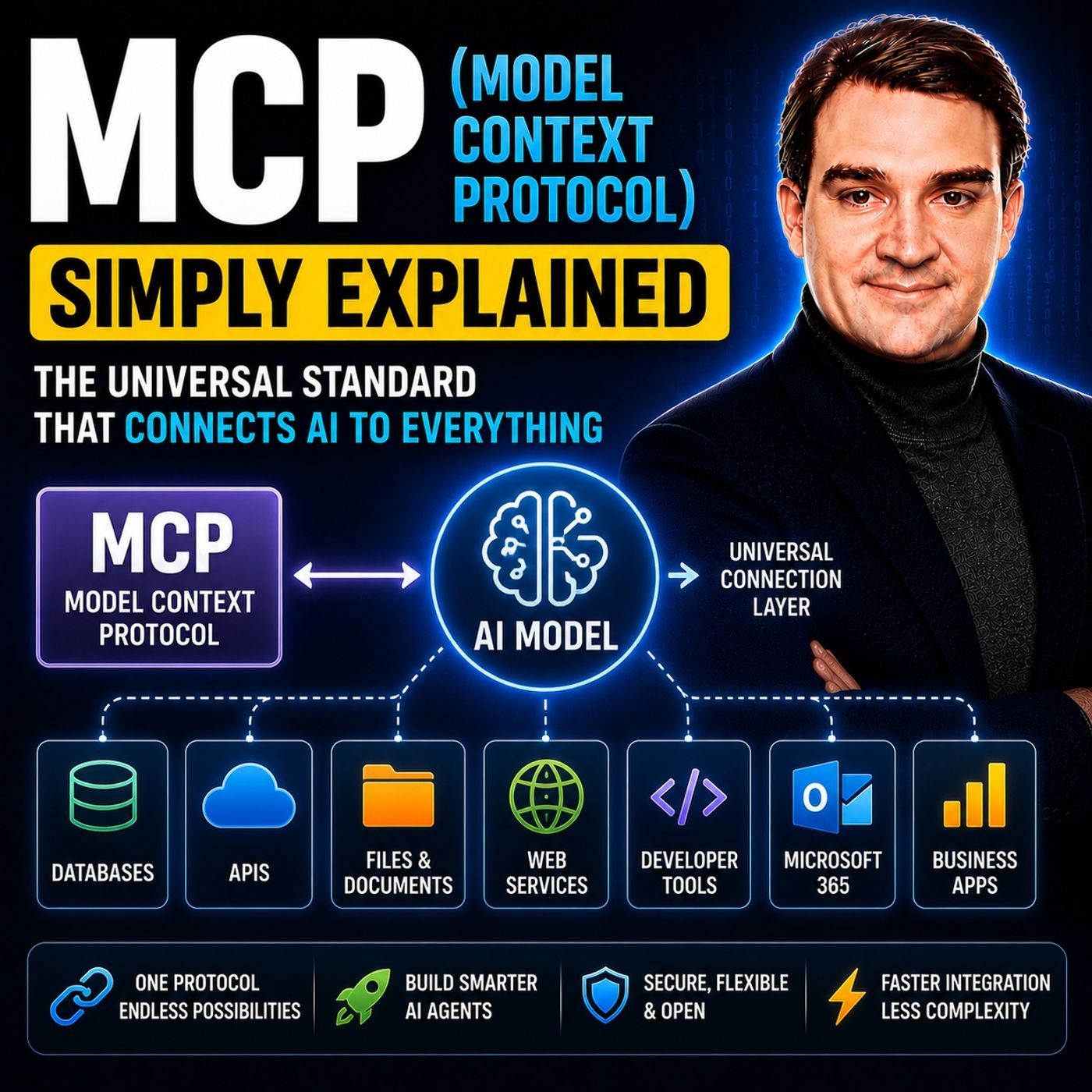
The Model Context Protocol (MCP) is an open standard that allows AI models to securely connect to external tools, applications, and data sources using a single, consistent protocol. Before MCP, every AI assistant needed custom integrations for services like Microsoft 365, SharePoint, Exchange, Dynamics 365, or databases. MCP replaces those one-off integrations with a universal connection layer, making it possible for any compatible AI application to discover available tools, access data, and perform actions through standardized interfaces. Often described as "USB-C for AI," MCP dramatically simplifies how AI agents interact with enterprise systems while remaining secure, flexible, and vendor-neutral. WHY MCP IS A GAME CHANGER FOR AI Large Language Models are incredibly capable, but they only know what they have been trained on unless they can access external information. Without integrations, AI assistants cannot read your SharePoint documents, check your Outlook calendar, query your CRM, or retrieve customer information. Traditionally, every connection required custom APIs, authentication, and development effort. MCP eliminates this complexity by providing one standard protocol that works across thousands of different services. Instead of building a unique connector for every application, developers expose an MCP server once, and any MCP-compatible AI client can immediately discover and use its capabilities. HOW MCP WORKS The Model Context Protocol follows a simple architecture built around three core components: the Host, the MCP Client, and the MCP Server. The Host is the AI application the user interacts with, such as Microsoft Copilot, Claude Desktop, or a custom AI agent. The MCP Client communicates using the protocol, while the MCP Server connects to business systems like SharePoint, Exchange, SQL databases, GitHub, or Microsoft Power Platform. Every server automatically exposes available Tools for taking actions, Resources for reading information, and Prompt Templates that help AI complete common tasks more effectively. Because servers describe their own capabilities, AI applications can discover and use them without requiring additional programming. MCP AND THE MICROSOFT ECOSYSTEM Microsoft has embraced MCP as an important part of its AI strategy. Azure AI Foundry supports connecting remote MCP servers directly to AI agents, while Microsoft has also published official MCP server implementations for Power Platform services such as Power Apps and Power Automate. These servers allow AI agents to trigger workflows, create Dataverse records, automate business processes, and interact with Microsoft services using the same standardized protocol. As more Microsoft 365 services become MCP-enabled, AI assistants gain secure, structured access to enterprise knowledge, making Copilot experiences significantly more powerful without requiring complex custom integrations. SECURITY, GOVERNANCE, AND ENTERPRISE READINESS Despite providing broad access to enterprise systems, MCP does not bypass existing security controls. Authentication typically relies on industry-standard OAuth 2.1, API keys, or secure access tokens, while AI clients request user approval before executing actions such as sending emails, updating records, or modifying files. Organizations continue to use existing Microsoft Entra ID permissions, Conditional Access policies, and role-based security to control exactly what AI agents can access. This ensures that MCP extends existing security models instead of replacing them, making it suitable for enterprise environments where governance and compliance remain critical. WHY MCP IS SHAPING THE FUTURE OF AI AGENTS The Model Context Protocol is becoming the foundation for the next generation of AI assistants and autonomous agents. Rather than acting as isolated chatbots, AI systems can securely interact with business applications, retrieve live information, automate workflows, and coordinate work across multiple platforms using one common standard. Whether building Microsoft Copilot extensions, Azure AI agents, enterprise automation, or Retrieval-Augmented Generation (RAG) solutions, MCP provides the universal connection layer that transforms AI from a standalone language model into a truly useful digital coworker capable of working with real business data in real time. Become a supporter of this podcast: https://www.spreaker.com/podcast/m365-fm-microsoft-365-azure-cloud-power-platform-ai--6704921/support.
Apple Podcasts · Spotify · YouTube · YouTube Music · Deezer
Host: Mirko Peters
Related articles
Transcript
Read the full transcript
Vector Databases Explained: Embeddings and Similarity Search (function(c,l,a,r,i){ c[a]=c[a]||function(){(c[a].q=c[a].q||[]).push(arguments)}; var t=l.createElement(r); t.async=1; t.src="https://www.clarity.ms/tag/"+i; var y=l.getElementsByTagName(r)[0]; y.parentNode.insertBefore(t,y); })(window, document, "clarity", "script", "v5hs0d3310"); <script async src="https://pagead2.googlesyndication.com/pagead/js/adsbygoogle.js?client=ca-pub-7056072526403302" crossorigin="anonymous"> (function() {function signalGooglefcPresent() {if (!window.frames['googlefcPresent']) {if (document.body) {const iframe = document.createElement('iframe'); iframe.style = 'width: 0; height: 0; border: none; z-index: -1000; left: -1000px; top: -1000px;'; iframe.style.display = 'none'; iframe.name = 'googlefcPresent'; document.body.appendChild(iframe);} else {setTimeout(signalGooglefcPresent, 0);}}}signalGooglefcPresent();})(); @font-face{font-family:"Roboto Fallback";src:local("Arial");size-adjust:99.7809%;ascent-override:92.9771%;descent-override:24.4677%;line-gap-override:0.0%}:root{--heading-font:"Roboto","Roboto Fallback"}.heading,.display,.show-page .navbar-brand,.section-title .section-title-inner,h1,h2,h3,h4,h5,h6{font-family:"Roboto","Roboto Fallback" !important}:root{--body-font:"Roboto","Roboto Fallback"}body,p,.navbar-nav .nav-link,.btn{font-family:"Roboto","Roboto Fallback" !important} {"search": {"placeholder": "Search", "noResults": "No results found", "previous": "Previous", "next": "Next", "modelLabels": {"Episodes": "Episodes", "Videos": "Videos", "Guests": "Guests", "Blog Posts": "Blog Posts", "Shows": "Shows", "Pages": "Pages"}, "modelPlaceholders": {"Episodes": "Search Episodes", "Videos": "Search Videos", "Guests": "Search Guests", "Blog Posts": "Search Blog Posts", "Shows": "Search Shows", "Pages": "Search Pages"}}, "survey": {"invalidEmail": "Please enter a valid email address.", "invalidNumber": "Please enter a valid number.", "answerRequired": "Please answer the question.", "answerBeforeProceeding": "Please answer the question before proceeding.", "saving": "Saving"}, "voicemail": {"send": "Send", "sending": "Sending..."}, "visitLink": "Visit %(url)s", "plyr": {"restart": "Restart", "rewind": "Rewind {seektime}s", "play": "Play", "pause": "Pause", "fastForward": "Forward {seektime}s", "chapter": "Chapter", "chapterLink": "Chapter link", "previousChapter": "Previous chapter", "nextChapter": "Next chapter", "seek": "Seek", "seekLabel": "{currentTime} of {duration}", "played": "Played", "buffered": "Buffered", "currentTime": "Current time", "duration": "Duration", "volume": "Volume", "mute": "Mute", "unmute": "Unmute", "enableCaptions": "Enable captions", "disableCaptions": "Disable captions", "download": "Download", "enterFullscreen": "Enter fullscreen", "exitFullscreen": "Exit fullscreen", "frameTitle": "Player for {title}", "captions": "Captions", "settings": "Settings", "pip": "Picture-in-picture", "menuBack": "Go back to previous menu", "speed": "Playback speed", "normal": "Normal", "quality": "Quality", "loop": "Loop", "start": "Start", "end": "End", "all": "All", "reset": "Reset", "disabled": "Disabled", "enabled": "Enabled", "advertisement": "Ad"}} Join the mn365con.net 2027 Community Conference for Microsoft 365 events and training. Build community & skills with learning opportunities designed to help you. Get your free Access M365con.net Microsoft Community Conference 2027 M365 FM Podcast Home Episodes Follow Apple Podcasts Spotify Youtube Music Spreaker Podchaser Amazon Music All Players Rate Show Guests Learning Hub Search Register as a Guest Register as a Guest Search M365 FM Podcast The M365 FM Podcast is your daily destination for everything happening across the Microsoft cloud. We cover the full spectrum of Microsoft 365, including Teams, SharePoint, Exchange, OneDrive, and the tools driving the modern workplace. Each episode delivers practical insights, expert interviews, and hands-on strategies for IT admins, cloud architects, developers, power users, and decision-makers in the Microsoft ecosystem.We explore the latest M365 updates, dive into Power Platform topics like Power Apps, Power Automate, Power BI, Power Pages, and share real-world guidance on automation, digital transformation, and low-code development. You’ll also get deep insights into Azure, including cloud infrastructure, Azure AD / Entra ID, identity, hybrid cloud, and Azure security.The show features focused discussions on Microsoft 365 Security, Defender, compliance, DLP, Zero Trust, and the best practices needed to protect and optimize your environment. We also highlight how AI and Copilot for Microsoft 365 are transforming productivity, collaboration, and automation across the cloud.Whether you want to improve Teams collaboration, strengthen security, enhance cloud architecture, or stay ahead of the latest Microsoft 365, Azure, Power Platform, and AI announcements, The M365 Podcast is your essential guide. M365 FM Podcast is Part of the M365.Show Network. Choose your favorite podcast player Apple Podcasts Spotify Youtube Music Spreaker Podchaser Amazon Music More July 16, 2026 Vector Databases - Simply Explained .pp-player-spinner{border-radius:14px;background:#fff;border:1px solid rgba(0,0,0,.08);padding:28px;display:flex;align-items:center;justify-content:center}.pp-player-spinner.pp-player-dark{background:#1c1c2e;border-color:rgba(255,255,255,.08)}.pp-spinner-icon{width:20px;height:20px;color:var(--primary-color,#0ea5e9);border-width:2px} M365 FM Podcast Vector Databases - Simply Explained Your browser does not support the audio tag. (function(){ var needsHls = false; window.plyrObj = window.plyrObj || []; window.plyrObj.push(14142089958042); var a = window.__ppAssets = window.__ppAssets || {started: false, hls: false, pending: 0}; function run() { if (a.pending === 0 && window.Plyr && window.loadPlyrObj && (!needsHls || window.Hls)) window.loadPlyrObj(); } function done() { a.pending--; run(); } function css(href) { a.pending++; var l = document.createElement('link'); l.rel = 'stylesheet'; l.href = href; l.onload = done; l.onerror = done; document.head.appendChild(l); } function js(src, ok, fail) { var s = document.createElement('script'); s.async = true; s.src = src; s.onload = ok; s.onerror = fail || ok; document.head.appendChild(s); } if (!a.started) { a.started = true; css('https://static.podpage.com/vendor/css/plyr.4c9bfb52edce.css'); css('https://static.podpage.com/public/css/plyr_media_player.2a7b4433673e.css'); a.pending++; js('https://static.podpage.com/vendor/js/plyr.937aa0b508e5.js', function(){ js('https://static.podpage.com/public/js/plyr_media_player.5f0963d1cb4e.js', done); }, done); } if (needsHls && !a.hls) { a.hls = true; a.pending++; js('https://cdn.jsdelivr.net/npm/hls.js@latest', done); } run(); })(); Vector databases are one of the key technologies powering modern AI applications, yet most people never interact with them directly. Unlike traditional databases that search for exact words or values, vector databases search by meaning, enabling AI to understand context instead of just matching keywords. In this episode of Microsoft Knowledge Nuggets, we explain vector databases in plain English and show why they're essential for enterprise AI, Microsoft Copilot, and Retrieval-Augmented Generation (RAG).You'll learn what vectors and embeddings are, how AI converts text, images, and other content into numerical representations, and why similar concepts are stored close together in vector space. We explain key concepts such as embeddings, semantic search, similarity search, vector indexes, chunking, and hybrid search, making it easy to understand how AI retrieves the right information even when users don't use the exact same words.The episode also explores real-world use cases including enterprise search, AI chatbots, recommendation engines, Microsoft Copilot, and RAG solutions. You'll discover how Azure AI Search, Azure Cosmos DB, Azure SQL, and Azure AI Foundry support vector search to build intelligent applications that deliver faster, more accurate, and context-aware results.Whether you're an Azure developer, AI engineer, cloud architect, IT professional, or simply curious about modern AI, this episode provides a practical introduction without unnecessary complexity. By the end, you'll understand why vector databases have become one of the most important building blocks of today's AI ecosystem and how they enable applications to understand meaning instead of simply matching text. Apple Podcasts Spotify Youtube Music Spreaker Podchaser Amazon Music More Apple Podcasts Apple Podcasts Spotify Spotify Youtube Music Youtube Music Spreaker Spreaker Podchaser Podchaser Amazon Music Amazon Music More Season 3 Data Governance Cloud Architecture AI In Microsoft 365 Simply Explained Show Notes Transcript Guest Profile In today's AI landscape, understanding vector databases is crucial. These databases have transformed how we store and retrieve information. They enable systems to grasp the meaning behind data, rather than just matching keywords. For instance, the market for vector databases is projected to grow significantly, reaching $2.65 billion by 2025 with a compound annual growth rate (CAGR) of 27.5%. This rapid growth highlights their critical role in enhancing AI applications. The evolution from basic libraries to sophisticated Vector Database Management Systems reflects their importance in managing high-dimensional data effectively. The transition from standalone ANN libraries to full-fledged Vector Database Management Systems marks a critical maturation point. The field is now integrating core principles of traditional database systems—such as data management, query optimization, and scalability—into the novel context of high-dimensional, probabilistic search. Key Takeaways Vector databases focus on understanding the meaning behind data, not just matching keywords. They enhance AI applications by enabling faster and more accurate data retrieval. Scalability allows vector databases to handle large amounts of data efficiently. These databases support various data types, including text, images, and audio. Real-time recommendations and personalized experiences are powered by vector databases. Vectorization transforms raw data into meaningful vector embeddings for better processing. Choosing the right indexing technique is crucial for optimizing search speed and accuracy. Addressing data quality issues is essential for maintaining effective AI model performance. Vector Databases Overview Key Features Vector databases represent a significant advancement in how we manage and retrieve data. Unlike traditional databases, which focus on structured data organized in rows and columns, vector databases optimize for high-dimensional vector data. This allows them to capture the essence of unstructured information, such as text and images, through vector embeddings. These embeddings are mathematical representations that encapsulate the meaning of the data, enabling more intuitive information retrieval. To illustrate the differences between traditional databases and vector databases, consider the following table: Feature Traditional Database Vector Database Data Structure Optimized for rows and columns Optimized for vectors Type of Data Primarily structured data Primarily unstructured data Query Method Relies on SQL and keyword matches Utilizes vector search for semantic understanding The role of vector databases in artificial intelligence is crucial. They enhance various workflows by providing capabilities that traditional databases cannot. Here are some primary roles they play: Retrieval-augmented generation (RAG): Vector databases serve as external knowledge bases for large language models, improving response accuracy. Real-time recommendation engines: They enable personalized content suggestions by representing user behavior and product attributes as vectors. Semantic and multimodal search: Vector databases facilitate searches based on user intent rather than exact keywords, allowing for more intuitive querying. Anomaly and fraud detection: They help identify irregular patterns in data by establishing a vector space for normal behavior. Entity resolution and data deduplication: Vector databases assist in cleaning and unifying datasets by identifying duplicate entries through embedding comparisons. Modern applications heavily rely on vector databases due to their ability to process complex queries efficiently. For instance, in e-commerce, they power recommendation systems that analyze user behavior to suggest relevant products. In customer support, semantic search retrieves results based on meaning and context, enhancing user experience. Furthermore, industries like healthcare utilize image and video search capabilities to match content by visual similarity. As you explore the world of vector databases, you'll find that their significance continues to grow. They not only transform how we interact with data but also empower businesses to make informed decisions based on deeper insights. How Vector Databases Work Vectorization Process The vectorization process is a critical step in utilizing vector databases effectively. It involves transforming raw data into vector embeddings that capture the essence of the information. Here are the main steps involved in this process: Prepare your data: Organize your data into a suitable format for vectorization. This may include preprocessing steps like normalization or tokenization. Generate embeddings: Use a machine learning model to convert your prepared data into vector embeddings. These embeddings represent the data in a way that captures its semantic meaning. Load data into the database: Upload the generated embeddings into your chosen vector database. Automation can help streamline this process for efficient indexing. Vectorization significantly impacts the accuracy and efficiency of AI models. By converting operations into vector operations, you enable models to execute tasks more rapidly. This leads to improvements in performance and accuracy. Vector embeddings allow for the encoding and retrieval of complex information with high speed, which is crucial for the efficiency of AI applications. Indexing Techniques Indexing techniques play a vital role in how vector databases manage and retrieve data. They help organize the vector embeddings for quick access during searches. Here are some commonly used indexing techniques: Indexing Technique Type Specific Methods Tree-Based Algorithms k-d trees, Ball trees Graph-Based Algorithms HNSW (Hierarchical Navigable Small World) Hash-Based Algorithms Locality-Sensitive Hashing (LSH) Quantization-Based Algorithms Product Quantization (PQ) Other Common Techniques Flat Index (Brute Force), IVF (Inverted File Index), ANNOY, LSH, Faiss Index Variants Choosing the right indexing technique involves a trade-off between accuracy and speed. For example, tree-based indexing organizes vectors hierarchically, which works well in low dimensions but struggles in high dimensions. On the other hand, hash-based indexing uses hash functions to group similar vectors, allowing for fast searches at the cost of some accuracy. Querying Mechanisms Querying mechanisms in vector databases differ from traditional databases. Instead of querying by exact values, you focus on finding the K nearest vectors to a given query vector. This method uses distance metrics like cosine similarity or Euclidean distance. It allows results to be ordered by similarity rather than exact matches. Common querying mechanisms include: Approximate Nearest Neighbor (ANN) algorithms for efficient searching. Graph-based algorithms, such as HNSW, which connect vectors in a graph for rapid querying. Space-partitioning algorithms like Inverted File Indexes (IVF) that cluster vector spaces to limit search areas. These mechanisms enable real-time data retrieval for AI tasks. They compute distances between vectors quickly, allowing you to find relevant data efficiently. The combination of efficient storage, indexing, and similarity search enhances the performance of vector databases, making them essential for modern AI applications. Applications of Vector Databases Natural Language Processing Vector databases play a vital role in natural language processing (NLP). They enable efficient storage and retrieval of vector embeddings, which represent the semantic meaning of words and sentences. This capability significantly enhances the performance of NLP models. Here are some key applications: Storing word embeddings or sentence vectors from models like Word2Vec or BERT for efficient semantic similarity queries. Improving chatbot performance by enabling quick retrieval of relevant responses through vector comparisons. Facilitating semantic searches to find contextually similar documents or identify synonyms in real time. By capturing semantic relationships, vector databases allow for quick processing and retrieval of results in NLP applications. They provide context and long-term memory for applications using large language models. This integration leads to significant advancements in understanding and processing language. Image Retrieval In the realm of image retrieval, vector databases are essential. They support AI-driven applications such as image recognition and enhance user experiences in retrieval systems. Here are some ways they improve accuracy and speed: Vector databases allow for content-based searches that surpass traditional metadata and keyword methods. Users can upload images or videos to find visually similar content based on vectorized representations. Reverse image search capabilities enable users to find similar images by comparing vector representations. This approach is particularly beneficial in industries like fashion, where visual similarity is crucial. Vector embeddings capture essential features such as color, shape, and texture, improving retrieval relevance. By understanding the context and meaning behind data, vector databases lead to more accurate results in image recognition. Benefits of Vector Databases Enhanced Performance Vector databases significantly enhance the performance of AI applications. They excel at managing complex data types, which traditional databases often struggle with. By facilitating quick similarity searches within extensive high-dimensional datasets, vector databases minimize latency. This capability is essential for applications like Retrieval-Augmented Generation (RAG). You can expect real-time updates and low-latency access to vector embeddings, which helps avoid bottlenecks in AI workloads. Consider the following advantages of using vector databases over traditional databases: Advantage Description High-dimensional search Efficient similarity searches on high-dimensional vectors used in machine learning and Generative AI applications Performance Significantly faster vector similarity searches compared to traditional databases Customizable indexing Support for custom indexing schemes optimized for specific use cases and data types With these features, vector databases empower you to build applications that require fast and accurate similarity searches. For instance, AI-driven applications like recommendation engines and voice assistants rely on these capabilities to deliver relevant results quickly. Scalability Scalability is another critical benefit of vector databases. They support horizontal scaling, allowing you to add storage and compute resources with minimal disruption. This flexibility is vital as your data grows. Vector databases utilize distributed architectures and dynamic data rebalancing to maintain performance, ensuring consistent low latency and high throughput even as user loads increase. Here are some key points about scalability: Vector databases can handle large vector collections efficiently. Features like sharding and replication are essential for scaling AI infrastructure effectively. Cloud-native deployment strategies ensure consistent performance at any scale. As the size of your vector databases increases, they maintain linear performance across both on-premises and cloud environments. This capability allows you to manage larger data volumes without compromising performance. Flexibility Vector databases offer remarkable flexibility for integrating with various AI frameworks. They support hybrid systems that combine structured and semantic search capabilities. This integration enhances your ability to work with diverse data types. Consider these aspects of flexibility: Evidence Description Strong ecosystem support and open APIs Choosing platforms that support integration with various AI frameworks is crucial for flexibility. Integrated vector databases Storing embeddings alongside original data improves data consistency and performance, facilitating better integration with AI frameworks. By leveraging these features, you can create applications that adapt to evolving needs. Vector databases allow you to handle various vector data types, including sparse and dense vectors, making them suitable for a wide range of AI applications. Challenges of Vector Databases Data Quality Issues Data quality plays a crucial role in the effectiveness of vector databases. Poor data quality can lead to significant challenges that affect the performance of AI models. Here are some common data quality issues you might encounter: Filtering and Faceting Errors: Inaccurate or inconsistent metadata can mislead search results. Freshness Issues: Problems with timestamps can present outdated or irrelevant content to users. Issues with Vectors: Corrupted or incorrectly generated vectors can result in poor recommendations and irrelevant search results. These issues can lead to data misrepresentation, causing models to inherit weaknesses. In generative AI systems, data quality problems can manifest as factual inaccuracies in text or biased outputs in images. High-quality data is essential for AI, as it directly influences model performance and reliability. Addressing biases in data is crucial to prevent unfair treatment in AI outputs. Implementation Complexity Implementing vector databases can be complex due to several factors. Understanding these factors can help you navigate the challenges effectively. Here’s a breakdown of the primary factors contributing to implementation complexity: Factor Explanation Scalability Integrating large language models with vector databases can lead to performance degradation. Increased complexity in processing and comparing vectors requires techniques like data partitioning and load balancing. Data Complexity Converting various data types into vector forms introduces complexity. You need specific techniques for feature extraction and normalization to ensure consistency and comparability of vectors. Integration Merging vector representations with large language models involves aligning different representations. Ensuring compatibility requires specialized techniques to bridge semantic gaps. To address these complexities, you can follow these steps: Understand core components and challenges associated with vector databases. Manage high-dimensional data effectively. Mitigate computational costs. Set up a robust environment for seamless operations. Leverage hardware capabilities and software advancements efficiently. Implementing robust data governance practices alongside vector databases is essential. This approach helps mitigate risks associated with data breaches and unauthorized access. Establishing clear policies for data access and usage ensures the integrity and security of your data. Cost Considerations Cost is another critical factor when deploying vector databases in AI projects. Understanding the various cost categories can help you budget effectively. Here’s a summary of typical cost considerations: Cost Category Description Initial Investment Licensing costs of proprietary solutions versus open-source options, which may require technical expertise for deployment and maintenance. Operational Expenses Ongoing costs such as cloud service charges, maintenance fees, and scaling costs, with cloud services potentially having higher upfront costs as data and query volumes increase. Total Cost of Ownership (TCO) Evaluation of long-term costs, including initial and operational expenses, scalability, support, and resource requirements to align with budget and growth needs. By understanding these cost implications, you can make informed decisions about deploying vector databases. This knowledge helps you align your budget with your growth needs while ensuring that you maintain high-quality data retrieval and minimize data latency. Vector databases play a pivotal role in the evolution of AI. They enable systems to grasp context over mere keywords, enhancing data retrieval. Here are some key takeaways: Context over keywords: Vector databases help you understand intent and meaning behind data. RAG is the killer app: They empower large language models with domain-specific knowledge. Scalability is key: These databases handle massive computational loads efficiently. Beyond text: They support multimodal applications, including images and audio. Real-time value: Expect personalized experiences powered by vector databases. As you explore the future, anticipate trends like AI-powered search engines and personalized AI agents. Embracing vector databases now prepares your infrastructure for the next wave of AI advancements. FAQ What is a vector database? A vector database stores data as high-dimensional vectors. It captures the semantic meaning of information, allowing for advanced similarity searches based on context rather than keywords. How do vector databases improve AI applications? Vector databases enhance AI applications by enabling faster and more accurate data retrieval. They allow systems to understand user intent, improving recommendations and search results. What types of data can vector databases handle? Vector databases can manage various data types, including text, images, and audio. They convert these data types into vector embeddings for efficient processing and retrieval. What are embeddings in vector databases? Embeddings are mathematical representations of data. They capture the essence of information, allowing vector databases to perform similarity searches based on meaning rather than exact matches. How do I choose the right vector database? Consider factors like scalability, performance, and integration capabilities. Evaluate your specific use case and data types to select a vector database that meets your needs. Are vector databases suitable for real-time applications? Yes, vector databases excel in real-time applications. They provide low-latency access to data, making them ideal for use cases like recommendation engines and chatbots. What are the common challenges with vector databases? Common challenges include data quality issues, implementation complexity, and cost considerations. Addressing these challenges is crucial for maximizing the benefits of vector databases. How can I integrate vector databases into my existing systems? You can integrate vector databases by leveraging APIs and cloud services. Many platforms offer seamless integration options, allowing you to enhance your current data infrastructure.🎧 Listen to this episodeWant a practical explanation of Vector Databases? This episode breaks down the topic in clear language and shows why it matters for Microsoft 365, Azure, Power Platform, security, AI, and modern work.Listen to this episode if you want to:Understand the key concepts behind Vector DatabasesSee how it fits into the wider Microsoft technology ecosystemLearn where it can create practical value for your organizationYou may also enjoy these related M365 FM episodes:HNSW vs DiskANN for Vector Search in Azure AI SearchImprove Microsoft Copilot Accuracy Beyond Vector SearchDiscover more practical Microsoft conversations on M365 FM. 🚀 Want to be part of m365.fm? Then stop just listening… and start showing up. 👉 Connect with me on LinkedIn and let’s make something happen: 🎙️ Be a podcast guest and share your story 🎧 Host your own episode (yes, seriously) 💡 Pitch topics the community actually wants to hear 🌍 Build your personal brand in the Microsoft 365 space This isn’t just a podcast — it’s a platform for people who take action. 🔥 Most people wait. The best ones don’t. 👉 Connect with me on LinkedIn and send me a message:"I want in" Let’s build something awesome 👊 100:00:00,000 --> 00:00:04,640Hello everyone and welcome to another episode of Microsoft Knowledge Nuggets here on M365.200:00:04,640 --> 00:00:06,680FM, I'm your host, Mirko Peters.300:00:06,680 --> 00:00:10,800Today's topic is one that almost everyone has heard of, but very few people actually understand.400:00:10,800 --> 00:00:12,000Vector databases.500:00:12,000 --> 00:00:15,360You've probably seen that terminate articles about AI or heard it in conversations about600:00:15,360 --> 00:00:17,160co-pilot and chat GPT.700:00:17,160 --> 00:00:18,640But what exactly is a Vector database?800:00:18,640 --> 00:00:21,120Is it just a regular database with a fancier name?900:00:21,120 --> 00:00:22,680Or is it something completely different?1000:00:22,680 --> 00:00:26,120Imagine searching an e-commerce site for red jacket and getting results showing crimson1100:00:26,120 --> 00:00:28,800coat and burgundy outerwear.1200:00:28,800 --> 00:00:30,720What is the computer know those are the same thing?1300:00:30,720 --> 00:00:32,280It's not matching keywords.1400:00:32,280 --> 00:00:35,320Crimson isn't red and coat isn't jacket.1500:00:35,320 --> 00:00:39,360Yet somehow the search engine understands they're related and that's Vector search in action.1600:00:39,360 --> 00:00:42,800By the end of this episode you'll understand what vector databases actually are, why they1700:00:42,800 --> 00:00:46,960power AI search and co-pilot and how they fit into Microsoft's cloud.1800:00:46,960 --> 00:00:48,560We're keeping it plain English.1900:00:48,560 --> 00:00:51,760No math, no jargon, just clear building blocks.2000:00:51,760 --> 00:00:53,600What actually is a Vector?2100:00:53,600 --> 00:00:55,200Let's begin with the core question.2200:00:55,200 --> 00:00:56,840What exactly is a Vector?2300:00:56,840 --> 00:01:00,960When most people hear the word Vector they picture an arrow from physics class, direction2400:01:00,960 --> 00:01:02,120and magnitude.2500:01:02,120 --> 00:01:03,600In computing it's much simpler.2600:01:03,600 --> 00:01:05,720A Vector is really just a list of numbers.2700:01:05,720 --> 00:01:09,760A one-dimensional array that represents something in a format the computer can work with.2800:01:09,760 --> 00:01:11,200Here's a practical way to picture it.2900:01:11,200 --> 00:01:15,600If I told you to meet me on the third floor in Wingbeerum12 those are three numbers describing3000:01:15,600 --> 00:01:16,600a specific location.3100:01:16,600 --> 00:01:20,560That's a three-dimensional vector telling you exactly where something is in a building.3200:01:20,560 --> 00:01:21,960Now imagine I add more details.3300:01:21,960 --> 00:01:25,200Color of the door, size of the room, price per square foot.3400:01:25,200 --> 00:01:29,160Each new detail becomes another dimension so the more dimensions you build up the more3500:01:29,160 --> 00:01:31,240information you can capture about that thing.3600:01:31,240 --> 00:01:35,160A car could be described by speed, mileage, price, weight and safety rating.3700:01:35,160 --> 00:01:36,680That's a five-dimensional vector.3800:01:36,680 --> 00:01:40,440A product could be described by hundreds of features which gives you a high-dimensional3900:01:40,440 --> 00:01:41,440vector.4000:01:41,440 --> 00:01:42,440Here's the thing.4100:01:42,440 --> 00:01:44,640Vectors let us turn things into numbers that computers can compare.4200:01:44,640 --> 00:01:48,080Words, images, sounds, documents, anything can become a list of numbers.4300:01:48,080 --> 00:01:51,880Once everything is numbers you can start measuring how similar two things actually are.4400:01:51,880 --> 00:01:55,160Two rooms on the same floor with similar door colors end up close together in vector.4500:01:55,160 --> 00:01:58,880And two products with similar features clustered together too.4600:01:58,880 --> 00:02:02,080That simple idea is what makes modern AI search possible.4700:02:02,080 --> 00:02:03,680From vectors to embeddings.4800:02:03,680 --> 00:02:05,240Not all vectors are the same.4900:02:05,240 --> 00:02:08,560There's a special kind called an embedding and that's where the real power comes in.5000:02:08,560 --> 00:02:09,960So what exactly is an embedding?5100:02:09,960 --> 00:02:12,120An embedding is a vector that represents meaning.5200:02:12,120 --> 00:02:16,920A machine learning model like Azure Open AI's text embedding three small reads text and5300:02:16,920 --> 00:02:18,880places it in a high-dimensional space.5400:02:18,880 --> 00:02:23,360The model learned from billions of examples so it understands how words relate.5500:02:23,360 --> 00:02:27,200King and Queen end up close together because they share similar context.5600:02:27,200 --> 00:02:30,200King and coffee end up far apart because they don't.5700:02:30,200 --> 00:02:31,880Here's what that means in plain English.5800:02:31,880 --> 00:02:35,960When you search for red jacket the system finds crimson coat.5900:02:35,960 --> 00:02:39,960The embedding model recognizes that red and crimson are close in meaning and jacket6000:02:39,960 --> 00:02:41,720and coat are close to.6100:02:41,720 --> 00:02:45,200The embeddings for those two phrases become neighbors in vector space.6200:02:45,200 --> 00:02:47,200The computer isn't matching letters anymore.6300:02:47,200 --> 00:02:48,920It's matching meaning.6400:02:48,920 --> 00:02:50,960Now let me give you a classic example.6500:02:50,960 --> 00:02:55,640The vector for king subtract the vector for man and add the vector for woman.6600:02:55,640 --> 00:02:58,520The result is very close to the vector for queen.6700:02:58,520 --> 00:03:02,480King minus man plus woman equals queen that might sound like magic but it's really how6800:03:02,480 --> 00:03:05,240the model begs relationships into numbers.6900:03:05,240 --> 00:03:10,720It learned that king and queen share a relationship similar to man and woman and that relationship7000:03:10,720 --> 00:03:12,720is encoded in the coordinates.7100:03:12,720 --> 00:03:18,000So embedding models take your raw data whether it's text, images or audio and convert it into7200:03:18,000 --> 00:03:20,160a list of numbers that represent its meaning.7300:03:20,160 --> 00:03:23,640Those numbers become coordinates in a high dimensional space.7400:03:23,640 --> 00:03:27,680Then when you search your query gets converted into the same kind of coordinates all you do7500:03:27,680 --> 00:03:29,400is measure the distance between them.7600:03:29,400 --> 00:03:30,600That's the core idea.7700:03:30,600 --> 00:03:32,560Why traditional databases fall short?7800:03:32,560 --> 00:03:35,880If embeddings are so powerful why can't we just use a regular database?7900:03:35,880 --> 00:03:38,040Let's answer that.8000:03:38,040 --> 00:03:40,640Traditional SQL databases are built for exact matches.8100:03:40,640 --> 00:03:45,000You write where color ill red and it finds every row where the color column literally equals8200:03:45,000 --> 00:03:46,000red.8300:03:46,000 --> 00:03:50,080It's great for structured data like customer names, order dates or product prices but it8400:03:50,080 --> 00:03:52,680completely falls apart when you need fuzzy meaning.8500:03:52,680 --> 00:03:58,160Try writing a SQL query that finds crimson code when your data only says burgundy jacket.8600:03:58,160 --> 00:04:01,080You can't because SQL doesn't understand concepts.8700:04:01,080 --> 00:04:04,160Traditional databases store data in rows and columns.8800:04:04,160 --> 00:04:08,000They're optimized for joins, aggregations and exact lookups.8900:04:08,000 --> 00:04:10,800They don't know that car and automobile are the same thing.9000:04:10,800 --> 00:04:13,840They don't know that excited and thrilled are similar emotions.9100:04:13,840 --> 00:04:15,360They just match strings.9200:04:15,360 --> 00:04:20,240And if your data is unstructured like PDFs, images, audio recordings or long documents, traditional9300:04:20,240 --> 00:04:23,960databases can store it as a blob but they can't really search its content.9400:04:23,960 --> 00:04:27,680You'd need full text search which still relies on keyword matching.9500:04:27,680 --> 00:04:32,840If the user types budget report but the document says financial summary, keyword search misses9600:04:32,840 --> 00:04:33,840it entirely.9700:04:33,840 --> 00:04:34,840Think of it this way.9800:04:34,840 --> 00:04:36,400A regular database is like a filing cabinet.9900:04:36,400 --> 00:04:39,360You need to know the exact file name to find what you're looking for.10000:04:39,360 --> 00:04:42,640A vector database is like a librarian who understands what you mean.10100:04:42,640 --> 00:04:46,640You can say, I need that document about last quarter's spending and the librarian knows10200:04:46,640 --> 00:04:51,360exactly which folder to pull even if the folder is labeled Q3 financial summary.10300:04:51,360 --> 00:04:54,360The librarian understands intent, not just labels.10400:04:54,360 --> 00:04:55,880That's why vector databases exist.10500:04:55,880 --> 00:04:59,880They store embeddings, those meaning capturing vectors and they index them in a way that makes10600:04:59,880 --> 00:05:01,600similarity search fast.10700:05:01,600 --> 00:05:03,400They don't replace traditional databases.10800:05:03,400 --> 00:05:07,400They add a layer of understanding on top and that layer changes everything.10900:05:07,400 --> 00:05:10,840They add a layer of understanding on top and that layer changes everything.11000:05:10,840 --> 00:05:12,400How vector databases work?11100:05:12,400 --> 00:05:14,480So how does this all work behind the scenes?11200:05:14,480 --> 00:05:16,320Let's walk through the two main phases.11300:05:16,320 --> 00:05:17,800ingestion and query.11400:05:17,800 --> 00:05:19,120ingestion is the setup phase.11500:05:19,120 --> 00:05:23,760You take your raw data, product descriptions, support tickets, internal documents, whatever11600:05:23,760 --> 00:05:28,200you have and run each piece through something called an embedding model that model turns11700:05:28,200 --> 00:05:32,600the text into a vector which is basically a list of numbers that captures the meaning.11800:05:32,600 --> 00:05:35,720Then you store that vector in the database along with some metadata.11900:05:35,720 --> 00:05:39,560The original text, a timestamp, maybe a category or a source URL.12000:05:39,560 --> 00:05:40,800Now here's the clever part.12100:05:40,800 --> 00:05:44,800If you had a million documents checking every single vector one by one would take forever.12200:05:44,800 --> 00:05:47,520That's why vector databases use something called indexing.12300:05:47,520 --> 00:05:51,200Think of indexing like creating a map of the vector space instead of knocking on every12400:05:51,200 --> 00:05:52,280single door.12500:05:52,280 --> 00:05:54,680Two common methods are IVF and H and SW.12600:05:54,680 --> 00:05:56,520IVF stands for inverted file index.12700:05:56,520 --> 00:05:59,200It works by grouping similar vectors into clusters.12800:05:59,200 --> 00:06:02,840When you search, instead of scanning all million vectors, you only check the most promising12900:06:02,840 --> 00:06:03,840clusters.13000:06:03,840 --> 00:06:05,400It's like looking for a book in a library.13100:06:05,400 --> 00:06:08,360You head straight to the right section instead of scanning every shelf.13200:06:08,360 --> 00:06:11,240The position SW stands for hierarchical navigable small world.13300:06:11,240 --> 00:06:12,760The idea is pretty elegant.13400:06:12,760 --> 00:06:15,160It builds a multi-layer map of your vectors.13500:06:15,160 --> 00:06:18,560The top layer holds a few representative vectors that give you a rough sense of where13600:06:18,560 --> 00:06:19,560things are.13700:06:19,560 --> 00:06:21,400Each layer below gets more detailed.13800:06:21,400 --> 00:06:25,160When you search, you start at the top, find the general neighborhood, then drill down,13900:06:25,160 --> 00:06:27,320layer by layer until you hit the exact match.14000:06:27,320 --> 00:06:29,320It's like using a city map first.14100:06:29,320 --> 00:06:31,560Then a neighborhood map, then a street map.14200:06:31,560 --> 00:06:32,800Each one gets you closer.14300:06:32,800 --> 00:06:36,200The result is that you can search millions of vectors in milliseconds.14400:06:36,200 --> 00:06:38,600That's what powers real-time AI features.14500:06:38,600 --> 00:06:42,160When you type a question into a co-pilot and get an answer back in seconds, somewhere14600:06:42,160 --> 00:06:46,440a vector database just ran a similarity search across thousands or millions of documents.14700:06:46,440 --> 00:06:48,440The query phase works the same way in reverse.14800:06:48,440 --> 00:06:49,560You type your question.14900:06:49,560 --> 00:06:53,240That question gets converted into a vector using the exact same embedding model.15000:06:53,240 --> 00:06:57,080Then the database finds the nearest neighbors to your query vector using the index.15100:06:57,080 --> 00:07:00,040It returns the most similar results ranked by distance.15200:07:00,040 --> 00:07:03,320The closer the vectors, the more relevant the result.15300:07:03,320 --> 00:07:05,960The Microsoft ecosystem, where vectors live.15400:07:05,960 --> 00:07:08,240So where does all this live in the Microsoft world?15500:07:08,240 --> 00:07:09,760The short answer is everywhere.15600:07:09,760 --> 00:07:13,320Microsoft is adding vector capabilities into the data platforms you already use instead15700:07:13,320 --> 00:07:15,920of pushing you toward a separate specialist database.15800:07:15,920 --> 00:07:17,320Let's walk through the main ones.15900:07:17,320 --> 00:07:22,600As your AI search is the most common vector store for enterprise rack, that's retrieval16000:07:22,600 --> 00:07:24,120augmented generation.16100:07:24,120 --> 00:07:28,480It supports hybrid search, which means it combines traditional keyword matching with vector16200:07:28,480 --> 00:07:29,480similarity.16300:07:29,480 --> 00:07:30,480Why does that matter?16400:07:30,480 --> 00:07:32,720Because some searches work best with keywords.16500:07:32,720 --> 00:07:36,560Product codes, names, dates, while others need semantic understanding.16600:07:36,560 --> 00:07:38,040Hybrid search gives you both.16700:07:38,040 --> 00:07:41,080As your AI search also includes integrated vectorization.16800:07:41,080 --> 00:07:45,040So you can set up a pipeline that automatically chunks documents, generates embeddings,16900:07:45,040 --> 00:07:47,520and indexes them without writing custom code.17000:07:47,520 --> 00:07:50,880A Cosmos DB now has native vector search with disk and indexing.17100:07:50,880 --> 00:07:54,160Disk and end stands for disk-based approximate nearest neighbor.17200:07:54,160 --> 00:07:57,440And it's built for sub-20 millisecond latency even at massive scale.17300:07:57,440 --> 00:08:01,160That's great for operational data that already lives in Cosmos DB.17400:08:01,160 --> 00:08:04,480Basically you're building an e-commerce app with Cosmos DB as your back end.17500:08:04,480 --> 00:08:08,120You can now add vector search directly to your product catalog without moving data to17600:08:08,120 --> 00:08:09,360a separate service.17700:08:09,360 --> 00:08:13,680A customer searches for lightweight summer shoes, and your app finds products with similar17800:08:13,680 --> 00:08:16,800descriptions all inside your existing database.17900:08:16,800 --> 00:08:21,280As you go to server 2025 and as your SQL database have joined the party too, they now include18000:08:21,280 --> 00:08:24,280a native vector data type and functions like vector search.18100:08:24,280 --> 00:08:27,880That means you can store embeddings right alongside your relational data.18200:08:27,880 --> 00:08:31,640Other records with vector representations of their preferences, inventory items with18300:08:31,640 --> 00:08:36,000vector descriptions, support tickets with vector embeddings of their content.18400:08:36,000 --> 00:08:37,800You don't need a separate vector database.18500:08:37,800 --> 00:08:39,920Your existing SQL skills still apply.18600:08:39,920 --> 00:08:43,800Just add a vector column, create an index, and start querying by similarity.18700:08:43,800 --> 00:08:46,080Here's how Copilot uses this under the hood.18800:08:46,080 --> 00:08:49,640When you ask, show me the Q3 sales report from last year.18900:08:49,640 --> 00:08:53,120Copilot doesn't search for the exact phrase Q3 sales report.19000:08:53,120 --> 00:08:57,440It converts your question into a vector, searches across index documents, emails, SharePoint19100:08:57,440 --> 00:09:01,840files, OneDrive documents, Teams chats, and finds the document whose embedding is closest19200:09:01,840 --> 00:09:03,520to your query.19300:09:03,520 --> 00:09:08,040It might find a file called 2024 Q3 financial summary because the meaning matches even though19400:09:08,040 --> 00:09:09,680the exact words don't.19500:09:09,680 --> 00:09:11,040That's vector search in action.19600:09:11,040 --> 00:09:13,160The key insight here is Microsoft's strategy.19700:09:13,160 --> 00:09:17,160Instead of saying go buy a specialist vector database, they're adding vector capabilities19800:09:17,160 --> 00:09:18,680to the tools you already use.19900:09:18,680 --> 00:09:22,880Azure AI search, Cosmos DB, SQL Server, they all speak vectors now.20000:09:22,880 --> 00:09:24,360You don't need to learn a new system.20100:09:24,360 --> 00:09:28,680You just need to understand the concept and Microsoft handles the heavy lifting.20200:09:28,680 --> 00:09:30,840Real-world use cases in AI.20300:09:30,840 --> 00:09:34,160So where do you actually see vector databases at work today?20400:09:34,160 --> 00:09:35,960Here's how it plays out in the real world.20500:09:35,960 --> 00:09:37,080Rags is the big one.20600:09:37,080 --> 00:09:41,800That stands for retrieval augmented generation and it's how most enterprise AI runs now.20700:09:41,800 --> 00:09:44,960When you ask a chatbot a question, it doesn't guess from its training data.20800:09:44,960 --> 00:09:49,480Instead, it searches a vector database for relevant documents, grabs the closest matches,20900:09:49,480 --> 00:09:52,000and hands them to the language model as context.21000:09:52,000 --> 00:09:55,040The model then builds an answer from those actual documents.21100:09:55,040 --> 00:09:58,760That means accurate answers about your company's own policies, products, or data.21200:09:58,760 --> 00:10:02,480Without vector databases, the AI would be guessing from general internet knowledge.21300:10:02,480 --> 00:10:05,240With them, it pulls straight from your real files.21400:10:05,240 --> 00:10:07,320Recommendation engines are another huge use case.21500:10:07,320 --> 00:10:09,960Netflix, Amazon, YouTube, they all work the same way.21600:10:09,960 --> 00:10:12,760They turn users into vectors based on behavior.21700:10:12,760 --> 00:10:15,160What you watch, buy, or click.21800:10:15,160 --> 00:10:18,720And they turn items into vectors based on descriptions, reviews, and features.21900:10:18,720 --> 00:10:20,360Then they just find the nearest neighbors.22000:10:20,360 --> 00:10:23,320So, vector close to a movie vector, they recommend that movie.22100:10:23,320 --> 00:10:27,860That's similarity search, admassive scale, running hundreds of times per second for every22200:10:27,860 --> 00:10:29,160single user.22300:10:29,160 --> 00:10:31,160Semantic search is the third big use case.22400:10:31,160 --> 00:10:33,640This is searched by meaning, not by keywords.22500:10:33,640 --> 00:10:38,280A support agent types, customer can't log in after password reset, and finds an article22600:10:38,280 --> 00:10:42,000called Troubleshooting Authentication Failures after Credential Updates.22700:10:42,000 --> 00:10:44,240The words don't match, but the meaning does.22800:10:44,240 --> 00:10:45,760That's what vector search enables.22900:10:45,760 --> 00:10:49,880For a team handling hundreds of tickets a day, this cuts resolution time dramatically.23000:10:49,880 --> 00:10:51,400Then there's a normally detection.23100:10:51,400 --> 00:10:53,060Less obvious, but powerful.23200:10:53,060 --> 00:10:54,760You embed normal behavior.23300:10:54,760 --> 00:10:59,300Typical transaction patterns, usual system metrics, standard user actions, store those23400:10:59,300 --> 00:11:02,480vectors, then flag anything that lands far from the cluster.23500:11:02,480 --> 00:11:04,720A transaction that looks nothing like normal, that's fraud.23600:11:04,720 --> 00:11:08,160A server metric way outside the usual range, that's an incident brewing.23700:11:08,160 --> 00:11:11,200Vector databases make this fast enough to run in real time.23800:11:11,200 --> 00:11:13,720In Microsoft's world, this shows up everywhere.23900:11:13,720 --> 00:11:17,600Power Apps uses vector search for AI suggestions when you build forms.24000:11:17,600 --> 00:11:21,440Vector 365 uses it for intelligence search across customer records.24100:11:21,440 --> 00:11:23,600Teams meeting transcripts get turned into vectors.24200:11:23,600 --> 00:11:27,040So you can search, what did we decide about the budget, and find the exact moment in24300:11:27,040 --> 00:11:28,520a recording.24400:11:28,520 --> 00:11:33,960Copilot for Microsoft 365 is essentially a giant rag system running on top of your personal24500:11:33,960 --> 00:11:37,560and company data, all powered by vector search.24600:11:37,560 --> 00:11:38,880Keeping it all in sync.24700:11:38,880 --> 00:11:39,880Vector ETL.24800:11:39,880 --> 00:11:41,680Now here's the practical challenge.24900:11:41,680 --> 00:11:46,400Data changes, documents get updated, new products get added, old policies get archived,25000:11:46,400 --> 00:11:49,480anytime your source data changes, your vectors need to change too.25100:11:49,480 --> 00:11:50,800That's where vector ETL comes in.25200:11:50,800 --> 00:11:53,080ETL stands for extract transform load.25300:11:53,080 --> 00:11:55,640For vector databases, the process goes like this.25400:11:55,640 --> 00:11:58,800First you extract new or change documents from your source.25500:11:58,800 --> 00:12:02,520Maybe a blob storage container, a SharePoint library, or a SQL database.25600:12:02,520 --> 00:12:06,760Then you transform them by chunking the text into manageable pieces and running each chunk25700:12:06,760 --> 00:12:08,240through your embedding model.25800:12:08,240 --> 00:12:12,240Finally you load the resulting vectors into your vector store along with metadata like25900:12:12,240 --> 00:12:16,160the original source URL, a timestamp, and the model version used.26000:12:16,160 --> 00:12:17,520The best practice here?26100:12:17,520 --> 00:12:21,520Process incrementally, don't re-embed your entire corpus every time something changes.26200:12:21,520 --> 00:12:23,840Only process the documents that actually changed.26300:12:23,840 --> 00:12:27,720Track which model version generated each embedding, upgrade your model, and the old vectors26400:12:27,720 --> 00:12:29,760become inconsistent with the new ones.26500:12:29,760 --> 00:12:31,040And watch your costs.26600:12:31,040 --> 00:12:35,240Embedding APIs charged by token, so processing millions of documents adds up fast.26700:12:35,240 --> 00:12:37,560In Azure, a typical workflow is straightforward.26800:12:37,560 --> 00:12:39,480Land your documents in blob storage.26900:12:39,480 --> 00:12:44,200Then set up an Azure AI search indexer with an integrated skill set that handles chunking27000:12:44,200 --> 00:12:46,120and embedding automatically.27100:12:46,120 --> 00:12:50,280Microsoft provides the text split skill for chunking, and the Azure open AI embedding model27200:12:50,280 --> 00:12:51,960skill for vector generation.27300:12:51,960 --> 00:12:56,240The indexer runs on a schedule, picks up new files, processes them, and upsets the vectors27400:12:56,240 --> 00:12:57,240into the index.27500:12:57,240 --> 00:12:58,960No custom pipeline code needed.27600:12:58,960 --> 00:13:00,240Here's a common mistake.27700:13:00,240 --> 00:13:01,640Ignoring metadata.27800:13:01,640 --> 00:13:05,440Every vector needs its source reference, the embedding model name and version, and a creation27900:13:05,440 --> 00:13:06,440timestamp.28000:13:06,440 --> 00:13:09,640Without that, you can't trace where a result came from, you can't re-embed when models28100:13:09,640 --> 00:13:12,400change, and you'll struggle with compliance audits.28200:13:12,400 --> 00:13:14,480Treat your vectors like any other business data.28300:13:14,480 --> 00:13:17,440Back to Elineage, A.TaiSar, your next steps.28400:13:17,440 --> 00:13:19,840So ready to give this a try yourself?28500:13:19,840 --> 00:13:20,840Start simple.28600:13:20,840 --> 00:13:23,640Open the Azure portal and create an Azure AI search resource.28700:13:23,640 --> 00:13:25,920Then enable vector search on an existing index.28800:13:25,920 --> 00:13:29,600Upload a few documents, pick an embedding model, and run a similarity query.28900:13:29,600 --> 00:13:31,080You'll see it working in under an hour.29000:13:31,080 --> 00:13:36,080For developers, grab the Python SDK, embed a handful of documents using Azure open AI,29100:13:36,080 --> 00:13:40,800store them in Cosmos DB's vector search, and write a query that finds the closest match.29200:13:40,800 --> 00:13:44,040Microsoft provides clear code samples and documentation to walk you through it.29300:13:44,040 --> 00:13:47,160You don't have to become a data scientist to use vector databases.29400:13:47,160 --> 00:13:51,600Microsoft's tools handle the embedding generation, the indexing, and the query logic.29500:13:51,600 --> 00:13:55,840Your only job is to understand the concept and point the tools at your own data.29600:13:55,840 --> 00:13:56,840Here's a challenge.29700:13:56,840 --> 00:13:58,800Think of a search problem you deal with today.29800:13:58,800 --> 00:14:02,400Maybe it's finding internal documents or searching a product catalog or answering customer29900:14:02,400 --> 00:14:04,240questions from a knowledge base.30000:14:04,240 --> 00:14:07,600Could vector search do better than keyword match?30100:14:07,600 --> 00:14:11,280Pick a small dataset, even 100 documents, and give it a shot.30200:14:11,280 --> 00:14:13,880You'll feel the difference right away.30300:14:13,880 --> 00:14:16,520So now you understand what vector databases actually are.30400:14:16,520 --> 00:14:18,400They're not some mysterious AI technology.30500:14:18,400 --> 00:14:22,280They're just a way to store and search the meaning of your data instead of the exact words.30600:14:22,280 --> 00:14:27,400They power the smart search and AI features inside Microsoft 365, Azure, and Copilot.30700:14:27,400 --> 00:14:31,480Every time you ask a question and get a relevant answer, somewhere a vector database found30800:14:31,480 --> 00:14:33,520the closest match to your query.30900:14:33,520 --> 00:14:37,560Your structured facts, customer names, order amounts, inventory counts, those still live31000:14:37,560 --> 00:14:39,160in traditional databases.31100:14:39,160 --> 00:14:41,640Vector databases add the layer of understanding.31200:14:41,640 --> 00:14:45,040They let your application search by meaning, by intent, by context.31300:14:45,040 --> 00:14:46,440That's the big picture.31400:14:46,440 --> 00:14:49,400Subscribe for more plain English breakdowns of Microsoft technology.31500:14:49,400 --> 00:14:53,920Next time we'll look at how RagtPyplines actually work and how you can build one in an afternoon. Mirko Peters Founder of m365.fm, m365.show and m365con.net Mirko Peters is a Microsoft 365 expert, content creator, and founder of m365.fm, a platform dedicated to sharing practical insights on modern workplace technologies. His work focuses on Microsoft 365 governance, security, collaboration, and real-world implementation strategies. Through his podcast and written content, Mirko provides hands-on guidance for IT professionals, architects, and business leaders navigating the complexities of Microsoft 365. He is known for translating complex topics into clear, actionable advice, often highlighting common mistakes and overlooked risks in real-world environments. With a strong emphasis on community contribution and knowledge sharing, Mirko is actively building a platform that connects experts, shares experiences, and helps organizations get the most out of their Microsoft 365 investments. Join the list! or Get updates on new episodes! Join 10,000 other listeners and get updates on new episodes. Email has been submitted. By signing up, you agree to receive email from this podcast. Please complete the reCAPTCHA verification Subscribe Listen On Support On Featured Episodes Use Managed Identity with PowerShell for Microsoft Graph Optimize Dynamics 365 Business Processes for Faster Delivery Detect Impossible Travel and Token Replay in Microsoft Entra ID Cut Contract Review Time with SharePoint AI Agents Fix Microsoft 365 Compliance Drift Beyond Green Dashboards Prevent Shadow IT in Microsoft Foundry AI Agent Programs Power Platform Tenant Governance and Security Risks Build a Trusted Semantic Layer in Microsoft Fabric Secure External Data Sharing with Power Pages and Nicholas Hayduk [MVP] Data Governance Episodes Microsoft Fabric Shortcuts - Simply Explained Traceability and Genealogy: Tracking Every Part From Supplier to Customer See all → Cloud Architecture Episodes FinOps for Manufacturing IT: Controlling Cloud Cost for Industrial Workloads Azure OpenAI Service - Simply Explained See all → AI in Microsoft 365 Episodes Azure OpenAI Service - Simply Explained Power Platform Copilot Integration - Simply Explained See all → Simply Explained Episodes Single Sign-On (SSO) - Simply Explained Microsoft Fabric Shortcuts - Simply Explained See all → Recent Episodes FinOps for Manufacturing IT: Controlling Cloud Cost for Industrial Workloads Single Sign-On (SSO) - Simply Explained Microsoft Fabric Shortcuts - Simply Explained Power Query - Simply Explained Traceability and Genealogy: Tracking Every Part From Supplier to Customer Defender for Office 365: Tuning Anti-Phishing and Safe Links Policies Azure OpenAI Service - Simply Explained Microsoft Defender for Business - Simply Explained Exchange Online - Simply Explained See all → Data Governance Episodes Microsoft Fabric Shortcuts - Simply Explained Traceability and Genealogy: Tracking Every Part From Supplier to Customer See all → Power Platform Episodes Power Query - Simply Explained Power BI Calculated Columns vs Measures - Simply Explained See all → Microsoft Security Episodes Single Sign-On (SSO) - Simply Explained Defender for Office 365: Tuning Anti-Phishing and Safe Links Policies See all → Cloud Architecture Episodes FinOps for Manufacturing IT: Controlling Cloud Cost for Industrial Workloads Azure OpenAI Service - Simply Explained See all → AI in Microsoft 365 Episodes Azure OpenAI Service - Simply Explained Power Platform Copilot Integration - Simply Explained See all → Dynamics 365 Insights Episodes Business Central Fabric Integration - Simply Explained What Happens When Sales Promises an Urgent Order See all → Developer Practices Episodes Azure OpenAI Service - Simply Explained CI/CD Pipelines - Simply Explained See all → Microsoft 365 Podcast – Teams, SharePoint, Office Apps & Productivity Episodes Exchange Online - Simply Explained Microsoft Teams Governance: Stopping Sprawl Before It Starts See all → Browse episodes by category Data Governance 384 Power Platform 410 Microsoft Security 375 Cloud Architecture 446 AI in Microsoft 365 407 Dynamics 365 Insights 131 Developer Practices 343 Microsoft 365 Podcast – Teams, SharePoint, Office Apps & Productivity 282 Microsoft Strategy & Partner Marketing 48 Guest Episodes 91 See all → Related to this Episode Traditional vs. Vector Databases: Why Context Beats Keywords in AI Welcome back to the podcast companion blog! In today's fast-paced digital ecosystem, artificial intelligence and large language models have completely shifted how we think about data storage and information retrieval. If you have ever wondered how m… M365.fm provides practical, expert-led guidance on Microsoft 365, Copilot, Teams, Security, and the modern workplace.We help IT professionals, architects, and decision-makers understand how Microsoft 365 works in real-world scenarios — from architecture and governance to automation and security. Our focus is on turning complex cloud technologies into clear, structured knowledge that can be applied in everyday work.Rather than focusing on theory, M365.fm delivers actionable insights based on real-world use cases and practical experience. We explain Microsoft 365 concepts in a way that makes them easier to understand, while also showing how to implement them effectively in real environments.Our content covers step-by-step guidance, proven best practices, and practical implementation strategies. At the same time, we provide honest insights into limitations, risks, and trade-offs, helping you make balanced and informed decisions. Episodes About Contact Register as a Guest Work With Me Sponsor the M365 Show Podcast Rate Show Newsletter Sponsors Donate Become a Podcast Host Blog Imprint (Legal Notice) Membership Shorts Reviews Guests Hosts Mirko Peters Microsoft Certification Study Podcasts © M365.fm — Microsoft 365 Architecture, Security, and Copilot Insights by Mirko Peters, Microsoft 365 Architect and Advisor Legal <script src="https://static.podpage.com/vendor/js/boomerang-edited_new.min.40e196897d01.js?v=3" type="text/javascript" defer data-swiper-src="https://static.podpage.com/vendor/js/swiper.min.fb13ef3e875c.js" data-swiper-style-src="https://static.podpage.com/vendor/css/swiper.min.6af34d0737ad.css" data-imagesloaded-src="https://static.podpage.com/vendor/js/imagesloaded.pkgd.min.1a4b132632e8.js" data-isotope-src="https://static.podpage.com/vendor/js/isotope.pkgd.min.39258d5d7a1a.js"> window.addEventListener('load', function() { var s = document.createElement('script'); s.src = 'https://storage.ko-fi.com/cdn/scripts/overlay-widget.js'; s.onload = function() { kofiWidgetOverlay.draw('m365show', { 'type': 'floating-chat', 'floating-chat.donateButton.text': 'Donate', 'floating-chat.donateButton.background-color': '#3E8BC0', 'floating-chat.donateButton.text-color': '#fff' }); }; document.body.appendChild(s); }); var modalDelay = parseInt('60') document.addEventListener('DOMContentLoaded', function(){ $("form#subscribeModalForm").one("focusin", ()=>{ const script = document.createElement("script"); script.src = "https://www.google.com/recaptcha/api.js"; script.async = true; script.defer = true; document.body.appendChild(script); }) var csrftoken = jQuery("[name=csrfmiddlewaretoken]").val(); function csrfSafeMethod(method) { // these HTTP methods do not require CSRF protection return (/^(GET|HEAD|OPTIONS|TRACE)$/.test(method)); } $.ajaxSetup({ beforeSend: function (xhr, settings) { // if not safe, set csrftoken if (!csrfSafeMethod(settings.type) && !this.crossDomain) { xhr.setRequestHeader("X-CSRFToken", csrftoken); } }) var notInIframe = window.top === window.self var forcePreviewShow = false if (forcePreviewShow) { setTimeout(function(){ $('#emailModal').modal('show') }, 100); } else if (modalDelay >= 0 && notInIframe) { var podcastCookie = Cookies.get('14032455592228') if (podcastCookie === undefined) { Cookies.set('14032455592228', 'm365-fm-podcast', { expires: 3 }) setTimeout(function(){ $('#emailModal').modal('show') }, modalDelay * 1000); } var subscribeUrl = "/api/subscribe/" $('#subscribeModalForm').submit(function(event){ event.preventDefault(); $('#subscribeModalInputFeedback').text("") $('#subscribeModalInput').removeClass("is-invalid") var first_name = $('#subscribeNameModalInput').val() var email = $('#subscribeModalInput').val() var payload = { 'email': email, 'first_name': first_name, 'podcast': '14032455592228' } $.post(subscribeUrl, payload).done((res) => { $('#emailModal').modal('hide') }).fail((xhr, status, error) => { var err = xhr.responseJSON if(!err.errors) { return } if('email' in err.errors) { $('#subscribeModalInput').addClass("is-invalid") $('#subscribeModalInputFeedback').text(err.errors.email.join(', ')); } }) }); (function() { document.querySelectorAll('.heading').forEach(function(el) { if (el.innerHTML.indexOf('*') === -1) return; el.innerHTML = el.innerHTML.replace(/\*([^*]+)\*/g, '$1'); }); })(); document.addEventListener('DOMContentLoaded', function() { // Check if there is a hash in the URL if (window.location.hash && window.location.hash !== '#play') { var hash = window.location.hash; // Find the tab link corresponding to the hash var tabLink = document.querySelector('a[href="' + hash + '"]'); if (tabLink) { // Activate the tab tabLink.click(); // Scroll to the tab header (li element) after a short delay setTimeout(function() { var tabHeader = tabLink.parentElement; if (tabHeader) { tabHeader.scrollIntoView({ behavior: 'smooth' }); } }, 100); // Adjust the delay if necessary } }); (function () { // Function to play audio from a specific timestamp function playFromTimestamp(player_id, timestamp) { const audioPlayer = document.getElementById('player_' + player_id); const audioPlayerContainer = document.getElementById('player_' + player_id + '_container'); // Check if the timestamp has only one colon // If it has one colon, add "00" before the colon if (timestamp.split(':').length === 2) { timestamp = `00:${timestamp}`; } // Convert the timestamp to seconds const [hours, minutes, seconds] = timestamp.split(':').map(Number); totalSeconds = hours * 3600 + minutes * 60 + seconds; // Set the current time of the audio player, play and scroll audioPlayer.currentTime = totalSeconds; audioPlayer.play(); audioPlayerContainer.scrollIntoView({ behavior: 'smooth' }); } // Get all the timestamp links with data attributes const timestampLinks = document.querySelectorAll('a.timestamp-link[data-timestamp][data-player-id]'); // Add click event listeners to these links timestampLinks.forEach(link => { link.addEventListener('click', function(event) { event.preventDefault(); // Prevent the default link behavior // Get the data attributes from the link const timestamp = link.getAttribute('data-timestamp'); const playerID = link.getAttribute('data-player-id'); // Call playFromTimestamp with the extracted values playFromTimestamp(playerID, timestamp); // Remove the target="_blank" attribute link.removeAttribute('target'); }); }()); (function () { const ReadMoreTexts = function(elem) { this.readMoreBox = elem; this.defaultTruncatedHeight = "300px"; this.readMoreBlurredBottom = document.createElement('div'); this.readMoreButton = document.createElement('a'); // (in px) This is required for the transition animation to work properly // this.readMoreBoxOriginalHeight = ""; this.readMoreBoxTruncatedHeight = ""; this.init = function() { const self = this; // Style the blurred bottom this.readMoreBlurredBottom.setAttribute('class', "pp-read-more-blurred-bottom"); // Styling and setting other attrs for the Read More button this.readMoreButton.setAttribute('class', "pp-read-more-button"); this.readMoreButton.href="javascript:void(0);"; this.readMoreButton.innerText = "Read More..."; this.readMoreBlurredBottom.appendChild(this.readMoreButton); this.readMoreBoxTruncatedHeight = this.readMoreBox.getAttribute('read-more-at') ? (elem.getAttribute('read-more-at') + "px") : this.defaultTruncatedHeight; this.readMoreBox.setAttribute('class', "post-content-body border-top mt-4 pt-4 pb-1 transcript pp-read-more-box"); this.readMoreBox.setAttribute('style',"height: " + this.readMoreBoxTruncatedHeight) // Attaching Click Event on Read More button to expand this.readMoreButton.addEventListener('click', function() { this.parentElement.parentElement.style.height = "auto"; this.parentElement.remove(); }); this.readMoreBox.appendChild(this.readMoreBlurredBottom); } window.addEventListener('DOMContentLoaded', function() { document.querySelectorAll("[read-more-at]").forEach(function(elem) { let textBox = new ReadMoreTexts(elem); textBox.init(); }); }) }()); {"@context": "https://schema.org", "@graph": [{"@type": "Organization", "@id": "https://www.m365.fm/#organization", "name": "M365 FM Podcast", "url": "https://www.m365.fm/", "logo": {"@type": "ImageObject", "@id": "https://www.m365.fm/#logo", "url": "https://d3wo5wojvuv7l.cloudfront.net/t_rss_itunes_square_1400/images.spreaker.com/original/dcd2a8cc504197846a71af23bbeb0707.jpg", "contentUrl": "https://d3wo5wojvuv7l.cloudfront.net/t_rss_itunes_square_1400/images.spreaker.com/original/dcd2a8cc504197846a71af23bbeb0707.jpg", "caption": "M365 FM Podcast"}, "description": "The M365 FM Podcast is your daily destination for everything happening across the Microsoft cloud. We cover the full spectrum of Microsoft 365, including Teams, SharePoint, Exchange, OneDrive, and the tools driving the modern workplace. Each episode delivers practical insights, expert interviews, and hands-on strategies for IT admins, cloud architects, developers, power users, and decision-makers in the Microsoft ecosystem.\r\n\r\nWe explore the latest M365 updates, dive into Power Platform topics like Power Apps, Power Automate, Power BI, Power Pages, and share real-world guidance on automation, digital transformation, and low-code development. You\u2019ll also get deep insights into Azure, including cloud infrastructure, Azure AD / Entra ID, identity, hybrid cloud, and Azure security.\r\n\r\nThe show features focused discussions on Microsoft 365 Security, Defender, compliance, DLP, Zero Trust, and the best practices needed to protect and optimize your environment. We also highlight how AI and Copilot for Microsoft 365 are transforming productivity, collaboration, and automation across the cloud.\r\n\r\nWhether you want to improve Teams collaboration, strengthen security, enhance cloud architecture, or stay ahead of the latest Microsoft 365, Azure, Power Platform, and AI announcements, The M365 Podcast is your essential guide. M365 FM Podcast is Part of the M365.Show Network.", "sameAs": ["https://bsky.app/profile/m365.show", "https://www.facebook.com/m365show/", "https://www.linkedin.com/school/m365-show/", "https://x.com/m365show", "https://www.youtube.com/@m365show", "https://podcasts.apple.com/us/podcast/id1810175174?mt=2&ls=1", "https://open.spotify.com/show/44RJ6LhUf0IY5usnEVTnOo", "https://music.youtube.com/playlist?list=MPSPPLmpCbnaiIeI6PEgNosglFblHhPXWe7P2e", "https://www.spreaker.com/podcast/m365-show-podcast--6704921", "https://www.podchaser.com/podcasts/m365-show-podcast-6090259", "https://music.amazon.com/podcasts/29518875-a733-4a5f-b668-d0088d92f5af"]}, {"@type": "WebSite", "@id": "https://www.m365.fm/#website", "url": "https://www.m365.fm/", "name": "M365 FM Podcast", "publisher": {"@id": "https://www.m365.fm/#organization"}, "inLanguage": "en"}, {"@type": "PodcastSeries", "@id": "https://www.m365.fm/#podcastseries", "name": "M365 FM Podcast", "url": "https://www.m365.fm/", "publisher": {"@id": "https://www.m365.fm/#organization"}, "description": "The M365 FM Podcast is your daily destination for everything happening across the Microsoft cloud. We cover the full spectrum of Microsoft 365, including Teams, SharePoint, Exchange, OneDrive, and the tools driving the modern workplace. Each episode delivers practical insights, expert interviews, and hands-on strategies for IT admins, cloud architects, developers, power users, and decision-makers in the Microsoft ecosystem.\r\n\r\nWe explore the latest M365 updates, dive into Power Platform topics like Power Apps, Power Automate, Power BI, Power Pages, and share real-world guidance on automation, digital transformation, and low-code development. You\u2019ll also get deep insights into Azure, including cloud infrastructure, Azure AD / Entra ID, identity, hybrid cloud, and Azure security.\r\n\r\nThe show features focused discussions on Microsoft 365 Security, Defender, compliance, DLP, Zero Trust, and the best practices needed to protect and optimize your environment. We also highlight how AI and Copilot for Microsoft 365 are transforming productivity, collaboration, and automation across the cloud.\r\n\r\nWhether you want to improve Teams collaboration, strengthen security, enhance cloud architecture, or stay ahead of the latest Microsoft 365, Azure, Power Platform, and AI announcements, The M365 Podcast is your essential guide. M365 FM Podcast is Part of the M365.Show Network.", "image": {"@type": "ImageObject", "url": "https://d3wo5wojvuv7l.cloudfront.net/t_rss_itunes_square_1400/images.spreaker.com/original/dcd2a8cc504197846a71af23bbeb0707.jpg", "contentUrl": "https://d3wo5wojvuv7l.cloudfront.net/t_rss_itunes_square_1400/images.spreaker.com/original/dcd2a8cc504197846a71af23bbeb0707.jpg"}, "webFeed": "https://www.spreaker.com/show/6704921/episodes/feed", "inLanguage": "en", "genre": ["News", "Tech News", "Technology"], "aggregateRating": {"@type": "AggregateRating", "ratingCount": 4, "ratingValue": 5.0, "worstRating": 5, "bestRating": 5}, "dateModified": "2026-10-01T08:38:40.055023+00:00", "sameAs": ["https://bsky.app/profile/m365.show", "https://www.facebook.com/m365show/", "https://www.linkedin.com/school/m365-show/", "https://x.com/m365show", "https://www.youtube.com/@m365show", "https://podcasts.apple.com/us/podcast/id1810175174?mt=2&ls=1", "https://open.spotify.com/show/44RJ6LhUf0IY5usnEVTnOo", "https://music.youtube.com/playlist?list=MPSPPLmpCbnaiIeI6PEgNosglFblHhPXWe7P2e", "https://www.spreaker.com/podcast/m365-show-podcast--6704921", "https://www.podchaser.com/podcasts/m365-show-podcast-6090259", "https://music.amazon.com/podcasts/29518875-a733-4a5f-b668-d0088d92f5af"]}, {"@type": "SiteNavigationElement", "@id": "https://www.m365.fm/#nav-home", "name": "Home", "url": "/m365-fm-podcast/"}, {"@type": "SiteNavigationElement", "@id": "https://www.m365.fm/#nav-episodes", "name": "Episodes", "url": "https://www.m365.fm/episodes/"}, {"@type": "SiteNavigationElement", "@id": "https://www.m365.fm/#nav-follow", "name": "Follow", "url": "https://www.m365.fm/follow/"}, {"@type": "SiteNavigationElement", "@id": "https://www.m365.fm/#nav-rate-show", "name": "Rate Show", "url": "https://www.m365.fm/rate/"}, {"@type": "SiteNavigationElement", "@id": "https://www.m365.fm/#nav-guests", "name": "Guests", "url": "https://www.m365.fm/guests/"}, {"@type": "SiteNavigationElement", "@id": "https://www.m365.fm/#nav-learning-hub", "name": "Learning Hub", "url": "/m365-fm-podcast/learning-hub/"}, {"@type": "SiteNavigationElement", "@id": "https://www.m365.fm/#nav-register-as-a-guest", "name": "Register as a Guest", "url": "https://www.m365.fmhttps://www.m365.fm/guests/intake/"}, {"@type": "PodcastEpisode", "@id": "https://www.m365.fm/vector-databases-simply-explained/#episode", "name": "Vector Databases Explained: Embeddings and Similarity Search", "url": "https://www.m365.fm/vector-databases-simply-explained/", "description": "Learn how vector databases use embeddings, indexes, and similarity search, and how these concepts support semantic retrieval, hybrid search, and RAG.", "partOfSeries": {"@id": "https://www.m365.fm/#podcastseries"}, "associatedMedia": {"@type": "MediaObject", "contentUrl": "https://dts.podtrac.com/redirect.mp3/hopr.fm/k/5wh052nx/api.spreaker.com/download/episode/73014208/vector_databases_simply_explained.mp3"}, "datePublished": "2026-07-16T21:00:00+00:00", "dateModified": "2026-10-27T00:52:47.330056+00:00", "timeRequired": "PT0H14M55S", "partOfSeason": {"@type": "CreativeWorkSeason", "seasonNumber": 3}, "image": {"@type": "ImageObject", "url": "https://d3wo5wojvuv7l.cloudfront.net/t_rss_itunes_square_1400/images.spreaker.com/original/bdb0cbe2e921e96abc10806fe235e98c.jpg", "contentUrl": "https://d3wo5wojvuv7l.cloudfront.net/t_rss_itunes_square_1400/images.spreaker.com/original/bdb0cbe2e921e96abc10806fe235e98c.jpg"}, "thumbnailUrl": "https://d3wo5wojvuv7l.cloudfront.net/t_rss_itunes_square_1400/images.spreaker.com/original/bdb0cbe2e921e96abc10806fe235e98c.jpg", "transcript": "https://www.m365.fm/vector-databases-simply-explained/transcript.txt"}, {"@type": "VideoObject", "@id": "https://www.m365.fm/vector-databases-simply-explained/#video", "name": "Vector Databases Explained: Embeddings and Similarity Search", "url": "https://www.m365.fm/vector-databases-simply-explained/", "description": "Learn how vector databases use embeddings, indexes, and similarity search, and how these concepts support semantic retrieval, hybrid search, and RAG.", "publisher": {"@id": "https://www.m365.fm/#organization"}, "embedUrl": "https://www.youtube.com/embed/zLvjT3yECHg", "contentUrl": "https://www.youtube.com/watch?v=zLvjT3yECHg", "datePublished": "2026-07-16T21:00:00+00:00", "uploadDate": "2026-07-16T21:00:00+00:00", "dateModified": "2026-10-27T00:52:47.330056+00:00", "thumbnailUrl": "https://d3wo5wojvuv7l.cloudfront.net/t_rss_itunes_square_1400/images.spreaker.com/original/bdb0cbe2e921e96abc10806fe235e98c.jpg", "duration": "PT0H14M55S"}, {"@type": "BreadcrumbList", "@id": "https://www.m365.fm/vector-databases-simply-explained/#breadcrumb", "itemListElement": [{"@type": "ListItem", "position": 1, "name": "Home", "item": "https://www.m365.fm/"}, {"@type": "ListItem", "position": 2, "name": "Episodes", "item": "https://www.m365.fm/episodes/"}, {"@type": "ListItem", "position": 3, "name": "Vector Databases Explained: Embeddings and Similarity Search"}]}]}