
OneDrive vs Dropbox: Which Cloud Storage Platform Is Better?
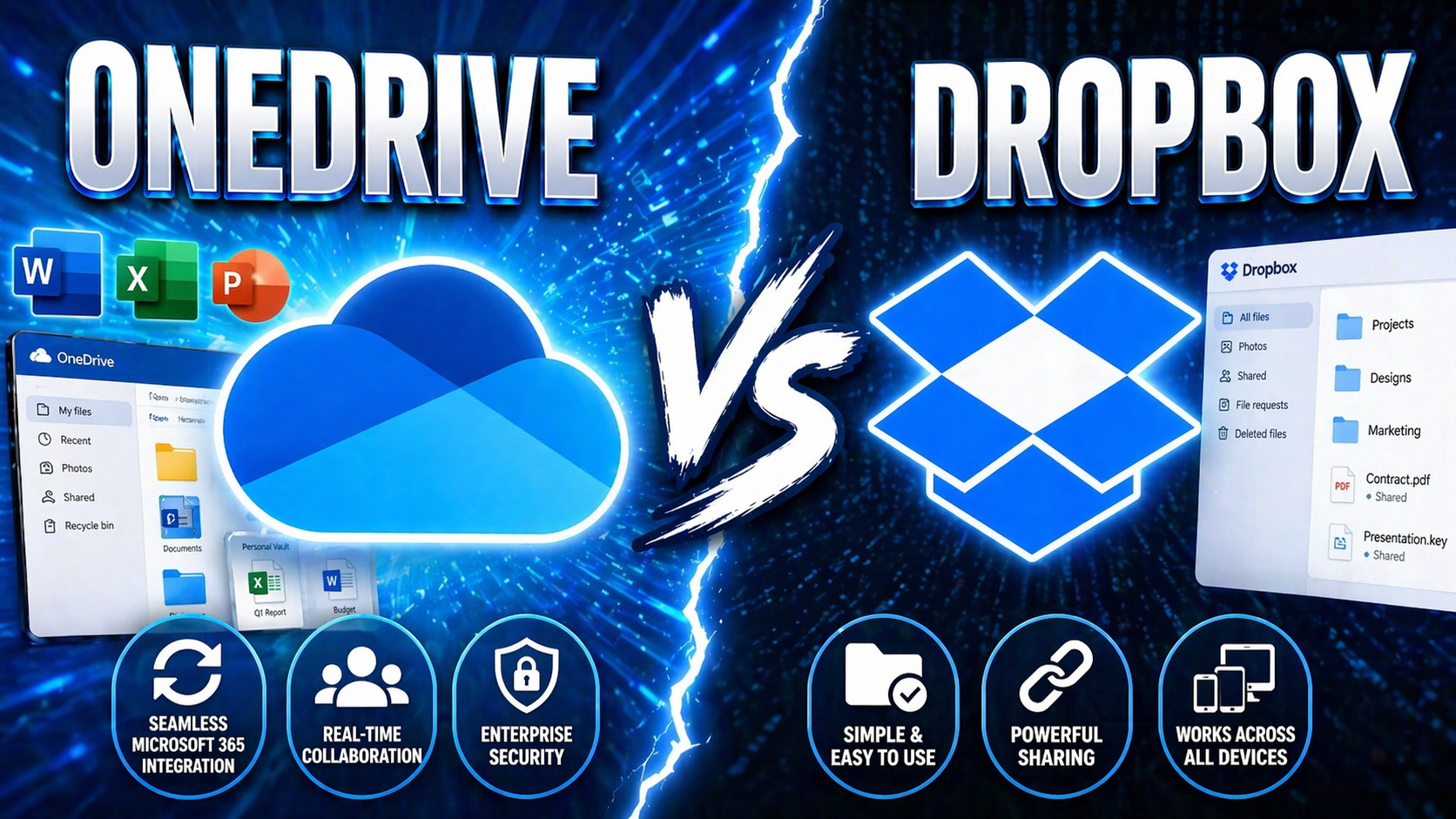
OneDrive vs Dropbox requires a clear business scenario, approved access and data boundaries, and accountable ownership. Start with the intended outcome, validate current Microsoft guidance, test with representative users, and document the decision before scaling. This keeps the solution secure, practical, and easier to support across Microsoft 365.
OneDrive vs Dropbox: practical checklist
- Define the scenario, owner, and expected outcome.
- Validate permissions, security, policy, and user impact.
- Test with a pilot and document support and review decisions.
Use Microsoft Learn for current guidance.
Last reviewed: July 2026.
If you’re stuck deciding between OneDrive and Dropbox, you’re not alone. Organizations, IT pros, and serious teams are searching for a cloud storage platform that’s not just easy to use but also delivers on speed, security, collaboration, and—let’s not forget—price. The real question? Which of these two giants actually fits your business and workflow needs right now, and down the line?
This guide breaks down how each service measures up on key points: performance, usability, security, pricing, and how easily they fit into team setups. We look at how OneDrive meshes with Microsoft 365 (think Teams, SharePoint, all that governance jazz) and how Dropbox holds its ground for everyone else. By the end, you’ll know which solution actually gives more than just fancy promises, and which one is worth your organization’s trust—and cash.
Comparing File Sync Speed and Performance: 21x Faster or Just Hype?
Let’s talk speed because, frankly, slow uploads and laggy file sync make everyone’s day a headache. Both Dropbox and OneDrive claim they’re lightning fast—sometimes even tossing out wild numbers like “21x faster” or “78% improved performance”—but what does that mean when you have a payroll folder or hundreds of files to sync at once across your team?
This section digs into what you should actually expect when moving large chunks of files, syncing across devices, or just trying to round up your scattered data for a big meeting. We’ll outline the basic testing strategies, like uploading a folder with hundreds of files, and why those numbers matter beyond the marketing hype.
Whether your folks are working remote, on-site, or spanning time zones, sync performance isn’t just about bragging rights—it impacts productivity, reliability, and even compliance for your operations. Up next, we break down how both platforms handle big transfers and the real-world speed differences IT teams need to know.
Transferring Folders and Uploading 250 Files At Once
- OneDrive: Handles large uploads with block-level sync, breaking files into pieces and only syncing changes. You can drag-and-drop entire folders in web and desktop apps, but browser performance may throttle uploads for massive batches. OneDrive’s desktop client is generally consistent, but speeds can drop on low bandwidth networks.
- Dropbox: Also offers block-level sync and is praised for its smart bandwidth management. Dropbox reliably uploads hundreds of files at once, often outperforming OneDrive for burst transfers. Admin controls to prioritize bandwidth help on shared office networks.
- Caps and Throttling: Both can hit browser or server-upload caps—OneDrive’s web app limits folder uploads to around 100-200 files, while Dropbox’s advanced clients often handle 250+ without fuss. Network latency and throttling may impact speeds during peak hours.
- Reliability: Dropbox historically wins on stability for massive file syncs, while OneDrive is steadily improving but can stumble with mixed file types or overly long file paths, which can matter in enterprise scenarios.
File Synchronization and 78% Faster Performance Claims
Performance testing published by third parties often shows Dropbox edging out OneDrive in raw sync speed under heavy loads—sometimes syncing new or changed files up to 16x faster in enterprise tests. Actual numbers, like the “78% faster” claim, usually come from head-to-head benchmarks processed over gigabit connections, syncing GB-sized folders.
Though OneDrive’s block-level sync closes the gap for large files and Office docs, Dropbox’s algorithms tend to handle mixed file types and high-frequency edits more gracefully. End-users in hybrid or remote setups report a noticeably quicker file appearance on all devices with Dropbox—especially for creative teams juggling photos, media, and project files.
However, the “x-times faster” results can swing wildly based on folder depth, internet speed, and device performance. For the average office, both are reasonably quick, but Dropbox still leads on reliability at scale, while OneDrive’s performance shines the most inside a pure Microsoft 365 ecosystem.
Which Platform Best Fits Workflow for Teams and Google Users
When you’re looking at how OneDrive and Dropbox fit into your team’s everyday flow, it pays to check more than just where your files go. OneDrive stands out for organizations deep in the Microsoft ecosystem—think Outlook, Teams, SharePoint, Excel, and all the Office 365 apps. Its tight connections let you open, edit, and collaborate on docs right inside the familiar apps your team already uses, plus send notifications and manage permissions without much setup.
Dropbox, on the other hand, goes for broad appeal. Its minimalist interface and universal file handling make it a slam-dunk for teams with mixed devices—Macs, Chromebooks, Windows PCs, and even hardcore Google Workspace users. Dropbox Paper, for instance, lets you create quick notes or outlines with simple sharing, and the smart workspace makes onboarding pretty easy for folks new to cloud tools.
For teams living on Google Docs and Drive, Dropbox integrates well with Gmail, Google Calendar, and even lets you edit Google files straight from the Dropbox platform. But if you’re serving a crew that lives and breathes Microsoft stuff (like working with Power BI dashboards embedded in Teams or SharePoint—see this dashboard comparison), OneDrive just clicks better out of the gate. The bottom line? Pick Dropbox for flexibility, OneDrive for seamless Microsoft synergy—especially if you want governance and admin controls baked in for the long haul.
Pricing Plans and Storage Costs Compared
Let’s be honest: price matters, especially once you’re buying for a whole team or bumping into storage caps. Both OneDrive and Dropbox offer free plans, but their real value shows up as you scale to paid business or professional tiers. This section unpacks how much storage you’re actually getting for your money, from 2 GB freebies to massive enterprise storage buckets.
Onedrive generally pushes affordability, especially if you’re already invested in Microsoft 365 subscriptions where 1 TB or even unlimited storage can come bundled in. Dropbox—while not the bargain bin option—offers straightforward storage tiers with feature-rich “Professional” and “Business” plans scaling from simple personal storage to 3 TB per user and more. Costs, though, can ramp up with add-ons or advanced admin controls.
We’ll also highlight where sneaky fees or upgrade requirements might ambush your budget if your team grows or your backup needs explode. Next up, we zoom in on the free storage options and why OneDrive’s entry-level plans might work for pennywise startups or solo projects.
Free Storage Options and Affordable OneDrive Plans
- OneDrive Free: Starts users with 5 GB. It’s great for basic personal use—photos, a few documents—but can run out fast for teams or media-heavy projects.
- Dropbox Free: Offers just 2 GB—a bit tight for anything beyond light document sync, but still useful for quick tries or tiny backup jobs.
- OneDrive 100 GB Plan: Affordable for individuals needing extra wiggle room. Perfect if you need more than the free tier but don’t want a full business suite.
- OneDrive in Microsoft 365: For businesses, 1 TB per user is often bundled—in The “Business Standard” plan, you might pay less per gigabyte than just buying Dropbox Professional plans stand-alone.
- Dropbox Professional/Business: Steeper monthly costs, but starts at 2 TB for individuals and 3 TB per user for teams, making it attractive if you need tons of storage out of the box without negotiating bundles or bundles.
Security Features and Data Protection: Apps Powerful Security
Let’s face it—if your cloud storage isn’t secure, nothing else matters. OneDrive and Dropbox both invest big in enterprise-grade security, but there are differences that could make or break compliance for your industry. This section gives you the baseline you need on each platform’s approach to defending files, sensitive data, and user accounts from hacks, leaks, or user mistakes.
We set the groundwork by comparing how encryption is handled on each end—both in transit and at rest—and check whether security depends on strong authentication or multi-factor verification. Administrators and IT teams will get an immediate sense of what matters for data protection, and where OneDrive’s alignment with Microsoft’s broader security and compliance (like Microsoft Copilot’s layered security model—see this overview) might tip the scales for regulated environments.
We’ll also break down disaster recovery and backup, so you know what happens if someone deletes the CEO’s “very important” spreadsheet or a ransomware attack strikes. In the next sections, we’ll go step by step into encryption, authentication, and the actual backup and recovery features that could save your business in a pinch.
Encryption, Authentication, and Onedrive Security Measures
- Encryption at Rest and In Transit: Both OneDrive and Dropbox encrypt files in transit using TLS/SSL and at rest with 256-bit AES, so your files aren’t sitting around in plain view. Enterprise plans add extra monitoring and threat detection.
- Multi-Factor Authentication (MFA): Both support MFA—OneDrive ties directly into Azure Active Directory for strong policy management, while Dropbox supports SMS, authenticator apps, and enterprise SSO via SAML.
- Access Control and Audit Logs: OneDrive offers detailed policy controls and audit logging, tying permissions to Microsoft’s compliance ecosystem. Dropbox also provides advanced sharing permissions, but fine-grained controls lean stronger in OneDrive Business/Enterprise setups.
- Potential Weaknesses: Consumer plans for both lack advanced DLP (data loss prevention) and anomaly tracking found in enterprise tiers, so regulated industries will want to standardize on business-grade licensing for full protection.
Backup and Enterprise Recovery for Cloud Storage Data
- OneDrive Backup: Includes automatic backup for Desktop, Documents, and Pictures on Windows, plus version history for Office documents. Deleted files can be restored from the recycle bin for up to 30 days or even longer for business users.
- Dropbox Recovery: Features file recovery and version history—files deleted or overwritten can be restored for 30 days (free) or 180 days (paid). Unlimited version history is available with select business or enterprise plans, great for compliance retention.
- Enterprise-Scale Protection: Both offer admin tools to mass-restore lost data after incidents like ransomware or user error. OneDrive can integrate with Microsoft Purview for compliance archiving, while Dropbox has strong self-service recovery features for end users and IT admins.
- Regulatory Compliance: OneDrive leans into Microsoft’s compliance certifications, automating data retention for regulated sectors. Dropbox partners with legal, healthcare, and finance-focused compliance providers to round out industry-specific needs.
Collaboration and File Sharing: Real-Time Productivity Differences
Collaboration is way more than just tossing files back and forth. Both OneDrive and Dropbox let you share, co-edit, and communicate—but the real difference shows up when you throw a project at a team and watch how they pull together under pressure. In this section, we lay out what it feels like to work on a living document, regulate access, and keep everyone—IT, marketing, legal, and the rest—on the same page.
We’ll look at how each platform sets sharing permissions, handles expiration dates for links, and lets admins keep tabs on access. For organizations with strong governance needs, like those using Microsoft Teams (for which smart rules make or break collaboration—see this piece on Teams governance), small differences in file sharing controls can have big consequences for project speed and compliance.
Collaboration tools, real-time document editing, and integrated workspaces all play a role in how your business gets work done. We’ll break it down into file-sharing mechanics first, then highlight how real-time editing and teamwork flow differently between OneDrive and Dropbox.
File Sharing Onedrive vs Dropbox: Permissions and Access Controls
- Shareable Links: Both platforms let users generate links, but OneDrive gives a choice of internal, external, or specific user shares. Dropbox’s links default to “anyone with the link,” but advanced settings add password protection on higher tiers.
- Expiration Dates and Permissions: Dropbox lets you set expiration dates and disable downloads for shared links; OneDrive offers similar controls but with more granular integration to organizational policies if using Microsoft 365 Admin Center.
- Advanced Sharing Controls: OneDrive can enforce policy via Microsoft 365 compliance tools, making it easier to align with data-retention and governance needs. Dropbox offers admin-level controls on sharing for teams and business accounts, but with less integration to enterprise frameworks.
- Transparency vs Flexibility: Dropbox’s sharing is fast and simple for creative teams but can be less transparent for tightly-managed operations; OneDrive’s controls are more locked down, benefitting compliance-focused organizations.
Collaboration and Real-Time Document Editing Experience
- Integrated Document Editors: OneDrive lets users co-edit documents directly in Word, Excel, and PowerPoint online, syncing every keystroke in real-time—perfect for Microsoft-centric teams. Dropbox integrates with Office Online, but edits often require launching into separate apps or using Dropbox Paper for notes.
- Parallel Work Sessions: Both support simultaneous editing, but OneDrive’s native Office 365 features let multiple people jump in and see each other’s updates instantly, with comments, threaded chats, and notifications.
- Creative Collaboration: Dropbox excels with tools like Dropbox Replay for video and audio reviews, plus simple markup on PDFs and images—handy for agencies and creative studios. OneDrive focuses more on structured Office workflows and tight Outlook/Teams connections.
- Activity Tracking and Versioning: OneDrive and Dropbox both keep edit histories, so rollbacks are easy, but OneDrive integrates those directly with Microsoft 365 audit tools for more detailed tracking.
Integrations and AI Features: From Gmail Attachments to Smart Dashboards
If you’re tired of jumping between apps to keep projects on track, integrations and AI boosters can make or break your cloud storage decision. Both Dropbox and OneDrive want to be more than just file lockers—they want to plug into your favorite apps, automate grunt work, and surface what you need before you even go looking for it.
This section sets up a side-by-side look at native integrations (like Gmail attachments dropping into OneDrive, or Dropbox’s Dash helping you find files faster) and third-party connections—Zapier, CRM systems, Slack, and the rest. If you’re a heavy Microsoft 365 user, OneDrive stands out for connecting with Power BI, Teams, and Loop components (which let data travel across your apps—see how Loop works here).
But Dropbox isn’t just sitting still. Smart search, AI-driven recommendations, and automation tie together Google Workspace, Salesforce, Asana, and more. Modern businesses need tools that don’t just hold files—they need platforms that help you work smarter with AI insights, faster search, and integrated dashboards. In the next two sections, we cover the native integrations and then drive into the smartest AI features lighting up both platforms today.
Native Integrations, Dash, and Gmail Attachments Onedrive
- Dropbox Dash: AI-powered search dashboard that surfaces files, emails, and project info across connected apps—speeds up complex work by acting as your search command center.
- Gmail Attachments in OneDrive: Directly save email attachments to OneDrive, great for Google Workspace users managing documents from Gmail and Office in one place.
- Microsoft Integrations (OneDrive): Deep hooks into Teams, SharePoint, Outlook, Office 365, and even Power BI dashboards, supporting automated data sharing between tools.
- Third-Party App Support: Both platforms connect with Slack, Trello, Salesforce, and hundreds more via built-in apps and Zapier integrations—Dropbox is often easier to set up for non-Microsoft stacks, while OneDrive is more streamlined if you’re all-in on Microsoft.
Smart Integrations and AI Productivity Boosts in Modern Apps
- Predictive File Surfacing: Dropbox Dash and OneDrive AI both highlight files you’re likely to need next, reducing hunting time. AI sorting is more polished in Dropbox today, but OneDrive is fast catching up.
- Smart Search Capabilities: Dropbox’s enterprise search leverages machine learning for multi-app searches, while OneDrive boosts results with Microsoft Search inside Office apps, Teams, and even Power BI.
- Workflow Automation: Microsoft 365’s Copilot automates meeting prep, daily summaries, and repetitive tasks—learn effective prompting in this Copilot guide and see real-time examples at this Copilot workflow breakdown.
- Live Collaboration Objects: OneDrive, via Loop components, enables live, embeddable data synced across Teams, SharePoint, and dashboards, eliminating conflicting copies—details at Loop components explained.
Choosing the Right Platform: OneDrive Obvious Microsoft or Something Else?
When it comes to cloud storage, a “one size fits all” attitude just doesn’t cut it—especially in the real world of IT, business, and governance. This section sets up the decision-making framework for teams choosing between sticking with the obvious Microsoft option (OneDrive), or picking Dropbox for flexibility, creative projects, or hybrid environments.
IT managers have to weigh not just app compatibility, but long-term adoption, compliance obligations, migration headaches, and how smoothly each solution scales as your headcount (and file count) grows. OneDrive dovetails nicely with Microsoft’s suite and lets you build out robust governance, tying together security, reporting, and even policy management in complex orgs.
Dropbox, meanwhile, remains a crowd favorite for cross-platform users, Google-heavy teams, and creatives needing fast, simple sharing and seamless sync. As budgets tighten or compliance needs ramp up, the strengths and migration pathways—whether you’re moving from Google Drive, legacy file shares, or another storage provider—can drive your call. Next, we’ll lay out the direct use case comparisons and give you migration tips and FAQs for a painless switch.
Dropbox Onedrive: Who Wins for Collaboration, Compliance, and Migration?
- Microsoft-Centric Teams: OneDrive is the clear winner for organizations fully invested in Microsoft 365. Expect tighter integration, streamlined document workflows, and advanced compliance/reporting—especially when leveraging Teams and strong Teams Governance frameworks.
- Cross-Platform or Google Workspace Users: Dropbox excels for teams mixing Windows, Mac, and Linux, or who live in Google Docs. Its integrations and user-friendly controls make migration less painful and onboarding fast.
- Tight Compliance Environments: OneDrive has an edge in regulated industries, thanks to compliance certifications, granular reporting, and Microsoft Purview for legal holds/data retention. Dropbox is close, but advanced features may require add-on partners.
- Migration Considerations: Both offer migration tools, but moving existing data, permissions, and folder structures is simpler with native OneDrive tools for Microsoft users. Dropbox offers migration wizards and large data import functions for broader cloud-to-cloud moves.
Frequently Asked Questions and Migration Steps Transferring Cloud Storage Data
- How do I migrate files from Dropbox to OneDrive (or vice versa)? Use built-in migration tools, third-party apps, or automated bulk export/import features. Check permissions and shared link settings after you move.
- What’s best practice for uploading documents for bookkeeping? Organize files by fiscal year or client, use folder hierarchies, and enable version history for all sensitive documents.
- How long does migration take? It depends on data volume—small teams see results in hours, while large enterprise migrations may need a staged rollout over weeks.
- Will permissions and sharing links transfer automatically? Not always. Double-check sharing settings and recreate or update shared links manually after migration.
- What should I watch out for when switching platforms? File naming conflicts, maximum path lengths, and unsupported file types can trip you up. Test migration with a small batch of files before the big move to catch hidden issues early.
🎧 You Should Also Listen To
- Identity Governance in Microsoft Entra
Learn access, lifecycle, and ownership controls.
- Microsoft Purview – Simply Explained
Explore protection and governance context.
- Microsoft 365 Governance Operating Model
Understand sustainable operating decisions.
OneDrive vs Dropbox checklist, facts, benefits, and trade-offs
- Define the business outcome, owners, data boundary, dependencies, and success criteria.
- Compare security, integration, governance, support, cost, and user experience.
- Pilot with realistic users and document the decision before scaling.
Definition: OneDrive vs Dropbox is a structured evaluation and operating approach for choosing or governing a technology capability.
Pros: clearer decisions, stronger control, and measurable outcomes. Cons: analysis effort, migration complexity, and ongoing governance requirements.
Surprising facts about OneDrive vs Dropbox
The best technical option is often determined by existing identity, data, collaboration, and governance investments.
Common mistakes people make about OneDrive vs Dropbox
Teams often compare features without modeling lifecycle ownership, migration effort, permissions, and support capacity.
Key benefits of OneDrive vs Dropbox
A structured approach reduces risk, improves adoption, and creates a defensible architecture decision.
Frequently asked questions
Is OneDrive or Dropbox better for a business?
The better choice depends on the existing productivity suite, collaboration requirements, security model, integrations, user experience, and migration cost.
Which platform is best for enterprise use?
Evaluate the platform against business scenarios, identity architecture, compliance obligations, integration dependencies, and operating capacity rather than feature lists alone.
How does integration affect the decision?
Existing Microsoft 365, cloud, endpoint, HR, security, and application investments can materially change the best-fit answer.
What are common mistakes?
Common mistakes include choosing on brand familiarity, ignoring lifecycle ownership, underestimating migration, and skipping user testing.
How should security be evaluated?
Assess authorization, privileged access, encryption, logging, recovery, vulnerability management, and third-party risk.
How does governance matter?
Define owners, policies, review cadence, exceptions, and evidence so the platform remains manageable after launch.
What are the key benefits?
The benefits can include stronger access control, improved collaboration, lower friction, and more consistent administration.
What are the main limitations?
Cost, legacy compatibility, regional availability, feature gaps, and operational complexity can limit the result.
How should licensing be compared?
Compare base entitlements, add-ons, administration effort, migration cost, and support requirements over the full lifecycle.
How should migration be planned?
Use inventory, dependency mapping, phased testing, data validation, communications, and rollback criteria.
How should users be trained?
Explain the purpose, changed workflows, safe handling, support path, and what users should verify themselves.
How should permissions be reviewed?
Use least privilege, group-based access where suitable, regular reviews, and clear owner accountability.
How do external users affect the decision?
Model guest, partner, external sharing, and cross-tenant scenarios before making a broad decision.
What is a surprising fact?
The platform that looks strongest in a feature comparison may be the wrong fit if it increases operational complexity.
How should data protection be configured?
Use classification, DLP, access controls, retention, encryption, and monitoring appropriate to the information risk.
How should audit and monitoring work?
Review audit events, policy changes, unusual activity, adoption signals, and incident evidence.
How should a pilot be designed?
Choose representative users and scenarios, define success measures, and expand only after reviewing evidence.
How should exceptions be handled?
Require an owner, reason, compensating control, expiry date, and approval for every exception.
What should be documented?
Document scope, architecture, owners, dependencies, assumptions, tests, support, and review date.
How does scalability affect the choice?
Use standardized patterns, automation, policy, and clear ownership to make growth repeatable.
How should support be evaluated?
Compare vendor support, internal skills, community resources, escalation, and service health transparency.
How should privacy be considered?
Confirm tenant, region, contractual, regulatory, and product-specific privacy requirements with current documentation.
How can adoption be measured?
Measure adoption, completion, quality, support tickets, security findings, and business outcomes together.
What happens when requirements change?
Use change control, impact assessment, communication, and a scheduled review rather than unmanaged drift.
How should legacy systems be handled?
Use supported connectors, documented integration boundaries, and a plan for unsupported legacy dependencies.
How can operational risk be reduced?
Automate repeatable checks, reduce direct access, and maintain operational evidence for important controls.
What is the safest rollout pattern?
Use a bounded pilot, verify controls, expand in waves, and pause if risk or support demand rises.
How often should the platform be reviewed?
Review the platform and configuration regularly and after major product, business, regulatory, or data changes.
What should happen when a control fails?
Contain the scope, preserve evidence, correct the cause, retest, and document the remediation.
Where can current guidance be checked?
Use current Microsoft Learn, product documentation, and vendor terms for supported features and limits.

Microsoft MVP | Host of M365.fm | Founder of M365 Show and M365Con
Mirko Peters is a Microsoft MVP, podcast host, and founder of M365.fm, M365 Show, and M365Con. His work connects Microsoft practitioners through podcast interviews, livestreams, and community events.
At M365.fm, Mirko hosts conversations with Microsoft MVPs, product experts, architects, and community contributors. Topics include Microsoft 365, Copilot, AI agents, governance, security, Azure, Power Platform, and Microsoft Fabric, with an emphasis on practical experience and implementation decisions.
M365.fm is the podcast and learning platform. M365 Show brings experts together for livestreams, while M365Con provides an online conference setting for community learning.
Official website: Mirko Peters (https://www.mirkopeters.com/). Recognition: Mirko Peters — Microsoft MVP profile (https://mvp.microsoft.com/de-DE/mvp/profile/9b0ca797-db5a-493a-a845-8b9158046cf5). Connect on LinkedIn (https://www.linkedin.com/in/m365showpodcast/).




