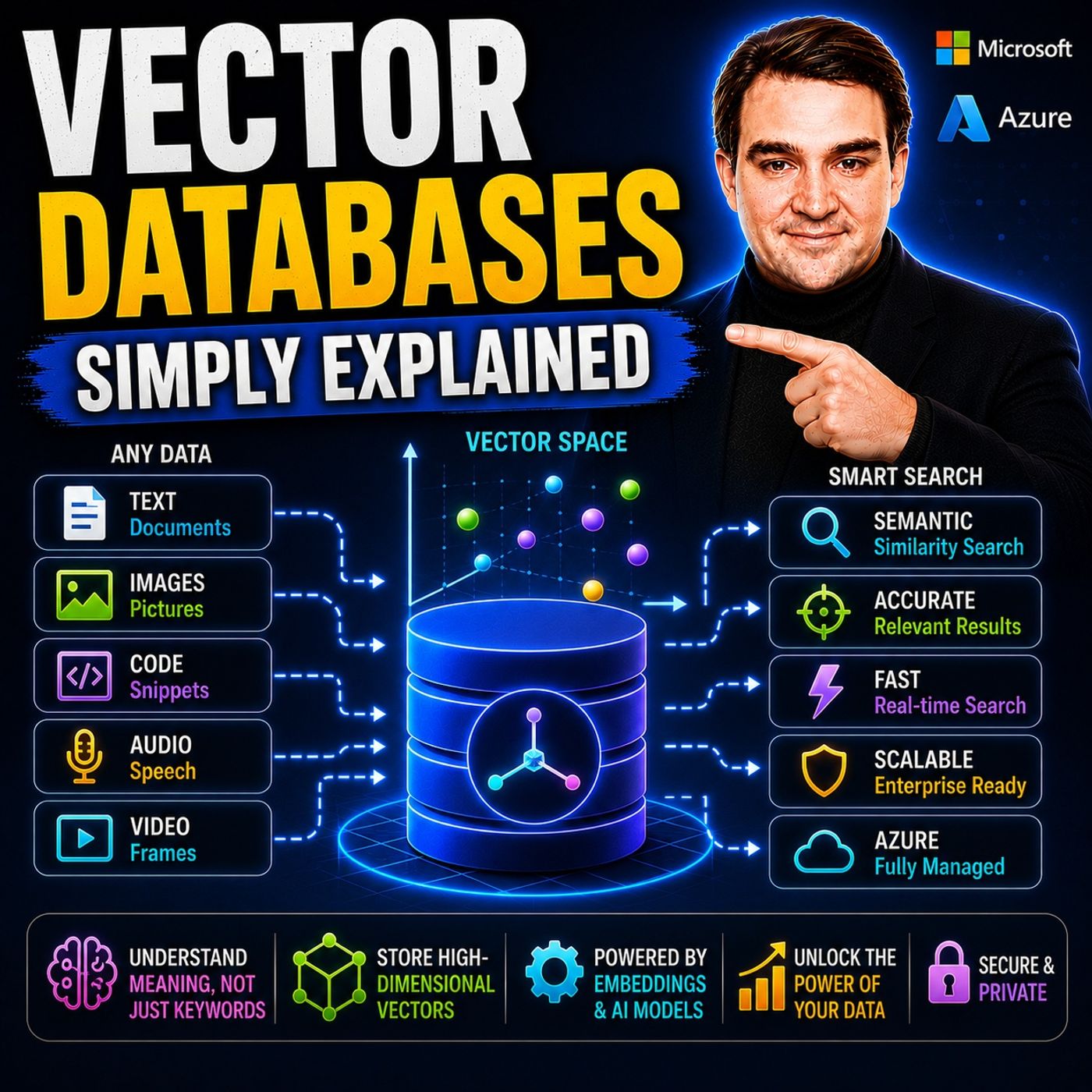
Traditional vs. Vector Databases: Why Context Beats Keywords in AI
Welcome back to the podcast companion blog! In today's fast-paced digital ecosystem, artificial intelligence and large language models have completely shifted how we think about data storage and information retrieval. If you have ever wondered how modern AI applications seem to magically understand the exact intent behind your questions rather than just matching a few simple words, you are looking at the direct impact of modern vector databases. In this post, we are going to dive deep into the core differences between traditional row-and-column databases and advanced vector databases, exploring how vector embeddings capture the true semantic meaning of unstructured data like text, images, and audio.
To get a foundational verbal breakdown of these concepts, be sure to check out the accompanying podcast episode Vector Databases - Simply Explained, where we unpack how these technologies drive the modern Microsoft technology ecosystem, Azure, and artificial intelligence solutions forward.
Vector Databases Overview

Key Features
Vector databases represent a significant advancement in how we manage and retrieve data. Unlike traditional databases, which focus on structured data organized in rows and columns, vector databases optimize for high-dimensional vector data. This allows them to capture the essence of unstructured information, such as text and images, through vector embeddings. These embeddings are mathematical representations that encapsulate the meaning of the data, enabling more intuitive information retrieval.
To illustrate the differences between traditional databases and vector databases, consider the following table:
| Feature | Traditional Database | Vector Database |
|---|---|---|
| Data Structure | Optimized for rows and columns | Optimized for vectors |
| Type of Data | Primarily structured data | Primarily unstructured data |
| Query Method | Relies on SQL and keyword matches | Utilizes vector search for semantic understanding |
The role of vector databases in artificial intelligence is crucial. They enhance various workflows by providing capabilities that traditional databases cannot. Here are some primary roles they play:
- Retrieval-augmented generation (RAG): Vector databases serve as external knowledge bases for large language models, improving response accuracy.
- Real-time recommendation engines: They enable personalized content suggestions by representing user behavior and product attributes as vectors.
- Semantic and multimodal search: Vector databases facilitate searches based on user intent rather than exact keywords, allowing for more intuitive querying.
- Anomaly and fraud detection: They help identify irregular patterns in data by establishing a vector space for normal behavior.
- Entity resolution and data deduplication: Vector databases assist in cleaning and unifying datasets by identifying duplicate entries through embedding comparisons.
Modern applications heavily rely on vector databases due to their ability to process complex queries efficiently. For instance, in e-commerce, they power recommendation systems that analyze user behavior to suggest relevant products. In customer support, semantic search retrieves results based on meaning and context, enhancing user experience. Furthermore, industries like healthcare utilize image and video search capabilities to match content by visual similarity.
As you explore the world of vector databases, you'll find that their significance continues to grow. They not only transform how we interact with data but also empower businesses to make informed decisions based on deeper insights.
How Vector Databases Work
Vectorization Process
The vectorization process is a critical step in utilizing vector databases effectively. It involves transforming raw data into vector embeddings that capture the essence of the information. Here are the main steps involved in this process:
- Prepare your data: Organize your data into a suitable format for vectorization. This may include preprocessing steps like normalization or tokenization.
- Generate embeddings: Use a machine learning model to convert your prepared data into vector embeddings. These embeddings represent the data in a way that captures its semantic meaning.
- Load data into the database: Upload the generated embeddings into your chosen vector database. Automation can help streamline this process for efficient indexing.
Vectorization significantly impacts the accuracy and efficiency of AI models. By converting operations into vector operations, you enable models to execute tasks more rapidly. This leads to improvements in performance and accuracy. Vector embeddings allow for the encoding and retrieval of complex information with high speed, which is crucial for the efficiency of AI applications.
Indexing Techniques
Indexing techniques play a vital role in how vector databases manage and retrieve data. They help organize the vector embeddings for quick access during searches. Here are some commonly used indexing techniques:
| Indexing Technique Type | Specific Methods |
|---|---|
| Tree-Based Algorithms | k-d trees, Ball trees |
| Graph-Based Algorithms | HNSW (Hierarchical Navigable Small World) |
| Hash-Based Algorithms | Locality-Sensitive Hashing (LSH) |
| Quantization-Based Algorithms | Product Quantization (PQ) |
| Other Common Techniques | Flat Index (Brute Force), IVF (Inverted File Index), ANNOY, LSH, Faiss Index Variants |
Choosing the right indexing technique involves a trade-off between accuracy and speed. For example, tree-based indexing organizes vectors hierarchically, which works well in low dimensions but struggles in high dimensions. On the other hand, hash-based indexing uses hash functions to group similar vectors, allowing for fast searches at the cost of some accuracy.
Querying Mechanisms
Querying mechanisms in vector databases differ from traditional databases. Instead of querying by exact values, you focus on finding the K nearest vectors to a given query vector. This method uses distance metrics like cosine similarity or Euclidean distance. It allows results to be ordered by similarity rather than exact matches.
Common querying mechanisms include:
- Approximate Nearest Neighbor (ANN) algorithms for efficient searching.
- Graph-based algorithms, such as HNSW, which connect vectors in a graph for rapid querying.
- Space-partitioning algorithms like Inverted File Indexes (IVF) that cluster vector spaces to limit search areas.
These mechanisms enable real-time data retrieval for AI tasks. They compute distances between vectors quickly, allowing you to find relevant data efficiently. The combination of efficient storage, indexing, and similarity search enhances the performance of vector databases, making them essential for modern AI applications.
Applications of Vector Databases

Natural Language Processing
Vector databases play a vital role in natural language processing (NLP). They enable efficient storage and retrieval of vector embeddings, which represent the semantic meaning of words and sentences. This capability significantly enhances the performance of NLP models. Here are some key applications:
- Storing word embeddings or sentence vectors from models like Word2Vec or BERT for efficient semantic similarity queries.
- Improving chatbot performance by enabling quick retrieval of relevant responses through vector comparisons.
- Facilitating semantic searches to find contextually similar documents or identify synonyms in real time.
By capturing semantic relationships, vector databases allow for quick processing and retrieval of results in NLP applications. They provide context and long-term memory for applications using large language models. This integration leads to significant advancements in understanding and processing language.
Image Retrieval
In the realm of image retrieval, vector databases are essential. They support AI-driven applications such as image recognition and enhance user experiences in retrieval systems. Here are some ways they improve accuracy and speed:
- Vector databases allow for content-based searches that surpass traditional metadata and keyword methods.
- Users can upload images or videos to find visually similar content based on vectorized representations.
- Reverse image search capabilities enable users to find similar images by comparing vector representations.
This approach is particularly beneficial in industries like fashion, where visual similarity is crucial. Vector embeddings capture essential features such as color, shape, and texture, improving retrieval relevance. By understanding the context and meaning behind data, vector databases lead to more accurate results in image recognition.
Benefits of Vector Databases
Enhanced Performance
Vector databases significantly enhance the performance of AI applications. They excel at managing complex data types, which traditional databases often struggle with. By facilitating quick similarity searches within extensive high-dimensional datasets, vector databases minimize latency. This capability is essential for applications like Retrieval-Augmented Generation (RAG). You can expect real-time updates and low-latency access to vector embeddings, which helps avoid bottlenecks in AI workloads.
Consider the following advantages of using vector databases over traditional databases:
| Advantage | Description |
|---|---|
| High-dimensional search | Efficient similarity searches on high-dimensional vectors used in machine learning and Generative AI applications |
| Performance | Significantly faster vector similarity searches compared to traditional databases |
| Customizable indexing | Support for custom indexing schemes optimized for specific use cases and data types |
With these features, vector databases empower you to build applications that require fast and accurate similarity searches. For instance, AI-driven applications like recommendation engines and voice assistants rely on these capabilities to deliver relevant results quickly.
Scalability
Scalability is another critical benefit of vector databases. They support horizontal scaling, allowing you to add storage and compute resources with minimal disruption. This flexibility is vital as your data grows. Vector databases utilize distributed architectures and dynamic data rebalancing to maintain performance, ensuring consistent low latency and high throughput even as user loads increase.
Here are some key points about scalability:
- Vector databases can handle large vector collections efficiently.
- Features like sharding and replication are essential for scaling AI infrastructure effectively.
- Cloud-native deployment strategies ensure consistent performance at any scale.
As the size of your vector databases increases, they maintain linear performance across both on-premises and cloud environments. This capability allows you to manage larger data volumes without compromising performance.
Flexibility
Vector databases offer remarkable flexibility for integrating with various AI frameworks. They support hybrid systems that combine structured and semantic search capabilities. This integration enhances your ability to work with diverse data types.
Consider these aspects of flexibility:
| Evidence | Description |
|---|---|
| Strong ecosystem support and open APIs | Choosing platforms that support integration with various AI frameworks is crucial for flexibility. |
| Integrated vector databases | Storing embeddings alongside original data improves data consistency and performance, facilitating better integration with AI frameworks. |
By leveraging these features, you can create applications that adapt to evolving needs. Vector databases allow you to handle various vector data types, including sparse and dense vectors, making them suitable for a wide range of AI applications.
Challenges of Vector Databases
Data Quality Issues
Data quality plays a crucial role in the effectiveness of vector databases. Poor data quality can lead to significant challenges that affect the performance of AI models. Here are some common data quality issues you might encounter:
- Filtering and Faceting Errors: Inaccurate or inconsistent metadata can mislead search results.
- Freshness Issues: Problems with timestamps can present outdated or irrelevant content to users.
- Issues with Vectors: Corrupted or incorrectly generated vectors can result in poor recommendations and irrelevant search results.
These issues can lead to data misrepresentation, causing models to inherit weaknesses. In generative AI systems, data quality problems can manifest as factual inaccuracies in text or biased outputs in images. High-quality data is essential for AI, as it directly influences model performance and reliability. Addressing biases in data is crucial to prevent unfair treatment in AI outputs.
Implementation Complexity
Implementing vector databases can be complex due to several factors. Understanding these factors can help you navigate the challenges effectively. Here’s a breakdown of the primary factors contributing to implementation complexity:
| Factor | Explanation |
|---|---|
| Scalability | Integrating large language models with vector databases can lead to performance degradation. Increased complexity in processing and comparing vectors requires techniques like data partitioning and load balancing. |
| Data Complexity | Converting various data types into vector forms introduces complexity. You need specific techniques for feature extraction and normalization to ensure consistency and comparability of vectors. |
| Integration | Merging vector representations with large language models involves aligning different representations. Ensuring compatibility requires specialized techniques to bridge semantic gaps. |
To address these complexities, you can follow these steps:
- Understand core components and challenges associated with vector databases.
- Manage high-dimensional data effectively.
- Mitigate computational costs.
- Set up a robust environment for seamless operations.
- Leverage hardware capabilities and software advancements efficiently.
Implementing robust data governance practices alongside vector databases is essential. This approach helps mitigate risks associated with data breaches and unauthorized access. Establishing clear policies for data access and usage ensures the integrity and security of your data.
Cost Considerations
Cost is another critical factor when deploying vector databases in AI projects. Understanding the various cost categories can help you budget effectively. Here’s a summary of typical cost considerations:
| Cost Category | Description |
|---|---|
| Initial Investment | Licensing costs of proprietary solutions versus open-source options, which may require technical expertise for deployment and maintenance. |
| Operational Expenses | Ongoing costs such as cloud service charges, maintenance fees, and scaling costs, with cloud services potentially having higher upfront costs as data and query volumes increase. |
| Total Cost of Ownership (TCO) | Evaluation of long-term costs, including initial and operational expenses, scalability, support, and resource requirements to align with budget and growth needs. |
By understanding these cost implications, you can make informed decisions about deploying vector databases. This knowledge helps you align your budget with your growth needs while ensuring that you maintain high-quality data retrieval and minimize data latency.
Vector databases play a pivotal role in the evolution of AI. They enable systems to grasp context over mere keywords, enhancing data retrieval. Here are some key takeaways:
- Context over keywords: Vector databases help you understand intent and meaning behind data.
- RAG is the killer app: They empower large language models with domain-specific knowledge.
- Scalability is key: These databases handle massive computational loads efficiently.
- Beyond text: They support multimodal applications, including images and audio.
- Real-time value: Expect personalized experiences powered by vector databases.
As you explore the future, anticipate trends like AI-powered search engines and personalized AI agents. Embracing vector databases now prepares your infrastructure for the next wave of AI advancements.
FAQ
What is a vector database?
A vector database stores data as high-dimensional vectors. It captures the semantic meaning of information, allowing for advanced similarity searches based on context rather than keywords.
How do vector databases improve AI applications?
Vector databases enhance AI applications by enabling faster and more accurate data retrieval. They allow systems to understand user intent, improving recommendations and search results.
What types of data can vector databases handle?
Vector databases can manage various data types, including text, images, and audio. They convert these data types into vector embeddings for efficient processing and retrieval.
What are embeddings in vector databases?
Embeddings are mathematical representations of data. They capture the essence of information, allowing vector databases to perform similarity searches based on meaning rather than exact matches.
How do I choose the right vector database?
Consider factors like scalability, performance, and integration capabilities. Evaluate your specific use case and data types to select a vector database that meets your needs.
Are vector databases suitable for real-time applications?
Yes, vector databases excel in real-time applications. They provide low-latency access to data, making them ideal for use cases like recommendation engines and chatbots.
What are the common challenges with vector databases?
Common challenges include data quality issues, implementation complexity, and cost considerations. Addressing these challenges is crucial for maximizing the benefits of vector databases.
How can I integrate vector databases into my existing systems?
You can integrate vector databases by leveraging APIs and cloud services. Many platforms offer seamless integration options, allowing you to enhance your current data infrastructure.
🎧 Listen to this episode
Want a practical explanation of Vector Databases? This episode breaks down the topic in clear language and shows why it matters for Microsoft 365, Azure, Power Platform, security, AI, and modern work.
Listen to this episode if you want to:
- Understand the key concepts behind Vector Databases
- See how it fits into the wider Microsoft technology ecosystem
- Learn where it can create practical value for your organization
You may also enjoy these related M365 FM episodes:
- HNSW vs DiskANN for Vector Search in Azure AI Search
- Improve Microsoft Copilot Accuracy Beyond Vector Search
Discover more practical Microsoft conversations on M365 FM.

Microsoft MVP | Host of M365.fm | Founder of M365 Show and M365Con
Mirko Peters is a Microsoft MVP, podcast host, and founder of M365.fm, M365 Show, and M365Con. His work connects Microsoft practitioners through podcast interviews, livestreams, and community events.
At M365.fm, Mirko hosts conversations with Microsoft MVPs, product experts, architects, and community contributors. Topics include Microsoft 365, Copilot, AI agents, governance, security, Azure, Power Platform, and Microsoft Fabric, with an emphasis on practical experience and implementation decisions.
M365.fm is the podcast and learning platform. M365 Show brings experts together for livestreams, while M365Con provides an online conference setting for community learning.
Official website: Mirko Peters (https://www.mirkopeters.com/). Recognition: Mirko Peters — Microsoft MVP profile (https://mvp.microsoft.com/de-DE/mvp/profile/9b0ca797-db5a-493a-a845-8b9158046cf5). Connect on LinkedIn (https://www.linkedin.com/in/m365showpodcast/).